Mu-Pan – Encounter XXI

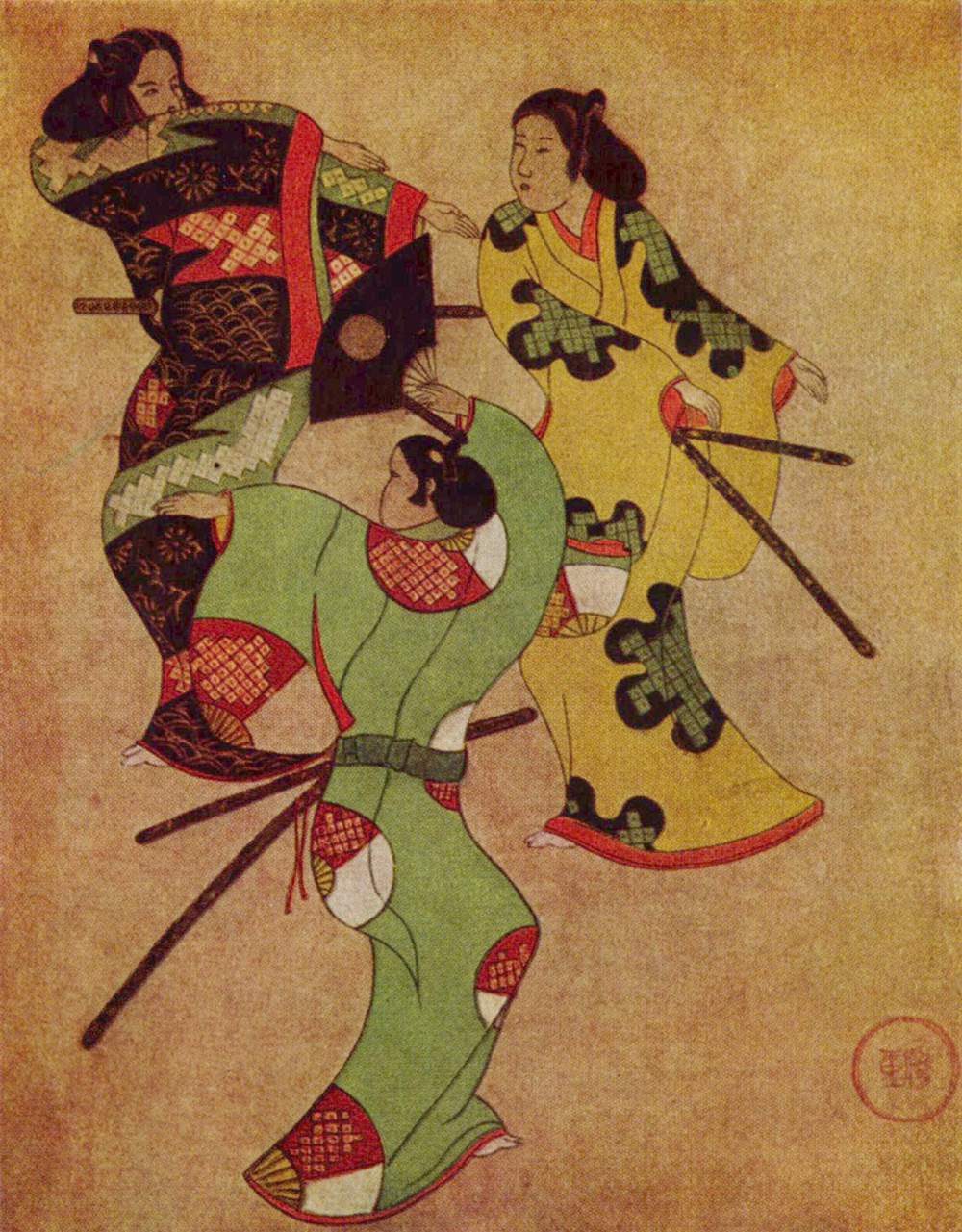
2532. As one passes through this woodland of pines and pale blue rhododendrons, they might (1 in 12 chance) be accosted by a sort of clown – a short, slight man wearing a frightful blue mask and brightly colored silks and going barefoot. The clown appears about 20 yards ahead of the adventurers, performs a series of comical acrobatics and motions them to follow him.

The clown leads the adventurers to a secret grove of tall, black pines. Black moss covers the ground and the boughs of the trees are thick with spider webs. Sitting on the ground in the grove is a porcelain bottle decorated with black moths. The bottle contains a powerful narcotic, that, when imbibed, causes one to fall instantly and deeply asleep. As a person falls into unconsciousness, they also fall through the mossy ground, which becomes spongy, then more and more insubstantial until it can no longer hold the sleeper’s weight.

The sleeper passes through the ground for about 100 yards, finally emerging in an etheric chamber of mists and half-heard whispers. This chamber leads into the lair of a coven of nine witches (shugenjas, level 1d4+1) loyal to the Yozi. Like the grove above, it is lousy with spider swarms and giant spiders, as well as a tribe of twenty-five blue faced bugbears (HD 3+1) with long, golden brown fur that lightens to silvery white at the tips. The leader of the witches is Gatachru, a creature that appears to be female from the waist up and spider below. She has skin the complexion of black currants and eyes that shine like sapphires. On Gatachru’s head is an ivory crown set with two large emeralds, one containing the trapped soul of a holy bujin, the other that of a sohei.

The chambers of the bugbears and Yozi cult connect to the wider underworld of demons, devils and the unquiet dead.

| Gatachru: HD 6; AC 2 [17]; Atk 1 weapon (1d6) and bite (1d4 plus poison); Move 12 (C9); Save 11; CL/XP 10/1400; Special: Poison, magic resistance (40%), casts spells as a 6th level sohei and 6th level shugenja, surprise on roll of 1-3 on 1d6.

Mu-Pan – Encounter XX

Another glimpse into Mu-Pan – tomorrow, Megacrawl 3000.

2202. The central three miles of this hex, running from north to south, is occupied by a massive wall. The wall is 15 feet side and 30 feet tall, with a 40 foot tall tower every 100 yards. The wall is constructed of ebony, semi-glossy stones and appears to have been constructed a millennium ago by the ophidians. Stairs leading up to the wall are located on the west face of the wall, and the east face shows signs of salt encrustation and heavy weathering, as though by the sea. Although not manned by any soldiers, the wall is sometimes used as a hideout by bandits. Many charred and shattered sections speak to attacks from armies on the wall. Each tower has a 1 in 20 chance of being home to a CL 1d4+1 monster.

CL | Possible Monster
2 | Aka-name, centipedes (giant), kaeru-ningen, nezumi-oni, zombies
3 | Banshee, bugbears, ghouls, lizard samurai, mogura-jin, yellow mold
4 | Bakemono-toro, ogres, ragged craws, tesso, tsurube-otoshi, wererats
5 | Doppelganger, grey ooze, jiki-niku-gaki, shamshir, spider (giant), wights

Mu-Pan – Encounter XIX

No posting tomorrow – out of town (in an airplane that hopefully will maintain its roof integrity for the entire flight). Here’s a couple more encounters from the Mu-Pan map. I’m still working on the next Megacrawl episode – sorry for the delay. More Mu-Pan monsters, comic book characters, a sample chapter from the MM! book (so you can get an idea of what it’s going to look like) and the Gods of Mu-Pan on the way. Busy busy. Have fun on the internet.

2032. Three leprous zombies (HD 2; bite causes disease) are chained to a large stone post carved to look like a column of koi. One zombie has an ivory pin (worth 40 gp) stuck through its left temple. This pen, when put to paper, causes the person’s memories or current thoughts to pour onto the page as though a watercolor painting.

2045. A trader, Kaith by name, sits by the side of the road nursing a wounded leg. He was attacked by a wild cat two days back, and now has a bad infection and a fever. If he sees people coming, he struggles to his feet and grabs his cloak, warning people to stay away. If they continue to approach, he raises the edges of his cloak like wings and a swarm of twelve giant bats (HD 4) emerges from the unnatural darkness within. As they emerge, he becomes noticeably paler and falls to the ground. The magic cloak summons the bats, but inflicts 1d12 points of damage when it does so – the damage sustained by Kaith is enough to knock him unconscious.

Monsters of Mu-Pan II

Let’s do another round of Mu-Pan monstrosities …

On a side note – I really want to commission an illustration of the shamshir (4-armed snakey dudes), but I’m having no luck contacting artists. If you’re an artist and you’re up to making some bucks, let me know. If your rates are reasonable enough, I might have a couple other commissions to go along with it.

Baku (Japanese)
Hit Dice: 10
Armor Class: 2 [17]
Attack: 2 claws (2d6), gore (2d8)
Saving Throw: 5
Special: Astral and ethereal travel, +1 or better weapon to hit, protection circle, remove curse
Move: 12
Alignment: Law
Challenge Level/XP: 12/2000

A baku is an otherworldly creature that devour dreams and nightmares. It has an elephant’s trunk and tusks, rhinoceros’ eyes, ox tail and tiger paws. They constantly project a magic circle against evil and are capable of dispelling nightmares and curses (per remove curse). Baku can travel astrally and ethereally.

Harionago – Barbed Woman (Japanese)
Hit Dice: 5
Armor Class: 6 [13]
Attack: 1d10 hair barbs (1d4)
Saving Throw: 12
Special: Animated hair, undead
Move: 12
Alignment: Chaos
Challenge Level/XP: 6/400

These frightening ghouls appear as lovely women with extremely long hair. Their hair is tipped with barbs and can be controlled by the ghoul and used to attack and grapple. Barbed women usually attack young men. When a young man is encountered, the barbed woman laughs at them. If the young man laughs back, the barbed woman attacks. Barbed women eat the people they kill.

Kamaitachi (Japanese)
Hit Dice: 4
Armor Class: 3 [16]
Attack: 3 claws (1d6)
Saving Throw: 13
Special: Knock down, surprise on 1-3 on 1d6
Move: 24
Alignment: Neutrality
Challenge Level/XP: 6/400

The kamaitachi is a bizarre monster that looks like a trio of weasels with sickle-like claws riding on a swirling wind. The monster has three “attacks”, each made by a separate weasel. The monster gets three attacks per round, and uses the first to attempt to knock its opponent prone.

Monkey Folk (Chinese)
Hit Dice: 1d6
Armor Class: 6 [13]
Attack: Bite (1d3) or weapon (1d6+1)
Saving Throw: 18
Special: High strength and dexterity
Move: 12/12 (climbing)
Alignment: Neutrality
Challenge Level/XP: B/10

Monkey folk are intelligent monkeys that dress and behave like humans. Being monkeys, they are chattery and sometimes unpredictable. Monkey folk are known for their high dexterity and strength (+1 bonuses). This strength allows them to wield weapons meant for man-sized creatures without penalty. They are expert climbers.

Large troupes of monkey folk are led by a sage (5th to 8th level shugenja). He is assisted by two apprentices (2nd or 3rd level). For every 20 monkey folk there will be a 3rd level ninja, and for every 100 a 5th level ninja. Most monkey folk wield staves or nine ring broadswords. When they wear armor, it is rarely heavier than a haramaki, but a few bodyguards will wear haramaki-do (AC 15).

Monsters of Mu-Pan I

I don’t know for certain how many of these I’ll do, but we’ll call this Part I just in case.

Bakeneko – Monster Cat (Japanese)
Hit Dice: 3
Armor Class: 6 [13]
Attack: 2 claws (1d4), bite (1d4)
Saving Throw: 14
Special: Spells
Move: 15
Alignment: Neutrality (5% are Law)
Challenge Level/XP: 5/240

Monster cats have a plethora of magical powers. Although they never appear to be anything more than a normal domestic cat, a monster cat can grow to as long as five feet in length. They have the following spell abilities: Dancing lights (3/day), ghost sound (3/day) and polymorph self (1/day). Monster cats can animate fresh corpses into zombies by jumping over them. They are also capable of walking on their hind legs. A monster cat that lives long enough has its tail split; such creatures, called forked-tails (neko-mata), have 6 HD. About 5% of monster cats are actually lawful in alignment.

Basan (Japanese)
Hit Dice: 8
Armor Class: 6 [13]
Attack: 2 scratch (1d6), peck (1d8)
Saving Throw: 8
Special: Ghostfire
Move: 12
Alignment: Neutrality
Challenge Level/XP: 9/1100

Basans are 10-foot tall roosters with brilliant plumage and fiery crests. They are capable of breathing cones of ghostfire (15 feet long, 10 feet at base) from their beaks. This ghostfire deals 3d6 points of damage, even to creatures normally immune to fire, because it burns one’s soul. Victims can make a saving throw for half damage.

Fox Woman
Hit Dice: 8+1
Armor Class: 3 [16]
Attack: Bite (1d6) or weapon (1d6)
Saving Throw: 8
Special: Alternate form, charm person, entourage, silver or magic weapons to hit
Move: 18
Alignment: Chaos or Neutrality
Challenge Level/XP: 10/1400

The fox woman is a lycanthrope than can assume the form of a silver fox, a vixen (half-fox, half-nymph) or nymph. Fox women can use the charm person spell on men at will. They dwell in lonely woodlands, accompanied by 1d4+1 charmed males who will do anything to protect their mistress. At least one male is a bujin or fighting-man of 2nd to 5th level. There is a 50% chance that another male is a bujin or fighting-man of 1st to 4th level. There is a 10% chance that one of the remaining males is a shugenja or ninja. There is a also 10% chance the fox maiden has stolen a beautiful infant girl to raise as her own.

Gashadokuro (Japanese)
Hit Dice: 5+1
Armor Class: 5 [14]
Attack: Strike (2d6)
Saving Throw: 12
Special: Decapitate, minimum damage from edged or piercing weapons, surprise on roll of 1-3 on 1d6
Move: 15
Alignment: Chaos
Challenge Level/XP: 8/800

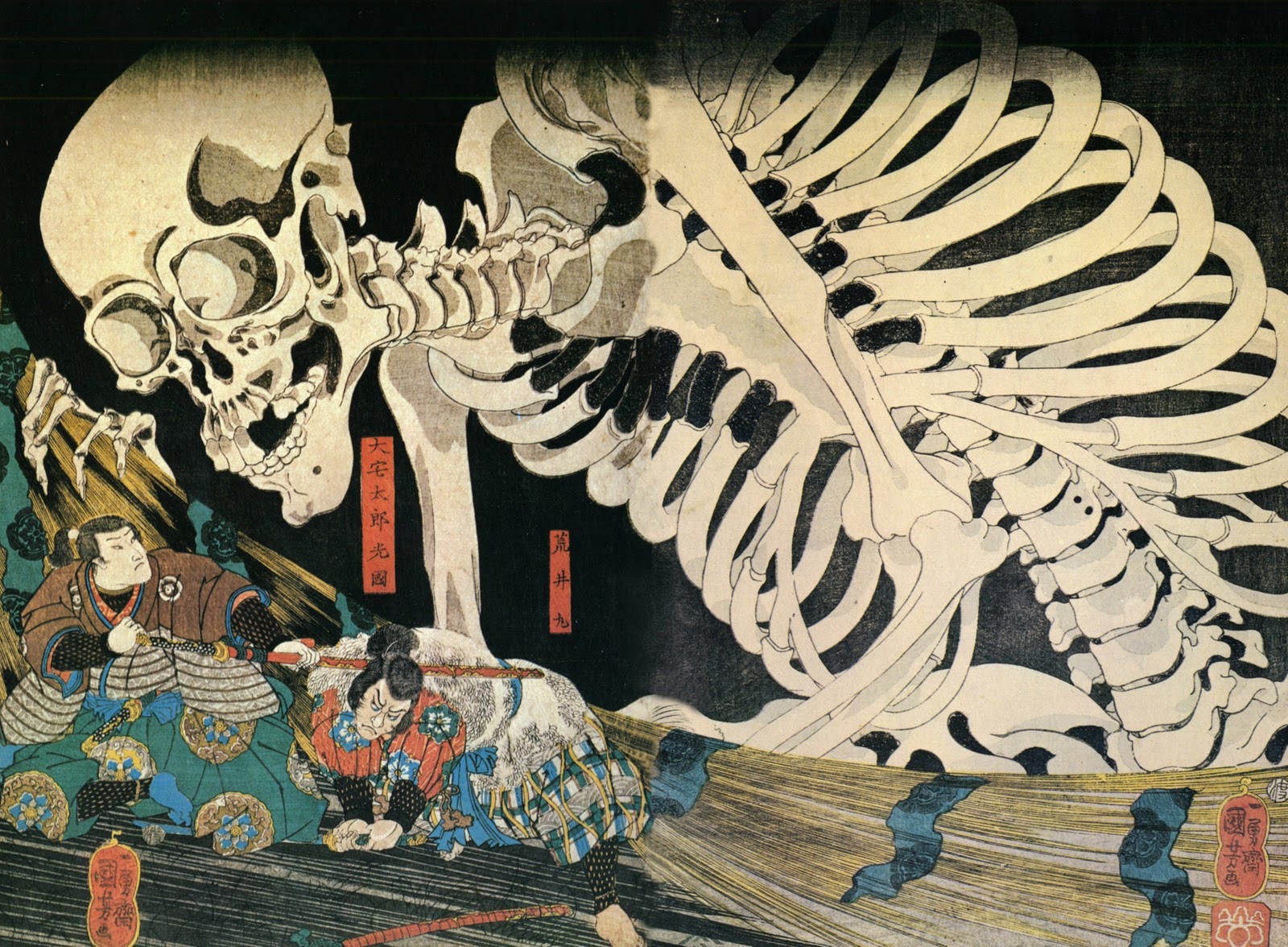
Gashadokuro are giant skeletons with a burning hunger for human flesh. They attack human beings on sight, trying to grapple them with their massive, bony fingers. If successful, the gashadokuro will attempt to bite their head off (-4 to hit, 5d6 damage) each round. Gashadokuro are created from the bones of people who have starved to death. Gashadokuro, despite being fifteen-foot-tall skeletons, are incredibly quiet and stealthy.

Hitotsumi-Kozo – One-Eyed Boy (Japanese)
Hit Dice: 3
Armor Class: 6 [13]
Attack: Weapon (1d4)
Saving Throw: 14
Special: Bad luck, frightful appearance, ray of enfeeblement, silence, true seeing
Move: 9
Alignment: Neutrality
Challenge Level/XP: 7/600

A one-eyed boy looks like a small humanoid with a single, giant eye and a long tongue. They enjoy frightening people, but despise noise. One-eyed boys are immune to illusions and can see through invisibility. Creatures with fewer than 3 HD must succeed at a saving throw to avoid fleeing from a one-eyed boy. The creatures can use the silence spell at will and can fire a ray that reduces the target’s strength to 3 for 1 hour unless the target succeeds at a saving throw. The weakness ray can be fire once every 3 rounds. Anyone viewing a one-eyed boy must succeed at a saving throw or fall under the effects of a curse for one month. One-eyed boys usually wield bo staves and slings.

Mu-Pan – Encounter XVIII

So begins the day of too many posts! First up – another encounter for Mu-Pan. Later, I wade into the ABC challenge thing and later I’m going to post a few new monsters for Ruins and Ronin.

1611. A number of winding catacombs are dug into the side of the mountains here. The catacombs run for several miles, have arched ceilings and are lined with shelves (3 feet off the ground, 3 feet deep). The floor of the caverns are cut to allow water to flow down the center, and small streams do run from the catacombs. The entrance to the catacombs is protected by a bronze portcullis that can only be opened by playing a hunting melody on a bamboo flute (or by physical force – requires 2 hours of pounding with weapons or a combined strength of 60 to pull open).

The catacombs contain numerous skeletons wrapped in leather and tied with silken cords. Several of these bodies seem to shift as one walks past them – a trick caused by thin trip wires. At each juncture of the catacombs, there hangs a bronze temple bell by a red cord. When a bell is passed without being rung, the corpses in the tunnel the adventurers have just left animate as skeleton warriors, crawling from their wrappings and relying on their claw-like finger bones to attack. There are 1d10+7 skeletons in each tunnel. Ringing a bell after the skeletons have animated does nothing.

The main inhabitant of the catacombs is Bzisfisihm, a poet and high priest of the shamshir who died over 1,000 years ago. His main tomb is located in the center of the catacombs. The tomb is preceeded by an antechamber with three red doors. The center door leads into a small chamber with a collapsible floor. Beneath the floor is a stone chute that is both covered in oils and embedded with shards of glass. Those falling down the shaft suffer 2d6 points of damage minus their total armor bonus. They are deposited in a small stone tomb, already piled high with bodies.

The other two doors lead into the tomb proper. The tomb is clad in red stone and features a white, marble dais in the center surrounded by a dozen terracotta warriors. Atop the dais there is a gaudy sarcophagus of marble and brass containing the body of Bzisfisihm wrapped in red silk and tied with golden cords (worth 100 gp). Set in the mummified remains of the high priest there is a tiger’s eye gem. This gem contains the high priest’s spirit, which can leave the gem to inhabit and animate the terracotta warriors.

The lid of the sarcophagus is heavy, requiring a combined strength of 30 to lift and move about. If placed flat on the floor, it becomes a doorway into a pocket dimension containing the high priest’s treasures. The pocket dimension appears as a stone staircase descending 100 feet and emptying onto a small island seemingly floating in space. The “walls” of the island, though invisible, do exist, and strange creatures can be seen beyond those walls, some noticing the adventurers and moving to glare at them from the walls, like curious children or hungry dogs.

This island/room contains a stout, iron chest embedded with 2-inch long spikes. The chest is locked and trapped – should one walk away from the chest, it fires its spikes throughout the room (1d4 attacks person from 2 HD creature, 1d4 damage each), accompanied by a blinding flash of light (save or blinded for 1d4 hours). Inside the chest there are a number of large aquamarines – one for each adventurer and two of each shape – circle, oval, square, triangle, etc. Each aquamarine is worth 500 gp, but they are cursed. The two holders of the same shape have their spirits switched – in effect, the players trade character sheets. The only way to switch bodies back is to bath in foamy surf of the Sea of Stars at sunset.

| Terracotta Warrior: HD 3; AC 3 [16]; Atk 1 slam (1d6+1); Move 9; Save 14; CL/XP 3/60; Special: None.

Mu-Pan – Encounter XVII

One more from Mu-Pan …

1409. The city-state of Zi’asssazus is home to the sparkling court of pious Prince Zilewei, a sagacious enchanter who commands two companies of warriors (one of archers, the other of light infantry). The town is defended by four tall watchtowers.

The city-state has aging walls covered in many coats of whitewash. A visitor can tell that Zi’asssazus is constructed on the disintegrating corpse of an older city. In fact, it was once the site of an ophidian city-state. The shamshir do not have the architectural ability of their forebears, so their wattle and daub patches and additions to the ancient buildings are noticeably more crude.

Zilewei’s palace is a modest castle of somber hues and noble, stuffy guards swathed in silks and carrying two nagamaki and a brace of five shuriken. The palace contains a shrine dedicated to Nassi’a, the Moth Goddess. The walls of the shrine are hung with dozens of bronze moths with lacquered wings. It is staffed at all times by a sacred drummer who maintains a steady rhythm.

The palace is constructed at the top of a wooded hill. Two ancient stone reservoirs are located beneath the palace, and the rest of the city-state below them. Gravity brings water from the reservoirs through clay pipes to intricately carved and ancient fountains. The fountains’ spouts are bronze cobras. The city-state is known for its moneychangers (scrupulously honest, with very safe vaults), its guides (many of them former soldiers) and its unique taverns. The shamshir combine their taverns with their baths. The shamshir of both sexes luxuriate on heated slabs in the steam, sipping tea or quaffing heady liqueurs from silver flutes. The people enjoy cockfighting, which they do in the alleys off the main streets, with betting a must.

The land around Zi’asssazus is a lightly wooded grassland surrounded by a thicker woodland inhabited by giant mantises. The farmers of the city-state raise ducks in ponds, grow hemp and rye and keep goats and cattle.

| Zilewei, Shamshir Shugenja Lvl 5: HP 14 [16]; AC 9 [10]; Save 11 (9 vs magic); CL/XP 4/120; Special: Spells (3rd). Heavy robes decorated with slips of golden hair in clasps of silver, spellbook.

A Bevy of Bujin

As regular readers know, my Mu-Pan hexcrawl is based on Mike Davison’s excellent Ruins and Ronin ruleset (and by reading this sentence, you are now contractually obligated to go buy it – sorry, the law’s the law).

R-n-R is, in turn, based on Swords and Wizardry White Box, so it keeps things simple. There are four classes – Bujin (fighting-man), Sohei (cleric), Shugenja (magic-user) and Half-Ogre. In addition, Mike has released the Ninja, Kensai, Headhunter and Henyeyokai classes on his blog. The bujin is, essentially, a samurai that can make use of the heaviest armor in the game and any weapon.

Unfortunately, Mu-Pan is based as much on China as Japan, and that leaves a few gaps where fighting-men are concerned, primarily in the form of the shaolin monk. Of course, there’s a perfectly good monk in NOD 1 and S-n-W Complete, but I decided I wanted to minimize reliance on other rulebooks when writing Mu-Pan. Besides which, there are some important differences in terms of Hit Dice between White Box, Core and Complete. To that end, I came up with this little system for modifying the existing bujin to model different kinds of Asian warriors, from wandering swordsmen to fighting monks to members of dart bureaus.

Keep in mind, this is a rough draft. I’d love to hear comments on the concept.

The bujin as written is designed to be a heavily armored warrior, serving on the front lines of an adventuring band, his o-yoroi armor deflecting deadly blows while his flashing katanas cut down foe after foe. This is a fine archetype of Asian fighting prowess, but it stands at almost the opposite end of the spectrum from Asia’s other great fighting archetype – the unarmed martial artist. To model your bujin as something other than a samurai, this houserule permits you to reduce your allowable armor in return for a special ability. The less armor you are permitted (and thus the more damage you’re likely to take in combat), the more special abilities you can have.

Maximum Armor Bonus | Special Abilities
+0 | 4
+2 | 3
+4 | 2
+6 | 1

Special Abilities

Combat Sense – You are normally surprised on a roll of 1 on 1d8 and can make a saving throw to avoid back stabs from ninjas and thieves.

Deflect Missiles – Once per round, you can make a saving throw to avoid an otherwise successful missile attack.

Estimate Foe – For each round you do not attack your opponent, you gain a +1 bonus to hit, Armor Class and damage for the remainder of the combat against that opponent.

Headlong Charge – You run at an opponent or ride at an opponent and attempt a single attack at a +2 bonus to hit along the way. You must run at least 20 feet to use this ability, and you suffer a -2 penalty to your AC during any round in which you make a headlong charge.

Fists of Iron – Your unarmed attacks do 1d6-1 (1d4) points of damage.

Flurry of Blows – You can make one attack against a secondary opponent every other round.

Iron Hold – With a successful attack you wrap your opponent up using your arms and even legs; equivalent of a hold person spell until your opponent makes a successful saving throw (penalty equal to difference between your strength and their strength). If your attack fails, you suffer a 1 point penalty to Armor Class until your next turn.

Ki Shout – You harness all your power and put it into a single melee attack, gaining a +2 bonus to damage if you hit. You can unleash a ki shout only once per day.

Mighty Leap – You can make a 6 foot horizontal and 3 foot vertical leap if heavy encumbered, 8 foot / 4 foot leaps if lightly encumbered and 10 foot / 5 foot leaps if unencumbered.

Mounted Archery – You suffer no penalties to firing a bow from an unsteady platform, like a boat, horse, flying carpet, etc.

Parry Blows – You can trade an attack during a round for a +1 bonus to your AC or the AC of a creature or object no more than 3 feet away from you.

Parry Death Blow – Once per combat you can make a saving throw to retain 1 hp when a successful blow would otherwise have killed you.

Swift Motion – You roll a separate initiative from your group, and may take whichever initiative roll is better. Your movement rate is also increased by three.

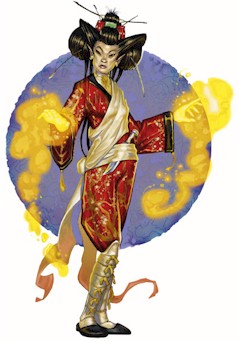
Image by Wayne Reynolds via Paizo. I’m a WAR junkie, so when I saw this image pop up today on their blog, I had to appropriate it.

Mu-Pan – Encounter XVI

Had some homework to do with my daughter tonight (designing a Harry Potter game for school), so no Megacrawl today – hopefully tomorrow. In the meantime, enjoy another Mu-Pan encounter …

1425. A pagoda has been constructed here from round, pearly stones that don’t appear to be held together by any sort of mortar. The pagoda’s roofs are made of a bronze-colored wood that shimmers in the daytime. Inside the pagoda there is a pit that burns with purple-black fire. The flames rise to about 10 feet, but flare when living creatures approach. At night, the pagoda gives off a glassy, purple glow to a distance of about 100 feet (double that when living creatures are nearby). At night, encounters with undead monstrosities occur on the roll of 1 on 1d6 made every hour. Use the following table to determine what dark pilgrim visits the pagoda.

Roll | Monster
1-2  | Zombies (1d6+6)
3-4  | Jikininki (1d3+3)
5-6  | Ghouls (1d3+1)
7     | Gashadokoru (1d3; see monsters)
8     | Kyonshi – Hopping Vampire (1d2)
9     | Shikki-Gaki (1)
10   | Jiki-Ketsu-Gaki (1)

__

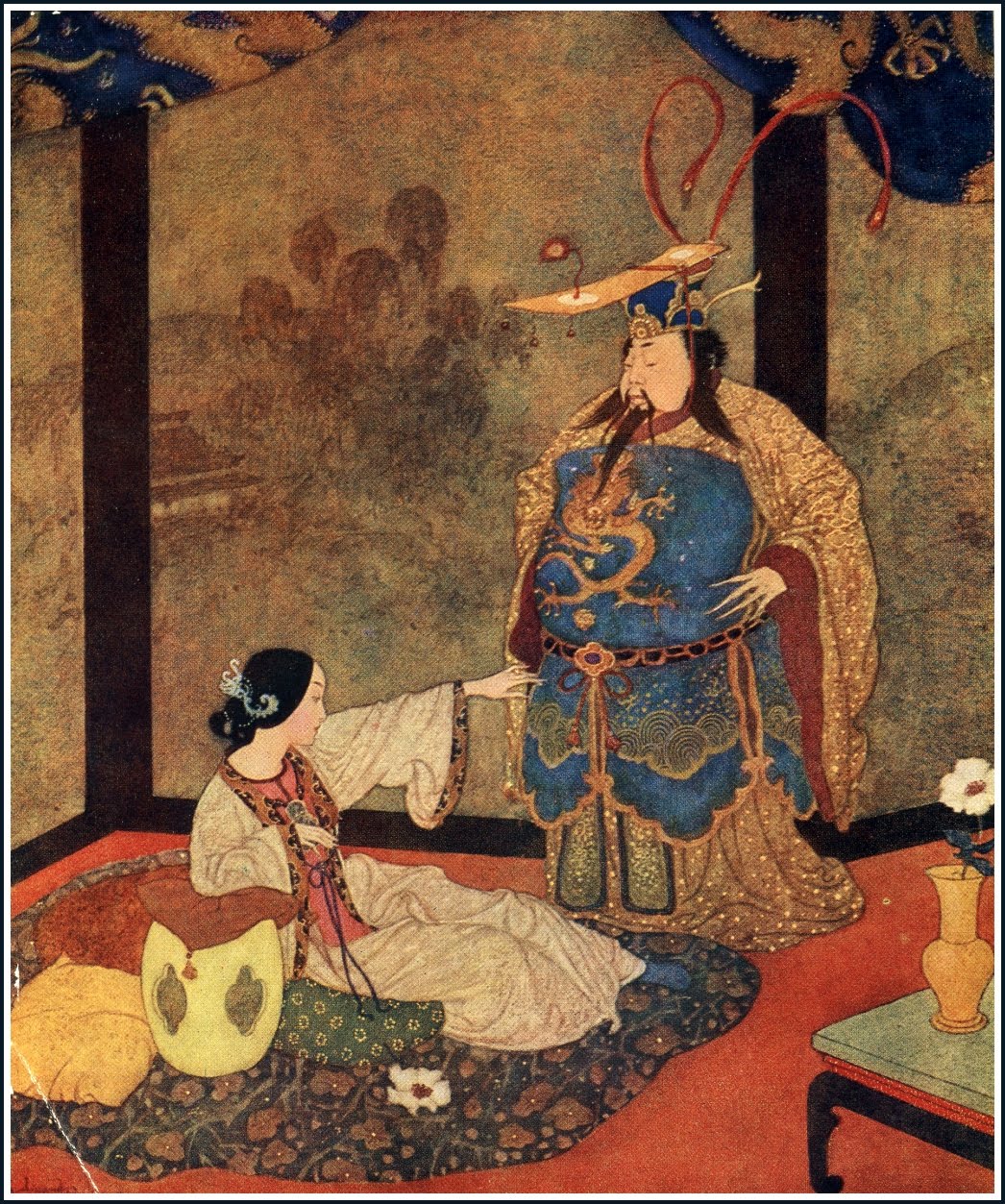
Image by Edmond Dulac

Mu-Pan – Encounter XV

A wizard’s tower high in the mountains …

1244. The top of a mountain has been carved, or possibly molded, into a slim tower that overlooks its surroundings for 18 miles (3 hexes). The master of this house is Zabrasha, an elementalist and sworn enemy of the men of Tsanjan. Her presence here has long been a thorn in their side, but as yet they have mounted no serious attack on her citadel.

The citadel looks like a needle of gray stone piercing the heavens. In fact, the “needle” is about 200 feet in diameter and 300 feet tall. Nestled in this massive citadel are 99 chambers, each decorated in a different color (some repeat) and each holding a small shrine to an elemental spirit. Zabrasha’s servants, about 20 kobolds with gleaming scales and five apprentices, keep incense burning at the shrines and make daily chants before them. The entrance to the tower is gained by climbing a long, winding stair about 500 feet up the side of the windy mountain. The stairs end in a 20-ft long tunnel that opens into an enclosed courtyard with three bronze doors. The side doors lead spartan quarters that the Gray Lady makes available to petitioner and travelers. These rooms contain bronze braziers for warmth, sleeping mats and pegs for hanging belongings, but nothing else. The other door is guarded by two ishidzukui-shishi (HD 5+2; 19, 16 hp).

The base of the tower’s mountain is covered in a thick woodland of stunted poplars, birches, walnuts and wild cherry trees. The area is rich in game animals (deer, mountain pigs, shaggy hares) that the kobolds trap and the apprentices prepare. Both apprentices and kobolds wear conical hats made of rabbit hide. A neglected town hides in those woodlands. It is inhabited by two dozen hunters and their families and holds only one building of note, a crumbling tower that holds an ancient altar dedicated to the Panda Emperor.

Zabrasha is an elderly woman with gray hair, gray eyes and tawny skin. She has a delicate build and a deeply creased, though still attractive face. While kindly at heart, she is always on guard for her enemies and she is a harsh mistress with her apprentices, believing that tough love will save them in the future as they attempt to deal with elementals and other extra-planar creatures of great power. An old romantic, she falls in love easily, especially with older bujin that remind her of her first husband and partner in adventuring.

Zabrasha’s treasure consists of 950 sp, 770 gp and a diamond worth 800 gp.

| Apprentice, Elementalist Lvl 1: HP 1d6; AC 9 [10]; Save 15; CL/XP B/10; Special: Command spirits (4/day), turn elementals. Equipment, grimoire, tools.

| Zabrasha, the Gray Lady, Elementalist Lvl 10: HP 27 [31]; AC 9 [10]; Save 8; CL/XP 12/2000; Special: Command spirits (8/day), turn elementals. Equipment, grimoire, tools.

Note: If you do not wish to use the elementalist class from NOD 3, substitute with the shugenja.

Image from Wizards of the Coast website.