The Mottled Documentarian and NOD 19

First – NOD 19 is now for sale in soft cover form – $9.99 cheap (as the saying goes).

Second – the Mottled Documentarian

So, I generated this monster using the dictionary method made famous a couple days ago ON THIS VERY BLOG!!!

Let’s take those threads and try to make an actual usable monster.

MOTTLED DOCUMENTARIAN
Medium Giant; Low Intelligence; Neutral (N); Pack (1d4)

HD: 7
AC: 22
ATK: 2 slams (1d6)
MV: 30
SV: F10 R12 W13
XP: 700 (CL 8)

Mottled documentarians are stout giants that stand about 7 feet tall. They are built like fireplugs and have skin a mottled white/grey in color. In their cold northern homelands, this allows them to surprise foes on a roll of 1-2 on 1d6.

Most documentarians dress in furs and when they carry weapons, they rarely carry anything other than clubs or crude spears. Mottled documentarians have no body hair. On the backs of their shoulders and necks, they have what appear to be encrustations similar to gemstones.

Mottled documentarians remember everything, but can access nothing – hence their low intelligence. Everything said in their presence, everything they have ever seen – even the thoughts and prepared spells of others in their presence – is projected from their minds into gemstones, including the encrustations on their backs. Each gemstone can hold a single fact/spaell. When one is full, their minds begin using another. When no gemstone is handy, a new encrustation appears on their backs. The typical mottled documentarian has 2d4 of these encrustations.

In combat, a mottled documentarian attacks with its giant fists. Creatures stuck by a fist and suffering more than 3 points of damage must pass a Fortitude saving throw or be knocked back 2d6 feet. A person knocked back more than 5 feet must pass a Reflex save or be knocked prone as well.

While fighting a mottled documentarian, people must beware that they don’t have thoughts and memories plucked from their brains. Each round a character is within 30 feet of a mottled documentarian, they must pass a Will saving throw or suffer memory loss. For spellcasters, this causes them to lose one prepared spell (for sorcerers, one known spell is forgotten for 24 hours). For skill-based characters, one of their skills (choose randomly) becomes a knack. For warriors, they suffer a -1 penalty to hit as they forget some of their martial training. These lost memories return after 24 hours, and are also stored either on an encrustation on the monster or on a gemstone nearby (perhaps one possessed by a player).

The memories within the encrustations (or gemstones) of a mottled documentarian can be accessed. A person must hold the item in their hand and concentrate. Activation requires a successful Will saving throw. If successful, they either gain the benefit of a random piece of information (TK’s choice) or, if capable, learn a new spell. Once information is retrieved from a gemstone or encrustation, it is erased from the item.

Special Qualities: Cold resistance, magic resistance 20%, surprise (2 in 6)


We Have Puddings and Jellies … Why Not Custards?

I like my dungeons a bit on the goofy side, I’ll admit. I dig the freewheelin’ olden days when there was no good reason not to have three green martians hanging out in a room next to a tribe of orcs who had just tangled with the dalek on level 6. I don’t necessarily want to do that kind of thing all the time, but it certainly keeps people guessing and keeps the gaming atmosphere light and fun.

With that in mind … dungeon custards. No – not a topic on kobold cookery (though God knows we need one), but rather a new form of ooze that’s maybe not quite as oozy as other oozes. I mean, if we have puddings and jellies, why the heck not custards?

Custards are a bit thicker than the average ooze, which hampers them a bit, but also gives them a bit more punch and a few extra special abilities. Rather than invent some new ooze monsters, I’m going to present this monster as a template you can add to existing ooze monsters – yes, even if you don’t normally use templates.

Here goes …

1. Custards are made of sterner stuff than normal oozes, so they gain one hit dice, and improve their armor class by 1 step. This makes them vulnerable to attacks by all sorts of weapons (i.e. they lose immunity to certain types of weapon, not including oozes that are only struck by silver or magic weapons).

2. Custards are not quite as flexible as most oozes. They can flow through cracks and such, but reduce their speed by half when doing so.

3. When custards are exposed to fire damage equal to at least half their current hit point total (or to out it another way, when a custard takes half its hit points in fire damage), it liquifies somewhat and takes on the characteristics of a normal ooze of its type.

4. Custards suffer half damage from cold.

5. Custards do not divide or engulf – they’re too thick – but they do cling. Whenever a creature is struck by a custard in combat and suffers damage, it must pass a saving throw (Reflex save in B&T) or have the ooze cling to him. This allows the ooze to inflict automatic acid damage each round (1d4 if you don’t have a different acid damage value already) and the character counts as entangled. The ooze can be cut away or the victim can free herself with a bend bars/open doors check, but some of the ooze remains clinging to the victim, and more importantly, begins to use their body heat to grow.

If the adventurer is wearing armor, it is assumed that the custard is clinging to the armor. In this case, the armor must make an item saving throw vs. acid each round. If successful, it holds up and the adventurer suffers no acid damage and does not begin to grow. If an item saving throw fails, the armor in that spot is ruined and the custard begins dealing damage and growing.

Each round that the ooze deals damage to the character, it grows by 1 HD, eventually reaching the normal maximum hit dice for an ooze of its type. This process can be stopped in the following ways: The ooze can be scraped away with a blade, the ooze can be burned away with fire or the ooze can be defeated with a cure disease spell.

If using a blade, the victim suffers 1d3 points of damage with each attempt, and the custard gets a saving throw to resist. When the custard fails a save, the scraping has been successful. Fire works the same way, though the damage is equal to 1d4 points of damage per round. If using a fire spell that deals more damage, impose a penalty to the ooze’s save equal to -1 per 2 points of additional average damage (i.e. average torch damage is 2.5; average 5 dice fireball damage is (3.5 x 5) or 17.5; the custard would suffer a -7 penalty (rounding down) to its saving throw if its victim was exposed to the full fury of a 5 dice fireball).

There you have it. So how about a sample custard for Blood & Treasure?

BLACKBERRY CUSTARD (BLACK PUDDING)
Huge Ooze, Neutral (N), Non-Intelligent; Solitary
HD 11
AC 4
ATK Slam (2d6 + 2d6 acid + cling)
MV 20 (Climb 20)
SV F 7, R 10, W 10
XP 1,100 (CL 12)

The typical blackberry custard measures 15 feet across and 2 feet thick. It weighs about 22,000 pounds. The creature secretes a digestive acid that dissolves organic material (50 points of damage per round) and metal (20 points of damage per round), but does not affect stone. Any hit by the monster deals acid damage, and the target’s armor and clothing dissolve and become useless immediately unless they succeed on an item saving throw. A metal or wooden weapon that strikes a blackberry custard also dissolves unless it passes a saving throw. A blackberry custard that strikes a victim clings to it (see above).

There are other varieties of blackberry custards in existence. Chocolate custards (brown puddings) (12 HD) dwell in deserts. Vanilla custards (white puddings) (10 HD) dwell in snowy regions and dissolve stone instead of metal. Mocha custards (dun puddings) (9 HD) dwell in tropical jungles and only dissolve organic materials.
Special Qualities: Immune to mind effects, resistance to cold

Noah’s Ark – Dictionary Monster Special Abilities

As promised – here are those special abilities associated with the letters.

What powers does our documentarian have?

Special attacks – Occult (it can cast spells), uppercut (it’s slam attacks knock people down) and energy drain!

Special qualities – Cold resistance 50%, magic resistance 21% and natural invisibility

Not bad – I might modify the energy drain and natural invisibility, though.

Tomorrow I’ll post the finished documentarian, maybe with horrible art by myself!

Noah’s Ark – Generating Monsters With a Dictionary

So you’re writing up an adventure, and you want some original monsters to throw at the players – something they haven’t seen before. Unfortunately, you’re a bit short on time. Well, with a random word plucked from your head or generated at dictionary.com, and with this ridiculously goofy system below, you’ve got it covered.

STEP ONE – GET SOME WORDS
As mentioned above, dictionary.com has a random word generator. What you’re looking for is a noun – this is the most important word – and maybe one or two modifiers. Adjectives are the obvious modifiers for nouns, but verbs can work as well, so long as you pop an -ing on the end (i.e. bite becomes biting, claw becomes clawing, sleep becomes sleeping).

STEP TWO – THE BASICS
Now we need to generate some basic stats for our monster. We’re going to use the noun to determine the monster type (even if you don’t use type in your system, this is still good for figuring out what the monster looks like and how it attacks), size (important – determines speed and damage), hit dice and armor class.

HIT DICE: Count the number of consonants in the word. This is the monster’s total hit dice.

ARMOR CLASS: Count the number of vowels in the word. Multiply this number by two and add to 10 for the monster’s (ascending) AC. For descending, just subtract the number from 11.

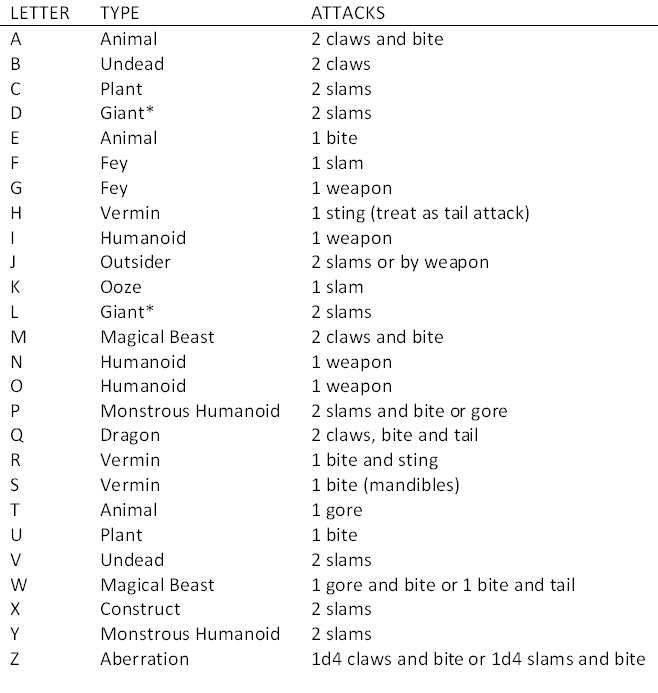
TYPE: The monster’s type is based on the first letter of the word:

* If the monster’s size is tiny to medium, feel free to change the giant into a humanoid or monstrous humanoid; in any event, increase the giant’s damage output by one size level

SIZE: The monster’s size is based on the last letter of the word:

STEP THREE – SPECIAL ABILITIES
There are two classes of special abilities for our purposes: Special Attacks and Special Qualities (which includes special defenses).

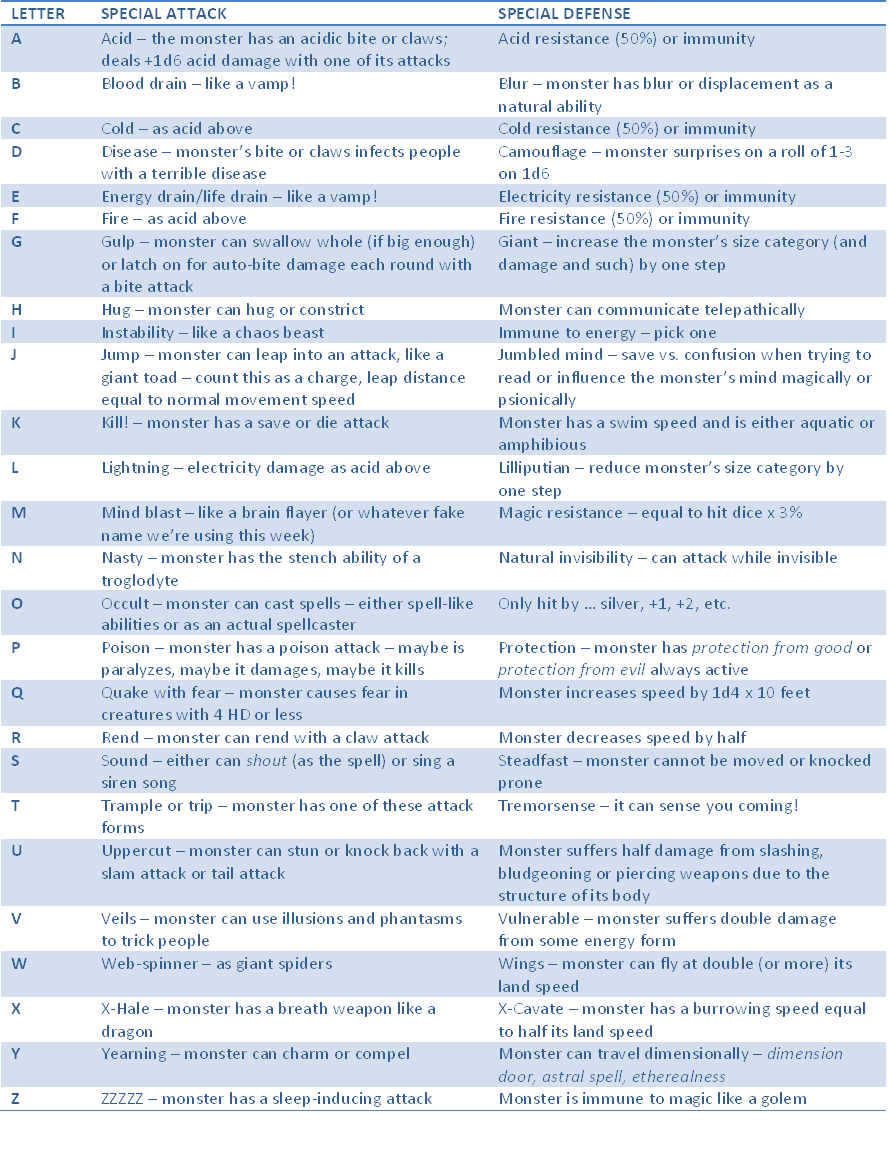
The monster’s special attacks are determined by the third, fifth and seventh letters in the word – if a monster doesn’t have a seventh or fifth letter, then they don’t have special abilities for those slots. In other words, the more letters (and more hit dice), the more special abilities.

I’ll present those tables tomorrow.

SAMPLE MONSTER
In the mean time, let’s look at a sample noun. Using dictionary.com, I generated the word “documentarian” and the modifier “mottled”. What the heck is a mottled documentarian?

Hit Dice: Documentarian has seven consonants, so our monster has 7 HD
Armor Class: Documentarian has six consonants, so our monster has an AC 22 (or AC -1)
Type: Documentarian starts with “D”, so our monster is a Giant with 2 slams
Size: The documentarian’s size should be Medium. A medium giant seems stupid, but in this case we’ll say the monster has giant girth – bulging muscles – rather than giant height

So far, we have:

MOTTLED DOCUMENTARIAN
Medium Giant

HD: 7
AC: 22
ATK: 2 slams (1d6)
MV: 30

Fear the Forms!

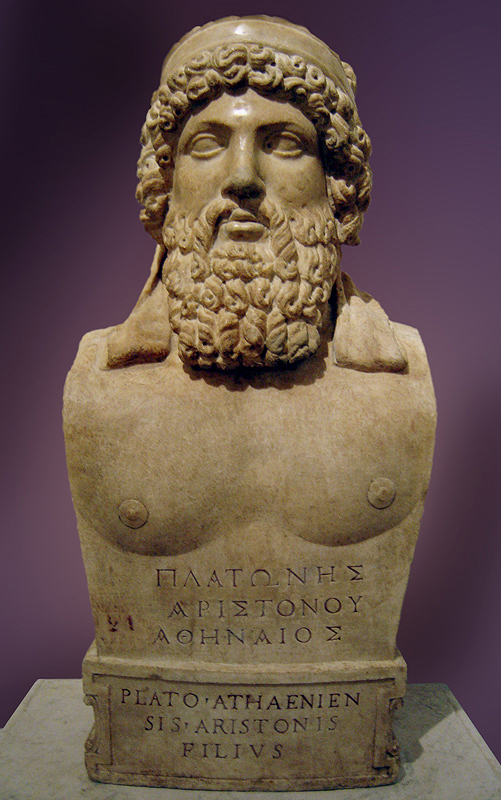
I was perusing the Art of Manliness blog a few days ago (I highly recommend it), and they had a post about Plato’s Parable of the Chariot. I’ll let you do the reading yourself.

Being an RPG guy, my mind is constantly scanning for things to adapt. While reading that article, I was struck with the concept of the forms – Truth, Beauty, etc. Now, I suppose the forms would make great deities for a game, but how often do you get to play with deities in a game? I figured they might make great monsters.

The basic idea is a monster that personifies some concept, physical or mental, to a perfect degree. Today, I’m going to do two forms based on ability scores, Strength and Intelligence.

STRENGTH
Medium Outsider, Neutral (N), Average Intelligence; Feat (1d4)

HD 7
AC 18 [+1]
ATK 2 slams (2d6 + bull rush)
MV 30
SV F10 R10 W10
XP 1,750 (CL 9)

Forms of strength look like perfect humanoid physical specimens, with perfect musculature, though lacking heads. How they see, hear, scent, etc. is unknown. They speak in a booming voice that is simply emitted from their bodies.

Targets struck by a form of strength must pass a Fortitude saving throw, modified by their strength modifier, or be knocked-back as though hit with a bull rush attack. They are capable of stomping (per the spell stomp) up to 3 times per day.

Forms of strength are capable of leaping up to 30 feet backwards, forwards, up or down (without falling damage). Likewise they are skilled at jumping, breaking down doors and bending bars. They have an effective strength score of 25.

Once per day, a form of strength can cause a creature it has struck to begin adhering to its conception of perfection. Each round, it gains 1 point of strength and loses one point of each of its mental ability scores. When the victim’s mental ability scores are reduced to 6, they themselves become forms of strength; this state can only be reversed by a wish spell.

Special: Weapon resistance to bludgeoning weapons

INTELLIGENCE
Medium Outsider, Neutral (N), Super Intelligence; Feat (1d4)

HD 5
AC 18 [+1]
ATK 1 incorporeal touch (1d6 + stun 1 round)
MV 30 (Fly 60)
SV F11 R10 W8
XP 1,250 (CL 7)

Forms of intelligence are ephemeral, incorporeal beings. They have over-large heads with smooth pates; these heads are transparent, revealing the massive brains beneath, that spark with their unceasing pondering. Their thin, wispy bodies suggest atrophy. They generally float above the ground and usually move by flying. Forms of intelligence communicate telepathically, to a range of 200 feet or with other forms of intelligence up to any range.

A form of intelligence’s touch attack ignores armor (except for magical armor) and forces those who suffer damage to pass a Will save or be stunned for 1d4 rounds.

The incredible intelligence of a form of intelligence allows it to work out the possible and likely movements of their foes to several rounds, and as such gives them the effective protection of a displacement spell (without they actually be displaced as the spell describes). They are capable, three times per day, of reciting such mind-numbing conundrums and theories that those within 10 feet must pass a Will save or be struck with confusion (per the spell) for a number of rounds equal to 5 minus their intelligence modifier.

Once per day, a form of intelligence can cause a creature it has struck to begin adhering to its conception of perfection. Each round, it gains 1 point of intelligence and loses one point of each of its physical ability scores. When the victim’s physical ability scores are reduced to 6, they themselves become forms of intelligence; this state can only be reversed by a wish spell.

Spells: At will – detect thoughts (ESP); 1/day – ego whip, id insinuation, mind blank

Special: Incorporeal

Monsters of the Virgin Woode

I’ve spent a few hours finalizing the new monster stats that will appear in NOD 19 (coming soon – I swear – just give me time). Thought I’d share a few of the beasts from mythic North America. The cultural origin of the monsters appears in parentheses after the monster’s name. Keep in mind, most of these monsters have been fantasy-ized, as is typical for the grand old game (i.e. I already know it isn’t accurate in terms of folklore).`

ALTAMAHA-HA (Georgians)
Large Animal, Neutral (N), Animal Intelligence; School (1d4)
HD 8
AC 14
ATK 1 bite (1d6) and 1 slam (1d8)
MV Swim 50
SV F8 R8 W14
XP 400 (CL 8)

The Altamaha-ha is a giant river creature that looks vaguely like a giant sturgeon with a bony ridge on its back and a snout like a crocodile. The monster is grey in color, with a belly the color of parchment. Mostly harmless, they are curious creatures who are attracted to humanoid activity, and those ridges on their backs have a nasty habit of damaging or capsizing river craft. Boats under which the animal scrapes must pass an item saving throw or spring a leak.

BOO HAG (Gullah)
Medium Monstrous Humanoid, Chaotic (CE), Average Intelligence; Solitary
HD 6
AC 15
ATK 2 claws (1d4) and bite (1d6)
MV 30 (Swim 50)
SV F12 R10 W10
XP 1500 (CL 8)

Boo hags are monstrous women of the swamp. Similar to vampires, they drain the life of their foes by riding them at night while they sleep and stealing their breath. A hag squatting atop a person drains one hit dice or level from them every 10 minutes.

Those victims they kill, they skin, as they have no skin of their own. They use this skin as a disguise when they wish to hunt at night in settled areas. Boo hags are amphibious, and look like skinless, gaunt women with blazing eyes and gnashing, yellow teeth. They can be distracted for 1d10 minutes by brooms, the straws of which they are compelled to stop and count. If attacked while counting straws, the hags flee with their brooms, that they may count the straws at their leisure in a safe place.

Spells: 3/day—gaseous form

FASTACHEE (Seminole)
Small Humanoid, Lawful (NG), Average Intelligence; Clan (1d20)
HD 1
AC 12
ATK 1 weapon
MV 20
SV F14 R15 W15
XP 50 (CL 1)

The fastachee are the dwarves of the hilly portions of the Virgin Woode, exiles from the Bleeding Mountains who settled here long ago. They have reddish-brown skin and black hair, which they wear long, braiding both the hair on their heads and their chins. The fastachee have long since given up on mining, save for the working of flint and granite. They are now mostly farmers, growing corn and raiding medicinal gardens. They enjoy a +2 bonus to save vs. poison and magic. They usually wear buckskin armor and wield tomahawks.

HEADLESS HORSEMAN (Washington Irving)
Large Undead, Chaotic (CE), Average Intelligence; Patrol (1d6)
HD 7
AC 18
ATK 1 sword (1d8 + special) and 2 hooves (1d6) and bite (1d4)
MV 30 (Mounted 50)
SV F12 R12 W10
XP 1750 (CL 9)

Headless horsemen may be encountered alone or in small patrols. The souls of horsemen who have perished in battle and now seek vengeance on the living. They appear as soldiers of various types, always mounted on black horses and always lacking a head. Most carry lanterns, perhaps even jack-o-lanterns, and slashing swords.

Headless horsemen are dangerous opponents. The whinny of their spectral horses and their own shrieks, screams and maniacal laughter cause fear (as the spell) in those with 3 HD or less. They prefer to get their victims running away, that they might swoop in and attempt to decapitate them. Attacks with their swords that roll a natural ‘20’ have a chance at decapitation; the target must pass a Reflex save to avoid this terrible fate. Mounted warriors who are decapitated will rise as headless horsemen themselves in 24 hours, while all others who are decapitated rise as wraiths, none of them under the control of their creator.

Headless horsemen have but a single weakness. They cannot cross running water, like streams or rivers. Make it across a bridge, and they cannot follow, though they may throw their lanterns in a fit of pique.

Note that the headless horsemen’s stats represent the horseman upon his horse – the two are rarely separated. That being said, it is possible to remove a headless horsemen from his steed, though he always gets a Fortitude saving throw to resist, and can, the next round, “teleport” back onto his mount. The two creatures live and die as a team.

Spells: 3/day—ethereal jaunt

Special Qualities: Immune to fear and all mind effects

KANONTSISTÓNTIE (Mohawk)
Large Aberration, Neutral (N), High Intelligence; Solitary
HD 7
AC 18 [+1]
ATK Slam (1d10) or breath weapon
MV Fly 40
SV F11 R12 W9
XP 1750 (CL 9)

Kanontsistóntie are giant, flying heads that appear to be constructed of bronze. They have unmoving faces and apparently sightless eyes, though they see all. Their mouths are agape and one can discern powerful energies within. The ultimate purpose of these entities is unknown and often seems contradictory from day to day. They primarily seek sustenance in the form of grain, lording it over lesser peoples and threatening them with destruction if they fail to pay tribute.

Kanontsistóntie have a breath weapon they can use once every three rounds, and no more than three times per day. The breath weapon is a 60-ft. cone of pure energy that deals 6d6 points of damage. Objects deposited in their mouths linger for a moment, and then disappear in a cascade of colored motes of light. Living creatures so transported into the “belly of the beast” suffer 6d6 points of damage, and, if they live, find themselves suffering 1d6 points of energy damage per day as they are slowly processed and digested by the head.

Special Qualities: Magic resistance 15%, regenerate

SPLINTERCAT (Lumberjack)
Medium Magical Beast, Neutral (N), Animal Intelligence; Solitary
HD 4
AC 14
ATK Bite (1d6) or slam (2d6)
MV 40
SV F11 R10 W17
XP 400 (CL 5)

Splintercats are odd creatures that look like stout mountain lions with broad, flat heads. They so love honey that they charge at trees hosting beehives, smashing into them so hard that the trees are killed; they lose their branches and leaves and are utterly blighted. This rather odd method of feeding leaves them with a terrible headache and in an eternally foul mood.

YEHASURI (Catawba)
Tiny Humanoid, Chaotic (CE), Average Intelligence; Band (2d8)
HD 0
AC 13
ATK By weapon
MV 20
SV F16 R16 W16
XP 25 (CL 0)

Yehasuri are the goblins of the Virgin Woode. They appear as tiny, hairy wildmen armed with spears and darts. They dwell in burrows beneath tree stumps (they enjoy fermented stump water) and issue out at night to hunt for animals and any unfortunate humanoids they might come upon. The smell of tobacco, either tobacco smoke or the juice, drives them away in a panic.

Bring Some Love to Your Dungeon – The Puttis

Dungeons – dank and damp and deadly – killing the spawn that chaos belches into the inner recesses of the earth – retrieving all manner of treasures, sacred and profane – falling deeply in love with a minotaur and betraying your friends on its behalf … wait, what?

PUTTI

Small Outsider, Neutral (CN), High Intelligence; Flutter (1d6)

HD: 3
AC: 16 [+1]
ATK: 1 arrow (1d4 or see below)
MV: 20 (Fly 40)
SV: F12 R11 W10
XP: 300 (CL 4)

Putti are mischevious little bastards, spawn of the gods and goddesses of love, who haunt dungeons looking for opportunities to spread love and trouble. They appear as plump humanoid infants with pink skin and rosy cheeks and small white wings (clearly too small to allow them to fly, yet fly they do).

Putti are armed with short bows and a quiver of 10 arrows. These arrows can be fired as normal shafts, or they can be used to deliver the putti’s spell-like abilities. When used to deliver spells, roll damage (1d4) and apply this as a penalty on the victim’s saving throw.

Spells: 3/day – Calm emotions, charm person, clairaudience/clairvoyance, confusion, light, rage, suggestion; 1/day – Charm monster, command, dimension door, dominate person, dream, ethereal jaunt, irresistible dance.

Special Qualities: Immune to fear, magic resistance (15%)

Star Fish from Outer Space – The Asterions

I promised stats (well, I promised to have them yesterday, so bad on me) for these ladies and gents, so here they are!

Star Mother
Huge Aberration, Neutral, Average Intelligence; Solitary

HD 12
AC 16
ATK 2 slams (2d6 + poison II)
MV 20, Climb 20
SV F 6, R 9, W 7
XP 1200 (CL 13)

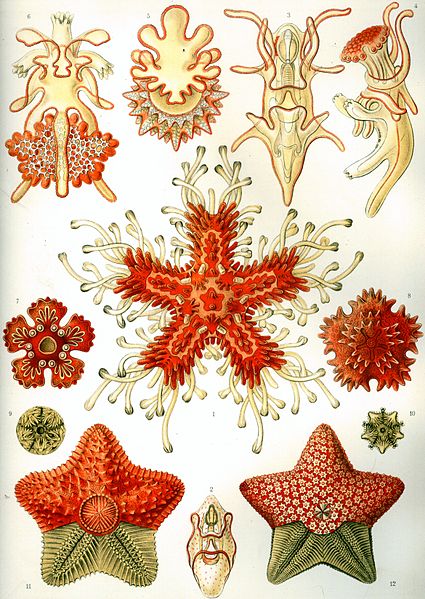
Star mothers are huge, 5-armed starfish-like creatures. They are capable of planeshifting once per week, and use this ability to invade new domains. A star mother is surrounded by a 60-ft. radius aura that has the same effect as the eyebite spell.

Special Qualities: Magic resistance 25%

Starling
Tiny Aberration, Neutral, Average Intelligence; Clutch (2d6)

HD 0
AC 14
ATK 1 bite (1 + poison I)
MV 10, Climb 10, Fly 40
SV F 19, R 16, W 13
XP 50 (CL 1)

Starlings are the tiny offspring of the star mother. They look like 5-armed starfish with transparent flesh (acts as natural improved invisibility). They rarely enter combat, preferring instead to sneak up on victims while they are sleeping. They then attach themselves to a spot just beneath the base of the neck, and easily hidden by clothing, and use their magical powers to dominate their victims (per dominate person as a 6th level spellcaster). The dominate ability requires the monster to be in contact with its target.

Star Warrior
Medium Aberration, Neutral, Average Intelligence; Gang (1d8)

HD 4
AC 15
ATK 2 slams (1d4 + poison II) and bite (1d6)
MV 20, Climb 20
SV F 14, R 14, W 11
XP 400 (CL 5)

The star warriors are the 7-armed rank and file of the asterion armies, bred from humanoids that have been altered by the weird chemistries of the starlings. Each star warrior has a large, central eye that can, once per day, emit a ray 120 feet in length (Reflex save to avoid). The eye’s color corresponds to the type of ray, which you can roll randomly for each gang of star warriors:

1. Color spray (as the spell) – golden-brown eye
2. Energy missile – cold (as the spell) – violet eye
3. Hold person (as the spell) – emerald green eye
4. Magic missile (as the spell, 1 missile) – icy blue eye
5. Sleep (as the spell, 1 target) – deep maroon eye
6. Slow (as the spell) – vibrant crimson eye

Star Lord
Large Aberration, Neutral, High Intelligence; Command (1d4)

HD 8
AC 16
ATK 2 slams (1d6 + poison II) and bite (1d8)
MV 20, Climb 20
SV F 10, R 11, W 8
XP 800 (CL 9)

Star lords are 11-armed asterions who serve as the commanders of the star warriors. Their multifaceted central eyes can fire off all the various rays common to the star warriors, each once per day. They can levitate at will.

Special Qualities: Magic resistance 15%, levitation

The Star Lords

The cosmos of Nod hides many dangers, none greater than the Star Lords, a race of star-shaped creatures who roam from planet to planet in search of slaves and survival. The Star Lords, or Astarions, have no conception of danger, and thus fear nothing. It is said they once attempted to conquer Hell, seeing its demons and devils as no more fearsome than one might a peasant or fat merchant.

Of the astarions, there are four sorts which share a deep kinship and which always work in concert to achieve their aims. When they enter a new dimension, the first to be seen is the Star Mother. Her brood, the Starlings, soon appear and carry out their purpose of conquering the minds of whatever creature calls the dimension home. Some of these starlings manage to pervert the chemistries of their hosts, turning them into the dread Star Warriors, and a few of these Star Warriors manage to morph into the dreaded Star Lords, who rule dimensions until they are drained of resources.

[I’m putting this material down before I forget it – expect stats in the next post]

Star Mothers
A star mother is a huge being that looks like a massive sea star, with black, coarse flesh and a pink underbelly. It lies, splayed out in a cool cavern, it’s great bulging eye atop its body, its legs flexed that it might deposit hundreds of small, translucent eggs on the ground. These eggs hatch in a few days, producing starlings. Star mothers are powerful combatants due to their size and flexibility.

Starlings
Starlings are tiny creatures that resemble transparent sea stars. They are, of course, quite sneaky and stealthy, and it is their purpose to leave their mother’s nest and seek out sentient beings. Waiting until they sleep (usually), they attach themselves to their chosen victim’s back, at the base of their neck. From this point, they use their powers to bend the person to their will, pressing them to visit the cave, gather other starlings, and distribute them among other folk, especially folk known to be powerful, influential or capable of entering places in secret (i.e. thieves and assassins).

Star Warriors
About 1 in 6 starlings is capable of slowly changing their hosts into star warriors. Star warriors are medium-sized creatures that appear as sea stars with coral flesh and large eyes in their center. These eyes are various colors, each corresponding to a different type of ray which the monster can use a limited number of times per day. Star warriors are covered in a sort of chitin, and they are capable of flight.

Star Lord
A rare star warrior is destined to grow to large size. Its flesh becomes a deep crimson, and its eye becomes multifaceted, allowing it to use a variety of rays. Star Lords are the rulers of their people, and gain mental control over any humanoid controlled by one of its brother starlings. Star lords command their slaves (whether controlled or merely cowed) to offer up all manner of resources, ceasing the raising of new crops or mining of new materials, and instead directing all effort towards the aggrandizement of the Astarions. When the resources are depleted, the Astarions move on, their star mother shifting into a new dimension / planet / world while its old children simply cease to be, drying into dust and blowing away.

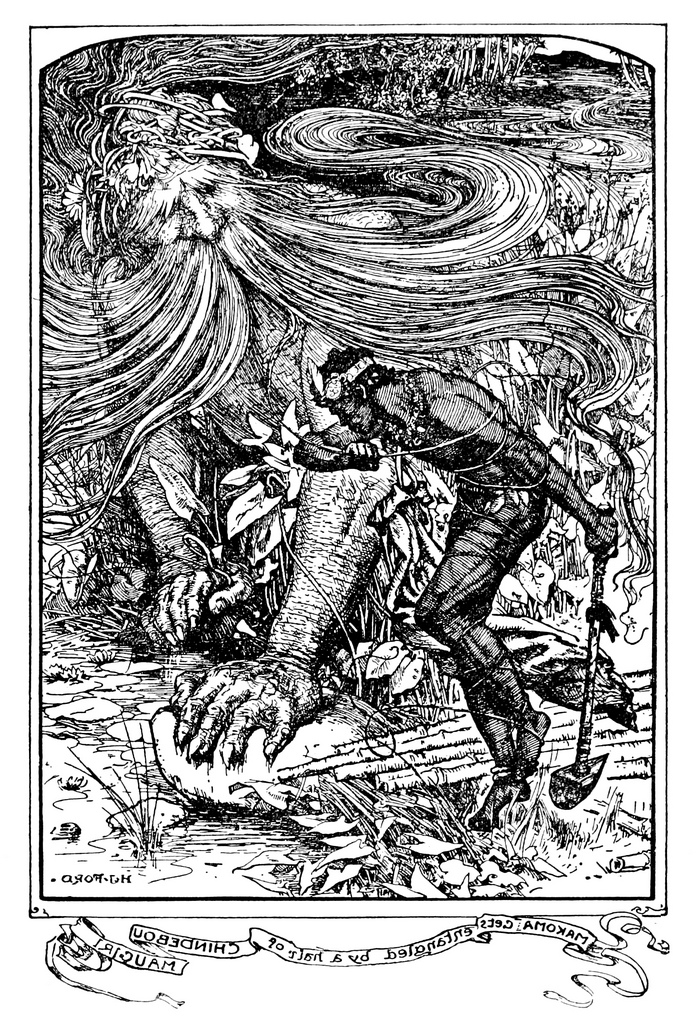
The Monsters of Henry Justice Ford – Part II

Today, I present three giants to confound (and stomp on) you precious PC’s.

River Giant
Huge Giant; Chaotic (NE); Average Intelligence; Eddy (1d4)

HD 12
AC 17
ATK 1 slam (2d6) or 4 locks (1d4 + constrict)
MV 30 (Swim 40)
SV F4, R9, W9
XP 1200 (CL 13)

River giants are the children of the great rivers. They appear as massive humanoids with long, grey mustaches and beards which seem to flow and ripple with a will of their own. They dwell within rivers, sometimes in simple caves, but more often in submerged strongholds with courts of nixies and river nymphs.

In combat, a river giant can breathe forth, once per day, a fetid mist per the obscuring mist spell. Those trapped within the mist must pass a single Fortitude saving throw or succumb to filth fever. Their mustaches and beards can be used as tendrils to grab and constrict attackers.

Special Qualities: Resistance to cold

Jinnati
Large Giant; Chaotic (NE); Average Intelligence; Blaze (1d6)

HD 4
AC 14
ATK 1 slam (1d10 + 1d6 fire) or by weapon (+1d4 fire)
MV 30
SV F10, R14, W14
XP 400 (CL 5)

The jinnati, or fire-eaters, are a breed of fire-breathing ogres who dwell in volcanic hills in tropical regions. They have ruddy to dull green skin, lustrous black hair and sparkling eyes that suggest clever malevolence. Jinnati rarely wear armor, though when they do it is usually formed of glowing, red scales, and likewise when they arm themselves they do so with metal weapons. They have a profound lust for reddish and orange gemstones, and will almost anything to possess them, even behave honorably.

Jinnati can breathe a 15-ft. long line of fire once per day. This fire deals as many hit points of damage as the jinnati currently possesses (or half that with a successful Reflex saving throw). They can recharge this fire breath by eating fire – that is, inhaling flames from any sort of source larger than a torch.

Creatures grappled by the monsters suffer as though from a heat metal spell, in addition to suffering normal grapple damage.

Special Qualities: Immune to fire, vulnerable to cold

Stalo
Large Giant; Chaotic (CE); Average Intelligence; Roost (1d6)

HD 6
AC 15
ATK 2 claws (1d6) and bite (1d4)
MV 30
SV F9, R12, W12
XP 600 (CL 7)

Stalos are magical ogres that haunt the northern woodlands and steppes. They have dark brown to nearly black skin, leering yellow eyes and pronounced fangs.

A stalo possesses a set of pipes not unlike those of a satyr. When playing those pipes, those within 1 mile must pass a Will saving throw or be charmed (per the charm person spell) and convinced that they must journey to the source of the piping. Subjects within 30 feet of the piping must make an additional Will save or be held (per the hold person spell) for 1d6 rounds, during which time the stalo will kill them for its supper. A stalo can track unerringly on his home territory.

A stalo has one weakness, and that is running water. While they can cross running water, they do so slowly (movement rate of 5) and must pass a Will save each round or be either frozen with fear for one round.

Spells: At will—calm animals, speak with animals; 1/day—summon nature’s ally II