Shades of White

And so we come to the trickier dragons – black and white. That means, to some extent, shades of light gray and shades of dark gray. Still – let’s see what we come up with for the white dragon’s kin.

Achromatic Dragon: The small, feral cousins of the white dragon are covered in spiked hide reminiscent of a rhinoceros’, with swept back antlers on its head and cruel, gnashing teeth in its long snout. Achromatic dragons hunt in the manner of crocodiles, lurking beneath the snow and then lunging out at victims. Achromatic dragons never speak or use spells, but they are capable of breathing a swirling vortex of snow that acts as an 8 HD air elemental’s whirlwind ability and inflicts 1d6 points of cold damage each round for ten rounds.

ACHROMATIC DRAGON: HD 5; AC 2 [17]; Atk 2 claws (1d4) and bite (2d8); Move 9 (F24); Save 12; CL/XP 7/600; Special: Breathes blizzards.

Cinereous Dragon: Also called the ashen dragon, the cinereous is a small white dragon with an especially vicious streak. More intelligent than most white dragons, they have a 65% chance of speaking, and those who speak have a 15% chance of casting spells. Cinereous dragons cast spells as an anti-cleric and have three 1st level spells, two 2nd level spells and one 3rd level spell. A  cinereous dragon has an ash gray hide, black eyes, a purple tongue and mouth and hundreds of jagged teeth in its long snout. Atop its head are two long, black horns – like those of a Texas longhorn – and a cluster of black, horn-like spikes tips its thick tail. Cinereous dragons have no breath weapon. Rather, their presence seems to steal all the warmth and kindness from the area. All creatures within 20 feet of the beast must save each round or suffer 1d6 points of cold damage. All creatures within 50 feet of the beast must pass a saving throw any time they wish to do something unselfish or kind – i.e. a cleric using a cure spell on someone other than themselves.

CINEREOUS DRAGON: HD 5; AC 2 [17]; Atk 2 claws (1d4), bite (2d8), gore (1d6), tail spikes (1d4); Move 9 (F24); Save 12; CL/XP 8/800; Special: Steal warmth and kindness, anti-cleric spells.

Ghastly Dragon: The ghastly dragon dwells on abandoned battlefields of the frozen north, where man has spilled the blood of man. It feeds on corpses, like a raven and can whip up the echoes of the spiritual agony of men who have died in battle. These echoes appear as swirling maelstroms of screaming spirits that cover an area 60-ft in diameter around the dragon and force people within the maelstrom to save (once) or lose 1d6 points of wisdom. Ghastly dragons have scales the color of dead, human flesh, with blotches reminiscent of decay. They have stubby spikes that run from their heads to their tails and bloated bodies that waddle about on four stubby legs. Ghastly dragons have a 15% chance of speech, and those who speak have a 15% chance of casting the following spells: Phantasmal force, cause fear and animate dead.

GHASTLY DRAGON: HD 6; AC 2 [17]; Atk 2 claws (1d4) and bite (2d8); Move 6 (F18); Save 11; CL/XP 9/1100; Special: Maelstrom of agonized spirits, spells.

Isabelline Dragon: Isabelline dragons are large and regal, with dull, delicate scales and long, swan-like neck. Isabelline dragons have petite heads, large, sapphire eyes and swirling horns reminiscent of unicorns. Isabelline dragons dwell in vaults beneath snowy mountains. They are capable, while holding their breaths, of passing through earth as easily as air, giving them an effective burrowing speed equal to their flying speed for up to 5 rounds. Their palaces are wondrous and luxurious, with all of the dragon’s riches being spent on creature comforts and art – isabelline dragons have one-tenth the normal coins in their horde and triple the art objects/jewelry. Isabelline dragons always speak and have a 45% chance of casting 1d4 first level and 1d3 2nd level magic-user spells. In place of a breath weapon (how crude and vulgar!) they can sap the color from themselves and their surroundings (but not living creatures) in a diameter of 300 feet. Everything becomes stark white, granting the dragon the equivalent of improved invisibility and forcing those who linger in this area for more than 3 rounds to pass a saving throw or suffer from the equivalent of snow blindness (lasts for 1d3 hours).

ISABELLINE DRAGON: HD 7; AC 2 [17]; Atk 2 claws (1d4) and bite (2d8); Move 9 (F24); Save 9; CL/XP 10/1400; Special: Drain color, spells.

Ivory Dragon: Ivory dragons dwell in cold woodlands in icy caves obscured by the boughs of pine trees. It is said they even smell like pine, making detecting them difficult even for creatures with a powerful sense of smell. They have ivory colored scales of varying sizes, with two ridges of bony, fan-shaped protrusions running down their backs (in the style of a stegosaurus), long necks, small, quick heads (they enjoy a +1 bonus to initiative rolls) and whip-like tails. Two long, ivory tusks jut out of their mouths, giving them a powerful bite attack. Ivory dragons are collectors, eschewing treasure for collections of books, armor, weapons, jewels, hour glasses or some other such nonsense. Their ill-tempers often drive them to scatter treasures of coins atop mountains just to keep them from the hands of folk who do value such objects. An ivory dragon’s breath weapon is a cone, like that of a typical white dragon, but instead of cold damage, it has a hold monster effect (save negates) that lasts for 1 hour, as the spell. While held, a creature’s skin takes on an ivory sheen, making them look like a statue. Ivory dragons have a 20% chance of speech, but never cast spells.

IVORY DRAGON: HD 6; AC 2 [17]; Atk 2 claws (1d4) and bite (3d8); Move 9 (F24); Save 11; CL/XP 8/800; Special: Breath weapon (hold monster).

Pearl Dragon: Pearl dragons dwell in arctic oceans, swimming with the monsters of the deep and surfacing only to torment humanoids and demand tribute from them. Pearl dragons have bodies like elasmosauruses, with sleek heads. Their hemispherical scales gleam like pearls and their eyes shine with malevolence. Pearl dragons never speak, but can communicate telepathically up to 1 mile. They can use this telepathy to summon a pod of 1d6 orcas with a 50% chance of success once per day. Pearl dragons can cast spells as psychic powers, having 1d6 first level, 1d4 second level and 1d2 third level magic-user spells at their disposal. In place of a breath weapon, they can implant a phobia inside a person’s mind. People fighting a pearl dragon must pass a saving throw or suffer from one of the following fears:

1. Fear of boats or ships
2. Fear of pain
3. Fear of open spaces
4. Fear of wind
5. Fear of water
6. Fear of magic

The fear lasts for 1 hour, with a 1% chance of it becoming permanent. When presented with the phobia, a character must pass a saving throw or go into a panic attack, losing their turn, breathing heavily and attempting to flee from the source of the phobia. If they cannot flee from the source of the phobia, they become catatonic until the phobia disappears from their mind.

PEARL DRAGON: HD 7; AC 2 [17]; Atk 1 bite (3d6); Move 6 (S30); Save 9; CL/XP 10/1400; Special: Summon orcas, spells, zone of fear.

Image from CLKER

Shades of Green

Ah – Green! The color of plants and She-Hulk, Spring and infections. Also the color of nasty reptilian beasts who belch chlorine gas. Enjoy some variations on the green dragon …

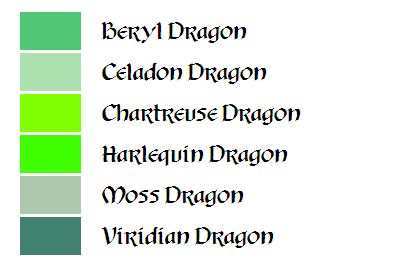
Moss Dragon: The moss dragon is a small green dragon with a serious inferiority complex. A bully, it lurks near rivers and streams, its grey scales mottled with green looking like a moss-covered boulder, and then jumps out at travelers demanding their lunch money. They dwell in burrows dug into river banks. The entrance to the burrow is always submerged, while the main dwelling cave is above the water table (well, most of the time). Moss dragons breath a pale green vapor that condenses on the skin (or armor) as green slime. The cloud is 30-ft in diameter. All within must pass a saving throw or be struck by a green slime (with all the fun that entails). Moss dragons only have a 25% chance of speaking, but the normal chance of magic-user if they do speak.

MOSS DRAGON: HD 7 (28 hp); AC 2 [17]; Atk 2 claws (1d6), 1 bite (2d10); Move 9 (Fly 24); Save 9; CL/XP 10/1400; Special: Camouflage (surprise on 3 in 6), slime breath.

Chartreuse Dragon: Chartreuse dragons are large brutes, with a tortoise-shaped body (no shell) and a wicked sense of humor. Chartreuse dragons enjoy luxury and decadence – the heady scent of exotic perfumes, rare delicacies, soft silk cushions, etc. Their eyes, large and golden, can hypnotize and command humanoids (save at -2 vs. charm monster), and people enslaved are used to construct wooden palaces in hard-to-find places. A chartreuse dragon has an 85% chance of speech, but only a 5% chance for magic-use, as their lazy minds are rarely up to the mental contortions and acrobatics needed to bend reality. Their breath is an acidic fog that covers a 60-ft diameter area and deals 1d6 points of damage per round to everyone and everything in the vicinity. Assume that armor can suffer 2 points of damage per armor bonus before it is useless, and weapons damage equal to their own maximum damage output. Magical items are unaffected by this acid. A chartreuse dragon’s acid breath has reduced more than a few adventurers to Frazetta-esque nudity!

CHARTREUSE DRAGON: HD 9 (36 hp); AC 2 [17]; Atk 2 claws (1d6), 1 bite (2d10); Move 9 (Fly 24); Save 6; CL/XP 11/1700; Special: Breathes poison gas.

Celadon Dragon: These medium-sized beasts dwell in the tree tops. They have sinuous bodies, like constrictors, with stubby legs that are tipped with long claws for climbing trees. They have two rows of spines on their backs that are connected with a thin membrane. When held close to their bodies, they nearly disappear, but when unfurled they look like sails, and allow the beast to glide and fly. Celadon dragons are ill-tempered brutes that kill as much for the fun of it as for practical reasons. Celadon dragons always speak, but they never cast spells. Their poisonous cloud breath (50-ft diameter) causes half normal breath damage and robs people of 1d4+1 points of strength, dexterity and constitution as it sears their lungs. While the hit point damage from a celadon dragon’s breath cannot be reduced with a saving throw, the ability score damage can be so negated. Lost ability score points are regained at the rate of 1 point per night of complete rest. Points not regained after one week are lost permanently.

CELADON DRAGON: HD 8 (32 hp); AC 2 [17]; Atk 2 claws (1d8), 1 bite (2d10); Move 9 (Fly 18); Save 8; CL/XP 10/1400; Special: Poison gas.

Beryl Dragon: Beryl dragons are large, overbearing know-it-alls. More neutral than chaotic, they are always capable of speech, though rarely capable of interesting speech. Beryl dragons are sages (per the rules for sages) with a pedantic, superior attitude. They stock their lairs with scrolls and books and sometimes resort to chaining humanoid sages to the walls as a sort of living reference source. Beryl dragons are severely near-sighted, making escaping their attention at long distance somewhat easy. They are always magic-users, with the normal complement of green dragon spells plus the following: Detect magic (at will), ESP (at will), legend lore (1/day) and sleep (1/day). They can communicate telepathically up to a range of 100 feet. The gas exhaled by a beryl dragon is a vivid green and covers a diameter of 30 feet. Creatures within the gas must pass a saving throw or lose their memories for 24 hours. During this time, their effective class level and hit points are reduced to one half (i.e. they retain some of their skill, but not all of it).

BERYL DRAGON: HD 9 (36 hp); AC 2 [17]; Atk 2 claws (1d6), 1 bite (2d10); Move 9 (Fly 24); Save 6; CL/XP 12/2000; Special: Forgetting gas, spells.

Viridian Dragon: These medium-sized green dragons live among rocky places in small caves, curing their snake-like bodies into a coil. They are extremely greedy and paranoid, though not entirely evil – some even become boon companions of similarly greedy people provided the dragon always gets the first choice and largest share of discovered treasure. Viridian dragons bury their treasure in multiple locations around their lair and cannot be forced to divulge its location by anything less than a wish (and a saving throw applies here to force the truth out of them). A viridian dragon’s breath is like a powerful drug. It makes people who fail a saving throw immune to fear and besets them with powerful, frightening hallucinations (per the nightmare spell, only while awake). These effects last for 2d6 hours and are then followed by withdrawal symptoms for 1d6 days minus a victim’s constitution bonus. Withdrawals include chills, nausea and an aching neck and shoulders. Viridian dragons have the normal green dragon chance for speaking and magic-use.

VIRIDIAN DRAGON: HD 8 (32 hp); AC 2 [17]; Atk 2 claws (1d6), 1 bite (2d8); Move 9 (Fly 18); Save 8; CL/XP 10/1400; Special: Hallucinogenic gas.

Harlequin Dragon: Harlequin dragons are small, feral looking beasts that dwell in mountain caves overlooking tracts of woodland. Harlequin dragons always look like their grinning, but this is just a trick of their anatomy, for they are morose and moody things that despise life. Harlequin dragons have the normal chance to speak for green dragons, but no chance to cast spells in the normal sense. All harlequin dragons, however, are capable of summoning the local wildlife (say, 1d3+3 wolves or 1d3 brown bears) once per day and they can command and speak with plants. Their poisonous breath covers the same diameter as a green dragon’s (50 feet) but causes uncontrollable laughter (as the spell) rather than damage.

HARLEQUIN DRAGON: HD 7 (28 hp); AC 2 [17]; Atk 2 claws (1d6), 1 bite (2d8); Move 12 (Fly 24); Save 9; CL/XP 10/1400; Special: Command plants and animals, laughing gas breath.

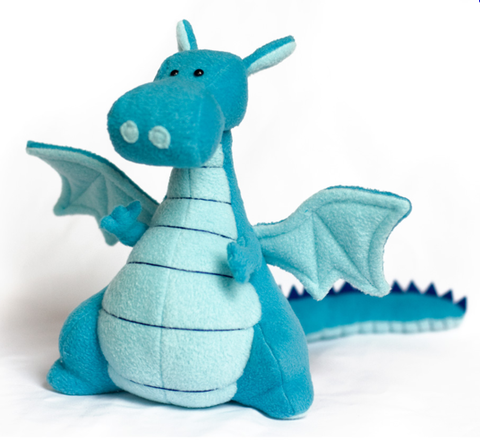
Illustration from CLKER

Shades of Blue

Here are six cousins to the venerable blue dragon.

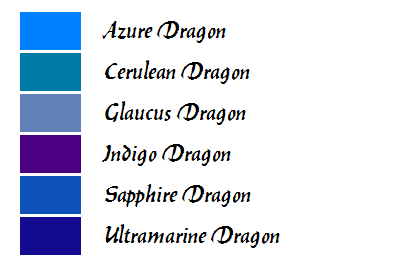
Azure Dragon: An azure dragon’s sense of self-worth is as majestic as the color of its scales. Azure dragons are mesa dwellers – haughty and self-satisfied. They control the weather over their domains, alternately keeping it dry as dust to discourage large interlopers from approaching and then, when fools dare tread on their domain, causing downpours that turn into flash floods. Azure dragons are medium-sized for blue dragons, with lofty, white horns that curl and nearly meet above its head. Azure dragons are always capable of speech (usually a throaty, superior baritone) and magic. They can always use the following spells: Control weather (at will), call lightning (at will) and lightning bolt (3/day).

| Azure Dragon: HD 9; AC 2 [17]; Atk 2 claws (1d6), 1 bite (3d8); Move 9 (F24); Save 6; CL/XP 11/1700; Special: Spells, control weather, call lightning and lightning bolt.

Cerulean Dragon: Cerulean dragons are small for blue dragons, with tiny scales and over-sized wings. They are gregarious and vivacious, and the least wicked of the blue dragons, though they are as self-centered as any other wyrm, and prefer to be the center of attention. Electricity runs up and down their scales (touching them inflicts 1d4 points of damage) and their bodies give off an electric hum. They are capable of controlling electro-magnetic forces around their body (treat as double-strength telekinesis that only works on iron-based objects). Most cerulean dragons keep dozens of steel blades around their lairs, whipping them into a blade barrier when intruders approach. The blade barrier has a radius of 20 feet and inflicts 8d6 points of damage to anyone who passes through the barrier. They have the normal chances for speech and magic use.

| Cerulean Dragon: HD 8; AC 2 [17]; Atk 2 claws (1d6), 1 bite (3d6); Move 9 (F24); Save 7; CL/XP 11/1700; Special: Magnetism, blade barrier.

Glaucus Dragon: Small, wiry and suspicious, the glaucus dragon likes to toy with its prey. It always acts as though it is incapable of speech and magic use, and always pretends to be sleeping when first encountered. The beast breathes a heady, thick gas – as thick as pea soup – that forces those who breathe it in to pass a saving throw or be struck by the slow spell and age 1d10 years per round. The cloud covers an area measuring 20-feet in radius. This aging can be reversed with a potion consisting of the offending dragon’s blood mixed with blueberries and stirred with electrified copper. They have the normal chance for a blue dragon to speak and use magic.

| Glaucus Dragon: HD 8; AC 1 [18]; Atk 2 claws (1d6), 1 bite (3d6); Move 12 (F27); Save 8; CL/XP 11/1700; Special: Breath weapon (aging).

Indigo Dragon: Indigo dragons are large and lazy – almost floppy if that’s possible for a dragon. They have small, useless wings on their shoulders and terrific maws filled with sharp teeth and two elephantine tusks that jut out of their mouths. Indigo dragon are gluttonous and boorish. They have only a 45% chance to speak, and when they can speak they rarely have anything interesting to say. Indigo dragons radiate an aura of static electricity down the spines on their back. This electricity arcs to any creature within 10 feet, inflicting 2d6 damage per round on characters without metal armor and an additional 1d6 damage for characters in metal armor and/or wielding a metal weapon (i.e. 4d6 total for a character in metal armor wielding a metal weapon. Indigo dragons are encountered in their lairs 80% of the time and are asleep about 70% of the time.

| Indigo Dragon: HD 10; AC 2 [17]; Atk 2 claws (1d6), 1 bite (4d6); Move 6; Save 5; CL/XP 12/2000; Special: Electric aura.

Sapphire Dragon: Sapphire Dragons have brilliant, polished scales that look like little teardrop shaped sapphires. They live deep underground and are notoriously fastidious and picky about their surroundings. All sapphire dragons can assume human shape as they wish, usually taking the form of tall, stately men or women with blue-black hair and sapphire blue eyes. They enjoy attention and worship, and often cultivate little cults of beautiful men and women. Sapphire dragons can always communicate telepathically and cast spells, though they sometimes are incapable of physical speech.

A sapphire dragon with spell-casting ability always has the following spells: First Level – Sleep; Second – Level: ESP; Third Level: Suggestion; Fourth Level – Confusion; Fifth Level: Feeblemind. Their breath is a sapphire ray that can be directed at a single victim. The ray causes all of the victim’s synapses to fire, stunning them for one round and leaving them with a pounding headache for the next 24 hours. While suffering from the headache, spellcasters have a 5% chance of their spells failing to materialize.

| Sapphire Dragon: HD 9; AC 2 [17]; Atk 2 claws (1d6), 1 bite (3d8); Move 9 (F18); Save 7; CL/XP 13/2300; Special: Breath weapon (stun), spells, telepathy 100 feet.

Ultramarine Dragon: Ultramarine dragons are large, powerful specimens of dragonhood, with deep blue scales that gleam in the light and absolutely blaze in the moonlight. They have large, knowing eyes and long, overlapping fangs. Ultramarine dragons are imperious and overbearing, and are especially vulnerable to flattery. They are also uncommonly fond of intoxicating beverages, and have been known to keep especially skilled bartenders in their lairs mixing wondrous concoctions.

An ultramarine dragon spits chain lightning. Chain lightning strikes one target initially, then arcs to up to ten other targets who cannot be more than 10 feet apart from one another. Damage is normal on the first target and half normal on all others. Saving throws to halve damage are permitted. If multiple targets fail this saving throw, their minds are switched by the mystic lightning.

| Ultramarine Dragon: HD 10; AC 2[17]; Atk 2 claws (1d6), 1 bite (3d8); Move 9 (Fly 24); Save 5; CL/XP 13/2300; Special: Chain lightning (damage and mind-switching).

Image found at the Lost Papers of Tsojcanth.

Shades of Red

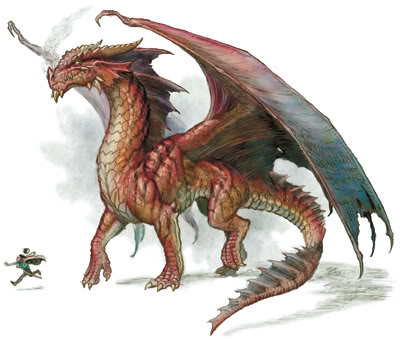
Yeah, yeah – the mighty red dragon, paragon of scaled evil and terror in the game. But where’s the subtlety, the range? Leave your players guessing with the following six sub-species of the venerable red dragon. The remainder of this post is declared Open Game Content.

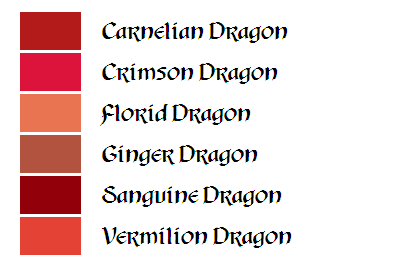
Carnelian Dragon: The carnelian dragon is medium-sized for a red dragon (i.e. 10 HD) and always intelligent, though never capable of speech. Carnelian dragons always possess the following spells: Detect evil (3/day), ESP (3/day), Legend Lore (1/day), Suggestion (1/day). They communicate telepathically in a screeching voice that raises the hairs on the nape of the neck. A carnelian dragon replaces the red dragon’s cone of fire breath with a psychic pulse that disrupts the synapses of the brain. All within 30 feet must pass a saving throw or be affected. For the next 6 rounds, the person must pass a saving throw whenever they want to perform an action other than running away or dodging blows (but without the benefit of a shield, which requires active thinking). Any other act – attacking, spell casting, talking, tap dancing, playing checkers – requires a successful save.

| Carnelian Dragon: HD 10; AC 2 [17]; Atk 2 claws (1d8), 1 bite (3d10); Move 9 (F24); Save 5; CL/XP 12/2000; Special: Spells, psychic pulse.

Crimson Dragon: The crimson dragon is a large, ponderous beast with a shortened snout and heavy eyes. Crimson dragon’s never speak and are relatively un-intelligent. They relish the infliction of distress and pain, and are as often on the move as in their lairs. In place of fire breath, a crimson dragon can breath a blast of wind – hot as a desert wind – that destroys water (reduces all water stores by half), withers plant life (normal dragon breath weapon damage to plant creatures) and sucks the moisture from other living creatures (half normal dragon breath weapon damage to non-plant creatures of flesh and blood).

| Crimson Dragon: HD 11; AC 2 [17]; Atk 2 claws (1d8), 1 bite (3d10); Move 6 (F15); Save 4; CL/XP 13/2300; Special: Drought breath.

Florid Dragon: The florid dragon is an ill-tempered brute of medium size (i.e. 10 HD). They have shinier scales than most red dragons, and smaller, saw-like teeth in their mouths. A florid dragon has the normal chances for speech and magic use. In place of fire breath, it simply radiates a wave of punishing heat from its body. The heat causes 1d6 points of damage per round to creatures within 10-ft of the dragon, 1d4 points to creatures from 10 to 20 feet away from the dragon and 1 point of damage per round to creatures within 20 to 40 feet of the dragon. Wearing metal armor increases this damage to 1d8/1d6/1d4 respectively. The florid dragon can maintain this heat for 10 minutes per day.

| Florid Dragon: HD 10; AC 2 [17]; Atk 2 claws (1d8), 1 bite (2d10); Move 9 (F24); Save 5; CL/XP 12/2000; Special: Radiate heat.

Ginger Dragon: The ginger dragon is a smaller, less wicked cousin of the red dragon. Lonely and somewhat sensitive, its evil nature usually manifests in flashes of murderous rage when rejected or criticized. When not murderously angry, though, it is a welcoming companion, even generous to adventurers. Where the florid dragon radiates intense heat, the ginger dragon absorbs heat, making the area around him very cool, and thus his warm presence (think of him as a radiator with a 5-ft radius range) all the more pleasant. Within 100 feet of the dragon, the air is absolutely frigid, and people unprotected from the cold suffer 1d6 points of damage per turn from the frost. Within 1 mile of the dragon, things are notably cold, though not damaging. Ginger dragons are always capable of speech and have the normal chance for magic use. Their claws are overly long and razor sharp.

| Ginger Dragon: HD 9; AC 2 [17]; Atk 2 claws (1d8+1), 1 bite (3d10); Move 12 (F24); Save 6; CL/XP 11/1700; Special: Absorb heat, immune to fire.

Sanguine Dragon: These infernal brutes are ever in league with the dark powers of Hell, acting as their messengers and assassins in the world of mortals. They are small for red dragons and possessed of black, branching antlers that are lovely to behold if they aren’t gouging out your eye or spleen. Sanguine dragons can always speak and cast spells, and choose their spells from the anti-cleric’s spell list. They replace the red dragon’s cone of fire with a cone of spiritual hellfire, which numbs the soul and robs one of their common decency. Those hit must pass a save or be drained of one level. Those drained of a level must pass a second saving throw or have their alignment move from Lawful to Neutral or Neutral to Chaotic for the span of one month.

| Sanguine Dragon: HD 9; AC 2 [17]; Atk 2 claws (1d8), 1 bite (3d10), 1 gore (1d8); Move 9 (F24); Save 6; CL/XP 12/2000; Special: Hellfire, anti-cleric spells.

Vermilion Dragon: The noble vermilion dragon replaces the fury of the red dragon with a sense of superiority and mild disdain for lesser creatures. Nevertheless, they are as close as a red dragon can get to benevolence, and officially have a Neutral alignment (with benevolent tendencies). Vermilion dragons, like actors, love nothing more than to talk about themselves and hear others talk about them, especially in glowing terms. They are large, with refined features and have a lust for gold (especially in the form of crowns and other regalia) that borders on the obsessive. A vermilion dragon’s cone of fire causes full damage on neutral creatures, 150% normal damage on chaotic creatures, and only half damage on Lawful creatures. Lawful creatures struck by the breath also have all curses and diseases removed from their person and any drained level has a 50% chance of being restored if drained in the last year. Vermilion dragons can always speak, and have the normal chance for magic use.

| Vermilion Dragon: HD 11; AC 2 [17]; Atk 2 claws (1d8), 1 bite (3d10); Move 9 (F24); Save 4; CL/XP 13/2300; Special: Cleansing fire.

Chim Chimera Cheree

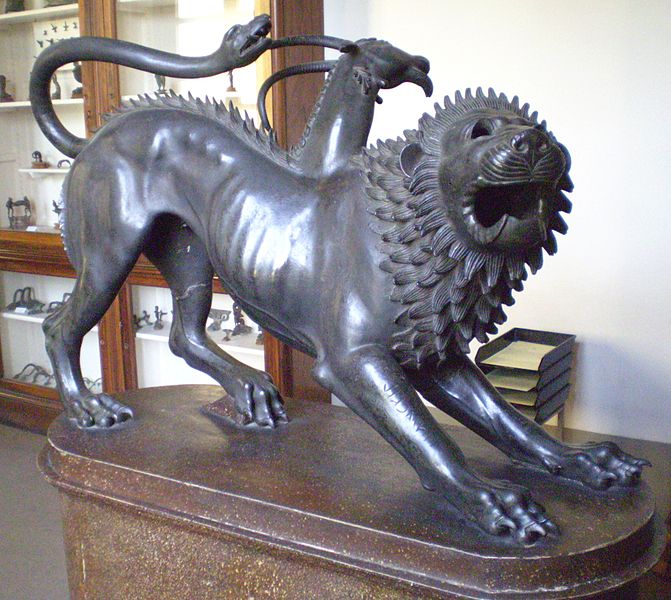
The chimera: lion + goat + dragon = booooring. Let’s spice this critter up a bit. First, we need the basic stats:

Chimera: HD 9; AC 4 [15]; Atk (see below); Move 9 (Fly 18); Save 6; CL/XP 11/1700; Special: Flight, plus see below.

Then we roll some random dice on the tables below to add attacks and special abilities …

Right Head and Front Body (d12)
1. Bear (Cave/Polar): 2 claws (1d6+1), 1 bite (1d10+1); gains hug attack for 3d6 damage
2. Cheetah: 2 claws (1d3), 1 bite (1d6); increases land speed by +3, can trip with claw attacks
3. Crocodile: 1 bite (1d6); replace flight speed with swim speed
4. Eagle: 2 talons (1d4), 1 bite (1d8); increases flight speed to 24
5. Hyena: 1 bite (1d3)
6. Lion: 2 claws (1d4), 1 bite (1d8)
7. Owl: 2 talons (1d8), 1 bite (1d6+1); increases flight speed to 20 and flies silently, -2 to hit in bright light
8. Tiger: 2 claws (1d4+1), 1 bite (1d8); gains swim speed of 6
9. Tyrannosaurus Rex: 1 bite (2d8); clamp down jaws and shake for auto damage in subsequent rounds [front body will be the same as rear body, not that of a T-Rex]
10. Weasel: 1 bite (2d6); clamps down and sucks blood for 2d6 damage per round
11. Wolf: 1 bite (1d4+1); can trip with bite attack
12. Wolverine: 1 bite/claw (1d6+3); +4 to attack due to ferocity

Left Head and Rear Body (d10)
1. Ankylosaurus: 1 clubbed tail (1d10); body covered with armored plates for -3 [+3] AC
2. Antelope/Gazelle: 1 gore (1d4); increases land speed by +3
3. Bison/Bull: 1 gore (1d8)
4. Boar: 1 gore (3d4); continues attacking 2 rounds after death
5. Camel: 1 bite (1d2); can spit (blind for 1 round)
6. Elephant: 1 trunk (1d8), 2 tusks (1d8); never forgets
7. Goat: 2 horns (1d4)
8. Rhinoceros: 1 horn (2d6); double damage on a charge
9. Stag, Giant: 2 antlers (1d8)
10. Triceratops: 1 gore (2d8); bony plate grants a -1 [+1] AC

Center Head (d20; chimera with gold dragon, hound archon, lammasu and unicorn heads are Lawful)
1. Basilisk: 1 bite (1d8); petrifying gaze
2. Blink Dog: 1 bite (1d6); teleport
3. Bulette: 1 bite (3d6); body has bony plates for -2 [+2] AC and replaces flight with burrow speed
4. Cockatrice: 1 bite (1d3); petrifying bite
5. Coeurl: 1 bite (1d8); displacement effect
6. Dragon (breath weapon is 3/day for 3d8 damage)
     1. Black: 1 bite (3d4); spits acid
     2. Blue: 1 bite (3d4); breathe lightning
     3. Gold: 1 bite (3d4); breathe fire or chlorine gas
     4. Green: 1 bite (3d4); breathe poison gas
     5. Red: 1 bite (3d4); breathe fire
     6. White: 1 bite (3d4; breathe frost
7. Dragonne: 1 bite (2d6+1); roar weakens those who hear it
8. Gorgon: 1 gore (2d6); petrifying breath
9. Hell Hound: 1 bite (1d6); breathe fire 3/day for 3d8 damage and immune to fire
10. Hound Archon: 1 bite (1d8+2); cast spells (bless, continual flame, detect evil, protection from evil)
11. Hydra: 1 bite (1d6); regenerate 2 heads if head not destroyed by fire
12. Lamia: Has a female torso in place of a central head; spells (charm monster and suggestion), touch drains a point of wisdom permanently
13. Lammasu: Spells (dimension door, invisibility x2, protection from evil, 10’ radius)
14. Nightmare: 1 bite (1d8); breathe brimstone smoke (-2 to hit), become incorporeal
15. Rust Monster: 2 antennae (corrode metal, destroying it)
16. Stirge: 1 proboscis (1d3); drains 1d4 blood per round automatically with proboscis hit
17. Unicorn: 1 horn (1d8); teleport, double damage for charge
18. Vrock: 1 beak (1d6); cause darkness, immune to fire, magic resistance (50%)
19. Winter Wolf: 1 bite (1d6+1); breathe frost 1/turn (10’ range, 4d6 damage)
20. Yith Hound: 1 bite (1d6+1); bay (cause fear within 100 ft), magic resistance (10%)

Tail (d20; increase challenge level by 1 if the creature has a special tail)
1-16. None or per rear body
17. Manticore Tail: 6 tail spikes (1d6) per round, range 180 ft.
18. Scorpion Tail: 1 sting (1d4 + lethal poison)
19. Skunk Tail: Spray musk
20. Snake Tail: 1 bite (1 hp + lethal poison)

1d8 Cockatrices

Image from Blood & Treasure by Jon Kaufman

Maybe it’s the pain killers I’ve been taking since I had a wisdom tooth was pulled, but here are a collection of goofy variations on the venerable cockatrice. When one of the killer chickens shows up as a random monster, roll 1d8 and replace him with one of his cousins.

1. Cock’a’leeky – wounds from its bite do not heal, save with the application of a cure light wounds spell and holy water. Each successful bite attacks deals 1 point of damage per hour until healed.

2. Cock Robbin’ – a cockatrice that can back stab for double damage, move silently and hide in shadows as a 5th level thief. Has a black mask marking on its face.

3. Cockatrice Rex – a cockatrice the size of a tyrannosaurus rex (essentially a t-rex with a petrifying bite).

4. Cockatwice – two headed cockatrice with two bite attacks.

5. Cock’n’Bull – like a chimera, except with the head of a gorgon and a cockatrice (use gorgon stats with an extra bite from the cockatrice head).

6. Peacockatrice – its colorful feathers hypnotize (save or stunned for 1d4 rounds).

7. Poppycock – has a bright red plume, its bite causes a deathless sleep (save or permanent sleep, can be defeated with a remove curse spell).

8. Weathercockatrice – belches a killer fog (cloudkill) in place of the petrifying bite.

Of course, wise adventurers will remember to bring their cockatrice spaniel, a hunting dog immune to the creature’s petrifying bite.

What Better Way to Say Happy Mother’s Day …

… than with the Mother of Chaos. Happy Mother’s Day to all mom’s everywhere. 
A special thanks to my mom who played that weird D&D thing with me when I couldn’t find anyone else to do it, slaying orcs with me in between vacuuming and dusting.

Tiamat
Hit Dice: 20 (100 hp)
Armor Class: -2 [21]
Attacks: 5 bites (3d6)
Move: 12/18 (Flying)
Special: Breath weapons (see below), +1 or better weapon to hit, resistance to acid, cold, electricity and fire (50%), immune to poison, spells
Save: 3
CL/XP: 26/5200

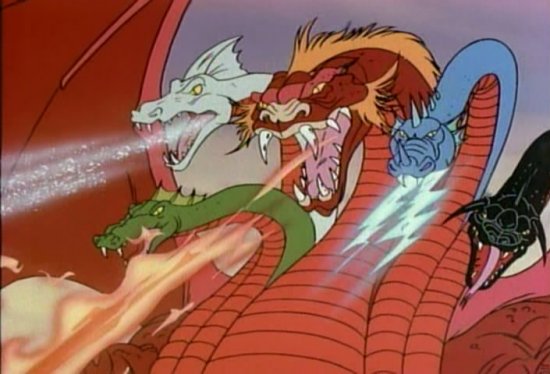
Tiamat is the Queen of Primordial Chaos, rival of the Demogorgon and mother of all monsters, but especially dragons, serpents, merfolk and scorpion men. Defeated by Marduk, her corpse (i.e. unadulterated chaos) became the building blocks for the lawful cosmos. When she appears, Tiamat takes the form of a five headed dragon with the breath weapons of an ancient blue, red, white, black and green dragon. She can cast spells as a 12th level magic-user and 15th level cleric and can control undead and demons as a 15th level cleric.

The Coming of the Alpha Cetaceans

When paleontologists unearthed the giant skull from the alkaline soil of central Nevada, they at first believed they had found the skull of a prehistoric whale, for the famous deserts of Nevada were once covered by a shallow sea. Little did they imagine they had found the proof that Earth had been visited long ago by a race of giant aliens, or that they were due for a re-visitation.

The Alpha Cetaceans come from a massive, damp, wooded planet in the Alpha Ceti system. They stand roughly 40 feet tall and have a thick, stocky build. Their skulls are topped by a massive bone crest that acts as an “aerial” for their psychic powers. For millions of years the highly advanced Alpha Cetaceans have roamed the universe as self-appointed chroniclers of history and arbiters of the fitness for survival. When they visited Nevada 250 million years ago, they found the primitive life forms remarkable for their variety and entered into their logs a notation of the likelihood of intelligent life that might one day rival them evolving. This, of course, necessitated a scheduled re-visit for a possible extinction event. Among the Alpha Cetaceans was one scholar Leiru, who attempted to destroy the expedition that life on Earth might progress unmolested. For this, she was killed by her fellows and left to rot under the shallow sea.

When exploring, the Alpha Cetaceans wear suits of battle armor in vibrant colors (blues, yellows, purple, greens) that reflect their heritage and scholarly achievements. Besides their psychic powers, they are armed with massive energy lances.

LVL 8 | PH 10 | MN 12 | DC 16 | SPD 2 | XP 10000
ATK Energy Lance (3d6, 100’ range) or slam (2d6)
POW Analyze, Command, Commune, Locate, Read Minds, Sending, Telekinesis
GEAR Heavy Armor (Levitate, Shield), Energy Lance (Energy Bolt)

Image depicts a blue whale skull turned on end. From an image roundup at Super Punch.

Monsters of Mu-Pan III

Taking a day trip to a date farm today, and next week I’m spending a couple days at Disneyland, so posting will probably be light. Getting closer to being finished with NOD 8 and Mystery Men! – excited about that. Hopefully some glimpses at the finished pages of Mystery Men! soon.

Gyuki – Ox-Ogre (Japanese)
Hit Dice: 8
Armor Class: 1 [18]
Attack: Gore (1d8), 2 pincers (1d8)
Saving Throw: 8
Special: Magic immunity, resistance to damage (10%)
Move: 12
Alignment: Neutrality
Challenge Level/XP: 9/1100

Ox ogres appear as massive crabs with the heads of oxen and the tusks of elephants. They dwell in coastal waters and only emerge to hunt.

Kasha (Japanese)
Hit Dice: 5
Armor Class: 3 [16]
Attack: 2 claws (1d4), bite (1d4)
Saving Throw: 12
Special: +1 or better weapon to hit, magic resistance (20%), stun, surprise on a roll of 1-2 on 1d6
Move: 15
Alignment: Chaos
Challenge Level/XP: 9/1100

Kasha are cat demons that prowl the fringes of civilization in search of funeral processions. When they find one, they leap from the underbrush and sieze the corpse, dragging it into the forest to devour it. The ferocity of the attack is such that, provided the kasha achieves surprise, all in attendance must succeed at a saving throw or be stunned and unable to act for 3 rounds. The kasha is exceptionally difficult to track. Kasha make their lairs in burrows beneath dead pine trees. They decorate their lairs with the jewelry and funeral shrouds of their meals. The soul of a devoured corpse cannot enter the afterlife and thus wanders the woods in which the kasha makes its home as a ghost until the kasha is destroyed.

Ninja (Japanese)
Hit Dice: 2
Armor Class: 4 [15]
Attack: Strike (1d4) or Weapon (1d6)
Saving Throw: 16
Special: Death attack, stun, spells
Move: 15
Alignment: Neutrality
Challenge Level/XP: 6/400

Ninjas are humans that have trained themselves in the arts of stealth, assassination and illusion. When encountered on the job they wear black clothing, hoods and masks. Ninjas have all the abilities of assassins, including the assassins’ death attack, the ability to make a stunning attack as a monk and the ability to cast phantasmal force and ventriloquism.

Ninjas are armed with shuriken and wakizashi. They might also carry hankyu. Ninjas also carry a collection of powders that they can blow into their enemy’s faces. These powders can be used to blind an opponent, cause itching and sneezing (-2 to AC and to hit) or sleep (as the spell) unless a saving throw is made.

Groups of four or more ninjas are led by a 3 HD genin. If a clan is encountered, there is one genin per 10 ninjas. The clan is led by an 5 HD jonin with the ability to cast invisibility and obscuring mist. He is assisted by a 4 HD chunin with the ability to cast obscuring mist. Both jonin and chunin are capable of flipping out once per day, gaining a +2 bonus to hit and damage.

Shamshir
Hit Dice: 3
Armor Class: 4 [15]
Attack: 4 weapons (1d6) or bite (1d3 plus poison)
Saving Throw: 14
Special: Poison
Move: 15/12 (climbing)
Alignment: Neutrality
Challenge Level/XP: 5/240

The shamshir are a strange humanoid people who combine mammalian and reptilian characteristics. They have four arms and pale scales speckled with electric blue and long hair that ranges from white to gray to aquamarine. Shamshir have humanoid faces with poison sacs in their checks.

Shamshir can replace one weapon attack with a poisonous bite that deals 1d3 damage plus an additional 1d6 damage if the victim fails a saving throw. Because they are so quick, they rarely wear armor. They arm themselves with longbows and katana.

Shamshir tribes are ruled by princes called shatyas. Shatyas usually have 4 to 8 levels in bujin. Shatyas are guarded by level 2 to 4 bodyguards.

Common Names: Aehvel, Aisfimies, Alshsis, Bishl, Bisihism, Clihih, Csisei, Dieshm, Flivsi, Gesisi, Gilih, Hilxishessi, Ilxeh, Ji-Ahh, Kisssi, Melesiees, Ofesh, Oszissie, Qeehvis, Rielesi, Rissi, Sphisei

Image of shamshir by Jason Sholtis of Underworld Ink. I cannot recommend him highly enough!