Back from Vacation

After a week away from work (the real job), I’m back delving into the wonders of the Las Vegas real estate market. Over the past nine days, I managed to almost finish NOD 29 and got some heavy work done on my World War II supplement to GRIT & VIGOR. I also watched some B-movies, did some yard work, got the hard copy of MYSTERY MEN! Second Edition created and ordered a proof copy (it’s going to be in color), found some cheap old AD&D artifacts at a used record store, watched my daughter in her first Shakespeare play (she played the nurse in Romeo & Juliet) and didn’t shave.

I also didn’t do any blog posts, though I did keep in touch with the gaming community via Google +. For those who didn’t see that, I present two characters for GRIT & VIGOR, one a character from an old movie, the other an actor. For those who did, I’ll throw in a third character – a dangerous lady.

Vince Kane – A Character You Probably Do Not Know

Vince Kane is the main character in an old George Raft picture called A Dangerous Profession (1949). It’s not a great movie, but a movie doesn’t have to be great to inspire usable game material. The beauty of B-movies and simple stories is that they’re usually easier to adapt into modern game scenarios. Much of what makes a movie great – strong characterizations, interesting character relationships, etc. – does not always translate well into a game, or at least should come from the interaction of the players and game master, rather than be programmed and forced on everyone. A good game often revolves around a good plot that is not too hard to follow, since players are usually grasping around in the dark during game play. Vince Kane is also an interesting idea for an detective who isn’t technically a professional detective, much in the way that Matlock and Perry Mason are detectives who are technically lawyers.

Vince Kane is an ex-cop turned bail bondsman. Things heat up when a buddy of his from the police force, Lt. Nick Ferrone (played by Jim Backus) picks up Claude Brackett, who skipped bail a few years back for an embezzlement charge. Checking Brackett’s room, Kane discovers that he’s in town with the woman who broke his heart, who turns out to now be the embezzler’s wife, Lucy Brackett. When Claude Brackett turns up murdered, Kane investigates and discovers a web of lies.

N Private Eye, LVL 8, HP 36, AC 11, MV 40, ATK +5, SV F12 R7 W9

Str 10 Int 12 Wis 15 Dex 14 Con 13 Cha 8

Special: Detect clue (2 in 6), detect lie (4 in 6), get a clue from Venture Master, back stab, note concealed items, +2 save vs. fear

Knacks: Cant*, Influence People

Skills: Cant*, Crack Code, Gather Intelligence, Hide in Shadows, Listen at Doors, Move Silently, Search, Sleight of Hand and Track (humans only)

Feats: Grappler, Iron Will, Lighting Reflexes

* Cant in this context is the tough talk of old Hollywood gangster movies

Hoot Gibson, A Man More Interesting than His Characters
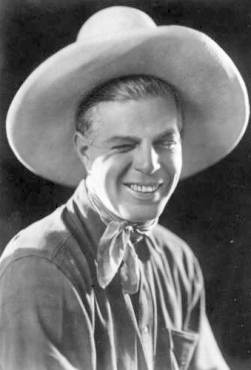
Now we shift from a character to a real person who was, himself, quite a character. It’s not too often you come across an actor’s biography which is more interesting than the characters he played. Hoot Gibson is one of those fellows.

Hoot started riding horses as a boy in Nebraska, and after the family moved to California he started working on ranches. He showed a talent for it, and soon started competing in rodeos, winning several honors. It was during his rodeo days that he started acting in silent movies. After a stint as a sergeant in the Tank Corps in World War I, he went back to rodeo and movies, usually as a bit player and stunt rider. In 1922, when demand was high for cowboy pictures, he moved into starring roles and made a whole slew of pictures. Hoot also learned to fly planes and even got injured in a crash while racing planes.

Like I said, he was an interesting fellow.

N Cowboy/Fighter, LVL 7/3, HP 39, AC 12, MV 40, ATK +4, SV F9 R8 W12, Str 13 Int 9 Wis 11 Dex 16 Con 13 Cha 13

Special: +2 save vs. trample attacks, rope (add half horse’s HD to lasso attacks), select exceptional horses, surprised 1 in 8, no penalty when grappling large animals, extra attack against opponents with fewer HD

Knacks: Don Disguise, Handle Animals, Pilot Aircraft

Skills (Cowboy): Appraise value (livestock), endure, gamble, handle animal, jump, ride mount, survive outdoors, track

Skills (Fighter): Bend bars, break down doors, endure, gunnery, jump, lift gates

Feats: Dodge, Knack, Pugilist

Weapons: Colt Single-Action Army (1d6), Winchester M1894 repeating rifle (2d4)

Ma Barker

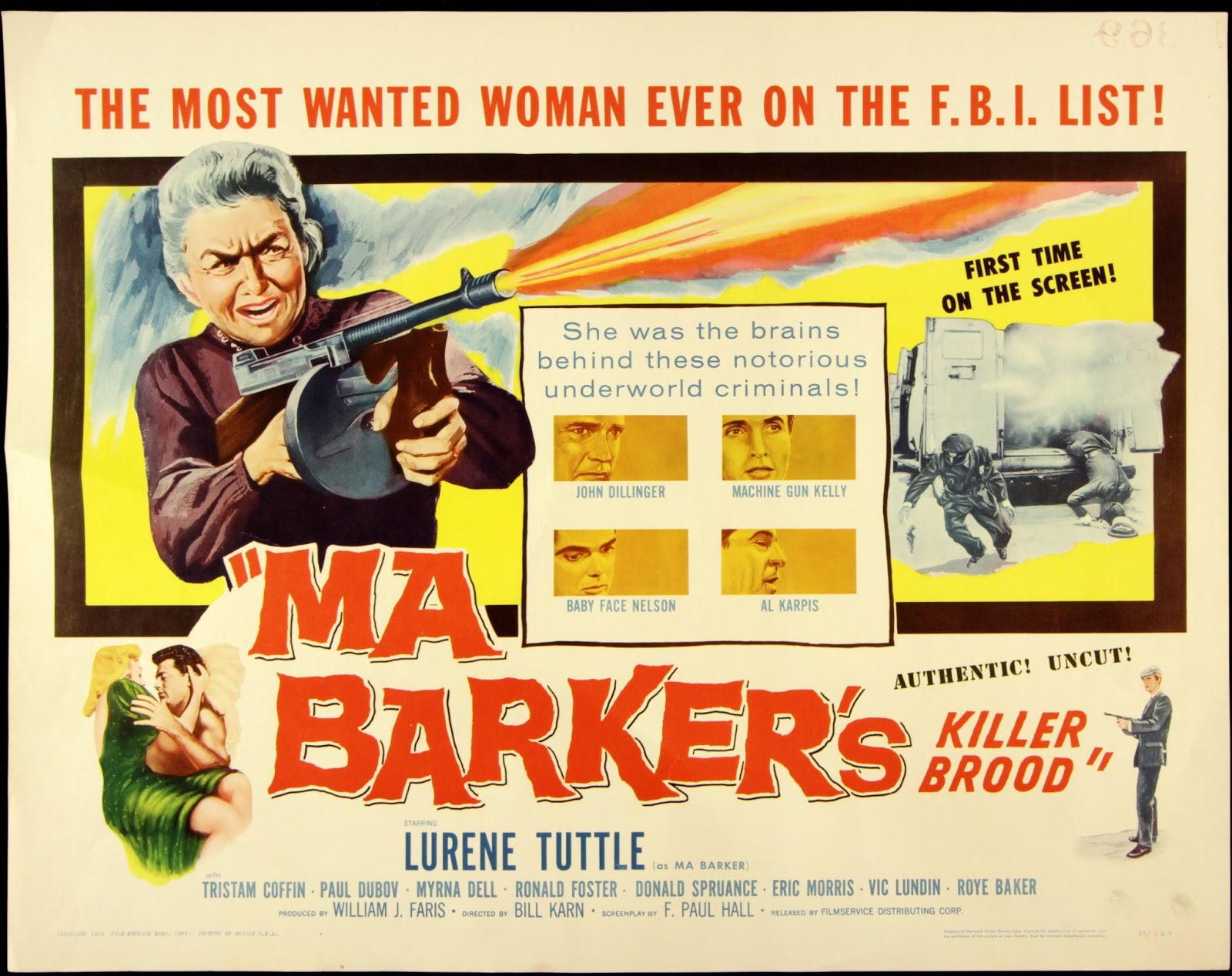
I don’t know how much cache’ the gangsters of the Depression have these days with the young people, but they once had a standing approaching folk heroes. Bonnie and Clyde, ‘Baby Face’ Nelson, John Dillinger, etc. And then there’s Ma. Ma Barker. Ma Barker had four criminal sons, Herman, Lloyd, Arthur and Fred, and served as their ring leader … or did she?

From the sound of it, Ma Barker as criminal mastermind of her sons’ foul play is the bunk. One gangster, Alvin Karpis, described her as “superstitious, gullible, simple, cantankerous and, well, generally law abiding.” She was clearly an accomplice in the criminal activities of the gang, helping them before and after crimes, but probably was not the gun-totin’ mama of popular culture. When J. Edgar Hoover described her as “the most vicious, dangerous and resourceful criminal brain of the last decade”, he was probably full of shit. I know – J. Edgar Hoover, an agent of the federal government – lying is hard to believe.

But in GRIT & VIGOR, when truth isn’t stranger than fiction, we slap it around a little until it is. Our Ma Barker is the gangster of the movies, engaging in gun play and maybe even chomping on a cigar while her minions rob banks.

NE Rogue, LVL 8, HP 28, AC 10, MV 40, ATK +5, SV F12 R9 W10, Str 8 Int 15 Wis 13 Dex 11 Con 11 Cha 12

Special: Backstab for +2d6 damage, note concealed items

Knacks: Gather Intelligence*, Treat Injury

Skills : Appraise Value, Cant, Don Disguise, Gather Intelligence*, Hide in Shadows, Influence People, Listen at Doors, Move Silently

Feats: Exploit Weakness, Improvise, Iron Will, Leadership

Weapons: Thompson sub-machine gun (1d6)
Your Kung-Fu Could be Better …

When writing GRIT & VIGOR, I wanted to include some martial arts. You can’t very well have manly adventures without a few face kicks and quivering palms. To that end, there is a sub-class of fighter called the boxer which is, essentially, the monk class without the supernatural abilities.

Since the game uses feats, I decided to create several feats to simulate different styles of martial arts. All of them have prerequisites, of course, but could probably be taken by 6th level or so. Here’s a little preview of the martial arts master feats. You might find them handy in your game if it uses feats or something similar, or perhaps you could adapt them as special abilities for a martial artist class in your game.

Aikido Master

Prerequisites: Int 13+, Pugilist (or Boxer), Dodge, Expertise

An aikido master can sacrifice his own attacks against a grappled opponent to lock them into combat. Each round, the aikido master makes an attack roll, noting the total. To break the lock, the aikido master’s opponent must make an attack roll with a result higher than the aikido master’s Armor Class and higher than the aikido master’s attack roll. If he fails, he may not move or attack anyone else. If he succeeds, he may either count the attack towards the aikido master and deal damage as normal, or instead move or attack another.

Bagyazhang Master

Prerequisites: Con 13+, Pugilist (or Boxer Class), Great Fortitude, Iron Will

The baguazhang master adds his Constitution bonus to his Armor Class and to Reflex saving throws. This is in addition to his Dexterity modifier, not in place of it.

Bartitsu Master

Prerequisites: 13+, Pugilist (or Boxer), Dodge, Look Smart

When the bartitsu master gets his opponent into a grapple, the opponent must pass an Endure task check each round the grapple is maintained or succumb to pain and fall unconscious for 1d4 rounds.

Capoeira Master

Prerequisites: Dex 13+, Pugilist (or Boxer Class), Brawler, Lightning Reflexes

When fighting three or more opponents, a capoeira master may make one free trip attack per round, in addition to his normal attack, against one of those opponents.

Jujutsu Master

Prerequisites: Int 13+, Pugilist (or Boxer), Expertise, Trip

When using the throw or trip combat maneuvers, a jujutsu master adds his opponent’s strength bonus to his own strength bonus when rolling his attack roll.

Karate Master

Prerequisites: Str 13+, Pugilist (or Boxer Class), Cleave, Power Attack

Karate masters deal triple damage with critical hits when making an unarmed attack. Items rolling a saving throw to avoid being destroyed by a karate master do so at a -2 penalty.

Savate Master

Prerequisites: Str 13+, Pugilist (or Boxer Class), Brawler, Power Attack

When a savate master makes a successful unarmed attack against an opponent and rolls a critical hit, the opponent is stunned for one round or knocked prone (player’s choice) in addition to suffering damage.

Taekwondo Master

Prerequisites: Attack bonus +2 or higher, Pugilist (or Boxer Class), Flying Kick

You can make an unarmed attack against an opponent that is behind you at no penalty, or strike two flanking opponents by rolling an attack against each and splitting your attack bonus between them.

T’ai Chi Ch’uan Master

Prerequisites: Dex 13+, Pugilist (or Boxer), Dodge, Iron Will

When a t’ai chi ch’uan master is attacked in combat and missed, he may force his opponent to pass a Reflex saving throw or be grappled, or a Fortitude saving throw or be pushed back 5 feet.

Wing Chun Master

Prerequisites: Dex 13+, Pugilist (or Boxer Class), Dodge, Great Fortitude

Wing chun masters may re-roll failed saving throws made to resist combat maneuvers.

Xing Yi Quan Master

Prerequisites: Str 13+, Pugilist (or Boxer Class), Look Smart, Power Attack

When a xing yi quan master uses his power attack feat against an opponent at +3 to damage and -3 to hit and successfully attacks, he stuns his opponent for 1 round.

The Hierarchy of Materials

Machines are a pain in the butt.

Well, really, they’re a challenge, and challenges are half the reason to design a game.

The challenge in this case is dealing with 100 years of machine technology in a systematic way that allows one decade to flow into the next in a rational way that permits gameplay.

The specific challenge I’ve been playing with is Armor Class. Armor Class and attack rolls and damage rolls work – they’re an abstract way to deal with combat between individuals and they’ve managed to produce fun gameplay for a long time. I don’t want to rock that boat. There are some functional limits, though, that become apparent when you have to allow for a system that runs from “man in loincloth” to modern tank with 12 inches of steel armor.

Functionally, an attack roll involves rolling a d20, which gives you a maximum roll of 20. Characters in the sweet spot of levels are going to bring maybe a +4 or +5 to their attack rolls. High strength or dexterity adds another +3. Side factors throw in a +2 or +4 bonus to hit. The result: You’re not going to get many attack rolls higher than 30. Sure, at high levels, with everything on your side, maybe you roll a 40. But – and this is key – tanks were destroyed by guys with, reasonably, 1 or 2 Hit Dice all the time in World War II. A tank shouldn’t require a “40” attack roll to inflict damage.

So what do we do with that 12″ armor?

Well, damage reduction makes sense. This allows us two mechanisms to govern the ability to damage objects (and hit points lends a hand as well). Now, we don’t need super high Armor Class. We can have manageable Armor Class ratings, supplemented by Damage Reduction that makes sure certain classes of weapons cannot destroy certain objects. A fighting-man shouldn’t be able to sink the Bismark with a revolver, no matter how high his level is.

My first attempt at damage reduction was based on two factors – what is the object’s skin/hull made of, and how thick is it. I came up with some arbitrary values and used them as a place holder. Steel armor, for example, would provide 20 points of damage reduction per inch. Wood would be 5 points. Most other metals 10 points, etc. Simple enough, but maybe not realistic. With damage reduction in play, I needed to deal with the amount of damage inflicted by weapons.

Once again, a system was involved – in simple terms, rating firearms on the energy they were putting into their projectiles and turning these ratings into damage figures. Once again, I had a system that needed to take into account everything from slings to super-cannon, and now I needed it to interact intelligently with damage reduction. Obviously, some of these values were getting pretty big. Tanks were rolling around with 240 points of damage reduction, which meant anti-tank weapons needed to reasonably deal more than 240 points of damage (quite a bit more, actually) to destroy them. How does one roll upwards of 400 points of damage? That could take more than 60 d6, or about 20d20. That’s a lot of dice!

I won’t bore you with the details of the calibrations – and I’m honestly not done with all of them yet – but I did come up with a plan to simplify things.The point of my using damage reduction was to make sure that certain weapons were going to be ineffective on certain machines. In the real world, this isn’t just about how hard you’re hitting something, it’s also about what you’re hitting it with. This gave me the idea of a hierarchy of materials based on the strength of that material (or as near as I could figure it).

With this system, I decided that damage reduction would be 12 points per inch of material, regardless of the material. I chose 12 because it is easy to divide by 2, 3 and 4 (i.e. half-inch, quarter-inch, third-inch).

Using the hierarchy of materials, one compares the material being hit with the material doing the hitting. If they’re on the same “level”, or the hitter is at a lower level than the “hittee”, damage reduction applies as normal. If the hitter is one level higher in the hierarchy, use half the normal damage reduction value. If the hitter is more than one level higher, it ignores the damage reduction entirely. For every level lower, the damage reduction value is increased by 6 per inch.

Here’s the hierarchy I came up with (changes pending):

A. Kevlar
B. Tungsten
C. Steel (Hard, Armor), Titanium Alloy, Uranium (Depleted)
D. Mangalloy, Steel (Medium)
E. Cast Iron, Chainmail, Nickel Alloy, Spider Silk, Stainless Steel, Steel (Soft)
F. Aluminum, Bamboo, Brass, Copper, Fiberglass, Granite, Hard Woods (Ash, Hickory, Maple, Oak, Walnut), Nickel, Titanium, Wrought Iron
G. Bricks (Hard), Glass (Bulletproof), Lead, Limestone, Sandstone, Soft Woods
H. Bricks (Common), Concrete
I. Flesh

Let’s take an inch of steel armor (Class C). It has the following damage reduction values:

6 vs. Class B (tungsten projectiles)
12 vs. Class C (hard steel projectiles)
24 vs. Class E (cast iron, like old cannon balls)
30 vs. Class F (brass and copper, like many non-armor piercing projectiles)
36 vs. Class G (lead projectiles)
48 vs. Class I (Flesh, which sounds ridiculous until you realize you need to deal with things like Kaiju vs. tanks)

If we assume that adamantine is harder than tungsten, then we could say that steel armor has no damage reduction against adamantine. One could make that argument for magic weapons as well if they were using them in their game.

There’s still some work to do with this idea, and I’ll probably alter the hierarchy before I’m finished, but I think this is a simple, workable system that will make that campaign involving Hitler invading Mars as viable as one that just involves a small band of French resistance fighters committing acts of sabotage and espionage during World War II. The main idea is not to build a complex war game that takes every possible contingency into account, but rather to make a system that makes fighting tanks in Grit & Vigor not much more complex than fighting purple worms in Blood & Treasure.

Grit & Treasure (Blood & Vigor?)

German warbird, or …

Work proceeds on Grit & Vigor. The last couple weeks have been spent gathering vehicle data, turning it into something useful, and brainstorming the rules for dogfights, car chases and inventions.

On the vehicle front, I now have data for about 1,400 tanks, cars and airplanes, and believe I have found a way to turn the raw data into game data. Just for fun, I thought I might throw out some comparisons between military vehicles from the olden days and Blood & Treasure monsters. Obviously, I need to look at some heavyweights.

THE MONSTERS

The Neothelid – 25 HD wrapped up in acid-dripping, tentacled horror. Imagine it going toe-to-toe with a Russian T-18 tank. The tank is easier to hit, but can absorb some damage and deal it pretty well.

T-18: Huge Construct (Tank), HD 25 (88 hp), AC 19 (DR 6), SPD 10 mph (140), ATK 1 tank gun (8d8) and light machine gun (1d8), MVR +0, CP 2/0, WT 13,000 lb.

… fantasy robot – who would win in a fight?

The Balor Demon – 20 HD of demonic fury, roughly equivalent to a Curtiss P-40 Warhawk. The Warhawk can deal more damage with its six heavy machine guns, but the Balor isn’t affected by such mundane weaponry. Better load that Warhawk up with magic bullets.

Curtiss P-40 Warhawk: Huge Construct (Fighter), HD 20 (70 hp), AC 16, SPD 360 mph (5280), ATK 6 heavy machine guns (2d6) and bombs (1000 lb), MVR +2, CP 1/0, CEILING 29,000 ft., WT 8,400 lb.

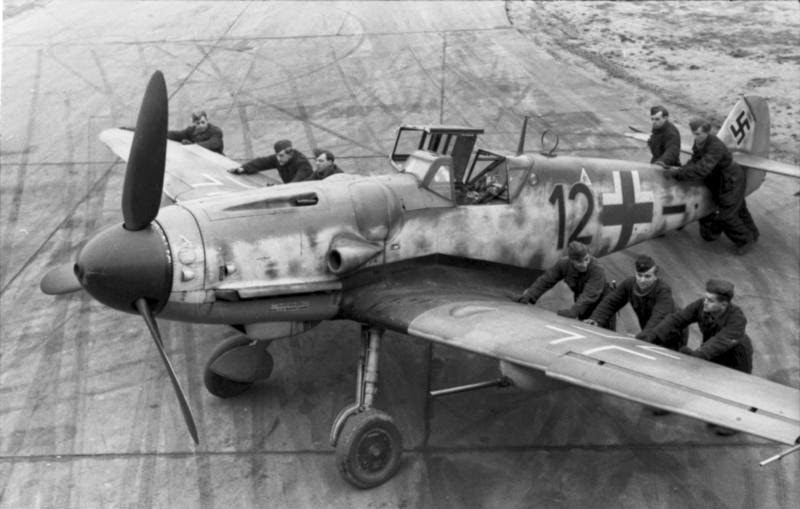
The Iron Golem – 18 HD of heavy metal death, the equal of Messerschmitt Bf.109 – though let’s be honest, one good strafe or bomb drop, and the iron golem’s iron hide and its vaunted magic immunity is going to go up in smoke.

Messerschmitt Bf.109: Large-X Construct (Fighter), HD 18 (63 hp), AC 16, SPD 398 mph (5830), ATK 2 heavy machine guns (2d6) and 1 medium machine gun (1d8) and bombs (550 lb), MVR +3, CP 1/0, CEILING 39,000 ft., WT 6,940 lb.

A few notes on the vehicles:

Size is based on weight (and how interesting would that be to do with all the monsters?). I used the full d20 scale (I only used Small to Huge in B&T), and added half-steps in. Size determines Hit Dice.

CP refers to crew and passengers. The crew is going to be making the attacks for the vehicle, so it’s their attack bonus that counts when firing their weapons.

The weapons here are generic, and the final stats will include their ROF and range. ROF works into the gun rules, with each addition round you fire at a target either increasing your chance to hit by +1, or contributing to an additional 1d6 damage at a rate of 5 rounds to 1d6 damage – player’s choice and they can mix and match (e.g. an extra 20 rounds of ammo can translate into a +20 bonus to hit, or +4d6 damage or something in between, like +10 to hit and +2d6 damage). The bombs I still haven’t decided on, but probably going to be treated as something like a fireball spell – damage dice and radius based on the poundage, with people and items passing saving throws to halve the damage. The game is really designed more for man vs. man, rather than man vs. B-17 Flying Fortress.

Speed is the vehicles top speed, in miles per hour and, in parentheses, feet per round. For car chases, I’m working out a system that uses top speed as a determinant for the difficulty of stunts, to make it easy for referees and players to create stats for vehicles without having to know much about them other than their weight, their style and their top speed.

Armor Class is based on the material of the vehicle’s skin, as well as its thickness. Size plays a part as well. Damage reduction (DR) is based on the thickness of the armor, since I needed a way to screen the tanks from weapons that, by right, shouldn’t be able to penetrate their armor.

MVR is maneuverability, which is based on the vehicle’s type and its power to weight ratio.

Not a perfect system, I know, but I think it will work well enough for game purposes. My focus is on three systems – aerial combat (aircraft vs. aircraft), car chases and a nod towards aircraft attacking land vehicles. G&V isn’t designed as a wargame, but the combat rules should be able to handle something as basic as two tanks plugging away at one another.

Oh, and just for fun …

Burrough’s Barsoom Scout Flyer: Large Construct (Fighter), HD 11 (39 hp), AC 20, SPD 300 mph (1460), ATK none, MVR +3, CP 5/0, CEILING 11,000 ft., WT 1,500 lb.

Nemo’s Nautilus: Colossal x5 Construct (Submarine), HD 250 (875 hp), AC 22, SPD 40 mph (580), ATK 1 ram, MVR -1, CP ???, DEPTH 52,000 ft., WT 1,500 tons

Well’s Martian Tripod: Huge-X Construct (Tank), HD 31 (109 hp), AC 22, SPD 10 mph (140), ATK 1 heat ray (10d6 fire) and black smoke projector (as cloudkill?), MVR +1, CP 1/0, WT 20,000 lb.

Martian Tripod vs. Balor – now that’s a fight I would pay to see!

Grit & Vigor Update

G&V had been languishing. I was finishing the Monster Tome, of course, so I was busy, but the game just wasn’t gelling for me. And then POW – a kiss on the forehead by a muse who either looked like a Gibson Girl or Teddy Roosevelt (hopefully not both), and instead of finishing work on the latest issue of NOD, I’ve been messing with G&V night and day. For those who might be interested, a few thoughts …

#1 – I’m focusing the main rules on the period from 1850 to 1959 – a century of manly exploits. The “adventures” section, as well as covering different genres of play (espionage, sieges, exploration, scientifiction) and sub-rules useful for those kinds of adventures, also covers each decade between 1850 and 1960, with major event (wars, assassination, inventions, discoveries) and literature and film from those years, and with stats for important firearms, vehicles and other goodies from that year as well. I’m going to include – though I haven’t yet – a brief description of popular settings for manly adventures – Chicago, New York, Los Angeles, Paris, London, the Amazon, the Congo, the American Southwest, the Yukon, etc.

#2 – The character stuff is pretty well finished. I played around with using backgrounds as a stand-in for races, but then decided against it. Why? When I tried to imagine different famous characters or actual people using those backgrounds, I found them too restrictive. In their place, people now roll up a background randomly, initially focusing on making their character a School Boy, a Boy of the Streets, a Working Boy or a Cadet. The tables you roll on, though, can send you in different directions – the Boy of the Street, for example, might be taken in by a rich old woman and sent to school. This makes a character’s background a bit more interesting and varied.

#3 – I struggled with classes – too many, too few, etc. At one point, I devised a method where levels were earned with experience, and with each level, adventurers could choose a new feat. These feats were classified as scholarly, martial, underhanded and rugged, and a character’s class, at a given level, was based on in which category the majority of that character’s feats were classed. So, if most of your feats are martial, you’re a fighting man. You roll hit points with a d10, and you attack as a fighting man of that level, etc. If two levels later, most of your feats are underhanded, you’re now a rogue, etc. This ultimately didn’t work for me, though I might include it as an option. Instead, there are four major classes, and then sub-classes characters can qualify for if their ability scores are high enough. The classes are going to be kept fairly simple (maybe one or two special abilities), as they are done in Bloody Basic.

#4 – I’ve written some simple rules for guns, car chases and dogfights that I think will work, and otherwise am using the Blood & Treasure engine for task resolution and combat, with a couple added bits and pieces.

#5 – I’m about half-finished with the “monster” section, which mostly focuses on animals and human beings, but includes some more fantastic or science-fiction fare as well. Since the game is compatible with Blood & Treasure, you can introduce anything from one into the other. About the only thing I’m changing is to measure distance in Grit & Vigor with yards rather than feet – it helps with the longer ranges and faster speeds of things like cars and guns.

There’s still plenty of work to do, and this weekend I really need to focus on finishing up some blog posts and getting some more work done on NOD 26, and I need to finish up Blood Basic – Contemporary Edition. But give me a month or two, and I think G&V will be ready for a playtest on Google+. If you’d like to be involved in this playtest, leave a comment here or find me on Google+. The intro adventure will either be “Taft Must Die!” or “Against the Thugee”. Hopefully, it will be on sale in 2015. When it is, I plan on using the G&V engine to finish up 1800 American Empires, Apocalypse 1900, and revisions of Space Princess and Mystery Men! (yeah, I know). I’d also like to revise Pars Fortuna using the Blood & Treasure engine and with much more art.

The Evils of Drink and Other Intoxicants

From Wikipedia

A little preview of GRIT & VIGOR here for you. When you base a game on manly exploits of the olden days, you have to put some thought into rank drunkenness and other intoxicating past times. How can you run a Victorian-era game without using an opium den as a set piece, and how can you run a game set in the Old West without a drunken brawl in a saloon? You can’t – it’s somewhere in the bylaws I think – and so you need some rules to cover intoxicants and their effect on the human body (specifically, the PC’s bodies and those NPC bodies they’re going to be clashing with).

Why I never thought of writing these rules for Blood & Treasure, I don’t know, but they would work for that game and most other old school games I should suppose. Obviously, the rules are kept simple and abstract – they’re meant to take up a column of the rulebook, not a chapter – but I think they’ll do the job.

INTOXICANTS

Strong men often crave strong drink to dull the pain of living, or to celebrate a hard-fought victory. Of course, alcohol isn’t the only intoxicant a man or his enemies might use. Intoxicants are treated as poisons, and thus require a Fortitude saving throw to resist. They come in three broad varieties: Depressants, stimulants and hallucinogenics.

Intoxicants are also given two levels of efficacy – mild and strong. A strong substance not only has a greater effect than a mild one, and it imposes a -10 penalty to save against it.

The dosage of intoxicants varies widely, so use your best judgment. Mild intoxicants have a duration of 1d6 turns, while strong intoxicants have a duration of 1d6 hours.

If a character already under the effects of a mild intoxicant takes another dose and fails his saving throw, treat him as though he has taken a strong intoxicant.

Each time a character falls prey to the effects of a mild intoxicant, there is a 5% chance they will develop an addiction to that intoxicant (rules for that to follow). Strong intoxicants have a 10% chance per use of causing addiction.

MILD DRUG EFFECT

Depressant: -2 penalty to sensory task checks and balance and tumbling task checks, -2 penalty to AC and to all attack rolls, 10% chance per hour of falling asleep

Stimulant: -2 penalty to all wisdom=based task checks and Will saves and saves vs. sleep effects, +2 bonus to all other saving throws and to attack, -2 penalty to AC

Hallucinogenic: Confusion (there would be a page reference here in the rulebook, but if you’ve played ye old fantasy rpg, you know what confusion does)

STRONG DRUG EFFECT

Depressant: -4 penalty to sensory task checks and balance and tumbling task checks, -4 penalty to AC and to all attack rolls, 10% chance per turn of exhaustion of falling asleep

Stimulant: -4 penalty to all wisdom-based task checks and Will saves and saves vs. sleep effects, +4 bonus to all other saving throws and to attack, -4 penalty to AC, suffers 1d6 points of damage to body per hour of duration, after duration the character is left fatigued for equal duration

Hallucinogenic: Confusion, with a 10% chance that the condition is permanent

Some common intoxicants include the following:

Alcohol: Mild or strong depressantAmphetamine: Strong stimulant
Caffeine: Mild stimulant
Cannabis: Mild depressant and Hallucinogenic
Cocaine: Strong stimulant
Heroine: Strong depressant
LSD: Strong hallucinogenic
Mescaline: Strong hallucinogenic
Morphine: Strong depressant
Mushrooms: Mild or strong hallucinogenic
Nicotine: Mild stimulant
Nitrous: Oxide Mild hallucinogenic
Opium: Strong depressant

ACTION X is dead … Long live GRIT & VIGOR

Cover art by George Bellows

I tried. So help me I tried. But I just couldn’t get into the thing.

The idea was to do to the Modern SRD what I did with the fantasy SRD – i.e. turn it into a modern version of Blood & Treasure. The problem – I just couldn’t find the hook, the energy, the right feel that would make the thing gel. It’s tough to make something good if you don’t love it, you know.

And then the revelation.

I was musing on what kind of RPG Ron Swanson would play. I know – ridiculous – but an hour on a treadmill can send the mind into all sorts of odd places. Of course, the answer is that Ron Swanson wouldn’t play an RPG. He is, however, the closest thing modern America has to a folk hero, and symbolic of a movement by modern men to get in touch with their roots. I needed a subject that I found interesting, fun and inspirational – and by Ron Swanson’s mustache, the manly adventure of yesteryear was going to be it. Surviving in the wilds, steering tall ships, plunging into the mysterious corners of the globe in search of loot, hunkering down in a trench, preparing to dash into the oncoming bullets of the hun! – that was the ticket.

So, Action X is dead, may it rest in peace. I’m replacing it with GRIT & VIGOR – BOLD VENTURES FOR RUGGED FELLOWS. I’ve been writing the crap out of it for the last week, and think I can begin play-testing it on Google + in January and publishing it sometime in the Spring or Summer.

GRIT & VIGOR draws on the literature of Kipling, Conan-Doyle, Conrad, Hemingway, REH, London, Burroughs and their ilk. It’s about larger than life men going on adventures in search of money, power and freedom. Yes, women can play G&V – either as male characters (it is role playing, after all), or by flipping all the pronouns in the book from masculine to feminine – any woman worth her salt will do anything she likes with my game rules – she doesn’t need me to give her permission or molly-coddle her.

A FEW SPECIFICS

Characters, also called “rugged individualists” in G&V, do not belong to a permanent “class”. Special abilities, skills and weapon proficiencies are handled with feats. You get several at first level, many of them are rolled randomly on one of four tables meant to represent your character’s background (you can Go Rogue, Go to School, Go to Work or Go to war), though the referee could allow players to simply choose them if they preferred. All of the feats are given one of four classifications – Mental, Martial, Red-Blooded and Underhanded.

Whichever of those categories the majority of your character’s feats fall into determines your character’s “class” at that level, with their class determining what dice they roll for hit points, and what ability scores they can boost at levels 4, 8, 12, 16, etc. So, at 1st level, a character with mostly Martial feats is classed as a Fighter, and rolls 1d10 for hit points. By level 3, he may have more Red-Blooded feats than any other, so now he’s classed as a Daredevil that rolls d8 for hit points. Other than that, attack bonuses and saving throws are the same for everyone, though they are modified by ability scores and feats.

Combat, saving throws and task checks work as they do in Blood & Treasure, as do hit points, Armor Class, ability scores, etc. Aerial combat and vehicle rules will be included, of course. Psychic powers are included in the game, but are optional. For opponents, the game primarily uses animals and human beings, but a few monsters (vampires, werewolves, morlocks) are included as well for those who want a paranormal or science-fiction element in their game.

The game will also include what I’m calling an Almanac of Adventure. This will be a series of articles covering different time periods and genres that referees (Venture Masters) can use to build their campaigns. One might be “Wild West”, and will provide some tips and information relevant to that era, as well as any additional rules or equipment to run that setting. Another might be “Mystery”, and will discuss running mystery-oriented games. Hopefully you get the idea. There will also be “Steampunk”, “Atomic Super-Science”, “The Jazz Age”, etc.

I’d also like to include an element of taking the manly virtues expounded on in the game and applying them to one’s real life. Maybe XP awards for overcoming real life challenges that players can apply to their characters – a good chance for members of a gaming group to support one another outside the gaming table. Sounds corny, I guess, but I am corny so I don’t give a damn!

That’s the plan, ladies and gents. I’ll let you know when the playtesting is about to begin, in case you’d like to join in.

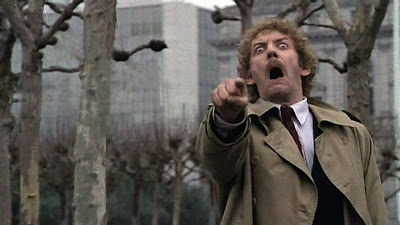
Invasion of the Pod Jellies

While writing the new hexcrawl, I scribbled these lovely fellows out and thought folks might find a use for them …

Several (3d4) large seed pods float in the ocean here, and might be seen (1 in 6 chance) by a vessel passing through this hex. The pods are about 6 feet long and consist of a very thick, green hide (Armor Class 18). The pods should be treated as having 20 hit points. They are vulnerable to fire, but immune to cold.

Within the pod, there is a strange, gelatinous life form that, through its mental powers, can understand and duplicate any sentient humanoid. Each pod jelly picks a single humanoid to make its own, using its ESP to choose a likely candidate, and each day absorbs a portion of their being (i.e. 1d6 points of constitution damage) while turning itself into a clone or replica of that person. The pod must be within 30 feet of its victim to do this, and victim receives a Will saving throw each day to resist the effect. When the original’s constitution is reduced to zero, the clone bursts forth from the pod and the original’s body disintegrates.

The pod jellies duplicate the original’s body (i.e. hit dice and physical ability scores) and mind (intelligence and charisma scores, though wisdom is never higher than 6) perfectly, knowing all they knew and having the same general special abilities. They cannot, however, exhibit emotion or faith, and emotion based powers (such as a berserk rage or a cleric’s divine powers), are duplicated and therefore they are not possessed.

POD JELLY
Medium Ooze, Chaotic (NE), Average Intelligence; Invasion (3d6)

HD 2
AC 16
ATK Touch (1d4 acid)
MV 20
SV F15 R15 W15
XP 200 (CL 3)

These are the abilities of a pod jelly in its native form, outside the protection of its pod-like shell and before it has taken on the form of a humanoid. In humanoid form, it loses its resistance to acid, though it retains its ESP ability and can still utter a psychic scream (i.e. psionic blast) once per day, though this takes the form of an actual shrill scream as well as a mental effect.

Special Abilities: Resistance to acid

Spell-Like Abilities: At will—Detect thoughts (ESP); 3/day—Psionic blast

I suppose I need to include them in ACTION X.

What’s more frightening, the psionic blast or that damn perm?


It’s a Nice Day for a White Wizard

Yeah, I should probably be shot for that title.

So, a couple days ago I posted a spell list for “black magicians” that was based on the supposed powers that the demons in De Plancy’s Infernal Dictionary could bestow upon a conjurer. In ACTION X, these magic-users, officially called black magicians or conjurers, are Charisma-based spellcasters, meaning they will make a charisma-based task check to cast spells.

The flip side of these folks are the white magicians, or theurgists, who are Wisdom-based. Same rules for spellcasting, but a different key ability and a different spell list. For the white magicians, I decided to delve primarily into reputed miracles, both from the Old and New Testaments in the Bible, and from what I could glean from the lives of the saints and a few notions tucked in from the druids. If you were running a campaign with somewhat Biblical clerics, you might find this list useful. I think it’s a pretty fun mix of God’s mercy and God’s wrath, and isn’t completely foreign to what is expected from a fantasy cleric.

FIRST LEVEL
1. Aid
2. Bless
3. Comprehend Languages
4. Control Light
5. Cure Light Wounds
6. Multiply Food and Water
7. Protection from Evil
8. Summon Nature’s Ally I
9. Sustenance
10. Turn Undead

SECOND LEVEL
1. Augury
2. Buoyancy
3. Calm Emotions
4. Consecrate
5. Cure Moderate Wounds
6. Detect Thoughts (ESP)
7. Gentle Repose
8. Levitate
9. Remove Paralysis
10. Speak with Animals
11. Summon Nature’s Ally II
12. Summon Swarm

THIRD LEVEL
1. Cause Disease
2. Create Food and Water
3. Cure Blindness/Deafness
4. Cure Disease
5. Cure Serious Wounds
6. Fly
7. Hold Person
8. Remove Curse
9. Summon Nature’s Ally III
10. Tongues
11. Water Walk

FOURTH LEVEL
1. Blight
2. Charm Monster
3. Control Water
4. Cure Critical Wounds
5. Divination
6. Flame Strike
7. Holy Smite
8. Restoration
9. Sticks to Snakes

FIFTH LEVEL
1. Awaken
2. Bilocation
3. Commune
4. Contact Other Plane
5. Healing Circle
6. Hold Monster
7. Insect Plague
8. Raise Dead

SIXTH LEVEL
1. Banishment
2. Geas
3. Move Earth
4. Wind Walk

SEVENTH LEVEL
1. Control Weather
2. Create Golem
3. Transmute Matter

EIGHTH LEVEL
1. Earthquake
2. Holy Aura

NINTH LEVEL
1. Astral Projection

NEW SPELLS

Bilocation – A trick of the saints and apparently noted in psychic phenomena, this is the ability to be in two places at once. I aim to make this a non-combat spell – the point would be to allow the magician to simultaneously accomplish two tasks.

Buoyancy – There is a tale of a miracle that involved making a metal object dropped into a river float to the surface.

Create Golem – A clay golem, to be precise.

Multiply Food & Water – This is based, obviously, on the loaves and fishes episode.

Sustenance – This would allow the magician to go without food and drink (and maybe sleep) without suffering any negative consequences.

Transmute Matter – In the Black Magic post, I mentioned Transmute Metal and Transmute Liquid. Since spells in ACTION X are not prepared ahead of time, creating scarcity and thus more challenging game play by multiplying the number of spells, it seems to me I might as well combine those spells into a Transmute Matter spell.

Turn Undead – Yes, in ACTION X it’s a spell.

Now, if we have charismatic Conjurers and wise Theurgists, who uses intelligence? Well, besides the non-magical brainiacs and hackers, it’s the psions of course. I’ll post the psion power list in a couple days.

De Plancy’s Spellbook

I’ve been working on the spells and psionic powers for ACTION X, and wanted to not only go a bit “lower magic” for the game, but also make it as realistic as one can make the supernatural. To that end, I decided to only use psionic powers that reputedly exist in the real world (fair warning – I don’t believe in psychic abilities). For magic spells, I decided to use two main sources, since the magician class has two lists of spells – black magic and white magic. The source for the black magic spells is de Plancy’s Dictionnaire Infernal and the powers the various demons were capable of granting to conjurers. For the white magicians, I looked at the miracles of the Bible and of the saints as well as the reputed powers of the druids.

Since lots of gamers are acquainted with de Plancy’s work, I thought the spell list I extracted from it would be of interest …

FIRST LEVEL
Audible Glamer
Burning Hands
Charm Animal
Charm Person
Command
Cure Light Wounds
Detect Evil
Detect Magic
Knowledge*
Light
Phantasmal Force
Protection from Evil

SECOND LEVEL
Augury
Calm Emotions
Charisma
Consecrate
Desecrate
Detect Thoughts (ESP)
Find Familiar
Improved Phantasmal Force
Intelligence
Invisibility
Numismatize*
Speak with Animals
Strength

THIRD LEVEL
Blindness/Deafness
Compel Return
Cure Blindness/Deafness
Cure Serious Wounds
Heroism
Hold Person
Locate Object
Putrify*
Rage
Reveal Secrets*
Speak with Dead
Spectral Force
Suggestion

FOURTH LEVEL
Cause Disease
Command Plants
Confusion
Cure Disease
Detect Lie
Divination
Fireball
Lightning Bolt
Modify Memory
Polymorph Other
Polymorph Self
Restoration

FIFTH LEVEL
Contact Other Plane
Control Winds
Feeblemind
Song of Discord
Teleport

SIXTH LEVEL
Find the Path
Legend Lore
Longevity
Transformation
Water Tell*

SEVENTH LEVEL
Control Weather
Raise Tower*
Transmute Liquid*
Transmute Metal*

EIGHTH LEVEL
Earthquake

NINTH LEVEL
Astral Projection

* New Spell

While most of the supernatural ability granted by these demons were easily converted into an existing spell, a few were not. I haven’t written these spells up officially yet, but the following will give you a brief idea:

Knowledge: Gives the conjurer expert knowledge in one particular skill.

Numismatize: Turns raw metal directly into coins.

Putrefy: Causes a wound to become ridden with worms and rot.

Raise Tower: Sort of a variation on the magnificent mansion spell; this one raises a stone tower with an armory full of weapons.

Reveal Secrets: Like ESP, only it plucks the secrets from one person’s mind and shares them with all people nearby.

Transmute Liquid: Transmutes one liquid into another, i.e. water into wine, wine into blood, etc.

Transmute Metal: Transmutes one metal into another, i.e. lead into gold.

Water Tell: Variation on stone tell; in de Plancy, one couldn’t talk to rocks, but they could talk to rivers.