Monsters of Space Princess

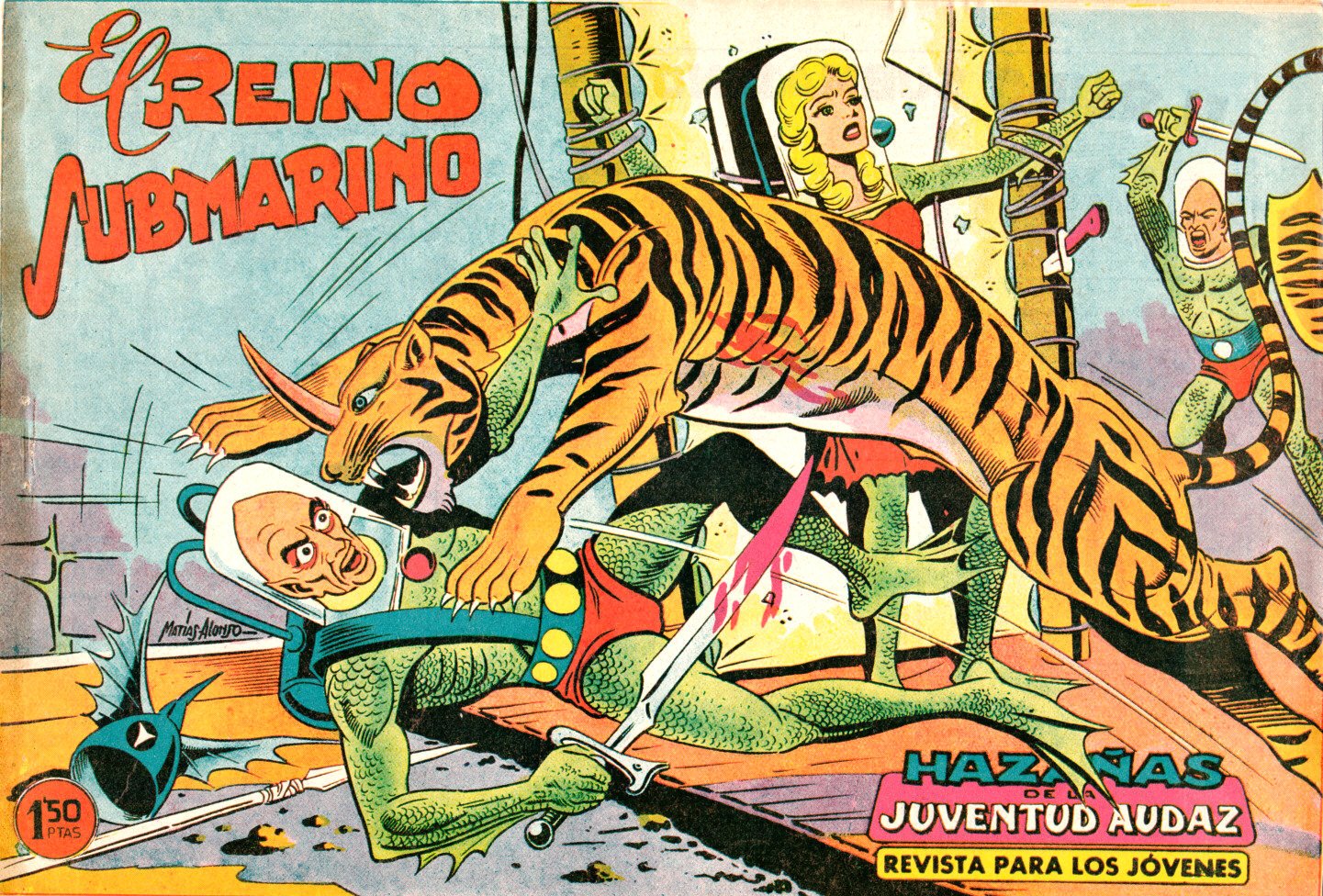
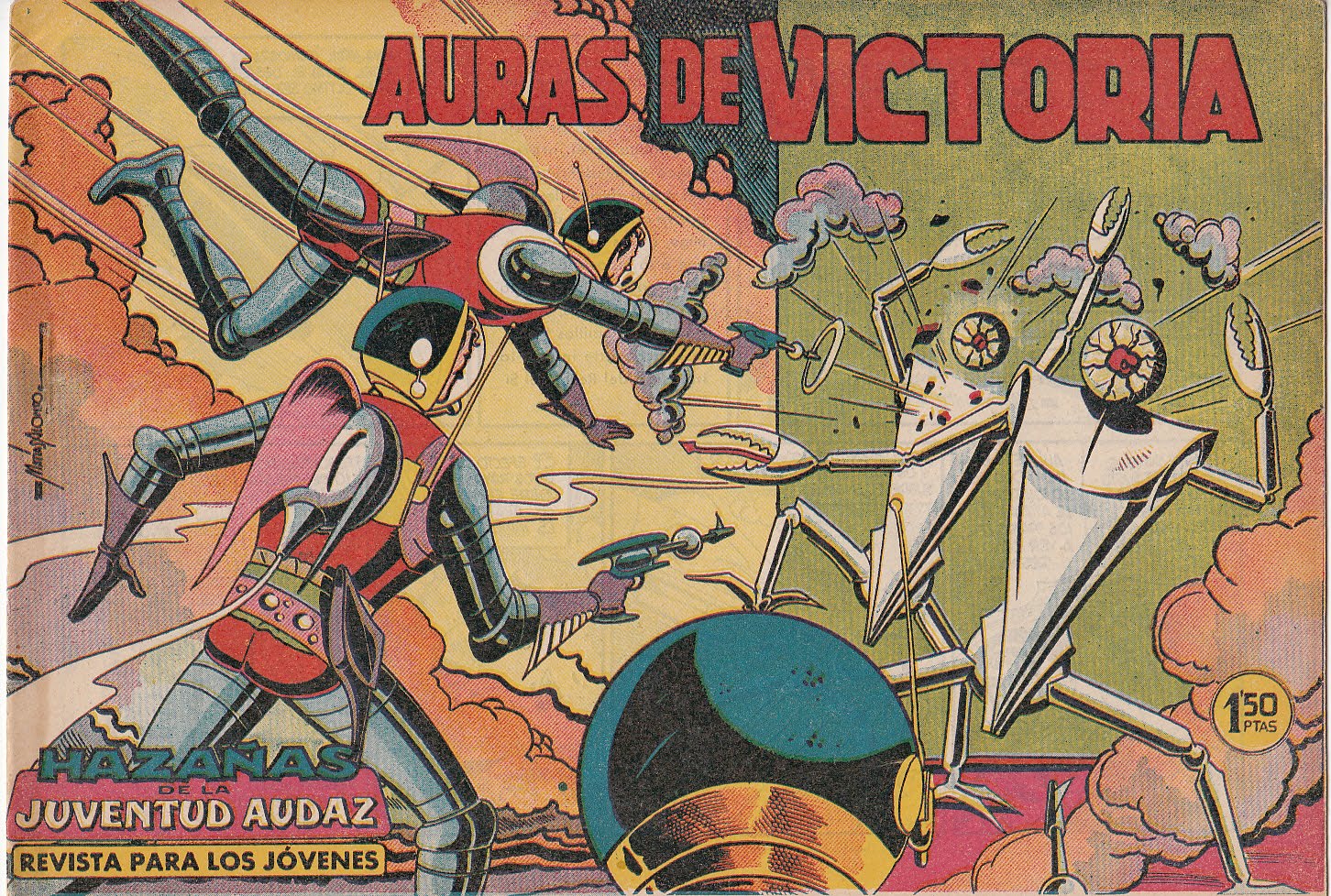
Here are a few sample monsters – “aliens”, in fact, from the Space Princess game. The game is coming along pretty well – just a bit more writing to do and then some artwork and she’s ready for testing!

Devil Girl
Devil girls come from a female dominated society with a declining male population. Devil girls are undeniably attractive, but merciless in their treatment of others. They wear uniforms of a black, vinyl-like substance that is a surprisingly good armor. Devil girls suffer only half damage from cold, electricity and fire and they can blanket a 60-ft radius area around themselves in complete darkness once per day for 10 minutes. Devil girls are capable of seeing in this weird darkness, but other creatures are not, giving the devil girls a +5 bonus and the others a -5 penalty to attack.

DEVIL GIRL: HD 4; DEFENSE 12; FIGHT 9 (strike +1); SHOOT 9 (ray gun +5); MOVE N; STR 13; DEX 13; MEN 9; KNO 12; DL 5; Special: Darkness, resistance to damage.

Space Amazon
Space amazons are women of tremendous strength and dexterity who are sometimes hired as elite guards in a space fortress, or perhaps were captured and subsequently escaped, living as outlaws in the fortress’s myriad tunnels and chambers. Space amazons stand about 8 feet tall and have green skin, white hair, and long antennae. Large groups of space amazons are commanded by a myrmidia. Each myrmidia has a 5% chance of secretly falling in love with a male star warrior and betraying her sisters on his behalf. If spurned by him, her berserk fury is doubled against him.

SPACE AMAZON: HD 4; DEFENSE 8; FIGHT 10 (axe +2); SHOOT 8 (ray gun +5); MOVE N; STR 15; DEX 12; MEN 12; KNO 10; DL 5; Special: Berserk Fury (+2 FIGHT and +2 damage vs. males).

MYRMIDIA: HD 6; DEFENSE 10; FIGHT 13 (axe +2); SHOOT 10 (ray gun +5); MOVE N; STR 16; DEX 13; MEN 13; KNO 11; DL 5; Special: Berserk Fury (+2 FIGHT and +2 damage vs. males), chance to fall in love, double fury when spurned.

Trilodite
Trilodites are protoplasmic aliens consisting of a ooze-like interior and a pink, rubbery exterior. Trilodites “stand” about three feet tall, usually on three pseudopods. They often have three additional pseudopods emerging from higher on their bodies that they use as arms. Trilodites can use these pseudopods to manipulate small objects as a human uses hands, and can retract or grow additional pseudopods as they like, though eight seems to be their useful limit. Trilodites have a high sensory awareness, and are thus rarely surprised. Because of their alien structures and minds, they enjoy a +2 bonus on tests to resist psychic powers that attempt to control or influence them. Their elastic forms give them a +2 bonus to DEFENSE to resist attempts to grab or hold them.

TRILODITE: HD 2; DEFENSE 8; FIGHT 7 (weapon +2); SHOOT 5 (ray gun +5); MOVE S; STR 14; DEX 8; MEN 10; KNO 10; DL 2; Special: Resist psychic powers, hard to hold.

Voltan
Voltans are a humanoid species with slightly pointed ears and bald heads covered with peaked ridges. They are quite strong and very intelligent. Some voltans have red skin, while others have blue skin. The red voltans tend towards contemplation and a love of logic, while the blue voltans are emotional, over-bearing and militant. Blue voltans arm themselves with jagged blades and ray guns and wear steel mesh tunics. Red voltans do not wear armor or carry hand weapons, but do use ray guns.

BLUE VOLTAN: HD 3; DEFENSE 9; FIGHT 9 (weapon +2); SHOOT 7 (ray gun +5); MOVE N; STR 16; DEX 10; MEN 14; KNO 14; DL 3; Special: Immune to fear.

RED VOLTAN: HD 1; DEFENSE 5; FIGHT 7 (open hand +1); SHOOT 5 (ray gun +5); MOVE N; STR 16; DEX 10; MEN 14; KNO 14; DL 3; Special: ESP, stunning grasp, immune to fear.

Spaceship Combat in Space Princess

Alternate title – if you’re expecting Rient’s Fleet Captain, boy are you going to be disappointed!

I’m writing the spaceship combat rules now for Space Princess and thought I’d bounce a few things off of my readers (wow – it feels both cool and pretentious as Hell to say “my readers”).

The Basics: Space Princess’ spaceship combat rules are designed to do one thing – simulate the rescuers of the “space princess” escaping into light speed from the Dark Lord’s minions. That’s it. If the game is successful, maybe an expansion could add more to the rules, but for the game, I want to simulate one thing and one thing only to keep it simple.

The Procedure: As it stands, the spaceship combat procedure works as follows:

1 – Maneuver: The player of the character piloting the escape ship make a pilot test to attempt to stay away from the pursuing ships. If he fails, they come closer (and closer means it’s easier to hit with weapons), if he succeeds they either stay at the same range or fall behind. There are penalties attached to his roll based on how many pursuers he’s trying to dodge, whether there are obstacles to maneuvering (the ground, canyon walls, asteroids) and damage his ship might have taken.

2 – Fire Weapons: Good guys and bad guys fire their weapons. Each hit means a damage roll for the affected ship. These damage rolls are not in terms of “hit points” or “hull points”, but rather an actual effect on the ship. The smaller the ship, the more dire a hit is likely to be. The worst forms of damage are hull breach (can suck players out into space, where they die) or complete destruction of the ship. Complete destruction is rare – the pursuers are usually trying to disable your ship and capture you.

3 – After all weapon fire is resolved, the player whose character is in charge of navigation (scientists are the best at this) makes a roll to see if she’s calculated the proper formula for light speed. The chances of doing this on the first round are very remote, but the difficulty of the roll is lessened with each failure. This means you don’t know how long it will take to jump into light speed (and safety) – should make each such roll dramatic.

That’s the basic procedure. For ship types, I’m keeping it pretty generic. In order of size, they are: Starfighter, Shuttle, Freighter, Blockade Runner, Corvette, Cruiser and Dreadnaught. Smaller ships are more maneuverable, larger ships have better armor (which actually doesn’t make sense in Zero-G, but I’m working off pulp sci-fi and movie tropes, not reality).

So here’s where I want to access your brains. I’m thinking about possible damage results on ships. Ships are rated based on Speed (includes maneuverability), Armor, Number of Engines and Different Weapon Systems (laser banks, torpedoes and tractor beams for the dreadnaughts). Here’s my list of damage effects so far:

1 – Engine Damage – penalty to speed/maneuvering; once a ship has lost all engines it is dead in space

2 – Computer Damage – maybe hits different systems – damaged Nav-Computer means you cannot jump into light speed until fixed. Weapon Systems Computer might turn off all weaponry until fixed. Maybe the engines can be knocked off line as well. Possible damage to characters from the boards sparking and going up in flame, a’la Star Trek.

3 – Artificial Gravity Lost – this would potentially damage characters on the ship from things floating about (or from them floating about).

4 – Weapon Destroyed – One of the ship’s weapon systems is destroyed.

5 – Hull Damage – lowers the ship’s Armor rating by one. Probably the best result you can get from damage. Somebody will probably mention force shields here – I’d rather just consider them part of the “armor package” – to keep things simple, if two things essentially serve the same function, I’d rather merge them together.

6 – Hull Breach – chance of sucking people into space

7 – Ship Destroyed – this would be a “roll again, if comes up again, spaceship destroyed and all aboard killed” – it’s old school, so yeah, instant death is a possibility.

All of the results except ship destroyed would be repairable – again, a scientist would be best at this (or maybe somebody invents an engineer class to lend a hand).

The Monsters of Space Princess

While I’ve been writing Mu-Pan and plotting out Hell (previews to come soon), I’ve also been slowly filling in the gaps on Space Princess. At this point, I’m about 80% done writing it, having put some yeoman’s work into the monster section yesterday. Most of the beast are re-purposed from Ye Olde Game or d20 Modern, with a couple originals stuck in as well. I still want to invent some more aliens that might lurk in the bowels of a space fortress, but the following list should give you an idea at what adventurers might find in the game. The “danger level” gives an idea of how powerful the monster is.

Now I just need to finish up the starship battle rules, the sample space fortress (or one sector therein) and sort out the art, do some play testing and I’ll have a nice little pulpy beer and pretzels sci-fi game. Should come in at around 50 pages, and therefore be pretty affordable.

Target 10!

When I started writing Space Princess, I decided I wanted to do a really simple game – thus four ability scores, four classes with three “levels” each, etc. When I came up with 1800 – American Empires, I decided to use the same rules concept, and then again with Mutant Truckers of the Polyester Road, especially because MTotPR was going to be a mini-game for NOD. As I played with the concept, I came up with an easy system I’m calling Target 10 – all tests (skill tests, saving throws) and combat involve rolling 1d20, adding a modifier and trying to roll a ’10’ or higher to succeed. The following excerpt shows where the rules stand at the moment. They were written specifically for American Empires.

Tests
A test is a roll made to determine whether an action succeeds when the outcome of the action is in question. Every action made in a game does not need to be tested. Getting dressed in the morning, for example, does not require a test. Of course, getting ready in the morning and out the door in 10 minutes or getting dressed with two broken arms might require a test of dexterity.

A test is made by roll 1d20, applying modifiers (see below) and trying to roll “10” or higher.

Man vs. Man
When a test pits one person against another (or one creature against another), the test is modified by comparing the relative skill and raw ability of the two opponents. Each opponent calculates their Test Value (TV). A character’s TV is equal to their modifier in whatever ability score governs the test. If the character possesses the skill being tested (see Classes above), they also add their skill value to the TV. Situational modifiers, as determined by the Referee, might also apply, but should never be higher than +3.

Compare the acting character’s TV to the opposing character’s TV. The difference is the bonus or penalty applied to the acting character’s test roll.

When two characters are both trying to “act”, the character with the higher TV always rolls their test first. If the TV’s are equal, defer to the character with the greater skill. If the skill values are equal, defer to the character with the higher ability score. If the ability scores are equal, flip a coin.

In many cases, the outcome can be determined with a single test roll. In some cases, a Referee can require multiple successes to finally succeed, usually no more than 3. He might even a bad consequence if either or both parties rack of too many failures.

Example: Two venturers, Juan and Susan, are trying to sway an Apache chief to cement an alliance with their country. This requires a test of the Negotiate Treaty skill.

Juan has Skill 9 and Charisma 12 (+1), while Susan has Skill 6 and Charisma 18 (+4). This means Juan has a TV of 9 + 1 = 10 and Susan a TV of 6 + 4 = 10. Since the TV’s are equal, there is no modifier to either character’s test roll. Since Juan has the higher skill, he tests first.

The Referee decides it will be more exciting to require three successes to sway the Apache chief. Moreover, he rules that if the two together rack up four failure before either has succeeded, the Apache chief will call off the negotiation and have both venturers killed.

Juan’s first test roll is a “4”, indicating one failure. Susan now rolls an “11”, a success! Three more failures and the Apache chief loses his cool. Juan now rolls a “7”, followed by a “9” for Susan – two more failures. Juan rounds it out with a “13” and Susan with an “8”. That does it – their arguing has angered the Apache chief, who finds neither of them worthy of an alliance and summons his braves to take them into the desert and bury them to their necks in the sand.

Man vs. Nature
Whenever a test pits a character or creature against the natural world – for example, shifting a heavy boulder or predicting the weather, the actor’s Test Value is compared against a Test Value of 1 to 10 chosen by the Referee. In most cases, the test value is “5”. Nature, in these cases, does not “act”, and therefore does not make a test roll. A Referee can still require multiple successes to succeed and can still impose consequences for multiple failures.

Luck Points
Luck Points are a simple mechanic that allows groups of characters of differing skill levels to adventure together without the more skilled completely dominating play. A Luck Point can be spent to automatically succeed at any test, or, in the case of combat, to ignore an opponent’s success.

Luck Points can be earned while exploring (see Occurrences below), but a character can never have more points of luck than they started with. In other words, low skill characters can never have more than 3 luck points at one time, mid-skill level characters can never have more than 1 luck point at a time and high-skill characters cannot have any luck points at all – they have to rely on their skill alone to survive.

Combat Tests
Combat occurs whenever two or more creatures or characters seek to do violence upon one another, whether their aim is to kill, disable or knock unconscious. Combat is conducted in “rounds”. A round is roughly one minute long. During a round, a character may declare how his character is moving and how (or if) they are acting.

The first step in running a combat round is for all players to declare their actions for the round. Possible actions are as follows:

Movements: Advance, Charge, Flee, Hold Ground, Maneuver, Stand and Withdraw.

Actions: Defend, Disarm, Grapple, Kill, Negotiate, Subdue and Trip.

Other actions are certainly possible – a player need only be limited by their imagination.

The next step is to determine the order of play. Each person involved in the combat rolls 1d6 and adds their dexterity bonus. The highest score goes first and play proceeds through the remainder of the scores. In the case of a tie, movement and actions are considered to happen simultaneously. This makes it possible for two combatants to kill one another during the same round of combat.

The acting character then rolls a combat test (see below).

Movements

Advance: And advancing combatant keeps their guard up and moves forward 3 paces.

Charge: A charging combatant goes full speed ahead (and damn the torpedoes!). They move at triple their normal speed (i.e. 30 paces for humans). A charging character does not add their dexterity bonus to their defense score during the round, but adds double their strength bonus to their attack score.

Flee: A fleeing character runs at full speed (i.e. 30 paces for humans), turning their back on their enemy. If they go after their attacking opponent in combat, their opponent’s attack is automatically successful.

Hold: A character that holds does not move at all, unless forced to move by an opponent’s attack.

Maneuver: A maneuvering character attempts to maneuver their opponent into a certain position by the way that they attack – maybe driving them back towards an open pit or maneuvering so that the character gains the high ground or places their back against a wall. When a maneuvering character attacks, they score no damage, but do move their opponent 3 paces in whatever direction they like.

Stand: Whether the character was sitting or lying down at the beginning of combat or they were knocked down, this movement puts them back on their feet. A character cannot stand if they are being attacked.

Withdraw: A withdrawing combatant keeps their guard up and moves backward 3 paces. They may still attack if their opponent is advancing.

Actions

Defend: A defending character increases their DV by dexterity bonus (i.e. they double their bonus) or +1, whichever is higher.

Disarm: A character trying to disarm an opponent does not roll damage against them on a successful test; rather, they knock whatever they are holding (weapon or otherwise) from their hand. The item flies 1d6 paces in a random direction. A disarm attack is made using the attacker’s RAV instead of MAV.

Grapple: A character trying to grapple an opponent does not roll damage against them on a successful test; rather, they lock their opponent in a hold. A creature or character locked in a pin suffers a -1 penalty to attack and defend, and must make a grapple attack of their own to break the hold.

Kill: A character trying to kill scores normal damage against an opponent, and that damage can reduce the opponent’s hit points below 0, killing them.

Negotiate: A negotiating character attempts to engage their opponent in conversation, usually to buy time or simply stop an unnecessary combat from occurring. Only venturers have the ability to negotiate in combat. With a successful skill roll, they keep their opponents from attacking for one round, provided they are not themselves attacked.

Subdue: A character trying to subdue scores normal damage against an opponent, but that damage cannot reduce the opponent’s hit points below 0, leaving them unconscious for 1d6 turns.

Trip: A character trying to trip an opponent does not roll damage against them on a successful test; rather, they knock the opponent to the ground. A creature or character on the ground suffers a -2 penalty to attack and defend.

Combat Tests
Combat tests work like other tests – one compares two values to determine if there is a bonus or penalty on the roll and then rolls 1d20, applying the modifier. If the roll is a “12” or higher, they succeed.

Where most tests use a characters skill + ability modifier, combat tests use three values:

Melee Attack Value (FIGHT) = Hit Dice + Strength Modifier + Weapon Bonus

Ranged Attack Value (SHOOT) = Hit Dice + Dexterity Modifier + Weapon Bonus

Defense Value (DEFENSE) = Hit Dice + Dexterity Modifier + Armor Bonus

When attacking with fist, feet, claws, bites or hand held weapons, the attacker compares their FIGHT to the defender’s DEFENSE to determine the bonus or penalty to their test.

When attacking with thrown items, spittle, pistols, muskets and bows, the attacker compares their SHOOT to the defender’s DEFENSE to determine the bonus or penalty to their test.

As with regular tests, a bonus cannot be higher than +10 and a penalty cannot be lower than -10.

Situational modifiers can also be added to a test roll, as determined by the Referee. Situational modifiers can include a bonus for higher ground, sun in the eyes, etc. They should not amount to more than a total modifier of +3 or -3.

Example: Captain Cole, a soldier, is locked in combat with a leatherstocking named Francois. Captain Cole has Hit Dice 6, Strength 15 (+3), Dexterity 12 (+1) and he is fighting using a Saber (+2). Francois has Hit Dice 7, Strength 14 (+2), Dexterity 15 (+3) and he is fighting using a Knife (+1). Neither gentleman is wearing armor.

Captain Cole has a FIGHT of 6 + 3 + 2 = 11 and a DEFENSE of 6 + 1 = 7.

Francois has a FIGHT of 7 + 2 + 1 = 10 and a DEFENSE of 7 + 3 = 10.

When Cole attacks Francois, he compares his FIGHT of 11 to Francois’ DEFENSE of 10, indicating a +1 bonus to attack.

When Francois attacks Cole, he compares his FIGHT of 10 to Cole’s DEFENSE of 7, indicating a +3 bonus to attack.

Damage
Damage is rolled with 1d6, adding the attacker’s Strength modifier if using a melee weapon or Dexterity modifier if using a ranged weapon. In either case, an ability penalty cannot reduce damage below 1.

Ending Combat
Combat continues, round after round, until all combatants on one side are either dead, unconscious or have fled.

Eyebots, Horned Tigers & Space Princesses

A couple things today.

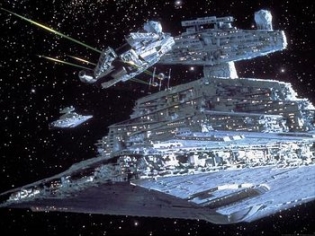
First – some cool sci-fi art harvested from the digital tides.

This one makes me think Traveller, but very ’70s slick sci-fi. From the Syd Mead Gallery.

These images are more Encounter Critical to my mind – the kind of game I’m probably way more likely to play than Traveler. To be completely honest, though, I’ve never played either game. I’ve rolled up characters, but never had the chance to play. Found at (like the image above) Super Punch!

Also …

So, I was perusing a blog that asked why sci-fi RPGs never hit it as big as fantasy RPGs. My take was that D-n-D (’cause when you’re talking about uber-successful fantasy rpg’s, you’re talking about D-n-D) was successful because it borrowed things from the fantasy genre without trying to emulate fantasy stories. Instead, it was a wargame set in a dungeon. That kind of game is easier to run than story emulation, and therefore it was more popular. So – my question – would a sci-fi game that attempts to be nothing more than, for example, “save the space princess from the starlord’s fortress” work. I think my next project that I promised I wouldn’t write was just born. And I think I’ll call it Space Princess.

Hmmm – Star Warrior, Scoundrel, Scientist and Psychic … this could be fun.

Update: Jay reminds me of X-plorers. I need to look into that game.

Update 2: In the meantime, I’m thinking about the concept of sci-fi heroes delving into star fortress, and here’s where my mind is wandering:

Four ability scores – Strength (bonus to hit, bonus to hit points), Dexterity (bonus to hit, bonus to defense), Mentality (for psychics) and Knowledge (for scientists) – simple bonuses and used for saving throws (maybe score x3 as a percent + 5% per character level?)

Four classes – As above; I’ve already written a scientist and psychic class that I could adapt, and the star warrior and scoundrel should be pretty easy as well.

Races – Human, Android, Alien – the alien rules would be a “build your own alien” concept – probably would resemble d20 race builds more than anything else. They would probably have a level limit and be able to take levels as star warrior or a multi-class based on whatever ability score they get a bonus to.

Scoundrel skills – Disguise, Defeat Security System, Hide Contraband, Avoid Notice, Fast Talk, Pilot Ship – percentage skills like a thief, except you get six columns with percentage changes and assign the skills yourself; maybe Star Warriors can choose a skill as well?

Would rules that assign levels to players by dice roll – a’la Young Hero (Luke), Experienced Heroes (Han and Chewie), Old Hero (Obi-Wan) – be any good? Maybe a fun option. Also – maybe just five levels with slow advancement in the middle.

Need rules for the space battle when you’ve escaped the space fortress and the minions are chasing you.

I don’t know if I’ll go any further, but it’s fun to think about.

Thinking about some Mystery Men! Changes …

I’m still playing with some of the details of Mystery Men!

– I’m thinking of having all ability scores rolled with 1d6 and then boosted purely by buying powers. This is based on a suggestion I got early on, and I think it makes sense to use the spending of XP to make super heroes as opposed to spending both dice and XP. Besides, some heroes have several (or all) heavily boosted ability scores (I’m looking at the big blue boyscout here), which is tougher to duplicate using the current system.

– I think I’m going to divide ability scores and levels into five bands: Normal (1-6), Heroic (7-12), Superhuman (13-18), Epic (19-24) and Cosmic (25-30). Ability bonuses will be +1 per three points of ability (i.e. +0 for a score of 1 or 2, +1 for a score of 3 to 5 etc to +10 at 30) and will only be used for attack and damage bonuses.

– Feats will require you to roll 1d20 and meet or beat a score of 10. You modify this roll by the difference between your ability score or level (depending on what you’re doing) and your opponent’s. Using this scheme you’ll always fail on a natural “1” and always succeed on a natural “20”. I think I was worried too much about normal humans getting away with facing down Galactus when nobody is going to play a normal human – oh, maybe a non-powered hero, but still a hero capable of amazing things. For feats that aren’t against an opponent, you compare your ability/level against the following scores based on the five bands: Normal 3, Heroic 9, Superhuman 15, Epic 21 and Cosmic 27. I think this might be simpler than the current scheme, although they aren’t terribly different from one another.

– For monsters, I think I’m going to refer to Hit Dice as Level for monsters and characters – keeps me from having to explain that they’re essentially the same thing. I’m going to include a Physique and Mentality score for them as well for use in feats. The monster stats should thus be: Level, Physique, Mentality, Defense Class, Speed, XP Value and Attacks and Powers.

I think that’s it for now. Still trying to find time to play the game with some friends – when I do I’ll have some play reports. In the meantime I’m working away at NOD 7 and my Frog God projects. Posts might be a bit more sporadic in February, since most of what I’m writing isn’t stuff I can preview on the blog. This week I’m going to try to write up some demon lords – something I want to make a regular feature in NOD, stat out some Hanna Barbera heroes and who knows what else. In the meantime, have fun out there!

Deathbot Battle Redux

When last I pitted the Deathbot in battle against Captain Triumph, I had to admit that the good Captain, a 30,000 XP character, was a bit outmatched. I wondered then how the Deathbot would fare against someone more powerful – enter Superman.

Superman is built using 150,000 XP and I assigned his ability scores to make him just about as tough as I could. Truth be told, you just can’t roll this guy up in Mystery Men! using the rules  you bump the number of starting ability dice – an option I plan to include in the finished rules.

Here, then, are the stats for the Man of Tomorrow … and of course, these stats are not intended to infringe on or threaten DC Comics’ intellectual property or copyrights.

Str 30 (+9)
Int 8 (+2)
Wil 10 (+3)
Dex 30 (+9)
Con 30 (+9)
Cha 4 (+0)

XP: 70,000
LVL: 20
HP: 288
DC: 23
AB:+15
FB: +9
SPD: 7 (8 flying)

Powers (All Permanent)
Fly
Energy Ray (Heat) – 30’ range, 4d6 damage, ranged attack vs. DC 10+Dex
Armor – +4 DC
Endure Elements – comfortable in hot and cold environments
Stoneskin – damage reduction 3
Super Strength* – +4 Str
Super Dexterity* – +4 Dex
Super Constitution* – +4 Con
Super Speed – increase speed by 5

*I assigned the ability scores, but still figured he should have to pay for super strength, dexterity and constitution

And yes, Superman probably has about 100 other powers – I’m hitting the old tried and true with this list.

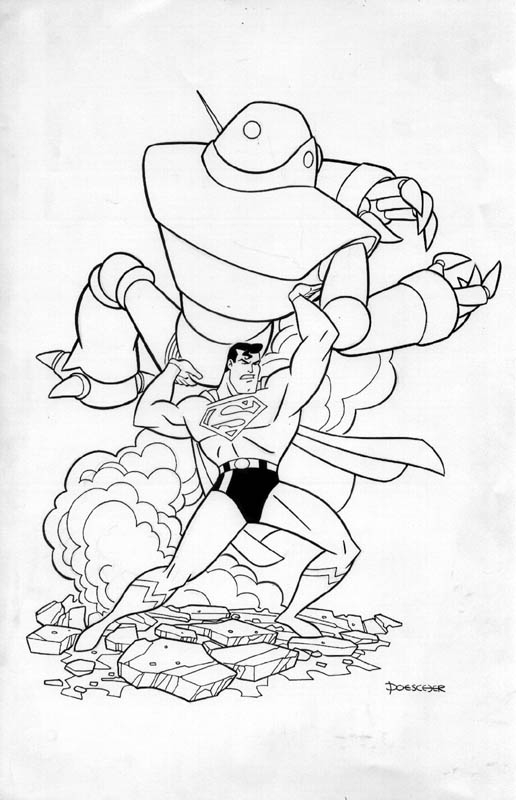
The last Deathbot was toned down a bit – Superman is going to face off with a fully powered giant robot with the following stats:

DEATHBOT
HD 18 (100 hp); DC 30; Attacks with 2 slams for 4d6 damage; Speed 1; XP 6450; Powers: Darkvision, energy bolt (from eyes, ), iron body.

This battle will take place on a street in a major city, and Superman will begin the battle in flight. Let’s fight …

ROUND ONE

Initiative Order (1d10 + Spd + Dex): Superman [22], Deathbot [6]

Superman is always going to win initiative against the Deathbot, so we’ll forgo future initiative rolls to speed this up. Because of his speed (7) is seven times higher than the giant robot, Superman gets 3 actions per round.

In round one, Superman is first going to charge into the Deathbot and attempt to knock it down. This will give him +1d6 damage for the attack, but reduce his DC by 3, to 20. Superman rolls 1d20 + FB + Str and gets [32], scoring 1d6+9 + 1d6 damage and rolling [17] and scoring only 12 damage due the robot’s iron body. He follows up with a blast of his heat rays and then another wallop from his fists (or fisks, if you happen to be Popeye). He rolls a [41] for the heat rays and a [26] for the punch, scoring a hit from the heat rays. He rolls 13 damage. The Deathbot rolls a feat of constitution and gets [25], enough to cut the damage in half to 6. The Iron Body power of the Deathbot cuts that in half again, to 3.

The Deathbot strikes back with his own energy bolts (electricity). He rolls a [25], enough to hit Superman, and causes 72 points of damage. Superman rolls a feat of constitution to halve the damage and gets [17], not enough to save.

We end the round with the Deathbot having 85 hit points and Superman reduced to 216 hit points.

ROUND TWO

Superman has three actions again. The heat rays were pretty ineffective, so he’s going to focus on grappling the robot and lifting it. He can lift 100 tons without difficulty, so I would rule that he could do it. To grapple it (i.e. grab it) he’s going to have to beat the robot’s DC of 30 by 5, i.e. he needs to roll a 35. Even if he just beats the DC of 30, he’ll manage to cause some damage. This round, he rolls [33] and then [42] for his first two actions. The first attack scores [13] damage, reduced to 8 due to iron body. The second attack scores [14] damage, reduced to 9. The second attack beats 35, so he manages to grab the robot. He’ll use his last action to fly the robot about 1 mile up (he could go up to 50 at his speed, but 1 mile should be sufficient).

The Deathbot is in pretty serious trouble, but being a robot he focuses on the task at hand. He’ll attempt to make two slam attacks against Superman, rolling [37] and [24]. He scores two hits, rolling [8] and [13] damage. Superman’s stoneskin power reduces these to 5 and 10.

At the end of Round Two, Superman has 201 hit points left, the Deathbot has 68.

ROUND THREE
Last round of combat, most likely. Superman is going to let the beast fall. Falling damage, like in the original game, is 1d6 per 10′, with a maximum of 20d6. On the way down, I’ll let the Deathbot make a final energy bolt attack. He rolls a [21] and then rolls [59] points of damage. Superman makes a constitution feat, rolling [15] – not enough to cut the damage in half. When the Deathbot hits the ground, he takes 58 points of damage, reduced to 53 because of iron body. The Deathbot gets a dexterity feat to take half damage from the fall and rolls a [7], failing. Technically, Superman still has two actions left, so he’s going to use one to fly back down and the other to punch the Deathbot. This will count as a charge. He rolls a [44] to hit. Since he wasn’t using any other special attack, beating the ‘bot’s DC by more than 5 means double damage. He rolls 2d6+18 plus another 1d6 for the charge, getting [19], which is reduced to 14 because of iron body.

At the end of Round Three, Superman has 142 hit points. The Deathbot has 1 hit point. Tough little guy, isn’t he.

ROUND FOUR
Nothing fancy this time. Superman is going punch, punch and punch. He rolls [28] [25] and [35]. All three punches do damage, and the last punch does double damage. He rolls a total of 55 points of damage, reduced to 40 because of iron body. More than enough to finish off the Deathbot.

WHAT I LEARNED
Superman outclassed the Deathbot, but only at 150,000 XP. Reduce his starting XP to 100,000 and his level drops to 11 – that means far fewer hit points and a reduced attack bonus, and Superman is in for a far tougher fight. Given that the giant robot is supposed to be a useful monster in the game, I’m definitely going to knock him down a few pegs – specifically the DC, probably to 25. I also think I’ll cap the energy bolt, in fact all damage from powers, at 10 dice.

Image by Erik Doescher from comicartfans website.

Random Musings on RPG Clones vs. Frankensteins

In the world of modern old school gaming, you have your originals (D&D, AD&D, etc), your clones (OSRIC, LL) and your simulacra (LotFP, S&W, BFRPG, C&C, etc). Personally, I love ’em all – for the nostalgia, for the rules lite approach and for the fact that I find something that I like in every one that I read. Which brings to mind something that Jeff Rients once blogged about – wouldn’t it be cool if you could go to a website, go through a list of D&D rules, mark check boxes of your preferred version of that rule and then click a button and have your customized D&D rules spit out as a PDF. Of course, the answer is – yes, that would be quite cool. But it also got me thinking about what my customized game might look like. Here goes …

COVER – Tough choice, but it would either be Erol Otus or Wayne Reynolds. I know, I know …

ABILITY SCORES – Molvay D&D

RACES – 3rd Edition – I like the way they handle the stats – probably the most rules lite portion of those rules

CLASSES – Either Swords & Wizardry – simple, to the point, very little need to check out the rules during play – or Castles & Crusades – more choices, but still pretty streamlined – love that single saving throw though

EQUIPMENT – Moldvay D&D, including those encumbrance rules (or maybe my own from Pars Fortuna)

COMBAT – BFRPG – really, my answer is Moldvay but with ascending AC and attack bonuses instead of charts, but I think BFRPG gets the closest to that

SPELLS – Moldvay rules with 3rd edition’s breadth

MONSTERS – AD&D

So, what would your customized D&D look like?

Scaling Speed in Mystery Men!

I’ve mentioned before that the trick of writing a super heroic RPG is dealing with scale. Whatever system you use has to be able to handle 98 lb weaklings and guys who can bench press locomotives, and it needs to do so in such a way that the two can adventure together – i.e. you have to part ways with reality a bit to make it all work.

If scaling Strength in a comic book hero game is hard to do, scaling speed is just as hard. Again, you need to have a system that accommodates normal (even slow) human beings and folks who can zip around at the speed of light, and you need to integrate speed with the other rules systems to make super speed meaningful, but not overpowering.

My initial idea was to use the traditional movement rate concepts from old school games, but expressed in yards or meters per minute. Thus, a movement rate of 100 became standard. The problem, of course, was that cars, for example, would have a normal movement of about 900, and other vehicles higher than that. That means super speedsters would have the same speed advantages. With most of the action in a comic book hero game taking place in fairly confined quarters, speeds of 900+ don’t have much relevance, and when you get into the 1000’s they become fairly unwieldy. So, I decided to change my scale.

Playing around on Wikipedia, I discovered the concept of “orders of magnitudes of speed”, and decided alter it to fit my purposes. Mystery Men! will have ten speed bands, ranging from 1 (slow humans) to 2 (normal humans) to 10 (speed of light). People can move from one speed band to a higher speed band by running, maintaining the higher speed with feats of Constitution, and reaching even higher speeds (just momentarily) by a feat of Strength.

The speed scale is as follows:

1 – 50 yards/round – old folks, children
2 – 100 yards/round – healthy adult human
3 – 200 yards/round – bicycles, many animals
4 – 500 yards/round – cars, motorcycles
5 – 1500 yards/round – high-speed rail, airplanes
6 – 5000 yards/round – jet airliners
7 – 20,000 yards/round – sound
8 – 100,000 yards/round – supersonic speed
9 – 10,000,000 yards/round – sub-light speed
10 – 20,000,000 yards/round – light speed

Obviously quite a leap from “old lady” to “light speed”, but I think in the context of the game it should work. You’ll have your normal speed, rated 1 to 10 – characters begin with a normal speed of 2. You can run at the next highest speed for 1 round, and thereafter can continue at that speed with a feat of Constitution each round. You can generate a burst of speed at 2 speed levels higher than your normal speed by making a feat of Strength, but the burst only lasts 1 round, max. You always have the option to move at a slower speed, of course. The table included in the rules will show speed per round, speed per turn and mph/kph for each speed rating.

Initiative. which was to be determined by speed, will now be determined by a d10 roll modified by your Dexterity bonus and speed (so, with a 30 Dex and 10 Speed, you’d end up with a +19 to initiative – pretty hard to beat). Speed will also govern how many actions a character can take during a round. When engaged in combat with a foe, compare your speed to his speed. If your speed is twice his speed, you can make two actions (move, attack, activate power, etc) per round. If your speed is triple his speed, you can make three actions. In order to keep super speedsters from being unbeatable, we’ll cap it at three actions per round for now.

Hopefully, this will make speed a relevant ability in the game, while keeping it easy to track and not something that will break the game.

And yes, I think I’ve decided to drop the panel/page/issue time concept for the more traditional rounds/turns, etc. MM! is supposed to be a reworking of old school games to make learning it simpler, so it makes sense to stick with language most gamers already know.

Art by Mike Wieringo

RANDOM ANNOUNCEMENTS

Currently, I’m working on NOD 7, which will feature 3 cities. Blackpoort is written and I’m working on Lyonesse now and then have to write Antigoon. Right now, I’m on schedule to publish in the middle of February.

After I adjust the speed rules, I’ll be ready to put the Mystery Men! beta rules out for play testing. If this project interests you, please consider downloading the rules and running a quick game, or even just going through character generation and running a fight. If you do play with the rules (or even just read them), I hope you’ll give me some feedback. The beta rules won’t include the sample setting or all the explanatory text on “what is role playing”, “how you roll dice” – that will be included in the final product. Right now, looks like the final game will come in at a slim 60 pages, so it should be pretty affordable in print, and the e-book will be free.

I’m also working on writing my third Hexcrawl Classic for Frog God Games. The first should see print in February – very excited, as it’s my first freelance sort of gig. I’ve just been tapped to be a part of a much larger project for the Frog God, which I’ll be cranking on for the next couple months. Despite the work load (being busy is a blessing!), I’ll continue to post to the blog just about every day.

Speaking of posting – I’m getting lots of page views on the Megacrawl 3000 posts, but nobody is playing along in the comments – not for the last 2 posts. Since I inteded Megacrawl 3000 as a game for the community at large and not a creative writing exercise for me, I’ll probably drop it after this last episode for lack of participation. If you want to see it continue, by all means get involved!

That’s all for now. Should make another Blackpoort post tonight, and then start posting on Lyonesse later this week. I also want to do some more retro-engineering on Darkness & Dread, have Noble and Everyman classes that need to see the light of day, and want to begin statting out some demon lords for NOD. Lots to do.

Thinking About Feats in Mystery Men!

So, one thing to come out of my little play-test of Mystery Men! yesterday was that my “feats” concept had some serious flaws. Essentially, feats in MM! are meant to be a catch-all ability check, skill check, saving throw system. It was inspired by the old “X in 6” method of old school fantasy games and the “roll under your ability” score concept we also used back in the day. The trouble with Mystery Men! is one of scale.

Traditional fantasy games have ability scores ranging from 3 to 18. This encompasses the whole of human experience, with a 3 being fairly pitiful and an 18 being the human maximum. Characters in old school fantasy are either human or close enough to human that a simple X in 6 chance works pretty well. Most folk have a 1 in 6 chance to do things, extraordinary folk knock this up to 2 in 6 or 3 in 6. For ability checks, you can roll 1d20, with pitiful characters having a 15% chance of success and amazing characters a 90% chance of success.

In Mystery Men! you need a system that will handle both Willy Lumpkin and The Hulk. This makes a flat 1 in 6 chance a problem, because the Hulk can do things that Lumpkin does not have a 1 in 6 chance of doing. Likewise with “roll under ability score”.

My first instinct was to roll different dice ranges for different types of tasks, trying to roll under an ability score. Initially, I was going to do 1d10 for normal feats (i.e. things a normal person could do with great effort and a bit of luck), 1d20 for heroic feats, 1d20+10 for super feats (things well beyond the capacity of normal human beings) and 1d20+20 for epic feats (things best left to the gods). This meant that Willy Lumpkin, with ability scores probably ranging from 1 to 3, had no chance of performing super or epic feats, and only 10-30% chance of performing normal feats and a 5-15% chance of performing heroic feats. Okay, problem solved.

And then I started playing out the combat. Resisting a power or attack was going to be classed as normal, heroic, super or epic based on the level of the attacker or power user. With Catwoman being 16th level, resisting her attacks and powers would be a super task, and usually beyond the ability of Invisible Woman. A game where a hero or villain always succeeds or always fails against another one is not terribly playable, especially when Invisible Woman and Catwoman were not that far apart in levels.

In my combat example, I decided to change the dice rolls from 1d10 / 1d20 / 1d20+10 / 1d20+20 to 1d10 / 2d10 / 3d10 / 4d10. That removes the problem of Invisible Woman not being able to resist Catwoman, but it reintroduces the problem of Willy Lumpkin having a slim chance (5%) of performing super feats, like leaping over buildings. So, no solution there.

I could bump the feat bonus a character gets, having it match the character’s level. But then level trumps raw ability, and Invisible Woman, with human levels of Strength, can leap over buildings. Not going to work.

I could ditch the idea of using feats for saving throws, and institute a single save value a’ la Swords and Wizardry (which means high level heroes are almost never taken down by powers, and low level heroes are almost always taken down by powers) or even institute different types of saves (Death Rays, Poison, etc) with generally the same effect.

What I’m thinking of doing is giving feats a flat number that one must meet or beat by rolling 1d10 and adding ability score bonus and feat bonus (and also ditching the “normal” feat category) –

Heroic Feats  – meet or beat a 10
Super Feats – meet or beat a 15
Epic Feats – meet or beat a 20

Resisting an opponent’s powers requires you to meet or beat 5 + your opponent’s feat bonus. That would put even 20th level characters in the upper ranges of the heroic level, giving most heroes some chance to resist the powers of their opponents. I’m going to drop the “save vs. attacks” angle, because it’s a pain in the rear and easier to just ditch the “instant knockout” idea. This means the more powers you have the lower your level and thus the easier your powers are to resist, and vice versa.

Now, pathetic man, a 1st level hero with an ability score of 1, is rolling 1d10-1, meaning he can’t perform heroic feats. I can live with that. Not everyone can be a hero all the time, and if this is a character, he doesn’t have a score of 1 in every ability.

Normal woman, a 3rd level hero with an ability score of 3, is rolling 1d10+1, meaning she can perform heroic feats 20% of the time.

Excellent dude, a 6th level hero with an ability score of 6, is rolling 1d10+3, meaning he can perform heroic feats 40% of the time.

Amazing woman, a 10th level hero with an ability score of 10, is rolling 1d10+7, meaning she can perform heroic feats 80% of the time, and super feats 30% of the time.

Maxi-Man, a 20th level hero with an ability score of 30, is rolling 1d10+18. He cannot fail at heroic or super feats, and he performs epic feats 80% of the time. Since this character represents the absolute pinnacle, I think I’m okay with this.

I might also add an optional rule wherein a roll of “1” always introduces a complication to the situation – i.e. you leap over the building, but land on the mayor’s car or crash through the street on the other side. That way, Maxi-Man still has to roll for heroic and super feats, and though he’ll always succeed, the Referee can introduce a complication of some kind 10% of the time.

I’m open to suggestions on this one – what do you think?

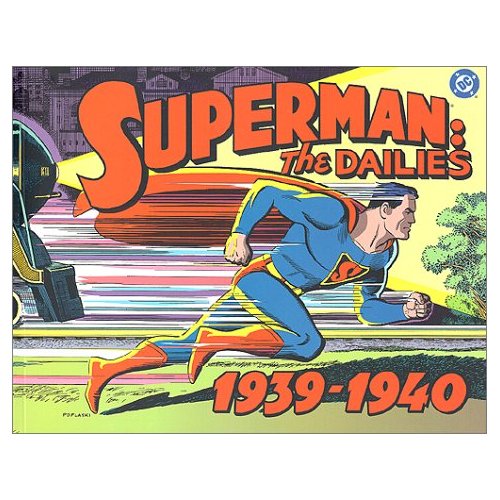
Picture taken from Amazon. I just finished reading Superman: The Dailies, 1939-1940, and it was great.