Holy Moses, It’s a New Class!

Yes, a new class … probably the last new class of 2014 … based on Moses, that fellow who parted the Red Sea and held the Ten Commandments.

At least, it’s based a little on Moses, and a little on other old time prophets. In essence, it’s a non-warrior cleric with more flexibility in terms of spells, but fewer spells to choose from.

In a moment, the class. First, a couple words from our sponsor (which happens to be me)

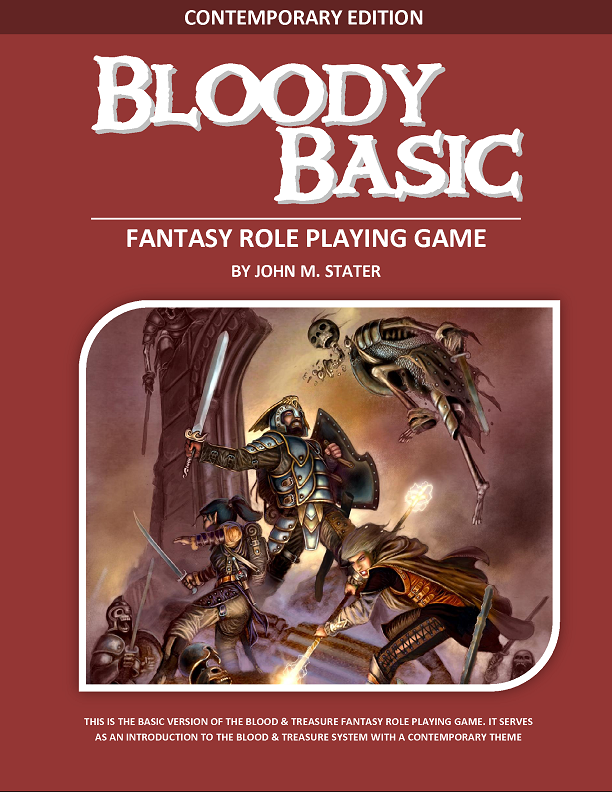
Two new e-books up on Lulu over the past couple days. The long awaited (well, by me anyways – took me forever to finish it) NOD 24, and the even longer-awaited (again, by me) Bloody Basic – Contemporary Edition. From my descriptions on Lulu.com …

BLOODY BASIC – CONTEMPORARY EDITION

Bloody Basic takes the advanced Blood & Treasure Fantasy Role Playing rules and boils them down to the essentials to make gaming easy, fast and fun. The Contemporary Edition rules include rules for the contemporary races, classes, spells and monsters of fantasy role playing, including automatons, drakkens, gnomes, fighters, sorcerers, clerics and thieves. $4.99 for 44 pages

NOD 24

2014 comes to a close with the 24th issue of NOD! In this issue, we continue the Ende hex crawl started in NOD 23, detail some Indian divinities, get into some court intrigue, make monsters with a dictionary, explore the ancient Red Sea as a campaign setting, tangle with space genies, and meet some 1920’s superheroes called the Roustabouts. 80 pages. $4.39 for 80 pages

Wow! What amazing bargains (if you’re into this kind of thing).

Now, back to our program!

The prophet is a cleric who goes way back … all the way to Moses in fact. The prophet is destined to be a religious leader of a people, if he or she can live long enough. Starting out in life, they are touched by a deity and tasked with leading their chosen people, or converting their chosen people, to their worship. They must eventually lead these people into the wilderness to found a new kingdom for them. The deity in question should be one that is, as yet, minor in stature, or a major deity that has largely been forgotten by his or her chosen people.

Obviously, this class is based on Moses. I won’t go over the story of Moses – it’s easy enough to find – but suffice to say he was a prince who discovered his true heritage and was chosen by God to lead his people through the Wilderness to the Promised Land. As an emissary for God on Earth, he could perform miracles, and as a man that was raised in a royal house, he had a good deal of non-spiritual leadership ability.

The prophet class has an innate ability to commune with the divine, a spell list based on the miracles attributed to Moses, other Biblical prophets and Christian saints. You’ll notice quite a bit of overlap with the normal cleric’s spell list. The prophet begins life as an aristocrat, and that means he has some capacity for fighting and leading people. His leadership abilities will continue to improve as he gains levels, though his fighting ability will improve more slowly. Prophets are not meant to be front-line warriors. A prophet’s spellcasting ability is in some ways more limited than a cleric’s, and in others superior.

Restrictions: Wisdom 13+, Charisma 9+, alignment must be LG, LN or LE

Hit Dice: d8 at first level, d6 at each level afterwards

Skills: Decipher Codes, Find Secret Doors

Weapons: Any*

Armor: Any*

Prophets are trained in the use of all arms and armor, but using arms and armor not allowed to a magic-user represents a lack of faith in their deity, and imposes a spell failure chance on them (cumulative):

Non-permissible light weapon +5%
Non-permissible medium weapon +10%
Non-permissible heavy weapon +15%
Non-permissible light armor +10%
Non-permissible medium armor +20%
Non-permissible heavy armor +30%

Spell failure chance should be rolled when the prophet beseeches her deity for a miracle. If the spell fails, the deity chooses to ignore her.

A prophet does not technically cast spells. Rather, he asks for miracles. A prophet is allowed a limited number of miracles of each miracle level per day. He does not need to memorize or prepare miracles, as long as he has access to a level of miracles, he can ask for any of them. The prophets’ miracles are listed at the end of this article.

Besides adventuring to earn money and power, a prophet’s most important job is to amass followers. To this end, a prophet must preach before multitudes, attempting to either convert them to his new faith, or reawaken them to an old faith. Treat conversion as a Charisma task in which the prophet is skilled.

The prophet can attempt to groups of 0 to 1 HD creatures, or individuals with more than 1 hit dice. With groups, the prophet makes a Charisma task check and, if successful, converts a number of followers equal to his 1d4 plus his level. Difficulties include differences in ethical alignment (law – neutral – chaos) and moral alignment (good – neutral – evil), or the people being strongly dedicated to another faith. The same basic process is used for individuals, with an additional penalty equal to the each level the target is higher than the prophet.

When 0 or 1 hit dice individuals join the prophet’s cult, you might need to determine what they are:
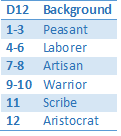
There is a 1 in 6 chance per person that they are wholly dedicated to their new faith, and need never check their morale. Others, however, may lose faith in the face of hardships (as determined by the TK). When this happens, the prophet must make a new conversion task check for each individual. If he fails, they decide to return to their homes and their old way of life.

A prophet must take care of his followers. He must provide food and water for them, protect them, provide some manner of shelter (tents at a minimum), and heal them when they are wounded or sick.

For one battle per day, the prophet can grant a benefice to his warriors in battle. As the prophet’s level increases, he gains additional benefices he can grant. Each benefice can be granted to one battle per day, and only one benefice can be granted per battle.
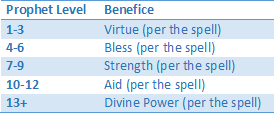
At 6th level, one of the prophet’s existing followers can become his acolyte. The prophet’s acolyte becomes a lesser divine servant of the prophet’s deity, gaining abilities as the prophet gains abilities.
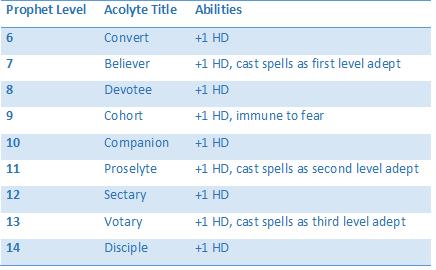
A prophet with fewer than 10 followers by 6th level must perform a quest for his deity or lose his ability to request miracles. Likewise a prophet with fewer than 25 followers at 7th level, fewer than 50 followers at 8th level, and fewer than 100 followers at 9th level and each level beyond 9th.

A prophet that is killed might enjoy an apotheosis upon death. There is a 5% chance per level of the prophet. When an apotheosis occurs, the prophet transforms into an outsider of similar alignment with roughly as many Hit Dice as the prophet +1. In this form, the prophet remains in the material plane for one minute per level. Thereafter, he is called to his home plane and disappears forever unless resurrected. If resurrected, the prophet returns in his original body, not as an outsider.

FIRST LEVEL MIRACLES
1. Aid
2. Bless
3. Comprehend Languages
4. Control Light
5. Cure Light Wounds
6. Multiply Food and Water
7. Protection from Evil
8. Summon Nature’s Ally I
9. Sustenance
10. Turn Undead

SECOND LEVEL MIRACLES
1. Augury
2. Buoyancy
3. Calm Emotions
4. Consecrate
5. Cure Moderate Wounds
6. Detect Thoughts (ESP)
7. Gentle Repose
8. Levitate
9. Remove Paralysis
10. Speak with Animals
11. Summon Nature’s Ally II
12. Summon Swarm

THIRD LEVEL MIRACLES
1. Cause Disease
2. Create Food and Water
3. Cure Blindness/Deafness
4. Cure Disease
5. Cure Serious Wounds
6. Fly
7. Hold Person
8. Remove Curse
9. Summon Nature’s Ally III
10. Tongues
11. Water Walk

FOURTH LEVEL MIRACLES
1. Blight
2. Charm Monster
3. Control Water
4. Cure Critical Wounds
5. Divination
6. Flame Strike
7. Holy Smite
8. Restoration
9. Sticks to Snakes

FIFTH LEVEL MIRACLES
1. Awaken
2. Bilocation
3. Commune
4. Contact Other Plane
5. Healing Circle
6. Hold Monster
7. Insect Plague
8. Raise Dead

SIXTH LEVEL MIRACLES
1. Banishment
2. Geas
3. Move Earth
4. Wind Walk

SEVENTH LEVEL MIRACLES
1. Control Weather
2. Create Clay Golem
3. Transmute Matter

EIGHTH LEVEL MIRACLES
1. Earthquake
2. Holy Aura

NINTH LEVEL MIRACLES
1. Astral Projection

NEW SPELLS

BILOCATION
Level: 5
Range: Personal
Duration: 1 minute

For one minute, the prophet can be in two places at once. Each version of the prophet can carry out movement and actions as normal. The second version can appear within 1 mile per prophet level of the first. When the second version disappears, any damage or other effects he sustained, or any items he took possession of, return to the first version.

BUOYANCY
Level: 2
Range: Close (30 ft.)
Duration: 1 minute

One object within 30 feet designated by the caster becomes buoyant in water, and floats to the surface.

CREATE CLAY GOLEM
Level: 7
Range: Touch
Duration: 10 minutes per level

By fashioning a roughly human-sized and shaped object out of clay and inscribing a magic sigil on its head, the prophet can cause it to become a clay golem for 10 minutes per prophet level.

MULTIPLY FOOD & WATER
Level: 1
Range: Touch
Duration: Instantaneous

This miracle takes existing food and water and multiplies, creating one extra portion per prophet level.

SUSTENANCE
Level: 1
Range: Personal
Duration: Instantaneous

The prophet can go without food, drink and sleep for one day, but must sacrifice one point of constitution to do so. This constitution point cannot be healed while any casting of this spell is in effect. A prophet could, therefore, use sustenance for seven days straight, but would be without seven points of constitution on the seventh day, and would suffer the normal effects of a lower constitution. Constitution points sacrificed for this spell return at the rate of one per day of rest.

TRANSMUTE MATTER
Level: 7
Range: Touch
Duration: 24 hours

The prophet can transmute matter from one form to another, thus lead to gold or steel to adamantine. The effect lasts for 24 hours. At the end of this time, the object must pass an item saving throw (as its original matter) or disintegrate.

 

The Phoenix

This class originally came about because I was working on some class ideas inspired by the classic elementals – not in terms of “guy who uses fire”, but rather “class inspired by fire’s representation in folklore and mythology”.

Speaking of fire, this is what I came up with:

THE PHOENIX

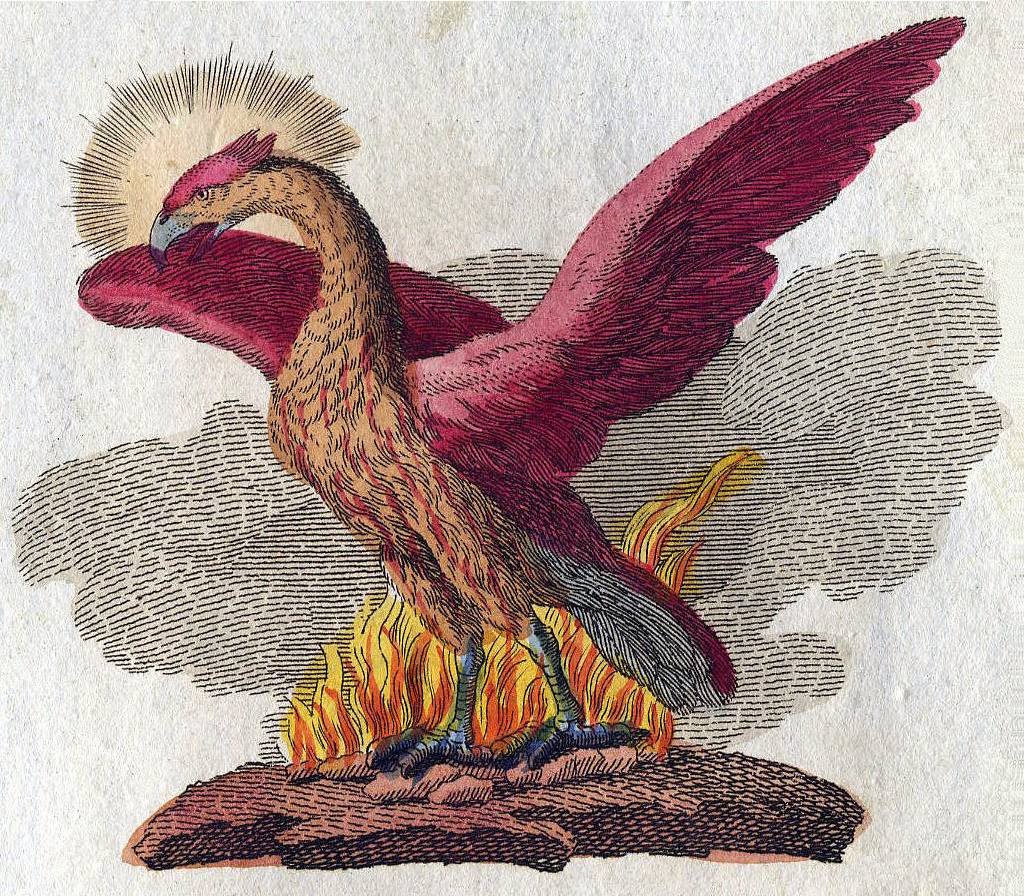
Some humanoids are born with an especially powerful spark of life. These are warrior souls, caught up in the great circle of life. Phoenixes have souls that never stop. When a phoenix dies, he or she immediately reincarnates as a new creature with the same memories and its personality mostly intact. The phoenix can do this many times, though each time stresses their constitution to the max, and each time a phoenix dies may be their last. Of course, it isn’t really the end of the phoenix’s soul – it merely transmigrates elsewhere in the cosmos (i.e. time for the player to roll up a new character) and fights on!

ARMOR – Any armor, including shields

WEAPONS – Any weapon

SKILLS – None

The key ability of a phoenix is his ability to reincarnate upon death, per the druid spell of the same name. When a phoenix is reduced to 0 hit points, its body immediately bursts into a 10-ft. radius of fire which deals 1d6 points of damage per four levels of the phoenix. The phoenix has a chance to direct this flame at a single target; if they can pass a Will saving throw they can direct the fire up to a range of 10 feet per four levels at a single target, who suffers all the damage (Reflex save to halve damage).

Once the fireworks are over, the phoenix emerges from the fire and smoke in a new body rolled randomly on the table below.

D%: REINCARNATED AS …
01. Aasimar
02. Azer
03. Blink Dog
04-07. Bugbear
08. Centaur
09. Crabman
10. Doppelganger
11-13. Dromite
14-19. Dwarf (10% chance of duergar)
20-25. Elf (10% chance of drow)
26-29. Gnoll
30-35. Gnome (10% chance of svirfneblin)
36-39. Goblin (10% chance of blue)
40. Grimlock
41-46. Half-elf
47-52. Half-orc
53. Harpy
54. Hengeyokai
55-58. Hobgoblin
59-64. Human
65. Janni
66-67. Juggernaut
68-71. Kobold
72-76. Lizard man
77. Minotaur
78-82. Neanderthal
83-85. Notac-Ichat (see NOD Companion)
86. Ogre
87-90. Orc
91. Satyr
92-93. Tiefling
94. Troglodyte
95. Unbodied
96-97. Utu (see NOD Companion)
98-00. Xeph

Roll randomly for the gender of the new body.

The phoenix gains all the abilities inherent to his new body (though not equipment, like a satyr’s pipes), but retains his normal hit points (adjusted for losing a level – see below), saving throws, attack bonus, ability scores and ability to speak. The phoenix personality remains largely the same, but is nudged a bit in the direction of its new form. If the phoenix has half or less of the hit dice of his new form, his new form is reduced in size by one size category.

The transformation is not without cost. The phoenix loses one level, and his experience points are reduced to the minimum level for his new level. A first level phoenix can reincarnate. His level remains at first, and his XP are reduced to 0. The phoenix must also pass a Fortitude saving throw or lose 1d3 points of constitution, permanently.

Once the transformation is complete, the phoenix must adjust to their new body. Each round, the phoenix must attempt a Will save. Once they succeed, they gain control over their faculties and can act normally. Until then, they are stunned.

A third level phoenix gains a limited form of regeneration. His natural healing is doubled (i.e. 2 hit points per level per night of rest), and he enjoys a +2 bonus to save vs. poison and disease.

A sixth level phoenix gains access to his soul’s memories. By meditating for one hour, the phoenix gains the use of one feat per three levels (i.e. two feats at sixth level, three a ninth, etc.). The phoenix can only access memories in this way once per day.

A ninth level phoenix can build a fortress-temple dedicated to the Phoenix. The phoenix attracts a body of 1d12+9 men-at-arms, heavy infantry, to serve as his personal bodyguard. In addition, a young 1st level phoenix seeks him out as a master (likely a sidekick from a former life).

Unhinging Clerics from Alignment

A Chaotic cardinal for a Lawful church? Read on …

Since the beginning of the game, clerics (and anti-clerics and druids) have largely been defined by their alignment. In the context of the early game, this made sense. Clerics were based on a combination of Van Helsing the vampire hunter and the religious knights of the crusades. That clerics must be Lawful was logical when you considered that they were based on adherents of a moral religion.

Note – I’m not going to get in a discussion here about the morality of the medieval Christian church. What I mean to convey is the idea that while Jews, Christians and Muslims believe that God created the universe and has some measure of control over nature (i.e. he can control the weather and such), they put their focus on his code of rules (thou shall not kill, etc.). Clerics of God, therefore, should be defined by their alignment.

Almost as soon as the game was written, though, it started to change. Clerics stopped being tied to an implicit Medieval Christianity and instead were tied to polytheistic deities, most of them just anthropomorphized forces of nature. Rather than the pseudo-Templars and Hospitalers that seem to have been intended under the original rules, we got clerics of Thor and Loki. Since Thor was Chaotic Good (if my memory of the Deities & Demigods/Legends & Lore book), his clerics needed to be Chaotic Good as well, which meant they needed to be “crusaders” for enlightened freedom. The Thor of mythology, however, did not seem particularly concerned with moral concepts. He was a personification of thunder and lightning, and, if anything, a ready and eager foe of the giants (i.e. natural calamities). It should have made more sense to use druids as the priests of all the nature deities, but they became saddled with the concept of True Neutrality. Ultimately, several unrelated systems were mashed together to make something that was mostly fun, but also didn’t make much sense.

How about a different concept for clerics? One that keep the basic rules in place (and hopefully the fun), but changes with the whys and wherefores and takes the focus for clerics away from alignment, and puts it back on casting spells in armor and pounding heads with maces.

Clerics, like magic-users, are spellcasters. The universe they inhabit has physical laws that can be broken with magic spells. In other words, the supernatural in thus universe is natural – it’s just a nature with processes that are beyond most mortals. The universe also has gods, goddesses and other divine beings. Maybe they created the universe, maybe they just have a secret knowledge of how it works. Either way, clerics join their cults and learn how to perform rituals that can alter the fabric of reality in ways the gods and goddesses are willing to allow.

Think of the universe as the internet, and clerics as people who have been given passwords to systems by the owners/creators of those systems, as a bank gives a customer a password that allows the customer to access her account information and perform other allowed functions. Because clerics are given this access in exchange for performing the necessary rituals and living by the rules of their temple or order or brotherhood, they have more time to spend on learning to fight than magic-users.

Magic-users are the hackers of the universe. They alter the fabric of reality without anyone’s permission, and it’s not easy. They have to learn the code of the gods and hijack it. This forces them to spend all their time figuring out how to get things done, and gives them little time left over for learning to fight. It also allows them a much wider array of powers than the clerics (though they still haven’t figured out how to hack into the healing spells).

Clerics in this scheme are not champions of an alignment, but champions of their cult/church/temple/brotherhood/etc. They represent their little faction in the very dangerous fantasy worlds in which they live, just as fighters serve kings and thieves serve their guilds. The name of the game is survival and power. In this scheme we do not need to tie the god of thunder to a particular alignment. He has a cult of followers whose existence allows him to play games in the cosmos (think of the scene in Jason and the Argonauts with the gods moving mortals around like chess pieces) or who just brag about how awesome he is. In return for their service he lets them alter reality on his terms. Within this cult, there can be clerics of any alignment, so long as they advance his agenda. In fact, the god of thunder might not even pay much attention to the cult. Maybe he gave his “passwords” to somebody long ago, and they passed the knowledge down to those who would serve them loyally.

Alignments in this sort of universe are not warring cosmic factions (a rather heady concept when you consider that the game is mostly made up of swashbuckling adventures and puzzle solving in a quest for money and experience/power), but rather the personal codes if men and women that determine how they interact with the world.

Clerics of Thor can be lawful, neutral or chaotic. The lawful clerics like to stick up for the little guy, the neutrals serve their order loyally to stay in good with their masters, and the chaotics try to get away with as much as possible without being expelled. This would endow these invented religious organizations a bit more color and intrigue. The lawfuls and chaotics within the cult don’t quite trust each other, and each works to control the cult because they fear the other faction, but they aren’t necessarily at each others throats all the time. The lawful heads of the cult might even understand that the chaotic clerics have their value in the organization, doing things they might shy away from, but which are necessary to advance the cult’s goals in the world.

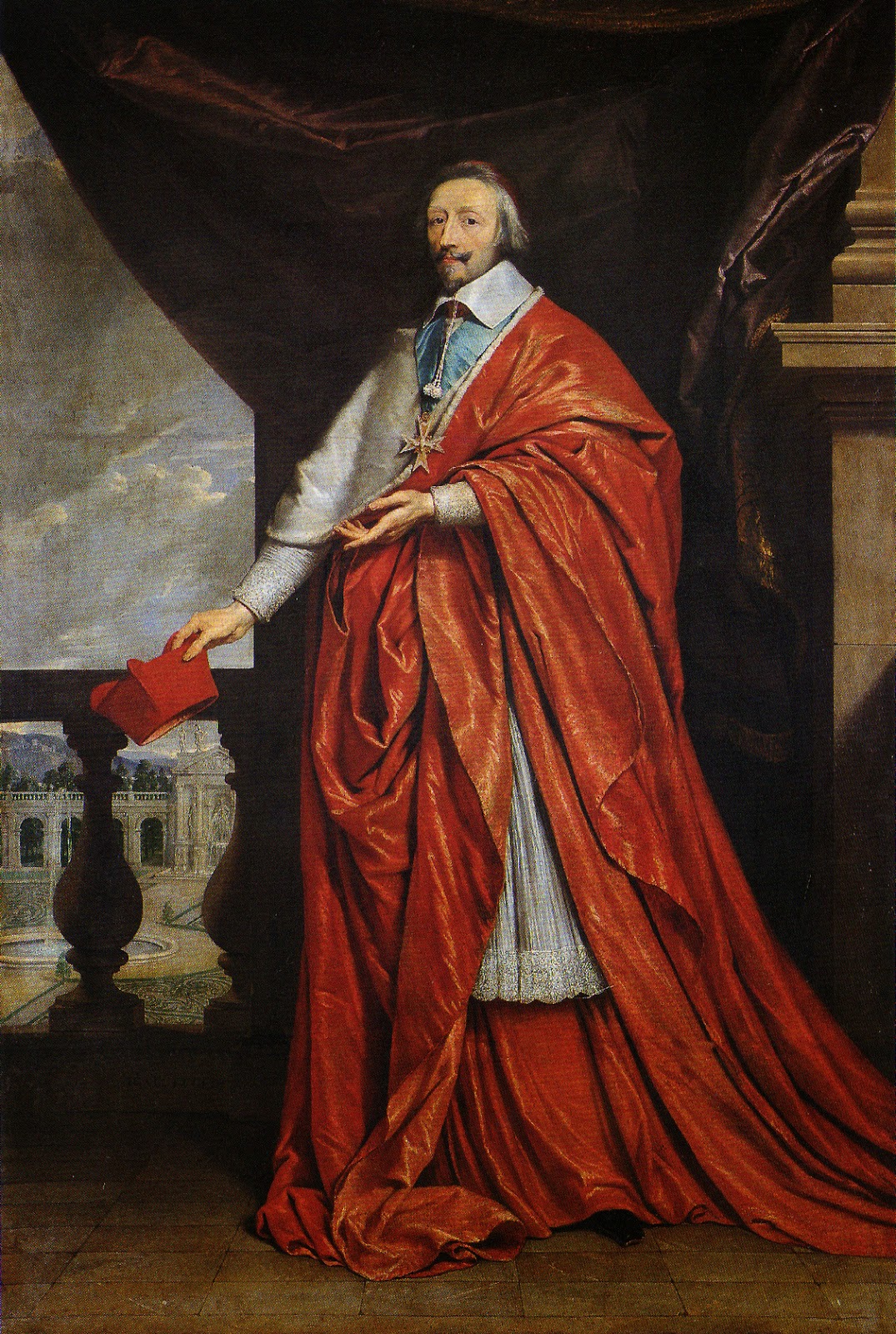
A deity that does represent or espouse a moral or immoral concept might, of course, restrict his or her clerics to a particular alignment. A deity of charity would want his clerics to be charitable – this would make chaotic clerics a bit tricky. Likewise, a god of trickery would want his clerics to be tricky – this might not work well for lawful sorts. Then again, consider Cardinal Richelieu – a member in good-standing of an ostensibly lawful church, and a terrible villain if most accounts are to be believed.

I guess this is a conception of alignment and clerics that would only fit in well in a Robert E Howard-style fantasy world, where the name of the game is power. It certainly wouldn’t be to every player’s taste, but it should please some players or at least prove entertaining for a while to veteran players. At a minimum, it could free clerics in the game from being forced into the role of do-gooder or do-badder, and instead make them more enjoyable to play.

The Incarnator

It’s been way too long since the last post, so hopefully this one will make it up. This is admittedly not an “old school” sort of class, but rather more of a “high fantasy” concept.

THE INCARNATOR

The incarnator is a mystic character class that can make the power of the stars incarnate on and within his person. These stellar incarnations appear in many shapes, but are always composed of light of a different color, based upon the star sign being invoked.

Incarnators train in much the same way as monks, psychics, and soulknives. They operate in training houses as tight-knit brotherhoods under the tutelage of a master.

In your campaign, incarnators might be the equivalent of magicians or psychics who specialize in star magic, or they might even have the blood of star gods and goddesses (the Pleiades) running through their veins.

REQUIREMENTS: Wisdom and Charisma 13+

ARMOR ALLOWED: Padded, leather, studded leather, and ring mail

WEAPONS ALLOWED: Club, dagger, dart, light crossbow, light mace, quarterstaff, short sword

SKILLS: Communicate, Decipher Codes, Navigation

CLASS ABILITIES

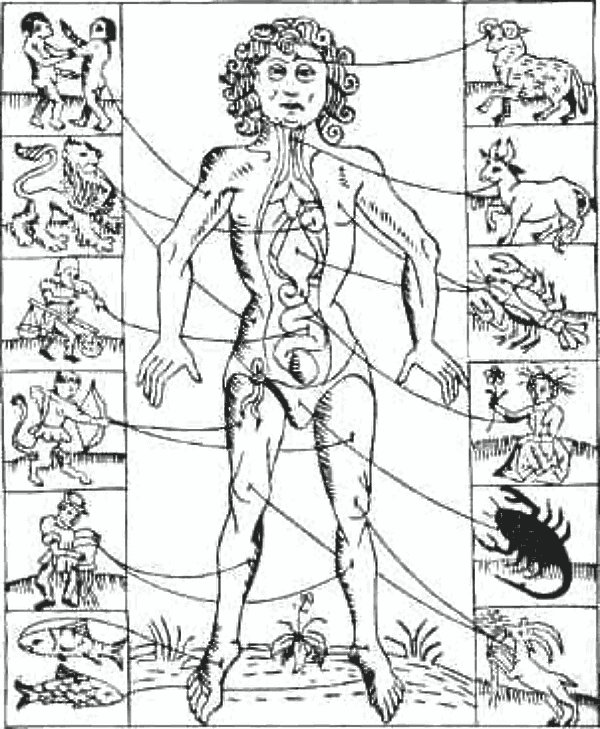
1. Incarnators call upon the mystic power of the stars, in the form of the twelve signs of the zodiac. Obviously, different fantasy worlds might have different star signs, but the rules here use the traditional zodiac – adjustments may need to be made for other worlds.

Because an incarnator calls upon the zodiac, they must first have their own star sign rolled randomly, with a 12-sided dice, of course.

2. Incarnators are skilled at drawing astrological charts. The action takes one hour, and not only reveals a person’s star sign, but also acts as an augury spell for the person in question.

3. To manifest an incarnation they must make a task check (a Will save) modified by their Wisdom score. Manifesting from one’s own birth sign is at a +2 bonus, from one’s own element at no penalty, from other elements at a -2 penalty, and from an opposing element at a -4 penalty. It is impossible for an incarnator to manifest from his opposing sign.

There are three types of incarnations an incarnator can manifest:

Artifacts are objects of solidified starlight. Manifesting an artifact requires a Will saving throw made with no additional penalty (see above).

Summonings are creatures composed entirely of solidified starlight. A summoning requires a Will saving throw with a penalty equal to the monster’s Hit Dice.

Aspects are internal or external modifications of the body. Aspects require a Will saving throw with a -10 penalty.

An incarnator can attempt a set number of manifestations per day (see table below). These numbers represent attempts, not successes. It’s possible for an incarnator to fail on all their attempted manifestations during a day. An incarnator can attempt the same manifestation multiple times per day if they choose.

Fire signs produce red light, earth green, air white and water blue.

If an incarnator is manifesting three incarnations from the same element, he gains resistance to that element’s related energy (fire, acid, electricity, cold) so long as his incarnations are manifested.

The artifacts, summonings and aspects associated with the signs are as follows:

Weapons: All incarnator weapons, including natural weapons, appear as solidified light of the appropriate color. The weapon acts in all ways as a +1 magic weapon of its type. A 6th level incarnator’s weapons also deal +1d6 points of energy damage based upon its element (i.e. Aries is a fire sign, so a warhammer of Aries deals +1d6 fire damage). A 12th level incarnator’s weapon acts as a +1 brilliant light weapon of its type. Weapons last for one turn (10 minutes). Manifested natural weapons permit an attack by the incarnator in addition to a held weapon.

Armor: Incarnator armor acts as +1 magic armor of its type. A 6th level incarnator’s armor also provides resistance against the appropriate energy (fire for fire signs, acid for earth signs, electricity for air signs and cold for water signs). Armor lasts for one hour.

Potion Bottle: The potion bottle of Aquarius contains a potion that duplicates a single spell of a level equal to the incarnator’s level divided by four, rounding down. Thus, a 1st level incarnator can manifest a potion that duplicates a 0-level spell, a 2nd to 5th level incarnator a first level spell, a 6th to 9th level incarnator a second level spell, and so on. The potion bottle and the liquid starlight is contains last for one turn, though the effects of the spell within have the normal duration.

Scales: The scales of Libra can take a measure of creatures, determining their alignment leanings (chaos vs. law, good vs. evil) and also the wisdom of an action (per the augury spell). The scales manifest for 1 turn.

Monsters: Monsters are energy constructs that fight as their normal type, but enjoy resistance to the energy associated with their sign. They last for 6 rounds.

Split: When a character splits, they become two incarnators of half their normal level and half their current hit points. If one is killed while split, the incarnator absorbs his former half, but suffers one level of energy damage (not drain). A split lasts for one round + one round per level of the incarnator.

Mighty Roar: The mighty roar works as the special ability of the dragonne. While manifesting the mighty roar, the incarnator’s eyes glow red, and a mane of reddish light filaments sprouts from his or her head. The mighty roar ability lasts for one round + one round per level of the incarnator.

Magic Circle: Per the magic circle spell, affecting either good or evil. The magic circle actually appears as a glowing green aura around the incarnator’s body, and lasts for one round + one round per level of the incarnator.

Blinding Beauty: Per the nymph ability, this ability causes the incarnator’s body to glow with luminous, white light. Blinding beauty lasts for one round + one round per level of the incarnator.

Horse Body: The incarnator manifests a centaur like horse body of red light. He gains the movement rate and natural hoof attacks of a centaur.

Steam Body: Per the gaseous form spell, but the incarnator can choose to expand into the equivalent of the fog cloud spell. Lasts for one round + one round per level.

Scales and Gills: The incarnator gains a swim speed of 60 and water breathing (per the spell). Lasts for one round + one round per incarnator level.


History of NOD Part IV

Wow – so I let myself get lax on updating the blog again. In my defense, I’ve been super busy at work (real work, that one that plays for my mansion and gold-plated yacht) and super busy at home (NOD Companion just needs a little editing and layout work, NOD 22 is coming along nicely, Mystery Men! got a small revision and ACTION X has been reborn as GRIT & VIGOR and is also coming along nicely). So, there’s my excuse. Here’s my post …

HISTORY OF HUMANS AND HALFLINGS

With the power of the elves and dwarves broken, the world was left to the humans and their ilk. We now reach a time a scant five thousand years ago.

As the dragons of Mu-Pan slowly retired into secret places, they left their scions in charge of their warring kingdoms. In time, they would be united in an empire that would have to tolerate numerous dynastic changes and revolutions and stand up to the machinations of the weird lords of Tsanjan.

Thule harbored a rogue elven land called Pohiola. This nightmare kingdom would slowly give way to the invasions of the horsemen of the steppe, as they laid the foundations for such kingdoms as Mab, Luhan and Azsor.

Antilia and Hybresail would remain largely wild places, home as they were to the shattered homeland of elves and dwarves, its human and demi-human populations reduced to barbarism.

In the Motherlands and Lemuria, the human populations learned well from their former elven masters, and founded sorcerous empires founded on demon worship. In time, such empires as Irem, Nabu and Kolos would fall in spectacular eldritch fashion. In their ashes, a new empire was born that would rule much of the Motherlands – Nomo. Nomo was founded when a band of elven adventurers led by Prince Partholon left the shores of Antilia in a dozen longships and make their way to the Motherlands. Finding themselves among a tribe of human barbarians, they soon asserted themselves as their masters, founding the city-state of Nomo and eventually extending their control over much of the sub-continent. Under Nomo’s emperors and empresses a 2,000 year empire was begun which would end only with the disappearance of the Emperor during adventures in the mysterious West.

With the emperor’s disappearance, Nomo fell into factional fighting, with each faction supporting its own candidate for emperor. The former tributary kings and queens in the empire also staked their claims on the throne.

Thus it is in today’s land of NOD. City-states built on the ruins of kingdoms built on the ruins of empires, all threatened by encroaching chaos.

RACIAL CLASS VARIANTS
In Blood & Treasure, I introduced the notion of variant classes. These were meant to illustrate the way one might create new classes using old classes as a base, with fairly minor changes.

BARBARIAN VARIANT: HALF-ORC THUG

Half-orcs often grow up on the mean streets, learning to excel not as trained fighters but as street brawlers. These half-orc thugs advance as barbarians, save for as follows: They may only use padded or leather armor and bucklers, they have the following skills: Bend Bars, Break Down Doors, Climb Sheer Surfaces, Gather Rumors, Hide in Shadows, Jump, Move Silently and Pick Pockets.

PALADIN VARIANT: ELVEN GALLANT

Gallants are elven paladins as dedicated to romance and wooing women as they are to righting wrongs and protecting the weak. While most paladins can be a bit stodgy, elven gallants are rather dashing and devil-may-care.

In a three-fold alignment system, gallants must be Lawful. In a nine-fold system, though, they need only be Good. Gallants cast spells from the bard spell list rather than the paladin spell list.

THIEF VARIANT: DWARF PROSPECTOR

As adventurous as dwarves can be, their first loves are always gold, gems and silver. Many, if not most, get their first taste of adventure as prospectors, heading into the hills or depths in search of metals or stones to mine.

Dwarf prospectors have the following skills: Climb Sheer Surfaces, Find Traps, Hide in Shadows, Listen at Doors, Move Silently, Notice Unusual Stonework, Open Locks, Remove Traps and Spelunking. In addition, they can wield picks and hammers.

THIEF VARIANT: GNOME PRANKSTER

Gnomes are innately magical folk, and some learn from a young age to tailor their magical abilities to the profession of thievery. These gnome thieves are noted for their enjoyment of taunting their victims with pranks and riddles, leaving calling cards and boasting of their thefts before they happen.

In place of a gnome’s normal innate spells, a prankster can cast the following spells: Mage hand, open/closer and ventriloquism.

THIEF VARIANT: HALFLING GYPSY

Many of the halflings that people meet are of a breed known as the pikey – wanderers from the east who live a semi-nomadic life among the larger races, making a living telling fortunes, picking pockets, stealing pies (they love pies) and bilking the naive.

Gypsies have the abilities of thieves, save they replace the backstab ability with the bard’s ability to fascinate. Their skills are as follows: Balance, Climb Sheer Surfaces, Escape Bonds, Gather Rumors, Hide in Shadows, Move Silently, Pick Pockets, Train Animals and Trickery.

The Canting Crew

Before we get on with the new class (which may or may not work, but it’s a fun experiment), I want to announce that all my hard copy books are 10% off right now at Lulu.com. Go check ’em out if you’ve been waiting, and keep your eyes open for Lulu.com sales to make the deals even sweeter.

THE CANTING CREW

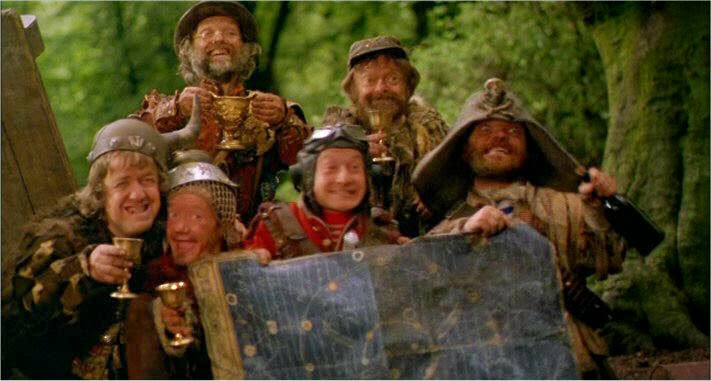
In my quest to create yet another odd character class, I have dreamed up the canting crew. Actually, the inspiration for the class was a small band of robbers cutting a swathe through time after stealing a map of creation. You’ve probably heard of them. Watching Time Bandits made me think of a band of halflings causing trouble, and that made me think of the swarm rules in d20 and one thing led to another and … the canting crew. Obviously, this is not a traditional character class, so it’s not only not for every player, but not for every campaign. Truth be told – I have no idea if this will even work.

REQUIREMENTS
Dexterity 9+, Charisma 13+
Non-lawful, non-good; robber gangs are not necessarily evil, but they are certainly not good
Halfling or gnome (or other small races, if allowed in your games)

ARMOR ALLOWED
Padded and leather armor; no shields

WEAPONS ALLOWED
Club, dagger, dart, hammer, light mace and sling

SKILLS
Hide in Shadows, Move Silently

CLASS ABILITIES

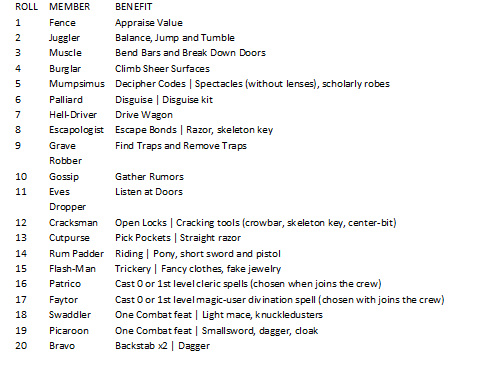
A canting crew starts out as a single rogue, the boss. As the crew gains levels, it also gains members, with each member representing one hit dice, or level, of the crew. Each time a new member is added to the crew, that member should be named, and a dice should be rolled on the following table to get an idea of what that new member brings to the crew.

When a member of the crew brings a competence in a task, that particular member is skilled in that task, and his presence and tutelage makes Gives rest of the members a knack in that task. If a canting crew is divided, this distinction might be important.

The canting crew attacks as a swarm. Attacks against the crew deal damage to the band’s collective hit points. The crew can split up to make attacks, or even choose not to throw all their weight against a single opponent. For however many members of the crew are attacking a single foe (usually no more than eight against a medium-sized creature), treat the attacks as coming from a robber crew of that level. Thus, three robbers attacking a creature attack as a 3rd level crew, i.e. with a +2 attack bonus. The crew, no matter how they are split up, uses saving throw values for their crew’s full level. Any feat taken by the robber crew is assumed to be held by all members of the crew. Feats or abilities that come with individual members are possessed only by that member.

On the downside, robber crews are composed of multiple halflings or gnomes, and each member requires his or her own equipment and rations. This makes running a robber crew a bit expensive, so make sure you don’t pass up a chance for treasure or theft!

Damage against a robber crew must also be addressed. When a robber crew’s hit points are reduced to 0, it is assumed that all of the members have been killed, the boss being the last to fall. For every three points of damage a crew suffers, there is a 10% chance that one member, chosen at random, is killed and must be replaced when the crew next reaches civilization. While the crew is short a member, they are also short that member’s skills or abilities and their help in a fight. When the crew does reach civilization, a new random member is added to the crew.

A 3rd level canting crew learns how to cover one another’s retreats. Members of the crew can retreat at a full run without drawing an attack from their foes.

A 5th level canting crew’s chattering and dodging about has a chance of confusing their opponents. Each round a crew decides to caper instead of actually attacking, their foe must pass a Will saving throw or be stunned for that round. To confuse an opponent, at least three members of the crew must be engaged in combat with that opponent.

A 7th level canting crew learns how to look out for each other. They roll their chance of being surprised on 1d8 instead of 1d6. In addition, when they fight, each member of the canting crew engaged with a single creature over the first member increases the Armor Class of the group fighting that creature by one.

A 9th level canting crew can establish a hideout for themselves, per the thief class. The canting crew does not attract a lieutenant, but they do attract a number of lesser rogues and thieves, with the members of the canting crew each taking on a small gang of their own to tutor and control.

Demigods, the First Adventurers

It would be hard to tell who the first adventurer in literature ever was, but I suppose Gilgamesh might fit the bill. Gilgamesh is the son a human king and the goddess Ninsun, making him a demi-god. In the annals of adventuring, he has good company – Heracles, Achilles, Cuchulainn, Hanuman, Māui, Perseus, Theseus, and many more.

So if demigods can be adventurers in myth and literature, why not in Blood & Treasure?

First things first – we need to define our demigods. If one has some experience in fantasy role playing games, they’ll know that demi-gods are usually depicted as extraordinarily powerful entities. Obviously, characters that powerful would not work well as adventurers, unless one was doing some pretty epic adventuring.

Our demigods are going to be a bit more human (or demi-human), and like other adventurers, are going to become more powerful as they advance in levels. In other words, they’re going to be on par with the other characters – don’t expect them to eclipse the magic-users, thieves and fighters in the party.

REQUIREMENTS
No ability score lower than 10, one ability score higher than 15

ARMOR ALLOWED
Padded, leather, studded leather; bucklers and shields

WEAPONS ALLOWED
Any weapon

SKILLS
Bend Bars, Break Down Doors, Find Secret Doors, Ignore Pain, Jump, Monster Lore

CLASS ABILITIES
At 1st level, a demigod’s player must choose their character’s divine ancestry. Whether a god or goddess, they must choose one of the following domains for their character’s divine parent based on their character’s highest ability score.

  • STR Destruction, Strength, War, Water
  • INT Knowledge, Magic
  • WIS Death, Healing, Sun
  • DEX Air, Fire, Travel
  • CON Animal, Earth, Plant, Protection
  • CHA Love, Luck, Trickery

The demigod gains one power based on his or her parentage, as follows:

  • AIR: Resistance to electricity damage, feather fall at will
  • ANIMAL: Speak with animals at will, charm animal three times per day
  • DEATH: Command undead three times per day
  • DESTRUCTION: Smite opponent once per day (+2 to hit and double damage if you hit)
  • EARTH: Resistance to acid damage, +1 bonus to saving throws while standing on bare earth
  • FIRE: Immune to fire damage
  • HEALING: Laying on of hands ability, per the paladin
  • KNOWLEDGE: Legend lore ability, per the bard
  • LOVE: Charm person once per day, three times per day at 4th level
  • LUCK: Re-roll one saving throw once per day
  • MAGIC: Save vs. magic at +2
  • PLANT: Speak with plants at will, command plants once per day
  • PROTECTION: Barkskin three times per day
  • STRENGTH: Can wield two-handed weapons with one hand
  • SUN: Use light at will, daylight once per day
  • TRAVEL: Haste once per day for one round per level
  • TRICKERY: Trickery as class skill, spell abilities of a gnome
  • WAR: Deals double damage on a charge (if birthed by a war god like Ares) or command double the normal numbers of henchmen (if birthed by a war goddess like Athena)
  • WATER: Resistance to cold damage; cannot sink in water (though can be held under and drowned)

Demigods are supernaturally tough, and gain the Armor Class bonuses as a monk.

Demigods are born to greatness, and are expected to do great things. A 1st level demigod is given an ordained labor by his divine parent. This works as a geas, and requires the demigod to do one of the following by the time he or she reaches 4th level.

  1. Capture a monster* with twice as many Hit Dice (minimum 2 Hit Dice more) as the demigod
  2. Complete a heroic task that would be considered very difficult for the character (the Treasure Keeper has to use his or her best judgment on this one)
  3. Slay a monster* with twice as many Hit Dice (minimum 3 Hit Dice more) as the demigod
  4. Steal a relic (must be worth as many gp as the demigod as XP or be magical)

* Monster in this connotation refers to magical beasts, monstrous humanoids, dragons, prehistoric animals, giants and outsiders

Until the labor is completed, the demigod cannot advance beyond 4th level. A new labor is ordained when the hero reaches 5th level, and must be completed by the time the demigod reaches 8th level. Additional labors must be completed by 12th and 16th level.

  • The first labor completed earns the demigod a one-time use of the restoration spell on him or herself.
  • The second labor completed earns the demigod a one-time use of the raise dead spell on him or herself.
  • The third labor completed earns the demigod a one-time use of the resurrection spell on him or herself.
  • The fourth labor completed earns the demigod the right to ascend into Heaven (or wherever mom or dad are from) when they die.

Demigods are renowned for one of their physical or mental abilities, and this ability grows as their fame grows. A demigod increases his or her highest ability score by one point at 2nd, 4th, 6th, 8th and 10th level.

A 3rd level demigod can make pleas for assistance to his divine parent. Demigods can appeal for 0 to 2nd level spells by passing a Charisma task check with a penalty equal to the level of the spell. At 7th level, the demigod can begin appealing for 3rd to 4th level spells. At 11th level, the demigod can begin appealing for 5th to 6th level spells. Each time an appeal is answered, the demigod must pledge 10% of their earned treasure to the cult of their divine parent (a minimum of 50 gp per spell level).

A 5th level demigod gains magic resistance equal to 1% per level, to a maximum of 10%.

A 9th level demigod may establish a hero cult for themselves. The demigod must construct a temple in his own honor and in the honor of his divine parent. The demigod then attracts 1d6 men-at-arms per level, 1d6 first level clerics or druids and a 4th level cleric or druid to serve as his high priest.


DEMIGOD ADVANCEMENT
LVL
XP
HD
ATK
F
R
W
TITLE
1
0
1d12
+0
13
13
13
Scion
2
2,500
2d12
+1
12
12
12
Exemplar
3
5,000
3d12
+2
12
12
12
Champion
4
10,000
4d12
+3
11
11
11
Hero
5
20,000
5d12
+3
11
11
11
Cynosure
6
40,000
6d12
+4
10
10
10
Archon
7
80,000
7d12
+5
10
10
10
Paragon
8
160,000
8d12
+6
9
9
9
Superhero
9
300,000
9d12
+6
9
9
9
Demigod
10
600,000
10d12
+7
8
8
8
Demigod
11
900,000
+3 hp
+8
8
8
8
Demigod
12
1,100,000
+3 hp
+9
7
7
7
Demigod
13
1,400,000
+3 hp
+9
7
7
7
Demigod
14
1,700,000
+3 hp
+10
6
6
6
Demigod
15
2,000,000
+3 hp
+11
6
6
6
Demigod
16
2,300,000
+3 hp
+12
5
5
5
Demigod
17
2,600,000
+3 hp
+12
5
5
5
Demigod
18
2,900,000
+3 hp
+13
4
4
4
Demigod
19
3,200,000
+3 hp
+14
4
4
4
Demigod
20
3,500,000
+3 hp
+15
3
3
3
Demigod

Horses Are Sooooo 1978

Or whenever the paladin was first published. I wanted to be clever with the title, but not to the degree that I was going to do five seconds of research with Google.

Paladins, at 5th level, can undertake a quest to obtain a very intelligent mount. Depending on the edition you play, this mount either hangs out with you all the time and sorta requires you to hire a groom or page or whatever to look out for it when you’re in a dungeon, or it just pops into existence whenever it is convenient. You can probably guess which concept I like better.

But what if … what if there were more options than that super-clever wonder horse? Well, how about these …

(Use as inspiration, or roll randomly with a D12)

1. Mechanical Warhorse – requires a quest to settle a grudge for the Dwarf King, who forged the horse in his own workshop. Just combine an automaton and a heavy warhorse to get the stats. For anti-paladins, the mechanical warhorse is grey and spiky.

2. Putti – I think I did stats for these fellows once (you know, the chubby, winged babies people mistakenly call cherubs or cupids), if not, just make them Lawful (LG) imps. For anti-paladins, just use an imp.

3. Unicorn – but only if the paladin is female. For anti-paladins … not sure.

4. Aasimar Squire – 4 HD, of course. For anti-paladins, a tiefling picaroon.

5. Blink Dog – maybe the quest involves rescuing it from a giant’s kennels. For anti-paladins, a shadow mastiffs.

6. Halo – actually a lantern archon with 4 HD that oftens hangs out around the paladin’s noggin. For anti-paladins, just craft a red-hued evil version of the lantern archon.

7. Relic – the relic is the skull of a cleric which the paladin can communicate with telepathically, and which can cast spells as a 4th level cleric (though not touch spells, obviously).

8. Choir – a choir of four 1 HD lay priests who can chant (as the spell) and inspire (as bards). For anti-paladins, four 1 HD flaggelants with scourges who do the same.

9. Gold Wyrmling – precocious, of course. For anti-paladins, a red wyrmling.

10. Brownie Knight – gained by embarking on a quest for the Fairy Queen, a bit of a curmudgeon. For anti-paladins, a spriggan thug of the Unseelie Court.

11. Elven Sage – an old codger with silver hair who can cast spells as an adept (venerable master). For anti-paladins, a drow alchemist who may or may not be trying to poison their master.

12. Reformed Prostitute – a prostitute who has seen the light and can cast spells as an adept (venerable master; note, the prostitute is not venerable in terms of age, but in terms of the blessings bestowed upon him or her). For anti-paladins, a fallen, alcoholic friar or nun.

Establishing a New Dungeon Order with the Masons! [New Class]

Here’s the deal – Freemasonry, whatever you think of it, has some uber-awesome level titles. And level titles, my friend, mean Old School gaming to me. In short – I had no choice but to create this class. I hope it goes without saying that I mean no disrespect to actual Freemasons out there – this is just me having a bit of fun.

Guilds are common among the artisans of NOD, but none have gained such infamy as Fraternity of Stonemasons. Actually many different fraternities organized in lodges, the migratory nature of masonry has led to the formerly autonomous fraternities becoming an international network of lodges, controlled by a Great Lodge, the location and membership of which is a well-kept secret, even from most of the members. Because of the size of this network, and its being spread across many city-states, empires and faiths, there is a vague sense of hostility towards the Fraternity by many rulers and high priests, who question the loyalty of the members.

For their part, the masons are primarily dedicated to their work, traveling from castle to monument to Great Wall to dungeon, cutting and setting stone. The travels of a mason, though, send them through many strange and dangerous lands, making those masons who travel beyond the borders of their home city or town adventurers in their own right. These adventuring masons, or freemasons, make up the elite of the ancient Fraternity, garnering wealth, influence and knowledge for their lodges.

REQUIREMENTS
Intelligence 11+, Strength 9+, Dexterity 13+
Lawful (LG, LN)

ARMOR ALLOWED
Padded armor, leather armor
No shields

WEAPONS ALLOWED
Club, dagger, hammer, handaxe, heavy pick, light crossbow, light mace, light pick, quarterstaff, sap, sling, warhammer

SKILLS
Bend Bars*, Break Down Doors*, Find Secret Doors**, Notice Unusual Stonework***

* Requires mason’s tools; otherwise counts as a knack

** Masons are skilled when looking for secret doors disguised as stone, but only have a knack for finding other secret doors

*** As the dwarf ability, or see New Tasks in this book

CLASS ABILITIES

All masons are capable of cutting stone, earning a wage of 1 silver piece per day for normal masonry and 1 gp a day for ornamental masonry or overseeing up to 10 lower-level masons. Ornamental masonry requires a Reflex task check; naturally, you treat the mason as though he were “skilled” at this task.

In order to earn these wages, the mason must carry a set of mason’s tools. These tools include a pair of wooden compasses, a piece of chalk or charcoal to make marks, chisels of different sizes, a hammer, plumb, a trowel, iron and wooden dowels. These tools are kept in a large canvas or leather bag or backpack, and weigh 20 pounds.

Finally, 1st level masons learn the secret signs, tokens, grips and words of their fraternity. This counts as a secret language, much like the thieves’ cant, that allows masons to identify one another and communicate without others understanding them. Masons can also learn Earth Elemental as one of their starting languages.

A 3rd level mason (master mason) scores double damage against elemental earth creatures and other creatures made entirely or primarily of rock, stone or earth, not including gargoyles, who are just big fakers.

A 6th level mason (master elect) learns the secret rites of the Fraternity, the Rites of Elemental Earth, handed down from the ancient dwarven founders of the Fraternity. These rites permit the mason to cast a small number of spells using the same rules as a magic-user. The mason must carry a special manual filled with his spells, which are recorded in the secret signs of the Fraternity. Other masons can interpret these signs, but must pass a special Decipher Codes check as though they were skilled in the task.

Masons prepare and cast the same number of spells per day as a ranger.

1st level: Elemental weapon (acid only), magic stone, mason mark*, mending**, pass through element**, shatter, soften earth and stone

2nd level: Explosive runes, meld into stone, shockwave***, spike stones, stone shape, summon small earth elemental

3rd level: Move earth, passwall, stoneskin, summon medium earth elemental, transmute mud to rock, transmute rock to mud, wall of stone

4th level: Earthquake, earthwalk, repel stone****, stone of flesh, summon large earth elemental

* As wizard mark

** Affects earth/stone only

*** Mason must strike the ground with a hammer or pick to cast this spell

**** As repel metal or stone, save it only repels stone

In addition, a 6th level mason (master elect) learns to turn elemental earth creatures as a cleric turns undead. The mason turns earth elementals as a cleric five levels lower than his mason level.

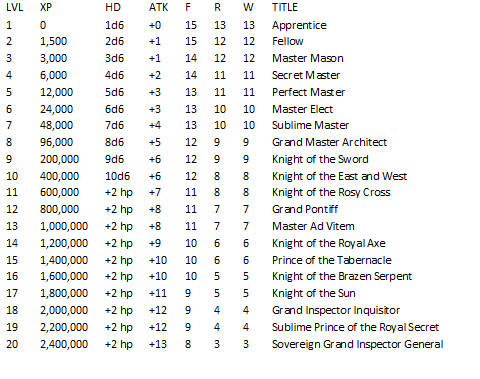
A 9th level mason (knight of the sword) earns the right to establish a lodge of the Fraternity in a town or city-state in which no lodge already exists. A mason who becomes a worshipful master attracts 1d6 normal masons (i.e. 0-level artisans) per level, 1d6 first level masons who wish to train under him and one 5th level mason protégé.

A 9th level mason (knight of the sword) also begins to learn to carve powerful runes, as follows:

Knight of the Sword (9th) | Rune of sleep

Knight of the East and West (10th) | Rune of pain

Knight of the Rosy Cross (11th) | Rune of persuasion

Grand Pontiff (12th) | Rune of fear

Master Ad Vitem (13th) | Rune of stunning

Knight of the Royal Axe (14th) | Rune of weakness

Prince of the Tabernacle (15th) | Rune of insanity

Knight of the Brazen Serpent (16th) | Rune of death

Runes work as the symbol spells, but must be carved in stone and are triggered when first looked upon by an intelligent creature. The mason can carve no more than one such rune per day, and can have no more than five runes (of any type) active at any one time.

Upon achieving 12th level (Grand Pontiff), a mason gains command over a Grand Lodge, which simply encompasses all the lodges within a given region (the definition of region here being determined by the Treasure Keeper in regards to his or her own campaign). If there is already a Grand Pontiff in the region, assume that they achieve 13th level and hand down the duties to the new Grand Pontiff. Grand Pontiffs also gain the ability to planeshift into the Elemental Earth Plane (and return to the Material Plane at a time of their choosing) once per day.

Beyond 17th level (knight of the sun), there can be only one mason at each level. A mason cannot rise beyond 17th level without supplanting a higher level mason. This can be done by waiting for them to die (arranging or causing death is not permitted, though of course one can attempt to get away with it if they are bold and stupid enough to forget all those sweet divination spells that can be used to convict them) or challenging them to a contest of masonry. These contests are usually epic in scope, requiring extraordinarily difficult works of masonry that are either decided by a series of task checks, each more difficult than the last, or by judgment from a council of masons that have achieved a minimum of 12th level.

The Grand Inspector Inquisitor (18th) of masonry may issue commands to fellow masons that are the equivalent of a quest spell. The Grand Inspector Inquisitor is the highest level mason whose identity is known to other masons. He knows the identity of the Sublime Prince of the Royal Secret.

The Sublime Prince of the Royal Secret (19th) is capable, once per day, of communing the powers of elemental earth (per the commune with nature or contact higher power spells). He alone knows the identity of the Sovereign Grand Inspector General.

The Sovereign Grand Inspector General (20th) controls the Great Lodge, which consists of all lodges and grand lodges within a single reality. As the leader of all masons, he or she is capable, once per day, of summoning an earth elemental swarm to do his or her bidding.

Edit: Crap – forgot the class advancement table with all the kickass level titles …

Precision Swiss Dungeoneering

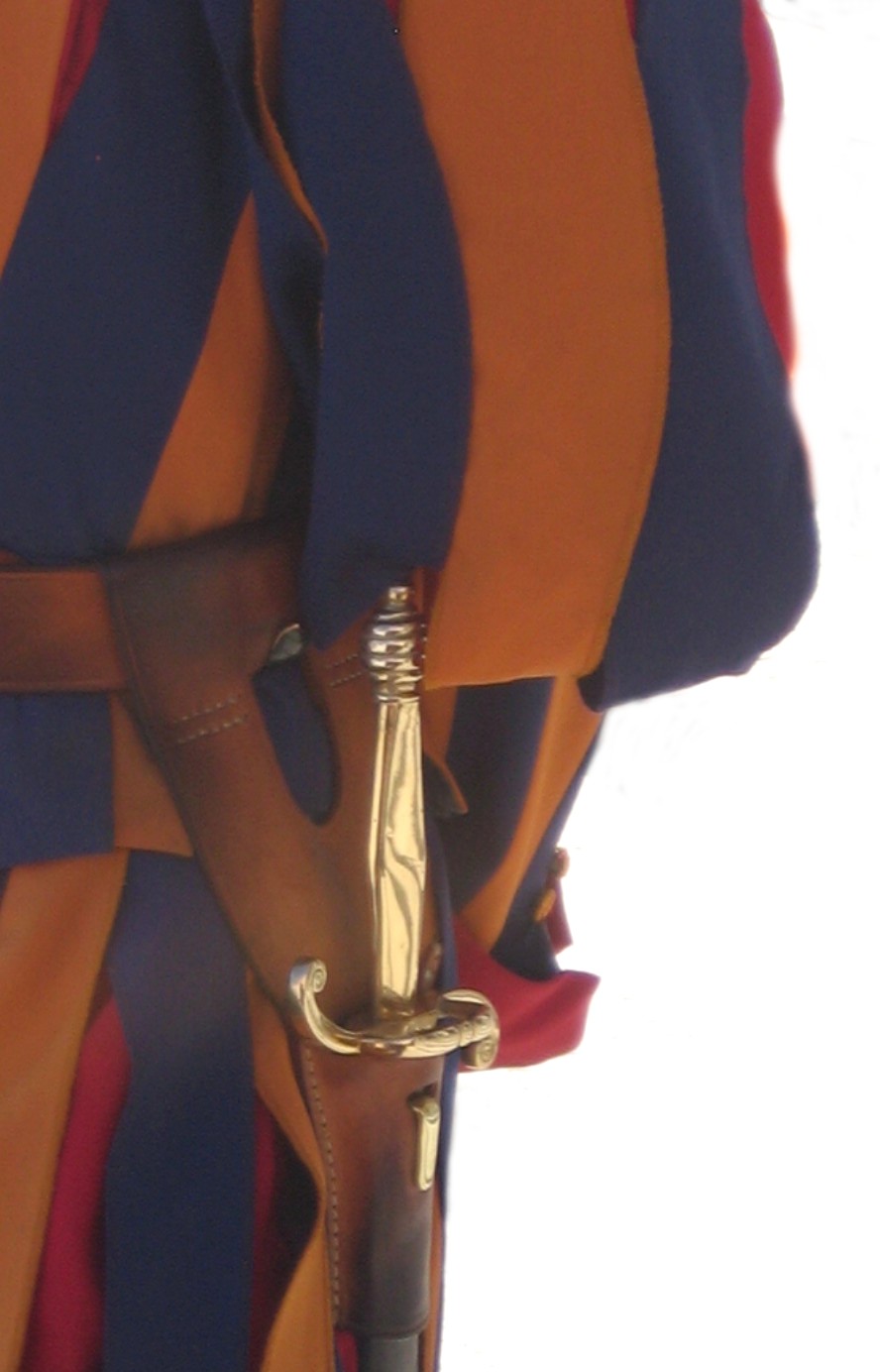
Image by Joshua Sherurcij

I honestly don’t know. I go on a walk. A funny idea pops into my head, which I quickly dismiss. Then a couple more thoughts pop in to flesh out the original idea, and the next thing you know I’m writing up a Blood & Treasure class called the Switzer. On the other hand, one of the founders of the hobby was of Swiss origin, so maybe this class is way overdue!

The Switzer

Switzers are folks from mountainous regions who live up to several flimsy stereotypes (and outright fabrications!) and delve in dungeons. Hey, the inspiration behind this idea is pretty sparse, just do me a favor and roll with it.

Switzers advance in level as rangers.

A life in the mountains has given the 1st level Switzer (regular) a knack at noting unusual stonework and slopes as a dwarf (or count these abilities as skills if the Switzer is a dwarf). Switzers also have an innate money sense. They can calculate a number of coins and the value of gemstones with 80% accuracy. When buying goods, they can make an Intelligence check to either find a bargain (10% discount) or to find superior merchandise (pay a 50% premium, gain a +1 bonus to checks or attacks when using the item).

Switzers must remain true neutral for their entire careers, but they have mercenary hearts and can commit Lawful, Chaotic, Good or Evil acts at the cost of 10 gp per Switzer level. A Switzer who strays from neutrality becomes a normal fighter with the fighting ability of a cleric until he or she receives an atonement spell.

The mountain homes of Switzers are lousy with mad wizards and scientists, so 3rd level Switzers (mountaineer) thus gain particular skill at combating one of their most common and hideous creations, the flesh golem. Against a flesh golem, a Switzer gains a +1 bonus to hit and scores double damage on a successful hit. At 7th level (hellebardier), the Switzer’s innate familiarity with clockworks gives him a similar advantage against iron golems, antikytheres, automatons (i.e. mechanical men) and other clockwork creatures.

A 4th level Switzer (gardist) becomes a master of the pole arm and pike, gaining a +1 bonus to hit and damage with them. When fighting in formation, the Switzer also gains a +1 bonus per 5 fellow warriors (similarly armed) in the formation to Armor Class, up to a +4 bonus.

A 5th level Switzer (Alpinist) can undertake a quest, guided by a divine vision, to find and gain the service of an unusually intelligent, strong, and loyal St. Bernard to serve him. If the Switzer’s dog dies, he must wait until gaining another level of Switzer to undertake the quest again.

The St. Bernard has the following stats:

St. Bernard, Medium Magical Beast: HD 2+2; AC 16; ATK 1 bite (1d6); MV 40; F12 R12 W16; AL N (LN); XP 200; Special—Resistance to cold, cask of wine (produces enough restorative brandy to restore a total of 2 hp per Switzer level per day), low intelligence.

A 6th level Switzer (yodeler) can cast a small collection of spells by yodeling. The spells are drawn from the following list. The Switzer can cast as many spells as the paladin (see B&T Player’s Guide).

Level One: Cause fear, charm person, daze, hideous laughter, message, open/close, sleep

Level Two: Animal trance, daze monster, enthrall, hold person, rage, shatter, sound burst

Level Three: Charm monster, confusion, crushing despair, good hope, speak with animals

Level Four: Dominate person, hold monster, repel vermin, shout

An 8th level Switzer (Reisläufer) gains the ability to manufacture magical cheeses. The cheeses must be created from the milk of a magical beast (one with the proper equipment, of course), and can be infused with a spell effect that duplicates one of the monster’s special abilities or one spell up to 4th level that the monster can cast. Making the cheese takes as long as brewing an equivalent potion, and requires a proper kitchen.

A 10th level Switzer (Burgrave) can choose to establish a stronghold in the wilderness and gain followers (see High Level Play below). The lands controlled by the burgrave are called a canton. A Switzer who commands a canton attracts 1d6 men-at-arms per level, 1d6 first level Switzers who wish to train under them and one 3rd level Switzer to serve as a leutnant. These Switzers should be generated as characters under control of the player.

Edited 9/19 – Made a correction in the text and added an ability