Dragon By Dragon – August 1979 (28)

It’s August 1979, and you’re standing in front of a magazine rack. Which magazine do you choose?

Well, too bad. I’m not reviewing Playboy (more’s the pity). You’re going to have to be happy with The Dragon #28.

We open this issue with this:

“It is fun to be unique. It is fun to be part of something unique. Sometimes, though, some of us forget just how strange all of this stuff is to the uninitiated. In the eyes of the mainstream of contemporary culture, what we do — play “games” — is decidedly different. Some would even
call it strange …”
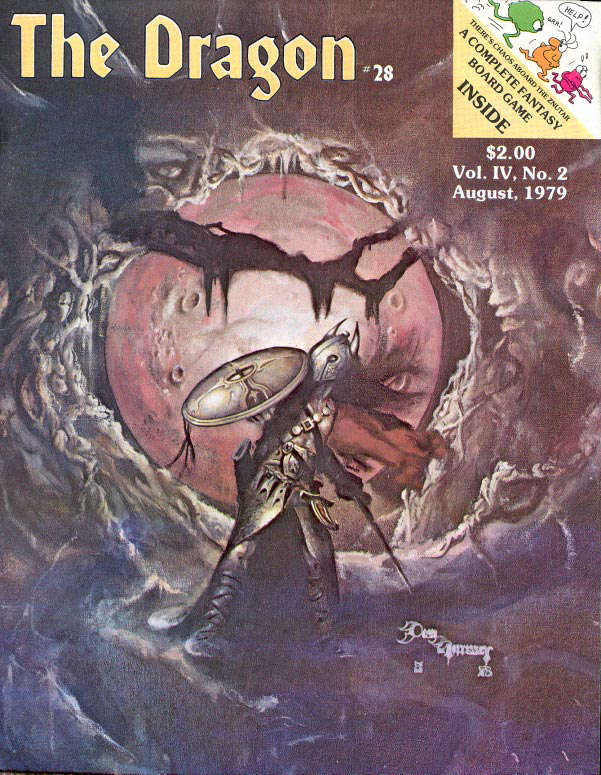
Kask ain’t just whistlin’ Dixie. The funny thing is – as much as Gary and Dave’s little game has influence modern video games, those of us who still play the pen & paper varieties are still considered strange. People I work with are always a little surprised – not sure quite how to react – when I mention that I write role playing game books. Interesting to hear in the comments how many of us are “open gamers”.

Well, this issue opens up with a biggee – “The Politics of Hell” by Alexander Von Thorn. Van Thorn has an author page at Amazon.com, and (if it’s him) a Twitter account. If you have any questions about Hellish politics, feel free to contact the author directly.

The first line is: “Author’s note: The following article cannot be considered the official doctrine of either Advanced Dungeons and Dragons or the Roman Catholic Church. However, it is compatible with AD&D, and except for the parts about Asmodeus it is not in conflict with works on demonology as generally accepted by Catholic exorcists, thus enjoying tacit approval by the Church.” You know, just in case you were worried about your AD&D game rubbing the Catholic exorcists the wrong way.

The article pretty much sets up the political landscape of AD&D’s version of Hell, as we came to know it through the Monster Manuals, with Asmodeus on the top of the heap. It also includes stats for Satan, Belial, and Astaroth (with art).

Next, Jake Jaquet presents The Dungeon Master’s Guide – possibly the most useful RPG book ever made. The article is a collection of comments and reminiscences by people who were involved with the project, including Jeff Leason, Len Lakofka, Lawrence Schick, Jean Wells, Allan Hammack, Mike Carr, James Ward, Darlene Pekul and Gary Gygax, in an exclusive interview with The Dragon (I’m sure it was quite a coup to land that interview!)

Up next, Dan Bromberg writes “A Short Course in D&D. This is an interesting article about folks at Cranbrook Prep School setting up a 2 week course in D&D for incoming freshmen. They ended up charging $1.50, plus another $1.50 for low impact dice (the DM didn’t have to pay). The course books were a copy of Basic D&D and the Player’s Handbook. Given the fact that I still find rules in AD&D I didn’t know existed, a course like this might have been useful to me when I was a kid.

Time for some war gaming – “The Cavalry Plain at Austerlitz” by Bill Fawcett. This is a nice description of the battle that pitted the cavalry of Napoleon’s France against Austria and Russia. It is followed up by an article on “Simulating the Cavalry Plain”, also by Mr. Fawcett. He gives a nice overview of the order of battle on both sides, along with victory conditions for each side. Highly useful for folks playing Napoleonic war games.

I didn’t get interested in the Napoleonics until I started reading Military History magazine in college. Now I’m super excited to get GRIT & VIGOR published so I can write up a Napoleonic supplement to it.

Next up – alignment time! Gary Gygax opines on Evil: Law vs. Chaos in “From the Sorcerer’s Scroll”. In this, he defines the characteristics of Chaotic Evil and Lawful Evil … and then let’s Neutral Evil fall where it may. He defines “evil” as the desire to advance self over others by whatever means possible, and always by the foulest means possible (emphasis mine). I like this, because it makes no qualms about what evil characters are in AD&D – they’re villains. They’re not misunderstood, and they’re not necessarily realistic depictions of human beings. Just theatrical villains you can take some enjoyment in beating the crap out of (or in playing, if you’re in the mood to foreclose on orphans and tie maidens to railroads). The Law vs. Chaos element is the desire to create a world ruled by evil vs. evil for its own sake. Now you know.

Dig this ad:
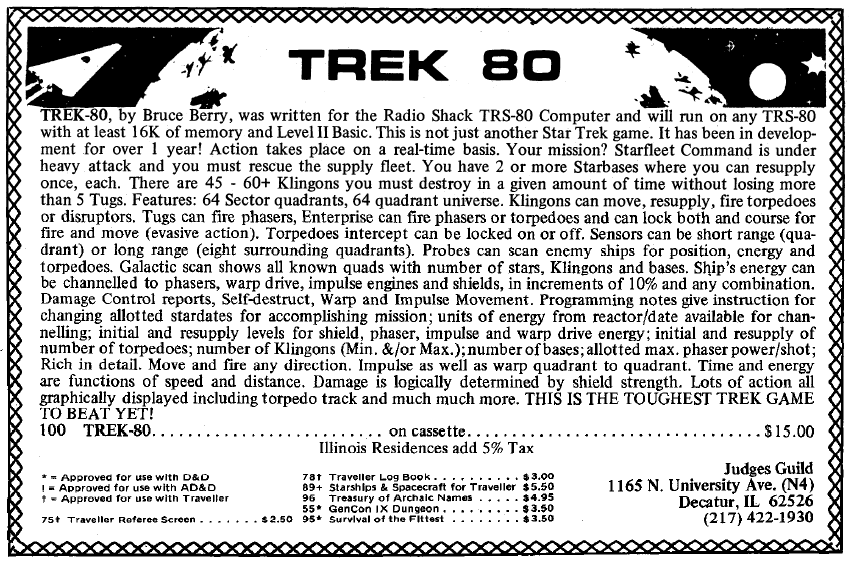
Looks like Judge’s Guild got into computer games early. The only thing I can’t figure is whether or not this was a licensed game. Here’s the article on the game at Wikipedia … and here, apparently, is a clone …

Allen Hammack writes “Six Guns & Sorcery”. If this sounds familiar, you might remember it from the old DMG, where they provided guides for conversions between AD&D and Boot Hill and AD&D and Gamma World. If you need a quick bravery stat, you can use the following:

Subtract the following from 100 for each class:

Cleric: 2 x Wisdom
Fighter and Monk: 1 x Wisdom
Magic-User: 3 x Wisdom
Thief: 4 x Wisdom

Maybe more interesting are the damage dice for some Old West weapons – Derringers do 1d4 damage, other hand guns do 1d8, shotguns do 1d10 and dynamite sticks do 4d6 damage. With these values, I wonder why they were so worried about including firearms in D&D.

Phil Neuscheler now writes “Fantasy Smith’s Notebook”. This was intended as a series of articles concerning the modeling of miniatures for D&D.

“When you have small amounts of cash to start with, you may wish to get adventurer character figures first, and use a substitute for monsters in your miniature games. After all, you will continue to play your own character(s) no matter what kind of monsters you encounter, so you’ll use the character figure more often than any individual monster. Monsters are simply not cost effective.”

The article provides contact information for several miniature makers active at the time. I wondered how many were still in the business today:

U.S. Airfix – I remember these guys making airplane models – maybe snap-together models. They still produce figures, though I’m not sure they have any ancients or medievals anymore.

Archive Miniatures – These guys appear to be defunct.

Garrison (Greenwood & Ball) – Sadly closed for business. Name sounds more like a law firm.

Grenadier – These folks appear to now be owned by Mirliton. Free downloads at the link.

Hinchcliffe Models Ltd – Still alive, but owned by Hinds Figures Ltd.

Heritage Models Inc – now defunct.

Jack Scruby’s Miniatures – there’s a Jack Scruby line at HistoriFigs. Also found a catalog from 1972 at Amazon.

Martian Miniatures – couldn’t find them online.

Miniature Figurines Ltd (Minifigs) – alive and kickin’ with a Tripod site.

Ral Partha Enterprises – still around, and pushing the resurgence of Chaos Wars. I always wanted to get into these minis when I was a kid, but the money just wasn’t there.

Next up is “Armies of the Renaissance – Part IV The English” by Nick Nascati. This covers the Welsh longbow and its importance to the rise of English military power, as well as their deadly combination of bill, pike and musket. They wore less armor than other armies, but appear to have had a high level of discipline. Also notable is the adoption of the red coat in the late 1600’s.

You might remember Lance Harrop from last week’s installment of Dragon By Dragon – this week we’re looking at his “Elvish Tactics in Fantasy Miniatures”. Not surprisingly, elvish tactics are all about speed and maneuverability. Lance gives us the following order of battle:
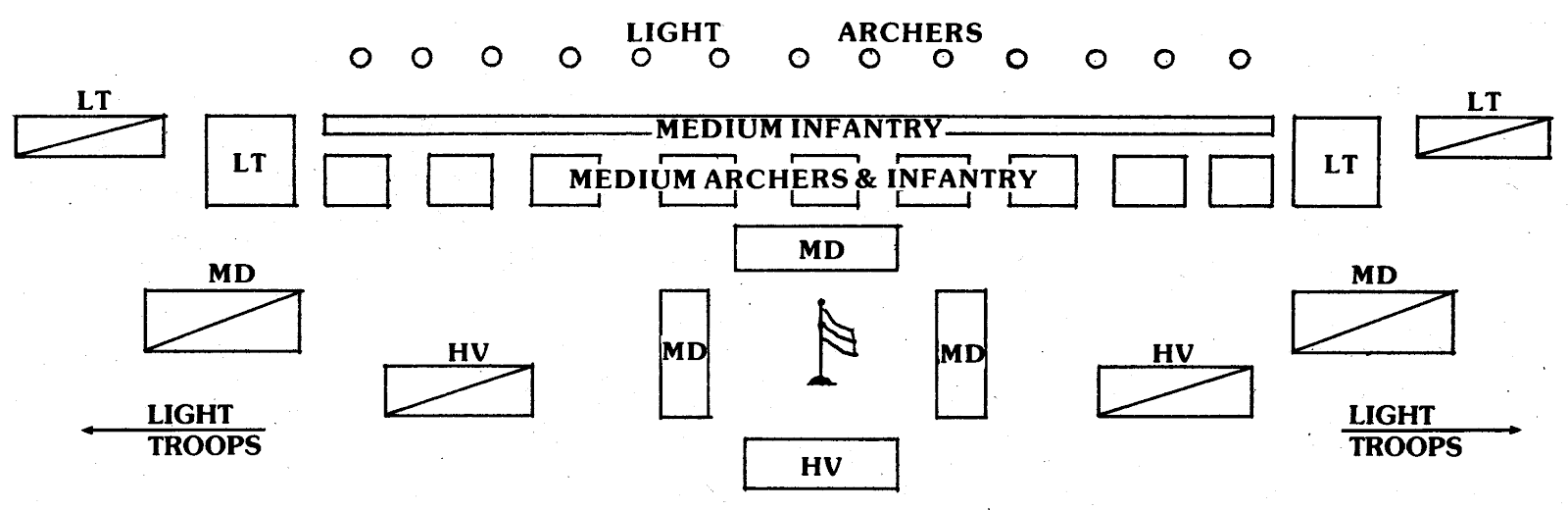
The light archers, light horse archers and light cavalry are there to harass the enemy. The light archers are protected by the light infantry. The medium infantry are the main line of troops, with the medium archers behind them. The elite heavy infantry are the reserve, and the medium mounted infantry and heavy mounted infantry are fast deployment reserves. The medium cavalry are the shock troops, and the heavy infantry are the elite elvish knights.

As always, Mr. Harrop gives a few notes about elves:

* They use silver to denote rank, not gold
* They do not use red or black leather
* High elves wear blue and white, middle elves green and white, low elves dark green and tan, sea elves sea green and sky blue and dark elves browns and blacks
* Elves are concerned with having a unified front

Next, Gygax sounds off in Up On A Soap Box – in this edition, on manufacturer conventions. You can imagine how fascinating this article is 35 years after it was written.

In Out on a Limb, we present this week’s Great Moments in Nerd Rage:

“This brings me to a point that I didn’t want to write about when I started this letter: spell points. I HAVE HAD ENOUGH OF FORGETTING SPELLS!!!!!!!” – Mark Jacobs

And in response:

“Gee, it’s always so much fun getting letters from unproven critics who think they have some inner track on “the way of things.” As to what may or may not be absurd, let me say this; if you don’t like it, why give me all of this grief? D&D has always made a point of being nothing more than guidelines for structuring a game, and stating so.”

Oh wait – some more:

“Your argument that healing is too slow is specious, and naive. You obviously have never been in a combat situation yourself, nor have you apparently even participated in something such as the Society for Creative Anachronism’s mock battles.”

God, I love this hobby (and God – I hate this hobby).

We now have another installment of The Voyages of Exploration Ship Znutar. An excerpt:
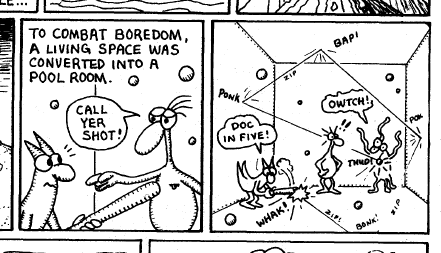
We have next a full board game by Tom Wham – The Awful Green Things from Outer Space. I won’t go into much detail here – the rules look pretty simple, the game is tied in with Znutar above, and I love that they used to do things like this in The Dragon.

Len Lakofka’s Bazaar of the Bizarre presents Potions of Forgetfulness, Rings of Silence, the Horn of Hadies (their spelling, not mine), the Chime of Warning, the Apparatus of Spiky Owns (a play on Spike Jones, God bless him), Leomund’s Plate and Cup, and a slick little guide for generating random magic-user spell books. To whit:

Jon Mattson now gives us “Level Progression for Players and Dungeon Masters”. This is actually a guide to how many XP players and Dungeon Master’s earn for playing different games. I kinda love this – would be a blast to introduce to the blogosphere. I have to reproduce the level charts:

“Giants in the Earth” time! Lawrence Schick and Tom Moldvay (my hero) give us the following literary giants given AD&D stats:

Leigh Brackett’s Eric John Stark (15th level fighter) – I have to admit, I was bored to tears by the one Eric John Stark book I read; they also include stats for Northhounds (4 HD)

Lord Dunsany’s Welleran (A Lawful Good ghost that possesses anyone who picks up his sword)

James M. Ward now gives us “Monty Strikes Back”. He was the original Monty Hall Dungeon Master, you might remember, who gave out tons of great treasure. This is another story of a game played with many of the early entrants into the hobby.

“We were on a winter level tonight and were far from pleased. It was Friday, one of our usual D&D nights and we were going down into a refrigerated level of Monty’s that we had found weeks before. We had all made fur coats for our figures and most of the group was going down. Robert, Jake, and Dave (I) (Tractics boys through and through) were going down as their 20th level fighters; Brian (a tractics lover too, but a fanatic on Western Gunfight) was going as his 21st level thief/fighter/cleric dwarf; Ernie, Dave (II), and I were going down as wizards of the 18th level (just little guys); Freddie was his stupid high level sword carried by a flesh golem from Jake’s golem squadron; Tom and Tim went as druids (probably because they liked all types of herbs).”

In “The Dragon’s Augury”, we have reviews of Divine Right by TSR, Sorcerer by SPI, and a book, America B.C.: Ancient Settlers in the New World by Barry Fell. Still for sale at Amazon, and four stars!

“The Dragon’s Bestiary” gives us Jake Jaquet’s Slinger. Here are the basic stats in B&T format:

Tiny Magical Beast, Low Intelligence, HD 3, AC 17, ATK 1 spine (1d4 + poison IV), MV 60, F15 R11 W15, AL N, XP 300.

These little buggers, which look like iguanas, can throw their tail spines about 20′. They are vulnerable to fire.

Fineous Fingers, Fred and Charly are stealing a Palantir in this issue.

And that wraps up issue #28. It’s always nice to leave with a song, and since Spike Jones was mentioned …
New Awesome Adventure from Anders Hedenbjörk Lager!

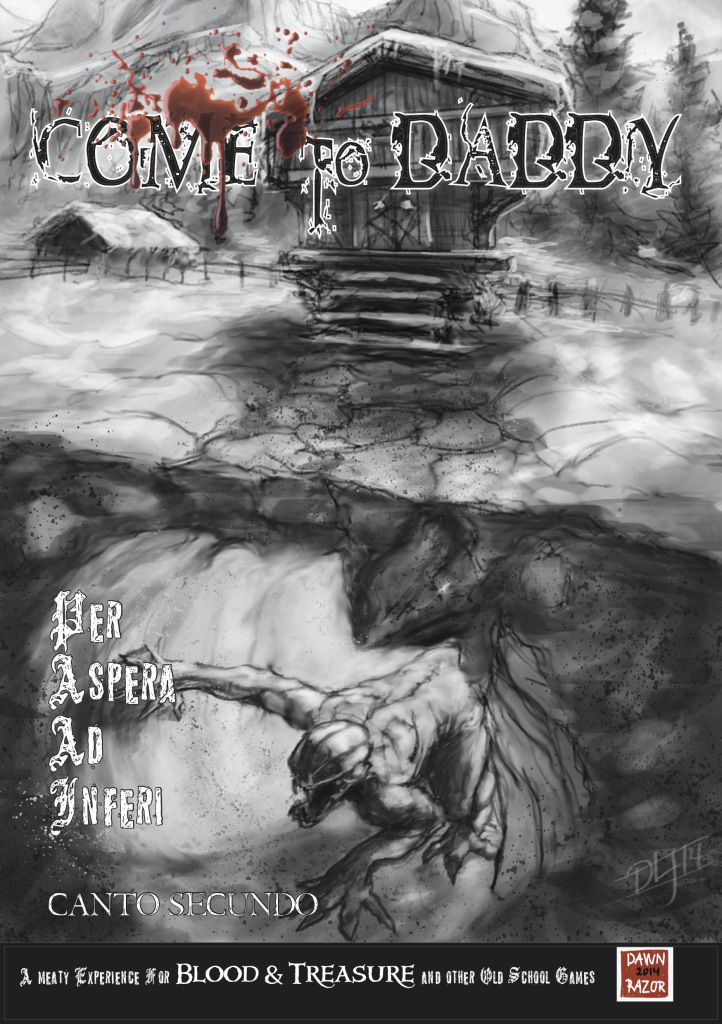
Hey folks – just a quick note this morning to direct your attention to a new, FREE, 80-page adventure for Blood & Treasure by Anders Hedenbjörk Lager. This guy does good stuff, and with a price like FREE, how could you lose.

It’s called Come to Daddy, and it is part two of the Per Aspera Ad Inferi trilogy and is the follow up to No Country for Old Men, which was excellent. Here’s a blurb:

“The battle with the barrow-draugr had taken the most of our energy, and we barely escaped with our lives. The gnome was sorely injured in the leg and everyone was frozen to the bone. The horses and most of our supplies were still left in the draugr cave, where we had to abandon it to save our hides. Times looked bleak and despair had set in for real when Halross shouted:

“-Hey, I see a farm over there”

A farm out here in the outback? Strange, but in our current situation the prospect of a warm fire and some hot soup seemed like a gift from heaven. Slowly, we started our descent alone the snow filled slopes towards the cosy farm.”

Boys and girls, we’re talking about crazy viking mutant cannibal killers. If you don’t want to sink your teeth into that, I don’t know why you’re here.

Let’s get into some specifics. The book looks great – good layout, art, etc. There are some nice pieces by David Lewis Johnson, and everything is clear and easy to read.

The adventure itself may be tricky to run, and is a bit different than many you have played. You have a family of cannibals attempting to lull the characters into feeling safe on their farm, and then slowly picking them off, one by one, using all manner of tactics. You’ll have to set this one up properly – it has to seem as though the farm is a safe place and a curiosity, rather than a side adventure. This is one that might kill off characters, so make sure you have a group of players that know its a game, know the character is a piece of paper, and enjoy the challenge. The adventure is designed for characters from 4th to 6th level.

As for exploration, you have a wooded valley and the farm, along with a farm house and tool shed, as well as an entry into the Nightmare Realm. There is an old ruin of the temple used by the nightmare cultists, and all manner of frightening things to encounter there. Ultimately, the PC’s need to defeat the Mother of Lies, and this isn’t easy. If the players are very determined, they’ll probably have to settle for survival and getting the heck out of there.

Besides the adventure, you also have many extras – The Ritual of Banishment – a form of ritual magic used to defeat the Mother of Lies; a few monsters, many unique (such as the aforementioned Mother of Lies, a were-worg, “the severed ones” and multiple ghösts) and rules for horror and madness (with some great random tables), some new traps, new magic items and spells, alternative healing rules, and rules that expand the poison (and drugs) in Blood & Treasure very nicely. Honestly, if you play B&T or just like it, you’ll get plenty from Come to Daddy even if you never play the adventure.

Seriously, Anders is knocking it out of the park with these babies, so please check them out and give them a play through with your group, whatever system you play. He also has a version specifically statted for Swords & Wizardry as well, and of course either will work with any old school game system.

Come to Daddy gets my absolute highest recommendation! Download it HERE.

More Monsters I Just Made Up

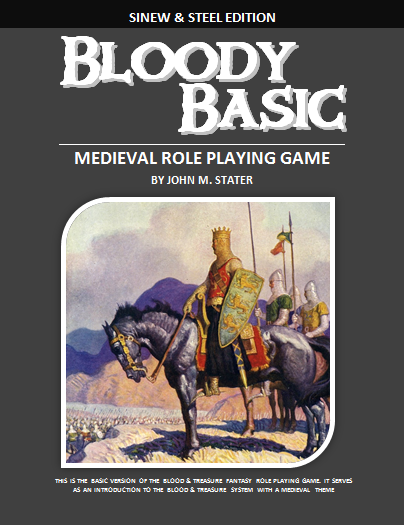
First – I should get the Bloody Basic Sinew & Steel Edition up for sale in the next couple days, along with the next issue of NOD – number 26. Just finishing things up, last bits of editing, etc. BB Weird Fantasy is next, and then I delve into Grit & Vigor and get that bad boy done and up for sale.

Now, on to the monsters …

ENGINE OF HELL
Large Construct, Neutral (N), Non-Intelligent; Squad (1d4)

Hit Dice: 10
Armor Class: 20 [+1]
Attack: 2 claws (2d6 damage)
Move: 20
Saves: F9 R10 W10
XP: 1000 (CL 11)

Engines of Hell are monstrous, brazen constructs operated by imps. They are armored suits of bronze and brass, often of monstrous shape and form, and glowing red hot. Smoke escapes from the nostrils fashioned on the engine’s brazen head. The imp sits within the chest cavity, operating the construct with levers and chains.

Engines of Hell have no minds of their own. They are under the control of the imp. If the imp is removed, killed, etc. the construct ceases operating. Attacks that require a Will save that are directed against the pilot imp must be made by the pilot imp, not the construct.

All Engines of Hell have the above basic statistics. In addition, they can choose one of the following modifications from each category:

HANDS
Cannon Arms: The construct can make 1d8 damage slam attacks with its cannon arms at a -1 penalty (they are clumsy), but can also use them to fire cannonballs (3d6 damage, 100’ range) up to three times per arm.

Chain Hands: The construct has 10-ft chains instead of hands, allowing it to slash targets up to 10 feet away for 1d8 damage.

Crushing Grip: The construct’s claw attacks constrict on a successful hit.

Jackhammer Hands: The construct’s hands are actually jackhammers, doubling its attacks and dealing 1d8 damage. In addition, hits warded away by armor or shields force those items to pass a saving throw or be made useless.

HELM
Battering Ram: Construct gains a gore attack for 1d8 damage.

Flame Belcher: Construct can, three times per day, belch forth a 10’ cone of fire for 3d6 damage.

Gnashing Jaws: Construct gains a bite attack for 1d8 damage.

FEET
Quake Makers: One per day, the construct can produce the same effect as the stomp spell, non-magically.

Raking Claws: The construct gain an addition claw attack for 2d6 damage with its feet.

Rocket Boots: The construct can, once per day, fire boot rockets and leap a distance and height equal to 100 feet (i.e. 100 feet high, straight up, 100 feet distant without really leaving the ground, 50 feet high and 50 feet distant, etc.).

Special Qualities: Immune to fire, vulnerable to cold, magic resistance 10%

LADY LION
Medium Outsider, Neutral (N), Average Intelligence; Solitary

Hit Dice: 12
Armor Class: 18 [+1]
Attack: 4 +1 scimitars (1d8+1 + bleed)
Move: 30 (Fly 20)
Save: F11 R12 W11
XP: 700 (CL 8)

Lady lions are mortal versions of Sekhmet, the goddess of slaughter and vengeance. Delivered unto the Material Plane by the gods or other similar powers, they are intended to cut a swathe of death as a means of reminding people of their mortality and their inferior position to the gods. On some occasions, they are brought to the Material Plane to complete a quest, and in this capacity might work with or against the player characters.

Lady lions look like tall female humanoids with faces that suggest the ferocity and grandeur of the lioness. Their limbs are long and muscular, their bodies powerful and lean. Lady lions wear armor of steel cords and wield twin +1 scimitars, attacking twice per round with each scimitar.

The lady lion’s magical scimitars cause bleeding wounds. Those struck who fail a Fortitude saving throw begin losing one point of constitution per round from blood loss until magical healing is applied. The TK should keep track of lost constitution points. For every three points of lost constitution, from whatever source, the lady lion can animate the blood into a monster per the spell summon monster I. The monster in question looks as though it were composed of blood, but will otherwise act as a normal monster of its type. These blood monsters, if they do not attack, can merge forms into more powerful monsters, essentially combining their hit dice and taking a new, appropriate form. Two 1 HD giant blood rats, for example, could form into a 2 HD blood wolf. These monsters can be dispelled, but reformed a round later. Once formed, they do not have to be controlled by the lady lion, and can combine on their own, without direction (i.e. without the lady lion having to forgo attacking for a round).

Once per day, a lady lion can transform herself, for one round, into a blade barrier.

Special Qualities: Resistance to fire and electricity, magic resistance 15%

MEGALAR
Huge Magical Beast, Neutral (N), Animal Intelligence; Solitary

Hit Dice: 9
Armor Class: 16
Attacks: Bite (1d10 + swallow whole)
Move: 30
Saves: F6 R9 W14
XP: 900 (CL 10)

Megalars are huge reptiles with big feet. They have a rather flat body profile, and walk low to the ground. Wherever a megalar stomps a foot (they can stomp two feet per round), a jet of hot, flammable gasses explodes from the ground. This is, essentially, a one-way portal to the Elemental Plane of Combustion. These pillars deal 1d6 points of fire damage to all within 10 feet due to their extreme temperature, and burst into flames if they contact an open fire. A flaming pillar burns for one turn, dealing 2d6 damage to the touch, and 1d6 damage to all within 10 feet.

Special Qualities: Immune to fire

NEMESIS
Medium Outsider, Neutral (N), Average Intelligence; Solitary

Hit Dice: 8
Armor Class: Varies
Attacks: Varies
Move: Varies
Saves: F9 R9 W9
XP: 800 (CL 9)

A nemesis is an extraplanar spirit called into the Material Plane to punish a mortal creature. They are usually summoned by powerful clerics or magic-users, or they are sent by extraplanar powers. A nemesis’ form varies with the creature it is fighting.

Against warriors and monsters that primarily rely on, the nemesis seals itself in a shell of living steel. It has AC 22 and attacks with weapons formed from the living steel –any two one-handed weapons, dealing +2 damage with each. The steel-form nemesis has a movement rate of 20 and is immune to all combat maneuvers.

Against clerics and druids, the nemesis takes on a necrotic form, resembling a lich, though not undead. In this form it attacks twice per round, dealing 2d6 points of negative energy damage each round and enjoying magic resistance 35% against divine magic. The necrotic form has AC 18 [Silver], a movement rate of 30 and is immune to negative energy damage.

Against magic-users and sorcerers, the nemesis takes on a pure energy form. Each round, it can produce an effect equal to a level 0 or first level spell. Three times per day, it can produce an effect equal to a 2nd to 4th level spell. Once per day, it can produce an effect equal to a 5th to 6th level spell. In energy form, the nemesis has AC 17 [+1] and a movement rate of 30 (Fly 60). They are immune to fire and electricity damage.

Against thieves and assassins, the nemesis takes on a shadow form. In shadow form, they automatically hide in shadows and move silently. They have AC 16 [Silver] and a movement rate of 60. Shadow nemeses attack with two shadow daggers that deal 1d4 damage and force a fortitude saving throw to avoid being chilled to the heart (1d4 constitution damage, stunned for one round). They can backstab for triple damage.

The nemesis can change its form once per round. They are single-minded in their quests to punish or destroy. When their quest is complete, or they are destroyed, they return to their plane of origin in the Pleiades Star Cluster.

VASCULON
Medium Construct, Neutral (N), Non-Intelligent; Solitary

Hit Dice: 6
Armor Class: 18
Attacks: 2 slams (1d8) or 4 rays (60’/see below)
Move: 30
Saves: F12 R12 W12
XP: 600 (CL 7)

A vasculon is a construct composed of human veins, arteries, ganglia and nervous system encased inside a humanoid shaped glassy-steel shell. In place of eyes, the vasculon as four bloodstones set on its head. Each round that it does not attack physically, it can fire scarlet rays from these eyes at up to four separate targets. These rays ignore armor, and have the following effects:

Boil Blood: 2d6 fire damage; Fortitude save for half

Freeze Blood: 1d6 cold damage; slowed (as spell) for 1d4 rounds

Gout of Blood: Creature bleeds from its orifices, 1d6 damage plus 1 point of Con damage

Manipulate Humors: Creature struck with fear (as cause fear spell), crushing despair (as spell) or rage (as spell)

Each ray can only be used once per round, and each ray must be directed at a different target. Attacks against the bloodstones are made against AC 20, and each bloodstone has 20 hit points.

Special Qualities: Magic resistance 10%

ZORDOK
Tiny Aberration, Neutral (N), Low Intelligence; Solitary

Hit Dice: 3
Armor Class: 18
Attacks: Electric arc (60’/1d6 damage + one level energy damage + shift consciousness)
Move: 0 (Fly 60)
Saves: F17 R13 W13
XP: 750 (CL 5)

Zordoks look like glowing spheres surrounded by orbiting motes of light, not unlike the way atoms are sometimes fancifully depicted. A zordok can launch a lightning bolt attack that, if it hits, transfers its consciousness into a living person. The person then gains the Galvanized template (see below), and also suffers one level of energy damage. This energy damage increases the zordok’s size by one step (+1 HD, +2 damage) and increases its intelligence by one step (low to average, average to high, high to super).

The zordok can move its consciousness from body to body by firing its electrical arcs. Each time it does, the new target suffers one level of energy damage and the zordok’s original body becomes larger and more intelligent.

If the host of the zordok’s consciousness is killed or knocked unconscious, the zordok’s body is turned into a tiny adamantine sphere. The creature will reconstitute itself in 1d4 days at its original 3 HD power level.

Special Qualities: Immune to electricity, resistance to fire and cold

GALVANIZED TEMPLATE

A galvanized creature is immune to electricity and can use the shocking hands and levitate spells at will. If grounded, they must pass a Fortitude saving throw or be knocked unconscious for 1d6 rounds.

Monsters I Just Made Up

I just made these up. Do you find me more cool and mysterious!

MONKEY CAT
Small Magical Beast, Neutral (N), Low to Average Intelligence; Pride (2d8)

Hit Dice: 1
Armor Class: 13
Attack: 2 claws (1d2) or bite (1d3)
Move: 50 (Climb 20)
Saves: F14 R12 W15
XP: 50 (CL 1)

Monkey cats dwell in the steamy equatorial jungles. They look like cats with long tails, and overlong arms and legs that end in grasping hands. Most are black, but other color schemes exist. Like both monkeys and cats, they are terribly curious, and have a penchant for theft. They dwell in prides in the tree tops under a Grand Dame, who decorates herself with stolen jewelry. Her attendants are the bullies and protectors of the tribe, while her daughters hunt and practice the ancient rites that honor the creator of the monkey cats, an Aegyptian wizard with more time and money than he knew what to do with. Crude carvings of his face are made in the high tree tops, and are worshipped with yowling songs and ritual hunts of birds and rodents.

Monkey cat characters gain a bonus of +2 to dexterity and suffer a -2 penalty to intelligence. They can hang from their tails, and gain a climb speed of 20. They can see in the dark up to 60 feet. Monkey cats can multi-class as fighter/thieves, sorcerer/thieves and cleric/thieves.

GLOBULOUS LOOCH
Large Aberration, Chaotic (CE), Low Intelligence; Pod (1d4)

Hit Dice: 7
Armor Class: 14 (18 when skinned)
Attack: 2 slams (2d6 + Poison II) [ooze form]
Move: 30 (Fly 20)
Save: F11 R12 W11
XP: 700 (CL 8)

Globulous looches are buoyant balls of skin and fat with six beady eyes on their underside. They mostly float on air currents, especially in narrow valleys of high mountain ranges, observing the inhabitants and travelers and cursing them silently. When their hatred for other beings gets the better of them, they descend to the ground and split, releasing their ooze form, which then does its best to gobble up as much plant and animal life as possible as it grows a new, thick skin and regains its buoyancy. Globulous looches are especially fond of magic items, which they drain of their magic. The enchantments in the item are retained by the globulous looch for up to 24 hours, and are usable at will. Magic armor simply transfers its magical armor bonus to the looch (as well as any special abilities), and magic weapons transfer their bonus to hit and damage (as well as any special abilities). After 24 hours, a new skin is grown, and the globulous looch, if still alive, floats back into the atmosphere.

TRABALLER
Medium Humanoid, Neutral (N), Average Intelligence; Gathering (3d8)

Hit Dice: 1+1
Armor Class: 13 (leather scale, buckler)
Attacks: By weapon (1d8)
Move: 30 (Burrow 10)
Saves: F13 R15 W15
XP: 150 (CL 2)

Traballers are flinty-skinned folk with manes of black hair and perpetual scowls on their faces. They stand as tall as elves, but have overlong arms and legs and pot bellies. Their touch causes sympathetic vibrations in solid items, causing them to shatter (item saving throw permitted). Stone items save at -4. Traballers most work as miners and quarrymen. They are secretive folk, dwelling away from others in simple huts, and hiding their children and wives under heavy scarlet cloaks bound at the ankles and wrists in brass bands. While so hidden, traballer females gain mystic abilities bestowed on the species by their goddess of mysteries, allowing them to cast spells as adepts (level 1 to 4).

Male traballers wear armor of leather scales with steel collars and bands around their arms and legs. In battle, they wield steel battle rings that can be used as shields (two are the equivalent of a buckler), bludgeons and can be thrown (25’ range, 1d3+2 damage).

Traballer characters enjoy a +1 bonus to Constitution, but suffer a -1 penalty to Charisma. Female characters who retain their scarlet coverings also gain a +1 bonus to Wisdom, but suffer an additional -1 penalty to Charisma (total -2) for their unnerving appearance. They can make sundering attack with their bare hands. Males understand how to fight with their battle rings. Shrouded females gain the following spells, provided they have a Wisdom score of 10 or higher, each spell usable once per day: Guidance, mending and sanctuary. Traballer characters cannot multi-class, but they can dual class like humans.

Bring Some Muscle Into the Dungeon

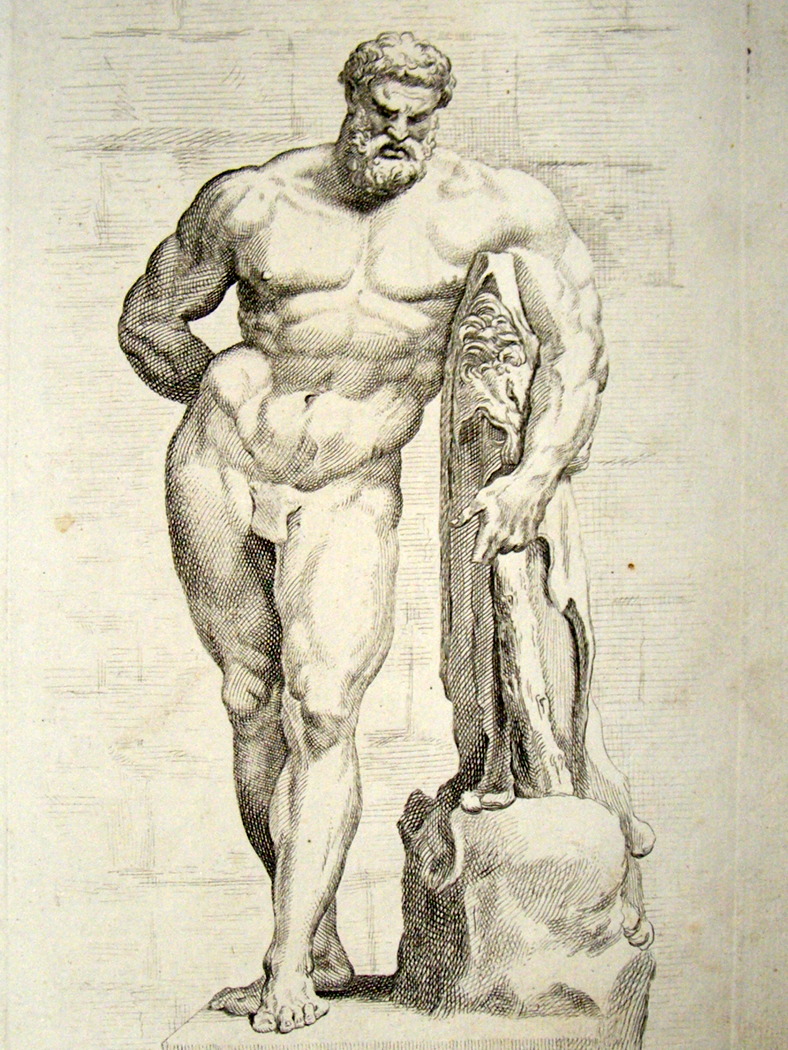
1958. Steve Reeves plays Hercules and not only is a legend born, but a new genre of action/adventure – Sword & Sandals: the heroic adventures of oiled bodybuilders strangling things with their bare hands, bending bars and lifting gates.

We have lots of interesting characters running around fantasy roleplaying games, and plenty have 18’s in Strength, but none of them are true musclemen. Until now …

Requirements & Restrictions
Strength 15+, at least 6’ tall

Musclemen wear no armor, only the hides of the animals and monsters that have slain. They can use shields

Musclemen can wield any weapon, but double-handed weapons are preferred

Hit Dice: d12

Skills: Bend Bars/Lift Gates, Climb Sheer Surfaces, Jump, Swimming

Advance As: Fighter

Special Abilities
Musclemen are capable of using their muscles to influence reactions, either through charm and awe, or sheer intimidation. Musclemen can modify reaction checks with their Strength score rather than Charisma score if the TK deems the situation appropriate.

Musclemen add 1.5 their strength bonus to attacks and damage when armed with double-handed weapons.

Musclemen treat creatures as one size category smaller for grapple and bull rush attacks.

Once per day, a muscleman can call on an adrenaline rush and either re roll a failed strength check with a +2 bonus or double their strength bonus on a single melee attack and damage. They can also make sundering attacks with their bare hands.

A muscleman spends a great deal of time in training. Every four levels, beginning with fourth level, they can deduct one point from intelligence, wisdom or charisma and add it to their strength score.

Musclemen gain additional skills as they advance in level if their strength score is high enough.

Burst Chains and Iron Bands (Level 3, Strength 16) – A muscleman can burst chains and iron bands simply by flexing their chest muscles or biceps.

Toss Dwarf (Level 5, Strength 17) – Musclemen can toss gnomes (Str 17), halflings (Str 19) and dwarfs (Str 21) at opponents. Treat this as a ranged attack with a range of 10 feet. If the muscleman misses, the tossed character gets no attack, loses their turn and suffers 1d4 points of damage. If their attack hits, the tossed character makes an attack as though charging, and the mere act of throwing them scores 1d6 points of damage for gnomes, 1d8 for halflings and 1d10 for dwarves, plus the muscleman’s strength bonus.

Hammer Nails (Level 7, Strength 18) – A muscleman’s sinews are iron hard, allowing him to hammer nails with their bare fists. Difficulties include hammering sharp items larger than nails, or hammering into materials harder than wood.

Bite Through Chains (Level 9, Strength 20) – A muscleman’s jaws are such that he can bite through metal. In addition, he can bite characters that he grapples (treat as an additional unarmed attack).

Ulflandia – Giants and Magic Wells

I’m about 90% finished writing the Ulflandia hex crawl, which means I’m pretty much on schedule to get the next issue of NOD out this month. I should get Bloody Basic – Sinew & Steel Edition out as well, and maybe Bloody Basic – Weird Fantasy Edition (depending on how much reading I get done between now and the end of the month). Once those are put to bed, I turn my near-sighted eyes to Grit & Vigor, which I would like to publish before the end of summer.

That being said, I thought I’d post a few Ulflandia entries today to give people a taste of it. Enjoy!

3324 OLD GROG | MONSTER

Old Grog the hill giant smith dwells here, keeping a forge, three unruly daughters and a motherly wife who could only kill a person with kindness, for she’s otherwise gentle as a lamb. Old Grog remembers the old ways, and he can breathe magic into his creations if he has the mind to – he’ll swap minor magic weapons and armor for tales well told (and a heap of gold). If somebody will promise to wed one of his daughters, he’ll make more powerful magic items. He keeps a giant spider on an unbreakable silver thread in his workshop as a guard animal and companion. The spider is well versed in elven poetry and gnomish limericks, and he has a fine baritone voice (for a spider).

Treasure: 150 pp, a silver hammer (80 gp).

3630 FOREST GIANTS | MONSTER

A band of fifteen forest giants and their mates dwells in a massive hall made of timber in this hex. The longhouse is surrounded by a wooden picket and a shallow moat, about 20 feet wide, filled with gooey mud and crossed by a drawbridge.

The forest giants have grey skin, no hair and emerald eyes. They dress in tunics and leggings, usually of green, brown, russet or grey, and wear cloaks. Forest giants are excellent bowmen, and carry large longbows and scimitars.

The forest giants have a love for ale and wine, and will gladly trade their guidance through the woods for intoxicants.

Treasure: 65 pp, 1,750 gp, a silver medallion set with a citrine (500 gp), a sable cloak with a golden clasp set with alexandrite (1,500 gp), a scroll of darkvision, a +1 shield (giant-sized), a potion of hide from undead, and a potion of remove paralysis.

3724 NOBRUN THE NECROMANCER | STRONGHOLD

The stronghold of Nobrun of the Glassy Eyes appears to be a cave set in a doughty granite hill topped by long, green grasses with a base surrounded by huckleberry bushes. The cave mouth is shaped like the maw of a demon, and there is the notable scent of sulfur surrounding the place.

If one approaches the cave mouth, a vrock demon is conjured. The vrock, Xerial, is Nobrun’s major domo. He will inquire as to the nature of the visit and peruse his scroll to see if the visitors are expected. If they are, he will permit them to enter the cave, at which point they will see a stone stair leading up to the top of the hill and a simple wooden door painted dull green. The door is wizard locked. Beyond the door, which appears to be attached to nothing, is the invisible tower of Nobrun.

Nobrun is a necromancer. He is inhumanly tall and thin, with long, bony fingers absolutely covered in rings. Some of the rings look valuable, others are made from human hair or meteoric iron and engraved with runes. The necromancer dresses in purple silk and black velvet, in the manner of a Spanish grandee. Nobrun is always heavily perfumed (usually lavender), and he has a long, black beard (he colors it) and strange, glassy eyes. One of his eyes has a permanent x-ray vision spell cast on it, while the other always sees with a faerie fire effect. He normally wears a patch lined with lead over the x-ray eye.

Nobrun lives alone, except for his army of zombies. All of them are shaved smooth and dyed purple, and dressed in black velvet doublets and leggings of silver maille. Nobrun is currently between apprentices.

3924 THE BOILING WELL | WONDER

A well in this hex produces great gouts of steam from the water, which nearly boils with magical energy. The water is about 20 feet below the surface, the well being constructed of grey stones that are slick with green slime that must be cleared before one can safely enter the well.

By bathing in the water for one minute (suffering 1d6 points of Constitution damage in the process), a magic-user or sorcerer gains the knowledge of a single weird spell. The spell remains lodged in a person’s mind for 24 hours. A sorcerer can add the spell to her natural repertoire if she has a spare spell slot, while a magic-user can scribe the spell on a scroll or in his spell book. Of course, they can also just cast the spell and discharge it from their mind permanently.

The second time a magic-user bathes in the well, the Constitution damage becomes Constitution drain. The third time, it becomes 1d6 points of energy drain. A fourth dip is fatal, turning the magician into a rampaging chaos beast.

The random spells learned from the well are:

D6 SPELL
1 Accursed Archer
2 Blasphemous Shield
3 Golden Torch
4 Hex of Diminution
5 Invocation of Righteous Anger
6 Unknowable Incantation of the Yellow Doors

ACCURSED ARCHER
Level: Magic-User 1
Range: Medium (150 ft.)
Duration: Concentration + 1 round

This spell forces a single opponent within range that is shooting or throwing missiles to automatically target one of his own allies. If he has no allies, the spell simply applies a -1 penalty to his attacks on non-allies.

BLASPHEMOUS SHIELD
Level: Magic-User 2
Range: Personal
Duration: 1 minute

This spell conjures a shield (much like the shield spell) before the spellcaster. The shield bears an image blasphemous to a single chosen cleric within sight of the magic-user.

The cleric must pass a Will saving throw each round he or she attempts to do anything but attack the bearer of the shield. The shield bearer enjoys AC 18 against the cleric’s attacks, and a +1 bonus to saving throws against the cleric’s spells. Spell that are saved against have a 25% chance of turning back on the spellcasting cleric.

GOLDEN TORCH
Level: Magic-User 2 (Lawful (Good))
Range: See below
Duration: 1 hour

A golden torch appears in the magician’s right hand (always the right hand, and there it must stay). It emits a golden glow with double the illumination of a normal torch, and emits positive energy in a 30-foot radius. This positive energy doubles the normal healing rate of living creatures and grants them a +1 bonus to save vs. poison, disease and death effects, forces undead creatures to pass a Will saving throw to enter the positive energy and imposes a -2 penalty to their Fortitude saving throws.

HEX OF DIMINUTION
Level: Magic-User 4
Range: Touch
Duration: Instantaneous

This hex slowly shrinks a creature down to tiny size. Each hour, the creature’s size category is reduced by one. The spell is permanent, though it can be reversed with one or several permanent enlarge person spells, dispel magic or wish. The creature’s equipment does not shrink with him or her.

INVOCATION OF RIGHTEOUS ANGER
Level: Magic-User 5
Range: Personal
Duration: 1 minute

As the cleric spell righteous might, save that the magic-user is unable to cast spells while enlarged.

UNKNOWABLE INCANTATION OF THE YELLOW DOORS
Level: Magic-User 6
Range: Personal
Duration: See below

Often used as a last ditch effort to escape certain doom, the unknowable incantation is a dangerous spell. When cast, the magic-user is surrounded by walls of black energy (negative energy, in fact) with four yellow portals placed to the north, south, east and west. The black walls form a circle with a 20-ft diameter, and they rise 20 feet before ending in a ceiling.

Touching the walls causes 1d6 points of energy drain. Each round, the walls and ceiling contract, moving inward by 5 feet (the movement is actually fluid, not all at once). If they close in on a creature, it is killed unless it is immune to energy drain, in which case it left unharmed.

The walls can be avoided by entering one of the yellow portals. Each portal leads to a random plane, elemental or outer. The magic-user has no control over where the doors lead, nor has he any knowledge of where they lead. Once a door is touched, a person is transported to that plane. There is a 5% chance that the door deposits the person before a power of that plane.

Of Armsmen and Puissants

I’ve put in some yeoman’s work on the Weird Fantasy Edition of Bloody Basic, and, in the process, had some inspiration for what I think I’m calling the Sinew & Steel Edition.

Sinew & Steel is designed to be a version of Bloody Basic with no magic or supernatural elements at all. In other words, it is role-playing in the real (well, mostly real) Middle Ages, with all the filth and plague you would expect from such a thing. Naturally, Sinew & Steel only has human characters, and they may (at least for now) take levels as armsmen (with the subclasses of barbarian, cavalier and cleric), thief (with the subclasses of assassin, charlatan, hedge wizard and minstrel) and scholar (specializing as a lawyer, theologian or leech). The game will feature some simple rules for strongholds, warfare, storming castles (rather than dungeons) and sieges. When you take out spells, monsters (outside of human and animal monsters) and magical treasure, you sure make a concise game, so I’m trying to fill the pages with other useful materials.

I need to get back to work on the next issue of NOD, and I need to set up my own little playtest of GRIT & VIGOR, but I think I might be able to complete Bloody Basic – Weird Fantasy Edition and Bloody Basic – Sinew & Steel Edition by sometime around mid-summer. And, of course, “midsummer” brings up the possibility of doing a Shakespeare edition of Bloody Basic. ‘Zounds, that would be fun!

Now, the armsman … or as the class is known in the Weird Fantasy Edition, the puissant.

The armsman uses the spell casting ability of the magic-user as a basis for using combat feats. I’ve brought this idea up before, and I’m certainly not the first person to think of it, but I thought I might post the class here for your enjoyment and use.

THE ARMSMAN
The armsman is a trained warrior, a master of fence, who is designed to dominate utterly the field of battle. While any sort of historical warrior can be portrayed using the armsman class, most wear heavy armor and carry the most potent weapons they can.

REQUIREMENTS & RESTRICTIONS – Armsmen must have a Strength score of 9 or higher. They can be of any religion, and they can use any weapon and wear any armor.

SPECIAL ABILITIES – Armsmen have the ability to perform feats of combat excellence while fighting. An armsman can perform a limited number of feats per day, based on their level and the level of difficulty of the feat. Armsmen know only a limited number of feats, beginning with three first level feats at first level. An armsman learns a new feat each time they advance in level. They might also learn additional feats from other armsmen.
At sixth level, an armsman gains a retainer. The retainer is a loyal companion under the control of the armsman’s player. The retainer is rolled randomly on the retainer table at the end of this section. The TK should roll ability scores for the retainer and assign them a name and religion. The armsman must pay for his retainer’s room and board. Arsmen receive 25% of the XP earned by the armsman.

FIRST LEVEL ARMSMAN FEATS

1. ARTFUL DODGE – You avoid one enemy attack this round, provided you are capable of moving.

2. CLEAVE – If you slay an opponent this round, you get an extra attack against another opponent within reach.

3. CRITICAL HIT – One successful attack you strike this round does an extra 1d6 points of damage.

4. FAR SHOT – You double the range of a missile weapon attack.

5. FIGHT BLIND – You can make one attack while blind without suffering any penalty on the attack.

6. GUARDS & WARDS – You accept a penalty to hit, and gain a bonus equal to that penalty to your own Armor Class.

7. IRON FIST – You may deal 1d4 points of damage with an unarmed strike this round.

8. POWER ATTACK – You accept a penalty to hit, and if your attack is successful gain a bonus equal to the penalty to damage.

9. QUICK – You add +1 to your initiative roll next round.

10. SHIELD BASH – You may attack with a shield at no penalty, scoring 1d4 points of damage if successful.

11. SWORD & DAGGER – You may attack with two weapons you are holding this round. One weapon can be of medium weight, the other must be light. The light weapon attacks at a penalty of -4 to your attack roll.

12. WEAPON FOCUS – Choose one weapon. For the remainder of this combat, you gain a +1 bonus to hit with that weapon.

SECOND LEVEL ARMSMAN FEATS

1. BULL RUSH – Any opponent you successfully attack this round is also knocked out of your way (up to 5 feet).

2. DEFLECT ARROWS – For one minute you can negate hits on you from missile weapons with a successful Reflex saving throw.

3. DISARM – Any opponent you successful attack this round is also disarmed of their weapon or any other item they are holding.

4. FEINT – Any opponent you successful attack this round is fooled into moving into an awkward position, and is denied an attack on their next turn (whether this round or the next).

5. GRAPPLE – Any opponent you successfully attack with an unarmed strike this round is also held and pinned by you. This pin is maintained until they make a successful attack roll against you.

6. STUNNING FIST – Any opponent you successfully attack with your unarmed strike is dazed for 1d4 rounds. While dazed, they may not move or attack, but can defend themselves.

7. SUNDER – Any opponent you attack this round also has their weapon, shield or some other item they are holding sundered in twain. Fragile items are broken instantly. Wooden items have a 2 in 6 chance of surviving. Metal items have a 4 in 6 chance.

8. TRIP – Any opponent you successfully attack this round is also knocked prone to the ground.

THIRD LEVEL ARMSMAN FEATS

1. GREAT CLEAVE – As long as you keep slaying opponents, you keep gaining extra attacks against new opponents within reach.

2. SHOT ON THE RUN – You may make a full run and still shoot or throw missiles without any penalty to your attacks.

3. SNATCH ARROWS – As deflect arrows, but you actually catch the missiles and may immediately, out of turn, throw them back at your attackers (if they are within range).

4. SPRING ATTACK – You may make a move, attack, and then make a second move.

5. WHIRLWIND ATTACK – You make one attack against every opponent within reach of your weapon. A penalty equal to the total number of attacks you are making is applied to each and every one of these attacks. Attacking five people, therefore, results in a -5 penalty to each of those five attacks.

BARBARIAN SUBCLASS
An armsman with a Constitution of 13 or higher can opt to be a barbarian. Barbarians are wild and woolly warriors from the wilderness. They eschew the civilized ways of normal armsmen. Barbarians do not gain the feats of an armsman and they cannot use armor heavier than maille. Barbarians can go berserk in one combat per day per level. While berserk, the barbarian deducts two from her Armor Class, but scores double damage with successful melee attacks. In addition, barbarians can climb sheer surfaces and move silently as thieves (see below).

THE CAVALIER SUBCLASS
An armsmen with a Dexterity score of 13 or higher can opt to be a cavalier. Cavaliers specialize in mounted combat. They suffer no penalty for fighting on horseback, and gain three special feats not available to other armsmen.

1. RIDE-BY ATTACK – While charging on a mount, the cavalier may attack at any point during the charge – in essence, making a move, attacking, and then moving again.

2. SPIRITED CHARGE – The cavalier deals double damage with his weapon attack while charging on a mount.

3. TRAMPLE – The cavalier can trample opponents with its mount by simply riding over them. The mount gets no attacks that round other than trampling, dealing double hoof damage to all in its path unless they pass a Reflex saving throw, in which case they cut the damage in half. The cavalier may still attack with his own weapon while trampling.

THE CLERIC SUBCLASS
An armsman with a wisdom of 13 or higher can opt to become a cleric. Clerics are religious knights or fighting priests. While clerics must have a religion, the extent of their faith is up to them. One can be a fighting bishop and give only cursory lip service to their faith. Clerics can bless, as theologians (see Scholar below).

The Eyes Have It [Monsters]

The Floating Eye of Death via HERE

Ah, yes – eye monsters. Monsters composed of a giant eye with a toothy maw and the ability to use magical rays. I think another game called them beholders, but since me calling them beholders might get me in trouble, I call them eye monsters here, the “evil eye” in Blood & Treasure (voted number one RPG in the world by the owner of this blog), and I’ve heard many other euphemisms in other portions of the open content RPG world. Whatever you call them, they’re a modern classic and below you will find a few variations that might be fun for your game.

DESCRYER
Large Aberration, Chaotic (CE), High Intelligence; Cluster (1d6)

Hit Dice: 9
Armor Class: 21
Attacks: 2 lashes (1d6)
Move: 5 (Fly 30)
Saving Throws: F10 R11 W8
Experience Point Value: 800 (CL 9)

Descryers are evil eyes of an especially brilliant hue. Like their kin, they can communicate with any sentient creature within 100 feet, with their thoughts entering a person’s mind like a tongue entering one’s ear – a very creepy, unwelcome feeling to be sure.

The descryers are the sages and oracles of their species, capable of perceiving past, present and future, and seeing beyond the material world. They are less dangerous in combat than their kin, but very useful to their people. Most are treated as oracles, and are housed in temples under the guard of their zealous cultists the akshi.

Descryers sees magical emanations naturally. It is constantly treated as though under the effects of detect magic. They are also treated as though under constant true seeing and detect good effects.

Unlike their kin, the descryer does not possess gaze attacks. Rather, they are capable of casting powerful divination effects. When they do so, they emit brilliant light, with a different color of light connected to each of their abilities. Creatures within 30 feet of this light must pass a Fortitude saving throw or be struck blind for 1d6 minutes. Creatures so affected must also pass a Will saving throw or have their emotional state altered for 1d6 hours (see descriptions below for effects).

Each divination power can be used by a descryer once per day, but no more than once every 1d4 rounds. Their powers are as follows:

CONTACT OTHER PLANE: As the magic-user spell. Accompanied by a moody blue light that causes crushing despair (as the bard spell).

DISCERN LOCATION: As the magic-user spell. Accompanied by an intense red light that causes rage (as the spell) .

FORESIGHT: As the magic-user spell. Accompanied by a pale yellow light that causes fatigue.

LEGEND LORE: As the magic-user spell. Accompanied by a scathing green light that affects people per the cause fear spell.

PROBE THOUGHTS: As the magic-user spell. Accompanied by a piercing white light that causes an effect similar to the calm emotions spell.

VISION: As the magic-user spell. Accompanied by a deep purple light that causes weakness (as the ray of enfeeblement spell).

Special Qualities: Resistance to acid, cold, electricity, fire and sonic, magic resistance 35%

EXAMINER
Medium Aberration, Chaotic (CE), High Intelligence; Cluster (1d6)

Hit Dice: 7
Armor Class: 19
Attacks: 2 lashes (1d4+1)
Move: 5 (Fly 40)
Saving Throws: F12 R12 W9
Experience Point Value: 700 (CL 8)

Examiners are the crafty spies of their species. Smaller than their more powerful kin, they are capable of getting into somewhat tighter spaces. Examiners see magical emanations naturally, and are always under the effect of a detect invisibility effect. They are also capable of turning invisible three times per day, and using the blink spell once per day. Examiners are albinos, with pale flesh and pink irises. They communicate telepathically in a high-pitched drone that makes the eyes water.

The examiner possesses gaze attacks, but can only use one per round. It cannot maintain any specific gaze attack for more than one round, and must wait 1d4 rounds before activating that particular gaze attack again. The examiner’s gaze attacks have a range of 90 feet (assuming line of sight).
BURN: Subjects must succeed on a Fortitude save or be affected as though by burning hands.

CHARM: Subjects must succeed on a Will save or be affected as though by charm monster.

CONFUSE: Subjects must succeed on a Will save or be affected as though by confusion.

HYPNOTIZE: Subjects must succeed on a Will save or be affected as though by hypnotism.
PARALYZE: Subjects must succeed on a Will save or be affected as though by hold monster.
PROBE: Subjects must succeed on a Will save or be affected as though by detect thoughts (ESP).
SLEEP: Subjects must succeed on a Will save or be affected as though by sleep.

WEAKEN: Subjects must succeed on a Will save or see visions as per a ray of enfeeblement.

Special Qualities: Resistance to acid, cold, electricity, fire and sonic, magic resistance 15%

NECROPSIS
Large Aberration, Chaotic (CE), High Intelligence; Cluster (1d6)

Hit Dice: 11
Armor Class: 23 [Silver]
Attacks: 2 lashes (1d6)
Move: 5 (Fly 30)
Saving Throws: F 9, R 10, W 7
Experience Point Value: 1,100 (CL 12)

The necropsis is an eye monster that has dabbled in the necromantic arts. Steeped in negative energy, they have taken on necromantic powers. The necropsis is incorporeal. It has black flesh and a grey eyeball with a maroon iris. They communicate telepathically within 100 feet, with a ghostly moan.

The necropsis sees magical emanations naturally. It is constantly treated as though under the effects of detect magic. Additionally, the necropsis is also treated as though under a constant detect invisibility affect, and enjoys a constant invisibility to undead effect.
The necropsis possesses a vast repertoire of gaze attacks, but can only use one per round. It cannot maintain any specific gaze attack for more than one round, and must wait 1d4 rounds before activating that particular gaze attack again. The necropsis’ gaze attacks have a range of 150 feet (assuming line of sight).

BITE: Subjects must succeed on a Will save or be affected as though by eyebite.

CHILL: Subjects must succeed on a Fortitude save or be affected as though by chill touch.

CURSE: Subjects must succeed on a Will save or be affected as though by bestow curse.
DEATH: Subjects must succeed on a Will save or be affected as though by inflict critical wounds (4d6+4 damage; save for half damage).
ENERVATE: Subjects must succeed on a Fortitude save or be affected as though by enervation.

PAIN: Subjects must succeed on a Will save or be affected as though by symbol of pain.
RE-ANIMATE: Dead bodies within the monster’s gaze are affected per the animate dead spell.
SLAY: Subjects must succeed on a Fortitude save or be affected as though by slay living.

Special Qualities: Resistance to acid, cold, electricity, fire and sonic, magic resistance 25%

AKSHI
Medium Aberration, Chaotic (CE), High Intelligence; Cluster (1d6)

Hit Dice: 9
Armor Class: 18
Attacks: 4 lashes (1d6 + grapple) and weapon
Move: 30
Saving Throws: F11 R11 W8
Experience Point Value: 900 (CL 10)

The akshi are the insane crossbreeds of the eye monsters and the mind eaters. Bitter exiles from both communities, they sometimes form cults dedicated to the descryers or become underworld warlords, dominating lesser creatures and waging war on both the mind eaters and eye monsters.

Akshi look like humanoids with greenish skin, long arms with three fingers and a thumb, and a head composed almost entirely of a massive eye. Four long lashes are set around the eye. The akshi has no mouth – it drains life energy from creatures with its drain gaze attack, using its lashes to hold creatures in front of it, and its humanoid arms to force their eyes open. Akshi communicate telepathically with a domineering, imperious voice that has an unmistakably bitter edge to it.

Akshi see magical emanations naturally, per the detect magic spell.
The akshi possesses a repertoire of psionic and gaze attacks, but can only use one per round. It cannot maintain any specific attack for more than one round, and must wait 1d4 rounds before activating that particular attack again. The akshi’s attacks have a range of 60 feet (assuming line of sight for gaze attacks).

BLAST (PSIONIC): As the mind eater mental blast ability.

CHARM (GAZE): Subjects must succeed on a Will save or be affected as though by charm monster.

DAZE (GAZE): Subjects must succeed on a Will save or be affected as though by daze.

DRAIN (GAZE): Subjects must succeed on a Fortitude save or be affected as though by vampiric touch.

HARM (GAZE): Subjects must succeed on a Will save or be affected as though by inflict light wounds.

BURN (GAZE): Subjects must succeed on a Fortitude save or be affected as though by burning hands.
PARALYZE (GAZE): Subjects must succeed on a Will save or be affected as though by hold person.

SLEEP (GAZE): Subjects must succeed on a Will save or be affected as though by sleep.
WEAKEN (GAZE): Subjects must succeed on a Fortitude save or be affected as though by a ray of enfeeblement.

Special Qualities: Resistance to acid, cold, electricity, fire and sonic, magic resistance 55%

Spells: 1/day–astral projection, detect thoughts (ESP), levitate, suggestion

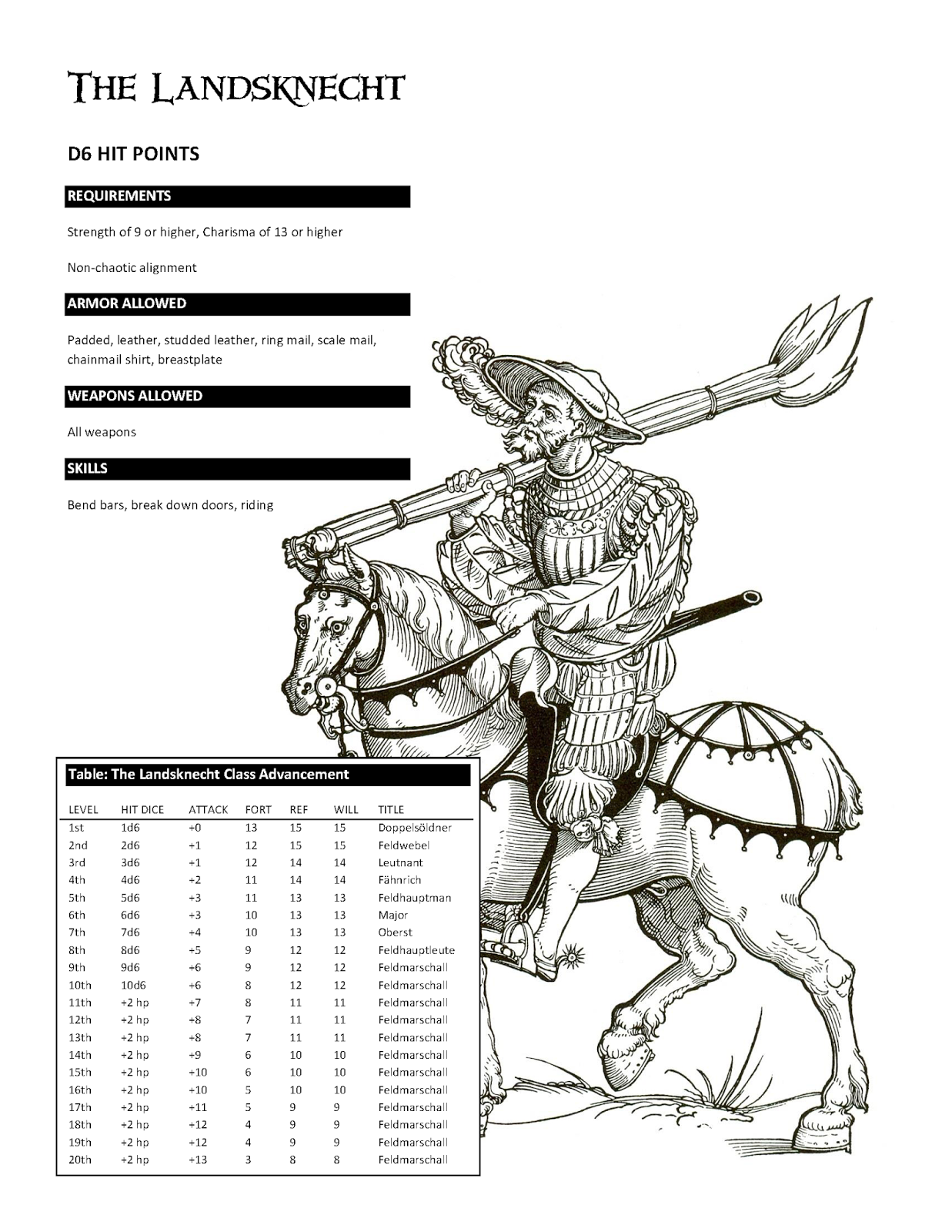
The Landsknecht

Click to make larger … you know, so you can actually read it

The landsknechts – roughly translated as lowland vassals – were the preeminent mercenaries of Europe in the 16th century, surpassing the famous Swiss pikemen when they defeated them at the Battles of Bicocca and Marignano. The landsknechts were first formed in 1487 by Maximilian I, the Holy Roman Emperor, as an imitation of the Swiss pikemen. Like the Swiss, they relied primarily on the pike with support from crossbowmen, arquebusiers, halberdiers and swordsmen. The landknechts probably reached their height during the Thirty Years War (which is why I’m featuring the class in this issue).

What roll could a landsknecht play in dungeon exploration? It is a common practice to bring retainers into a dungeon to help overpower enemies and soak up their attacks for the player characters. The landsknecht is a master of soldiers, a captain in the field. The landsknecht may not be as powerful a front-line warrior as the fighter, but he brings friends and knows how to use them.

Experience Points: As Fighter

A landsknecht is not trained to fight solo, like a fighter, but rather in a company of warriors. When he starts his career, he is a slightly less powerful fighter, though he receives a +1 bonus to hit with spears, pikes and other polearms due to long training with these weapons.

As the landsknecht advances in level, he adds men-at-arms to his company. At each level beyond 1st, the landsknecht adds a single man-at-arms to his company. The man-at-arms equipment is rolled on the table below:

D10 ROLL
1-5. Pike (or spear), leather armor, dagger
6-8. Arquebus (or heavy crossbow), leather armor, scimitar
9. Halberd, leather armor, dagger
10. Greatsword, leather armor, dagger

These men-at-arms are the landsknecht’s personal guard, and do not count as his retainers. Retainers can still be hired separately by the landsknecht, and are commanded by him, but they do not benefit from his special abilities as his personal guard does.

A 3rd level landsknecht adds a trabant to his personal guard. The trabant is a 2 HD warrior armed with a greatsword, dagger and ringmail.

A 5th level landsknecht adds a kaplan (chaplain) to his personal guard. The kaplan has the same alignment and patron deity as the landsknecht. He fights as a 2 HD warrior and casts spells as a level two adept. The kaplan is armed with a light mace, buckler and chainmail shirt.
Once per day, a 6th level landsknecht can inspire his personal guard to amazing levels of courage. As long as he is within 10 feet of them, they enjoy a +1 bonus to save vs charm and fear effects, and a +1 bonus to hit and damage for one battle.

A 7th level landsknecht adds a führer (guide) to his personal guard. The guide fights as a 2 HD warrior and has the track and survival skills as a 2nd level ranger.

Once per day, an 8th level landsknecht can inspire his personal guard to greatness. All troops within 30 feet of the landsknecht gain 1 Hit Dice, an additional +1 bonus to hit and damage, and a +1 bonus on all Fortitude saving throws for the duration of one battle.

A 9th level landsknecht adds a standard bearer (and personal standard) to his personal guard at 9th level. The standard increases the fighting ability of his special troops (trabant, kaplan, führer) by one hit dice, and grants his entire personal guard a +1 bonus to save vs. fear and magic spells. The standard bearer fights as a 3 HD warrior, using his standard as a quarterstaff. He also carries a dagger and wears a breastplate.

It is not uncommon for a landsknecht to lose troops, of course. Any troops lost from his personal guard can be purchased in a settlement (town-sized or larger) at a cost of 10 gp per soldier plus equipment costs. Special troops can be purchased for 100 gp plus equipment costs.

Holy Moses, It’s a New Class!

Yes, a new class … probably the last new class of 2014 … based on Moses, that fellow who parted the Red Sea and held the Ten Commandments.

At least, it’s based a little on Moses, and a little on other old time prophets. In essence, it’s a non-warrior cleric with more flexibility in terms of spells, but fewer spells to choose from.

In a moment, the class. First, a couple words from our sponsor (which happens to be me)

Two new e-books up on Lulu over the past couple days. The long awaited (well, by me anyways – took me forever to finish it) NOD 24, and the even longer-awaited (again, by me) Bloody Basic – Contemporary Edition. From my descriptions on Lulu.com …

BLOODY BASIC – CONTEMPORARY EDITION

Bloody Basic takes the advanced Blood & Treasure Fantasy Role Playing rules and boils them down to the essentials to make gaming easy, fast and fun. The Contemporary Edition rules include rules for the contemporary races, classes, spells and monsters of fantasy role playing, including automatons, drakkens, gnomes, fighters, sorcerers, clerics and thieves. $4.99 for 44 pages

NOD 24

2014 comes to a close with the 24th issue of NOD! In this issue, we continue the Ende hex crawl started in NOD 23, detail some Indian divinities, get into some court intrigue, make monsters with a dictionary, explore the ancient Red Sea as a campaign setting, tangle with space genies, and meet some 1920’s superheroes called the Roustabouts. 80 pages. $4.39 for 80 pages

Wow! What amazing bargains (if you’re into this kind of thing).

Now, back to our program!

The prophet is a cleric who goes way back … all the way to Moses in fact. The prophet is destined to be a religious leader of a people, if he or she can live long enough. Starting out in life, they are touched by a deity and tasked with leading their chosen people, or converting their chosen people, to their worship. They must eventually lead these people into the wilderness to found a new kingdom for them. The deity in question should be one that is, as yet, minor in stature, or a major deity that has largely been forgotten by his or her chosen people.

Obviously, this class is based on Moses. I won’t go over the story of Moses – it’s easy enough to find – but suffice to say he was a prince who discovered his true heritage and was chosen by God to lead his people through the Wilderness to the Promised Land. As an emissary for God on Earth, he could perform miracles, and as a man that was raised in a royal house, he had a good deal of non-spiritual leadership ability.

The prophet class has an innate ability to commune with the divine, a spell list based on the miracles attributed to Moses, other Biblical prophets and Christian saints. You’ll notice quite a bit of overlap with the normal cleric’s spell list. The prophet begins life as an aristocrat, and that means he has some capacity for fighting and leading people. His leadership abilities will continue to improve as he gains levels, though his fighting ability will improve more slowly. Prophets are not meant to be front-line warriors. A prophet’s spellcasting ability is in some ways more limited than a cleric’s, and in others superior.

Restrictions: Wisdom 13+, Charisma 9+, alignment must be LG, LN or LE

Hit Dice: d8 at first level, d6 at each level afterwards

Skills: Decipher Codes, Find Secret Doors

Weapons: Any*

Armor: Any*

Prophets are trained in the use of all arms and armor, but using arms and armor not allowed to a magic-user represents a lack of faith in their deity, and imposes a spell failure chance on them (cumulative):

Non-permissible light weapon +5%
Non-permissible medium weapon +10%
Non-permissible heavy weapon +15%
Non-permissible light armor +10%
Non-permissible medium armor +20%
Non-permissible heavy armor +30%

Spell failure chance should be rolled when the prophet beseeches her deity for a miracle. If the spell fails, the deity chooses to ignore her.

A prophet does not technically cast spells. Rather, he asks for miracles. A prophet is allowed a limited number of miracles of each miracle level per day. He does not need to memorize or prepare miracles, as long as he has access to a level of miracles, he can ask for any of them. The prophets’ miracles are listed at the end of this article.

Besides adventuring to earn money and power, a prophet’s most important job is to amass followers. To this end, a prophet must preach before multitudes, attempting to either convert them to his new faith, or reawaken them to an old faith. Treat conversion as a Charisma task in which the prophet is skilled.

The prophet can attempt to groups of 0 to 1 HD creatures, or individuals with more than 1 hit dice. With groups, the prophet makes a Charisma task check and, if successful, converts a number of followers equal to his 1d4 plus his level. Difficulties include differences in ethical alignment (law – neutral – chaos) and moral alignment (good – neutral – evil), or the people being strongly dedicated to another faith. The same basic process is used for individuals, with an additional penalty equal to the each level the target is higher than the prophet.

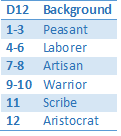
When 0 or 1 hit dice individuals join the prophet’s cult, you might need to determine what they are:

There is a 1 in 6 chance per person that they are wholly dedicated to their new faith, and need never check their morale. Others, however, may lose faith in the face of hardships (as determined by the TK). When this happens, the prophet must make a new conversion task check for each individual. If he fails, they decide to return to their homes and their old way of life.

A prophet must take care of his followers. He must provide food and water for them, protect them, provide some manner of shelter (tents at a minimum), and heal them when they are wounded or sick.

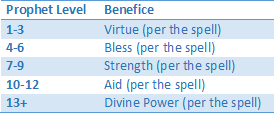
For one battle per day, the prophet can grant a benefice to his warriors in battle. As the prophet’s level increases, he gains additional benefices he can grant. Each benefice can be granted to one battle per day, and only one benefice can be granted per battle.

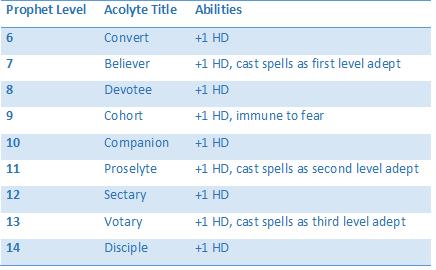
At 6th level, one of the prophet’s existing followers can become his acolyte. The prophet’s acolyte becomes a lesser divine servant of the prophet’s deity, gaining abilities as the prophet gains abilities.

A prophet with fewer than 10 followers by 6th level must perform a quest for his deity or lose his ability to request miracles. Likewise a prophet with fewer than 25 followers at 7th level, fewer than 50 followers at 8th level, and fewer than 100 followers at 9th level and each level beyond 9th.

A prophet that is killed might enjoy an apotheosis upon death. There is a 5% chance per level of the prophet. When an apotheosis occurs, the prophet transforms into an outsider of similar alignment with roughly as many Hit Dice as the prophet +1. In this form, the prophet remains in the material plane for one minute per level. Thereafter, he is called to his home plane and disappears forever unless resurrected. If resurrected, the prophet returns in his original body, not as an outsider.

FIRST LEVEL MIRACLES
1. Aid
2. Bless
3. Comprehend Languages
4. Control Light
5. Cure Light Wounds
6. Multiply Food and Water
7. Protection from Evil
8. Summon Nature’s Ally I
9. Sustenance
10. Turn Undead

SECOND LEVEL MIRACLES
1. Augury
2. Buoyancy
3. Calm Emotions
4. Consecrate
5. Cure Moderate Wounds
6. Detect Thoughts (ESP)
7. Gentle Repose
8. Levitate
9. Remove Paralysis
10. Speak with Animals
11. Summon Nature’s Ally II
12. Summon Swarm

THIRD LEVEL MIRACLES
1. Cause Disease
2. Create Food and Water
3. Cure Blindness/Deafness
4. Cure Disease
5. Cure Serious Wounds
6. Fly
7. Hold Person
8. Remove Curse
9. Summon Nature’s Ally III
10. Tongues
11. Water Walk

FOURTH LEVEL MIRACLES
1. Blight
2. Charm Monster
3. Control Water
4. Cure Critical Wounds
5. Divination
6. Flame Strike
7. Holy Smite
8. Restoration
9. Sticks to Snakes

FIFTH LEVEL MIRACLES
1. Awaken
2. Bilocation
3. Commune
4. Contact Other Plane
5. Healing Circle
6. Hold Monster
7. Insect Plague
8. Raise Dead

SIXTH LEVEL MIRACLES
1. Banishment
2. Geas
3. Move Earth
4. Wind Walk

SEVENTH LEVEL MIRACLES
1. Control Weather
2. Create Clay Golem
3. Transmute Matter

EIGHTH LEVEL MIRACLES
1. Earthquake
2. Holy Aura

NINTH LEVEL MIRACLES
1. Astral Projection

NEW SPELLS

BILOCATION
Level: 5
Range: Personal
Duration: 1 minute

For one minute, the prophet can be in two places at once. Each version of the prophet can carry out movement and actions as normal. The second version can appear within 1 mile per prophet level of the first. When the second version disappears, any damage or other effects he sustained, or any items he took possession of, return to the first version.

BUOYANCY
Level: 2
Range: Close (30 ft.)
Duration: 1 minute

One object within 30 feet designated by the caster becomes buoyant in water, and floats to the surface.

CREATE CLAY GOLEM
Level: 7
Range: Touch
Duration: 10 minutes per level

By fashioning a roughly human-sized and shaped object out of clay and inscribing a magic sigil on its head, the prophet can cause it to become a clay golem for 10 minutes per prophet level.

MULTIPLY FOOD & WATER
Level: 1
Range: Touch
Duration: Instantaneous

This miracle takes existing food and water and multiplies, creating one extra portion per prophet level.

SUSTENANCE
Level: 1
Range: Personal
Duration: Instantaneous

The prophet can go without food, drink and sleep for one day, but must sacrifice one point of constitution to do so. This constitution point cannot be healed while any casting of this spell is in effect. A prophet could, therefore, use sustenance for seven days straight, but would be without seven points of constitution on the seventh day, and would suffer the normal effects of a lower constitution. Constitution points sacrificed for this spell return at the rate of one per day of rest.

TRANSMUTE MATTER
Level: 7
Range: Touch
Duration: 24 hours

The prophet can transmute matter from one form to another, thus lead to gold or steel to adamantine. The effect lasts for 24 hours. At the end of this time, the object must pass an item saving throw (as its original matter) or disintegrate.