Dragon by Dragon – March 1980 (35)

This week (or month, depending on how you look at it), The Dragon greets us with a very 1980’s bit of Cold War schtick – a couple commies about to get whooped by either a bunch of heavily armed and magical snowmen, or some U.S. Marines in disguise. Either way, not a good day for the Russkis. Luckily, we’ll never have to worry about Russia actively trying to conquer its neighbors … never mind.

Let’s dive in!

#1. From Avant-Garde to Mainstream

From the Dragon Rumbles column:

“Judging from the 43rd Hobby Industry of America trade show, held Jan. 27-30 in Anaheim, Calif., our once lonely pastime has arrived with a vengeance. According to what the buyers and store owners were saying, adventure gaming (for want of another term) is booming, with the heavy emphasis on fantasy. Sales of Advanced D&D DMG bear this out; it is the best-selling game/gamebook of all time.”

I wonder if that still holds. From what I understand, sales back in the old days were much higher than they are now.

#2. Oops

I did a thing a while back about type-o spells. In an article on errata in the AD&D books, Allen Hammack introduces a few screwed up magic items:

RING OF THREE WITCHES— Rather self-explanatory. It looks like any other magic ring and will radiate a dweomer if detected for. If summoned or commanded to function or if a wish is made upon it, the three witches (each a 20th level chaotic evil Magic-User) will issue forth and wreak havoc.

CUBE OF FARCE —Upon pressing this cube, a field of force will spring up just as in the Cube of Force, but on the interior of the cubic field the operator of the Cube is subjected to 6 different “comedies” at the same time, and must save vs. spell or he will be insane for 1-10 rounds. The “comedies” are “Gilligan’s Island”, “Hee Haw”, “Hello, Larry” , “I Love Lucy”, “Good Times”, and “The White House Press Conference.”

CARPET OF FRYING— When this magic carpet is sat upon and commanded to do anything, it will paralyze the person(s) on the carpet (save applicable), causing the person(s) to stretch out along its length. It will then begin to radiate a temperature of 375° F. and continue until the victim is well-done. Needless to say, the smell of frying human (or halfling or elf or dwarf or gnome or half-orc) will attract any monsters in the area who are fond of such delicacies.

WAND OF LIGHTENING —This wand, whether directed at an opponent or oneself, will cause the operator to gradually become weightless. Once the wand is activated it cannot be stopped until the process is complete (5 rounds). Treat as gaseous form to see if the victim is blown by air currents, although the victim will obviously not be able to pass through cracks or holes. See what messing up one little letter in a spell can do?

#3. Black Holes!

In an article on Traveller variants by James Hopkins, we get a neat little table on random black holes:

AD BREAK

Finally a new one from Ral Parth – The Clerics
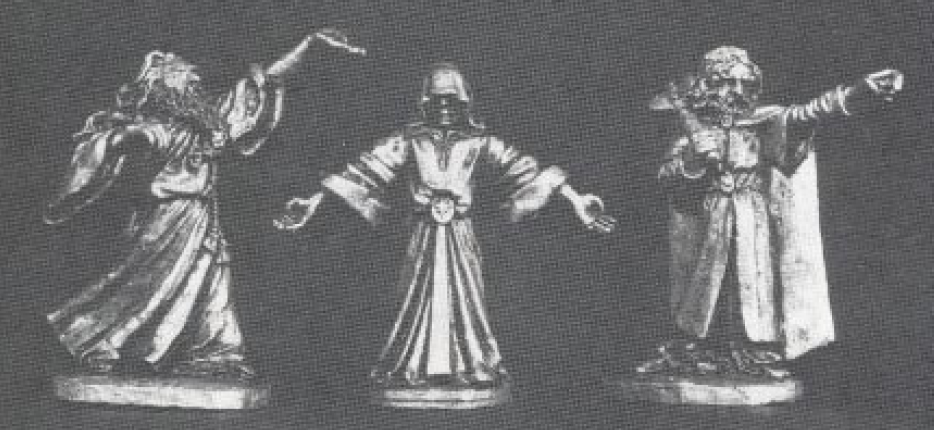
The one on the left look a little dramatic, huh? The one on the right is calling his shot before he knocks a goblin head over the fence. You can buy them here.

#4. Experience Points

Len Lakofka does an alternative way to hand out XP. Here’s the quick rundown:

1. A character amasses at least one half of the experience points he or she needs to gain a promotion (level) (an option allows this percentage to be as low as 30% for a 20th level figure).

2. He or she seeks a person (preferably) two or more levels higher but of the same race and alignment, to train him or her in the skills needed to fully gain the new level.

3. The cost of this training varies from as little as 10 s.p. for 1 x. p. to as much as 2 g.p. for 1 x.p.

4. The training time is computed in days or fractions of days, and during that period the figures are bound in what amounts to a sworn oath in the name of their Gods to be honorable, faithful
and loyal to one another.

Why are experience points given to a character? The methods are:

1. For killing opponents (“monsters”), as per AD&D.

2. For defeating, subduing, enspelling opponents (“monsters”), a one-half award. (Note: killing an enspelled monster still only gains the half award unless the killing is done immediately and not after questioning or having the figure perform some act )

3. For learning the use of magic items (per the awards in the Dungeon Masters Guide for magic items) by experiment and experience, NEVER from the use of a spell or through magic in a
device.

4. From protracted use of an item (weapons and armor, etc. )

5. For certain one-time uses of an item in an “adventure situation.”

6. For acts directly related to a character’s profession.

I’ve admitted in the past that I was a terrible AD&D player, because I never really read the books. I was a Moldvay/Cook punk who grabbed classes, spells, monsters and magic items from AD&D, but I never really used the rules. So the bit about XP for learning to use magic items is interesting – I always figured you just got fat XP for finding a magic item. Maybe you did in AD&D, or maybe I missed the actual rule. I have no idea. Guess I’ll break out the DMG and find out later today.

#5. Same Crap, Different Decade

“Unfortunately, not all particular wargame enthusiasts are able to “minimize losses and maximize gains.” Frequently, wargames allow individual players to display some extreme prodigality, giving bystanders the impression that wargamers are nothing but impassive warmongers who are bent upon destruction, with all its violent emotions, whatever the cost may be. These “war-moralizers” feel that a new race of fascists and communists will be born, with the instinctive impressions that war and its wastefulness is the way of life. Moreover, other groups of “war-moralizers” say that wargaming is an act of practicing the willful murder of mankind condemned by God. And all of this moralizing comes from just playing a game!”

Sound familiar. These days, the emotionally immature are playing the “disagreement = violence” argument, but it all boils down to the same damn thing – tyranny. One person or group gets to direct the lives of all others – what they may say, may do, how they do it, etc.

I want to make sure folks know that Theron Kuntz, in this article, is lamenting and arguing against the bullshit moralizers of the period.

If you love freedom – yours as well as the freedom of others to piss you off – Fight On!

#6. Touched (Really Hard) by an Angel

William Fawcett has a nice article on angels (which of course first has to assure the religious that this is make-believe, so get that pissy look off your face). The article gives you a look at the history of angels (or of lesser divine beings, if you prefer), the hierarchy of Heaven, and then stats for the different angels.

You get seraphim, cherubim, thrones, dominations, virtues, powers, principalities, archangels and angels of the ninth order. All the classics. Makes me want to write an overpowered angel PC class using those as the level titles … maybe next week.

Here’s a sample, using Blood and Treasure stats.

Angel of the Ninth Order

Size/Type: Large Outsider
Hit Dice: 8
Armor Class: 21 [+1]
Attack: 1 strike (4d6)
Movement: 30 (Fly 60)
Saves: F8 R8 W8
Immunities:
Resistance: Magic 50%
Alignment: Lawful (LG)
Intelligence: High
No. Appearing: 1 or 1d4
XP: 2,000

Spells: At will–cure light wounds, purify food & drink, hold person, tongues, plane shift (others), speak with dead, blade barrier, cure disease; 1/day–control weather.

#7. Giants in the Earth
I always enjoy Lawrence Schick and Tom Moldvay’s GitE articles. This issue features:

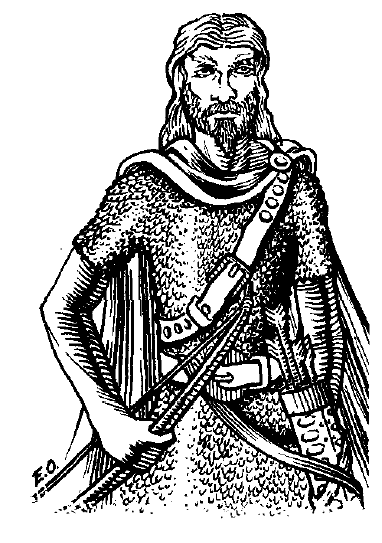
Cecelia Holland‘s MUIRTAGH THE BOWMAN (16th level bard, 7th level fighter, 5th level thief) – with a great piece by Erol Otus. And, it turns out she was born right here in Southern Nevada, in Henderson, back when it was a factory town producing magnesium for the war effort.

H. Rider Haggard‘s UMSLOPOGAAS (15th level fighter)

Henry Kuttner‘s EDWARD BOND (9th level fighter)

Henry Kuttner’s GANELON (25th level fighter) – with some very early Jeff Dee artwork

They also detail the Sword of Llyr from Kuttner. The sword doubles Ganelon’s psionic strength and ability, and gives him some extra psionic disciplines: Invisibility, ESP, Body Equilibrium, Expansion, Mass Domination and Teleportation.

#8. Quickfloor

You’ve heard of quicksand (especially if you’re my age), but Stephen Zagieboylo invented magical “quickfloor” for dungeons. People sink in 1d4+3 rounds (or 1d4+2 if in chainmail, 1d4+1 in platemail). The first person in the marching order has a 40% chance of noticing it, halflings have a 60% chance. Characters have a chance to cross safely based on their dexterity – For 3-5 a 10% chance, for 6-9 a 25% chance, for 10-13 a 50% chance, for 14-16 a 80% chance and for 17-18 a 90% chance. If you tie a rope between two wooden posts that flank the quickfloor, you create a magic bridge that allows people to cross safely, but kills anyone already in the quickfloor (I guess by solidifying it).

QUICK ASIDE

Q: Who was the top ranked AD&D player in the U.S.A. in 1980?

A. Bob Blake

Now you know.

#9. Citadel Miniatures

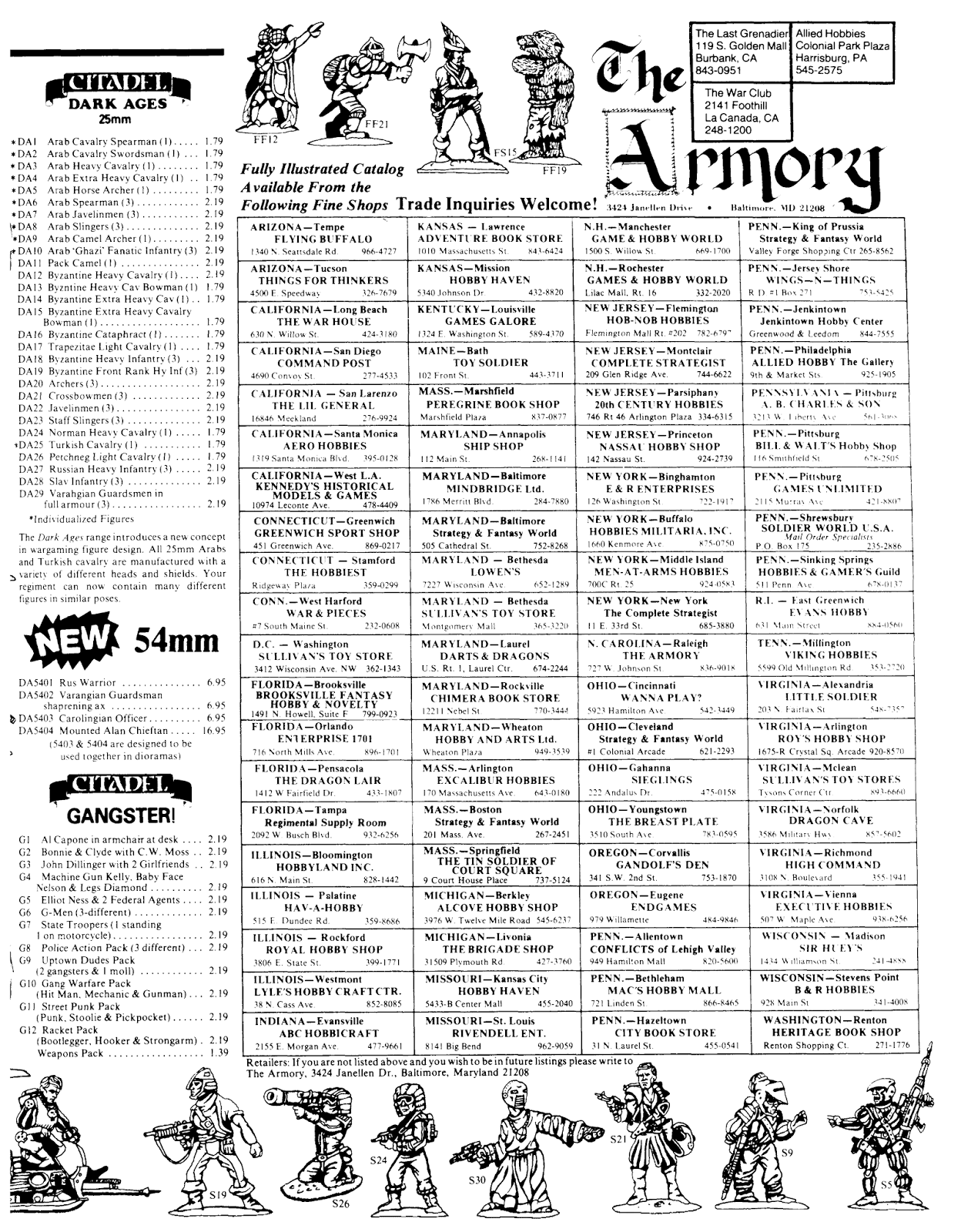
Great ad from Citadel, with their characteristically great mini illustrations.


Now, what can we do with this ad?

Idea 1 – Make a game. Pick a miniature, or do a die drop and see what you land on – that’s your character. Use Risus or something to get some stats, equipment, etc and then invade the Tomb of Horrors.

Idea 2 – The spacefarer miniatures look like a rough draft for Rogue Trader and Warhammer 40,000. Reimagine what the game would have looked like with these illustrations as your guide. Imperial Marines with puffy sleeves instead of bulky armor.

AD BREAK

Yeah, the last bit was an ad as well, but check these out …
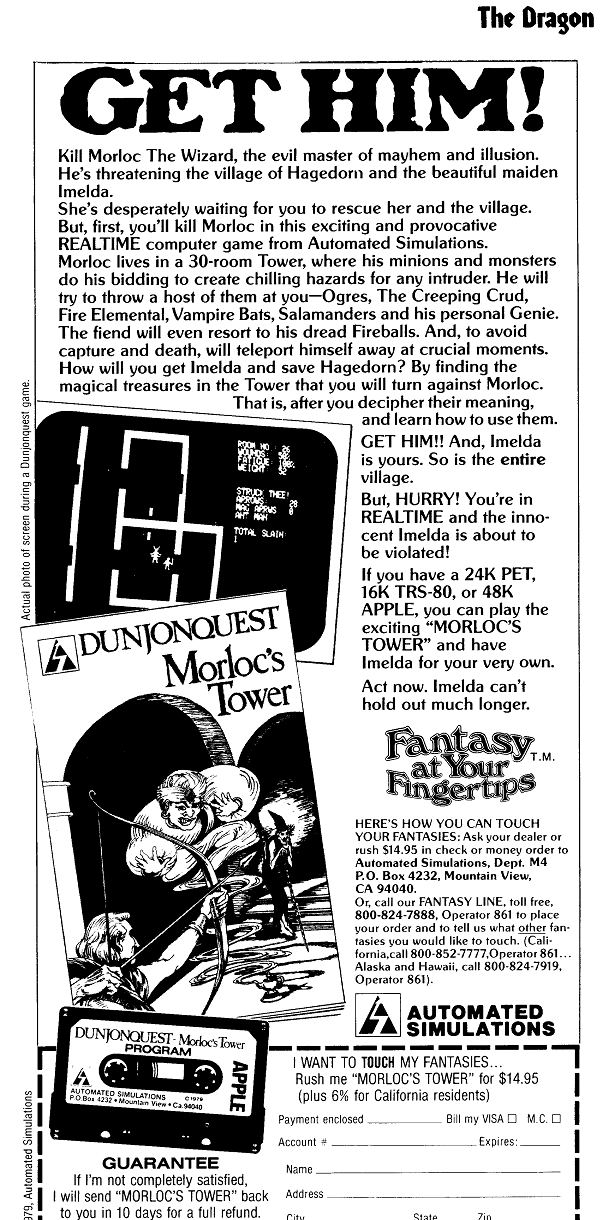
We have an OSR for tabletop games … is there also an OSR for old-style computer rpgs? Honestly don’t know – but I bet they’d make great apps for smart phones.

Coming soon to these reviews …

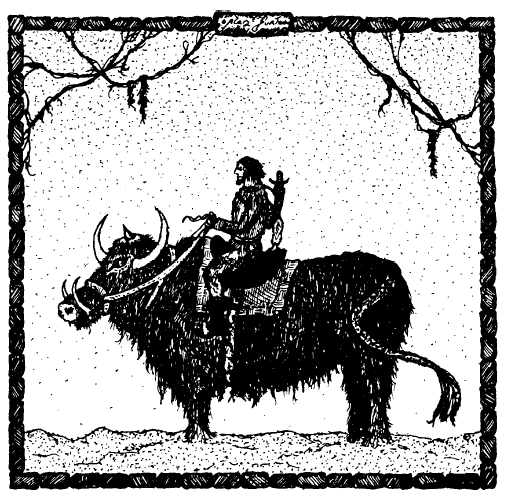
No wormy in this issue, so I’ll leave you with this image from the “Oasis” short story by Cynthia Frazer
So, I need to write an Angel PC class, and a Beastrider class this week.

New Spell – New Monster – New Class

Just a few things that popped into my head lately …

NEW SPELL

Alter Voice
Level: Magic-user 0
Range: Personal
Duration: 1 hour

This spell permits you to alter your voice, mimicking another voice you have heard perfectly. It does not enable you to speak another language, of course. The spell also alters your inner voice, permitting you to fool creatures through the medium of telepathy.

(I’ve watch lots of old movies and TV shows, in which characters have an uncanny ability to duplicate other character’s voices, especially over the phone)

NEW MONSTER

Zoophytic Mangler

Size/Type: Medium Elemental
Hit Dice: 6
Armor Class: 17 [+1]
Attack: 2 slams (1d8)
Movement: 20
Saves: F10 R12 W12
Alignment: Neutral (N)
Intelligence: Non-
No. Appearing: 1
XP: 600 (CL 18)

A zoophytic mangler is an quasi-elemental creature raised from the sea floor by aquatic mages who have learned the spell. The creature is composed of a core of dead coral. Its exterior is covered with hundreds of beautiful, flower-like living corals. These corals exude a poisonous mist that surrounds the monster to a radius of 20′. Any creature breathing this mist must pass a Fortitude save at -2 or be affected as per Poison III. Those who do save are still sickened, and remain sickened for 1 hour after they leave the monster’s presence. This mist works in the open air and underwater.

(Just read a story about a venomous coral that has sickened quite a few folks)

NEW CLASS

Knight of Flowers

I drew this!

Knights of flowers are a variation on the paladin class. It is only open to halflings, gnomes and other small fey folk. A knight of flowers differs from the paladin as follows:

They must be good in alignment, but can be lawful good (the Rose Order), neutral good (the Lily Order) or chaotic good (the Daffodil Order).

They are skilled in nature lore and flower arranging, rather than riding

Can detect poison at will, instead of evil

Learns to turn plant creatures and evil fey, instead of undead

Instead of a gaining a special warhorse, they gain the ability to draw special abilities from wreaths of different flowers. The wreath must be woven by a maiden, dryad or nymph, and the magical potency of the flowers lasts for one adventure. The knight of flowers can only wear one wreath at a time:

+1 to hit Evil — chestnut

+1 to Charisma tasks — dahlia, daisy, dandelion, plum blossom

+1 to Fortitude saves — ivy

+1 to Intelligence tasks — cherry blossom, lilac, pansy

+1 to Strength tasks — laurel

+1 to Will saves — gladiolus

+1 to melee damage — fennel, oak leaf

+2 to save vs. disease and poison — lily

1 re-roll (d20) per day — gardenia

Animal Friendship (1/day) — magnolia

Bane (1/day) — lobelia

Calm Emotions (1/day) — bullrush, olive

Charm Monster (1/day) — orchid

Charm Person (1/day) — amaranth, carnation, jasmine, chrysanthemum, coriander, honeysuckle, tulip

Color Spray (1/day) — iris

Command (1/day) — heliotrope, thistle

Crushing Despair (1/day) — yellow rose, rue

Cure Light Wounds (1/day) — Eglantine rose, lotus

Daze (1/day) — wormwood

Detect Magic (1/day) — witch-hazel

Disrupt Undead (1/day) — cypress

Fool’s Gold (1/day) — buttercup

Good Hope (1/day) — delphinium, peony

Hold Person (1/day — mistletoe

Inflict Light Wounds (1/day) — marigold

Light (1/day) — sunflower

Magic Weapon (1/day) — red rose

Protection from Evil (1/day) — baby’s breath

Protection from Normal Missiles (1/day) — heather

Ray of Frost (1/day) — hydrangea

Silence (1/day) — white rose

Sleep (1/day) — poppy

Speak with Dead (1/day) — asphodel

Surprised on d8 — begonia

Tongues (1/day) — balm

Can neutralize poison instead of curing disease

Casts spells from the druid spell list, instead of the paladin list

Otherwise, they have the paladin’s special abilities

Prank

I’ve been quite busy with real life the last week – you might note that I didn’t get a Dragon By Dragon out last Sunday – so I’m forcing myself to stop and write this.

PRANK
Level: Illusionist 1
Range: Close (30′, 50′ for gnomes)
Duration: See below

The prank spell permits the illusionist to carry out one of several classic pranks, as follows.

Blacken: Causes a black ring to appear around a person’s eye when using a spyglass
Blat: Causes a roar of flatulence to blast out when somebody within range sits down

Burn: Causes a bite of food to become extremely spicy; the victim must pass a Fortitude savinv throw or spit the food out, drink lots of water and generally carry on for a round

Dribble: Causes liquid to dribble from a vessel on a person’s shirt

Kick: Causes an illusory “kick me” sign to appear on the person’s back; the first person (other than the spellcaster) who sees it must pass a Will saving throw to resist the temptation

Mark: Causes an illusory mustache and goatee (and perhaps blackens a tooth) on the target

Slip: Causes a banana to appear under a person’s feet (Reflex save to avoid slipping)

Sneeze: Causes the victim to break into a sneezing fit for 1 round if they fail a Fortitude save

Squirt: Permits any flower within range to squirt a person in the face with water

Tinkle: Causes a sensation of warm water on a sleeping person’s hand; they must pass a Fortitude save or have an accident

Some effects are instantaneous. Otherwise, the prank lasts for 1 minute per spellcaster level. Once the spell is cast, the illusionist has one turn (10 minutes) to activate the effect. Only one effect can be created with each casting of the spell.

New Monster and New Games!

A couple things today – first, a new monster:

DEAD EYES

Size/Type: Medium Undead
Hit Dice: 5
Armor Class: 16 [Silver]
Attack: 2 claws (1d4)
Movement: 30
Saves: F13 R13 W11
Resistance: Magic 10%
Alignment: Chaotic (CE)Intelligence: Average
No. Appearing: 1
XP: 1,250 (CL 7)

A dead eyes is an undead monster. It looks like a beautiful man or woman with frightening, dead eyes, black as night and absent of the spark of life. The monster lurks in caves or ruins, startling people first from the surprise appearance of a beautiful stranger in the wilderness, and then by the attack that follows.

A dead eyes hates beauty and happiness, and does what it can to destroy it. The monster can attack physically, even though it is semi-insubstantial, but its more potent attack is its gaze. The gaze of a dead eyes causes first physical numbness in the extremities, and then spiritual numbness.

The physical numbness takes the form of halving the character’s movement rate and a cumulative -1 penalty to hit and damage and AC each round, to a maximum of a -3 penalty. The spiritual numbness takes the form of first the crushing despair spell, and the next round the hold monster spell and the third round the loss of 1 level to energy drain per round.

SECOND – TWO NEW GAMES FROM JMS!


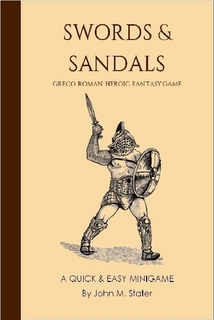
Swords & Sandals is a quick and easy role playing game based on old-fashioned gladiator and Hercules movies. Set in a fantasy Greco-Roman world, players take on the role of centurions, gladiators and sibyls, striving for gold and glory by fighting monsters and conquering cities. All you need to play is pencil, paper, a few ordinary dice, these rules, a few friends and a free afternoon. 37 pages. PDF … $3.19


Manbot Warriors: Remember the great sci-fi cartoons of the 1970’s and 1980’s? Well, Manbot Warriors isn’t one of them … but it could have been. Manbot Warriors is a quick and easy roleplaying game set in a sci-fi universe where heroic manbot warriors defend the peaceful citizens of the galaxy from the evil of the Galactic Core. Easy to learn and easy to play, it requires only a pencil, paper, a few ordinary dice and these rules. 19 pages. PDF … $2.99

I’ll have the print books up for sale soon – just need to get the review copies.

CHECK THEM OUT, LET ME KNOW WHAT YOU THINK!

They Sup on Your Dreams

Hummingbird Men

Type: Tiny monstrous humanoid
Hit Dice: 0 (1d4 hp)
Armor Class: 13 [Silver]
Attacks: None
Move: 10 (Fly 100)
Saves: F19 R10 W14; +2 save vs. mind-affecting effects
Resistance: Magic 35%
Alignment: Neutral (N)
Intelligence: Low
No. Appearing: 1
XP: 50 (CL 1)

They are tiny, with long, beak-like snouts and beady eyes that sometimes strike you as cruel or callous, other times as curious. They have hummingbird wings where a man’s arms would be, and lithe bodies in pleasant, subdued colors – dusky rose, marmalade, the blue-grey of a threatening storm.

They appear at night, and settle down on a person to sup on the nectar of their fitful dreams. Dreams of isolation or rejection please them most; night terrors sate them quickly, but leave them unsatisfied. They hover and stare, and touch their snouts to the person’s temples or forehead, remaining for a few minutes. The dreamer has the best rest of his life; if he was nursing a psychic wound (such as damage to a mental ability score), he heals at twice the normal rate for the hummingbird man’s presence.

If the hummingbird man is threatened by one who knows not what it is or by one who cherishes his dreams, fair or foul, the beast flits back and disgorges nightmares from its snout. These nightmares are illusions, but hard to disbelieve (-2 to save). They usually take one of the following forms:

1 Black tentacles (solidifying from black mists)
2 Phantasmal killer (often a wild-eyed version of one’s close relatives/lovers/self)
3 Shapechange (into something one would not want to be)
4 Flesh to stone (usually a slow transitions, from feet to head)
5 Insect plague (but not always insects)

The victim has a chance to disbelieve each round, but only if the player says they disbelieve. The saving throw begins at -2, but the penalty increases by -1 each round as they are drawn further into the nightmare. The nightmare, thankfully, ends after 6 rounds, by which time the hummingbird man has fled to dine on blacker psyches.

Dragon by Dragon – January 1980 (33)

“This is the ’80s and I’m down with the ladies.” – Tone-Loc

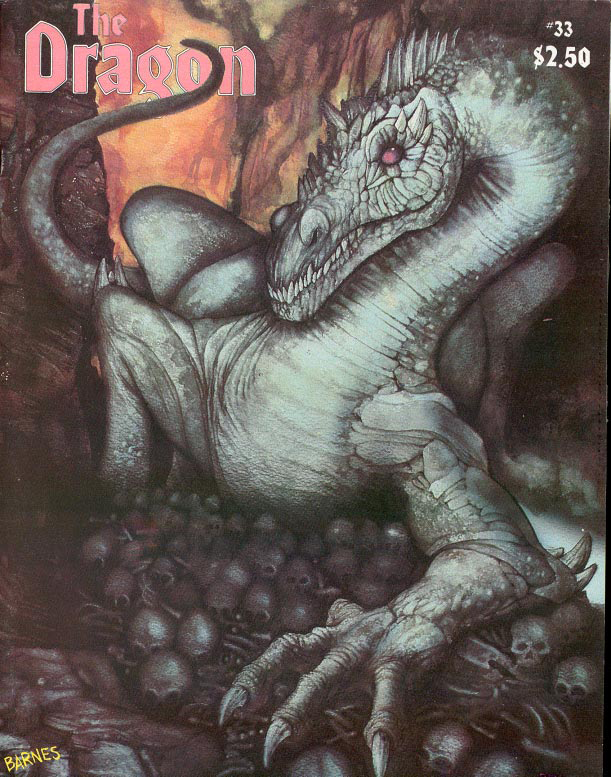
And so we bravely enter the 1980’s (though, again, not technically). The Dragon #33 (we haven’t dropped the “the” yet) welcomes the new decade with “Dragon’s Lair” by John Barnes. The painting won Best of Show and “Best Color Fantasy” awards at the Northwest Annual Science Fiction Festival in Seattle.

What goodies await us inside? Let us find out.

I. Gardner F. Fox

Known best for the Justice Society of America, Fox also wrote fantasy novels later in life, the Kothar the Barbarian series maybe the best known of them, but also Niall of the Far Travels.

Oh, and apparently Guy Gardner was named for him (not sure that was an honor or an insult).

This issue of The Dragon features a short Niall story – the character has appeared in the magazine before. This one is “The Eyes of Mavis Deval”. Here’s the opening:

“It was her eyes that drew his stare as he sat astride the high-peak saddle of his stallion, there on the edge of the huge slave market. They were a brilliant green, those eyes, and it seemed to Niall of the Far Travels as he looked, that there was a tiny flame glowing in each pupil.”

II. Painting Tips

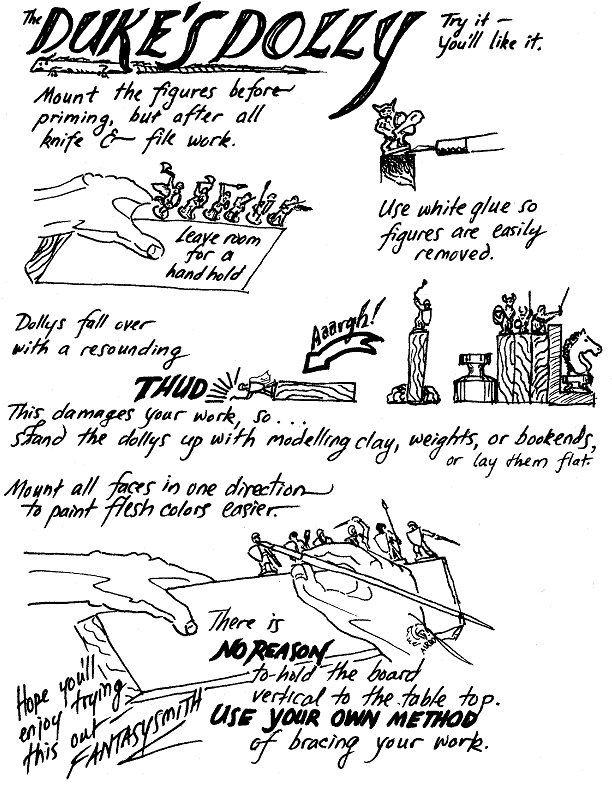
I got into painting Warhammer miniatures back in college, because I had waaaaay too much money and really needed to drain lots of it away on hunks of lead that I don’t look at anymore. So, I know a little (very little) about painting them, and this …

… looks like a darn good idea to me. Presented by Fantasysmith – the person knows his or her stuff!

III. H. R. Lovins, bringin’ the prose

Dig the sprightly prose:

“My friend and I had taken our favorites: a Fighter with rippling muscles, a Cleric of somber colors and mood, a superstitious slinking Thief, and a couple of guardian Magic Users. Unfortunately, someone else was using the back way for a similar evasion. Our leaders turned a corner into a party of a half-dozen well-dressed besworded gents who, not caring to sidle past our group, began to comment acidly on our travel-worn condition, and wonder aloud whether an unpleasant odor was ours, or native to the alley.”

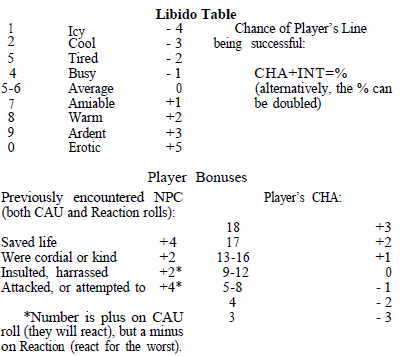
The article is pretty interesting, in the idea of giving NPC’s a Caution (Cau) score. The Caution score is used for two things:

1) The score must be exceeded on a d20 before rolling reaction dice. If not exceeded, the NPC just walks away – no interaction with the players. I kind of dig this – after all, when confronted by a group of murder-hobos, I think most normal folk would get the heck out of there, smiling and making excuses.

2) The Caution score is also used to determine whether an NPC will get involved with a PC – do they throw caution to the wind and take the plunge. Again, you roll d20 and try to exceed CAU. In the case of “woo pitching”, as the kids say, you add the NPC’s Libido score to the roll. Libido score, you say? What’s the Libido score?

IV. Gygax on Magic

“Magic, AD&D magic, is most certainly make-believe. If there are “Black Arts” and “Occult Sciences” which deal with real, working magic spells, I have yet to see them. Mildly put, I do not have any faith in the powers of magic, nor have I ever seen anyone who could perform anything approaching a mere first-level AD&D spell without props.”

Sounds like the religious nuts are already giving him trouble over the “occult” influences on AD&D.

V. Speaking of Magic …

Len Lakofka in this issue is looking at the shortcomings of some of the spells as written, and is making suggestions for improvement. Magic Missile, for example …

“Gary Gygax and I have gone around in a circle on this spell for some period of time. The controversy, in my opinion, lies around the fact that there is NO SAVING THROW and that the missile goes “unerringly” to its target. Why is this so annoying to me? It is unfair because it allows players to foil most opposing spells by putting a Magic Missile into the opposing spell caster, it allows Magic Missiles into melee regardless of the size difference and quantity of ‘friends’ in the melee, and it allows for shots that would amaze Robin Hood with their accuracy!

Gary says that a Magic-User can counter with a simple spell like Shield to prevent this damage. What he overlooks is that the opponent must take a round to cast the Shield and in that time the spell caster is beset by fighters, et al. I find it too unfair to “monsters” that a single FIRST-level spell can be this powerful. Therefore, I have modified the spell in the following ways:

1. There is still no saving throw if the target is surprised, immobile, walking or prone and is at least the size of a Kobold.

2. Figures in melee, figures running (except those running right at the spell caster), figures evading, behind (or moving behind) significant cover, or casting a spell obtain some type of saving throw. This saving throw is their normal one with modification as follows:

A figure casting a spell obtains a s.t., but at -4.

A figure in melee obtains a normal s.t. but adds +1 for every opponent above the first one he/she/it is fighting (unless the size differential is so significant that the opponents do not get in the way—i.e., 6 dwarves against a hill giant would allow the giant a normal s.t. Missiles that MISS their target might hit others in the melee! Select a figure and then give him/her/it a normal s.t. to see if the stray missile hits or misses. In the above example, the dwarves would not be hit. All saving throws are on a missile-by-missile basis. Missiles fire at a rate of 1 every 3 seconds. Thus, a figure moving behind a wall might not be hit by every missile in a barrage of Magic missiles.

A figure with over 50% cover (who then presents a target size of ½ a kobold) always obtains a s.t. of from 16 to 20 depending upon cover and his/her/its actions. This prevents firing through an arrow slit some hundred feet away to hit some poor guard. I have found it necessary to rule in this way to stop Magic-Users from Magic Missiling everything that walks because of the broad language of the spell text. Magic Missile, as written, is too powerful and must be toned down.”

Ladies and gentlemen, I give you rules bloat. The problem, of course, isn’t the DM making the rules he wants for his game. It’s in the opening paragraph:

“I felt that some spells leave a great deal unsaid (or they say too much), and thus individual rulings are often necessary to prevent abuses and to make the game fair and equitable for players and “monsters” alike.”

So what’s wrong with individual rulings?

Well, what was wrong was that the hobby had already grown into two camps. One was playing the game at home, and doing what they wanted with their campaigns. The other was either playing at conventions, and thus needed everybody on the same page, or was playing at home and still believed that everyone needed to be on the same page. I’m a libertarian, so you can guess which side I’m on in this argument.

In Lakofka’s defense, it’s not just about standardization or extra rules. It’s about players being creative with spells, and trying to turn every spell into “instant death”.

VI. No Swords for Clerics

I liked this bit from Lawrence Huss about why clerics may not use edged (or pointy) weapons:

“‘Why, ‘tis as plain as the forbidden pikestaff! The purpose and nature of all edged weapons (and what is a point but a section of an edge?) is to cut, release blood and kill, both in reality and symbolically.

‘The club, mace and flail are but growths of the staff, which stands for guidance and religious authority. Though the end result of the sword stroke and the well-aimed mace blow are the same, the symbolic intent differs. As the High Power judges our acts much from a viewpoint in which symbols supersede particulars, this symbolic difference in intent is of greatest importance, both to the performance of the specifically clerical functions and in the gaining of spiritual eminence.'”

In other words, spare the rod, spoil the bugbear.

Now, some might argue that symbolism is pointless – the enemy is dead. What does it matter that he was slashed or bludgeoned to death?

But we’re talking clerics. Priests. Symbolism is everything!

VII. Old Time Hockey Gaming, Coach!

Did you ever want to see a huge list of Game Masters operating in the U.S. in 1980? Great – this issue is for you. Let’s check out my stomping grounds, Las Vegas NV.

We have Bill Coburn, running D&D, Traveler, Metamorphosis Alpha and general board games, and David Whitney, running D&D, Traveler and general board games.

We’ve seen Bil Coburn in the pages of The Dragon before, writing on the effectiveness of poison back in September 1978. I couldn’t find him online, nor David Whitney. Alas.

VIII. Question of the Month

“QUESTION: There is this character (a Magic-User) being refereed by an inexperienced DM. Because of his lack of knowledge, he let the character advance in levels too quickly. He also has 86 magic items. By the time the character got to 34th level, the DM had learned from his mistakes and proceeded to try to kill the powerful character. He tried a Ring of Transference, and when that didn’t work he hit him with 2000 (100% magic resistant) thieves. Is it within the D&D or AD&D rules for a DM to deliberately try to kill a character?”

Yikes!!!

Runner up:

“QUESTION: Is an invisibility spell cancelled when you fall on your face from tripping either over your own feet or from someone else’s number 13’s?

ANSWER: No.”

IX. The Infancy of Home Computing

This issue has the inaugural article on “The Electrical Eye”, about gaming on computers. I thought the little guide to computer manufacturers was intresting:

Witness Apple corporate HQ just 35 years ago (I think … the actual street number doesn’t show up on GoogleEarth):

Oh, and yeah, they got the address wrong above. It was on Bandley Drive, as confirmed at this article showing the layout.

X. Frosts

The “Dragon’s Bestiary” this month is by Roger Moore – Rogar of Moria. I always like Roger in the pages of the later Dragon’s that I read.

Frosts are “snow pixies” – little buggers that pack a punch. Here’s an adaptation of the stats for Blood & Treasure

Size/Type: Tiny Fey
Hit Dice: 0
Armor Class: 15
Attacks: 1 attack (1d3)
Move: 20′ (Fly 60′)
Saves: F19 R12 W12
Intelligence: High
Alignment: Neutral (with good tendencies)
No. Appearing: 1d6

Frosts can turn invisible at will, but cannot attack while invisible. They can use cone of cold (3 dice) once per day and frost fingers (cold version of burning hands) 2/day – and can use frost fingers while invisible. One frost in six can use freezing sphere once per day. Frosts can also control temperatures within 10 feet.

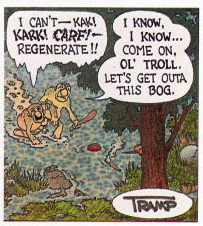
I’ll leave you this fine Sunday morning with some Tramp

Saving Throws – 2E vs 3E

I’m beginning the process of revising Blood & Treasure for release next year. This is primarily a task of getting in the errata, looking for things I and others might have missed, and refreshing the design. I want to make the books more readable, and thus easier to use. I’m also considering new cover art for the books – commissioned cover art. If you have suggestions for artists you would like to see grace the covers, let me know in the comments.

Revisions are also a good time to examine some premises – are there things that were not wrong, per se, but which could be better. To that end, I was looking at saving throws the other day, and whether B&T saving throws, which are based on the values in 3rd edition, are easier or harder than saving throws in older editions.

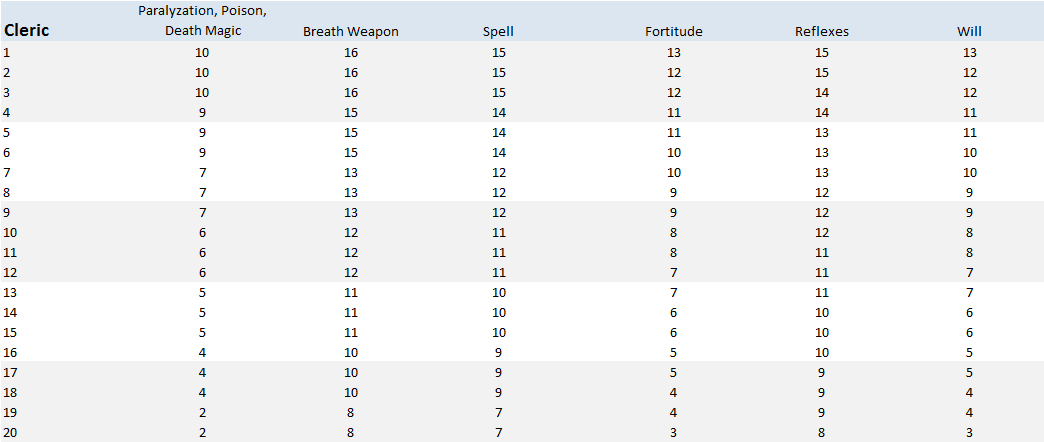
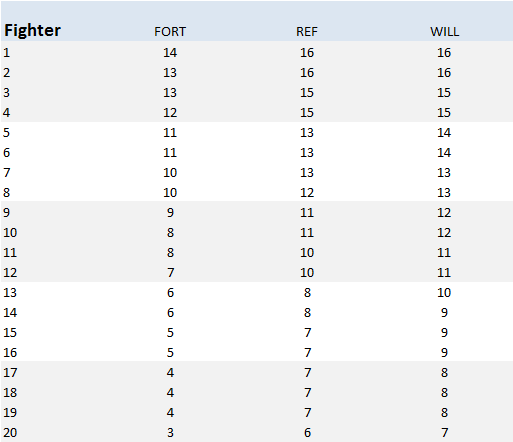
I did a quick search online this morning and found the 2nd edition AD&D saving throw tables, so I’m using them for this analysis. I figured that Save vs. Paralyzation, Poison & Death Magic mapped pretty well to Fortitude in B&T. Save vs. Breath Weapon maps pretty well to Reflexes, and Spells to Will. What I didn’t notice until now (it’s been a while since I looked at 2nd edition, and perhaps the values are the same in 1st as well), is that Save vs. Wands, Staves and Rods is just Save vs. Spells, but 1 point easier. I’ll incorporate that into the revised B&T for sure (+1 bonus to save vs. spells cast from wands, staves and rods).

Anyhow – here is how they shaped up:

Clerics (or Priests, in 2E) weren’t that great against spells, which was changed in 3E. People often complained about the clerics being a bit too good in 3E, so perhaps they shouldn’t have made that change. That aside, the other categories end up pretty close at 20th level, but PPDM is much better than FORT for most of the cleric’s career. Perhaps the worse FORT save in 3E makes up for the better WILL save.

The fighters have an easier time of it in 3E at early levels, and a worse time of it at higher levels in terms of REF and WILL saves.

Magic-users are pretty close on PPDM vs. FORT and BW vs. REF. SP/WILL differ somewhat, with a marked improvement in 3E at very high levels.

Thieves in 2E were better vs. PPDM than BW, which was flipped in 3E. Save vs. Spells / WILL is pretty close.

So, between those editions, there were changes to be sure, but the overall ranges from 15 to 8 for poor saving throws and 13 to 3 for good saving throws, are pretty close.

My temptation is to do hybrids of these in the revised B&T, so they’re not quite so formulaic. Something like:

Dragon by Dragon – December 1979 (32)

Depending where you are when you read this, good morning, good afternoon, good evening or good night. It’s Sunday, which means it’s time to crack open the vault and review another issue of The Dragon. Technically not the last of the 1970’s (that would be December 1980), but for most folks, the end of the decade.

Let’s take a look at the Top 10 Cool Things in The Dragon #32

Side note – cover by Phil Foglio, which means his contributions to the magazine’s comics section shouldn’t be too far away. Always a highlight for me back in the day.

Yes, because of Dixie. I’m a red-blooded American male, and I make no apologies for it.

ONE | GOOD ADVICE

When question about super high level characters (as in, “no freaking way they got there fairly), ED gives the following sage advice …

“Cheating, yes, but who? If you refuse to play with these sorry individuals, they are only cheating
themselves of the feeling of accomplishment that comes from having honestly earned a level advancement. To each his own . . .”

Good advice then, and good now. Learn to enjoy losing spectacularly at games, and you will find them twice as enjoyable as you used to.

TWO | POISON

Charles Sagui has an article on “Poisons from AA to XX” that I enjoyed. I always like articles written from a position of authority concerning make-believe stuff, and this one has several firm rules for poisons that you might not have known:

1) Poison is restricted to Neutral and Evil characters when used against human or humanoid types … against dungeon monsters, anyone can use poison.

2) Alchemists alone distill and manufacture poisons – magic-users, thieves and assassins who are caught making poisons are told immediately to “cease and desist” – imagine, slapping a cease and desist order from the Alchemist’s Guild on a PC! Apparently, if the order is ignore, the PC “will receive a visitor who will see to it that he stops permanently.” – Sounds like a fun encounter to run.

3) Alchemists learn to make poison at one strength per level of experience up to the 5th, beginning with level 0, strength “AA”. At 6th, the alchemist can make strength “S” sleep poison. After 6th, he learns to make one strength per two levels, through strength “J” at 16th level. Type “X” can be made by 20th level alchemists, type “XX” by 25th level alchemists. Alchemists through 4th level make only ingested poisons. From 5th to 8th level, they make ingested plus water-soluble poisons. From 9th to 16th they learn to make contact and gaseous poisons.

4) Assassins are the main customers, and they dictate to the alchemists who can buy poison. Locksmiths are granted permission by the assassins to put poison needles and gases in locks and chests so the rich can keep their possessions safe. – This suggests that the thieves and assassins are not on the best of terms.

5) Any character is permitted to buy strength “S” sleep poison. Thieves, by paying the assassins 500 gp per level, are permitted to buy strengths “AA”, “A” and “B” poison. They may buy up to 60 vials of “AA” per year, up to 30 vials of “A” and up to 15 vials of “B”. Magic-users can pay 1,000 gp per level to get the right to coat darts and daggers with “AA” and “A” poison. The same buying restrictions for thieves apply.

6) A small vial of poison is enough to coat 6 arrowheads, 8 darts, 12 needles or 1 dagger or spear point. Two vials will coat a short sword. Three will coat a long or broadsword, four a bastard sword and five a two-handed sword. Each coating lasts for 2 successful hits, and up to 5 coats can be applied to a blade at a time. One vial is equal to one dose when swallowed.

7) Evil humanoids should never use more than “AA” poison. If they are employed by a powerful evil NPC, they may use up to “D”.

8) Poisons found in dungeons are:

0-50% – ingested
51-80% – water-soluble
81-90% – contact
91-100% – poison gas

9) Damage from poison is taken at a rate of the minimum hit point damage for the poison per melee round (which would have been a minute, back in the old days) until max damage rolled is met. So, a poison that deals 1-10 damage would do 1 point of damage per round. If you rolled “6” damage, it would deal 1 point of damage per round for 6 rounds. A poison that did 5-100 damage would deal 5 points of damage per round.

10) When you save vs. sleep poison, you act as though slowed for 3 rounds.

11) When using poison-coated weapons, each time you draw the weapon or return it to its scabbard, you have to save by rolling your Dex or less (on 1d20, I assume), minus 1 for water-soluble and -3 for contact, or you suffer max poison damage. You also have to make a Dex save every other round for water soluble and every round for contact poison that the weapon is used in combat to avoid poisoning yourself. This applies until the weapon is washed, even if the weapon does not have enough poison left to poison opponents in combat.

12) Silver weapons will not hold poison, not will magic weapons. Normal weapons that are poison-coated gives them a dark discoloration, so everyone will know the weapon is poisoned.

Lots of rules, but actually pretty useful ones. The article then goes on to detail the different poison strengths – I won’t reproduce those here.

THREE | WEAPONS OF ASIA

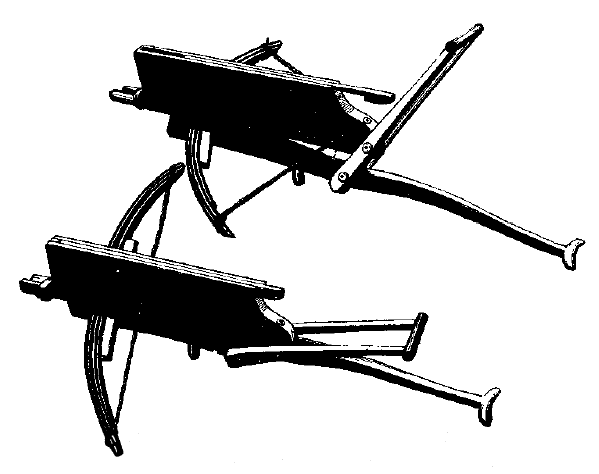
This is a companion article to the armor article from last issue, also by Michael Kluever. Here’s a bit on the Chu-ko-nu, or repeating crossbow.

“An interesting variation was the repeating crossbow (Chu-ko-nu). It propelled two bolts simultaneously from its wooden magazine, which held a total of 24 featherless quarrels, each approximately 8.25 inches long. The bolts were contained in a box sliding on top of the stock and moved into firing position by a lever pivoted to both. The throwing of the lever forward and back drew the bowstring, placed the bolt in position and fired the weapon. Chinese annals relate that 100 crossbowmen could project 2,000 quarrels in fifteen seconds. The repeater crossbow was used as late as the Chinese Japanese War of 1894-95.”

Apparently I need to include it in Grit & Vigor.

FOUR | SINISTER SEAWEED

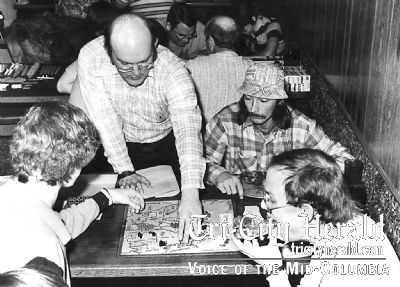
You got some interesting articles back in the day. This one, by George Laking, is about aquatic megaflora, and its danger to adventurers. The info in the article was designed by the Mid-Columbia Wargaming Society of Richland, Washington. With a little searching, I found a picture of Mr. Laking and some society members from a 1978 newspaper. The internet!

So, you’re first thought it – screw seaweed, bring me dragons!

You fool!

Apparently, megaflora stands capture oxygen in vast bubble domes within their branches. Within this bubble dome, there is a bunch of dry limbs and twigs from this megaflora. The interior of the dome resembles a quiet, dry forest surrounded by thick trunks. Bubble dome heights range from 4 to 40 feet, depending on the size of the stand.

Where’s the danger. Well, the stands can capture ships for 1-12 hours, making them vulnerable to aquatic monster attacks.

The bigger danger is bubble dome “blows”! The domes are temporary structures. In some cases, the gas cannot escape and pressure builds up until it explodes, throwing dry branches and limbs 2d10 x 10 feet into the air in a huge fountain of water and foam! Ships will fall into the void left, and then be slammed by the walls of water rushing back in, possibly destroying the ship. A blown stand looks like a peaceful lagoon with walls of megaflora around it, quickly growing in to fill the clearing. This will be the lair of aquatic monsters, guarding the treasure left by ships destroyed in past blows.

A third danger is that pure oxygen is poisonous to people. Divide the height of the dome by 10 and take this as a percentage chance per hour that a character absorbs too much oxygen into her bloodstream. A character who reaches this threshold, upon leaving the dome, must make a save vs. poison or immediately die.

Also – pure oxygen is extremely flammable. Let’s say you light a torch inside the dome …

“(1) The initial explosion of gas would create a 6-20 die fireball of incandescent oxygen, depending on the size and depth of the bubble dome (depth of dome divided by ten equals hit dice). The size of the fireball would be half as large as the initial dome after the explosion of the gas. Saving throws would be applicable.

(2) Following the initial explosion, the fireball would immediately rise to the surface with a subsequent catastrophic inrush of ocean water onto the previously dry dome interior. Each character would have to undergo a check for system shock as the walls of water met with implosive fury. A character saving vs. system shock would only take 3-10 (d6) of damage. Failing to save means immediate death!

(3) Finally—should the character survive—an immediate check vs. oxygen poisoning would be necessary to determine if he/she had exceeded the critical threshold at that point. If so, that character would have to make an additional save vs. poison per oxygen poisoning (above).”

Frankly, a weird bubble dome dungeon would be awesome, and a great challenge. A ship gets stuck and attacked by aquatic ogres. Adventurers follow them down to retrieve something important, find a massive bubble dome with a dead, maze-like forest within it. They have to work fast to avoid being killed by too much oxygen, and there is a chance that it explodes and the ship is drawn down into sea and crushed.

FIVE | THE BEST LAID PLANS

From Gygax’s “Sorcerer’s Scroll”:

“In a previous column I mentioned that I would set up an adventure where the players would end up in the city streets of the 20th century. Well, I knocked together some rules, put the scenario together, stocked the place with “treasures” of a technological sort, and sprinkled some monsters (thugs, gangs, police, etc.) around.

Much to my chagrin, Ernie the Barbarian was leading the expedition. When his party emerged from the subway—and despite the general blackout in the city due to the power failure caused by their entry into this alternate world—he stopped, looked, listened and then headed back for the “safety” of the “real world!” Some people really know how to spoil a DM’s fun …”

Damn players.

SIX | SAGE ADVICE

From Jean Wells in “Sage Advice”:

“The subject is dwarven women and whether or not they have beards. Last spring when we were working on the final editing of the Dungeon Masters Guide, I tried to get Gary Gygax to change the section on dwarves so that dwarven women would not have beards. Needless to say, I was not very successful.

What I didn’t realize was that for some strange reason (completely unknown to me), I had started something. I did not understand the full impact of what I had done until I went to GenCon this year. Many people stopped me in the hall to either agree with me wholeheartedly, or disagree with me and then tell me that I was crazy. Everyone knows that dwarven women have beards, they said. It did not stop there. Oh, no! We have even been getting mail on this issue. It is not too bad, but I don’t like being accused of making an issue out of the subject.

One thing that everyone who has taken sides in this issue fails to remember is that Gary Gygax wrote the Dungeon Masters Guide and it is his book. He can say whatever he wants to. You can agree with him or side with me, but either way, the person who has final say in his or her campaign is the DM. So, for all the people who have written in to agree with me or to agree with Gary, and for those who haven’t yet but were planning to, please save your breath. Gnome women don’t have beards (this is true and I am glad). Dwarven women may indeed have beards, Gary, but not in my world.”

Yeah, there have always been gamers who A) didn’t get that it was make-believe, and there was therefore no right or wrong, and B) didn’t get that their own opinion isn’t law.

Also this question:

“Question: We are having an argument over an issue that has us divided. My friends say that with a ring of telekinesis they can make an arrow spin at the speed of light and then release it, having it do between 100 and 600 points of damage to their target. I say this is impossible! What do you think?”

God – I remember these fools.

Finally:

“Question: I am having a romance with a god, but he won’t have anything to do with me until I divorce my present husband. How do I go about divorcing my husband?”

Ye Gods!

BONUS AD!

For sale – crappy t-shirts.

Actually, I would wear one of these with a ridiculous amount of pride. I’m super tempted to lift the graphic and make one online for myself.

Looks like the Barbarian Shop was in a private residence:

SEVEN | INSECTOIDS

Len Lakofka presents in this issue his insectoids, which are just the humanoid races with insect characteristics grafted on. For example: Scorpiorcs. For Blood & Treasure, they would look like:

Scorpiorc, Medium Monstrous Humanoid: HD 2; AC 16; ATK 2 pincers (1d6) and weapon; MV 40; SV F15 R12 W13; XP 300 (CL 4); Special-Surprised on d8 (due to eye stalks), move silently (70%), back stab x2.

Scorpiorcs never use flaming swords or carry any sort of flame. They also never use armor, but may carry a shield. They speak Scorkish and broken Orcish. They can advance as fighters from a beginning “level” of 2 to a top rank of 4.

I also have to mention the “skags”, which are a blend of scorpion, kobold, ant and goblin. This is actually a sort of “monster class” – dig it:

BONUS AD

Great title. Found HERE at Boardgame Geek. Stephen Fabian did the art, so it has be worth a few bucks based on that alone.
EIGHT | TRAVELER POLITICS

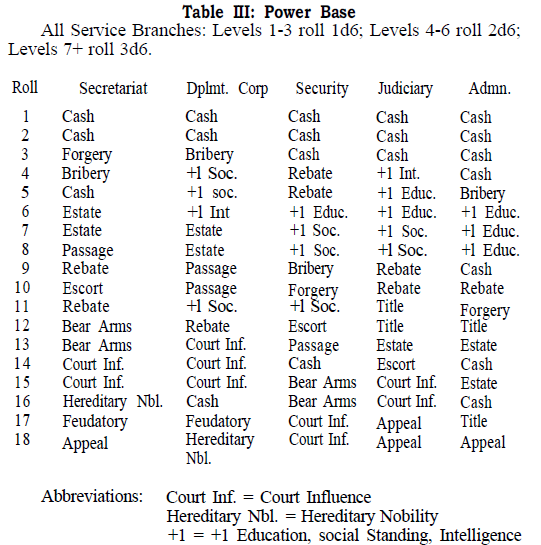
I’ve never played Traveler, so I can’t comment on the utility of this article about diplomats in the Traveler Universe. I can, however, draw attention to this table, which may prove useful to people:

I’m sure somebody can adapt this to their game, when trying to figure out an NPC’s s power base in some fantasy or sci-fi city.

NINE | DRUIDS

William Fawcett has a long article on “The Druid in Fact and Fantasy”. A tough subject, because so little is known, or at this point, can be known. I’m not going to dwell on the historical bits in the article, but I did like this:

“DECLARATION OF PEACE
A new Druidic ability

Although the Druid, due to his involvement with life, is unable to turn undead, his role of the peacemaker gives him a similar ability with most humanoids. Before or during any armed combat if he has not struck any blow, a Druid has the ability to make a Declaration of Peace. This declaration has a 10% plus 5% per level (15% 1st level, 20% 2nd, etc.) chance of causing all armed combat to cease for two rounds per level of the Druid. This does not affect magical combat in any way, nor will it stop a humanoid who is in combat with any non-humanoid opponent. Once the combat is stopped, any non-combat activities may take place such as cures, running away (and chasing), blesses, magic of any form, or even trying to talk out the dispute.

After peace has been successfully Declared, combat will resume when the effect wears off (roll initiatives), or at any time earlier if anyone who is under the restraint of the Declaration is physically harmed in any way. This could be caused by an outside party or even by magic, which is not restrained by the Declaration. A fireball going off tends to destroy even a temporary mood of reconciliation. Once a Druid strikes a blow or causes direct harm in any way to a member of a party of humanoids, he permanently loses his ability to include any member of that party in a Declaration of Peace. The Declaration of Peace affects all those within the sound of the Druid’s voice, a 50’ radius which may be modified by circumstances.”

He also has quite a few magic cauldrons and some thoughts on herbs. Good read overall.

TEN | MIRTH

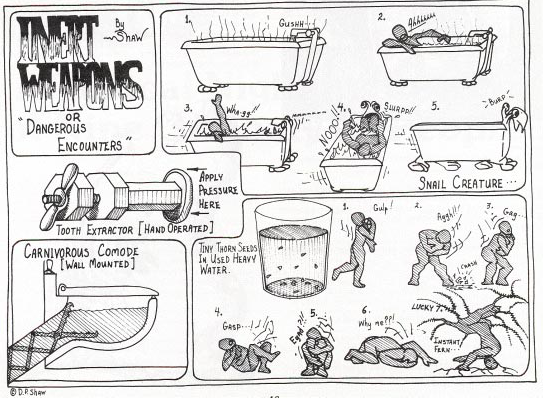
Well, it’s funny to DM’s

ELEVEN | THE FELL PASS

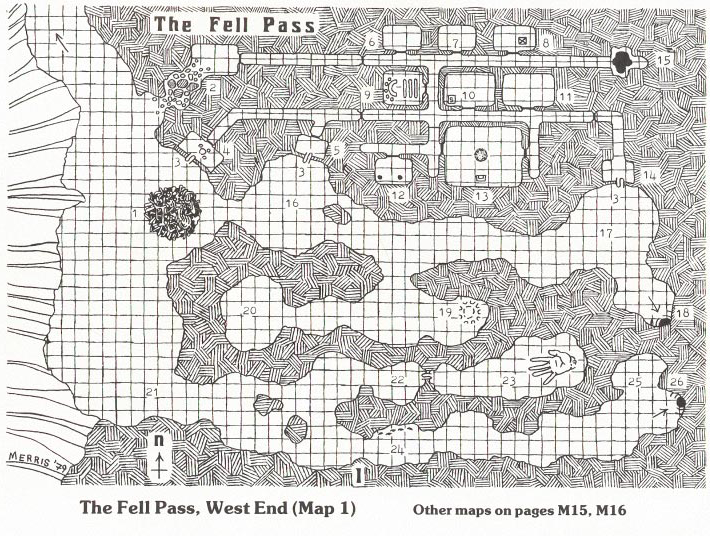
An adventure in this issue – “The Fell Pass” by Karl Merris!

Check out the map:

That hatching seems reminiscent! A also hereby challenge Dyson Logos to include more giant, disembodied hands on his very excellent maps.

The adventure takes place in geothermally heated caverns, and includes cave bears, ogres, a spidersilk snare, gray ooze, manticores, griffons, shadows, trolls, pit vipers, Vlog the Ogre …

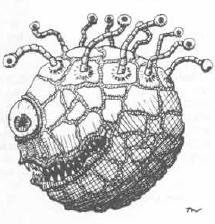
… and Xorddanx the Beholder:

I love the heck out of that art, which is by Merris himself!

I did some searching, and I’m pretty sure I’ve found him online. He appears to be a Brony now, and might have no interest left in D&D, but if I can commission a piece of fantasy art from him, I’ll let you know …

FINAL SHOT

The Blowhard

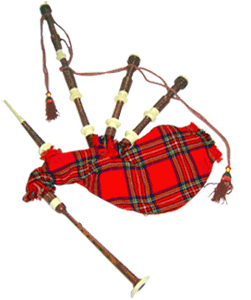
What happens when you mix one of these …

With one of these …

THE PIPER
Large Aberration; Chaotic (CE); Super Intelligence; Solitary

Hit Dice: 9
Armor Class: 18
Attacks: Bite (2d6) and one blow tube (see below)
Movement: Fly 30
Saves: F10 R11 W6
XP: 900 (CL 10)

Pipers look like great bloated sacks of flesh, bristling with eight blow tubes and possessed of three sinister eyes circling a gaping maw filled with sharp teeth. The monster is little more than a stomach and brain (and an evil brain at that). It haunts deep caverns and shadowy dimensions, preying on adventurers and other monsters. Pipers levitate naturally, and move by flight. They can speak (some might detect a Scottish brogue), and can communicate telepathically with other aberrations within 1 mile.

The piper has eight blow tubes sticking from its body that it uses to emit sounds. Some of these sounds are shrill and piercing, others are deep and resounding. All of them have magical effects when they are used, as follows:

1) Sound Burst – As the spell. Sounds like the blaring of a fog horn.

2) Sonic Ray – As the energy ray spell, using sonic energy. Sounds like a high pitched shriek.

3) Dancing – As irresistible dance spell. Sounds like an Irish jig.

4) Shatter – As the spell, except that it affects a 30′ radius area around the monster. Sounds like an opera singer hitting a super high note.

5) Silence – As the spell, except it affects a 30′ radius area around the monster. Sounds like … silence.

6) Confusion – As the spell, except it affects a 10′ radius area around the monster. Sounds like the screaming of a madman.

7) Blasphemy – As the spell. Sounds like the cackle of demons.

8) Discord – As the spell song of discord. Sounds like a cacophony of voices and instruments.

9) Hold – As the spell hold monster. Sounds like a quick blast of trumpets, followed by the trill of flutes while the affected creature remains held.

Special Qualities: Magic resistance 5%, immune to poison

Of course, you could also present the monster as something like this handsome fellow:

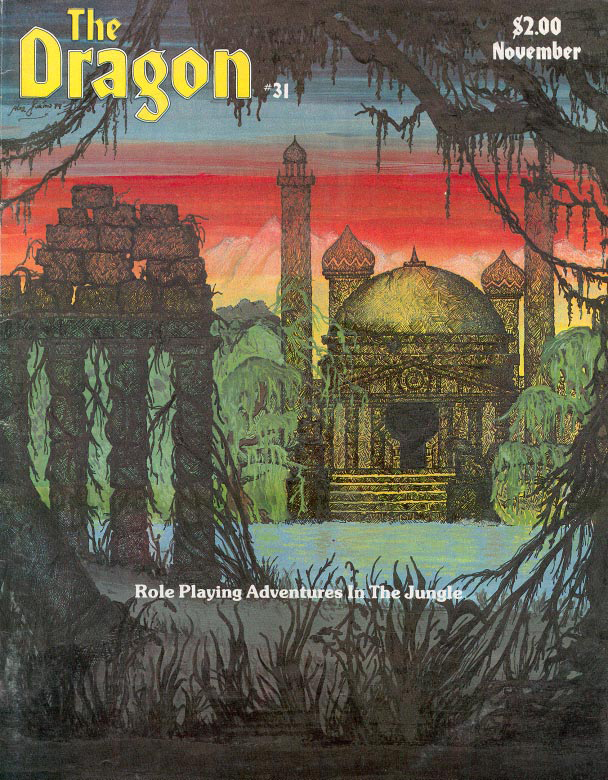
Dragon by Dragon – November 1979 (31)

November 1979

The Iran Hostage Crisis

Morning Edition premiers on NPR

The last cargo of phosphate shipped from Banaba Island

Obviously, they were troubled times for the world.

But take heart, gentle reader, for the game wizards blessed our eyeballs and brains with The Dragon #31.

I’m going to start doing these reviews a little different (since they take about 3 or 4 hours otherwise), and focus on the Top 10 Cool Things in each issue. They might be articles, they might be ads.

COOL THING NUMBER ONE: RAL PARTHA

Click for the larger version. Those are some pretty slick landsknechts (and such). I love the idea of the Thirty Years War as a campaign setting (even wrote about it), and these would make great miniatures for it.

Side note – when I looked up those colorful plastic robots on Amazon that I showed in my Manbot Warriors post, I found a few other great sets that I remember from my childhood. Now I want to write a little mini-game for all of them – cowboys and indians, plastic army men, Romans, plastic knights, firemen, etc. Just need to get the rules for Manbots right, and then I can expand.

COOL THING NUMBER TWO: JOHN ERIC HOLMES

If you love the old game, you probably love (or at least like) Mr. Holmes. This issue has an excerpt from a novel he was writing called Trollshead. Here’s the first paragraph:

“The campfire cast flickering shadows into the surrounding trees and across the face of the lean man squatting opposite. He wore an iron cap with a leather lining which cast a shadow over his thick brows. A ragged scar ran from the comer of his left eye down the cheek to vanish in the folds of a woolen tunic at his neck. A tough customer, Boinger thought to himself.”
Boinger? Well, I don’t know if the novel was ever finished – couldn’t find it on Amazon.com. Here’s another taste:

“’I think we can take them,’ said the halfling confidently. ‘Four half-orcs, old scar face, and that damned troll.'”

I like that halfling’s moxie. He doesn’t look so confident in the accompanying art by Chris Holmes.

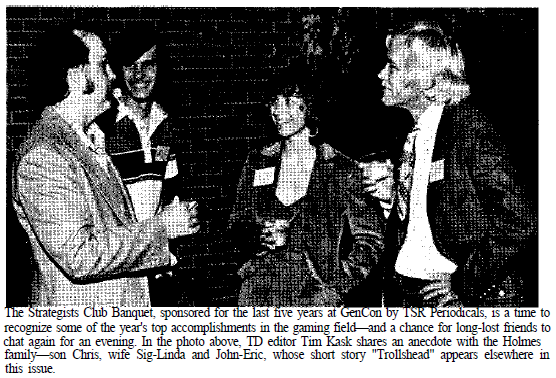
Bonus – Later in the issue they cover the 5th annual Strategists Club Banquet and Awards, which features a picture of Tim Kask talking with the Holmes family, son Chris, wife Sig-Linda and John-Eric himself.

Sometimes, I miss the 1970’s. But only sometimes, and only a little.

COOL THING NUMBER THREE: STRAIGHT TALK

In his article on using jungles in D&D, Tim Kask says it like it is:

“Traditional accounts of the jungle, from Bomba the Jungle Boy to Jungle Jim to Tarzan, have always depicted the jungle as a place of peril—but there has always been justification for jungle adventures. We’ll leave aside the philanthropic wanderings of Livingstone and Schweitzer and look at jungles from a more typical D&D viewpoint: greed.”

The article is pretty long, and covers jungles in Asia, Africa and South America. A few takeaways:

1 – He notes that any rules for wilderness exploration will do, but he likes Source of the Nile. This reminds me of the use of Outdoor Survival in old D&D games. Does this happen much anymore? Using another game to fill in the gaps. I’ve read so much about Source of the Nile in these old Dragons that I kinda want to buy the game. Doesn’t appear to be in print anymore, so I guess I need to look around.

2 – Rain forest plant growth is so quick that a trail blazed through it disappears in a few days (I’d go 1d4+1 days, personally).

3 – “With the restrictions placed on poison within D&D and AD&D, the DM may wish to eliminate some or all of the natural poisons found in the jungle.”Sorry jungle, but you’re just to poisonous for the rules as written. We’re going to have to make some changes.

4 – “The Jivaro, known for their practice of shrinking heads, are so surrounded by myth and misinformation that it is hard to distinguish fact from fancy without serious study. It can be safely stated that they were fierce and deadly foes.”

5 – “In the tropical rain forest jungles, the humidity never falls below 85 or 90 percent. This high moisture rots and mildews cloth and leather, unless they are assiduously treated to prevent it All metals will oxidize; armor will rust and swords and daggers will lose their edges. The humidity affects people by lowering resistance as a result of overworking the sweat glands, thereby causing wounds to heal at a greatly retarded rate, if at all.” So, rules wise – maybe force item saving throws once a week if things are not cared for, and reduce non-magical healing to 2 hit points (or hit points per level) every three days.

6 – Typical weapons of jungle cultures are blowguns (with poison darts), spear, club, throwing knives (treat as hand axes, maybe), assegai (treat as short swords).

7 – Kask writes a whole bit on how the presence of a 25th level magic-user might affect a local jungle. It includes using stone shape to make a hill into a fortified abode, permanently charming a panther and permanently enlarging it to use as a guard beast, attracting a spider monkey with find familiar, and then impressing the locals with his magic and being worshiped by them as a jungle god. The tribe that follows him flourishes, he starts experimenting with the local flora and fauna, and then the last experiment goes to far – instant ruined jungle city for adventurers to loot. I like the ways this guy thinks!

COOL THING NUMBER FOUR: WHAT THE?

Lou Zocchi had a ventriloquist act. ‘Nuff said.

COOL THING NUMBER FIVE: MINI-GAMES

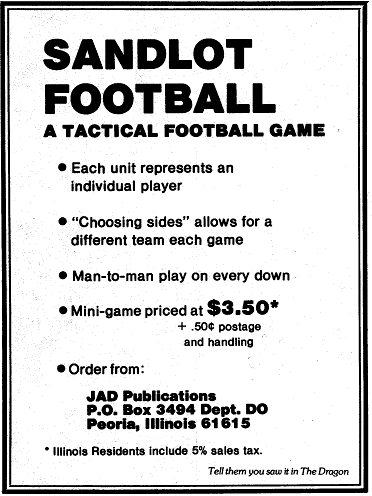
The rules aren’t in this issue, just an add, but this sounds cool:

Also makes we want to write a game for these guys:

And, surprise surprise – it’s on BoardgameGeek.com.

Check it out

COOL THING NUMBER SIX: LOU SCHEIMER AS A MUSE

From Kenneth W. Burke’s article “Will Jason Destroy The Dragonship? Stay Tuned …”

“The following Alpha Omega variant has been derived from the “Victory of Star Command’ episode of the Jason of Star Command television mini-series. To play it, you need one or two Alpha Omega games.”

You might be asking yourself, “What is Jason of Star Command?”

Now you’re asking yourself, “Why, God? Why?”

James Doohan was a regular in other episodes – God bless him.

COOL THING NUMBER SEVEN: RANDOM TABLES

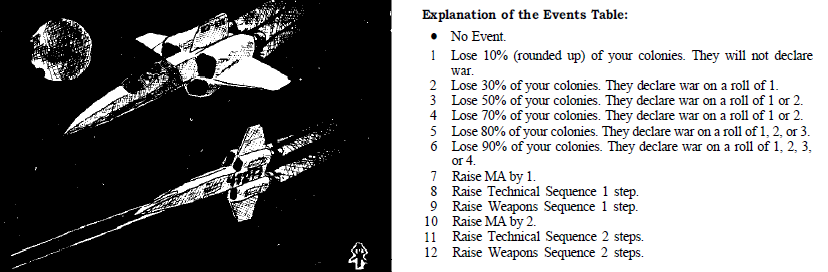
Here’s a new table for STELLAR CONQUEST that just has to be useful to somebody:

I don’t know what MA stands for, but I think it has something to do with movement.

COOL THING NUMBER EIGHT: SIZE CHARTS

In the Fantasysmith article they ask “How tall is a giant?” What I liked in the article was the two drawings comparing fantasy folk:

Elves dressed up as Peter Pan is so outside the mainstream now, that I think it rocks on toast.

Check out the giants:

You’ll perhaps note that it looks as though the storm giant has just finished beating the crap out of the rest of them.

COOL THING NUMBER EIGHT: JAPANESE ARMOR

Michael Kluever comes across with an article about the armor of the Far East. The article covers the armor of China, Tibet, Korea, Mongolia, and Japan. All text, but it does a nice job of covering the basics. Here are the basics:

China: Padded, ring, scale and brigandine (studded leather); mail and plate rarely utilized; paper armor was used in the Tang Period, especially in Southern China – 10 to 15 thicknesses was adequate to stop an arrow or musket ball. Shields were often the only form of protection for foot soldiers; rhino hide was prized for making shields.

Mongolia: Horse armor (barding) of leather scales

Korea: Like the Chinese, but lower quality materials and the helms were black laquered

Tibet: Lacquered hide armor in red and black, with engravings, in the form of a long coat – awesome. Barding was leather.

Japan: Lamellar armor (banded mail in AD&D, more or less), with small hand shields (Te-date)

COOL THING NUMBER NINE: OLD SCHOOL PLAYERS

From Jean Wells’ “Sage Advice” column:

“Question: We have a group of players here who insist that they can ride on a mule in a 10-foot-wide and 10-foot-high corridor and shoot arrows from longbows. Now, there are two characters who say they ride side by side and do this over the objections of the rest of the party members. I think this is wrong. Am I right?”

Right or wrong, I like the cut of those players’ collective jibs. I solemnly swear that I am going to commission this as a piece of art this weekend.

Also – Jean Wells was trying to write an article about female gamers and they put in this ad:

COOL THING NUMBER TEN: THE JUNGLE HYDRA

You have to love this monster from an unknown author – not a hydra in the “guarding the Golden Fleece” since, but more in the giant version of the microscopic hydra sense. It’s called the Ukuyatangi, and it looks like a blob with tentacles. It sits on a stump in the jungle and spreads the tentacles into the rank undergrowth to blend in. Due to the camouflage, there is a 90% chance for adventurers walking through the area to touch a tentacle, which then makes a free grapple attack. The monster consumes one man-sized creature a day, and regurgitates indigestible bits, which litter its clearing. After it’s full, it just constricts people to death and leaves them to rot. Reptilian in nature, the monster is susceptible to cold, going dormant when under 50-degrees F (or 10-degrees C).

Ukuyatangi: HD 7 to 9; AC 5; MV 1/4″, ATK 2 tentacles per target, up to 4 per round (2d4 + constrict); Special – swallow whole; SZ Large (6-10′ tall, tentacles 20-40′ long)

SPECIAL BONUS COOL: WORMY