Scientific Items for Blood and Treasure

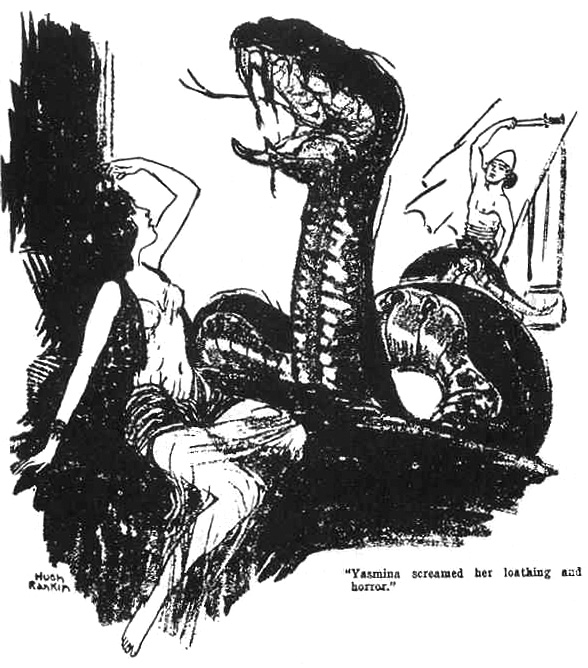
It’s been too long since my last post, but I’ve been pretty busy editing Blood & Treasure Second Edition. While the second edition is mostly about fixing errors and streamlining rules, I also decided to add a little extra to the game to make it more than just a revision. What I came up with was a few scientific items to spice up dungeon treasures. The items are, of course, optional for those TKs who do appreciate science fantasy.

Here’s a little sneak peek at the items.

Scientific Items

Some TK’s may wish to mingle some science (or science-fantasy, really) into their game. Perhaps their campaign is set long after a great war that left the world in a primitive state, and thus powerful scientific artifacts are hidden in ruins. On the other hand, it could be a “sword & planet” or planetary romance campaign, not unlike the world of Barsoom in Edgar Rice Burrough’s John Carter of Mars series of books, which mingles objects of super science alongside swords and armor.
Whatever the reason, the following tables can be used to roll random scientific treasures to include in your dungeon ruins.

d%         Science Value01-12     Power crystals (1d6)
13-18     Bionics
19-21     Blaster
22-23     Brain implant
24-29     Chronometer
30-34     Cubitron
35-37     Electro-whip
38-41     Exoskeleton
42-44     Flying discs
45-47     Force belt
48-50     Holo-projector
51-58     Infrared goggles
60-61     Jet belt
62-63     Laser sword
64-68     Mutagen capsule
69          Preservation collar
70-75     Ray gun
76-78     Shock gloves
79-83     Sonic pick
84-89     Spacesuit
90-92     Throwing disc
93-97     Tri-scanner
98-00     Vibro-dagger

The items will require a flow chart to figure out.
Here are a couple descriptions:

Bionics: Bionics are scientific items that can be attached to living bodies, improving them in various ways. The table below determines what bionic part was found:

d6 Bionic
1. Arm—left
2. Arm—right
3. Eye
4. Leg—left
5. Leg—right
6. Pincer

A bionic part can either be held up to a freshly severed stump, in which case it attaches itself (and stops the bleeding), or it can be opened and then sealed over the body part. In this latter case, the bionic item soon destroys the part it was fastened over (a painful process) and ruins it for future use.

Bionic items are not powered by power crystals. Rather, they integrate themselves into one’s own body, and power themselves biologically. Each bionic implant a character has “drains” one point of constitution while it is still implanted. When removed, the drained point of constitution is restored (though the body part is not).

Arm: Increase strength by +1; if both arms are bionic, unarmed damage is 1d4

Eye: Darkvision to 60’, find secret doors on roll of 1 to 4 on 1d6

Leg: Increase speed by +10 feet per round; leap 15 feet forward and 5 feet backward or straight up

Pincer: Gain melee attack for 1d6+1 damage; opponents suffer -2 penalty to save vs. grapple attacks

Skullcap: Increase intelligence by +2

Blaster: A blaster is a large device that fits over one’s hand. It is powered by one’s life force rather than a power crystal. Each time it is used, the user must pass a saving throw or suffer 1 point of constitution drain. This drain cannot be healed until the device is removed, which requires a character to roll d% under her combined intelligence and wisdom scores.

While attached to a character, the blaster can send out a laser blast (120’ line, ignores half of armor’s armor bonus, deals 3d6 fire damage) or a sonic blast (60’ cone, 2d6 sonic damage, save vs. deafness for 1 hour, crystal and glass items must save or be shattered).

When a character’s constitution falls below 5, he becomes Chaotic. If constitution is reduced to 0, the user becomes a mindless zombie and the blaster falls from their hand.

Flying Discs: These 2-ft. diameter metal discs can be adhered to the feet and provide the ability to levitate up to 60 feet off the ground, or fly at a speed of 60 feet per round. They consume 1 charge from their power crystals per 10 minutes of use.

Laser Sword: These swords appear to be no more than a pommel until activated. They drain 1 charge from their power crystal per minute of use. Laser swords give off light as a torch and ignore half of non-magic armor’s armor bonus. Laser swords deal 1d10 damage.

Power Crystal: These small, luminous crystals provide power for scientific items. Each crystal holds 10 charges when it is found (unless it is found in an object that was being used, in which case it has 1d10 charges).

Sonic Pick: This 8” long metal wand can be used to find secret doors, open locks and find and remove traps. The user must roll 1d20 under their intelligence score to successfully use the device. Each use uses 1 charge.

And if Brutorz Bill is reading this – yeah, the mutagen capsules come with a little random mutation table.

Courtly Love for Paladins

Here’s another notion I came up with for Blood & Treasure Second Edition that I decided not to use in the rules, as it seemed to be just one more thing to stack on top of paladins. Although the ability is designed for paladins, it could be extended to any Lawful Good character if a referee wished. It is probably most useful in a chivalric campaign.

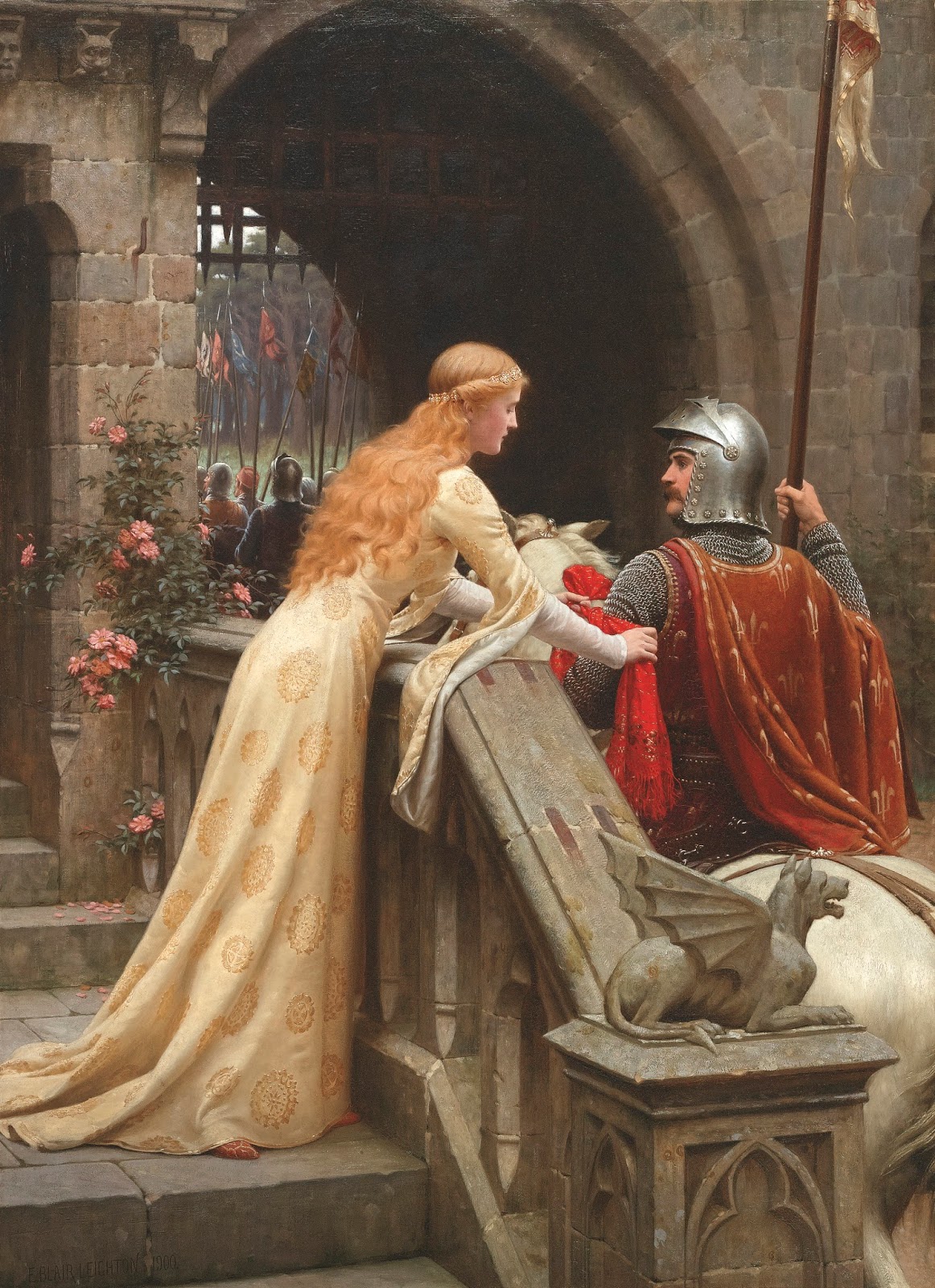
The ability is, of course, inspired by Lancelot and Guinevere.

Courtly Love

Before reaching 5th level, a paladin may select a charming man or woman as their object of courtly love. The chosen must have a Charisma score of 13 or higher, and must be a member of the aristocracy, nobility or royalty. They may be married, and must not be Chaotic. The paladin holds them up as an ideal and does heroic deeds in their name and for their favor. The paladin may not deny them requests, so long as they do not violate his alignment and code of conduct, though in disobeying the object of courtly love becomes displeased, and the paladin suffers a -1 penalty to attack and to all saving throws until they are again pleased. The paladin remains true to their courtly love forever – they may not “break up” with them without losing their paladin status.

When the paladin performs a heroic deed for their courtly love, there is a chance in 20 equal to the paladin’s level that their love is pleased and grants them a token (a scarf, a pin, a lock of hair, etc.) While in possession of this love token, the paladin may invoke the the following effects three times: Add his love’s Charisma bonus to an attack roll, a damage roll or a saving throw.

When so pleased by their paladin, there is a percentage chance equal to the paladin’s Charisma score that the courtly love is overcome by emotion and attempts to seduce the paladin into a true romance. The paladin may not give in to this temptation without breaking his code and losing his paladin status. That being said, to refuse makes the courtly love displeased (see above). A Lawful love will not press the matter, but may suffer as per a geas if their love is not returned. A Neutral love will press the matter, forcing the paladin to pass a saving throw to resist the temptation. The TK may add the paladin’s Wisdom bonus to the saving throw, but must subtract his love’s Charisma bonus from the roll as well.

Uh oh – he better not try to turn undead any time soon …


Don’t Lose Your Barbaric Edge

This is a half-formed notion that came to me last night while working on Blood & Treasure Second Edition. It’s not in that book, but I thought somebody might find it useful.

The idea of a “barbaric edge” comes from good old Robert E. Howard, who posited the notion that barbarians were in many ways superior to members of civilization, whether they be decadent nobles or downtrodden peasants. Barbarians in Howard’s fiction are usually a cut above non-barbarians.

The Edge

In games, the barbaric edge allows you to treat one of the following ability scores – Strength, Dexterity, Constitution or Wisdom – as though it were an 18. Each morning, a person with the barbaric edge can decide which ability they will treat this way. Ability damage affects the temporary score, and the real score if the damage persists and the barbarian chooses to boost a different ability score from the one that was damaged.

Note that druids who boost Wisdom do gain extra spells for high Wisdom, but clerics do not unless they worship something wild and primordial. One might permit it for a cleric of Thor, for example, but not a cleric of Minerva.

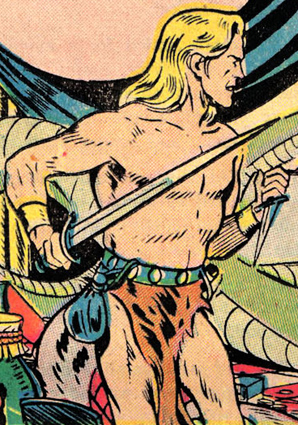
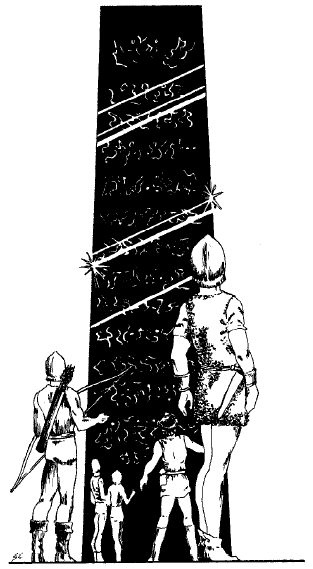
Example: Crom the Barbarian (pictured above) wakes up one morning and stretches his iron sinews. He normally has a strength score of 13 (a +1 bonus). Today, he’ll increase his bonus (but not his actual strength score) to +2. Tomorrow he might be feeling especially cat-like, and improve his +0 dexterity modifier to +1.

Gaining the Edge

How does one obtain a barbaric edge? By living rough in the wilderness and eschewing the soft pleasures of civilization. This means that the barbaric edge is open to any class, provided they do the following:

1) Always sleep outside in the wilderness; in a pinch, sleeping in an alley or field will do. This means no beds, no pillows – no more than an animal pelt to protect you from the elements.

2) Low retention of wealth; you can keep 10% of your found treasure to spend on equipment and gear (maybe more if you use a system that requires paying for training to level up), giving the rest away. Treasure is there to be won, not enjoyed – think of it as catch-and-release. Treasure not kept must either be discarded as though it were trash, given to others (who may not spend it on you) with a hearty sniff of contempt, or spent in a tavern on booze and sex (i.e. drinks on the house, and you must drink until you collapse or get in a rip-roaring fight).

3) No fancy clothes or armor; you retain the barbarian edge by wearing no more than leather armor or maybe a chainmail shirt if they are used in the campaign. You cannot wear silks and satin – really just a loincloth and sandals or fur boots will do when you’re not fighting.

4) A lack of trust for civilization and civilized people. A barbarian can adventure with civilized men and women, but they must be kept at an emotional distance, and the barbarian must sneer at and criticize their soft living and decadent morality. This is primarily done through role playing.

5) A barbarian’s food must come from his own hunting, gathering or fishing rather than from “iron rations” and magic. If this means going hungry, so be it. The barbarian may indulge in a tavern after an adventure, but only once and only in terms of a tavern crawl as in (2) above.

Losing the Edge

Breaking any of these rules means the barbaric edge is lost. No ability boosts. It can only be regained by living by the above rules for a full month of game time (or perhaps for two or three game sessions if that’s easier to calculate). Only after that time spent living wild does the barbarian shake off the excesses of civilization and regain his barbaric edge.

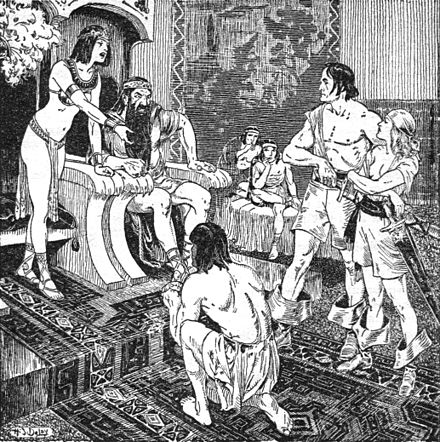
Don’t trust them Conan, they use rugs!


Dragon by Dragon – May 1981 (49)

May of 1981 saw me turn 9. I hadn’t heard of D&D back then (and wouldn’t for another 3 years), but if I had heard of D&D, and subscribed to Dragon Magazine, this is what would have shown up in my mailbox that month.

Pretty cool cover, right? There’s more inside, in a 12-page section dedicated to the work of Tim Hildebrandt.

Of course there’s more than just my Hildebrandt in this issue … let’s check it out.

First up is a new ad by Ral Partha, this time featuring their new line-up of Adventurers miniatures. I got curious this time and decided to look up Ral Partha’s address – 5938 Carthage Ct, Cincinnati OH.

It came up with this impressive edifice:

I’ll show off a few more old RPG addresses in this post if I get a chance.

Now that we’ve looked at Ral Partha’s old digs, let’s get to the fun of complaining readers, in this case William G. Welsh, on the archer class in last issue:

“Second — “Kobolds, goblins, dwarves, gnomes and halflings cannot become archers.” In the last chapter of the third book of the Lord of the Rings trilogy, there are no less than three incidents where the effectiveness of hobbit archers is demonstrated. Also, refer to the AD&D Monster Manual, p. 50, under halflings, under special attacks, note “+3 with bow or sling.”

This stuff kills me. The answer from the editor was:

“None of the ideas presented in articles in DRAGON magazine are official rule changes or additions, unless the article specifically says so (and there haven’t been very many of those). The people who write articles that we publish aren’t trying to get everyone to play the way they do, and we certainly don’t hold that opinion ourselves. As is the case with many of the game rules themselves, the articles in DRAGON magazine are suggestions, ideas and alternatives.”

It amazes me when that has to be said, but if comment sections on the internet have done anything, it’s to prove that things like that still need to be said. Could various school systems around the globe please spend a few minutes explaining to people what “opinion” means?

The meat and drink of this issue, other than the special art section, is about tournaments. No, not knights trying to poke each other with lances and Robin Hood splitting an arrow, but D&D tournaments. If I’m honest … I have no interest at all in them, but I’ll try to give them a quick review.

The first article discusses fairness in scoring tournaments, giving a long list of actions that should go into scoring points, and explaining that DM’s need to make sure players know how they’ll be scored. Sounds logical to me.

The next bit discusses improving on the Slave Pits tournament adventure, followed by Mentzer’s reply that “It isn’t that easy”. I can remember getting the Slave Pits module as a kid (I guess about 4 years after this issue was published) and being confused about the whole tournament concept – how you didn’t use the full map, and scored things. As a kid, I wasn’t sure if I was supposed to care about this stuff or not.

Strangely enough, the article complaining about the adventure is really complaining about the size of the teams in the AD&D Open, specifically that nine-person teams are too large. Mentzer explains the problem – not enough Dungeon Masters at the tournaments. Can’t argue with that.

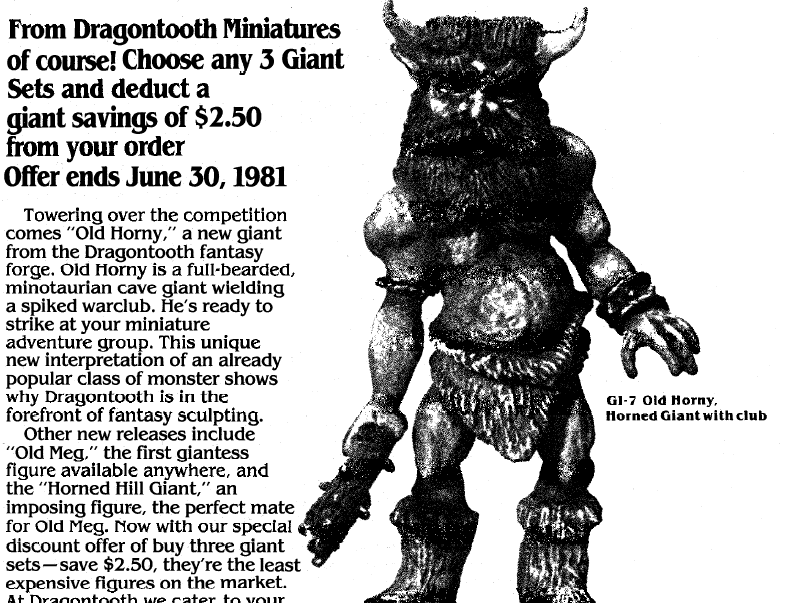
Dig this:

Old Horny indeed. Let’s hope those horns on his head were the source of his nickname. And here, keeping with the theme of this post, is Dragontooth Miniatures old location:

Or is it? A Hilton? I’m thinking perhaps the old building was torn down and replaced. That, or Conrad Hilton had a secret hobby.

The next few articles are a bit too timely to make sense to talk about here – GenCon is growing, , GenCon East fills the Origins ‘hole’ (I’m sure that’s not as filthy as it sounds) and there are nine ways to win the painting contest at GenCon.

Okay, enough of that convention stuff. Next up: Samurai!

This is an interesting take on the character class. The editor’s note mentions that the author, Anthony Salva, holds a first degree black belt in Hapkido. The class that follows is heavily influenced by this, and it’s really a bit more like an alternate monk than the samurai most people would expect.

That said, it’s a pretty groovy class. It’s tough to make it in – you need Str 15, Dex 17 and Int 15 to qualify, but the class is open to gnomes, halflings, elves, half-elves and humans.

This version of the samurai cannot use armor, but his AC improved by 1 per 4 levels. They can use two-handed swords, short swords, bows and staffs, and a samurai of 4th level or higher can obtain his “personal weapons”, which are sacred to him. It mentions the weapons of honor – “Katana, Wakizashi and Nunchakos” are described later in the article.

Apparently Dragon Magazine got there first. Source

The samurai’s special abilities are as follows: Jump front kick (-3 to hit, 2d6 damage), judo throw, ceremony of fealty-weapons of honor (4th level; and here it mentions that katana do 1d12 or 1d10 damage, wakizashi 2d4 or 1d8 and nunchako 1d8 damage), sweep and double chop (5th level), crescent kick/side kick combination, back roundhouse kick, illusionist spell ability (8th level), “360” and downward kick, the slaying hand (10th level), flying side kick (requires movement, -3 to hit, 1d20 damage) and a samurai who becomes a shogun (13th level) has a 25% chance to obtain 30 psionic power points. They go on a bit later to mention they can reduce falling damage, hide in shadows and move silently as a thief, and can dive and roll over obstacles.

This class would probably be a blast to play, especially as a gnome. I’ve often thought that the monk would make a pretty good “cartoon hero” class, and this version of the samurai has me thinking of Samurai Champloo and other anime samurai. If anyone has experience with this class, please drop a note down below and let us know how it went.

Merle Rasmussen now brings us a nice Top Secret article about special ammunition – armor-piercing, dumdum, gyrojet, duplex, etc. Lots of stats (and I mean lots with a capital “L”), but probably useful info for other games as well.

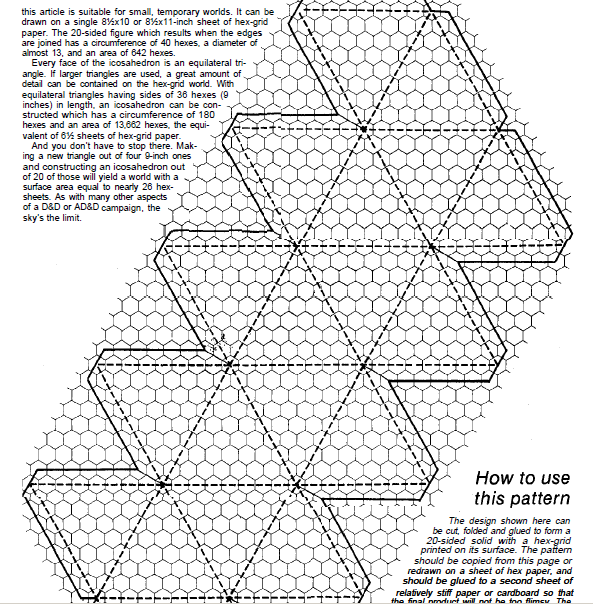
Karl Horak has an article called “Getting a world into shape”, which gets into different shapes for campaign worlds, as in cylinders, polygons, etc.If you want a campaign world in the shape of a 20-sided die, this is the article for you.

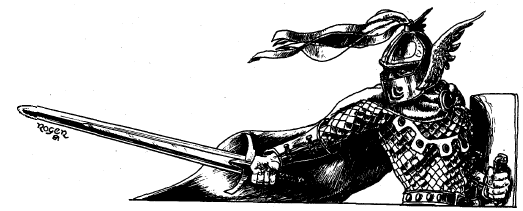
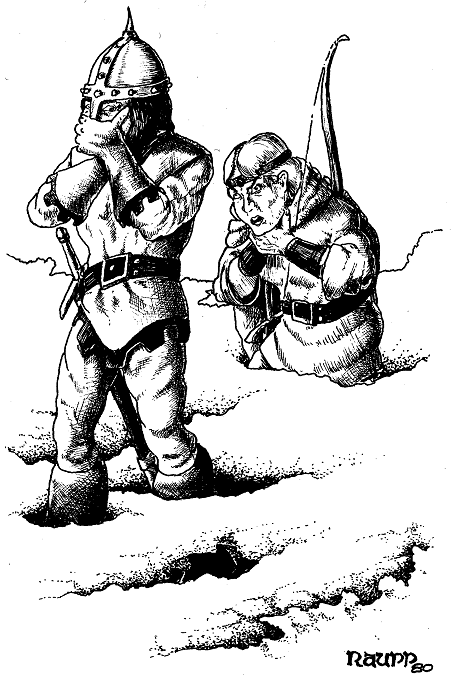
Giants in the Earth in this issue presents some Poul Anderson characters – Holder Carlsen (14th level paladin) and Hugi (5th level gnome fighter). The art by Roger Raupp is great:

He’s always fantastic with knights and warriors. The article also has stats for T. J. Morgan‘s Ellide (6th level fighter)

G. Arthur Rahman has an article on historical names – Anglo-Saxon, Byzantine, etc. Very useful then, less so now with the resources of the internet at one’s disposal.

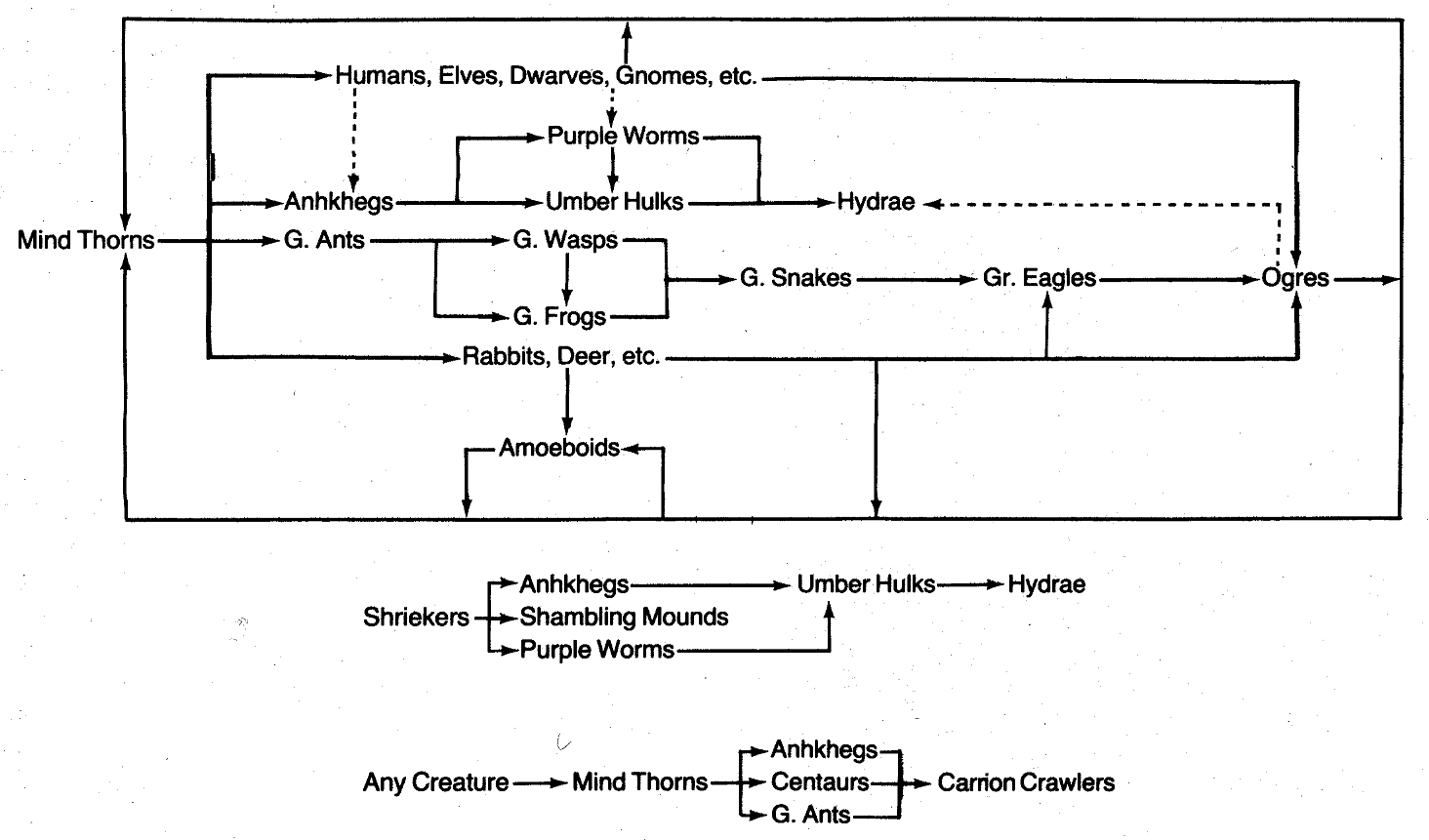
Jon Mattson‘s article “Monster mixing – AD&D creatures adapted to a C&S campaign” show that Dragon was not yet the house organ for TSR that it would become (though it always had more outside content than White Dwarf once it became GW’s house organ). While the article is quite useful for players of Chivalry & Sorcery, it also has an interesting piece at the end – a flowchart of AD&D monster predation:

And now you know.

Up next in the magazine is the section on Tim Hildebrandt‘s art. I’d post some images (aside from the cover above), but a Google search (or clicking on the artist’s name up above) will do you more good these days. Take a look – I think you’ll like what you see. I will post this quote from the interview with the artist:

“One thing leads to another thing leads to another thing and you start growing and growing. Things keep expanding, and the more I do myself, the more I see that there is to learn.”

Lots of wisdom in those words.

The Dragon’s Bestiary in this issue features the Loren Kruse’s Nogra (“a small creature with long, sharp claws which somewhat resembles a hairless lynx”). The basic stats for Blood & Treasure are below:

Nogra, Small Magical Beast: HD 2, AC 15, ATK 1 bite (1d4), MV 20′, SV F12 R11 W15, INT Low, AL Neutral (N), XP 200 (CL 3), Special-Body secretes a substance which absorbs all light (including into the infrared and ultraviolet spectrums), liquid is also a contact poison (save or blinded for 2d4 rounds), light sensitivity

Leonard Lakofka has a new class for this issue (which hopefully doesn’t do halflings wrong) called the Alchemist. Another old Dragon classic. It seems like such an obvious class for D&D, but it’s tricky. My version was essentially Dr. Jekyll, to give it a twist and make more than a guy who isn’t remotely as useful as a magic-user. Lakofka’s is, in fact, not an adventurer.

Lakofka’s alchemist has to have Str 9, Int 10, Wis 6, Dex 9, Con 14 and Cha 16 to qualify, and they must be human, elf or half-elf, with only the humans hitting the highest levels. They only earn XP by “plying their trade”, not adventuring. They can make pottery, blow glass, identify potions, manufacture poisons and manufacture magic potions. It’s a useful class, and could be adjusted to be an adventurer, but as a non-adventuring NPC I’m not sure why one needs to go to the trouble of having levels. It seems like a “novice-veteran-master” approach would work just as well, or even just “the alchemist can do what the DM to needs her do” concept. That being said, Lakofka always puts a lot of work into these things, and his alchemist is no different and thus is worth the read.

Gary Snyder now gets into the weeds on the issue of wishes and how to adjudicate them. This brings up a great point about fantasy gaming and gamers. I’ll often be watching some TV show or movie and think, “That plot element would never work in a game – the players would kill that guy in a heartbeat / or they would never touch that statue, ’cause statues are always trouble in a dungeon.” The idea of wishes probably seemed so simple when the game was first written, and then creative players got hold of the concept and made DM heads explode. Snyder gives ten rules to keep wishes in check which have largely been adopted into the game.

It’s followed up by a short article/story about wishing by Roger E. Moore.

Paul Montgomery Crabaugh has an artcle about travel and clothing in DragonQuest.

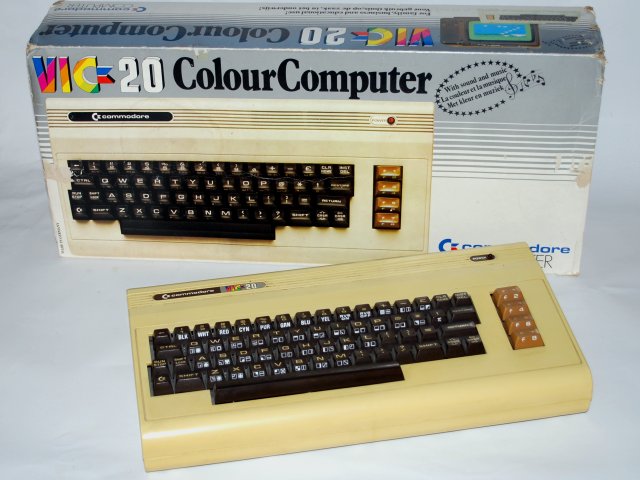
If you need a time keeper program in BASIC, Mark Herro has you covered in this month’s The Electric Eye. Blast from the past to see those IF … THEN statements and GOTO commands. I learned BASIC on a VIC-20, which is actually still sitting in my closet.

Side note – I love this Grenadier miniature …

Great sculpt

Side note II – A bit of Wormy

And now on to White Dwarf 25, the June/July 1981 issue. I’ll keep this one brief, and just cover the bases:

Lewis Pulsipher has the third part of the Introduction to D&D series, covering spellcasters. Great art in this one.

Trevor Graver has Optional Skill Acquisition for Travellers. This one ditches the random tables (which are pretty cool) for a skill point system. Control vs. Chaos, the eternal struggle in game design.

Roger Musson has a nice article on The Interesting Dungeon – worth the read.

Tony Chamberlain & Paul Skidmore have an interesting “clerical AD&D skirmish for a large number of players” called Lower Canon Court. This is another one that would probably be fun to play with a big group on Google+.

This issue has some clever magic items – the bowl of everlasting porridge, the bell of watchfulness – a notion on determining handedness in games by Lew Pulsipher (left-handed males 8%, females 4%), and Roger E. Moore has a bit on fake torture items.

Andy Slack has Vacc Suits in Traveller.
Dream Demon!

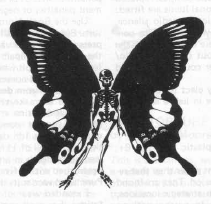
The Fiend Factory this issue is themed The Black Manse, and has stats for Dream Demons (which are really cool) by Phil Masters, the Incubus by Roger E. Moore, Brain Suckers by John R. Gordon and the Guardian by Simon Tilbrook. As always, the art is top notch. It’s a shame there was never a Fiend Folio II – so many great monsters were left behind.

Lewis Pulsipher‘s second article this issue is on “What Makes a Good AD&D Character Class”. I would answer – people want to play it and it doesn’t screw up the game. This is pretty much what he says, focusing especially on the class not being overpowering. His example of an overpowering class makes me actually want to create it – The Guardian class he posits can listen at doors, use x-ray vision, become ethereal and has a psionic boomerang defense that kills some mind flayers. I dig it.

And that’s that … Have fun on the internet!
A Duet of Spells

Since most of my time right now is devoted to editing, it’s been tough to produce new material for the blog. I guess I had the Bard of Avon buzzing in my ear this weekend, though, when I wrote these thought up these spells …

Star Crossed
Magic-User 3
30’ range
Permanent until removed

The magic-user causes two creatures within 30 feet to have their fates exchanged. The two creatures must be friends or allies of one another. The spell exchanges the ability score modifiers, attack bonus and saving throw values between the two creatures. The spell lasts until the two creatures make contact with one another while remove curse is cast on them.

Zounds
Cleric (Lawful) 2
30’ range
Lasts a number of rounds equal to the cleric’s level

One target within 30 feet has terrible, bleeding wounds opened up on its hands and feet. The pain is terrible, leaving the creature crippled (see Conditions) and imposing a -3 penalty to attack and perform tasks involving holding tools or using their hands (pick pocket, open lock, etc.).

For Lawful clerics, though, it also brings on an apotheosis, increasing their caster level by +2 and granting them a +1 bonus to save vs. magic for 24 hours.

I’ve been wanting to do something Shakespearean – perhaps this points the way.

Three Monsters Mild

I’m kinda sorta working on a little book called Monsters Mild, which will include 12 to 15 monsters that are not so much intended as foes to fight as they are to be things characters might meet and maybe even befriend. They are intended to be fantasy color. The first one showed up on Google+ a little while ago, and has been illustrated by the ever-wondrous Joel Priddy (blessed be his pen). The others will get their own illustrations somewhere along the line …

Man-Wort

Medium Plant

Hit Dice: 3
Armor Class: 16
Attacks: Fist (1d6)
Move: 20’
Saves: F12 R14 W14
Intelligence: Average
No. Appearing: 1 usually, but 1d6 in the wilderness
Alignment: Neutral
XP: 300 (CL 4)

Resistance to weapons, immune to poison, ESP 1/day

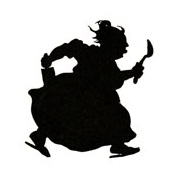
These monsters look like roughly humanoid-shaped turnips, with bushy green stalks on their head and beady black eyes and thick fingers and toes on their hands and feet. They can summon up herbs of any kind in their hands, three times per day, including poisons, medicinal herbs and cooking ingredients. They are somewhat slow-witted, though not stupid, and often take a liking to children and the elderly. Many appear before the hovels of abandoned elders and become their servants and caretakers. Man-worts do not speak (they have no mouths). They need to root themselves in soil for at least one hour per day to survive, and need as much water as human beings. They will fight when people they love are threatened.

Granny Woman

Medium Fey

Hit Dice: 1
Armor Class: 11
Attacks: Rolling pin (2d6)
Move: 20’
Saves: F15 R13 W12
Intelligence: High
No. Appearing: 1
Alignment: Lawful (CG or NG)
XP: 100 (CL 2)

Magic resistance 25%

A granny woman is a fey creature that appears as a very old – an impossibly old – woman with large, knowing eyes and withered hands that hide a powerful grip. Granny women live in the woods, near enough to settlements to be helpful, but not so near as to be annoyed by all the nonsense and going’s on. They usually live with a familiar in the form of large, furry cat. These cats are ill-tempered to folks who deserve it, but quite charming (if not a little bossy) to the good-at-heart. Acceptance by a granny woman’s cat means acceptance by a granny woman.

Granny women can use the following spells as inborn abilities: At will-animal messenger, calm animals, detect invisibility, detect magic, discern aura, pass without trace, speak with animals, speak with plants; 3/day-goodberry (baked into tarts), magic stone, sleep; 1/day-cause fear, daze monster, geas/quest, mending, smoke image (from her own pipe only), summon nature’s ally IV.

There is a 1 in 12 chance that a granny woman lives with a man-wort (q.v.), and a 1 in 6 chance they live with an orphaned child they are bringing up. If threatened, they have only to scream or whistle and one of the following creatures appears to aid them:

1. Grey Render (who likes its head to be scratched)
2. 1d4+1 brownies (who appreciate good cooking)
3. 1d6 wood elf, gnome or halfling warriors (who need their socks darned)
4. 1d4+2 cooshee (who will hang around for an ear scritch and soup bone)
5. A curtal friar (cleric or druid, 1d4+2 for level, old friend of the granny woman)
6. A ranger and 1d4 outlaws (ranger level 1d4; he and his men look after the old girl when they’re not being chased by the sheriff)

A granny woman will never turn away folk in need unless they are thoroughly wicked, and even then she will help but also place a geas on them with her touch that forces them to perform three acts of pure goodness in a fortnight.

Goop

Small Ooze

Hit Dice: 0 (1d4 hp)
Armor Class: 14
Attacks: Slam (1d3 + constrict)
Move: 20’ (Climb 20′)
Saves: F17 R16 W17
Intelligence: Low
No. Appearing: 1d3
XP: 50 (CL 1)

Resistance to weapons, immune to acid, surprise (1-4 on 1d6)

Goops are small oozes with highly variable colors (and sometimes swirls of color). They lurk around corners and creep up on people, crawling onto them when they aren’t looking. Goops are terribly insecure, and desire the warmth of humanoid contact. When they are clinging to people, they give off a telepathic purr that only the person they are touching can hear. The purr is calming (+1 bonus to save vs. emotional manipulation and fear).

Unfortunately, goops are extremely sticky (takes a combined strength of 28 to remove them, and there’s a 50% chance anyone involved gets the goop re-stuck on them), and they can ruin armor, clothing and weapons with the mild acid they secrete when frustrated or afraid (item saving throw at +2 for metal items).

Each goop has one important, inborn piece of knowledge. In any “sticky situation” the adventurers find themselves in, there is a 1% chance that goop has the answer they are looking for, and will release it to the adventurer with which it has bonded.

Dragon by Dragon – February 1981 (46)

Happy Easter boys and girls. I hope you have a good one – family, friends, fun and a little time for relaxation and meditation. Hopefully, you also have some time to read this review of Dragon 46 (and White Dwarf 23).

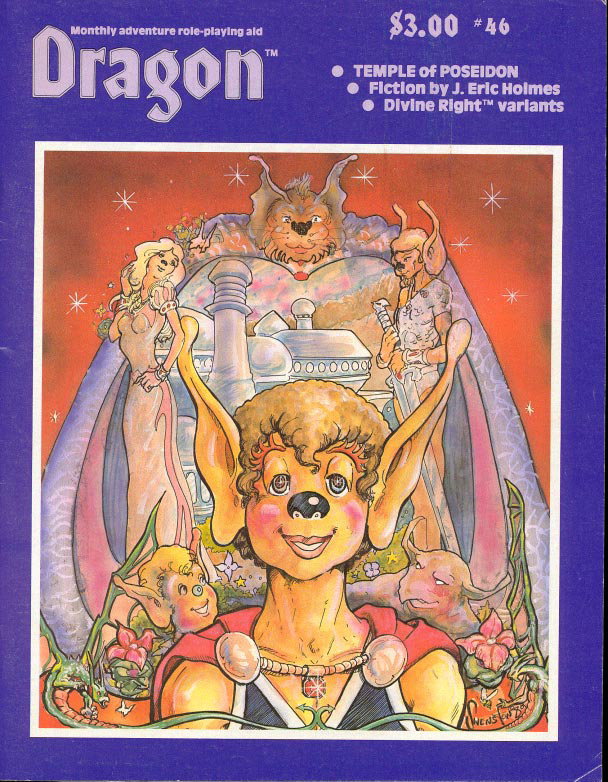
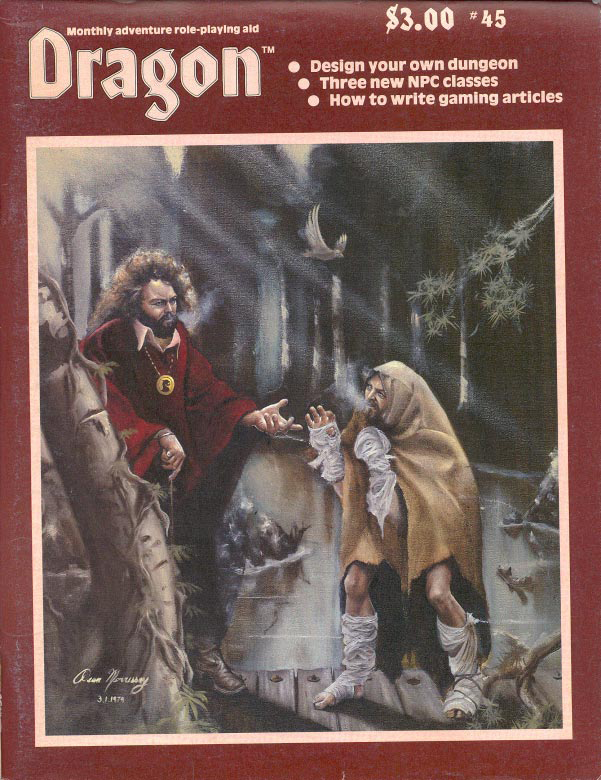
I’ll level with you here. The first time I saw this cover, I didn’t quite know what to make of it. There are a few other “cute” Dragon covers, but this one sorta took the cake. It’s not a bad cover, though, and actually relates to a new comic in this issue – Pinsom by Steve Swenston. It’s a style of fantasy I always digged, and one which I wish had had more coverage in Dragon. Check the end of the article for another glimpse of Swenston’s work.

Moving on …

First up – an advertisement (no, not for anything I did)

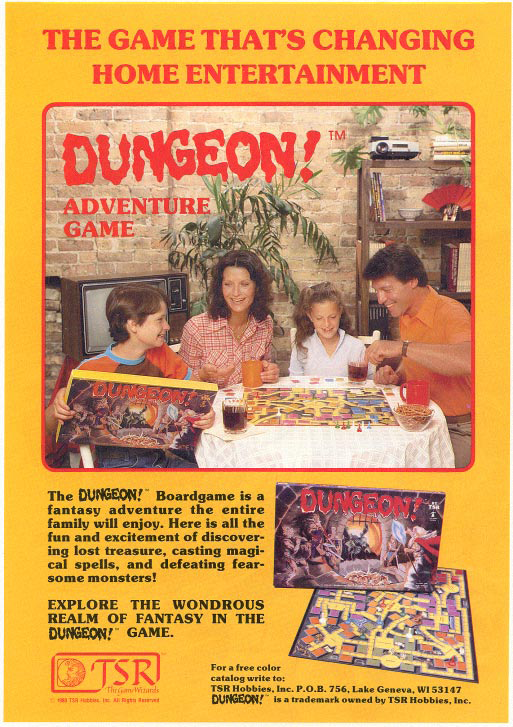
Yes, for those of us who lived through the transition, there was home entertainment BEFORE Dungeon!, and home entertainment AFTER Dungeon!. You young whippersnappers have no idea.

In all seriousness, if you’ve never played the game, I highly recommend it (at least, the old version that I used to have – I don’t know if they done any crappy re-imaginings lately). It just occurred to me that it might be cool to combine Dungeon! with Talisman – at least, with the “classes” in Talisman.

The first bit of content in this issue is a short story by J. Eric Holmes, “The Sorcerer’s Jewel” – so always worth a read. Great art by Roslof to go with it! Here’s a sample (of art and text) …

“When Tarkan departed from The Green Dragon, only minutes later, Zereth pushed Boinger off the end of the wooden bench on which they both sat. “Follow him,” he ordered, “and be secretive about it.” It was midnight when the little thief returned. His elven companion had left the tavern common room and gone upstairs to the rented room the two shared, but when Boinger roused him he dressed and came down. The noisy crowd at the bar and fire served their secret purpose better than whispering in their room, where ears might be pressed to the adjoining wall.”

That image to the right just screams D&D to me, and the story does as well. I’ll admit I’m not much of a reader of the fiction in The Dragon, which I should probably remedy at some point, given that I dig Gardner Fox, Homes and Gygax. More importantly, It would be interesting to glean some bits of useful lore from the stories that ostensibly come from actual gameplay.

Here’s another Roslof from that issue:

Love the halfling.

This issue goes pretty heavy into variants on Divine Right (which I don’t have) and touches on The Tribes of Crane (which I never played). I mention this in case people have do have or have played those games want to check out the issue.

The “Dragon’s Bestiary” features the Gaund by Ed Greenwood. Greenwood’s monsters are always well thought out, and seem to point to the direction in which games were moving at the time, which I guess you could call fantasy realism.

I’m more enthused about Roger E. Moore‘s “This Here’s Tyrannosaurus Tex”, a Boot Hill Scenario based on The Valley of the Gwangi.

For those who do not know of The Valley of the Gwangi

I haven’t seen it in a long time – I need to put it on the list.

Among other things, the article includes a hit location chart for the t-rex …

01-20  Tail
21-50  Rear leg
51-55  Forearm
56-75  Abdomen (1% chance of mortal wound)
76-85  Chest (5% chance of mortal wound)
86-00  Head and neck (2% chance of mortal wound)

Also this handy guide to killing a t-rex with dynamite

“For every two sticks of dynamite used against a Tyrannosaur in one attack, there is a cumulative 50% chance of stunning it for one turn (10 seconds), a 25% chance of inflicting a wound or wounds (d10: 1-2 = one wound, 3-5 = two wounds, 6-8 = three wounds, 9-0 = four wounds), and a cumulative 10% chance of killing it outright. This percentage is reduced by 20% (for stunning, wounding, and killing) for each 2” (12’) that the monster is distant from the explosion. For example, 20 sticks of dynamite exploded 4” (24’) from a Tyrannosaur has a 460% chance of stunning it (500-40=460), a 210% chance of wounding it (250-40=210) and a 60% chance of killing it (100-40=60). Treat any amount of dynamite greater than 40 sticks as 40 sticks.”

Paul Montgomery Crabaugh follows up with another Boot Hill article, “How to ease the Boot Hill identity crisis”. I love the first paragraph …

“Everyone seems to have a place in Boot Hill except the player-characters, who have to be content with a place on Boot Hill. They wander in out of nowhere, invariably causing much havoc and then moving on.”

I have to admit, that sounds pretty good to me – not sure I want to remedy that situation. However, if you do, you’ll find a random table of identities for a Boot Hill character. I dig the fact that female characters have a 2% chance to be nuns. I’d love to play a gunslinging nun.

The feature of this issue is “The Temple of Poseidon” by Paul Reiche III. The intro has nothing to do with the adventure, but it does delve into TSR history …

“I wrote The Temple of Poseidon early in the spring of 1980 as part of an application for employment at TSR Hobbies, Inc. Having grown tired of fourteen straight years of school, I decided to take some time off from college and work full-time for a change. The problem was where to find a job. I had already had several, all of which were boring or (as was with the case with piano moving) physically undesirable.

A year earlier, TSR had hired my good friend Erol Otus as a staff artist. After visiting Erol out in the chilly wastes of Wisconsin, and learning that—contrary to what I had heard—the men and women of TSR were not evil, hateful creatures, I decided that perhaps a job with TSR was the kind of change I was looking for. So with several years of playing experience and authorship of two fantasy roleplaying supplements under my belt (Booty and The Beasts and The Necromican co-authored with Mathias Genser and Erol Otus) I started work on the Temple of Poseidon.”

He goes on to say the adventure was inspired by Lovecraft and CAS – and it’s a great dungeon crawl. Well worth reading and running.

Another dandy by Roslof – casting a spell from a scroll

Here’s a cool bit:

“Time and the way the party spends it plays an integral part in this adventure. Exactly 10 turns after the characters descend the spiral staircase and enter the alien base, the evil priests of Ythog Nthlei will succeed in freeing their master. The only way to prevent them from attaining their goal is to kill them before the end of 10 turns. If they succeed, Ythog Nthlei will instantly move to Room 31 with his treasure: The priests will remain in their room.”

“Giants in the Earth“, by Tom Moldvay, opens things up for contributions. So, no giants this time. Dang.

Time for some sage advice …

Question: What happens when a cornered (as in a deep pit) undead creature is turned?

Answer: The act of turning undead (by a good Cleric) compels the victim to turn directly away from the Cleric and move as fast and as far away as possible for 3-12 rounds. When it is physically impossible for the creature to keep moving away, it will retreat to the most remote (from the Cleric) location in the area and continually face away from the Cleric and his/her holy symbol. — J. Ward, W. Niebling

So basically, it’s like the cleric telling the undead to go stand in the corner and think about what they’re done.

And now we come to the comics, and Steve Swenston‘s Pinsom.

Cool stuff.

And so ends the chronicle of February 1981’s Dragon Magazine. But what were those knuckleheads in the UK up to?

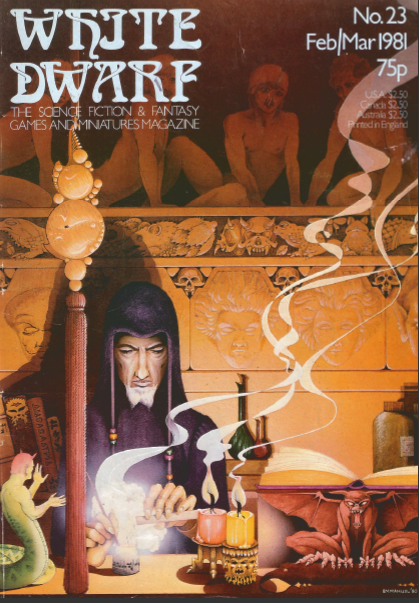
At a minimum, the White Dwarf cover for Feb/Mar 1981 (that would be #23) was putting off a very different vibe than The Dragon. It’s definitely an image with which to conjure.

This issue of WD starts a series by Lewis Pulsipher, “An Introduction to Dungeons & Dragons”. Good series, and worth the read for the newcomers to the hobby – although I’ve always thought learning to play these games is much better done by joining an existing group and playing. In the early days of the hobby, though, this wasn’t always possible and many groups were learning as they went.

Next up is an interview with Marc Miller, covering his origins and the origins of Traveller. If you’re a fan, you might want to give it a look.

You might also enjoy a look at the Marc Miller of 1981 …

The “Fiend Factory” this issue has the Flymen by Daniel Collerton, with art by Russ Nicholson – great monsters, though they’re only a half-inch tall. However, with a handy shrink ray, they could give a party of adventurers plenty of trouble as they look for a way to return to normal size.

Here are the Blood & Treasure stats, first for the tiny-sized fly men in a swarm, and then for the fly men as they would appear to shrunken adventurers:

Flyman, Tiny Humanoid: HD 0 (1 hp), AC 14 (20 when flying), ATK special, MV 5′ (Fly 30′), SV F16 R16 W16, AL Neutral (LN), Special-Swarm surrounds a person’s head blinding them (-4 to hit, 1d4 automatic hits per round), tiny weapons are poisoned and people have a 1 in 20 chance of being allergic and suffering ill effect; roll 1d8; 1-7 renders the area stung swollen and useless, taking 1d4 turns to set in and then lasting for 1d20+24 turns. An 8 means the character falls into a coma in 1d4 rounds and dies in 1d20+24 turns unless the venom is neutralized.

Drone, “Medium” Humanoid: HD 0 (3 hp), AC 12, ATK nil, MV 20′ (Fly 50′), SV F13 R16 W17, AL Neutral (LN), Special-Strength of 17, semi-intelligent, 1d10+10 appearing.

Artisan, “Medium” Humanoid: HD 1, AC 12, ATK 1 weapon, MV 20′ (Fly 50′), SV F 13 R15 W15, AL Neutral (LN), Special-Usually armed with unpoisoned daggers, their skill in metalwork surpasses the dwarves.

Warrior, “Medium” Humanoid: HD 3, AC 14 (carapace, shield), ATK 1 weapon + poison, MV 20′ (Fly 50′), SV F12 R14 W14, AL Neutral (LN), Special-Carry shields, carapace like studded leather, armed with short bow, short sword, dagger, poisoned weapons (save vs. poison, if save suffer 1d6+4 damage, if fail die instantly), allergic people suffer -4 penalty to save, weapons have enough venom for 5 strikes.

Flyguard, “Medium” Humanoid: HD 9, AC 16 (chain, shield), ATK 2 weapon + poison, MV 30′, SV F9 R10 W11, AL Neutral (LN), Special-Carry composite bow, longsword and dagger (poisoned as above), can size-change and have size rods, ride wasps.

Flymage, “Medium” Humanoid: HD 6, AC 16, ATK 1 weapon + poison, MV 30′, SV as 12th level magic-users, AL Neutral (LN), Special-Can size-change and have size rods, has innate powers (locate insects, summon insects, insect plague, creeping doom, size change to medium size for 30 rounds) and powers granted by their god, Ssrrpt’ck (must pray for 5 rounds).

There are five fly mages per hive, and each has extra powers depending on his role. There is the Master Attack, Master Defense, Master Healer, Master Knowledge, Master Worshiper.

The article also includes info on other types of flymen, the Northflies and Sandflies. Awesome stuff – seek it out and use it, for crying out loud. The flymen would make an incredible side trek in a dungeon or wilderness. In fact, the issue includes “The Hive of the Hrrr’l”, also by Daniel Collerton, so you’re all set.

Also: The flymen’s heads can be hollowed out and used as masks.

In addition:

Size-Change
Magic-User 4, Cleric 3

Range: Touch
Duration: 30 rounds

Spell causes a creature to shrink by a factor of 144 (human down to 1/2″ in height).

Spell Focus: A telescoping rod (costs 1,000 gp) that must be pushed in while the spell is being cast.

The White Dwarf isn’t done yet – you also get a new class, The Elementalist by Stephen Bland, the Khazad-class Seeker Starship for Traveller by Roger E. Moore, and A Spellcaster’s Guide to Arcane Power by Bill Milne. That last article involves a spell point system for spellcasting. There are also some keen magic items.

All in all, a really good issue of White Dwarf … in fact, I give it the nod over The Dragon this time around.

Happy Easter folks!

Dragon by Dragon – January 1981 (45)

A new year! 1981!

Inflation was rough as hell, but if you could scrape it together you could get a new Tandy TRS 80 PC for $150 (or $390 in today’s dollars). This year would see the release of the hostages in Iran, the first flight of the space shuttle Columbia and an attempted assassination of President Reagan.

For the geek set, it was an embarrassment of riches in the movie theaters – Raiders of the Lost Ark, Mad Max 2, Evil Dead, An American Werewolf in London, The Howling, Halloween, Escape from New York, Clash of the Titans, Time Bandits, Scanners, Excalibur, Dragonslayer and, of course, the finest film ever made, Cannonball Run.

How did the venerable Dragon kick off 1981? Let’s see …

From the art in the first article, it would appear it was stinking up the place.

Actually, Robert Plamondon‘s article “Gas ’em Up and Smoke ’em Out” reviews how gases and smoke would work in a dungeon environment. It’s a sign of the times, as Old School (which I now realize means pre-1980) gaming gives way bit by bit to realism, at least for game designers and article writers. Here’s a sample:

“Using the rule-of-thumb design specs of 500 cubic feet per person of room volume and 24 cubic feet per minute per person of ventilating air, and applying a little algebra, we find that the ratio of incoming air volume to room volume is about 1:20.83.”

This article uses a little math and engineering, but also comes across with some useful bits for referees:

  • A room with standard ventilation will take about 2 hours and 20 minutes for poison gas or smoke to go away. Even without ventilation, poison gas will eventually react with everything in the room and become harmless.
  • Poison gas costs between 1,000 gp and 6,000 gp per trap.
  • Gas masks should be easy for an alchemist and leather worker to put together, but inventing them will take 2d4 months and 1d6+1 x 1,000 gp, with a 50% chance of success.
  • A successful save vs. poison gas means holding one’s breath and escaping the gas. A failed save means breathing the gas and dying. Initially one falls unconscious and dies 5 rounds later.
  • People who know about the presence of poison gas get a +4 bonus to save against it.

Plamondon also provides a nice table of poison gases, which may come in just as handy for modern games and fantasy games:

Oh, and THIS GUY might be the Robert Plamondon of the article.

The Dragon Tooth miniatures ad would make a nice deep dungeon encounter table:

Roll d20

  1. High Elfin Hero-King in Dragon Helm (Elf Fighter 8/Magic-User 7, helm controls dragons, longsword, chainmail, shield)
  2. Rogue or Thief, Skulkingly Caped (Human Thief 1 or 9, rapier and dagger)
  3. Sorcerer, Sorcerering or Sorceress, Sorcerering (Human Magic-User 9, staff)
  4. Swordswoman armed with Sword and Spear (Human Fighter 3, longsword and glaive)
  5. Rictus, the Zombie King (Zombie with 10 HD, scimitar, skeletal horse)
  6. Swordsman Kane, in Scale Armour (Human Fighter 3, sword, scale mail)
  7. Cleric in Mitred Helmet Armed with Mace in Scale Armour (Human Cleric 9, footman’s mace, chainmail)
  8. Fool or Jester, Armed with Sword (Human Bard 4, longsword)
  9. Bard or Harpist with Harp and Armed with Sword (Human Bard 8, longsword)
  10. Swordsman Roland with Sword and Shield in Scale Armour (Human Fighter 3, short sword, scale mail)
  11. Elfin Enchanter, Enchanting (Human Magic-User 7)
  12. Female Thief or Rogue, Caped and Thieving (Human Thief 1 or 9, rapier)
  13. Silent Stalker, Stalking (honestly, your guess is as good as mine, but I love it)
  14. Gladius-Hero in Roman-Style Armour (Human Fighter 4, breastplate, shield, short sword)
  15. Barbarian Hero wearing Vulture Helmet and Fur (Human Fighter 4, scimitar, leather armor and shield)
  16. Rachir, the Red Archer-Ranger/Fighter with Bow (Human Ranger 3, composite bow, long sword, leather armor, shield)
  17. High Elfin Warrior Maiden Armed with Sword (Elf Fighter 4, broadsword, chainmail)
  18. Gundar the Barbarian with Axe and Sword (Human Fighter 9, leather armor, battle axe, longsword)
  19. Subotai the Mongol-Swordsman with Shield (Human Fighter 3, scimitar, dagger, chainmail, shield)
  20. Swashbuckler Fighter with Cutlass and Dagger (Human Fighter 5, scimitar, dagger)

Next up, we have a couple old school NPC classes – the Astrologer by Roger E. Moore and the Alchemist by Roger E. Moore and Georgia Moore. These are nice and short classes, and could probably be adapted as non-classed NPCs with interesting abilities by most GM’s. Of course, I’d also love to see them used as PC’s in a game.

Here’s a taste of the astrologer:

Here’s a nice bit from the alchemist class:

“For the creation of homonculi, it is suggested that Pseudo-Dragon venom and Gargoyle blood be among, the. required ingredients, as well as the Magic-User’s own blood, since these items bear some relationship to a Homonculous’s poisonous bite and appearance. Costs and time for making a Homonculous are outlined in the Monster Manual.”

And this:

“Formulas for manufacturing cockatrices may be found in L. Sprague de Camp’s book, The Ancient Engineers, Chapter 9, “The European Engineers.” Additional notes appear in The Worm Ouroborous, by E. R. Eddison, “Conjuring in the Iron Tower.” Note that de Camp’s book refers to the cockatrice as a “basilisk,” and tells of an alchemical way of making gold from burnt “basilisk” parts.”

One more reason to read Eddison’s book, and now I want to find de Camp’s as well.

Oh Hell, and this:

“At the Dungeon Master’s option, cloning may be performed by biogenesis-studying Alchemists; this should be considered a very powerful (and very rarely performed) ability that will entail expenditures of 100,000 g.p. or more.”

Philip Meyers‘ article “Magic Items for Everyman” covers random magic items for NPC’s. They’re quite extensive and worth taking a look at.

Bazaar of the Bizarre has a couple nifty magic items. The Eidolon of Khalk’Ru is a real pip if you have a cleric or magic-user in the party (and who doesn’t?). There’s also the Bell of Pavlov, box of many holdings, ruby slippers, ring of oak and pet rocks – man I want to pit a guy with three pet rocks up against an unsuspecting party.

But hey – we’re not done with new classes yet. Len Lakofka presents a new fighter or ranger sub-class, the Archer. Really, it’s the archer, a fighter sub-class, and the archer-ranger, a ranger sub-class. This is accompanied by whole host of advanced rules for missile fire in D&D.

Archers get fewer melee attacks per round than fighters and more missile attacks than fighters. They get an additional +1 with magic bows and arrows. If their intelligence is 9 or higher, they also learn some magic-user spells at 7th level. At 3rd level they learn to make arrows, and they learn to make bows at 5th level.

The main bonus for archers are bonuses to hit and damage, which get pretty big at high levels.

The big feature of this issue was the Dragon Dungeon Design Kit – a bunch of cardboard pieces you could use to create tabletop maps of the dungeon rooms adventurers encountered. You got wall sections, treasure chests and all sorts of dungeon dressing.

Michael Kluever‘s article “Castles, Castles Everywhere” is a nicely researched article about castles. Worth the read.

Roger E. Moore is back again with “How To Have a Good Time Being Evil”, a lighthearted look at the subject. Think over-the-top silver age comic book evil rather than the genuine article. One bit I especially liked was this, as it is a good description of the Chaotic / Evil alignment:

“Now for the group goals. Anyone who’s played Monsters! Monsters! already knows what the goal is in an evil campaign. The goal is to beat up on the good guys. The goody-good Paladins, sneaky Rangers, and less-than-macho elves are going to get what they deserve. What right have they got, breaking into our lairs, killing our underlings and friends, and taking away the treasures we worked so hard to steal? Besides, what we’re doing is the way of the universe. Only the strong survive. Nice guys finish last. I’m number one. If you help all the wimps get ahead in the universe, you undo natural selections and evolution, which is trying to make us tougher. Might makes right. And so on. Working up the goals and general background philosophy of an evil campaign is not difficult (and is actually a little disturbing, as some people say such things in seriousness. How little we know about our own alignments …)”

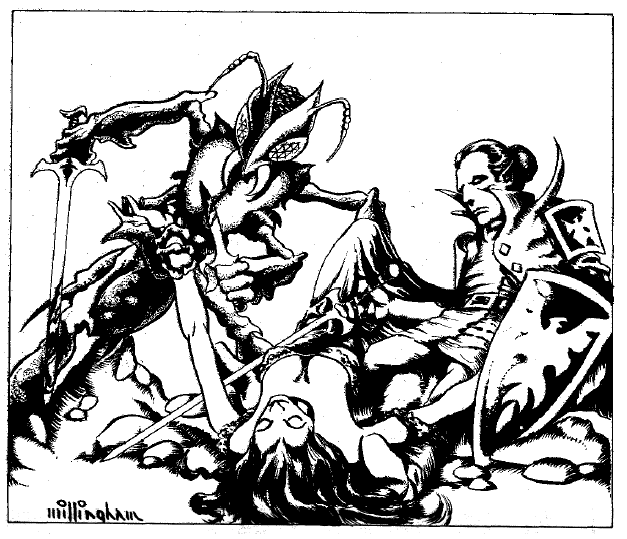
I think the true test of a great monster is great art. Well, maybe not, but a nice piece of art makes we want to use a monster, regardless of its stats. To whit, the skyzorr’n by Jon Mattson:

Art by Willingham, of course. It’s actually not a bad beastie – nomadic insect people.

Skyzorr’n, Medium Monstrous Humanoid: HD 2+1, AC 16, MV 20′, ATK 1d4 claws (1d4) or 1d2 by weapon; AL Chaotic (LE), Special–Bite for 1d4+1 plus poison, surprise 1-3 on 1d6, immune to natural paralysis (not spells) and 90% of poisons, +2 to save vs. heat and cold attacks, resistance to edged and piercing weapons.

They inhabit deserts and badlands in hive communities (70% underground). They are matriarchal, ruled by queens (they look like grotesque bloated spiders) with High intelligence. They use weapons 50% of the time (longswords, scimitars, military forks, spears and slings). If two claw attacks hit, they get a bite attack. The poison deals 1 point of Strength and Dexterity damage for 2d4 turns.

Read the issue to get the full description – very cool. They also have sand lizards by Marcella Peyre-Ferry and dust devils by Bruce Sears.

I wonder if WOTC would consider making a monster book with all of these creatures in it?

Well – that’s all folks. No White Dwarf supplement this time, since it was bi-monthly. I’ll hit it next week (God willing and the creek don’t rise).

The Black Mystics

I was going to offer a no-prize to whoever could identify from whence these fellow come, but then I decided to use the art down below, which should kill any mystery to their origin. These guys are pretty tough, but I also tried to keep them simple.

Black Mystic (Black Master)

Black Mystic

Medium Aberration, Chaotic (NE)

Hit Dice: 6
Armor Class: 18
Attack: Strike (1d8) or by weapon +2
Movement: 60′
Saves: F12 R11 W19
Intelligence: High
No. Appearing: 1d4
XP: 600 (CL 7)

Magic resistance*

Spells—Augury (1), detect thoughts (ESP) (1), hold person (3), phantasmal force (2)

Black Master

Medium Aberration, Chaotic (NE)

Hit Dice: 12
Armor Class: 20
Attack: Strike (2d6) or by weapon +4
Movement: 80′
Saves: F9 R8 W4
Intelligence: Super
No. Appearing: 1 + 1d4 mystics
XP: 1,200 (CL 13)

Magic resistance*

Spells—Augury (3), cause fear (3), contact other plane (1), detect thoughts (ESP), dimension door (1), divination (1), hold monster (3), spectral force (3)

Black mystics are men (always men) who have entered into a dark pact with the nether forces in a bid for earthly power. To become a black mystic, they must have all the goodness in their souls extracted. This goodness, or higher soul, takes the form of a golden sphere, and is kept imprisoned by the black mystics in some form of mystic receptacle or iron-bound box.

Black mystics have amazing reflexes, catching or slapping away normal missiles on a roll of 1-4 on 1d6. They make no sound when they move, and have an 85% chance to hide in shadows. The sight of their twisted bodies forces creatures with 2 HD or fewer to pass a saving throw or be stunned with disbelief for 1d6 rounds.

Black masters rule the black mystics. They have a 95% chance to hide in shadows, and can shapechange twice per day into giant constrictors, giant vultures (use stats for giant eagle) or giant scorpions.

If a black mystic or black master’s higher soul is released from its captivity, it vaults into the celestial heavens and leaves the mystic or master dead. Damage against the soul’s receptacle causes stuns mystics and masters if they fail a saving throw.

* In Blood & Treasure Second Edition, magic resistance is not a percentage. Rather, it requires the spell caster to roll higher than the creature’s HD+10 with 1d20 + the spellcaster’s level. If you want to use a percentage, I’d go with 15% for the mystics and 30% for the masters.

EDIT: Well, it was at the time … now, not so much (Aug 2017)

Magic in the Blood and Other Ruminations

The main reason I wrote Blood & Treasure was that I got tired of converting material to Swords & Wizardry, which was the first system I used in my hex crawls. I decided, rather than make a clone, I would make a rules lite version of the game that stuffed 30+ years of monsters, classes, spells, etc. into the main rules so I would spend less time converting on the fly, and so my OGL statements wouldn’t be so darn long.

To that end, I included the 3rd edition sorcerer among the classes. After all, some folks who played 3E and Pathfinder probably loved the class, and they might be looking for a rules lite game that would support it.

Now, I’m working on the 2nd edition of Blood & Treasure. The goal is still to have a rules lite game that throws everything into the pot and allows folks to pick and choose what they want to use, but I’m also trying to give the game a bit more character of its own. Part of that involves making sure the character classes have something cool about them that makes people really want to play them. These are generally things inspired by folklore or fantasy literature or movies – things that are part of fantasy, but not necessarily part of D&D. Fighters, for example, are going to get a little boost in the form of being able to subdue monsters and turn them into mounts. We see tons of fantasy art and miniatures with warriors riding all sorts of animals and monsters, and D&D had something like this in terms of subduing dragons, so I’m expanding that concept.

The sorcerer … well, the sorcerer needs some help. The entire class is really just an alternate magic system for magic-users – it has no real character of its own. To help the sorcerer stand on its own two feet, I’ve added two abilities that work well with the “magic in the blood” theme.

In my current draft of Blood & Treasure Second Edition, they have an inborn ability to pick up on “magical vibrations”, which means they know when they’re in the presence of spells, illusions and monsters, but they don’t know what is magical around them or how – kind of like Spider-Man’s spidey sense.

Sorcerers also have a way to increase their spell use through dangerous means, somewhat like the spell casting rules in Pars Fortuna. Sorcerers can attempt to cast spells they do not know, but must make a roll to do so, and if they fail may end up doing themselves irreparable harm, or being visited by powerful outsiders, who are accidentally gated in and might be angry about it, or just casting the opposite of what they meant to cast.

They also gather cult-like followers at higher levels, rather than building strongholds. Sorcerers strike me as eccentric wanderers, rather than conservative castle builders.

I’ve also written some variant bloodline sorcerers that are comparable to the variant specialist magic-users, that give them a chance to be related to some of the monsters they meet, and give them some other boosts.

Other Tropes

Sorcerers get the biggest face lift in the game, but a few other fantasy tropes have found a home with other classes.

Fighters have a way of subduing monsters and turning them into mounts (think of all those warriors riding on weird animals and monsters in fantasy art).

Paladins pick up some knightly honors as they advance in level, giving them access to noble and royal courts and improving their reaction rolls (except with chaotic evil monsters, who become more likely to attack them).

Duelists pick up a lackey to be used and abused.

Magic-users pick up odd bits of pseudo-scientific lore as they learn new spell levels – bits of alchemy, knowledge of parachutes, how to build clockworks and a few tips for slight increases in the potency of their spells.

Druids can sacrifice “despoilers of the wilderness” to pick up some extra elemental power, with the extra power depending on the means of sacrifice (blade, drowning, hanging, etc.)

Thieves at mid-level can assemble teams of lesser rogues for dungeon heists – essentially a quick way to pick up some henchmen for a job (but can they be trusted?)

Assassins can now brew some interesting poisons.

You get the idea. Hopefully, these abilities will prove fun and interesting during game play, and will give Blood & Treasure a bit more character of its own.