En Garde: The Duelist

When I dove into the Blood and Treasure project, I had two goals in mind. First and foremost, make it as rules light as possible so that the game is compatible with old school games – that also means reining in some of the power creep that was present in the 3rd edition. Second – use as much of the material in the SRD as humanly possible. Now, sometimes the first goal precludes the second. Some spells – primarily the “mass” spells were, in my opinion, part of the power creep issue. If such a spell wasn’t in an older version of the rules, it didn’t make it into Blood and Treasure. Other spells and feats played off of rules or minutia that I ejected, so they didn’t quite make it in. In all, I retained 95% of the spells, all of the monsters and probably 95% of the magic items.

One thing that didn’t make it in, however, were prestige classes. Initially, I wanted to find a way to use them. The concept isn’t as new school as some folks might thing. The paladin was originally open only to mid-level fighters of lawful alignment – i.e. a prestige class, and the bard that made it into AD-n-D was largely the same. The problem, though, was one of special abilities. So many of the special abilities of the prestige classes just no longer worked in the rules lite environment, and of course many of the prestige classes in the SRD were just patches to get around the fact that multi-classing in the d20 rules did not work properly for spellcasters.

Still, I’m a scavenger at heart, so I was determined to get something out of those prestige classes. The assassin was already slated to become a full class in Blood and Treasure, and looking at the other classes, I saw another that I thought had the makings of full class-hood – the Duelist. Truth be told, I’ve long been a fan of the duelist concept, starting from the first time I watched Cyrano de Bergerac in a freshman English class. So, without further ado, I present the Duelist in “rough draft” form – some changes may occur before it’s official.

DUELIST
Duelists are warriors who learn to fight using trickery, fancy swordplay and quick reflexes rather than armor and shields. Duelists may be swashbuckling rogues or serious and studious masters of fence.

Requirements: Duelists must have dexterity and intelligence scores of 13 or higher.

Hit Dice: d8 (+3 hit points per level from 10th to 20th).

Armor: Leather armor.

Shield: No.

Weapons: Any.

Skills: Balancing and jumping (see Heroic Tasks below).

CLASS FEATURES
A duelist adds her intelligence bonus (if any) as well as her dexterity bonus to her Armor Class while wielding a melee weapon.

Duelists can make special attacks with a +2 bonus to their attack roll.

When fighting defensively, a duelist enjoys a +4 bonus to Armor Class instead of the normal +2 bonus.

At 4th level (romantic), a duelist gains a +2 bonus on initiative rolls.

At 8th level (avenger), a duelist gains an additional +2 bonus on all reflex saving throws and on will saving throws against fear.

At 9th level (duelist), a duelist can choose to establish a stronghold in the wilderness and gain followers (see High Level Play below). A duelist who becomes a lord or lady attracts 1d6 men-at-arms per level, 1d6 first level duelists who wish to train under them and one 3rd level duelist to serve as a lieutenant. These duelists should be generated as characters under control of the player.

At 10th level (duelist), a duelist gains the ability to strike precisely with a one-handed piercing weapon, such as a rapier or dagger, doing double damage on a successful hit. The precise strike can only be attempted in the round after the duelist’s opponent has missed with one of their own attacks. When making a precise strike, a duelist cannot attack with a weapon in his other hand or use a shield. A duelist’s precise strike only works against living creatures with discernible anatomies. At 20th level, the extra damage on a precise strike increases to triple.

At 14th level (duelist), if a duelist chooses to fight defensively, one successful attack against him each round must be re-rolled.

At 18th level (duelist), a duelist using a one-handed piercing weapon may deflect one successful ranged attack per round.
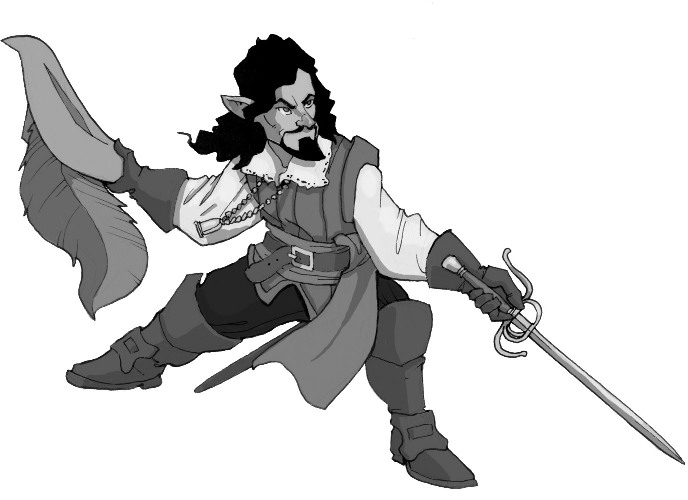
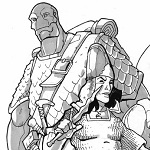
Illustration of a gnome duelist by Jon Kaufman.

Potential Google + Gaming

This post is really just for me to organize my thoughts and put them in pixels before I completely forget them. If any of these ideas grab your imagination, let me know.

For the Money, For the Glory, and For the Fun
The Duke of Raleigh has a challenge for any crew of mutants who want to earn a big payoff – travel west into the Rockies and bring him back a load of the most valuable beverage in post-apocalyptic America … Coors! This would be a Mutant Truckers game, in which (if enough people were interested) two or more crews would complete to make the journey to Colorado and back for a load of Coors.

Assault on Eagle’s Nest
This would be an Action X game (yeah, I’d probably have to finish those rules first) in which a crack team of heroes assaults Eagle’s Nest (Hitler’s command complex). The characters would all be based on literary, comic and movie characters who would have been active during World War II. No super heroes, just guys and dolls who can hold their own in a fight. Indiana Jones, Boston Blackie, Mademoiselle Marie, D.A. Grant Gardner, Sgt. Rock, Maj. Reisman, Pvt. Kelly, a young James Bond, etc.

Silver Age Madness
A Mystery Men! game in which silver age characters deal with all the challenges of the comic books of that period (nosy mates, turning into a gorilla, being split in two, etc.) while trying to keep the world from ending by a mysterious assault from something beyond their reckoning.

Crawling Through Nod
This would be a hex crawl through Nod using Blood and Treasure. A band of diverse heroes (all the races and classes I’ve published in Nod would be open game) doing what they want, going where they want in true sandbox style. There could be a few epic quests hidden in the sandbox for folks who like that sort of thing. No limits to this one – everything would be open from Hell to the Firmament.


The Catacombs of Old Mars
Using Space Princess rules, a band of heroes delve into the ancient catacombs of Mars in search of a mad scientist, who is attempting to unlock the Shiva-Force, a formula that could end the universe as we know it.


Fortuna’s Wheel
This would be a megadungeon delve using Pars Fortuna rules, as characters win their way into the Great Spire at the center of the world, atop of which there stands (reputedly) the Wheel of Fortuna, with which one can gain their hearts’ desire. All you have to do to get it is make your way through a mile high spire of stone that supports hidden kingdoms and every monster you could imagine.


The Streets of Shore City
Another Mystery Men! campaign, this one pitting low-powered heroes against the criminal elements lurking in the alleys of Shore City. Gangbusting, random patrols and maybe a chance to show up the “super heroes” when things really hit the fan.

The Queens of Elemental Earth

This idea popped into my head today, so I explored it a bit.

The primal earth has produced many wonders, but none so lovely (and few so powerful) as the so-called Queens of Elemental Earth. These five sisters are worshipped as goddesses by many of the folk who dwell beneath the earth and are honored by all elemental earth creatures.

The queens look like astoundingly beautiful statues of women in their natural state. They are translucent and gleam with an inner light that produces a magical aura. Within their eyes dance shimmering motes of light that affect all upon which they train their gaze. They dwell in luxurious palaces beneath the ground, served by lesser elementals and fey creatures.

While the queens are ground in neutrality, with some preference for order (i.e. Law), they are, as one might expect, possessed of a very keen appreciation for the wonder that is them. They do not like to be disobeyed or their intentions and desires frustrated, and they have no qualms about destroying lesser creatures that get in their way.

All of the queens can move through rock, stone and soil as easily as a human moves through the air. They suffer half damage from all attacks from manufactured and natural weapons.

Adamantia
Adamantia is Queen Diamond. She has a smooth body of translucent crystal with inner reflections of pink. Adamantia is the strongest and most durable of the five sisters, and she is unforgiving in her disdain of imperfection and muddled thinking. She is always under the effect of a true seeing spell and a zone of truth. She is worshipped as a goddess of clarity, truth and perfection. Her stronghold is a fortress of gleaming adamant, with every surface stark white and lit by a soft, pinkish-white glow. Her court includes elemental earth creatures as well as entities of Law and a host of human paladins that have declared her the focus of their courtly, chaste love.

Adamantia produces an aura of truth (see zone of truth above) that also acts a protection aura against chaotic creatures (per protection from evil, 10-ft. radius). Her gaze acts as a hold monster spell.

Adamantia can cast the following spells as innate abilities: At will – charm person; 3/day – break enchantment, charm monster, cure disease, dispel magic, haste (self), invisibility; 1/day – dimension door, ray of enfeeblement, strength, suggestion, wave of exhaustion. She can also cast spells as a 10th level cleric.

Adamantia: HD 21; AC -7 [26]; Atk 2 strikes (4d6); Move 36; Save 3; CL/XP 30/7400; Special: +2 or better weapon to hit, aura, gaze, earth glide, half damage from all weapons, suffers double damage from sonic attacks, immune to fire, resistance to cold (50%), magic resistance (65%), regenerate 3 hp/round.

Rubinia
Queen Ruby, Rubinia, is composed of a translucent red substance. Her hair (though it is merely sculpted on her head) appears wild and unkempt and her eyes gleam with power. She is worshipped as a goddess of fire and passion and strength. Her court includes elemental earth creatures as well as exiled or rebellious elemental fire creatures. Her stronghold is enclosed in a ruby sphere with spherical chambers that look like bubbles within the sphere and connected by curving tunnels that radiate out from her central court. Gravity is completely relative within the sphere, with people able to walk on all surfaces.

Rubinia produces an aura of weakness (10-ft. radius) that forces people to pass a saving throw or be affected per a ray of enfeeblement. Her gaze forces people to pass a saving throw or be enraged (per the emotion or rage spell, depending on which version of the grand old game you play). Enraged folk never turn their anger upon Rubinia or her servants. Her touch ages people as the touch of a ghost.

Rubinia can cast the following spells as innate abilities: At will – augury; 3/day – charm person, divination, dispel magic, haste (self), invisibility; 1/day – dimension door, flame strike, heal, heat metal. She can also cast spells as a 10th level magic-user.

Rubinia: HD 21; AC -6 [25]; Atk 2 strikes (4d6); Move 36; Save 3; CL/XP 30/7400; Special: +2 or better weapon to hit, aura, gaze, earth glide, half damage from all weapons, suffers double damage from sonic attacks, immune to fire, resistance to cold (50%), magic resistance (55%), regenerate 3 hp/round.

Esmeraude
Esmeraude, Queen Emerald, is the most sensuous and beautiful of the sisters, possessed of a green, healthy glow and a warm, though unyielding, touch. Her stronghold is a paen to love and romance, being a series of limestone caverns with jade pools, rushing streams, laughing waterfalls and gardens of flowering trees, ferns and flowers. Her court consists of elemental earth creatures, nymphs and dryads.

Esmeraude radiates an aura of blinding beauty (per a nymph) and her gaze stuns creatures for 2d4 rounds. Her kiss can grant magic-user’s the effects of a mnemonic enhancement for 24 hours, but also imbues upon them a geas that they must visit her once per year and serve her faithfully for one week.

Esmeraude can cast the following spells as innate abilities: At will – cause blindness; 3/day – cure blindness, cause fear, dispel magic, haste (self), invisibility; 1/day – charm monster, dimension door, entangle, plant growth, suggestion. She can also cast spells as a 12th level druid.

Esmeraude: HD 21; AC -5 [24]; Atk 2 strikes (4d6); Move 36; Save 3; CL/XP 30/7400; Special: +2 or better weapon to hit, aura, gaze, earth glide, half damage from all weapons, suffers double damage from sonic attacks, resistance to cold and fire (50%), magic resistance (55%), regenerate 3 hp/round.

Amethysta
Queen Amethyst appears as a woman of translucent purple crystal accompanied always by three legendary panthers with purple-black fur. She is a queen of dreams who commands a court of elemental earth creatures, succubi and illusionists. Her court is held in a palace of mottled purple walls set in a maze-like layout, with many secret chambers where visitors can rest themselves on comfortable beds stuffed with celestial goose down and sleep under silk and satin, perhaps never to wake again.

Amethysta produces a purple aura of slumber (as the daze spell) and her gaze causes confusion. Those struck by her, even lightly, must pass a saving throw or fall into a deep sleep. She can deliver a kiss that drains levels per a succubus.

Amethysta can cast the following spells as innate abilities: At will – sleep; 3/day – cause fear, dispel magic, haste (self), invisibility; 1/day – dimension door, dream, nightmare, phantasmal killer, poison. She also casts spells as a 10th level illusionist.

Amethysta: HD 21; AC -5 [24]; Atk 2 strikes (4d6); Move 36; Save 3; CL/XP 31/7700; Special: +2 or better weapon to hit, aura, gaze, earth glide, half damage from all weapons, suffers double damage from sonic attacks, resistance to cold and fire (50%), magic resistance (45%), regenerate 3 hp/round, life drain.

Zaffira
Zaffira is a bubbly, almost giddy queen of sapphires. She appears as a beautiful, young woman with translucent blue skin, her eyes like star sapphires and her hair tumbling like cascades of water down her back to her ankles. She dwells in a floating palace of sapphire walls and misty, damp halls occupied by elemental earth creatures as well as sylphs and other exiled air creatures and giant eagles. Zaffira is worshipped as a goddess of innocence, truth and courage.

Zaffira produces an aura of euphoria. Folk who enter it must pass a saving throw or be calmed, losing all desire to commit violence or even engage in argument. Her gaze causes people to break into uncontrollable laughter (per the spell).

Zaffira can cast the following spells as innate abilities: At will – hold person; 3/day – cause fear, discern lies, dispel magic, haste (self), invisibility; 1/day – globe of invulnerability, mark of justice, ray of enfeeblement, resilient sphere, strength. She also casts spells as a 12th level cleric.

Zaffira: HD 21; AC -6 [25]; Atk 2 strikes (4d6); Move 36; Save 3; CL/XP 23/5300; Special: +2 or better weapon to hit, aura, gaze, earth glide, half damage from all weapons, suffers double damage from sonic attacks, resistance to fire and cold (50%), magic resistance (65%), regenerate 3 hp/round.

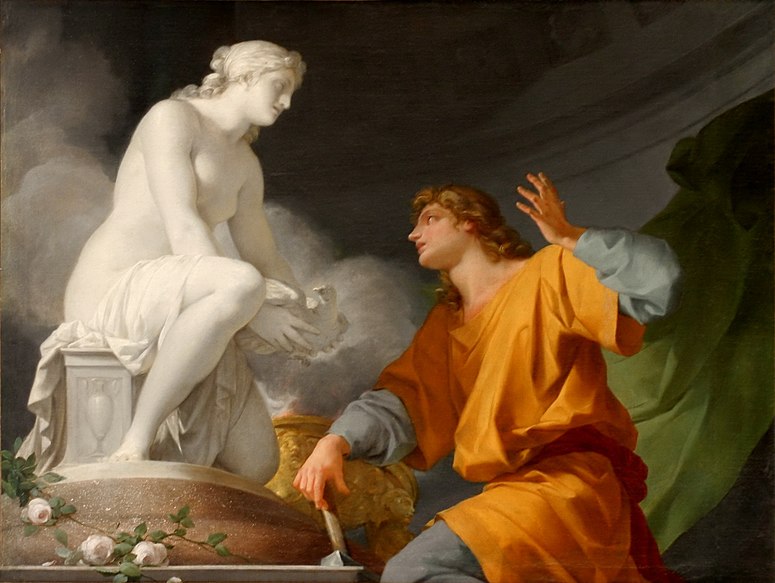
Image found HERE. Painted by Jean-Baptiste Regnault (1786).

The S-word in Blood & Treasure

While I’ve been scrambling to finish NOD 12 by the end of the year, Blood and Treasure and Space Princess have been simmering on the back burner. B and T is about 80% complete – all the monsters, spell and magic items converted, classes written, basic rules finished – and is mostly waiting for some info on high level play (strongholds, wargames, magic research) and a sample delve. Space Princess needs some modifications to the rules (fairly minor) and a formal writing down of the sample delve. They’ll probably both be available in January of 2012.

In the meantime, here’s a look of how non-combat actions can be resolved in the game (i.e. skills, one of the dirtiest words in Old School gaming). Also, a preview of the game’s iconic thief.

HEROIC TASKS

The concept of “heroic tasks” covers everything from climbing a sheer wall to riding a dragon. Brushing one’s teeth or stepping over a puddle do not qualify as heroic tasks, and characters can do these and most things automatically, without rolling any dice. Accomplishing very difficult (or almost impossible) tasks, on the other hand, does require a player take dice in hand and roll to discover his character’s fate.

For each of the heroic tasks described below, the conditions of the task are described as either “easy” or “difficult”. If somebody meets the definition of an easy task, they need not roll dice to see if they succeed. Success is assumed.

For people attempting a difficult task, dice must be rolled, and failure imposes consequences.

The actual dice to be rolled and the number needed for success depends on whether the person attempting the heroic task is unskilled, unskilled but has a knack or skilled.

UNSKILLED: An unskilled person can succeed at a difficult task by rolling 1d20, adding the relevant ability modifier, and trying to equal or beat an “18”. Alternatively, you can simply roll 1d6 and attempt to roll a “1”.

KNACK: An unskilled person with a knack for something (such as an elf’s knack for finding secret doors or a gnome’s knack for listening at doors) can succeed at a difficult task by rolling 1d20, adding the relevant ability modifier, and trying to equal or beat a “15”. Alternatively, you can simply roll 1d6 and attempt to roll a “1” or “2”.

SKILLED: A character skilled at a heroic task improves his chances of success as he or she advances in level. A skilled skill check is made by rolling a saving throw, modifying the 1d20 roll with the appropriate ability score modifier.

The type of saving throw depends on the ability most associated with the heroic task. Saving throws made to accomplish a heroic task are modified by their associated ability score, not the ability scores that normally modify saving throws (see Saving Throws above).

Strength: Fortitude
Dexterity: Reflex
Constitution: Fortitude
Intelligence: Will
Wisdom: Will
Charisma: Will

In some circumstances, a Referee can alter which ability is associated with a heroic task, and therefore which type of saving throw. Such is the power of being a Referee!

MULTIPLE DIFFICULTIES
If a heroic task you are attempting involves more than one difficulty, a -2 penalty per extra difficulty is applied to the dice roll. For example, riding a mount during combat is difficult, and therefore requires a skill check for success. Riding an untamed flying mount that has been frightened during combat involves four different difficulties, and thus imposes a -6 penalty (-2 per difficulty beyond the first) to the skill check to avoid failure.

[Note – just a sample of the more “old school” heroic tasks here – there are more in the game]

BEND BARS (STRENGTH)
Adventurers tend to get themselves into trouble, either by breaking into a monster’s home and stealing its loot or by failing to pay the king’s taxes on said stolen loot. This means that they might end up in the king’s dungeon or maybe on the wrong side of a portcullis with thousands of angry kobolds rushing towards them.

EASY: Bending bars is only easy if the bars are made of a weak metal, like gold, or very rusty iron bars. Using a tool might make bending bars an easy task as well.

DIFFICULT: The following difficulties force a character to attempt an action check when bending bars:
• Bending normal metal bars
• Bending bars one inch or more thick

FAILURE: The bars do not bend.

NOTE: Adamantine bars cannot be bent.

FINDING SECRET DOORS (INTELLIGENCE)
When a wizard wants to hide their treasure for all time, they might put it behind a massive metal door with a dozen locks trapped with acid, or they might put it behind a door that blends into the wall. Of course, they might do both.

SKILLED: Elves have a knack for finding secret doors.

EASY: Finding a secret door is never easy.

DIFFICULT: The following difficulties force a character to attempt an action check to find a secret door:
• Secret door is built to resemble the surface of a wall, floor or ceiling (i.e. all secret doors).
• Secret door is hidden using magic.

FAILURE: The secret door remains a secret.

NOTE: Finding a secret door does not necessarily mean opening a secret door. Many secret doors require special catches to be tripped (a book pulled from a bookshelf or a wall sconce pulled down, for example). Characters who cannot figure out how to open a secret door may have to batter it down (see Battering Doors above).

HIDING (DEXTERITY)
When an adventurer finds themselves hunted in a hostile dungeon or fortress, hiding might come in handy.

SKILLED: Thieves and assassins are skilled at hiding anywhere. Rangers are skilled at hiding in the wilderness. Halflings have a knack for hiding.

EASY: Hiding one’s entire body behind a solid opaque object.

DIFFICULT: The following difficulties force a character to attempt an action check to hide:
• Hiding behind a translucent objects (no, you cannot hide behind a transparent object!)
• Hiding behind an object smaller than you are.
• Hiding behind a non-rigid object, such as curtains.
• Hiding in nothing but shadow (counts as two difficulties)
• Hiding while under observation (requires a distraction)

FAILURE: You are noticed by an observer.

NOTE: If wearing camouflaging clothing (i.e. green in a woodland, black when hiding in shadows) you may receive a +2 bonus to your dice roll.

Dueling with a Deck of Cards

Toying with a mini-game involving sword duels and a deck of cards. I’ll fill you all in as I get further with it, but at the moment it involves playing black cards for offense, red cards for defense, sometimes wanting to go higher than your opponent, sometimes lower, may include some bluffing elements for feints, damage would involve losing cards in your hand and it would take into account the benefits of using a shield. Sound good? We’ll see.

In the meantime, enjoy a small glimpse into HELL!

9.57 Amber Tower: Three hundred cowardly shades dwell here in a village of packed mud houses surrounded by a dry moat filled with pongee sticks coated with a black, tar-like poison that causes people to slip into a comatose sleep for 1d4 days. When they awake, they find themselves changed, their skin scaled and colored deep purple on their extremities and their minds possessed of an animal cunning, though their intelligence score drops to 2.

The shades of the village have ashen skin that is cracked and dry. They are lean and quiet and move stiffly, almost as though they were zombies.

The village is overseen by Leralol, a nalfeshnee minion of Barbatos who dwells in a tower of amber glass that gives off waves of heat. Standing within 100 feet of the tower is uncomfortable. Moving to within 10 feet causes 1d4 point of damage per turn. This damage persists within the tower, which is about 50 feet tall and 20 feet in diameter. Each floor of the tower is circular in shape, with an arched roof and a spiral stair in the center leading to the next floor. All of the glass surfaces in the tower are hot to the touch, causing 1d6 points of damage.

In the lower chambers, Leralol has dozens of newly arrived shades chained to the ceiling, drying like prosciutto. The third level holds changed victims of the black tar poison in cages. These poor souls serve as Leralol’s primary form of entertainment – hunting. The fourth level holds his kennel of nerizo demons, which he uses on his hunts. The fifth level holds his own quarters, a room about twice as big as it should be, given the size of the tower. This room is decorated with all manner of grisly hunting trophies, most of them humanoid, but also many wild, demonic animals as well, a row of seven succubus heads posed most scandalously and the head of a hellephant that has been turned into a headboard on Leralol’s bed. Five servant succubi are chained to this bed, but have enough room to move through the chamber, which connects to a small pantry, kitchen and armory.

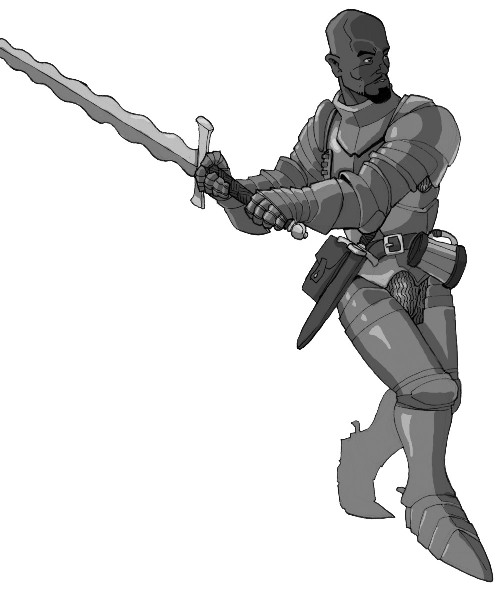
Image is the iconic fighter from Blood & Treasure, by Jon Kaufman (natch)

Magic-Users in Blood and Treasure

Just a quick sample of the magic-user as it will appear in Blood and Treasure. Nothing earth shattering – mostly did it to show off the sweet illo by Jon Kaufman.

MAGIC-USER

Magic-users are spell casters who can access the widest variety of spells in the game. They are scholars and thus fairly weak combatants.

Requirements: A magic-user must have an intelligence score of 9 or higher.

Hit Dice: d4 (+1 hit points per level from 10th to 20th).

Armor: None.

Shield: No.

Weapons: Club, dagger, dart and quarterstaff.

Skills: Deciphering scripts.

CLASS FEATURES
A magic-user casts spells from the magic-user spell list. A magic-user must choose and prepare his spells ahead of time. Like other spell casters, a magic-user can cast only a certain number of spells of each spell level per day. His base daily spell allotment is given on Table: The Magic-User. Unlike a bard or sorcerer, a magic-user may know any number of spells. He must choose and prepare his spells ahead of time by getting a good night’s sleep and spending one hour studying his spellbook. While studying, the magic-user decides which spells to prepare. He cannot prepare any spell not recorded in her spellbook, except for read magic, which all magic-users can prepare from memory and which they must know to read their spellbook.

A magic-user begins play with a spellbook containing four 0-level spells and three 1st-level spells. At any time, a magic-user can add spells found in other magic-user spellbooks or scrolls to her own or can conduct spell research to learn new or invent spells.

At 9th level (wizard), a magic-user can choose to establish a stronghold in the wilderness and gain followers (see High Level Play below). A magic-user who becomes a lord or lady attracts 1d6 men-at-arms per level (chaotic magic-users can choose to employ goblins, orcs or hobgoblins instead), 1d6 first level magic-users who wish to train under them and one 3rd level magic-user to serve as a lieutenant. These magic-users should be generated as characters under control of the player.

MAGIC-USER SPECIALIZATION
A school is one of eight groupings of spells defined by a common theme. If desired, a magic-user may specialize in one school of magic. Specialization allows a magic-user to cast extra spells from her chosen school, but she then never learns to cast spells from some other schools.

A specialist wizard can prepare three additional spells of her specialty school each day. Each extra spell must be from a different spell level that the magic-user can cast.

The magic-user must choose whether to specialize and, if she does so, choose her specialty at 1st level. At this time, she must also give up two other schools of magic (unless she chooses to specialize in divination), which become her prohibited schools. A magic-user cannot give up the divination school to fulfill this requirement. A magic-user may not change either her specialization or her prohibited schools later. Spells of the prohibited school or schools cannot be cast by the magic-user, even using scrolls or wands.

The eight schools of arcane magic are abjuration, conjuration, divination, enchantment, evocation, illusion, necromancy, and transmutation.

Abjuration: Spells that protect, block, or banish. An abjuration specialist is called an abjurer.

Conjuration: Spells that bring creatures or materials to the caster. A conjuration specialist is called a conjurer.

Divination: Spells that reveal information. A divination specialist is called a diviner. Unlike other specialists, a diviner must give up only one other school.

Enchantment: Spells that imbue the recipient with some property or grant the caster power over another being. An enchantment specialist is an enchanter.

Evocation: Spells that manipulate energy or create something from nothing. An evocation specialist is called an evoker.

Illusion: Spells that alter perception or create false images. An illusion specialist is called an illusionist.

Necromancy: Spells that manipulate, create, or destroy life or life force. A necromancy specialist is called a necromancer.

Transmutation: Spells that transform the recipient physically or change its properties in a more subtle way. A transmutation specialist is called a transmuter.

Alternate Dying Rules

I just wrote up these alternate dying rules for Blood & Treasure. The normal rule is the old fashioned dead at 0 hit points.

ALTERNATE DYING RULES
Some referees (and many players) think death at zero hit points is too harsh and prefer a system that makes dying less common. With those folks in mind, we present this alternate death system. Using this system for most monsters can be a bit of a headache with most monsters, though it might be used for important or unique monsters.

At zero hit points, a character fall unconscious for 1d4 hours. While they are unconscious, they are completely helpless and can be slain by a foe that has the time to slit their throat, stab them in the heart or strangle them with their bare hands. Any amount of healing, either from overnight rest or magic brings them to a conscious state.

If a character is driven into negative hit points, they must pass a fortitude saving throw modified by their current negative hit point total or die.

If such a character does not die, they are considered unconscious and severely wounded. They remain unconscious until their hit point total is brought back to 1 or higher. While severely wounded, a character heals only one hit point of damage per day of rest. Moreover, they must roll on the following table to determine the extent of their severe wounds.

SEVERE WOUNDS TABLE
1-4. Facial scars. Character loses 1 point of charisma permanently.
5. Blindness. This can be cured with remove blindness.
6. Deafness. This can be cured with remove deafness.
7. Mangled limbs. Roll 1d4 to determine the exact limb (1 Left Arm/Hand, 2 Right Arm/Hand, 3 Left Leg/foot, 4 Right leg/foot). Folk with arm or hand damage lose 1 point of strength permanently and suffer from all the obvious effects of such an injury. Folk with leg or foot damage lose 1 point of dexterity permanently and move at half the normal rate.
8. Chest trauma. This might be a punctured lung, broken ribs or other organ damage. The victim loses 1 point of constitution permanently.
9. Severed limb. Roll 1d4 to determine the exact limb (1 Left Arm/Hand, 2 Right Arm/Hand, 3 Left Leg, 4 Right leg). Folk who lose an arm or hand lose 1d3 points of strength permanently and suffer from all the obvious effects of losing such a limb. Folk who lose a leg lose 1d3 points of dexterity permanently and move at half the normal rate. The regenerate spell can restore lost limbs.
10. Head injury. Victim loses 1d3 mental ability score points. For each lost point, roll 1d6 randomly to determine which ability score is affected: 1-2 Intelligence, 3-4 Wisdom, 5-6 Charisma.

Cure serious wounds, cure critical wounds and heal remove the effects of these serious wounds (except for severed limbs) as well as healing hit point damage. Lesser cure spells return lost hit points, but do not remove the effects of these wounds. Some other spells (as noted above) can alleviate these wounds, specifically any spell that heals ability score damage.

Choosing the Bloody Cover

Last night, the child and I started looking at potential covers for Blood and Treasure. I’ve been chipping away at it in between writing the Hell hex crawl, finishing HCC 6 and putting the finishing touches on Space Princess, and I’ve so far finished about 90% of the chapter on characters* (still need to work on strongholds, domains and mass combat), have the basic adventure rules finished (skill checks, combat, dangers, movement/time, etc.) and have spells and monsters from A-C written up. So far, so good.

On to the cover mock-ups …

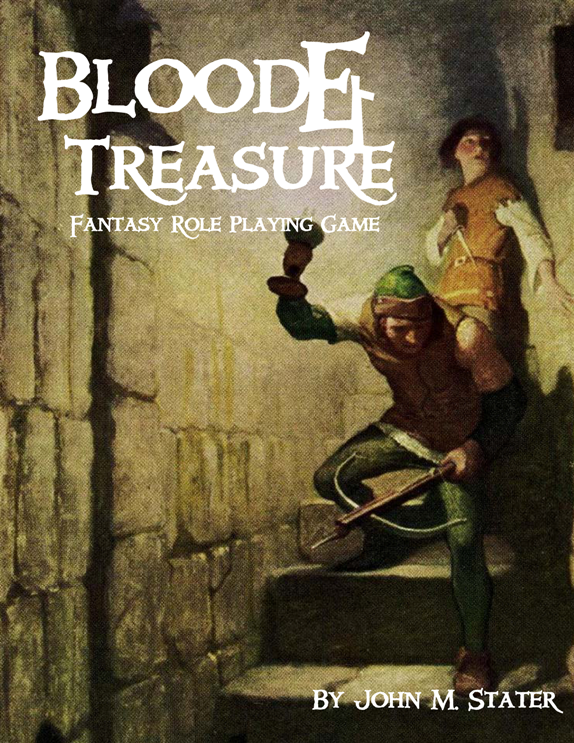
First image I looked at is one people have seen in my adverts on the back of issues of NOD. I originally found it at Golden Age Comic Book Stories. I like the overall look and feel – descending into the unknown – and it remains a strong contender.

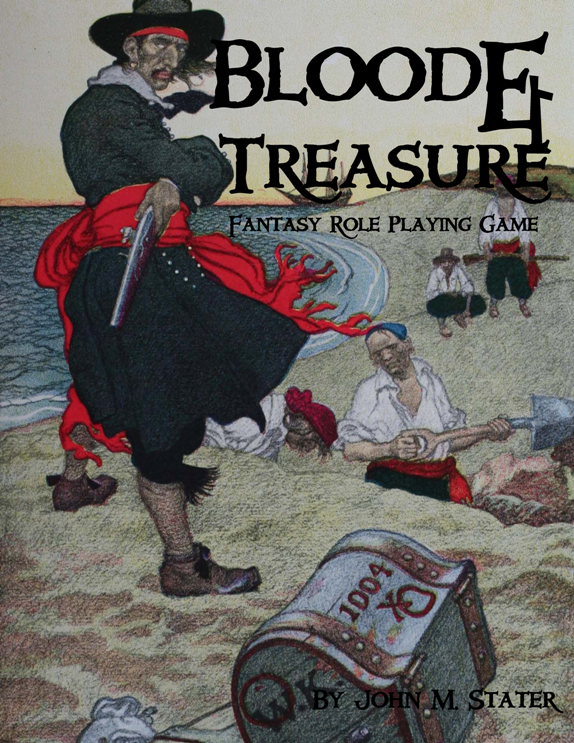
Looking at some other images from GACBS, I found this one which fits the “treasure” theme nicely, but frankly makes the game look like it’s about pirates.

Side Note: I have to write a game about pirates now, because this illustration would rock as a book cover. I’ll put it in the queue after Action X.

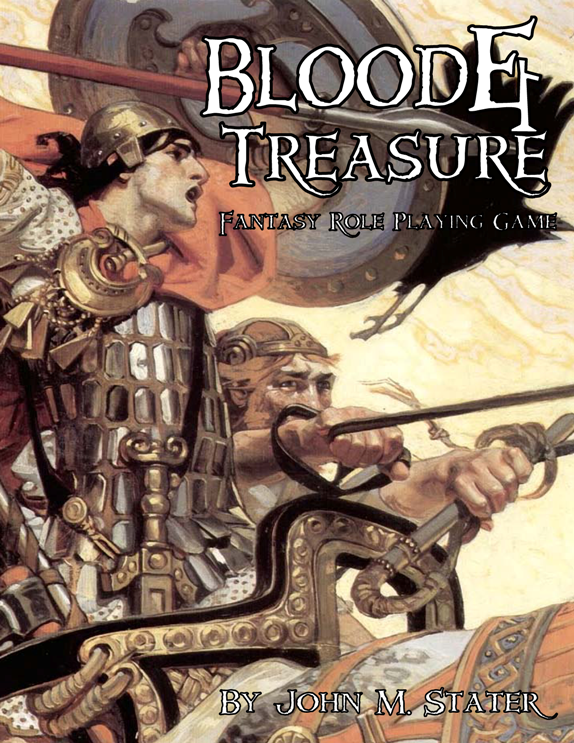
J.C. Leyendecker is one of my favorite illustrators. This illustration of Cuchulain is gorgeous. Very heroic – but is heroic the vibe I want for Blood and Treasure? The interior character art I’ve commissioned is meant to look like adventurers who are banged up, dirty and scarred. Nice, but I’m not sure it’s quite right.

The last image was initially just for fun – I didn’t expect I would like it. It is a medieval painting of a cleric being beaten up by demons. No – not the one I just used for NOD 11, but probably depicting the same scene. After I dropped it in, though, I did like it, very much. Even looks like there is a goblin and gnoll in the background.

In the final analysis, for me, it’s between the first cover and the last. Unless I find something else, of course. What are your thoughts, gentle reader?

* Races are going to be the traditional human, dwarf, elf, gnome, halfling, half-elf and half-orc. Classes are going to be all the classes in the SRD (barbarian, bard, cleric, druid, fighter, magic-user, monk, paladin, ranger, sorcerer and thief) plus two of the prestige classes turned into full classes, the assassin and duelist. I think that covers things pretty well.

MEGA-MONSTERS: The Anaxim

The SRD is a pretty big document, with plenty of neat things to make use of, even for old school gamers. This is one of the reasons I’ve embarked on the Blood and Treasure project – make a system with old school rules that attempts to embrace just about everything the SRD has to offer – thematically, it would be Basic rules with all the Advanced classes, spells and monsters. If you started playing back in the ’80s, you probably know what I’m talking about. Recently, I was perusing some of the epic-level monsters in the SRD and though that any one of them might make a neat center piece to a massive campaign of the kind suggested in Mentzer’s BECMI set of rules. Thus – MEGA-MONSTERS.

The conversion below is for both Blood and Treasure (as it currently stands in my mind) and Swords and Wizardry, with S-n-W stats being behind the slash where necessary.

ANAXIM
Huge Construct, Intelligent, Lawful
Hit Dice: 30
Armor Class: 27 / -8 [27]
Attacks: 2 spinning blades (2d8), 6 projectile spikes (2d8, 120’) and lightning bolt (10d6, 300’) or sonic blast (10d6 + deafness, 60’ cone)
Move: 60 (Fly 200) / 18 (Fly 30)
Saving Throws: F8, R2, W2 / 3
Special: Summon iron golem, +2 or better weapon to hit, regenerate 3 hp/round, resistance to fire and cold (50%), immune to polymorph, petrification and illusions, blindsight (500’), telepathy (1,000’)
Spells: At will – Displacement, ethereal jaunt, greater dispel magic, greater invisibility / Dispel magic, invisibility, etherealness (as the potion)
XP: 38,000 / 39/10,100

Anaxims, or God-Machines, are massive constructs shaped something like beetles and are as large to an iron golem is as an elephant is to a human being. In place of mandibles that have two spinning blades on iron arms and their bodies are studded with six massive spikes that can be launched at enemies up to 120 feet away. They can also emit lightning bolts and sonic blasts. Four times per day, an anaxim can summon an iron golem to fight by its side.

Anaxims might be the product of titans or hordes of lawful creatures like formians. They are created to smash the forces of chaos (in a final, end of Law vs. Chaos way) or guard the secrets of Creation.

Regenesis
The Regenesis campaign pits the adventurers against a secret cult dedicated to re-creating the universe. The current universe, they believe, is tainted by chaos and thus not perfectible. They wish to create an anaxim and set it upon the forces of Law, smashing the machinery of creation and allowing the universe to collapse in on itself and, in their belief system, be recreated from a single, perfect mainspring. Of course, they are insane, but that doesn’t stop them from being dangerous.

BASIC: Basic adventures pit the adventurers against the foot soldiers of the cult. To create their anaxim, the cultists have struck out in search of pure metals and master smiths and engineers, enslaving them. Each individual cell of the cult is responsible for a single part of the finished anaxim, as guided by a group called “The Divine Architects”. Perhaps the ultimate basic adventure would have the adventurers penetrating the slave factory of one cell as they prepare to place their part of the anaxim in the hands of a visiting, extra-planar Architect.

EXPERT: The expert adventurers force the adventurers to strike out into the wilderness to attack other cells of the cult. Perhaps there are three key factories all trying to produce a single part of the anaxim, and at least one must be stopped to slow down the cult’s plan. Golems of various kinds should come into play at these levels, along with conspirators of the cult – sages, magic-users, nobles, etc.

MASTER: The master level adventures involve moving beyond the material plane. The plan of the cult, which is spread across the cosmos (i.e. not only on the adventurer’s home world), has put the Divine Architects (formians) in conflict with the polyhedroids who maintain the mystic gears of the cosmos. A perfect mainspring has been stolen, and the cosmos is grinding to a halt. The adventurers must find the clandestine base where the various parts of the anaxim are being assembled, for it is hidden in a pocket dimension somewhere in creation.

EPIC: The final adventurers involve an assault on the pocket dimension of the true powers behind the cult and the Divine Architects – a band of rebellious titans who seek the cosmos’ destruction for their own purposes, as each believes he can create his own little universe – a multi-verse, one might call it – with he or she taking the role of Creator. The pocket dimension houses a small world (about the size of an asteroid), and deep within this world sits the anaxim, ready to be activated.

A couple notes on Blood and Treasure

For Armor Class conversions (SRD to BnT), I’m using the following formula:

AC 10 to 18 = keep the same
AC 19-20 = 19
AC 21-22 = 20
AC 23-24 = 21
AC 25-26 = 22
AC 27-28 = 23
AC 29-30 = 24
AC 31-32 = 25
AC 33-35 = 26
AC 36-38 = 27
AC 39-41 = 28
AC 42-44 = 29
AC 45+ = 30

Determining XP in Blood and Treasure will (at the moment, I might change my mind) be done as follows:

For monsters with no special combat abilities, XP = HD x 10

For monsters with minor special combat abilities, XP = HD x 100

For monsters with major special combat abilities, XP = HD x 1,000

And no, I haven’t yet figured out what will count as minor and major special abilities. Spells of 0 to 4th level will probably be minor, spells of 5th level or higher are major; resistance to damage (i.e. half damage) will be minor, immunity major; only harmed by silver weapons minor, magic weapons major, etc.

The saving throws are just the number you have to equal or beat on a d20 roll for monsters. Characters would be adding the appropriate ability bonus (constitution to Fortitude saves, dexterity to Reflex saves, wisdom to Will saves). If the save is considered “difficult” – for example, if saving against a creature with 5 HD or levels more than you or because of some extenuating circumstance determined by the Referee, there is a -5 penalty on the saving throw. I’m trying to keep bonuses and penalties to a bare minimum in Blood and Treasure.

I’m going to cap monster Hit Dice and Armor Class at 30. From Kobold to Orcus (or Anaxim), I think a range of 0 to 30 is sufficient. Character levels run from 1 to 20.

Oh, and yeah, I’m still working on Space Princess (art is being produced by Jason Sholtis as we speak, and it rocks! I need to write a sample space fortress …), 1800 – American Empires (holding pattern until Space Princess is finished) and Action X (holding pattern until American Empires is finished – oh, and I think I found a font I like for the title today!). Also almost finished with Hex Crawl Classic 6 (this weekend for sure), still working on NOD 12 and I should dive into Rappan Athuk at some point soon. Busy and happy!

Blood & Treasure RPG

You know how hard it is to think up a name for a fantasy game that hasn’t already been taken?

Here’s an idea that popped into my head today. I love the old school games and write for them and will continue to write for them until the cows come home. I am pro-retro in all of its glorious forms, from Castles and Crusades to Basic Fantasy RPG to Labyrinth Lord to Swords and Wizardry and beyond.

But … I don’t hate the modern game introduced in the SRD (System Reference Document). I stopped playing it because there were too damned many rules and modifiers to keep straight – I wanted simplicity – but why can’t I have elf druids and dwarf magic-users and what about gnomes and half-orcs and prismatic sprays and you know, those conditions rules were pretty handy and the three saving throw categories weren’t bad, just different.

Today, I’m driving around town and think – maybe it would be fun to just write a rules-lite version of the SRD that has everything in it – nothing (much) removed because it wasn’t there 20 or 30 years ago or because I don’t personally get much mileage from it. Feats could still be there, but optional (remember my Boons article from NOD 1?) for those who hate feats. I can do skills like I did in Pars Fortuna – as saving throws, with a blanket modifier of maybe -5 for difficult tasks and -10 for super difficult tasks – no skill points and all that guff, and anyone without the skill succeeds on a flat 1 in 6. The diplomacy and intimidate stuff can be optional for people who prefer to leave that up to the players’ skill rather than dice rolls. About the only thing I can imagine leaving out is some of the alignment specific spells (i.e. keep it simple with Law/Good vs. Chaos/Evil instead of nine alignments). Prestige classes – why not? You can jump in at 6th level from certain classes, because dwarven defenders are cool. Yeah – we walk back the power level, because the game was overpowered and tended to make super heroes rather than adventurers. Basically, I don’t want to be the GOD OF THE RULES who issues commandments from on high or gives you his version of the perfect, just the dude who put the rules together in a readable form and sold it to you.

I guess the real theme for Blood & Treasure is lots of options + super simple rules that you can mostly carry around in your head.

No, I don’t know when. But eventually.

What do you think?

Image from Golden Age Comic Book Stories