The Polyhedroids

Two of the creatures that proved popular in my best.monster.ever poll were the modrons and the slaad. Since neither is open content, I’ve had to create my own versions for inclusion in Blood & Treasure. The polyhedroids fit the role of “agents of absolute law”.

POLYHEDROID
The mechanisms that regulate the clockwork movement of the cosmos are unseen, but they do exist. And while sages and theologians may argue and fight over who designed and put them into motion, they rarely worry over who maintains them. More importantly, when the cosmos needs an upgrade such as a new moon, who builds it, puts it in place and sets it off on its merry way? The who in question are the polyhedroids. The polyhedroids are like organic constructs. They are creatures of absolute law and order; every polyhedroid has a place in the scheme of things and every polyhedroid wants nothing more than to perform the task they have been assigned. They oppose chaos because it is an opposing force, not out of any love or comprehension of virtue, and since they see all living and non-living things as mere gears of the cosmos, they have no compunction about using these gears as they see fit to maintain cosmic order.

Spheroid
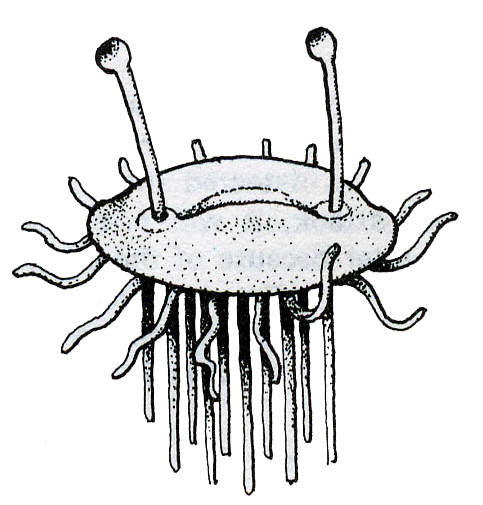
Spheroids are the least of the polyhedroids. They have a single eye, which can seemingly travel around the surface of their body as they like, and a small mouth that always sits at the bottom of the sphere. Once given a task, a spheroid works at that task until it is complete and then become idle, waiting for a new order from a more complex polyhedroid.

Spheroid, Small Outsider, Lawful, Low Intelligence: HD 1; AC 13; Atk 1 tentacle (1d4); Move 20; Save F 13, R 13, W 14; XP 100 (Basic); Special: Immune to enchantment and illusion, surprised on 1 in 4, resistance to electricity, spells (at will-levitate), telepathy 100 ft.

Tetrahedroid
Tetrahedroids are the engineers of the polyhedroids. They look like triangular pyramids turned on their points. From each of their four vertices, they sprout a tentacle. On three of their four faces, they bear a single large eye. On the fourth face, that which points up, they have a mouth. They are capable of balancing and moving on a single tentacle and attacking with the other three. Tetrahedroids often work alone or in small groups on major tasks or command a work crew of four spheroids.

Tetrahedroid, Medium Outsider, Lawful, Average Intelligence: HD 4; AC 15; Atk 3 tentacles (1d6); Move 30; Save F 11, R 11, W 11; XP 400 (Basic); Special: Immune to enchantment and illusion, resistance to acid and electricity, magic resistance 10%, spells (at will-levitate, mage hand), telepathy 100 ft.

Hexahedroid
Hexahedroids are employed to command work details of spheroids and tetrahedroids or to fight in polyhedroid armies when chaos threatens the cosmic order. They appear as cubes turned on their points, with eight tentacles sprouting from their vertices. Three of their faces bear great eyes, while the other three bear mouths. Hexahedroids attack with four tentacles and can cast spells as 6th level clerics. They can cast one spell per round, even while attacking. Hexahedroids command crews of six tetrahedroids.

Hexahedroid, Medium Outsider, Lawful, Average Intelligence: HD 6; AC 17; Atk 4 tentacles (1d8 + constrict); Move 40; Save F 10, R 10, W 10; XP 600 (Expert); Special: Immune to enchantment and illusion, resistance to acid, fire and electricity, magic resistance 15%, spells (at will-levitate, mage hand; 1/day-magic missile, shield), telepathy 100 ft.

Octahedroids
Octahedroids are governors among the polyhedroids. They appear as octahedrons (or 8-sided dice if you please) lying on their horizontal axis. They have six tentacles sprouting from their vertices. Those that ring their center are used for movement, while the two on the ends are used for attack and manipulation, though technically they could use two of their central tentacles for attack if need be. They have four eyes and four mouths and cast spells as 8th level clerics. They are capable of cast two spells per round, even while attacking. Each octahedroid has a bodyguard of 8 hexahedroids.

Octahedroid, Large Outsider, Lawful, High Intelligence: HD 8; AC 19 [+1]; Atk 2 or 4 tentacles (2d6 + constrict); Move 60 (Fly 180); Save F 9, R 8, W 8; XP 4000 (Master); Special: Immune to enchantment and illusion, resistance to acid, cold, fire and electricity, magic resistance 20%, spells (continuous- detect lies, protection from evil; at will-levitate, mage hand, telekinesis; 3/day-command, detect invisibility, detect magic, magic missile, shield;1/day-interposing hand, wall of force), telepathy 100 ft.

Dodecahedroids
Dodecahedroids are lords among the polyhedroids. They appear as dodecahedrons (or 12-sided dice if you please) sprouting 20 tentacles. They have 6 eyes and 6 mouths spaced around their bodies, and cannot be surprised. They cast spells as 12th level clerics and are capable of casting three spells per round even while attacking. Each dodecahedroid commands a council of 12 octahedroids.

Dodecahedroid, Large Outsider, Lawful, High Intelligence: HD 12; AC 21 [+2]; Atk 10 tentacles (2d6 + constrict); Move 90 (Fly 270); Save F 7, R 4, W 6; XP 6000 (Master); Special: Immune to enchantment and illusion, resistance to acid, cold, electricity, fire and sonics, magic resistance 30%, spells (continuous-detect invisibility, detect lies, protection from evil; at will-command, detect magic, detect thoughts, levitate, mage hand, telekinesis; 3/day- dimension door, magic missile, shield, wall of force;1/day-dispel magic, force cage, forceful hand, interposing hand, teleport), telepathy 1,000 ft.

Icosahedroids
Icosahedroids are kings among the polyhedroids. They appear as icosahedrons (or 20-sided dice if you please) sprouting 12 tentacles. They have twenty complete faces consisting of an oblong eye and mouth. They cast spells as 20th level clerics and are capable of casting four spells per round even while attacking. Each icosahedroid commands a kingdom of 20 dodecahedroids, 240 octahedroids, thousands of hexahedroids, millions of tetrahedroids and untold numbers of spheroids.

Icosahedroid, Huge Outsider, Lawful, Super Intelligence: HD 20; AC 23 [+3]; Atk 6 tentacles (3d6 + 1d6 electricity + constrict); Move 120 (Fly 360); Save F 3, R 3, W 3; XP 10000 (Epic); Special: Immune to enchantment and illusion, resistance to acid, cold, electricity, fire, negative energy and sonics, magic resistance 50%, spells (continuous-detect invisibility, detect lies, detect thoughts, protection from evil; at will-command, detect magic, dimension door, levitate, mage hand, telekinesis; 3/day- dispel magic, magic missile, planeshift, shield, teleport without error, wall of force;1/day-clenched fist, crushing hand, force cage, forceful hand, grasping hand, interposing hand), telepathy 10,000 ft.

Antikytheres

During the best.monster.ever discussion there was a request for clockwork horrors. Here’s my version of the, sort of the fantasy version of self-replicating machines that just don’t know when to stop.

ANTIKYTHERES

Antikytheres are clockwork creations of magic-users designed to retrieve rare earths, metals or gemstones for their alchemical work. They look like scarabs fashioned from precious metals and their dim programming sometimes blossoms into true intelligence, allowing them to reproduce and form hordes. These hordes can descend on a region and strip it bare of mineral resources, all for the purpose of making additional antikytheres. It is not for nothing that dwarves and gnomes attack them on site and then pursue their creator with a rare determination.

Antikytheres are small creatures that look like scarabs with six jointed legs ending in spikes, mandibles capable of chewing through stone and wing flaps that can open to release razor-sharp chakrams. An antikythere holds six of these missiles.

The bronze antikytheres are the basic models. Silver antikytheres are more intelligent than bronze antikytheres and are also immune to acids. Through a nozzle in their mouths they can spit acid once every three rounds. The acid emerges in a 10-ft line and otherwise conforms to the acid arrow spell. Gold antikytheres are the most intelligent form of the construct. They are also immune to fire and, in instead of spitting acid every three rounds can spray a 15-ft. cone of alchemist’s fire once per day.

Although terrifying enough alone, when five antikytheres work together they can set up vibrations that can cause a small earthquake (per the spell). Each round, there is a 5% chance per antikythere involved (remember, there must be at least five) of causing the earthquake effect. Other antikythere in the area of effect have a +3 bonus to save vs. the earthquake due to their knowledge of it coming and their ability to clamp their spiked legs into the ground for stability.

Bronze Antikythere, Small Construct, Neutral, Non-Intelligent: HD 2; AC 17; Atk 1 bite (1d6) or chakram (1d4); MV 30 (Burrow 15); Save F 16, R 15, W 15; XP 200; Special: Immune to electricity, paralyzed by dispel magic, vulnerable to sonic attacks.

Silver Antikythere, Small Construct, Neutral, Animal Intelligence: HD 4; AC 16; Atk 1 bite (1d6) or 2 chakram (1d4); MV 30 (Burrow 15); Save F 15, R 14, W 15; XP 300; Special: Spit acid, immune to acid and electricity, paralyzed by dispel magic, vulnerable to sonic attacks.

Gold Antikythere, Small Construct, Neutral, Low Intelligence: HD 6; AC 15; Atk 1 bite (1d6) or 2 chakram (1d4); MV 30 (Burrow 15); Save F 13, R 12, W 13; XP 300; Special: Spray alchemist’s fire, immune to acid, electricity and fire, paralyzed by dispel magic, vulnerable to sonic attacks.


Explaining Hit Points

How’s this for a draft for how I’m explaining hit points in Blood & Treasure

“Hit points don’t represent anything solid or real or concrete in and of themselves. Rather, they are part of a complex calculation that boils down to this: “What are the chances that the next moment of mortal peril you experience will be your last.” That mortal peril might be a sword fight, a poison needle, a trap door … anything that might kill you. Most often, hit points relate to combat.

It is important to remember that hit points are only part of the combat calculation for how likely you are to die. The complete calculation is in two parts. The first part pits your opponent’s fighting skill against your armor and quickness (i.e. his or her attack roll vs. your Armor Class). The second part pits your opponent’s strength and weapon type against your own fighting skill (i.e. his or her damage roll vs. your hit points). While most of the numbers in these calculations are fairly static, hit points moves quite a bit. The more danger you experience, the more likely your next dangerous act will be your last.

This is why a character can go from 100 to 1 hit points without suffering any particular physical hardships. All of those lost hit points represent narrow misses, lucky breaks and scrapes and scratches. Those last hit points lost, though, represent the sword in the heart, the knife in the back, the quaff of poisoned wine or the plunge off a cliff onto the rocks below. It represents the end of the story. (Though if your friends have enough money and are inclined to spend it, that story might have a new beginning).

The alternate dying system (see below) provides an option for translating 0 hit points into injury rather than sure death, of course, but the baseline assumption is that your hit points are merely an abstract measure of your chances of survival. Treasure them, adventurer, and know when to say when.”

Smilodars

The first response I got when I asked about awesome monsters from the old D&D line (B/X or BECMI or RC) referenced the aranea, which made it into the SRD, and the rakasta. I wanted to slap myself in the forehead. The rakasta were one my old favorites from that line. How could I forget the rakasta?

Thus are born the smilodars of Blood & Treasure. They should be compatible with most old school clones.

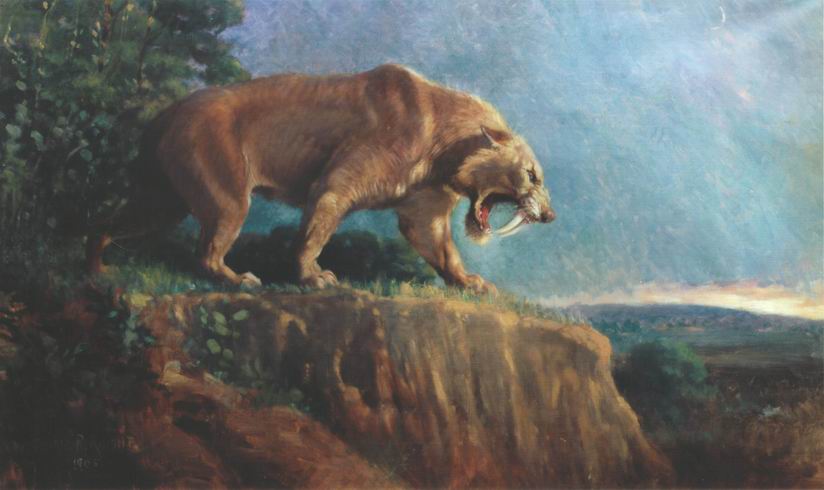
Smilodon by Charles Knight

SMILODAR
Neutral Medium Humanoid, Average Intelligence; Hunting Band (1d8) or Tribe (80 + 50% + 1d4 x 5 smilodons)

HD 2; AC 12; ATK 1 clawed gauntlet (1d4) and/or spear (1d6) or throwing axe (1d6) or bite (1d4); MV 30 (Leap 15); Save F 12, R 15, W 15; XP 100; Special: Leap into combat.

The smilodar are cat-headed men and women with tawny fur and sabre-teeth. They dwell in steppes and sometimes on the edges of deserts, hunting prey and raiding nearby human and demi-human settlements. While they bear no particular ill will towards most, smilodars have an innate hatred of gnolls and attack them on sight. Smilodars stand about 7 feet tall. They speak their own language and that of large, predatory cats, and might also learn Common, Gnoll and Goblin.

A typical smilodar warrior wears a leather loincloth and carries a clawed metal gauntlet (1d4 damage), spear and a throwing axe or four javelins.

Elite smilodar warriors are mounted on the backs of semi-domesticated smilodons. They fashion leather saddles that allow them to lock their hind-claws into leather flaps and thus ride using only one hand to steady themselves. Smilodars control their mounts with sounds and scents rather than reins.

In combat, smilodars can leap from their mounts, covering up to 15 feet and attacking as though making a charge. Their mounts then fight in concert with their masters, who can attack with spear and clawed gauntlet each round with a -2 penalty to hit with each. If disarmed, they can still bite for 1d4 points of damage.

SMILODARS AS CHARACTERS
Smilodars tend to come from primitive backwaters and lost lands. They adjust their starting ability scores as follows: Strength +1, Constitution +1, Intelligence -1. Smilodars retain the leaping ability of their monstrous cousins, essentially using it as a charge attack that does not require them to move at least 30 feet. As with all charges, they suffer the normal penalty to AC when charging. Smilodars can multi-class as barbarian/clerics and barbarian/thieves. They speak Smilodar and the language of large, predatory cats, and might also choose to learn Common, Elf, Gnoll and Goblin.

Best. Monster. Ever. [A Poll]

Image found at flumph.com. No, seriously.

My work on Blood & Treasure is rapidly coming to a close. Only a couple small sections are left to be written and I’m now embarking on editing the sizable tome. I’ve managed to include most of the monsters of the SRD, including a few psionic beasts (some rely too heavily on the d20 psionic system to work well without it) and many of the epic level monsters (toned down a bit).

About the only monsters that didn’t make the cut were those of the “monster +1” variety – i.e. a monster with additional hit dice or class levels. With all the myriad systems and calculations, statting up monsters like that was useful in d20, but in Blood & Treasure its mostly a waste of space. Even the “alternate iconics” have all made it in as well, from the greymalkin to the evil eye to the phrenic scourge. That being said, there’s always room for a few more monsters.

So – my question is this: What is the best monster ever! that wasn’t included in the SRD, but does exist in some open content source?

In particular, I want to know what you think is the best monster ever! from each of the following books:

[I’ll keep a tally as people comment]

AD&D’s Fiend Folio

Beaktapus (as an alternative to the Grell) … 2 votes
Crypt Thing … 1 vote
Dark Creepers and Stalkers … 1/2 vote
Death Knight … 1 vote
Flail Snail … 2 votes
Skulk … 1/2 vote
Slaad … 3 votes

* I think it’s a testament that by far the most response is for Fiend Folio monsters. It’s may favorite as well, and I guess I just draw that sort of crowd!

** Looks like the slaad are starting to run away with this one

AD&D’s Monster Manual II

Metal Monsters (as an alternative to the modrons) … 1 vote

D&D’s Rules Cyclopedia 

Rakasta … 1 vote

Any of the myriad d20 sourcebooks

Clockwork Horrors (an alternative version, of course) … 1 vote
Hengeyokai (an original version, most likely) … 3 votes
Primordial Ooze (as an alternative to the deepspawn) … 1 vote

I’d love to hear from the readers … what is your favorite that you’d like to see in Blood & Treasure?

Cover of the Day

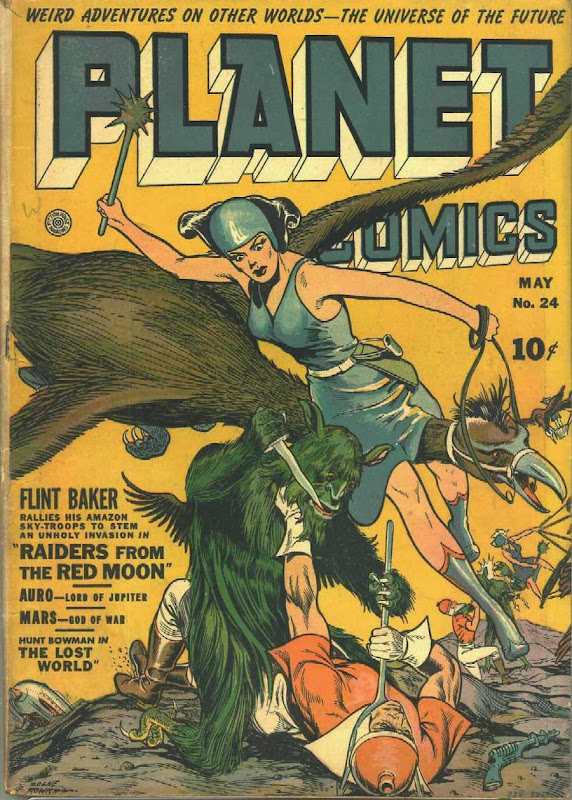
So tell me, dear readers. Is this fantasy or science-fantasy? Or science-fiction? I don’t know, but I do know that I love everything about this cover. Let’s break it down, along with some quick stats for Space Princess and Blood & Treasure.

We have to start with our heroine. Who sez the ladies were always helpless victims on old pulp and comic book covers? Okay, maybe 99% of the time, but still. From the cover blurb, we can assume this is one of Flint Baker’s amazon sky-troops. AMAZON SKY-TROOPS. Please tell me that phrase makes you smile. Tastefully dressed amazons equipped with morningstars flying about on the surprisingly strong necks of mutant vultures. If you look at the background closely, you’ll see that some of the amazons are riding on flat platforms being pulled by the birds – maybe the sci-fi equivalent of floating discs.

Amazon Sky-Trooper (B&T): Medium Humanoid, Neutral, Average Intelligence; HD 3; AC 14 [5]; Atk 1 morningstar (1d6+1); Move 30; Save F 14/R 12/W 14; XP 150; Special: No penalty to attack while mounted.

Amazon Sky-Trooper (SP): HD 3; DEF 16; FIGHT 8 (1d6+1); SHOOT 9; MOVE N; STR 5; DEX 6; MEN 4; KNO 4; DL 3; Special: No penalty to attack while mounted.

Vulturoid (B&T): Medium Animal, Neutral, Animal Intelligence; HD 6; AC 13 [6]; Atk 2 claws (1d6) and bite (1d6); Move 20 (Fly 90); Save F 10/R 9/W 15; XP 300; Special: None.

Vulturoid (SP): HD 6; DEF 17; FIGHT 14 (1d6); SHOOT 10; MOVE F; STR 8; DEX 4; MEN 3; KNO 0; DL 6; Special: None.


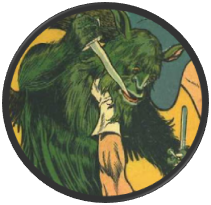
Moving downward, we come across a furry gent who is apparently a raider from the Red Moon. Perhaps we could also call him a Red Moonman. He’s not only furry, he also has cute little ears and demonic talons for feet. And check out the fork he’s holding that guy down with.

Raider of the Red Moon (B&T): Medium Humanoid, Chaotic, Low Intelligence; HD 2; AC 15 [4]; Atk 1 war-fork (1d4), dagger (1d4) or 2 talons (1d4); Move 20; Save F 12/R 15/W 16; XP 200; Special: Resistance to cold, can make two attacks per round with weapons, or, if has initiative, pounce and make four attacks with weapons and talons.

Raider of the Red Moon (SP): HD 2; DEF 16; FIGHT 6 (1d4); SHOOT 6; MOVE S; STR 4; DEX 4; MEN 4; KNO 2; DL 2; Special: Resistance to cold, can make two attacks per round with weapons, or, if has initiative, pounce and make four attacks with weapons and talons.

If we continue down, we meet, I assume, Flint Baker, and frankly, he’s the least interesting thing on this cover. No pixels will be wasted on Flint.

Other stories include Auro, Lord of Jupiter, Mars, God of War and Hunt Bowman in the Lost World. If you don’t name your next ranger Hunt Bowman, you might be taking your gaming just a tad too serious.

Big, Green and Plenty Mean [Monster]

In honor of the new John Carter movie (no, I haven’t seen it), and the fact that this kick ass illustration is in the public domain, I present everyone’s favorite green, four armed aliens for a variety of systems with the serial numbers just barely filed off.

Consider this baby Open Game Content.

ZHARKS (GREEN MARTIANS)

Illustration by J. Allen St. John

Zharks are tall (18-ft for males, 12-ft for females) humanoids who inhabit ruined cities in great wastelands. Exceptionally warlike and cruel, they form great hordes that compete, violently, for resources and slaves. Zharks have long torsos that support four arms, one pair located about 2 feet above the other. They have large eyes, ear stalks on the top of their bald heads, and great tusks jutting from their mouths. Zharks have olive green to dark green skin that is thick and waxy, helping to keep their bodies from losing too much moisture in the warm deserts they call home.

Zharks arm themselves with swords, spears and radium guns. These guns are exceptionally long rifles that fire bullets with a core of radium. When the outer casing of the bullets cracks and the radium is exposed to sunlight, it explodes for an additional 1d6 points of damage. Some zharks carry smaller radium pistols. The zharks acquire their more high-tech weaponry from others, for they are only capable of crafting primitive weapons.

Zharks are usually mounted on eight-legged monsters called zhotes. Their arch enemies are the girallons.

BLOOD & TREASURE
Zhark, Large Monstrous Humanoid, Chaotic, Average Intelligence
HD 5; AC 14; Atk 4 weapon attacks; Move 40; Saves F 12, R 11, W 11; XP 250; Special: None.

SWORDS & WIZARDRY

Zhark: HD 5; AC 5 [14]; Atk 4 weapon attacks; Move 15; Save 12; CL/XP 5/240; Special: None.

MYSTERY MEN

Zhark: LVL 5; PH 7 (+2); MN 3; DC 15; SPD 2; XP 500; Atk 4 weapon attacks.

SPACE PRINCESS

Zhark: HD 5; DEF 16; FIGHT 12 (1d10); SHOOT 9 (2d6); MOVE N; STR 7; DEX 4; MEN 5; KNO 3; DL 6; Special: Can make a total of four attacks each round.

A Fantasy Cosmos

While writing (or, to some degree, copy/pasting from the SRD) Blood & Treasure the other day, I finally came to the section on the planes. I decided, for a sample cosmos (and I do mean sample – there is no official cosmology for Blood & Treasure), to present something like the one I use for NOD. I thought folks might like to see it, but note – it lacks a mention of Hell or the Firmament at the moment.

ONE POSSIBLE COSMOLOGY

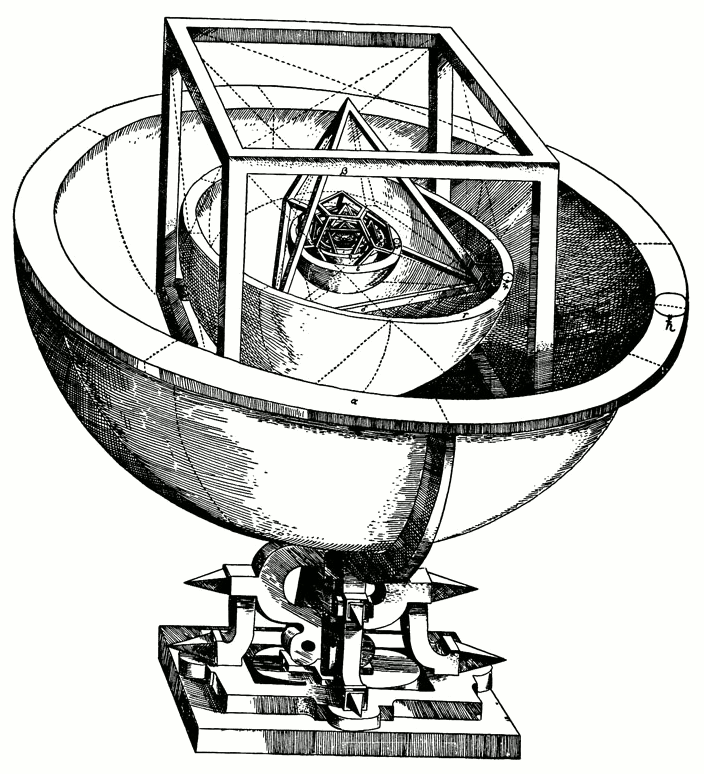
This cosmology of planes is inspired by the old Ptolomaic view of the universe, i.e. The Earth at the center of the universe surrounded by “crystalline spheres” containing the different planets and beyond them the Empyrean Heaven of God and the angels. At the center of Earth lies Hell, essentially a plane within a plane.

In this conception, the Ethereal Plane extends beyond Earth to the Moon, but no further. The Astral Plane extends throughout the entire universe, to the borders of the Empyrean Heaven.
All of the planes (i.e. planets) in this cosmology other than the Empyrean Heaven are self-contained spheres. Heaven is infinite.

EARTH AND THE MOON (MATERIAL PLANE)
Earth and the Moon are the Material Plane, the center of the universe. The Moon differs from Earth only in that it is mildly-chaotic. They define what is considered normal. The Material Plane has the following traits:

• Normal gravity.

• Normal Time

• Alterable morphic.

• No Elemental or Energy Traits (specific locations may have these traits, however)

• Mildly neutral-aligned (mildly chaos-aligned for the Moon).

• Normal magic.

THE ETHEREAL PLANE
The Ethereal Plane is coexistent with the Material Plane and the plane of Luna. The Material Plane itself is visible from the Ethereal Plane, but it appears muted and indistinct, its colors blurring into each other and its edges turning fuzzy.

While it is possible to see into the Material Plane from the Ethereal Plane, the Ethereal Plane is usually invisible to those on the Material Plane. Normally, creatures on the Ethereal Plane cannot attack creatures on the Material Plane, and vice versa. A traveler on the Ethereal Plane is invisible, incorporeal, and silent to someone on the Material Plane.

The Ethereal Plane is mostly empty of structures and impediments. However, the plane has its own inhabitants. Some of these are other ethereal travelers, but the ghosts found here pose a particular peril to those who walk the fog.
It has the following traits.

• No gravity.

• Alterable morphic. The plane contains little to alter, however.

• Mildly neutral-aligned.

• Normal magic. Spells function normally on the Ethereal Plane, though they do not cross into the Material Plane. The only exceptions are spells and spell-like abilities that have the force descriptor and abjuration spells that affect ethereal beings. Spellcasters on the Material Plane must have some way to detect foes on the Ethereal Plane before targeting them with force-based spells, of course. While it’s possible to hit ethereal enemies with a force spell cast on the Material Plane, the reverse isn’t possible. No magical attacks cross from the Ethereal Plane to the Material Plane, including force attacks.

PLANE OF SHADOW
The Plane of Shadow is a dimly lit dimension that is both coterminous to and coexistent with the Material Plane. It overlaps the Material Plane much as the Ethereal Plane does, so a planar traveler can use the Plane of Shadow to cover great distances quickly.

The Plane of Shadow is also coterminous to other planes. With the right spell, a character can use the Plane of Shadow to visit other realities.

The Plane of Shadow is a world of black and white; color itself has been bleached from the environment. It is otherwise appears similar to the Material Plane.

Despite the lack of light sources, various plants, animals, and humanoids call the Plane of Shadow home.

The Plane of Shadow is magically morphic, and parts continually flow onto other planes. As a result, creating a precise map of the plane is next to impossible, despite the presence of landmarks.

The Plane of Shadow has the following traits.

• Magically morphic. Certain spells modify the base material of the Plane of Shadow. The utility and power of these spells within the Plane of Shadow make them particularly useful for explorers and natives alike.

• Mildly neutral-aligned.

• Enhanced magic. Spells of shadow are enhanced on the Plane of Shadow. Such spells are cast as though they were prepared with the Maximize Spell feat. Shadow conjuration and shadow evocation spells are 30% as powerful as the conjurations and evocations they mimic (as opposed to 20%). Greater shadow conjuration and greater shadow evocation are 70% as powerful (not 60%), and a shades spell conjures at 90% of the power of the original (not 80%).

• Impeded magic. Spells that use or generate light or fire may fizzle when cast on the Plane of Shadow. Spells that produce light are less effective in general, because all light sources have their ranges halved here. Despite the dark nature of the Plane of Shadow, spells that produce, use, or manipulate darkness are unaffected by the plane.

THE ASTRAL PLANE
The Astral Plane is the space between the planes. When a character moves through an interplanar portal or projects her spirit to a different plane of existence, she travels through the Astral Plane. Spells that allow instantaneous movement across a plane briefly touch the Astral Plane.

The Astral Plane is a great, endless sphere of clear silvery sky, both above and below. Occasional bits of solid matter can be found here, but most of the Astral Plane is an endless, open domain. Both planar travelers and refugees from other planes call the Astral Plane home.

The Astral Plane has the following traits.

• Subjective directional gravity.

• Timeless. Age, hunger, thirst, poison, and natural healing don’t function in the Astral Plane, though they resume functioning when the traveler leaves the Astral Plane.

• Mildly neutral-aligned.

• Enhanced magic. All spells and spell-like abilities used within the Astral Plane may be employed as if they were improved by the Quicken Spell feat. Already quickened spells and spell-like abilities are unaffected, as are spells from magic items. Spells so quickened are still prepared and cast at their unmodified level. As with the Quicken Spell feat, only one quickened spell can be cast per round.

MERCURY (ELEMENTAL PLANE OF EARTH)
Mercury is a solid sphere of rock and metal burrowed through by a multitude if tunnels and caverns. An unwary and unprepared traveler to Mercury may find himself entombed within this vast solidity of material and have his life crushed into nothingness, his powdered remains a warning to any foolish enough to follow.

Despite its solid, unyielding nature, Mercury is varied in its consistency, ranging from soft soil to veins of heavier and more valuable metal.

Mercury has the following traits.

• Earth-dominant.

• Enhanced magic. Spells and spell-like abilities that use, manipulate, or create earth or stone are both empowered and extended (as if the Empower Spell and Extend Spell metamagic feats had been used on them). Spells and spell-like abilities that are already empowered or extended are unaffected by this benefit.

• Impeded magic. Spells and spell-like abilities that use or create air (including spells that summon air elementals or outsiders with the air subtype) are impeded.

VENUS (POSITIVE ENERGY PLANE)
Venus is a lush world of brilliant, almost blinding color and overgrown vegetation and animals. Some area of the plane are so fertile that entering them can actually cause a person to explode with life.

Venus has the following traits.

• Normal gravity.

• Minor positive-dominant. Some regions of the plane have the major positive-dominant trait instead, and those islands may be inhabited by various divinities of fertility and life.

• Enhanced magic. Spells and spell-like abilities that use positive energy, including cure spells, are maximized (as if the Maximize Spell metamagic feat had been used on them). Spells and spell-like abilities that are already maximized are unaffected by this benefit. Class abilities that use positive energy, such as turning and destroying undead, gain a +10 bonus on the roll to determine Hit Dice affected.

• Impeded magic. Spells and spell-like abilities that use negative energy (including inflict spells) are impeded.

MARS (PLANE OF NEUTRALITY)
Mars is an earth-like plane dedicated to neutrality in the war between Law and Chaos. It is a small sphere and taken up by red, sandstone hills, shallow, salty seas, lowlands of red, tuberous plants watered by vast canals and gleaming, ancient cities slowly falling into ruin. The various people of Mars are warriors who glory in combat.

Mars has the following traits.

• Light gravity.

• Strongly neutral-aligned. Lawfuls and chaotic suffer a -2 penalty to reaction checks and to intelligence- and wisdom-based checks.

• Limited magic. The following spells operate normally on Mars: Detect thoughts (ESP), xxx. All other spells fail to operate here.

• Flowing time. Time passes more quickly on Mars than the Material Plane. A year spent on Mars corresponds to a day on the Material Plane.

SUN (ELEMENTAL PLANE OF FIRE)
Everything is alight on the Sun. The ground is nothing more than great, evershifting plates of compressed flame. The air ripples with the heat of continual firestorms, and the most common liquid is magma, not water. The oceans are made of liquid flame, and the mountains ooze with molten lava. Fire survives here without need for fuel or air, but flammables brought onto the plane are consumed readily.

The Sun has the following traits.

• Fire-dominant.

• Enhanced magic. Spells and spell-like abilities with the fire descriptor are both maximized and enlarged (as if the Maximize Spell and Enlarge Spell had been used on them). Spells and spell-like abilities that are already maximized or enlarged are unaffected by this benefit.

• Impeded magic. Spells and spell-like abilities that use or create water (including spells that summon water elementals or outsiders with the water subtype) are impeded.

JUPITER (ELEMENTAL PLANE OF AIR)
Jupiter is a giant spheric plane of air. At the heart of Jupiter there is a core of iron and adamantine, and there are other bits of solid ground and water vapor floating amid the endless, roiling skies of Jupiter.

Jupiter is the home of all manner of airborne creatures. Indeed, flying creatures find themselves at a great advantage on this plane. While travelers without flight can survive easily here, they are at a disadvantage.

Jupiter has the following traits.

• Subjective directional gravity. Inhabitants of the plane determine their own “down” direction. Objects not under the motive force of others do not move.

• Air-dominant.

• Enhanced magic. Spells and spell-like abilities that use, manipulate, or create air are both empowered and enlarged (as if the Empower Spell and Enlarge Spell metamagic feats had been used on them).

• Impeded magic. Spells and spell-like abilities that use or create earth (including spells that summon earth elementals or earth-based outsiders) are impeded.

SATURN (PLANE OF CHAOS)
Saturn is a plane infused with chaos, and therefore quite alien to most folk of the Material Plane. It is covered by all manner of fascinating land-scapes, including ashen plains cut by streams of mercury, swamps of sentient ooze, thickets of mineral plants like sheaves of swords and towering mountains of vapor, all under a greenish-black sky illuminated by the plane’s wondrous rings from which ioun stones are plucked.

Saturn has the following traits:

• Strongly chaos-aligned. Lawfuls suffer a -2 penalty to reaction checks and to intelligence- and wisdom-based checks.

• Wild magic.

NEPTUNE (ELEMENTAL PLANE OF WATER)
Neptune is a sea without a floor or a surface; an entirely fluid sphere lit by a diffuse glow. It is one of the more hospitable of the Inner Planes once a traveler gets past the problem of breathing.

The eternal oceans of this plane vary between ice cold and boiling hot, between saline and fresh. They are perpetually in motion, wracked by currents and tides. The plane’s permanent settlements form around bits of flotsam and jetsam suspended within this endless liquid. These settlements drift on the tides of the plane of Neptune.

Neptune has the following traits.

• Subjective directional gravity. The gravity here works similar to that of the Elemental Plane of Air. But sinking or rising on the Elemental Plane of Water is slower (and less dangerous) than on the Elemental Plane of Air.

• Water-dominant.

• Enhanced magic. Spells and spell-like abilities that use or create water are both extended and enlarged (as if the Extend Spell and Enlarge Spell metamagic feats had been used on them). Spells and spell-like abilities that are already extended or enlarged are unaffected by this benefit.

• Impeded magic. Spells and spell-like abilities with the fire descriptor are impeded.

URANUS (PLANE OF LAW)
Uranus is the opposite of Saturn, a plane of law and perfection. Uranus has the same landscapes as the Material Plane, but they are each perfect and slightly angular, often repetitious, as though made by the will of a single artist. The skies and landscapes of Uranus all carry a metallic hue – warm coppers, brilliant silvers and dazzling golds.
Uranus has the following traits:

• Strongly law-aligned. Chaotics suffer a -2 penalty to reaction checks and to intelligence- and wisdom-based checks.

• Static. Uranus cannot be altered by visitors.

• Timeless. Time does not flow on Uranus.

PLUTO (NEGATIVE ENERGY PLANE)
To an observer, there’s little to see on Pluto. It is a dark, empty place, an eternal pit where a traveler can fall until the plane itself steals away all light and life. Pluto is the most hostile of the planets, and the most uncaring and intolerant of life. Only creatures immune to its life-draining energies can survive there.

Pluto has the following traits.

• Subjective directional gravity.

• Major negative-dominant. Some areas within the plane have only the minor negative-dominant trait, and these islands tend to be inhabited.

• Enhanced magic. Spells and spell-like abilities that use negative energy are maximized. Spells and spell-like abilities that are already maximized are unaffected by this benefit. Class abilities that use negative energy, such as rebuking and controlling undead, gain a +10 bonus on the roll.

• Impeded magic. Spells and spell-like abilities that use positive energy, including cure spells, are impeded. Characters on this plane take a –10 penalty on Fortitude saving throws made to regain lost levels from a life drain attack.
B&T Lost Classes: The Shadowdancer

The shadowdancer is an interesting little class. While I don’t think of it being an archetype of fantasy fiction (at least not the old stuff I read), one can imagine it fitting in well with Gygax’s concept of a “shadow plane” and even with some of the mythology surrounding the ninja. Ultimately, I don’t know where this class fits in, but I do know that somebody out there could have a good time playing one, and that’s good enough for me.

Shadowdancer

Silhouette from Telecanter

Shadowdancers are characters akin to thieves and assassins, with mystic powers related to the mysterious shadow plane.

Requirements: Shadowdancers must have dexterity and charisma scores of 13 or higher.

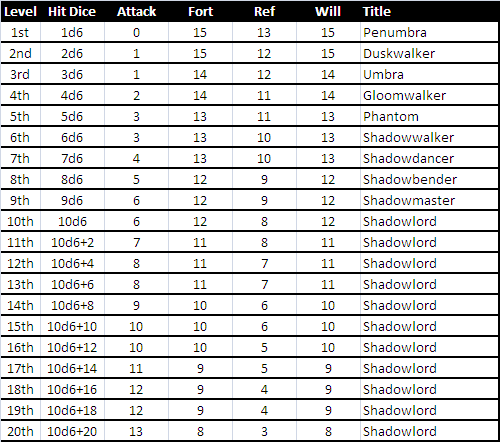
Hit Dice: d6 (+2 hit points per level from 10th to 20th).

Armor: Padded and leather armor.

Shield: Bucklers.

Weapons: Club, crossbow (any), dagger, dart, light mace, morningstar, punching dagger, quarterstaff, rapier, sap, shortbow and short sword.

Skills: Balance, decipher script, disguise, escape, hide, jump, legerdemain, listen at doors and move silently.

CLASS FEATURES

Shadowdancers are so at home in the darkness that they gain darkvision to a range of 60 feet. They are so skilled at hiding in shadows that, as long as there are shadows within 10 feet, they gain a +3 bonus to all hide attempts as the shadows seem to flow over their bodies. Furthermore, a shadowdancer can use the spell deeper darkness three times per day.

At 2nd level, a shadowdancer can create visual illusions per the spell silent image once per day, but only if in a shadowy area.

At 3rd level a shadowdance learns to separate her own shadow into an independent entity. Unlike a normal shadow, this shadow’s alignment matches that of the shadowdancer and the creature cannot create spawn. The summoned shadow cannot be turned, rebuked, or commanded by any third party. This shadow serves as a companion to the shadowdancer and can communicate intelligibly with the shadowdancer. Every third level gained by the shadowdancer adds +2 HD to her shadow companion.

If a shadow companion is destroyed, or the shadowdancer chooses to dismiss it, the shadowdancer must attempt a Fortitude save. If the saving throw fails, the shadowdancer loses 200 experience points per shadowdancer level. A successful saving throw reduces the loss by half, to 100 XP per class level. The shadowdancer’s XP total can never go below 0 as the result of a shadow’s dismissal or destruction. A destroyed or dismissed shadow companion cannot be replaced for 30 days.

At 4th level, a shadowdancer gains the ability to travel between shadows as if by means of a dimension door spell. The limitation is that the magical transport must begin and end in an area with at least some shadow. A shadowdancer can jump up to a total of 20 feet each day in this way; this may be a single jump of 20 feet or two jumps of 10 feet each. Every two levels higher than 4th, the distance a shadowdancer can jump each day doubles (40 feet at 6th, 80 feet at 8th, and 160 feet at 10th). This amount can be split among many jumps, but each one, no matter how small, counts as a 10-foot increment.

Starting at 6th level, once per day, when a shadowdancer would be reduced to 0 hit points or less by damage in combat (from a weapon or other blow, not a spell or special ability), she can attempt to roll with the damage. She makes a Reflex saving throw and, if successful, takes only half damage from the blow. She must be aware of the attack and able to react to it in order to execute her defensive roll.

At 8th level, the shadowdancer can cast the blacklight spell once per day.

At 10th level, the shadowdancer can cast the shadow conjuration spell once per day. Their use of the blacklight spell increases to three per day, and they can use deeper darkness and silent image five times per day.

At 12th level, the shadow dancer can cast the shadow evocation spell once per day. Their use of shadow conjuration increases to three times per day, they can use blacklight and silent image five times per day and cast deeper darkness at will.

Blood & Treasure: An Idea and a Problem

Before I begin this post … The NOD 13 E-Book is back up for sale. I had forgotten to credit an artist, so I needed to bring it down until I could fix the PDF this morning. So – back up for sale, $3.50. Buy it HERE if you’ve a mind to.

Now back to our regularly scheduled post …

How many readers do yard work or putter around in the garden? If not, I highly suggest it, because it gives you time to think and create.

THE IDEA

B&T Ranger by Jon Kaufman

Today I was putting in a veggie garden and while I toiled a thought popped into my head. I want Blood & Treasure to be inclusive of all the editions that fed into the SRD – but that means a Referee who wants to run the game without some material from one or another edition has to put together a list for his players of what material is forbidden. That’s a pain in the butt.

So, working off of ideas I’ve seen floated around by Zak Smith and Jeff Rients and possibly others, I thought I might help those Referees out. Obviously, if a Referee is exluding material based on the theme of his or her campaign, I can’t read their minds and help with that. But, if they want to exclude things based on the edition it showed up in, that I can handle.

The idea is simple. I’m using three categories of material:

Classic: For me, this is the material that showed up in the three original books and material from the “basic” game written by Holmes and expanded by Moldvay, Cook and Mentzer. So, the four basic classes (yes, of course you don’t have to use the thief), the human, elf, dwarf and halfling, the old stand-by spells and the old stand-by monsters.

Advanced: This is the stuff from the original supplements as well as the first edition of AD&D. Material (i.e. classes, races, spells and monsters) that is “advanced” will be marked with a little black diamond next to the name.

Expanded: This is the stuff that showed up in the 2nd and 3rd editions of the game, from feats to sorcerers to tieflings to grey renders. Expanded material will be marked with a little black circle.

So, if a Referee just wants to run a “classic” campaign, he can tell the players to avoid any race, class or spell marked with a diamond or circle.  Likewise, those who want an “advanced” campaign can caution players not to attempt to use materials marked with a circle. Simple and, I think, not too intrusive. Let me know what you think …

THE PROBLEM
Inclusivity is nice, but it poses some problems. For all intents and purposes, I am finished writing Blood & Treasure and it looks like it’s coming in around 300 big fat pages. That’s a sizable book, and not to some peoples’ taste. So …

How about I produce three books?

One will be a 300 page monster with everything in it. This should run in the $30 range.

The other two will be divided into a Player’s Guide with the classes, races, spells and basic rules (combat, skills, saving throws, etc.) and a Referee’s Guide with monsters, treasure and info on creating and running adventures and campaign worlds. These would probably sell in the $15 range.

My only worry here is that somebody could accidentally buy all three and waste some of their hard earned money.

Again, let me know what you think.