Kendrick Lim (kunkka) produces beautiful, full, rich colors – very vibrant and satisfying.
KUNKKA
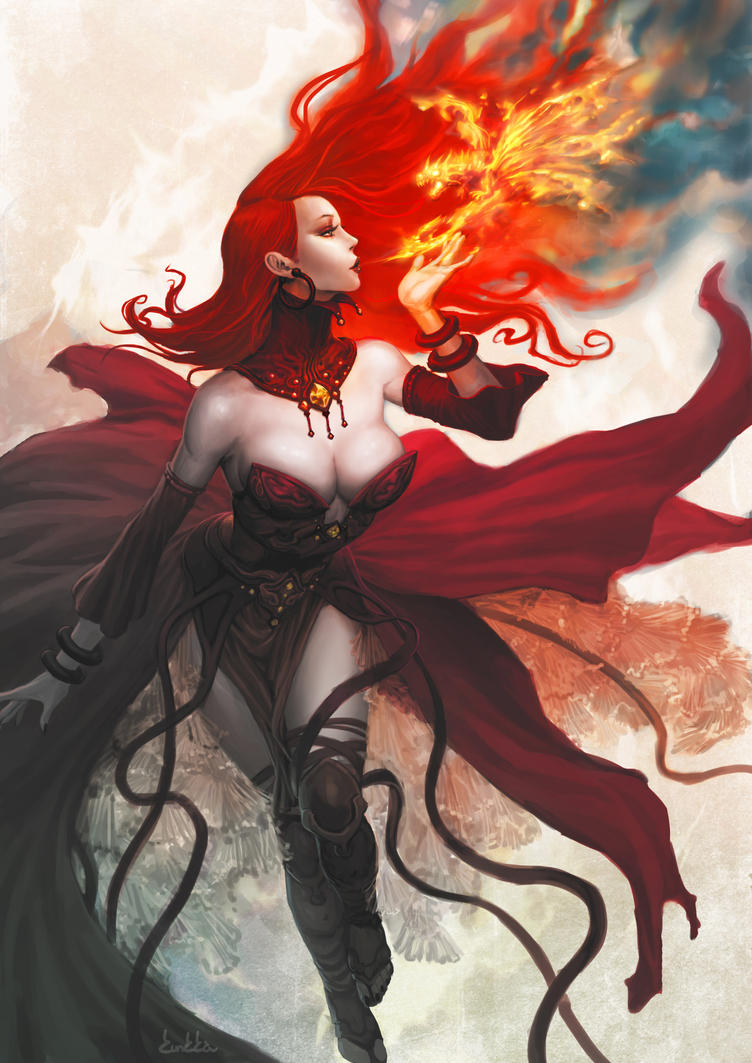
Maiden of Fire
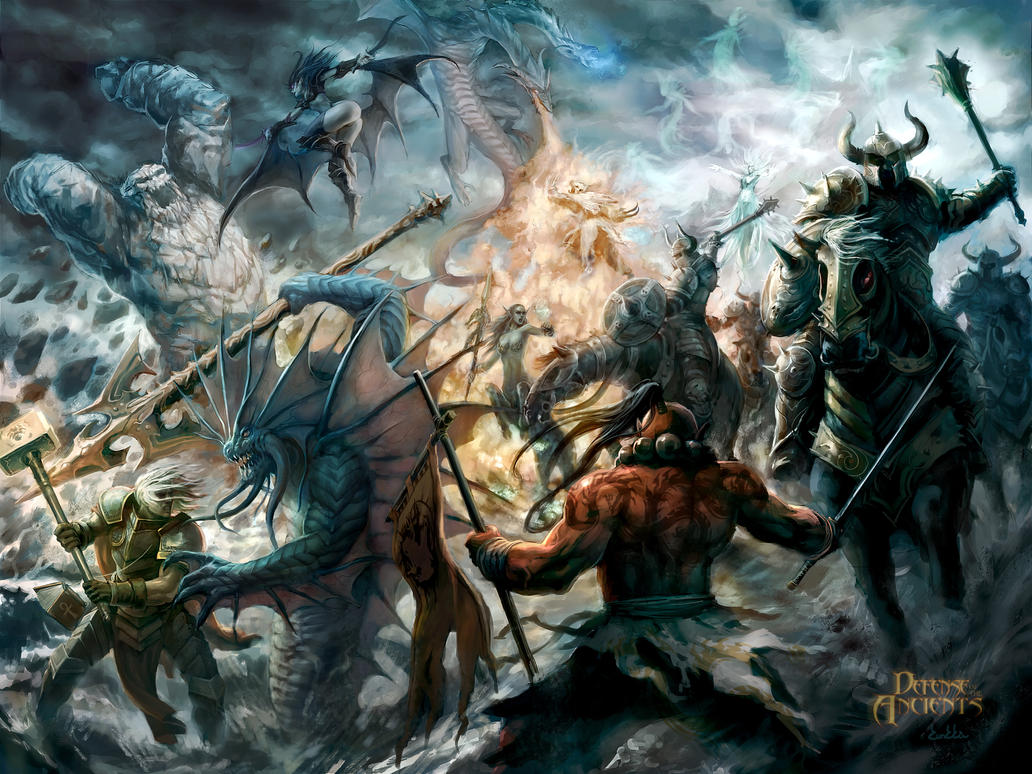
Defense of the Ancients
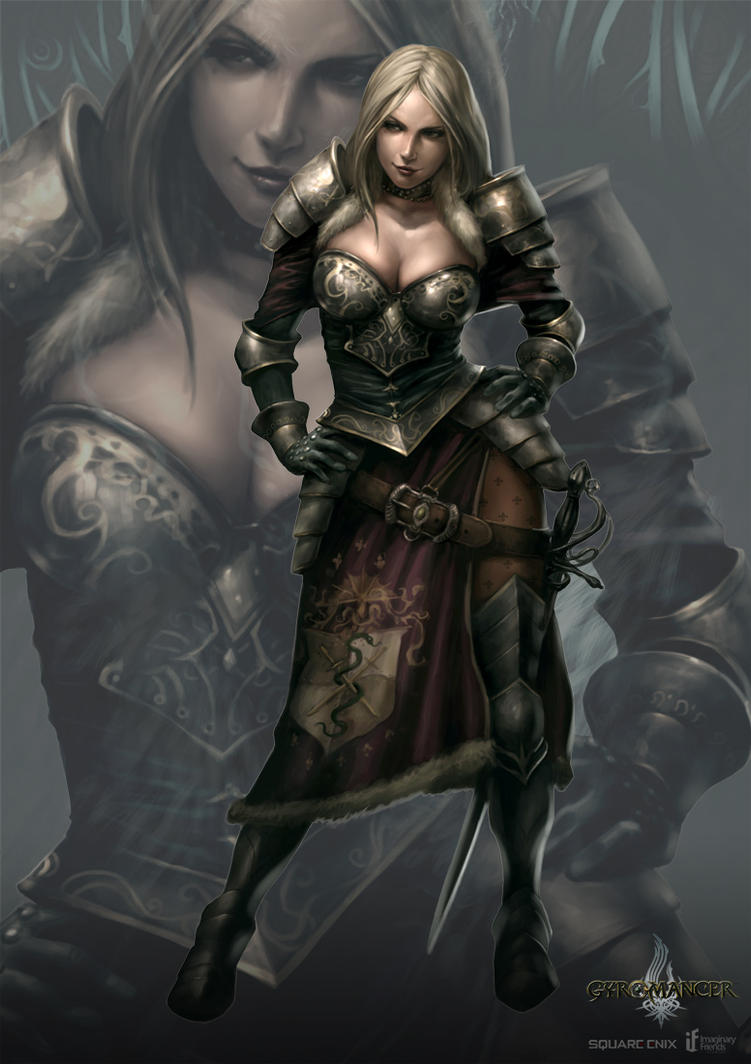
Gina – gyromancer
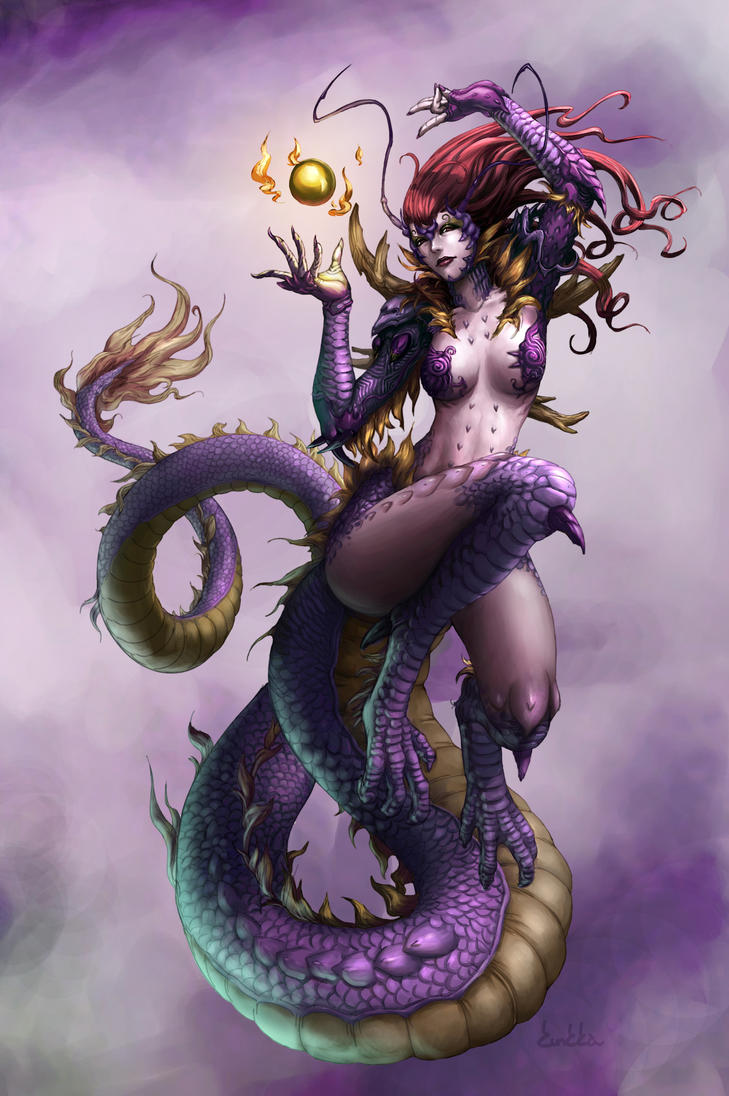
Dragon Lady
Kendrick Lim (kunkka) produces beautiful, full, rich colors – very vibrant and satisfying.
Another preview – maybe the last before the release of NOD 11. I’m going to try to finish the first Hell hex crawl installment this weekend and publish sometime next week. I think the schedule will be …
NOD 11 – Ante-Hell, Circle 1 and Circle 2 – North half
NOD 12 – Ante-Hell, Circle 1 and Circle 2 – South half
NOD 13 – Circles 2-5
NOD 14 – Circle 6 (City of Dis)
NOD 15 – Circles 7-9
I think it’s safe to say that by NOD 15, I’ll be sick and tired of writing about Hell.
In the meantime – here’s the preview material …
15.39 Aella: This windy hex holds the stronghold of Aella, titaness of whirlwinds, daughter of Khaos. Aella’s barony is always windy, with the direction of the wind shifting substantially from moment to moment and whirlwinds forming each hour on a roll of 1 on 1d4 (treat as an air elemental’s whirlwind power).
In the midst of these winds there is a great dome of tarnished gold. The dome is pierced by a grand gatehouse of white marble with towers 60 feet tall and inner and outer portcullises. The gatehouse and dome are defended by 15 companies of sinister bronze men, who pour molten bronze upon people from murder holes in the gatehouse (6d6 damage, save for half) and 5 squadrons of harpies, who pepper invaders with arrows and sing their terrible songs.
Aella is lithe and graceful, but her green eyes have a malevolent cast and her red hair is wild and unkempt. Her skin is the color of a crimson sunset and her frame is encased in mithral platemail. She carries a massive glaive. Her treasure includes 3,920 gp, 740 pp and a silver idol in a copper basin (worth 14,000 gp) that depicts her father.
18.28 Mount Kippat: Kippat is a lonely mountain that towers over the surrounding savannah. Plumes of white and yellow smoke pour out of crevices near the base (climbers must save vs. poison or fall unconscious and fall for 6d6 points of damage). The cracks and crevices of the mountain are inhabited by a tribe (really multiple families) of 400 goblins. The crevices are anywhere from 10 to 30 feet deep, and the bottoms have been hollowed out by the goblins, who sought both a place to live and the green garnets that abound here. Over time, the goblins tunneled deep into the mountain, discovering that the deeper one went, the larger the garnets became until they finally coalesced into a single garnet about 20 feet in diameter at the very center of the mountain. A bizarre creature appears to exist in the heart of the garnet. The garnet’s great size and faceted nature makes it difficult to discern just what it hides, but it is clearly evil and the garnets of its mountain seem to carry with them a taint to this mother garnet.
66.9 Water Bridge: A powerful gout of water emerges from the ground here and arcs into the distance, well past the horizon. One can step into the rushing water and, if they can hold their breath for 10 rounds or fight the current enough to keep their head out of water (requires an open doors roll each round) they are delivered across the hex, suffering only 3d6 points of damage for the journey.
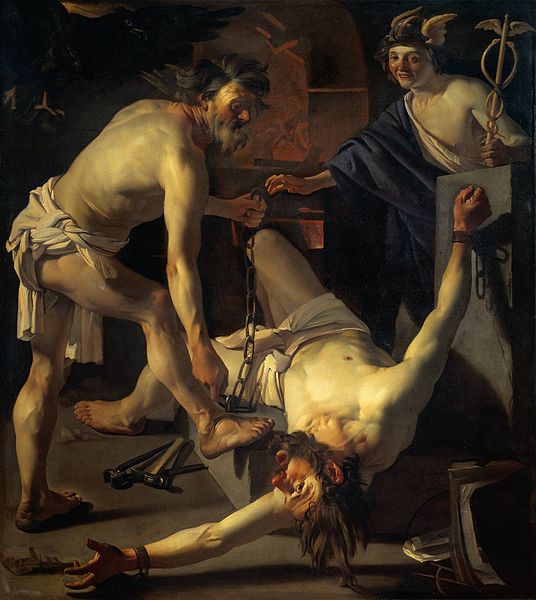
Unfortunately, the plume of water plunges back into the ground at the end of its journey, depositing the adventurer in a series of partially submerged limestone caverns crawling with giant centipedes, green slimes and other monstrosities. It is impossible to “swim” back up the flowing water and the limestone caves seem to climb ever downward, with waterfalls and submerged tunnels all the way. At the bottom of the caves there is a sickly titan chained to the cavern walls. The titan looks pale, its eyes rheumy and its lips lank and parched despite the moisture of the caverns.
The titan, Felix, is the son of Anatole, goddess of the sunrise and Sors, the god of luck. He was locked away, hidden from the Sun, as a means of tormenting his mother. His chains are semi-ethereal and pass through his wrists and ankles. They keep him weak and prevent him from using his magical powers. If freed, he would be a target for every demon and devil in Hell, but he would be a powerful ally for a time and a great help in escaping Hell.
—
Yeah, the titans were built with the help of THIS.

The esteemed Jason Sholtis is now working on illustrations for Space Princess, so the game’s release is imminent. To keep the atomic fires of excitement for this game stoked, I thought I’d provide a sampling of the super science that scientists in the game can build, provided they have the skill and resources.
Super Science
Super Science is our name for high-tech equipment. The following list of super science is not exhaustive, and Referees and the players of scientist characters should feel to invent new items.
The name of each item is followed by a number in parentheses. This number is the test value for a scientist’s skill test when trying to fabricate the item.
Found super science devices can be salvaged for parts. A working super science device is worth a number of SCI (science points) equal to half its test value, rounded down. Thus, a working anti-gravity belt is worth 7 SCI. A non-functional device is worth 1d6 SCI.
Anti-Grav Belt (TV 15): An anti-gravity belt allows one to rise or descend through the air (or vacuum) at a rate of 10 paces per round. An anti-gravity belt can be used 10 times before needing a recharge.
Electro-Scrambler (TV 20): An electro-scrambler can be used to disrupt the electric brains of robots, androids and gynoids. The effectiveness of an electro-scrambler depends on the skill level of the scientist who created it. When used, consult the following table:
Find the skill level of the inventor and then cross reference the number of Hit Dice of the robot. The resulting percentage is the chance that the electro-scrambler works. When unleashed, an electro-scrambler affects all robots, androids and gynoids in a 30-ft radius unless they have specifically been given immunity by the inventor of the device (i.e. a scientist can choose to make the androids and gynoids that are his allies immune to his electro-scrambler). Making these modifications costs five Science Points per android, gynoid, or robot so modified.
Robots that are affected must flee (usually while bleeping loudly and smoking) for 1d6+1 rounds in the opposite direction. If they cannot flee, they simply walk repeatedly into a wall. If attacked while affected by an electro-scrambler, a robot goes berserk, fighting back with a +2 bonus to hit. Androids and gynoids receive a Mentality test to ignore the effects of an electro-scrambler.
Force Screen (TV 10): A force screen is usually projected from a belt or other small piece of equipment attached to a person’s clothing. The force screen grants a +2 bonus to DEFENSE against missile attacks. It can be used for 10 rounds of combat before needing a recharge.
Invizo-Screen (TV 20): An invizo-screen emanates from a helmet worn on the head, making the person completely invisible for up to 10 rounds before it must be recharged. An invisible person has their Defense Rating increased by 10 if they do not attacks, and increased by 5 if they do attack in combat. Invisible people can still be heard, felt and smelled.
Medi-Kit (TV 10): A medi-kit is a small box that can dispense chemicals that heal wounds (+2d6 hit points) and neutralize poisons. A medi-kit can be used 6 times before its chemical stores must be replenished.
Mento-Helmet (TV 20): A mento-helmet amplified a person’s natural brain waves and performance. It grants a +2 bonus to mentality tests and gives a person the ESP ability of mystics. The mento-helmet can be used 10 times before needing a recharge.
Ray Gun – Basic (TV 10): A basic ray gun fires rays of energy. Ray guns can be used 10 times before they must be recharged. All ray guns have a range of 30 paces.
Ray Gun – Freeze (TV 15): A freeze ray immobilizes a creature for 1d4+1 rounds unless they pass a test of Strength (TV 10).
Space Suit (TV 10): A space suit allows a person to survive in a vacuum for 1 hour before its oxygen supply must be replenished. It consists of an air-tight suit of plastic and rubber, a glass helmet and oxygen tanks that can either be external or worked into the lining of the suit.
—
Image found HERE.

Over the past few months my wife and I have been watching Dark Shadows, the 1960’s gothic horror soap opera that eventually revolved around Barnabas Collins, a vampire from the coast of Maine. My wife and her friend got into Dark Shadows years ago when they were first released on video cassette and then DVD. I’m a newcomer to the saga, and, given my retro proclivities and love of quality cheese, I’m completely hooked.
For the old school RPG enthusiast, Dark Shadows is a pretty good fit. For starters, it has production values that are on par with our beloved LBB’s. Lines are forgotten, mike booms and cameras sometimes get into shots and impenetrable brick walls often shudder when touched. Re-shooting scenes was an expense the producers were not able or willing to incur, but I’m a firm believer that bad special effects do not ruin good stories. Dark Shadows is a cracking good story.
Most DVD collections ignore the early episodes in favor of the episodes that introduced Barnabas, who became the break-out hit of the series. The story begins with Victoria Winters taking a job as a tutor with the Collins family. The Collins family is suitably Gothic and weird. The grand dame is Elizabeth Collins Stoddard, who hasn’t left the family home in over a decade – and nobody knows why. Well, nobody except one Jason McGuire, who knows precisely why and is blackmailing Elizabeth as a result. McGuire, as played by Dennis Patrick, is so slimy I found myself dreading his arrival as much as the characters – and praying for his violent downfall as much as his victims as well. Elizabeth’s brother is Roger Collins, an alcoholic single father who was apparently married to a phoenix – i.e. his wife left him and then returned and revealed she was really a mythological creature who catches fire and burns. Weird. Roger’s son is David, a precocious boy (they always are in the 1960’s) who claims that the ghost of Josette Collins still haunts the old house on the estate (she does – for a while, at least, until a new ghost shows up). Elizabeth has a swinging daughter named Carolyn who hates Jason McGuire enough to take up with the world’s goofiest hippy biker just to piss off mom. Jason’s comrade in villainy is one Willy Loomis, who thinks he has discovered that the Collins family jewels are sealed in a crypt on Eagle Hill Cemetery, only to find out that something terrible is hidden within (I’m sure plenty of RPG tomb robbers can relate).
Barnabas, when he finally arrives, proves the maxim that you can’t judge a production by its budget. The storylines with him are often very creepy. His big goal, early on, is to be re-united with Josette, the woman he loved back in 1795. I won’t go into the details, but the storyline is well written and often well played and is disturbing even if you ignore the fact that Barnabas is a vampire. This is something for RPG referees to think about. Don’t let your villains be villains because of the special abilities written next to their names. Make them villainous because of what they do, not because of what they can do.
Eventually, Dr. Julia Hoffman arrives on the scene and adds a new dimension in villainy. She sees curing Barnabas of his vampirism as a way to establish herself as a medical genius, and pursues this with an amoral zeal that eventually catches up to her. Another good template for a villain in RPG’s – the amoral enabler whose agenda complicates the lives of the protagonists.
I highly suggest that folks with a Netflix account or some other way to access the series give it a try. Don’t be put off by the production values – as with the LBB’s, there’s some real treasure buried beneath the modest facade.
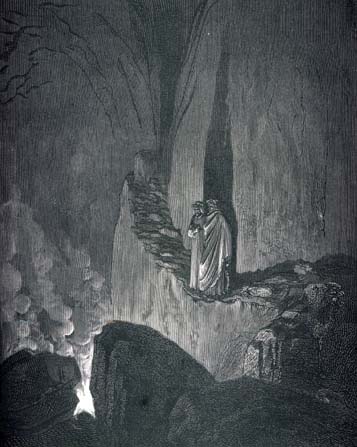
12.40. Hobgoblins: A tribe of 100 brutish hobgoblins burrow deep into the earth here in search of iron for their master, Flavros. Their village is a series of gray, adobe buildings bristling with spikes and stacked upon each other in the fashion of a great mound. The hobgoblins are overseen by an erinyes called Gofany, a reeve in service to Flavros, who is as paranoid and ill-tempered as any demon ever born into Hell. She is clothed in banded armor of leather and bronze and from her wings hand dozens of holy symbols taken from foolish clerics. The village is surrounded by a 20-ft deep moat filled with hundreds of spikes (actually tubes containing worms that infect wounds caused by the tubes; save vs. disease or lose 1 point of constitution each day as the worms burrow through flesh and spread their putrescence.
The hobgoblins leave the village in work gangs overseen by the largest and meanest hobgoblins of the tribe, venturing out to ancient mines where they descend into the darkness and return with sacks of iron ingots. They process the iron around their village, and great heaps of slag have completely blighted the meadows. At Gofany’s command, 1d6 of these slag heaps can rise up in the manner of earth elementals to combat her challengers.
Gofany keeps a treasure of 1,000 sp, 3,000 gp, 260 pp and a silver plate worth 16,000 gp. The plate, when filled with a bit of wine, acts as a scrying pool that shows any person alive living their most humiliating moment.
13.56. Sand Pit: The landscape here descends into a valley of dunes. Black rivulets flow into the sandy area from the surrounding landscape, forming a oozy marsh in the center. Strange totem poles of grotesques jut up from the sandy soil, apparently carved from living trees. These totem poles are few and far between when one first enters the hex, but become more numerous as one approaches the center. They seem to exert a strange influence over magic spells cast here as well, an influence that becomes more pronounced as they become more numerous. The chance that a spell cast in the hex goes awry starts at 15%. For each mile towards the center of the hex one travels, that chance increases by 5%. If a spell is found to go awry, roll as though the spell caster has used a wand of wonder.
This strange hex has a forge fueled by cold, black fames at its heart. The flames arise from the heart of an ancient demon lord called Humbaba, long since slain by the forces of Law. The forge is worked by a three duergar brothers without names, who are themselves chained to the forge. They are currently beating upon a tangle of black, iron wires intended to become a crown for the succubus called Lady Scarlet, who dwells in a deeper Hell. The forge and the duergar are guarded by a company of dragon men who are clad in burning platemail and who wield military forks that drip with acid.
14.34. Saslarta’s Domicile: Saslarta is a pit fiend who controls a particularly unpleasant stronghold as a vassal of Azazel. Saslarta appears as a masculine, muscular humanoid with obsidian scales and a head reminiscent of a raven, upon which he wears a platinum diadem (12,000 gp). His stronghold is dull, ugly and filthy and stinks of feces. In fact, it is made of great bricks of excrement through which burrow worms and dung beetles (each turn spent inside the fortress carries a 1 in 6 chance of 1d4 rot grubs falling on you from above).
Saslarta’s fortress is surrounded by fields grazed by stench kows, the kows being tended by halfling cowherds, who split their time between tending the herds and patching the fortress walls with fresh loads of dung. The halflings are renowned leather workers. The fortress is defended by ten companies of manes demons.
The walls of the fortress are 50 feet high and it has nine mound-like towers. The entrance is via a barbican. The courtyard of the barbican is home to a chaos dragon called Mote. The wide halls and chambers of the fortress are jumbled together in a haphazard fashion, and there are numerous pits holding loathsome otyughs. A buzzing of giant flies constantly assaults the ears, and attacks by 2d6 the beasts occur on a 1 in 6 chance per hour. Saslarta’s throne room consists of a deep chamber guarded by rusted iron portcullises. His throne and the dais is rests on are made of concrete and are surrounded by a moat of raw sewage that drips from rusted pipes that jut from the walls at odd angles. The throne actually sits on a rusted iron grate, beneath which is his treasure chamber.
Saslarta’s treasure consists of 36,000 sp, 2,000 gp, 1,170 pp and a garnet worth 950 gp that was lodged in his eye during a fight with a movanic deva. The treasure is kept in a deep pit that is home to a truly massive otyugh with the face of Doukas Basileios, an ancient emperor of Nomo.
Just a few random images harvested from a grand tour of the internet.
Dang It’s a Great Day Department

Did Superman Ever Star in a Diorama Fighting a Cyclops? Department
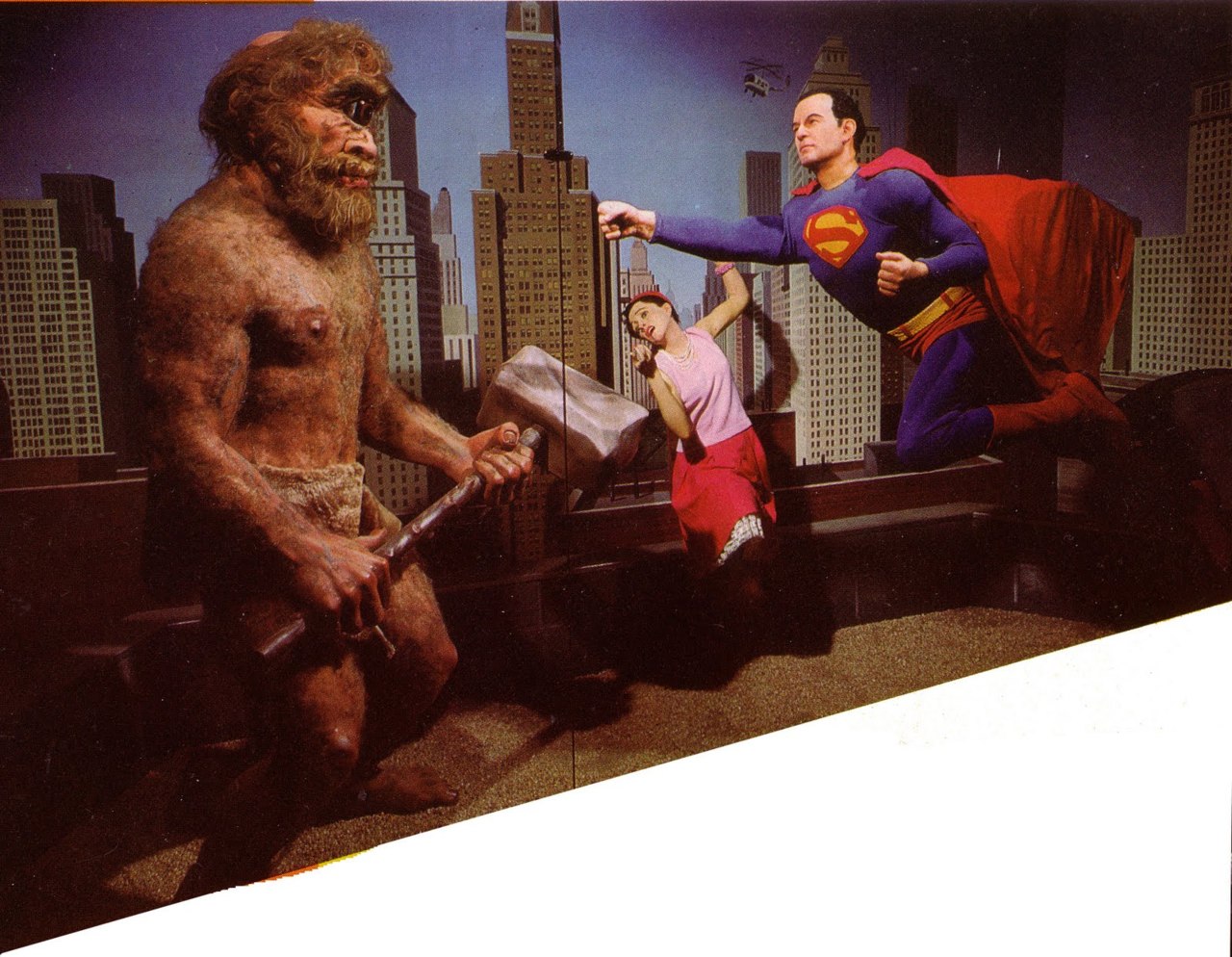
Yes. Yes he did. At the World’s Fair, in fact.
Geeks Come Out of Your Shell Department

Handy guide to the popular dances of the day. Don’t miss a chance to shake your geek thing.
G.I. Jump the Shark Department

This is the point when your toy line has take one step to many. See also – William “The Refrigerator” Perry with a football flail action figure.
Halloween Peaked in the 1970’s Deparment
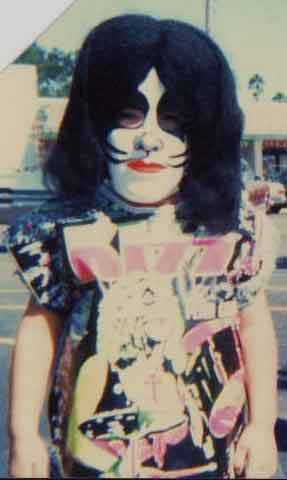
Let’s just be honest about it and move on with our lives.
Theo Ortner Kicks Ass Department

Those teeth are going to leave a mark.
Keep it Clean Department
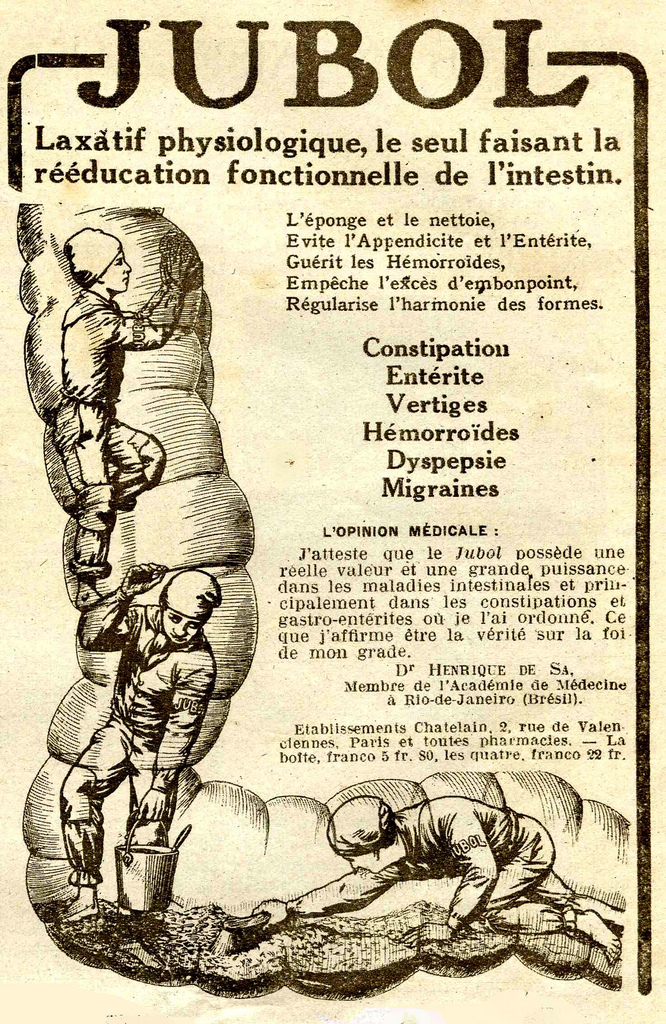
Yeah, ending it with the bowel gnomes.
Kennon James (Kennon9) is one of those artists who I would love to just toss some rules to and say “Here, illustrate these. Whatever you want.” Great style – very expressive and fun.
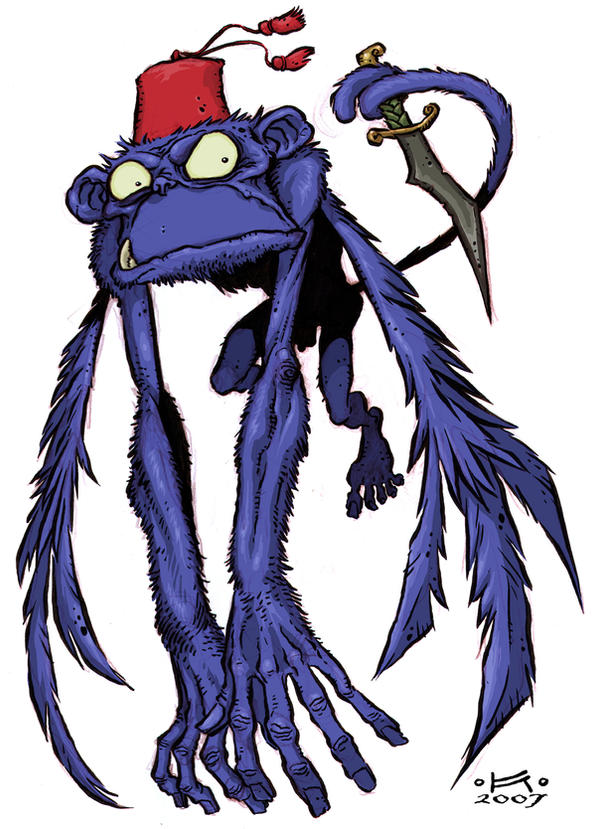

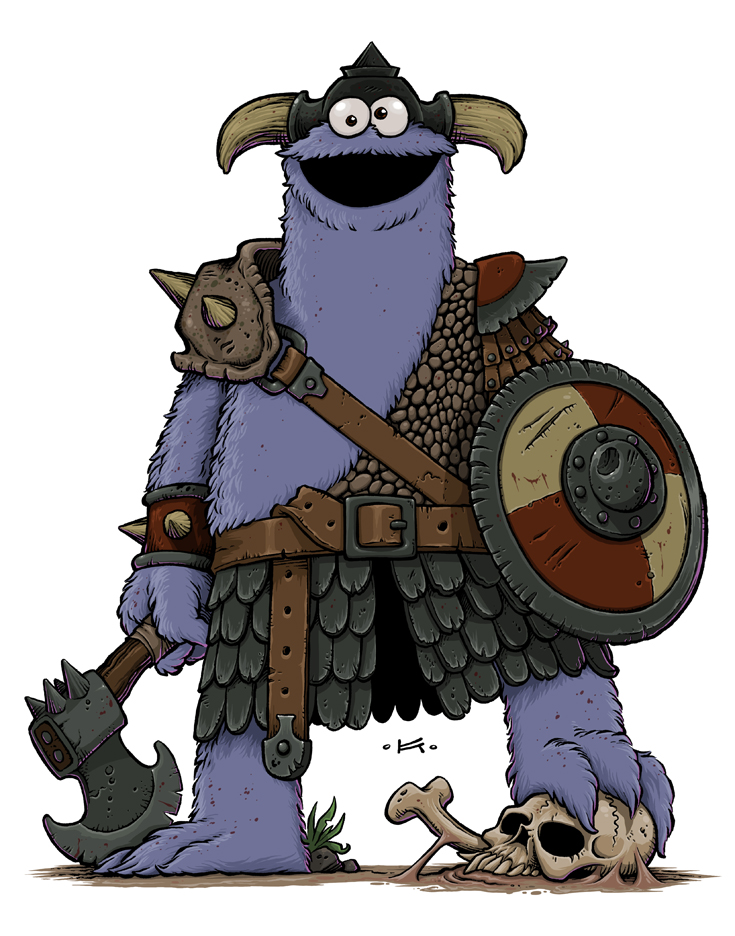
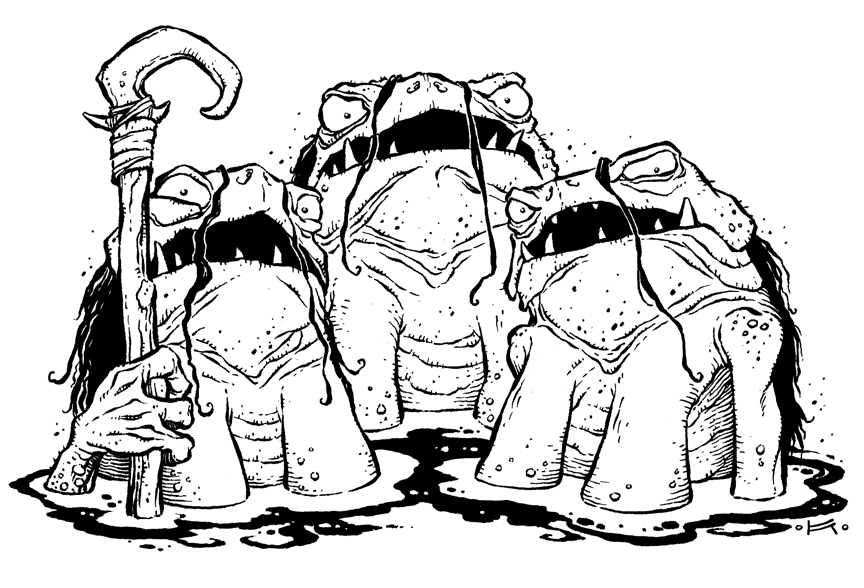
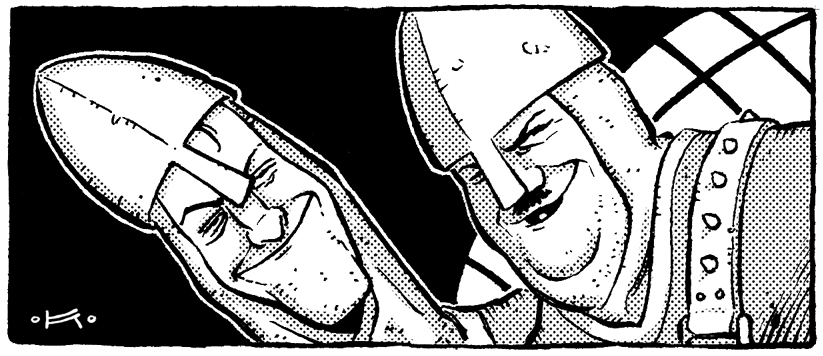
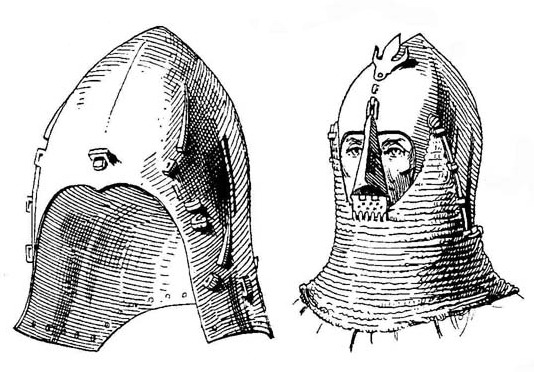
Dual helms are constructed in pairs and are connected to one another through subtle strings of being that float through the ether.
Gemini Helms
When little used, Gemini helms allow the two wearers to swap abilities. One category of ability can be swapped at a time for up to 1 hour in a 24 hour period. These categories are as follows: fighting ability (i.e. attack bonus), strength, intelligence, wisdom, constitution, dexterity, charisma, hit points (damage stays with the person damaged, though, so a person who normally has but 20 hit points and swaps it with his comrades 50 hit points will die when the switch it over if he’s taken more than 19 points of damage), saving throws (all categories, if applicable), prepared/memorized spells and spell casting ability and special abilities (i.e. a thief could swap his special thief abilities for a ranger’s special ranger abilities).
Each time a pair of people use the helms, there is a cumulative 1% chance of a feedback, up to a maximum chance of 12%. If a feedback occurs, consult the following table:
ROLL D10
1-6. Memory Swap: Particular memories swamp between the people – perhaps memories of their parents.
7-9. Personality Swap: This could also count as an alignment swap.
10. Combination: The pair average all of their ability scores and lose half of their class levels (-1), gaining half of their comrade’s class levels +1. In other words, a 6th level fighter and 8th level combined would turn into two 4th/5th level fighter/thieves.
Puppet Helms
Each of these helms acts as a helm of telepathy. It also gives its wearer the ability to impose his will on the wearer of the other puppet helm. When this battle of wills occurs, both players should roll 1d20. Whichever rolls the furthest under their charisma score wins the battle and can force their companion to do or say one thing that takes no more than 1 turn (10 minutes). The winner of this contest of wills suffers 1d3 points of charisma damage, the charisma damage disappearing after 8 hours of sleep.
Helms of Summoning
The wearer of one of these helms can remove it, strike it with a small platinum rod and say “Come Hither!” and their comrade appears beneath the helm (and no, not if you’re holding it over the edge of a cliff or under water – don’t be a pain in the ass). The other helm appears on the summoner’s head when his comrade appears. These helms can be used once per day, but with each use there is a cumulative 1% chance that the summoned comrade will actually be their double from another reality. This chance re-sets at the next full moon. If an alternate comrade appears, use the following table to determine what shows up:
ROLL D6
1. Zombie: Retains a feral intellect, thoroughly chaotic. Fights with as many Hit Dice as the person had levels, but loses any special abilities. Those who lose more than half their hit points to the zombie’s attacks must pass a saving throw or become a zombie themselves. Remove disease cures them, but only inflicts 1d6 points of damage per caster level to the summoned zombie.
2. Demonic: Has the abilities of the person summoned (or the reverse, if they were a cleric or paladin), but with a demonic cast and a chaotic alignment. The summoned demon is immune to fire and mind reading and has bat wings that give it a flight speed of 12.
3. Hulk: Summoned person is much larger than normal, with double the strength (or strength bonus, to keep it simple) and an intellect of 1d4+2. Might start calling the summoner “George” and develop a strange fascination with small, furry mammals.
4. Reverse Gender: Summoned person is of the opposite gender. All abilities stay the same, but personality might be slightly altered.
5. Evil Twin: Appears to be the person summoned, but is secretly chaotic and smart enough to realize the situation and use it to their advantage. If the summoned person was chaotic, the evil twin will attempt to kill and replace his or her double. If male, will eventually grow a goatee.
6. Lycanthrope: Summoned person is a lycanthrope (Ref’s choice).

9.51. Halflings: Far from the salt-of-the-earth, pleasant folk of the world above, the halflings of hell are bestial little fiends who delight in the torment of others, and especially of things larger than they are. They are the sum of all the fears and jealousies that infect their kin who dwell in the sunlight. These particular halflings dwell in the branches of a wood of thorny trees that covers most of this hex. The trees grow in clumps and have a bark that can be pulped and turned into a mild poison that they rub on their barbed whips. This poison adds +1 to the damage inflicted by the whips and raises especially large and uncomfortable welts on the skin (-2 effective dexterity for 24 hours).
The halflings dress in bark cloth and lurk in the branches, preparing to ambush travelers with their barbed nets. People captured are tortured to death (suffer 1d3 points of constitution damage each day until they die). The halflings then attempt to capture their shades with their nets when they appear. The shades of lawful and neutral creatures are especially valuable in Hell, but hard to hold onto.
The halflings live in small, clannish groups of about 1d10+20 individuals. There are twenty such groups in this hex and they are encountered on a roll of 1-2 on 1d6.
10.47. Traveling Salesman: The master of Hell has a soft spot in its heart for salesmen, and they are welcomed as honored guests in its myriad rings. One of the best is a man called Kharvel, a huckster extraordinary whose crooked dealings landed him in Hell after he died. He was granted his memories and his old body by the powers-that-be and now roams Asphodel atop a great achaierai he calls Tripoli. From here he sells all manner of goods stolen and traded for, including random potions (one in six is cursed to have the opposite effect and one in twelve of those is cursed to be permanent), maps (one in six is genuine), amulets (all fake), and other odds and ends.
Despite his dishonest nature, Kharvel is actually a good source of rumors and information about the netherworld, though he charges a high price for information. He looks like a well-proportioned, rugged man with golden skin, a balding pate and a devilish beard and mustache. He wears a white tunic and cloak, worn sandals and a leather belt that holds a curved sword, several pouches and pipes of the sewer. These pipes summon shadow rats instead of the normal, mortal variety.
11.46. Ruined Fortress: While the lords of Hell may appear to be eternal and everlasting, they are as mutable, in a way, as humanity. Demons are creatures of spirit and thus immortal, but they can be reduced in stature by their peers and mortal challengers. Such was the fate of Pashatiel, a demon of doorways and beginnings and endings who deigned challenge the power of Flavros and was duly defeated and demoted.
Pashatiel’s fortress was constructed of iron blocks welded together. The fortress had two layers of walls – an outer wall 25 feet tall with 11 towers standing 30 feet tall, and an inner wall 30 feet tall with 8 towers standing 35 feet tall. The place is without windows. The top of the towers are shaped like the pretty, outstretched hands of a maiden.
The fortress is now empty. The demons who died here fighting the army of Flavros have melted away into the landscape. Weapons and armor, including hundreds of arrows that retain their poisoned tips, are scattered about the place, many atop black stains on the walls and floor that have a vaguely humanoid shape.
The interior of the fortress is clad in ivory-colored marble that is very clean and very smooth. Hallways, doorways and archways abound in this weird, quiet place, with actual chambers being few and far between. When people pass through the archways and doorways, they feel a tickle on the back of their neck, as though something is watching them and has made a note of their arrival. The interior is like a maze, and there is but a 2 in 6 chance per round (3 in 6 for elves, 4 in 6 for dwarves) of making any real progress.
The only chamber of note in the fortress is the inner sanctum, a sort of circular great hall at the heart of the place containing a throne atop a circular dais. Sprawled on this throne is Pashatiel, who in life took the form of a short, graceful man with deep wrinkles on his bronze-colored face, wide, gray, catlike eyes and long, straight, night-black hair. His appearance is now ashen and indistinct – like a shadow rather than a demon lord. Pashatiel is now a prisoner of his fortress – reduced in stature to a mere shadow demon.
Pashatiel inhabits the walls, floors and ceilings of his fortress, with the dais being the focus of his spirit and power. He can, with a thought, disappear from the dais and re-emerge from any wall, floor or ceiling. He can also command 2d4 shadows or 1d4 allips to arise from the black stains on the walls and floors.
If defeated as a shadow demon, Pashatiel sinks into the ground and re-emerges some time later as a mere lemure. Beneath the dais, which weighs 3 tons, there is a hidden treasure cache containing 1,250 gp and 400 sp.
—
Image from HERE. From the Monkees episode The Devil and Peter Tork – I wanted one of the devil as salesman, but I got this instead.
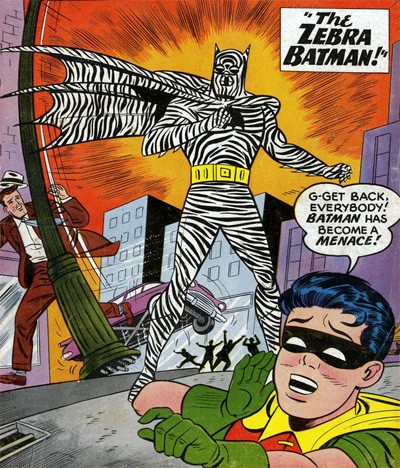
Is your superhero campaign getting a little staid – a little routine – maybe boring. Would you consider bringing the insanity of DC’s Silver Age into it? Can your players handle the challenge, or are they a bunch of mopey, modern age cry babies who think getting turned into a gorilla is some kind of punishment? If you answered yes and/or no to the questions in the appropriate order … oh Hell – here’s a chart. Roll a dice.

I think my next MM! Google + campaign will draw heavily on the imaginary stories from DC’s Silver Age, though I have no idea how as yet.
—
Edited to correct an error.
 Land of Nod