The All-New, All-Different NOD #1

Okay, actually neither new nor different, but I did fix a few things and turned it into a zip file to make downloading easier. Apparently, since Friday it got 147 downloads, which blows me away. Thanks to all who downloaded it, and I truly hope you get something useful out of it.

So, far, NOD #2 looks like it will have:

Books & Scrolls
Ophir: City of Slaves
Some Ideas on Weapons
Scientist NPC class
Thieves and Assassins
Trade Items – alternate treasures
Urban Settings

Maybe a serialized fantasy story (via Project Gutenberg, if I can figure out how to do it without breaking any laws)

Previews of the magic system and some spells from my PARS FORTUNATM project.

When I get enough material to fill an issue, I will release it. Next one might be free, or might carry a small charge. I would like to eventually have some original art in these things, and that will cost some money. Still, I’ll keep them as cheap as possible.

Lin Carter’s The Barbarian of World’s End

Ganelon Silvermane, a name to conjure … well, to conjure the imagination of a thirteen year-old boy. Lin Carter’s Gondwane epic, of which The Barbarian of World’s End is fourth book (hey, I started the Lord of Rings with Two Towers, I guess it’s a habit), is a strange thing. Reading the book, I felt like I was reading a bizarre fairy tale meant for children (or children at heart). There is very little dialogue, and the dialogue there is is not the stuff of Shakespeare. The prose is written as though the story is being told to you by an uncle – and from the subject matter, probably a very strange uncle whose had a bit too much to drink.

I am aware that this sounds like I’m trashing the book, but I really rather liked it. It is not great literature, but it is as imaginative as hell. The characters, creatures and city-states of Gondwane would feel right at home in Encounter Critical and any campaign setting that you could imagine would feel at home in Encounter Critical. Mobile cities, flying castles, tiger men, noseless brigands – dozens of things to fire the imagination of any Referee trying to run a retro-stupid world and have a blast doing it. When I started the book, I was not that impressed. When I finished the book, I was determined to find the rest of the epic and see what other bizarre creations Lin Carter had up his sleeve.

On Ophir, The City of Slaves Part 2

As mentioned in a previous post, I only detail a small part of a city-state. This gives the players a “home range” that they understand, and tends to make the various NPCs more important and meaningful because they are interacted with more often. Naturally, if an entire campaign were to be set in a city-state, I would detail more of it.

Most of the inhabitants detailed below do not have combat statistics presented for them. In these cases, use one of the following sets of statistics:

• Academics: HD 1d4; AC 9 [10]; Atk 1 fist (1d2) or weapon (1d4); Move 12; Save 18; CL/XP A/5; Special: Skills depend on the academic’s profession.

• Aristocrats: HD 1; AC 7 [12]; Atk 1 weapon (1d8); Move 12; Save 17; CL/XP 1/15; Special: None.

• Commoner: HD 1d6; AC 9 [10]; Atk 1 fist (1d2) or weapon (1d4); Move 12; Save 18; CL/XP B/10; Special: Skills depend on the commoner’s profession.

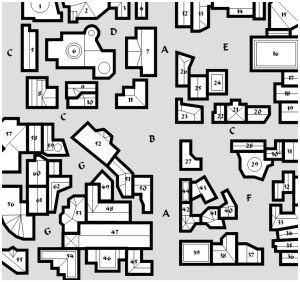
A. Purple Street
Named for the old Purple Kingdom, of which Ophir was once the capital. The Purple Kingdom was named for the purple dyes that the people of the Wyvern Coast once specialized in. Purple Street has the look of a fancy street that is showing its age. Most of the entryways are set a few feet below street level. The street is paved with prophyry tiles (a purple stone) and lined with limestone troughs filled by water bearers in the employ of Zargo.

Crowds along this street include foreigners just arriving to the city (including adventurers), street walkers, citizens going about their businesses, noisy fishwives, sailors looking for a good time, urchins practicing their pick pocketing (1 n 6 chance adventurers lose a purse or other small item while on this streets) and guardsmen. Priestly processions also move up and down this street, as do herds of animals purchased in the Beast Market and headed for a merchant galley or cog.

Following this street north, one eventually reaches the Palace of Zargo and the manor of his grand vizier. To the south, the street reaches the banks of the River Asphodel and the quays and warehouses that line them.

Grand Vizier: Lathta is Prince Zargo’s grand vizier. He is a youthful cousin, dandyish and pessimistic, but completely honorable. His four-story manor abuts the palace and connects to it with secret tunnels that also, via trapdoors, connect to the catacombs. Lathta does not like Zargo, but fears to act against him, though he does his best to intercede for victims of the Prince’s cruelty. Lathta’s wives, Jamila and Hasda, live on his country estate with his seven children (all sons). Lathta keeps his treasure (150 pp, 580 gp, 480 sp, a large red garnet worth 400 gp) in a locked vault in his cellar. His manor is always under the guard of twenty men-at-arms (chainmail, shield, battle axe, light crossbow, 10 bolts).

• Lathta: HD 3 (14 hp); AC 3 [16]; Atk 1 weapon (1d8+1); Move 12; Save 14; CL/XP 3/60; Special: None. Masterwork long sword, masterwork chainmail, shield, silver dagger, torque of office (gold studded with amethysts, worth 800 gp).

Palace: The palace of Prince Zargo dominates the center of Ophir. Composed of six-foot thick grantie walls, it is five stories tall and features two onion-shaped domes covered in beaten gold. The palace’s courtyard features gardens and fountains and leads to the prince’s stables, which house his twelve racing stallions.

The palace is under the constant guard of thirty men-at-arms under the command of three sergeants, a lieutenant called Galim and Elektra, the captain of the palace guard. The entrance to the palace is guarded by Korvos, an ogre. Korvos is virtuous and honorable, and much beloved by the children of Ophir. He is known to be loyal to the prince, and has never been known to be derelict in his duties.

Zargo keeps most of his treasures in the Treasury, but he keeps numerous art objects (15,000 gp worth) spread throughout his palace. Zargo has a harem of twenty wives and 43 children. Zargo’s older children live outside the city-state on his manors. His younger children (fifteen of them) live in the palace with their mothers. Zargo’s harem is protected by five eunuch bodyguards (HP 13, 11, 10, 10, 10), all wearing chainmail hauberks and armed with curved two-handed swords.

Zargo is advised by his grand vizier (see above). His court magician is Jamala, a necromancer with access to the catacombs beneath the city-state and a laboratory in which she experiments with re-animating dead tissue. Zargo’s chapel, dedicated to Lotan, is overseen by Taru the Black, a rival and ex-lover of Aralla, the pontiff of Ophir and high priestess of Lotan. He still bears the scars of their romance.

• Elektra, Fighting-Woman Lvl 6: HP 38; AC 1 [18]; Save 11; Platemail, shield, curved long sword, silver dagger, longbow, 20 arrows, 5d6 gp, ring of spell turning, a gift from Jamala to seal a secret deal. She wears a full helm with a brass wyvern crest and a red tunic emblazoned with the gold sea wyvern of Ophir over armor.

• Galim, Fighting-Man Lvl 3: HP 13; AC 1 [18]; Save 14; Platemail, shield, curved long sword, dagger, longbow, 20 arrows, 3d6 gp. He wears a red tunic emblazoned with a gold sea wyvern over his armor, and a helm topped by two leather horns painted yellow.

• Jamala, Magic-User Lvl 9: HP 32; AC 10 [9]; Save 7; Special: Magic-user spells (5th); Silver dagger, spellbook, chime of opening, 9d6 gp. Jamala’s laboratory is protected by six zombies. She wears crimson robes traced with golden runes and flashy (but mostly brass) jewelry worth 50 gp. Jamala walks with a limp, one of her feet being mauled once by a chimera and replaced in a semi-successful experiment with the foot of a dead dancing girl.

• Korvos, Beastman Fighting-Man Lvl 7: HP 43; AC 2 [17]; Atk 1 two-handed sword (1d10); Move 9; Save 10; CL/XP 8/800; Special: Tremendous strength (+2), only surprised on 1 in 10, fights blind with no penalties, can detect invisible creatures and discern lies on a 1-22 on 1d6; Chainmail, shield, two-handed sword (used in one hand), 5d6 gp.

• Taru, Cleric Lvl 4: HP 24; AC 3 [16]; Save 11; Special: Cleric spells (2nd); Plate mail, shield, heavy mace, holy symbol of Lotan, scroll of cure light wounds, 4d6 gp.

• Zargo, Assassin Lvl 11: HP 40; AC 3 [16]; Save 5 (4 vs. death); Special: High dexterity (+1), cheat death, decipher script, disguise, sneak attack for quadruple damage, stealth, poison; Dagger of poison (save or +1d6 damage and searing pain), silver darts (5), elven chainmail, periapt of proof against poison.

B. The Market of Braying Beasts
At the intersection of Purple Street and the Processionary is the racous animal market. Temporary pens fill the center of the square and hold goats, sheep, cattle, horses and camels (and occaisionally more exotic and dangerous creatures). Surrounding the pens are numerous merchants selling the beasts, almost always in large lots, to other merchants, who might then march them down Purple Street to an awaiting galley on the river. Animals are never moved north from the market, as this is forbidden. They enter the market in large, noisy herds from the Processionary, either from east or west. The assassins of the city conduct most of their business here in the din and cover of the crowds.

C. The Processionary
This is the main street between the gates of the city -state. It has considerable cart and camel traffic, and is thronged by peddlers, tinkers, sailors, prostitutes and cutpurses. It is paved with limestone cobbles, which are in poor repair and present a hazard to those who would engage in a fight (save each round or fall prone). Following the Processionary east leads to the Garrison, and to the west leads to the Chancery and Royal Treasury.

Chancery: This is the manse of Riba, the Chancellor of Ophir (meaning she is in charge of the city-state’s finances and tax collection). Riba is the prince’s aunt and holds her office despite her stated distaste for many of his actions and methods. She is an old woman, moody and blustering and feared by her tax collectors. She suspects that Zargo is the leader of the assassins and would dearly like to expose and destroy him and take the throne herself. She is served by several servants who are led by her valet, Horak. Riba is tall and stately, with long, braided silver hair and thin lips often turned down in a scowl. She dresses in robes of dazzling colors and keeps her jewelry simple and understated (gold, 300 gp worth).

Royal Treasury: This building is a fortress of limestone blocks with a single entrance protected by an steel portcullis. It is guarded by thirty men-at-arms (fifteen archers with ring mail, shield, light crossbow, 10 bolts and hand axe and fifteen heavy footmen with chainmail, shield, pole arm and curved short sword). The treasury’s commandant is Balulla, a Cushite with sharpened teeth and an absolute dedication to duty. Balulla is assisted by two sergeants, Jali and Hasif.

The treasury contains the following treasures in locked (and poisoned gas trapped) iron strongboxes. The sum total is 13,000 sp, 500 ep, 12,100 gp, 20 pp, a silver aquamanile worth 4,800 gp, 15 ingots of gold (45 lb, 100 gp/lb) and 30 pounds of purple dye in terracotta pots (worth 3 gp/lb).

• Balulla, Barbarian Lvl 3: HP 21; AC 7 [12]; Save 13; Special: Cannot be flanked or back stabbed, fears magic, berserk; Battle axe, throwing irons (treat as hand axe), leather armor, necklace of polished bone and quartz crystals worth 150 gp, 3d6 gp.

• Jali: HD 3 (14 hp); AC 5 [14]; Atk 1 weapon (1d8); Move 12; Save 14; CL/XP 3/60; Special: None. Longbow, curved short sword, ring armor, shield, 1d6 gp.

• Hasif: HD 3 (10 hp); AC 3 [16]; Atk 1 weapon (1d8); Move 12; Save 14; CL/XP 3/60; Special: None. Chainmail, shield, pole arm, short sword, 1d6 gp.

Garrison: The garrison is a large keep of limestone with five tall towers. The commander of the garrison is Lord Amiral. Amiral has chiseled features. He is mysterious and philisophical and worships the Ogdoad, agents of Chaos. He has five wives, the eldest handling the day-to-day affairs of his house and, truth be told, his command. He has twenty children (12 sons, 8 daughters) ranging in age from 3 to 26. Two of his sons, Zarkon and Farim, serve under him. His eldest daughter has received extensive training as a magic-user. His treasure consists of 10,000 cp, 10,000 sp and 1,100 gp kept in a vault in the keep protected with a fire trap (4d6 damage). Amiral makes no bones about his religion. He devoutly worships the chaotic Ogdoad. This has raised the ire of the Temple of Lotan, but worship of the frog gods has spread among his soldiers.

• Amiral, Fighting-Man Lvl 5: HP 31; AC 0 [19]; Save 12; Masterwork platemail, shield, masterwork long sword, silver dagger, masterwork lance, golden holy symbol of chaos worth 100 gp.

• Zarkon, Fighting-Man Lvl 2: HP 12; AC 0 [19]; Save 15; Masterwork platemail, shield, long sword, dagger, lance, ring of protection +1.

• Farim, Fighting-Man Lvl 2: HP 7; AC 2 [17]; Save 15; Platemail, battle axe, pistol (treat as light crossbow), 10 shots, dagger.

• Kelara, Magic-User Lvl 3: HP 10; AC 8 [11]; Save 13; Special: Magic-user spells (2nd), can maximize one spell per week; Staff, silver dagger, spellbook.

Tomorrow I will finish up the denizens of Ophir (well, not all of them, I have to save something for NOD #2). I’m then going to post some ideas on wilderness campaigns and strongholds and then delve into the Nabu desert sandbox to the east of the Wyvern Coast. Somewhere along the line I’ll post the druid and illusionist and do some previews for PARS FORTUNATM.

Inspiring Churches and Undersea Gardens

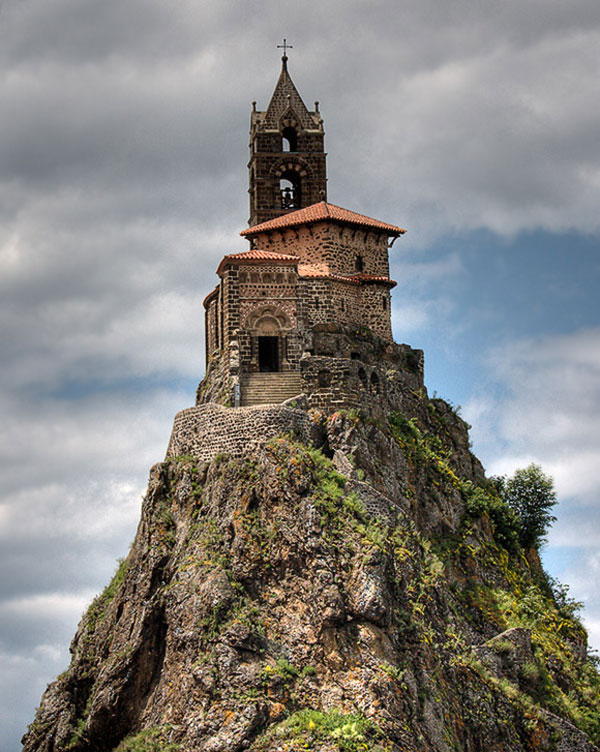
Visit this site for photos of 50 amazing churches – good inspiration for those who need to erect a few astounding temples to forgotten gods in their sandbox.

Visit this site for photos of undersea gardens in Asia – good inspiration for those who have dedicated themselves to treating the aquatic portions of their sandboxes the same as they treat their non-aquatic ones (what the heck was I thinking?)

And visit my site later today for my first downloadable issue of NOD. I hope. It’s going to be a long day.

Emphyrio by Jack Vance

While I was on my trip to Chicago, I managed to finish Emphyrio by Jack Vance, published in 1969. In enjoyed the book, but I always enjoy Jack Vance, so that might have had something to do with it. Like all of his works, it was full of lovely (or at least interesting) descriptions; full of wonder yet believable – the wondrous mundane, if you will.

The story concerns the life of one Ghyl Tarvoke, inhabitant of the planet Halma and member of a slightly repressive society. The story follows Ghyl’s life from boy to man, and is reminiscent of the journeys of Cugel (but with a more respectable protagonist). The story is science fiction, but really only in terms of the setting. Like all of Vance’s material, Emphyrio is about the characters and the interplay of the characters and the world they find themselves in. I was satisfied with the story’s conclusion, though the “twist” that leads to it was pretty obvious in retrospect, and I’m surprised I didn’t pick up on it until Ghyl did.

Vance is always a fun read for me. He does a good job of writing into his stories a pervasive danger derived from the way the stories within the story so rarely play out the way they “should”, and from Vance’s willingness to deny characters, important and unimportant, a pleasant ending.

Back from Stoink!

My three day conference in Chicago, as good as it was, is thankfully over and I’m back in Vegas. I have a book review to write, a PDF to get out (about 90% done, little art left to deal with) and some encounters in the infamous city of Ophir to write about. And the artwork to the right – has nothing to do with anything. Just a coffer corpse strangling a mildly peeved high-level cleric. And congratulations to those who get the reference in the title …

On Ophir, The City of Slaves – Part One

  • Size: Town (5,000 citizens)
  • Race: Human
  • Temples: Lotan; also Astarte, Baal-Zebul, Kothar-wa-Khasis, Melkarth, Shedu, Tangadorn
  • Ruler: Prince Zargo (Human Assassin Lvl 11)
  • High Priest: Aralla of the Temple of Lotan (Human Cleric/Magic-User Lvl 7)
  • Guildmaster: Ketha (Human Thief Lvl 10)
  • Theme: Barbary Pirates, Swords & Sandals
  • Accent: Vaguely Middle Eastern
  • Vistas: Towers, raised highways, remnants of an ancient city, worn and weathered walls, tarnished domes, lazy citizens, humanoid soldiers
  • Cuisine: Lamb, mutton, oysters, fish, squid, gamebirds, flat bread, rum, spiced wine, ale, short beer
  • Common Names: Aida, Aliq, Ama, Balma, Diyulla, Far, Haba, Hakin, Hasmila, Hoob, Ibrah, Jumnah, Kar, Ketha, Lath, Muhad, Naam, Nabee’, Nood, Rasha, Riha, Says, Shad, Ubaamir, Wasir, Zargo, Ziyad
  • Strange Customs: Never look a person in the eyes, only whispers after sundown (tongue sliced on first offense, removed on second)
  • Monetary Unit: Shekel

Ophir is a city of corsairs and cut-throats, slave markets and crowded bazarres, opium dens and danger around every corner. It is the great black market of the Motherlands, where anything is for sale.

Ophir is a center of the slave trade and a black market for stolen goods, especially magic items. No questions are asked in Ophir, so long as the guild and the prince get their 50% cut. Most nearby city-states keep factors in Ophir to hunt for desired magic items.

The archetypal Ophirian has blue-black hair, brown eyes and tanned skin. Citizens wear colorful robes over tunics and sandals on their feet. Turbans are common among the men, while women wear silk scarves or tie their hair up with ribbons, strings of pearls or golden chains. It is common for people to anoint their hair with scented oils, and guests in Ophirian homes always have their feet washed and anointed with oils when they arrive.

Ophir’s men-at-arms wear distinctive red scarves around their pointed helmets. They are equipped with chainmail, shield, short sword (falchion), light crossbow and 10 crossbow bolts. One guard in ten carries a heavy crossbow. Every group of more than three soldiers is accompanied by a sergeant-at-arms, and there is always one sergeant for every ten soldiers. Groups of twenty or more are commanded by a captain.

The people of Ophir speak with a rough, earthy dialect. Many are wanted by the authorities of other city-states and are kept in line by their fear of Prince Zargo’s assassins and the might of the guild of thieves.

Random Punishments
1. Chain Gang (1-6 days)
2. Fine (10-100 gp)
3. Lashes (5-20, 1-4 subdual damage each)
4. Loss of Hand
5. Pilloried (1-4 days)
6. Prince’s Dungeon (1-4 weeks)

Gambling is a common past time in Ophir, usually using dice. The locals also enjoy pit fighting (to the death). Horse and camel races are conducted in some of the dry river beds near the city. The city-state boasts two champions of the Herculean Games held in Guelph.

Ophir’s economy is based on the slave trade and the black market. Ophir’s domain is composed mostly of dry, volcanic soil. The city-state is surrounded by a cedar forest and a few pleasant meadows that support goat and sheep herding. Most commoners make their living from the sea as fishermen or sailors.

Next, a map of the “adventurer’s quarter” and I begin to detail the folks who live there.

Assassins

The assassin is a tough one. I won’t deny that the main reason I used it is nostalgia. That being said, I did my best to make it a useful and hopefully enjoyable class. I think there are two main problems with the assassin class. The first is that the assassin really doesn’t fit well into the “dungeon” environment. Assassins should be plying their trade in the homes of fat merchants or in the castles of the local lord or even in the alleys and side streets of a city-state, but not really in a mythic underworld. I suppose someone might hire an assassin to take out a major power in a mythic underworld (that might make a good fantasy story, in fact), but will they do it over and over again? The whole point of dungeon delving is power, whether via gold pieces, magic items or hidden knowledge. Assassins have their own path to power, and I don’t think it usually goes through dank caverns and trap-laden corridors beneath the earth.

Problem number two is “assassination” boiled down to a single roll of the dice. In C&C it is a death attack – observe for a few rounds, attack, victim saves or dies. How anti-climactic can you get? And what happens when the Ref starts setting groups of assassins on the PC’s? Big damage with a single attack seems to already exist in most systems with the thief’s back stab, so why an assassin?

Despite all of this, I was determined to take a shot at creating an assassin class. The first step was looking for an archetype. If you’re doing a barbarian, you look to Conan. If you’re doing a ranger, you look to Davy Crockett or Aragorn. So who is the archetypal assassin who is a main character in a story? The character that immediately springs to my mind is Bond. James Bond.

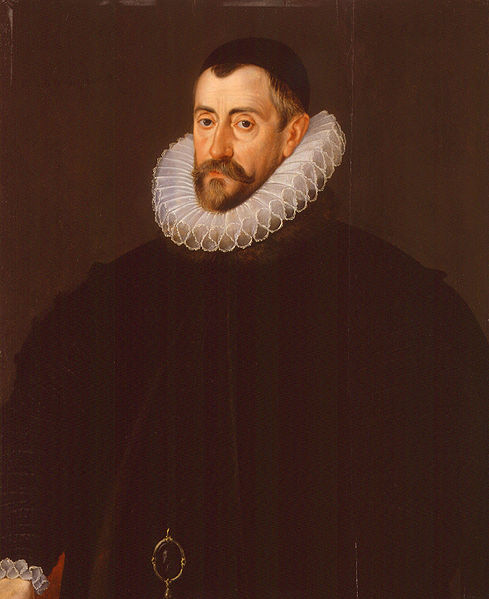
In Bond you have a stealthy, deadly (license to kill) errand boy who solves problems. Once you latch on to a spy as an archetype, you also need to look at the history of spies and assassins in the pre-modern eras that fantasy gaming encompasses. You have the Elizabethan spy ring of Sir Francis Walsingham (pictured to the right), the ninjas of feudal Japan, the poisoners of Renaissance Italy, and many others. Taking these influences together, and leaning on previous versions of the assassin in D&D-style games, I came up with this …

What follows is Open Game Content

THE ASSASSIN
The assassin is a sub-class of thief that specializes in stealthy killings for a fee. They are commonly used as spies, and most major city-states have at least one or two spy rings from rival city-states in operation. Like thieves, assassins are useful as scouts. Their skills are not as wide-ranging as thieves, but they are more effective as combatants.

Prime Attribute: Dexterity, 13+ (+5% experience)

Hit Dice: 1d6+1 (Gains 2 hp/level after 9th level.)

Armor/Shield Permitted: Leather and shields.

Weapons Permitted: Any.

Cheat Death (1st): Assassins have an uncanny ability to escape certain doom. Assassins enjoy a +1 bonus to saving throws vs. death. Skilled escape artists, assassins use saving throws to wriggle out of non-magical ropes or chains, and they have a 1 in 6 chance to escape from magical bindings, like magical ropes or chains or spells like hold person or paralysis.

Decipher Script (1st): Assassins can decipher writings by making a successful saving throw. This includes unfamiliar languages, codes and incomplete messages.

Disguise (1st): Assassins train as thespians and masters of disguise. Assassins usually carry some odds and ends (soot, putty, rags for stuffing) that allow them impersonate others. The assassin’s diguises are usually effective on a roll of 1-4 on 1d6, provided the assassin is impersonating a person of the same race and gender. Impersonating another humanoid race lowers his chances by one, and impersonating another gender also lowers his chances by one. Impersonating a monstrous race lowers his chances by two. Even if the disguise is effective, those who know the impersonated person well receive a saving throw to see through the rouse.

Sneak Attack (1st): If an assassin takes an opponent by surprise (i.e. in a surprise round or simply attacking someone in a “non-combat” situation) or by attacking from the shadows, an assassin attacks at a +4 bonus to hit. A successful hit inflicts double normal damage. As the assassin gains experience, the damage inflicted increases. At fifth level, a sneak attack deals triple damage, and at ninth level a sneak attack inflicts quadruple damage.

Stealth (1st): Assassins have the following special abilities: Hiding in shadows, moving silently, climbing sheer surfaces, picking pockets (and other acts of legerdemain) and picking locks (with a set of burglar’s tools, which cost 25 gp). Use of these abilities requires the assassin to succeed at a saving throw (in essence, making a saving throw to avoid failure). Non-assassins have a 1 in 6 chance of successfully performing these abilities.

Hiding in Shadows: Hiding in shadows requires shadows, of course, and is as effective as the invisibility spell, except that the thief cannot move while hiding in shadows.

Moving Silently: This means moving without making any sound at all. A thief moving silently and scouting ahead of a party can avoid an encounter entirely if his opponents are surprised.

Climb Sheer Surfaces: This means surfaces with no, or almost no, hand or toe holds. The Referee might require multiple saving throws for long climbs, and might regard failure as merely “no progress” or actual falling.

Poison (1st): Assassins are well practiced at using poisons, and have no chance of poisoning themselves when applying it weapons or slipping it in food and drink. Assassins can identify poisons on a roll of 1-3 on 1d6 and neutralize most poisons on a roll of 1 on 1d6, provided they have some herbs and other chemical agents on their person (a supply of 10 uses of these items costs 25 gp and can be obtained from most alchemists or herbalists).

Finally, an assassin can use these same herbs and agents to produce poisons of their own. At level 1, assassins know how to brew sleeping draughts and poisons that cause nausea (-2 penalty to all rolls). These simple poisons last one hour, and victims receive a saving throw to avoid the effects. These simple poisons can be applied to an assassin’s weapons as a sticky paste. They cost 50 gp to make and take 1 day to brew a single use.

By level 3, an assassin has learned to make more potent poisons that can either inflict 1d6 points of damage for every three levels an assassin has attained (i.e. 1d6 at level 3, 2d6 at level 6, 3d6 at level 9 and so on) or that cause paralysis for 10 minutes. Again, saving throws are allowed. These poisons can be applied to an assassin’s weapons as a sticky paste. They cost 250 gp to brew and take 1 day to brew a single use.

At level 9, assassins learn how to make a potion of poison that forces imbibers to save or die instantly. This poison cannot be applied to weapons. It costs 1,000 gp to brew and takes 1 day to brew a single use.

Level Experience Hit Dice Attack Save Title
1 0 1 +0 15 Ruffian
2 1,500 2 +0 14 Marauder
3 3,000 3 +1 13 Thugee
4 6,000 4 +1 12 Blackguard
5 12,000 5 +2 11 Cut-Throat
6 25,000 6 +2 10 Hellhound
7 50,000 7 +3 9 Malefactor
8 100,000 8 +3 8 Slayer
9 200,000 9 +4 7 Master Assassin
10 320,000 +2 hp +5 6 Master Assassin
11 440,000 +4 hp +5 5 Master Assassin
12 560,000 +6 hp +6 4 Master Assassin

Well, I’m heading off to Chicago tomorrow for a research conference, so I won’t be updating the blog for a few days. I hope by Thursday or Friday to finish and post my first downloadable “issue” of NOD, collecting most of the April posts. Until then …

Thieves

This post is Open Game Content

THE THIEF
The thief relies on cunning to win the day. Thieves are middling warriors and have no magical abilities, but they are hard to kill and train themselves in a wide array of skills useful to adventurers.

Prime Attribute: Dexterity, 13+ (+5% experience)

Hit Dice: 1d6 (Gains 2 hp/level after 9th level.)

Armor/Shield Permitted: Leather, padded and shields.

Weapons Permitted: Club, dagger, dart, hand axe, javelin, light crossbow, maces, short bow, short sword, sling, staff.

BACK STAB (1st): A thief normally avoids face-to-face combat if possible, preferring instead to use stealth to catch an opponent unaware. A thief able to attack an unaware opponent from the rear gains a bonus to hit and damage. To catch an opponent unaware, a thief must make a successful move silently check to sneak up behind the foe, or make a successful hide check while behind the opponent. A thief that succeeds can make a back stab at a +4 bonus to hit. A successful hit inflicts double normal damage.

As the thief gains experience, the damage inflicted increases. At fifth level, a back stab deals triple damage, and at ninth level a back stab inflicts quadruple damage.

DECIPHER SCRIPT (1st): Thieves can decipher writings by making a successful saving throw. This includes unfamiliar languages, codes and incomplete messages. Thieves can also use this ability to decipher and then cast spells from arcane scrolls, though the saving throw to do so is made at a -10 penalty.

THIEVERY (1st): A thief’s training makes them particularly adept at dungeon delving. Thieves successfully listen at doors and find secret doors (and hidden traps) as well as elves (2 in 6 and 4 in 6 chance respectively), and can find pits and traps as well as a dwarf (1 in 6 chance of just noticing, 3 in 6 chance if searching).

Moreover, thieves have the following unique abilities: Hiding in shadows, moving silently, climbing sheer surfaces, picking pockets (and other acts of legerdemain) and picking locks (with a set of burglar’s tools, which cost 25 gp). Use of these abilities requires the thief to succeed at a saving throw (in essence, making a saving throw to avoid failure). Non-thieves have a 1 in 6 chance of successfully performing these abilities.

Hiding in Shadows: Hiding in shadows requires shadows, of course, and is as effective as the invisibility spell, except that the thief cannot move while hiding in shadows.

Moving Silently: This means moving without making any sound at all. A thief moving silently and scouting ahead of a party can avoid an encounter entirely if his opponents are surprised.

Climb Sheer Surfaces: This means surfaces with no, or almost no, hand or toe holds. The Referee might require multiple saving throws for long climbs, and might regard failure as merely “no progress” or actual falling.

THIEVES’ CANT (1st): Thieves often use a street language known only to those in the “trade”. Code words, hand signals, demeanor, and other signs comprise the language of thieves’ cant and can be used to convey complex ideas. The language may vary to some degree both geographically and culturally, making cants unique to each region, city, and even within a city.

Level Experience Hit Dice Attack Save Title
1 0 1 +0 14 Scamp
2 1,500 2 +0 13 Varlet
3 3,000 3 +1 12 Villain
4 6,000 4 +1 11 Dodger
5 12,000 5 +2 10 Rapscallion
6 25,000 6 +2 9 Desperado
7 50,000 7 +3 8 Rook
8 100,000 8 +3 7 Scoundrel
9 200,000 9 +4 6 Master Thief
10 320,000 +2 hp +5 5 Master Thief
11 440,000 +4 hp +5 4 Master Thief
12 560,000 +6 hp +6 3 Master Thief

Assassin is next …