New Stuff in the World of Games

Hey folks – three new notions in the world of gaming you might want to check out. Give ’em a click.

Mischief, Inc.

Mischief, Inc. is a new company looking to produce adventures for the OSR. You can grab a preview of their first adventure, 0A – The Tomb of Rakoss the Undying, and visit forums set up for just about every OSR game in the world, including Blood & Treasure.

Project 2d8

The biggest challenge to gaming these days seems to be hooking up with other gamers. Project 2d8 has been launched on Community Funded to create an online tabletop for RPG’s. It looks pretty impressive, so check it out and if you find it a worthwhile project, throw them a few coins. You can also find them on the Book of Faces.

One Hit Die

One Hit Die is a new web series that presents D&D shot in the style of The Office. It stars Phil Burke, from Hell on Wheels. Check it out One Hit Die for more, or look them up on Twitter.

B is for Barbarian II: The Improvening

Oh yeah, it’s already time for the second edition of B is for Barbarian! A few things occurred to me since yesterday:

I. COMBAT

I think the combat table would work better if it compared attacker skill to defender skill:

Armor: With this matrix, armor provides an armor save, as follows:

  • Leather Armor/Thick Skin: Avoid losing a life on a roll of 6 on 1d6
  • Chainmail/Thick Scales: Avoid losing a life on a roll of 5-6 on 1d6
  • Platemail: Avoid losing a life on a roll of 4-6 on 1d6
  • Magic Armor: Avoid losing a life on a roll of 3-6 on 1d6

Mounted Combat: It was also pointed out that an attacker on horseback should get a bonus. Let’s turn that around – fighting a mounted attacker while on foot will count as “fighting from an awkward position”, and thus degrade the attack ability of the person on foot.

Reach: One might also consider fighting somebody with better reach, either because they are larger (like a giant) or because they have a longer melee weapon fighting from an awkward position. In this case, when fighting somebody with a longer weapon, your first successful attack can be counted as disarming them rather than taking away one of their lives.

II. Companions

A few additional companions occurred to me:

Eagle/Falcon/Hawk: A bird of prey serves you loyally. It fights as a beast and has 2 lives. It also has Eagle Eyes and can fly, which is pretty sweet.

Panther/Lion/Tiger: This can either be a big cat or a mysterious, dark woman who can turn into a big cat. It fights as a beast and has 5 lives. It has Cat-Like Reflexes and can Intimidate.

Giant: Not a real giant, just a huge warrior played by Richard Kiel or Wilt Chamberlain. Skilled fighter with 7 lives and armed with leather armor and a maul. Can Intimidate.

Ninja: What the heck, it’s the 80’s! The ninja is a skilled fighter with 5 lives armed with a sword and shuriken (treat as chakram). Can fight like a Whirlwind and has Cat-Like Reflexes.

If anything else occurs to me, I’ll release the 3rd edition.

B is for Barbarian I

And not just any barbarian, I’m talking about b-movie barbarians. You know, those bare-chested outlaws that littered the cinemas back in the glorious ‘80s. I was watching Deathstalker the other day, and it inspired me to put together a quick mini-game of ‘80s barbarian action.

CHARACTER CREATION

You are a barbarian warrior. Heck, not just a warrior, a freaking barbarian lord! That means you don’t need to worry about races or classes or all that nonsense.

As a cat-like barbarian lord, you have 9 lives (more on that later) and you’re a kick-ass combatant. In combat, which uses a D6, you score a hit as follows:

vs. unarmored foes roll 2-6 on 1d6
vs. leather armor or thick skin roll 3-6 on 1d6
vs. chainmail or thick scales roll 4-6 on 1d6
vs. platemail roll 5-6 on 1d6
vs. magic armor or ethereal foes roll 6 on 1d6

Each hit takes one life from a foe.

Of course, less skilled fighters use different hit scores. The full attack matrix is there to the right.

In the attack matrix, a 6 followed by another number means if the attacker rolls a “6”, they must roll another 1d6 and roll in the additional range to succeed.
Attacking from horseback or in an awkward position or without a weapon drops one’s effective skill level (for each such problem) by one column.

Okay – so that’s combat!

So, how do we distinguish one barbarian from another (other than hair color and style of loincloth) – with the extras.

Equipment
Each barbarian hero can choose two pieces of equipment. Each weapon causes a special effect when the hero rolls a “6” in combat and follows it up with a second “6” on 1d6

  • Axe: Can be used to chop down doors (roll 3-6 on 1d6); in combat, decapitates foes for instant death
  • Bow: Range of 200 yards; in combat, can pin foes to walls
  • Broadsword: In combat, decapitates foes for instant death
  • Chainmail Bikini: Can negate hits on a roll of 4-6 on 1d6; and if you’re a guy, the bikini is also going to get you a few weird looks
  • Chakram: Range of 50 yards; in combat, can decapitate foes for instant death
  • Flying Guillotine: Range 5 yards; in combat can decapitate foes for instant death
  • Francisca: Range 10 yards
  • Helmet: Can negate one hit and is then destroyed; can have wings, horns or a plume
  • Maul: Can be used to smash down doors (roll 2-6 on 1d6); in combat, can knock foes flat on their back
  • Shield: Can negate one hit and is then destroyed
  • Spear: Range 10 yards; in combat impales foes for extra loss of life

Skills
Each barbarian hero can choose one extra skill to possess:

  • Beastspeaker: Can communicate with animals, and can control their actions on a roll of 4-6 on 1d6
  • Bull Strength: Can tote wenches, kegs and other heavy objects on his shoulders; up to 300 pounds
  • Cat-Like Reflexes: Can climb walls and move silently on a roll of 3-6 on 1d6
  • Cleave: Can make a free attack on an opponent within reach after successfully killing another foe
  • Eagle Eyes: Can spot ambushes, traps and secret or concealed doors on a roll of 3-6 on 1d6
  • Fortitude: Can ignore the effects of fatigue, poison or disease on a roll of 3-6 on 1d6
  • Horseman: Can attack from horseback with no penalty
  • Intimidate: Can get information out of foes or cause unskilled combatants to flee him on a roll of 3-6 on 1d6
  • Iron Will: Can ignore the effects of magical control and fear on a roll of 3-6 on 1d6
  • Savage Cunning: Can hide in the wilderness and surprise foes (free attack) on a roll of 3-6 on 1d6
  • Scholarly Mein: Can read ancient inscriptions, disarm traps on a roll of 3-6 on 1d6 and produce 1d6 bombs (range 10 yards) per day if he has the ingredients for gunpowder (watch the gorn episode of Star Trek for the formula)
  • Skullduggery: Can pick pockets and find and disarm traps on a roll of 3-6 on 1d6
  • Whirlwind: Can make multiple attacks against foes within range, reducing his combat skill by one column for each additional foe attacked during the round
  • Woo Women: Can make the ladies knees weak and cause their hearts to flutter on a roll of 3-6 on 1d6


Companions
A good barbarian does not travel alone. The barbarian hero can choose two companions for his adventure from the following list. Each companion can fight by his side and brings other abilities to the table as well.

  • Amazon Warrior: Expert warrior with sword and bow, can intimidate foes; has 6 lives
  • Charming Warrior: Expert warrior with sword and shield, can woo women; has 6 lives
  • Cunning Outlaw: Skilled warrior with sword and bow, capable of skullduggery; has 6 lives
  • Feisty Peasant: Unskilled warrior with club, can carry stuff and use common sense to get out of predicaments on a roll of 4-6 on 1d6; has 3 lives
  • Hedge Wizard: Unskilled warrior with staff, possesses a scholarly mein, can cast simple spells of detection and can counter the spells of other wizards on a roll of 4-6 on 1d6; has 3 lives
  • Holy Man: Skilled warrior with mace and chainmail, can hold spirits and undead at bay on a roll of 3-6 on 1d6; has 3 lives
  • Wily Thief: Skilled warrior with dagger, possesses cat-like reflexes, eagle eyes and skullduggery; has 3 lives
  • Young Barbarian: Skilled warrior with axe, possesses savage cunning and bull strength; has 6 lives

Motivations
With each adventure, a barbarian hero has one of three motivations: Greed (i.e. gold, jewels, etc.), Lust (for a prince or princess, feisty peasant girl, dashing swordsman, etc.) or Revenge. Some adventures might allow more than one such motivation. Whenever the barbarian hero (or a comrade) would be destroyed during the adventure, he or she can play a motivation card and manage an amazing feat that ensures their survival.

ADVENTURES

So, you have your barbarian hero and his retinue. Adventures are simple – come up with a patron, a cause, a villain and his lieutenant and soldiers, a fortress for the villain, dangers along the way, and you’re done.

For evil high priests, wizards and sorcerers, give them whatever spells make sense – usually things like teleportation, gaseous form, fireballs, lightning bolts, mind control, invisibility, etc. To resist a spell, a barbarian hero or hedge wizard needs to roll a 3-6 on 1d6, while others need to roll a 4-6 on 1d6.

For monsters, dig into your game books. A monster has as many lives as it has hit dice, fights like a monster, beast or demon (use your best judgment) and has as many attacks as you think it should have. Give the monsters skills (as above) where necessary. The main thing – don’t overthink it. This is a barbarian b-movie, after all. It’s not the story, it’s the action!

All or Nothing (or Head-to-Head) Combat Rolls

On my walk today, I started thinking about variations on Blood & Treasure (and all the games it is based on, of course) combat. The traditional form is for one entity to make an attack roll against a static defense score, followed by its opponent (or opponents) doing the same, each success causing damage until somebody is out of hit points.

It occurred to me that a different effect could be achieved by each entity in a combat rolling a d20 at the same time in an attempt to out-roll their opponent. Whoever rolls the highest in this little duel wins the round and deals damage. Again, repeat until somebody is out of hit points.

The first step to running this combat is to calculate the entity’s total combat bonus (TCB, if you’re an Elvis fan).

Character TCB = Attack bonus + Strength modifier + Dexterity modifier + Armor bonus + miscellaneous modifiers

Monster TCB = Hit Dice bonus + Size bonus (Large +2; Huge +4) + Speed bonus (Fast +2; Very Fast +4) + Armor bonus + miscellaneous modifiers

The miscellaneous modifiers would be from magic weapons, special abilities, fighting with two weapons, or in B&T any tactical advantages a character manages to have.

When it comes time to fight, each combatant rolls 1d20 and adds their TCB. Whoever rolls the highest wins the round and the loser suffers normal damage (or other effects) from the attack form being employed by the attacker.

When multiple entities are attacking a single entity, they can either pool their TCB’s for a single roll, or each can take a tactical advantage and roll separately. If rolling separately, the defender must then roll against each of them, splitting his TCB as he sees fit.

Monsters with multiple attacks (including fighters or two-weapon wielding characters) can either direct each attack (with full TCB added to each) against multiple opponents, or concentrate attacks (combining damage) against single opponents.

This could be an interesting way to alter the generally accepted tactics of B&T-style combat. Things in this system could go badly very quickly, which might make things more “grim and gritty”. Then again, since its totally untested, this system might just completely screw up your game!

If you try this out, let me know how it worked in the comments or via email.

Nodian Maps of Old

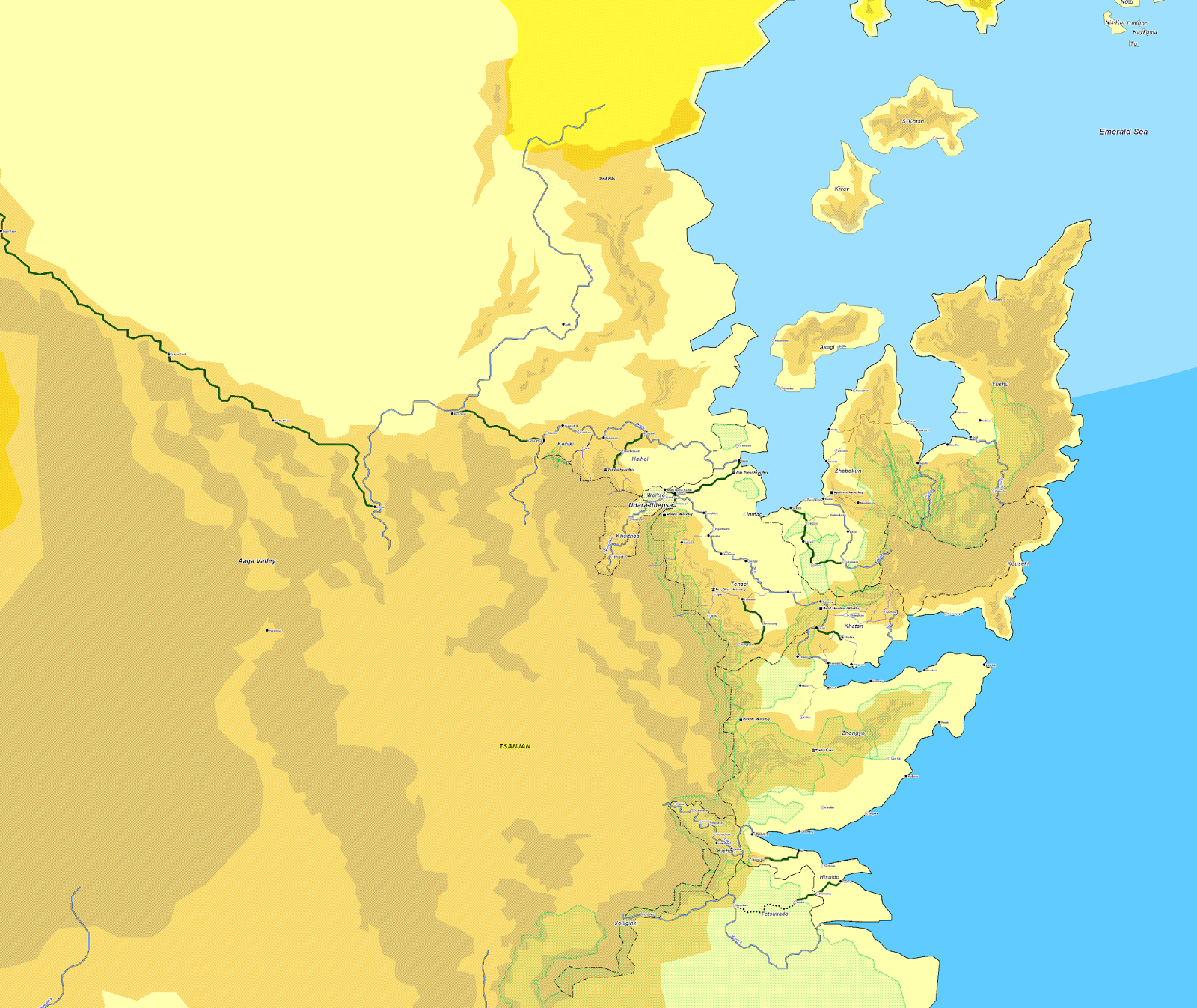
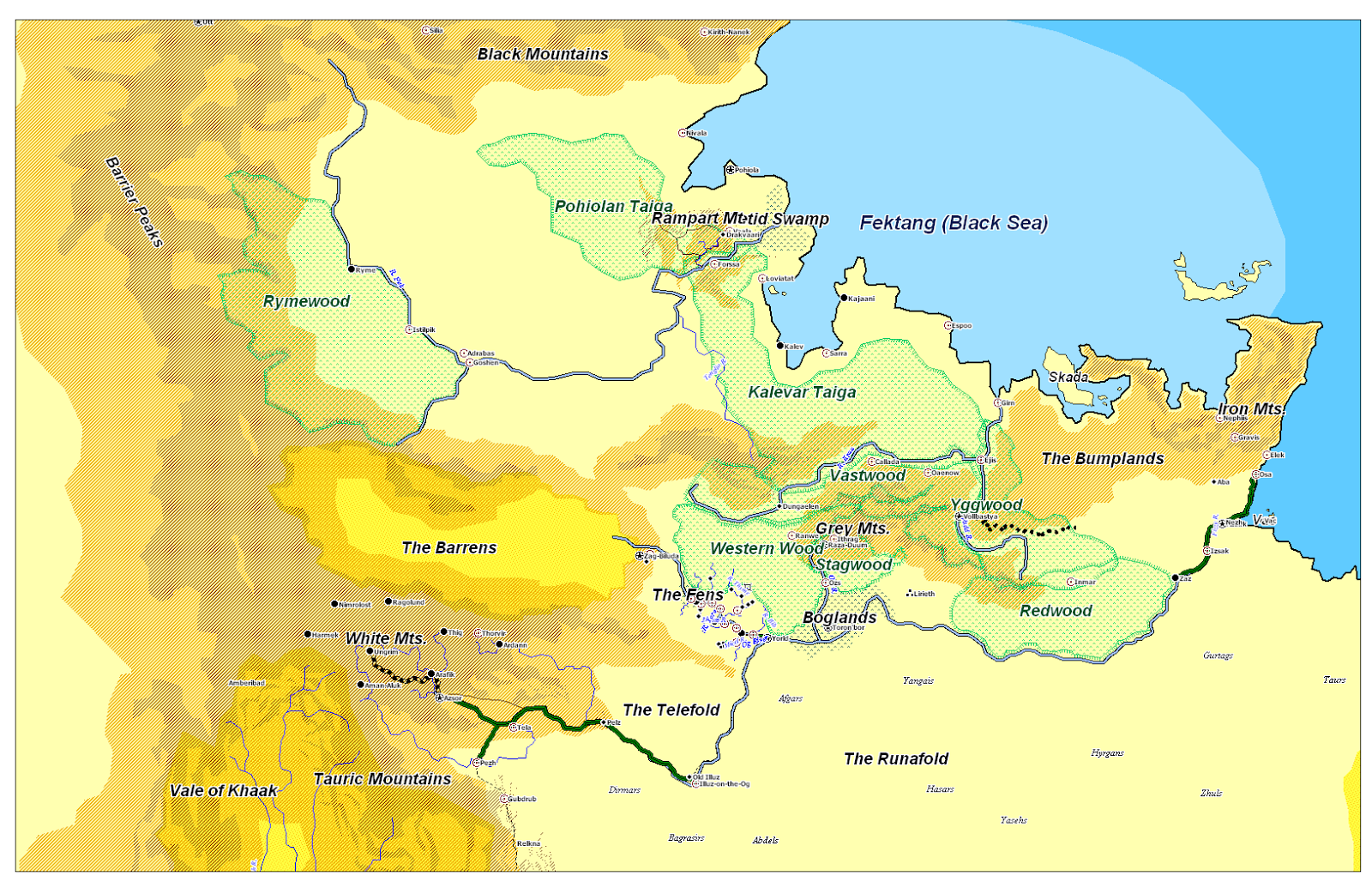
Back when I first started my NOD campaign (maybe around 2005/2006), I wasn’t making hex maps. I was making all sorts of other maps, though, in my capacity as a GIS manager at a real estate company. I was making those maps using a neat piece of software called MapInfo, and, having no other mapping resource and being a total geek, I decided to draw the maps for my new campaign world in MapInfo.

The advantage was that MapInfo maps are fully geocoded – i.e. they have real lat/long coordinates. For Nod, I began with a map of North America and then drew my continents (based on a projection of Earth many millions of years into the future) on top of it. From there, I slowly sculpted the shorelines, drew in woodlands, hills, mountains, deserts, etc.

Two full campaigns were run in the world, one set in Thule (then referred to as Og) and the other in Mu-Pan, and then I began the process of creating the hex crawl material for the gaming magazine. In the process, quite a few things changed – primarily in terms of the style of the world from Greyhawk-style nation state model to the “tiny-pockets-of-civilization-amidst-monster-infested-wilderness” model.

Anyhow – I was recently checking out those original maps, and thought folks might like to see them. They aren’t precisely the same scale (and I’m too lazy to include the scales), but they should give you an idea of what this big lump of fantasy world grew out of.

(As usual, click to embiggen)

Mu-Pan
It originally had more cities, towns and villages. The desert in the north is Yondo. The Tsanjan Plateau is based on the idea of Leng.
Thule
Originally called Og after the big river in the south (a sort of Nordic Amazon). Home of the first Nod campaign, an epic murder-mystery that taught me that I had players with absolutely no interest in solving murder mysteries. Fun nonetheless. Probably the next area I’ll cover with a hex crawl.

I’m considering cleaning these up (i.e. updating them) and using them in the NOD Companion.

Cracking Open the Manual of Bodily Health

I’m going to depart from the usual rpg stuff to discuss something else that should be near and dear to our hearts, namely … our hearts.

About two years ago I easily fit into a stereotype of the geek – I was male, fat and had a beard. I was also having some heart palpitations and decided to go in for a check up. The heart palpitations turned out not to be a big problem – they were the result of me taking niacin supplements – but I did have some other issues that stemmed from being overweight. At the time, I weighed 280 pounds, and got there by sitting on the couch too much and eating more than I should. I knew I was badly out of shape and wanted to get in better shape so I could enjoy by wife, daughter and potential grandchildren someday, but I frankly needed an extra push. The doctor visit was it.

Over the next year, I did a ton of walking, often on a treadmill, was much more careful about food, and dropped 50 pounds. Eventually, I plateaued at 230 pounds and slowed down on the exercise and got a little sloppy on the food side. Before I knew it, I was no longer plateauing – I was hitting 240. There was no way in hell I was going that route again, so I got serious again – counting calories and stepping up the exercise – and I’m now hovering around 220 pounds with my eye set firmly on 180.

So, why should you care? Let’s be honest. Lots of nerds and geeks are fat (yeah, I’m not going to sugar-coat it with PC language – we’re fat), and being fat means a shorter life, more medical problems and, frankly, less fun. At a time when many of the pioneers of pencil-and-paper gaming are passing away, wouldn’t we love to have their creativity around for a few more years – good, healthy years. And as we geeks of the 1980’s grow into maturity and get married and have children, don’t we want to stick around for their sake? Lots of us need to lose weight and get healthier, and for many it seems like something impossible to do. Don’t have the time. Don’t want to commit. Don’t want to tell ourselves no. You know the story. I’m here to serve as an example that you can get healthier (and believe me, I’m only mid-way through my quest!) and enjoy it.

What follows are some tips on losing weight, drawn from my own experience. They may work for you, they may not, but hopefully they will prove of use to you.

My basic plan is a two-pronged attack: Diet and exercise.

By diet, I do not mean a diet I found in a magazine or online. I mean taking in fewer calories each day than I need to survive, and trying to make healthier choices whenever possible. In my first weight loss phase, I used a program I found on Ask.com that used food units. To maintain an 1800 calorie a day diet, I could have 6 units of protein, 6 units of grains, 6 units of vegetables, etc. I now use an app on my phone called My Fitness Pal. I used it to measure how many calories I’m taking in each day, set up a daily goal based on my current weight and where I want to go (1970 calories per day in my case) and it keeps track of how many calories I’m burning by meshing with another app that I’ll discuss in a moment.

I do my best to avoid foods I know I shouldn’t indulge too much in, but otherwise do not have a special diet. I eat meat, grains, vegetables, fruit, nuts, dairy, diet soda (sometimes with a shot of rum, tequila or bourbon), etc., with the occasional sugary (or sugar-free) indulgence. Not too difficult a regimen – I just watch how much food and drink I take in.

Most weeks, I keep my daily net calorie intake to around 1500 calories. In one week out of every four, I allow myself to average 2000 calories per day so that my body doesn’t get too used to 1500 calories a day.

In terms of exercise, I do both cardio and strength training. Both are very useful. I work out 6 times a week (sometimes more), and usually stagger the workouts – usually cardio (walking and some running, usually for an hour or more) on Saturday, Sunday, Tuesday and Thursday, and strength training (kettle bell, dumbells, weight resistance, interval training usually for 20 to 30 minutes) on Monday and Wednesday. For building muscle, you need to have one or two days of rest between workouts – the workout breaks your muscle down, the rest period builds it back up. Get plenty of sleep and plenty of protein when you’re trying to build muscle. On Friday, I rest – and often hit the town with the wife!

To track my exercise, I use an app called Runtastic and to keep better track of my calorie burn, a Timex heart rate monitor (which my wife affectionately calls my sports bra since it straps around my chest). The heart rate monitor has worked fairly well, though after 6 months of constant use it is having some minor problems. You might want to shop around a bit. For strength training, I’m currently using a 20 pound kettle bell and 15 pound dumbbells, but plan to get some heavier weights soon.

The key to losing weight is grit. You have to exercise when you don’t feel like it. You have to tell yourself NO! more often than not when the donuts show up at work. Once you get into the habit, it really isn’t too difficult to do. Despite the many times I didn’t want to get up and exercise, I have never once not felt great after I did it – and watching the stomach shrink and the biceps grow feels pretty awesome as well. Honestly, on days when I rest from exercising, I have to force myself to sit down and not exercise. It just seems like second-nature now, and it makes me feel so darn good! Now that I’m in the 1500 calorie a day mindset, its remarkable how difficult it is for me to take in 2000 calories in a day – I just don’t need all that food. Get yourself started, stick to it, and I promise these things will become second nature to you.

Now that I’ve lost 60 pounds, I have more energy, more self-confidence and more fun with the wife (wink wink nudge nudge say no more). You can get these things as well if you’ll make the commitment, and you, your family, friends and gaming community will get to enjoy your presence on this earth for years to come.

If you need some more convincing, advice and support, I suggest these two websites:

NERD FITNESS – This one seems pretty obvious, huh. It’s a fitness site run by a nerd who is now in excellent shape, and features advice, pep talks and testimonials from other folks like us. I enjoy the pep talks and the exuberance of Steve Kamb for linking his nerd interests with getting healthy.

THE ART OF MANLINESS – Not just for men (though mainly for men), this site has some good exercise tips and lots of other great articles about being the best man (or person) you can be, emotionally, spiritually and physically. Because of this site, I dress better, shave with a safety razor instead of plastic disposable junk (no, still not man enough for a straight razor or tomahawk shave), read quite a bit more (and not just fantasy and sci-fi novels) and do a much better job of shining my shoes.

Hey, two years ago I was just another fat guy with a beard and glasses. I was a good husband, a good father and a good person, but I was not healthy. Now, I’m still a good husband, good father, good person, probably even more of a nerd since I now produce rpg material as well as consume it, but I’m also healthier, un-bearded, rock the contact lenses once-in-a-while, get compliments from women about how I look and I feel better than I have in two decades.

If you’ve wanted to get healthier and, as Steve Kamb says, “Level up your life”, I urge you to take the plunge. Don’t let the jocks have all the fun!

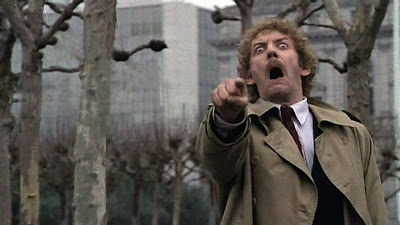
Invasion of the Pod Jellies

While writing the new hexcrawl, I scribbled these lovely fellows out and thought folks might find a use for them …

Several (3d4) large seed pods float in the ocean here, and might be seen (1 in 6 chance) by a vessel passing through this hex. The pods are about 6 feet long and consist of a very thick, green hide (Armor Class 18). The pods should be treated as having 20 hit points. They are vulnerable to fire, but immune to cold.

Within the pod, there is a strange, gelatinous life form that, through its mental powers, can understand and duplicate any sentient humanoid. Each pod jelly picks a single humanoid to make its own, using its ESP to choose a likely candidate, and each day absorbs a portion of their being (i.e. 1d6 points of constitution damage) while turning itself into a clone or replica of that person. The pod must be within 30 feet of its victim to do this, and victim receives a Will saving throw each day to resist the effect. When the original’s constitution is reduced to zero, the clone bursts forth from the pod and the original’s body disintegrates.

The pod jellies duplicate the original’s body (i.e. hit dice and physical ability scores) and mind (intelligence and charisma scores, though wisdom is never higher than 6) perfectly, knowing all they knew and having the same general special abilities. They cannot, however, exhibit emotion or faith, and emotion based powers (such as a berserk rage or a cleric’s divine powers), are duplicated and therefore they are not possessed.

POD JELLY
Medium Ooze, Chaotic (NE), Average Intelligence; Invasion (3d6)

HD 2
AC 16
ATK Touch (1d4 acid)
MV 20
SV F15 R15 W15
XP 200 (CL 3)

These are the abilities of a pod jelly in its native form, outside the protection of its pod-like shell and before it has taken on the form of a humanoid. In humanoid form, it loses its resistance to acid, though it retains its ESP ability and can still utter a psychic scream (i.e. psionic blast) once per day, though this takes the form of an actual shrill scream as well as a mental effect.

Special Abilities: Resistance to acid

Spell-Like Abilities: At will—Detect thoughts (ESP); 3/day—Psionic blast

I suppose I need to include them in ACTION X.

What’s more frightening, the psionic blast or that damn perm?


It’s a Nice Day for a White Wizard

Yeah, I should probably be shot for that title.

So, a couple days ago I posted a spell list for “black magicians” that was based on the supposed powers that the demons in De Plancy’s Infernal Dictionary could bestow upon a conjurer. In ACTION X, these magic-users, officially called black magicians or conjurers, are Charisma-based spellcasters, meaning they will make a charisma-based task check to cast spells.

The flip side of these folks are the white magicians, or theurgists, who are Wisdom-based. Same rules for spellcasting, but a different key ability and a different spell list. For the white magicians, I decided to delve primarily into reputed miracles, both from the Old and New Testaments in the Bible, and from what I could glean from the lives of the saints and a few notions tucked in from the druids. If you were running a campaign with somewhat Biblical clerics, you might find this list useful. I think it’s a pretty fun mix of God’s mercy and God’s wrath, and isn’t completely foreign to what is expected from a fantasy cleric.

FIRST LEVEL
1. Aid
2. Bless
3. Comprehend Languages
4. Control Light
5. Cure Light Wounds
6. Multiply Food and Water
7. Protection from Evil
8. Summon Nature’s Ally I
9. Sustenance
10. Turn Undead

SECOND LEVEL
1. Augury
2. Buoyancy
3. Calm Emotions
4. Consecrate
5. Cure Moderate Wounds
6. Detect Thoughts (ESP)
7. Gentle Repose
8. Levitate
9. Remove Paralysis
10. Speak with Animals
11. Summon Nature’s Ally II
12. Summon Swarm

THIRD LEVEL
1. Cause Disease
2. Create Food and Water
3. Cure Blindness/Deafness
4. Cure Disease
5. Cure Serious Wounds
6. Fly
7. Hold Person
8. Remove Curse
9. Summon Nature’s Ally III
10. Tongues
11. Water Walk

FOURTH LEVEL
1. Blight
2. Charm Monster
3. Control Water
4. Cure Critical Wounds
5. Divination
6. Flame Strike
7. Holy Smite
8. Restoration
9. Sticks to Snakes

FIFTH LEVEL
1. Awaken
2. Bilocation
3. Commune
4. Contact Other Plane
5. Healing Circle
6. Hold Monster
7. Insect Plague
8. Raise Dead

SIXTH LEVEL
1. Banishment
2. Geas
3. Move Earth
4. Wind Walk

SEVENTH LEVEL
1. Control Weather
2. Create Golem
3. Transmute Matter

EIGHTH LEVEL
1. Earthquake
2. Holy Aura

NINTH LEVEL
1. Astral Projection

NEW SPELLS

Bilocation – A trick of the saints and apparently noted in psychic phenomena, this is the ability to be in two places at once. I aim to make this a non-combat spell – the point would be to allow the magician to simultaneously accomplish two tasks.

Buoyancy – There is a tale of a miracle that involved making a metal object dropped into a river float to the surface.

Create Golem – A clay golem, to be precise.

Multiply Food & Water – This is based, obviously, on the loaves and fishes episode.

Sustenance – This would allow the magician to go without food and drink (and maybe sleep) without suffering any negative consequences.

Transmute Matter – In the Black Magic post, I mentioned Transmute Metal and Transmute Liquid. Since spells in ACTION X are not prepared ahead of time, creating scarcity and thus more challenging game play by multiplying the number of spells, it seems to me I might as well combine those spells into a Transmute Matter spell.

Turn Undead – Yes, in ACTION X it’s a spell.

Now, if we have charismatic Conjurers and wise Theurgists, who uses intelligence? Well, besides the non-magical brainiacs and hackers, it’s the psions of course. I’ll post the psion power list in a couple days.

De Plancy’s Spellbook

I’ve been working on the spells and psionic powers for ACTION X, and wanted to not only go a bit “lower magic” for the game, but also make it as realistic as one can make the supernatural. To that end, I decided to only use psionic powers that reputedly exist in the real world (fair warning – I don’t believe in psychic abilities). For magic spells, I decided to use two main sources, since the magician class has two lists of spells – black magic and white magic. The source for the black magic spells is de Plancy’s Dictionnaire Infernal and the powers the various demons were capable of granting to conjurers. For the white magicians, I looked at the miracles of the Bible and of the saints as well as the reputed powers of the druids.

Since lots of gamers are acquainted with de Plancy’s work, I thought the spell list I extracted from it would be of interest …

FIRST LEVEL
Audible Glamer
Burning Hands
Charm Animal
Charm Person
Command
Cure Light Wounds
Detect Evil
Detect Magic
Knowledge*
Light
Phantasmal Force
Protection from Evil

SECOND LEVEL
Augury
Calm Emotions
Charisma
Consecrate
Desecrate
Detect Thoughts (ESP)
Find Familiar
Improved Phantasmal Force
Intelligence
Invisibility
Numismatize*
Speak with Animals
Strength

THIRD LEVEL
Blindness/Deafness
Compel Return
Cure Blindness/Deafness
Cure Serious Wounds
Heroism
Hold Person
Locate Object
Putrify*
Rage
Reveal Secrets*
Speak with Dead
Spectral Force
Suggestion

FOURTH LEVEL
Cause Disease
Command Plants
Confusion
Cure Disease
Detect Lie
Divination
Fireball
Lightning Bolt
Modify Memory
Polymorph Other
Polymorph Self
Restoration

FIFTH LEVEL
Contact Other Plane
Control Winds
Feeblemind
Song of Discord
Teleport

SIXTH LEVEL
Find the Path
Legend Lore
Longevity
Transformation
Water Tell*

SEVENTH LEVEL
Control Weather
Raise Tower*
Transmute Liquid*
Transmute Metal*

EIGHTH LEVEL
Earthquake

NINTH LEVEL
Astral Projection

* New Spell

While most of the supernatural ability granted by these demons were easily converted into an existing spell, a few were not. I haven’t written these spells up officially yet, but the following will give you a brief idea:

Knowledge: Gives the conjurer expert knowledge in one particular skill.

Numismatize: Turns raw metal directly into coins.

Putrefy: Causes a wound to become ridden with worms and rot.

Raise Tower: Sort of a variation on the magnificent mansion spell; this one raises a stone tower with an armory full of weapons.

Reveal Secrets: Like ESP, only it plucks the secrets from one person’s mind and shares them with all people nearby.

Transmute Liquid: Transmutes one liquid into another, i.e. water into wine, wine into blood, etc.

Transmute Metal: Transmutes one metal into another, i.e. lead into gold.

Water Tell: Variation on stone tell; in de Plancy, one couldn’t talk to rocks, but they could talk to rivers.

Fiendish Flora: Portal Plant

PORTAL PLANT
Huge plant, Neutral (N), Non-intelligent; Solitary (1)

HD 4 (20)
AC 15
ATK 1 bite (1d6 + swallow whole)
MV 0
SV F10 R17 W14 (F3 R8 W5)
XP 400 (CL 5) (2000)

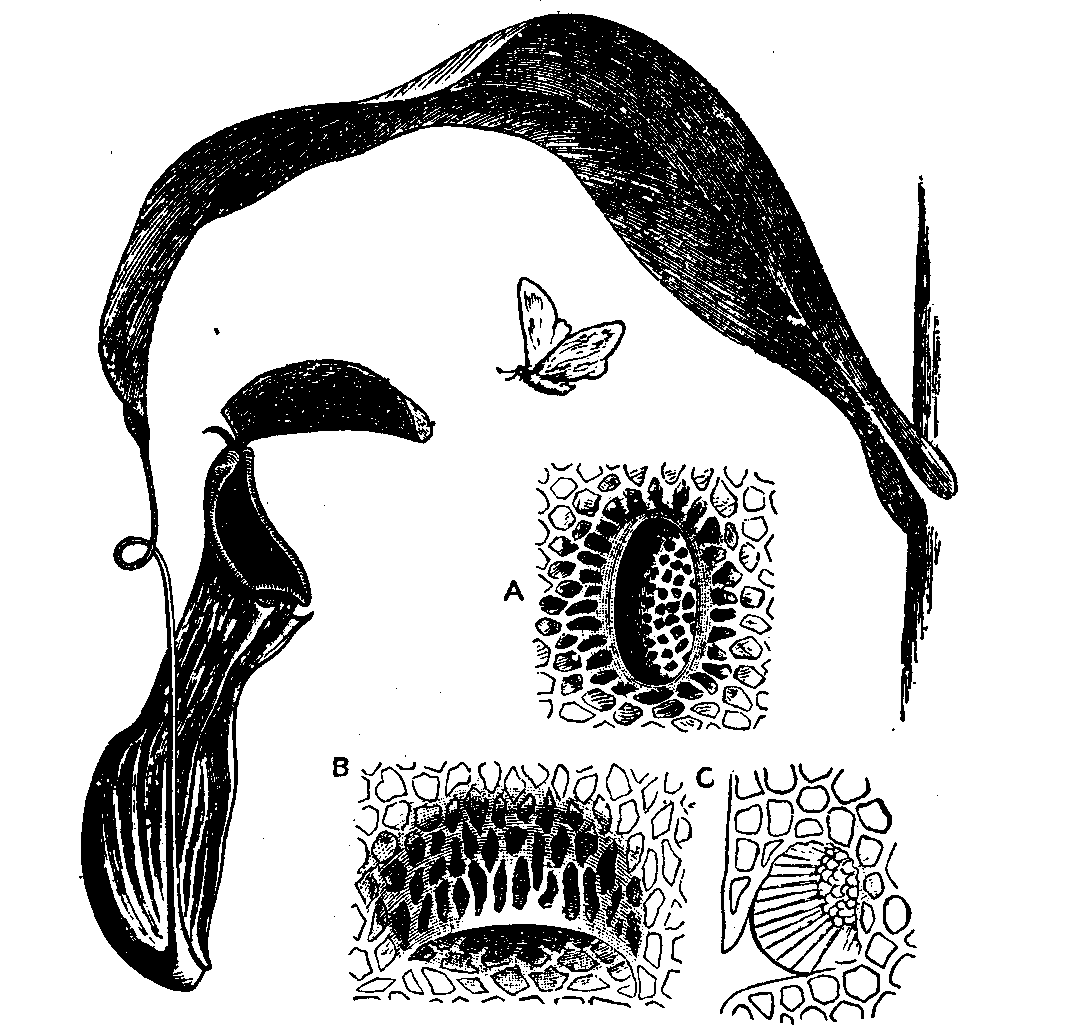
Portal plants are carnivorous plants that slightly resemble pitcher plants. To most folks, they appear as thick (6 inches in diameter) vines topped by large, bulbous structures that can open and close like a great maw. Portal plants are usually found in tropical woodlands.

What most folks do not see and do not know is that the plant you see is actually part of a much larger network of plants, connected by a monstrously huge root system. The plant one sees has 4 hit dice in combat, while the entire colony of plants has 20. It is possible to destroy one of the plant’s “heads” while not destroying the plant as a whole. This colony can cover 1 square mile.

When a person is bitten by the plant and swallowed whole, they are teleported into another of the plant’s pitchers, up to 1 mile away. From this plant, the person is disgorged onto the ground and ignored, the colony having stolen 1d4 points of intelligence from the victim (this is damage, not drain). The magical plants draw nourishment from this psychic vampirism.