When In Rome, Kill As the Romans Do

Rome looms so large in European history, and therefore on the ancient and medieval European wargames that informed so much of early fantasy RPG’s, that an article like this seems a bit useless. Of course, I’m writing it anyway, because – dang – you try generating this much web content without being useless once in a while.

Enough preamble. Let’s get down to Roman weaponry …

BIPENNIS
The bipennis, or labrys, is a double-headed axe that, depending on how one pronounces the word, could be a big hit at the gaming table. “You attack the orc with what?”

The weapons were most associated with Minoan civilization and the Greeks, and seem to have taken on quite a significant symbolic meaning, being adopted by Greek fascists, Greek metal heads and lesbians and feminists – clearly it’s a uniter and not a divider (unless used to separate somebody from their head). If you’re a cleric capable of wielding edged weapons, the bipennis might be a good one to wield.

Medium weapon; 1d8 damage; 6 lb.; 10 gp

CESTUS
Probably one of the first, “Dude, I want those” that I ever came across as a young geek getting into RPG’s. Essentially the anti-boxing glove, a cestus was made of leather strips, sometimes studded with metal or bladed, that was worn over the hands and used to beat the living crap out of people. For our purposes, we’ll use all three versions, and allow monks using the cestus, and any character with the Weapon Focus feat in the cestus, to treat them as either unarmed attacks or armed attacks, whichever is more favorable for the situation.

Cestus: Light weapon; +1 damage; 0.5 lb; 5 sp

Cestus, Studded: Light weapon; +2 damage; 1 lb.; 1 gp

Cestus, Bladed (Myrmex): Light weapon; +3 damage; 1 lb.; 1 gp 5 sp

FALCATA
The name is new, but the sword is old. Rome’s Iberian allies and mercenaries employed these slightly curved, thick bladed swords and impressed their Roman pals with how effective they were in a scrap. Because of their shape, and the weight of their blade, a falcata scores a critical hit (if you use such things) on a natural roll of 19 or 20.

Light weapon; 1d4+1 damage; 2 lb.; 15 gp

FALX
Falx are sickle-like weapons employed by the Dacians and Thracians, and later used by the Romans as siege hooks. The single-handed version was the sica, which is essentially just a sickle and is not covered here. The falx was the two-handed version, a pole weapon with a 3-ft. long wooden haft tipped by a long, sickle-shaped blade. The point could pierce helmets and the blade split shields.

Heavy weapon; 1d8 damage; 8 lb.; 8 gp

GLADIUS
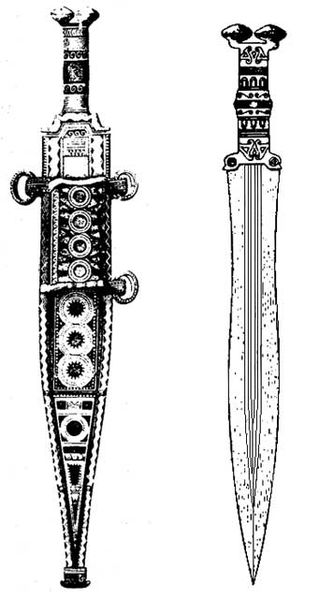
While not the first straight-bladed short sword, the gladius could be one of the best known due to their use by gladiators, who are undeniably cool. The gladius was adopted from the Celtiberians, and was known as the Gladius Hispaniensis, or “Hispanic Sword”.

Light weapon; 1d6 damage; 2 lb.; 10 gp
HASTA
Hasta means “spear”, which is handy, since hastas are, in fact, spears. They were carried by early Roman legionaries, and gave them the name hastate. In later years, they were abandoned for the javelin and short sword, but they still have their place in classical Roman violence. Hasta were about 6.5 feet long.

Medium weapon; 1d8 damage; 6 lb.; 2 gp

PUGIO
The pugio is the Roman dagger, one of the basic weapons of the Roman soldier (along with short sword, javelins and shield). Nothing fancy here, just a cool name.

Light weapon; 1d4 damage; 1 lb.; 2 gp

PLUMBATA
I remember when I first got into AD&D, the darts confused me. The only darts I had ever seen were the ones used with dart boards, and I always pictured with a smile magic-users throwing those little things at people in dungeons. The plumbata is the real deal though, the mother of all lawn darts. These darts are weighted with lead and had barbed heads. Magic-users can hurl these bad boys with their heads held high.

Thrown weapon; 1d4 damage; 0.5 lb.; 5 sp

SCISSOR
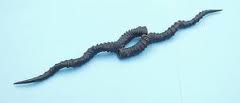
Yes, you can run with this. The scissor is a “maybe” weapon, about which very little is known. It might have consisted of a hollow, metal tube that was worn over the arm. The tube closes over the fist, and projected from this there is a semicircular blade. There was probably a crossbar in the end to assist in a gladiator controlling the weapon. The tube makes it useful as both a buckler and as a weapon.

Light weapon; 1d4+1 damage; 2.5 lb.; 15 gp
SPATHA
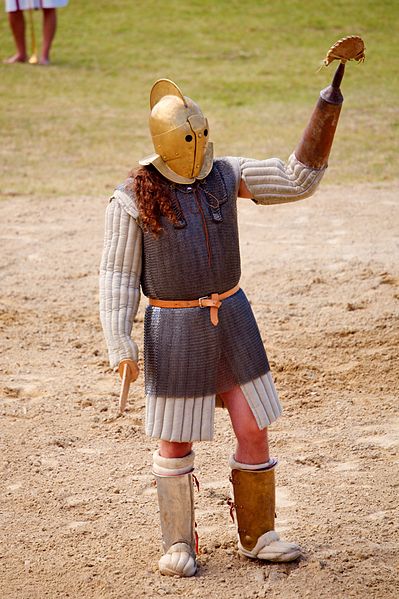
The spatha was the Roman long sword. Measuring about 3 feet in length, it was used in war and gladiatorial fights in first millennium AD Europe. Used primarily by the Germans, it replaced the gladius as the primary infantry weapon of the Romans.

Medium weapon; 1d8 damage; 4 lb.; 15 gp


All images found at Wikipedia
What’s In Santa’s Sack? – Elf Edition

Of course, Santa Claus isn’t going to forget about those Chaotic Good demi-humans, close kin to his helpers at the North Pole. Grab a d30 and roll up some loot for your favorite fairy.

1. Bejewelled ear-wax cleaner
2. Pointy hat in glorious velvet
3. New silver bells for one’s formal pointy shoes
4. Magical easy bake oven in the shape of a tree
5. Autographed tapestry of Santa Claus
6. Stereoscope cards of Freyr in all her divine glory
7. A shiny new sword with silver engraving in the shape of acanthus leaves
8. Magical coat of leaves – they match the woodland environment and season and act as camouflage
9. Licorice drops – elves can’t get enough of licorice drops, and each is embossed with an elf-cross
10. Nymphs and Dryads I Have Known, a memoir by Högni Half-Elven
11. Drizz’t plushie and a collection of silver pins (worth 5 gp)
12. A box of flower petals crystalized in sugar
13. A trick flask with two sides to allow one to hide potions or trick enemies into drinking poison!
14. New woolen tights
15. Harp engraved with prancing unicorns
16. False mustache and beard
17. “Brownie-whistle” – a silver whistle only the fey can hear
18. A silver comb
19. An Italian greyhound puppy, since they’re effectively the elves of the dog world
20. 1001 Things to Say to Piss Off a Dwarf – popular old joke book
21. Magical chemise – one can pull an endless number of red roses from the sleeves
22. Silver dagger
23. A sword cane – come on, you know elves would love those things
24. Kerchief of Elvenkind – admittedly, not as useful as the cloak or boots, but a dapper touch nonetheless
25. Quiver of handmade elfshot
26. Wooden sculpture of a feminine leg with a continual light spell cast on it’
27. New longbow
28. Set of three bowstrings woven from the tail hairs of a unicorn (+1 damage, worth 10 gp each, each lasts for 1d20 shots)
29. Flagon of sweet, clear wine
30. Shirt of elven mail

Master Blaster – New Class for Blood and Treasure

Because you, the reader, DEMANDED IT!*

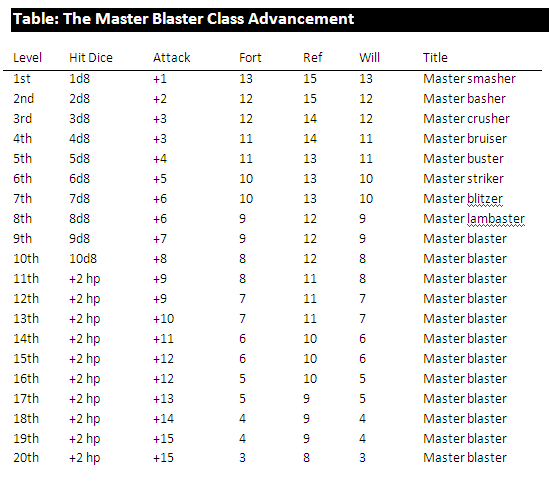
THE MASTER BLASTER

Master blasters are weird combinations of halfling thieves and bone-headed berserkers who join forces to plunder and, when the dungeons just aren’t producing, render methane from pig shit. Hey, it’s just a very specific class – deal with it.

Master blasters have one set of ability scores. The mental ability scores (Intelligence, Wisdom and Charisma) belong to the halfling “master”, while the physical ability scores (Strength, Dexterity and Constitution) belong to the human or humanoid “blaster”. If separated, assume that the master has physical ability scores of 3, while the blaster has mental ability scores of 3.

Master blasters, likewise, have a single hit point total. Again, if separated, assume that 75% of those hit points belong to the blaster, while 25% belong to the master. The character also has a single armor class – both master and blaster must wear the same sort of armor – etc. Heck – if you’re goofy enough to allow this class in your game, you can sort out the details.

HIT DICE: d8 to 10th level, +2 hit points per level thereafter

REQUIREMENTS: Strength and Intelligence of 13+, non-lawful (good)

ARMOR ALLOWED: Padded and leather armor, no shields

WEAPONS ALLOWED: Any, except bows, crossbows and firearms

SKILLS: Find/remove traps, open locks

ADVANCE AS: Barbarians

Master blasters enjoy a few benefits from their unique partnership. Because they have two sets of eyes and ears, they are only surprised on a roll of 1 on 1d8. In addition, they may attack twice each round. One attack is performed by the blaster, using the character’s normal physical ability scores, while the other is launched master, using his physical ability scores of 3. The master can only use small weapons, and thus, unless fighting a large monster, must usually restrict him or herself to thrown weapons.

Because of their physical configuration, master blasters must purchase a specially made saddle for the master. These saddles cost as much as normal horse saddles, though they are quite different in design.

Masters are trained engineers, and can make a special Will save, modified by Intelligence, to understand and operate machines. When dealing with weird machines of the ancients (or from the future), they suffer a -5 penalty to their roll. If the machinery has no obvious moving parts, they suffer an additional -5 to the roll. If the machine is magical in nature, this also imposes a -5 penalty to the roll.

A 9th level master blaster can choose to establish a stronghold in the wilderness and gain followers (see High Level Play below). The master blaster must engineer this stronghold to create a methane processing station; this methane can be used to power other machineries in the stronghold, including flame projectors and the like.

A master blaster who becomes a lord or lady attracts 1d6 swine (with one swineherd per 6 swine), 1d4 berserkers per level to their retinue, 1d4 first level barbarians as guards and 1d4 first level thieves who wish to learn the finer points of engineering. These barbarians and thieves should be generated as player characters under the control of the master blaster’s player. There is a 5% chance per barbarian that they are actually a wereboar that will be loyal to the master blaster.

* Nobody demanded it – I’m a liar.

Images found HERE

What’s In Santa’s Sack? – Dwarf Edition

Are you eye-ballin’ me boy?

Let’s kick the holiday season off right with a nice gift guide for the dwarf in your life. If your players have a lawful dwarf in their midst, roll a D30 and give the little bugger something nice from old Kris Kringle …

1. Beard extensions
2. Spiked boots of tooled purple worm leather
3. Jeweled eye patch (or two, if the poor dear is blind)
4. Treacle surprise!
5. Rock candy shaped like little earth elementals
6. New undergarments with a fresh pine scent
7. Monogramed leather apron – smith in style!
8. Blue dragon leather grip for the warhammer
9. Illustrated copy of The Amorous Adventures of Freya Grunsdottir
10. Basket Weaving Made Easy – much of it is applicable to beards
11. Woolen stockings – 3 pairs!
12. Bag of novelty pipe cleaners
13. Subscription to the Mead of the Month club
14. A real treasure map!
15. Balrog-B-Gon (1% chance of actually working)
16. Pair of gold-sniffing ferrets
17. Aurumvorax-fur coat
18. Helm with handy-dandy candle holder
19. Nose wax (to keep the old neb nice and shiny!)
20. Monogram lace hanky, ‘cause even dwarves need a good cry sometimes
21. Leather bodice studded with rhinestones (for the dwarfettes … or maybe not …)
22. Adamantine pick-axe autographed by Bjorn “the Badger” Bjornholm
23. Lead miniature collection, “The Great Dwarves of History”
24. Official Junior Vulcan Metallurgy Set
25. Bar of lye soap, nose tweezers and ivory mustache comb in a tasteful gift bag
26. Box of assorted candied beetles
27. 50’ of silk rope
28. Cave bear rug
29. Ale mug engraved with the dwarf’s name
30. Collection of Norðri, Suðri, Austri and Vestri commemorative plates


Cush and Pwenet – A Hospice, a Mindmaster and the Krakoo

57.08 Nabu Castle: Rising above the savannah is a concentric castle in the style of Old Nabu. From the outside, the castle looks perfectly normal. The outer wall is 20’ tall and constructed of white limestone (quite dazzling under the blazing sun). It has a single gate house with a bronze portcullis that has been rended apart like tin foil. The gate house is guarded by a blazing bones (43 hp) who holds a chain connected to a cauldron of boiling palm oil.

Beyond the outer wall there are the burnt remains of many huts and a well that still supplies sweet water. At some point, a desperate woman cast a golden ring (100 gp) into the well.

The inner wall is 30’ tall and shows signs of damage (broken ramparts, piles of rubble) on its eastern side. The inner gatehouse, located away from the outer gatehouse, consists of 40’ tall towers bristling with arrow slits. Inside each tower are five skeleton archers (HP 7, 6, 6, 5, 2, 2 in each). The iron portcullis between the towers is rusted shut, and would take a combined strength of 100 to force it open.

Once one has breached the inner walls, they will discover that the castle’s donjon is nothing but a pile of rubble. Nevertheless, a cavernous opening does give access to a small entry chamber guarded by three zombies (HP 10, 2, 1) wearing a number of cow bells. Any fight with them will produce a racket, warning the lord of the castle that dinner is served.

From the entry chamber one will pass through a wide tunnel that winds below the castle. The tunnel eventually splits into three passages. The easternmost passage leads to a veritable ossuary of humanoid and animal bones as well as dozens of bell jars containing rare herbs and fungi worth 10 gp each to a herbalist or sage.

The central passage leads further down until the slope becomes quick slippery (permanent grease spell), sending intruders into a deep pool (10’) of fresh water. A submerged tunnel leads to the bottom of the well.

The westernmost passage leads down a bit before ending in a large burrow supported by pillars of limestone. This burrow holds a pool of black water and a large pile of treasure. It is the home of a middle-aged dragon who calls himself Mindmaster the Controller.

Mindmaster sacked this fortress a millenia ago and has been sleeping for the past two centuries. He has copper scales, a sinewy body with bat-like wings, and hypnotic eyes (gaze attack). He is capable of casting the following spells: Grease, detect thoughts (ESP), summon monster I, wall of fire and animate dead. Mindmaster’s breath weapon is a cloud of hallucinogenic gas (save or suffer frightening hallucinations for 1d4 rounds).

Mindmaster’s hoard consists of 1,000 gp and a wand of wonder.

57.44 Hospice of the Blazing Sun: A band of Lawful clerics and knights has established here a hospice and road house for folk bound from the west and south for points north. The hopsice was established on a sacred field of battle, where warriors of the Order of the Blazing Sun, crusaders in service to Mithras, did battle with a coalition of gnolls and the servants of Chaos.

The hospice is a small fort of adobe brick. There is an outer wall, about 16 feet high and 4 feet thick, which is patrolled by crossbow-armed warriors of the order, with a two gates consisting of an iron grate. A 10-ft. deep pit, 8-ft. wide and 16-ft. long, has been secreted beyond the gate, and can be set to open when trod upon by releasing a lever near the inner gate. Above the gate, there is a gold plate (worth about 160 gp) depicting the face of Mithras.

Within the wall, there is a stable (can hold 30 horses), a small smithy manned by the armorer Kanu (who worships Ogun, but keeps it quiet around the religious knight), a cookhouse where game and cattle are barbequed by a cook called Amah, and the main keep, a 20-ft. tall building, square in foundation with sides 40-ft. long, with crenelations on the roof. The keep has a single, sturdy oak door bounnd in iron. Within, there is a great hall, chapel of Mithras, hospice, kitchen, apothecary, armory, a cellar (storage, including several barrels of sweet wine) small rooms for travelers and even smaller cells for the warrior of the hospice.

The hospice is manned by 20 men-at-arms (ring mail, heavy mace, light crossbow (fires bullets rather than bolts), 10 bullets), ten 1st level fighters (light horse, chainmail, shield, lance, light mace) and six 1st level clerics (light horse, chainmail, light mace, three throwing hammers). They are led by a chanter called Bonse and the master of the hospice is the vidame Arkhun, who hails from Ibis.

The hospice is famous for its wine (the valley it is situated in produces a decent grape, which the brothers turn into a sweet wine) and the cattle they graze on the savannah. Recently, a constrictor has stolen its way into the cellar, and awaits its prey.

60.06 Krakoo: This hex was long dominated by a powerful band of gnolls. Over time, their numbers fell and another group of crow-headed warriors called the krakoo invaded. The last band of gnoll warriors, their chieftain Zharl and his eight bodyguards, are now chained to several thorny acacias, slowly bleeding to death. The krakoo have set up their new stronghold on a rocky promontory, studding the upper portions with the spears (and bones) of the gnolls. If aided, the gnolls will happily lead adventurers to the promontory, and will even fight with them, but they ultimately cannot be trusted.

Weapon Showcase – India

Let’s get one thing straight – Indian weapons are awesome for the names alone. Firangis and kayamkulams and talwars sound wonderful, even if facing one in the hands of an angry kshatriya would be anything but pleasant. I was recently bumping around for the name of one type of sword in particular – the pata – when I came across the others and decided to write about them here, giving them some stats for Blood & Treasure. So, without further ado –

Note – all images come from Wikipedia

Aruval

The aruval is an Indian machete-like weapon. The top section is curved and comes to a point, and gives wielders a +1 bonus to grapple attacks. The base is often kept razor sharp so it can be used for slashing.

Medium weapon; 1d4+1 damage; 2 lb.; 8 gp

Bagh nakh

The famous bagh nakh are also known as tiger’s claws. The bagh nakh consists of four or five short, curved, claw-like blades affixed to a metal cross-bar or a glove. Bagh nakh grant the user a +1 bonus to Climb task checks.

Light weapon; 1d3 damage; 1 lb.; 5 gp

Bhuj

The bhuj is also known as a gandasa, or axe-dagger. The dagger blade is affixed to an axe-like haft. The blade is short (7 to 10 inches) and broad, with a gentle curve. The haft is usually hollow and hides another slim, stiletto-like blade.

Light weapon; 1d6 damage (or 1d4 damage from stiletto); 4 lb.; 9 gp

Bichawa

The bichawa is a loop-hilted dagger with a narrow, undulating blade. Based on the maru, or horn dagger, of southern India, it is often used as an ornamental weapon. The loop hilt sometimes serves as a knuckle-guard. The weapons are about 1 foot long.

Light weapon; 1d4 damage; 1 lb.; 2 gp

Firangi

The firangi is a long, straight-bladed sword imported into India from Portugal. The blades were manufactured in Europe, and the name of the sword is derived from the Arabic term for Europeans, al-faranji (i.e. Frank). Blades were usually 3 feet long, and either of the broadsword (double-edge) or backsword (single-edge) variety. Firangi had basket-hilts that provide the wielder a +1 bonus to save vs. disarm attacks. Because of its length, it was traditionally used as a cavalry weapon.

Medium weapon; 1d8 damage; 4 lb.; 15 gp

Gada

Monks don’t have to look like Bruce Lee

The gada is a Indian bludgeoning weapon not too different from a heavy mace. It has a large, heavy metal head in the shape of a ball on a thick, short shaft. It is often used as physical training equipment, and Hanuman favored it as a weapon. Because of the thickness of the shaft, it must be wielded with two hands save by those with a strength score of 16 or higher.

Heavy weapon; 1d6+1 damage; 9 lb.; 12 gp

Kalarippayatt

The kalarippayatt is a 2-1/2 foot long wooden stick that is used as a practice weapon by young warriors learning dagger fighting. It is also used as a weapon in its own right. It is usually made from the wood of the tamarind tree.

Light weapon; 1d3 damage; 1 lb.; 1 gp

Kayamkulam vaal

The kayamkulam vaal is a stately, double-edged dueling blade favored by the aristocracy of Nair. The blade is of medium length and tapers from the hilt to the very sharp point. It was often wielded with a buckler.

Medium weapon; 1d6 damage; 3 lb.; 20 gp

Khanda

The khanda is a broad, straight-bladed sword with very little point. A spike projects from the hilt. The khanda, having virtually no point, is not used for thrusting, but for hacking and slashing, somewhat like an axe.  The sword is double-edged and heavy.

Medium weapon; 1d6+2 damage; 4 lb.; 30 gp

Lathi

The lathi is a long staff, usually measuring about 6 to 8 feet in length, and often tipped with metal. A weapon of Indian monks.

Medium weapon; 1d6 damage; 4 lb.; 1 sp

Maduvu

The maduvu is a unique Indian weapon used by the martial artists (i.e. monks) of India. Made from deer horns, it is treated as a double-bladed dagger. Monks using a maduvu keep a low profile, and use it more as a defensive weapon than offensive. Monks armed with maduvu can treat it as a shield rather than weapon during each round of combat.

Light weapon; 1d4 damage; 1.5 lb.; 5 gp

Malappuram Kathi

The malappuram kathi was an ancient form of dagger used in Kerala. The blade is about 2 feet long and thicker at the top than at the base. The hilt was made from deer horn. It is said that wounds from a malappuram kathi were difficult to heal and often became infected. This was owed either to the unique construction of the weapon or the metals used by the very few Keralan blacksmiths who knew the secret of forging the weapon.

Light weapon; 1d3+1 damage; 1.5 lb.; 2 gp

Moplah

Moplah are very short swords with wide blades – wider at the tip than the base. Moplah were worn on the back, using special belts.

Light weapon; 1d6 damage; 2 lb.; 5 gp

Parashu

The parashu is a large, Indian battle axe. Some were double-bladed, while others had a single-blade and a spike. Most were about 5 feet in length.

Large weapon; 1d8+1 damage; 12 lb.; 20 gp

Pata

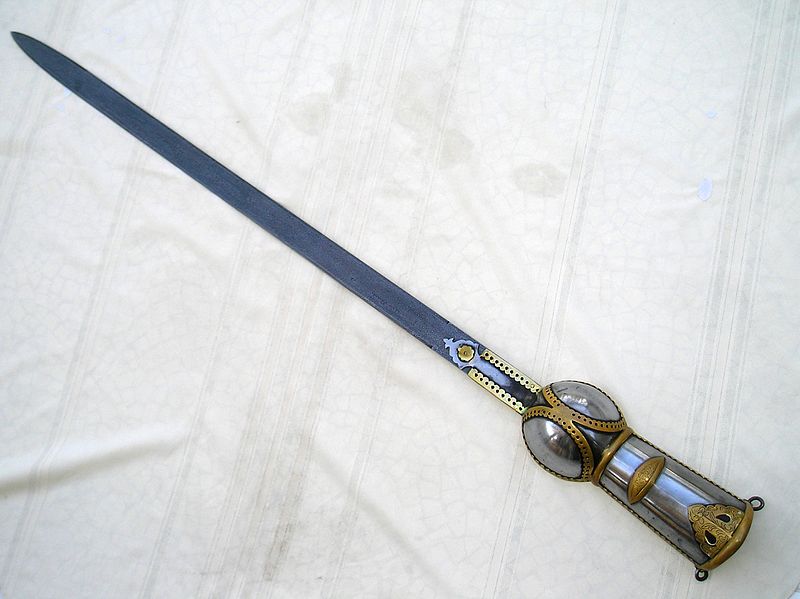
The pata is a very unique Indian straight-bladed sword that incorporates a gauntlet as the handguard. The wielder places his hand in the gauntlet and the sword is held rigid pointing straight out from the wielder’s lower arm. Pata were most often wielded one in each hand, or a pata was wielded in one hand and a javelin, whip or axe in the other. Pata could be from 1 to 4 feet in length, so we can assume that dual-wielders probably used one long pata and one short pata. The gauntlet guard gives the wielder a +2 bonus to save vs. disarm attacks.

Short Pata: Light weapon; 1d4+1 damage; 2 lb.; 10 gp

Long Pata: Medium weapon; 1d6+1 damage; 4 lb.; 15 gp

Talwar

The talwar is a curved sword that originated with the Turkic peoples of Central Asia. Wider than similar Middle Eastern swords, it usually had a disc hilt. Because the blade is not too tilted, it is useful for slashing and thrusting, and because the tip of the blade is especially heavy it was quite useful for amputating and decapitating opponents. When wielded by an attacker with at least a +3 attack bonus (and the Weapon Focus feat, if feats are used in your game), the talwar deals a critical hit on a roll of 19 or 20; though a critical hit on a “19” allows the target a Reflex saving throw to avoid it.

Medium weapon; 1d8 damage; 5 lb.; 15 gp

Trishula

The trishula is an Indian trident that also serves as a potent Hindu and Buddhist symbol. Although as a symbol it is often pictured without the haft, as a weapon is it usually hafted. Hindu clerics of war often choose the trishula as their weapon.

Medium weapon; 1d6+1 damage; 4 lb.; 15 gp

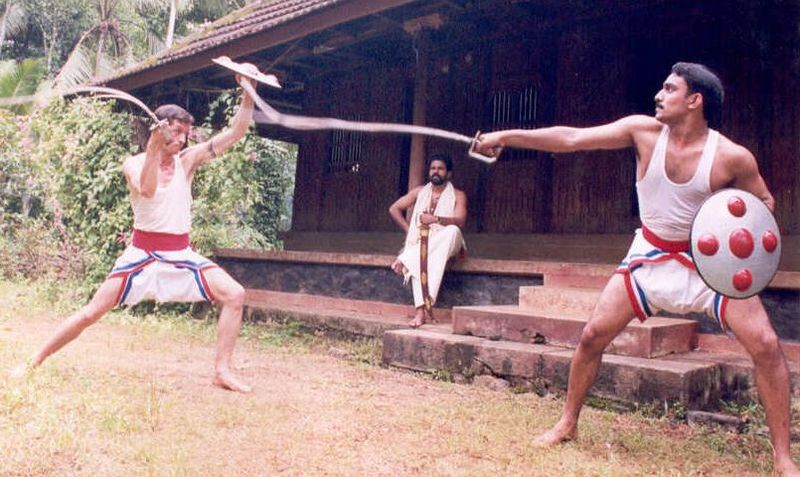
Urumi 

The urumi is a long sword with a flexible blade. The blade is sturdy enough to slice through flesh, but flexible enough to be rolled into a coil. The urumi is almost as dangerous to the wielder as it is to the target, and any time an urumi-wielder rolls an attack roll that is less than 20 – his attack bonus, he must pass a Reflex save or suffer 1d4 points of damage. Wielders with an attack bonus of at least +3 (and the Weapon Focus feat if this feat is used in your game) can choose to brandish the weapon, swinging it back and forth before them in arcs – when doing so, any creature attacking them in melee combat with a weapon shorter than 4-ft. must pass a Reflex save each round or suffer 1d4 points of damage.

Medium weapon; 1d6+1 damage; 6 lb.; 28 gp

Image from http://en.wikipedia.org/wiki/File:Urmi-Payattu.jpg

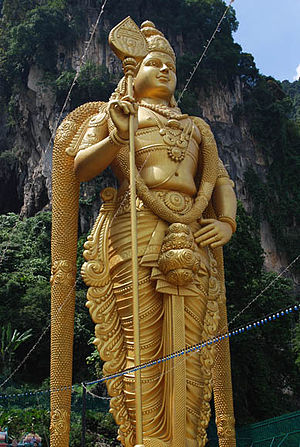
Vel

The vel is a broad-bladed spear used primarily by the Tamils in combat. The weapon’s name is derived from the divine weapon of the Hindu deity Murugan.

Thrown weapon; 1d6 damage; range 40/80; 3 lb.; 2 gp

Murugan’s Vel: +3 holy vel; when hurled against a tree, it splits the tree into two halves, which become celestial animals of Murugan’s choosing

Dragon by Dragon – February 1979 (22)

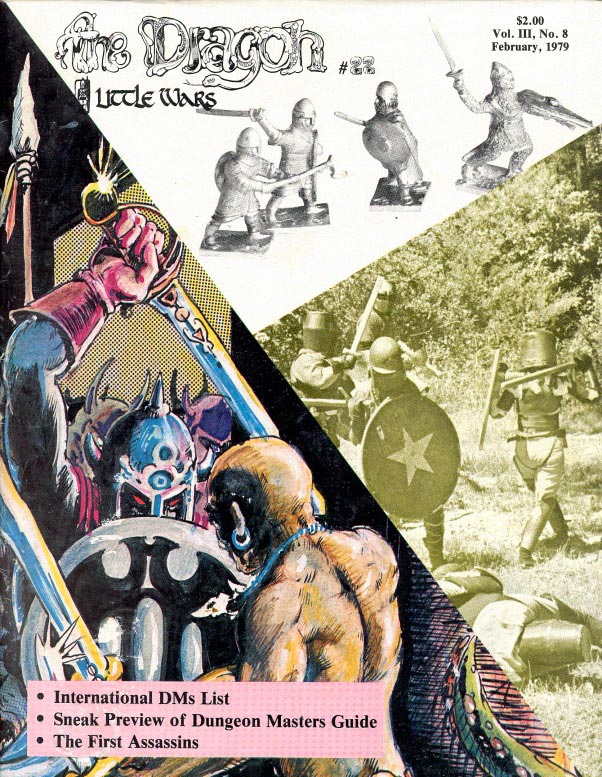
A new year has dawned, and February brings us an interesting cover combining a photo of miniatures, a photo of what I’m guessing are some SCA’ers bludgeoning one another, and an illustration of fantasy swordplay. Given that the byline on the cover is “Little Wars“, one can imagine what lies inside.

As has become a tradition of this series, the first thing I manage to fall in love with is the latest Ral Partha advert. If I’m completely honest, I’m not usually that enthused about their sculptures, but I love the names and notions. In this case, it’s the Army of Mu’ugalavya! I think it would make a good random encounter for any campaign – imagine a plane hopping army of conquerors carving out footholds on a thousand material planes.

When encountered, the army consists of the following:

1d6+1 Heavy Infantry (men-at-arms with platemail and spear)

1d6+2 Medium Infantry (men-at-arms with scale mail, shield and war hammer)

1d6+3 Medium Infantry (men-at-arms with scale mail, shield and barbed spear)

1d6+4 Heavy Infantry (men-at-arms with platemail and battleaxe)

1d6+5 Archers (men-at-arms with leather armor, longbow and dagger)

1d6+6 Slingers (men-at-arms with sling and hand axe)

General – fighter of level 1d6+7 in platemail with shield and longsword

When encountered, roll a reaction check:

Hostile – the army attempts to kill the encountered party to keep them from revealing their presence here

Neutral – the army attempts to capture the party and interrogate them about the surrounding lands

Friendly – the army attempts to recruit the party, promising them a share of any plunder they get

Our first article is The First Assassins by James E. Bruner, a study on the infamous Order of Assassins that once plagued the Middle East. The article gives a history of the organization. It’s really a fascinating story, and if applied to the assassins of AD&D (and its simulacra) would make that class infinitely more interesting. Imagine a world populated not with rangers who were mere fighters of the greenwood and assassins who were mere men-in-black with poisoned knives, but with the Numenoreans of Tolkien and the cultists Hasan Sabbah (or his simulacra) bent on overthrowing the most powerful religious leader in the known world. One should also note that the real assassins had their own level titles: In order from lowest to highest they were Adherents, Companions, Propagandists (remember, they were primarily preachers attempting to undermine the Caliphate that they may replace the Caliph with a member of their own sect), Greater Propagandists and Grand Headmaster of the Order.

The history continues in this issue with Irresistible Force – A Brief Account of the Rise of the Swiss Confederation with Commentary on Their Military Tactics by Gary Gygax (one can imagine from the title how brief the article will end up being). It’s quite an interesting article as well, and contains one of those percentile charts of the Swiss Army that readers of the old Monster Manual will recognize well. An army book like this would have been pretty cool back in the day – sort of a “Monster Manual” of ancient, medieval and renaissance armies. I’d like to produce something similar myself one of these days for Blood & Treasure.

Nick Nascati follows this up with Armies of the Renaissance – Part One. This article gives a brief overview of what is to come, with some history of the period (the great generals of the period, the mercenaries (which seem to be the inspiration for all those bandit troops led by high-level fighters in AD&D) and artillery).

Review time! This issue covers the following games (and I’ll include the concluding paragraph of each review):

Boardgame – Up-Scope!: “Still, you take what you can get. This one isn’t bad. I just wish it were better. Play it, before you buy it, to find whether you’ll love it or hate it. — Dave Minch”

Book – The Face in the Frost: “This well-written novel of strange hauntings, sorcerous conjurations, and outrageous humor can not be recommended too highly! Go out and get a copy right now, but be prepared to spend a long, uninterrupted period of time reading it, for you won’t want to put it away until it is finished once you begin!

(I concur on this one – great book)

Boardgame – Panzerkrieg: “All in all, this is a game which is every bit worth its $12.95 pricetag. Not only is the game colorful and well-done graphically, but it provides excellent play value for the money with its eight scenarios, each one a bit different from the others — and some with the Russians on defense, others with the Russians on the attack. There are some minor flaws, (more playtesting would have helped), but these are far outweighed by the game’s advantages and overall appeal. I recommend this title to anyone who enjoys the Eastern Front, or who simply enjoys a good historical game no matter what the subject. — Mike Carr”

Magazines – Apprentice #2 and Phoenix: “APPRENTICE is certainly bad, but for one dollar it is a value if you appreciate jokes. PHOENIX is worse, and no price is given. If it is free, you might wish to get it. – Gary Gygax”

(Bear in mind, this review came after the magazines in question wrote a bad review of The Dragon)

Up next is a big installment of Mapping the Dungeons, which presents DM’s and gaming groups and their addresses from around the U.S. and beyond. Not much of interest here other than the historical record of early players of role playing games, but I did like the little piece of art at the end by McLean. I love his comic pieces, of course, but I would have liked to have seen more of his serious stuff appear in old TSR publications.

Gary Gygax now chimes in with Dungeons & Dragon – What It Is and Where It Is Going. He mentions that perhaps 150,000 people now play D&D, and gives a brief synopsis of its history and the future he envisioned for it. He brings up AD&D, modules and similar material and … computers! One line I did like was this:

“It is my personal opinion that the game form is a classic which is of the same stamp as chess and MONOPOLY® ; time will be the judge.”

I think he got that one right, though the present copyright holders seem to be bent on proving him wrong.

Up next is an examination of a new game from TSR called 4th Dimension – a game that sounds like a mix of chess and Stratego that involves capturing an opposing Time-Lord on a circular board divided into variably sized spaces. Honestly – never heard of this one, though it sounds pretty cool. Here’s a link to Game Board Geek’s page on the game.

This is followed by a multi-page preview of the AD&D DMG – essentially a few pages from the magic items section and the attack matrices and a few more bits.

If anyone doubts that Gary Gygax did not appreciate negative criticism, one need only pick up this issue of The Dragon. He already savaged a couple fanzines, and now he offers a review of a review of AD&D’s Player’s Handbook in SPI’s house mag, Strategy & Tactics. A sample …

“What is worthy of comment, however, is the source of the critical commentary on AD&D being nothing more than a rewrite of D&D. Coming from an officer of SPI, the past masters of the rehash, artisans of the warmed-over WWII battle game, purveyors of the umpteenth version of the same, tired scenario, it is indeed a wonder that Mr. Berg would bring up such a spectre!”

I have a feeling these snipes probably turned more people away from D&D than the bad reviews.

Stalemate at Kassala is a play report of a war game that re-enacted a battle in 1541, when the Portuguese sent 400 infantry with 1000 stand of firearms and some cannon to aid the Ethiopian emperor Galawedos against an army of invading Egyptians and their Nubian allies. As you can tell from the title, it ended in stalemate.

Finieous Fingers then runs into “Grollem” and buys his precious ring of invisibility off him for 1,000 gp (actually turns out to be a fake sold by a hobbit in a Grollem suit), and then wanders into a dragon horde, where he discovers just how fake the ring is.

Ah – a classic article comes up next – Gygax’s Nomenclature of Pole Arms. I’ll say no more, for the truly initiated of the RPG community know all about it.

That’s it for February 1979! Not a bad issue really, especially because it reinforces the importance of history in D&D – it ain’t just fantasy folks.

Cush and Pwenet – Pillars, Mists and Spires

Note: No ostriches appear in this preview!

53.15 Fortress of Pillars: There is a very strange fortress in this hex. The structure is built of bluish-grey stone and is raised above the ground on pillars encusted with sea shells. It has a grand front gate of oak and iron, but no apparent way to enter it without walking on air (and this is, in fact, the way the fortress is entered by visitors – the inhabitants use the hippogriffs kept in the stable to come and go).

It is a large keep with nine towers (one is central) topped by glass bubbles aquamarine in color that, from afar, appear to be filled with water. This is a trick of the eye – each in fact holds a small garden of exotic, fragrant flowers from the jungles of Cush. The walls of the fortress are 30 feet tall, the eight outer towers about 40 feet tall and the central tower about 50 feet tall. Atop the walls, one sees 1d4 crossbow-armed goblins on watch at any given time. The walls are exceptionally slick, and one suffers a -2 penalty to climb them.

The fortress actually holds 40 goblins (ring mail, spear, light or heavy crossbow) and other monstrous guards. They work for His Most Illustrious Eminence, the Palatine Baron Devald the Daring, a displaced Tremanni warrior who made his fortune as a trader, raider and plunderer in Ende and Cush. As mentioned above, he has a stable of 10 hippogriffs, and he also has an old goblin witch-woman called Zaxa who serves as his major domo and court wizard.

54.27 Mists: This hex is thronged by enchanted mists. The hex looks clear during the day, but if adventurers spend the night here, they awake to a thick fog that makes navigation all but impossible. A ranger or druid can attempt to roll 1d12 under their level to escape the hex – others have a 1 in 20 chance per day to escape. The mists are inhabited by a company of people who lingered too long here. They now appear as misty shades. When encountered (2 in 6 chance per day; 2d8 shades) they attempt to drag people deeper into the mists. After one week in the mists, adventurers must pass a Will save each day or lose one level; any person who has all their levels drained (either by the mists or by the shades), becomes one of the people-of-the-mist and is trapped in this weird pseudo-dimension for all time.

55.35 Spires: The landscape of the savannah here is broken by large limestone spires and arches. The ground here is uneven and difficult to travel across. The soil is sandy around the spires and in the many shallow canyons, and thick with brambles and poisonous snakes. A keen-eyed elf might notice a vast murder of ravens wheeling and keening about a particularly tall spire in the distance. At the base of this spire, a female fighter called Ambang lies dying, two arrows piercing her breast. She was ambushed by seven gnolls – their bodies lie about her and already bare signs of feasting by the carrion birds. Ambang will be dead 1d10 minutes after she is found by adventurers.

Seasonal Beasties – Ladies in Grey

In the fall, the earth begins to fall asleep, and sleep was the inspiration for this next seasonal beastie …

LADIES IN GREY

Women in gray are fey spirits who appear as elegant elven women. The are clad in ruffled silks of teal and dun and dappled bodices of velvet, their collars and wrists ringed in lace. Their skin is as white as bleached bone, their thin, enticing lips are champagne, their hair platinum and their eyes xanadu. They are, no doubt, lovely, but they do not inspire love.

Ladies in grey appear when the wind turns chill and the leaves begin to fall. One might think of them as the harbingers of winter. They walk through the streets of villages and down woodland paths, a chill following them wherever they go. It is said they speak of deep secrets in the hush, honeyed voices, and their raison d’etre is to lay low the powerful to make room for new blood.

In any situation, the ladies in grey will focus their attentions on the most powerful (by levels or possible hit dice) person in their presence. They move swiftly, their bodies and clothes blurring as they do so, and those who enter melee with them must pass a Will save each round or be affected as per the slow spell from the hypnotic quality of their blurred movements. If engaged in hand-to-hand combat, they can produce a slim, silver sickle, but prefer to use their own chilling touch.

Those touched by a lady in grey must pass a Fortitude saving throw or be cast into a deep slumber from which they cannot easily be awakened. The amount one fails the save indicates the amount of time they slumber:

MISSED BY … DURATION
1 … 1d4 rounds
2-3 … 1d4 minutes
4-5 … 1d4 turns
6-7 … 1d4 hours
8-9 … 1d4 days
10-11 … 1d4 weeks
12-13 … 1d4 months
14-15 … 1d4 years
16+ … 1d4 decades

While slumbering, a victim is placed in stasis – they do not age, nor are the affected by any beneficial or deleterious effects currently on their person, such as spells like bless or poison or disease. They can be harmed and healed while sleeping. While sleeping, half of their life force (i.e. half their levels or hit dice, rounding up) are drained from them and into the surrounding landscape, making plants within 10 feet grow lush and bloom. When they awaken, they must pass one Fortitude saving throw per level or hit dice lost, or lose that level or hit dice permanently.

A person can awaken a sleeping creature with a kiss, but doing so imparts one of their one levels or hit dice to the slumberer. This means that the slumberer need not roll a Fortitude saving throw for one of their lost levels or hit dice.

Lady in Grey, Medium Fey, Average Intelligence: HD 5; AC 14; ATK 1 sickle (1d4) or touch (sleep – see above); MV 30; F13 R11 W11; AL Neutral (N); XP 1250; Special – Sleep touch, blur effect, slow effect – see above.

Fanfare for a Death Scene

When I drive, I typically listen to the radio more than to CD’s. This drives my wife nuts, because I’m a rapid channel-changer – I don’t settle for songs I don’t like.

“Why,” she asks, “don’t you just put in a CD of music you know you like?”

“Because,” I explain for the thousandth time, “I like to be surprised.”

If I don’t listen to random stuff, I don’t discover new things to love. It’s the same reason I like the “view similar titles” function on Netflix – you never know what you’ll find, and often that new thing you discover to love is a new old thing. Enter Fanfare for a Death Scene.

I’ve been on a Charlie Chan kick lately – Sidney Toler’s Chan, to be precise – and through that I discovered Fanfare.

Fanfare for a Death Scene is a spy flick from 1964 starring Richard Egan. I put it on my queue and almost didn’t watch it, but one night the wife and daughter were at her drama practice, and decided to give it a whirl.

The film opens with a shot of a sanitarium at night. The camera sweeps in through the bars of the front gate in a shot that reminded me of a Tim Burton film, and then we sweep through the halls of the sanitarium, where all the doctors and nurses are slumped over dead, shocked looks on their faces. After this bit, I felt certain that Burton had seen this film – I was getting a Burton’s Batman vibe. The shot then moves to the exterior, where two men are sitting in a car. They suddenly see a Burgess Meredith burst through the hedges – okay, he wasn’t playing himself, but still, Burgess Meredith is always a good sign. The man sees the fellows in the car, pulls out a trumpet, and then begins playing it. The men in the car stare at him, incredulous, and then turn on their lights. When the lights hit the trumpet player, he pulls out a gun and begins firing. The lights are knocked out, one of the men is hit, and he sends the other off to deliver the news that Bannerman had escaped!

If this sounds nuts, it is, and it defines the wonder of this movie. It’s like a ’60s Batman episode without the Dynamic Duo. Meredith plays a crazy scientist and amateur-trumpeter who devises a deadly poison. Telly Savalas plays the Mongolian khan who controls shadow governments all over the world, who wants the poison for some nefarious scheme. Viveca Lindfors (I fell in love with her in The Adventures of Don Juan with Errol Flynn – another must-see) is his Mongolian princess, while Tina Louise (Ginger from Gilligan’s Island) plays one of his assassins (in a suggestive scene you might be surprised to find on early 60’s television).

This whole bizarre crew is being hunted by our hero, Stryker, a secret agent and industrialist, who is assisted by agents of the Probational Bureau of Investigation (okay, I think that’s what it was called – I watched it about two weeks ago). Honestly – seek out the film on Netflix if you can – words can’t quite describe how much I liked this movie. Weird without being too weird – it reminded me of a typically gonzo role playing game session, where everyone is having fun and nobody cares how goofy things get.

The real reason to watch this, though, is the inspiration it can provide for an espionage game, especially a Cold War game. Nobody believes Stryker when he tells them that the USA has little to fear from Russia and China – the real deal are the Mongolians and their shadow governments and assassins. Tina Louise makes an awesome femme fatale, Savalas an excellent Yellow Peril, and one can imagine the adventures of agents of the PBI as they fight these fellows in games that could have been inspired by a weird, slightly campy ’60’s spy show that never existed.