Three Bad Bishops, You Know So Well

Let’s review, for a moment, the cleric.

The cleric was the original middle child of D&D – stuck square between the magic-user and fighter in terms of spell use and fighting ability – and the first class born from play, rather than the Chainmail rulebook. Legend has it that Sir Fang, a vampire character (yes, monster characters are as D&D as apple pie is American), was proving troublesome, so somebody decided they needed a Van Helsing* to deal with the rapscallion.

* Side Note: If you want to thoroughly understand the undead of D&D, you need to watch the Universal and Hammer horror films. Never understood the whole “vampire energy drain touch” thing? Watch Captain Kronos. You’ll understand. Plus Caroline Munro

So, the cleric, as it was introduced into the rules, became a mix of Van Helsing vampire hunter and medieval bishop-of-war, with the stylistic emphasis on the latter rather than the former. Who were these battling bishops of the Middle Ages, you ask? Read on …

ADHEMAR OF LE PUY, BISHOP OF PUY-EN-VELAY

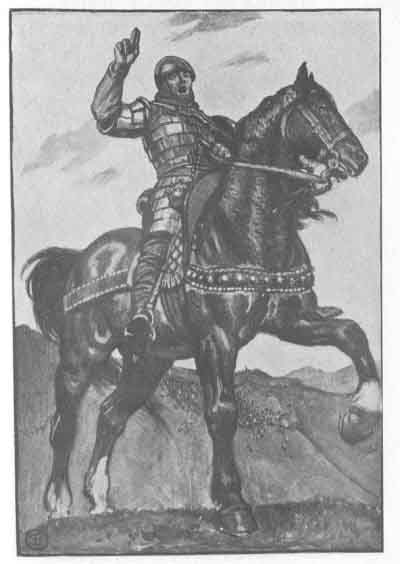
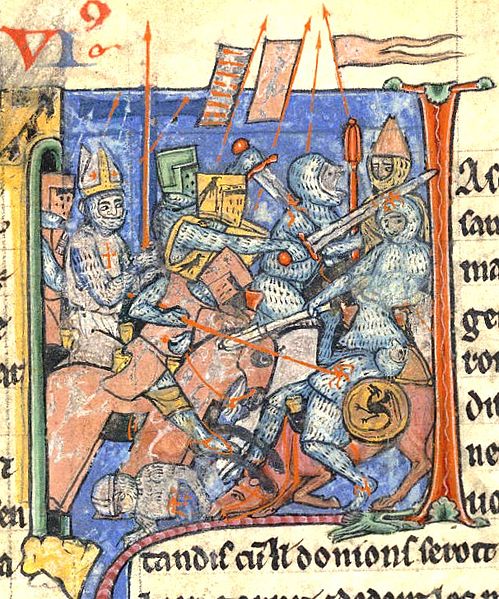
Adhemar (totally made up name, right?) hailed from France, and he plays an important part in the First Crusade. You can see him to the right, wearing the mitre*

* Side Note: If your 9th level cleric doesn’t enter dungeon fully armored and wearing a mitre, he should be stripped of his clerical powers and forever consigned to being a second-rate fighter. No Lawful or Chaotic deity worth his salt should forgive the sin of “awesome headgear aversion” in his followers.

He was paired up on the crusade with a bunch of stupid fighting-men who quarreled all the time over leadership, but managed to keep things focused with his spiritual leadership throughout the ordeal. When he died (probably of disease*), some claimed that he pulled the old Obi Wan trick (remember, Star Wars was a “long time ago”, so it technically occurred before the First Crusade) and returned as a ghost to cheer the foot soldiers on.

BISHOP ADHEMAR, LAWFUL CLERIC 9: HP 24; AC 15; ATK 1 longsword +6 (1d8); MV 30; SV F 10, R 12, W 8; Special: Turn undead, cleric spells (6/5/4/3/2/1); Gear: Chainmail, longsword, mitre, holy symbol, warhorse; Abilities: STR 12; INT 13; WIS 15; DEX 12; CON 8; CHA 14.

* Side Note: Died of disease? Hello! Cure disease – low level spell – what’s the deal? Well, it turns out that many of these bishops, uninformed of the D&D rules, used edged weapons and thus were unable to cast spells. Fortunately, fighting bishops of the future will be forewarned.

ODO, EARL OF KENT, BISHOP OF BAYEUX

Half-brother to William the Conqueror (a 9th or 10th level fighting man in his own right), Odo has one of the great names in the history of names (but far behind this guy). In fact, whenever I’m writing high-level clerics in a medieval milieu, it’s all I can do to avoid naming all of them Odo.

Odo is a little more “traditional D&D cleric” than the others, or at least pretended to be. Apparently, the Bayeux Tapestry (according to that shining light of accuracy Wikipedia) belabors the fact that he did not actually shed blood during the battle, and he is pictured armed with a club rather than an edged weapon urging the soldiers to battle – perhaps with a bless spell.

Odo also, apparently, gained his fortune by killing things (well, people) and taking their stuff, which I think cements him as a true D&D cleric, albeit a chaotic one. He joined the First Crusade (see above), but died before he actually got there, thus robbing the crusaders of some very useful cure (or cause) wounds spells.

BISHOP ODO, CHAOTIC CLERIC 9: HP 35; AC 15; ATK 1 club +7 (1d4+1); MV 30; SV F 9, R 12, W 9; Special: Rebuke undead, cleric spells (6/5/4/3/2/1); Gear: Chainmail, club, holy symbol, warhorse; Abilities: STR 14; INT 12; WIS 9; DEX 9; CON 12; CHA 12.

TURPIN, ARCHBISHOP OF REIMS

Turpin is no mere bishop. He’s an archbishop (so, 12th level, I guess). Turpin lived a few centuries before the other two in this post, and he was one of the Twelve Peers of Charlemagne and a pal of Roland. Some of the legends of Turpin might be confused with his predecessor, Milo, a “warrior clerk” (i.e. cleric).

In any event, Turpin was a bad-ass, and he wielded a magic sword called Almace (“Almighty”) that may have been forged by Wayland (the god-smith, not the puppeteer). A comparison of the three magic swords of the romances of Roland declared Kurt the least, Almace the second and Durendal the finest, so naturally I’ll assume Kurt is a +1 sword, Almace +2 and Durendal +3 (it’s science, dude).

ARCHBISHOP TURPIN, LAWFUL CLERIC 12: HP 34; AC 16; ATK Almace +11 (1d8+3); MV 20; SV F 7, R 11, W 7; Special: Turn undead, cleric spells (6/6/5/4/3/2/2); Gear: Banded mail, Almace (+2 longsword), holy symbol, warhorse; Abilities: STR 13; INT 11; WIS 16; DEX 9; CON 10; CHA 14.

Amazons, Archons and Azers

I’m now working my through the monster chapter doing a first pass on editing before it goes to Tanner for a more thorough look, and I decided “Why not preview a few monsters on the blog”. (i.e. I needed a quick and easy post for the day because I’m busy as spit).

I figure this can give folks an idea about the format (different than in earlier previews – a format I liked but just became too difficult to layout effectively and make the info easy for the TK to access during play) and maybe preview a few of the new monsters in the game.

AMAZON
Medium Humanoid, Alignment Varies, Average Intelligence; Company (1d20)

HD: 1 + 1
AC: 16 (chainmail and shield)
ATK: Longsword (1d8+1) or longbow (100 ft., 1d8+1)
MV: 30
SV: F 15, R 13, W 15
XP: 100 (CL 2)

Amazons are humanoid females who are expert warriors. All amazons are uncommonly tall and handsome. They come in three varieties, named after the color of their skin; the blue amazons, green amazons and red amazons. All amazons eschew accepting males into their society, but do require them for mating. Male humans are often taken by them in raids, mated with, and then sent on their way. Boys born onto the island are given to mercenary bands composed of the sons of amazons. These men, who lack the special abilities of their mothers, are called myrmidons. They look like their fathers, but their eye color and personality matches their mother.

Blue amazons are Lawful (LG) and worship the goddess of wisdom and war. Their skin is deep azure and they have hair that shines like silver. They are the wisest of the amazons, and enjoy a magic resistance of 10% and immunity to surprise. Blue amazons fight in close-knit ranks with spears and shields and they wear platemail (AC 19). They are usually led by clerics or paladins.

Green amazons are Neutral (N) and worship the goddess of the hunt. Their skin is jade green and their hair dark, forest green. Green amazons dwell in the woodlands, spending their days hunting. They can survive and track as well as rangers and can attack twice per round with their longbows. They are usually led by druids or rangers.

Red amazons are Chaotic (CE) and worship the goddess of black magic. Their skin is vivid crimson and their hair jet black. Red amazons fight as berserkers, attacking twice per round with their long swords, and they are immune to fear. They are usually led by chaos clerics or warlocks.

Organization: Band of 80 warriors plus 50% non-combatants plus leader of 4th to 7th level (1d4+3).

ARCHON
Archons are celestials that are not unlike angels, but of an inferior class. Archons speak Celestial, Infernal, and Draconic, but can speak with almost any creature using tongues.

A righteous aura surrounds archons that fight or get angry. Any hostile creature within a 20-foot radius of an archon must succeed on a Will save to resist its effects. Those who fail take a –2 penalty on attacks, AC, and saves for 24 hours or until they successfully hit the archon.

Spells: Continuous—magic circle against evil, tongues; At will—teleport

HOUND ARCHON
Medium Outsider, Lawful (LG), Average Intelligence; Pack (1d6)

HD: 6
AC: 19 [+1]
ATK: Bite (1d8) and slam (1d4) or +1 greatsword (2d6) and bite (1d8)
MV: 40
SV: F 10, R 10, W 10; +4 save vs. poison
XP: 3,000 (CL 8)

Hound archons look like well-muscled humans with canine heads. Hound archons prefer to attack with their natural weapons but occasionally use +1 greatswords.

A hound archon can assume any canine form of small to large size. While in canine form, the hound archon loses its bite, slam, and greatsword attacks, but gains the bite attack of the form it chooses.

Once per day, a hound archon can attempt to smite a Chaotic creature, doing double damage if it hits.

Special Qualities: Immune to electricity and petrification, magic resistance 15%

Spells: Continuous—magic circle against evil, tongues; At will—aid, continual flame, detect evil, message, teleport

LANTERN ARCHON
Small Outsider, Lawful (LG), Low Intelligence; Gleam (1d6)

HD: 1
AC: 15 [+1]
ATK: 2 light rays (30 ft., 1d6)
MV: Fly 60
SV: F 14, R 12, W 14; +4 save vs. poison
XP: 250 (CL 3)

Lantern archons appear as floating balls of light that glow about as brightly as a torch. Only their destruction can extinguish the glow, though they can try to hide it. A lantern archon has little reason to get within melee range. It usually hovers just close enough to bring the enemy within its aura of menace and then blasts away with its light rays. Lantern archons prefer to concentrate on a single opponent, seeking to reduce enemy numbers quickly.

Special Qualities: Immune to electricity and petrification

Spells: Continuous—magic circle against evil, tongues; At will— aid, detect evil, continual flame

TRUMPET ARCHON
Medium Outsider, Lawful (LG), High Intelligence; Blast (1d6)

HD: 12
AC: 23 [+1]
ATK: +2 greatsword (3d6)
MV: 40 (Fly 90)
SV: F 7, R 7, W 6; +4 save vs. poison
XP: 3,000 (CL 14)

Trumpet archons are angelic humanoids that carry long, silver trumpets. If forced into an extended battle, the archon sounds its trumpet and attacks with a vengeance. An archon’s trumpet produces music of utter clarity, piercing beauty, and, if the trumpet archon wills it, paralyzing awe. All creatures except archons within 100 feet of the blast must succeed on a Fortitude saving throw or be paralyzed for 1d4 rounds. The archon can also command its trumpet to become a +2 greatsword. If a trumpet is stolen, it becomes a chunk of useless metal until the owner can recover it. Woe betides the thief caught with one.

Special Qualities: Immune to electricity and petrification, magic resistance 30%

Spells: Continuous—magic circle against evil, tongues; At will—detect evil, continual flame, message

AZER
Medium Outsider (Fire), Lawful (LN), Average Intelligence; Squad (1d6)

HD: 2
AC: 21 (Scale, shield)
ATK: Battleaxe (1d8 + 1 fire)
MV: 30
SV: F 12, R 12, W 12
XP: 200 (CL 3)

Azers are dwarf-like beings native to the Elemental Plane of Fire. They wear kilts of brass, bronze, or copper and speak Fire Elemental and Dwarf (50% chance). Although unfriendly and taciturn, azers rarely provoke a fight except to relieve a foe of gems, which they love. Azers wield broad-headed spears or well-crafted hammers. An azer’s body is intensely hot, so its unarmed attacks and metal weapons deal extra fire damage.

Special Qualities: Immune to fire, magic resistance 5%, vulnerable to cold

Organization: Clan of 100 azer plus 50% non-combatants plus 7 HD leader

AZERS AS CHARACTERS
Azer characters modify their starting ability scores as follows: Str +1, Int +1, Cha -2. They have darkvision to a range of 60 and retain the special abilities of normal azer. Azer speak Fire Elemental, and may also speak the other elemental tongues and Celestial, Dwarf and Infernal. Azer can multi-class as cleric/fighters, fighter/magic-users and fighter/ thieves. Whatever their class, they can only advance to a max of 6th level.

Will Kaanga Rue the Day He Met Bwana Black-Jaw?

See what I did there? Kaanga. Rue. Yeah – spent more time on the title than the rest of the post. As always, a hearty thanks to the Comic Book Catacombs for posting this story. Away we go …

Right off the bat, I defy you to figure out what the @#$#%$ is going on. The story reads like they removed every other panel. We start off with the finest jungle comic book poetry ever written (“Devil-Devil Wind”, because the benighted love using the same word twice in a row to provide emphasis).

First, Ann watches Kaanga spear a panther in the chest. Fair enough – the predator might have had is coming. Next, she asks why they are stopping while Kaanga seemingly glues his canoe back together. Stopping when … why … where are they … what? Finally, Kaanga smells a guy in the forest, gets pissed and picks up his bola. [Note, Kaanga has a bola, so he’s officially playing by the Companion rules].

The story doesn’t get much clearer here. Because a man riding an antelope* doesn’t see Kaanga hiding behind a plant, his guilt is proven. In response, Kaanga does the only responsible thing – he throws a bola at him and then threatens him. M’bala now mutters something incoherent about white men, fire-eaters and demons (could be the blow to the skull he just received from those rocks) and Kaanga responds that, yes, he knew it all along. Knew what all along?

* Yeah, even my favorite thing – people riding animals that God and nature have deemed un-ride-able doesn’t rescue this stinker. Alas!

Kaanga and Ann now mount their zebras (awesome, but, no, still not enough) and head to the village, where the villagers send them to the Valley of Leopards (probably because they don’t want the Aryan with the itchy finger and doped eyes anywhere near their kids).

We close with a very lost toucan – perhaps on his own search for colorful, fruity breakfast cereal.

“Bones of a lost temple” is good, I’ll admit that. Might use it myself one of these days. As a long-time fan of Jonny Quest, I have to nod approvingly at “AI-EEE!” being used not once, but twice on the same page.

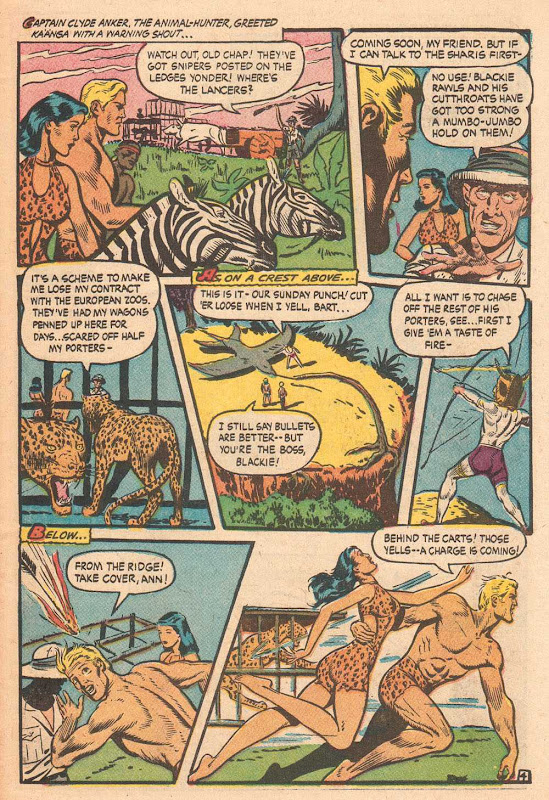
Ah, the plot thickens. Blackie Rawls wants to screw up Capt. Clyde Ankers contract with European zoos! The fiend! In the last panel, Kaanga’s hurry to save Ann from the arrow causes him to inadvertently snap her neck. Oh well – time to find a new henchwoman!

See – tribesmen mounted on antelopes and zebras killing in the name of Flame God. This really should be something wonderful. Pity. One thing does inspire me though …

Drum of Command: This item looks like a large bongo. When struck, all who can hear the drum must pass a (Will) saving throw or be whipped into a frenzy (per the barbarian’s rage) and attack whomever the drummer indicates for 1d6 rounds. Fear effects counter the effect of the magic drum.

The giant flaming bird-glider is a nice touch. Those contracts are as good as broken! Oh Blackie, you scoundrel!

See “Then the flame-kite crashing as M’bala’s treachery saw a chance –” is not a sentence. Damn close, but not a sentence.

Nevertheless, Kaanga takes one to the dome and out he goes. The kite explodes, the panther escapes back into the jungle (plot point, I’m thinking) and Ann and Capt. Clyde are taken prisoner.

So, is Blackie freeing the animals out of a sense of kindness?

So, Blackie has given his minions a false sense of confidence in themselves while ruining zoo contracts. I just don’t know …

“A savage surge of bull-ape’s might …” is another fantastic line. We now finally know what the heck was happening in the first panel (it was a preview!). We also now know that Kaanga’s war cry is “Haa-Ree!”. Please work that one into your next game for me. Thanks!

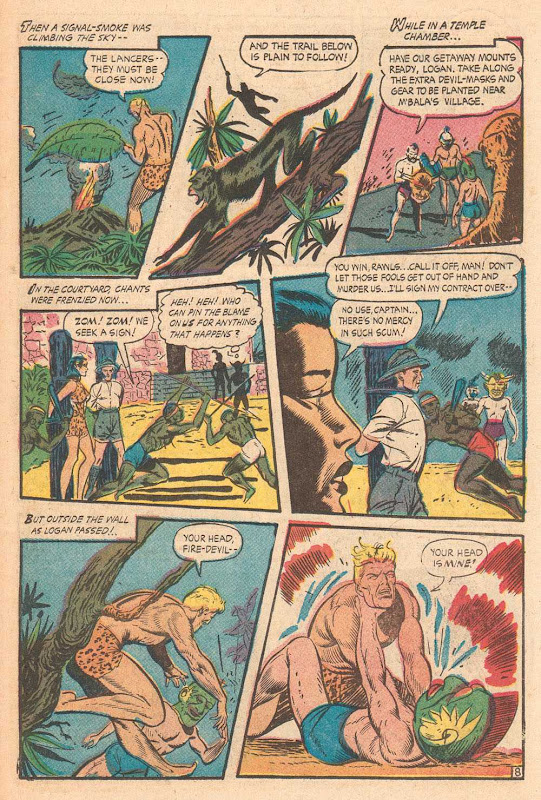
Kaanga uses a signal-smoke (or, if you’re 99% of English speakers, a smoke signal) to signal the lancers and heads off on the trail of the bad guys. Spider-Man shows up in panel two, chasing a monkey, and then we’re looking at the lost temple of the fire gods, one of whom must be called Zom. Again, I really should be enjoying this more than I am.

Blackie brags about the fact that his plan is so intricate and clever that they’ll never pin it on him. Pin what on him? Who the $%@#$% hell knows, though it is worth mentioning that everyone involved in the story is already 100% aware that he’s behind it all. I guess the lack of evidence will be important in the Superior Court of Jungle Law.

And then we find out just what Blackie Rawls is after. He wants Capt. Clyde’s contract. That’s it. That’s the whole dang caper. Tribal war, murder, etc. for a zoo contract. No diamonds, no King Solomon’s Mines. A zoo contract. The stuff legends are made of.

“Your head is mine!” Really sums it all up, doesn’t it. I take it back. Forget the war cry. In your next game (this week, this weekend, whenever), please make sure you yell “Your head is mine!” while attacking at least once. Maybe twice.

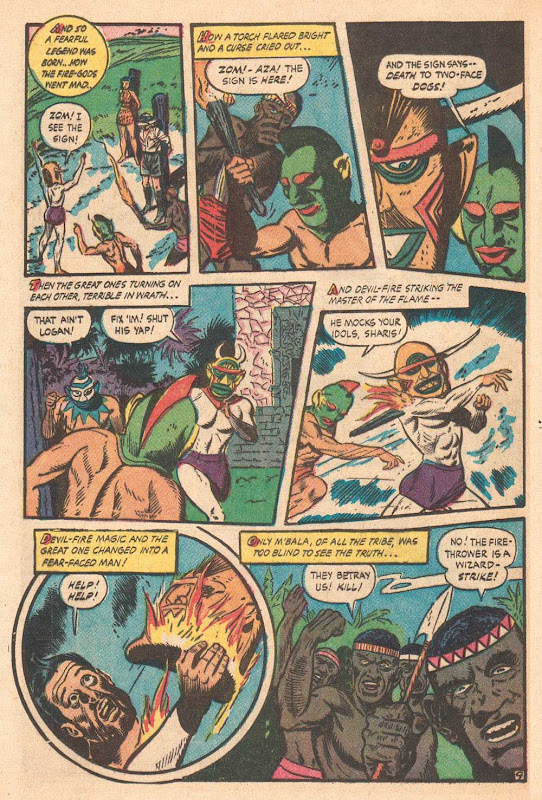
I like the last panel.

Angry Dude: “They betray us! KILL!”

M’bala: “No! The fire-thrower is a wizard – strike!”

Apparently M’bala is still aiming for better working conditions and a pension plan.

And so we come to the end of our tale. Kaanga punches M’bala in the face, the fire gods ride off on zebras, only to be killed by the lancers (who ride bog-standard horses – how boring), Ann is released from her bonds (say what you will about the comic, Riddell could draw one heck of an Ann), and Kaanga throws a patronizing parting shot to the natives. We can only pray they’ll kill him in his sleep one night.

And what did we learn from all this? Absolutely nothing! Thanks boys and girls … more inanity from the Land of Nod tomorrow.

How to Enchant An Item

Here’s a draft for the whole “creating magic items” bit for Blood & Treasure. Still thinking about this, so feel free to make suggestions and such (unless you think it sucks, in which case keep it to yourself as I have a fragile ego and artistic temperament).

The overall idea is that games are always talking about all the cool ingredients that can be used in making magic items, but this one is going to codify it (in a very vague way, of course). It’s also going to attempt to use the system for making these items as a impetus for adventure – i.e. you need a medusa’s tooth for an item, you have to slay it yourself. The other idea is to make sure that magic items are not being created willy nilly and all the time without using several tons of required gold pieces or XP costs to achieve it.

THE BASICS
The game has two systems for “what level do I have to be?” to make magic items, one based on 3rd edition, where as full spellcasters advance in levels they learn to make different types of magic items, and the other drawn from older versions of the game, that require one to be 9th level to make anything. Treasure Keepers can do as they like.

The overall cost to make an item is equal to have the gp value of the item – which can be divided up by the creator between hiring master craftsmen and alchemists, making the item to be enchanted, etc.

The item to be enchanted must be made by a master craftsman under the watchful eye of the magic item’s creator using the best possible materials

Magic weapons, armor, rings and rods must be forged from meteoric iron, mithral or adamantine or, for rings and rods, precious metals

Leather goods must be made from expensive animal hides

Cloth goods must be made from expensive fabrics (silk, velvet, cloth-of-gold, cloth-of-silver, wool from the exceptionally fine sheep, the hair of virgins, etc.)

Wooden goods (wands, staves, etc.) must be carved from rare and expensive woods

Scrolls must be scribed on vellum prepared by a master or chiseled in an expensive stone (malachite, porphyry) using an adamantine chisel

Potions must be brewed in vats made of precious metals with the assistance of an alchemist

MAGICAL ELEMENTS
All magic items are tied to an “equivalent spell” determined by the Treasure Keeper – i.e. what spell is sorta kinda (or exactly) like the magic item being made here. For each level of that spell, the item requires a “magical element”.

Roll d8 for potions and scrolls, d10 for all other magic items.

MAGICAL ELEMENT (Roll d10)
1-2 Herb (must be harvested from a special place or at a special time)
3-4 Mineral (discovered in a dungeon)
5-8 Monster (slain by the magic-user and his comrades)
9 Place
10 Time

HERBS (may be ground, used to make essential oils, smoked, burned as incense or ingested as a tea)
Angelica: Good and lawful spells, abjurations, summoning
Anise: Abjurations and divinations (esp. clairvoyance)
Basil: Strength, fire, evocations, necromancy, command/domination
Bamboo: Dispel magic
Caraway: Air spells, charm spells, movement
Cinnamon: Holy spells, mind-effects, communication spells, healing spells
Cloves: Negative energy protection, silence, dispel magic, charm person, astral projection, ethereal jaunt and other travel spells (teleport, dimension door)
Coriander: Abjurations
Foxglove: Poison, cause wound spells
Frankincense: ???
Galangal: Luck spells, blessings, remove curse
Garlic: Exorcism, protection from undead, healing, weather spells
Ginger: Fire spells, curses, evocations, spells of travel or movement
Ginseng: Restoration
Hellebore: Exorcism
Henbane: Poison, death spells
Holly: Resistance to electricity, magic circles, protection from evil
Horehound: Plant spells, tree spells, hallow
Lavender: Bless, healing, memory spells, sleep, bull’s strength, bear’s endurance, illusions
Lovage: Eagle’s splendor, charm spells
Mace: Transmutations
Mandrake: Evocations, summoning, visions
Marigold: Illusions
Marjoram: Animal spells, necromancy
Mistletoe: Love, druidic spells
Mugwort: Astral and ethereal travel
Mustard: Enchantments, dispel magic
Myrrh: ???
Myrtle: ???
Nutmeg: Dream, nightmare, divination
Onion: Contact other plane, commune
Oregano: Calm emotions, good hope, abjurations
Parsley: Haste
Peppermint: Animals, energy spells (including protection and resistance), healing, necromancy
Pomegranate: Communication with the dead, necromancy
Poppyseed: Sleep, dream, nightmare, confusion, insanity, binding spells, curses
Rosemary: Fear (including resistance to), exorcism, legend lore, alarm, glyphs and other spells that protect items, fox’s cunning, owl’s wisdom, water spells
Saffron: Sun and light spells, divinations, true seeing, detect invisibility, wind spells
Sage: Healing, longevity, protection from scrying
Savory: Animal spells, fey spells
Star Anise: Lawful spells, mark of justice, detect lie, hallow, aid, bless, prayer
Tarragon: Dragon spells, rage, remove fear
Thyme: Fey spells, divinations, necromancy
Turmeric: War and weapon spells, exorcisms, hold spells, mage armor, shield
Wormwood: Illusion

MINERALS
Agate: Plant spells, physical ability boosts, cure spells, abjurations
Amber: Sun and light spells, detect spells
Amethyst: Mind and emotion spells, clairaudience and other hearing spells, AC-enhancing spells, remove curse, break enchantment
Aventurine: Earth spells, open doors, knock, passwall, remove curse
Bloodstone: Remove fear, enhance physical abilities, heroism, mage’s transformation
Carnelian: Abjurations, fire spells, spells of movement (fly, jump, haste)
Chrysoberyl: Spell turning, reflective spells, locate object, spells of awareness
Copper: Remove fear, neutralize or delay poisons, communication spells
Emerald: Charms and enchantments, exorcism, enhance mental abilities and vision
Fluorite: Chaos spells, cure disease
Garnet: Abjurations, heal
Gold: Spells of purification, positive energy spells
Hematite: Mental and psychic spells, time spells
Jade: Water spells, wisdom spells, healing
Jasper: Abjurations, cure disease
Lapis Lazuli: Psychic spells, remove fear, divinations
Malachite: Plant spells, bear’s endurance, transmutations
Moonstone: Confusion, insanity, wish, neutralize poison, sleep, illusions
Obsidian: Protection from energy, detect evil, true seeing
Onyx: Lawful spells, spells of command and control, abjurations, wall spells
Opal: Emotion spells, memory spells, astral projection, ethereal jaunt, dream, nightmare
Platinum: Anti-transmutation
Quartz: Aid, bless, prayer and other such spells, evocations, cold spells
Rhodochrosite: Fire spells, legend lore, calm emotions
Rose Quartz: Atonement, heal, cure disease, resistance to fire and other energies
Ruby: Command spells, growth spells, haste, resistance to fire and other energies
Sapphire: Wind spells, water spells, planar travel, abjurations, creation spells
Silver: Energy spells, sleep, insanity, magic circles and other protections
Sunstone: Sun, light and fire spells, blessings,strength
Tiger Eye: Animal spells, true seeing, divinations, travel spells
Topaz: Blessings, evocations, mineral detection
Tourmaline: Heal spells, mental spells, plant spells
Turquoise: Earth spells

MONSTER
Requires eye, hair, feather, skin, gland, organ, claw, tooth, etc. of a monster (aberration, dragon, fey, giant, magical beast, monstrous humanoid, outsider, undead) or legendary personage (at least 12th level) associated with the spell or power being woven into the item. Monster must have twice the Hit Dice of the equivalent spell to be used.

PLACE
Ruined temple
Ancient palace
Place associated with birth or death of particular god or demigod
Place associated with magical or historic event
Stone circle sanctified by a 15th or higher level druid
Elemental plane or other plane of existence
Atop highest mountain
Fabled or mythic island
Active volcano
Cloud giant’s castle
Storm giant’s undersea palace
Waters of a magic pool or fountain
Bottom of deepest chasm
Within the pounding surf
Waters of a holy river

TIME
Specific phase of the Moon
Specific solstice or equinox
Specific position of stars
Anniversary of magical or historic event
During a storm, earthquake or other cataclysm (natural)
During a meteor shower

Example: Flaming Longword
The Treasure Keeper rules that fireball is the important spell for a flaming longsword. Fireball is a 3rd level spell, so there will be three rolls on the table above. The TK rolls and gets mineral, monster and time. He decides the “mineral” will be carnelian (3,000 gp worth, powdered), the “monster” a salamander’s blood and the “time” during a meteor shower. The magic user must also provide a sword made of meteoric iron, mithral or adamantine. The magic-user will have to use divinations to discover when and where a meteor shower is to occur, and of course he’ll have to liberate a carnelian from a dungeon and slay a salamander. The services of an alchemist are needed to prepare the carnelian powder. While the flaming sword is forged by a master smith (during the meteor shower and under the open sky, of course), the magic-user mingles in the carnelian powder and salamander blood and casts the fireball spell.

Example: Cape of the Mountebank
The magic-user must provide around 5,000 gp worth of materials for this cape, which must be woven of silk or another expensive material, probably with gold or silver thread embroidered in it. It is associated with the dimension door spell, a 4th level spell of movement and travel. Rolling the dice, the TK decides he needs an herb, two minerals and a place. He decides the place will be the tomb of an infamous illusionist – the enchantment, though not the manufacture of the cloak, must occur there. The “herb” is ginger, which must be brewed into an ale and consumed by the magic-user while creating the item. The “minerals” are sapphire and tiger’s eye, which must be powdered and mixed into a dye for the cloak. The cloak will have silver threads embroidered into it to form symbols of power.
Buy My Crap … Save Some Money!

Quick post this morning to announce that Lulu.com is holding a 20% sale until May 18th. If you’ve been waiting to buy some of my stuff, or other RPG items, now would be a pretty good time. The code is “TENYEAR”.

Later today, I’ll have a preview of an unfinished idea for Blood & Treasure … magic item creation.

Dragon by Dragon – October 1976 (3)

Three issues into The Dragon and we have our first sci-fi cover! What lies within? Well – not much sci-fi …

First up we have an editorial by Tim Kask about fantasy. He brings up at least one good point – your ability to imagine something is predicated on your past experience. To my mind, that means get out there and experience as much as possible, even if it is just through art. The more you have seen, the more you will see and can imagine. Tim then goes on to remark that fiction, in future, will be better laid out (people complained), but that The Dragon will still feature fiction.

Next, Gary Gygax asks “Does Anyone Remember War of the Empires?” If he was asking me, the answer would be “I’ve never even heard of War of the Empires, Gary, tell me more.” The game was a very early sci-fi wargame (circa 1966) that seemed geared to postal play, pitting Terran commanders against one another working for either the Greatest Empire or the League of Worlds. He goes on to tell the tale of its demise (twice) and the difficulty in running such a game. These days, it would probably be a snap. Alas.

The next page has a sweet illustration in an advert for Starweb, a PBM sci-fi game.

Dig it!

The next article is one of my favorites, for no other reason than it defies belief these days. Len Lakofka explains how one can play … a female!!!

What can the ladies do in D&D? They can be fighters, magic-users, thieves and clerics. They can do just as well as men in magic and can surpass them as thieves, but they are behind men in all ways in terms of fighting … though they have “attributes their male counterparts do not!” (God, it hurts a little writing this). Elven female clerics can rise to especially high levels. Because, you know … elven females are just really good clerics. I guess.

For attributes, women roll 1d8+1d6 for Strength, 3d6 for Wisdom, Intelligence, Dexterity and Constitution (and any woman with a 13-14 in Strength adds +1 to her Con score) and roll 2d10 to determine Beauty (not Charisma). Beauty is apparently important to thieves, fighters and magic-users if its exceptional (15+), but may not be used by clerics if they are lawful or neutral.

He then goes through all the level titles and XP requirements for women (which are different from men) – and honestly, I do dig the level titles, which feature Battle Maiden, Shield Maiden, Heroine, Valkyrie and War Lady for fighters, Superioress and Matriarch for clerics, Witch (in place of Wizard) for magic-users, and a few cringe-inducing titles for thieves (wench, hag, jade, succubus, adventuress, soothsayer, gypsy and sibyl).

Female adventurers have slightly different stats than their male counterparts – most especially in that high-level thieves and fighters who are particularly beautiful learn to cast some spells – which mostly boil down to charming and seducing men and tarot reading.

Simply put, this is one hell of a sexist article, entertaining only in the context of how far gaming has come since then.

“Garrison Ernst” continues with another part of “The Search for the Gnome Cache”. You know, I did enjoy his Gord the Rogue material – I’ll have to read through these one of these days.

Brad Stock and Brian Lane present some nice birth tables for D&D – 30% chance of commoner, 55% chance of merchant class, 10% gentleman and 10% noble, then you roll for sibling rank and then more rolls to determine you “sub-class” and initial money, monthly allowance from family (a neat idea) for first year of adventuring or until 3rd level, whichever comes first) and starting skills. A very wealthy noble, for example, starts with 400 gp, a monthly allowance of 60 gp and four skills from group 1, three from groups 2 and 3. He might, thus, end up with the following skills: woodsman, miner, jeweler, sailor, mason, normal merchant, scribe, artist, adventurer (3rd level fighter) and Don Juan. Not sure if it really makes sense for nobles to have so many skills.

There are several other tables for nobles and some for rolling one’s race randomly, including “half-goblin/half-orc”, “half-elf” and the infamous and lawsuit-inspiring “hobbit”.

Page 17 has a Fineous Fingers comic strip … I think this might be the first one in The Dragon. We also see the first letters page “Out on a Limb”, which in retrospect really isn’t a play on dragons or fantasy. Garry F. Spiegle writes maybe the best line concerning Gnome Cache – “the writing was so good about a subject so terrible”. Scott Rosenberg was pissed that they wouldn’t let him Xerox tables for GM’s and sell them (at cost). Lewis Pulsipher doesn’t like all the ads and illustrations (waste of space) and writes a critque of that “Three Kindreds of the Eldar” article that’s about two or three times longer than the original article, made even longer by a response from Larry Smith who, believe it or not, disagrees with Lewis. The exchange reminds me of Triumph the Insult Comic Dog’s answer to the question, “What material was Han Solo frozen in?” – A: “Who gives a shit?”

Next: “A Plethora of Obscure Sub-Classes”, including the Healer by C. Hettlestad, the Scribe by David Mumper and the Samurai by Mike Childers (modified by Jeff Kay).

Larry Smith offers a “New View of Dwarves”, with some sweet level titles for dwarf fighters (dwarf – warrior – spearman – dwarf hero – swordbearer – axewielder – champion – dwarf lord – dwarf king) and the revelation that there are only 7 dwarf families 😉 and thus 7 dwarf kings, the tribe of Durin being the most prestigious. They have some rules for dwarf clerics and thieves, and my favorite two lines:

Dwarves as Magicians, Assassins, Monks, Paladins, Illusionists, Rangers or Sages.

The above is not allowed.

We round it out with John Pickens’ Berserker, Gordon Davidson’s Idiot and Charles Carner, William Cannon and Pete Simon’s Jester.

The issue ends with a table of “Combat Modifications for Dexterity” by Steve Cline, with percentile ranges for high dexterity. These include modifiers for melee attacks, ranged attacks, damage and defense.

The State of Blood and Treasure

I get a few questions now and then about where Blood & Treasure stands in terms of completion. I’m going to answer them.

First – my plan to include actual poisoned needle traps in the print books has run into some legal problems, so that’s out. Yeah – contact poison is out as well. Still no word on the possibility of working glyphs of warding.

Second – Here’s an outline of the different sections of the game and where they stand. Keep in mind, all of these sections are going through editing and playtesting, so take the “100% complete” tag with a grain of salt.

I. Introduction – 100% complete
– Basic concepts of an RPG, the dice, etc.

II. Characters – 100% written and laid out
Five Seven races (sorry), 13 classes, 13 variant classes, spell lists, feats, equipment, strongholds & domains

III. Rules of Play – 100% written and laid out
– Encumbrance, movement, light, poison, disease, falling, survival, task resolution, combat, mass combat

IV. Magic – 100% written in first draft, now being given a serious edit
– Spells, intro to magic item creation

V. Adventures – 90% written
– Dungeons, wilderness, urban, planes

VI. Monsters – 100% written in first draft, now being given a serious edit
– Monsters, creating and modifying monsters

VII. Treasure – 100% written in first draft, now being given a serious edit
– Money, gems, art, magic items

Appendices – not yet written
– Conversion guides (old school, new school), inspirational reading, useful charts and tables

Once the sections that are “being given a serious edit” are “seriously edited”, they’ll go to the next stage of editing by Tanner Yea, my editing hero.

Also – here are the “final” covers for the Player’s Tome and Treasure Keeper’s Tome.

For the TK’s Tome, I wanted something that suggested the wider world of fantasy, while the Player’s Tome focused on the adventurers. The Complete book (contains Player’s Tome and TK’s Tome in one volume) will look like the Player’s Tome, except it will replace “Player’s Tome” with “Complete Game”.

The Player’s Tome will include the Intro, Characters, Rules of Play and Magic chapters.

The TK’s Tome will include the Intro, Adventures, Monsters and Treasures chapters.

So – now you know. I’m also working on the S&W Rappan Athuk conversions (about 10 more chapters to go – this is going to be one seriously &^#&@ huge adventure – I’m pretty sure I’m going to run it on G+ when it’s finished) and NOD 15 (the final circles of Hell! Hallelujah!!!). When Blood & Treasure is in the can, I start on 1800 – American Empires in earnest. I really want to do something good with that one, and will probably make it compatible with Blood & Treasure.

I’m busy as beard groomer at an OSR convention, and thankful for it!

What Would ______ Do? [Random]

Maybe you’re running a game and you’re just not sure how man-at-arms #5 would react to the thief’s bribe. Maybe your a player who wants to mix things up a bit. Maybe you just like stupid random tables …

Whatever you’re doing, roll on this table when you want to ask yourself, “What would _______ do?”

Then do it.

ROLL D20

1. Conan (Roll 1d3; 1 = Pulp Fantasy Conan; 2 = Comic Book Conan; 3 = Movie Conan)
2. Elric
3. Gandalf (Roll 1d6; 1-4 Grey; 5-6 White)
4. Bilbo
5. Grey Mouser
6. Lone Ranger
7. Cugel the Clever
8. Tarzan
9. Odysseus
10. Dejah Thoris
11. Red Sonja
12. The Mighty Thor
13. Prince Valiant
14. Solomon Kane
15. Legolas
16. Batman (Roll 1d8+1 x 10 for which decade’s Batman you’re talking about)
17. Randolph Carter
18. Obi Wan Kenobi
19. James T. Kirk (1 in 6 chance of “Mirror Mirror” Kirk)
20. Fu Manchu

Example: You’re presented with a fortress you need to get into, for the king must be warned of an invading army and his major domo, who controls the guards, is working against him. How do you get into the fortress? Ask yourself, “What would [Roll 1d20; Get 6] the Lone Ranger Do?”

So, you disguise yourself as a kooky old miner and try to bluff your way past the guards. Problem solved!

NOD 14 and Avengers and Rappan Athuk

A few quick notes …

1

NOD 14 has been released as an e-book. Print book will follow after I’ve seen my review copy.


“Issue 14 arrives with two new chapters in the Hellcrawl, sending players through the swamps of Stygia and into the murderous metropolis of Dis. You can also build more notable nobles and set families to feuding with two new random generators. Also – variant white dragons, magic hats and random dungeon chambers!”

Link is over on the right. $3.50 for 100 pages.

2

Saw Avengers last night, and for the first time in a looooooong time, I can honestly say I watched a movie without having any complaints afterward. Most of the “prequels” left me either mostly satisfied or mostly unsatisfied, but the Avengers just freaking works. It was like watching Star Wars for the first time when I was a kid – exciting, fun, etc. I’ll call it the Citizen Kane of superhero movie. Go give it a shot.

3

Almost forgot a third important thing … Rappan Athuk. Hit the Kickstarter and take the record for biggest RPG Kickstarter away from Vampire: The Whatever!

It’s a Dirty Job …

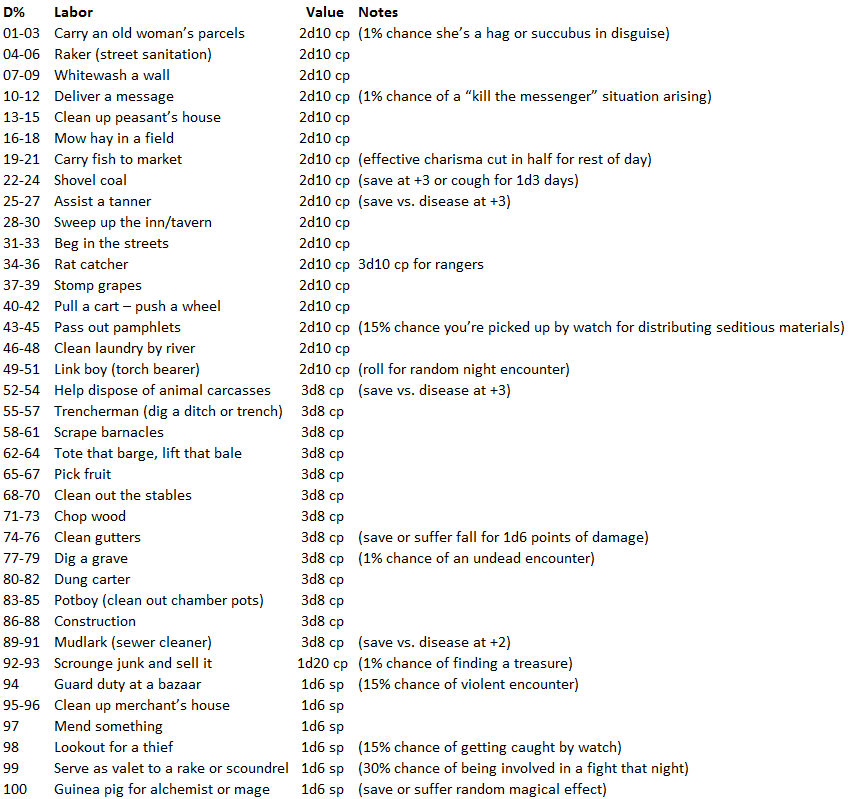
In my Google + Nod game, two characters recently found the need to do some day jobs while the party was resting between dungeon delves. One just didn’t have much coin, and the other decided to take Jeff Rients’ Carousing Table for a spin (and he was a paladin when he did it – the operative word being “was”).

Anyhow, I came up with this table of crappy day jobs, none of which pay much, and some of which carry a little danger.