The Glooms – Evil Pumpkins and Dwarf Kings

I’m about three days away from finishing the main writing on the Hell South hex crawl for NOD 12. Then I have a few articles to finish up and should be able to publish before Christmas – or maybe after Christmas. We’ll see.

10.72 Anemone Shelf: Hundreds of brightly colored giant sea anemones are attached to a wide shelf along the bank of the Acheron, about 70 feet below the surface. Equally colorful nixies dwell within these anemone, sometimes falling prey to them, but more often tending them. The nixies are led by the druid Anwyla, whose sea cave lair is hidden by the anemones. Deep within this sea cave there is a bubbling fountain of air. Bathing in this air, which carries a damp, green smell, one becomes a creature of living water. While in this form, the person can swim at a speed of 30 and is immune to cold and resistant to fire. This state lasts for a number of hours equal to the person’s constitution score.

35.99 Bothaaa: This hex holds the lair of Bothaaa, a giant, fiendish octopus spawned by Dagon himself. Bothaaa is usually in his sea cave, studying his greatest treasure, a jar that holds the preserved head of the Rivana, youngest daughter of the lich lord Piran. This head wears a crystal diadem (worth 1,000 gp). It is still alive, the body resting in Guelph in an ornate crypt. The head is sought by Dudge, the chaotic knight currently trapped in the stomach of the dragon whale Oraguldurn [7.63].

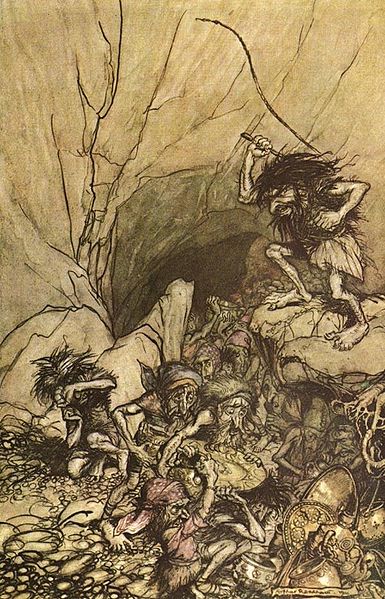
9.66 Grimserne: Grimserne is the dark city of Alberich, the king of the nyblings, a race of sorcerous, demonic dwarves. The nyblings are sore put upon by Alberich, and the shade slaves of Grimserne even more so.

Grimserne is home to 5,000 shades and 3,500 nyblings. The city is built into the sides of a massive and ever deepening pit mine from which the slaves extract copious amounts of coal, enough to fire the furnaces of Dis. The nymblings direct the slaves in their mining and then form them into great caravans who march towards the palace of Minos and the narrow stairs that lead down to the third ring of Hell. Each shade holds 300 pounds of coal in its back in canvas and leather sacks, and by the end of the journey to Dis are so spent that they often melt into the landscape, only to emerge back in their pit a few days later.

Alberich is a mighty sorcerer among dwarves. He and his people possess an unheard of skill at forging magical items, making them as easily as most craftsman make normal items, but expecting cruel payments for their handiwork and cursing the items to make sure they are not betrayed.

11.70 Prison Farm: The damned souls of 450 greedy halfling farmers toil here on a vast field, farming and tending animals under the poisonous whip of the balor Enkepis and his manes. The halflings grow bitter kale, lima beans, Brussels sprouts and pumpkins that grow to about four feet in diameter and bear tormented faces on their pale orange skins. They also tend sheep that they turn into spicy meat pies that are valued throughout Hell.

Each of the pumpkins, if one should carve a hole into it and crawl inside (gnomes and halflings can manage this) is a portal to the surface world.

13.57 Peat Fields: This hex was once a great swamp of tsetse flies and stinging nettles. It has since been drained and is now a great expanse of peat fields. Miserable shades now roam the fields, cutting the peat under the watchful eyes of gnoll overseers. The peat is destined for the lodge of Barbatos, who disdains the use of coal and thornwood. The peat moss is rank with worms, each one with the face of a damned, miserable soul.

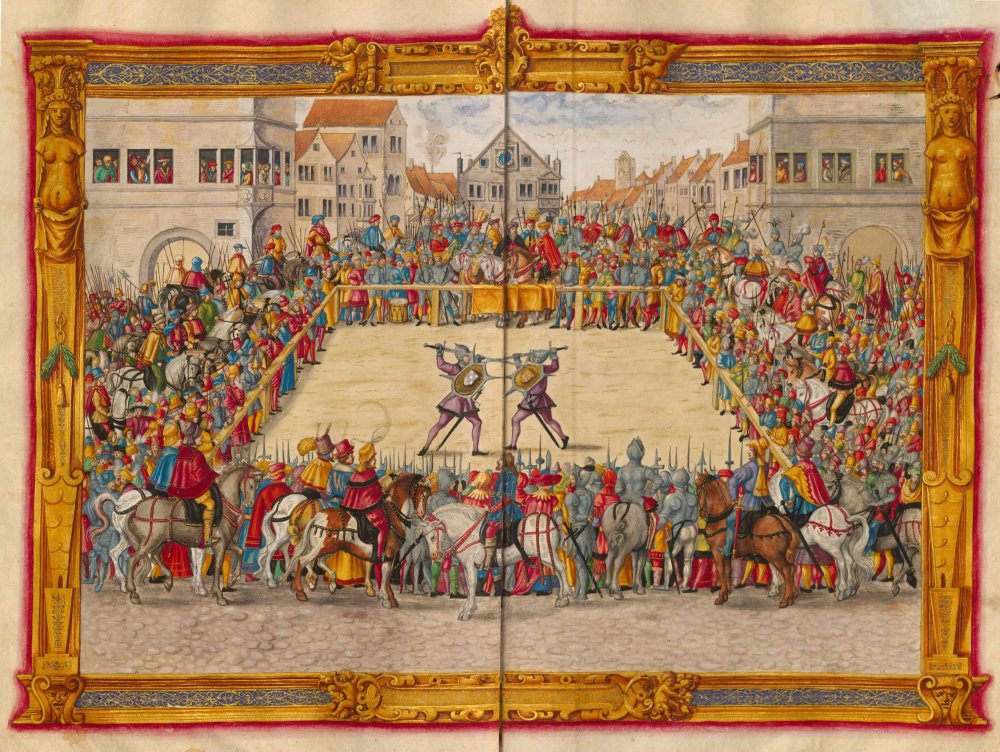
Image by Rackham; found at Wikipedia.
Six Magical Bracelets for Your Viewing Pleasure

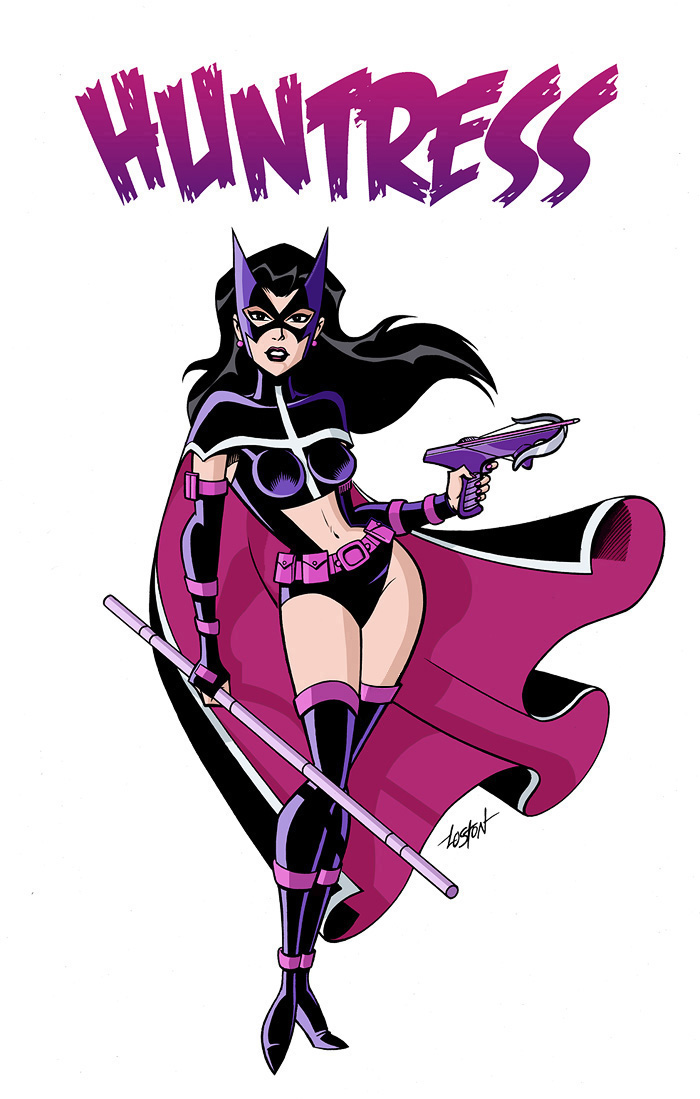
Just got an art book by Steve Prescott delivered yesterday (Aggregate – buy it, won’t you) and was inspired by the chick on the cover.

Bangles of Bakram: These two bangles are carved from wood and each bears a small hole in it. The bangles were originally worn as earrings by Bakram, a highly skilled and deadly monk who weighed in the neighborhood of 350 pounds. If worn as earrings again, these items grant the wearer the abilities of a monk 5 levels, or, if you have no levels as a monk, a 5th level monk. Most folk make the mistake of wearing them as bracelets. When put on the wrists, the bangles grant the same ability, but also grant the wearer Bakram’s weight. Ballooning to 350 pounds, the person suffers a -2 penalty to their constitution score and is treated as though they are carrying their extra weight as added encumbrance.

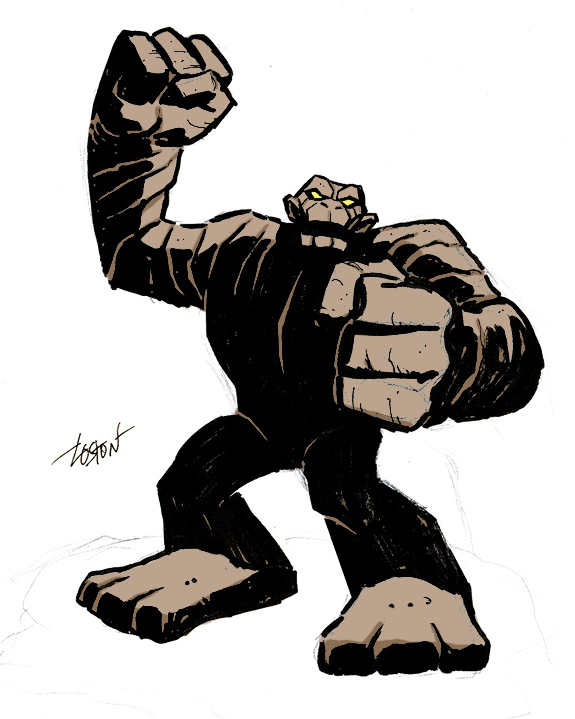
Armlets of Devolution: These armlets, when placed around the biceps, hold tight and cannot be removed. The armlets act as rings of protection +1. Each week, the wearer must pass a saving throw or their body and mind “devolves”. Elves devolve initially into half-elves and then humans. Other demi-humans devolve into humans (of the same general height as their original race). Once human, or if they began as humans, they devolve first into a Neanderthal and then into an albino ape. Once the person has been changed into an albino ape, the armlets release from them. Changing back requires a wish.

Bracelet of Missile Deflection: These thick bracelets of gold, when clasped around the wrists, grant a +2 bonus to Armor Class against missile attacks. Moreover, when the wearer is attacked by magic missiles, they can make a saving throw to not only avoid the attack, but to deflect those missiles back at their caster.

Bracelet of Reaching: This single bracelet is made of bronze and engraved with a triangle pattern. It is normally kept off of one’s wrist, for when it is put on a person’s hand disappears and can be projected, by the wearer, from any similarly sized hole in their view. This could be the top of a vase, another bracelet, a large key ring, a mouse hole, etc. The bracelet can be pushed up to the shoulder if the wearer wishes, with their projected hand (which is part of their body and can be damaged normally) extending to the same length.

Bracers of Magnetism: These iron bracelets are set with large hematites. When clanged together, they can pull any small iron or steel item to the bracelets. If the item is held, the holder can make a strength check to hold onto their item; the bracelets pull with a strength of 25. If a sharp item is pulled to the wearer, they must pass a saving throw to avoid being hit and damaged by that item as though it was wielded by a person with a strength of 25.

Dragon Bracers: These bracers are made from the hide of a blue dragon. Once per day, the wearer can cause the bracers to cover their body with the equivalent of leather armor and granting them immunity to lightning attacks. The armor lasts for 10 rounds, but if struck with lightning immediately retract.

Now This Is the Seed of a Game …

Map of San Fran’s Chinatown in 1885. And I mean hardcore Chinatown – tongs and exiled princesses and foolish Occidentals and opium dens and weird dragon cults and foo dogs and all that good stuff. I have to do something with this …


Oh – and Emperor Norton. Have to throw in Emperor Norton, just for fun. Maybe it could be a supplement to Action X? Or a board game – like Monopoly but with tongs and kung-fu.

Map from THE BIG MAP BLOG, the internet’s premier source for BIG MAPS! When you’re in the mood for a BIG MAP, think THE BIG MAP BLOG.

The S-word in Blood & Treasure

While I’ve been scrambling to finish NOD 12 by the end of the year, Blood and Treasure and Space Princess have been simmering on the back burner. B and T is about 80% complete – all the monsters, spell and magic items converted, classes written, basic rules finished – and is mostly waiting for some info on high level play (strongholds, wargames, magic research) and a sample delve. Space Princess needs some modifications to the rules (fairly minor) and a formal writing down of the sample delve. They’ll probably both be available in January of 2012.

In the meantime, here’s a look of how non-combat actions can be resolved in the game (i.e. skills, one of the dirtiest words in Old School gaming). Also, a preview of the game’s iconic thief.

HEROIC TASKS

The concept of “heroic tasks” covers everything from climbing a sheer wall to riding a dragon. Brushing one’s teeth or stepping over a puddle do not qualify as heroic tasks, and characters can do these and most things automatically, without rolling any dice. Accomplishing very difficult (or almost impossible) tasks, on the other hand, does require a player take dice in hand and roll to discover his character’s fate.

For each of the heroic tasks described below, the conditions of the task are described as either “easy” or “difficult”. If somebody meets the definition of an easy task, they need not roll dice to see if they succeed. Success is assumed.

For people attempting a difficult task, dice must be rolled, and failure imposes consequences.

The actual dice to be rolled and the number needed for success depends on whether the person attempting the heroic task is unskilled, unskilled but has a knack or skilled.

UNSKILLED: An unskilled person can succeed at a difficult task by rolling 1d20, adding the relevant ability modifier, and trying to equal or beat an “18”. Alternatively, you can simply roll 1d6 and attempt to roll a “1”.

KNACK: An unskilled person with a knack for something (such as an elf’s knack for finding secret doors or a gnome’s knack for listening at doors) can succeed at a difficult task by rolling 1d20, adding the relevant ability modifier, and trying to equal or beat a “15”. Alternatively, you can simply roll 1d6 and attempt to roll a “1” or “2”.

SKILLED: A character skilled at a heroic task improves his chances of success as he or she advances in level. A skilled skill check is made by rolling a saving throw, modifying the 1d20 roll with the appropriate ability score modifier.

The type of saving throw depends on the ability most associated with the heroic task. Saving throws made to accomplish a heroic task are modified by their associated ability score, not the ability scores that normally modify saving throws (see Saving Throws above).

Strength: Fortitude
Dexterity: Reflex
Constitution: Fortitude
Intelligence: Will
Wisdom: Will
Charisma: Will

In some circumstances, a Referee can alter which ability is associated with a heroic task, and therefore which type of saving throw. Such is the power of being a Referee!

MULTIPLE DIFFICULTIES
If a heroic task you are attempting involves more than one difficulty, a -2 penalty per extra difficulty is applied to the dice roll. For example, riding a mount during combat is difficult, and therefore requires a skill check for success. Riding an untamed flying mount that has been frightened during combat involves four different difficulties, and thus imposes a -6 penalty (-2 per difficulty beyond the first) to the skill check to avoid failure.

[Note – just a sample of the more “old school” heroic tasks here – there are more in the game]

BEND BARS (STRENGTH)
Adventurers tend to get themselves into trouble, either by breaking into a monster’s home and stealing its loot or by failing to pay the king’s taxes on said stolen loot. This means that they might end up in the king’s dungeon or maybe on the wrong side of a portcullis with thousands of angry kobolds rushing towards them.

EASY: Bending bars is only easy if the bars are made of a weak metal, like gold, or very rusty iron bars. Using a tool might make bending bars an easy task as well.

DIFFICULT: The following difficulties force a character to attempt an action check when bending bars:
• Bending normal metal bars
• Bending bars one inch or more thick

FAILURE: The bars do not bend.

NOTE: Adamantine bars cannot be bent.

FINDING SECRET DOORS (INTELLIGENCE)
When a wizard wants to hide their treasure for all time, they might put it behind a massive metal door with a dozen locks trapped with acid, or they might put it behind a door that blends into the wall. Of course, they might do both.

SKILLED: Elves have a knack for finding secret doors.

EASY: Finding a secret door is never easy.

DIFFICULT: The following difficulties force a character to attempt an action check to find a secret door:
• Secret door is built to resemble the surface of a wall, floor or ceiling (i.e. all secret doors).
• Secret door is hidden using magic.

FAILURE: The secret door remains a secret.

NOTE: Finding a secret door does not necessarily mean opening a secret door. Many secret doors require special catches to be tripped (a book pulled from a bookshelf or a wall sconce pulled down, for example). Characters who cannot figure out how to open a secret door may have to batter it down (see Battering Doors above).

HIDING (DEXTERITY)
When an adventurer finds themselves hunted in a hostile dungeon or fortress, hiding might come in handy.

SKILLED: Thieves and assassins are skilled at hiding anywhere. Rangers are skilled at hiding in the wilderness. Halflings have a knack for hiding.

EASY: Hiding one’s entire body behind a solid opaque object.

DIFFICULT: The following difficulties force a character to attempt an action check to hide:
• Hiding behind a translucent objects (no, you cannot hide behind a transparent object!)
• Hiding behind an object smaller than you are.
• Hiding behind a non-rigid object, such as curtains.
• Hiding in nothing but shadow (counts as two difficulties)
• Hiding while under observation (requires a distraction)

FAILURE: You are noticed by an observer.

NOTE: If wearing camouflaging clothing (i.e. green in a woodland, black when hiding in shadows) you may receive a +2 bonus to your dice roll.

Dueling with a Deck of Cards

Toying with a mini-game involving sword duels and a deck of cards. I’ll fill you all in as I get further with it, but at the moment it involves playing black cards for offense, red cards for defense, sometimes wanting to go higher than your opponent, sometimes lower, may include some bluffing elements for feints, damage would involve losing cards in your hand and it would take into account the benefits of using a shield. Sound good? We’ll see.

In the meantime, enjoy a small glimpse into HELL!

9.57 Amber Tower: Three hundred cowardly shades dwell here in a village of packed mud houses surrounded by a dry moat filled with pongee sticks coated with a black, tar-like poison that causes people to slip into a comatose sleep for 1d4 days. When they awake, they find themselves changed, their skin scaled and colored deep purple on their extremities and their minds possessed of an animal cunning, though their intelligence score drops to 2.

The shades of the village have ashen skin that is cracked and dry. They are lean and quiet and move stiffly, almost as though they were zombies.

The village is overseen by Leralol, a nalfeshnee minion of Barbatos who dwells in a tower of amber glass that gives off waves of heat. Standing within 100 feet of the tower is uncomfortable. Moving to within 10 feet causes 1d4 point of damage per turn. This damage persists within the tower, which is about 50 feet tall and 20 feet in diameter. Each floor of the tower is circular in shape, with an arched roof and a spiral stair in the center leading to the next floor. All of the glass surfaces in the tower are hot to the touch, causing 1d6 points of damage.

In the lower chambers, Leralol has dozens of newly arrived shades chained to the ceiling, drying like prosciutto. The third level holds changed victims of the black tar poison in cages. These poor souls serve as Leralol’s primary form of entertainment – hunting. The fourth level holds his kennel of nerizo demons, which he uses on his hunts. The fifth level holds his own quarters, a room about twice as big as it should be, given the size of the tower. This room is decorated with all manner of grisly hunting trophies, most of them humanoid, but also many wild, demonic animals as well, a row of seven succubus heads posed most scandalously and the head of a hellephant that has been turned into a headboard on Leralol’s bed. Five servant succubi are chained to this bed, but have enough room to move through the chamber, which connects to a small pantry, kitchen and armory.

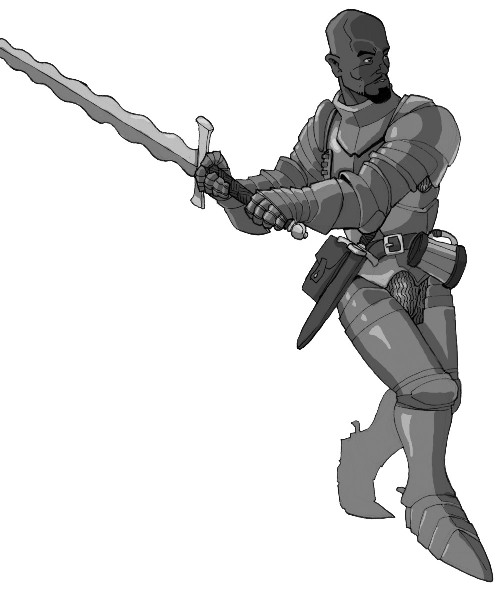
Image is the iconic fighter from Blood & Treasure, by Jon Kaufman (natch)

The Glooms – Ghoul Town

110.100 Ghala-ghilan: Ghala-ghilan is the gruesome city-state of the ghouls and ghasts and their hideous lords. The city houses 5,000 ghouls, 1,500 ghasts and their slaves/cattle, which number 1d10 x 1,000 humanoids at any given moment. Ghala-ghilan has sandstone walls topped by a hundred onion domes cast in bronze and painted with black enamel. In each tower there is a squad of ghouls armed with slings and crude axes. The streets of Ghala-ghilan are wide and covered with a damp, slimy film. The buildings are sandstone towers rising 30 to 50 feet in height, with flat roofs topped by memorial statues stolen from cemeteries all over the world. Amidst these towers there are long palaces with colonnades.

The ghouls need not eat often, so when they do slaughter their herds of humanoid slaves, they hold grandiose feasts with strangely sedate and dainty entertainments.

112.99 Celestial Army: An army of luminous aasimar has gathered here for an assault on Ghala-ghilan, the city of ghouls [110.100], for the ghouls have stolen something precious to the powers of Law, the legendary Pistis Sophia. The paladin Eaduvenius leads the bright host, who are now camped in white pavilions (regrettably sullied by their long trek through the Underworld) flying white pennons emblazoned with various symbols holy to the forces of Law. The army numbers 25 companies of heavy infantry and 50 companies of light infantry and archers. Almost all of them are drawn from the Farukh, the descendants of the Heavenly Host that once descended to Nod to destroy the wicked city of Irem and stayed to long. The Farukh dwell in the hills outside of the city-state of Guelph. In addition to the warrior, the army has about 300 bearers and handlers to look after the giant lizards used as pack animals, and ten packs of blink dogs.

117.64 Hot Cave: There is a deep, dank, damp cave here that is heated by a thermal vent and mineral spring. The interior of the cave and much of the exterior is covered by a massive yellow musk creeper. The cave is always filled with 3d6 yellow musk zombies and encounters with 2d4 zombies occur in this hex on a roll of 1-4 on 1d6 per day.

120.63 Exploding Pool: A simple pool in this hex is bordered by white stones that glow lightly. Should a person try to drink from it, the fountain explodes into a water spout, throwing them 1d10 x 10 feet into the air. Should one attempt to ride this spout to the top (requires a dexterity check on 2d6+12) find they can access a chamber carved into the ceiling that contains a great trove of treasure guarded by an ancient water elemental.

121.66 Tormented Mephits: Ten fire mephitis have been chained to the ground here near a frosty cave. The cave is inhabited by three frost giant brothers, Frimli, Giri and Hundi and their pet small white dragon, Snurl. The giants torment the mephitis from time to time, carrying small torches near them and then snapping them away.

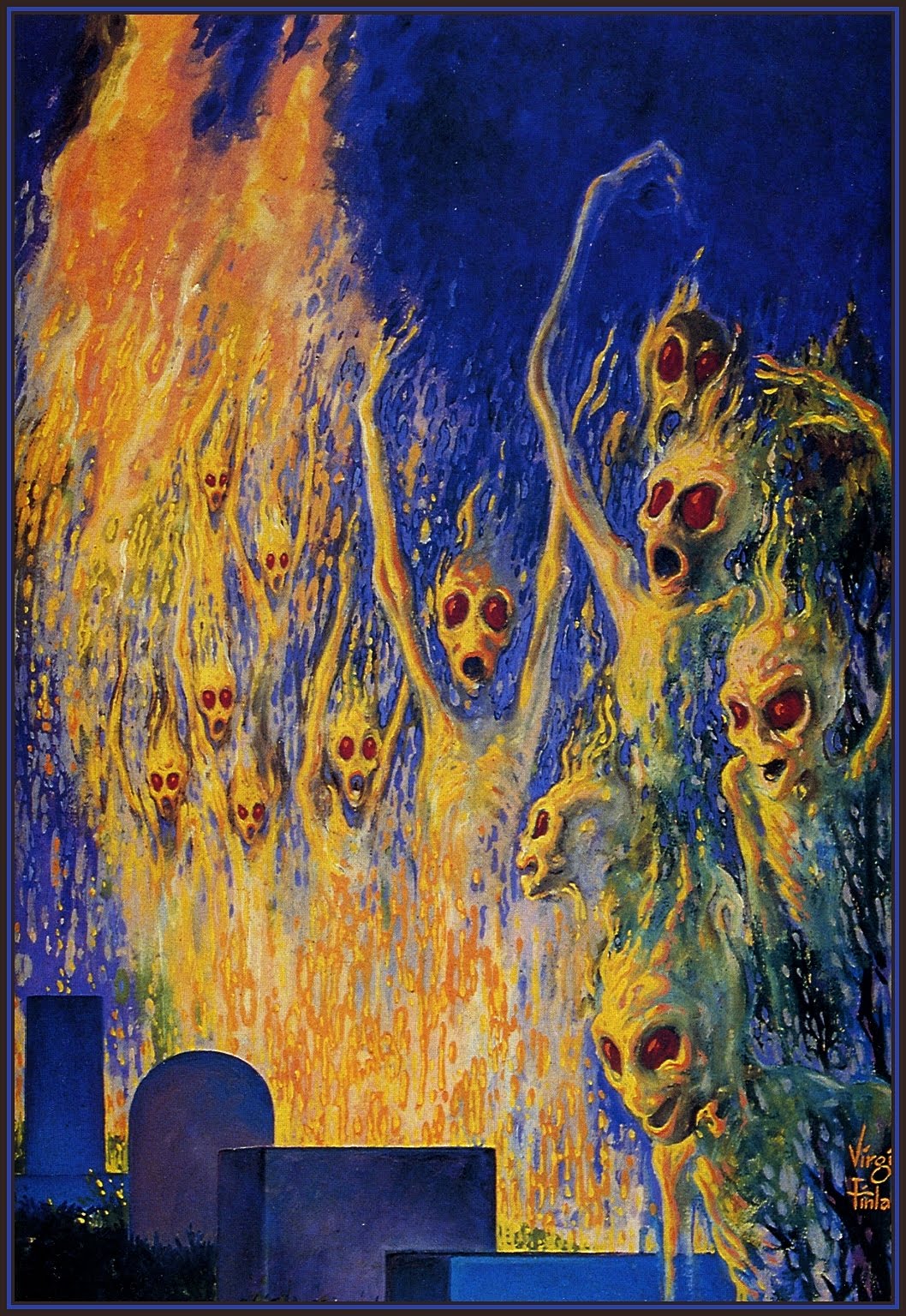
Image from Golden Age Comic Book Stories; by Virgil Finlay

Magical Prehistory Tour

Dinosaurs. Awesome, right? Lots of them, though – hard to keep track, especially when scientists keep changing their darn minds about them (they’re brontosauruses because that name is cooler, and triceratops are so a species of dinosaurs, so shut up scientist man). Here’s a handy dandy guide to basic forms and a few handy “mutations” to keep your players guessing.

DINO TYPES

Not scientific, but just a quick batch of stats for some basic dino types. And yes – I already know it doesn’t cover everything, just the stuff that pops up most often in old dinosaur movies and the Flintstones.

CERATOPSIANS
These are the fellows with the lovely head fringes and horns, like triceratops. Assume the basic ceratopsian is about 30 feet long.

CERATOPSIAN: HD 15; AC 0 [19] front, 5 [14] back; Atk 1 gore (4d8); Move 12; Save 3; CL/XP 15/2900; Special: None.

PTEROSAURS
Technically not dinosaurs, but if they’re on the Flintstones, they’re close enough for me. These are the flyers. The basic pterosaur has a wingspan of about 15 feet and a length of about 5 feet.

PTEROSAUR: HD 5; AC 2 [17]; Atk 2 claws (1d4), 1 bite (2d8); Move 9 (Fly 24); Save 12; CL/XP 6/400; Special: None.

SAUROPODS
The big boys – quadrupeds with long necks who make little tremors when they walk. Assume that the basic sauropod is around 150 feet long.

SAUROPOD: HD 25; AC 6 [13]; Atk 1 stomp (4d10); Move 9; Save 3; CL/XP 25/5900; Special: None.

THERAPODS
The therapods cover the bipedal carnivores, of which the T-Rex and Velociraptor are now the most famous. Assume that the basic therapod is huge in size (i.e. around 30 feet long). When a therapod bites prey, it grabs the victim in its jaws, shaking and chewing for automatic damage in subsequent rounds. Only victims with shells, bone frills, or spines can avoid the horrendous tearing damage.

THERAPOD: HD 18; AC 4 [15]; Atk 1 bite (4d8); Move 18; Save 3; CL/XP 19/2400; Special: Chews and tears.

THYREOPHERANS
These are the quadruped armored or spiked dinosaurs, like stegosaurus and ankylosaurus. Assume that the basic thyreopheran is about 20 feet long.

THYREOPHERAN: HD 15; AC 2 [17]; Atk 1 bite (1d8), 1 tail (4d6); Move 9; Save 3; CL/XP 15/2900; Special: None.

MUTATIONS
No more humdrum dinos for us, my friend. Let’s make them fabulous!

1D30 / MUTATION
1-2 Small and quick – reduce HD by half (and modify saving throws accordingly) and double their speed. In addition, they get a bonus to initiative (how much depends on what you roll, +1 if d6, +2 if d10, +3 if d20; if you roll d8, you’re weird and I just can’t help you). Decrease damage by one dice size.

3 Big and beefy – increase HD by 50%, cut movement in half and if they are at least 60 feet in length they can cause an earthquake (as the spell) once per day in a 100-ft radius. Increase damage by one dice size.

4 Red scales – dinosaur is immune to fire.

5 Blue scales – dinosaur is immune to lightning.

6 White scales – dinosaur is immune to cold.

7 Gold scales – dinosaur is immune to non-magic weapons and +2 to save vs. magic.

8 Black scales – dinosaur surprises on 3 in 6 at night, has darkvision.

9 Woolly – dinosaur has fur. This gives it a +1 bonus to AC and resistance (50%) to cold.

10 Massive Brain – dinosaur has high intelligence and can use a psychic blast (30-ft cone, save or stunned for 1d4 rounds) three times per day.

11 Draconic – as small and quick, plus dinosaur has dragon wings and the flight speed and breath weapon of a random dragon; 1 = Black; 2 = Blue; 3 = Gold; 4 = Green; 5 = Red; 6 = White. Dino-dragons can never speak or cast magic spells.

12 Spitter – can spit poison (30-ft range; save or blinded and 1d6 damage) or belch acid (10-ft cone, 2d6 damage).

13 Leaper – can leap up to 20 feet forward or 10 feet backward. When leaping to attack, treat as a charge.

14 Gorgonoid – has metallic scales as a gorgon; increase AC by +4.

15-16 Horns – has two horns or two extra horns; gains an additional gore attack for 2d6 damage.

17 Manticoroid – has tail spikes that can be fired like those of a manticore for 1d6 points of damage.

18 Displacement – per the mirror image spell (4 additional images), can be used three times per day.

19 Blink – per the blink dog.

20-21 Camouflage – surprises on a roll of 1-3 on 1d6.

22 Stone Cold Awesome – has a petrifying bite, per the cockatrice. Dinosaur can swallow and ingest the stone if a carnivore.

23 Laser eyes – can fire searing beams from eyes three times per day. Range of 60 feet, 3d6 points of damage, ranged attack required.

24 Scream – per the shout spell, usable three times per day.

25 Rider – dinosaur is ridden by a caveman bounty hunter (per dwarf fighter level 1d4+4). Rider wears the equivalent of leather armor and carries a club and three throwing spears.

26 Trill – dinosaur can trill as a remorhaz.

27 Song – dinosaur produces a vibration that causes sleep (as the spell). Usable three times per day.

28 Song – dinosaur produces a vibration that causes a charm monster effect. Usable three times per day.

29 Song – dinosaur produces a vibration that causes a hold monster effect. Usable three times per day.

30 Construct – dinosaur is made of metal and gears. Increase AC by +5. There is a 5% chance it can change its shape to that of a stone giant (also made of metal and gears, AC +5). Constructs are immune to mind effecting spells, poison and disease and take half damage from fire and lightning.

Have any other ideas? Put them in the comments – let’s take this table to 100!

Image from Golden Age Comic Book Stories, by the great Charles Knight.