Excellent Castle Resource

This is a site I found years ago that I just re-googled today because its existence popped into my brain. Essentially, Bob Carney builds castles out of Lego and posts photos of his creations and – best of all for RPGers – floor plans! The plans are often drawn by Bob specifically for Lego construction, meaning they are a bit squared off and therefore easier to transcribe to graph paper*.

Bob has an impressive collection of castles from throughout Europe, including most of the standard castle plans (tower keep, concentric, etc). The image to the right is Neuschwanstein.

If you need a castle floor plan, take a look.

Bob Carney – The Land of Nod salutes you!

* Man, I love graph paper.

Ibis, City of Sorcerers – Court of Spirits

A few more streets today, and then in a few days I’ll preview about half of the building locations.

Part One (Map)
Part Two
Part Three

D. Court of Spirits
This open yard is filled with patches of slender white mushrooms about 9-inches in height. The courtyard is not paved. In the middle there is an old, dry well (that might lead down to a dungeon, if a Referee is so inclined). The buildings that surround the yard back up to it and have any windows that might look over it boarded up or painted, except for the hostel [40].

On moonlit nights, the mushrooms awaken and become mushroom fairies that look like crude little dolls of white clay wearing mushroom caps and glowing as brightly as the moon above. These fairies will form circles and perform a very slow dance. Standing in the midst of one of these circles has a random effect:

Effect
1. In the blink of an eye, 10 years have passed. To observers, you simply blink away, but you will return to this spot 10 years of game time later unaware that you have been away.
2. You are teleported to Fairyland for 1 year and replaced by a wicked changeling. Observers will not see the switch, but may discover the change later.
3. As above, but instead of being replaced by a changeling your trip to Fairyland lasts for 10 years to you, but occurs in the blink of an eye to observers. You reappear aged a decade and with one level of druid or magic-user (or one extra level if you are already a druid or magic-user). Alternatively, a Referee may wish to play out your time in Fairyland.
4. Hypnotic patterns drive you mad unless you pass a saving throw.
5. You gain fairy sight (i.e. permanent detect invisibility), but you also see people as their inner (and often horrible) selves and lose 2 points of charisma as you find people unpleasant to deal with.
6. You are transformed into a werewolf. This will not become obvious, even to you, until the next full moon.
7. You are transformed into a mushroom-man.
8. You grow the ears and tail of an ass, effectively lowering your charisma by 1.
9. You are split into three separate beings, each with a portion of your personality and a third of your class levels.
10. You now bear an invisible fairy mark. Fairies are more friendly toward you (by fairy terms) from now on (i.e. +2 reaction adjustment).
11. You spontaneously learn a 1st level magic-user spell, but forget it and one other spell within 1d6 days. While you know the new spell you can cast it once per day. Once it and the old spell are forgotten, you will not remember ever knowing them and they will be replaced in your spell book with an unflattering sketch of your mother.
12. You think you’ve been transformed into a werewolf, and will act the part at each full moon until someone gives you a proper slap upside the head and calms you down. Nonetheless, you will go through the motions again at the next full moon.

E. Silver Lane
This narrow, noisy lane is named not only for the commerce that occurs in its confines, but also for the quartz paving stones that are streaked with silver. The bakery at the end of the street was once a noble villa, hence the higher class of paving. The buildings here rise a minimum of 10-ft and thus provide shade for most of the day. Many of them have rooftop gardens.

Crowds: The streets here are always crowded with customers, apprentices running errands and masters coming or going from lunch or home.

Random Encounters
1. Cart loaded with bread headed for a temple; pushed by two apprentices and guided by a third waving a stick
2. Disgruntled mercenaries (2d6)
3. Gaggle of 2d6 students visiting the scriptorium
4. Guardsmen (1d6 + sergeant)
5. Sly man begging alms and picking pockets (Thief Lvl 5)
6. Thugs (1d4+1) sent by the thieves’ den to collect protection money (Fighting-Men Lvl 3)

F. Court of Purple Dreams
The Court of Purple Dreams is dominated by a tall, pyramidal mausoleum of Princess Hashminepsis, who passed from NOD over 400 years ago (or should have). The buildings surrounding the court back onto it, and thus the court is very private and quiet. Running under its purple pavers are tunnels connecting to the sewers and allowing easy access for the ghouls of the under-city to their mistress’s tomb.

Crowds: There are no crowds in the Court of Purple Dreams, ever. Random encounters only occur here at night, and are usually with unpleasant things.

Random Encounters
1. Ghost, seeking to warn you away from certain doom
2. Ghouls, seeking fresh meat
3. Imps, seeking distraction
4. Midnight Peddler, seeking customers
5. Necromancer (Lvl 1d6+2) seeking counsel
6. Vampire and 1d3 spawn, seeking a warm drink

G. The University
The old University dominates the central portion of the map. Paved with aged limestone stained yellow with time, and walked with sages similarly aged, it boasts the finest library known to mankind (at least in the Motherlands and their environs).

Crowds: The University is always crowded with sages, students and apprentice magicians, as well as their servants and tradesmen who have been called on to provide some service. At night, it is more quiet due to curfews, but is still prowled by rakes, harlots and the more cunning students.

Random Encounters
1. A dozen young students trailing behind a harried scholar
2. 1d6 upper class-men and their valets
3. A magic-user and his apprentice
4. A rake coming to collect a debt owed by a student
5. Adventurers seeking a sage
6. A monster escaped from the subterranean vats

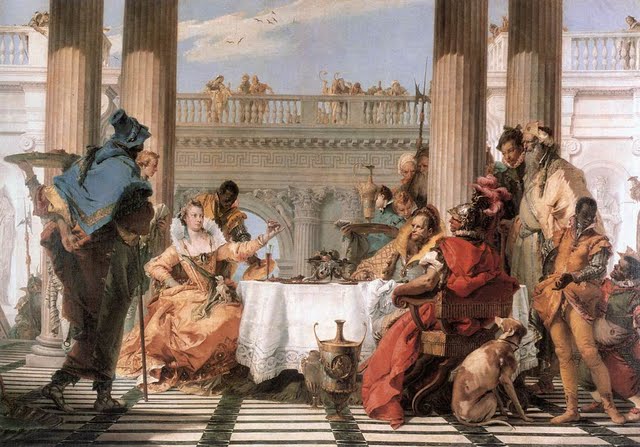
Art by Giovanni Batista Tiepolo: Banquet of Cleopatra (1743)

NOD Sandbox Format

I’ve posted about this kind of thing before, but now I’m starting to visualize how I want to format my sandboxes in future issues of NOD and future blog previews. My main concern is making the information 1) useful for a Referee during actual play and 2) flavorful and unique enough to keep players interested or fire the imagination of the Referee so he or she can keep players interested. With that in mind, here’s how I might format future sandbox presentations …

REGION NAME
• Description of the area; where does it fit in with other maps
• History of the area – very basic
o Pandiluvian Period
o Golden Age
o Modern Age
• [Basic map showing the regions and naming them, along with stars for city-states and dots for towns]
• [Smaller map showing where this region fits into the larger world map]
• [Welcome to NOD sidebar – quick description of the campaign world and what has appeared before]

Sub-regions

Sub-region 1
• Description – landscape, flora, fauna, minerals; hex movement in the region
• List city-states, major towns, monster tribes and strongholds and their interactions (if any); include mini armorials

• List major dungeons, along with rumors regarding those dungeons

Sub-region 2
• Description – landscape, flora, fauna, minerals; hex movement in the region
• List city-states, major towns, monster tribes and strongholds and their interactions (if any); include mini armorials

• List major dungeons, along with rumors regarding those dungeons

Dangers
• Random encounter tables for the different regions – one table using 1d12; go from weak to strong, so when the Ref rolls a “12” he knows he should chuckle wickedly
• Discuss No. Appearing formula, when to roll, how often to roll, etc.

Tribes
• Picture (head shot – maybe no picture, see how this one goes) of major humanoid types (including berserkers, men-at-arms typical for the region); for each a brief societal description (mostly as pertains to game play), armor and weapons; show hexes where they appear; give tribal treasure guides – coins, art, livestock, magic – main idea is to help make the goblins of Region X distinct (at least a little bit) from the goblins of Region Y
o Give stats for sub-chiefs/sergeants (+2 HD) and chiefs/captains (+4 HD) along with stats for the basic monster type
• Discuss concept of tribal spell-casters (with a basic statblock for level 3, level 5 and level 7)
• Note – Humanoid leaders and spell-casters that have class levels are described in detail in the text
• Give three map templates for different types of lairs – these will change from issue to issue, but always remain basic; label the chambers rather than number them
o Cave Lairs
o Village/Forts
o Camps

Keyed Encounters
• List all of the keyed encounter areas:
o Set-Up (describe the place, the people, etc)
o Twist (why should anyone care)
o Reward (not just treasure, also information, captives to free, XP for discovering)
• For towns and city-states, do sidebars like I do for official city-state write-ups
o Include a little map, very basic, with maybe 3 locations that are quickly described or maybe just given descriptive names
• For “dungeons”, have a black and white map with chambers that are described on the map (“Orc guards with flame throwers”, “slime lake”, maybe a little drawing for fun) and leave rest to the Referee to flesh out [I might not go with this idea – I need to test it out]

Walled village of 100 cantankerous diamond miners ruled by Bob, a flatulent mayor with red hair and green eyes and five lovely daughters. The village has a popular roadhouse run by Beth, a swarthy beauty with a missing eye, that rents private rooms for 5 gp a night and serves an excellent brandy and robust camel stew. The village is defended by 12 men-at-arms in chainmail carrying leaden clubs and darts. The villagers have 300 gp worth of diamonds and mining tools, and keep trained crysmals that they use to find new veins of diamond.

Cave lair of 200 gnolls with a chief called Gronk and 20 sub-chiefs. The gnolls carry battered shields, barbed spears and short bows. They worship an idol of Demogorgon and have a high priestess called Zima. The gnolls have a cursed crystal ball they stole from a traveling magician and know about the secret entrance to the Dungeon of Doom [Hex No.]. The gnolls are allied with the ogres in [Hex No.].

Monastery of Mercurius, the God of Merchants and Travelers. It houses 20 acolytes and adepts and its abbot is Father Frink. The abbey is constructed of purple stone and has numerous towers topped by conical, silver roofs. Its sits on a hill covered with sunflowers and badger burrows. The monastery has a vault containing the shin-bone of St. Blabus which, if kissed, cures disease about 2 out of 6 times (if it doesn’t work, its assumed you’re a creep and you’re beaten soundly and sent on your way). The monastery’s village consists of blah blah blah.

A magical spear is lodged in a crooked oak tree here. The spear has a red shaft and a bronze head and answers to the name ‘Longfellow’. It hums in the presence of warriors with more skill than its owner, and will do its best to get its owner killed so that the more powerful warrior can claim it.

New Monsters
• List all of the new monsters that appear in the text that aren’t easily found elsewhere.
• [Sidebar of new monsters that appear here that first appeared in another issue of NOD]

Pre-generated Characters
• Six (or more?) pre-gens that can be used as a rival party or whatever; use any new races/humanoids unique to the area and classes that mesh with the area, should reflect the region; no levels so they can be scaled as a Referee needs them to be for his game.

Art by Arthur Rackham, 1921

Thinking About Experience and Levels

First, I’ll declare right off that I’m okay with Experience Points and Levels just as they are. However, I got to thinking about how BRP advances skills that you use during an adventure by having you roll percentage dice at the end of the adventure and advancing the skill if you roll over it – thus, as you get better at something it becomes harder for you to get better still.

So, what if you had a rating for, say, Fighting and Magic, beginning at 10. Levels in fighting-man and magic-user and other classes are then pegged to ratings for Fighting and Magic (and/or other categories, whatever makes sense in a particular game). So, to become a 2nd level fighting-man, you might need a Fighting rating of 20. At the end of a session of play, you roll your percentile dice, and if you roll above your current rating, you increase your rating by 1 or 2 or 5 points – whatever the Referee is comfortable with. I think 2 would be a good number. When your Fighting rating hits 20, you become a 2nd level fighter. Likewise, magic-users rely on their magic rating. Clerics, on the other hand, might need ratings in both Fighting and Magic, say a 18 in Fighting and a 16 in Magic to advance to 2nd level.

Just a random thought inspired by the idea of “roll to advance”.

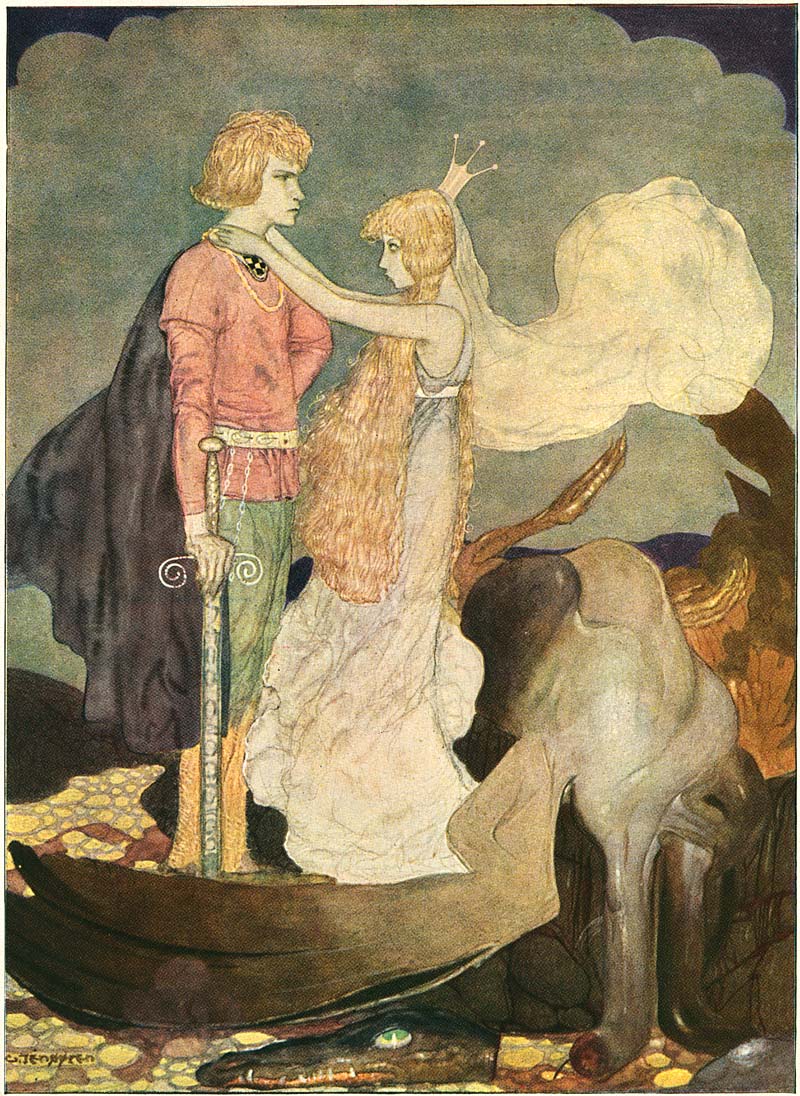
Art by Gustaf Tenggren, illustration for Grimm’s Fairy Tales in 1923

Mines and Mining – Part Four

This post covers minerals M through R.

Part One, Part Two, Part Three.

Marble
Marble (4 gp / lb); Architecture, Art

Marble is formed from the metamorphism of limestone. It is mostly comprised of crystals of aragonite and dolomite. The name derives from the Greek for “shining stone”. Pure white marble comes from very pure limestone. The swirls seen in most marble are impurities from clay, silt, sand, iron and other materials. Green coloration is usually from the presence of serpentine. Marble’s relative softness, resistance to shattering, and color made it a popular medium for sculpture and architecture.

Mercury
Cinnabar (3 gp / lb); Alchemy, Art
Mercury (10 gp / lb); Alchemy, Art
Vermillion (2 gp / oz); Pigment (Red)

Mercury, also called quicksilver or hydrargyrum, is the only metal that is liquid at room temperature. It is a silvery metal found in deposits of calomel, livingstonite, corderite and cinnabar. Cinnabar is a scarlet to brick red mineral that is found in alkali hot springs and near volcanoes, often with dolomite.

Mercury is separated from cinnabar and other minerals by roasting. The mercury condenses easily into a condensing column and then collected and shipped in iron flasks.

Alchemists would heat elemental mercury with aqua fortis to prepare mercuric oxide. The reaction produced a thick, red vapor over the surface of the solution, while the mercuric oxide fell out of solution as red crystals. The oxygen released from this solution was called “dephlogisticated air” by Joseph Priestley.

Cinnabar is a source of vermillion, an orange-red pigment that has been used since prehistoric times. To the Romans, who called it minium, It was the most valuable pigment. The imperial government fixed the price at 70 sesterces to the pound, ten times more expensive than red ochre, because of the incredible demand and the short supply of cinnabar. Like many ancient pigments, it was toxic. The Olmecs and Mayans relied on its toxic reputation to repel tomb robbers, putting it in burial chambers and inserting it into limestone sarcophagi. The Chinese used it in carved lacquer ware, the layer of lacquer protecting people from the toxicity of the cinnabar.

Mercury dissolved gold and silver, making it useful in plating those two metals over other materials. Alchemists combined mercury with tin, sal ammoniac and flowers of sulfur to make mosaic gold, a yellow, crystalline powder used as a pigment in bronzing and gilding wood and metal.

Obsidian
Obsidian; Equipment, Minor Gem

Obsidian is volcanic glass that occurs in obsidian flows near active or dead volcanoes. It is usually black, but impurities can make it dark green to brown and even colorless. Obsidian with fluffy white inclusions is called snowflake obsidian. Gas bubbles can produce obsidian with a golden or rainbow sheen. Obsidian has been used since prehistoric times to craft blades, tools and projectiles. It can also be cut as a gem and used in art objects and jewelry.

Olivine and Peridot
Olivine; Minor Gem
Peridot; Medium Gem

Olivine is a greenish mineral common on Earth, the Moon, Mars and in comets. Gem quality olivine is called peridot. Peridot occurs in lava rocks. It is a rare gem and always colored olive green. Peridot is the only gemstone found in meteorites. Olivine is supposed to provide protection from magic spells, while peridot wards off enchantments.

Opal
Fire Opal; Medium Gem
Opal; Medium Gem

Opals are a mineraloid gel commonly found in sandstone and basalt. The water content in opals can be quite high, up to 20%. Opals range from colorless, white, gray, red, orange, yellow, blue, green, magenta, rose, pink, slate, olive, brown and black. Opals that have red against black are the rarest, while white and green opals are the most common. Fire opals are translucent, transparent opals of warm colors, such as yellow, orange or red. Opals were believed to be lucky stones and to cause invisibility if wrapped in a bay leaf and held in the hand.

Pearl
Pearl; Minor Gem

Pearl is not a stone, though it does have a mineral base. Pearls are produced by a living, shelled mollusk. They are made from layers of nacre, or mother-of-pearl. The best pearls are produced by oysters, but they are quite rare. In a haul of 3 tons, only 3 or 4 oysters will produce perfect pearls. The largest pearl yet found came from a giant clam, and weighed 14 pounds. White and black pearls are the most common and popular pearls, but there are also pink, blue, champagne, green and purple pearls.

Phosphorus
Phosphorus (7 gp / oz); Alchemy
Proto-Match (1 gp); Equipment

Phosphorus does not occur free in nature, but can be found with many other minerals, especially apatite. White phosphorus was discovered in 1669, by German alchemist Hennig Brand. It was named for Phosphorus, the light-bearer, i.e. Lucifer.

The most common way of obtaining phosphorus was from human waste. The process involves boiling urine to produce a residue which was heated to produce phosphorus gas which would condense into a white powder. The powder is flammable and capable of blistering fingers and burning holes in cloth. It takes 2,000 gallons of urine to produce one pound of phosphorus.

Hennig Brand eventually sold the recipe for 200 thalers (approximately 80 gp) and others eventually figured out the recipe from clues left by Brand. In 1680, Robert Boyle made the forerunner to modern matches when he used phosphorus-coated paper to ignite a sulfur-tipped wooden splint that he rubbed across the paper.

Pitchblende (Uranium)
Pitchblende (100 gp / lb); Art, Magic Items

Pitchblende, or uraninite, is a black mineral that contains uranium, lead, thorium, rare earth minerals and radium. The radium and lead are due to the decay of the uranium. Pitchblende was usually found with silver deposits.

Refined uranium is a silvery white metal. The element was discovered in 1789 by the apothecary Martin Heinrich Klaproth, but the metal was not isolated until 1841 by chemist Eugene-Melchior Peligot, making it unlikely to have been discovered in most fantasy settings. Unrefined pitchblende, however, was added to glass and mosaic tiles to give them a yellow-green to orange-red color. This uranium glass was usually about 2% uranium. Given the composition of pitchblende, a Referee who is running a science-fantasy game might want to require it as an ingredient for making magical objects.

Platinum
Platinum (1,000 gp / lb); Coins, art objects

Platinum is a silvery metal that is resistant to corrosion and acid and malleable enough to work. It occurs with copper and nickel ores, often in the sands of rivers.

Like gold, platinum dissolves in aqua regia, and this substance was used to isolate pure platinum in the 18th century. More often, natural platinum, which is combined with other metals in the platinum family, is found and was worked by ancient peoples.

Platinum is harder than gold or silver, and with a much higher melting point. Platinum was unknown in Medieval Europe, but the peoples of pre-Columbian Central and South America were aware of a naturally occurring gold-platinum alloy and used it to make jewelry. Once the Europeans obtained platinum, they found they had no way of making a fire hot enough to melt it, which prevented them from minting the platinum coins sometimes seen in fantasy games. Such coins, had they existed, would have probably been made from the aforementioned alloy (and thus worth 5 gp each).

Porphyry
Porphyry (5 gp / lb); Architecture, Art

Imperial porphyry is a deep brownish-purple rock used to build monuments and buildings in ancient Rome and in hardcarving. It is an igneous rock that contains crystals of quartz (q.v.) and feldspar (q.v.). It came from a single quarry in the rocky wastes of Egypt’s eastern deserts.

Quartz
Amethyst; Major Gem, Protection from Drunkenness
Aventurine; Medium Gem
Banded Agate; Minor Gem, Sleep
Carnelian; Medium Gem, Protection from Evil
Chalcedony; Medium Gem, Protection from Undead
Chrysoprase; Medium Gem, Invisibility
Citrine; Medium Gem
Jasper; Minor Gem, Protection from Poison
Moss Agate; Minor Gem, Sleep
Onyx; Medium Gem, Cause Chaos
Rock Crystal; Minor Gem
Rose Quartz; Minor Gem
Sard; Medium Gem
Sardonyx; Medium Gem
Smoky Quartz; Minor Gem
Tiger’s Eye; Minor Gem, Protection from Ethereal Creatures

Quartz is the second most abundant mineral in the Earth’s crust after feldspar. It occurs with granite, shale, schist, sandstone, and gneiss. Pliny believed it was permanently frozen ice because it was often found near glaciers, but not volcanoes, and in spherical form would cool the hands and act as a prism. Quartz deposits often contain gold (q.v.).

Many forms of quartz are precious stones. Pure quartz is rock crystal, citrine is pale yellow, rose quartz is pink, amethyst purple, smoky quartz gray, milky quartz (the most common) white, jasper reddish brown, tiger’s eye is gold and red-brown and hawk’s eye is blue.

Agate, a form of quartz, comes in many varieties, including banded agate and moss agate. Onyx is a black agate with bands every color but blue and purple. Sardonyx replaces the black of onyx with brown. Both are cut into cabochons and used for intaglios (i.e. engraved gems).

Chalcedony is a white or lightly colored quartz. It can also be banded. Aventurine is translucent chalcedony with shimmering inclusions. Carnelian is translucent orange-red, while sard is a brown carnelian. Chrysoprase is gemstone quality chalcedony that is apple green to deep green.

The native Americans called quartz geodes that contained agate, jasper or opal “thunder eggs”. They believed that they were thrown by thunder spirits at one another.

Rhodochrosite
Rhodochrosite; Medium Gem

Rhodochrosite is a precious stone that varies in color from rose red to pink or pale brown. The purest form of the stone is rose red in color. Rhodochrosite occurs in hydro-thermal veins in silver ore deposits. The Incas believed it to be the hardened blood of their ancient kings. As a soft mineral with perfect cleavage, it is difficult to facet.

Pars Fortuna Basic Set?

Basic sets are a well-regarded bit of nostalgia in fantasy gaming and apparently are making a comeback in the modern iteration of Dungeons and Dragons. They also happen to be an excellent way to introduce a game to new players!

It occurred to me that I could create a “basic rulebook” for my little game experiment, Pars Fortuna that would cover levels 1 through 4, four of the twelve playable races, a nice assortment of monsters (low level and mid-level) and magic items, all the cantraps (level 1 to 3 spells), all the basic rules needed for play, a dungeon adventure and all the bits of advice I can muster. My goal would be to present this item as a free download and for sale “at cost” on Lulu.com, to be followed by the full game at normal prices (I don’t know how long it is going to be, so I don’t know how much it will cost yet). The full “Expert Rules” will include all 12 playable races, spells and monsters, and would include a sandbox along with deeper levels of the dungeon in the basic rules.

I’d love some feedback to whether this seems to be a good idea or just a silly gimmick. Let me know what you think!

On Ibis, City of Sorcerers – The Souk

This continues the preview of Ibis, City of Sorcerers.

Part One (with map), Part Two

C. The Souk
The Souk is both a street and a market that stretches across the enter of Ibis, beginning in the accom-panying map, and extending well to the east. Along the souk are factories, dozens of markets (i.e. armor market, animal market, cooper’s market, etc) and a few counting houses, not to mention a large guard tower with its own dungeon. The road is paved with limestone from start to finish.

Crowds: The Souk is always crowded with people. At any given time, most of the citizens of Ibis, at least those without servants, end up on the Souk shopping for necessities and luxuries. Water bearers are common, as are peddlers selling honey cakes, boiled eels, salted dates, candied scarabs and other delicacies. Entertainers perform with pipes or juggle or do bits of acrobatic daring in the middle of the street for copper scruples. Guardsmen are ever present, clad in ring mail and carrying light crossbows and pole arms and usually accompanied by a sergeant in a dashing yellow turban with an ostrich feather.

Random Encounters
1 Adventurers (see end of article for sample NPCs)
2 Guardsmen (1d6 + sergeant)
3 Mages (two, preparing to duel)
4 Pick Pocket (save or lose a wallet ot purse)
5 Noble Retinue (Aristocrat with bodyguards and slaves)
6 Priests (1d6+6 carrying an idol and chanting)

Guard Tower: The guard tower is a remnant of one of the gatehouses that guarded the entrance to the old city. In fact, it still has a gate, though it is always left open for the old wall has since been torn down and recycled into building material for newer buildings.

The guard tower consists of an east and west tower, both rising four stories in height and being 20-ft in length and width. The west tower has a cellar that is used as a temporary dungeon – a few manacles on the walls and a hot poker for troublesome prisoners. The top story of the west tower serves as an office of sorts for the captain of the guard, Khnemu, a surly old gentleman missing an eye and most of his teeth.

Khnemu can be seen from time to time passing from tower to tower (they connect on the third story, over the portcullis) or wandering the souk inspecting the activities of his men. He wears a shiny cuirasse over a scaret tunic and baggy pants of white or grey and carries a light mace and dagger. In tow is a taller man with narrow eyes and a long, waxed mustache. This is Khnemu’s lieutenant, Zahur, a fair man with an eye for the fairer sex and a plan to outlive his captain and eventually ascend to his vacant position.

The remainder of the towers is given over to basic supplies, weapons (light crossbows, bolts, pole arms) and barracks for the fifty men assigned to the Souk and the surrounding streets and alleys.

Merchant Stalls: There are nine merchant stalls on the portion of the Souk that appears on this map. It is rare that one is closed during the day (1 in 20 chance). In general, assume that a merchant has what a player is looking for on a roll of 1-4 on 1d6.

C1. Jamila (3 hp) runs a stall selling hot drinks (tea, from a rusty samovar) and rolls spiced with cinnamon. The quality is poor, but the food is cheap and thus the stall always attracts a large crowd, mostly of laborers and bearers. The men and women chatter away at the stall and a person who spends a little time a few coins will usually (90%) pick up a rumor or two. Jamila (2 hp) is an elderly woman with reddish-brown skin and thick, silver hair that hangs down to her waist and is usually clasped back in copper bands. She is helpful enough, but move slowly, so most of her regular customers help themselves.

C2. Nexu (5 hp) is a clumsy oaf who runs a fruit stand, selling dates, figs and almonds. He currently has a croopy cough, turning often from negotiation (he loves to barter) to cough into his sleeve.

C3. Nit (4 hp) is a painfully thin woman with yellowish, leathery skin and limp, black hair. She always wears a tattered black robe and sells religious scrolls (hymns, not spells) and incense. Her work is of low quality and her prices very cheap. Nit (3 hp) treats haggling with contempt, for she considers her wares to be sacred and, thus, worth every scruple she asks. Most folk find her unpleasant to deal with – her eyes are always flitting about nervously, and she never smiles.

C4. Serq the bubasti (a cat-woman, see NOD #3 for more information) runs a fragrant booth selling bottles of scent. Her perfumes are excellent, and she is capable of concocting scents to attract and repel all sorts of natural (and monstrous) creatures. The centerpiece of her stall is a wooden idol of Bast, the cat goddess of the Nabu, and her own three black cats. Serq is cheerful and mischievious, but a bit on the covetous side, especially when a handsome stranger is nearby. She enjoys chit-chat, and it can be difficult to get a word in edgewise once she starts gossiping.

C5. Ubad is a nervous man in thick blue robes and a blue veil. He explains his veil by claiming to be a nomad from the vast desert of Nabu, but a true nomad could see through this easily for his accent is wrong and his slang is gibberish. Ubad speaks with a hollow, raspy voice. He serves watery soups with bits of unidentifiable meat floating in it, and cold, sweet tea that he keeps packed in wet towels. While his drinks seem popular with customers, few eat the soup because they suspect that Ubad is a ghoul.

C6. Funsani (3 hp) is a mournful, sickly widower who sells fish pies and other pastries. His stall consists of three of four wicker chairs beneath a shade and a wooden cabinet (that he carries on his back when coming and going) containing his wares, which he bakes fresh each morning. Funsani is a soft-hearted man and very sentimental (he has a locket with a lock of his dead wife’s hair in it).

C7. Hathor (1 hp) is a middle-aged woman who sells robes, tunics and other bits of clothing, all of the finest quality and intended as formal wear. While she often has one or two objects pre-made (or never purchased by the person who ordered them), she makes most items from scratch, and can usually be found in her booth sitting cross-legged on a woven mat, sewing or embroidering. She keeps two or three bolts of cloth in her stand, but has more cloth in her home. She is a devout worshiper of her namesake and attends prayers daily.

C8. Sabola (6 hp) is sadistic old bastard who runs a booth selling talismans, herbs and holy water, all of it authentic and of high quality. His talismans have a 1 in 6 chance of granting a +1 luck bonus to any roll, but will only do this once. Sabola has six children who help in his booth and who often receive a sound cuffing from their father when they are lax in their duties. He gets his wares from a holy woman who lives on the outskirts of town, and who can perform faith healings for a price.

C9. Moswen (6 hp) is a callous and barbaric woman, a true chaotic with a cynical sense of humor. She is tall and broad shouldered, and most suspect (correctly) that she has ogre blood flowing in her veins. That said, Moswen is married to a (corrupt) guardsman and has born him five atheltic children, two or three of which are usually helping at her booth. She sells maps to the various ruins and sites in the Nabu Desert (with about a 15% accuracy rate) and also deals in poisons, but only with folk who speak the cant and know a pass-word they can get from the local thieves’ den.

Last Days of 15%-off Sale on NOD #2

Just an FYI – if you’d like to take advantage of the 15% off sale Lulu is offering on the print version of NOD #2, head over to my storefront today or tomorrow. NOD #2 is normally $9.00, but with the sale is only $7.65.

In NOD #2 you can explore the wicked city of Ophir – more than 60 encounters! It also contains a narrative naval combat system, new classes (thief, assassin, venturer, elan), fourteen magic candles, alternate treasures, books & scrolls and ideas on running urban and wilderness adventures. Plus – a serialization of George MacDonald’s classic fantasy novel PHANTASTES.

Just use the code “BEACHREAD305” to get the discount. And if you do buy it (or anything else I’m trying to shift) – Thanks!

And stay tuned to this blog later today for another peek at the city-state of Ibis.

Deviant Friday – Mahmud A. Asrar Edition

Today we wander back into pin-up land with Mahmud A. Asrar, Anjum on DeviantArt. Most of Anjum’s work is in the superhero genre and Star Wars. Enjoy five of my faves …


Dejah Thoris – because showing pin-up art without showing Dejah is just a crime. By the by – how many people think she’ll end up looking like this in the new Disney-produced Mars movie?
Wonder Woman – nice redesign on the costume – better than the official redesign in my opinion.
Valkyrie – always one of my favorite comic book heroines.
Red Sonja – again, pin-ups without Red is just wrong.


Rom – One of these days I’ll post my monster stats for “Astral Knights”, based on this guy.

Note: This has become the second most popular post I ever made on this blog – far outstripping other Deviant Friday posts. My question to those to continue to visit – what brought you here? I suspect it was Dejah Thoris, but I’d love to know if it’s something else. Thanks!

Mines and Mining – Part Three

Entries D-L. Click for Part One and Part Two.

Diamond
Diamond; Major Gem

Diamonds are the hardest known minerals. Perfect diamonds are clear and colorless, while other diamonds contain impurities that lend them a tint. These colors, in order of their rarity, are yellow, brown, blue, green, black, translucent white, pink, violet, orange, purple and red. Diamonds are the product of deep, volcanic eruptions and thus appear in volcanic areas, often in river deposits. Diamonds can also be formed by meteor impacts. The name is derived from the Greek for “un-breakable”. Indians venerated them as religious icons. The undead are vulnerable to diamonds.

Feldspar, Moonstone and Sunstone
Moonstone; Minor Gem
Sunstone; Medium Gem

Feldspar is an igneous rock formed from magma flows. It is one of the most common rocks in the Earth’s crust. The name derives from the German for “field” and “a rock that does not contain ore”. It is a common ingredient in the production of ceramics and it is used as an abrasive.

There are two forms of feldspar that are considered precious stones. Moonstone is a feldspar with a pearly, luminescent luster. Moonstones were believed to cause lycanthropy. Sunstones are a transparent, reddish feldspar with a spangled appearance. Sunstone is believed to ward spells, evil spirits and poison.

FlintFlint (7 cp / lb); Architecture, Equipment

Flint has been mined since prehistoric times. It is a form of quartz known for its hardness. Flint occurs as nodules and masses in sedimentary rocks such as chalk and limestone. Inside the nodule, it is a dark grey, black, white, green or brown in color, and usually glossy. When struck, flint splits into sharp flakes or blades. This process is called knapping, and was used during the stone age to made tools and weapons. When struck against steel, flint produces sparks. This alone makes it useful to adventurers. Because of its ability to create sparks, flint was used in flintlock firearms. Flint was also used a building material. Nodules of flint will explode if heated by fire.

Garnet
Garnet; Medium Gem

Garnet is a group of minerals that has been used since the Bronze Age as gemstones and abrasives. Among their number are carbuncles (almandine), a deep red stone that occurs in mica schists. Carbuncle was believed to have been present in the Garden of Evil. Pyrope (“fire eyed) is a transparent garnet colored deep red to nearly black. Uvarovite is a bright green garnet that occurs in crystalline marbles and schists, but it too small to facet. Carbuncles are supposed to give one the keen sight of a dragon.

Glass
Faience (5 gp / lb); Art
Glass (3 sp / lb); Art

Glass is made from silica and other compounds, typically soda, lime, lead and even pitchblende. The impurities might make the glass easier to work, glossier or tinted. Naturally occurring glass, like obsidian, were used by primitive people to make tools and weapons. The first true glass was made in the Middle East. The earliest glass products are beads, but by the Bronze Age people were making colored glass ingots and vessels. By the Middle Ages, most of the glass items we are used to today, such as windows, dining ware and mirrors, were in production.

Faience is an early ceramic invented by the Egyptians. Faience contains no clay. Rather, it is composed of crushed quartz or sand, with small amounts of lime and other ingredients. In the early days, it was given a blue-green glaze and used as a substitute for precious stones of that color, such as turquoise or lapis lazuli.

Gold
Electrum (50 gp / lb); Art, Coins
Gold (100 gp / lb); Art, Coins

Gold, or aurum, is a shiny, yellow mineral that has been valued by humans since ancient times. It is found in quartz deposits, usually with silver, sometimes in the form of electrum. The Romans uncovered gold deposits by unleashing pent up water to wash away the top soil. The quartz was then mined with picks and shovels, crushed, and washed in placers to separate the gold.

Gold is inert and malleable, making it an excellent material for coins and other art objects. Gold was alloyed with copper to create orichalcum and hepatizon. In quartz deposits, It was found as a natural alloy with silver called electrum. Electrum is harder and more durable than gold, so it was used as an early coinage. Unfortunately, the difficulty in determining the exact ratio of gold to silver in electrum meant it was impossible to determine the true value of an electrum coin. For this reason, silver soon replaced electrum as the metal of choice for coinage. Most electrum is 75% gold and 25% silver and copper. For fantasy coinage, it is simple enough to assign electrum coins a value between gold and silver.

Gold was associated with the Sun. It was believed to be the perfect, most noble metal because it is inert and only dissolved in aqua regia. The secret of turning base metals into gold was not merely a quest for wealth. Rather, the mystic alchemist was attempting to reach perfect spiritual purity, transforming his mortal form into a divine form.

GraniteGranite (3 gp / lb); Architecture

Granite is an igneous rock formed from magma. It has a coarse texture and can be pink to dark grey to black. Outcrops of granite tend to form tors or rounded massifs, and sometimes occur as round depressions surrounded by hills. The name is derived from the Latin for “crystalline rock”. Granite is hard, tough and heavy, and thus favored as a building material. Some of the pyramids were built of granite blocks, or a combination of granite and limestone.

Hematite
Hematite; Minor Gem
Ochre (6 sp / oz); Pigment
Tomb Dust (100 gp / lb); Trap

Hematite is black to reddish brown to red mineral found in bodies of water or near volcanoes. It usually occurs in banded iron deposits, which are found in primordial sedimentary rocks, usually with thin bands of shale and chert. Hematite is an iron-bearing ore (see Iron), but has many uses in its own right.

Hematite gives ochre clay its color. Ochre was a common cosmetic in ancient and medieval times, being used by Egyptian women to color their lips and Pict warriors to color their bodies for war. In powdered form, it is used as a trap in tombs. The powdered hematite is scattered thickly on the floor to be stirred up by tomb robbers. Once airborne, it irritates the skin, eyes and nose, eventually causing siderosis, a lung disease. Hematite is used as a gemstone in jewelry, especially as an engraved gem.

Hematite is believed to have the power to heal wounds and can aid fighters in combat. It is also supposed to be good for ailments of the blood.

Iron
Copperas (5 sp / lb); Equipment (Ink)
Iron (8 sp / lb); Equipment
Iron Pyrite (2 sp / oz); Equipment (Guns)
Steel (5 gp / lb); Equipment

Iron, or ferrum, occurs in the mineral iron pyrite and in banded iron deposits. Iron pyrite, also called brazzle or fool’s gold, looks vaguely like gold ore. Iron pyrite creates sparks when struck with steel, and is thus useful for starting fires and igniting guns. Banded iron deposits are found in primordial sedimentary rocks with thin layers of shale and chert. Banded iron deposits also contain hematite and lodestone.

Iron was first gathered by humans from meteors. This meteoric iron had a high nickel content, and was used to make tools and weapons. Iron was harder and more durable than bronze, and thus highly valued. The Hittites traded silver for it at 40 times the weight of the iron. Bog iron was used by the Celts and Vikings, and in Colonial America. Bog iron occurs where iron is eroded from stone by a river and then settles in a bog.

Iron is smelted from iron pyrite using bloomeries, blast furnaces and fineries. Most processes create either wrought iron or bar iron, which can be used to make cast iron objects. There are various methods for refining iron into steel by removing carbon impurity.

Iron pyrite is used in wheel-lock firearms. It was also used to make copperas (see below). This was done by heaping it up and allowing it to weather, the acidic runoff being boiled with iron to produce copperas. Copperas, in turn, was an ingredient in vitriol, or sulfuric acid (see Sulfur).

Alchemists used iron in the production of copperas, which they nicknamed the green lion. Copperas is iron-sulphate, a blue-green powder. It was used in the manufacture of gall iron ink and in wool dyeing. Gall iron ink was the standard writing ink of Medieval Europe. It was made by mixing copperas with gallotannic acid and gum arabic. Gallotannic acid is extracted from oak galls and fermented. Gum arabic is the sap of the acacia tree. The result of the mixture was a pale grey solution which darkens to a purple-black color when put on vellum or paper. It cannot be erased or washed away, only scraped, making it a good ink to use in spellbooks and important documents. Gall iron ink must be stored in a stoppered bottle and becomes unusable after a time. Its high acid content eventually destroys the paper and vellum it is put on.

Folklore often held that fairy-folk had an aversion to iron, or were in fact harmed by it. A Referee might want to allow iron or steel weapons to do +1d6 points of damage to fairy creatures, and maybe +1 damage to elves. This would leave elves using bronze weapons.

Jade
Jade; Minor Gem, Muscial Skill

Jade is actually two metamorphic stones called nephrite and jadeite. Nephrite is white or a variety of greens, while jadeite might be blue, lavender, mauve, pink or emerald green. Translucent green jade is the most valuable.

Jade has been carved since prehistoric times. It has the same toughness as quartz and has been carved into beads, buttons, axe heads, knives and all manner of art objects. Jade is usually worked with quartz or garnet sand and polished with bamboo or ground jade.

Jade’s name is derived from the Spanish for “loin stone”, as it was reputed to cure ailments of the loins and kidneys. It was the imperial stone of China and considered more valuable than gold or silver. It was the favored medium for carving scholarly items and opium pipes, because inhaling the fumes through jade would insure long life.

Jet
Jet; Minor Gem

Jet is a black or dark brown mineraloid that forms from decaying wood under extreme pressure. In essence, jet is a precious form of coal. Jet has been used in jewelry since 17,000 BC. Hard jet is the result of carbon compression and salt water, while soft jet results from fresh water.

Lapis Lazuli
Lapis Lazuli; Minor Gem

Lapis lazuli is a rock, not a mineral. It occurs in limestone deposits in Badakhshan province in Afghanistan. The rock has been mined, and valued, for 6,000 years. Lapis lazuli is made into jewelry, carvings, boxes, mosaics, ornaments and vases and is also used to clad the walls and columns of palaces and temples. Lapis lazuli is also ground into a powder to make ultramarine pigment for painting. It was used by the Assyrians and Babylonians for making seals and favored by the Egyptians for making amulets.

Lead
Lead (1 gp / lb); Alloy, Coins, Forgeries

Lead, or plumbum, is a bluish-grey metal that is very soft. It tarnishes very quickly, taking on a dark grey color. Lead is found in a mineral called galena. Galena is a silver-grey mineral that contains lead, silver, sulfur and arsenic.

Galena was initially mined from surface deposits using the fire-setting technique. It was then followed into veins that usually followed vertical fissures. Surface deposits are found in blighted areas, as lead is poisonous.

Lead was originally smelted from galena in boles, large fires built on a hill that used wind to stoke the flames. This required two days of strong wind and left a large heap of ore. Later, water mills powered bellows that stoked furnaces fueled by “white coal” (dried branches). The ore would be washed and smashed into bits and then smelted in these furnaces and cast into ingots. By-products of this smelting included silver and arsenic.

Galena was used in its own right as kohl, an Egyptian cosmetic for the eyes that was used to reduce the glare of the desert sun and to repel flies. Kohl was also used into Elizabethan times to give the skin a noble pallor.

Lead was most famously used by the Romans to cast pipes for their water and sewage systems. The Romans also used it to make terrerae, tokens distributed by the emperor that entitled the holder to food or money, and as a food preservative. The Chinese used lead to mint coins. Lead is part of the copper alloy called potin, which was also used to make coins. Geishas in Japan used lead carbonate for face-whitening make-up. Lead was also used in forgeries by plating it with gold.

Alchemists once made “sugar of lead”, or lead acetate. The substance has a sweet taste, and was used as a reagent to make other lead compounds, a fixitive for many dyes and as a sugar substitute. The Romans would produce it by boiling grape juice in lead pots. This would yield a sugar syrup called defrutum, which was further concentrated into sapa. The syrups were used to sweeten wine and to sweeten and preserve fruits. One possible result of using this syrup is, of course, lead poisoning.

Limestone
Limestone (1 sp / lb); Architecture
Quicklime (2 sp / lb); Alchemy
Travertine (2 gp / lb); Architecture

Limestone is a sedimentary rock comprised of calcite with measures of chert, flint, clay, silt and sand. Limestone makes up about 10% of the world’s sedimentary rocks, and is a common building material. The Great Pyramid at Giza is made entirely of limestone blocks. The English used a variety called beer stone in their churches. Crushed, lime-stone makes a solid base for road construction. Limestone can also be roasted down to create quicklime. The English once used quicklime as a weapon against a French fleet, throwing it in the eyes of their opponents. Quicklime was also an ingredient in Greek Fire, for when combined with water it increases its temperature to above 150-degrees and ignites the fuel.

Lodestone
Lodestone (25 gp); Magnet

Lodestone, or magnetite, is the most magnetic of the minerals. It can be found in the form of black sand on beaches and in banded iron deposits with hematite (q.v.) and iron (q.v.). Lodestones are black minerals.