Well, watching all the episodes of Rocky Jones, Space Ranger and Space Angel took longer than I anticipated … in fact, I have three Space Angels left to go. Today, though, I can finally write a little report on the underrated, and probably forgotten if not for a couple episodes of MST3K, science fiction series Rocky Jones, Space Ranger.
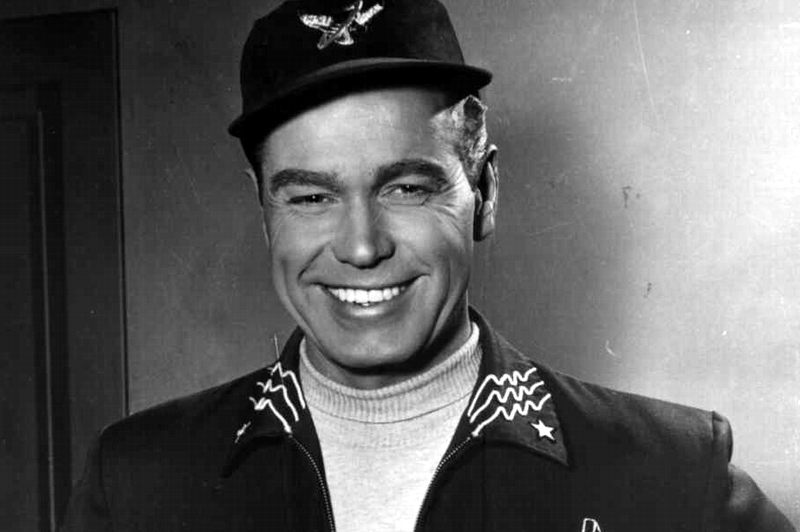
The Basics
Rocky Jones, Space Ranger consists of 39 episodes broadcast in syndication in 1954. Although not as popular as Tom Corbett, Space Cadet (1950-1955) or Space Patrol (1950-1955), it has the benefit of all of its episodes surviving to the modern day. All three series were aimed at children, but Rocky Jones didn’t play down to the kids, and it lacked some of spaceman elements that its rivals did. It seems to me as a bridge between Flash Gordon/Buck Rogers and Star Trek. Despite a lack of longevity, Rocky Jones did get some merchandise and a few comic book stories.
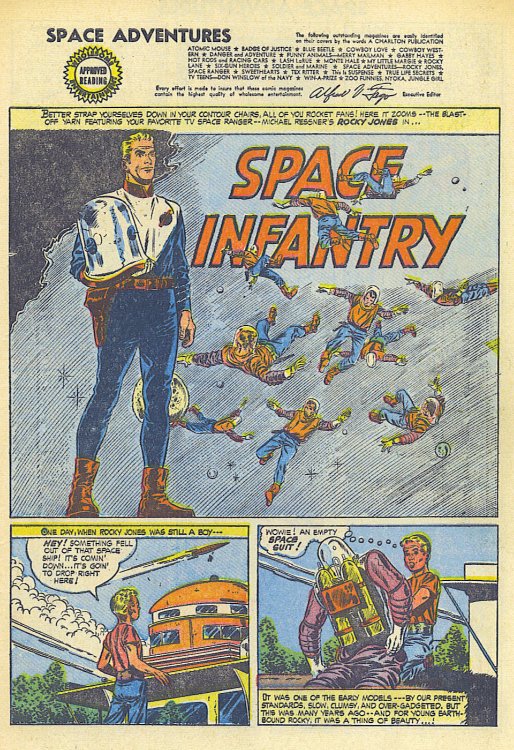 Rocky Jones had some pretty good special effects for the time period (and budget), some decent acting (I especially like Richard Crane’s calm and collected depiction of Rocky Jones – I’ve heard he was among the actors considered as captain of old NCC-1701) and a few decent stories. It also had pretty good continuity – when characters left, they were not forgotten. When a moon joins the United Worlds in one episode, a representative of that moon appears in a later episode at a conference.
Side Trek – One of those lost characters was Winky (presumably a nickname), Rocky Jones’ first assistant. Winky was played by Scotty Beckett, best known for being in the old Our Gang comedies. Winky made it through 26 seasons before Scotty was thrown in the clink on a concealed weapons charge.
The Setting
Rocky Jones is set almsot entirely within the Solar System. It is worth noting here that scientific realism is not a strong suit of Rocky Jones, or any other kids sci-fi series (or, frankly, any of the Star Treks if we’re honest). The Space Rangers are headquartered on Earth, under the direction of the Secretary for Space Affairs Drake. From there, they patrol the United Worlds of the Solar System. Some episodes send the crew beyond the Solar System to Una and Alpha Centauri.
In the early episodes, Rocky captains the XV-2 Orbit Jet. When it is destroyed in one episode, he is given command of the XV-3 Silver Moon. Both craft are identical. In one episode the XV-12 is mentioned, so there is presumably at least 12 vessels in the Space Rangers’ fleet.
These ships have the traditional rocket ship look, and can land directly on planets. They are perhaps 130 to 150 feet long/tall. The vessels are equipped with rocket launchers or missile launchers, a “cold light” mechanism which we would know as a cloaking device, and a primitive form of universal translator (you have to speak into it so others can understand you on a paired device). The ships are nominally crewed by two, a pilot and co-pilot, but Rocky also had Vena Ray in his crew as navigator and language specialist, and Bobby, presumably a cadet, and Professor Newton or Mayberry were usually along as well.

The space vessels had a cockpit, an adjoining room with chairs to facilitate blast-offs and equipment used by Vena for navigation, and an additional room that may have been for storage. These rooms always appear to be “upright”, whether the ship is vertically or horizontally oriented. Artificial gravity – a rotating capsule – lazy set design – we’ll never know.
Before one of these vessels was launched, it had to be charged. A Star Trek fan could imagine the vessel being “charged” with anti-matter to allow it to generate enough energy to warp space. The quick journey to Alpha Centauri suggests that the XV-2 and XV-3 could warp space.
A few space stations, all of the ring-and-spokes variety, appear in the series. They are not massive, and apparently have a single operator.

Space Station RV5
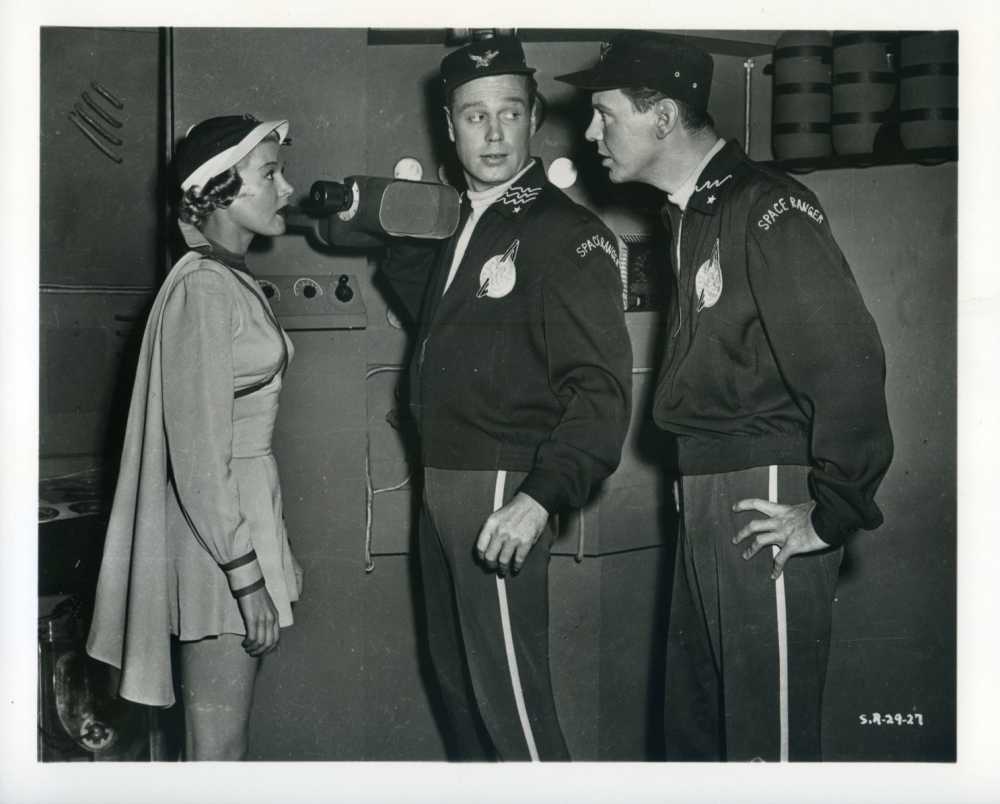
 I really dig the uniforms worn by the Space Rangers. We see a field uniform in the series that consists of a white undershirt, jacket, trousers and cap, and a dress uniform that reminds me of Kirk’s fancy uniform in Star Trek: The Motion Picture. Both are well-designed. Secretary drake wears a uniform unique to him. We see three rank insignia in the show, consisting of a low rank with one “stripe”, a high rank of three “stripes” and the wide bar worn by Secretary Drake. Presumably there is a middle rank with two “stripes”. The ranks could be something like lieutenant – commander – captain.
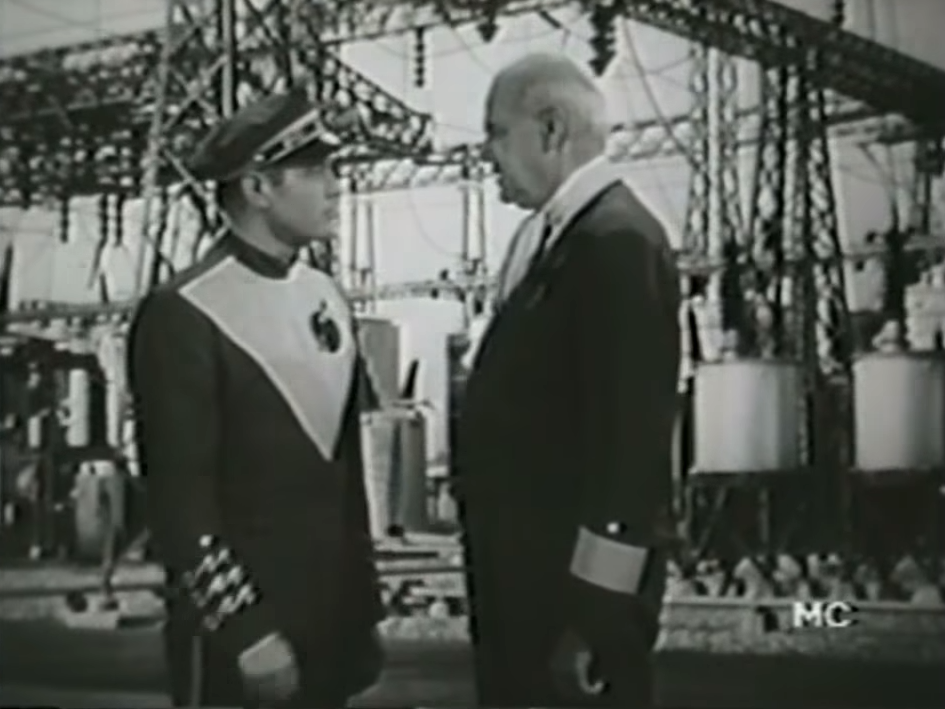
Rocky in dress uniform and Secretary Drake

Rocky and Winky in field uniforms without jackets
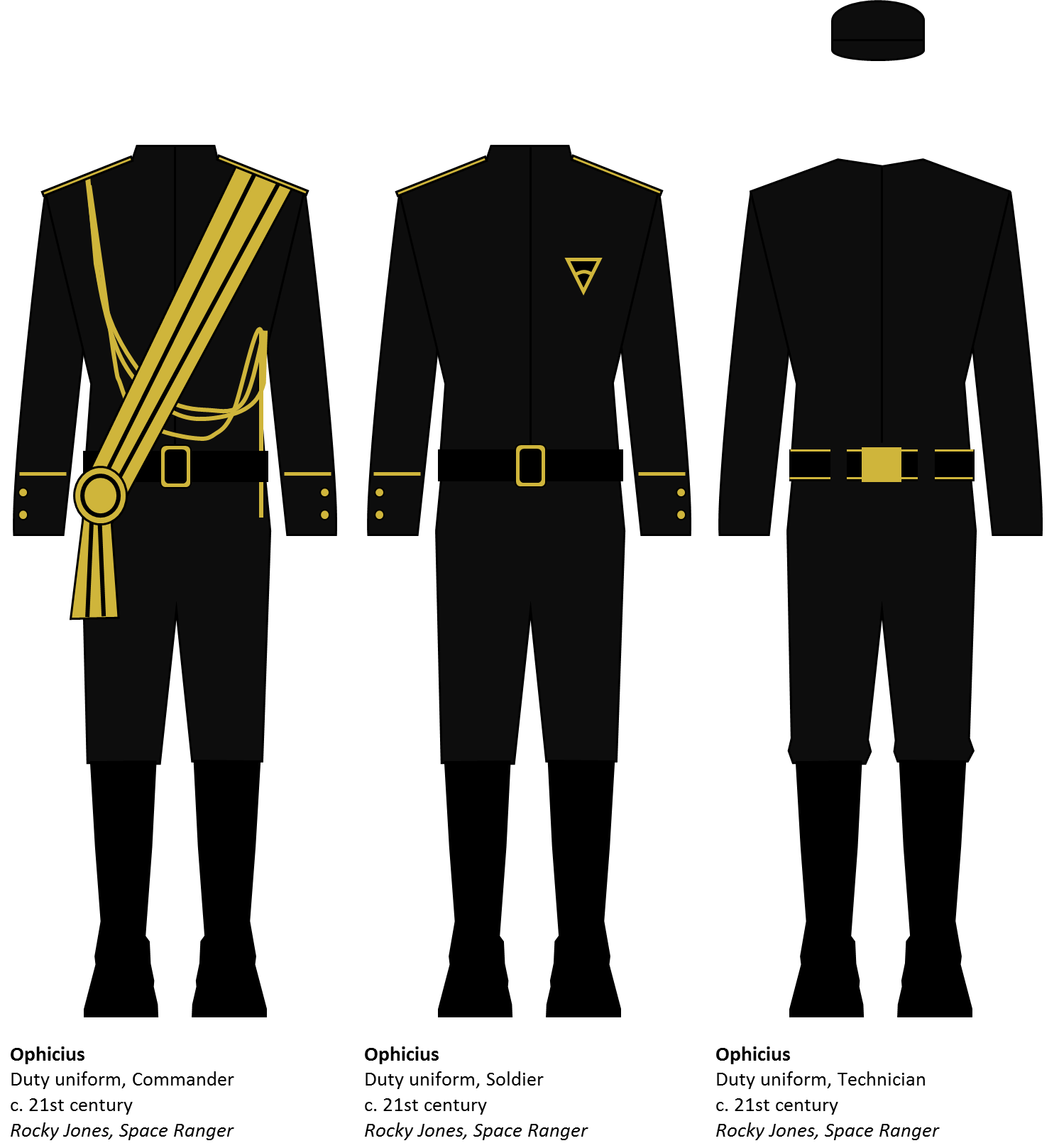
The Ophicians and Herculons have their own consistent uniforms. I meant to draw them all, but frankly did not have time. Look for a future addition to this post.
Hey – here’s that future addition!

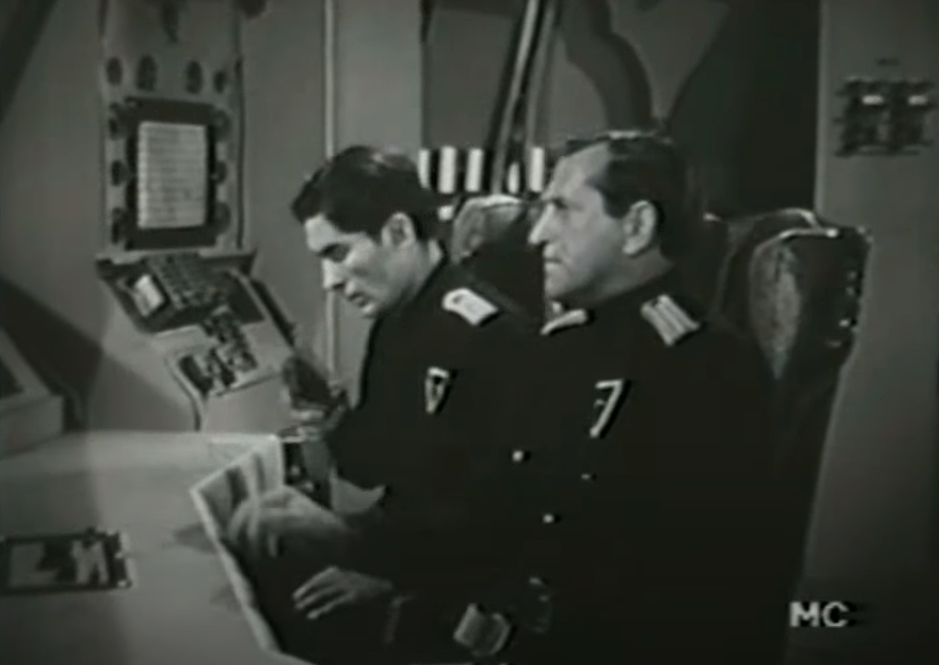
And here’s those nasty Ophicians:
Characters
Rock Jones (Richard Crane), the principal character, is a level-headed, serious leader. He never came off as a parody to me – no grand speeches or easy victories, but a skilled, determined guy who sees things through to the end.
Rocky is first assisted by Winky (Scotty Beckett), who was a wise-cracker, but perfectly competent in his job. When Winky left the series, he was replaced by Biffin “Biff” Cardoza (Jimmy Lydon), an inhabitant of the friendly planetoid Herculon as part of an exchange system.
Vena Ray (Sally Mansfield) was a civilian whose brother was a member of the Space Rangers. Conern for her brother brought her onto the crew as navigator. Rocky wasn’t thrilled with this addition at first, but happily included her when he discovered how good she was at the job.
Bobby (Robert Lydon), presumably a cadet due to his young age, was often taken along as a valued team member. In early episodes, Professor Newton (Maurice Cass) served as the ship’s science advisor. When Cass passed away, Professor Mayberry (Reginald Shieffield) took over.
Ranger Clark (William Hudson) commanded space refueling station OW9. We also meet Ranger Griff and Ranger Marshall during the series.
Leading them all is Secretary Drake (Charles Meredith), head of the office of Space Affairs. Drake is a fatherly sort, who treats his underlings more like family than employees.

All is not peace and harmony in the Solar System. Opposing the United Worlds in the early episodes is the planet Ophicius, head of the Ophicius Group, under the reign of its Suzerain Cleolanta (Patsy Parsons). While Cleolanta had a yen for Rocky Jones, she was always plotting against the United Worlds. Assisting her were the likes of Atlasande (Harry Lauter), her chief aide.
Rocky later visits the twin gypsy moons of Negato and Posito, where he tangles with Bovarro (John Banner), the blowhard ruler of Posito until that moon crashes into Ophicius. And yes, it is the same John Banner would would play Sgt. Shultz on Hogan’s Heroes.
After Rocky and the Space Rangers evacuate Ophicius and Posito, the Positoans are apparently re-settled on the plantoid Herculon. Bovarro’s daughter, Juliandra (Ann Robinson), becomes Suzerain in place of her evil twin sister, Noviandra. Side note – I have to admit that I though Juliandra was smoking hot.
Perhaps the most fun villain was the egotistical coward Pinto Vortando (Ted Hecht). Pinto begins as a villain, becomes a bum on the moon Ankapor after his defeat, and ultimately becomes an ally of Rocky Jones and the Space Rangers. Pinto always refers to himself in the third person.
The Final Frontier
A Rocky Jones-inspired campaign would never have to leave the Solar System. The series mentions a few real places, many imaginary places that could be renamed moons or planetoids, and at least one completely made up moon of Mercury.
As mentioned above, scientific realism is not high on the series’ list of accomplishments, so places far from the Sun and much smaller than Earth manage to have habitable climates and normal gravity. I guess it can all be explained with the magic of future technology. A few of the more notable spots (and my guess for where they could be located) follow:
Let’s begin with real places.
Mars is mentioned in the series, though never visited. It has humanoid inhabitants, as well as mammoths. I imagine a world of cold, red grasslands, where primitive Martians once hunted their mammoths the way ancient Siberians did.
Saturn has two inhabited moons. Enceladus (Saturn-2) is mentioned to have a tropical climate. Titan (Saturn-6) is mentioned as the place where a criminal named Mickey Simpson was arrested. Since Mickey was held at Space Ranger’s HQ, we can presume Titan was a member of the United Worlds.
Venus is also inhabited, though never visited in the series. It appears that Venusians are not humans, though they are humanoid.
Jupiter has a few inhabited moons, though you won’t find them in any text books. Fornax is visited in “Bobby’s Comet”. The people dwell underground, and have a slightly Ancient Egyptian/Middle Eastern vibe to their clothing. Their planet has a crystal that can be used to power spaceships … dilithium, maybe? It is ruled by Zorovak. Another moon, Positta, is described as a great place to visit for 24 hours.

“Pyramid” on Fornax
Ankapor also has an underground civilization. Not a part of the United Worlds, it hosts many ne’er-do-wells. I could see it being the same as Ceres in the asteroid belt – a marketplace located between the inner and outer worlds.
Apollo Minor is a moon ruled by Pinto Vortando. After his overthrow, it joins the United Worlds. It is located on the fringes of the Solar System.
Cylenus is a planetoid or moon where the Ophicians captured Bobby and Prof. Newton.
Hermes is a planetoid on the fringes of the Solar System that is pulled out of orbit by the magnetic power of Regalio.
The planet Medina is ruled by the villainous Agar and his kindlier sister Yara.

Ophicius is called a planet, and has an Earth-like climate/atmosphere, but when Secretary Drake notes it on the map in his office it appears to be a moon of Jupiter. The location of New Ophicius, after its collision with the gypsy moon Posito, is anybody’s guess.
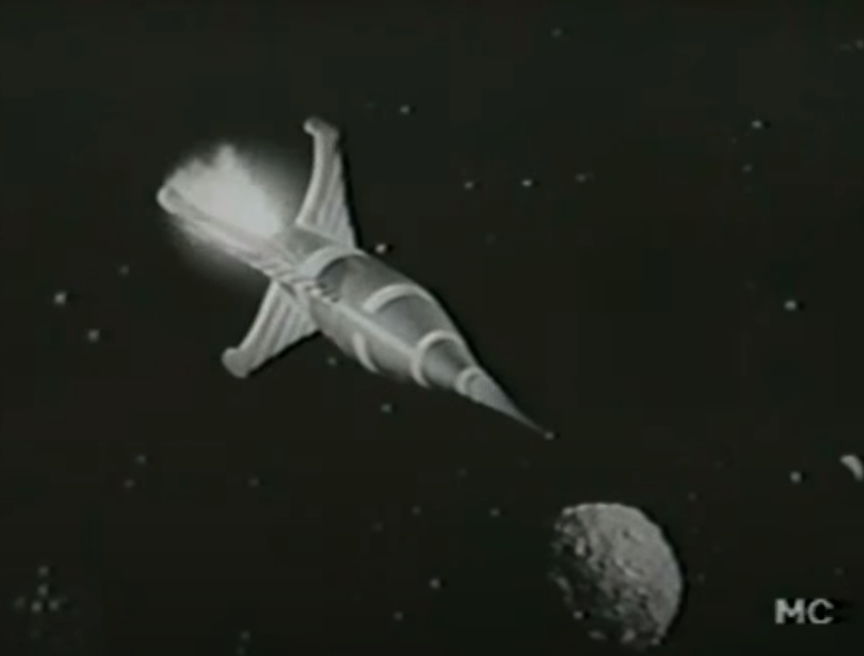
Ophician spaceship
Prah is a planetoid supposedly impossible to land upon. It hosts a gang of space pirates.
Torida is the uninhabited moon of Mercury.
Rocky also visits an unnamed moon on the fringes of the Solar System in “Blast Off” – maybe my favorite series of episodes in the series.
Three places outside the Solar System are mentioned in the series. The two most important are Regalio, a planet orbiting Alpha Centauri (and the furthest a Space Ranger has ever traveled), and Herculon. Regalio does not have atomic power, but rather has perfected magnetic power. It is ruled by a Nizam. Herculon orbits Una, a star located between Sol and Alpha Centauri, which if we’re picking a real place means Una is Proxima Centauri. It is ruled by Suzerain Juliandra, daughter of Bovarro.
Final Thoughts
I really enjoyed this series. I started exploring it when I was prepping my personal Star Trek campaign. With a few small changes, it could serve as Star Trek’s past. You have to figure the kids who watched Rocky Jones were probably the young adults who watched Star Trek. Although aimed at children, the show managed a few interesting episodes. It was action-packed and fun, and I highly recommend watching a few episodes. If you think you’ll be bored with it, try one of the stories done on MST3K.
 Sunday |
 Monday |
  Tuesday |
  Wednesday |
  Thursday |
  Friday |
  Saturday |
 Sunday |
 Monday |
  Tuesday |
  Wednesday |
  Thursday |
  Friday |
  Saturday |
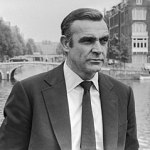
 A year later, we get our first glimpse of the wonderful TARDIS and its pilot, the Doctor, played by William Hartnell. Hartnell had a career in crime movies, and so brings a little subtle menace with him to the role of the mysterious Doctor. I remember reading somewhere that the show was intended to teach children about history … and then I found out the Daleks showed up pretty early in the series and realized that any history education kids were going to get was probably incidental.
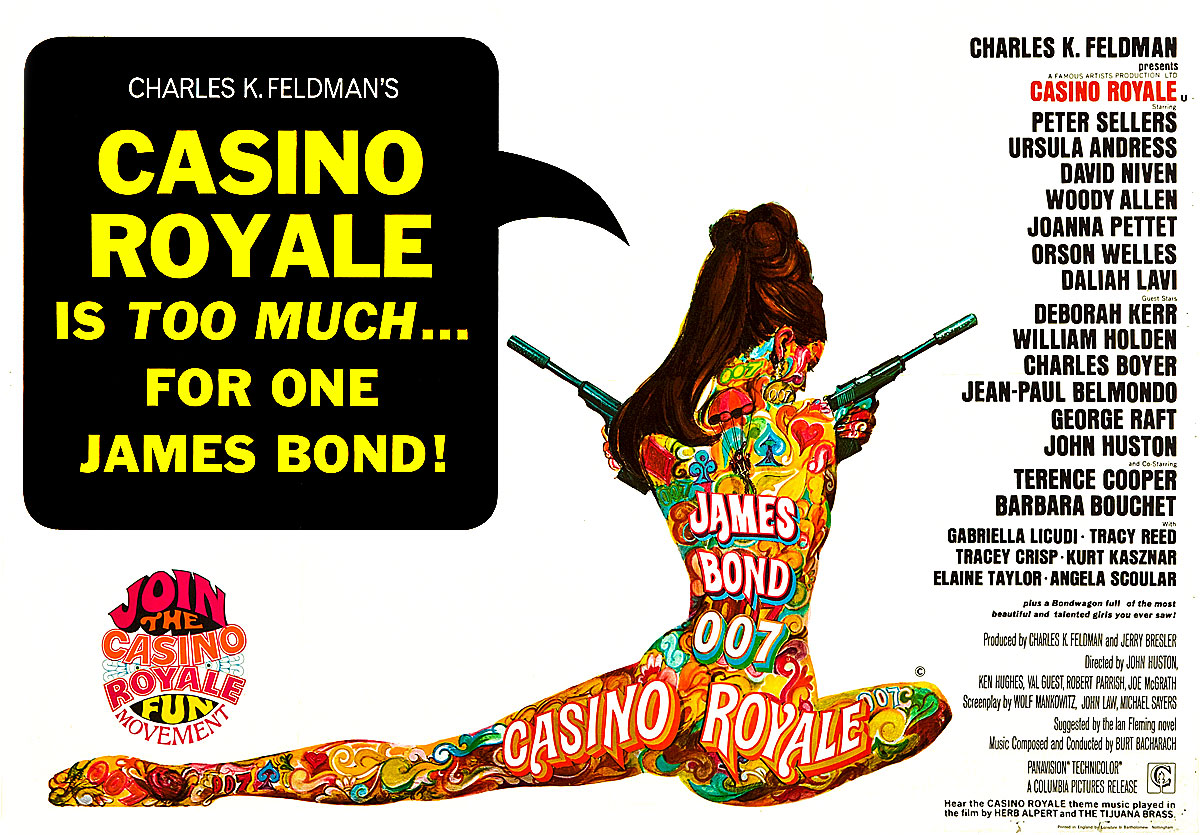
 The Doctor’s first regeneration is followed three years later by Bond’s first regeneration, with George Lazenby taking over for one film to very mixed reviews. Lazenby’s bond was a departure from the formula. Where Connery’s Bond was a more emotionally distant, Lazenby’s Bond gets married in the film to Contessa Teresa di Vicenzo, played by Diana Rigg. This was faithful to the novel, but would not be repeated in the series for many years. Lazenby’s tenure was followed two years later by one more outing for Connery.
 The Third Doctor appears three years before the Third Bond, with Jon Pertwee beginning his celebrated tenure as the Doctor. Pertwee’s Doctor struck me as a bit less irrascible than Troughton’s, but still testy. This is also our first Doctor in color … big, bright, beautiful color. There’s so much right about this run. It was the first run of Who that I saw after I started watching the Tom Baker years, and I wasn’t sure at first that I was going to like it, but I really did.
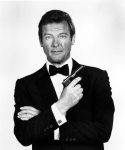 Just as many people associate the classic Doctor with the actor who had the longest tenure in the roll (just wait a minute, he’ll be along any time now), I think my generation probably associates Bond with Roger Moore. Yeah, when we got older, Gen X took the tack that Connery was cooler because he was more serious yadda yadda yadda … but in our hearts we loved Roger Moore. Moore would spend 13 years as James Bond, and though he started off the cold, dashing assassin you would expect, his own more jovial personality ultimately took over. I love camp, so I have no problem with thus, though I totally understand those who don’t like it.
 As the longest Bond tenure was gettig started, the longest Doctor tenure arrived a year later. Tom Baker‘s run was similar to Moore’s run as Bond, starting out with a beautiful alien menace and growing more campy as they years went on. Again – no problem for me. I adore Baker’s Doctor, and he is without a doubt my favorite. He also had my favorite companion in the form of Lela. No, not because of her outfit, but because while the Doctor was figuring out a virtuous solution to a problem she was pulling a knife and saying the obvious – let’s just kill the bad guy. That was a great counterpiece for the Doctor.
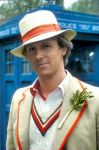 Roger Moore would survive into the 80’s as Bond, but Baker would hand over the role of the Doctor to Peter Davison. I’ll state it up front – I dig Davison in the role. He had a daunting challenge ahead of him taking over for the beloved Baker. I’ll also state, frankly, that I don’t like most of the serials he played in. The writers didn’t give him as likeable companions (again, this is no slight directed towards the actors, who were great), and the stories didn’t always thrill me. Still, there was some good stuff there, and I think Davison should get more credit than he does. I do think, though, that the franchise at this point was losing steam … the assumptions on which it was built were shifting under its feet; and honestly, the Bond franchise was in the same boat.
 The Roger Moore Bond era would be rounded out in the Doctor Who franchise by Colin Baker. Baker’s doctor was a return to the earlier menace of the Doctor’s alien mind, and maybe more so than any other doctor he has a severity that is shocking when compared to the wise fool played by Tom Baker. They say that Colin Baker wanted a more updated look for his Doctor – something not unlike that of the ninth incarnation, but instead the designers tried to catch lightning in a bottle with something more reminiscent of the fourth Doctor.
 Roger Moore was 58 years old when he made A View to a Kill, and was ready to retire. The rumors started swirling that Remington Steele’s Pierce Brosnan was going to be Bond. Cool! Loved Remington Steele, and who better to take over for Moore than Brosnan. This is going to be so great, I can’t wait until … Timothy Dalton? Huh?
 The Fourth Bond was going to be okay, but what about the Seventh Doctor? The first time I watched a Sylvester McCoy serial I was still high on watching Tom Baker, and I wasn’t so sure about this guy. When I got the chance to watch more of them on Retro TV, I found that I really liked McCoy in the role. The angry edge was gone, the tone was sometimes lighter and perhaps more manic, and I really looked forward to more. I think McCoy’s run reminds me the most of Tom Baker’s, so I guess it’s no surprise that I like it. But alas, after three years, the magic was fading and there would be no regeneration for the Doctor. He just faded away …
 there, it sorta sucked – I think I prefered my tenure in the 80’s). Still, there was excitement and hope for the new series, and that’s always good.
 shifted into something I loved in the past from something I was going to watch in the present.
 Sunday |
 Monday |
  Tuesday |
  Wednesday |
  Thursday |
  Saturday |

 Land of Nod