It Came From the SRD – Part Two

Here’s part Two of my SRD conversions, letters F through K. I’ll post L-R tomorrow and then round it out on Wednesday with S-Z and some templates.

This post is open game content.

Frost Worm
Frost worm look like white and blue purple worms. They are capable of burrowing through ice, but not stone. They can produce a sonic trill that causes creatures who fail a saving throw to stand stunned for the duration of the trilling. If attacked, a stunned creature may make another saving throw. The worm can breath a cone of cold once per hour that inflicts 10d6 points of damage (saving throw for half damage). When killed, the frost worm turns to ice and shatters, dealing 10d6 damage to all within 100 feet.

• Frost Worm: HD 14; AC 1 [18]; Atk 1 bite (3d6); Move 12 (Burrow 3); Save 3; CL/XP 18/3800; Special: Trill, breath weapon, explode, immune to cold.

Fury
A cruel hunter and roaming brigand, the fury is a harpy that has trained to become a deadly archer. Furies often become mercenaries, selling their services to the highest bidder. When not employed, they make ends meet as highway robbers, forcing merchant caravans to pay protection money. Their siren song is no less effective than a normal harpy’s, and their touch also charms (saving throws apply).

• Fury: HD 7; AC 4 [15]; Atk 2 talons (1d3) and weapon (1d6+2); Move 6 (Fly 18); Save 9; CL/XP 8/800; Special: Flight, siren-song, +2 to hit and damage with bows.

Ghost
Ghosts are restless spirits that dwell between the ethereal and material planes. They can emit a frightening moan (save vs. fear) and their touch ages a person one decade (in the case of most humanoids) or one century (in the case of long-lived demi-humans). Ghosts can also use telekinesis to hurl small objects. As ethereal creatures, ghosts can only be harmed by magic spells and weapons.

• Ghost: HD 6; AC 4 [15]; Atk 1 touch (aging) or 1 hurled object (1d4); Move (Fly 12); Save 11; CL/XP 9/1100; Special: Moan, aging touch, telekinesis.

Girallon
Girallons are 8-foot tall, albino, four-armed gorillas that are as strong as stone giants. Although capable of fighting with their claws and bite, girallons sometimes employ simple weapons in combat. They are tribal by nature and have a simple language. They are fond of gems, jewelry and shiny metal. They are also fond of human flesh. Girallons speak their own simple language. A girallon that hits with two or more claw attacks latches onto the opponent’s body and tears the flesh for double damage.

• Girallon: HD 7+1; AC 16; Atk 4 claw (1d6) and 1 bite (1d8); Move 15 (Climb 15); Save 9; CL/XP 7/600; Special: Rend with claws, track by scent.

Grimlock
Grimlocks are a race of subterranean humanoid that raid the surface world at night searching for humans to butcher and devour. They are completely blind, but with their highly developed senses of smell and hearing they can sense creatures within 20 ft. Although they are immune to spells that require their victims to have sight, they can be partially “blinded” with spells such as ghost sound and sound burst or substances like snuff. Grimlocks have grey skin, black hair and white eyes. Their teeth are large and sharp. Grimlocks speak their own language. Grimlocks sometimes (10%) lair with medusae. In rocky areas, grimlocks are effectively invisible (and require a see invisibility spell to detect) if they remain motionless.

• Grimlock: HD 2; AC 4 [15]; Atk 1 slam (1d6) or 1 weapon (1d8); Move 15; Save 11; CL/XP 4/120; Special: Blind-fight, invisible in rocky areas.

Howler
A howler looks like a massive, emaciated lion with a mane of quills. In the middle of the night, it lies low in the grass and howls for hours on end. Those who hear the howl must make a saving throw each hour or temporarily lose one point of wisdom, with creatures who lose all of their wisdom dropping dead. Creatures engaged in melee combat with a howler suffer 1d4 attacks each round from its quills. With each successful attack, the victim must make a saving throw or have the quill break free and lodge in their flesh. Each quill so lodged imposes a -1 penalty to hit in combat.

• Howler: HD 6; AC 5 [14]; Atk 1 bite (2d8), 1d4 quills (1d6); Move 24; Save 11; CL/XP 8/800; Special: Howl, quills.

Janni
Janni are lesser kin to the djinn and efreet. They are formed of all four elements, and thus dwell on the material plane. They can change a creature’s size twice per day, become invisible three times per day, and speak with animals at will. They can also create food and water once per day (as a cleric) and shift into the ethereal plane for a few rounds at a time. They have telepathy with a range of 100 feet. Most janni are encountered wearing chainmail and armed with a curved sword and longbow.

• Janni: HD 6; AC 3 [16]; Atk 1 weapon (1d8); Move 12 (Fly 15); Save 11; CL/XP 7/600; Special: Spells.

Kapoacinth
Kapoacinth are aquatic cousins of the terrestrial gargoyle that lack wings. I imagine their “skin” might look like coral, and they would perch on a reef waiting for an unlucky sahuagin or undine to swim past.

• Kapoacinth: HD 4; AC 5 [14]; Atk 2 claws (1d3), 1 bite (1d4), 1 horn (1d6); Move 9 (Fly 15); Save 13; CL/XP 5/240; Special: None.

Krenshar
The krenshar is a strange, catlike carnivore with extremely flexible skin on its head. Krenshars use solitary scouts to drive prey into the waiting clutches of the pride. The scout appears from hiding, uses its scare ability, then chases the fleeing target to join the attack. A krenshar can pull the skin back from its head, revealing the musculature and bony structures of its skull. Combining this with a loud screech produces an unsettling effect that works like a scare spell.

• Krenshar: HD 2+2; AC 4 [15]; Atk 2 claw (1d4) and 1 bite (1d6); Move 15; Save 16; CL/XP 3/60; Special: Frighten.

It Came from the SRD – Part One

As I’ve mentioned before, I’m no purist when it comes to the many editions and iterations of the “world’s most popular role-playing game”. My own desire for simplicity draws me toward the older versions of the game and their modern simulacra, but that doesn’t mean I can’t find things to like about most editions. The problem, I think, is when some of these clever notions (kits, feats, templates) become revenue sources for their owners. That said, I think one of the top five best ideas ever concerning our favorite game was the creation of the Open Gaming License and its accompanying System Reference Document. The SRD, and all of the other open content on the internet, are amazing sources from which to mine ideas. Looking over the SRD today, I decided to convert a few creatures (and creature variants) that didn’t make it into S&W:C. All of the following is open game content.

Arrowhawk
An arrowhawk is a predator and scavenger from the Elemental Plane of Air. By twisting its body and varying the cadence of its wingbeats, an arrowhawk can fly at top speed in any direction.

• Arrowhawk: HD 7; AC 3 [16]; Atk 1 lightning bolt (2d8) or 1 bite (1d8); Move (Fly 24); Save 9; CL/XP 9/1100; Special: Immune to lightning.

Barghest
A barghest is a lupine fiend that can take the shape of a wolf or a goblin. A full-grown barghest is about 6 feet long and weighs 180 pounds. It has bluish-red skin and blue-black fur. A barghest’s eyes glow orange when it becomes excited. Barghests can cast blink, levitate and misdirection at will and charm monster and dimension door once per day. A barghest in wolf form leaves no tracks or trail. When a barghest slays an opponent, it can feed on the corpse, devouring both flesh and soul. Feeding prevents any form of raising or resurrection that requires part of the corpse. For every three suitable corpses a barghest devours, it gains one hit dice, and its armor class improves by one. The barghest only advances by consuming the corpses of creatures whose hit dice or levels are equal to or greater than its own current total. A barghest that reaches 9 hit dice through feeding immediately becomes a greater barghest upon completion of the act. A greater barghest gains the ability to cast invisibility and alter size once per day.

• Barghest: HD 6; AC 3 [16]; Atk 1 bite (1d6), 2 claws (1d4); Move 12; Save 11; CL/XP 8/800; Special: Change shape, cast spells, feed, only harmed by magic weapons.
• Greater Barghest: HD 9; AC 0 [19]; Atk 1 bite (1d8), 2 claws (1d6); Move 15; Save 6; CL/XP 12/2000; Special: Change shape, cast spells, feed, only harmed by magic weapons.

Belker
Belkers are wicked spirits of the air. They are composed of smoke, and their wings lend a demonic cast to their appearance. At will, it can take on gaseous form, looking like a pillar of smoke. In combat, it can engulf a victim, sending solidified, smoky claws into its lungs to tear and rend for 2d6 damage each round.

• Belker: HD 7; AC 2 [17]; Atk 2 wings (1d6), 2 claws (1d3), 1 bite (1d4); Move 12 (Fly 21); Save 9; CL/XP 9/1100; Special: Smoke claws, gaseous form.

Bodak
A bodak is the restless, angry spirit of one killed by an act of terrible, senseless evil. They appear as humanoids with rubbery, reddish skin, featureless faces and smoldering, orange eyes. Creatures that meet its pitiless gaze must pass a saving throw or die instantly, re-animating as bodaks 24 hours later. Bodaks loathe sunlight, which inflicts 1 point of damage each round it is in contact with their skin.

• Bodak: HD 9; AC 1 [18]; Atk 1 slam (1d8); Move 9; Save 6; CL/XP 12/2000; Special: Death gaze, vulnerable to light, unharmed by lightning.

Cauchemar
The cauchemar is a horrible, especially malevolent version of a nightmare. The sight of one of these great horrors bearing down is enough to shake the heart of the boldest champion.

• Cauchemar: HD 16; AC -5 [24]; Atk 1 bite (2d6), 2 hoofs (2d8); Move 18 (Fly 35); Save 3; CL/XP 19/4100; Special: Breathe smoke, become incorporeal.

Celestial Charger
A celestial charger is a unicorn blessed by the gods of light and law. They have the same abilities as normal unicorns, but can also cast spells as a level 7 cleric. Once per day, a celestial charger can deal +8 damage on a successful attack against an evil creature.

• Celestial Charger: HD 8; AC 0 [19]; Atk 2 hoofs (1d8), 1 horn (1d10); Move 24; Save 8; CL/XP 11/1700; Special: Double damage for charge, 25% magic resistance, teleport, smite evil, cast cleric spells as level 7 cleric.

Chaos Beast
Chaos beasts have mutable, ever-changing forms. For all its fearsome appearance, whether it has claws, fangs, pincers, tentacles, or spines, a chaos beast does little physical harm. A blow from a chaos beast causes a living creature to become a spongy, amorphous mass unless they pass a saving throw. An affected creature cannot hold or use any item. Soft or misshapen feet and legs reduce speed to 6. Searing pain courses along the nerves, so strong that the victim cannot cast spells or use magic items, and it attacks blindly, unable to distinguish friend from foe. Each round the victim spends in an amorphous state causes 1 point of wisdom drain from mental shock. If the victim’s wisdom score falls to 0, it becomes a chaos beast. A victim can regain its own shape by attempting a saving throw. A success reestablishes the creature’s normal form for 1 minute. On a failure, the victim can still repeat this check each round until successful or drained of wisdom. A shapechange or stoneskin spell does not cure an afflicted creature but fixes its form for the duration of the spell. A restoration or heal spell removes the affliction, but a separate restoration is necessary to restore any drained points of wisdom.

• Chaos Beast: HD 8; AC 3 [16]; Atk 2 claw (1d4); Move 9; Save 8; CL/XP 11/1700; Special: Corporeal instability, immune to critical hits and transformations, magic resistance 20%.

Choker
These vicious little subterranean predators have hands and feet with spiny pads that help grip almost any surface. The victim of a successful tentacle attack must make a saving throw or be strangled for 1d6 points of damage each round. Chokers are so fast, they can make an extra attack or move at the end of each round.

• Choker: HD 3; AC 2 [17]; Atk 2 tentacles (1d4); Move 9 (Climb 6); Save 14; CL/XP 5/240; Special: Strangle, quickness.

Chuul
Chuuls are a horrible combination of crustacean, insect, and serpent. Although amphibious, they are not good swimmers and prefer to attack on land or in shallow water. The victim of a chuul’s claw attack must succeed at a saving throw or be constricted for 3d6 points of damage each round. A chuul can transfer constricted victims from a claw to its tentacles on its next turn. The tentacles grapple with the same strength as the claw. They deal no damage, but do exude a secretion that paralyzes for 6 rounds if a saving throw is failed. While held in the tentacles, a victim suffers 1d8 points of damage each round from the chuul’s mandibles.

• Chuul: HD 11+2; AC -3 [22]; Atk 2 claw (2d6); Move 12 (Swim 9); Save 4; CL/XP 15/2900; Special: Amphibious, constrict, paralyze, immune to poison.

Cloaker
When resting or lying in wait, these creatures are almost impossible to distinguish from common black cloaks (the cloaker’s ivory claws look very much like bone clasps). Only when it unfurls does the horrific nature of the creature become apparent. A cloaker has a wingspan of about 8 feet. Cloakers emit a low moan that can either cause everyone within 30 feet to save vs. fear or cause one creature within 30 feet to save vs. hold monster. Cloakers can manipulate shadows, duplicating the effect of the spells blur or mirror image.

• Cloaker: HD 6; AC 3 [16]; Atk 1 tail (1d6), 1 bite (1d4); Move 3 (Fly 15); Save 11; CL/XP 9/1100; Special: Moan, shadow shift.

Derro
Derro are a degenerate race of albinos that dwell deep underground. At night, they walk the surface world, kidnapping humans for slaves or food. Most derro wear studded leather armor and carry repeating light crossbows with poisoned bolts (see below), fork-fauchards (pole arms that grant a +4 bonus to overbearing attacks) and daggers. Derro bands are often lead by their savants, a sort of combination of magic-user and cleric. Derro lairs contain 20-40 derro, 1d3 savants, 1d6 student savants, 20-30 slaves (80% female) and 1d3 gargoyle allies.

• Derro: HD 3; AC 14; Atk 1 weapon (1d4); Move 12; Save 14; CL/XP 4/120; Special: Magic resistance 30%.
• Savant: HD 7; AC 14; Atk 1 weapon (1d4); Move 12; Save 9; CL/XP 10/1400; Special: Magic resistance 30%, spells.

Destrachan
A destrachan looks something like an eyeless velociraptor with a gaping, lamprey-like mouth. It has a pair of complex, three-part ears that it can adjust to be more or less sensitive to various sounds. It is blind, yet hunts with a sense of hearing more precise than most creatures’ sight. From its tubular mouth a destrachan emits carefully focused harmonics, producing sonic energy so powerful it can shatter a stone wall. So skilled is a destrachan at controlling the sounds it emits that it can choose what type of material to affect with its attack.

A destrachan can blast sonic energy in a cone up to 80 feet long. It can also use this attack to affect any creatures or objects within a 30-foot radius. It can tune the harmonics of this destructive power to affect different types of targets, including a blast that deals 4d6 points of damage to all within 20 feet, stunning all foes within 20 feet (saving throws apply) or shattering a particular material.

• Destrachan: HD 8; AC 1 [18]; Atk 2 claw (1d6); Move 12; Save 8; CL/XP 11/1700; Special: Blindsight, sonic energy.

Dread Wraith
The oldest and most malevolent wraiths lurk in the depths of forgotten temples and other forsaken places. They can sense the approach of living creatures, and hunger for them. Dread wraiths are immune to all non-magical weapons, including silver ones. Arrows, even magical ones, inflict only a single point of damage on their etheric bodies. The touch of a dread wraith inflict 2d6 points of damage and drains 1d2 levels. Humanoids that have all of their levels drained by a dread wraith become wraiths themselves under the control of their killer.

• Dread Wraith: HD 16; AC 0 [19]; Atk 1 touch (2d6 + level drain); Move 9 (Fly 24); Save 3; CL/XP 19/4100; Special: Drain 1d2 levels per hit.

Elder Pudding
The most ancient black puddings are vast pools of inky death. They have the same special abilities as other black puddings, save that weapons and armor of any kind are destroyed with but a single hit.

• Elder Pudding: HD 20; AC 8 [11]; Atk 1 attack (4d8); Move 6; Save 3; CL/XP 21/4700; Special: Acidic surface, immune to cold, divides when hit with lightning.

Ethereal Filcher
Ethereal filchers look vaguely like giant, disembodied hands, the “fingers” each tipped in a hand with long, sinuous fingers. The “palm” contains a rudimentary face. Ethereal filchers can slip in and out of the ethereal plane at will, using this ability to take people by surprise. The creature attempts to seize an item, then quickly shifs back to the ether. Ethereal filchers can detect magic at will.

• Ethereal Filcher: HD 5; AC 2 [17]; Atk 1 bite (1d4); Move 15; Save 12; CL/XP 6/400; Special: Detect magic, ethereal jaunt, pick pockets.

Ethereal Marauder
Ethereal marauders look like bipedal lizards with no forelegs and with gaping, tri-corner mouths filled with fangs. Their coloration ranges from bright blue to deep violet. They live on the ethereal plane, but mostly hunt on the material plane. Once a marauder locates prey, it leaves the ethereal plane to attack, biting the victim and then retreating quickly back to the ether.

• Ethereal Marauder: HD 2+1; AC 5 [14]; Atk 1 bite (1d8); Move 15; Save 16; CL/XP 3/60; Special: Ethereal jaunt.

Coming Soon: I’ll finish up the unconverted SRD monsters and then get to work describing the southwest portion of the Wyvern Coast and the infamous city-state of Ophir.

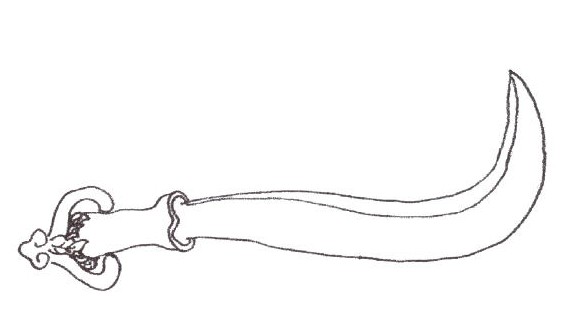
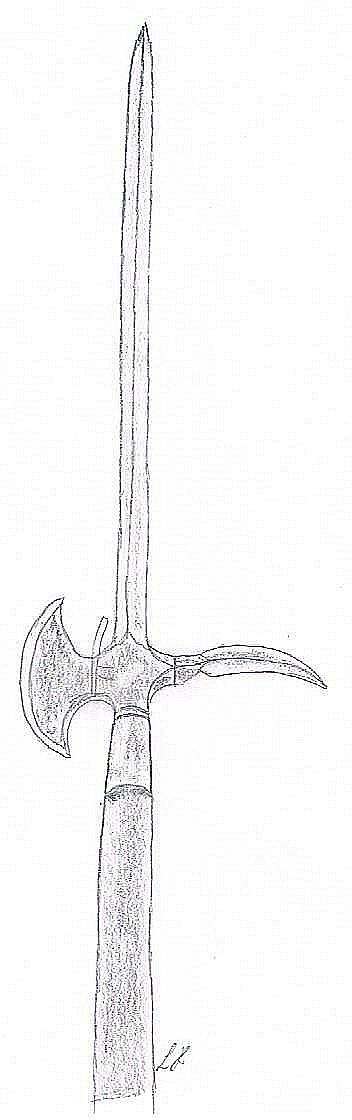
A Sword by Any Other Name

Weapons are a big part of fantasy role-playing. They are one of the main tools of the trade for vanquishing evil (or promoting it) and relieving the local humanoids of their ill-gotten booty. They are also a way that many players, especially those playing fighting-men, define their characters – archer vs. swordsman vs. weird guy who specializes in the flail.

The thousand variations on the D&D theme have introduced a few different ways of handling weapons in play, from the concept of everything doing 1d6 damage in 0E, to the introduction of variable damage types soon after, to 3rd edition’s variable damage + variable critical hit ranges + variable critical hit multipliers + different sizes + different weapon types (bludgeoning/piercing/slashing and simple/martial/exotic). AD&D’s weapon speeds and weapon vs. AC table was another way of differentiating one weapon from another, i.e. making one’s choice of weapon (or weapons) an element that could influence success or failure in the course of play.

Now, I like lots of variety in gaming, but I also like enough simplicity that I can store the vital game rules in my brain so that I rarely have to consult a book or table during play. For this reason, my desire for weapon differentiation extends about as far as variable weapon damage. Unfortunately, as a person who likes to write game material, and as an ardent devotee of Clark Ashton Smith, describing NPCs with maces and short swords can get a bit boring. So, using my dog-eared copy of Palladium’s Compendium of Weapons & Armor (one of the essential books for a Referee or a write of game material in my humble opinion), I present this handy list of weapon synonyms, along with their region of origination or most common use. The weapon types are based on Moldvay’s Red Book.

Axe, Battle (1d8)
• Africa – Elephant Axe
• Ancient – Khetan (Egypt)
• Central & South America – Maquahuilt
• East Asia – Masakari
• Europe – Bearded Axe, Bipennis, Doloire (wagoner’s axe), Sparte, Taber Axe, Toporok, Tuagh-gatha, Woodsman’s Axe
• India – Bullova, Tabar, Tabar-i-zin, Tungi, Venmuroo
• Near East – Ay-Balta
• Oceania – Balestarius, Head Axe, Udlimau

Axe, Hand (1d6) – includes sickles (*)
• Africa – Hunga-Munga, Shoka, Silepe, Throwing Irons
• Ancient – Dolabra (Rome), Epsilon Axe (Mid-East), Eye Axe (Mid-East), Novacula (Cyprus *)
• East Asia – Biliong, Kama, Kusarigama* (attached to chain), Toki Kakauroa, Piau
• Europe – Francisca, Hatchet, Hurlbat, Miner’s Axe, Thin Axe, Thrusting Axe
• India – Ancus (elephant goad), Galraki, Hoolurge, Kharga (sacrificial axe), Kodelly, Tongia
• Near East – Balta
• North America – Tomahawk
• Oceania – Adze, Arit, Kadjo, Kapak, Keerli, Pareh

Club (1d4) – includes staves (#)and throwing sticks (*)
• Africa – Kasrullah, Kerrie *, Rungu, Trombash *
• Ancient – Aclys * (Rome), Lisan (Egypt), Naboot # (Egypt)
• Central & South America – Iverapena, Macana, Pagaya
• East Asia – Bo #, Bokken (practice sword), Jo #, Kiam Bokiam, Tonfa, Yoribo
• Europe – Baculus, Blackjack, Cudgel, Maul, Quarterstaff #, Sap, Slung Shot, Truncheon
• India – Kirasoo *, Mugdar
• North America – Ga-Ne-U-Ga-O-Dus-Ha (deer antler club), I-Wata-Jinga, Ja-Dagna, Ja-Weti, Mandehi-Liguje (coup stick), Tiglun
• Oceania – Baggoro, Bi-Teran, Boomerang *, Burrong, Dowak *, Flat Club, Hoeroa, Japurunga, Kangaroo Rat *, Kauah, Kotiate, Kujerong, Kunnin *, Leonile, Lil-lil, Mabobo, Mattina, Meeri, Merai (jade club), Muragugna, Nil-li, Pacho, Pahu, Patu, Periperiu, Potu, Purijimala, Quirriang-an-wun, Rang-kwan, Sapakana, Siwalapa, Tambara, Tabutje, Tawha-tewha, Tindil, U’u, Ulas *, Uramata *, Waddy, Wahaika, Wairbi, Wakerti, Watilikri *, Weerba, Wirka, Yeamberren

Dagger (1d4) – includes knives
• Africa – Baswa Knife, Bracelet Dagger, Fantail Dagger, Forked Tongue Dagger, Kummya, Mongwanga, Pokwe, Telek
• Ancient – Falx Supina (Rome), Harpe (Greece), Parazonium (Greco-Roman), Pugio (Rome), Sica (Rome)
• East Asia – Aikuchi, Bade-Bade, Chopper, Dhaw, Golok, Hamidashi, Heyazashi, Himogatana, Koshigatana, Kozuka, Kubikiri, Kujungi, Kwaiken, Mit, Parang Ginah, Parang Latok, Piso Raut, Pisu Tonkeng, Raut, Rentjong, Siangkam (not quite a dagger, but close enough), Tanto, Tjaluk, To-Su
• Europe – Batardeau, Bodkin, Cinquedea, Chuchillo (folding knife), Degan, Dirk, Estradoit, Kidney Dagger, Main Gauche, Mattucashlass, Misercorde, Pavade, Poignard, Roundel Dagger, Scramasax, Sgain Dubh, Skain, Stiletto, Triple Dagger
• India – Bank, Buhj, Bich’hua, Bundi Katari, Chilanum, Choora, Haladie, Horn Dagger, Jamdhar Katari, Karoula, Katar, Katar Bank, Katar Dorlicaneh, Kukri, Maushtika, Moplah, Paiscush, Para-i-tutti, Phurbu, Pichangatti, Piha Kaetta, Saffdara, Vinchu
• Middle East – Acinaces. Bichaq, Chaqu (folding knife), Jambiya, Kard, Khanjar, Khanjarli, Khyber Knife, Kindjal, Pesh-Kabz, Qama, Zirah Bouk (mail-piercer)
• Oceania – Badik, Barong, Bayu, Beladau, Bolo, Buyu Knife, Halasan, Karambit, Kira (quartz blade), Kudi, Kudi Tranchang, Labo Belange, Lading, Mandaya Knife, Pahua (wooden), Palitai, Panabas, Sabit, Sadoep, Sakin, Sekin, Sewar, Tadji, Todo, Tolaki, Tombak Lada, Tuba,Wedong

Flail (1d6) – includes whips (*)
• Ancient – Flagellum (Rome)
• East Asia – Hui-Tho (bladed rope), Kau Sin Ke, Manriki Gusari, Nagegama, Nunchaku, Rante, Rante Ber Gangedug
• Europe – Ball & Chain, Bullwhip *, Cat-o’ Nine Tails *, Goupillon, Mace & Chain, Military Flail
• India – Binnol, Cumber-Jung
• Middle East – Kamcha *
• Oceania – Chemeti *, Kalus *, Laingtjat, Petjut *, Sa Tjat Koen

Mace (1d6)
• East Asia: Gunsen (war fan), Kiseru (smoking pipe), Suang-tu-fung
• Europe – Bouzdykan, Bulawa, Chacing Staff, Fist Mace, Hercules Club, Holy Water Sprinkler, Massuelle, Mazule, Pernat, Plombee, Quadrelle, Schestopjor
• India – Dhara, Gargaz, Garz, Lohangi, Ox Mace, Quoit, Shashpar, Sickle Mace, Singa (steel boomerang)
• Middle East – Dabus, Ox Mace
• Oceania – Gada, Ganjing

Pole Arm (1d10) – includes pikes (#) and tridents (*)
• Ancient – Romphaea (Greece), Sarissa # (Greece), Taru # (Egypt)
• Central & South America – Tepoztopilli
• East Asia – Bisento, Fang, Feruzue (concealed ball & chain), Half Moon, Hwa-Kek, Kongo-Zue, Kumade, Lajatang, Magari Yari *, Nagamaki, O-No, Shakujo Yari (concealed blade), Shinobi-Zue (concealed blade), Sjang Sutai, Shakwo, Sode Garami (sleeve tangler), Tetsubo, Tiger Trident *, Toyak
• Europe – Ahlspiess #, Awl Pike #, Beaked Axe, Berdysh/Berdiche, Bill, Bohemian Ear-Spoon, Brandestoc, Chauves-Spuris, Couteau De Breche, Croc, Falcastra, Falx, Feather Staff (concealed blades), Fuscina *, Glaive, Godendag, Halberd, Half Moon, Hippe, Jedburg Axe, Korseke, Langue De Boeuf (Ox Tongue), Lochaber Axe, Lucerne Hammer, Military Fork, Partizan, Pike #, Pitch Fork, Plancon A Picot #, Pole Axe, Runka, Sabre Halberd, Scaling Fork, Scorpion, Scythe, Spetum, Spontoon #, Sudis #, Voulge
• India – Khatramkha *, Kunjukdan, Saintie #, Veecharoval
• Oceania – Arbir, Hani

Spear (1d6) – includes lances (*) and throwing spears (#)
• Africa – Assegai #, Golo, Hinyuan, Kikuki, Koveh, Mahee, Makrigga, Mkuki, Sudanese Spear
• Ancient – Angon # (Franks), Cateia # (Celtic), Contus * (Rome), Egchos (Greece), Falarica (Rome), Framea * (Franks), Gaesom # (Rome), Jaculum # (Rome), Javelin # (Greece), Pelta # (Greece), Pilum # (Rome), Saunion # (Samnites), Spiculum # (Rome)
• East Asia – Dung, Hak, Hoko, Jarid #, Kamayari, Ken Shoka #, Lembing, Makura Yari, Nageyari #, Su Yari, Te Yari #, Yari
• Europe – Boar Spear, Harpoon #, Lance *, Lance-Ague * #, Pill, Zegaye *
• India – Ballam, Barchi, Bhala *, Garvo, Khundli P’Hansi, Laange, Patisthayana, Sang * (from camel back), Sangu, Shail *, Tschehouta
• Middle East – Rummh, Sinan
• North America – Ja-Mandehi *, Kahsita #
• Oceania – Aunurgith, Bandang, Bilari #, Budiak, Chimbane, Do-War, Enhero, Fal-Feg, Granggang, Irpull, Jiboru, Kadji, Kannai, Kapun, Kiero, Koy-Yung, Kujolio, Kuyan, Larna-Pe, Mon-Gil Mon-Gil, Mongile, Mu-Rungal, Nandum, Nerau, Pillara, Pouwhenua (also a staff), Sangkoh, Sanokat, Shanen Kopaton, Siligis #, Simbilan #, Sligi, Tahr Ruan, Tao, Tawok, Telempang, Tirrer, Tjunkuletti, To-Ono, Tombak, Tumpuling, Wainian, Wallunka, Wi Valli

Sword (1d8)
• Africa – Flyssa, Kaskara, Seme, Shotel
• Ancient – Spatha (Rome)
• East Asia – Dha, Dukn, Han Dachi, Katana, Sondang, Tashi
• Europe – Broadsword, Colichemarde, Craquemarte, Estoc, Falchion, Fleuret, Foil, Halstatt Sword, Karabela, Longsword, Pappenheimer, Rapier, Reiterpallasch, Sauschwerter (boar sword), Schiavona, Schnepfer, Spadroon, Tuck, Verdun
• India – Abbasi, Ahir, Dao, Firangi, Fish Spine Sword, Goliah, Gupti, Halab, Kastane, Katti Talwar, Khanda, Nagan, Pata, Pattisa, Pulouar, Ram Da’o, Sapola, Sirohi, Sosunpattah, Sultani, Talwar, Tegha
• Middle East – Karabela, Killj, Pala, Quaddara, Saif, Scimitar, Shamshir, Shashqa, Zulf-I-Khar
• Oceania – Campilan, Isau, Jumgheerdha, Pakayun, Peudeueng, Sikim Gala

Sword, Short (1d6)
• Africa – Babanga, Manople, Takouba, Wasa
• Ancient – Carp’s Tongue Sword (Europe), Gladius (Rome), Herebra (Phoenicia), Kledyv (Wales), Kopsh (Egypt), Machera (Greece), Sapara (Assyria), Seax (Anglo-Saxon), Xiphos (Greece)
• East Asia – Ama-Goi-Ken, Kamashimo Zashi, Ken, Kenuki Gata Tachi, Klewang, Luris Pedang, Ninjato, Opi, Pedang, Pira, Senangkas Bedok, Wakizashi
• Europe – Backsword, Badelaire, Baselard, Bilbo, Braquemar, Coustil A Croc, Cutlass, Dusack, Kantschar, Katzbalger, Palache, Sabre, Small Sword, Straight Sword
• India – Alamani , Ayda Katti, Kapee Dha, Kora, Shah Nawaz Khani, Surai, Zafar Takieh
• Middle East – Chereb, Goddara, Sassanid Sword, Yatagan
• Oceania – Beledah, Chundrick, Kris, Lopu, Manpau, Mentok, Perang Bedak, Parang Nabur, Parang Pandit, Piso Podang, Talibon, Tapak Kudak, Thinin

Sword, Two-Handed (1d10)
• Ancient – Dacian Falx (Celts, Germans)
• East Asia – Beheading Sword, No Dachi
• Europe – Bastard Sword, Claymore, Espadon, Executioner’s Sword, Flamberge, Zweihander
• India – Mel Puhah Bemoh
• Oceania – Dalwel

War Hammer (1d6) – includes picks (*)
• Europe – Bec-de-Corbin, Bisacuta *, Crowbill, Dagger Mace, Horseman’s Hammer, Martel de Fer, Oncin *, Tschekan Hammer
• India – Lohar *, Sabar *, Zaghnal *
• North America – Taavish

A few things I noticed while compiling this list …

Axes loom large in every culture. I’m no expert in weapon making, but my understanding is that axes only require a small strip of really good steel for their edge, so they’re much cheaper to make and maintain than swords.

Africa has some really cool axes, especially the throwing axes.

A band of kshatriyas armed with cumber-jungs sounds cooler than a band of fighting-men with flails. I would run away from both, but the former would make for a more picaresque story if I survived the experience.

Any player who was cool enough to have his fighter specialize with the Bohemian ear-spoon would probably get a secret +1 to all saving throws from me.

Oceania is club central, and if you set a game there you would probably want to differentiate the different types of clubs with different damage values.

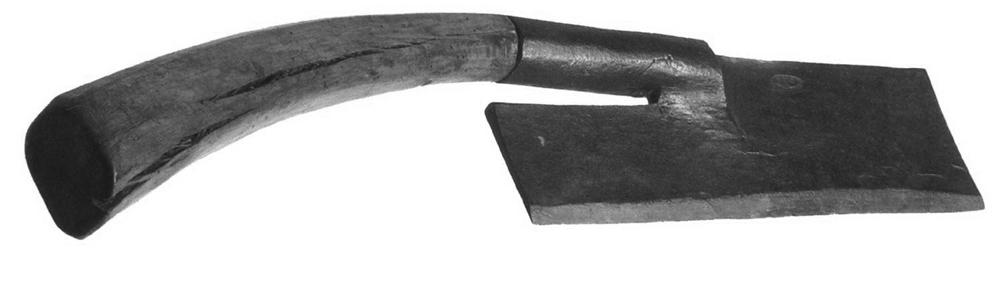
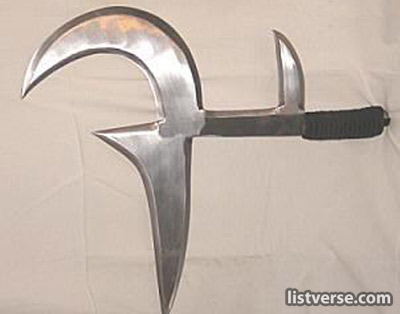
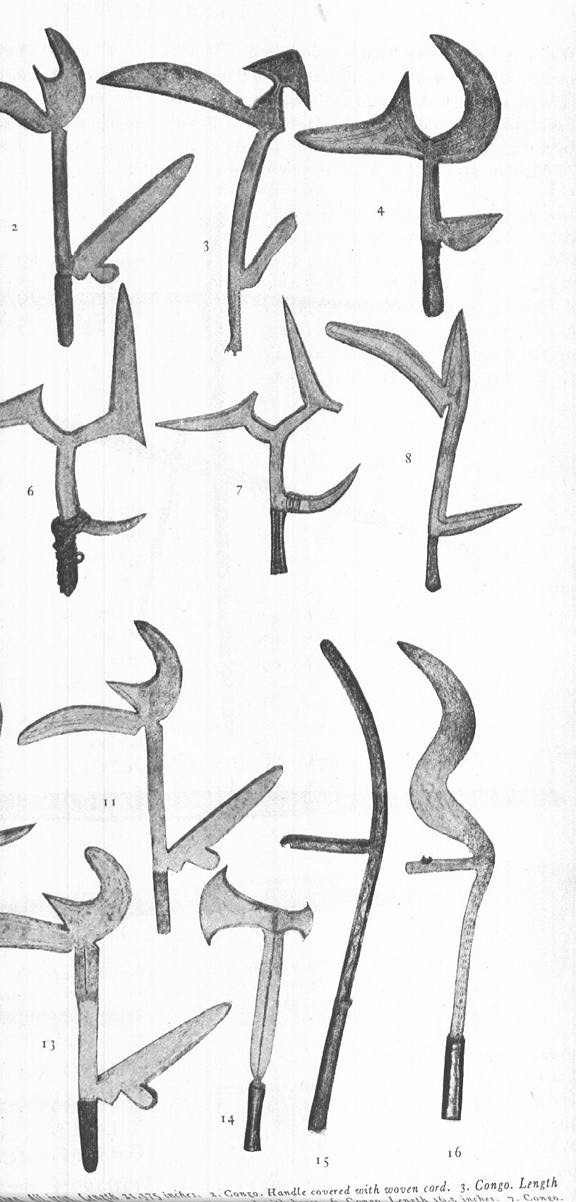
East Asia has a penchant for making weapons that defy categories. The jitte, for example, is a parrying weapon that might be considered a mace. Other parrying weapons are the sai, segu, tau-kiev and tjabang. The adarga is a Moorish combination of spear and shield used for parrying. Europe had similar weapons; the lantern shield and sword shield. The bagh nakh, or “tiger claw” is an Indian weapon that is a bar with four or five curved blades sticking from it. Entangling or capturing weapons incude the bolas, lasso/lariat and catch pole (or mancatcher). I might do a post on exotic, strange weapons at a later date.

Daggers are ubiquitous. I’m convinced that every NPC you ever deal with should have a dagger on his or her person.
Six from the Sanctum

I was playing with Seventh Sanctum’s alien and fantasy race generators today, and decided to stat up some of the results. If any enterprising artist wants to draw one of these oddballs, I’d love to see the result. The following is open game content.

Caledjula
Caledjula are tall, statuesque creatures with angular bodies and reddish-orange skin. Their heads are pointed and their jaws and foreheads jut out about three inches beyond their flat faces. Their eyes are large and brightly colored, and surrounded by long lashes. Their arms (wings, actually) and legs end in hands with seven long fingers. Caledjula have a radar-like sense reminiscent of bats. Caledjula are capable of imitating all sorts of speech, and their pleasant, deep voices and calm demeanor makes them successful negotiators. Caledjula are advanced in the areas of illusions and healing, and have more than their fair share of illusionists and clerics. The caledjula come from a barren world. They live beneath the surface in cave systems dug into the permafrost. They adorn themselves with leather armor, sometimes studded, in battle and carry long, thin blades and bolas.

Caledjula characters are capable of finding their way even in complete darkness. They can also fly. Caledjula enjoy a +2 bonus to save vs. illusions and every caledjula begins play knowing one minor illusion that they can cast once per day.

  • Caledjula: HD 1; AC 9 [10]; Atk 1 weapon; Move 12 (Fly 9); Save 16 (14 vs. illusion); Special:Radar sense, know one illusion spell.

Ifnut
Ifnuts have bulky, spherical bodies with thick, rubbery skin the color of damask. They have three heads that resemble elephant trunks tipped with black, beady eyes and three stubby limbs that end in three long finger/toes. These limbs are used for both movement and manipulation. Although omnivorous, ifnuts prefer to browse on vegetation. Ifnuts tend to be narcissists, and find it difficult to work with others on a permanent basis. Other races find them to be corrupt and untrustworthy. Ifnut armorers can fashion all manner of armor for ifnuts, with their suits of plate mail making them look like pot-bellied stoves. They can wield short weapons (short swords, daggers, light maces) and their heads are capable of casting stones as if they were slings.

Ifnut characters are only surprised on the roll of 1 on 1d8. Their thick skin improves their armor class by one. They can make one ranged attack each round for 1d4 points of damage, provided they have ammunition in the form of sling stones or bullets. Their limb placement does not allow for the use of other ranged weapons with the exception of light crossbows, with which they suffer a -2 penalty to hit.

  • Ifnut: HD 1; AC 8 [11]; Atk 1 weapon (1d6) or 1 thrown stone (1d4); Move 9; Save 16; Special: None.

Nif’nef
The nif’nef look like elves with honey-colored skin and wasp-shaped bodies (i.e. extremely thin waists). They have ashen hair, beady, black eyes, and thin mouths and noses. The nif’nef have a shamanistic belief system (i.e. druids in place of clerics) and they worship creatures of elemental earth. A group of five nif’nef can, with 3 rounds of ritual chanting, conjure an earth elemental from the ground. Nif’nef practice ritual cannibalism of deceased friends and family, preserving the flayed skins in alabaster boxes marked with angular runes. They dwell on a rich island chain that is the site of a lost civilization.

Nif’nef characters are light and graceful, gaining a +1 bonus to dexterity rolls at character creation, but suffering a -1 penalty to strength rolls. These modifications cannot send an ability score over 18 or below 3. Their quiet natures give them a +1 bonus to surprise (or sneak). Nif’nef have slow metabolisms that allow them to eat half as much as humans.

  • Nif’nef: HD 1d6; AC 8 [11]; Atk 1 weapon (1d6); Move 15; Save 17; Special: Surprise on 1-2 on 1d6.

Olvu’gai
The olvu’gai resemble nothing so much as giant potatoes covered in velvety, yellow fur. Sprouting from their “middles” are from eight to twelve thin tentacles, each about 10 feet in length. The tentacles are used to move, almost in the manner of a spider, and to manipulate objects. There are numerous patches of what appear to be long, black hairs sprouting from the bodies of the olvu’gai. These hairs are used to collect sensory data (smell, sight, sound). The creatures communicate by vibrating their tentacles, creating sounds reminiscent of the glass armonica. The creatures can also use these vibrations to render themselves invisible (as the spell). Olvu’gai are natural bureaucrats, with a love for classification and “everything in its place” thinking. They spend much of their time in endless debates about the minutiae of an idea, and only rarely move ahead with anything. Their home world is barren and craggy, which most of the life living in the soil. The world has no moon and suffers frequent catastrophes. The wildlife is as bizarre to an “earthling” as the olvu’gai themselves.

Olvu’gai characters retain their ability to become invisible, but may only use it once per day. Their very ordered thinking helps them find secret doors and traps on a roll of 1-2 on 1d6, but it takes them twice as long to search for them. Olvu’gai can learn to understand humanoid languages but not speak them. Likewise, their language can be learned by humanoids but cannot be spoken by them.

  • Olvu’gai: HD 1; AC 9 [10]; Atk 3 tentacles (1d6); Move 12; Save 16; Special: Invisibility.

Vindlu
Vindlu resemble long, thin lions covered in silvery scales tipped with aquamarine and they have long “whiskers” like those of a carp. These whiskers are extremely sensitive, making vindlu difficult to surprise and allowing them some insights into the emotions of others. Their four legs end in clawed hands. Outside their home city, they live in tight-knit family bands, hiring themselves out as assassins. They are very skilled at poison making.

The vindlu originate in a huge, prosperous city state located in the “Crawling Canyon”, a canyon that seemingly moves about their native highlands. The city-state is composed of circular brick “shell-keeps” centered around fire pits fueled by coal and always kept burning. The vindlu sleep on shelves overlooking the pit, with the interior of their buildings given over to storage rooms, kitchens, libraries and armories. Most of the city-state’s revenue comes from intricately died cotton textiles, the cotton harvest being a highlight of their year. Although not particularly religious, the vendlu give a nod to a hermaphroditic divinity they call Magfa. Magfa is aloof and mysterious, and works its wonders through earth-bound messengers and servants.

Vindlu characters enjoy a +1 bonus to save vs. poison, and are capable of using poison on their weapons safely and effectively. They also have a +1 bonus to save vs. fire damage. Their whiskers make them susceptible to surprise only on a roll of 1 on 1d8, and give them the ability to detect lies.

  • Vindlu: HD 1; AC 8 [11]; Atk 1 bite (1d4) or 1 weapon (1d8 + poison); Move 15; Save 16 (15 vs. poison and fire); Special:Surprised on roll of 1 on 1d8, detect lies / read emotions.

Zwunker
Zwunkers are an offshoot of dwarfs. They are black-skinned and have long manes of gold hair. Their eyes are faceted and resemble yellow diamonds. Zwunkers live in caves overlooking the sea. They are skilled sailors and love nothing more than to feel the wind whipping through their manes. Once per day, a zwunker can control the winds, either calming them or whipping them into a frenzy. Zwunkers are highly resistant to magic, and their presence actually absorbs magical energy. Essentially, their “magic resistance” applies to all magical effects within 30 feet of them. Zwunkers make elaborate leather armor (always black) and carry steel rods for weapons.

Zwunker characters enjoy the same benefits as normal zwunkers. They have a +2 bonus to save vs. magic. Their hair can be shaved and melted down into the equivalent of 5 gold pieces, though no zwunker would willingly do this save to avert his own death or that of a loved one. Zwunkers cannot work magic, and thus are barred from becoming clerics and magic-users, though they can become psychics.

  • Zwunker: HD 1; AC 6 [13]; Atk 1 weapon (1d6); Move 9; Save 16 (14 vs. magic); Special:Control wind, magic resistance 10%.

On Science

My last post mentioned a scientist. This is a class I came up with as an alternative to the magic-user. Essentially, I got on a “turn-literary-archetypes-into-classes” kick, and this was one of the results. It was never play-tested, so maybe we’ll technically call this one an NPC class.

Scientist
The scientist is an NPC dedicated to understanding the World of Nod and its bizarre, supernatural physics and applying this knowledge to the discovery and creation of new inventions. In laymen’s terms, what the magic-user does with spells, the scientist does with gadgets, gizmos and chemical formulas.

Scientists have been a staple of pulp fiction for a century, though they are most often encountered in “Sword & Planet” and “Scientifiction”, as it was once called. The archetypal scientist is an older man with a brilliant mind and a collection of fantastic inventions that help the hero of the story (which is sometimes him, but more often not) overcome obstacles. Just as wizards often play the role of villain in “Sword & Sorcery” stories, the mad or evil scientist is often the antagonist to the heroic swordsman’s protagonist.

Although one could draw inspiration from any number of the “natural philosophers” of the Middle Ages and Renaissance, no person better exemplifies the scientist we are seeking to create than Leonardo Da Vinci. Had he only lived in a fictional, fantastic world such as Nod, Da Vinci might have invented any number of mechanical contrivances.

Benjamin Franklin is the next major inspiration for our scientific adventurers, not the least of which because he “discovered” electricity (or “electrical fluid” as it was called in the 18th century) and invented and named the battery which serves as the foundation for our scientist’s make-believe inventions.

The original mad scientist in literature was Victor Frankenstein from Mary Shelley’s 1818 novel Frankenstein; or, The Modern Prometheus. Victor Frankenstein discovers the ability to return life to dead tissue and in the process creates the first flesh golem, though rather than being a mindless automaton, Frankenstein’s creature is quite intelligent.

As a counterpoint to the mad scientist, one need only look to Dr. Hans Zarkov, comrade of “Flash” Gordon. Over the course of the Flash Gordon comic strips, movies and books, Zarkov invents flying machines and invisibility rays, all while assisting his erstwhile ally in defending the Earth from the depredations of Emperor Ming.

The following is open game content.

Scientist
Prime Attributes: Intelligence, 13+ (5% experience)
Hit Dice: 1d4/level (Gains 1 hp/level after 10th.)
Armor/Shield Permitted: None.
Weapon Permitted: Dagger, club, staff, dart, light crossbow.

Scientists begin play with one small invention or three formulas (see below) and only 1d6 x 10 gp to spend on equipment. They must own a journal, their equivalent to the magic-user’s spell book.

Scientists spend most of their lives reading books and absorbing all sorts of knowledge and wisdom. At the Referee’s discretion, the scientist can recall old legends and/or lore on the roll of 1-2 on 1d6. In addition, they can make a saving throw in order to recall, understand or learn a new language (regardless of their intelligence score or the number of languages they already know).

A scientist’s powers of observation give them an improved chance of noticing secret or concealed doors and detecting the presence of noxious gases (i.e. detect on a roll of 1-2 on 1d6). Unfortunately, a scientist’s fascination with minutia makes them more likely to be surprised than others.

A scientist is capable of brewing formulas (i.e. potions) and discovering and creating new inventions (see below).

When a scientist reaches 9th level (genius) he will attract a level 1 scientist as his lab assistant if he builds a laboratory overlooking a major metropolitan area.

Inventions & Formulas
Scientists are capable of building machines and brewing chemical formulas that duplicate the effect of magic-user spells. Formulas are single-use items that work exactly like potions. Inventions are multiple use items that must be powered by “batteries” of the sort Ben Franklin invented (or miniature versions of the same). An invention can be used 1 time plus 1 time per scientist level minus the level of the duplicated spell before it must be recharged over night.

Before a scientist can brew a formula or build an invention, he must discover how to do so. This process of discovery cost 1,000 gp per spell level to be duplicated for standard spells, and 2,000 gp per spell level for entirely new creations. One week is required per spell level, with a chance of success equal to 25% plus 5% per level of the scientist minus 10% per level of the spell. The maximum chance of success is 95%.

Inventions and formulas must be discovered separately, even if they have the same effect.

Inventions come in three sizes: Small, Medium and Large. Small inventions can be held in one hand and rarely weigh more than 10 pounds. Medium sized inventions can be moved about clumsily by man-sized creatures using both their hands. A medium-sized invention uses 10 times the materials of a small invention, and costs 10 times as much to build. A large invention will fit (or nearly fit) inside a 10’ x 10’ room. Large inventions use 100 times the materials of small inventions, and cost 100 times as much to build. Formulas are treated as small inventions and weigh as much a standard coin or gem.

The level of spell a scientist can “fit” into an invention of a given size is as follows:

  • Scientists of level one to three can fit level one spells into small inventions, level two spells into medium inventions and level three spells into large inventions.
  • Scientists of level four to six can fit level one and two spells into small inventions, level three spells into medium inventions and level four spells into large inventions.
  • Scientists of level seven to nine can fit level one to three spells into small inventions, level four spells into medium inventions and level five spells into large inventions.
  • Scientist of level ten to twelve can fit level one to four spells into small inventions, level five spells into medium inventions and level six spells into large inventions.

Brewing a formula costs 25 gp times the spell level times the level of the scientist. A level one formula brewed by a level three scientist, for example, costs 25 x 1 x 3 gp, or 75 gp, to concoct. A level four formula brewed by a level nine scientist costs 25 x 4 x 9 gp, or 900 gp, to concoct. The Referee may want to create a list of rare ingredients for each formula the scientist discovers in lieu of the scientist just making a check.

Inventions cost 500 gp per spell level to create, and their manufacture requires five days plus two days per spell level. Thus, an invention that duplicates the level two spell acid arrow would cost 1,000 gp and require nine days of work to realize.

Players and Referees should come up with fantastic, quasi-scientific names for a scientist’s inventions, whether they are inspired by the natural philosophers of the Renaissance or the mad scientists from pulp fiction.

Level Experience Hit Dice Attack Save Title
1 0 1 +0 17 Tinkerer
2 2,600 2 +1 16 Chemist
3 5,200 3 +1 15 Scholar
4 10,400 4 +1 14 Philosopher
5 20,800 5 +1 13 Sage
6 42,500 6 +2 12 Professor
7 85,000 7 +2 11 Polymath
8 170,000 8 +2 10 Doctor
9 340,000 9 +2 9 Genius
10 500,000 10 +3 8 Genius
11 750,000 +1 hp
+3 7 Genius
12 1,000,000 +2 hp
+3 6 Genius

S&W Format

Hit Dice: 1d6-1 per level, +1 hit point per level after level 9

Level Experience Hit Dice Attack Save Title
1 0 1 +0 15 Tinkerer
2 2,200 2 +0 14 Chemist
3 4,400 3 +0 13 Scholar
4 8,800 4 +1 12 Philosopher
5 17,600 5 +1 11 Sage
6 35,000 6 +2 10 Professor
7 70,000 7 +2 9 Polymath
8 140,000 8 +3 8 Doctor
9 280,000 9 +3 7 Genius
10 430,000 +1 hp
+4 6 Genius
11 580,000 +2 hp
+5 5 Genius
12 730,000 +3 hp
+5 4 Genius

Psychic Phenomena

In my previous post of encounters on the Wyvern Coast, I referenced a psychic class, which I now present here. What follows is open game content.

The Psychic Sub-Class
The psychic is a sub-class of magic-user that learns to focus his innate mental powers to create astrounding psychic phenomena. Psychics must go though a training regimen not dissimilar to monks. But where monks train their bodies, psychics train their minds.

  • Prime Attribute: Intelligence & Wisdom, 13+ (+5% experience)
  • Hit Dice: 1d4 (Gains 1 hp/level after 10th level.)
  • Armor/Shield Permitted: Leather, padded.
  • Weapons Permitted: Club, dagger, dart, hand axe, light hammer, short bow, sickle, sling, spear, staff.

The most basic ability a psychic has is his “sixth sense”, which warns him of danger. Because of their sixth sense, psychics are only surprised on a roll of 1 on 1d8. Psychics receive a +1 bonus on saving throws made to avoid traps, and can spot secret or hidden doors as well as an elf.

Psychics train their minds to be a veritable fortress of intellect. This gives them a +1 bonus on saving throws against mental magics (ESP, charm person, etc) and the powers of other psychics. At 6th level, their intellect fortress becomes a tower of iron will and their saving throw bonus improves to +3.

At levels 1, 3, 5, 7, 9, and 11 the psychic opens the door to a new psychic power from the following list. To use a power, the psychic must succeed at a saving throw, and his victim (if there is one) must fail a saving throw. The subject of a psychic power must be within the psychic’s field of vision. If, during the day, a psychic fails a saving throw to activate a power, that power closes to him for the remainder of the day and until he spends one hour in meditation the next day.

Psychic Powers
Astral Projection: The psychic can enter a trance and project his astral spirit from his physical body. This astral spirit is incorporeal and unable to interact with the physical world. Astral spirits can only communicate using the power of telepathy. An astral spirit can travel freely over the physical world, and can enter the ethereal and astral planes at will. The astral spirit can interact with objects and creatures on the ethereal and astral planes, and can communicate normally therein. If a psychic’s astral spirit is killed, his physical body dies as well.

Channeling: By opening his mind to the cosmos, the psychic can commune with higher planes (as the magic-user spell contact other plane). Channelling is a difficult power to control, and imposes a -5 penalty on the psychic’s activation saving throw. A failure to activate this power results in the psychic’s personality (or alignment) changing (as determined by the Referee) for 1d6 days.

Clairaudience/Clairvoyance: A psychic with these abilities can see or hear the going’s on in a different place. If the psychic has never been in this place, or does not know somebody present, his saving throw to activate this ability is made at a -5 penalty. Separate saving throws must be made to use clairaudience (remote hearing) and clairvoyance (remote seeing).

Cloud Minds: With this ability, a psychic can cloud people’s minds, making himself invisible to them. Just as with the magic-user spell invisibility, an attack by the psychic spoils the effect. If used on multiple subjects, the psychic suffers a -1 penalty to his saving throw to activate the power for each subject beyond the first.

Dowsing: Using a simple dowsing rod, the psychic can find the nearest source of fresh water. He can also use this power to discover the location of precious metals and gems (as a wand of metal detection), but suffers a -3 penalty to his activation saving throw.

Ego Whip: This is the psychic’s ability to stun another sentient creature by causing terrible pain and trauma in their mind. A stunned creature remains stunned for a number of rounds equal to the psychic’s level. An ego whip can only be used on a single creature.

Empathic Projection: This is the ability to project powerful emotions (anger, joy, sorrow, fear) in the mind of a subject. It is up to the Referee to determine the effects these emotions might have on a situation. A psychic who fails his saving throw to activate this power must make an additional saving throw or be struck with the emotions himself.

ESP: With this ability, the psychic can read a subject’s mind, as with the magic-user spell of the same name.

Id Insinuation: By insinuating his own thoughts and memories in an opponent’s mind, the psychic causes either confusion (as the magic-user spell) or insanity (as the magic-user spell). Attempting to cause insanity imposes a -10 penalty on the psychic’s activation saving throw. A failure to activate this power properly forces the psychic to make a saving throw himself or suffer the effects of the power himself.

Illusion: The psychic can use this ability to plant powerful illusions inside a person’s mind. In general, these illusions will correspond to the basic spells of an illusionist, with a penalty equal to the illusion’s level assessed to the psychic’s activation saving throw.

Mesmerism: This is the ability to put others into a trance, thus gaining the ability to question them truthfully or implant suggestions in their mind. Implanting a suggestion works as the magic-user spell of the same, and imposes a -5 penalty on the psychic’s saving throw to activate the power.

Mind Thrust: With a sharp thrust of his mental powers into the mind of one sentient opponent, the psychic inflicts 1d6 points of damage plus one point of damage for every point difference between his own and his opponent’s intelligence scores. If an opponent’s intelligence score is unknown, assume that it is a 10.

Psionic Blast: A psionic blast works like an ego whip, but instead stuns creatures in 30-ft cone emanating from the psychic’s forehead. A psychic suffers a -5 penalty to activate a psionic blast.

Psychic Surgery: Psychic surgery can be used to double a creature’s natural healing or to grant a subject a +1 bonus to save against diseases. It can also be used to heal or inflict 1d6 points of damage. This requires the psychic to physically touch the subject, and the psychic’s saving throw to activate the power is made at a -5 penalty. At 5th level, the psychic can heal or inflict 2d6 points of damage. At 10th level, the psychic can heal or inflict 3d6 points of damage.

Psychometry: This is the psychic’s ability to read the psychic vibrations given off by an object or place, allowing him to learn elements of its history such as who last held the device, how it is used, or traumatic events that took place there. In effect, it works like the magic-user spell legend lore. The Referee might impose penalties on the psychic’s saving throw to activate this power depending on the age and provenance of the object or place being read.

Pyrokinesis: This is the ability to cause objects to burst into flames. The ability can only be used on flammable objects, and inflicts 1d4 points of damage per psychic level. Activating the power requires a full round of concentration on the part of the psychic. Failure to this activate this power requires the psychic to make an additional saving throw to avoid being damaged himself.

Telekinesis: This is the ability to move small objects with one’s mind. For precise telekinetic control of a small object, a -5 penalty is imposed on the psychic’s saving throw to activate this power. Otherwise, impose a penalty of -2 per 10 pounds of the object being moved.

Telepathy: With this ability, the psychic can project his thoughts into the minds of other sentient creatures. Penalties may be applied to this ability based on the distance of the psychic’s target or when he tries to communicate with several people at once.

Teleportation: This power allows a psychic to teleport (as the magic-user spell) objects. The psychic can teleport creatures, but suffers a -5 penalty to his saving throw to activate the power. Teleporting multiple objects or creatures imposes a -1 penalty to his activation saving throw per creature or object beyond the first.

Transvection: A psychic can use transvection to cause himself to levitate (as the magic-user spell). It can also be used to fly (as the magic-user spell), but such use imposes a -5 penalty to the psychic’s activation saving throw.

.nobrtable br { display: none }

Level Experience Hit Dice Attack Save Title
1 0 1 +0 17 Learner
2 2,200 2 +1 16 Mentalist
3 5,000 3 +1 15 Sensitive
4 10,000 4 +1 14 Channeler
5 20,000 5 +1 13 Esper
6 40,000 6 +2 12 Savant
7 75,000 7 +2 11 Yogi
8 150,000 8 +2 10 Guru
9 300,000 9 +2 9 Mind Lord
10 450,000 10 +3 8 Mind Lord
11 750,000 +1 hp +3 7 Mind Lord
12 950,000 +2 hp +3 6 Mind Lord

S&W Format
Hit Dice: 1d6 per level, +1 hit point per level after level 9
Armor/Shield Permitted: Leather.
Weapons Permitted: Club, dagger, dart, hand axe, short bow, sling, spear, staff.

Level Experience Hit Dice Attack Save Title
1 0 1 +0 15 Learner
2 1,800 2 +0 14 Mentalist
3 3,600 3 +0 13 Sensitive
4 7,200 4 +1 12 Channeler
5 14,400 5 +1 11 Esper
6 30,000 6 +2 10 Savant
7 60,000 7 +2 9 Yogi
8 120,000 8 +3 8 Guru
9 240,000 9 +3 7 Mind Lord
10 390,000 +1 hp +4 6 Mind Lord
11 540,000 +2 hp +5 5 Mind Lord
12 690,000 +3 hp +5 4 Mind Lord

Barbarians and Bards

This post continues the look at the hybrid character classes I used in my last campaign, featuring the barbarian and bard. What follows is open game content.

The Barbarian Sub-Class
The barbarian is a sub-class of fighting-man. Where fighting-men rely on training and skill to win the day, the barbarian uses ferocity and instinct. Most barbarians are members of uncivilized tribes of humans, demi-humans or humanoids. “Civilized” barbarians can represent men and women with hair-trigger tempers and a zest for violence.

  • Prime Attributes: Strength & Constitution, 13+ (+5% experience)
  • Hit Dice: 1d12/level (Gains 5 hp/level after 10th.)
  • Armor/Shield Permitted: Leather, padded, ring and shields.
  • Weapons Permitted: Any.

Attacks from the flank receive no bonus to hit a barbarian. Bonuses for attacks against a barbarian’s back are halved.

Barbarians mistrust the doings of magic-users and illusionists. When presented with displays of such magic they must succeed at a saving throw or be stunned with fear for 1 round.

At third level, the barbarian can go berserk in combat, gaining a +2 bonus to hit and damage, but suffering a -2 penalty to her armor class. The barbarian’s berserk fury lasts for a number of rounds equal to 1 + the barbarian’s level. While in her rage, the barbarian focuses on her foes until they are dead. If her rage continues after her foes are gone, she will attack her nearest ally unless she makes a successful saving throw. This ability can be used whenever the barbarian engages in combat.

At fifth level, a barbarian can continue to fight after losing all of her hit points if she is in a berserk fury. When the berserk fury ends, the barbarian succumbs to death.

Level Experience Hit Dice Attack Save Title
1 0 1 +0 17 Tribesman
2 2,100 2 +1 16 Savage
3 4,700 3 +2 15 Plunderer
4 9,400 4 +3 14 Raider
5 20,000 5 +4 13 Reaver
6 40,000 6 +5 12 Shield-Biter
7 80,000 7 +6 11 Berserker
8 160,000 8 +7 10 Conqueror
9 320,000 9 +8 9 Barbarian Prince
10 600,000 10 +9 8 Barbarian Prince
11 800,000 +5 hp
+10 7 Barbarian Prince
12 1,000,000 +10 hp
+11 6 Barbarian Prince

S&W Format

Hit Dice: 1d6+3 per level, +3 hit points per level after level 9
Armor Permitted: Leather, ring and shields

Level Experience Hit Dice Attack Save Title
1 0 1 +0 15 Tribesman
2 2,500 2 +0 14 Savage
3 5,000 3 +1 13 Plunderer
4 10,000 4 +2 12 Raider
5 20,000 5 +2 11 Reaver
6 40,000 6 +3 10 Shield-Biter
7 80,000 7 +4 9 Berserker
8 160,000 8 +5 8 Conqueror
9 320,000 9 +6 7 Barbarian Prince
10 440,000 +3 hp
+7 6 Barbarian Prince
11 560,000 +6 hp
+7 5 Barbarian Prince
12 680,000 +9 hp
+8 4 Barbarian Prince

The Bard Sub-Class

The bard is a sub-class of fighting-man, a warrior-poet whose music works magic. Bards are usually charismatic rogues, stealing hearts as readily as they cross steel. They are walking repositories of legends and stories. Their music is capable of stiffening the resolve of comrades, lulling guards into a daze, or charming lads and lasses.

  • Prime Attributes: Intelligence & Charisma, 13+ (+5% experience)
  • Hit Dice: 1d10/level (Gains 4 hp/level after 10th.)
  • Armor/Shield Permitted: Leather, padded, ring, shield.
  • Weapons Permitted: Bows, club, dagger, dart, hand axe, mace, war hammer, javelin, long sword, short sword, sling, spear, and staff.

Bards can decipher and interpret legends and secret writings by making an saving throw modified by their intelligence bonus/penalty. This includes unfamiliar languages, codes and incomplete messages. Bards can also use this ability to decipher and then cast spells from arcane scrolls, though the intelligence saving throw to do so is made at a penalty equal to the level of the spell being cast.

By playing music, singing or reciting heroic verse, bards can inspire listeners to surpass their normal level of performance, granting allies a +1 bonus to all saving throws for a number of rounds equal to the bard’s level. A bard can do this a number of times per day equal to their level. The bonus imparted increases with the bard’s level, to +2 at sixth level and +3 at twelfth level.

With a successful saving throw, a bard acquires or remembers some information pertaining to local notables, a legendary item, a noteworthy place or any other relevant bit of information. Acquiring the information may involve speaking to the locals or doing research in a library. It can also lead to a partial or complete understanding of a local or secret language, including the thieves’ cant, the secret language of druids or the trail signs of rangers. This ability cannot reveal the exact powers of a magic item, but may give a hint to its history, general function or activation. The Referee may make the saving throw harder based on the obscurity of the knowledge.

At fourth level, a bard gains the ability to place a single creature into a trance with a performance. The bard can use this ability three times per day, and can maintain the effect for a number of rounds equal to the character’s level.

When attempting to fascinate, the target makes a saving throw to resist. If the saving throw fails, the creature sits quietly and listens to the bard for the duration of the effect. While fascinated, the creature is considered prone and suffers a -4 penalty to saving throws and armor class. If the creature’s saving throw succeeds, the bard cannot attempt to fascinate that creature again for 24 hours. Any obvious threat to the fascinated creature, such as the casting of a spell, drawing a sword, or aiming of a weapon, automatically breaks the effect.

At fifth level, the bard may attempt to charm (as the spell charm person) a fascinated creature. At eighth level, the bard may attempt to implant a suggestion (as the spell) in a fascinated creature. At twelfth level, a bard may attempt to instill antipathy/sympathy (as the spell) on a fascinated creature. In each case, the creature receives an additional saving throw to resist the additional effect.

The number of creatures the bard can fascinate at once is equal to two less than the level of the bard. Thus, a fourth level bard can fascinate two creatures, a sixth level bard can fascinate 4 creatures and a twelfth level bard can fascinate 10 creatures.

At ninth level, a bard can inspire heroism in one other creature. For every two levels the bard attains beyond ninth level, the bard can inspire heroism in one additional creature. To inspire heroism, the bard must use song, poetry or some sort of oration. A creature inspired gains a +2 bonus to attacks and saving throws and +2 hit points per level for one minute.

Level Experience Hit Dice Attack Save Title
1 0 1 +0 18 Dilettante
2 1,500 2 +1 17 Raconteur
3 3,250 3 +2 16 Jongleur
4 7,500 4 +3 15 Versifer
5 15,000 5 +4 14 Goliard
6 30,000 6 +5 13 Poet
7 60,000 7 +6 12 Minstral
8 120,000 8 +7 11 Troubadour
9 240,000 9 +8 10 Meistersinger
10 450,000 10 +9 9 Meistersinger
11 625,000 +4 hp
+10 8 Meistersinger
12 800,000 +8 hp
+11 7 Meistersinger

S&W Format

Hit Dice: 1d6+2 per level, +3 hit points per level after level 9

Level Experience Hit Dice Attack Save Title
1 0 1 +0 16 Dilettante
2 1,700 2 +0 15 Raconteur
3 3,400 3 +1 14 Jongleur
4 6,800 4 +2 13 Versifer
5 13,600 5 +2 12 Goliard
6 25,000 6 +3 11 Poet
7 50,000 7 +4 10 Minstral
8 100,000 8 +5 9 Troubadour
9 200,000 9 +6 8 Meistersinger
10 320,000 +3 hp
+7 7 Meistersinger
11 440,000 +6 hp
+7 6 Meistersinger
12 560,000 +9 hp
+8 5 Meistersinger

The Fighting-Men of Nod

What follows is the fighting-man class I used for my last campaign. Nothing ground-breaking here, but I do include some original level titles that I’m pretty happy with. The following content is declared open game content.

THE FIGHTING-MAN
You are a warrior, trained in battle and in the use of armor and weapons. Whatever type of fighting-man you choose to play, you will probably end up on the front lines of your adventuring party, going toe-to-toe with dragons, goblins, and evil cultists, hacking your way through them and taking the brunt of their attacks. The fighting-man character is best equipped of all the character classes to dish out damage and absorb it, too. Clerics heal, and magic-users cast spells, but the down-and-dirty hack and slash work is up to you. You’re going to serve as the party’s sword and shield, protecting the weaker party members and taking down the enemies before you. Perhaps one day they will tell legends of your battle prowess, and followers will flock to your castle stronghold where you revel in your fame, riches, and newly earned nobility. Fail, of course, and you’ll die, just another forgotten warrior in a dangerous world.

  • Prime Requisite: Strength, 13+ (+5% experience)
  • Hit Dice: 1d10/level (Gains 4 hp/level after 10th.)
  • Armor/Shield Permitted: Any.
  • Weapons Permitted: Any.

Against creatures with one hit dice, a fighting-man makes one attack per level each round.

Fighting-men may choose one weapon with which to specialize. Once a specialized weapon is chosen, it cannot be changed. For fighters between 1st and 6th level, this specialization imparts a +1 bonus to hit and a +1 bonus to damage using that weapon. At 7th level the bonuses increase to +2 to hit and +2 to damage.

At 10th level, a fighting-man can make two attacks per combat round against creatures with 2 or more Hit Dice.

Level Experience Hit Dice Attack Save Title
1 0 1 +1 18 Yeoman
2 2,000 2 +2 17 Warrior
3 4,000 3 +3 16 Champion
4 8,500 4 +4 15 Duelist
5 17,000 5 +5 14 Swashbuckler
6 34,000 6 +6 13 Grognard
7 68,000 7 +7 12 Freelance
8 136,000 8 +8 11 Hero
9 272,000 9 +9 10 Warlord
10 500,000 10 +10 9 Warlord
11 750,000 +4 hp
+11 8 Warlord
12 1,000,000 +8 hp
+12 7 Warlord

Note on Saving Throws: I should explain that in my hybrid game saving throws were modified by ability score bonuses/penalties. Thus, I would tell a player to make a “strength saving throw”, requiring them to modify their roll with their character’s strength bonus or penalty.

S&W Format
Hit Dice: 1d6+2 per level, +3 hit points per level after level 9

Level Experience Hit Dice Attack Save Title
1 0 1 +0 16 Yeoman
2 2,000 2 +0 15 Warrior
3 4,000 3 +1 14 Champion
4 8,000 4 +2 13 Duelist
5 16,000 5 +2 12 Swashbuckler
6 30,000 6 +3 11 Grognard
7 60,000 7 +4 10 Freelance
8 120,000 8 +5 9 Hero
9 240,000 9 +6 8 Warlord
10 360,000 +3 hp
+7 7 Warlord
11 480,000 +6 hp
+7 6 Warlord
12 600,000 +9 hp
+8 5 Warlord

Beastmen, Centaurs and Mechanical Men

Denis Beauvais Bridge of Sorrows

These are the three “new races” I worked up for my Land of Nod campaign. The centaur owes its creation to Denis Beauvais‘ excellent painting Bridge of Sorrows (he could do the covers for my fantasy rules any day). Looking at that centaur knight, how can you not want to play one? The beastman was a replacement for the half-orc, and was intended as a simple way to introduce all sorts of bestial humanoids into the game as playable races. The mechanical man is a nod to pulp sci-fi and stories of Hephaestus’ automatons in Greek myth, as well as the venerable tin woodsman of Oz fame. The following content is declared open game content.

BEASTMAN
Beastman is not a race per se’, but rather a category of bestial humanoids. This category can include such humanoids as gnolls, orcs and hobgoblins or crossbreeds between such humanoids and humans. The most common “beastmen” in Nod are the half-orcs.

Half-orc characters are usually crossbred from human stock, and can almost pass for human. As they are often the product of rape, half-orcs frequently have a rough childhood. Their orc blood puts them at a disadvantage with most people, as orcs are known for their violent and criminal tendencies.

Half-orcs average from six to seven feet in height, and they are usually built like gorillas. Their skin often has a pink, grey or green cast to it. Half-orcs often have one of the following facial features: turned up nose, pointed ears, thick eyebrows, a heavy forehead, vestigal tusks and/or pointed teeth. Half-orc hair is coarse and unruly, and usually black, dark brown or dark red. Half-orc eyes are almost always brown, brownish green or greyish green.

Half-orcs usually speak the common tongue of men and often (60%) the language of orcs. It is not uncommon for them to learn the language of dwarves, goblins, ogres and giants. Players of half-orcs may wish to affect a deep, gutteral, grunting accent to their speech when communicating as their character.

  • Beastmen enjoy a +1 bonus to strength and constitution at character creation, but suffer a -2 penalty to charisma. These modifications cannot take an ability score above 18 or below 3.
  • Beastmen can see up to 60 feet in the dark. Their sense of smell is as refined as a wolf’s.
  • A beastman’s thick skin or fur coat improves its Armor Class by 1.
  • Beastmen enjoy a +2 bonus to save vs. disease.

CENTAUR
A centaur has the head, arms and torso of a human or elf and the lower body of a pony or ass. Centaurs dwell in meadows and glades surrounded by thick woodlands. They are known for their lack of temper and their fondness for women, war and song.

Centaurs are usually eight to nine feet tall from hoof to head. Even though their equine bodies are smaller than normal horses, they are still quite heavy and find it difficult to scale sheer surfaces without help from others. A centaur’s equine body may have any pattern common to normal horses, and the hair on their heads often follows suit. Centaurs usually have nut brown skin.

Centaurs speak their own language and often (50%) the language of elves. They occaisionally speak the common tongue of men. Many centaurs learn the languages of gnomes, goblins, halflings, kobolds and orcs. Because of their size, centaurs have booming voices. Players of centaurs may want to use a Greek accent when speaking as their characters.

  • Centaurs enjoy a +1 bonus to strength and constitution at character creation, but suffer a -2 penalty to wisdom. These modifications cannot take an ability score above 18 or below 3.
  • Centaurs can carry 150% more than most characters. In addition, their movement is adjusted by +6.
  • Because they are quadripeds, a centaur’s AC vs. grapple and overbearing attacks is increased by +2.
  • In combat, centaurs can choose to attack with their weapon or make two hoof attacks that deal 1d6 damage.
  • A centaurs body shape makes them unsuitable for playing monks. Centaur rangers, thieves and assassins do not gain those class’s ability to climb walls. Centaurs favor the barbarian and bard classes and have a +5% bonus to earned XP in those classes.
  • Centaur armor costs twice as much as normal humanoid armor.

MECHANICAL MAN
Mechanical men are intelligent, artificial lifeforms created by ancient peoples (elves, fish men, ophidians), wizards and Vulcanus, god of the forge. They are as sentient as any living creature, and can “procreate” by building children and endowing them with a portion of their own souls.

Mechanical men are humanoid creatures composed of tin, wood, bronze, porcelain, ivory, steel or other such materials. The actual form of a mechanical man is highly variable. Mechanical fighting-men often have suits of armor attached to their bodies, while thieves may streamline their bodies to make fitting into small places easier.

Mechanical men usually speak the common tongue of men and the language of their creators.

  • Mechanical men are immune to poison and disease. They do not need to eat or breath, although they can benefit from imbibing a magical potion. Spells that heal damage to living bodies are only half as effective on mechanical men.
  • Mechanical men have 50% resistance to lightning damage.
  • A mechanical man has a natural Armor Class of 7 [12]. His unarmed strikes do 1d3 damage.

Boons and Character Customization

As I mentioned in previous entries, my most recent game began using the 3rd edition rules for D-n-D. Gradually, we switched over to Castles & Crusades, as I wanted a more simple system of rules that would allow me to spend less time calculating Difficulty Classes and more time coming up with interesting things for the players to discover. I watched with interest when Basic Fantasy Role-Playing, Labyrinth Lord and OSRIC appeared on the scene, and then really fell in love with Swords & Wizardry. The rules my group used took bits and pieces from all of these games (spell research rules from Basic Fantasy Role-Playing, saving throws from Swords & Wizardry with a nod to the prime attribute concept in Castles & Crusades, the classes from Castles & Crusades, many of the spells in OSRIC, etc). In the end, the players were using a house-ruled version of Castles & Crusades, and I was using a house-ruled version of Swords & Wizardry.

There was one thing in 3rd edition D-n-D that I did like, at least in theory, and that was feats. I thought that feats could be a very clever way for players to construct the archetype they wanted to play without the need for creating dozens of new classes. Unfortunately, feats ultimately became a revenue source for WOTC; there were too many feats, too many sub-rules concerning those feats, and too many feat chains. I think that the feat chains were especially troublesome. After all, if a player goes to the trouble of making his character the greatest acrobat he can possibly be, the Referee kinda feels guilty if he doesn’t design adventures that allow the player to show off his acrobatic skills.

Just the same, I eventually decided that I liked giving the players some tools to tweak their characters. To this end, I adapted some of the d20 feats into what I called boons. The following content is declared open game content.

BOONS
As characters advance in level, they pick up specialized skills and abilities called boons. Boons are small bonuses that help to make characters unique. Players may choose a boon for their character at 3rd, 6th, 9th and 12th level. Unless otherwise noted, a boon cannot be chosen more than once. The boons a character may possess are as follows:

AGILE: You have a 2 in 6 chance to avoid falling into pits and a 2 in 6 chance to escape from simple bonds (i.e. ropes).

ATTRIBUTE BONUS: You may increase one of your attributes (i.e. Strength, Intelligence, etc) by +1. You can choose this boon and apply it to the same attribute more than once. You cannot increase an attribute beyond 18.

CLEAVE: When you drop an opponent to 0 or fewer hit points in melee combat, you may make a second attack with the same weapon at the end of the combat round against another creature within range of your weapon.

CLIMB WALLS: You can climb walls on a roll of 1 to 2 on 1d6.

DELAY POISON: You can delay (but not neutralize) poison on a roll of 1 to 2 on 1d6.

DODGE: You improve your Armor Class by 1. You lose this bonus when surprised or otherwise unable to move.

EMPOWER SPELL: You can cast one spell per day with all of its variables increased by 150%.

ENLARGE SPELL: You can double the range of one spell per day.

EXPERTISE: You can accept a -2 penalty to your attack rolls and gain a +2 bonus to your Armor Class.

EXTEND SPELL: You can cast one spell per day with a double duration.

FAST MOVEMENT: You improve your unencumbered movement rate by 3.

GREAT FORTITUDE: You gain a +1 bonus to saving throws against poison and disease.

HEAR NOISE: You can hear noises on a roll of 1 to 2 on 1d6 (or 1 to 3 on 1d6 if a nonhuman).

IMPROVED BANISHMENT: You gain a +1 bonus on rolls made to banish the undead.

IMPROVED DISARM: You gain a +1 bonus to make disarm attacks.

IMPROVED GRAPPLE: You gain a +1 bonus to make grapple attacks.

IMPROVED OVERBEARING: You gain a +1 bonus to make overbearing attacks.

IMPROVED PUMMELING: Your pummeling attacks deal 1d3 damage instead of 1d2 damage.

IMPROVED SUNDER: You gain a +1 bonus to make sundering attacks.

IRON WILL: You gain a +1 bonus to saving throws vs. magic.

LEADERSHIP: The morale of your henchmen improved by 2.

LEGENDS AND LORE: You can recall ancient legends and obscure lore on the roll of 1 on 1d6.

LIGHTNING REFLEXES: You gain a +1 bonus to saving throws against breath weapons and death rays.

MAGICAL APTITUDE: You learn to cast one first level magic-user or illusionist spell per day. Magic-users and illusionists may not choose this boon. You may choose this boon more than once, applying it to a different spell each time. To use these spells, you must keep a spellbook and memorize your spell or spells each day. Your referee may restrict which spells you can learn with this boon, and the armor class restrictions faced by magic-users and illusionists apply.

MOUNTED COMBAT: You can make attacks atop a mount without the usual penalty. When fighting atop a warhorse, you can direct the mount’s attacks and still make your own.

MOVE SILENTLY: You can move without making a sound on a roll of 1 to 2 on 1d6.

NEW SPELL: If you are a magic-user or illusionist, you can add an additional spell (of a level you can cast) to your spellbook.

PICK LOCK: You can pick locks on a roll of 1 to 2 on 1d6. You must have burglary tools to use this ability.

PICK POCKETS: You can pick pockets on a roll of 1 to 2 on 1d6.

POINT BLANK SHOT: You gain a +1 bonus to hit with missile weapons when your target is no more than 30 feet away.

POWER ATTACK: You can accept a -2 penalty to your melee attack rolls and gain a +1 bonus to melee damage.

SILENT SPELL: You can cast one spell per day without needing to vocalize it.

SKILL FOCUS: You gain a +1 bonus to saving throws when using a chosen skill associated with your class (such as thievery or woodcraft).

STILL SPELL: You can cast one spell per day without needing to move your hands.

SURVIVAL: You can hunt well enough to feed 6 people on a roll of 1 to 2 on 1d6.

TWO-WEAPON DEFENSE: When wielding two weapons you can forgo making an additional attack and instead improve your Armor Class by 1 as though you were using a shield.

TWO-WEAPON FIGHTING: Your penalties to attack with two weapons are reduced to -1 (primary) and -2 (off-hand). Normal penalties are -2 (primary) and -4 (off-hand).

TOUGHNESS: You gain 3 hit points.

WEAPON FINESSE: When wielding a dagger, hand axe, light hammer, light mace, short sword, sickle or whip you can use your dexterity bonus in place of your strength bonus when making attack rolls.

WEAPON FOCUS: You gain a +1 bonus to hit with a weapon usable by your class. Fighting-men cannot mix this boon with their weapon specialization ability.

WEAPON PROFICIENCY: You learn to use a weapon normally not usable by members of your class.

WIDEN SPELL: Once per day, you can double the coverage of a spell you cast.