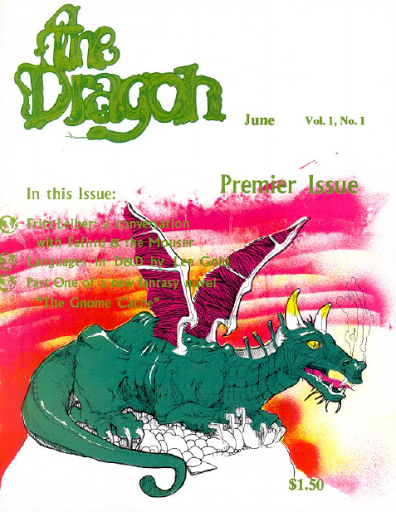
Dragon by Dragon – June 1976 (1)

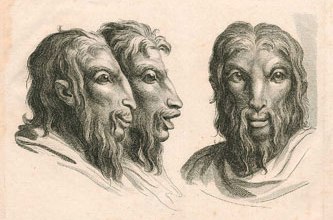
Who drew it? Couldn’t find it in the issue.

Yeah, everyone else does the whole “review every issue” or “review every page” thing, so why the heck can’t I?

Other than Great Britain and Iceland finally ending their codfish war (such a terrible waste), the first issue of The Dragon (formerly The Strategic Review) was probably the big highlight of June, 1976. So what does this little gem contain?

We have an article by Fritz Leiber, the man himself, talking about his wargame Lankhmar and giving a brief tour of Nehwon. Leiber closes this article with a bit on houris. Here’s an adaptation for Blood & Treasure (you know, the game I haven’t actually released yet).

Every hero (4th level fighter) attracts a houri as one of his followers provided he has a charisma of at least 15. The houri requires upkeep to the tune of 100 gp per month. As Leiber explains, a houri is so “slimly beautiful” that she “make all men their helpless slaves and intoxicate even a Hero to madness”. In play, this works as follows:

– Houris have 1d4 hit points (i.e. they can be killed by a dagger). They wear no armor, and may only wield a dagger themselves.

– All 0 or 1 HD male humans, demi-humans and humanoids within 10 feet of a houri must pass a Will saving throw or move directly toward the houri, rapt with fascination and unable to attack her (unless they are attacked by someone else, in which case the spell is broken).

– All higher level male characters within 10 feet of a houri must pass a Will saving throw or have their effective level cut in half.

Sounds like a useful follower to have, but heed the Mouser’s warning – “Women are ever treacherous and complicate any game to the point of sheerest insanity.”

Larry Smith provides a guide to running the Battle of Five Armies using the Chainmail rules.

Wesley D. Ives provides a task resolution system, as he informs us that a “more standardized system is needed” than DM’s just making it up as they go along. New School and Old School were clashing even back in 1976.

The system works by determining randomly a type of dice (by rolling d% and adding the attribute to be tested), from d4 to d12, rolling it and multiplying it by the attribute to be tested to find the percentage chance of success.

So, let’s say I want to jump across a chasm. This involves strength, and my dude has a strength of 13. I roll d% and get a 35. I add 13 to 35 and get 48, which tells me I need to roll a d8. I roll it, get a 5 and multiply that by 13, giving me a 65% chance of success. See – much easier than saying “roll under your strength” or “roll a save vs. paralyzation” or “roll 1d6 – you succeed on a 1 or 2”. Thank goodness for systems.

James M. Ward asks whether Magic and Science are compatible in D&D. Of course, he thinks it is (else it would be a pretty boring article). He introduces a race of people called the Artificers who use a trio of interesting high-tech items.

Lee Gold delves into languages. She notes that humanoids have a 20% chance of speaking Common, which makes much more sense than 3rd edition allowing dang near every sentient creature in the multiverse speaking Common (and thus negating the point of even having languages).

Jake Jaquet tells the tale of “The Search for the Forbidden Chamber”. Check it out for a picture of the infamous “Greyhawk Construction Co. LTD” and a Recyclesaurus.

Len Lakofka presents some miniature rules that were apparently going to be used in a 64-man elimination tournament at GenCon.

The creature feature presents the ever-loving Bulette (pronounced boo-lay, except not really), with an illustration that is really quite good. The reproduction isn’t perfect, but it’s a nice action shot featuring three armored warriors (God, do I prefer realistic armor to some of the fantasy nonsense that seems to predominate these days). The stats note that its mouth has 4-48 pts and its feet 3-18 points – i.e. 4d12 and 3d6. It took me a minute, but I finally realized this was the damage they dealt.

The description notes that it is a hybrid of armadillo and snapping turtle, and that, when full grown, they can dwarf a Percheron (a draft horse that originated in the Perche Valley of northern France of course – man, don’t you guys know anything?)

Mapping the Dungeons is a neat little feature, presenting the names of active DM’s. The FLAILSNAILs of its day, I suppose.

Joe Fischer gives tips on mapping a wilderness. He uses colors for the terrains and simple symbols for features – triangles for hamlets, squares for towns, circles for cities and crosses for fortresses. Circle any of these for ports. Article has a nice Conanesque barbarian illustration as well.

Peter Aronson adds four more levels onto the illusionist, as well as a few extra spells (1st – ventriloquism, mirror image, detect illusion*, color spray*; 2nd – magic mouth, rope trick, dispel illusion*, blur*; 3rd – suggestion, phantasmal killer*, illusionary script*, dispel exhaustion*; 6th – mass suggestion*, permanent/illusion* (no – the slash doesn’t make sense to me either), shadow/monsters III*, programmed/illusion*, conjure animals, true sight*; 7th – astral spell, prismatic wall, maze, vision*, alter reality*, prismatic spray).

The spells marked with an asterisk are detailed in the article, in case you wondered who invented phantasmal killer. Lots of classic spells here. Alter reality apparently works like a limited wish, but you first create an illusion of what you want to happen, and then the … spell description cuts off.

Lin Carter and Scott Bizar present “Royal Armies of the Hyborean Age”, which reminds you of how important wargaming still was to the hobby then. I think wargaming is pretty basic to the experience, really, which is why I threw some basic rules into Blood & Treasure for mass combat. I’m hoping to test them out this weekend with the daughter. She doesn’t know this yet – so keep it under your hat.

Gary Gygax (you might have heard of him) gives rules for hobbits and thieves in DUNGEON!, a game I so completely regret getting rid of I’d like to punch myself in the face.

“Garrison Ernst” (pseudonyms are as much a part of the history of this hobby as dice and beards) presents a chapter of “The Gnome Cache”, in which he gives an introduction to Oerth and its place in the cosmos. Oerth is a parallel Earth with the same basic geography as Earth, it claims, save Asia is a bit smaller and Europe and North America a trifle larger. It is peopled by folks similar to ours, with similar migrations, but it separates from Earth about 2,500 years ago. He also explains the difference in scientific laws (i.e. magic vs. technology) and that nobody knows what lies in the Terra Incognita of Africa and across the Western Ocean.

It might be fun to draw the nations of Oerth on a map of Europe. We’ve all heard that Gygax’s campaign was originally set in a fantasy North America, but here he says Europe, so perhaps Europe it should be.

Larry Smith now chimes in with the three kindreds of the Eldar – the Silvan (or Wood Elves), the Sindar (or Grey Elves) and the Noldor (or Exiles, the greatest of the elves). Apparently they all have a chance each game year of crossing the sea to the land of Valar – that would be a fun house rule to spring on players of elf characters.

“Say Bob, roll d% please”

“Okay … got a 9”

“Sorry Bob, your 6th level wood elf just went to the land of Valar. Roll up a new character.”

The wood elves can advance as fighters as far as they want, but are limited to 2nd level magic-user spells and may not use wands or staffs and have a 10% chance of going to Valar each year. Sindars are the regular D&D elves (and have a 25% chance of going to Valar each year). Noldor are uber elves with no level restrictions and with a 150% bonus to ranges and effects of spells. They have a 5% chance of going to Valar after performing a great deed.

Which begs the question, why would you ever play a non-Noldor elf?

Note: Totally digging the art in this issue.

Not a bad issue. Lots of goodies. I like the houri bit for fighters, the elves going across the sea is fun, and you get some neat hints about Lankhmar and Oerth from the guys who invented them. Worth the read.


Some Holiday Magic for the Season

Here’s a little preview of an article appearing in NOD #6 (any time now – almost there).

Bag of Goodies
The bag of goodies works in much the same manner as a bag of tricks, save instead of producing small animals (other than kittens and puppies), it produces small, simple toys. The prospective recipient of a gift must reach into the bag while making a wish, pulling out either a small toy made of wood or tin or, if they are chaotic or evil, a lump of coal. Wishes for swords will produce wooden swords, which can be used as clubs in combat. The bag operates once per year per person.

Chimney Charm (Spell, MU Level 2)
By touching one’s finger to one’s nose (but not placing it inside – different charm), they ascend through any chimney-like tube or hole, regardless of size and unharmed no matter what other material (smoke, water, acid) might be coursing through said concourse.

Dreidel of Fortune
This clay top can only be made by a lawful cleric of at least 3rd level. The dreidel is inscribed with the glyphs that mean “Nothing”, “Half”, “All” and “Put In”. When a gold piece is offered (it disappears when the top is spun) and the top is spun while chanting a charming ditty, the dreidel has the following effects (roll 1d4):

1. Nothing – Nothing happens to the spinner
2. Half – All spells and powers used by the spinner work at 50% efficacy for the next 24 hours
3. All – All spells and powers used by the spinner work at double efficacy for the next 24 hours
4. Put In – The spinner loses 1d6 x 100 XP to the top

And a petty god for the season …

Saint Nick (Demigod)
Saint Nick is the fey demigod of just desserts. He appears as a jolly gnome, dwarf or human (as he chooses) with white hair, a long white mustache and beard, a large, red nose and twinkling eyes, dressed in red robes and wearing a pointed red cap. Saint Nick carries a large, green bag from which he can pull any desire of a good creature who petitions him with a sacrifice of milk and cookies (per limited wish), but for wicked creatures he instead pulls out a large whipping stick and beats them to within an inch of their life (i.e. 1 hit point). Saint Nick is as strong as a frost giant and as nimble as a sprite. He can use the following spells at will: Animal Summoning (8 reindeer), Charm Monster, Chimney Charm, Detect Evil, ESP, Know Alignment, Magic Snow Ball and Uncontrollable Laughter.

Saint Nick’s clerics dress like their patron, with red robes over their armor and a whipping stick at the ready. They can learn the spells Chimney Charm and Magic Snow Ball when they learn to cast cleric spells of the equivalent level. Saint Nick’s clerics must pass on 50% of all treasure they collect to the poor and needy. At 9th level, they build fortified orphanages and hospices, conducting waifs and the sick from cities via caravan to their palaces of generosity.

Mines and Mining – Part Five

The Finale! Previous posts are as follows:

Part One: Mining and Smelting
Part Two: Alabaster to Corundum
Part Three: Diamond to Lodestone
Part Four: Marble to Rhodochrosite

Salt
Natron (5 sp / lb): Art, Preservation
Salt (5 gp / lb): Alchemy, Cooking

Salt occurs as a white, pink or reddish mineral in rock salt form. Rock salt occurs in vast beds of sedimentary minerals resulting from the drying of enclosed lakes and seas. These salt beds may by up to 350 meters thick and cover many square miles. Salt is also extracted from sea water.

Salt can be extracted from rock salt deposits by mining it. This was traditionally a very dangerous profession, and thus left to slaves and convicts. The salt occurs in the form of irregular salt domes, and may be transparent, white, pink, reddish or red in alternating bands. Some salt mines still in operation today are very ancient, including famous mines in the Punjab and Poland. These mines cover many square miles, run up to 10 levels deep, and have hundreds of miles of passages and thousands of chambers. In other words, they would make perfect dungeons.

Salt can also be collected from salt water from the sea or from brine springs. When extracted from water, the salt is either evaporated from the water using salt pans (pots made from a crude ceramic material called briquetage) or by boiling it down over a fire. Even when boiling is used, the brine is usually allowed to evaporate in salterns in order to concentrate it before the boiling occurs.

Salt is a useful material on its own, primarily as a food additive and an alchemical ingredient. At some points in time it was almost as valuable as gold. Alchemists can make spirit of salt, or hydrochloric acid, by mixing salt with vitriol (sulfuric acid). Spirit of salt was mixed with aqua fortis (see Urine) to produce aqua regia, the gold dissolving acid. Alchemists also used salt to produce sal mirabilis, or miraculous salt, a popular laxative.

Another product of dry sea beds is natron. Natron was used as a grease-cutting cleaning agent, a mouthwash, and tooth paste. When blended with olive oil, it made soap. Natron was an ingredient in antiseptics and it was used to dry and preserve fish and meat, kill insects, make leather and bleach clothing. The Egyptians used it in the mummi-fication process because it absorbs water. When added to castor oil, it made a smokeless fuel, allowing artists to pain in tombs without staining them with soot. The Romans combined natron with sand and lime in their glass and ceramic production, and it was used as a flux in soldering precious metals and as an ingredient in blue paint.

Sandstone
Sandstone (8 sp / lb): Architecture

Sandstone is a sedimentary rock composed of sand-sized minerals. Most is comprised of quartz and feldspar, the most common minerals in the Earth’s crust. Sandstone is usually colored tan, brown, yellow, red, gray and white. It is a common building material because it is easy to work and often resistant to weathering.

Serpentine
Serpentine (1 gp / lb): Architecture, Art

Serpentine is a group of many different minerals. The Romans called them “serpent rock”. They come in colors ranging from white to grey, yellow to green, brown to black and they are usually splotchy or veined. Serpentine is plentiful in sea beds. In the soil, it is toxic to plant life, and thus deposits often underlie strips of grassland in wooded areas. Serpentine marble (lizardite) ranges from red to green and weathers very well. Serpentine is a common stone in hardcarving. It can be carved into art objects or used as an architectural facing.

Silver
Silver (100 sp / lb): Art, Coins, Equipment

Silver, or argentum, is a whitish metal that is harder than gold, but still easily worked. This made it an excellent material for making coins, and in fact most coins through history were minted from silver. There are three main sources of silver: Quartz, galena and acanthite. For more information on quartz, see the entry for Gold & Quartz. For information on galena, see the entry for Lead. Acanthite is a blackish-grey mineral with a metallic luster.

Silver is most often used to make coins. Historically, silver coins were far more common than gold and copper (or bronze, brass, billon or potin) coins. In fantasy games, silver is also used on weapons, probably in the form of silver plate, because of its effect on lycanthropes. Silvering a weapon would probably involve the use of mercury, and would be performed by an alchemist rather than a smith.

Lunar Caustic, or lapis infernalis, was made by dissolving silver in aqua fortis and evaporating the substance. Sticks of lunar caustic were used in surgery because of its antiseptic properties. It blackens the hands. Argentum fulminans, or fulminating silver, is a silver compound that explodes readily, though the charge is fairly harmless in small amounts.

In mythology and folklore, silver is associated with the moon, thus lycanthrope’s vulnerability to silver.

Slate
Slate (5 cp / lb): Architecture

Slate is a grey stone formed from shale. The most common use for the stone is roof shingles, though high quality slate can be used for grave markers and other monuments.

Soapstone
Soapstone (1 cp / lb): Art

Soapstone is rock composed of talc and rich in magnesium. Soapstone has been a medium for carving for thousands of years. Native Americans used it to create bowls, cooking slabs and smoking pipes, the Indians for temple carvings and the Chinese for official seals. It is highly heat resistant, making it a good material for cooking slabs, seals that are to be dipped in hot wax and as a mold for soft metals.

Spinel
Spinel: Medium Gem

Spinel is a class of minerals found in gemstone bearing gravel, limestone and marble. Spinels range from blue to mauve or dark green, brown or black in color.

Sulfur
Black Powder (3 gp / lb): Equipment (Guns)
Sulfur (1 sp / lb): Alchemy, Laundry, Medicine
Vitriol (10 gp / vial): Acid

Sulfur is a soft, yellow mineral that can be found near volcanoes and hot springs and in salt domes. It can also be extracted from pyrite (iron + sulfur), cinnabar (mercury + sulfur), galena (lead + sulfur), sphalerite (zinc + sulfur), stibnite (antimony + sulfur) and the sulfates, gypsum, alunite and barite.

Sulfur is extracted by stacking deposits in brick kilns built on sloping hillsides, making sure to leave airspace between them. Powdered sulfur is then placed on top of these piles and ignited. As the elemental sulfur burns, the heat melts the sulfur in the deposits, causing molten sulfur to flow down the hillside. It is then collected in wooden buckets.

Sulfur was used by the Egyptians to treat granular eyelids, and the Greeks used it for fumigation and bleaching cloth. Sulfur was also used, along with phosphorus, by Robert Boyle in a forerunner to modern matches. Sulfur is odorless. The odors associated with it come from hydrogen sulfide in rotten eggs and sulfur dioxide in burnt matches.

Alchemists could turn sulfur into a powerful acid called vitriol. Vitriol was, in fact, sulfuric acid. It was made by burning sulfur into sulfur dioxide, and then converting the sulfur dioxide into pure sulfuric acid.

The colors of Jupiter’s moon Io are from various forms of sulfur. The planet probably smells of brimstone, and could be an excellent haunt for demons and devils.

Terracotta
Clay (5 cp / lb): Art

Terracotta, from the Italian for “baked earth”, is a clay-based ceramic. Terracotta usually has a reddish-orange color. Terracotta could be glazed or unglazed. It could be used to make pottery, figurines, bricks and roof shingles. Perhaps the most famous use of terracotta was in the creation of Chinese Emperor Qin Shi-Huang’s terracotta army. Virtually all cultures made use of terracotta, from China to India to Greece and Western Africa. Terracotta could be dried in the sun or baked in kilns.

Tin
Tin (3 gp / lb): Alloys, Equipment

Tin, or stannum, is a silvery metal that is primarily found in an ore called casserite. Pure tin deposits are sometimes found near river and stream flows. Miners harvest this tin by digging a trench at the bottom of a deposit, loosening the gravel with a pick, and then running water over the gravel to remove unwanted material. This process creates gullies. Casserite occurs in quartz deposits. It is a black to reddish brown to yellow crystalline mineral. It is found with tourmaline, topaz and arsenopyrite (q.v.).

Tin was mostly used in the form of bronze or pewter. Bronze is an alloy of tin and copper (see Copper above). Pewter is an alloy of tin and lead (85:15) that might also contain portions of antimony or copper.

Tin ingot currency (see below), with each ingot weighing one pound, was used in Indo-china and the Malay Peninsula during the 14th and 15th century.

Alchemists created “butter of tin”, or tin chloride, which was used in the dyeing industry to fix colors.

Topaz
Topaz: Medium Gem

Topaz is a gem that occurs with granite or rhyolite lava flows. Pure topaz is colorless, but tinted wine, yellow, pale grey, reddish-orange or blue-brown from impurities. Precious topaz is orange and imperial topaz is yellow, pink or pink-orange. Blue topaz is the rarest. Folklore holds that topaz wards away evil spirits.

Tourmaline
Tourmaline: Medium Gem

Tourmaline is a semi-precious stone found compounded with such elements as aluminum, iron, magnesium, sodium, lithium and potassium. It occurs with granite, marble and schist. There are several varieties of the gem. About 95% of all tourmalines are schorls, and colored bluish to brownish to black schorl. Dravite is a dark yellow to brownish-black, rubellite is rose or pink, indicolite is light blue to bluish-green, verdelite is green and achronite is a colorless tourmaline.

Turquoise
Turquoise: Minor Gem

Turquoise is blue-green mineral. It is a hydrous phosphate of aluminum and copper. Even the best turquoise is only a bit harder than glass. It forms from the action of acidic solutions on pre-existing minerals during weathering, often from such minerals as malachite and feldspar. Turquoise is often a by-product of copper mines. Turquoise has been valued as a precious stone for thousands of years. It was used by the ancient Aztecs, Chinese, Egyptians, Mesopotamians and Persians, for whom it was the national stone. The name derives from the French for a product derived from Persia imported through Turkey. It did not become a common ornamental stone in Europe until the 14th century. Common belief held that the stone had prophylactic qualities, and would change color to indicate the health of its owner. It was also supposed to aid horses.

Urine
Aqua Fortis (50 gp / vial): Acid
Black Powder (3 gp / lb): Equipment (Guns)
Saltpeter (2 gp / lb): Alchemy

Urine is not a mineral, but it contains minerals and it was an important material for Medieval industry. It was used as a source for both phosphorus (q.v.) and saltpeter, or potassium nitrate. Saltpeter is Latin for “stone salt”, and it was a critical ingredient in black powder and slow matches. Saltpeter was obtained by mixing manure with either mortar or wood ashes, common earth and straw into a compost heap 5 feet high by 5 feet wide by 15 feet wide. The heap was covered to protect it from the weather and kept moist with urine. This leached the water from the heap after one year, with the remaining liquid being mixed with wood ashes to produce saltpeter. The saltpeter crystals are added to sulfur and charcoal to produce black powder.

From saltpeter, the alchemist can produce aqua fortis, or strong water. Aqua fortis is nitric acid, a highly corrosive and toxic substance. Aqua fortis was used as a solvent to dissolve silver and most other metals, with the exception of gold and platinum. It was prepared by mixing sand, alum or vitriol with saltpeter and then distilling it by a hot fire. The gas that is produced condenses into aqua fortis. Refiners used this acid to separate silver from gold and copper, to mosaic workers for staining and coloring wood, and to other artists for coloring bone and ivory a fine purple color. Book binders used it to produce a marble effect on leather. Lapidaries use it to separate diamonds from metalline powders and to etch copper and brass. When mixed with oil of vitriol, it was used to stain canes with a tortoise shell effect.

Alchemists mixed aqua fortis with spirit of salt to create aqua regia, the gold dissolving acid and an important step in the creation of the philosopher’s stone.

Zinc
Zinc (7 gp / lb): Alloys

Zinc is a grey metal that is found in deposits of sphalerite. Sphalerite, which is also called zincblende, black-jack, and mock lead, is a yellow, brown or grey mineral.

Zinc is smelted by roasting in an oven. The zinc is placed in a clay retort shaped like a cylinder resting on a funnel. The retort is also packed with dolemite and a fuel like cow dung. The retort is then placed vertically into a furnace, which causes the zinc to become a vapor that condenses in the clay funnel and drips into a collection vessel. Such a furnace can separate 450 pounds of zinc in a day, producing sulfuric acid as a by-product.

Zinc is primarily used as an alloy with copper in brass. Flower of zinc, an alchemical compound also called zinc oxide, was used as a salve for the eyes, skin conditions and open wounds. It is still used in baby powder and creams that prevent or fight rash. The Romans used flower of zinc in paints and to make brass.

Zircon
Hyacinth: Medium Gem
Jacinth: Medium Gem
Jargoon: Medium Gem
Zircon: Medium Gem

Zircons occur in many kinds of rocks, but mostly granite. Zircons can be black, brown, hazel, pink, red, yellow or colorless. Light colored zircons are called jargoons, a corruption of the Persian zargun, or “golden colored”. Red zircons are called jacinths, and yellow zircons hyacinths.

Zircons were believed to decorate the lost city of Iram and the hilt of Excalibur. In the Roland cycles, Ganelon gave his wife Bramimunde two golden necklaces inlaid with jacinths and amethysts. According to the Book of Enoch, there is a mountain of jacinth in Hell. Jacinth was believed to be a good luck stone for travelers. It also wards off plague and protects one from fire.

The Gods of the Golden Sea

The native deities of the Golden Sea region are based on the mythologies of the Eastern Mediterranean, especially the Phrygians, Dacians and Thracians. Almost everything that is known of these entities comes to us from the Greeks and later Romans, and is viewed through their lens. Most of these gods and goddesses were adopted by the Greeks into their own pantheon, usually in positions that were no doubt inferior to the positions they held in the estimation of their native worshipers. Because there were many gaps in the knowledge of these divinities, I did my best to fill them in a suitably pulp-fantasy style.

Besides the deities listed here, several of the deities of the Motherlander pantheon (to be published in the near future) originated in this pantheon, including Bacchus (Dionysus), Hecate and possibly Proserpina (Persephone).

Note: The spells below, and only the spells, are designated Open Game Content.

Kubeleya (Cybele)
Also called Great Mother, Mountain Mother
Deity of Nature, Mountains, Caverns
Wields a staff
Served by earth elementals, fairies of a grim humor
Symbolized by the lion, bees
Aligned with Neutrality
Druids can cast Victory Chant (see below)

Kubeleya, also called Cybele and Rhea, is the grim goddess of the mountains and mother of the gods. She appears as a stately woman with a dour expression. She wears a long, belted dress, a high, cylindrical headdress called a polos, and a veil covering her entire body. One of her hands rests on an attendant lion while the other holds an instrument that resembles the tambourine. She is often pictured in a lion throne or a lion-drawn chariot.

Kubeleya’s consort is the demigod Attis. Attis has a bizarre origin. The demon Agdistos was a creature that was half man and half woman. It so terrified the gods that they killed it in a suitably bloody manner, and from its castrated male organ grew and almond tree. The remainder of Agdistos became Kubeleya.

One day, Nana, the daughter of the river god Sangarius, picked an almond and laid it on her breast, where it promptly disappeared and impregnated her. Nana abandoned the infant, who was raised by a he-goat in the hills and later adopted by human parents. As an adult, his beauty was godlike and attracted the attention of Kubeleya. Unfortunately, Attis had already been promised to the daughter of the local king. As the wedding songs were being sung, the jilted Kubeleya appeared in all her transcendent power, causing the wedding-goers, including Attis, to go mad and castrate themselves. Attis died, apparently of blood loss, but Kubeleya relented and resurrected him as a pine tree. This occurred on March 25, and is celebrated in the Hilaria festival, an orgiastic ceremony of wild music, drumming, dancing and drinking.

Kubeleya’s priests are called korybantes. They are male eunuchs (self-castrated, like Attis) who worship the Great Goddess in full armor with rhythmic stomping and the clashing of spear on shield.

VICTORY CHANT (Druid Level 2): The druid, by chanting and stomping, gives his allies a +1 bonus to hit and damage for as long as he keeps it up.

Adrasteia (Nemesis, Invidia, Erinys)
Also called Implacable, One from whom there is no escape
Deity of Protection and Righteousness
Wields a long sword and scourge
Served by inevitables (see NOD #3)
Symbolized by a scourge
Aligned with Law
Clerics can cast Unerring Huntress (see below)

Adrasteia is the goddess of the cosmic sea, dispenser of justice to the wicked and protector of the righteous. In some myths, she is the nursemaid to the infant Jupiter, who grants him a golden ball containing the universe as a toy. In others, she is Nemesis or Invidia, the goddess from which escape is impossible. She appears to her worshipers as a winged maiden with a face unmarred by pity. She might carry the scales of justice, or simply a sword and scourge. Adrasteia is a patron of magistrates and judges, soldiers and gladiators.

UNERRING HUNTRESS (Cleric Level 3): This spell allows the cleric to follow the path of a wanted criminal or blasphemer unerringly for a number of days equal to her level. During this time, she has no need of sleep and feels no hunger. If she has not captured or killed her quarry by the time the spell ends, she collapses into a deep slumber for a full day and cannot be roused.

Kotys (Cottyto, Cottytus)
Deity of the Moon, Caves, Darkness, Lust, Hunting
Wields a spear
Served by bacchae, demons, satyrs
Symbolized by the full moon
Aligned with Chaos
Clerics can cast Benighted Revelry (see below)

Kotys is a lunar goddess of hunting and wild revels. All of her sacred rituals are conducted at night, preferably by the light of the moon. These rites include raucous midnight orgies accompanied by shrill piping, the clashing of brass cymbals and the thunderous roll of drums, and nighttime relay torch-races on horseback.

Kotys appears as a woman wearing a foxskin cap and short chiton, wrapped in a leopard skin and holding a spear in one hand and a torch in the other. She has a hooded mantle on her shoulders fastened with a brooch and high, leather boots.

Kotys’ priests are called baptai due to the purification ritual they undergo to join the priesthood. They are not unlike the baccae who worship Dionysus / Bacchus.

BENIGHTED REVELRY (Cleric Level 3): This spell affects all sentient creatures within sight of the cleric who fail a saving throw. For the duration of the spell (1d6 rounds per person) they will act in one of three ways:


1 – The person enters a drunken stupor, falling over themselves and finding it impossible to do anything.


2 – The person becomes a raving lunatic, attacking whomever the cleric desires with their teeth and claws. The lunatic attacks twice per round but suffers a 2 point penalty to their Armor Class.


3 – The person acts like a love-starved satyr, attempting to grapple the nearest creature they find even remotely attractive and, well, what they do if successful depends on what kind of game you run.

Men (Lunus)
Also called The Lunar Bull
Deity of the Moon
Wields an axe
Served by nocturnal fey
Symbolized by the crescent moon or an ox skull
Aligned with Neutrality
Druids can rebuke/command lycanthropes as a cleric two levels lower than their druid level

Men is the so-called Lunar Bull, a deity presiding over time and the changing seasons. He appears as a rugged man with crescent horns, like those of a bull, atop his head, and sometimes with the head of a bull in the manner of the minotaur. He wears a Phrygian cap and a belted tunic, and is accompanied by white bulls and white lions.

Sabazios (Karabazmos)
Also called Great God, the Horseman
Deity of Health, Vitality, Abundance, the Underworld
Wields a staff or spear
Served by barghests, demons, wraiths
Symbolized by Hand
Aligned with Chaos
Clerics can cast Ghastly Steed (see below)

Sabazios appears as a black-skinned rider on a white horse. He wears a himation and is depicted carrying a staff of power or a spear. Sabazios is the conqueror of the Lunar Bull and the Solar Dragon, and represents male vitality. Games are held in his honor every five years. Sabazios is believed to by the father of Dionysus. Motherlanders associate him with Pluto.

Sabazios rules the Land of the Dead, emerging with a party of cthonic fey and wraiths to conduct hunts on the nights of the new moon. On these nights, villagers stow away their animals and keep indoors, for all night they hear the baying the barghests and the blowing of spectral horns.

Sabazios’ is the patron of horsemen and his priests are all skilled at riding and mounted combat. They blacken their armor and conduct ritual sacrifices of white bulls and ritual hunts of great beasts like chimeras and manticores. Sabazios is also a psycho-pomp, and thus represents the transmigration of the soul after death. This makes him a patron of magic and magic-users. Such scholarly followers honor sabazios by tattooing their right hands with so many sigils and designs that they are nearly black.

GHASTLY STEED (Cleric Level 2): This spell summons a ghostly white steed with the stats of a warhorse with maximum hit points. The steed is tireless, and serves for a number of hours equal to the cleric’s level divided by three. The cleric can exchange one hour of the spell’s duration for one minute of etherealness, but only while mounted on the steed.

Zalmoxis
Deity of Thunder, Strength, War, Incantation
Wields an axe
Served by berserkers, demons
Symbolized by his axe
Aligned with Chaos
Clerics can cast Thunderstruck (see below)

Zalmoxis appears as a handsome man, unclothed, wielding an axe or lightning bolt. He is a sky father and a deity of masculine power, a god of uncontrollable passions that are often unleashed as violence.

Zalmoxis’ most fervent worshipers believe he is the one true god who accepts their souls after death. Because they do not believe they can ever truly die, they fight as berserkers, gaining two attacks per round and suffering a 2 point penalty to their Armor Class. Zalmoxis is also skilled in the arts of incantation and singing, and thus is worshiped by bards.

Zalmoxis’ clerics wear no armor and only a small amount of clothing. They cultivate a wild, feral appearance and are permitted to wield axes and chopping blades in battle. Because they do not use armor, their Hit Dice are increased to 1d6+2 and +3 hp/level after 9th level.

THUNDERSTRUCK (Cleric Level 2): This enchantment is placed on the cleric’s weapon. The next time it hits in battle, it unleashes a terrific peal of thunder. The victim of the hit must pass a saving throw or be stunned for 1 round. Everyone within 20 feet, including the victim of the hit but excluding the cleric, must pass a saving throw or be deafened for 1d6 minutes.

Pars Fortuna Preview #5 – Magic!

So, part of my concept for PARS FORTUNA is introducing alternate rules. While the RPG will contain the old tried-and-true Vancian system for those who love it, the assumed magic system for the game is something different.

The Spell Interval System
The Spell Interval system assumes that casting spells involves gathering eldritch energies and then releasing them, with the words, gestures and tools that are involved shaping that “energy” to produce the desired effect. The more powerful a spell, the more energy it takes – i.e. the higher the level of the spell, the longer it takes for the magician’s body (and soul?) to absorb the needed energy to power the spell.

The spell level intervals are as follows: Each hour, you may cast one first level spell; each day you may cast one second level spell; each week you may cast one third level spell; each month one fourth level spell; each year one spell each of the sixth, seventh eighth and ninth levels.

Naturally, the average magician will not be satisfied with these restrictions, and will seek a way around them. Magicians can attempt to cast spells over and beyond what is allowed, but doing so can be dangerous. When a spell-caster wishes to cast additional spells of a level, he must make a saving throw, subtracting the level of the spell he wishes to cast from his roll. If successful, he channels and masters the energies necessary and casts the desired spell. If he fails, he must face the consequences, which include mental and physical deformities and supernatural curses. The more powerful the spell a magicians fails to cast, the more potentially disastrous the consequences!

Magical Tools
I’ve always enjoyed the idea of magicians carrying all sorts of odd objects and materials in order to work their art. Advanced versions of our favorite game have included material components for years, and they are often ignored because they are difficult to track. PARS FORTUNA uses a similar concept, as follows:

Level 1 to 3 spells are classified as “Cantraps” and require a fetish to cast. Each spell requires a different sort of fetish, and the fetish is not consumed in casting the spell – it is merely a cheap tool, composed of ordinary, mundane objects, that the magician must hold in his hand to successfully shape his magical energies into a spell.

Level 4 to 6 spells are classified as “Invocations” and require a tool (or set of tools) to cast. These tools are more expensive than the fetishes required by cantraps, and include arthames (mystic knives), censers and wands.

Level 7 to 9 spells are classified as “Rituals” and require expensive gems to cast. Unlike the fetishes and tools, these gems are consumed during the casting of the spell.

Sample Cantraps

Irritation (Cantrap)
Spell Level: 1
Range: 30 ft.
Duration: 1d4 rounds
Focus: Leaves from poison ivy, oak or sumac tied into a bundle with twine

You cover the target’s body in an itching sensation that lasts 1d4 rounds. For the duration, the target takes a –1 penalty on attack rolls, damage rolls and saving throws, and suffers a –1 penalty to its Armor Class if it fails a saving throw. The creature can scratch, negating the penalties for that round. Creatures that have thick hides are immune to this version of irritation.

Pitch Sight (Cantrap)
Spell Level: 2
Range: 30 ft.
Duration: 1 minute per level
Focus: A small piece of phosphorescent lichen held tightly in right fist

The caster and her allies can see normally through normal and magical darkness.

Curse of Light (Cantrap)
Spell Level: 3
Range: Touch
Duration: 1 hour/level
Focus: A tiny sack of phosphorus

You make the subject extremely sensitive to light. Abrupt exposure to bright light blinds the subject for 1d4 rounds. On subsequent rounds, they suffer a –1 penalty to all attack, damage and saving throw rolls.

Sample Invocations

Exorcise (Invocation)

Spell Level: 4
Range: 10 ft.
Duration: Instantaneous
Tool: Bolline (sickle) swung over the target’s head

You negate possession of a creature or object by any force. When you cast this spell, the possessing force may make a saving throw to resist you. If unsuccessful, the possessing creature is ejected from the host and stunned for one round. A creature affected by this spell cannot attempt to possess the same host for one day.

If cast against disembodied spirits, the spell forces those spirits to make a saving throw or flee away from the magician and keep at least 30 feet away for 1 hour.

Ghost Walk (Invocation)
Spell Level: 5
Range: Personal
Duration: 1 minute/level
Tool: Amulet set with a mirror

You become incorporeal, similar to a ghost. While ethereal, other ethereal creatures can harm you, as well as material creatures that use magic weapons and spells. You are immune to all non-magical attack forms, are not burned by normal fires, and are unaffected by natural cold or harmed by mundane acids.

You can move in any direction (including up or down) at will and with perfect maneuverability. You do not need to walk on the ground. You can pass through solid objects at will, although you cannot see when your eyes are within solid matter.

You are inaudible unless you decide to make noise. You pass through and operate in water as easily as you do in air. You cannot fall or take falling damage. You have no weight and do not set off traps that are triggered by weight. You do not leave footprints, have no scent and make no noise.

Your physical attacks are ineffectual against material creatures. Your spells affect material creatures normally.

Gem Guard (Invocation)
Spell Level: 6
Range: See text
Duration: 1 hour per level
Tool: Athame, used to split the focus gem

You transform a gem into a scrying device. When the spell is cast, the two halves of a corundum worth at least 1,000 gp become linked. When you hold one, you may scry on the other at will. You can see everything within 50 ft. of the other half. Any creature with at least a 12 intelligence has a 1-2 on 1d6 chance of sensing your attention. Spells may be cast freely through the linking gem, and may target any creature within its sensor range. Area effect spells may damage the other half of the focus, which has 30 hit points.

Sample Rituals

Infinite Step (Ritual)
Spell Level: 7
Range: Sight
Duration: Instantaneous
Gem: Jacinth (50 gp)

You (with one other willing party) instantly transfer yourself from your current location to any other spot within sight. At 12th level, the magician may make a second step from the destination.

Edge of Oblivion (Ritual)
Spell Level: 8
Range: 60 ft.
Duration: Instantaneous
Gem: Onyx (100 gp)

This spell assaults the mind and body of the subject. The subject must make two saving throws, one boosted by any wisdom bonus the creature enjoys, the other by any constitution bonus. If the subject fails the wisdom saving throw, the spell deals 1d6 permanent ability damage to the target’s intelligence, wisdom or charisma, determined randomly. If the subject fails the constitution saving throw, the spell deals 1d6 permanent ability damage to the target’s strength, dexterity or constitution, determined randomly. The caster is stunned for one round following the casting of this spell.

Prismatic Helix (Ritual)
Spell Level: 9
Range: 60 ft.
Duration: 10 minutes per level
Gem: Opal (500 gp)

The visible effect of the prismatic helix is a stationary, slowly rotating, seven strand helix, one for each color in the spectrum. This helix is 5 feet in diameter and up to 20 feet high. Any creature of 8 HD or less that looks at the helix from less than 60 feet away is fascinated, unable to do anything but stare at the helix. There is no limit to the number of creatures that can be captivated in this manner.

Once per round, the helix shoots one ray at the nearest creature, using the magician’s attack bonus. Roll randomly on the table below for the effect.

1. Red: 2d6 points of fire damage
2. Orange: 4d6 points of acid damage
3. Yellow: 8d6 points of electricity damage
4. Green: Poison (save or die)
5. Blue: Turned to stone
6. Indigo: Stark, raving mad
7. Violet: Sent to another dimension
8. Struck by two rays, roll twice, ignore any “8”

Individual strands are destroyed by opposite effects (as determined by the Referee). If a particular color has been destroyed, and that color is rolled for a ray attack, re-roll until a valid color is selected.

On Magic-Users and Illusionists – Part Two

Here are the rest of the illusionist spells. All of these spells are released as Open Game Content.

Level 5

  1. Dream
  2. False Vision
  3. Mass Suggestion
  4. Nightmare
  5. Persistent Image
  6. Seeming
  7. Shadow Evocation

Dream

Level: 5

Range: Unlimited

Duration: See text

You, or a messenger touched by you, sends a phantasmal message to others in the form of a dream. At the beginning of the spell, you must name the recipient or identify him or her by some title that leaves no doubt as to identity. The messenger then enters a trance, appears in the intended recipient’s dream, and delivers the message. The message can be of any length, and the recipient remembers it perfectly upon waking. The communication is one-way. The recipient cannot ask questions or offer information, nor can the messenger gain any information by observing the dreams of the recipient.

False Vision

Level: 5

Range: Touch

Duration: 1 hour per level

Any scrying spell used to view anything within the area of this spell instead receives a false image, as defined by you at the time of casting. As long as the duration lasts, you can concentrate to change the image as desired. While you aren’t concentrating, the image remains static.

Mass Suggestion

Level: 5

Range: 150 ft

This spell functions like suggestion, except that it affects one creature per level. The same suggestion
applies to all these creatures.

Nightmare

Level: 5

Range: Unlimited

Duration: Instantaneous

You send a hideous and unsettling phantasmal vision to a specific creature that you name or otherwise specifically designate. The nightmare prevents restful sleep and causes 1d10 points of damage. The nightmare leaves the subject unable to regain magic-user spells for the next 24 hours. Dispel evil cast on the subject while you are casting the spell dispels the nightmare and causes you to be stunned for 10 minutes per caster level of the dispel evil.

Persistent Image

Level: 5

Duration: 1 minute per level

This spell functions like phantasmal force, except for the duration. The figment follows a script determined by you and without your having to concentrate on it.

Seeming

Level: 5

Range: 50 ft

Duration: 12 hours

This spell functions like change self, except that you can change the appearance of other people as well. The spell can affect one creature per two levels of the illusionist. Affected creatures resume their normal appearances if slain. Unwilling targets can negate the spell’s effect on them by making a saving throw.

Shadow Evocation

Level: 5

Range: See text

Duration: See text

You use shadows to cast a quasi-real, illusory version of one of the following magic-user spells: Magic Missile, Shocking Grasp, Fireball, Lightning Bolt, Ice Storm, Wall of Fire or Wall of Ice.

Spells that deal damage have normal effects unless an affected creature succeeds on a saving throw. Each disbelieving creature takes only one-fifth damage from the attack. If the disbelieved attack has a special effect other than damage, that effect is one-fifth as strong (if applicable) or only 20% likely to occur. Nondamaging effects have normal effects except against those who disbelieve them. Against disbelievers, they have no effect.

Level 6

  1. Irresistible Dance
  2. Mislead
  3. Permanent Image
  4. Programmed Image
  5. Project Image *
  6. Shadow Walk
  7. Veil

Irresistible Dance

Level: 6

Range: Touch

Duration: 1d4+1 rounds

The subject feels an undeniable urge to dance and begins doing so, complete with foot shuffling and tapping. The spell effect makes it impossible for the subject to do anything other than caper and prance in place. The effect imposes a -2 penalty to Armor Class and a -5 penalty on saving throws and it negates any AC bonus granted by a shield the target holds.

Mislead

Level: 6

Range: 60 ft

Duration: 1 round per level and concentration + 3 rounds (see text)

You become invisible (as greater invisibility) and at the same time an illusory double of you (as phantasmal force) appears. You are then free to go elsewhere while your double moves away. The double moves as you direct it (which requires concentration beginning on the first round after the casting). You can make the double appear superimposed perfectly over your own body so that observers don’t notice an image appearing and you turning invisible. You and the figment can then move in different directions. The double moves at your speed and can talk and gesture as if it were real, but it cannot attack or cast spells, though it can pretend to do so.

The illusory double lasts as long as you concentrate upon it, plus 3 additional rounds. After you cease concentration, the illusory double continues to carry out the same activity until the duration expires. The invisibility
lasts for 1 round per level, regardless of concentration.

Permanent Image

Level: 6

Duration: Permanent

This spell functions like phantasmal force except that the illusion is permanent.

Programmed Image

Level: 6

Duration: Permanent until triggered, then 1 round per level

This spell functions like phantasmal force, except that this spell activates when a specific condition occurs. The event that triggers the illusion can be as general or as specific and detailed as desired but must be based on an audible, tactile, olfactory, or visual trigger. The trigger cannot be based on a quality that is not normally obvious to the senses, such as one’s philosophical or ethical stance.

Shadow Walk

Level: 6

Range: Touch

Duration: 1 hour per level

You and any creature you touch are then transported along a coiling path of shadows to the edge of the Material Plane where it borders the Plane of Shadows. The effect is largely illusory, but the path is quasi-real. You can take more than one creature along with you (subject to your level limit), but all must be touching each other.

In the region of shadow, you move at a rate of 50 miles per hour, moving normally on the borders of the Plane of Shadow but much more rapidly relative to the Material Plane. Thus, you can use this spell to travel rapidly by stepping onto the Plane of Shadow, moving the desired distance, and then stepping back onto the Material Plane.

Veil

Level: 6

Range: 600 ft

Duration: Concentration + 1 hour per level

You instantly change the appearance of the subjects and then maintain that appearance for the spell’s duration. You can make the subjects appear to be anything you wish. The subjects look, feel, and smell just like the creatures the spell makes them resemble. Affected creatures resume their normal appearances if slain. Unwilling targets can negate the spell’s effect on them by making saving throws. Those who interact with the subjects can attempt disbelief saving throws to see through the illusion, but magic resistance doesn’t help.

Level 7

  1. Greater Shadow Conjuration
  2. Mass Invisibility *
  3. Maze *
  4. Simulacrum *

Greater Shadow Conjuration

Level: 7

This spell functions like shadow conjuration, except that it can duplicate any magic-user conjuration or summoning spell of 6th level or lower. The illusory conjurations created deal three-fifths (60%) damage to nonbelievers, and non-damaging effects are 60% likely to work against nonbelievers.

Level 8

  1. Greater Shadow Evocation
  2. Permanency *
  3. Scintillating Pattern
  4. Screen

Scintillating Pattern

Level: 8

Range: 60 ft

Duration: Concentration + 2 rounds

A twisting pattern of discordant, coruscating colors weaves through the air, affecting creatures within it. The spell affects a total number of Hit Dice of creatures equal to your caster level within a 20-ft sphere. The spell affects each subject according to its Hit Dice.

6 HD or less:
Unconscious for 1d4 rounds, then stunned for 1d4 rounds, and then confused
for 1d4 rounds.

7 to 12 HD:
Stunned for 1d4 rounds then confused
for 1d4 rounds.

13 or more HD:
Confused
for 1d4 rounds.

Screen

Level: 8

Range: 60 ft

Duration: 24 hours

This spell combines several elements to create a powerful protection from scrying and direct observation. When casting the spell, you dictate what will and will not be observed in the spell’s area. The illusion created must be stated in general terms. Once the conditions are set, they cannot be changed.

Attempts to scry the area automatically detect the image stated by you with no save allowed. Sight and sound are appropriate to the illusion created. Direct observation may allow a save (as per a normal illusion), if there is cause to disbelieve what is seen. Even entering the area does not cancel the illusion or necessarily allow a save, assuming that hidden beings take care to stay out of the way of those affected by the illusion.

Greater Shadow Evocation

Level: 8

This spell functions like shadow evocation, except that it enables you to create partially real, illusory versions of the following magic-user spells: Cloudkill, Death Spell, Delayed Blast Fireball, Disintegrate, Wall of Iron or Wall of Stone. If recognized as a greater shadow evocation, a damaging spell deals only three-fifths (60%) damage.

Level 9

  1. Prismatic Sphere *
  2. Shades
  3. Weird

Shades

Level: 9

This spell functions like shadow conjuration, except that it mimics magic-user conjuration and summoning spells of 8th level or lower. The illusory conjurations created deal four-fifths (80%) damage to nonbelievers, and non-damaging effects are 80% likely to work against nonbelievers.

Weird

Level: 9

This spell functions like phantasmal killer, except it can affect any number of creatures, no two of which can be more than 30 feet apart. If a subject’s saving throw succeeds, it still takes 3d6 points of damage and is stunned for 1 round. The subject also temporarily loses 1d4 points of strength.

On Magic-Users and Illusionists – Part One

This post is released as Open Game Content.

THE MAGIC-USER

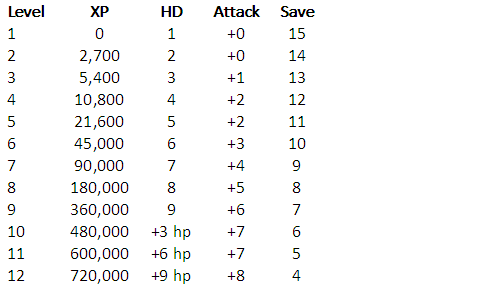
The magic-user is a mysterious figure, a student of arcane powers and spell casting. Usually cloaked in robes woven with mystical symbols, magic-users can be devastating opponents. However, they are usually physically weaker than other adventuring classes, and are untrained in the use of armor and weapons. As magic-users progress in level, they generally become the most powerful of the character classes. Perhaps one day, though, you will rise to such heights of power that you can build a mystically protected tower for your researches, create fabulous magic items, and scribe new formulae for hitherto unknown spells. Such arch-mages can sway the politics of kingdoms, and command respect and fear across the realms.

Prime Attribute: Intelligence, 13+ (+5% experience)

Hit Dice: 1d6-1 (Gains 1 hp/level after 9th level.)

Armor/Shield Permitted: None.

Weapons Permitted: Club, dagger, staff, and darts.

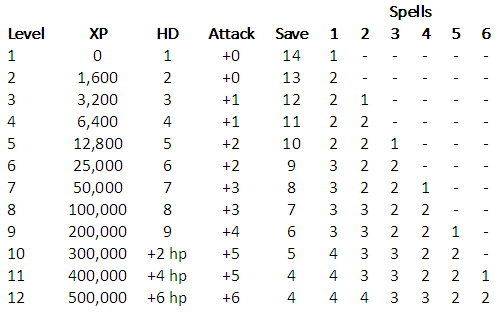
SPELLS (1st): A magic-user casts arcane spells. Each magic-user can cast a limited number of spells from each spell level per day. The table below lists the number of spells per day a magic-user may cast of each spell level. For example, a fifth level magic-user can cast four 1st level spells, two 2nd level spells, and one 3rd level spell. A magic-user must prepare spells before casting them by studying from a spell book. While studying, the magic-user decides which spells to prepare.

The magic-user keeps his spells in a spell book, or grimoire. The number of spells that a magic-user has in his spell book at the beginning of play is up to the Referee, but usually includes read magic, plus three additional spells – one offensive, one defensive and one practical.

Spells Per Day (By Spell Level)

Level Experience

Hit Dice

Attack

Save

Title

1

2

3

4

5

6

1 0

1

+0

15

Adept

1

2 2,500

2

+0

14

Soothsayer

2

3 5,000

3

+0

13

Evocator

2

1

4 10,000

4

+1

12

Mage

3

2

5 20,000

5

+1

11

Spellbinder

4

2

1

6 40,000

6

+2

10

Enchanter

4

2

2

7 65,000

7

+2

9

Marvel

4

3

2

1

8 95,000

8

+3

8

Archimage

4

3

3

2

9 135,000

9

+3

7

Wizard

4

3

3

2

1

10 190,000

+1

+4

6

Wizard

4

4

3

2

2

11 285,000

+2

+5

5

Wizard

4

4

4

3

3

12 385,000

+3

+5

4

Wizard

4

4

4

4

4

1

The Illusionist Sub-Class

The illusionist is a sub-class of magic-user that specializes in illusions. Illusionists are tricksters and charlatans. Illusionists tend to make their homes not in isolated towers but in towns, where there are people on whom they can practice their art. A high-level illusionist might open an emporium or found a traveling wonder show, attracting young apprentices with a yen for trickery. Where magic-users are scholarly, illusionists have an artistic temperament. They are often “bohemians” and may be agents of chaos and freedom, confidence men looking to make a dishonest gold piece, or even philosophers attempting to grasp the true meaning of reality.

Prime Attribute: Intelligence & Charisma, 13+ (+5% experience)

Hit Dice: 1d6-1 (Gains 1 hp/level after 9th level.)

Armor/Shield Permitted: None.

Weapons Permitted: Club, dagger, staff, and darts.

SPELLS (1st): An illusionist casts spells from the illusionist spell list. Each illusionist knows a limited number of spells from each spell level. These spells are learned through practice and invention, and new “spells known” gained via level advancement are gained without study or expense.

Unlike a traditional magic-user, the illusionist does not have to prepare spells each day before casting them. When an illusionist casts a spell from her repertoire, she must pay for it with spell points. A spell costs a number of spell points equal to its level. The chart below shows how many spell points the illusionist has at each level.

SHARP SENSES (1st): An illusionist’s innate ability to perceive the real from the unreal imparts a +1 bonus to all saving throws against illusions.

SILVER TONGUE (1st): Using her natural charisma and a bit of fast talking, the illusionist is a capable manipulator of people. Potential victims of the illusionist’s silver tongue receive a saving throw to see through her. If the saving throw is successful, apply a -2 penalty to reaction rolls with the NPC. If the saving throw fails, apply a +2 bonus to reaction rolls with the NPC.

Spells Known (By Spell Level)

Level Experience

Hit Dice

Attack

Save

SP

Title

1

2

3

4

5

6

1 0

1

+0

15

2

Quacksalver

2

2 2,600

2

+0

14

3

Humbug

2

3 5,200

3

+0

13

5

Prestidigitator

3

1

4 12,000

4

+1

12

9

Mountebank

4

2

5 24,000

5

+1

11

12

Pharisee

5

2

1

6 48,000

6

+2

10

15

Tregatour

5

3

2

7 70,000

7

+2

9

21

Charlatan

5

3

2

1

8 100,000

8

+3

8

28

Virtuoso

5

3

3

2

9 140,000

9

+3

7

33

Illusionist

6

4

3

2

1

10 195,000

+1

+4

6

42

Illusionist

6

4

4

3

2

11 290,000

+2

+5

5

51

Illusionist

6

4

4

3

3

12 400,000

+3

+5

4

66

Illusionist

6

5

5

4

4

1

Illusionist Spell List

* Indicates an existing magic-user spell

Level 1

  1. Change Self
  2. Color Spray
  3. Dancing Lights
  4. Daze
  5. Flare
  6. Ghost Sound
  7. Hideous Laughter
  8. Hypnotism
  9. Prestidigitation
  10. Silent Image
  11. Ventriloquism
  12. Wizard Mark

CHANGE Self

Level: 1

Range: Personal

Duration: 10 minutes per level

You make yourself, including your equipment, look different. You can seem 1 foot shorter or taller, thin, fat, or in between. You cannot change your body type. Otherwise, the extent of the apparent change is up to you.

COLOR SPRAY

Level: 1

Range: 15 ft cone

Duration: Instantaneous

A vivid cone of clashing colors springs forth from your hand. Each creature within the cone is affected according to its Hit Dice. Creatures with 2 HD or less is knocked unconscious for 2d4 rounds, then blinded and stunned for 1d4 rounds and then stunned for 1 round. Creatures with 3 or 4 HD are blinded and stunned for 1d4 rounds, then stunned for 1 round. Creatures with 5 or more HD are stunned for 1 round. Sightless creatures are not affected by color spray.

DANCING LIGHTS

Level: 1

Range: 150 ft

Duration: 1 minute

You create up to four lights that resemble lanterns or torches (and cast that amount of light), or up to four glowing spheres of light (which look like will-o’-wisps), or one faintly glowing, vaguely humanoid shape. The dancing lights
must stay within a 10-foot-radius area in relation to each other but otherwise move as you desire. The lights can move up to 100 feet per round. A light winks out if the distance between you and it exceeds the spell’s range.

DAZE

Level: 1

Range: 30 ft

Duration: 1 round

You cloud the mind of a humanoid creature with 4 or fewer Hit Dice so that it takes no actions for 1 round.

Flare

Level: 1

Range: 30 ft

Duration: Instantaneous

This spell creates a burst of light. If you cause the light to burst directly in front of a single creature, that creature is blinded for 1 minute unless it makes a successful saving throw.

Ghost Sound

Level: 1

Range: 30 ft.

Duration: 1 round per level

Ghost sound
allows you to create a volume of sound that rises, recedes, approaches, or remains at a fixed place. You choose what type of sound ghost sound
creates when casting it and cannot thereafter change the sound’s basic character.

Hideous Laughter

Level: 1

Range: 30 ft

Duration: 1 round per level

This spell afflicts the sentient subject with uncontrollable laughter. The subject can take no actions while laughing, but is not considered helpless. After the spell ends, it can act normally.

Hypnotism

Level: 1

Range: 30 ft.

Duration: 2d4 rounds

Your gestures and droning incantation fascinate nearby creatures, causing them to stop and stare blankly at you. In addition, you can use their rapt attention to make your suggestions and requests seem more plausible. Roll 2d4 to see how many total Hit Dice of creatures you affect. Creatures with fewer HD are affected before creatures with more HD. Only creatures that can see or hear you are affected, but they do not need to understand you to be fascinated.

Prestidigitation

Level: 1

Range: 10 ft

Duration: 1 hour

Prestidigitations are minor tricks that novice spell casters use for practice. Once cast, a prestidigitation
spell enables you to perform simple magical effects for 1 hour. The effects are minor and have severe limitations. A prestidigitation can slowly lift 1 pound of material. It can color, clean, or soil items in a 1-foot cube each round. It can chill, warm, or flavor 1 pound of nonliving material. It cannot deal damage or affect the concentration of spell casters. Prestidigitation
can create small objects, but they look crude and artificial. The materials created by a prestidigitation
spell are extremely fragile, and they cannot be used as tools, weapons, or spell components. Finally, a prestidigitation
lacks the power to duplicate any other spell effects. Any actual change to an object (beyond just moving, cleaning, or soiling it) persists only 1 hour.

Silent Image

Level: 1

Range: 600 ft

Duration: Concentration

This spell creates the visual illusion of an object, creature, or force, as visualized by you. The illusion does not create sound, smell, texture, or temperature. You can move the image within the limits of the size of the effect.

Ventriloquism

Level: 1

Range: 30 ft

Duration: 1 minute per level

You can make your voice (or any sound that you can normally make vocally) seem to issue from someplace else.

WIZARD Mark

Level: 1

Duration: Permanent

This spell allows you to inscribe your personal rune or mark, which can consist of no more than six characters. The writing can be visible or invisible. An arcane mark
spell enables you to etch the rune upon any substance without harm to the material upon which it is placed. If an invisible mark is made, a detect magic
spell causes it to glow and be visible, though not necessarily understandable.

Level 2

  1. Blur
  2. Darkness, 15 ft Radius *
  3. Hypnotic Pattern
  4. Invisibility *
  5. Magic Mouth *
  6. Mirror Image *
  7. Misdirection
  8. Phantasmal Force *
  9. Silence, 15 ft Radius *
  10. Suggestion *

Blur

Level: 2

Range: Touch

Duration: 1 minute per level

The subject’s outline appears blurred, shifting and wavering. This distortion grants the subject a +4 bonus to Armor Class against opponents with sight.

Hypnotic Pattern

Level: 2

Range: 150 ft

Duration: Concentration + 2 rounds

A twisting pattern of subtle, shifting colors weaves through the air, fascinating creatures within it. This spell works like hypnotism, except it lasts for as long as the illusionist concentrates, plus 2 rounds after.

Misdirection

Level: 2

Range: 30 ft

Duration: 1 hour per level

You misdirect the information from divination spells that reveal auras (detect evil, detect magic, discern lies,
and the like). On casting the spell, you choose another object within range. For the duration of the spell, the subject of misdirection
is detected as if it were the other object, with no saving throws allowed.

Level 3

  1. Blink
  2. Detect Invisibility *
  3. Dispel Illusion (as dispel magic, but only works against illusions)
  4. Displacement
  5. Enthrall
  6. Illusory Script
  7. Invisibility, 10 ft Radius *

Blink

Level: 3

Range: Personal

Duration: 1 round per level

You “blink” back and forth between the Material Plane and the Ethereal Plane. You look as though you’re winking in and out of reality very quickly and at random. Physical attacks against you are at a -5 penalty. If the attacker can hit ethereal creatures or see invisible creatures, the “to hit” penalty is reduced to -2. Spells that target you fail to work on you 50% of the time, and spells cast by you have a 20% chance of not working. You take half damage from area attacks and falling, and you gain a +2 bonus to hit in combat.

Displacement

Level: 3

Range: Touch

Duration: 1 round per level

The subject of this spell appears to be about 2 feet away from its true location. The creature benefits from a 50% miss chance on attacks.

Enthrall

Level: 3

Range: 150 ft

Duration: 1 hour or less

If you have the attention of a group of creatures, you can use this spell to hold them spellbound. To cast the spell, you must speak or sing without interruption for 1 round. Thereafter, those affected give you their undivided attention, ignoring their surroundings. They are considered to be friendly while under the effect of the spell. Any potentially affected creature of a race or religion unfriendly to yours gets a +2 bonus on the saving throw.

A creature with 4 or more HD or with a wisdom score of 15 or higher remains aware of its surroundings and remains indifferent. It gains a new saving throw if it witnesses actions that it opposes.

The effect lasts as long as you speak or sing, to a maximum of 1 hour. Those enthralled
by your words take no action while you speak or sing and for 1d3 rounds thereafter while they discuss the topic or performance. Those entering the area during the performance must also successfully save or become enthralled. The speech ends (but the 1d3-round delay still applies) if you lose concentration or do anything other than speak or sing.

If those not enthralled
have unfriendly or hostile attitudes toward you, they can collectively make a saving throw to try to end the spell by jeering and heckling. The heckling ends the spell.

If any member of the audience is attacked or subjected to some other overtly hostile act, the spell ends and the previously enthralled
members become immediately unfriendly toward you. Each creature with 4 or more HD or with a wisdom score of 15 or higher becomes hostile.

Illusory Script

Level: 3

Range: Touch

Duration: One day per level

You write instructions or other information on parchment, paper, or any suitable writing material. The illusory script
appears to be some form of foreign or magical writing. Only the person (or people) designated by you at the time of the casting are able to read the writing; it’s unintelligible to any other character, although an illusionist recognizes it as illusory script.

Any unauthorized creature attempting to read the script triggers a potent illusory effect and must make a saving throw. A successful saving throw means the creature can look away with only a mild sense of disorientation. Failure means the creature is subject to a suggestion implanted in the script by you at the time the illusory script spell was cast. The suggestion lasts only 30 minutes.

Level 4

  1. Confusion *
  2. Greater Invisibility
  3. Hallucinatory Terrain *
  4. Illusory Wall
  5. Phantasmal Killer
  6. Rainbow Pattern
  7. Shadow Conjuration
  8. Zone of Silence

Greater Invisibility

Level: 4

Duration: 1 round per level

This spell functions like invisibility, except that it doesn’t end if the subject attacks.

Illusory Wall

Level: 4

Range: 50 ft

Duration: Permanent

This spell creates the illusion of a wall, floor, ceiling, or similar surface. It appears absolutely real when viewed, but physical objects can pass through it without difficulty.

Phantasmal Killer

Level: 4

Range: 150 ft

Duration: Instantaneous

You create a phantasmal image of the most fearsome creature imaginable to the subject. Only the spell’s subject can see the phantasmal killer. You see only a vague shape. The target first gets a saving throw to recognize the image as unreal. If that fails, the phantasm touches the subject and the subject must succeed on a saving throw or die from fear. Even if the saving throw is successful, the subject takes 3d6 points of damage. If the subject of a phantasmal killer
attack succeeds in disbelieving and is wearing a helm of telepathy or is a psychic with the telepathy power, the beast can be turned upon you. You must then disbelieve it or become subject to its deadly fear attack.

Rainbow Pattern

Level: 4

Range: 150 ft

Duration: Concentration + 1 round per level

A glowing, rainbow-hued pattern of interweaving colors fascinates those within it. Rainbow pattern fascinates a maximum of 24 Hit Dice of creatures. An affected creature that fails its saves is fascinated by the pattern. With a simple gesture, you can make the rainbow pattern move up to 30 feet per round, moving its effective point of origin. All fascinated creatures follow the moving rainbow of light, trying to get or remain within the effect. Fascinated creatures who are restrained and removed from the pattern still try to follow it. If the pattern leads its subjects into a dangerous area each fascinated creature gets a second saving throw. If the view of the lights is completely blocked creatures who can’t see them are no longer affected.

Shadow Conjuration

Level: 4

Range: See text

Duration: See text

You use shadows to shape quasi-real illusions of one or more creatures, objects, or forces. Shadow conjuration can mimic any magic-user conjuration or summoning spell of 3rd level or lower. Shadow conjurations are 20% as strong as the real things, though creatures who believe the shadow conjurations to be real are affected by them at full strength. Any creature that interacts with the conjured object, force, or creature can make a saving throw to recognize its true nature. Spells that deal damage have normal effects unless the affected creature succeeds on a saving throw. Each disbelieving creature takes only 20% damage from the attack. If the disbelieved attack has a special effect other than damage, that effect is only 20% likely to occur.

A shadow creature has one-fifth the hit points of a normal creature of its kind (regardless of whether it’s recognized as shadowy). It deals normal damage and has all normal abilities and weaknesses. Against a creature that recognizes it as a shadow creature, however, the shadow creature’s damage is one-fifth (20%) normal, and all special abilities that do not deal lethal damage are only 20% likely to work. (Roll for each use and each affected character separately.) Furthermore, the shadow creature’s AC bonuses (i.e. points of Armor Class better than 9 [10]).are one-fifth as large.

A creature that succeeds on its save sees the shadow conjurations as transparent images superimposed on vague, shadowy forms.

Zone of Silence

Level: 4

Range: Personal

Duration: 1 hour per level

By casting zone of silence, you manipulate sound waves in your immediate vicinity so that you and those within the spell’s area can converse normally, yet no one outside can hear your voices or any other noises from within. This effect is centered on you and moves with you. Anyone who enters the zone immediately becomes subject to its effects, but those who leave are no longer affected.

On the Beastmen of Nabu – Part Three

Two more beastmen round out the blog series. Click to read Part I and Part II. The final article that will appear in NOD #3 will include cattle people, horse people, monkey people, raven people and swine people.

Aigosy (Goat People)
The aigosy are an eccentric race of mystics who dwell in irregularly shaped, or stepped, towers made of sun-dried bricks. Aigosy men always cultivate beards, sometimes small and neat, often curly and tangled, and all aigosy have thick, tangled hair that is usually black. Aigosy are tan to dusky in complexion and have long, flat noses. They traditionally wear felt skullcaps with small felt horns on them, rough tunics, cloaks and leggings and thick leather sandals. Aigosy have little use for jewelry, but do appreciate colored beads, especially glass beads, and often wear strings of them as necklaces and bracelets. Aigosy warriors wear ring mail under their robes and carry shields covered with leather and such weapons as flails, maces and slings. Most aigosy carry a set of pan-pipes.

An aigosy village consists of a dozen or so “towers”, each housing anywhere from three to seven aigosy. Aigosy men and women do not marry, and often do not even live together. Children are raised by the community, with the men cuffing any child that gets out of hand and women, after nursing, doing their best to mother any child within reach. The towers are decorated simply, with the most noticeable articles of furniture being the tall stools and chairs that they prefer. Each aigosy community has a large oven in which they bake their daily bread; flat loaves decorated with seeds in mystic patterns.

The aigosy live by herding goats and sheep and growing a few crops. Rugged and tough, the aigosy have an amazing ability to grow crops in very difficult environments. For this reason, they are considered lucky by many farmers, and should a family of aigosy wish to establish themselves on the fringes of a human settlement, they are usually welcomed (though not too warmly, for they are known to be a bit odd and disruptive).

The aigosy are unflappable, ignoring danger and keeping their cool in just about every situation except being near attractive members of the opposite sex. The truth is, the aigosy are a bit lecherous. They are also eccentric in their speech and manners. They have a cackling laughter that is more unnerving than contagious, and their eyes never seem quite right. They enjoy pondering things over, smoking a clay pipe and, if male, pulling on their beards. When they finally come to a decision, they become a flurry of excited activity.

Racial Characteristics: Aigosy are natural climbers, climbing very difficult surfaces on the roll of 1-2 on 1d6, and rarely failing to climb a surface that provides even small hand and foot holds. They enjoy a +1 bonus on saving throws against spells and effects that affect the mind (i.e. fear, charm, etc). An aigosy’s iron stomach allows them to digest just about anything and makes them more resistant (+2 bonus on saving throws) to poison and disease from ingested articles.

Aigosy Racial Class
The aigosy are often considered to be wild-eyed mystics and, frankly, weirdos. They come by their odd mannerisms honestly, though, for most aigosy are born with what one might call “fairy-sight”. Many aigosy can see spirits and can glimpse the future and past. Besides the racial characteristics mentioned above, a member of th aigosy racial class also gains some spell casting ability and the ability to see spirits.

Prime Requisite: Wisdom (13+ gets +5% bonus to earned experience).
Hit Dice: 1d6 (+2 hit points per level after 9th).
Weapons Permitted: Club, dart, mace, sling, staff.
Armor Permitted: Leather and shields.

Spells: Aigosy can cast divination spells in the same manner that clerics cast spells (i.e. they do not need spellbooks).

Level 1: Comprehend Languages*, Deathwatch*, Detect Evil, Detect Magic, Detect Secret Doors*, Detect Snares & Pits*, Detect Poison*, Detect Undead*, Hide from Undead*, Identify*, True Strike*

Level 2: Augury*, Detect Invisibility, ESP, Find Traps, Locate Object, Speak with Animals, Status*

Level 3: Clairaudience, Clairvoyance, Darkvision, Speak with Dead, Tongues*

Level 4: Detect Scrying*, Discern Lies*, Divination*, Locate Creature*, Speak with Plants, Scrying*, Wizard Eye

Level 5: Commune, Contact Other Plane, Prying Eyes*, Speak with Monsters

Level 6: Analyze Dweomer*, Find the Path, Legend Lore, True Seeing*

* – New spell – see end of article

Spirit Sight: Aigosy are capable of peering into the ethereal plane, and thus have a 1 in 6 chance (increasing by 1 every three levels) of spotting creatures either on the ethereal plane or creatures that are invisible.

Esou (Sheep People)
The esou live in tight-knit communities of 100 to 300 men and women led by a lord and his retainers. Esou communities are herding communities, keeping cattle, sheep and sometimes goats and swine. The esou are skilled at controlling their animals with horns, thus relieving them of the necessity of keeping dogs, which make them nervous. They build their communities on hills, usually constructing a large shell keep. Animals are, as much as possible, kept within the walls of the keep or very near, for the esou tend toward paranoia and are always certain that rustlers are just over the hill waiting to pounce.

Esou have dusky skin and curly blond hair. They wear woolen clothes, including long tunics, leather aprons and sandals. Most esou wear steel skullcaps with a curled ram-horn motif worked into the sides. Warrior equip themselves with ring armor or chainmail, shields and maces that are often tipped with steel heads shaped like a ram’s head. The esou are close-minded and suspicious. It is difficult to work oneself into their confidence, and easy to lose that confidence. Many esou expect visitors seeking hospitality to prove themselves with painful, physical ordeals.

Racial Characteristics: Esou are trained in defensive combat, giving them a base armor class of 8 [11]. They are only surprised on a roll of 1 on 1d8 and sense dangerous traps on a roll of 1 on 1d6.

Esou Racial Class
Esou warriors are experts at defensive combat, and thus very valuable to armies and parties of adventurers. Once an esou adopts a band of adventurers or soldiers, he becomes very protective of them. Esou are always on the lookout for danger, and often drive their comrades crazy with their constant fretting.

Prime Requisite: Constitution (13+ gets +5% bonus to earned experience).
Hit Dice: 1d6+2 (+3 hit points per level after 9th).
Weapons Permitted: Any.
Armor Permitted: Any.

Defensive Stance: When adopting a defensive posture, an esou gains a +1 bonus to hit and damage, a +2 bonus on all saving throws and a +2 bonus to Armor Class. In exchange, he cannot move during combat. A defensive stance lasts for 4 rounds, after which he suffers a -1 penalty to hit and damage for the remainder of the encounter. An esou can adopt his defensive stance a number of times per day equal to his level divided by two, rounding up.

Ignore Damage: At level 6, an esou can ignore 1 point of damage from melee, missile and spell attacks.

Trap Sense: Besides his 1 in 6 chance of noticing traps, an esou who takes levels in this racial class also gains a +1 bonus on saving throws to avoid traps.

NEW SPELLS –

ANALYZE DWEOMER
Level: Magic-User 6
Range: 30 ft.
Duration: 1 round per level

You learn all of the magical functions, effects and triggers on any magic item or any person under the effect of a spell that you look at. The person being analyzed or holding an object being analyzed may make a saving throw to foil your analysis. Casting this spell requires a tiny lens of ruby or sapphire set in a small golden loop, costing approximately 1,500 gp.

AUGURY
Level: Cleric 2
Range: Personal
Duration: Instantaneous

An augury can tell you whether a particular action will bring good or bad results for you in the immediate future. The base chance for receiving a meaningful reply is 70% + 1% per level, to a maximum of 90%; this roll is made secretly. A question may be so straightforward that a successful result is automatic, or so vague as to have no chance of success. If the augury succeeds, you get one of four results: Weal (if the action will probably bring good results), Woe (for bad results), Weal and woe (for both) or Nothing (for actions that don’t have especially good or bad results). If the spell fails, you get the “nothing” result. A cleric who gets the “nothing” result has no way to tell whether it was the consequence of a failed or successful augury. The augury can see into the future only about half an hour, so anything that might happen after that does not affect the result. Thus, the result might not take into account the long-term consequences of a contemplated action. All auguries cast by the same person about the same topic use the same dice result as the first casting.

COMPREHEND LANGUAGES
Level: Cleric, Magic-User 1
Range: Personal
Duration: 10 minutes per level

You can understand the spoken words of creatures or read otherwise incomprehensible written messages. In either case, you must touch the creature or the writing. The spell enables you to understand or read an unknown language, not speak or write it.

DEATHWATCH
Level: Cleric 1
Range: 30 ft.
Duration: 10 minutes per level

You can determine the condition of creatures near death within the spell’s range. You instantly know whether each creature within the area is dead, alive and wounded with 3 or fewer hit points left, alive with 4 or more hit points, undead, or neither alive nor dead (such as a construct).

DETECT POISON
Level: Cleric, Magic-User 1
Range: 30 ft.
Duration: Instantaneous

You determine whether a creature, object, or area has been poisoned or is poisonous.

DETECT SCRYING
Level: Magic-User 4
Range: 40 ft.
Duration: 24 hours

You immediately become aware of any attempt to observe you by means of a scrying spell or effect. The spell’s area radiates from you and moves as you move. You know the location of every magical sensor within the spell’s area. If the scrying attempt originates within the area, you also know its location; otherwise, you and the scrier immediately make opposed caster level checks (1d20 + caster level). If you at least match the scrier’s result, you get a visual image of the scrier and an accurate sense of his or her direction and distance from you.

DETECT SECRET DOORS
Level: Magic-User 1
Range: 60 ft.
Duration: 1 minute per level

You can detect secret doors, compartments, caches, and so forth. Only passages, doors, or openings that have been specifically constructed to escape detection are detected by this spell.

DETECT SNARES & PITS
Level: Druid 1
Range: 60 ft.
Duration: 10 minutes per level

You can detect simple pits, dead falls, and snares as well as mechanical traps constructed of natural materials. The spell does not detect complex traps, including trapdoor traps. The spell detects certain natural hazards, including quicksand, a sinkhole, or unsafe walls of natural rock.

DETECT UNDEAD
Level: Cleric, Magic-User 1
Range: 60 ft.
Duration: 1 minute per level

You can detect the number of undead creatures within range of the spell and their relative strength (i.e. hit dice or challenge level).

DISCERN LIES
Level: Cleric 4
Range: 30 ft.
Duration: 1 round per level

You know if the subject of your scrutiny deliberately and knowingly speaks a lie. The spell does not reveal the truth, uncover unintentional inaccuracies, or necessarily reveal evasions.

DIVINATION
Level: Cleric 4
Range: Personal
Duration: Instantaneous

Similar to augury but more powerful, a divination spell can provide you with a useful piece of advice in reply to a question concerning a specific goal, event, or activity that is to occur within one week. The base chance for a correct divination is 70% + 1% per caster level, to a maximum of 90%.

HIDE FROM UNDEAD
Level: Cleric 1
Range: Touch
Duration: 10 minutes per level

Undead cannot see, hear, or smell the warded creatures. Even extraordinary or supernatural sensory capabilities cannot detect or locate warded creatures. Non-intelligent undead creatures are automatically affected and act as though the warded creatures are not there. An intelligent undead creature gets a single saving throw.

IDENTIFY
Level: Magic-User 1
Range: Touch
Duration: Instantaneous

The spell determines all magic properties of a single magic item, including how to activate those functions (if appropriate), and how many charges are left (if any).

LOCATE CREATURE
Level: Magic-User 4
Duration: 10 minutes per level

This spell functions like locate object, except this spell locates a known or familiar creature.
You slowly turn and sense when you are facing in the direction of the creature to be located, provided it is within range. You also know in which direction the creature is moving, if any.

PRYING EYES
Level: Magic-User 5
Range: One mile
Duration: 1 hour per level

You create a number of semi-tangible, visible magical orbs (called “eyes”) equal to 1d4 + your level. These eyes move out, scout around, and return as you direct them when casting the spell. Each eye can see 120 feet (normal vision only) in all directions. Each eye has 1 hit point and an AC of 18. You give each eye some basic instructions of where to go, and it returns and replays in your mind what it has seen.

SCRYING
Level: Cleric 5, Druid 4, Magic-User 4
Range: See text
Duration: 1 minute per level

You can see and hear some creature, which may be at any distance. If the subject succeeds on a saving throw, the scrying attempt fails. If you have no knowledge of the creature, it gets a +10 bonus to its saving throw. If you have only secondhand knowledge of the creature, it gets a +5 bonus to its saving throw. If you have a picture or likeness of the creature, it suffers a -2 penalty to its saving throw. If you have a possession or garment of the creature, it suffers a -4 penalty to its saving throw. If you have a piece of the creature (body part, fingernail clippings, lock of hair), it suffers a -10 penalty to its saving throw. If the subject is on another plane, it gets a +5 bonus on its saving throw.

If the save fails, you can see and hear the subject and the subject’s immediate surroundings.

STATUS
Level: Cleric 2
Range: Touch
Duration: 1 hour per level

When you need to keep track of comrades who may get separated, status allows you to mentally monitor their relative positions and general condition. You are aware of direction and distance to the creatures and any conditions affecting them. Once the spell has been cast upon the subjects, the distance between them and the caster does not affect the spell as long as they are on the same plane of existence. If a subject leaves the plane, or if it dies, the spell ceases to function for it.

TONGUES
Level: Cleric 4, Magic-User 3
Range: Touch
Duration: 20 minutes per level

This spell grants the creature touched the ability to speak and understand the language of any intelligent creature, whether it is a racial tongue or a regional dialect.

TRUE SEEING
Level: Cleric 5, Druid 7, Magic-User 6
Range: Touch
Duration: 1 minute per level

You confer on the subject the ability to see all things as they actually are. The subject sees through normal and magical darkness, notices secret doors hidden by magic, sees the exact locations of creatures or objects under blur or displacement effects, sees invisible creatures or objects normally, sees through illusions, and sees the true form of polymorphed, changed, or transmuted things. Further, the subject can focus its vision to see into the Ethereal Plane (but not into extradimensional spaces). The range of true seeing conferred is 120 feet. True seeing does not penetrate solid objects. It in no way confers X-ray vision or its equivalent. It does not negate concealment, including that caused by fog and the like. True seeing does not help the viewer see through mundane disguises, spot creatures who are simply hiding, or notice secret doors hidden by mundane means.

TRUE STRIKE
Level: Magic-User 1
Range: Personal
Duration: See text

Your next attack roll (if it is made before the end of the next round) gains a +10 bonus to hit.

On the Beastmen of Nabu – Part One

In 1671 AD, a fellow by the name of Charles Le Brun produced a series of illustrations for his treatise on physiognomy – or a study of facial features. Included among these were fanciful illustrations of people with animal characteristics. Approximately 350 years later, a gaming geek is using these illustration to produce this …

The Beastmen of Nabu

Nabu was once a lush savanna cut by a river, the banks of which supported a highly advanced civilization. At the center of this civilization was the city-state of Nabu and its attendant empire that stretched from the jungles of Cush to the rocky hills of the Wyvern Coast. This empire was ruled by successive dynasties of scientist-kings, men and women who, it is said, were as above other humans as humans are above beasts. These kings and queen and their attendants produced wonders for their empire. And then, they apparently went too far. The cataclysm has been attributed to many possible occurrences, though most scholars would place the blame squarely on Nabu’s competition with its rival, Irem, over the verdant hills and forests of Venatia. The two powers, they believe, finally destroyed one another in a final clash of sorcery and science. In the wake of the cataclysm, both lands were turned to waste – wind-swept deserts and buried ruins replacing farmland and city, beastmen and corpses replacing men and women.

The beastmen of Nabu are, for the most part, human beings. Their habits and their faces, however, carry the mark of beasts and keep them separate from other humans, incapable of interbreeding with normal humans and often unwilling to manage their passions sufficiently to fit into to human society. There is no doubt that the beastmen were created by the energies unleashed during the cataclysm, but the process by which this transformation was accomplished is lost to modern theoretic wizardry.

Bubasti (Cat People)

The bubasti are a race of cat-like demi-humans who dwell on the margins of the River of Death. Bubasti appear as short (average 3 feet tall), slight humanoids with dusky skin and glossy, blue-black hair. They have furtive, piercing eyes and are prone to staring. The bubasti are chaotic down to their little souls, and often cruel and malicious. They dress in simple tunics and enjoy decorating themselves (when not on the hunt) with silver trinkets. In fact, bubasti place such a high value on silver that silver coins can be considered to be double in value when trading with the cat people.

The bubasti live in small communities of 10 to 30 individuals. They dwell in the tall reeds that clog the banks of the river. The bubasti construct tiny huts from the reeds. Each little den is separated by several yards from the others, and they are so cunningly camouflaged that it is possible to walk through a bubasti village without ever knowing. Villages are mostly made up of females and young, with a few older males living on the outskirts of the village and claiming it and its inhabitants as their territory. The females put up with this so long as the males keep mostly to themselves and make no attempt to assert political control over the village. Most males belong to no village, instead living the life of wanderers and adventurers.

The cat people mostly make their living as fishermen, but they are also skilled at hunting small birds with weighted nets. Bubasti give most of their religious devotion to the mythic Cat Lord, who the Nabu know as Bast but the cat people call Pasha. In turn, they enjoy Pasha’s special attention and protection, with people hurting a bubasti running a slight (5%) chance of attracting a curse (per the spell).

Racial Characteristics: Bubasti characters enjoy a +1 bonus to make saving throws against breath weapons and triggered traps. They only trip pit traps on a roll of 1 on 1d8, and take only half damage from falling. Bubasti can see in the dark as well as elves and dwarves. Bubasti speak their own language, a dialect of the common tongue of humankind, and the language of felines.

The Bubasti Racial Class

While you can use the bubasti as a race, like elf or halfling, capable of taking levels in the basic classes, you might also want to treat the bubasti as a class of their own. In addition to the racial abilities listed above, members of the bubasti class gain the ability to cast a limited number of spells and the chance to escape certain death.

Prime Requisite: Dexterity (13+ gets +5% bonus to earned experience).

Hit Dice: 1d6+1 (+1 hit points per level after 9th).

Weapons Permitted: Club, dagger, javelin, light crossbow, short bow, short sword, sling.

Armor Permitted: Leather, ring, shields.

Magic Spells (1st): The bubasti are granted access to a small number of spells by their divine patron. The bubasti spell list is described below. Bubasti cast spells as clerics.

Level One: Detect Evil, Detect Magic, Expeditious Retreat#, Feather Fall#, Jump#

Level Two: Detect Invisibility, Dexterity*, Find Traps, Invisibility, Speak with Animals

Level Three: Bestow Curse**, Dimension Door#, Locate Object, Summon Cats***

* As the magic-user spell Strength, but applies instead to dexterity. Bubasti gain 2d4 points of dexterity from this spell.

** The reverse of remove curse.

*** As Monster Summoning I, except the spell summons 2d6 normal cats from the aether. Cats have the following statistics: HD 1d2; AC 5 [14]; Atk 2 claws (1 damage), 1 bite (1 damage); Move 12; Save 17; CL/XP A/5; Special: None.

# New spell – see below.

Evasion (1st): The bubasti can roll with a potentially lethal blow to take less damage from it than she otherwise would. Once per day, when a bubasti would be reduced to 0 or fewer hit points by damage from a weapon or other blow, she can attempt a saving throw. If successful, she takes only half damage from the attack.

Keen Hearing (1st): A bubasti’s hearing is so acute that they are only surprised on a roll of 1 on 1d8.

Light Footed (1st): Bubasti are so quiet when they move that they are capable, when surrounded by equally quiet creatures or alone, of surprising their foes on the roll of 1-2 on 1d6.

Spells

Level

XP

HD

Attack

Save

1

2

3

1

0

1

+0

14

1

2

1,900

2

+0

13

1

3

3,800

3

+1

12

2

4

7,600

4

+1

11

2

5

15,200

5

+2

10

2

1

6

30,000

6

+2

9

2

1

7

60,000

7

+3

8

3

2

8

120,000

8

+3

7

3

2

9

240,000

9

+4

6

3

2

1

10

360,000

+1 hp

+5

5

3

2

1

11

480,000

+2 hp

+5

4

3

3

2

12

600,000

+3 hp

+6

4

3

3

2

New Spells –

Dimension Door

Level: 3 (bubasti), 4 (magic-user)

Range: 300 feet

Duration: Instantaneous

You instantly transfer yourself from your current location to any other spot within range. You always arrive at exactly the spot desired, whether by simply visualizing the area or by stating direction. You may bring one additional willing man-sized or smaller creature per three caster levels.

Expeditious Retreat

Level: 1

Range: Personal

Duration: 1 minute per level

This spell increases your land speed by +12.

Feather Fall

Level: 1

Range: 30 feet

Duration: Until landing, or 1 round per level

The affected creatures or objects fall so slowly that they take no damage upon landing.

Jump

Level: 1

Range: Touch

Duration: 1 minute per level

The subject of this spell can easily leap 10 feet horizontally or 6 feet vertically.

Belcwn (Lion People)

Unlike their small, furtive kin the bubasti, the lion people, or belcwn, are tall and broad of shoulder. The lion people have tanned, muscular bodies, golden eyes and curly blonde or red hair that is always worn long and loose. Belcwns dress in leather tunics. Warriors wear leather or ring armor and carry heavy flails, hooked swords or pole arms and sometimes shields. They are expert at using their weapons to knock their enemies prone, opening them to a vicious pounce. The male leader of a pride wears a heavy, animal skin cloak and receives visitors sitting on a beautifully carved wooden stool.

The belcwn live in prides, pitching their animal skin tents on grassy meadows near groves of acacia trees. Each pride consists of 6 to 12 female warriors and either a single male or a pair of brothers who rule as titular kings and defenders. While the women work as hunters and gatherers, the kings tutor their children in fighting and in the legends and lore of their people. The males also fill their time working on crafts necessary to the tribe’s survival – mostly weapon making, but also basket weaving and leather working. Males without a pride live as mercenaries and adventurers. Their foul tempers and penchant for violence make them useful to nobles, but poorly regarded by common folk.

The belcwn worship Pasha, the ruler of all felines, as well as deities of war and solar divinities. Males act as priests for their prides, and thus often have the magical abilities of low-level adepts. Many belcwn kings are attended by bubasti viziers.

Racial Characteristics: Belcwns are usually tall and muscular, but are generally not known for their intellects. New belcwn characters receive a +2 bonus to their strength attribute, but a -2 penalty to their intelligence. These modifications cannot take an ability score higher than 18 or lower than 3. Belcwns can see in the dark.

Belcwn Racial Class

Belcwns are roudy, eager warriors who enjoy coming to blows with their enemies. Their ear-shattering battle cries cause enemies to quake in their boots, and their powerful charges often send them scattering. In addition, belcwns possess an innate ability to command normal beasts.

Prime Requisite: Strength (13+ gets +5% bonus to earned experience).

Hit Dice: 1d6+2 (+3 hit points per level after 9th).

Weapons Permitted: Any.

Armor Permitted: Leather, ring, chainmail and shields.

Battle Yell: The belcwn usually enter battle with a terrible, throaty yell, not unlike a lion’s roar. Creatures with fewer hit dice than the belcwn (and no more than 5 hit dice in any event) must pass a saving throw or be struck with fear, suffering a -1 penalty to hit and damage during combat.

Charge: When belcwns charge into a fight, they enjoy a +1 bonus to hit and damage for one round, but suffer a -2 penalty to Armor Class and always lose initiative to troops who have set their spears against a charge. Foes that are damaged by a belcwn’s charge must make a saving throw or be knocked prone.

Command Animals: Belcwns possess a natural aura of command over natural, normal animals (i.e. not mythic animals like unicorns or giant versions of normal animals). Against these creatures, a belcwn can make a “turn undead” roll as a cleric of the belcwn’s level. If successful, the animals fall under the belcwn’s command as the undead fall under the command of an evil cleric, though the duration is only 1 hour.

Level

XP

HD

Attack

Save

1

0

1

+0

16

2

2,000

2

+0

15

3

4,000

3

+1

14

4

8,000

4

+2

13

5

16,000

5

+2

12

6

30,000

6

+3

11

7

60,000

7

+4

10

8

120,000

8

+5

9

9

240,000

9

+6

8

10

360,000

+3 hp

+7

7

11

480,000

+6 hp

+7

6

12

600,000

+9 hp

+8

5


The Gods of Nabu – Part Two

Continuing yesterday’s post. The spells detailed below are Open Game Content.

Nefertum
Also called Water-lily of the Sun
Deity of youth, beauty, perfume, luck
Wields a staff
Served by angels
Symbolized by a blue water-lily
Aligned with Law
Clerics learn Charm Person

Nefertum is the god of youth, beauty, perfume and luck. Small statuettes of him are carried by people as a good luck charm. Nefertum is the son of Ptah and Bast. He is usually depicted as a beautiful youth with blue water-lily flowers around his head. As the son of Bast, he sometimes is given the head of a feline. He is associated with the scent of the blue water-lily as well as its narcotic effect.

Neith
Also called Water, Weaver, Nurse of Crocodiles
Deity of hunting
Wields a short bow
Served by the fey
Symbolized by crossed arrows over a shield
Aligned with Neutrality
Clerics are permitted to use bows (but not crossbows) in combat

Neith is a goddess of war and hunting. She is said to make the weapons of warriors and to guard their bodies when they die. Neith is also associated with weaving and water. As a weaver, she is promoter of the domestic arts and guardian of marriage, as well as the weaver of the bandages and shrouds worn by the mummified dead. She is often depicted as a woman with a weaver’s shuttle atop her head and carrying a bow and arrows in her hand. She might also be depicted with the head of a lioness, snake or cow. Sometimes she is depicted nursing a baby crocodile. Neith is the mother of Ra, Apophis and Suchos and the wife of Khnum.

Nephthys
Also called Queen of the Embalmer’s Shop
Deity of the afterlife, mummification
Wields a staff
Served by angels
Symbolized by a phoenix
Aligned with Law
Clerics can detect invisible creatures (as detect evil) 1/day

Nephthys is the twin sister of Isis and brother of Serapis. She is the wife of Seth, and represents the transitional death experience. She is a protector of the dead, and often depicted as a falcon or with the wings of a falcon. Nephthys is a great goddess of the magic needed to proceed through the afterlife. With her sister, she is seen as a primary force keeping chaos at bay. As a patron of embalmers, she is also associated with Anubis, sometimes being named as his mother. Nephthys is depicted as youthful, nubile and exceedingly beautiful. She is regarded as more unpredictable than her sister. Her rites mandate the consumption of considerable amounts of beer. Her primary domain is darkness, especially on the border between civilization and wilderness. She is also a protector of the bennu bird and phoenix.

Nu
Also called Abyss
Deity of the primordial, watery abyss
Wields a staff
Served by ogdoads
Symbolized by a blue frog
Aligned with Chaos
Clerics learn Water Breathing

Nu is the deification of the primordial, watery abyss that preceded creation, and one of the Ogdoad. Nu is andro-gynous, its female form called Naunet. Nu’s male form is depicted as a frog or frog-headed man and his female form as a snake or snake-headed woman. His male form is also depicted as a crouching, bearded man with blue-green skin. In this form, he sometimes holds aloft a sun-barque occupied by eight deities, with Khepri standing in the middle. Nu is worshiped at underground streams.

Nut
Also called Mistress of All, She who holds 1,000 souls
Deity of night and the sky
Wields a staff
Served by fey and air elementals
Symbolized by a ladder
Aligned with Neutrality
Druids can turn monsters (as a cleric turns undead) 1/day
Druid sacred animals are the owl, swine and lioness

Nut is the deification of night, but also the goddess of the sky. Nut is a barrier separating chaos from the ordered cosmos. She is depicted as a cow whose body forms the heavens, a sycamore tree or as a giant sow suckling many piglets (representing the stars). She is the daughter of Tefnut and Shu and the sister-wife of Geb. Nut and Geb are the parents of Isis, Serapis and Nephthys.

Onuris
Also called Slayer of Enemies, Sky Bearer
Deity of war
Wields a spear
Served by angels
Symbolized by four ostrich plumes
Aligned with Law
Clerics are +1 to hit in combat

Onuris was a foreign war god adopted by the Egyptians. He was depicted as a bearded man wearing a robe or kilt and headdress with four ostrich feathers, holding a spear. He was sometimes depicted with the head of a lion. Onuris was a patron of the army and soldiers. Mock battles are staged at festivals honoring him. The Egyptians believed him to be a savior deity, as they believed war was the source of freedom and victory.

Ptah
Also called Opener of the mouth
Deity of creation
Wields a staff
Served by angels
Symbolized by an ankh and djed
Aligned with Law
Clerics learn the druid spell Stone Shape

Ptah called the world into being, having dreamed creation in his heart and speaking it. Atum was created by Ptah to sit on the primordial mound. He is depicted as a mummified man wearing a skull cap, holding in his hands an ankh and djed, the symbols of life, power and stability. He also manifests himself as the Apis bull. Because he called creation into being, Ptah is the patron of craftsmen, particularly masons. He is also associated with both reincarnation and fate.

Ra
Also called His Majesty, Sun, Creation, Father of Kings
Deity of the sun
Wields a sun beam
Served by angels
Symbolized by a sun disc
Celebrated at the Receiving of Ra (May 26)
Aligned with Law
Clerics can cast light at will

Ra (pronounced ‘ray’) is the sun god, specifically identified with the mid-day sun. He is the husband or father of Hathor and king of the gods. Some stories say he fathered Shu and Tefnut as well. Ra is the creator of Sacmis. Ra is usually associated with the falcon, and depicted as a falcon-headed man crowned with a sun disc. Ra is also believed to be embodied in a bull. Ra is believed to sail a sun barque, the barque protecting the sun from the primordial waters of night. He sails with other deities, including Seth, who protect the boat from the monsters of chaos, including Apophis. Worship of Ra included hymns, prayers and spells meant to help Ra overcome Apophis. His most important holiday, the “Receiving of Ra”, was celebrated on May 26.

Sacmis
Also called Mistress of Dread, Lady of Slaughter, Scarlet Lady, Avenger of Wrongs, Lady of Fire
Deity of the fire, war, death
Wields a sickle-sword
Served by angels
Symbolized by a lioness
Aligned with Law
Clerics can go berserk in combat (+2 to hit, -2 to AC)

Sacmis is the warrior goddess of Upper Egypt. She is depicted as a lioness, the fiercest hunter known to the Egyptians. It is said that death and destruction are balm to her warrior heart and that the hot desert wind is her breath. Sacmis is also a goddess of disease and the curing of disease, making her priests practiced physicians. Sacmis is the daughter of Ra. She was unleashed by Ra to destroy her enemies and in her blood-lust nearly destroyed all mankind before being tricked into drinking beer disguised as blood. The intoxication finally pacified her and ended her rampage. Sacmis is believed to protect kings in battle, stalking the land and destroying his enemies with arrows of fire. Her temples contain one statue of her for every day of the year, all coated with poison to protect them from vandals and thieves. To placate Sacmis’ wrath, her priestesses must perform a ritual before a different statue of the goddess each day of the year. At the beginning of each year, a festival of intoxication is held. The participants play music and dance and serve beer to Sacmis’ priestesses to the point of excess.

Selchis
Also called She who tightens the throat
Deity of poison, healing
Wields a dagger
Served by demons
Symbolized by a black scorpion
Aligned with Chaos
Clerics save vs. poison at +2

Selchis is the goddess of healing poisonous stings and bites. She is the deification of the scorpion. She is depicted as a scorpion or a woman with a scorpion on her head. She is worshiped by many priests, but has no temples. Selchis is a protector of kings and the dead and a patron of healers.

Serapis
Also called Lord of Love, Lord of Silence
Deity of fertility, love, rebirth
Wields a flail
Served by demons
Symbolized by a crook and flail
Aligned with Neutrality
Druids can turn undead 1/day
Druid sacred animals include the crocodile, hippopotamus and ram

Serapis is the god of rebirth and vegetation. Stories tell us that he was killed by his brother Seth, cut into fourteen pieces, and scattered over the earth. Serapis’ sisters Isis and Nephthys gathered these pieces, reconstructed him and eventually brought him back to life. His son and avenger is Horus. He is commonly depicted as a man with skin that is green (symbolizing rebirth) or black (symbolizing fertility) wearing a white crown and holding a crook and flail and wrapped like a mummy. His soul, in the form of a ram, is also worshiped as a separate entity. A living, sacred ram is sometimes kept in his temple.

Seshat
Also called She who scrivens, Mistress of the House of Books
Deity of wisdom, knowledge, history and writing
Wields a dagger
Served by angels
Symbolized by a papyrus plant
Aligned with Law
Clerics can legend lore as a bard

Seshat is the goddess of wisdom, knowledge, history and writing. She is the scribe and record keeper of the gods and is credited with inventing writing. Seshat is also associated with architecture, astronomy, astrology, building, mathematics and surveying. She is depicted as a woman with a papyrus plant above her head and holding a palm stem. She is usually dressed in a leopard or cheetah hide, a symbol of funerary priests. Seshat is the wife of Thoth.

Seth
Also called His Majesty, One who dazzles, Pillar of Stability
Deity of wisdom, knowledge, history and writing
Wields a sickle-sword
Served by devils
Symbolized by a Typhonic beast
Aligned with Chaos
Clerics learn the spell Summon Minion (see below)

Seth is the god of the desert, storms, chaos and darkness. He is depicted as an unknown animal called the Typhonic beast with a curved snout, square ears, forked tail and canine body, essentially a composite of three desert animals, the donkey, aardvark and jackal. He is also depicted as a man with the head of a Typhonic beast or a greyhound. The Power Scepter (Was) also depicts elements of the Typhonic beast. These scepters are carried by gods, kings and priests and give them power of chaos.

Seth was the brother of Serapis. Jealous, Seth murdered his brother, who was subsequently resurrected by his twin sisters, Isis and Nephthys. This puts Seth at odds with Horus, the avenging son of Serapis. Seth is also depicted as a voyager on and protector of Ra’s sun barque. Notable wives of Seth are Nephthys, Neith (with whom he fathered Suchos), Amtcheret (with whom he fathered Upuat, the wolf-headed patron of scouts), Thoeris and the foreign goddesses Anat and Astarte. As god of the desert wilderness, Seth’s temples are often placed on the outskirts of town alongside those of Nephthys.

SUMMON MINION (Cleric Level 6)
Range: 10 ft
Duration: 1 hour/cleric level

This spell summons one minion of Seth. A minion of Seth appears as a 6th level fighting-man in black platemail armor wielding a shield and long sword. The minion can assume the shape of a giant cobra or giant scorpion. The minion will serve for 1 hour/cleric level.

Shu
Also called Dryness, He who rises up
Deity of air
Wields a staff
Served by air elementals
Symbolized by an ostrich feather
Aligned with Neutrality
Druids learn the magic-user spell Gaseous Form
Druid sacred animals are the ostrich, eagle and serpent

Shu is the deification of air and one of the primal gods. He was created by Atum from his breath. With his sister, Tefnut, he is the father of Nut and Geb. Shu is believed to be a calming influence. He is depicted as a man wearing 1d4 ostrich feathers and carrying an ankh.

Socharis
Also called Great Lord with two wings spread
Deity of death
Wields a staff
Served by powerful undead, demons
Symbolized by a black falcon
Aligned with Chaos
Clerics are immune to life and level drain at 4th level

Socharis is the deification of the act of separating the soul from the body. He is depicted as a falcon-headed, mummified man with green skin (symbolizing rebirth). He is worshiped as a the patron god of the necropolis and also the patron of jewelers, armorers and other metal workers. His domain is among the shifting sands of the desert and always cloaked in blackness. One can only reach Socharis’ domain in the fourth and fifth hours of night. It is reserved for the wicked dead and populated with terrible serpents and dragons. Socharis himself dwells in hidden chambers beneath his domain, and is rarely seen. He is represented by eight demi-gods charged with the final destruction of the bodies of the damned with liquid fire emitted from their mouths.

Suchos
Also called Repairer of evil already done
Deity of rivers, fertility, crocodiles
Wields a mace
Served by water elementals
Symbolized by a crocodile
Aligned with Neutrality
Druids can increase their strength to 18 1/day for 1 rd/level
Druid sacred animals are the crocodile, snapping turtle and serpent

Suchos is the god of the river, its products and the fertility it brings. He is believed to be the first creature to emerge from the primordial waters of chaos to create the world. As a representation of strength and power, he is also a patron of the army. Suchos is a primal god, calling on other deities rather than interacting with humans directly. In this regard, he is sometimes seen as an avatar of Ammon. Suchos is depicted as a crocodile or crocodile-headed man carrying an uraeus (rod of authority) and ankh. Sailors invoke him as protection from crocodiles. His temples are located near the river and usually keep pampered crocodiles in sacred pools.

Thoeris
Also called Mistress of the horizon, She who is great
Deity of rivers, fertility, crocodiles
Wields a staff
Served by demons and water elementals
Symbolized by a hippopotamus
Aligned with Neutrality
Druids can go berserk in combat (+2 to hit, -2 to armor class)
Druid sacred animals are the hippopotamus, lion and crocodile

Thoeris is the consort of Apophis and a representation of the northern nighttime sky. As a demon queen, she is depicted as a combination of all things the Egyptian’s feared; the major part of her is the hippopotamus with the arms and legs of a lioness and the back of a crocodile. Despite her association with evil, Thoeris is also a protector of childbirth and children. Pregnant women wear amulets with her name and likeness to protect their pregnancies. Her image can also be found on knives made from hippopotamus ivory, which were used in rituals to drive evil spirits away from mothers and children.

Thoth (Trismegistus)
Also called Prometheus, Thrice Great, Lord of divine words
Deity of magic, writing, science and judgment
Wields a staff
Served by the fey
Symbolized by an ibis
Aligned with Neutrality
Druids learn the spell Balance (see below)
Druid sacred animals are the ibis, wild dog and giant baboon

Thoth is the heart and tongue of Ra and the means by which Ra’s will is translated into speech. He is invoked in arbitration, magic, writing, science and the judgment of the dead. Thoth is also a moon god. He is usually depicted as a man with the head of an ibis or as an ibis itself. He is also depicted as a dog- or baboon-faced man when he is the god of equilibrium. Thoth is a mediator between good and evil. He is the master of physical and moral law. He is credited with making the calculations that established the structure of the universe. He is believed to be the author of all knowledge.

BALANCE (Druid Level 6)
Range: 30 ft
Duration: 1 encounter

This spell creates balance between two designated opponents for 10 minutes, giving them the average of their hit dice or levels. For example, a combat between a 4th level fighting-man and a 10th level cleric would result in both combatants fighting as though they were 7th level in their respective classes. The combatants will temporarily gain or lose abilities as their new level dictates, but they will not gain or lose hit points. Spell-casters who are temporarily reduced in level may lose access to their higher level spells, but the preparation will not be negated. Spell-casters who gain access to higher level spells will not suddenly have those spells prepared, and thus will not be able to cast them.