Ulflandia – Giants and Magic Wells

I’m about 90% finished writing the Ulflandia hex crawl, which means I’m pretty much on schedule to get the next issue of NOD out this month. I should get Bloody Basic – Sinew & Steel Edition out as well, and maybe Bloody Basic – Weird Fantasy Edition (depending on how much reading I get done between now and the end of the month). Once those are put to bed, I turn my near-sighted eyes to Grit & Vigor, which I would like to publish before the end of summer.

That being said, I thought I’d post a few Ulflandia entries today to give people a taste of it. Enjoy!
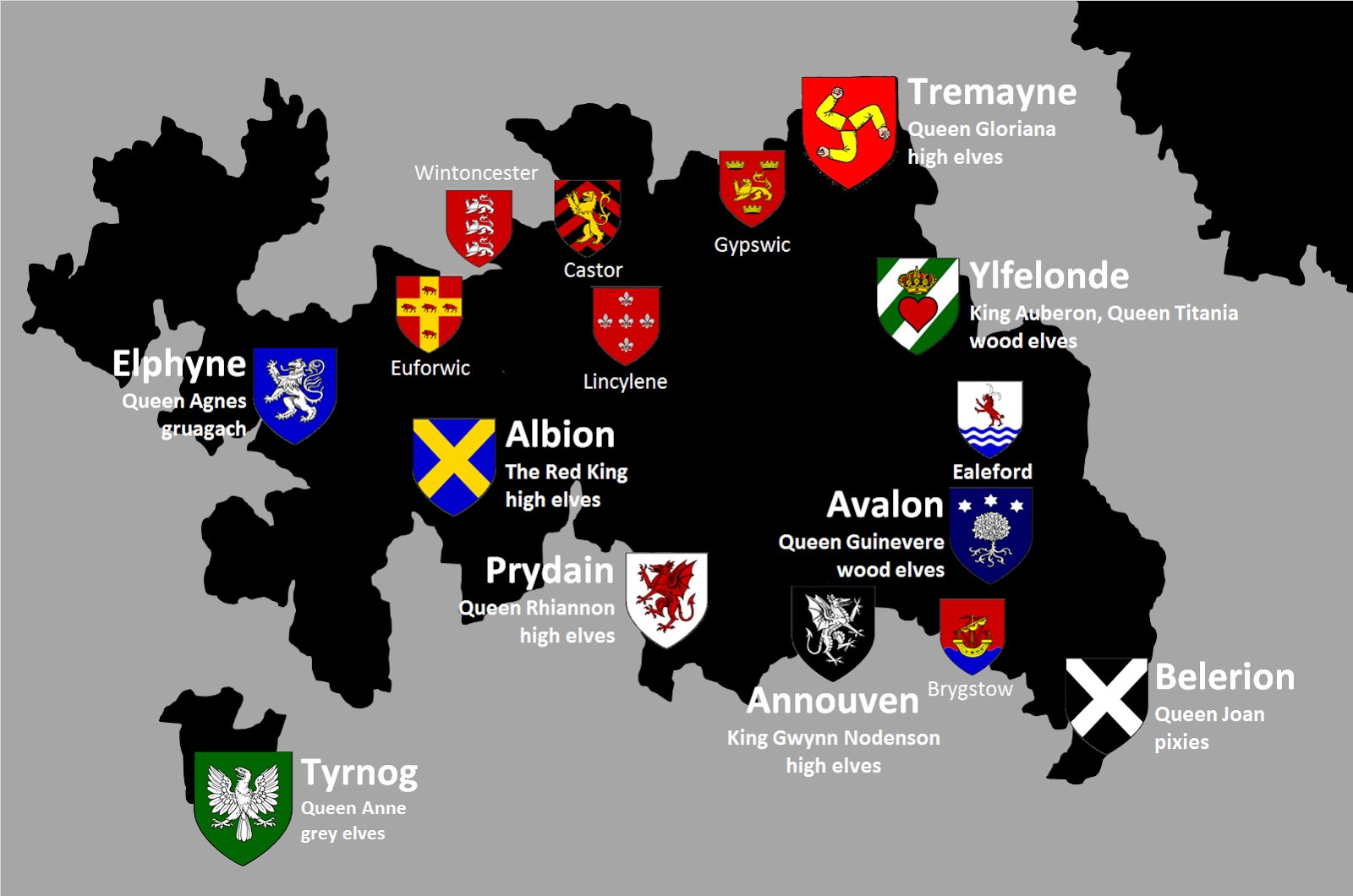
3324 OLD GROG | MONSTER

Old Grog the hill giant smith dwells here, keeping a forge, three unruly daughters and a motherly wife who could only kill a person with kindness, for she’s otherwise gentle as a lamb. Old Grog remembers the old ways, and he can breathe magic into his creations if he has the mind to – he’ll swap minor magic weapons and armor for tales well told (and a heap of gold). If somebody will promise to wed one of his daughters, he’ll make more powerful magic items. He keeps a giant spider on an unbreakable silver thread in his workshop as a guard animal and companion. The spider is well versed in elven poetry and gnomish limericks, and he has a fine baritone voice (for a spider).

Treasure: 150 pp, a silver hammer (80 gp).

3630 FOREST GIANTS | MONSTER

A band of fifteen forest giants and their mates dwells in a massive hall made of timber in this hex. The longhouse is surrounded by a wooden picket and a shallow moat, about 20 feet wide, filled with gooey mud and crossed by a drawbridge.

The forest giants have grey skin, no hair and emerald eyes. They dress in tunics and leggings, usually of green, brown, russet or grey, and wear cloaks. Forest giants are excellent bowmen, and carry large longbows and scimitars.

The forest giants have a love for ale and wine, and will gladly trade their guidance through the woods for intoxicants.

Treasure: 65 pp, 1,750 gp, a silver medallion set with a citrine (500 gp), a sable cloak with a golden clasp set with alexandrite (1,500 gp), a scroll of darkvision, a +1 shield (giant-sized), a potion of hide from undead, and a potion of remove paralysis.

3724 NOBRUN THE NECROMANCER | STRONGHOLD

The stronghold of Nobrun of the Glassy Eyes appears to be a cave set in a doughty granite hill topped by long, green grasses with a base surrounded by huckleberry bushes. The cave mouth is shaped like the maw of a demon, and there is the notable scent of sulfur surrounding the place.

If one approaches the cave mouth, a vrock demon is conjured. The vrock, Xerial, is Nobrun’s major domo. He will inquire as to the nature of the visit and peruse his scroll to see if the visitors are expected. If they are, he will permit them to enter the cave, at which point they will see a stone stair leading up to the top of the hill and a simple wooden door painted dull green. The door is wizard locked. Beyond the door, which appears to be attached to nothing, is the invisible tower of Nobrun.

Nobrun is a necromancer. He is inhumanly tall and thin, with long, bony fingers absolutely covered in rings. Some of the rings look valuable, others are made from human hair or meteoric iron and engraved with runes. The necromancer dresses in purple silk and black velvet, in the manner of a Spanish grandee. Nobrun is always heavily perfumed (usually lavender), and he has a long, black beard (he colors it) and strange, glassy eyes. One of his eyes has a permanent x-ray vision spell cast on it, while the other always sees with a faerie fire effect. He normally wears a patch lined with lead over the x-ray eye.

Nobrun lives alone, except for his army of zombies. All of them are shaved smooth and dyed purple, and dressed in black velvet doublets and leggings of silver maille. Nobrun is currently between apprentices.

3924 THE BOILING WELL | WONDER

A well in this hex produces great gouts of steam from the water, which nearly boils with magical energy. The water is about 20 feet below the surface, the well being constructed of grey stones that are slick with green slime that must be cleared before one can safely enter the well.

By bathing in the water for one minute (suffering 1d6 points of Constitution damage in the process), a magic-user or sorcerer gains the knowledge of a single weird spell. The spell remains lodged in a person’s mind for 24 hours. A sorcerer can add the spell to her natural repertoire if she has a spare spell slot, while a magic-user can scribe the spell on a scroll or in his spell book. Of course, they can also just cast the spell and discharge it from their mind permanently.

The second time a magic-user bathes in the well, the Constitution damage becomes Constitution drain. The third time, it becomes 1d6 points of energy drain. A fourth dip is fatal, turning the magician into a rampaging chaos beast.

The random spells learned from the well are:

D6 SPELL
1 Accursed Archer
2 Blasphemous Shield
3 Golden Torch
4 Hex of Diminution
5 Invocation of Righteous Anger
6 Unknowable Incantation of the Yellow Doors

ACCURSED ARCHER
Level: Magic-User 1
Range: Medium (150 ft.)
Duration: Concentration + 1 round

This spell forces a single opponent within range that is shooting or throwing missiles to automatically target one of his own allies. If he has no allies, the spell simply applies a -1 penalty to his attacks on non-allies.

BLASPHEMOUS SHIELD
Level: Magic-User 2
Range: Personal
Duration: 1 minute

This spell conjures a shield (much like the shield spell) before the spellcaster. The shield bears an image blasphemous to a single chosen cleric within sight of the magic-user.

The cleric must pass a Will saving throw each round he or she attempts to do anything but attack the bearer of the shield. The shield bearer enjoys AC 18 against the cleric’s attacks, and a +1 bonus to saving throws against the cleric’s spells. Spell that are saved against have a 25% chance of turning back on the spellcasting cleric.

GOLDEN TORCH
Level: Magic-User 2 (Lawful (Good))
Range: See below
Duration: 1 hour

A golden torch appears in the magician’s right hand (always the right hand, and there it must stay). It emits a golden glow with double the illumination of a normal torch, and emits positive energy in a 30-foot radius. This positive energy doubles the normal healing rate of living creatures and grants them a +1 bonus to save vs. poison, disease and death effects, forces undead creatures to pass a Will saving throw to enter the positive energy and imposes a -2 penalty to their Fortitude saving throws.

HEX OF DIMINUTION
Level: Magic-User 4
Range: Touch
Duration: Instantaneous

This hex slowly shrinks a creature down to tiny size. Each hour, the creature’s size category is reduced by one. The spell is permanent, though it can be reversed with one or several permanent enlarge person spells, dispel magic or wish. The creature’s equipment does not shrink with him or her.

INVOCATION OF RIGHTEOUS ANGER
Level: Magic-User 5
Range: Personal
Duration: 1 minute

As the cleric spell righteous might, save that the magic-user is unable to cast spells while enlarged.

UNKNOWABLE INCANTATION OF THE YELLOW DOORS
Level: Magic-User 6
Range: Personal
Duration: See below

Often used as a last ditch effort to escape certain doom, the unknowable incantation is a dangerous spell. When cast, the magic-user is surrounded by walls of black energy (negative energy, in fact) with four yellow portals placed to the north, south, east and west. The black walls form a circle with a 20-ft diameter, and they rise 20 feet before ending in a ceiling.

Touching the walls causes 1d6 points of energy drain. Each round, the walls and ceiling contract, moving inward by 5 feet (the movement is actually fluid, not all at once). If they close in on a creature, it is killed unless it is immune to energy drain, in which case it left unharmed.

The walls can be avoided by entering one of the yellow portals. Each portal leads to a random plane, elemental or outer. The magic-user has no control over where the doors lead, nor has he any knowledge of where they lead. Once a door is touched, a person is transported to that plane. There is a 5% chance that the door deposits the person before a power of that plane.

Misspells

Bonus XP if you know who this is!

When you write as much as I do, you get used to dealing with typographical errors. Some of them are rather amusing – I remember one blog post in which some room trap involved a wench rather than a winch lifting something heavy. I suppose anybody who has ever visited modern D&D message boards knows about that game’s very mysterious “rouge” class (which I have now decided I am going to write).

One area in which I have made more than a few errors, and repeated errors at that, is with spell names. Sometimes, these screwed up spell names actually make a sort of weird sense, and it occurred to me that errors in spelling on scrolls might lead to some amusement in a game of D&D (et. al.) Grammatically incorrect scrolls could be a new category of cursed magic item – the magic-user thinks they’re casting one thing, but discover their spell has a different effect.

A few ideas follow:

Altar Self: The caster is turned into an altar for the duration of the spell. Note sure if I want to know where the holy water comes from.

Animate Trope: This one takes some work for the GM. Think of a role playing trope and make it come to life (literally) during the game.

Baste: Warm meat juice is squirted on the caster, making them more delicious and stickier.

Blank: The caster’s face disappears for the duration of the spell.

Cane of Cold: A walking stick made of ice appears in your hand. Feel free to shake it angrily at your foes.

Charm Parson: As charm person, but it only works on clerics and druids (and the like).

Dorkness: The lights stay on, but the caster becomes socially awkward (Charisma 5) for duration of the spell.

Find Familiar: More of an incorrect inflection than misspelling, this spell causes they caster to find strangers strangely familiar. He just knows he knows them from somewhere, and it’s maddening that he cannot think of who they are. As a result of this frustration, he suffers a -1 penalty to Will saves for the duration of the spell.

Obscuring Mast: The mast of a ship grows from the ground right in front of somebody, obscuring their vision until they move out of the way.

Slaw: A jar of coleslaw appears.

Spectral Ham: A ghostly swine appears and otherwise acts as the spectral hand spell. This one might be an improvement over the original.

Summon Munster: Roll randomly on a d10: (1-2) Herman (i.e. a goofy flesh golem); (3-4) Grandpa (i.e. a vampire); (5-6) Eddie (i.e. a 1 HD werewolf); (7-8) Lily (not sure here – she’s Dracula’s daughter); (9-10) Marilyn (i.e. human female with high Charisma).

Tireball: A belted radial is launched bouncing towards a target point, and then explodes with a loud noise, sending shreds of rubber out. Basically as a fireball, without the “fire” damage and dealing minimum damage within the blast radius.

Have at it folks – I’m sure these can be improved upon and better versions can be invented.

Holy Moses, It’s a New Class!

Yes, a new class … probably the last new class of 2014 … based on Moses, that fellow who parted the Red Sea and held the Ten Commandments.

At least, it’s based a little on Moses, and a little on other old time prophets. In essence, it’s a non-warrior cleric with more flexibility in terms of spells, but fewer spells to choose from.

In a moment, the class. First, a couple words from our sponsor (which happens to be me)

Two new e-books up on Lulu over the past couple days. The long awaited (well, by me anyways – took me forever to finish it) NOD 24, and the even longer-awaited (again, by me) Bloody Basic – Contemporary Edition. From my descriptions on Lulu.com …

BLOODY BASIC – CONTEMPORARY EDITION

Bloody Basic takes the advanced Blood & Treasure Fantasy Role Playing rules and boils them down to the essentials to make gaming easy, fast and fun. The Contemporary Edition rules include rules for the contemporary races, classes, spells and monsters of fantasy role playing, including automatons, drakkens, gnomes, fighters, sorcerers, clerics and thieves. $4.99 for 44 pages

NOD 24

2014 comes to a close with the 24th issue of NOD! In this issue, we continue the Ende hex crawl started in NOD 23, detail some Indian divinities, get into some court intrigue, make monsters with a dictionary, explore the ancient Red Sea as a campaign setting, tangle with space genies, and meet some 1920’s superheroes called the Roustabouts. 80 pages. $4.39 for 80 pages

Wow! What amazing bargains (if you’re into this kind of thing).

Now, back to our program!

The prophet is a cleric who goes way back … all the way to Moses in fact. The prophet is destined to be a religious leader of a people, if he or she can live long enough. Starting out in life, they are touched by a deity and tasked with leading their chosen people, or converting their chosen people, to their worship. They must eventually lead these people into the wilderness to found a new kingdom for them. The deity in question should be one that is, as yet, minor in stature, or a major deity that has largely been forgotten by his or her chosen people.

Obviously, this class is based on Moses. I won’t go over the story of Moses – it’s easy enough to find – but suffice to say he was a prince who discovered his true heritage and was chosen by God to lead his people through the Wilderness to the Promised Land. As an emissary for God on Earth, he could perform miracles, and as a man that was raised in a royal house, he had a good deal of non-spiritual leadership ability.

The prophet class has an innate ability to commune with the divine, a spell list based on the miracles attributed to Moses, other Biblical prophets and Christian saints. You’ll notice quite a bit of overlap with the normal cleric’s spell list. The prophet begins life as an aristocrat, and that means he has some capacity for fighting and leading people. His leadership abilities will continue to improve as he gains levels, though his fighting ability will improve more slowly. Prophets are not meant to be front-line warriors. A prophet’s spellcasting ability is in some ways more limited than a cleric’s, and in others superior.

Restrictions: Wisdom 13+, Charisma 9+, alignment must be LG, LN or LE

Hit Dice: d8 at first level, d6 at each level afterwards

Skills: Decipher Codes, Find Secret Doors

Weapons: Any*

Armor: Any*

Prophets are trained in the use of all arms and armor, but using arms and armor not allowed to a magic-user represents a lack of faith in their deity, and imposes a spell failure chance on them (cumulative):

Non-permissible light weapon +5%
Non-permissible medium weapon +10%
Non-permissible heavy weapon +15%
Non-permissible light armor +10%
Non-permissible medium armor +20%
Non-permissible heavy armor +30%

Spell failure chance should be rolled when the prophet beseeches her deity for a miracle. If the spell fails, the deity chooses to ignore her.

A prophet does not technically cast spells. Rather, he asks for miracles. A prophet is allowed a limited number of miracles of each miracle level per day. He does not need to memorize or prepare miracles, as long as he has access to a level of miracles, he can ask for any of them. The prophets’ miracles are listed at the end of this article.

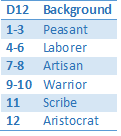
Besides adventuring to earn money and power, a prophet’s most important job is to amass followers. To this end, a prophet must preach before multitudes, attempting to either convert them to his new faith, or reawaken them to an old faith. Treat conversion as a Charisma task in which the prophet is skilled.

The prophet can attempt to groups of 0 to 1 HD creatures, or individuals with more than 1 hit dice. With groups, the prophet makes a Charisma task check and, if successful, converts a number of followers equal to his 1d4 plus his level. Difficulties include differences in ethical alignment (law – neutral – chaos) and moral alignment (good – neutral – evil), or the people being strongly dedicated to another faith. The same basic process is used for individuals, with an additional penalty equal to the each level the target is higher than the prophet.

When 0 or 1 hit dice individuals join the prophet’s cult, you might need to determine what they are:

There is a 1 in 6 chance per person that they are wholly dedicated to their new faith, and need never check their morale. Others, however, may lose faith in the face of hardships (as determined by the TK). When this happens, the prophet must make a new conversion task check for each individual. If he fails, they decide to return to their homes and their old way of life.

A prophet must take care of his followers. He must provide food and water for them, protect them, provide some manner of shelter (tents at a minimum), and heal them when they are wounded or sick.

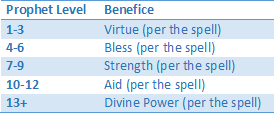
For one battle per day, the prophet can grant a benefice to his warriors in battle. As the prophet’s level increases, he gains additional benefices he can grant. Each benefice can be granted to one battle per day, and only one benefice can be granted per battle.

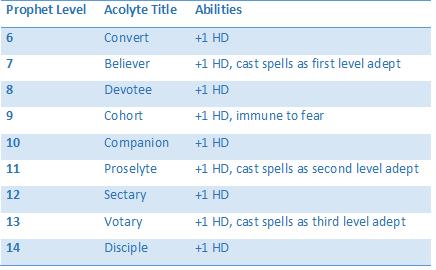
At 6th level, one of the prophet’s existing followers can become his acolyte. The prophet’s acolyte becomes a lesser divine servant of the prophet’s deity, gaining abilities as the prophet gains abilities.

A prophet with fewer than 10 followers by 6th level must perform a quest for his deity or lose his ability to request miracles. Likewise a prophet with fewer than 25 followers at 7th level, fewer than 50 followers at 8th level, and fewer than 100 followers at 9th level and each level beyond 9th.

A prophet that is killed might enjoy an apotheosis upon death. There is a 5% chance per level of the prophet. When an apotheosis occurs, the prophet transforms into an outsider of similar alignment with roughly as many Hit Dice as the prophet +1. In this form, the prophet remains in the material plane for one minute per level. Thereafter, he is called to his home plane and disappears forever unless resurrected. If resurrected, the prophet returns in his original body, not as an outsider.

FIRST LEVEL MIRACLES
1. Aid
2. Bless
3. Comprehend Languages
4. Control Light
5. Cure Light Wounds
6. Multiply Food and Water
7. Protection from Evil
8. Summon Nature’s Ally I
9. Sustenance
10. Turn Undead

SECOND LEVEL MIRACLES
1. Augury
2. Buoyancy
3. Calm Emotions
4. Consecrate
5. Cure Moderate Wounds
6. Detect Thoughts (ESP)
7. Gentle Repose
8. Levitate
9. Remove Paralysis
10. Speak with Animals
11. Summon Nature’s Ally II
12. Summon Swarm

THIRD LEVEL MIRACLES
1. Cause Disease
2. Create Food and Water
3. Cure Blindness/Deafness
4. Cure Disease
5. Cure Serious Wounds
6. Fly
7. Hold Person
8. Remove Curse
9. Summon Nature’s Ally III
10. Tongues
11. Water Walk

FOURTH LEVEL MIRACLES
1. Blight
2. Charm Monster
3. Control Water
4. Cure Critical Wounds
5. Divination
6. Flame Strike
7. Holy Smite
8. Restoration
9. Sticks to Snakes

FIFTH LEVEL MIRACLES
1. Awaken
2. Bilocation
3. Commune
4. Contact Other Plane
5. Healing Circle
6. Hold Monster
7. Insect Plague
8. Raise Dead

SIXTH LEVEL MIRACLES
1. Banishment
2. Geas
3. Move Earth
4. Wind Walk

SEVENTH LEVEL MIRACLES
1. Control Weather
2. Create Clay Golem
3. Transmute Matter

EIGHTH LEVEL MIRACLES
1. Earthquake
2. Holy Aura

NINTH LEVEL MIRACLES
1. Astral Projection

NEW SPELLS

BILOCATION
Level: 5
Range: Personal
Duration: 1 minute

For one minute, the prophet can be in two places at once. Each version of the prophet can carry out movement and actions as normal. The second version can appear within 1 mile per prophet level of the first. When the second version disappears, any damage or other effects he sustained, or any items he took possession of, return to the first version.

BUOYANCY
Level: 2
Range: Close (30 ft.)
Duration: 1 minute

One object within 30 feet designated by the caster becomes buoyant in water, and floats to the surface.

CREATE CLAY GOLEM
Level: 7
Range: Touch
Duration: 10 minutes per level

By fashioning a roughly human-sized and shaped object out of clay and inscribing a magic sigil on its head, the prophet can cause it to become a clay golem for 10 minutes per prophet level.

MULTIPLY FOOD & WATER
Level: 1
Range: Touch
Duration: Instantaneous

This miracle takes existing food and water and multiplies, creating one extra portion per prophet level.

SUSTENANCE
Level: 1
Range: Personal
Duration: Instantaneous

The prophet can go without food, drink and sleep for one day, but must sacrifice one point of constitution to do so. This constitution point cannot be healed while any casting of this spell is in effect. A prophet could, therefore, use sustenance for seven days straight, but would be without seven points of constitution on the seventh day, and would suffer the normal effects of a lower constitution. Constitution points sacrificed for this spell return at the rate of one per day of rest.

TRANSMUTE MATTER
Level: 7
Range: Touch
Duration: 24 hours

The prophet can transmute matter from one form to another, thus lead to gold or steel to adamantine. The effect lasts for 24 hours. At the end of this time, the object must pass an item saving throw (as its original matter) or disintegrate.


Saving Some Gold Pieces (and a Spell)

Boys and girls, if you’ve been waiting to buy some of my print products, you may be in luck. Lulu is running a sale through November 27th ..

And on November 27th, I’m going to throw in some markdowns of my own for the holiday season. You’ll find the link to my storefront on the side over there.

Don’t forget, if you buy a hard cover book, I’ll send you a free PDF of that book.
And now, to keep this post from being nothing but a commercial, I will make up a magic spell …

Wind Tunnel
Level: Cleric 5, Druid 4, Magic-User 5
Range: Centered on caster
Duration: 1 minute

This spell creates a tunnel of powerful winds extending 10 feet per level ahead and behind the spellcaster. The tunnel is large enough for the spellcaster to walk through normally, though it obviously cannot be larger than the chamber or passage which the spellcaster currently occupies. Missile weapons, gases and breath weapons are deflected by the wind tunnel. Creatures outside the tunnel trying to force their way through the tunnel suffer the effects of entering a huge air elemental’s whirlwind. The caster can decide if creatures grabbed by the wind tunnel are carried forward or backward and then deposited on the ground, prone, where the tunnel ends.If the tunnel is not created on solid ground, the spellcaster’s comrades (though not the spellcaster, on whom the spell is centered) might fall into the winds themselves (in other words, it cannot be used to create a bridge across a chasm unless the spellcaster’s comrades want to ride the winds across).

(Essentially, this is a variation on, and enhancement of the wind wall spell).

Odds and Ends (or Monster and Spells to be Precise)

SINOOZE

Large Ooze, Neutral (N), Non-Intelligent; Solitary

HD 8
AC 12
ATK Slam (1d6 + 1d6 acid)
MV see below
SV F10 R11 W11
XP 800 (CL 9)

Sinooze is an ooze that seeks out skeletal remains. It oozes over them and penetrates the bones with microscopic feelers, absorbing and reading the DNA. Using this information, it expands and takes the shape of the creature’s musculature.

The sinooze attacks and moves as the creature whose bones it animated. In addition, the monster deals acid damage when it successfully strikes. This acid damages organic materials and metal, but not stone.

Sinooze are flammable. When struck with fire, it suffers half damage, but is lit on fire. Subsequent successful attacks by the monster deal 1d6 points of fire damage. The monster continues to suffer 1d3 points of fire damage each round while ablaze.

Cold damage forces the ooze to pass a Fortitude saving throw or become thick and sluggish. Its movement is cut in half, and it becomes vulnerable to bludgeoning damage (i.e. takes full instead of half damage).

Special Qualities: Resistance to fire, weapon resistance

Bite of the Wolf
Level: Druid 2
Range: Personal
Duration: 1 hour

The druid’s mouth becomes a wolf’s muzzle. The druid gains a bite attack that deals 1d4 points of damage. Victims of the attack must pass a Reflex save or be tripped and knocked prone.

Coils of the Constrictor
Level: Druid 2
Range: Personal
Duration: 1 hour

The druid’s body becomes sinuous and flexible. On a successful grapple attack, the druid deals 1d4 points of damage and constricts his opponent for 1d4 points of damage per round until the grapple is broken.

Dwarfblood (Transmutation)
Level: Magic-User 1
Range: Personal
Duration: 1 hour

For one hour, the magic-user gains the special racial abilities of a dwarf.

Elfblood (Transmutation)
Level: Magic-User 2
Range: Personal
Duration: 1 hour

For one hour, the magic-user gains the special racial abilities of a elf.

Fangs of the Viper
Level: Druid 3
Range: Personal
Duration: 1 hour

The druid’s mouth becomes fanged. The druid gains a bite attack that deals 1d3 points of damage and injects Poison III into the victim.

Flashing Blade (Transmutation)
Level: Magic-User 1
Area of Effect: One blade
Duration: 1 hour

This spell can be cast on one medium or large blade, which must be touched by the magic-user. For one hour, the blade shines with a bright, blinding light. When the sword is used for an unsuccessful attack, the target of the attack must pass a Reflex save or be blinded until the end of the next round.

Foreboding (Illusion)
Level: Magic-User 2
Range: 30 feet
Area of Effect: One creature
Duration: 6 hours

The target of this spell has terrible feeling of foreboding. While under the effects of the spell, she believes every find trap task check she makes succeeds (i.e. finds a trap), every remove trap task check fails, and all listen at doors task checks result in her hearing weird, threatening noises on the other side of the door.

Gnomeblood (Transmutation)
Level: Magic-User 2
Range: Personal
Duration: 1 hour

For one hour, the magic-user gains the special racial abilities of a gnome.

Horns of the Rhino
Level: Druid 3
Range: Personal
Duration: 1 hour

The druid’s nose and forehead broaden and grow a fierce horn. The druid gains a gore attack that deals 1d8 points of damage. Every gore attack counts as a bull rush attack.

Horseless Carriage (Conjuration)
Level: Magic-User 4
Range: Object touched
Duration: 1 hour

By touching a wagon or similar wheeled conveyance, you imbue with the ability to move on its own. The wagon moves by your command, and in much the same way as a horse would, save that the wagon operates by voice command. For every three levels you possess, the wagon is moved by the equivalent of one horse (i.e. gains one horsepower). A 7th level magic-user could conjure up two horsepower, while a 12th level magic-user could conjure up four horsepower.

Hover (Transmutation)
Level: Magic-User 3
Range: Personal or close
Duration: 1 hour

This spell works like the levitate spell, except that it gives the recipient of the spell the ability to move at a movement rate of 20 forward and backward, and the recipient of the spell only levitates 6 inches above a solid or liquid surface.

Hug of the Bear
Level: Druid 3
Range: Personal
Duration: 1 hour

The druid’s arms become large and furry, and tipped with claws. The druid gains two claw attack each round that deals 1d6 points of damage. If both claw attacks hit a foe, they are automatically grappled.

Monstrous Mein (Transmutation)
Level: Magic-User 3
Range: Personal
Duration: 10 minutes

The magic-user’s creature type changes to monstrous humanoid. The magic-user gains darkvision to a range of 60 feet, is no longer affected by spells that affect humanoids (such as charm person), and gains a +2 bonus on Reflex saving throws. In addition, their visage becomes monstrous, and normal humans and men-at-arms must pass a Will saving throw upon seeing them or become frightened for 1d4 rounds.

Phantom Banker (Transmutation)
Level: Magic-User 2
Range: Close (30 feet)
Duration: Permanent

The magic-user changes one form of currency into the next higher form of currency, thus copper pieces into silver pieces, silver pieces into gold pieces, and gold pieces into platinum pieces. The total value of the coins does not change, thus 100 copper pieces can be changed into 10 silver pieces. Another use of the spell could then turn those 10 silver pieces into a single gold piece.

Polymath (Transmutation)
Level: Magic-User 3
Range: Personal
Duration: 1 hour per level

For the duration of this spell, the magic-user becomes a cleric, fighter or thief of her same level. The magic-user loses all magic-user abilities and restrictions for the duration of the spell, and for this reason they cannot end the spell early – the duration of the effect must be set by them when the cast the spell, up to one hour per level. While in their new class, they gain it’s hit dice (and thus re-roll hit points), saving throws, armor and weapon restrictions, special abilities, etc.

Polymath, Advanced (Transmutation)
Level: Magic-User 5
Range: Personal
Duration: 1 hour per level

As polymath, except the magic-user can become a multi-classed cleric/magic-user, fighter/magic-user or thief/magic-user of one level lower than their magic-user level (follow all normal multi-classing rules), or they can become a bard, ranger, barbarian, druid, assassin, etc. of one level lower than their magic-user level.

Potent Potables (Transmutation)
Level: Magic-User 2
Range: Close (30 feet)
Duration: 1 hour

All liquids within range of the magic-user take on the properties of alcohol for one hour. The liquids still taste the same, and potions still work as advertised, but the imbiber must pass a Fortitude saving throw or become drunk (treat as fatigued, but the player also has to slur their words when the speak and give out a loud, fake hiccup every so often – it’s called verisimilitude dude!)

Pussycat! (Transmutation)
Level: Magic-User 5
Range: Close (30 feet)
Duration: 1 minute

When the magic-user yells “pussycat!”, the most powerful creature (by number of levels or hit dice) is polymorphed into a normal cat for one minute, and it must pass a Will save or be frightened for the duration of the spell.

Quills of the Porcupine
Level: Druid 3
Range: Personal
Duration: 1 hour

The druid grows quills from his back and the back of his head and arms. When they make a successful bull rush attack, they deal an additional 1d6 points of damage, and creatures that miss them in melee combat must pass a Reflex saving throw or suffer 1 point of damage. The druid’s clothing is ruined by this spell, and she cannot cast it while wearing armor.

Sepulchral Power (Transmutation)
Level: Magic-User 5
Range: Personal
Duration: 10 minutes

The magic-user’s creature type changes to undead. The magic-user gains darkvision to a range of 60 feet, is no longer affected by spells that affect humanoids (such as charm person), is immune to illusions and mind-affecting effects, poison, sleep effects, paralysis, disease, stunning attacks, and gains a +2 bonus on Fortitude saving throws. They are still affected by death effects, but are now healed by negative energy and damaged by positive energy. Their appearance becomes gray and decayed, and normal humans and men-at-arms must pass a Will saving throw upon seeing them or become frightened for 1d6 rounds. As undead, they are liable to be turned or rebuked (and thus destroyed or controlled) by clerics and other classes with those abilities.

Spikes (Conjuration)
Level: Magic-User 2, Druid 2
Range: Touch
Duration: 1 hour

Armor touched by the spellcaster gains armor spikes, per the normal rules for armor spikes.

Supernumerary (Divination)
Level: Magic-User 2
Range: Close (30 feet)
Duration: Instantaneous

The magic-user instantly ascertains the exact quantity of one type of item within range, for example all the coins in an area by type.

Telecommunication (Conjuration)
Level: Magic-User 2
Range: Touch
Duration: 1 hour

The magic-user turns two cans, glasses, jars, etc. touched into a “telephone”. The objects are connected by an ethereal “wire” up to 1 mile long, and essentially work as though they were two tin cans connected by a string. There is some danger connected with this spell. When people communicate through it, they send out vibrations into the ethereal plane, and there is a 5% chance per conversation of attracting the attention of a wandering ethereal filcher.

Whitefoot
Level: Druid 2, Ranger 2
Range: Close (30 feet)
Duration: 1 hour

One creature within range leaves white tracks – as though it stepped in white paint – wherever it goes for one hour. This makes tracking a snap under most conditions.

Nodian Grimoire – Four New Spells

Image found HERE

I don’t invent all that many new spells – there are already so many of them, and I find that new ones often go unprepared because they’re a bit too niche – in other words, players don’t know what’s coming, so they tend to prepare the most tried and true spells for their clerics and magic-users.

That being said, a few ideas recently popped into my head, so I figured I would write them up.

ANIMATE ROOM

Level: Cleric 8
Range: Immediate area
Duration: 1 hour

This spell works much as animate object, except that it animates an entire room as a single monster. The room has the statistics of a huge animated object, and can use the objects within it as weapons to attack.

GODLY VISAGE

Level: Cleric 6
Range: Personal
Duration: 1 minute

The cleric takes on the physical form of his or her patron deity for one minute. Their equipment might change its form, but not its properties, magical or mundane (i.e. chainmail may look like +3 platemail, but it still acts like normal chainmail). Followers and enemies of the god or goddess must pass a Will saving throw or be stunned. This state lasts until the “deity” is hit in combat and damaged, or the “deity” or any of the “deity’s” allies attack the stunned creatures.

In addition to looking like their deity, the cleric gains the following special abilities: Suffer half damage from non-magical weapons and attacks, enjoys 5% spell resistance, and gains one special attack associated with their deity. This special attack should be no more powerful than a 3rd level spell, and can be used once.

QUID PRO QUO

Level: Magic-User 6
Range: Personal
Duration: 24 hours

By casting this spell, a magic-user declares a trigger spell, and the spell that will be triggered when that spell is cast in the magic-user’s presence, but not by the magic-user herself. Once this spell is cast, the effect lasts for 24 hours. If during that time any creature casts the trigger spell (hereafter known as the triggerer), instead of the trigger spell’s effect, a different spell is cast, with quid pro quo’s caster as the origin of the spell and the triggerer as the target (if applicable).

THIN AIR

Level: Magic-User 3
Area: One 3-ft. x 3-ft. x 3-ft. cube per level (max 30-ft. cube)
Duration: 1 minute

You rob the air within the area of effect of oxygen. You can move the area of effect while the spell lasts by concentrating on it – this concentration precludes other actions. Creatures within the thin air that engage in strenuous activity (running, climbing, fighting, etc.) must pass a Fortitude saving throw each round or become fatigued. A fatigued creature must continue to attempt Fortitude saving throws to avoid becoming dazed. Dazes creatures must continue to attempt Fortitude saving throws to avoid becoming unconscious. This unconscious state lasts for as long as the creature remains in the thin air, and 1d6 rounds thereafter.

Grand Curses

First post of 2014!!!

GRAND CURSES

Sometimes a simple spell just is not enough. Sometimes, that damn village that ran you out of town because your barbarian is a half-orc needs to learn what for. Sometimes that pompous duchess who stiffed you after you slayed the local dragon needs to find out you’re not to be messed with. Sometimes, a simple spell is not enough – you need a Grand Curse!

Grand curses are not unlike normal spells in their overall effect, but they strike many more targets than a normal spell. Grand curses spread like plagues. They are cast on a single person and from that person affect all others with which they have contact. In this way, a grand curse can impact virtually every person in a village, town, castle or even kingdom. Grand curses are no more difficult than the normal spells they mimic, but their cost is much higher for the spellcaster.

A spellcaster can turn any spell he or she knows into a grand curse. To do so, they must know the spell the grand curse is to mimic, and they must be willing to sacrifice a pound of their own flesh, metaphorically. Each person affected by a grand curse costs the original spellcaster 10 experience points per level of the mimicked spell. Affected, in this case, means any creature forced to attempt a saving throw versus the spell. If a village of 100 people is affected, for example, by a sleep spell in the form of a grand curse, the spellcaster would lose 4,000 XP. These lost XP can force a spellcaster to lose a level, so when you unleash a grand curse, beware! In addition, the grand curse counts as a spell four levels higher than the spell it mimics.

In all cases, the spellcaster casts the grand curse at one initial victim. This person receives a normal saving throw, but at a -4 penalty. If they pass their saving throw, the grand curse fails. Otherwise, they suffer the effects of the spell with a permanent duration until dispelled with dispel magic spell or remove curse. Each person that sees or has some sort of contact with the victim of the grand curse while they are feeling its effects must succeed at a saving throw themselves or become a victim of the grand curse themselves. The effects of the grand curse affect a victim 1d6 turns (i.e. 10-60 minutes) after they fail their saving throw, so it is possible for the victims to move about quite a bit – all the better to spread the curse.

And before you ask – yes, grand curses must have a negative effect on their victims. No cursing people with cure light wounds!

The following are examples of grand curses.

Beauty’s Sleep
Level: Magic-User 4

This grand curse mimics the sleep spell. Each person that sees a sleeping victim of the spell must pass a Will saving throw or fall to sleep themselves.

Black Mood
Level: Magic-User 8

This grand curse mimics the crushing despair spell. Each person that sees a weeping or otherwise saddened victim of the spell must pass a Will saving throw or fall into despair themselves.

Confusion of Tongues
Level: Magic-User 7

This grand curse mimics the garble spell. Each person that speaks with an addle-brained victim of the spell must pass a Will saving throw or become addle-brained themselves. The garble spell appears in The NOD Companion.

Danse Macabre
Level: Cleric 7

This grand curse mimics the cause disease spell. Each person that comes within 10 feet of a diseased victim of the spell must pass a Will saving throw or fall sick themselves.

Infectious Laughter
Level: Magic-User 6

This grand curse mimics the hideous laughter spell. Each person that hears a laughing victim of the spell must pass a Will saving throw or laugh themselves.

Mass Hysteria
Level: Magic-User 8

This grand curse mimics the confusion spell. Each person that comes within 10 feet of a confused victim of the spell must pass a Will saving throw or become confused themselves.

Plague of Accidents
Level: Magic-User 8

This grand curse mimics the fumble spell. Each person that sees a person drop something must pass a Will saving throw or become clumsy themselves. The fumble spell appears in The NOD Companion.

St Vitus’ Dance
Level: Magic-User 12

This grand curse mimics the irresistible dance spell. Each person that sees a dancing victim of the spell must pass a Will saving throw or dance themselves. Oh, and I know – there are no 12th level spells – but damn this would be cool. Maybe save it for an evil demigod.

It’s a Nice Day for a White Wizard

Yeah, I should probably be shot for that title.

So, a couple days ago I posted a spell list for “black magicians” that was based on the supposed powers that the demons in De Plancy’s Infernal Dictionary could bestow upon a conjurer. In ACTION X, these magic-users, officially called black magicians or conjurers, are Charisma-based spellcasters, meaning they will make a charisma-based task check to cast spells.

The flip side of these folks are the white magicians, or theurgists, who are Wisdom-based. Same rules for spellcasting, but a different key ability and a different spell list. For the white magicians, I decided to delve primarily into reputed miracles, both from the Old and New Testaments in the Bible, and from what I could glean from the lives of the saints and a few notions tucked in from the druids. If you were running a campaign with somewhat Biblical clerics, you might find this list useful. I think it’s a pretty fun mix of God’s mercy and God’s wrath, and isn’t completely foreign to what is expected from a fantasy cleric.

FIRST LEVEL
1. Aid
2. Bless
3. Comprehend Languages
4. Control Light
5. Cure Light Wounds
6. Multiply Food and Water
7. Protection from Evil
8. Summon Nature’s Ally I
9. Sustenance
10. Turn Undead

SECOND LEVEL
1. Augury
2. Buoyancy
3. Calm Emotions
4. Consecrate
5. Cure Moderate Wounds
6. Detect Thoughts (ESP)
7. Gentle Repose
8. Levitate
9. Remove Paralysis
10. Speak with Animals
11. Summon Nature’s Ally II
12. Summon Swarm

THIRD LEVEL
1. Cause Disease
2. Create Food and Water
3. Cure Blindness/Deafness
4. Cure Disease
5. Cure Serious Wounds
6. Fly
7. Hold Person
8. Remove Curse
9. Summon Nature’s Ally III
10. Tongues
11. Water Walk

FOURTH LEVEL
1. Blight
2. Charm Monster
3. Control Water
4. Cure Critical Wounds
5. Divination
6. Flame Strike
7. Holy Smite
8. Restoration
9. Sticks to Snakes

FIFTH LEVEL
1. Awaken
2. Bilocation
3. Commune
4. Contact Other Plane
5. Healing Circle
6. Hold Monster
7. Insect Plague
8. Raise Dead

SIXTH LEVEL
1. Banishment
2. Geas
3. Move Earth
4. Wind Walk

SEVENTH LEVEL
1. Control Weather
2. Create Golem
3. Transmute Matter

EIGHTH LEVEL
1. Earthquake
2. Holy Aura

NINTH LEVEL
1. Astral Projection

NEW SPELLS

Bilocation – A trick of the saints and apparently noted in psychic phenomena, this is the ability to be in two places at once. I aim to make this a non-combat spell – the point would be to allow the magician to simultaneously accomplish two tasks.

Buoyancy – There is a tale of a miracle that involved making a metal object dropped into a river float to the surface.

Create Golem – A clay golem, to be precise.

Multiply Food & Water – This is based, obviously, on the loaves and fishes episode.

Sustenance – This would allow the magician to go without food and drink (and maybe sleep) without suffering any negative consequences.

Transmute Matter – In the Black Magic post, I mentioned Transmute Metal and Transmute Liquid. Since spells in ACTION X are not prepared ahead of time, creating scarcity and thus more challenging game play by multiplying the number of spells, it seems to me I might as well combine those spells into a Transmute Matter spell.

Turn Undead – Yes, in ACTION X it’s a spell.

Now, if we have charismatic Conjurers and wise Theurgists, who uses intelligence? Well, besides the non-magical brainiacs and hackers, it’s the psions of course. I’ll post the psion power list in a couple days.

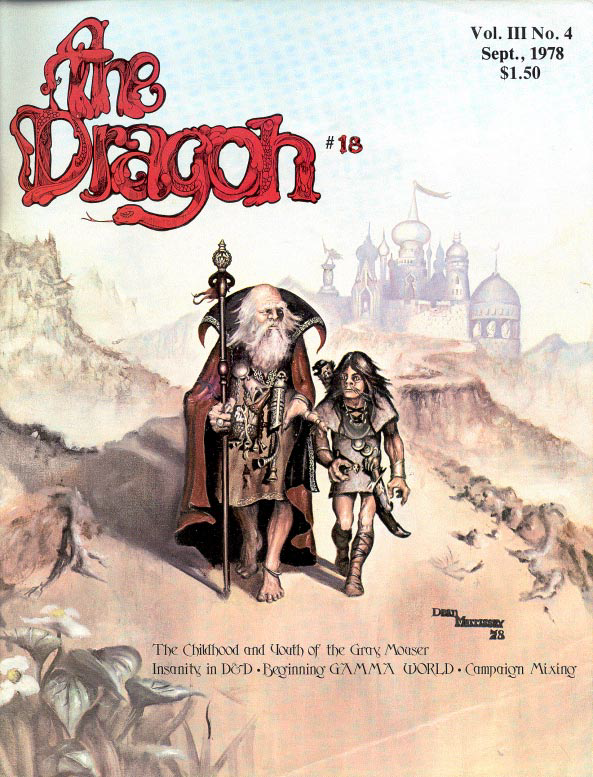
Dragon by Dragon – September 1978 (18)

Another week, another Dragon magazine. The last one was chock-full of stuff, how about this issue.

Traveller: The Strategy of Survival by Edward C. Cooper

As I was thinking, “I don’t remember any Traveller articles showing up before in The Dragon” I hit this line in the article, “I took advantage of the opportunity to observe the TRAVELLER phenomenon first hand” – ah – so this is at the dawn of Traveller.

I’ve never played Traveller, but I did create a character once (I was creating one character for every game I had a PDF of … though I skipped Exalted because after the first few steps I realized I just didn’t care enough to bother with it). This article appears to be about – well – keeping a character alive in Traveller. My favorite bit:

“Several other similar occurrences proved to me then that the success or failure of a character in most cases cannot be traced to “dice or chance” as often as it can to poor handling on the part of a player. I was both surprised and disappointed that some players even blamed a character or given situation for their own bad decisions. But then again, I was extremely excited, awed, by the skill some showed in manipulating their character’s life.”

That hits the spot for an old schooler – though it also shows that there were plenty of people back in the old days who were waiting for the new days with baited breath. Different strokes for different folks!

Reviews – Traveller, The Emerald Tablet, Imperium …

Well, imagine that! The reviewer appreciates that Traveller is not just D&D in space, but rather has its own “unique flavor and style”. The review is quite extensively, and I highly recommend it (yeah, I’m reviewing a review) for folks who don’t really know what Traveller is all about.

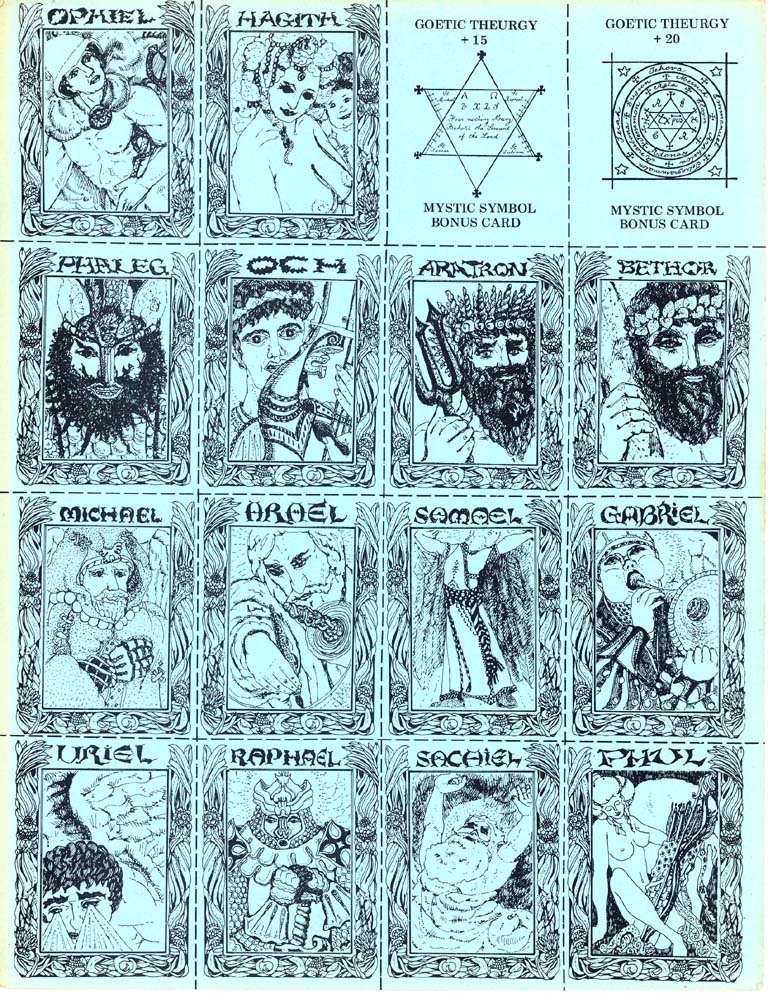
The Emerald Tablet is a set of fantasy wargame rules. The reviewer likes them, but admits he doesn’t know much about wargames. He likes that the magic system is based on ritual magic, which I know some people dig, but I always think it’s overrated. On the other hand – dig this sheet of Astral Force cards (click to enlarge … trust me, click it – click it now) I found at Boardgamegeek.com …

I don’t know what Phul does, but, hmm – anyways.

Imperium is another Game Designer’s Workshop product, a board game written by people who really love sci-fi literature. Apparently, Imperium is a game about the Terrans bumping up against the Imperium and the two sides fighting.

Pellic Quest is a computer moderated RPG (apparently a good thing, because computers are jerks like Dungeon Masters – see, the seeds of the new school were always there). Another sci-fi game, you start controlling a small planet in one of six roles (emperor, crusader, brigand, trader, droyds (robotic destroyers) or the zente (insect alien warriors). Each role needs different “winning points” and then go about making it happen.

Oh, and those zente …

Pretty sweet.

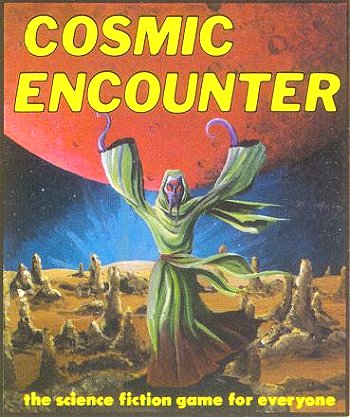
Cosmic Encounter is a sci-fi variation on draw poker.  Apparently it is simple and easy to learn, and, most importantly, fun, although the hype that one really has to get into the head of the alien race they control is wrong. The game combines several elements of classic, abstract games, and I want people who think they’re game designers to embrace this notion. Don’t begin with setting, begin with rules and get to know all sorts of old card games, board games, etc. Then apply setting to the game rules. This is how D&D was born and manages to remain so popular – it works as a game. Well, it used to, anyways.

INSANITY, or Why is My Character Eating Leaves? by Keven Thompson

A worthwhile article – insanity is tough to handle in games. Kevin Thompson devises first a saving throw vs. insanity (which makes sense given the time period). The saving throw is based on a matrix between Intelligence and Wisdom – find the number, add character level to it, and then try to roll 1d20 beneath that number. Neat idea (and I’ll be using it in a post this week).

If you fail the save, you roll d12 (always nice to see the d12) on an insanity chart.

INSANITY CHART

1. Nutty
2. Kleptomaniac
3. Perverse
4. Psychotic Hatred
5. Childlike Trusting
6. Schizoid
7. Severe Paranoia
8. Acute Paranoia
9. Gibbering
10. Suicidal
11. Violent
12. Catatonic

The good thing about this list is that it is more behavior based than clinical. It’s pretty easy to see how these “insanities” could impact actual play in a game.

New Spells in D&D! by Paul Suliin

(Love the use of the exclamation point)

This article introduces new spells created by an actual play group using the rules for spell research in Dragon #5. The editor chimes in with the admonition that every spell needs to have a loophole via which it can negated somehow.

The new spells include Nature Call, Magic Missile II, Moon Runes, Flamebolt, Mystic Rope, Pit of Flame, Word of Warding, Force Field, Extend I, Shatterray, Wall of Water, Extend II, Beam of Blasting, Conjure Djinn/Efreet, Density Control, Extend III, Combine I, Call Spirit, Rust Monster Touch and more.

Let’s convert a couple to Blood & Treasure

Magic Missile II
Level: Magic-User 2
Range: Medium (150 ft.)
Duration: Instantaneous

As magic missile, but this spell conjures either one +2 arrow or two +1 arrows, with a like amount added for every fifth level advanced beyond 3rd (i.e. two +2 arrows or four +1 arrows at 8th level, three +2 arrows or six +1 arrows at 13th level, etc.)

Density Control (which would also make a great power for Mystery Men!)
Level: Magic-User 6
Range: Personal
Duration: 3 minutes

The spellcaster can alter the density of his body from a gas to steel. Such changes alter the spellcaster’s Armor Class, so that at minimum density he is immune to physical weapons, and at maximum density he is AC 18 and his hands strike as swords (1d6 damage). Density may be altered throughout the duration of the spell, and items in contact with the spellcaster’s body when the spell is cast are altered along with him.

Magic: Governed by Laws of Theory by Thomas A. McCloud

Man, I used to roll my eyes at these when I was a kid – theory? dude, I want a new class, new race, new spells, new adventures, etc. But I’m an adult now, so … naw, I still think the same way.

This one attempts to draw inspiration on the how’s and why’s of magic in D&D by examining such sage tomes as the 1960 Encylcopedia Britannica and Frazer’s The Golden Bough. Dude – it’s a game. Of course magic is treated casually. Real estate is treated pretty casually in Monopoly because it’s also a game – move and countermove, risk taking, a random element. Don’t overthink it!

Let Your Town Have A Purpose, or, How To Design A Town In Boot Hill by Mike Crane

Sometimes I think Jay Ward wrote the titles of these articles (bonus Nod points to anyone who gets that reference). Mike covers the best scale (1″ = 20′) to draw the map, the need to think about why the town is there in terms of who settled it and what they do (dude, it’s there to give gunslingers a place to have gun fights), etc. To be completely honest, articles like this are a waste. A bunch of random tables for generating an Old West town would have been much more helpful, or just a suggestion of watching some old episodes of Bonanza. Sorry – guess I’m in a salty mood at the moment.

Reviews Continued … Alpha Omega

Okay, apparently we’re not done with reviews yet. Alpha Omega was Battleline’s first stab at a sci-fi game. The reviewer thinks it reminds him of Buck Rogers or Star Wars … and that’s not an endorsement, according to the reviewer. After all, if we can’t beat all the fun out of sci-fi and make it boring and cerebral, then what’s the f-ing point? (I am in a mood). Here’s a sample of the review …

Alpha Omega is billed as “A game of tactical combat in space,” a claim supported by the rules.

Okay then. Apparently, the art is superb on the counters, but they’re hard to read, and the scale (one hex equals one light second) and turn time (6 seconds) are weird for space fights. The game is also two-dimensional, rather than three-dimensional, although the reviewer doesn’t think three dimensions would have any bearing on the game, and thus might as well not be there. The game is really just naval combat on a board that looks like space. The weapons are not realistic (just names, really), so the game also lacks believability (a bugaboo that has never bothered me personally) – hell, they named a couple alien ships Akroid and Balushi – the bastards. Uggh – life’s too short for this. Game looks fun to me, and the cover is pretty cool.

The Chamber of the Godgame by Mick McAllister

The what of the what? It’s a short article describing a dungeon chamber based on a scene in John Fowles’ “grand metaphysical dungeon novel” The Magus. I won’t go into it – find the article or find the book.

Gamma World: Fire Report; Setting Up The Campaign by James M. Ward and Gary Jaquet

Neat little behind the scenes look at the why’s and wherefore’s of turning Metamorphosis Alpha into Gamma World.

Birth Tables – Boot Hill by Stephen Blair

This one’s a collection of random tables. Let’s roll on them and see what we get …

Social Class: Ranch Related (didn’t know that was a social class, but okay)

Profession of Father: Homesteader (ah, now I get it)

Birth Order: Bastard (makes sense)

Skills: Facility with numbers (this bastard can multiply!)

Initial Purse: $75

Size of Spread: 5,120 acres

Guidelines for Mixing Campaigns: Androids, Wizards, Several Mutants, and Liberal Doses of Imagination, Well Blended by James M. Ward

This article is a quick guide to converting D&D characters to MA characters. D&D characters get a radiation resistance of 3, and MA creatures get no save vs. magic. Magic armor completely disrupts protein and disruptor blasts (good to know). The shielding, metal and energy fields of the Warden stop crystal balls and helms of teleportation from working (it’s science, dude, deal with it). Good article – reminiscent of the treatment in the old DM’s Guide.

Monkish Weapons and Monk vs. Monk Combat by Garry Eckert

Apparently, Garry read a book about Japanese weapons and decided to apply what he learned to monks (who are drawn from Chinese fact and folklore, not Japanese – oi!). Skip it.

Effective Use of Poison by Bill Coburn

Quick article that defines poison as Class A, B or C.

Type A is in potion form, and includes Arsenic and Hemlock. It kills 80% of the time in 2d4 minutes and if it doesn’t kill, leaves a person stricken for 1 week (meaning half strength, dexterity, constitution and movement).

Type B is in the form of gas, darts, cobras and needles. A neurotoxin, it brings death 50% of the time in 4d4 days and leaves people stricken for 1d3 days after being unconscious 30 minutes after poisoning for 1d4 days.

Type C comes from monsters. A hemotoxin, is has a 10% chance of killing a character in 1d4 days, and leaves people stricken for 1d10 days after being unconscious 1 hour after poisoning for 2d4 days.

Armor in this scheme provides a bonus to save vs. poison (-2 penalty for no armor, no adjustment for leather, +1 for chainmail and +2 for platemail).

Not a bad little system, really.

Comics!

Finieous Fingers and his pals meet the evil wizard, and discover that a good initiative roll and a magic wand go a long way towards evening the score between fighters and magic-users.

In Wormy, the trolls make the mistake of breaking one of Wormy’s pool balls. Jeez I miss this comic. Who has the next Wormy in them?

The Childhood and Youth of the Gray Mouser by Harry O. Fischer

This is Harry’s version of the Gray Mouser’s youth, Harry having been a major help in creating all of the major characters of Nehwon back in the day. It begins …

“Mokker was the Prince of Pimps in the Street of Whores in Lankhmar. He could just as easily have been King. He was tastefully and expensively dressed, with massive gold and jeweled rings one or more to a finger. He was exceedingly complex; calculating, sometimes ruthless, vulnerable to fits of whimsy, possessing an almost perpetual erection (as it behooves a whore-master to have), and more. He was generous, and delighted in both the giving and getting of surprises. His whores loved him for this, in addition to the fact that he felt not the slightest hesitation about correcting or revenging a wrong to one of his, no matter how slight the transgression. Mokker was a thorough and practical rogue given to sudden impulses, possessing large eyes, a sensual mouth and plump cheeks; a merry companion and a deadly enemy. He was clever, aware of it, and arrogant.”

No, D&D wasn’t for kids just yet.

Next we have this …

Okay then.

Non-Player Character Statistics by ???

This is another quickie – random tables for determining NPC stats based on their personality. Kinda cool. I’ll roll one up – we’ll say a madame from Tremayne named Durla …

Pride (Ego): Little – =1-% greed, -1% work quality

Greed: Loans things, sells items for normal* prices

Quality of Work: Normal

Okay, well, now I know. I think I’ll stick to my method in Blood & Treasure (on sale now!)

And there you have it, along with some nice little comic panels from McLean. Lots of stuff packed into 34 pages, and not a bad read overall. The spells were fun, and I like the poison rules. The reviews got me to look up some old games I’d never heard of, and the insanity rules put an idea in my head I’ll explore more this week.

Have fun boys and girls, and don’t be the last geek on your block to get Blood & Treasure

Dragon by Dragon – June 1978 (15)

First page of the magazine … Fantasy Air Cavalry from Ral Partha. It’s a good start, let’s see how they finish.

Best line in Kask’s editorial this time …

“In the past year, we have met and overcome all obstacles in our path save one: the U.S. Post Offal.”

The more things change …

First article is Dragon Magic by Michael Benveniste. This is in the D&D Variant series (God, I love seeing that in an official TSR publication).

“The magic used by dragons is tempered by their nature. Dragons
are creatures of rock and wind, having little use for plants and water.
They feel little need for offensive spells, believing that their own body
and deadly breath fulfill this need.”

What follows is a spell list for dragons, and this idea: All dragons have a secret name they will reveal to nobody, under no circumstances. A legend lore or wish reveals a clue, but not the name, nor does commune or similar spells. A limited wish just confirms or denies a guess. Speaking the dragon’s name dispels all of his spells, and allows the speaker to demand one – just one – service from that dragon. Nice concept for driving a game: “We can’t get to the top of the Godmountain without the help of the Dragon of Peaks, and to do that we need to learn its true name.”

The spell list has all sorts of new dragon spells, including 1st level – Breath Charm, Charm Avians, Evaluate Item, Locate Lair, Magic Pointer, Werelight; 2nd level – See Other Planes, Wall of Gloom, Weave Barrier, Weight Control (boy, could you make money selling this one, as long as no phen phen is involved); 3rd level – Binding Spell, Hold Mammal, Mesh, Negate Enchantment I, Revelation, Servant Summoning I, Water to Wine, Wood to Sand; 4th level – Attack Other Planes, Rock to Sand, Seek, Turn Magic, Work Weather. There are some great, evocative names in there, and the more I read, the more I liked the idea. One sample …

“Water to Wine: A dragon loves good wine. This spell allows the dragon to convert any water (including salt or tainted) to wine valued even by Elves. Amount: 20 gallons per age class.”

Up next are a couple more D&D Variants. First, we have Pits by Richard Morenoff. It’s a pretty neat set of random tables to determine the contents or type of a pit. One possibility is a “citizen”, which consists of the following: Pipeweed grower, shipbuilder, hatmaker, beer merchant, sculptor, fisherman, locksmith, tool merchant, weapon merchant, teacher, loan shark and trapper. Old D&D means that 1 in 1000 pits found in a dungeon holds a pipeweed grower.

N. Robin Crossby of Australia next presents Random Events Table for Settlements and/or Settled Areas. This one is based on the current season (word to the wise, Spring and Winter are safer than Summer and Autumn). There can never be enough tables like this.

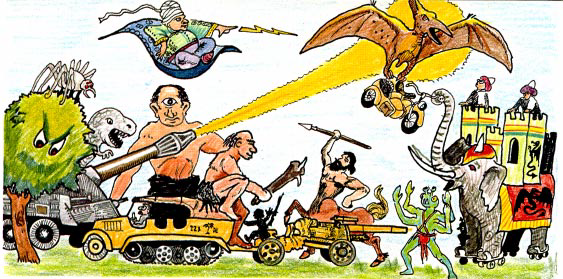
James Ward is up next with Monty and the German High Command, another expose of the gaming goings-on within TSR in 1978. The accompanying illustration brings me joy …

This one involves some WW2 Germans facing off against orcs, storm giants, manticores, an EHP (if you don’t know, you need to study your D&D history a little more closely), a warlock, heroes and superheroes, and trolls, all in an attempt to take a castle.

Jim Ward also presents some thoughts on Wandering Monsters, providing a list of Fourth Level wandering monsters. Takes me back to the game’s origin as a, well, game.

Jeff Swycaffer now presents Notes From Another Barely Successful D&D Player, a follow-up to Ward’s article in issue II/7. He tells of playing a “Maladroit”, who can’t cast spells, fight for a damn, pick locks or lead men. Instead, he lies like a rug. Some good ideas here – worth a read.

Jerome Arkenberg writes The Gospel of Benwa (is he referring to … hmmm) in Dragon Mirth, in which he extoles the Benwanite Heresy, that holds that all the problems in the world are due to the struggle between the Gods of Law and Chaos, and that only victory by the Gods of Neutrality can end misery on earth.

Gygax‘s From the Sorcerer’s Scroll covers D&D Ground Area and Spell Area Scale. Herein, he claims the confusion of 1″ = 10 feet indoors and 1″ = 10 yards outdoors will be cleared up in ADVANCED DUNGEON & DRAGONS. He explains how this originally came to pass – namely that the original scale was 1″ = 10 yards in CHAINMAIL, and that the 1/3 scale was devised by Arneson when he turned the tunneling and mining rules of CHAINMAIL into the dungeon rules of what would become DUNGEONS & DRAGONS. He also explains here that one turn = one scale minute in CHAINMAIL, but that for dungeon movement it was altered to one turn = ten minutes, since mapping and and exploring in an underground dungeon is slow work. The key here is that area of effect is always 1″ = 10 feet, even outdoors. So, there you go.

David Tillery is next with Weather in the Wilderness. This always seems to be such an obvious thing to do, but it has rarely paid off for me in a game. I usually just roll for inclement weather conditions when there’s to be an outdoor fight, to make the fight more interesting. Tillery has a pretty solid system, it seems – reminds me of the World of Greyhawk system.

Next, we have an ad announcing “TWO IMPORTANT NEW RELEASES FROM TSR”, those releases being GAMMA WORLD (love the original font) and the AD&D Player’s Handbook.

Next, we have Stellar Conquest: Examining Movement Tactics by Edward C. Cooper. Since I don’t know the game, I won’t go into it much, but I did enjoy the art:

Not enough space ships have giant pincers, in my opinion.

Next we have some fiction by L. Sprague deCampThe Green Magician.

“In that suspended gray mists began to whirl around them, Harold moment when the Shea realized that, although the pattern was perfectly clear, the details often didn’t work out right.

It was all very well to realize that, as Doc Chalmers once said, “The world we live in is composed of impressions received through the senses, and if the senses can be attuned to receive a different series of impressions, we should infallibly find ourselves living in another of the infinite number of possible worlds.” It was a scientific and personal triumph to have proved that, by the use of the sorites of symbolic logic, the gap to one of those possible worlds could be bridged.”

Funny – I just read this bit recently.

Next up … Fineous Fingers runs away from Grond the Anti-Paladin.

After that, a full page pic of Wormy counting his gold over a backgammon board.

The next article is Random Encounters for BOOT HILL, by Michael E. Crane. This should be useful for folks who play Old West games. It includes such things as mounted bandits, homesteaders in wagons, unarmed clergy, soldiers, indians, etc.

And so ends the June 1978 issue of The Dragon!