Dragon by Dragon – December 1980 (44)

When Christmas rolled around in 1980, a young me was still four years away from role playing games, though I did get this slick bike:

Found HERE!

A year later, I decided I like the Steelers better, and was stuck with a Cowboys bike – c’est la vie. I grew up in Las Vegas, so I was pretty fluid in my “favorite team” selection – I switched to the Raiders in 1984 when I was the only kid on my bus who picked them to beat the Redskins in the Super Bowl – I only did it to avoid going with the crowd.

Still, if you were already plays RPG’s in 1980, this issue of Dragon, #44, was what you were perusing over a cup of hot chocolate with some Rankin-Bass on in the background. It looks like a dandy – with a mini-game and everything!

As is often the case, the first thing that caught my eye was the ad by Ral Partha. They usually have the first ad in these old Dragon magazines, and this one is for a number of boxed adventure games they did. The games included miniatures, and look pretty cool.

I found a site with some pictures of the miniatures.

And the mannequin in the hooded robe just gave me an idea for a monster – I’ll post that later in the week.

Dig this missive from Mrs. Lori Tartaglio from Mercerville, N.J. She covers bearded female dwarves and Iran hostage crisis all in one letter.

“Dear Editors:

Will this endless quibbling never cease? Who CARES if female dwarves have beards or not? (TD#41) Why not let each DM or player or gaming group decide for themselves, for Ghu’s sake?!

Answer me this: Will the fact of dwarven women having or NOT having beards affect the outcome of the game in any major capacity? In my humble opinion, the answer is “no.” Not, of course, unless the DM has designed a “beard catcher” as one of his nasty little traps, and a female character of the dwarven persuasion (although no one ever had to persuade me to be a Dwarf-lady!) happens to be one of the party who’d sprung the trap and. . .

OY! This is getting out of hand! Now you’ve got me doing it!

C’mon, EGG and the rest of you guys! Grow up! If you’re going to argue, then do it about something worthwhile — like “do we go techno and nuke Iran off the face of the earth or do we send in a party of chaotic neutral fighter-mage mercs to teleport the hostages home and drop the Ayatollah with a black arrow.”

And by the way – I mentioned a few reviews ago that I was going to commission some bearded lady dwarf art, and I did, from Denis McCarthy – this will appear in the second edition of Blood & Treasure.

Just as some older issues of Dragon had stats for fictional western heroes for Boot Hill, this issue does the same for some fictional secret agents for Top Secret. The article is written by the developer and editor of the game, Allen Hammack.

For those keeping score, here’s some stuff you should know …

Strongest secret agent – John Steed, followed by Derek Flint and James Bond

Most charming secret agent – John Steed, followed by James Bond and Derek Flint

Most courageous secret agent – James Bond, followed by Derek Flint and a tie – Jim Phelps and Number 6

The weakest stats belong to Maxwell Smart and Napoleon Solo. I don’t want to criticize, but not making Emma Peel the most charming seems crazy … at least from my perspective. The article has full stats for all the agents, which is pretty damn cool.

Gregory G. H. Rihn presents one of the articles that could only be from the early days of the hobby – “Fantasy Genetics I – Humanoid Races in Review”. The article gives scientific names for the fantasy races. Elves, for example, are homo sapiens sylvanus, while orcs are homo sapiens orc. Those two races have to be homo sapiens able to breed with good old fashioned homo sapiens sapiens. I guess they should also be able to breed with homo sapiens neanderthalensis. An elf neanderthal crossbreed would give strong math skills, great strength and pointed ears – so Vulcans, essentially. He makes the kobolds, goblins, hobgoblins and bugbears part of the genus Australopithecus and ogres Ramapithecus. This is an interesting idea, and points to a time when the look of the fantasy races was not established – yeah, there was art in the Monster Manual, but it wasn’t treated as carved in stone.

This is followed up by “Fantasy Genetics II – Half-Orcs in a Variety of Styles” by Roger Moore. This is a cool little article about the fact that half-orcs are always half-human. So you get some monster stats for orc-kobolds, orc-goblins, orc-ogres, orc-bugbears, orc-hobgoblins and orc-gnolls. Short and sweet, and it would be a nice addition to the half-orc playable race.

But we’re not done yet, because John S. Olson gives us “Fantasy Genetics III – What Do You Get When You Cross?”, which is designed to discourage weird crossbreeds. I wonder if the author is this guy from Rice University?

Which, of course, brings us to the end of this discussion. There could be absolutely no more to write on the subject of fantasy genetics – the topic has been so thoroughly dealt with that to continue would be folly!

To paraphrase Johnny Carson, “Not so fast jelly doughnut breath!”

Paul Montgomery Crabaugh brings us “Fantasy Genetics IV – Half + Half Isn’t Always Full”. Honestly, I cannot see the point of this article. Moving on …

Here’s a little piece from Sage Advice that might quash the whole murder hobo mystique:

“Question: Is it okay for a Monk (Lawful Neutral) to sneak up on an opponent and then backstab? (Is this act chaotic? Is this evil?)

Answer: The act of killing a victim without knowing if he/she is truly an enemy (in other words, killing a complete stranger without knowing if he/she presents a threat) is a chaotic act. The act of killing an opponent with the knowledge that there is some other way to overcome him/her is an evil act. It would seem permissible for the Lawful Neutral Monk (or any other similarly aligned being) to attack a known enemy from the back, when circumstances make it necessary to kill that foe. —J. Ward, W. Niebling”

So, if the orcs don’t attack first, and you attack without trying to talk to them, you’re evil.

When I see ads like this:

I always do a search hoping to stump BoardGameGeek.com – hasn’t happened yet.

I know nothing about the game, but the miniature illustrations are cool, and the name “hellborn” is awesome – also Avenging Angels and Saints and Giant Knights. I found the rules for sale for $12.95 by the Gaming Gang and bought a copy – I’ll review them later this month (probably).

This issue’s “Giant in the Earth” switches authorship from Tom Moldvay to Dave Cook. Dave writes stats for C.S. Lewis’ Reepicheep (LG 7th level fighter) and Conan Doyle’s Professor Challenger (LN 16th level fighter with special sage abilities). Challenger’s Express hunting rifle is given a 300 yard range and 2d6 damage, in case you’re interested.

In 3rd edition, all the monsters got stats. In 1st edition, many of the monsters got stats, here and there, haphazardly. Len Lakofka‘s article this issue, “Monsters: How Strong is Strong” is one of those early efforts to codify these issues, and shows the gradual march of the game from “rulings not rules” to “a rule for everything”.

It’s predicated on the fact that a belt of hill giant strength gives a fighter damage that a hill giant doesn’t get, which, of course, cannot be permitted to persist. I guess. For those interested, bugbear chiefs are as strong as ankhegs, but not as strong as gorillas, who are as strong as black bears, but not as strong as carnivorous apes and brown bears. Kobolds roll 4d4 for strength, while leader types have d4+13 strength. He also gives a bit on “how to calculate the combat ability of a monster”. I was going to put in an excerpt, but dang is it long!

Next up is the aforementioned mini-game – “Food Fight” by Bryce Knorr (this guy?). This is set in a high school and features some early art from Bill Willingham (see to the right – maybe that’s Morgan Ironwolf when she was in high school). Make no mistake – for a mini-game about throwing food, it has pretty exhaustive rules. All of the foods have numerous stats, such as:

Ice cream with attack mode D has Range 1, Hit No. 8, App. Damage of 1d6+2, no ability to stun, but the number to splat is 5, slipperiness is 2 and APE is 5. There are different stats for attack mode F and attack mode T.

Oi! I now have a strange desire to make a rules lite version of the game.

By the way, this piece by Jack Crane from the fiction in this issue is all kinds of groovy …

This issue also has a long article by William Fawcett on the Judge’s Guild (I just noticed a Kickstarter popped up for a JG collection), along with reviews of nine of their products.

Speaking of reviews, Mark Herro offers up some reviews of early computer games (or super modern computer games, by the standards of 1980). You can see one of them, Android Nim, in action below:

He also reviews Dungeon of Death and Time Traveller.

Roger Moore has a new monster in the bestiary this month – the Koodjanuk, a monster from Elysium, and the Cryoserpent. I especially like the cryoserpent art. The B&T stats are below:

Koodjanuk, Large (30′ wingspan) Outsider: HD 8, AC 22 [+2], ATK 1 bite (2d6) or 2 talons (4d4), MV 50′ (Fly 110′), SV F8 R6 W8, AL NG, XP 800 (CL 9), Special-Magic resistance 75%, cast cleric spells as 12th level clerics, use psionics, 15% chance found with other good creatures of the upper planes.

Cryoserpent, Huge (50′ long) Monster: HD 12, AC 19, ATK 1 bite (4d6), MV 20′, SV F4 R7 W8, AL CE, XP 1200 (CL 13), Special-Magic resistance 25%, immune to cold, vulnerable to fire, gaze paralyzes creatures with 4 HD or less (save negates), tongue freezes water (12,000 square feet, 6″ deep, lasts 12 minutes), hollow tongue can fire 120′ freeze ray (48 damage, save negates), tongue may launch a 4″ diameter ball of ice (120′, +4 to hit, explodes when hits target for 4d6 damage in 10′ radius) – can use these last three powers up to a total of 6 times per day.

The bestiary also includes the ice golem by Rich Baldwin.

That’s it for #44. As always, I leave you with Wormy …
I miss Bender.

But what about White Dwarf?

The Dec 1980/Jan 1981 issue has the usual cool cover, though the color of the lettering could have been a bit better.

This issue includes aristocracy for Traveller by Rick D. Stuart, some cool magic items for AD&D, a very cool NPC class by Lewis Pulsipher called Black Priests. Here are the highlights:
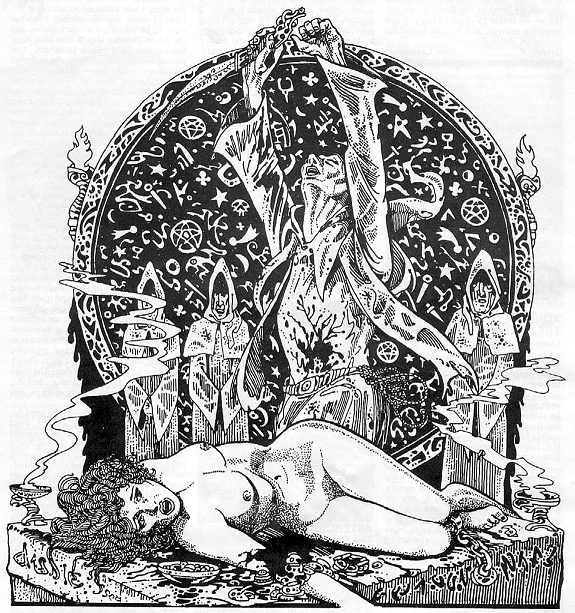
Black priests must have Wis, Dex and Cha of 13 or higher. They roll d6 for hit points, and they must be evil. If they change alignment, they become thieves. They can wear up to leather armor and use shields when not using thief skills.

A black priest’s chance to move silently and hide in shadows is doubled in their own evil temples (neat touch). They are -1 to hit and damage with swords, and +1 to hit and damage with daggers, and -2 to hit with ranged weapons other than throwing knives. Black priests can “backstab” with a strangling cord (1d8 damage, must have Str 7 or higher to use). They rebuke undead and cast spells as evil clerics, and they can call upon the Lords of Evil to summon a monster each battle (lots of rules governing this ability).

They gather followers at high levels, including other black priests, displacer beasts, gorgons, hill giants werewolves, minotaurs, invisible stalkers (summon 1/wk), trolls, undead and nightmares. Great class!

This issue has an adventure (as most did) – “The Search for the Temple of the Golden Spire” by Barney Sloane. It is intended for seven 2nd-4th level characters.

The monster section goes big time, with the Four Horsemen of the Apocalypse by Ian Cooper (one of them, Ky, is a Supra-Lich), Capricorns by Roger Moore, Crystal Golems by Robert Outram, and Ungoliant, Queen of the Spiders by Peter Cockburn.

Ungoliant, Huge Outsider: HD 38 (225 hp), AC 26 (Body) 14 (Belly) 24 (Eyes) [+3], ATK Bite (3d12 + swallow whole for instant death on natural 20) and 2 legs (2d12) or 2 palps (1d12), MV 90′, SV F3 R3 W3, AL CE, XP 38,000 (CL41), Special-Magic resistance 80% (50% of which is from her unlight (see below), and can be dispelled), immune to psionics, body oozes contact poison (Poison IV, -3 to save), breath 30′ x 30′ x 30′ fear gas 3/day, 10 eyes function as beholder, except 7th eye fires a matter agitation ray (as the psionic discipline) – one eye fires at a random target every 2 rounds, summon 3d10 phase spiders to cover her retreat.

Ungoliant is the originator of all spider kind. She is swathed in unlight (awesome concept – it’s equivalent to 5 darkness spells). She swallows gems, gaining 1 hp per 10 gp value. If she is seriously wounded, she rears up, exposing her belly, and attacks with her bite and 6 legs (2d12). If her unlight is dispelled with five continual light spells, then additional magical light deals 3d10 damage or destroys one of her eyes. A magic whip is embedded in one of her legs. In the hands of a chaotic evil creature it is a +5 flaming whip, +8 vs. good that inflicts 6d6 damage, or 12d6 in the hands of someone with a strength higher than 18.

Wow! Lolth is a piker in comparison.

Lewis Pulsipher also contributes a bit on an explanation of character stats in D&D. Here’s the interesting passage:

“Dragon breath, after all, does not burn the skin to a crisp (or freeze it) – a slightly ludicrous notion even if dragons are magical. Rather the superheated (or supercold) air, if it fills the lungs, does the damage. A victim of dragon fire dies because his lungs are destroyed, and it’s clear enough that turning one’s head away and keeping one’s mouth and nose shut will help reduce the damage.”

So save vs. dragon’s breath involves turning one’s head and holding one’s breath. Interesting concept.

That’s it for the White Dwarf, folks – and this post. Have fun!

Dragon by Dragon – November 1980 (43)

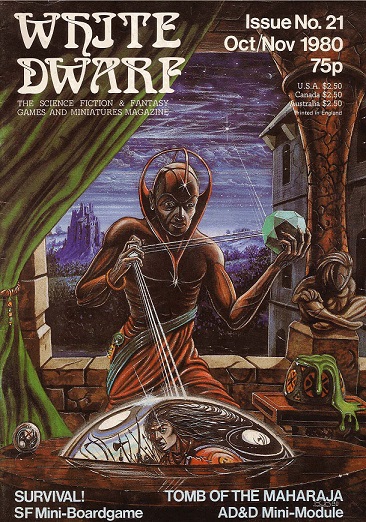
It’s time for another review of the grand old Dragon, and this time with a special guest appearance by White Dwarf #21. I figure, why not look at what WD was up to during the same month of Dragon I’m reviewing – see how the gaming communities in the US and UK differed.

First, though, we’ll dip into the Dragon and see what $3 got you back in 1980.

As you might be able to tell from the cover, this issue presents a new version of the Witch as an “NPC” class, written by Bill Mulhausen and revised and edited by Kim Mohan and Tom Moldvay. The first was back in Dragon #20, from November of 1978. I guess November is the month for witches.

This version is much like the one that will appear a few years later, dividing the witch into low (level 1-16) and high (level 17-22) orders. This is reminiscent of the AD&D druid. Here are a few of the essentials of the witch:

Requirements: Intelligence and Wisdom must be 15 or higher, must be human or elf (and elves are limited to 9th level, and can multi-class as witches).

Hit Dice: d4 to 11th level, +1 hit point per level thereafter.

Attack and save as magic-users.

Witches receive bonus spells for high Intelligence, as a cleric does for high Wisdom. Their chance to know each spell and such are as for a magic-user. For younger readers, AD&D magic-users had a percent chance to be able to learn any given spell of a level. This was based on their intelligence. You had to roll for each spell to see if a magic-user could learn it. So yeah, you could conceivably have a magic-user who couldn’t learn magic missile, fireball or lightning bolt.

The witch has rules for followers (gains 1d10x20 at 9th level if she establishes a place of worship), and rules about how many apprentices she can have.) She can apply for membership in the high order at level 10 if her Intelligence and Wisdom are 16 or higher and if she possesses a magic crystal ball, mirror or libram. High order witches can advance to 22nd level, and they receive special high order spells at each level from 16 to 22.

Besides their spells, they can brew poisons and narcotics, which they learn as they advance in level. This includes sleep (3rd level), truth (4th level) and love potions 6th level). She can read druid scrolls with no chance of failure, magic-user and illusionist scrolls with a 10% chance of failure and cleric spells if the spell is also on the witch’s spell list (8th level).

Witches can manufacture one magic candle per month at 9th level. The candles can cause love, offer magical protection, heal damage and other effects. She gets a familiar at 10th level, can brew flying ointment at 13th level, control dolls at 15th level, can fascinate with her gaze at 17th level, use limited wish at 21st level and shape change at 22nd level.

The witch has 8 levels of spells, which involve lots of charming, divination, some healing and a few offensive spells. It’s a cool class, but I can’t help but think you’d be just as well off with a magic-user.

Dave Cook (that one) offers some survival tips for the Slave Pits tournament at GenCon XIII. I only mention it here because those adventures went on to be classics when they were published as modules.

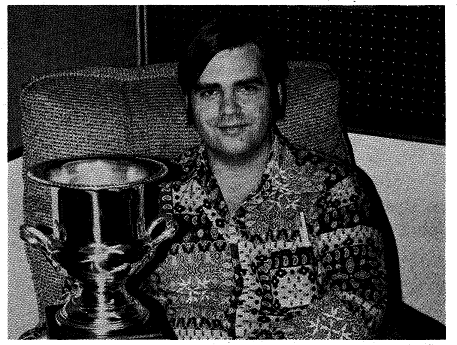
We also learn in this issue that Frank Mentzer won the 4th Invitational AD&D Masters Tournament at GenCon XIII. Dig that crazy shirt …

Speaking of great Dungeon Masters, this issue has a DM Evaluation Form for players to fill out. Here’s a sample …

This runs on for several pages and 43 questions! A couple issues ago, a reader complained that the adventures in the magazine were filler. This, ladies and gentlemen, is filler. I’m guessing GenCon kept them busy.

The Bestiary has some choice bits …

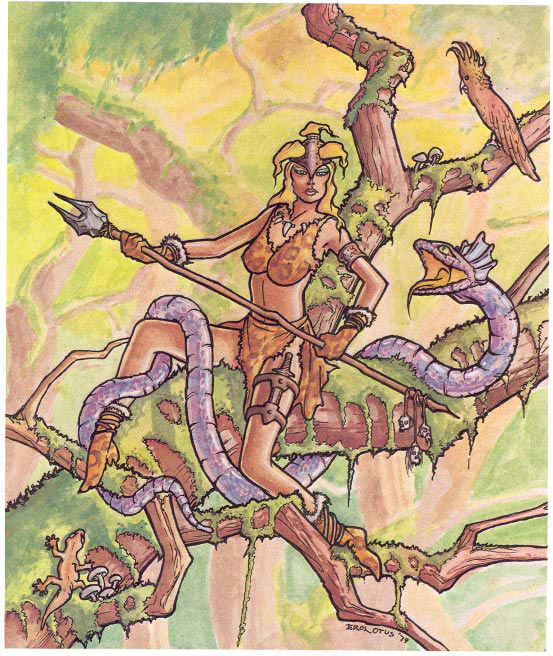
This is an amazon, art by Erol Otus (of course), monster by Roger E. Moore. I’d detail the monster stats here, but frankly, they’re humans and the women do all the “men’s work” and vice versa. Not much to see here – but the art is cool.

Todd Lockwood has a monster called a Tolwar that is basically a trunkless elephant who can telekinetically throw boulders (2d12 damage). They serve as loyal mounts.

Tolwar, Large Monster: HD 6, AC 15, ATK 1 slam (2d4) or 2 boulders (900’/2d12), MV 40′, SV F10 R11 W17, AL Neutral (N), XP 600 (CL 7), Special-Hurl boulders, only surprised on 1, telekinesis (100 lb), catch boulders with telekinesis (75%).

Ed Greenwood presents the lythlyx, a weird spiral creature that whips, constrict and drain blood from people.

Lythlyx, Large Aberration: HD 6, AC 19, ATK 1 whip (2d6 + constrict 3d6 + blood drain 1d4), MV 15′ (Fly 20′, Swim 20′), SV F13 R14 W11, AL Neutral (N), XP 600 (CL 7), Special-Blood drain can be used to heal monster (heal 1 hp per 4 hp taken), immune to charm, command, fear, hold monster and sleep, psionic attacks (all).

Now, give me a bunch of amazon warriors on tolwars hurling boulders at a band of adventurers who have stolen some amazon gold and are hiding in a half-ruined wizard’s tower, and you’ve got an adventure.

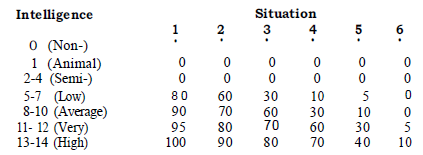
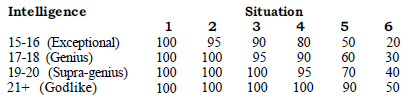
Philip Meyers has an article about disbelieving illusions, or more specifically phantasmal force. He comes up with a little system based on the intelligence of viewer and how suspicious they are about what they’re seeing. In the table below, situation 1 represents a character who has been informed about the illusion, and 6 is where the character expects to see what the illusion is depicting – in other words, 1 is super suspicious, and 6 is not suspicious at all.

The number is the percent chance of disbelief. It is increase by +20% if olfactory or thermal components are expected but not present, +20% if aural components are expected but not present, +10% if victim of illusion is an illusionist, -10% if victim is surprised and +10% if victim’s Wisdom is 15 or higher.

I reckon you can do about the same by giving a bonus to save vs. phantasmal force as opposed to improved phantasmal force or spectral force.

This issue contains a Traveller adventure called Canard. I won’t comment, because I’ve never played Traveller, but if you’re a fan, it’s probably worth checking out.

Two reviews which might be of interest – the first a Game Designers Workshop (not Games Workshop, as I originally posted) offering called Azhanti High Lightning, about fighting aboard a giant starship. The review was positive, but wonders whether or not they should have tried to tie it to Traveller.

They also review SPI’s DragonQuest, their first “serious” foray into Fantasy RPGs. The reviewer likes it – the intentional rather than random character generation, the action points in combat – but does not care for the way experience is handed out. Overall – positive review, and another reminder that Old School gaming was already becoming “Old School” in 1980.

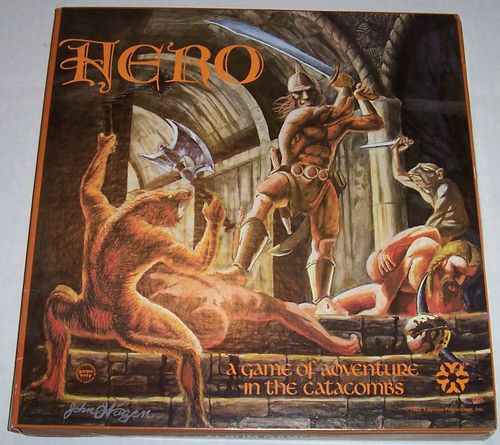
I’ll also note Hero, by Yaquinto Games. It was an “album game” – “The physical layout is like that of a double record album. The components are stored in the pockets, while the playing surface is printed on the two inside faces.”

Very cool idea, and it would be fun to see something similar done these days, especially considering the connection between Old School gaming and bitchin’ Heavy Metal album art.

I liked this comic …

A scroll of illiteracy would be a great cursed item in a game.

A fair issue of Dragon, with a couple notable bits.

So, what was White Dwarf up to in November (really Oct/Nov) of 1980.

First – cool cover, but there are much better WD covers yet to come. You also notice, right off, that the layout of WD is much more professional than for Dragon at this point. Dragon makes some improvements over the years, but frankly never looked as good, and by the 1990’s and 2000’s looked terrible.

In this issue, Andrew Finch presents some cool material inspired by The Chronicle of Thomas Covenant, Unbeliever. We have a new class, Lore Lords, who combine the spell-casting ability of magic-users and clerics, along with d8 hit dice and studded leather armor. Fortunately, this is balanced by a high XP requirement. Similar classes are the Rhadamaerl, who specialize in the lord of stone, and Hirebrand, who specializes in the lore of wood. There are also Bloodguards, who serve as bodyguards for Lore Lords, songs of summoning and words of power. Having never read the Thomas Convenant books, I cannot rate how accurate these classes are, but for fans they’re probably worth checking out. One bit I liked for Lore Lords was their ability to communicate telepathically with one another. A cool house rule might permit magic-users with intelligence and wisdom of 15 or higher to communicate this way with one another.

Roger E. Moore (yeah, that guy) presents a merchant class. It’s actually pretty close to the Venturer class I did, and I promise I hadn’t seen this write up when I wrote mine. Moore’s merchants can open locks, appraise items and use suggestion and command when speaking with people. These are all percentage skills, like those of the thief. Good class.

Azhanti High Lightning gets a review in this issue – positive as in the Dragon.

The Fiend Factory has several cool monsters, the Brothers of the Pine, Chthon, Enslaver, Micemen, Dragon Warriors, Grey Sqaargs and Cyclops. Here are some quick stats:

Brothers of the Pine, Medium Undead: HD 3, AC 15 [+1], ATK 1 weapon, MV 30′, SV F15 R15 W12, AL Chaotic (LE/NE), XP 1500 (CL 5), Special-Cast one 1st level druid spell per day, shrieking wail (save or flee for 1d8 turns), immune to cold, resistance to electricity, vulnerable to fire, only plant-based spells affect them.

Chthon, Medium Aberration: HD 8, AC 20, ATK nil, MV 0′, SV F13 R- W9, AL Chaotic (LE), XP 800 (CL 10), Special-Mineral intellect that hates all animal and plant life, especially intelligent, control up to 20 plants and animals (save to negate).

Enslaver, Tiny Aberration: HD 2+1, AC 14, ATK special, MV 10′, SV F19 R17 W12, AL Chaotic (CE), XP 200 (CL 3), Special-Blindsight 30′, 90% chance of hiding among rocks, dominate creatures that touch them (save negates), hosts freed from domination must make system shock roll or die, hosts are immune to pain and mind effects.

Micemen (crossbreed of brownie and orc!), Small Humanoid: HD 1-1, AC 13, ATK 1 javelin and dagger, MV 30′, SV F14 R16 W16, AL Chaotic (LE), Special-Infravision 90′, shun bright lights, surprise (4 in 6). Despite the picture, I’d like to see these dudes as evil piglets dressed as Robin Hood.

Dragon Warrior (made from dragon teeth), Medium Construct: HD 5+1, AC special, ATK 1 weapon, MV 20′, SV F14 R14 W14, AL Neutral (N), XP 500 (CL 6), Special-Cannot speak, obey commands, last for a number of turns equal to the dragon’s age category, +1 to hit, +2 to damage, attack as 6th level fighters, immune to parent’s breath weapon type, sleep, charm and hold, clad in scale armor and armed with broadsword, disintegrate when killed or dispelled.

Grey Sqaarg, Medium Construct: HD 6, AC 22, ATK 1 grapple, MV 20′, SV F14 R14 W14, AL Neutral (N), Special-Constructs built by ancient dwarves, never initiate attack, fight with strength bonus to hit and damage equal to combined modifiers of attackers, grapples to incapacitate people, made of solid stone, magic resistance 30%.

Cyclops, Large Giant: HD 6, AC 14, ATK 2 claws (1d6), bite (2d6), MV 30′, SV F10 R14 W14, AL Chaotic (CE), Special-Hypnotic stare, -1 to hit melee, -2 to hit ranged, +2 save vs. illusion, prefer to eat demi-humans to humans, breed with human females.

White Dwarf #21 also contains a sci-fi boardgame called Survival and a dungeon called the Tomb of the Maharaja. It is, I’m afraid, quite short and not terribly interesting.

All-in-all, some pretty cool stuff from the Brits in November 1980 – and of course, lots of art by Russ Nicholson.

Well, that does it for this edition of Dragon by Dragon. As always, I leave you with Tramp …

Dragon by Dragon – January 1980 (33)

“This is the ’80s and I’m down with the ladies.” – Tone-Loc

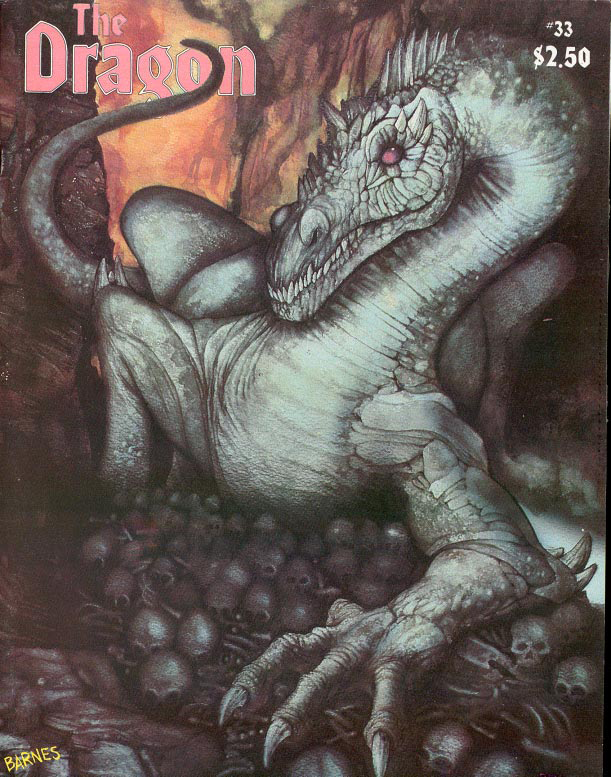
And so we bravely enter the 1980’s (though, again, not technically). The Dragon #33 (we haven’t dropped the “the” yet) welcomes the new decade with “Dragon’s Lair” by John Barnes. The painting won Best of Show and “Best Color Fantasy” awards at the Northwest Annual Science Fiction Festival in Seattle.

What goodies await us inside? Let us find out.

I. Gardner F. Fox

Known best for the Justice Society of America, Fox also wrote fantasy novels later in life, the Kothar the Barbarian series maybe the best known of them, but also Niall of the Far Travels.

Oh, and apparently Guy Gardner was named for him (not sure that was an honor or an insult).

This issue of The Dragon features a short Niall story – the character has appeared in the magazine before. This one is “The Eyes of Mavis Deval”. Here’s the opening:

“It was her eyes that drew his stare as he sat astride the high-peak saddle of his stallion, there on the edge of the huge slave market. They were a brilliant green, those eyes, and it seemed to Niall of the Far Travels as he looked, that there was a tiny flame glowing in each pupil.”

II. Painting Tips

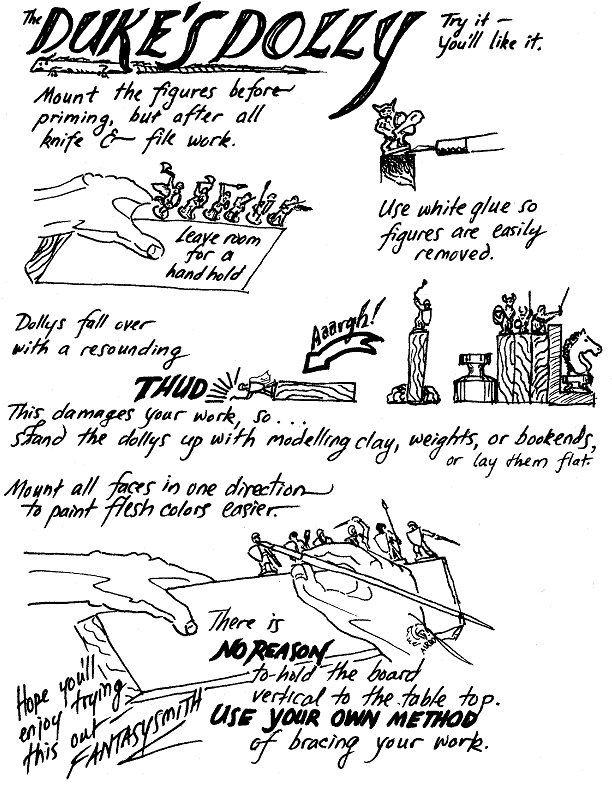
I got into painting Warhammer miniatures back in college, because I had waaaaay too much money and really needed to drain lots of it away on hunks of lead that I don’t look at anymore. So, I know a little (very little) about painting them, and this …

… looks like a darn good idea to me. Presented by Fantasysmith – the person knows his or her stuff!

III. H. R. Lovins, bringin’ the prose

Dig the sprightly prose:

“My friend and I had taken our favorites: a Fighter with rippling muscles, a Cleric of somber colors and mood, a superstitious slinking Thief, and a couple of guardian Magic Users. Unfortunately, someone else was using the back way for a similar evasion. Our leaders turned a corner into a party of a half-dozen well-dressed besworded gents who, not caring to sidle past our group, began to comment acidly on our travel-worn condition, and wonder aloud whether an unpleasant odor was ours, or native to the alley.”

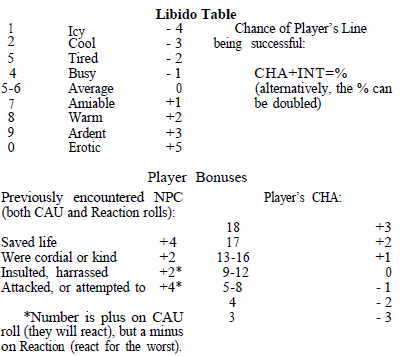
The article is pretty interesting, in the idea of giving NPC’s a Caution (Cau) score. The Caution score is used for two things:

1) The score must be exceeded on a d20 before rolling reaction dice. If not exceeded, the NPC just walks away – no interaction with the players. I kind of dig this – after all, when confronted by a group of murder-hobos, I think most normal folk would get the heck out of there, smiling and making excuses.

2) The Caution score is also used to determine whether an NPC will get involved with a PC – do they throw caution to the wind and take the plunge. Again, you roll d20 and try to exceed CAU. In the case of “woo pitching”, as the kids say, you add the NPC’s Libido score to the roll. Libido score, you say? What’s the Libido score?

IV. Gygax on Magic

“Magic, AD&D magic, is most certainly make-believe. If there are “Black Arts” and “Occult Sciences” which deal with real, working magic spells, I have yet to see them. Mildly put, I do not have any faith in the powers of magic, nor have I ever seen anyone who could perform anything approaching a mere first-level AD&D spell without props.”

Sounds like the religious nuts are already giving him trouble over the “occult” influences on AD&D.

V. Speaking of Magic …

Len Lakofka in this issue is looking at the shortcomings of some of the spells as written, and is making suggestions for improvement. Magic Missile, for example …

“Gary Gygax and I have gone around in a circle on this spell for some period of time. The controversy, in my opinion, lies around the fact that there is NO SAVING THROW and that the missile goes “unerringly” to its target. Why is this so annoying to me? It is unfair because it allows players to foil most opposing spells by putting a Magic Missile into the opposing spell caster, it allows Magic Missiles into melee regardless of the size difference and quantity of ‘friends’ in the melee, and it allows for shots that would amaze Robin Hood with their accuracy!

Gary says that a Magic-User can counter with a simple spell like Shield to prevent this damage. What he overlooks is that the opponent must take a round to cast the Shield and in that time the spell caster is beset by fighters, et al. I find it too unfair to “monsters” that a single FIRST-level spell can be this powerful. Therefore, I have modified the spell in the following ways:

1. There is still no saving throw if the target is surprised, immobile, walking or prone and is at least the size of a Kobold.

2. Figures in melee, figures running (except those running right at the spell caster), figures evading, behind (or moving behind) significant cover, or casting a spell obtain some type of saving throw. This saving throw is their normal one with modification as follows:

A figure casting a spell obtains a s.t., but at -4.

A figure in melee obtains a normal s.t. but adds +1 for every opponent above the first one he/she/it is fighting (unless the size differential is so significant that the opponents do not get in the way—i.e., 6 dwarves against a hill giant would allow the giant a normal s.t. Missiles that MISS their target might hit others in the melee! Select a figure and then give him/her/it a normal s.t. to see if the stray missile hits or misses. In the above example, the dwarves would not be hit. All saving throws are on a missile-by-missile basis. Missiles fire at a rate of 1 every 3 seconds. Thus, a figure moving behind a wall might not be hit by every missile in a barrage of Magic missiles.

A figure with over 50% cover (who then presents a target size of ½ a kobold) always obtains a s.t. of from 16 to 20 depending upon cover and his/her/its actions. This prevents firing through an arrow slit some hundred feet away to hit some poor guard. I have found it necessary to rule in this way to stop Magic-Users from Magic Missiling everything that walks because of the broad language of the spell text. Magic Missile, as written, is too powerful and must be toned down.”

Ladies and gentlemen, I give you rules bloat. The problem, of course, isn’t the DM making the rules he wants for his game. It’s in the opening paragraph:

“I felt that some spells leave a great deal unsaid (or they say too much), and thus individual rulings are often necessary to prevent abuses and to make the game fair and equitable for players and “monsters” alike.”

So what’s wrong with individual rulings?

Well, what was wrong was that the hobby had already grown into two camps. One was playing the game at home, and doing what they wanted with their campaigns. The other was either playing at conventions, and thus needed everybody on the same page, or was playing at home and still believed that everyone needed to be on the same page. I’m a libertarian, so you can guess which side I’m on in this argument.

In Lakofka’s defense, it’s not just about standardization or extra rules. It’s about players being creative with spells, and trying to turn every spell into “instant death”.

VI. No Swords for Clerics

I liked this bit from Lawrence Huss about why clerics may not use edged (or pointy) weapons:

“‘Why, ‘tis as plain as the forbidden pikestaff! The purpose and nature of all edged weapons (and what is a point but a section of an edge?) is to cut, release blood and kill, both in reality and symbolically.

‘The club, mace and flail are but growths of the staff, which stands for guidance and religious authority. Though the end result of the sword stroke and the well-aimed mace blow are the same, the symbolic intent differs. As the High Power judges our acts much from a viewpoint in which symbols supersede particulars, this symbolic difference in intent is of greatest importance, both to the performance of the specifically clerical functions and in the gaining of spiritual eminence.'”

In other words, spare the rod, spoil the bugbear.

Now, some might argue that symbolism is pointless – the enemy is dead. What does it matter that he was slashed or bludgeoned to death?

But we’re talking clerics. Priests. Symbolism is everything!

VII. Old Time Hockey Gaming, Coach!

Did you ever want to see a huge list of Game Masters operating in the U.S. in 1980? Great – this issue is for you. Let’s check out my stomping grounds, Las Vegas NV.

We have Bill Coburn, running D&D, Traveler, Metamorphosis Alpha and general board games, and David Whitney, running D&D, Traveler and general board games.

We’ve seen Bil Coburn in the pages of The Dragon before, writing on the effectiveness of poison back in September 1978. I couldn’t find him online, nor David Whitney. Alas.

VIII. Question of the Month

“QUESTION: There is this character (a Magic-User) being refereed by an inexperienced DM. Because of his lack of knowledge, he let the character advance in levels too quickly. He also has 86 magic items. By the time the character got to 34th level, the DM had learned from his mistakes and proceeded to try to kill the powerful character. He tried a Ring of Transference, and when that didn’t work he hit him with 2000 (100% magic resistant) thieves. Is it within the D&D or AD&D rules for a DM to deliberately try to kill a character?”

Yikes!!!

Runner up:

“QUESTION: Is an invisibility spell cancelled when you fall on your face from tripping either over your own feet or from someone else’s number 13’s?

ANSWER: No.”

IX. The Infancy of Home Computing

This issue has the inaugural article on “The Electrical Eye”, about gaming on computers. I thought the little guide to computer manufacturers was intresting:

Witness Apple corporate HQ just 35 years ago (I think … the actual street number doesn’t show up on GoogleEarth):

Oh, and yeah, they got the address wrong above. It was on Bandley Drive, as confirmed at this article showing the layout.

X. Frosts

The “Dragon’s Bestiary” this month is by Roger Moore – Rogar of Moria. I always like Roger in the pages of the later Dragon’s that I read.

Frosts are “snow pixies” – little buggers that pack a punch. Here’s an adaptation of the stats for Blood & Treasure

Size/Type: Tiny Fey
Hit Dice: 0
Armor Class: 15
Attacks: 1 attack (1d3)
Move: 20′ (Fly 60′)
Saves: F19 R12 W12
Intelligence: High
Alignment: Neutral (with good tendencies)
No. Appearing: 1d6

Frosts can turn invisible at will, but cannot attack while invisible. They can use cone of cold (3 dice) once per day and frost fingers (cold version of burning hands) 2/day – and can use frost fingers while invisible. One frost in six can use freezing sphere once per day. Frosts can also control temperatures within 10 feet.

I’ll leave you this fine Sunday morning with some Tramp