Dragon by Dragon – December 1978 (21)

Just imagine all the spiffy Ronco products people were unwrapping on Christmas day in 1978! A few folks might have also been perusing the December 1978 Dragon magazine while they were waiting for Christmas lunch or dinner. Let’s see what it included …

First up, we have a groovy little advert from Ral Partha that would make a good elven army list or encounter list. Let’s make it random …

01-05. Wood Elf Archers (Longbow and Shortsword)
06-25. Wood Elf Infantry (Longbow and Longsword)
26-30. Woof Elf Cavalry (Lance)
31-50. Sea Elf Pikeman
51-60. High Elf Swordsmen
61-75. High Elf Spearmen
76-95. High Elf Cavalry (Two-Handed Swords)
96-100. Elfin Command Group – Elf Commander (5th level fighter/magic-user), Elf Lieutenant (3rd level fighter/magic-user)

First article this issue is a revisit of the Search for the Nile game. This is basically a response to the article in the last issue of The Dragon by the games creator.

Okay – have to share this next ad with everybody …

Next up, we have a neat little table of titles for powerful NPCs by Brian Blume. This one works like the old menus at Chinese restaurants – choose one bit from column 1, one from column 2, etc. Here are a couple examples:

The Lord Protector, His Most Distinguished Illustriousness, The Crown Prince Bob, the Incomparable Slaughterer of Dragons

The Guildmaster, Her All Triumphant Laduyship, Lady Cassandra, The Terrible Scythe of Honor

Kinda groovy – worth checking out. I’ll probably turn it into a random table and use it for Nod now and again.

Willie Callison now presents a Cure for the “Same-Old-Monster” Blues. Every long-time DM has gone through this. Mr. Callison’s suggestion is to look at the world around you and draw inspiration from nature. The giant snake, for example, can be described as any real species of snake – different types of attacks, different color patterns, etc. You get the idea.

Callison also provides the next article – Inflation in D&D. In 1978, inflation would have been foremost on people’s minds, and Willie complains about the lack of realism inherent in the D&D economy – i.e. too many gold pieces floating around. Unfortunately, he doesn’t really give any solutions to the problem. So, kind of a pointless article.

Prophet Proofing (or how to counter foretelling spells) by David Schroeder attempts to throw a monkey wrench into spells like clairvoyance, clairaudience, wizard eye, ESP and x-ray vision. I’m generally not a fan of ideas on how to screw up powers that players should rightly be able to exercise with the characters. I mean, a fighter with a high strength and two-handed sword sure does kill lots of orcs – shouldn’t there be a way to screw that up? Sneaky tricks are a good thing in D&D – keeps the players on their toes – but at the same time, the clever use of spells to overcome obstacles is one of the points of the game.

Sensible Sorcery is an article by Ronald Pehr that explores ways to make researching spells more difficult for magic-users. I think I’m detecting a theme in this article.

Robert Wagner (no, probably not him) now delivers a Boot Hill Encounter Chart. The chart is for town encounters, and is divided into two parts – Town till 8 p.m. and Town after 8 p.m. The early chart gives a 1 in 6 chance of an encounter, while the late chart gives a 2 in 6 chance. Early encounters include pickpockets, various job offers (a very good idea!), being shot at by 1 or 2 people, being mugged by 1 or 2 people, being falsely arrested or have 1 or 2 deputies after you. The late encounters include jealous husbands, being challenged to a gun fight, seeing a bank robbery, more job offers and being arrested by a U. S. Marshall (maybe this guy!). It’s a very good chart, and easily adaptable to a fantasy game or one set later than the Old West period.

Rod Stevens delivers Encounters with Personality. Here, he provides a few ideas on giving monsters and NPCs a bit of history and personality for encounters. Did DM’s actually not do this back in the day? Perhaps – old D&D had a few elements of wargame/boardgame to it back in the day, but articles like this show the progression to a more story-based game. A couple examples:

1. BLARG: Ftr. Cha/Evil. Hobgoblin. Blarg hates everything but ogres. These he emulates but they hate him.
 

3rd 20 5 16 7 7 6 8 6 +1 +1 shrt. sd.

8. CLARENCE LINDIR: Ftr. Law/Good. Human. He is a constable who is always accompanied by 11 other constables. He will do anything to make an arrest including arresting jaywalkers, people with water in wine skins, or anything else he can think of. He often makes up absurd charges. When in court he will then charge resisting arrest if the party didn’t come peacefully. Of the hundreds of arrests he has made, he has only gotten 2 convictions. The townspeople pointedly ignore him and call him “Clarence the Clown” behind his back.
 

1st 9 7 1 7 9 1 0 9 7 8 + 2 + 2 mace & spear

Next come the game reviews. Olympica is set in 2206, where a human colony on Mars is being conquered by a group mind called “The Web” (prescient in a way, huh?). One player controls the assault group being sent by the U. N., while the other player defends the Web generator from the assault.

Don Turnbull of Cambridge, England presents a section of his Greenlands Dungeon – The Hall of Mystery. It’s quite a long description, but it involves riddles (sort of), mirrors (one a mirror of opposition, the other of life trapping containing a succubus) and a host of monsters in rooms. I will share the map …

Gary Gygax pops in next with a strategy guide for Rail Baron. I’ve heard good things about this game (one wonders if it could have been used in concert with Boot Hill), but I’ve never played it. Since I haven’t played it, I won’t chime in on how good a guide it is, but it does look as though it’s quite thorough. In fact, I think it might be the longest article in the magazine.

A couple more game reviews follow. King Arthur’s Knights, which reviewer S. List describes as being similar to TSR’s DUNGEON. Players choose to be a knight errant, knight at arms or great knight, which increasing levels of power and obligations, as well as tougher victory conditions. The map was apparently gorgeous, the rules book 16 pages long and there were 11 decks of small cards. There are several Magic Places on the board, and on each one places a magic treasure and magic guardian.

Timothy Jones now presents some optional rules for DUNGEON. There are new characters (halfling, dwarf, cleric, thief and paladin), new prizes (including a bag of dung!) and new monsters (red dragons, blue or white dragons, witches, evil wizards and evil priests).

T. Watson then has a review of Tolkien’s Silmarillon. Watson describes it as the bible of Middle Earth, with the Valar as the angels, Melkor/Morgoth as Lucifer and the elves as the chosen people. Watson seems to like it, despite it being long and dry, but also seems to indicate that it’s for folks who really want to know more about the imaginary Middle Earth.

In James Ward’s Monty Strikes Back, we get another installment of gonzo dungeoneering done right. Here’s a sample:

“The three ancient white dragons guarding the door were no problem. It was just a matter of running in the chamber hasted and invisible and throwing three hold monsters at things. They didn’t have any treasure, they were just there to slow us down a bit. As we walked through the door ‘Monty gave his “evil” chuckle (which always meant we were in big trouble) and we were told that we were sliding down a sheet of glare ice. We wound up pinioned against a mass of ice spears and everybody but Freddie had taken damage. He then thought it would be a great idea to use his flaming power to melt the spears away. Ernie and I, knowing the horrors Monty could think up, tried to stop him but it was too late. We were hit from above by partially melted ice stalactites and again Freddie was the only one unhurt.”

This was my point about D&D once being something like a wargame/boardgame. The fun was in moving around the pieces, not telling their life stories.

And that’s it for December. The reviews were interesting, a few of the articles useful, but honestly not among the best issues I’ve read.

Enjoy your Saturday gang!
What Gave the Magic-User a Headache?

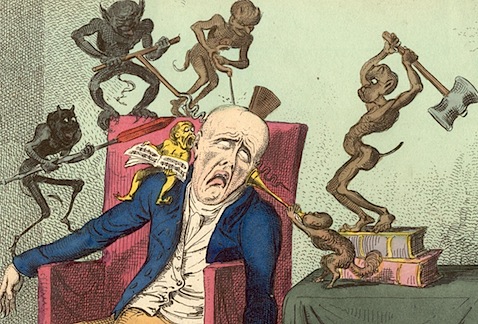
Magic-users are brain guys, and since they use their brains so much (and use them in such odd ways), they’re prone to frequent headaches. It’s not that different from swimmer’s suffering from swimmer’s ear or tennis players suffering from tennis elbow.

In play, whenever a random encounter roll is made and a “3” is rolled, there is a chance of the magic-user coming down with an aching  head. Let the magic-user roll a reverse saving throw (i.e. they need to fail the save to avoid the headache) – since the higher level a magic-user is, the more stress they put on the old grey matter. If a headache is indicated, roll d% on the following Random Magic-User Headache Table and inflict some agony.

01-04. Spell Residue: When a spell is imprinted on a magic-user’s brain and then unleashed, it often leaves behind a bit of itself – a spell residue, so to speak. This leads to a throbbing of the temporal lobe. The headache lasts until the magic-user unleashes all of his spells and then goes 24 hours without preparing any new spells OR until the magic-user can pass a once daily saving throw (as above). While suffering the headache, the magic-user suffers a 5% chance of spell failure and -2 penalty to all saving throws or skill throws involving concentration.

05-14. Dehydrated: Absent-minded as they are, magic-users often forget things like basic maintenance. The magic-user has become dehydrated, and this has started a headache. While suffering, the magic-user suffers a -1 penalty to all d20 rolls until he spends a day drinking a double ration of water.

15-16. Cerebral Parasite: The magic-user has picked up a cerebral parasite. The parasite lowers his intelligence score by 1d4 points (roll randomly each day) until removed with a cure disease spell.

17-19. Withdrawal Symptoms: Sometimes, a magic-user develops an addiction to a spell he or she has impressed on their minds. Randomly determine (or choose) a spell that the magic-user has memorized in the past, but which they do not have memorized now. Until the magic-user memorizes that spell and casts it for three days in a row, they suffer from a headache that gives them a 10% spell failure chance. If they go more than two days with this headache, they develop a nauseous stomach. If they go a week without memorizing the spell, they beat the addiction and are fine. If they eliminate the headache by memorizing the spell, they feed the addiction, and thereafter must memorize and cast the spell at least once per week or suffer from the withdrawal symptoms again.

20-35. Slept Funny: The magic-user must have slept funny, giving them a stiff neck and sore head. They suffer a -2 penalty to reflex saves (save vs. dragon breath, traps) and a -1 penalty to will saves (i.e. saves vs magic).

36-40. Tension – Fear: The magic-user has developed a headache from the stress and tension involved in dungeon delving. They must go 24 hours without encountering a monster or trap to remove the headache; otherwise, they suffer a -1 penalty to all will saves (save vs. magic) and a -3 penalty to all saves vs. fear.

41-45. Tension – Greed: The magic-user has developed an obsession with some piece of wealth owned by another character. Until they steal this item, they suffer a -1 penalty to all will saves (save vs. magic) and suffer a 15% spell failure chance any time they cast a spell that would be beneficial to the owner of the object of their desire.

46-50. Tension – Lust: The magic-user has developed an obsession with a fellow party member – one they would normally find attractive. Until they admit their feelings, they suffer from a -2 penalty to all will saves (saves vs. magic).

51-55. Allergies – Creature: The magic-user has developed an allergy to an animal owned by themselves or another party member, to a monster often encountered in the dungeon they are exploring (i.e. one of the monsters on the random encounter chart) or to another member of the party. When they get within 10 feet of this allergen, they suffer a headache that imposes a 5% spell failure chance and a -2 penalty to all will saves (saves vs. magic).

56-60. Allergies – Iron Rations: As above. The magic-user suffers the symptoms for 1d6 hours after consuming iron rations.

61-65. Allergies – Rope: As above. The magic-user suffers the symptoms for 1d6 hours after touching hempen rope.

66-70. Allergies – Magic Item: As above, but the allergy is to a particular magic item the magic-user recently came into possession of. The symptoms are suffered while the item is in his possession.

71-78. Pressure: The headache is caused by being more than 2 “levels” underground. The magic-user must either ascend to a higher level of the dungeon or suffer through the symptoms for 1d4+1 hours. While suffering, the magic-user suffers a 5% spell failure chance per dungeon level below 2 and a penalty to will saves (saves vs. magic) equal to the dungeon level they are on -2.

79-88. Light: Having spent so much time underground, the magic-user’s eyes are sensitive to light. They can stand torchlight, but must be at least 10 feet away from the torch. Anything else causes them to suffer a -2 penalty to all d20 rolls. This lasts until they have been exposed to pain-causing light for at least 4 hours.

89-99 Eye Strain: The eye strain caused by reading spell books, scrolls and ancient chaos carvings has caused a headache. The magic-user suffers a -1 penalty to all will saves (saves vs. magic) and a 5% spell failure chance until they rest their eyes for 48 hours.

100. Headache Demons: The magic-user is beset by 1d6 invisible headache demons:

Headache Demon, Tiny Outsider: HD 1; AC 14; ATK 1 implement of torture (1d4 + headache); MV 30 (Fly 40); F16 R13 W12; AL Chaotic (CE); XP 100; Special: Natural invisibility (per improved invisibility spell), yhose hit by the implements of torture must pass a will save or suffer a throbbing headache (-1 to all will saves, 5% spell failure chance; duration 1 hour) – additional spell failures increase the duration by one hour; three failed saves results in 1d4 points of intelligence, wisdom or charisma damage.

Murder, Most Random!

Halloween brings to mind ghost and goblins, yes, but also creepy or imposing Victorian mansions, and thus, MURDER!

The next time you need to generate a random murder for characters to solve, or perhaps explain the origin of the ghost they are busting, these random tables might come in handy …

WHERE? (d30)

1. Attic
2. Ballroom
3. Bathroom
4. Bedroom (upstairs)
5. Billiard Room
6. Buttery
7. Cellar / Undercroft
8. Dining Room / Eating Room
9. Drawing Room / Parlour
10. Dressing Room
11. Fainting Room (nudge nudge)
12. Gentleman’s Room
13. Great Chamber
14. Hall / Great Hall
15. Housekeeper’s Room
16. Kitchen
17. Larder
18. Library
19. Long Gallery
20. Lumber Room
21. Master Bedroom
22. Pantry / Butler’s Pantry
23. Picture Gallery
24. Scullery
25. Servant’s Quarters
26. Smoking Room
27. Solar / Solarium / Sunroom / Conservatory
28. Store Room
29. Study
30. Wine Cellar

WHO? (d30)

Note: This table can be used to generate the victim and the murderer, as well as the wrongly accused

1. Baronet / Lord
2. Lady of the House
3. Blustering Industrialist
4. Arrogant Playboy
5. Bold Explorer
6. Virile Sportsman
7. Member of Parliament
8. Spoiled Son/Daughter
9. Imperious Son/Daughter
10. Dowager Aunt
11. Doddering Uncle
12. Brainy Professor
13. Idiot Nephew
14. Sly Courtesan
15. Impassioned Suffragette
16. Intellectual Son/Daughter
17. Silly Son/Daughter
18. The Butler
19. Kitchen Maid / Scullery Maid
20. Cook
21. Valet
22. Driver / Chauffeur
23. Companion
24. Lady’s Maid
25. Nanny / Governess
26. Tutor
27. Chambermaid
28. Page / Houseman / Footman
29. Gamekeeper / Master of Hounds
30. Master of Horse

WHAT? (d8)

1. Poison (Arsenic, Curare)
2. Shot (revolver)
3. Stabbed or Slashed (knife, dagger, razor blade, something more archaic)
4. Bludgeoned (candlestick, wrench, statuette)
5. Strangled (rope, scarf, bare hands)
6. Electrocuted (where available)
7. Suffocated (or gassed)
8. Drowned

WHY? (d8)

1. Jealousy
2. Envy
3. Greed
4. Boredom
5. Ambition
6. Revenge
7. For the cause!
8. Because of the voices!

So, what is Chief Inspector Macintosh up against this week?

Doddering old Dr. Rolston has been found murdered in the fainting room! Egad! He appears to have been poisoned, and the most likely suspect is the very intellectual daughter of the family, Felicity, who had been conducting a bit of research into poisons. But why?

If Macintosh is smart, he’ll discover that the true murderer was the footman, Joseph, who did it out of jealousy – he envied those “hysteria treatments” the doctor had been giving to the scullery maid, Eliza, so he put a little extra kick in the old man’s brandy, and when next the two met in fainting room, the good doctor expired!

Random Jeweled Thrones Upon Which Your Barbarian Can Tread

Whenever I’m writing a hex crawl and I it’s time to describe some royal ugly dude’s throne, I have to take a pause. How do I make this interesting? In literary terms, the throne is an extension of the person sitting on it – and in game terms, thrones are one of those things that players should remember – they give an encounter a bit of color and flash – something to fire the imagination.

With that in mind, I present a few tables for randomly generating hopefully interesting thrones.

First things first, you need to know whose butt is going to be planted in it, because their rank will provide a modifier (or no modifier) to the dice rolls:

Knight/Baron: +0
Viscount/Count: +5
Duke: +10
Grand Duke/Prince: +15
King/Queen: +20
Pope/Emperor: +25

For monster monarchs, let their hit dice be your guide:

0 to 5 HD: +0
6 to 9 HD: +5
10 to 14 HD: +10
15 to 19 HD: +20
20+ HD: +25

THRONE MATERIAL (D%)

01-010 – Pine*
11-17 – Elm*
18-24 – Maple
25-31 – Cedar
32-38 – Oak
39-45 – Walnut
46-52 – Cherry
53-59 – Teak
60-64 – Limestone (or granite or basalt)
65-69 – Bone (re-roll if this is too bad ass for you)
70-74 – Iron/Steel (re-roll if this is too metal for you)
75-79 – Kingwood
80-84 – Tulipwood
85-89 – Ebony
90-94 – Blackwood
95-99 – Marble
100-104 – Porphyry
105-109 – Malachite
110-116 – Brass
117-120 – Silver
121-122 – Gold
123 – Platinum
124 – Mithril
125 – Adamantine

* 10% chance that the wood is covered by silver foil or gold leaf

ORNAMENTS (D%)

01-08 – None
09-16 – Carvings (animals, plants, monsters, geometric designs, etc.)
17-23 – Feathers (peacock, griffon, roc, angel, etc.)
24-30 – Fixtures, brass (knobs, spikes, figurines, medallions)
31-36 – Fixtures, silver
37-43 – Inlay, wood (rosewood, zebrawood, holly, cocobo, ziricote, blackwood, ebony, kingwood)
44-48 – Inlay, shells
49-55 – Pillows of silk
56-60 – Pillows of velvet
61-65 – Pillows of damask
66-70 – Inlay, alabaster
71-75 – Inlay, ivory or tusks (elephant, narwhal, catoblepas)
76-79 – Inlay, mother-of-pearl
80-85 – Pietra dure – marble
86-90 – Pillows of leather (monster hide)
91-94 – Fixtures, gold
95-98 – Fixtures, platinum
99-103 – Pietra dure – fancy stones (see Blood & Treasure)
104-106 – Fixtures, mithril
107-109 – Fixtures, adamantine
110 – 114 – Slaves (servants, dancers, musicians) – chained to throne
115-118 – Guard animals (wolves, cheetahs, lions, tigers) – chained to throne
119-122 – Gems (1d12; see Blood & Treasure)
123-125 – Jewels (1d12; see Blood & Treasure)

FOUNDATION (D%)

There is a 1 in 4 chance of the throne being situated on an interesting foundation

01-50 – Dais (1d4+1 steps)
51-75 – Moat – water
76-85 – Moat – perfumed water
86-95 – Moat – wine
96-99 – Moat – flaming oil
100-109 – Statue (i.e. throne atop a statue of a bearer, either an animal or people)
110-114 – Monster (throne actually on the back of a large, subdued monster)
115-125 – Slaves (throne on the back of human or demi-human or non-human slaves)

SPECIAL POWERS (D%)

Chance of special powers equal to 1 + rank modifier on percentile dice

01-06 – Augury (1/day)
07-12 – Charm person (1/day)
13-18 – Command (1/day)
19-27 – Detect evil or good (1/day)
28-33 – ESP (1/day)
34-37 – Summon monster III (1/day)
38-40 – Summon monster IV (1/day)
41-42 – Summon monster V (1/day)
43-46 – Augury (3/day)
47-50 – Charm person (3/day)
51-53 – Command (3/day)
54-58 – Detect evil or good (3/day)
59-62 – Break enchantment (1/day)
63-66 – Cure disease (1/day)
67-70 – Divination (1/day)
71-74 – Remove curse (1/day)
75-78 – ESP (3/day)
79-84 – Magic resistance 5%
85-87 – Detect evil or good (at will)
88-90 – ESP (at will)
91-94 – Magic resistance 10%
95-96 – Contact other plane (1/week)
97-98 – Gate (1/week)
99-101 – Protection from evil or good (constant)
102-104 – See invisibility (constant)
105-106 – Tongues (constant)
107-108 – True seeing (constant)
109-110 – Control weather (1/day)
111-112 – Flame strike (1/day)
113-114 – Insect plague (1/day)
115-116 – Lightning bolt (1/day)
117-118 – Slow (1/day)
119-120 – Magic resistance 20%
121-122 – Summon Monster VI (1/day)
123-124 – Summon Monster VII (1/day)
125 – Wish (1/lifetime)

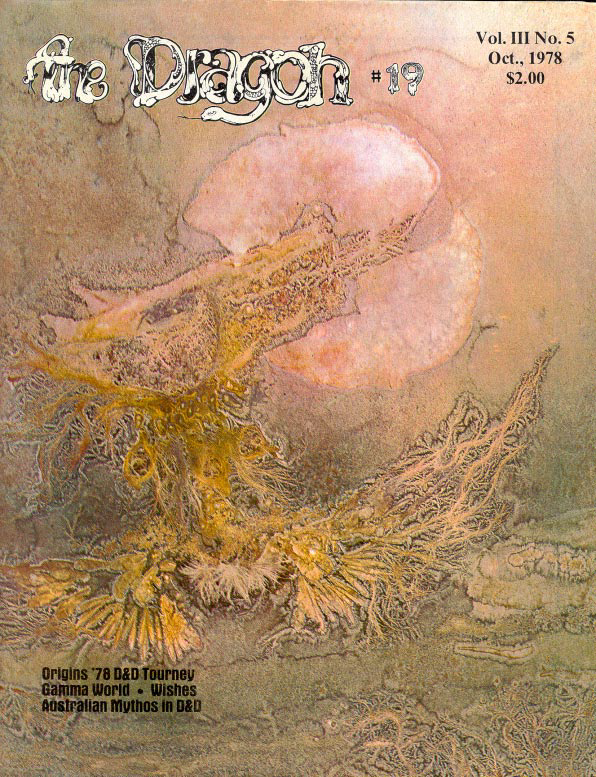
Dragon by Dragon – October 1978 (19)

Hey – almost have my months synced here! October 1978 and Dragon blows in with what appears to be a pretty full issue. Let’s begin …

First thing I see this issue, other than the editorial, is “The Battle for Snurre’s Hall”, the tournament for the Origins ’78 D&D Tournament. Good recap of the winning team’s tactics, and reminds you of the game aspect that I think sometimes gets buried under the “role play” aspect.

How Many Ettins Is a Fire Giant Worth: Competitive D&D by Bob Blake

And then this article reminds me of the importance of role play in the game. Basically, this is an article about scoring competitive modules. Given my intense interest in such things …

A Compendium of Diverse D&D Player Personalities by Mike Crane

Hmmm … maybe the next article holds something interesting …

Gamma World – A New List of Treasures To Be Found by Gary Gygax

Thanks EGG! A nice random table (1-100) of relics for Gamma World. We have a home donut maker, wire cutters in fair condition (an amazing find), a plastic box of 50-100 assorted screws (you know these are going to be used to stud a club, right), a leather bag of dice, etc.

Gamma World – More Excerpts from the Journals of Hald Sevrin by Gary Jaquet

This one covers the history of Gamma World in the Black Years. Apparently, it was hard, but people adapted.

Wormy

Or “Wormy 8 Ball” to my 12-year old brain.

Wormy swoops in (thank God) and provides some light entertainment – if you consider a tree troll being ripped apart light entertainment. Beware blue demons!

The thing that always made me wonder about Wormy was the trolls. Trolls were supposed to be complete bastards, right? But these guys were pretty cool. As a kid, the Monster Manual was as canon as it came, and this was the first introduction I had to “it’s my world, I can do whatever I want”. Good training for a young DM.

The Lowdown on Wishes by Kevin Thompson

The thing is, wishes have absolutely no place in a game. In a story, they’re fine. But in a game, nothing but trouble. Great line …

“Most DM’s want to be fair about wishes but don’t want Player characters to take undue advantage. So they kill them.”

The article tries to get into the science behind wishes. Mildly interesting, but very “campaign world” specific in a way. The idea is that wish spells are empowered into devices by wizards to allow non-wizards to use magic. They may vary in strength, and might have alignment restrictions as well (i.e. a lawful wish cannot be used for something chaotic). Thompson divides wishes into four classes:

CLASS I: Creates purely physical (mundane) objects or occurrences

CLASS II: Creates living, non-magical beings, weak magical equipment and duplicates magic-user spells up to 5th level

CLASS III: Creates living, magical beings (but only the weakest type), moderately strong magic items and can duplicate any magic-user spell and cleric spells up to 4th

CLASS IV: Can do almost anything except granting more wishes in any way, shape or form.

Not a bad schema, really.

Planning Creative Treasurers by Dave Schroeder

Dave gets into thinking more about treasures – why is that orc carrying a bunch of gems, for example, or using a theme with a treasure horde. He refers to these as toolkits, for example …

“A thief’s toolkit could contain a +1 dagger, a gem that glows in the presence of traps, a set of Gauntlets of Dexterity, a skeleton key that would raise its user’s chances of opening locks, or a pair of “waldos”, that would allow him to open trapped chests from a distance. Don’t forget a periscope for peeking around corners, or perhaps a bag of holding for the loot. Disappearance Dust would be useful, as would a Gauntlet of Etherealness that would let pouches and pockets be picked tracelessly.”

The Mythos of Australia by Jerome Arkenberg

Another in the line of mythos articles, and if you’ve ever dipped your toes into the Australian myths, you know they are quite interesting and tough to adapt to D&D. The beauty of the Greek and Norse myths is that so many of them read like comic books.

Systematic Magic by Robin W. Rhodes

I love it when geeks begin “rationally” explaining why it makes no sense that a magic-user with charm person in his book could ever earn enough gold/experience to figure out hypnotic pattern, since charm person is clearly a control spell and hypnotic pattern a mental spell.

Spells here are divided into these different categories, which have different prime requisites. Control spells, for example, have charisma as a prime requisite, while nature spells have constitution as their prime. Holy spells only have the lawful alignment as their prime requisite.

Lawful characters begin with two holy spells. Neutrals get one 1st level spell from (I guess, the language is confusing) the category that matches their highest ability score. Chaotics aren’t mentioned, and a character can never have more than two new spells at any one time.

The chance to miscast a spell is equal to the level of the spell divided by the prime requisite. So, dispel magic, a 3rd level defense spell, would have a 3/15 chance of miscast if the caster had a constitution of 15, i.e. 20% chance of miscast. DM determines the side effects of a miscast spell.

Casting a spell costs one point of its prime requisite per spell level – so that dispel magic spell would cost 3 points of constitution. One point is recovered for every turn (minute or 10 minutes, depending on the version of the game) not spent in melee.

A new spell must be successfully cast once per spell level before the caster can learn another spell of that level.

Only two fields of magic can be learned at a time.

A bit fiddly, but a neat idea. Wonder how it works in real play. Again, though, you can see the future divides of gaming even at this early stage – more rules vs. fewer rules, “logic” vs. gonzo, etc.

The Fastest Guns That Never Lived, Part III by Allen Hammack

This third in a series examines several more characters from western shows and gives them Boot Hill stats, including Bret, Bart and Beau Maverick, Will and Jeff Sonnet, Eli Wallach, Charles Bronson, James Coburn (fuck, I want to play James Coburn in a game of Boot Hill), Robert Vaughn, Tim Straum, Kid Shelleen and Jason McCord. I love that the article mashes up characters and actors.

A Mixture of Magic and Technology: Gamma World Review by Robert Barger

When people say magic and technology don’t mix, it really burns the author. Hallmark of a geek – being annoyed at differing opinions. He mostly covers the ease with which one can combine Gamma World and D&D, which is something I like as well. Moving on …

Spell Determination for Hostile Magic-Users by Steve Miller

This is a quick article to randomly determine what spells an NPC magic-user might have, inspired by a bunch of players bitching when a randomly encountered enchanter threw and ice storm and fireball at them and wiped out their PCs. My response to this problem …

Honestly, it is good to vary the spells a bit, but on the other hand, do players ever apologize for destroying the kick-ass villain you designed in some dungeon you worked all month to stock? No, they don’t. You shouldn’t either.

Charts for Determining the Location of Treasure by Ronald Guritzky

Nice random table of treasure locations – very helpful when you write a lot of this stuff.

1) The location of the treasure
1-6 Chest
7-9 Urn
10-12 Bag
13-13 Pot
16-17 Loose
18 Carried
19 Hidden (Wall, Floor, Secret Compartment, etc.)
20 Ref’s Choice

2) There is a one in four chance that a treasure has a trap in it.

3) Traps
01-20 1-8 Daggers (1 in 6 poison)
21-36 1-6 Arrows
37-46 1-3 Spears (1 in 6 poison)
47-62 Gas
63-78 Poison Lock
79-88 Monster in Chest (Pay attention to monster’s size)
89-92 Exploding Chest (2-7 dice of damage)
93-95 Chest Does a Spell At Person
96 Chest Acts as Mirror of Life Trapping
97 Intelligent Chest (2nd -7th Level Magic User)
98 Lose One Level of Experience
99 Lose One Magic Item
00 Roll Twice

4) Gasses (Roll 6 sided die for first digit and 4 sided die for second digit)
11-12 Obscures Vision (Players run into each other, miss treasure, etc.)
13-14 Blinds Player 01-100 Hours
21-22 Fear During Next 2-9 Fights
23-24 Sleep 6-36 Rounds
31 + 1-4 Points to Random Ability (8 hours) (1 in 10 permanent)
32-33 Sick: Return to Surface (1 in 6 in coma)
34 Paralyzation
41 Stone
42 Death!!
43 Polymorph to Monster or Animal 10’R.
44 Amnesia (1-20 days, 1 in 6 permanent)
51-52 Change Alignment
53-54 Slow (As slow spell)
61-62 Haste (As haste spell)
63 Cloud Kill
64 Go Berserk! Attack Friends!

I dig this ad for Star Trek miniatures. Even though Star Wars gets more notice, I think Trek, being born of episodic TV, might be a better fit for RPG’s

Footsteps in the Sky by ???

Fiction …

“All he could do was walk on the air as normals could walk on land and his four older brothers repeatedly told him that it was the most useless of all mental mutations. After Reveral’s long training sessions for manhood, he was finally beginning to believe his brothers’ taunts. His oldest brother Fer-in and his next oldest, Serpt, both could teleport themselves vast distances and had easily passed their tests of manhood. Karn, the brother closest to him in age, could read minds and, with great effort, control them, given time. He was even now on his test of manhood, but no one doubted that soft spoken Karn would do anything but succeed. Reveral was starting to be concerned with his own chances at surviving the test.”

Wormy Again …

He’s back, and that blue demon just bit a giant pool cue hard.

And that does it for October 1978. A few nice articles, a few that did nothing for me at all. Have fun this weekend!

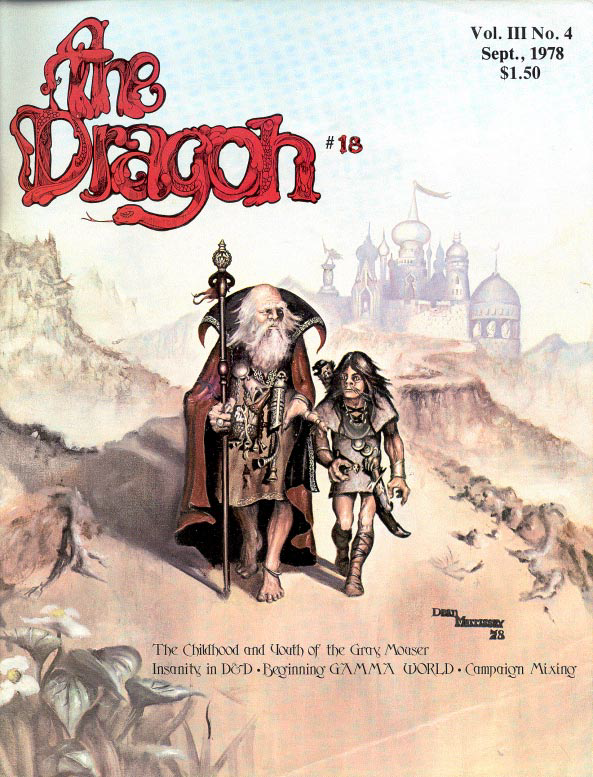
Dragon by Dragon – September 1978 (18)

Another week, another Dragon magazine. The last one was chock-full of stuff, how about this issue.

Traveller: The Strategy of Survival by Edward C. Cooper

As I was thinking, “I don’t remember any Traveller articles showing up before in The Dragon” I hit this line in the article, “I took advantage of the opportunity to observe the TRAVELLER phenomenon first hand” – ah – so this is at the dawn of Traveller.

I’ve never played Traveller, but I did create a character once (I was creating one character for every game I had a PDF of … though I skipped Exalted because after the first few steps I realized I just didn’t care enough to bother with it). This article appears to be about – well – keeping a character alive in Traveller. My favorite bit:

“Several other similar occurrences proved to me then that the success or failure of a character in most cases cannot be traced to “dice or chance” as often as it can to poor handling on the part of a player. I was both surprised and disappointed that some players even blamed a character or given situation for their own bad decisions. But then again, I was extremely excited, awed, by the skill some showed in manipulating their character’s life.”

That hits the spot for an old schooler – though it also shows that there were plenty of people back in the old days who were waiting for the new days with baited breath. Different strokes for different folks!

Reviews – Traveller, The Emerald Tablet, Imperium …

Well, imagine that! The reviewer appreciates that Traveller is not just D&D in space, but rather has its own “unique flavor and style”. The review is quite extensively, and I highly recommend it (yeah, I’m reviewing a review) for folks who don’t really know what Traveller is all about.

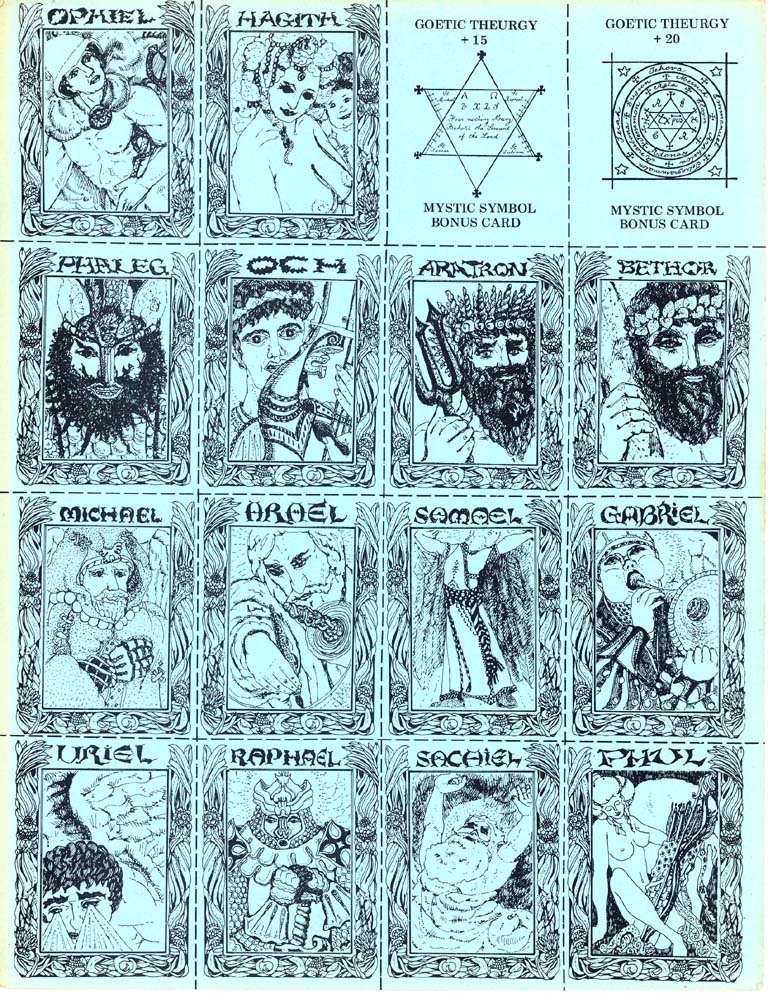
The Emerald Tablet is a set of fantasy wargame rules. The reviewer likes them, but admits he doesn’t know much about wargames. He likes that the magic system is based on ritual magic, which I know some people dig, but I always think it’s overrated. On the other hand – dig this sheet of Astral Force cards (click to enlarge … trust me, click it – click it now) I found at Boardgamegeek.com …

I don’t know what Phul does, but, hmm – anyways.

Imperium is another Game Designer’s Workshop product, a board game written by people who really love sci-fi literature. Apparently, Imperium is a game about the Terrans bumping up against the Imperium and the two sides fighting.

Pellic Quest is a computer moderated RPG (apparently a good thing, because computers are jerks like Dungeon Masters – see, the seeds of the new school were always there). Another sci-fi game, you start controlling a small planet in one of six roles (emperor, crusader, brigand, trader, droyds (robotic destroyers) or the zente (insect alien warriors). Each role needs different “winning points” and then go about making it happen.

Oh, and those zente …

Pretty sweet.

Cosmic Encounter is a sci-fi variation on draw poker.  Apparently it is simple and easy to learn, and, most importantly, fun, although the hype that one really has to get into the head of the alien race they control is wrong. The game combines several elements of classic, abstract games, and I want people who think they’re game designers to embrace this notion. Don’t begin with setting, begin with rules and get to know all sorts of old card games, board games, etc. Then apply setting to the game rules. This is how D&D was born and manages to remain so popular – it works as a game. Well, it used to, anyways.

INSANITY, or Why is My Character Eating Leaves? by Keven Thompson

A worthwhile article – insanity is tough to handle in games. Kevin Thompson devises first a saving throw vs. insanity (which makes sense given the time period). The saving throw is based on a matrix between Intelligence and Wisdom – find the number, add character level to it, and then try to roll 1d20 beneath that number. Neat idea (and I’ll be using it in a post this week).

If you fail the save, you roll d12 (always nice to see the d12) on an insanity chart.

INSANITY CHART

1. Nutty
2. Kleptomaniac
3. Perverse
4. Psychotic Hatred
5. Childlike Trusting
6. Schizoid
7. Severe Paranoia
8. Acute Paranoia
9. Gibbering
10. Suicidal
11. Violent
12. Catatonic

The good thing about this list is that it is more behavior based than clinical. It’s pretty easy to see how these “insanities” could impact actual play in a game.

New Spells in D&D! by Paul Suliin

(Love the use of the exclamation point)

This article introduces new spells created by an actual play group using the rules for spell research in Dragon #5. The editor chimes in with the admonition that every spell needs to have a loophole via which it can negated somehow.

The new spells include Nature Call, Magic Missile II, Moon Runes, Flamebolt, Mystic Rope, Pit of Flame, Word of Warding, Force Field, Extend I, Shatterray, Wall of Water, Extend II, Beam of Blasting, Conjure Djinn/Efreet, Density Control, Extend III, Combine I, Call Spirit, Rust Monster Touch and more.

Let’s convert a couple to Blood & Treasure

Magic Missile II
Level: Magic-User 2
Range: Medium (150 ft.)
Duration: Instantaneous

As magic missile, but this spell conjures either one +2 arrow or two +1 arrows, with a like amount added for every fifth level advanced beyond 3rd (i.e. two +2 arrows or four +1 arrows at 8th level, three +2 arrows or six +1 arrows at 13th level, etc.)

Density Control (which would also make a great power for Mystery Men!)
Level: Magic-User 6
Range: Personal
Duration: 3 minutes

The spellcaster can alter the density of his body from a gas to steel. Such changes alter the spellcaster’s Armor Class, so that at minimum density he is immune to physical weapons, and at maximum density he is AC 18 and his hands strike as swords (1d6 damage). Density may be altered throughout the duration of the spell, and items in contact with the spellcaster’s body when the spell is cast are altered along with him.

Magic: Governed by Laws of Theory by Thomas A. McCloud

Man, I used to roll my eyes at these when I was a kid – theory? dude, I want a new class, new race, new spells, new adventures, etc. But I’m an adult now, so … naw, I still think the same way.

This one attempts to draw inspiration on the how’s and why’s of magic in D&D by examining such sage tomes as the 1960 Encylcopedia Britannica and Frazer’s The Golden Bough. Dude – it’s a game. Of course magic is treated casually. Real estate is treated pretty casually in Monopoly because it’s also a game – move and countermove, risk taking, a random element. Don’t overthink it!

Let Your Town Have A Purpose, or, How To Design A Town In Boot Hill by Mike Crane

Sometimes I think Jay Ward wrote the titles of these articles (bonus Nod points to anyone who gets that reference). Mike covers the best scale (1″ = 20′) to draw the map, the need to think about why the town is there in terms of who settled it and what they do (dude, it’s there to give gunslingers a place to have gun fights), etc. To be completely honest, articles like this are a waste. A bunch of random tables for generating an Old West town would have been much more helpful, or just a suggestion of watching some old episodes of Bonanza. Sorry – guess I’m in a salty mood at the moment.

Reviews Continued … Alpha Omega

Okay, apparently we’re not done with reviews yet. Alpha Omega was Battleline’s first stab at a sci-fi game. The reviewer thinks it reminds him of Buck Rogers or Star Wars … and that’s not an endorsement, according to the reviewer. After all, if we can’t beat all the fun out of sci-fi and make it boring and cerebral, then what’s the f-ing point? (I am in a mood). Here’s a sample of the review …

Alpha Omega is billed as “A game of tactical combat in space,” a claim supported by the rules.

Okay then. Apparently, the art is superb on the counters, but they’re hard to read, and the scale (one hex equals one light second) and turn time (6 seconds) are weird for space fights. The game is also two-dimensional, rather than three-dimensional, although the reviewer doesn’t think three dimensions would have any bearing on the game, and thus might as well not be there. The game is really just naval combat on a board that looks like space. The weapons are not realistic (just names, really), so the game also lacks believability (a bugaboo that has never bothered me personally) – hell, they named a couple alien ships Akroid and Balushi – the bastards. Uggh – life’s too short for this. Game looks fun to me, and the cover is pretty cool.

The Chamber of the Godgame by Mick McAllister

The what of the what? It’s a short article describing a dungeon chamber based on a scene in John Fowles’ “grand metaphysical dungeon novel” The Magus. I won’t go into it – find the article or find the book.

Gamma World: Fire Report; Setting Up The Campaign by James M. Ward and Gary Jaquet

Neat little behind the scenes look at the why’s and wherefore’s of turning Metamorphosis Alpha into Gamma World.

Birth Tables – Boot Hill by Stephen Blair

This one’s a collection of random tables. Let’s roll on them and see what we get …

Social Class: Ranch Related (didn’t know that was a social class, but okay)

Profession of Father: Homesteader (ah, now I get it)

Birth Order: Bastard (makes sense)

Skills: Facility with numbers (this bastard can multiply!)

Initial Purse: $75

Size of Spread: 5,120 acres

Guidelines for Mixing Campaigns: Androids, Wizards, Several Mutants, and Liberal Doses of Imagination, Well Blended by James M. Ward

This article is a quick guide to converting D&D characters to MA characters. D&D characters get a radiation resistance of 3, and MA creatures get no save vs. magic. Magic armor completely disrupts protein and disruptor blasts (good to know). The shielding, metal and energy fields of the Warden stop crystal balls and helms of teleportation from working (it’s science, dude, deal with it). Good article – reminiscent of the treatment in the old DM’s Guide.

Monkish Weapons and Monk vs. Monk Combat by Garry Eckert

Apparently, Garry read a book about Japanese weapons and decided to apply what he learned to monks (who are drawn from Chinese fact and folklore, not Japanese – oi!). Skip it.

Effective Use of Poison by Bill Coburn

Quick article that defines poison as Class A, B or C.

Type A is in potion form, and includes Arsenic and Hemlock. It kills 80% of the time in 2d4 minutes and if it doesn’t kill, leaves a person stricken for 1 week (meaning half strength, dexterity, constitution and movement).

Type B is in the form of gas, darts, cobras and needles. A neurotoxin, it brings death 50% of the time in 4d4 days and leaves people stricken for 1d3 days after being unconscious 30 minutes after poisoning for 1d4 days.

Type C comes from monsters. A hemotoxin, is has a 10% chance of killing a character in 1d4 days, and leaves people stricken for 1d10 days after being unconscious 1 hour after poisoning for 2d4 days.

Armor in this scheme provides a bonus to save vs. poison (-2 penalty for no armor, no adjustment for leather, +1 for chainmail and +2 for platemail).

Not a bad little system, really.

Comics!

Finieous Fingers and his pals meet the evil wizard, and discover that a good initiative roll and a magic wand go a long way towards evening the score between fighters and magic-users.

In Wormy, the trolls make the mistake of breaking one of Wormy’s pool balls. Jeez I miss this comic. Who has the next Wormy in them?

The Childhood and Youth of the Gray Mouser by Harry O. Fischer

This is Harry’s version of the Gray Mouser’s youth, Harry having been a major help in creating all of the major characters of Nehwon back in the day. It begins …

“Mokker was the Prince of Pimps in the Street of Whores in Lankhmar. He could just as easily have been King. He was tastefully and expensively dressed, with massive gold and jeweled rings one or more to a finger. He was exceedingly complex; calculating, sometimes ruthless, vulnerable to fits of whimsy, possessing an almost perpetual erection (as it behooves a whore-master to have), and more. He was generous, and delighted in both the giving and getting of surprises. His whores loved him for this, in addition to the fact that he felt not the slightest hesitation about correcting or revenging a wrong to one of his, no matter how slight the transgression. Mokker was a thorough and practical rogue given to sudden impulses, possessing large eyes, a sensual mouth and plump cheeks; a merry companion and a deadly enemy. He was clever, aware of it, and arrogant.”

No, D&D wasn’t for kids just yet.

Next we have this …

Okay then.

Non-Player Character Statistics by ???

This is another quickie – random tables for determining NPC stats based on their personality. Kinda cool. I’ll roll one up – we’ll say a madame from Tremayne named Durla …

Pride (Ego): Little – =1-% greed, -1% work quality

Greed: Loans things, sells items for normal* prices

Quality of Work: Normal

Okay, well, now I know. I think I’ll stick to my method in Blood & Treasure (on sale now!)

And there you have it, along with some nice little comic panels from McLean. Lots of stuff packed into 34 pages, and not a bad read overall. The spells were fun, and I like the poison rules. The reviews got me to look up some old games I’d never heard of, and the insanity rules put an idea in my head I’ll explore more this week.

Have fun boys and girls, and don’t be the last geek on your block to get Blood & Treasure

Alien Booze

Star Trekkin’ across the universe can build up a mighty thirst, and there’s a good chance that the dive on Rigel-5 you just entered doesn’t have MGD on draft. Here are some other options.

Table I – Where

1. Venusian
2. Martian
3. Jovian
4. Saturnian
5. Mercurian
6. Plutonian
7. Neptunian
8. Denebian
9. Altairan
10. Cygnian
11. Betelgeusian
12. Polarian
13. Andromedan
14. Cetian
15. Algolian
16. Pleiadeian
17. Rigelian
18. Aldebaran
19. Antarean
20. Arcturan

Table II – Descriptor (roll 1d4 / 1d10)

1-1. Acid
1-2. Bitter
1-3. Black
1-4. Blood
1-5. Blue
1-6. Boiled
1-7. Brown
1-8. Bubbling
1-9. Copper
1-10. Crimson
2-1. Dark
2-2. Death
2-3. Dry
2-4. Fire
2-5. Fizzy
2-6. Frost
2-7. Gold
2-8. Green
2-9. Grey
2-10. Heavy
3-1. Jumping
3-2. Lite
3-3. Malt
3-4. Molten
3-5. Orange
3-6. Pale
3-7. Purple
3-8. Red
3-9. Rotting
3-10. Royal
4-1. Salt
4-2. Scarlet
4-3. Silver
4-4. Slime
4-5. Sour
4-6. Spiced
4-7. Spitting
4-8. Sweet
4-9. Viscous
4-10. Yellow

Table III – What

1. Ale
2. Beer
3. Brandy
4. Brew
5. Cider
6. Punch
7. Whiskey
8. Wine

Table IV – Possible Side Effects

01-04. Affected as though by male or female hormones (50-50 chance) – a noticeable change
05-08. Blind for 1d4 days
09-12. ESP for 24 hours
13-16. Fall in love with first person of opposite sex (or a reasonable facsimile thereof) that you see
17-20. Gain 1d10 pounds overnight
21-24. Grow dorsal fin and/or webbing between toes and fingers (or some other DNA snafu)
25-28. Hair falls out
29-32. Hair (green) grows on palms and tongue; falls out in 1d4 weeks
33-36. Hair turns blue or white or some other weird color
37-40. Increased intellect for 1d4 days, then weakened for 1d6 days
41-44. Increased strength for 1d4 days, then weakened for 1d6 days
45-48. Infravision for 1d4 days
49-52. Levitate for 24 hours
53-56. Lose 1d10 pounds overnight
57-60. Lose sense of taste for 1d4 weeks (5% chance this is permanent)
61-64. Memory loss for 1d4 days (per sitcom amnesia)
65-68. Overactive salivary glands for 1d4 days (sound like Daffy Duck)
69-72. Projectile vomiting (1d4+3 feet)
73-76. Put into highly suggestive state for 24 hours
77-80. Sleep for 1 week
81-84. Speak words in reverse order for24 hours
85-88. Temporary insanity for 1d6 days
89-92. Visited by pooka in form of green horse or pink elephant
93-96. You can see dead people
97-100. Emit highly flammable gases from every orifice for 24 hours

Dragon by Dragon – June 1978 (15)

First page of the magazine … Fantasy Air Cavalry from Ral Partha. It’s a good start, let’s see how they finish.

Best line in Kask’s editorial this time …

“In the past year, we have met and overcome all obstacles in our path save one: the U.S. Post Offal.”

The more things change …

First article is Dragon Magic by Michael Benveniste. This is in the D&D Variant series (God, I love seeing that in an official TSR publication).

“The magic used by dragons is tempered by their nature. Dragons
are creatures of rock and wind, having little use for plants and water.
They feel little need for offensive spells, believing that their own body
and deadly breath fulfill this need.”

What follows is a spell list for dragons, and this idea: All dragons have a secret name they will reveal to nobody, under no circumstances. A legend lore or wish reveals a clue, but not the name, nor does commune or similar spells. A limited wish just confirms or denies a guess. Speaking the dragon’s name dispels all of his spells, and allows the speaker to demand one – just one – service from that dragon. Nice concept for driving a game: “We can’t get to the top of the Godmountain without the help of the Dragon of Peaks, and to do that we need to learn its true name.”

The spell list has all sorts of new dragon spells, including 1st level – Breath Charm, Charm Avians, Evaluate Item, Locate Lair, Magic Pointer, Werelight; 2nd level – See Other Planes, Wall of Gloom, Weave Barrier, Weight Control (boy, could you make money selling this one, as long as no phen phen is involved); 3rd level – Binding Spell, Hold Mammal, Mesh, Negate Enchantment I, Revelation, Servant Summoning I, Water to Wine, Wood to Sand; 4th level – Attack Other Planes, Rock to Sand, Seek, Turn Magic, Work Weather. There are some great, evocative names in there, and the more I read, the more I liked the idea. One sample …

“Water to Wine: A dragon loves good wine. This spell allows the dragon to convert any water (including salt or tainted) to wine valued even by Elves. Amount: 20 gallons per age class.”

Up next are a couple more D&D Variants. First, we have Pits by Richard Morenoff. It’s a pretty neat set of random tables to determine the contents or type of a pit. One possibility is a “citizen”, which consists of the following: Pipeweed grower, shipbuilder, hatmaker, beer merchant, sculptor, fisherman, locksmith, tool merchant, weapon merchant, teacher, loan shark and trapper. Old D&D means that 1 in 1000 pits found in a dungeon holds a pipeweed grower.

N. Robin Crossby of Australia next presents Random Events Table for Settlements and/or Settled Areas. This one is based on the current season (word to the wise, Spring and Winter are safer than Summer and Autumn). There can never be enough tables like this.

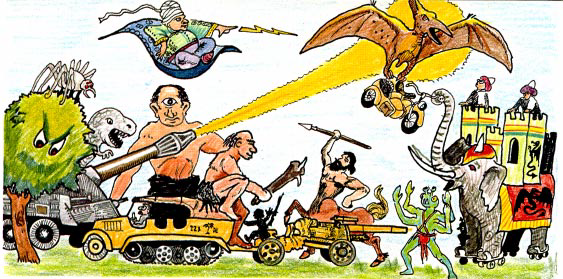
James Ward is up next with Monty and the German High Command, another expose of the gaming goings-on within TSR in 1978. The accompanying illustration brings me joy …

This one involves some WW2 Germans facing off against orcs, storm giants, manticores, an EHP (if you don’t know, you need to study your D&D history a little more closely), a warlock, heroes and superheroes, and trolls, all in an attempt to take a castle.

Jim Ward also presents some thoughts on Wandering Monsters, providing a list of Fourth Level wandering monsters. Takes me back to the game’s origin as a, well, game.

Jeff Swycaffer now presents Notes From Another Barely Successful D&D Player, a follow-up to Ward’s article in issue II/7. He tells of playing a “Maladroit”, who can’t cast spells, fight for a damn, pick locks or lead men. Instead, he lies like a rug. Some good ideas here – worth a read.

Jerome Arkenberg writes The Gospel of Benwa (is he referring to … hmmm) in Dragon Mirth, in which he extoles the Benwanite Heresy, that holds that all the problems in the world are due to the struggle between the Gods of Law and Chaos, and that only victory by the Gods of Neutrality can end misery on earth.

Gygax‘s From the Sorcerer’s Scroll covers D&D Ground Area and Spell Area Scale. Herein, he claims the confusion of 1″ = 10 feet indoors and 1″ = 10 yards outdoors will be cleared up in ADVANCED DUNGEON & DRAGONS. He explains how this originally came to pass – namely that the original scale was 1″ = 10 yards in CHAINMAIL, and that the 1/3 scale was devised by Arneson when he turned the tunneling and mining rules of CHAINMAIL into the dungeon rules of what would become DUNGEONS & DRAGONS. He also explains here that one turn = one scale minute in CHAINMAIL, but that for dungeon movement it was altered to one turn = ten minutes, since mapping and and exploring in an underground dungeon is slow work. The key here is that area of effect is always 1″ = 10 feet, even outdoors. So, there you go.

David Tillery is next with Weather in the Wilderness. This always seems to be such an obvious thing to do, but it has rarely paid off for me in a game. I usually just roll for inclement weather conditions when there’s to be an outdoor fight, to make the fight more interesting. Tillery has a pretty solid system, it seems – reminds me of the World of Greyhawk system.

Next, we have an ad announcing “TWO IMPORTANT NEW RELEASES FROM TSR”, those releases being GAMMA WORLD (love the original font) and the AD&D Player’s Handbook.

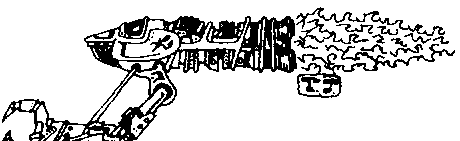
Next, we have Stellar Conquest: Examining Movement Tactics by Edward C. Cooper. Since I don’t know the game, I won’t go into it much, but I did enjoy the art:

Not enough space ships have giant pincers, in my opinion.

Next we have some fiction by L. Sprague deCampThe Green Magician.

“In that suspended gray mists began to whirl around them, Harold moment when the Shea realized that, although the pattern was perfectly clear, the details often didn’t work out right.

It was all very well to realize that, as Doc Chalmers once said, “The world we live in is composed of impressions received through the senses, and if the senses can be attuned to receive a different series of impressions, we should infallibly find ourselves living in another of the infinite number of possible worlds.” It was a scientific and personal triumph to have proved that, by the use of the sorites of symbolic logic, the gap to one of those possible worlds could be bridged.”

Funny – I just read this bit recently.

Next up … Fineous Fingers runs away from Grond the Anti-Paladin.

After that, a full page pic of Wormy counting his gold over a backgammon board.

The next article is Random Encounters for BOOT HILL, by Michael E. Crane. This should be useful for folks who play Old West games. It includes such things as mounted bandits, homesteaders in wagons, unarmed clergy, soldiers, indians, etc.

And so ends the June 1978 issue of The Dragon!

Dragon by Dragon – April 1978 (13)

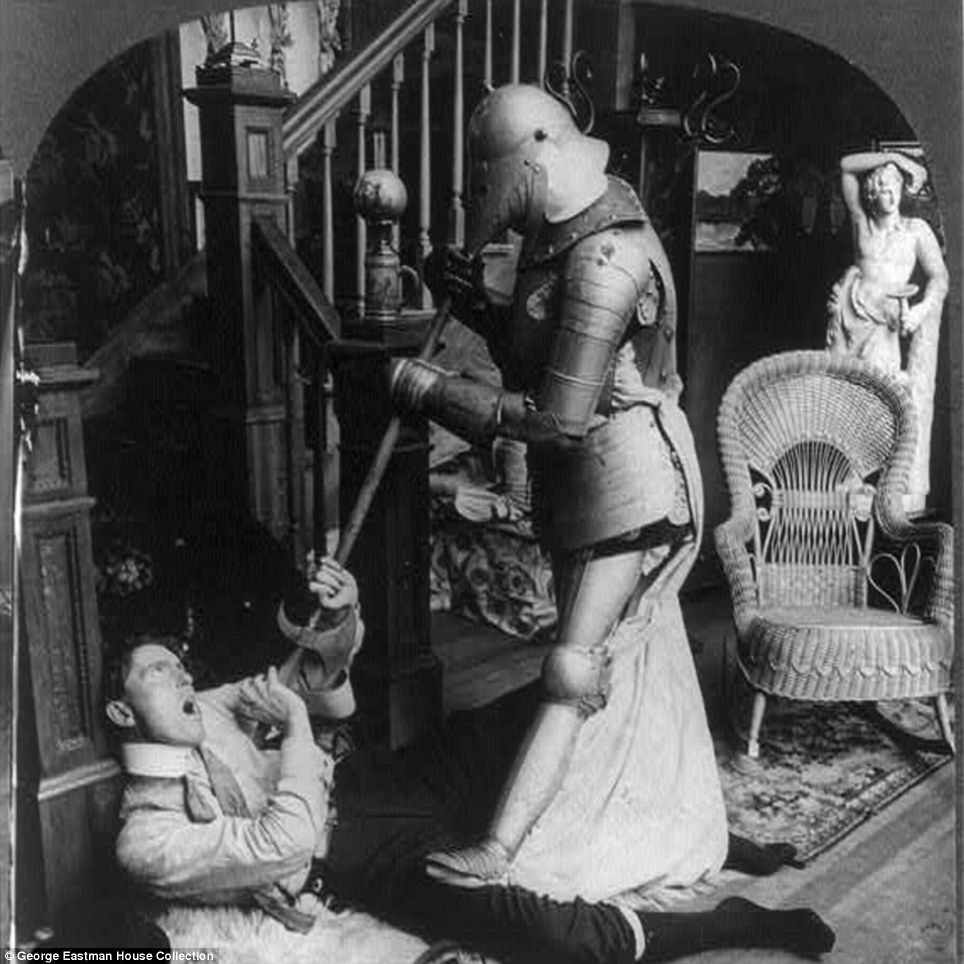
Niall armors up like a barbarian!

Dragon #13 is a mixed bag. Mostly good, a little wasted space (in my opinion of course, one man’s waste is another man’s … hmmm, that’s not going to sound right … skip it). Let’s take a look, shall we …

Tim Kask starts off with his editorial spiel, noting that this is the first of the monthly Dragons. It is also the April Fool’s edition, which we’ll regret a little later on. Gencon moves this year from the Playboy Resort in Lake Geneva (the what in where?) to the campus of the University of Wisconsin-Parkside in Kenosha – they needed more room. TSR Periodicals is also planning a move to a bigger building.

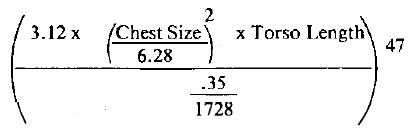
Shlump Da Orc (I’m guessing that’s a nom de plume) produces a surprisingly long article on figuring out how heavy giants are and how much they can lift. In fact, it is multiple efforts to answer this pressing question (one of the ones that suggests to me D&D was already beginning the process of moving from practice to theory with some folks). One formula explains that a 30-ft. tall giant should weigh 11.75 tons, have a 16′ 9″ chest and an 8′ long torso. Would you care for the semi-official weight formula?

Anyhow … the bit on how much a giant could pick up is a bit more interesting, if for no other reason than because of the following assumptions they use about the average human:

The average person can:

1) Carry his full weight on his back
2) Hold in his arms 3/4 of his weight – dead weight that is balanceable
3) With difficulty pick up half his body weight in dead weight
4) With difficulty pick up half his body weight in a struggling animal
5) With mild difficulty pick up 1/4 of his body weight a struggling animal with two hands
6) Fairly easily pick up 1/4 of his body weight in one hand of dead weight, balanced and somewhat symmetrical

Maybe these guidelines will prove useful to you one day.

The other useful bit is the weight (pounds per cubic foot) of various substances, such as:

Aluminum: 170 pounds
Brass, Forging: 525 pounds
Copper: 560 pounds
Iron, Malleable: 450 pounds
Gold: 1,205 pounds
Platinum: 1,340 pounds
Silver: 655 pounds
Steel, Cold Rolled: 500 pounds

Agate: 160 pounds
Beeswax: 60 pounds
Bone: 110 pounds
Diamond: 200 pounds

etc.

This one actually came in quite handy for something I was just writing for NOD, and definitely will be transcribed into an Excel document for future use in my writing. Thanks 30-year old Dragon!

Rob Kuntz now treads into dangerous territory with Tolkien in Dungeons & Dragons. I’m not sure if this was pre- or post-lawsuit. This one is an official pronouncement on the “position on D&D in conjunction with other worlds of fantasy which influenced it conception and specifically to clear up the fallacious beliefs regarding Tolkien’s fantasy as the only fantasy which inspired D&D”

The article mostly boils down to “D&D does not simulate Middle Earth, nor is it intended to, so please stop your nerd-whining”. This continues to be a problem in gaming, primarily in that many people forget that these are games, which by design are about allocating scarce resources to achieve victory (which, actually, is also what life is about), and not make-believe sessions in which whatever you want to happen does.

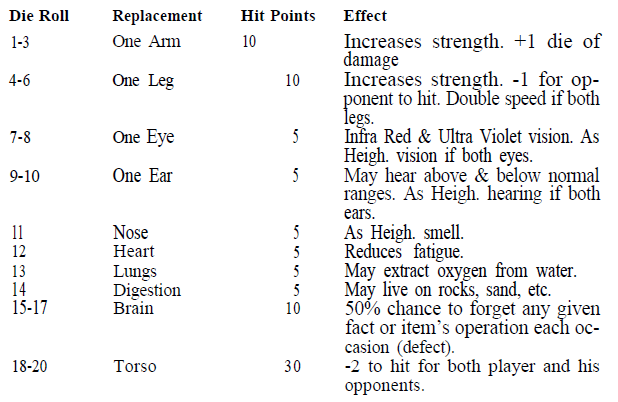
More interesting than this article is the inset by Brian Blume The Bionic Supplement for Metamorphosis Alpha. Bonzer! Random dice roll to replace your parts with bionic bits, and what those bits do. Totally worth reproducing in its entirety:

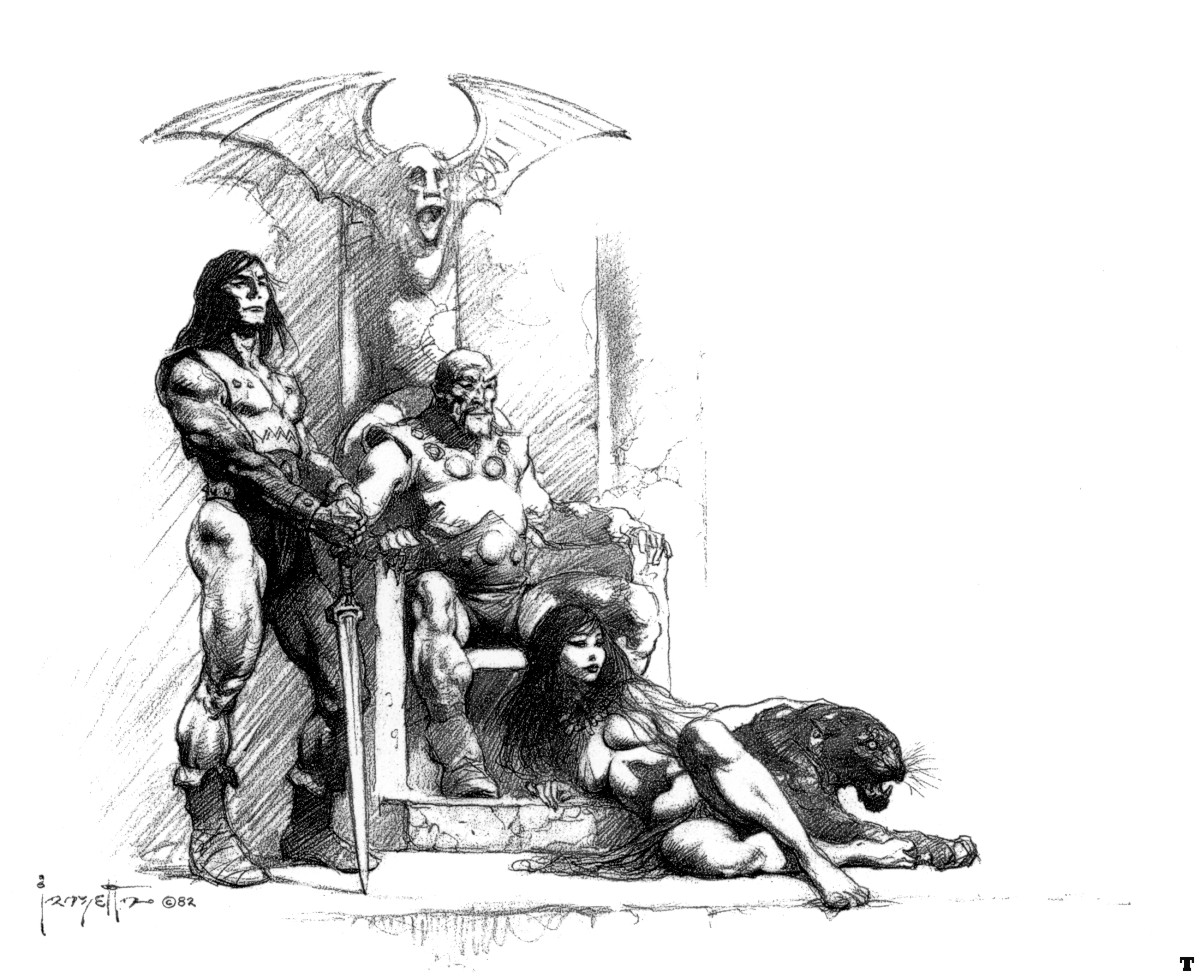
Jon Pickens is in next with an equally awesome article – D&D Option: Demon Generation. We begin with a kick-ass piece of art …

The article gives a way to generate additional “Types” of demons, with the following assumptions – all demons have Hit Dice and Gate ability appropriate to their level, all of Level III or less are vulnerable to normal weapons, the rest being vulnerable only to magical weapons, Magic Resistance 50% at Level I, increasing by 5% per level thereafter and special abilities based on the demon’s level. The powers are divided into 6 levels, and frankly, this looks like a blueprint for a demon class. I won’t reproduce it all, but worth checking out.

Jerome Arkenberg now presents the Japanese Mythos for D&D – again, very extensive article on the gods, goddesses, monsters and heroes of Japanese myth and legend, though the info on each god/demon/hero is pretty light. If you want a super rules-lite version of D&D, imagine if all you knew about a character was his Armor Class, Hit Points, Movement Rate, Magic Ability (i.e. level of magic-user or cleric), Fighter Ability and Psionic Ability.

Up next is the April Fool’s bit – a couple pages of song parodies. The less said the better.

Tim Kask now presents WARLORD: Correcting a Few Flaws. Since I know nothing about the game, I won’t comment on the article. Sounds like a fun game, though.

Gardner F. Fox now presents The Stolen Sacrifice, another adventure of Niall of the Far Travels (not to be confused with Niall of the Just Running to the Corner for Ice).

“The man moved silently through the shadows, keeping always to the darkest places. He moved as an animal might, his body poised for instant action, a big hand on the hilt of the longsword by his side. His eyes darted from a doorway to the far corner, where the wind blew a length of scarlet silk hanging from the wall. Caution was in his great body, for he knew that should he be seen this night, death would be his reward.”

Fineous Fingers finds out that just walking up to an evil wizard’s stronghold is stupid …

Yeah, you hate him, but DM’s love him. Meanwhile, Wormy introduces barbecued dwarf burgers.

We round it out with James Ward explaining a few tricks for adventurers – the kind of things that remind you that, at least back in the day, it really was a game, meant to be played and the rules exploited.

That’s it for #13. All in all a pretty useful issue, and especially good if you enjoy Gardner Fox.

Armor Up Like a Barbarian

Once upon a time, there was pretty realistic armor floating around in the fantasy realm – the stuff you would expect out of folks who did a little research at the local library. And then the 1980’s arrived on the scene …

In the spirit of ridiculous, barbarian-style armor, I present the following scheme:

Armor is for cowards, and nobody likes or respects a coward – not buxom serving wenches, not grizzled men-at-arms, not squirrely thieves, not fat merchants and certainly not the local lord with a quest that needs fulfilling.

In old school parlance, being unlikable = low charisma.

In a barbarian milieu, armor = cowardice.

The barbarian uses piecemeal armor. Each fledgling barbarian hero can decide, at character creation, to buy as many pieces of armor as they like – well, up to 8 anyways. Each piece costs 25 gp, improves one’s Armor Class by 1 and reduces their charisma score by 1. A barbarian cannot allow their charisma to fall below 3, so starting out with low charisma puts a solid ceiling on how much armor you get to wear as a barbarian. This doesn’t sound fair? By Crom, barbarians don’t whine about life not being fair – go be paladin you lousy #$%#%.

For each piece of armor you order, you roll on the following table – after all, only a real poser would actually go out and buy mismatched, piecemeal armor – barbarians pick it up off the bodies of the slain.


Note: Bits and straps of leather don’t count here – just metal. Leather up all you want.

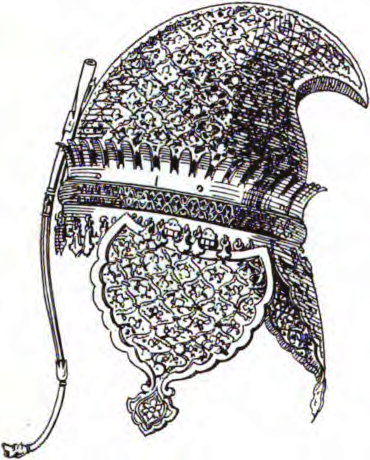
1. Helm (5% chance of wicked horns – if you have horns, you keep your point of charisma)


2. Sabatons (if this is your only piece of armor you lose an extra point of charisma – what kind of dork walks around with nothing but metal shoes)

3. Breastplate or shirt or mail or scales (+2 AC and -2 charisma)

4. Arm (right or left, your choice sport)

5. Leg (right or left, you choice sport)

Always protect yer fightin’ leg!

6. Shield (why does a shield dock your barbarian street cred? Because you should be wielding a honking big two-handed sword or axe, jerkwad)

7. Shoulder guards (if your charisma is still 15 or higher, you can add a cape; otherwise it would just make you look like a stupid poser)

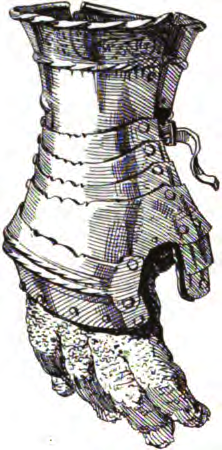
8. Gauntlet (5% chance of being spiked, which grants +1 bonus to damage each time you score a hit in combat)

9. Mail Loincloth (add mail brassiere if female, unless you want to kick it amazon style)

[You can Google “chainmail loincloth” on your own, chief]

10. Disc Armor (not as dorky as a breastplate, but still shows a lack of self-confidence, which is like a taped up pair of eyeglasses to a barbarian)

You can scrounge other pieces as you adventure, but note – adding a piece still means losing charisma, which means fewer retainers, lower reaction checks and probably some kind of penalty to carousing.

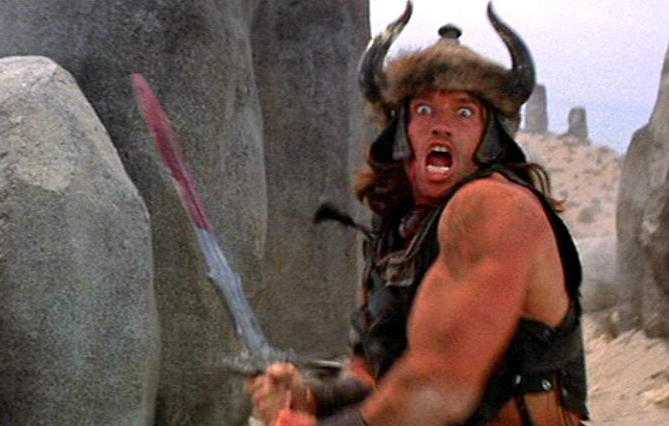
Don’t worry Conan, we can forgive the horned helmet … just not the acting