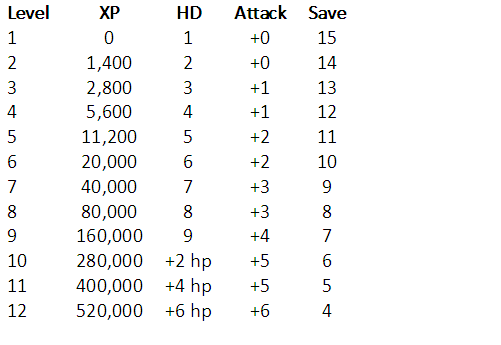
Generations

In my day …

I made a little post on Google+ today about an ancient Roman aqueduct recently found via a secret door in a chapel. I commented that had elves been real, they would have found it a long time ago, in reference to the ability of elves to detect secret doors more easily than humans can. My buddy Luke commented that, if elves were real they’d probably just remember where the door was located. It was a good point, and one that’s worth thinking about. So, let’s do a little experiment …

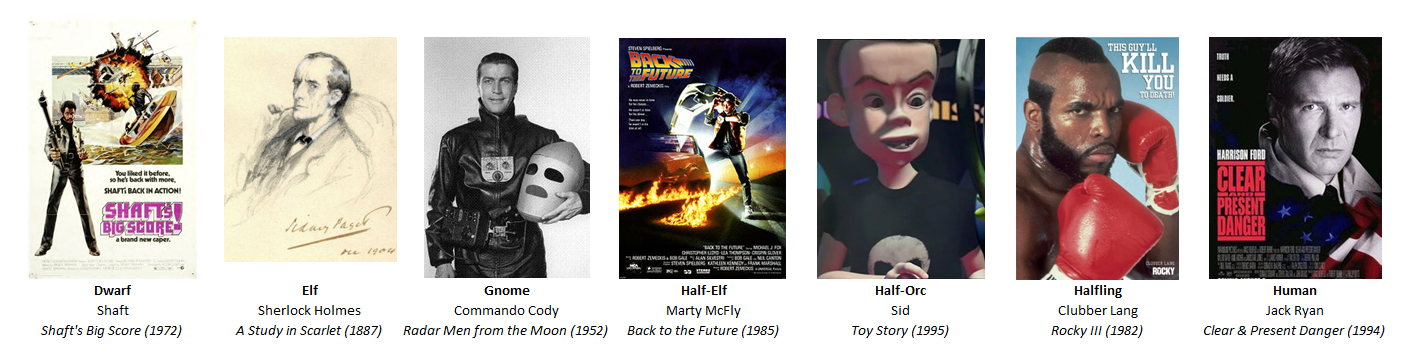
Let’s take some average adventurers from the “core” races as starting adventurers and treat each of them as an action/adventure hero from a movie or book published in the year they were “born”, using 2012 as our current year.

Then, we’ll look at some major event from world history and see how much these characters and their parents and grandparents experienced.

Our team of first level adventurers might look something like this …

That’s a pretty divergent group. The half-orc and humans are the young punks of the group – Gen Y, who never lived without a computer or cell phone. The halfling and half-elf are products of the ’80s and ’90s – Gen X. All in all, those four a pretty close to one another and probably speak the same language – after all, culture doesn’t change so quickly in the faux-Medieval settings embraced by most fantasy games.The dwarf, on the other hand, is going to be a bit less modern in his sensibilities. From the perspective of the human and half-orc, the gnome is practically from another century, and the Victorian elf is a relic in his manners and language. And these are all first level characters (which does bring up a problem of the whole “different life spans” thing in the game, which we’ll happily ignore for the purpose of this article).

Imagine the life experiences they have to draw upon, these characters. Imagine how their manners and mores will clash. They’re all first level, but the dwarf and gnome have to regard the others as young punks, and the elf has to feel a bit superior to them all.

Side Note – This makes me picture elves as a bunch of Doctor Who’s … wearing all sorts of odd fashions and using odd phrases because they remember when they were hip and still see them that way.

Another way to think of it … The human and half-orc are 4th edition D&D, the halfling and half-elf 3rd edition, the dwarf grew up on Moldvay/Cook, the gnome played wargames and the elf plays pinochle.

What They Know

Most of us have a good grip on the history we’ve lived through, and have heard the stories from our parents and grandparents about the history they’ve lived through. We might have also heard a few tidbits second hand about things our grandparent’s grandparents lived through. When you bring super long lifespans into the mix, this opens up a vast amount of historical knowledge to the average party.

Click to increase size; numbers represent the generations

In other words, “Who needs to hire a sage when you have an elf around?”

Generations

Thinking about the way these generations overlap brings up interesting prospects for a first level party. The elf, for example, may have known the humans great-great grandfather, and might easily be the father of the half-elf, who is the issue of a wild May Day fling of the human’s grandmother.

Peoples of Namera

There are now three Hex Crawl Chronicles out and a couple more in the can. I’m about to begin writing the next one, and since I’ve had a couple emails recently asking for some more details about the setting – in particular about the folks wandering around causing trouble in it – I thought I’d share a few of the details (well, as many as I know).

(Oh, and you can find the overall map for the setting HERE)

Bucranian
Appearance: HCC 5

The Bucranians of the great island Bucrania are handsome folk, with chiseled physiques and deep olive skin. Their hair and eyes are as black as night.
Noble Bucranians dress in tunics of expensive fabric, most purchased from the Last Men, and square cloaks. They wear leather sandals on their feet and phetas of silk on their heads. Commoners dress as nobles, only with less expensive fabrics. Warriors carry spear, short sword, javelins and oblong shields emblazoned with black bulls.

In Bucrania, all women are wards of the king and live one of his many palaces until they are wed to a man. The most valued men of the kingdom are athletes, and athletic games are frequent and hotly contested. Champions are adopted by the king and become princes of Bucrania. They are gathered into fraternal trios, and in these trios they battle minotaurs in the arena for the honor of their father and the favor of his “daughters”.

As humans, Bucranians can advance in any class. Bucranian priests are usually druids who worship bulls. Bucranian fighters favor spear and javelin.

Centaur
Appearance: HCC 3, HCC 4

A centaur has the head, arms and torso of a human or elf and the lower body of a pony or ass. Centaurs dwell in meadows and glades surrounded by thick woodlands. They are known for their lack of temper and their fondness for women, war and song.

Centaurs are usually seven to eight feet tall from hoof to head. Even though their equine bodies are smaller than normal horses, they are still quite heavy and find it difficult to scale sheer surfaces without help from others. A centaur’s equine body may have any pattern common to normal horses, and the hair on their heads often follows suit. Centaurs usually have nut brown skin.

Centaurs speak their own language and often (50%) the language of elves. They occasionally speak the common tongue of men. Many centaurs learn the languages of gnomes, goblins, halflings, kobolds and orcs. Because of their size, centaurs have booming voices.

Centaurs cannot have a strength or constitution scores lower than 9, nor can they have a wisdom score higher than 14. Centaurs can become fighting-men, advancing to a maximum of 7th level (8th level if strength is 14 or higher, 9th level if strength is 18). Centaurs can carry 150% more than most characters. In addition, their base movement is increased by 6. Because they are quadrupeds, a centaur’s gets a +2 save to avoid being knocked over or grappled. In combat, centaurs can choose to attack with their weapon or their hooves, which deal 1d4 points of damage. A centaur’s armor (really a combination of human armor and horse barding) costs twice as much as normal human armor.

Dwarves
Appearance: HCC 1, HCC 2, HCC 3, HCC 4

The dwarves of Namera are bandy-legged and wrinkled, with narrow eyes and immense noses, splayed toes, large hands (the better for holding hammers and climbing rocks) and snow white hair. Women are as ugly as the men, but their ugliness is made up for by a reputation as being honest, hard-working, and immense fun at parties.

Dwarves don’t like to stand out in a crowd, so they were muted colors that blend in with their surroundings, including hooded cloaks. They adore pockets and sew as many into their clothes as they can. Long, pointed shoes are also a must, to give the illusion of more height. Dwarf warriors look for as much armor as they can wear, and prefer practical weapons like hammers and axes to flashy swords. They usually carry crossbows or hand gonnes over bows. Dwarves are natural animal lovers, and every dwarf has his pet.

Dwarves follow the normal dwarf rules. Their gods are never named or invoked in public, and their clerics stay home to care for the clan (unless your favorite rules allow dwarf clerics, in which case they replace spoken prayers with noisy ululations.

Dwarves of the Aderumdocs
Appearance: HCC 5

Unlike their bandy-legged cousins of the west, the dwarves of the Aderumdoc Mountains are a bit shorter and much rounder, rosy cheeks, gap-toothed smiles (when they bother to smile) and long, nimble fingers. They have gray skin that becomes covered with moss as they grow older, giving them a natural camouflage in ancient forests.

The Aderumdoc dwarves are deliberate and patient, never given to rash action or thoughtless words. They often sit down cross-legged when it is time to think, puffing on their pipes and considering every angle. This makes them wondrous engineers, but can be quite taxing on their fellow adventurers when every fork in a tunnel must be weighed and considered.

The Aderumdoc dwarves follow the normal rules for dwarves.

Elves of the North
Appearance: HCC 4

These northern elves dwell in towers disguised as massive trees by illusions. They are uglier than the trouping elves to the south, having long legs and arms attached to squat bodies and faces that resemble brownies more than fashion models. These northern elves wear long mail byrnies and winged helmets traced with precious metals. They carry hide shields painted in bright colors and carry longswords and daggers.

Northern elves are gruff and forward than their southern kin, and do not bear so much resentment to others (though they dislike the imperious Northmen and their empire). They believe profoundly in freedom and actively sew chaos where societies seem to rigid and structured. The wood elves have learned how to train giant eagles for use as their mounts, and every wood elf warrior aspires to become an eagle rider.

The northern elves follow the same rules as all other elves. They can become fighter/magic-users (level 4 and 8 respectively), thieves (no limit), rangers (level 3) or fighter/magic-user/thieves (level 4/8/unlimited).

Elves of the Pirate Coast
Appearance: HCC 5

The elves of the Pirate Coast have sun-dappled skin and auburn locks they never cut and warm, gray eyes. The coastal elves stand about 5 feet tall and have wiry frames. The elves wear as little clothing as possible, preferring loose tunics and loincloths. In times of battle they put on ornate, polished armor and wield long swords, dagger and longbows.

The elves are natural horsemen, learning to ride at a very young age and not truly achieving adulthood until they are can perform all manner of acrobatic tricks and feats of mounted warfare. They are a carefree folk who have a tough time realizing that other people’s feelings, needs and desires exist. They are persistent, if not always skilled, singers and dancers.

These elves follow the same rules as other elves. Coast elf thieves are usually horse thieves and rustlers, and take as much joy in stealing as the warriors do in fighting and the magic-users in torching villages with fireballs.

Elves of Valley of the Hawks
Appearance: HCC 1

The elves of the Valley of the Hawks are typical for the elves of Namera. They stand about five feet in height and have lithe physiques, pale skin that gives off a glow of health and vitality. They usually wear their hair long and tie it back or weave it into braids. Their hair and eyes might be any color under the sun.

They follow the tradition of the trouping fairies, with every elf a lord or lady in dazzling raiment of mauve, cyan and soft green, riding fine horses and carrying ornate bows and long swords. Elves take great pains to have the most stylish and expensive clothing they can afford – their appearance is a matter of great pride for them.

All elves of the valley hail from a hidden fort that is disguised by illusions and enchantments to look like a grassy knoll. The elves tend moontrees, whose leaves absorb moonlight that distills into the sap. Dead branches have a core of hardened sap which is melted down and alloyed with aluminum and tin to form elven mail. Their cloaks of elvenkind come from the silk of the faerie dragon, which lives in globes of spun silk that look like colored lanterns hanging from the trees. Their boots of elvenkind come from the hides of harts that are killed and slaughtered ritually to gain the blessing of the forest.

The elves of the Valley are haughty and proud, but also terribly dashing and brave. They adhere to the normal rules for elves (or high elves for “advanced” games). Elf fighters of the Valley favor the use of long sword and long bow, or possibly lance.

Embalmers
Appearance: HCC 3

The Embalmers are a race of bronze skinned men with raven hair and violet eyes. They are short and stocky, the women voluptuous and the men given to wide exaggerations and long melancholies.

Male embalmers dress in woolen tunics and trousers and gray cloaks. They wrap their lower legs in leather thongs and wear leather sandals on their feet and intricately patterned conical wool caps on their heads. Women wear loose gowns, a wide leather belt wrapped just under their breasts, shorter cloaks and put their hair in braids. Warriors arm themselves with spear, shields of wood and leather, short bows and long knives.

The embalmers raise sheep, trading wool and foodstuffs for fragrant oils and herbs used in their embalming ritual, the aspect of their culture which gives it its common name. The embalmers make mummies of their dead philosophers and nobles, walling them into their temples and palaces that they may advise future generations through barred windows. Peasant corpses are burned for heat in the furnaces of their palaces.

Embalmers are humans and might be of any class. Paladins are rare among them and most embalmer clerics worship death gods. Embalmer fighters favor the spear or short bow.

Golden Men
Appearance: HCC 1

The Golden Men of the steppe have golden-brown skin and blazing red hair. They wear buckskins in the winter and loincloths when the weather is warm enough. Warriors wear leather armor and carry stout clubs and leather slings, or metal weapons they have scavenged from their victims.

The Golden Men are descended from the ancients and now dwell in small hunter-gatherer bands in the woodlands or as brutal nomads on the prairie. The ancient ruins that once made up their homes are sometimes haunted by them, as they return to their temples to pay homage to such deities as Alberni, the dog-headed moon goddess, Kishrdis, the obsidian-skinned goddess of mining and Thallos, the seven-eyed god of love.

The Golden Men are humans, and can advance in any class. Clerics are as common among them as druids and magic-users are quite rare since they lack the resources to produce books or scrolls. Most Golden Men magic-users use very ancient tomes from the times of the ancients printed on strange, glossy paper in tiny black letters. Golden Men fighters favor clubs and slings.

Half-Orc
Appearance: HCC 5

Half-orcs are not a race, but rather creatures with a mixture of human and humanoid (usually orc, goblin, gnoll, bugbear or hobgoblin) blood. Half-orcs can almost pass for human. They average from six to seven feet in height and are usually stocky. Their skin often has a pink, grey or green cast to it. Half-orcs often have one of the following facial features: Turned up nose, pointed ears, thick eyebrows, a heavy forehead, vestigial tusks and/or pointed teeth. Half-orc hair is coarse and unruly and usually black, dark brown or dark red. Half-orc eyes are almost always brown, brownish green or greyish green.

Half-orcs usually speak the common tongue of men and often (60%) the language of their other parent race. It is not uncommon for them to learn the language of dwarves, goblins, ogres and giants.

Half-orcs can see up to 60 feet in darkness and their sense of smell is as keen as a wolf’s. Their thick skin gives them a natural Armor Class of 8 [11], which can be enhanced with armor. Half-orcs enjoy a +2 bonus to saving throws against poison and disease.

Half-orcs can advance as fighters (up to 8th level), thieves (no level limit), assassins (up to 6th level) or fighter/thieves (up to 8th level as fighter and 12th level as thief).

Hivernians
Appearance: HCC 2

Hivernians have jaundiced, sallow skin and hair that ranges from dark carnelian to fiery orange. Their eyes are icy blue. Hivernians are short and wiry, with long arms, fingers and toes, pug noses, long teeth and heavy jaws. They wear animal skins and long hoods decorated with bones and teeth. Warriors carry spears and short bows and wear the equivalent of leather armor.

Hivernians are as ancient a people as the Golden Men, and have warred with them for generations. Unlike the Golden Men, who seem to be able to lay claim to an advanced civilization in the past, the Hivernians have ever been savages. They are skilled in stalking and hunting, and have no qualms about killing for the sheer enjoyment of it. Hivernians worship the elk-antlered, doe-eyed goddess Yhoundeh.

Hivernians move as silently as halflings and can track as well as rangers of their class level. Hivernians can take levels as fighters (up to 7th), fighter-thieves (up to 6th level in each) or magic-user/thieves (up to 5th level as magic-users and 6th level as thieves). Hivernian fighters favor the spear or short bow.

Last Men
Appearance: HCC 5

The Last Men have olive skin and blond hair always worn closely cropped. Dealing as they do in fabrics, the Last Men dress in heaps and layers of clothing, all of expensive and luxurious fabrics like damask silk and velour. Soldiers of the Last Men carry Bohemian ear-spoons (pole arms) and hand gonnes (treat as heavy crossbows).

The so-called “Last Men” are a population of men and women who consider themselves the last true humans left in Namera. All other peoples are infected with chaos and thus “sub-men” in the eyes of the Last Men. They are emotionless, bland people, their lives ordered by their master, The Golden God, and by an ingrained herd mentality. The Last Men deal in fabrics, growing cotton and mulberry trees. Their factories contain mechanical looms controlled by a difference engine kept in a great, black citadel in their city-state, located to the south of the Pirate Coast. True xenophobes, they fear corruption by others, but still send out traders in longships to trade fabrics for food and other items.

Last Men are humans, and can take levels in any class, but their lack of independent, creative thought makes magic-users among them rare. Clerics of the Golden God are more common. Last Men fighters favor the use of bohemian ear-spoon or hand gonne.

Necrophage
Appearance: HCC 3

Necrophages are tall and lean, with pallid skin that they paint in grotesque patterns using burgundy paint made from crushed elderberries and columbines. Their warriors wear leather or ring armor and carry shields, leaf-bladed short swords, spears and javelins.

The Necrophages are fierce warriors who roam the rolling steppes of the Land Beyond the Black Water with their herds of cattle, riding in war chariots. The necrophages consume the flesh of their dead and of enemy casualties in war. They are berserkers in combat, and while one might expect berserkers to charge into combat screaming, the necrophages fight in complete silence. Necrophage tribes are ruled by undead kings, wights, with worthy challengers raised by force of will when they die to challenge the existing wight-king. The necrophages worship Emntrix, the petty death who claims the souls of soldiers.

Necrophages are humans, and can take levels in any class. Necrophage clerics worship Emntrix, the petty death of soldiers. Necrophage warriors favor the short sword. They can choose to be berserkers, but lose the ability to wear more than ring armor. Berserkers gain a +1 bonus to attack in combat for a number of rounds equal to their constitution bonus plus their level. After they come out of rage, they suffer 1d6 points of damage from exhaustion.

Northmen
Appearance: HCC 1, HCC 2, HCC 4

The Northmen have ebony or chocolate skin and wavy hair of brown or black, often worn long. Most are stout and plump, but a few villages mingled with the elves in elder times and are noted for their height and the electric sparkle in their eyes. The northmen are known for their baggy trousers and long tunics. They favor axes and curved knives and usually wear chainmail or platemail.

Northmen are the architects of a great kingdom that is now tearing itself apart in a terrible civil war between three princesses who seek to replace their dead father. They are industrious folk, not given to flights of fancy, who regard others as just a tad less civilized than themselves. They have a tendency to roll their eyes at outlandish customs and costumes.

Northmen are humans and can take levels in any class. Their clerics worship such deities as Almerla the goddess of healing, Talaunus the god of civilization, Teros the god of war, Vilmarra the goddess of vengeance and Waith, goddess of the underworld. Northmen fighters always favor axes.

Sea Lords
Appearance: HCC 4, HCC 5

The average Sea Lord has pale skin (or deeply tanned skin for the crews of their lion-prowed longships), blond to auburn hair and eyes ranging from blue to gray. Men and women tend to be exceptionally tall, with a pleasant, rough demeanor. Sea Lords dress in leather tricorne hats, padded doublets and baggy pants tucked into tasseled buskins. Sea Ladies wear long dresses covered by shawls and pile their braided hair atop their heads, holding it with wooden pins. Noble Sea Lords and Ladies wear necklaces of bronzed leaves from their old domains in the White Islands. Warriors carry broadswords and pistols and wear steel breastplates over soft leather armor.

The Sea Lords, or Albians, came from across the Briny Sea to escape the sinking of their homeland, the White Islands. Most of the Sea Lords that escaped this cataclysm were men, the crews of ships. The early settlers suffered a distinct lack of women, giving rise to the taking of slaves among female humanoids of the Pirate Coast. For this reason, there are still a good many Sea Lords with goblin, orc or (if they are lucky) elf blood flowing through their veins (i.e. half-elves and half-orcs). Sea Lords always have a tale to tell, and in taverns they tell these tales to the accompaniment of fiddles, mouth harps and percussion provided by stamping feet and by clanging walking sticks and cudgels on whatever surface is handy.

The Sea Lord clerics always worship Albia, the White Goddess who created them and kept them until the betrayal of her father, the Briny Sea. Albia is a goddess of perfection and purity, the gleam in her father’s eye until he consumed her in a fit of pique. Where some religions produce holy water, the priests of Albia produce holy powders. The first were taken from the chalk cliffs of the White Islands, but modern powders, kept in vials of glass or silver, are drawn from chalk outcroppings on the Pirate Coast.

Swamper
Appearance: HCC 3

The swamp folk are albinos with long, kinky hair that they sculpt into a shape reminiscent of large horns or cones. They have broad faces and large, pink eyes. The Swampers dress in soft leather tunics and the more accomplished hunters wear black cloaks made from the pelts of swamp panthers. Warriors carry sickles and staves.

Swampers encountered outside their villages are hunters or gatherers looking for exotic herbs and insects. The gatherers carry horn-handled sickles, often silver bladed, leather slings, wicker holy symbols, spirit rattles and bags of herbs, including healing poultices and bundles meant to repel the undead. Gatherers are usually accompanied by a breed of large, white swine that are used as mounts, pack animals and to sniff out herbs and funguses.

Swampers can be of any class, but most of them are clerics or magic-users. Clerics worship spirits of the dead and of the earth. Swamper fighters favor the use of the staff, and there are probably more Swamper monks than true fighters.

Tevalar Elves
Appearance: HCC 4

The Tevalar elves are aquatic elves who dwell in fresh water. They have blue-green skin and are completely hairless, with large, black eyes. Their warriors wear coats of silvery scales, onion-domed helms of ground and polished river glass (filled with water and connected via copper tubing to brass water tanks on their backs). They are armed with tridents, crossbow and short swords.

The Tevalar are slightly paranoid expansionists, building dams to flood valleys and bringing nearby human and demi-human tribes under their sway. Tevalar elves know how their surface kin have been dimished by the surface folks, and are determined to escape this feat. This makes them easy to offend and quick to deal with situations decisively and, at times, violently.

Tevalar elves follow the same basic rules as elves, with the exception that they can swim as quickly as they move on land and breathe water rather than air. To be sure, they would make challenging player characters, given how reliant they are on their water tanks.

Witchmen
Appearance: HCC 1

Witchmen have tan or olive skin and a great variety of hair and eye colors. They wear long, straight tunics and woolen leggings. Their shoes are leather and pointed, and they wear tall pointed hats with wide brims; both shoes and hats are decorated with buckles of brass or silver. Warriors carry long swords and daggers, and wear either ring armor or chainmail.

The Witchmen come from southern climes and dwell in the swamps at the mouth of the Great River. They are mystics, steeped in eldritch knowledge and taught the arcane arts from childhood. They dwell under the rule a college of witches and warlocks, with young Witchmen accepted in synods when they reach puberty. They are educated in these synods and treat them something like political factions. They worship such deities as Eosinn, the faun goddess of hunting and Onorix, the goddess of wealth.

Their leaders are skilled in swordsmanship and magic, and should be treated as elves in terms of their class choices, though their maximum levels are 3 levels higher than elves. Witchmen favor long swords and daggers.

Oh – also – just finished my little map for HCC 6 – The Troll Hills. Time to start filling this baby up. We’ll have Witchmen colonists on the Great River, an unspeakable troll god and a lair for every troll that I can legally use and few I’ll probably create. Think of it as Against the Giants but for trolls. Should be fun!

Cyclopeans – Playable Race for PARS FORTUNA

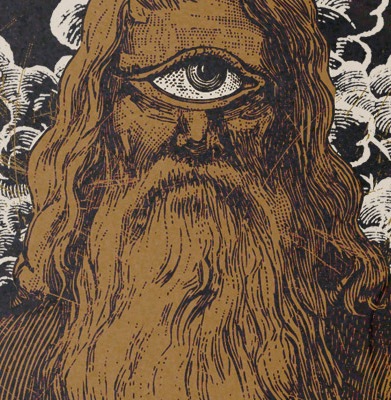
Having watched Krull over the weekend – a dandy fantasy movie, in my opinion – I was inspired to do something inspired by the cyclops in that movie. The cyclopean is designed for PARS FORTUNA, but should be readily usable in other old school-style games …

CYCLOPEAN (ARIMASPIAN)
The Cyclopeans are tall, rugged humanoids with a single, large eye located in the center of their face. Cyclopeans have skin tones that range from the color of aged parchment to a rich, glossy umber. Their hair is usually worn long and shaggy, and is always blue-black in youth and adulthood, turning white as a Cyclopean enters his or her later years. The Cyclopeans eye might be any color in the spectrum, with amber and blue being the most common colors, and mauve and mottled green/brown being the rarest.

A warlike people, the Cyclopeans nonetheless have a philosophical side – probably an artifact of their unique ability to see into the future. Born fatalists, they know well the curse that accompanies their power, and take care to only pierce the veil of time when their lives, or the lives of their loved ones, depend on it. Most Cyclopeans dwell in the wilds or on the fringes of civilization, making a living as trappers, hunters and bandits. They have a passion for fighting, but lack the organization of the Oraenca or their flair of the Ilel. Cyclopeans like to rush into battle, casting their military forks and then drawing their hand weapons to close with the enemy. Cyclopean warriors usually wear light or medium armor and carry shields, military forks and broadswords. They might also carry slings and knives.

Cyclopeans see in the Skathra kindred spirits, both for their wild ways and their divinatory powers. They respect the Bo’al, Oraenca and Olvugai as worthy warriors, and though they fear the deadliness of the Ilel, they can’t quite bring themselves to respect them.

Cyclopean names are short and to the point, and are usually followed with a wad of spittle if the name is despised or a clang of the fork on the ground if revered. Common names include Bach, Brel, Cert, Oban, Tohr and Venn for males and Azra, Jula, Kento, Mala and Trena for females.

Cyclopeans adventure for money, fame and a love of action. Cyclopeans like to stay on the move and stay in the action, for it helps to keep their fatalistic moods at bay.

Racial Abilities
All cyclopeans have the following special rules:

1. Cyclopeans have poor depth perception and peripheral vision. All opponents are treated as though they have a knack for surprising them. Cyclopeans suffer a -1 penalty to hit with ranged attacks, except when using their military forks, with which they train from childhood.

2. Cyclopeans have a knack for wilderness survival and reading people’s faces. This helps them discover falsehoods and guess at intentions.

3. No more than once per day, a Cyclopean can peer into the future. They will either glimpse a moment of Weal or a moment of Woe (50:50 chance). The moment glimpsed will be connected to their current endeavors or goals, and can be described with as much or as little detail as the Referee thinks appropriate. A Cyclopean might, for example, glimpse himself or a friend opening a door and being struck dead by a trap, or looking behind a curtain and discovering a secret door. Perhaps the door or curtain is unique and the Cyclopean will easily recognize it when they come to it – perhaps not. Perhaps the Cyclopean will never come across the possible future they have glimpsed. In general, this power acts as a free “clue” to something in the Cyclopean’s current adventure.

4. Whenever a Cyclopean glimpses the future, they hasten their own demise. For the next 24 hours, the Cyclopean suffers a -2 penalty to saving throws made to avoid death, damage or danger.

Class Abilities
Cyclopeans have the following class abilities:

Prime Requisite: Constitution (+5% bonus to earned XP if 13+)
Hit Dice: 1d6+2 (or 1d10), +2 hp per level after 9th
Saving Throws: As warrior
Attack Bonuses: As warrior
Restrictions: Cyclopeans can use any weapon, light and medium armor and shields.
XP Advancement: As the Oraenca

Cyclopean characters turn their racial knack for reading faces into a skill.

Cyclopeans can go berserker once per day. This berserkergang can only be entered once they have suffered damage in battle or once they have inflicted damage in battle. Once the berserker state is entered, the Cyclopean remains in it for a number of rounds equal to their Constitution divided by 3. They cannot exit the berserker state prematurely without passing a saving throw, and will attack anything in reach while under its spell. While berserk, a Cyclopean gets two melee attacks per round and inflicts +1 damage with melee attacks, but suffers a -2 penalty to Armor Class. A Cyclopean suffers from exhaustion for a number of hours equal to the rounds of combat they spent while berserk unless they spend a full turn after the battle resting.

Picture nabbed from HERE

PARS FORTUNA Discount and the Zwunkers

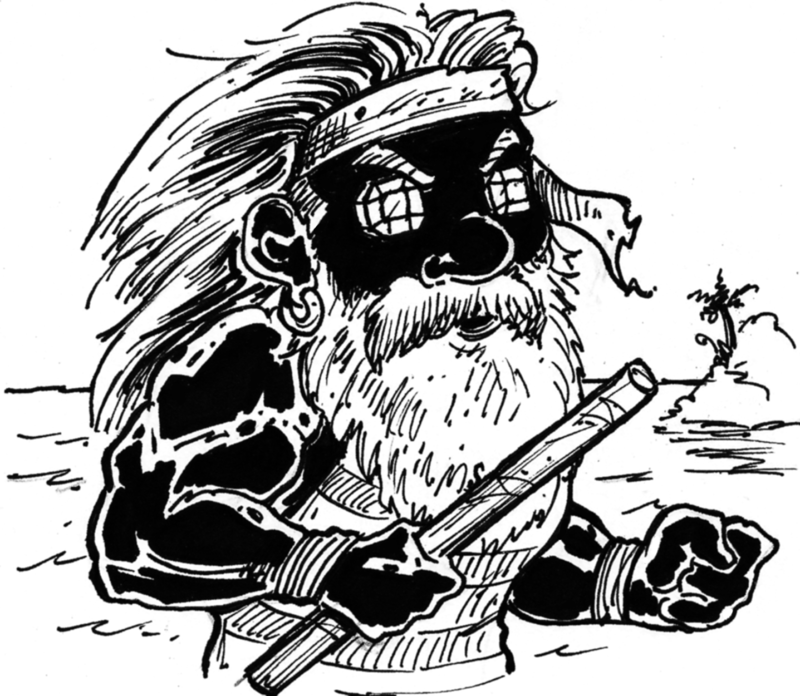
I present the Zwunker from the aforementioned PARS FORTUNA as a playable race.

Zwunkers (Sea Dogs)

Zwunkers are black-skinned dwarves with long manes of gold hair. Their eyes are faceted and resemble yellow diamonds.Zwunkers stand anywhere from 3 to 4 feet tall, and they are heavier than they look. Zwunkers are usually found working as sailors or hired muscle, so they tend to dress simply and prefer to let their arms be bare to show off their mighty thews.

In the PARS FORTUNA setting, Zwunkers seemingly have no home. Most ports have an itinerant population of the little buggers working as sailors, bodyguards, thugs or laborers. Zwunkers like to move around, and in fact often need to move around to stay ahead of the trouble they get into. When they do settle down, it is usually to dwell in caves overlooking the sea. These caves are decorated with flotsam and jetsam and all the bric-a-brac you would expect a person to collect in the course of dozens of sea voyages.

Zwunkers are wanderers and, often, troublemakers. They enjoy stirring things up and seeing what happens – introducing a little chaos into otherwise staid and steady lives. Although not overly fond of alcohol, they are downright obsessive over gambling and wagering, and most of the trouble they get into starts as a dare-turned-wager. Zwunkers are hard, diligent workers, taking great pride in out-working other folk. This makes them popular with Oraenca. Their disregard for authority makes them popular with the Kyssai. Most other races see them as a nuisance.

Zwunker adventurers aren’t much different from normal zwunkers – they like to see new things, annoy new people, walk further, climb higher, etc. Many Zwunker adventurers got their start when somebody bet them they wouldn’t climb into a hill or plunder a tomb.

Zwunker names are little more than nicknames. They are usually monosyllabic – names like Zurk, Yan or Gord for males and Tua, Offa or Zee for females.

RACIAL ABILITIES
Zwunkers have a knack for seamanship, including navigation (even away from the sea – they have an excellent sense of direction), climbing and swimming. Zwunkers are also very anti-magical in nature, receiving a +1 bonus to save vs. magic, and actually creating a zone of magical interference within 30 feet that creates a 5% chance of spells cast in that zone or into that zone going awry and not working.

CLASS ABILITIES

Prime Requisite: Constitution, 13+ (5% experience)

Hit Dice: 1d6+1 (+2 hp per level after 9th level)

Armor Restrictions: Zwunkers can wear light and medium armor and use shields.

Weapon Restrictions: Zwunkers can use any weapon except two-handed swords and pole arms.

Special Abilities: A Zwunker character’s anti-magic zone increases in power as they increase in level, adding a 1% chance per level of spells going awry (i.e. a 1st level zwunker’s zone has a 6% chance of ruining spells, while a 10th level Zwunker’s zone has a 15% chance of doing so). Once per day, a zwunker can control winds (and only winds) per the spell Control Weather. A 10th level Zwunker gains the ability to use the Control Weather spell, as written, once per day. Finally, Zwunker characters are skilled at climbing, navigating and other nautical tasks.

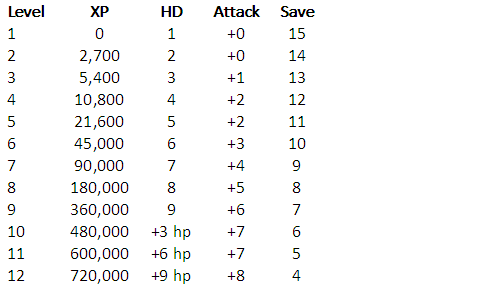
Zwunker Advancement

Level Experience Hit Dice Hit Bonus Saving Throw
1 0 1 +0 15
2 2,000 2 +0 14
3 4,000 3 +1 13
4 8,000 4 +1 12
5 16,000 5 +2 11
6 32,000 6 +3 10
7 64,000 7 +3 9
8 128,000 8 +4 8
9 256,000 9 +5 7
10 350,000 +2 hp +5 6
11 450,000 +4 hp +6 5
12 550,000 +6 hp +7 4


Pars Fortuna Preview #4 – Final 4 Races

These are the final four playable races populating the world of PARS FORTUNA. My next task will be to preview some aspects of magic and a few of the spells.


The attractive quadruped on the crest of the hill is a Skathra. The Skathra look like centaurs with the lower bodies of antelopes and spiral horns atop their heads. They have light brown skin and darker, auburn fur with black markings on their faces and sides. A skathra stands about 5 feet tall from hooves to head. They are wise, though sometimes confounding, creatures who dwell in the wild, green hills. Skathra have a natural wanderlust, and a desire to see everything there is to see before they die.

In game terms, Skathra are one of our magic-using classes. They combine their magical abilities with a talent for archery, lightning quick reflexes, survival skills and a knack for divinatory magic.

Slinking down the hill next to the Skathra is a Vindlu. Vindlu resemble long, thin lions covered in scales of silver tipped with aquamarine. They have long “whiskers” like those of a carp. These whiskers are extremely sensitive, making vindlu difficult to surprise and allowing them some insights into the emotions of others. Their four legs end in clawed hands. Outside their home city, they live in tight-knit family bands, hiring themselves out as “problem solvers”.

In game terms, Vindlu are one of our skill classes. Vindlu are stalkers and pouncers, and have a talent for avoiding traps and getting into places they are not wanted.

In the middle of the group is a Tachi. The Tachi are intelligent macaques who live in lattice-work cities on the thickly forested southern coasts, west of the lands of the Cakrol (and often in competition with them). The Tachi are merchants, moneylenders and bankers extraordinaire, and are always looking for a new path to riches.

Tachi are another skill class. They can literally smell gold and silver, and couple their natural proclivity for finding treasure with a head for business and a silver tongue. Tachi make natural spokespersons for adventuring parties in PARS FORTUNA.

And so we come to the last of the races of PARS FORTUNA – the Oraenca. The Oraenca are a race of stout, heavy warriors with skin like scarlet sandpaper and bones of iron. They measure four to five feet in height and are broad and muscular. Oraenca have flat faces, golden eyes, nose holes set high in their faces and broad mouths filled with chisel-like teeth. They are egg-layers and amphibious, having evolved in a shallow sea that is now a dry, salty wasteland. Exiled from their homeland, they found a home in the Empire of Vex, and have served as the foot soldiers for that empire and its Ilel rulers, for generations.

Oraenca are the heavy warriors of the game – they can use any kind of weapon and armor, and their fighting skills are primarily defensive – they gain an increased bonus with shields and can apply that bonus to a nearby comrade. Unfortunately, they are natural followers, and suffer a penalty when saving against mind-control effects.

And there you have it, the race of PARS FORTUNA – from slightly different to what-the-heck!

Pars Fortuna Preview #3 – More Races

Four more of the strange races in the PARS FORTUNA setting …

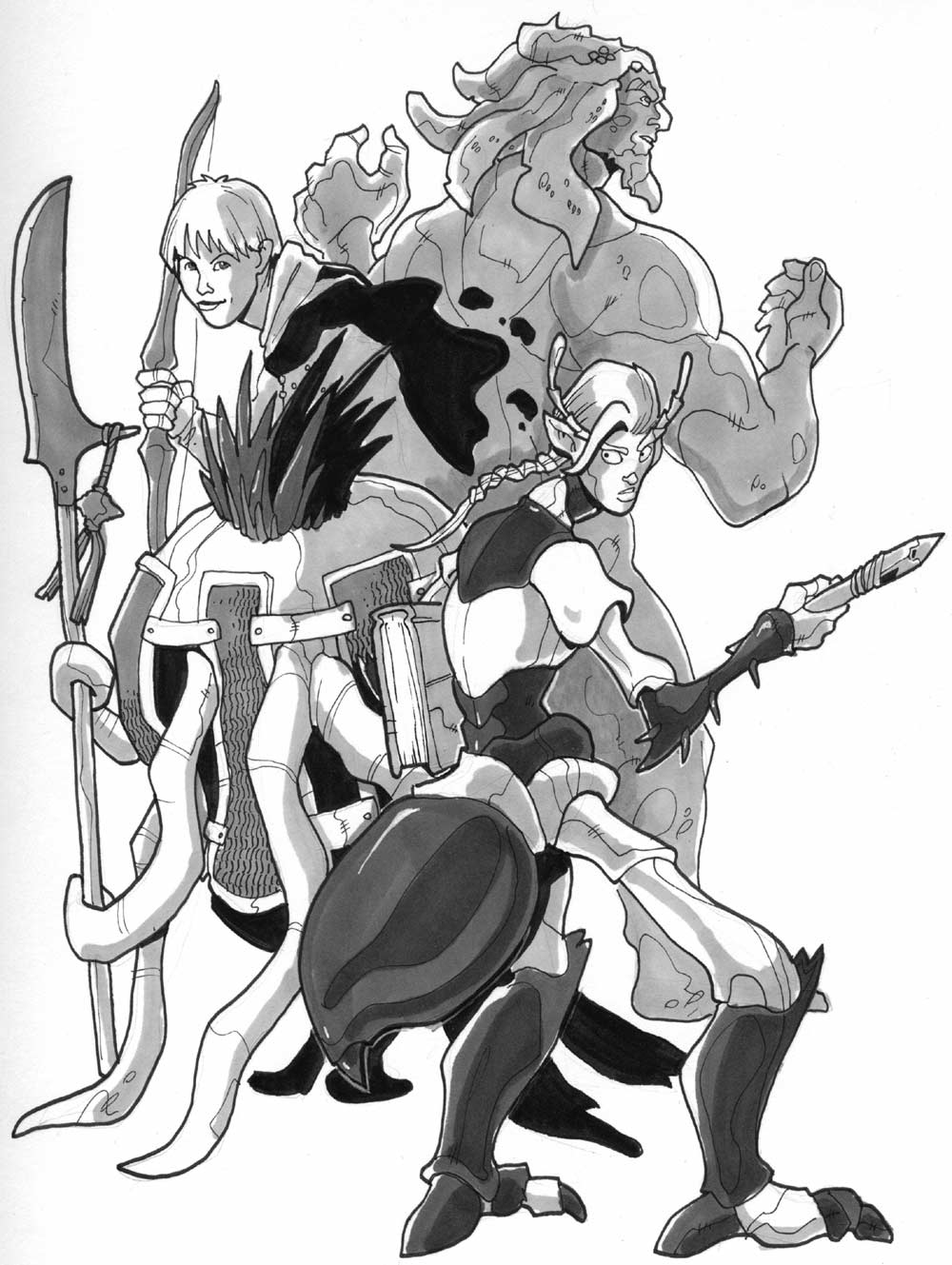
In the back of the pack we have a JAE. The Jae are clumps of walking vegetation that can assume a humanoid form by wrapping themselves around a skeleton of wood or metal. They use their morphic form and a little magic to make themselves appear to be members of other races – or even a person’s close friends or family. In their real form, the so-called kelpies can detach from their skeletons and move about almost like oozes – fitting into tight spaces and such. They are natural charlatans.

Jae are another spell casting race, with the added abilities of impersonating people and crawling around like an ooze when it suits them. They can communicate with plants.

Next to the Jae is a KYSSAI, also known as a ghost. The Kyssai are happy anarchists who view bodies of solid matter as prisons. Kyssai are capable of becoming ethereal for short periods, and are generally sneaky sorts. In the game setting, they are wanderers who pick up all sorts of useful information that a Referee might wish to introduce into game. They are the only race besides the Oraenca (see next preview) who can tolerate the Ilel – mostly for the spectacle.

Kyssai are another skill class, this time working as spies and scouts. They are good at sneaking about and surprising others and their power to become ethereal helps them infiltrate areas and escape with their lives. They are, alas, a bit emotionally stunted and have difficulty forming close relationships.

The bizarre creature that looks like a tentacled potato is an OLVUGAI. The Olvugai are nicknamed the visitors by the other races. They are, in fact, alien visitors to the setting, stranded on the strange world (dimension?) of PARS FORTUNA and dedicated to unraveling its mysteries.

Olvugai are a race of scholarly warriors. They are capable of attacking opponent in front and behind at the same time, and they are capable of becoming invisible for short periods of time. Olvugai have a knack for logical thinking and are skilled as sages.

In the foreground, we have a NIF, or wasp-woman. The Nif are the female counterparts to a mindless race of drones called the Nef. They dwell in hive-cities in the Cinnabar Flats, a desert of poisonous mineral springs. Each Nif belongs to a brood of sisters. The broods serve their queen mother and dote on their over-protective (and sentient) fathers until they get the call to strike out on their own. Nif have honey-colored carapaces marked with black patterns that they share with their brood-sisters.

The Nif are our third magic-using class. Their carapaces make them slightly more durable than the Caledjula and their talents run to elemental spells rather than illusions. Nif are resistant to poisons and acids, have thick carapaces and a knack for chemistry.

Our last preview of the races of PARS FORTUNA will appear next week, and include fire-loving lions, mercantile monkeys, wise antelope-centaurs and creatures with bones of steel.

Pars Fortuna Preview #2 – Races of Pars Fortuna (with ART!)

A month back I hired Jon Ascher, a gentleman known on DeviantArt as Pachycrocuta, to draw the odd, randomly generated races that populate the world of PARS FORTUNA, and boy did he knock it out of the park. I had him draw the races in groups of 4 (there are 12 total) and have now received the inked drawings and want to share them with everyone, along with some brief descriptions of the races, how they will be presented in the game and where they fit into the rules and setting.

The tall “gentleman” is a BO’AL. The bo’al are a race of hermaphrodites with bluish-green to deep green waxy skin reminiscent of the skin of a dolphin. In the setting, they dwell on a wide prairie bisected by a great river and crisscrossed with hundreds of canals, locks and irrigated fields. Nicknamed the engineers, they are taught from a young age the disciplines of mathematics, physics and architecture. Bo’al respect hard work and personal liberty – they’re happy to come together for a cause, but dislike the concept of kings. They are usually jovial sorts, and intensely curious about how things work.

In game terms, bo’al are one of the “skill” classes – and by this, I mean you tend to have three sorts of classes in class-based games – the fighting classes (good attack bonus, best hit dice, worst saving throws), the magic classes (spells, low attack bonus, low hit points, good saving throws) and the skill classes, which muddle about in the middle. The bo’al get a bonus to detect sloping passages, sliding walls, secret doors and large, room-sized traps (most folk do it on a 1 in 6, they do it on a 2 in 6), as befits their skill in engineering. They also have some skill at disabling traps, setting traps and repairing damaged items. Adding to their usefulness, they can withstand a pretty good amount of damage – they get an extra hit dice at 1st level and can regenerate some damage after each battle. So, the bo’al is a skill class with a nod towards combat.

At the center of the group is an ILEL, nicknamed the imperials. The ilel are a race of clones – copies of a former marshal of the Empire of Vex grown in vats to form a personal guard for the emperor. They have skin the color of burnished gold, hair as black as night, solid black eyes and a well developed sense of megalomania – probably why they now run the empire they were hired to protect. Ilel are accomplished swordsmen, specializing in fighting with broadsword and a wavy-bladed dagger called a kris. They are haughty and arrogant, often treating their comrades as henchmen, and if not for their ability to cut a path of red ruin through their enemies, they wouldn’t be tolerated.

The ilel is a fighting class. They are mobile fighters, so less armor but a boost in initiative. They also have some bonuses when fighting with two weapons (higher bonus to hit and the ability to trade their bonus to hit for a bonus to AC round by round). Because of their commanding attitude (and admitted skill at command) they improve the fighting-ability of their henchmen (no, not the other player characters, even if the ilel treats them like henchmen) and can have one henchman more than their charisma score would normally allow.

Next to the ilel is a CALEDJULA. The caledjula’s claim to fame is their ability to fly without the need of wings. Caledjula have tawny to reddish fur, pupil less white eyes, huge ears and six fingers on each hand. Caledjula are natural tricksters, having an inborn ability to generate illusions. In the game setting, they dwell in the tall mountains that surround Fortuna’s Spire (the literal “tent-pole” dungeon of the setting) in cliff dwellings. They are nicknamed the aeolians.

Caledjula are one of the magic race/classes in the setting, filling the role of a trickster class. All of the spell casters in PARS FORTUNA use the same spell list (126 spells, level 1 to 9), but each magical race gets a small list of spells open only to them – illusions in the case of the caledjula. The caledjula can also work on people’s emotions with their deep, melodic voices (i.e. a bonus to reaction checks) and they have a bat-like radar sense that lets them operate in complete darkness.

Finally, the little scaly bugger is a CAKROL. The cakrol resemble humanoid pangolins. Nicknamed zealots, cakrol are devoutly religious folk who live in little villages on a lush peninsula covered by rain forest. They make their way harvesting tropical crops, carving wooden idols, trading in beautifully crafted sailing barques and doing their best to protect themselves from the evil spirits that infest their homeland. They are a clannish people, and possessed of a fearful anger when they feel their adopted clan / guild / adventuring band is being threatened.

Cakrol are primarily a fighting class – they have the good attack bonuses, the hit points and the ability to use any weapon. They come with their own armor, which can be supplemented. Adding to this, they have some ability to detect and repel evil spirits (not unlike a cleric’s turn undead ability) and the ability to go berserk in combat.

All of the races in PARS FORTUNA will be presented as races separate from classes, and as racial classes (the default for the setting). My hope is that even people not interested in playing a “PARS FORTUNA” are able to find something useful in the book for their own game.

Next Preview – A ghostly adventuress, a walking heap of kelp, something from beyond the stars and a waspy woman …

On the Beastmen of Nabu – Part Three

Two more beastmen round out the blog series. Click to read Part I and Part II. The final article that will appear in NOD #3 will include cattle people, horse people, monkey people, raven people and swine people.

Aigosy (Goat People)
The aigosy are an eccentric race of mystics who dwell in irregularly shaped, or stepped, towers made of sun-dried bricks. Aigosy men always cultivate beards, sometimes small and neat, often curly and tangled, and all aigosy have thick, tangled hair that is usually black. Aigosy are tan to dusky in complexion and have long, flat noses. They traditionally wear felt skullcaps with small felt horns on them, rough tunics, cloaks and leggings and thick leather sandals. Aigosy have little use for jewelry, but do appreciate colored beads, especially glass beads, and often wear strings of them as necklaces and bracelets. Aigosy warriors wear ring mail under their robes and carry shields covered with leather and such weapons as flails, maces and slings. Most aigosy carry a set of pan-pipes.

An aigosy village consists of a dozen or so “towers”, each housing anywhere from three to seven aigosy. Aigosy men and women do not marry, and often do not even live together. Children are raised by the community, with the men cuffing any child that gets out of hand and women, after nursing, doing their best to mother any child within reach. The towers are decorated simply, with the most noticeable articles of furniture being the tall stools and chairs that they prefer. Each aigosy community has a large oven in which they bake their daily bread; flat loaves decorated with seeds in mystic patterns.

The aigosy live by herding goats and sheep and growing a few crops. Rugged and tough, the aigosy have an amazing ability to grow crops in very difficult environments. For this reason, they are considered lucky by many farmers, and should a family of aigosy wish to establish themselves on the fringes of a human settlement, they are usually welcomed (though not too warmly, for they are known to be a bit odd and disruptive).

The aigosy are unflappable, ignoring danger and keeping their cool in just about every situation except being near attractive members of the opposite sex. The truth is, the aigosy are a bit lecherous. They are also eccentric in their speech and manners. They have a cackling laughter that is more unnerving than contagious, and their eyes never seem quite right. They enjoy pondering things over, smoking a clay pipe and, if male, pulling on their beards. When they finally come to a decision, they become a flurry of excited activity.

Racial Characteristics: Aigosy are natural climbers, climbing very difficult surfaces on the roll of 1-2 on 1d6, and rarely failing to climb a surface that provides even small hand and foot holds. They enjoy a +1 bonus on saving throws against spells and effects that affect the mind (i.e. fear, charm, etc). An aigosy’s iron stomach allows them to digest just about anything and makes them more resistant (+2 bonus on saving throws) to poison and disease from ingested articles.

Aigosy Racial Class
The aigosy are often considered to be wild-eyed mystics and, frankly, weirdos. They come by their odd mannerisms honestly, though, for most aigosy are born with what one might call “fairy-sight”. Many aigosy can see spirits and can glimpse the future and past. Besides the racial characteristics mentioned above, a member of th aigosy racial class also gains some spell casting ability and the ability to see spirits.

Prime Requisite: Wisdom (13+ gets +5% bonus to earned experience).
Hit Dice: 1d6 (+2 hit points per level after 9th).
Weapons Permitted: Club, dart, mace, sling, staff.
Armor Permitted: Leather and shields.

Spells: Aigosy can cast divination spells in the same manner that clerics cast spells (i.e. they do not need spellbooks).

Level 1: Comprehend Languages*, Deathwatch*, Detect Evil, Detect Magic, Detect Secret Doors*, Detect Snares & Pits*, Detect Poison*, Detect Undead*, Hide from Undead*, Identify*, True Strike*

Level 2: Augury*, Detect Invisibility, ESP, Find Traps, Locate Object, Speak with Animals, Status*

Level 3: Clairaudience, Clairvoyance, Darkvision, Speak with Dead, Tongues*

Level 4: Detect Scrying*, Discern Lies*, Divination*, Locate Creature*, Speak with Plants, Scrying*, Wizard Eye

Level 5: Commune, Contact Other Plane, Prying Eyes*, Speak with Monsters

Level 6: Analyze Dweomer*, Find the Path, Legend Lore, True Seeing*

* – New spell – see end of article

Spirit Sight: Aigosy are capable of peering into the ethereal plane, and thus have a 1 in 6 chance (increasing by 1 every three levels) of spotting creatures either on the ethereal plane or creatures that are invisible.

Esou (Sheep People)
The esou live in tight-knit communities of 100 to 300 men and women led by a lord and his retainers. Esou communities are herding communities, keeping cattle, sheep and sometimes goats and swine. The esou are skilled at controlling their animals with horns, thus relieving them of the necessity of keeping dogs, which make them nervous. They build their communities on hills, usually constructing a large shell keep. Animals are, as much as possible, kept within the walls of the keep or very near, for the esou tend toward paranoia and are always certain that rustlers are just over the hill waiting to pounce.

Esou have dusky skin and curly blond hair. They wear woolen clothes, including long tunics, leather aprons and sandals. Most esou wear steel skullcaps with a curled ram-horn motif worked into the sides. Warrior equip themselves with ring armor or chainmail, shields and maces that are often tipped with steel heads shaped like a ram’s head. The esou are close-minded and suspicious. It is difficult to work oneself into their confidence, and easy to lose that confidence. Many esou expect visitors seeking hospitality to prove themselves with painful, physical ordeals.

Racial Characteristics: Esou are trained in defensive combat, giving them a base armor class of 8 [11]. They are only surprised on a roll of 1 on 1d8 and sense dangerous traps on a roll of 1 on 1d6.

Esou Racial Class
Esou warriors are experts at defensive combat, and thus very valuable to armies and parties of adventurers. Once an esou adopts a band of adventurers or soldiers, he becomes very protective of them. Esou are always on the lookout for danger, and often drive their comrades crazy with their constant fretting.

Prime Requisite: Constitution (13+ gets +5% bonus to earned experience).
Hit Dice: 1d6+2 (+3 hit points per level after 9th).
Weapons Permitted: Any.
Armor Permitted: Any.

Defensive Stance: When adopting a defensive posture, an esou gains a +1 bonus to hit and damage, a +2 bonus on all saving throws and a +2 bonus to Armor Class. In exchange, he cannot move during combat. A defensive stance lasts for 4 rounds, after which he suffers a -1 penalty to hit and damage for the remainder of the encounter. An esou can adopt his defensive stance a number of times per day equal to his level divided by two, rounding up.

Ignore Damage: At level 6, an esou can ignore 1 point of damage from melee, missile and spell attacks.

Trap Sense: Besides his 1 in 6 chance of noticing traps, an esou who takes levels in this racial class also gains a +1 bonus on saving throws to avoid traps.

NEW SPELLS –

ANALYZE DWEOMER
Level: Magic-User 6
Range: 30 ft.
Duration: 1 round per level

You learn all of the magical functions, effects and triggers on any magic item or any person under the effect of a spell that you look at. The person being analyzed or holding an object being analyzed may make a saving throw to foil your analysis. Casting this spell requires a tiny lens of ruby or sapphire set in a small golden loop, costing approximately 1,500 gp.

AUGURY
Level: Cleric 2
Range: Personal
Duration: Instantaneous

An augury can tell you whether a particular action will bring good or bad results for you in the immediate future. The base chance for receiving a meaningful reply is 70% + 1% per level, to a maximum of 90%; this roll is made secretly. A question may be so straightforward that a successful result is automatic, or so vague as to have no chance of success. If the augury succeeds, you get one of four results: Weal (if the action will probably bring good results), Woe (for bad results), Weal and woe (for both) or Nothing (for actions that don’t have especially good or bad results). If the spell fails, you get the “nothing” result. A cleric who gets the “nothing” result has no way to tell whether it was the consequence of a failed or successful augury. The augury can see into the future only about half an hour, so anything that might happen after that does not affect the result. Thus, the result might not take into account the long-term consequences of a contemplated action. All auguries cast by the same person about the same topic use the same dice result as the first casting.

COMPREHEND LANGUAGES
Level: Cleric, Magic-User 1
Range: Personal
Duration: 10 minutes per level

You can understand the spoken words of creatures or read otherwise incomprehensible written messages. In either case, you must touch the creature or the writing. The spell enables you to understand or read an unknown language, not speak or write it.

DEATHWATCH
Level: Cleric 1
Range: 30 ft.
Duration: 10 minutes per level

You can determine the condition of creatures near death within the spell’s range. You instantly know whether each creature within the area is dead, alive and wounded with 3 or fewer hit points left, alive with 4 or more hit points, undead, or neither alive nor dead (such as a construct).

DETECT POISON
Level: Cleric, Magic-User 1
Range: 30 ft.
Duration: Instantaneous

You determine whether a creature, object, or area has been poisoned or is poisonous.

DETECT SCRYING
Level: Magic-User 4
Range: 40 ft.
Duration: 24 hours

You immediately become aware of any attempt to observe you by means of a scrying spell or effect. The spell’s area radiates from you and moves as you move. You know the location of every magical sensor within the spell’s area. If the scrying attempt originates within the area, you also know its location; otherwise, you and the scrier immediately make opposed caster level checks (1d20 + caster level). If you at least match the scrier’s result, you get a visual image of the scrier and an accurate sense of his or her direction and distance from you.

DETECT SECRET DOORS
Level: Magic-User 1
Range: 60 ft.
Duration: 1 minute per level

You can detect secret doors, compartments, caches, and so forth. Only passages, doors, or openings that have been specifically constructed to escape detection are detected by this spell.

DETECT SNARES & PITS
Level: Druid 1
Range: 60 ft.
Duration: 10 minutes per level

You can detect simple pits, dead falls, and snares as well as mechanical traps constructed of natural materials. The spell does not detect complex traps, including trapdoor traps. The spell detects certain natural hazards, including quicksand, a sinkhole, or unsafe walls of natural rock.

DETECT UNDEAD
Level: Cleric, Magic-User 1
Range: 60 ft.
Duration: 1 minute per level

You can detect the number of undead creatures within range of the spell and their relative strength (i.e. hit dice or challenge level).

DISCERN LIES
Level: Cleric 4
Range: 30 ft.
Duration: 1 round per level

You know if the subject of your scrutiny deliberately and knowingly speaks a lie. The spell does not reveal the truth, uncover unintentional inaccuracies, or necessarily reveal evasions.

DIVINATION
Level: Cleric 4
Range: Personal
Duration: Instantaneous

Similar to augury but more powerful, a divination spell can provide you with a useful piece of advice in reply to a question concerning a specific goal, event, or activity that is to occur within one week. The base chance for a correct divination is 70% + 1% per caster level, to a maximum of 90%.

HIDE FROM UNDEAD
Level: Cleric 1
Range: Touch
Duration: 10 minutes per level

Undead cannot see, hear, or smell the warded creatures. Even extraordinary or supernatural sensory capabilities cannot detect or locate warded creatures. Non-intelligent undead creatures are automatically affected and act as though the warded creatures are not there. An intelligent undead creature gets a single saving throw.

IDENTIFY
Level: Magic-User 1
Range: Touch
Duration: Instantaneous

The spell determines all magic properties of a single magic item, including how to activate those functions (if appropriate), and how many charges are left (if any).

LOCATE CREATURE
Level: Magic-User 4
Duration: 10 minutes per level

This spell functions like locate object, except this spell locates a known or familiar creature.
You slowly turn and sense when you are facing in the direction of the creature to be located, provided it is within range. You also know in which direction the creature is moving, if any.

PRYING EYES
Level: Magic-User 5
Range: One mile
Duration: 1 hour per level

You create a number of semi-tangible, visible magical orbs (called “eyes”) equal to 1d4 + your level. These eyes move out, scout around, and return as you direct them when casting the spell. Each eye can see 120 feet (normal vision only) in all directions. Each eye has 1 hit point and an AC of 18. You give each eye some basic instructions of where to go, and it returns and replays in your mind what it has seen.

SCRYING
Level: Cleric 5, Druid 4, Magic-User 4
Range: See text
Duration: 1 minute per level

You can see and hear some creature, which may be at any distance. If the subject succeeds on a saving throw, the scrying attempt fails. If you have no knowledge of the creature, it gets a +10 bonus to its saving throw. If you have only secondhand knowledge of the creature, it gets a +5 bonus to its saving throw. If you have a picture or likeness of the creature, it suffers a -2 penalty to its saving throw. If you have a possession or garment of the creature, it suffers a -4 penalty to its saving throw. If you have a piece of the creature (body part, fingernail clippings, lock of hair), it suffers a -10 penalty to its saving throw. If the subject is on another plane, it gets a +5 bonus on its saving throw.

If the save fails, you can see and hear the subject and the subject’s immediate surroundings.

STATUS
Level: Cleric 2
Range: Touch
Duration: 1 hour per level

When you need to keep track of comrades who may get separated, status allows you to mentally monitor their relative positions and general condition. You are aware of direction and distance to the creatures and any conditions affecting them. Once the spell has been cast upon the subjects, the distance between them and the caster does not affect the spell as long as they are on the same plane of existence. If a subject leaves the plane, or if it dies, the spell ceases to function for it.

TONGUES
Level: Cleric 4, Magic-User 3
Range: Touch
Duration: 20 minutes per level

This spell grants the creature touched the ability to speak and understand the language of any intelligent creature, whether it is a racial tongue or a regional dialect.

TRUE SEEING
Level: Cleric 5, Druid 7, Magic-User 6
Range: Touch
Duration: 1 minute per level

You confer on the subject the ability to see all things as they actually are. The subject sees through normal and magical darkness, notices secret doors hidden by magic, sees the exact locations of creatures or objects under blur or displacement effects, sees invisible creatures or objects normally, sees through illusions, and sees the true form of polymorphed, changed, or transmuted things. Further, the subject can focus its vision to see into the Ethereal Plane (but not into extradimensional spaces). The range of true seeing conferred is 120 feet. True seeing does not penetrate solid objects. It in no way confers X-ray vision or its equivalent. It does not negate concealment, including that caused by fog and the like. True seeing does not help the viewer see through mundane disguises, spot creatures who are simply hiding, or notice secret doors hidden by mundane means.

TRUE STRIKE
Level: Magic-User 1
Range: Personal
Duration: See text

Your next attack roll (if it is made before the end of the next round) gains a +10 bonus to hit.

On the Beastmen of Nabu – Part Two

Two more beastmen for your enjoyment. Part One, detailing the cat and lion people, is here.

Kawa (Fox People)
The kawa are mostly known as highwaymen and thieves. They wander the River of Death in bands that are like extended families of 10 to 20 individuals, usually under the command (such as it is, for they are a deeply chaotic folk) of the eldest member. The arrival of a band of kawa in a settlement is met with mixed emotions, for while they are known to be thieves, they also bring news and the crafts of their wise women and cunning men to isolated villages.

The kawa are short (4 feet tall, on average) and wiry. They have ruddy skin and platinum blond hair, and eyes they gleam with cunning. They dress in beaded tunics, jaunty leather caps and leather sandals. Belt pouches hold charms and bundles of useful herbs. Kawa warriors carry short, thin swords and long knives, as well as short bows or slings. The kawa are friendly folk, but dishonest and always on the lookout for a sharp deal. They have soprano voices and demoniacal laughs that are deeply unnerving. Kawa often get drunk at night and play tricks, often very cruel ones, on whoever is close at hand.

Racial Characteristics: Kawa are sneaky and cunning. They surprise foes on the roll of 1-2 on 1d6, and because of their acute hearing are only surprised on a roll of 1 on 1d8. Most kawa have a working understanding of herbs and their supernatural and medicinal uses, enough so that their ministrations afford creatures a +1 bonus to save vs. poison and disease. A kawa’s fluid fighting style gives it a +1 bonus to Armor Class.

Ka’wa Racial Class
A ka’wa, despite his reputation, is a useful person to have around on an adventure. Quiet and clever, they make excellent scouts and can help a party of adventurers survive in a hostile wilderness. Moreover, their wandering ways exposes them to useful bits of lore and gossip, including a handful of minor charms. Besides their normal racial abilities, dedicated ka’wa scouts have some minor spellcasting ability and the ability to sneak about and survive in the wilderness.

Prime Requisite: Intelligence (13+ gets +5% bonus to earned experience).
Hit Dice: 1d6+1 (+2 hit points per level after 9th).
Weapons Permitted: Club, dagger, hand axe, javelin, light crossbow, flail, mace, short bow, short sword, sling.
Armor Permitted: Leather and shields.

Herblore: Kawa can spend time each day they spend in the wilderness looking for herbs. There is a 1 in 6 chance each day that they discover a combination of herbs that, with their store of herbal knowledge, can be used to brew a tea that acts as a potion. Roll the type of potion randomly, using the minor potions chart in the core rulebook.

Move Silently: When concentrating and not carrying particularly noisy objects, ka’wa can move about without making any sound. A kawa moving silently and scouting ahead of a party can avoid an encounter entirely if his opponents are surprised.

Perception: A kawa successfully listens at doors and finds secret doors and hidden traps as well as elves (2 in 6 and 4 in 6 chance respectively), and can find pits and traps as well as a dwarf (1 in 6 chance of just noticing, 3 in 6 chance if searching).

Spells: At level 1, 3, 6, 9 and 12, a kawa learns to cast a level 1 magic-user spell. They can cast each spell they know once per day. The kawa’s player can choose to learn a spell known by a magic-using comrade or roll randomly for the spell he learns.

Qamouli (Camel People)
The qamouli are tall, lanky folk often standing over 7 feet in height. They have long arms and a stride that, while loping and ungainly, makes them quite fast. Qamouli have tan skin and curly, golden or reddish hair. They decorate their faces with jewelry, but otherwise dress in simple saffron robes. They cover their misshapen heads, which give them no end of embarrassment, with brightly colored turbans and scarves. Warriors wear ring mail over their robes and carry long spears, sickle-shaped swords (treat as battle axes) and slings. They are obsessive about collecting holy symbols of all kinds of gods and goddesses – major, minor or forgotten, good, evil or otherwise. A qamouli never speaks ill of a divinity, no matter how ancient, unknown or foul.

The qamouli are desert traders. They have thick pads on their feet that protect them scorpion stings and the heat of the desert sands, and so never wear shoes. They roam in bands of 15 to 30 individuals, their long strides and amazing endurance carrying them swiftly across the sands from one village to another.

Racial Characteristics: Qamouli are generally not bothered by heat and cold, though they do suffer normal damage from fire and cold attacks. They need only half as much food and water as normal humans, and are usually (75%) capable of finding food and water in any environment. A qamouli can carry 1.5 times as much weight as a normal human. They have a base movement of 15, but their clumsiness gives them a -1 penalty to Armor Class.

Qamouli Racial Class
Qamouli are natural explorers and adventurers. They like to stay on the move, and always have an eye open for items of value. Besides their racial characteristics, qamouli also know how to protect themselves from wild animals and wicked spirits.

Prime Requisite: Constitution (13+ gets +5% bonus to earned experience).
Hit Dice: 1d6+2 (+3 hit points per level after 9th).
Weapons Permitted: Any.
Armor Permitted: Leather, ring and chainmail and shields.

Desert Songs: The qamouli are especially superstitious, and learn from a young age the secrets of warding away bad luck (+2 bonus to save vs. curses). They also learn ancient songs that keep away dangerous animals and wicked spirits. These songs are sung in a nasally baritone and, in fact, are fairly useful for keeping anything with hearing at bay. In play, these songs act as a cleric’s “turn undead” check, but can be used against normal animals and the undead.

Languages: Qamouli characters are allowed to know 2 bonus languages above and beyond what is allowed by their intelligence score.

On the Beastmen of Nabu – Part One

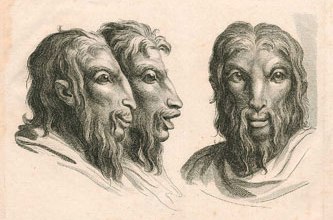
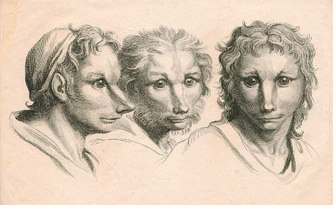
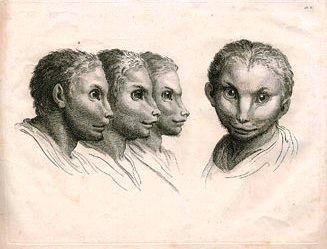
In 1671 AD, a fellow by the name of Charles Le Brun produced a series of illustrations for his treatise on physiognomy – or a study of facial features. Included among these were fanciful illustrations of people with animal characteristics. Approximately 350 years later, a gaming geek is using these illustration to produce this …

The Beastmen of Nabu

Nabu was once a lush savanna cut by a river, the banks of which supported a highly advanced civilization. At the center of this civilization was the city-state of Nabu and its attendant empire that stretched from the jungles of Cush to the rocky hills of the Wyvern Coast. This empire was ruled by successive dynasties of scientist-kings, men and women who, it is said, were as above other humans as humans are above beasts. These kings and queen and their attendants produced wonders for their empire. And then, they apparently went too far. The cataclysm has been attributed to many possible occurrences, though most scholars would place the blame squarely on Nabu’s competition with its rival, Irem, over the verdant hills and forests of Venatia. The two powers, they believe, finally destroyed one another in a final clash of sorcery and science. In the wake of the cataclysm, both lands were turned to waste – wind-swept deserts and buried ruins replacing farmland and city, beastmen and corpses replacing men and women.

The beastmen of Nabu are, for the most part, human beings. Their habits and their faces, however, carry the mark of beasts and keep them separate from other humans, incapable of interbreeding with normal humans and often unwilling to manage their passions sufficiently to fit into to human society. There is no doubt that the beastmen were created by the energies unleashed during the cataclysm, but the process by which this transformation was accomplished is lost to modern theoretic wizardry.

Bubasti (Cat People)

The bubasti are a race of cat-like demi-humans who dwell on the margins of the River of Death. Bubasti appear as short (average 3 feet tall), slight humanoids with dusky skin and glossy, blue-black hair. They have furtive, piercing eyes and are prone to staring. The bubasti are chaotic down to their little souls, and often cruel and malicious. They dress in simple tunics and enjoy decorating themselves (when not on the hunt) with silver trinkets. In fact, bubasti place such a high value on silver that silver coins can be considered to be double in value when trading with the cat people.

The bubasti live in small communities of 10 to 30 individuals. They dwell in the tall reeds that clog the banks of the river. The bubasti construct tiny huts from the reeds. Each little den is separated by several yards from the others, and they are so cunningly camouflaged that it is possible to walk through a bubasti village without ever knowing. Villages are mostly made up of females and young, with a few older males living on the outskirts of the village and claiming it and its inhabitants as their territory. The females put up with this so long as the males keep mostly to themselves and make no attempt to assert political control over the village. Most males belong to no village, instead living the life of wanderers and adventurers.

The cat people mostly make their living as fishermen, but they are also skilled at hunting small birds with weighted nets. Bubasti give most of their religious devotion to the mythic Cat Lord, who the Nabu know as Bast but the cat people call Pasha. In turn, they enjoy Pasha’s special attention and protection, with people hurting a bubasti running a slight (5%) chance of attracting a curse (per the spell).

Racial Characteristics: Bubasti characters enjoy a +1 bonus to make saving throws against breath weapons and triggered traps. They only trip pit traps on a roll of 1 on 1d8, and take only half damage from falling. Bubasti can see in the dark as well as elves and dwarves. Bubasti speak their own language, a dialect of the common tongue of humankind, and the language of felines.

The Bubasti Racial Class

While you can use the bubasti as a race, like elf or halfling, capable of taking levels in the basic classes, you might also want to treat the bubasti as a class of their own. In addition to the racial abilities listed above, members of the bubasti class gain the ability to cast a limited number of spells and the chance to escape certain death.

Prime Requisite: Dexterity (13+ gets +5% bonus to earned experience).

Hit Dice: 1d6+1 (+1 hit points per level after 9th).

Weapons Permitted: Club, dagger, javelin, light crossbow, short bow, short sword, sling.

Armor Permitted: Leather, ring, shields.

Magic Spells (1st): The bubasti are granted access to a small number of spells by their divine patron. The bubasti spell list is described below. Bubasti cast spells as clerics.

Level One: Detect Evil, Detect Magic, Expeditious Retreat#, Feather Fall#, Jump#

Level Two: Detect Invisibility, Dexterity*, Find Traps, Invisibility, Speak with Animals

Level Three: Bestow Curse**, Dimension Door#, Locate Object, Summon Cats***

* As the magic-user spell Strength, but applies instead to dexterity. Bubasti gain 2d4 points of dexterity from this spell.

** The reverse of remove curse.

*** As Monster Summoning I, except the spell summons 2d6 normal cats from the aether. Cats have the following statistics: HD 1d2; AC 5 [14]; Atk 2 claws (1 damage), 1 bite (1 damage); Move 12; Save 17; CL/XP A/5; Special: None.

# New spell – see below.

Evasion (1st): The bubasti can roll with a potentially lethal blow to take less damage from it than she otherwise would. Once per day, when a bubasti would be reduced to 0 or fewer hit points by damage from a weapon or other blow, she can attempt a saving throw. If successful, she takes only half damage from the attack.

Keen Hearing (1st): A bubasti’s hearing is so acute that they are only surprised on a roll of 1 on 1d8.

Light Footed (1st): Bubasti are so quiet when they move that they are capable, when surrounded by equally quiet creatures or alone, of surprising their foes on the roll of 1-2 on 1d6.

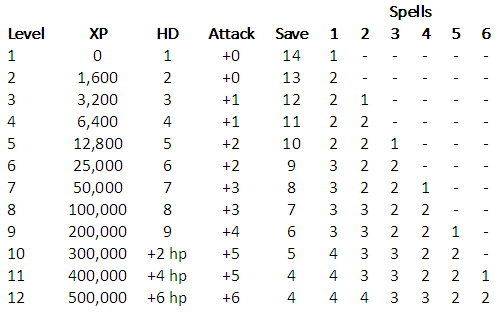
Spells

Level

XP

HD

Attack

Save

1

2

3

1

0

1

+0

14

1

2

1,900

2

+0

13

1

3

3,800

3

+1

12

2

4

7,600

4

+1

11

2

5

15,200

5

+2

10

2

1

6

30,000

6

+2

9

2

1

7

60,000

7

+3

8

3

2

8

120,000

8

+3

7

3

2

9

240,000

9

+4

6

3

2

1

10

360,000

+1 hp

+5

5

3

2

1

11

480,000

+2 hp

+5

4

3

3

2

12

600,000

+3 hp

+6

4

3

3

2

New Spells –

Dimension Door

Level: 3 (bubasti), 4 (magic-user)

Range: 300 feet

Duration: Instantaneous

You instantly transfer yourself from your current location to any other spot within range. You always arrive at exactly the spot desired, whether by simply visualizing the area or by stating direction. You may bring one additional willing man-sized or smaller creature per three caster levels.

Expeditious Retreat

Level: 1

Range: Personal

Duration: 1 minute per level

This spell increases your land speed by +12.

Feather Fall

Level: 1

Range: 30 feet

Duration: Until landing, or 1 round per level

The affected creatures or objects fall so slowly that they take no damage upon landing.

Jump

Level: 1

Range: Touch

Duration: 1 minute per level

The subject of this spell can easily leap 10 feet horizontally or 6 feet vertically.

Belcwn (Lion People)

Unlike their small, furtive kin the bubasti, the lion people, or belcwn, are tall and broad of shoulder. The lion people have tanned, muscular bodies, golden eyes and curly blonde or red hair that is always worn long and loose. Belcwns dress in leather tunics. Warriors wear leather or ring armor and carry heavy flails, hooked swords or pole arms and sometimes shields. They are expert at using their weapons to knock their enemies prone, opening them to a vicious pounce. The male leader of a pride wears a heavy, animal skin cloak and receives visitors sitting on a beautifully carved wooden stool.

The belcwn live in prides, pitching their animal skin tents on grassy meadows near groves of acacia trees. Each pride consists of 6 to 12 female warriors and either a single male or a pair of brothers who rule as titular kings and defenders. While the women work as hunters and gatherers, the kings tutor their children in fighting and in the legends and lore of their people. The males also fill their time working on crafts necessary to the tribe’s survival – mostly weapon making, but also basket weaving and leather working. Males without a pride live as mercenaries and adventurers. Their foul tempers and penchant for violence make them useful to nobles, but poorly regarded by common folk.

The belcwn worship Pasha, the ruler of all felines, as well as deities of war and solar divinities. Males act as priests for their prides, and thus often have the magical abilities of low-level adepts. Many belcwn kings are attended by bubasti viziers.

Racial Characteristics: Belcwns are usually tall and muscular, but are generally not known for their intellects. New belcwn characters receive a +2 bonus to their strength attribute, but a -2 penalty to their intelligence. These modifications cannot take an ability score higher than 18 or lower than 3. Belcwns can see in the dark.

Belcwn Racial Class

Belcwns are roudy, eager warriors who enjoy coming to blows with their enemies. Their ear-shattering battle cries cause enemies to quake in their boots, and their powerful charges often send them scattering. In addition, belcwns possess an innate ability to command normal beasts.

Prime Requisite: Strength (13+ gets +5% bonus to earned experience).

Hit Dice: 1d6+2 (+3 hit points per level after 9th).

Weapons Permitted: Any.

Armor Permitted: Leather, ring, chainmail and shields.

Battle Yell: The belcwn usually enter battle with a terrible, throaty yell, not unlike a lion’s roar. Creatures with fewer hit dice than the belcwn (and no more than 5 hit dice in any event) must pass a saving throw or be struck with fear, suffering a -1 penalty to hit and damage during combat.

Charge: When belcwns charge into a fight, they enjoy a +1 bonus to hit and damage for one round, but suffer a -2 penalty to Armor Class and always lose initiative to troops who have set their spears against a charge. Foes that are damaged by a belcwn’s charge must make a saving throw or be knocked prone.

Command Animals: Belcwns possess a natural aura of command over natural, normal animals (i.e. not mythic animals like unicorns or giant versions of normal animals). Against these creatures, a belcwn can make a “turn undead” roll as a cleric of the belcwn’s level. If successful, the animals fall under the belcwn’s command as the undead fall under the command of an evil cleric, though the duration is only 1 hour.

Level

XP

HD

Attack

Save

1

0

1

+0

16

2

2,000

2

+0

15

3

4,000

3

+1

14

4

8,000

4

+2

13

5

16,000

5

+2

12

6

30,000

6

+3

11

7

60,000

7

+4

10

8

120,000

8

+5

9

9

240,000

9

+6

8

10

360,000

+3 hp

+7

7

11

480,000

+6 hp

+7

6

12

600,000

+9 hp

+8

5