The Creeps (Part 2)

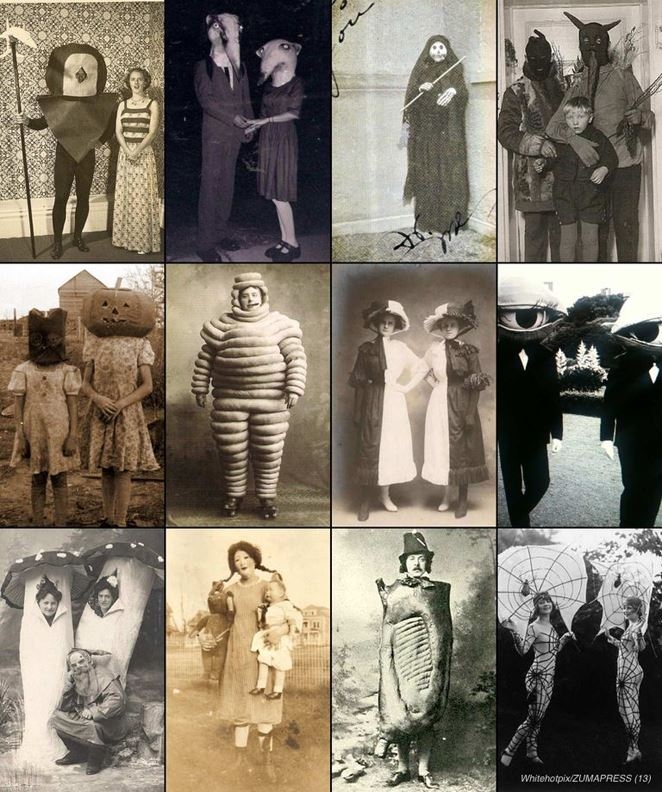
Today I have the second installment of the Creeps. Enjoy!

GEMINETTES
Medium Fey, Chaotic (LE), Average Intelligence; Pair
HD: 4
AC: 13
ATK: 1 strike (see below)
MV: 30
SV: F 14 R 11 W 11
XP: 500 (CL 5)

Geminettes always appear in pairs, with cold, calculating eyes and graceful forms. In combat, they attempt to maintain contact with either their white or black hands; while in contact, they suffer a -2 penalty to hit and a -2 penalty to AC, but gain 25% resistance to magic and can only be harmed by silver and magical weapons.
When a geminette strikes with its black hand, the effect is per a chilling touch spell. When it strikes with its white hand, the effect is per a shocking grasp spell.

All creatures within 20 feet of a pair of geminettes find themselves becoming conflicted. In any round in which they attempt an action, they must pass a Will save. If they fail the save by 1 to 5 points, they hesitate and do nothing during that round. If they fail the save by 6 or more points, they decide to do the opposite of their desired action (or, if “the opposite” simply does not make sense, then nothing at all). Whenever such a save is failed, the adventurer suffers 1 point of charisma damage and the geminettes gain a +5% bonus to their magic resistance.

AWFUL EYEFUL
Medium Fey, Chaotic (LE), High Intelligence; Solitary or Pair
HD: 8
AC: 17
ATK: 1 slam (1d4) or eye ray
MV: 30
SV: F 11 R 9 W 8
XP: 800 (CL 9)

Awful eyefuls consider themselves the nobility of the creeps. They always dress well (whatever era they are found in), and they have the ability to mask their true appearance with that of a vaguely handsome man.

Awful eyefuls walk among mortals, causing them to feel envy and feeding off their petty (and not so petty) jealousies. All creatures within sight an awful eyeful must pass a Will save anytime they see another person doing something they cannot, or doing at a higher level than they can. If they fail this save, they become intensely jealous, suffering a point of intelligence damage and immediately spending a round attempting to outdo that person.

As awful eyefuls feed, they gain the following special abilities:

INT DAMAGE INFLICTED: ABILITIES GAINED
0-2: None
3-5: Detect thoughts (ESP) at will and +1 bonus to hit, damage and AC
6-8: Steal the fighting ability or skills of one creature per round within 20 feet; this translates into applying a 3 point penalty to an opponent’s attack bonus or skill bonus and gaining a like bonus themselves
9+: Steal the spellcasting ability of one creature per round within 20 feet; the awful eyeful steals one spell from an opponent and gains the ability to cast it one time.

SWAMM
Small Fey, Chaotic (CE), Average Intelligence; Band (1d8)
HD: 3
AC: 14
ATK: 1 touch (poison III)
MV: 20
SV: F 15 R 12 W 12
XP: 300 (CL 4)

Swamms appear as dancing mushrooms, surrounded by a sparkling cloud of spores in a 10-ft. radius. Folk who breathe in these spores must pass a Fortitude save each round or find themselves becoming sluggish and lazy. This translates into a -1 penalty to hit and to AC, and a -3 penalty to base movement, as well as 1 point of charisma damage. The loss of charisma represents a loss of ambition. Creatures that have lost half their charisma score to a swamm’s spore cloud are affected per a sleep spell. Each time a victim of a swamm suffers a point of charisma damage, the swamm heals 1d3 points of hit point damage.

MAD MUM
Medium Fey, Chaotic (CE), Average Intelligence; Solitary
HD: 5
AC: 15
ATK: 1 strike (1d4 + confusion)
MV: 30
SV: F 13 R 11 W 11
XP: 500 (CL 6)

Mad mums feed on love and the desire to protect loved ones. Mad mums never speak, and in fact appear to hate loud noises of any kind. They appear as plastic faced women holding dolls. These dolls are their murderous moppets, dirty-faced, greasy-fingered tots that, when thrown by the mad mum, animate and attack, fighting as well as gnolls.

The touch of a mad mum returns people to an infantile state (per the confusion spell) if the target fails a Will save. Gestures of love or protection made in front of a mad mum force the protector to pass a Will save or become obsessed with the creature they are trying to defend. They suffer 1 point of intelligence damage, and find themselves unable to move more than 3 feet away from the object of their obsession, and they do nothing but fight defensively, lending their bonus to AC to the person they are trying to defend.

Spells: At will—silence

Special: Vulnerable to sonic damage

TUCK
Medium Fey, Chaotic (CE), Average Intelligence; Buffet (1d6)
HD: 1
AC: 16
ATK: 1 kick (1d6)
MV: 30
SV: F 15 R 13 W 13
XP: 100 (CL 2)

Tucks appear as dancing bits of meat. They appear before hungry people, dancing about, taunting them. All tucks operate under a displacement effect (per the spell), making them difficult to catch or hit.

Their taunting of the hungry causes desperation and frustration, which they feed upon. Each time a person attempts to hit or grapple them and fails, they must pass a Will save or suffer 1 point of wisdom damage. Each time this happened, the tuck gains 5 points of movement and increases its AC by 1 (to a maximum of 60 feet per round and AC 20).

LOB-LOLLY
Medium Fey, Chaotic (NE), Average Intelligence; Web (1d6)
HD: 3
AC: 14
ATK: 1 parasol (1d4 + stun for 1 round) or strike (1d3 + poison I)
MV: 40
SV: F 14 R 12 W 12
XP: 300 (CL 3)

Lob-lollies appear as spidery women in webbed outfits. They carry similarly webbed parasols, which they use to deadly effect in combat. With each step they take, they send out a web of psychic energy through the ground, forcing all within 10 feet to pass a Will save or be held (per hold person) for 1d4 rounds.

Lob-lollies can walk on walls and ceilings (per spider climb). They can spin their parasols in combat, causing a hypnotic pattern (per the spell). While holding their parasols and able to move, they enjoy the benefits of the protection from normal missiles spell.

Lob-lollies always laugh gaily as they fight, and their moves are sensuous. Males and some females watching them them must pass a Will save each round or become loathe to attack them (-2 penalty to hit, 1 point of wisdom damage). If a person loses half their wisdom to this effect, they attempt to defend the lob-lolly, trying to win their affection (and impossible task). Each time a person loses a point of wisdom, the lob-lolly regains one lost hit point.

But before we go … one more sort of creep to annoy your players …

JINKS
Small Fey, Chaotic (CE), Average Intelligence; Band (1d8)
HD: 0
AC: 13
ATK: 1 strike (1d3) or small weapon (1d4)
MV: 50
SV: F 17 R 12 W 13
XP: 50 (CL 1)

Jinks are goblin-like creeps that look like children wearing grotesque masks. They gather in gangs in dark places – they even enter settlements at night – and prey on the fears and superstitions of people. They generally lurk in the shadows (hiding as well as a 6th level thief) and use their spells to unnerve people. Anyone failing a saving throw against one of their spells also suffers a point of wisdom damage (or 1d4 points of wisdom damage if they succumb to the jinks’ cause fear spell) as they become more jittery and prone to fright. A person who has lost half their wisdom to the jinks spells must pass a Will saving throw each round or become frightened for 1 turn. For each point of wisdom damage caused by a jink, it gains a +1 bonus to hit and damage for the remainder of a fight.

Spells: At will—audible glamer; 3/day—mage hand, phantasmal force; 1/day—cause fear

Dragon by Dragon – May 1979 (25)

May 1979 – the author of this post was 7 and about 5 years away from discovering Dungeons & Dragon. Let’s see what I was missing …

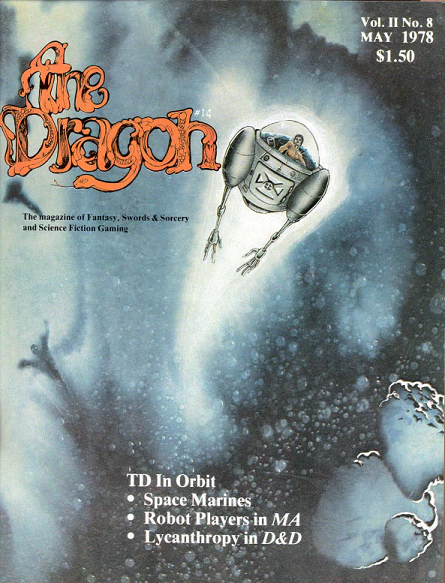
First and foremost – awesome cover. Well done!

A Part of Gamma World Revisited by James M. Ward

Not exactly a title one can conjure with, but the article itself is probably useful to most Gamma Worlders. It covers the history behind the Cryptic Alliances, and might be helpful for campaign play. What I found interesting was the geography of the alliances:

Brotherhood of Thought – started at the University of California, but spread up and down the west coast and into the Rockies.

Seekers – The Seekers are Texans

The Knights of Genetic Purity – don’t say

Friends of Entropy – headquartered in Lincoln, Nebraska

The Iron Society – they’re found in all bombed out areas – seems like Pittsburgh would have been a great headquarters

The Zoopremists – started in the mountain range near Torreon, Mexico

The Healers – Duluth, Minnesota

Restorationists – Boston and Providence

Followers of the Voice – their most successful group is in an underground base in the Appalachians south of Charleston and west of Raleigh – they’re led by a bunny-girl (i.e. female hoop)

Ranks of the Fit – began near Memphis, Tennessee by a circus bear who had its mental faculties increased a thousand fold; their civilization has spread as far north as Cincinnati and as far south as Baton Rouge, presumably along the Mississippi River and its tributaries.

The Archivists – mountains between Butte, MT and Billings, SD and Idaho Falls, MT

Radioactivists – based below Atlanta in the flattened peninsula that was Florida

The Created – have surrounded St. Louis with warbots

Judging and You! by James M. Ward

This is a collection of tricks of the game judging trade, especially for Gamma World and Dungeons & Dragons.

The Tug of the Machine by Allen Evans

A bit of fiction. One column’s worth. And I can’t copy paste it. Sorry.

The Armada Disasters

This is a nice history of naval operations and the clash of nations in the 16th century, and most particularly about the Spanish Armada and its disastrous clash with the English.

From the Sorcerer’s Scroll: The Proper Place of Character Social Class in D&D by Gary Gygax

This covers the introduction of social classes to characters in D&D. It mentions that the initial idea came from MAR Barker’s Empire of the Petal Throne. Gygax points out that Tekumel has a well-thought out culture and social structure, and the lack (or possible lack) of such a structure in D&D makes using social class problematic. He suggests a very simple table for determining social class:

01-75 – Common background
76-95 – Aristocratic background
96-00 – Upper class background

He then goes on to question the use of birth tables and social class, and I have to agree. I suppose if a campaign focuses on social class and the interaction within classes and between classes – something like you’d get in Flashing Blades – it makes sense. If you’re doing the whole Conan thing – plundering tombs and such – I don’t see much point to it.

Armies of the Renaissance by Nick Nascati

Part III of this series, this one covers the Condotierre and The Papacy. Great introduction:

“If Woody Allen would ever decide to turn his comedic talents to writing history, the result would very probably read like a history of Italy in the Age of the Condotierre. Few periods in history could possibly be as full of petty squabbles and pointless maneuvering, as this age when greedy, mercenary captains controlled the destiny of the Italian City-States. Warfare was formalized to the point where it almost became a life-size chess match, with few fatalities. However, their military system does assume a certain importance in our study of the period.”

Well worth the read for wargamers doing this period.

Would the Real Orc Please Step Forward? by Lance Harrop

Here’s an interesting article subtitled “Dealing with the Proliferation of Orcish Miniatures”. Interesting for two reasons.

One is that it covers “orc genealogy and taxonomy” – always fun to see somebody dissect make-believe like that. Lance draws a family tree of evil humanoids, putting orcs, ogres, kobolds, hobgoblins and goblins all on branches of that tree, with hobgoblins and goblins forking off from the same branch. Pretty standard idea these days, maybe kinda new in those days. He then lays out some ideas on how to take this system and use it when selecting miniatures, since back in the day miniatures were a bit more generic – i.e. an ugly humanoid miniature could just as easily be used as a kobold as it could for a goblin.

The other interesting thing about this article is that there was a need to deal with the proliferation of orcish miniatures. I’m guessing that nerds in the Middle Ages were worried about similarly silly things – it runs deep in our breed.

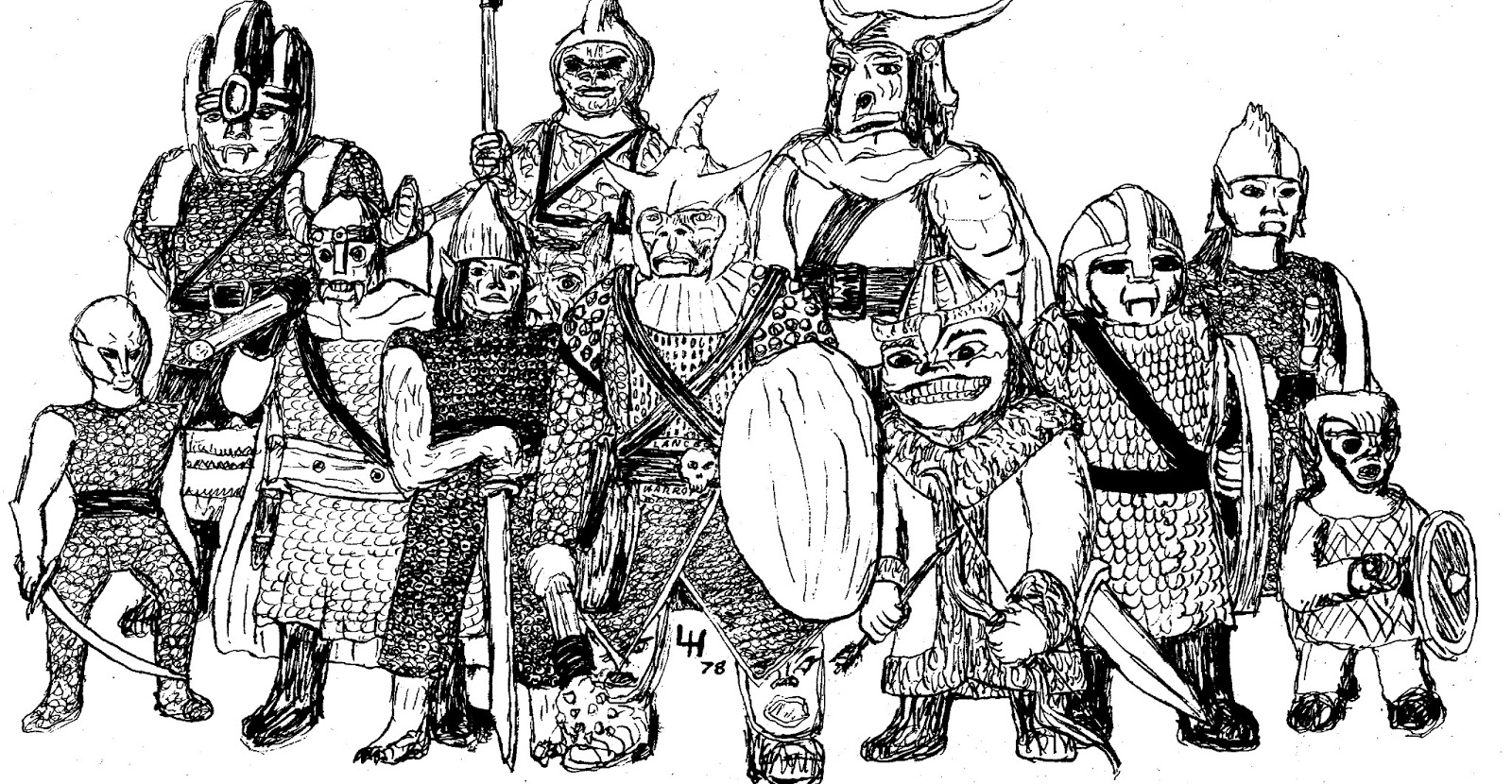
He also provides a picture of several of the miniatures of the day …

Finally, he provides this guide to wargaming with orcs:

1. All goblin races dislike the sunlight, so lower their morale in the daytime.

2. Kobolds and Gnomes will almost instantly attack each other, so have them make obedience checks when they are in charging distance. The same with goblins and dwarves and lesser orcs and elves. Great orcs, man orcs, ogres and hobgoblins will not generally disobey.

3. Orcs of different tribes will also attack each other, as will all goblin races, but powerful leaders can keep them in check, so adjust the die roll against the level of the leader.

4. Usually only great orcs and man orcs will fight in formations, the others will fight en masse.

The Traveller Navy Wants to Join You by R. D. Stuart

An article that covers new career opportunities in Traveller. I don’t play Traveller, so I don’t know that I can comment on how well these are written, but I bet it would come in handy if you were doing a Star Trek-esque Traveller campaign.

Gamma World Artifact Use Chart by Gay Jaquet

This article swaps out the artifact use charts in Gamma World for a more complex and abstract system. Personally – I’ll stick with the charts. I think they’re fun.

An Alien in a Strange Land by James M. Ward

Ward wrote quite a bit for this issue, huh?

This is a bit of Gamma World fiction that seems to be taken from actual play:

“Blern had left those mutated fools of Entropy with an organization that should last until the time it decided to return and take over again. Riding off, on a very reluctant Brutorz, had carried with the act a certain satisfaction in a finished job that was well done. The miles were quickly eaten up under the hooves of the Brutorz and soon Blern was in territory that it had never visited or heard about before. Days passed into a sort of boredom that was unusual for the mutant. It got so that it was wishing for an attack by anything, just to break the monotony, and almost with that thought, Blern spotted the group.”

Excerpt from an Interview with an Iron Golem by Michael McCrery

Interview with a Vampire was written in 1976 – I’m wondering if this article was a play on that. Either way, this one reminds me of the skits that appear in the last 15 minutes of Saturday Night Live. Essentially, another piece of fiction drawn (I’m guessing) from actual play.

War of Flowers by William B. Fawcett

Another nice wargaming article, this one on the Aztecs. I like this bit …

“The Aztec “empire” was in fact a conglomeration of city states that formed rather fluid coalitions which were normally centered on the most powerful cities found in the area of present day Mexico City. In these coalitions there were normally one or two major powers who, by their size and military strength, were able to compel the lesser cities to join in their efforts. When a city was ‘conquered’ the result was the imposition of tribute and economic sanctions rather than social or political absorption, as occurred in Europe or China. This tribute was reluctantly paid to the victorious city only until some way to avoid it was found (such as an alliance to an even more powerful city). Any political or military alliance was then ruled entirely by expedience, and quickly and easily dissolved.”

This is pretty much how I envision all the city-states in NOD. Why? Better for game play in my opinion.

Xochiyaoyotl by Neal M. Dorst

This is a concise set of rules for Pre-Hispanic Mexican wargaming.

Varieties of Vampires by R. P. Smith

This article tackles all the various vampire legends from around the world. It suggests using the same basic game stats for all vampires, but then adds different move rates and environments for the different vampire legends, along with descriptions:

Asanbosam (Africa): Men (9 hit dice), women (8 hit dice), or children (7 hit dice) who look normal except for a pair of books instead of feet. They can charm at minus 3, (except against clerics, whom they avoid) and can throw a single sleep spell per night. They can call 3-18 leopards or 2-12 tigers. Only a cleric can kill the asanbosam.

Burcolakas (Greece): It has a swollen, tense, hard skin. It can scream once per night which deafens all in hearing range for 24 hours, no saving throw. It can also kill, not only by draining life levels, but by naming its victim by name and commanding the victim into a fatal action. It can imitate any voice it hears, with as much of a chance of being detected as an assassin has of being discovered in disguise. It controls 10-100 rats, but no wolves. To defeat: cut off and burn its head.

Great idea – wish I’d thought of it. My favorite bit from the article … “Hence, any body left unguarded without a Bless spell from a cleric will become a vampire within seven days.” Use that rule, and I promise the cleric will hold onto those bless spells. Nobody needs that stupid henchmen you used for cannon fodder coming back to haunt you as a vampire.

To Select a Mythos by Bob Bledsaw

This article covers creating a mythos for one’s campaign. I like that he pushes a “screw reality” concept and chooses fun over strict realism.

Arms and Armor of the Conquistadores by Michael H. Kluever

Another article about fighting on Old Mexico. This one gives a history of the Spanish conquest and then describes the weapons and armor of the different troops.

Not a bad issue. Like the vampire article quite a bit, could have done without so much fiction. The “helpful tips” stuff is helpful for folks new to gaming – not so much for an old fart like myself. If I was doing some Aztec vs. Spanish wargaming, this issue would have really been a boon.

Okay folks – see you tomorrow when I have a new goofy character class you might enjoy.

Happy Thanksgiving, One and All!

From We Heart Vintage

Just a quick note today to wish everyone (American or not) a happy day. It’s always a good idea to stop and take an inventory of the blessings in your life, and among mine is the audience of folks who read my blog and buy my stuff. You folks have given me, through your attention and your cold hard cash, an opportunity to pretend to be a real grown up writer, and I appreciate it more than you know.

As a way to show my appreciation, I’m put all of my books at Lulu are now 10% off between now and the end of the year (not the PDF’s though – they’re cheap enough already). At the moment, Lulu is doing a 30% sale as well (code is DELIRITAS), so if you’ve been waiting to buy NOD or Blood & Treasure or anything else, now’s the time! Remember, with Blood & Treasure, I’ll send you a link for a free download of a PDF when you buy a hard cover book – just email me the receipt.

In other news, I’ve commissioned the first bits of character class art for the Nod Companion, which will gather together classes, races and other useful character bits from the NOD magazines, revising and updating them for Blood & Treasure. It will also include a brief run-down of the Land of Nod’s history and major city-states and peoples, for those who want to know more and can’t wait for me to hex crawl the entire planet (yeah, that’s just about what I’m aiming for – I might skip a bit of open ocean, but I do want to hex crawl the entire landmass).

And finally, to keep this post useful …

HELL-PUNKINS

Hell-punkins are orange gourds that are grown in the swamps of Hell. They are steeped in hatred and misery and, when the air turns cold, heaved out of the depths to spread fear on the Material Plane.

Hell-Punkins look like large pumpkins (usually about 3-ft in diameter) with burning red eyes and jagged mouths that look as though they were ripped into the flesh of the plant by the plant’s own burning desire to nibble on the flesh of innocents. A single long tendril (8 feet) rises from the top of the plant.

Hell-Punkins can breathe cones (10 ft.) of molten gunk and seed from their mouths once per day. The gunk initially does 2d6 points of damage, and if the target fails their Reflex save to cut the damage in half, sticks to people’s skin and deals another 1d6 points of damage the next round. More importantly, the seeds in the gunk begin to sprout the second round, digging roots into the person’s blood (1d4 points of damage) and then sprouting forth in tendrils that grow quickly, entangling the victim (per the spell entangle). Victims killed by this burning gunk eventually become the fodder for a new crop of hell-punkins.

The creatures move by bouncing and utter a wheezy cackle of delight when they discover new victims.

Demons and devils enjoy a spicy pie made from hell-punkins, a pie that deals 3d6 points of internal damage to most humanoids.

Hell-Punkin, Small Plant, Low Intelligence: HD 3; AC 16; ATK 1 bite (1d4) and 1 tendril whip (1d4/10′ range) or breathe burning gunk; MV 20; F13 R14 W15; AL Chaotic (CE); XP 300; Special – Breathe gunk, immune to fire and poison, magic resistance 15%

Seasonal Beasties – Leaf Golem

Everyone enjoys jumping in a fresh pile of fallen leaves (okay, actually I don’t know anybody who does that, but just play along, okay), but some piles are better left alone (what a weird phrase to write!)

Leaf golems are constructed by druids in the autumnal months, when leaves have turned yellow, gold and red and fallen from the trees and vines are beginning their retreat before the coming of winter. A vast quantity of this plant material is gathered by the druid and sprinkled with various holy compounds and then left in a clearing under a new moon. When the first hint of moonlight touches the mouldering pile, it stirs and rises as a leaf golem.

Leaf golems look something like shambling mounds – they are vaguely humanoid, stout and thick, and smell of rotting vegetation. Unlike shambling mounds, they are a bit taller than they are wide. They have no faces, but appear to be able to see and hear. They make no sound other than a persistent rustling, even when standing still, but quieted when imitating a leaf pile and ready to attack.

Leaf golems contain dozens of thick, woody tendrils and their interiors are suffused with brown mold. Up to four of these tendrils can be projected from the creature’s body to attack creatures. A creature constricted by a tendril must pass a Fortitude saving throw each round or be dragged 5 feet closer to the monster. When they are right next to the monster, the next dragging pulls them inside the monster. A leaf golem can hold one medium-sized creature at a time, two small creatures or four tiny creatures. Creatures inside the leaf golem begin to suffocate, and are affected per brown mold, suffering 1d6 points of cold damage per round until dead. When dead, they are ejected in a random direction, flying 5 feet and possibly striking another creature for damage (1d3 for tiny creatures, 1d6 for small creatures, 2d6 for medium creatures).

The presence of the brown mold and the dampness of its leafy body give a leaf golem resistance to fire. The monsters are immune to cold and suffer only half damage from piercing weapons like spears and arrows.

Leaf golems are immune to most spells, and those spells that do affect it do so in weird ways (with no save):

– A blight spell drives the golem back 120 feet and deals 3d12 points of damage to it.

– A command plants spell slows a leaf golem for 1d6 rounds and suppresses its magic immunity during that time.

Leaf Golem, Large Construct, Non-Intelligent: HD 9 (45 hp); AC 19; ATK 2 slams (2d8 + constrict) and 4 tendrils (1d4 + constrict); Move 20; F10 R11 W11; AL Neutral; XP 2250; Special – Resistance to fire, magic immunity (see above), suffocate (see above), immune to cold, brown mold, surprise (3 in 6 in leafy areas), weapon resistance (piercing).

Image found at Pixabay

Six Spooky Spectres

Although spectres traditionally seem to be played as actively hostile entities (chaotic, and all), they don’t have to be, and in fact can make for pretty excellent ghost encounters. Level drain does a great job of recreating, for the players and thus their characters, of the sheer fright and revulsion of being touched by “that which should not be!”. 

FORLOTH & BRENA

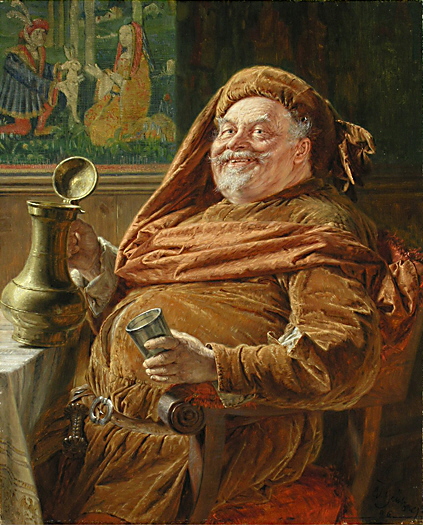
Forloth was a great man in life – great in deed in his youth, and great in girth in his dotage. Always a man of monumental hunger and thirst, he spent his later years in his favorite tavern at his favorite table, regaling the customers with stories of great deeds in far away lands, his wine goblet and lap rarely empty and his coin flowing freely. And so it was when he died – a small belch, a rolling of the eyes, and gone. It took four strong men to remove the body, and the whole town attended the funeral – even the Lord Mayor. A couple weeks later, the first dead body was found in the cellar – a serving wench – long in the tooth but no less beautiful for her years of service and always the favorite of Forloth – keeled over on a barrel of wine, her hair turned stark white. When Brena’s laughter began being heard echoing in the rafters and the wine began turning sour, the townsfolk soon quit the tavern and the landlord was forced to move his establishment. The tavern still stands empty, but a few brave souls have claimed to peek in the thick windows at midnight and see Forloth at his table, Brena in his lap, a ghostly goblet of spirits in his hands.

Forloth: HD 7; HP 22; AC 15 [silver]; Atk 1 strike (1d8 + energy drain); Move 40 (Fly 80); F12 R12 W9; AL C (NE); XP 1750; Special – Incorporeal, powerless in sunlight.

Brena: HD 5; HP 14; AC 15 [silver]; Atk 1 strike (1d8 + energy drain); Move 40 (Fly 80); F13 R12 W10; AL C (CE); XP 1250; Special – Incorporeal, powerless in sunlight.

COBHAR THE BEGGAR KING

Cobhar was born a beggar and thief, and spent his childhood learning how to steal and get away with it. Always an angry man, he hid it well and made a reputation for himself of a leader among the beggars and outlaws of the city – an unofficial ambassador of the underclass whose company was enjoyed by commoners, aristocrats and adventurers alike. Alas, he was a man of ambition, and one of those ambitions was to forge his beggars into a corps equal to the guild of thieves. The master of thieves, Lord Nock, couldn’t allow that, and so one night Cobhar took his last drink of rum and had his body unceremoniously dumped in the harbor, wrapped in heavy chains. The very next night, the thieves were surprised in their shadowy citadel by the appearance of a waterlogged man in chains. Few escaped that hideout, Lord Nock among them, and the reign of the thieves was over. Their hideout remains empty, the lair of Cobhar’s spectre and, stories say, still flush with the plunder of the guild. What nobody knows, though, are how many of the old thieves now haunt the halls of the guildhouse …

Cobhar: HD 7; HP 27; AC 15 [silver]; Atk 1 strike (1d8 + energy drain); Move 40 (Fly 80); F12 R12 W9; AL C (CE); XP 1750; Special – Incorporeal, powerless in sunlight.

MAELA THE MOURNFUL

Maela was a simple woman who lived in a small village by a river. Married to the miller, she was a respected member of her community who wanted, more than anything, to give birth to a child. After many years, she and the miller were blessed with a child, bright of eye and blithe of spirit. All was well for many years, until the coming of the orcs. In a flash, the village was razed, the mill set alight with Maela’s husband and child sealed within. The woman rushed into the blaze, but was unable to save them, and in her trauma rose a month later as a spectre. The charred remains of the mill still stand by the river, and the village is still abandoned. Maela has a powerful compulsion to care for people in distress, and a keen desire to embrace children and other small humanoids (gnomes, halflings). She is not hostile unless rebuffed.

Maela: HD 7; HP 20; AC 15 [silver]; Atk 1 strike (1d8 + energy drain); Move 40 (Fly 80); F12 R12 W9; AL N; XP 1750; Special – Incorporeal, powerless in sunlight.

GUILLA OF THE AUBURN LOCKS

Guilla was the prettiest girl in town – rosy cheeks, auburn curls, brilliant green eyes, etc. – and always popular with the men of the town (young and old). There were stories, of course, that she was perhaps to desirous of their caresses, but she denied everything and her father and mother would not hear of her indiscretions. It was when an adventuring bard entered the picture that things went awry. Handsome and dashing, for the first time in her life, Guilla herself fell in love. In the past, she had always had the upper hand, but now things were different. The bard stayed in town for a couple weeks, and spent nearly every waking moment of that time in her company, until the jealous men of the town had had enough and vowed to end his tenure as Guilla’s lover. It so happened that the bard finally acquiesced to Guilla’s pleading and vowed he would steal away with her on Midsummer’s night. The couple would make their way to the great city over the mountains and there live happily ever after. On his way to window, though, the bard was waylaid by the townsmen and, beaten and bloody, sent down river tied to a raft, never to be heard from again. Guilla waited the night through, and when the next day she heard that the bard had crept away in the night, her heart broke. Two days later, in a daze, she drank from a vial of poison and ended her life. At the next Midsummer night, during the revels of the young, a beautiful woman was seen gliding through the streets. One reveler was surprised by her, especially when he recognized her as Guilla, and when she embraced him, he died. Now, every Midsummer night, the ghost of Guilla glides through the streets of the town, seeking the love and adoration she once had in life, accompanied by the spectres of those she has embraced. There are three such spectres – fawning young men with eyes for none but Guilla. They will defend her to the “death”.

Guilla: HD 7; HP 32; AC 15 [silver]; Atk 1 strike (1d8 + energy drain); Move 40 (Fly 80); F12 R12 W9; AL C (CE); XP 1750; Special – Incorporeal, powerless in sunlight, men must pass a Will save upon seeing her face or be stunned for 1 round.

Spectral Lover: HD 3; AC 15 [silver]; Atk 1 strike (1d8 + energy drain); Move 40 (Fly 80); F14 R13 W11; AL C (LE); XP 750; Special – Incorporeal, powerless in sunlight, energy drain steals only one level.

SCENTH, THE SENTINEL OF BAGWELL HALL

Scenth was a man-at-arms in the employ of Baron Pirpasko, a man with many enemies who was ever fearful of the assassin’s blade. It so happened one night that Scenth was stationed outside the baron’s room as sentinel. While the baron was fast asleep, the baroness, a raven-haired beauty of questionable morals, crept out of bed and stole away with the sentinel for a midnight dalliance. The couple finished their lovemaking and she returned to her lord’s chamber while Scenth returned to his post. The young warrior had barely got to his post, though, when a scream broke the nocturnal silence. Opening the door, he saw the baroness clutching the bloody baron to her chest, a cruel smile on her lips.

“The baron has been murdered,” she screamed, her smile turning into a look of horror as other warriors reached the room.”An assassin got past that foolish boy and killed his master!”

Despite his protestations and accusations, the lad was found guilty of shirking his duty and was summarily hanged. The next night, though, as the household prepared to retire, they discovered the young man back at his post, his head still crooked and scarred by the noose. The baron’s squire challenged the ghostly lad and was nearly killed when his body was run through by Scenth’s ghostly sword. The man was left a shaken wreck, and the rest of the guard soon quit the manse, along with the duplicitous baroness, the baron’s chest of treasure locked away in the chamber beyond her reach.

Scenth: HD 7; HP 31; AC 15 [silver]; Atk 1 strike (1d8 + energy drain); Move 40 (Fly 80); F12 R12 W9; AL C (LE); XP 1750; Special – Incorporeal, powerless in sunlight.

PARIL

Paril was a thief, and one of the best in the world in his day. No vault had ever foiled him, and no ancient temple or forbidden boudoir had proved proof against his cunning. So it was that he delved deep beneath the earth in search of a sceptre of wondrous powers – one more challenge to be overcome. He stole past dozens of guards and wards, tricked a cyclops, walked a wire of spider silk and plucked the sceptre from under the nose of the demon Tessasses. Sceptre in hand, challenge overcome, he made his way out of the dungeon and was, quite suddenly, crushed by a bit of ancient masonry. His back broken, he fell prey to giant rats. An ignoble end to a master thief. Now, his spirit haunts the corridor, the sceptre still in his mortal form’s skeletal hand, beneath the tumbled masonry.

[The idea here is a spectre appearing on the 1st level of a dungeon in a corridor that leads to deeper levels]

Paril: HD 7; HP 22; AC 15 [silver]; Atk 1 strike (1d8 + energy drain); Move 40 (Fly 80); F12 R12 W9; AL C (NE); XP 1750; Special – Incorporeal, powerless in sunlight, surprise on roll of 1-3 on 1d6.

Dragon by Dragon – August 1978 (17)

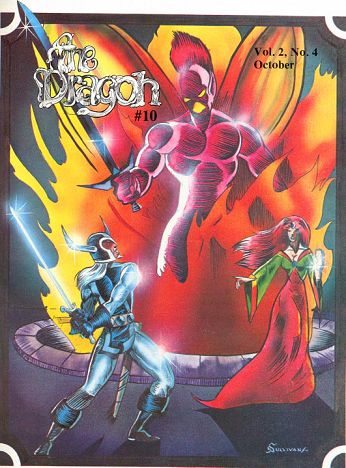
No, I didn’t stop doing Dragon by Dragon, just got busy last week. Now that I’m back, let’s see what the August 1978 issue (number 17) has to offer.

First and foremost, we have a cover that reminds me of some of the pinball machines of the era, or perhaps the side of the bitchin’est van to ever ply the byways of Lake Geneva, Wisconsin.

Article #1: Vampires in the Dungeon by Clayton J. Miner

The article seems to work off the notion that vampires are total party killers, which may be true, depending on the level of the party. The article goes on to explain why, taking into account their different abilities and how to use them to best effect – including charming multiple party members and having them wait to be drained of blood later, using the dungeon rodents as a spy network, etc. Some of the article seems to assume things about vampires that I don’t think were addressed in the rules – i.e. the older a vampire is, the more resistant it is to holy symbols (which may be true, if you’re considering the vampire’s Hit Dice correspond with age). It also posits the best ways to destroy a vampire. Not a bad article, but to be frank, the monster description and a little imagination from referees and players would be just as good.

Article #2: Chainmail Revisited – Jousting in D&D by Jon Pickens

Ah – anyone who has tilted in the FLAILSNAILS Jousting Tournaments run by the excellent Mike Davison is already aware of these rules. This article works on addressing a few perceived shortcomings of the rules, i.e. “I’m a Lord, and he’s a lowly Level 1. IT ISN’T FAIR!”

There is also a cartoon from Will McLean, who will go on to be, in my opinion, one of the shining lights of Dragon’s humor department for many years to come.

Article #3: Dragonlord review by Glenn Williams

If I’m honest, I never spent much time reading reviews in Dragon Magazine. Reading reviews to old games is even less interesting to me, but I’m going to do it anyways. Williams finds the art, by Morno, to be top drawer. The game concerns battles between dragon riders. Williams points out that the map, while pretty, is screwed up because it shows everything from the side, when it really should be top-down. In addition, the map sections do not align correctly, and the grid is a set of Cartesian squares – a hex grid would have been better. The rules, Williams says, are also too complex. Still, he likes the concept, and thinks the game can be improved, such as playing it with the Warriors of the Green Planet map.

I couldn’t find the game online for sale, but there are some other Wee Warriors products at EBay.

Article #4: Faceless Men and Clockwork Monsters

Why wasn’t that the name of an actual game? This article presents a Dungeons & Dragons adventure aboard the Starship Warden (from Metamorphosis Alpha). I’m pretty familiar with this story, but if you haven’t read of this genre-bending excursion, you should try to find it.

Next comes a great add from Dragon Tooth Fantasy Figures, proclaiming the war between the Saurian Empire and Amphibian Confederacy. Love the art …

 I think I get more inspiration from the ads of Dragon Magazine than the articles – quick, dynamic ideas with catchy art.

Article #5: A Wizard with a Difference by James M. Ward

Love the editor’s note …

“ED. Note: The following is recommended as a source of bedevilment to be used by DM on their NPC’s. Some of the possibilities here will drive the average group of PC’s wild when trying to deal with running NPC‘s.”

Prepare for a piece of pure opinion by yours truly – D&D is more fun when the DM is trying to kill the characters. I don’t mean by cheating, but by being a clever, inventive bastard.

The article presents the idea of specialist wizards, using the following types: “Wizard of Aggression”, “Wizard of Defense”, “Wizard of All Things Rustic”, “Wizard of Control”, “Wizard of Tenaciousness” (yeah, I’m picturing Jack Black), “Wizard of Detection”, “Wizard of Fire” and “Wizard of Movement”. One can see some overlap with the later specialists – Conjurer, Necromancer, etc., but these do sound more fun.

The concept is that these wizards get two spells of their specialty per level (I think, the rules could be a bit clearer) and have a percentage chance of casting them based on the level of the spell and the level of the magic-user. Ward suggests these wizards are best used as NPC’s, which is a good point. The average NPC has a short lifespan in combat, so doesn’t necessarily need a vast list of spells, many of which are designed for exploration, which the NPC doesn’t need.

There are plenty of new spells or modified spells – a really fun article to read.

Article #6: Sights & Sounds in Dungeons & Dragons

Another one of those darned useful sets of random tables, this one for random sounds and random sights in a dungeon. Both use a d20, though the sounds table actually runs to 21, with 21 being a bit of a joke (rattling dice/dungeon master’s scream of anguish/garbage disposal/etc.)

Article #7: Variant Monster Dept.

This article gathers a few monsters, including the Magic Munchkin by Michael Kolakowski, the Scholar by Patricia LaPointe, and the Crs’tchen by Dennis Chapman. I love the fact that none of them share the same statistical arrangement – heck, the Munchkin has no stats to speak of. Just for fun, I’ll convert the Scholar for Blood & Treasure:

SCHOLAR
Medium humanoid, Neutral (N), High Intelligence; Symposium (1d10+10)

HD: 1 to 3
AC: 10
ATK: By weapon
MV: 30
SV: 1 HD = F15 R15 W12 / 2 HD = F14 R15 W12 / HD 3 = F12 R14 W11
XP: 1 HD = 100 (CL 2) / 2 HD = 200 (CL 3) / 3 HD = 300 (CL 4)

Scholars are short, bearded men in tweed robes with leather patches on the elbows. They smoke foul-smelling pipes than can produce enough smoke to provide an obscuring mist. There are three levels of scholars.

Instrictors (1 HD) know two spells, confusion and read obscure languages. Confusion is cast by answering a simple question, the answer being in an obscure language.

Associate Profussors (2 HD) know three more spells: Fear, time stop and book missiles. Fear takes effect after muttering about term papers being due. Book missiles works as magic missile, save the books inflict 1d8 points of damage.

Fool Profussors (3 HD) have three ultimate spells. The first is power word stun (the incantation being “Surprise Quiz Today”). Academic dust does 3d6 points of damage and can paralyze the mind for 2-4 turns.  The final spell is cause boredom, which works as a sleep spell that affects any level/HD of creature.

One powerful incantation causes scholars to be seized by instant cardiac arrest – “Tenure denied”.

Article #8: The Monk and Bard in ‘DUNGEON!’ by Jon Pickens

Always love Pickens’ stuff. This one introduces the bard and monk into games of DUNGEON!. I love that game – so sorry that I got rid of my copy years ago. I need to find a copy online (and yeah, I know Hasbro is going to do a reprint – I’d rather have an old game – I’m weird that way).

Article #9: Tesseracts by Gary Jordan

These have been covered nicely at Aeons & Auguries. Jordan covers putting cubic tesseracts into a dungeon do drive map makers nuts. A worthy goal!

Article #10: Ogre Piece by Piece by Jerry Epperson

I’ll admit it. I played it years ago, and found it somewhat boring. If you do love the game and want some variations from 1978, find this article.

Article #11: Design Journal – Boredom and the Average D&D Dungeon by James Ward

If you know James Ward, you know “average” probably ain’t happening in any dungeon he’s written. In this article, he described the idea of filling new dungeon levels with “areas of history” – i.e. themed sections based on history, like an Ancient Egypt area with minions of Set, evil high priests of Set, an 11th level grave robber thief, etc. He also covers Ancient India, The Far East and The Future Machine Age. Good advice, of course, especially for fun-house dungeons.

Article #12: A Short History of Adamantite by Charles Sagui

Short indeed. He labels adamantite as an alloy of Mithril, Carbon, Iron and a few secret ingredients – technically known as Mithriferral Carbide. It is 4/5 the weight of steel, and provides a +2 on AC and hit probability for weapons. It is much more expensive to work and much more difficult to enchant. Sagui gives some prices for different armors (plate armor is 20,000 gp, chainmail 14,000 gp, daggers 1,500 gp) as well.

Article #13: Messengers of God: Angels in Dungeons & Dragons by Stephen H. Dorneman

Dorneman introduces the idea (new at the time, of course) of some non-omnipotent Lawful beings to counter all those devils and demons. He describes four types of angels – Type I (Angel of Wrath), Type II (Angel of Healing), Type III (Archangel of Mercy) and Type IV (Seraphim). Honestly, it never occurred to me to use “types” of angels to counter the “types” of demons. Neat article.

Article #14: Natural Armor for Monsters in Monsters, Monsters by Doug Miller

This one is just what it sounds like. If you don’t have Monsters, Monsters, it won’t do much for you.

Comics

Fineous Fingers is saved from the Antipaladin by the evil wizard, because he needs a thief – not a bad way to handle an encounter in your next game, especially if the needed character is a major pain in the ass to the rest of the party.

Wormy plays a nasty trick on some goblins and tree trolls.

Article #15: Warp War review by Tony Watson

Warp War was a mini-game by Metagaming (click here for Warp War on Boardgame Geek).

From the description, it almost sounds like Car Wars in space – you have to build your ships and then use them to fight over star systems. Watson likes it, and I must admit it sounds fun.

And that brings us to the end. This one is pretty packed, with lots of great articles. Definitely one to look out for!

Dragon by Dragon – July 1978 (16)

Dragon #16 holds great promise based on the cover alone – a bad-ass barbarian and the word “ninja” …

To begin with, a gentle commentary from Kask regarding the amount of fiction in the magazine:

“Due to the length of the conclusion of THE GREEN MAGICIAN, we found it necessary to add an additional four pages this issue. Contrary to what some Philistines might think, this is not a fiction magazine. The Philistines I refer to are the ones that don’t want to see any fiction at all in these pages. To forestall the howls, the extra four pages were added to compensate, not that the story NEEDS compensating for.”

Gerald Guinn kicks this issue off with a rebuttal to a letter criticizing The Cthulhu Mythos Revisited. An entertaining exchange one would now expect to see … well, on every message board and blog frequented by geeks.

Jerome Arkenberg brings us the Near Eastern Mythos. Like the other articles in this series, it keeps it short and sweet and covers quite a bit of ground – everyone from An(s) to Ziusudra(s). The heroes in this article would be especially useful for swords and sandals campaigns – heck, this article, a map of the Near East and a few dungeon maps would be all you need to run a great campaign. The scorpion men are worth a look …

Scorpion Man: HP 240 (holy crap!), AC 1, MV 20″, Magic as 15th level wizard, fighter ability as 15th level lord and Class I psionic ability.

Okay, gonzo stats, but a sweet piece of art. I also love the fact that the “artifacts” presented would, in modern D&D circles, be considered fairly weak magic items.

After the Near Eastern mythos, we have the big article of the issue – The Ultimate NPC: Ninja – The DM’s Hit Man by Sheldon Price. I can hear the audible gasps of the “dick DM” crowd and the clicking of their teeth. To be honest, they have a point, but I think the article also needs to be seen in the context of the time. With characters bouncing around from game to game, there was the real danger of a ridiculously powerful character (probably played by a cheater) showing up to ruin everyone’s fun.

Here’s the rundown – Ninjas are limited to 16th level and must be neutral; they cannot use psionics. Their special abilities include seeing in the dark, tracking (as ranger with 20% penalty), simulate death, poison use (lots of rules here), far travel (2nd to 5th level 50 miles a day, 6th to 9th level 75 miles per day, 10th level or higher 100 miles per day – a unique ability), they prefer no armor but will wear leather or chainmail and they have a special shield called a neru-kuwa, they attack as a fighter, can attack open-handed as a monk and use judo as a samurai (originally in … uh, some other issue), they get a save vs. all damage, save as magic-users of one level higher against spells and can attack with any weapon at a -3 penalty, save ninja weapons they have mastered and weapons associated with a disguise class they have learned. Otherwise they save as a fighter. Their disguises are learned randomly. The article goes on a bit … go read it. It’s actually not too shabby in terms of being overpowered, especially since it’s assumed that one or two ninjas will be taking on an entire party and their retinues.

James Ward does another The Adventures of Monty Haul #3. This involves Freddie and his love of the weird. A sample:

“We appeared on a frosty plain of ice and snow with four Storm Giants swinging their weapons and Monty chuckling something about “minor guards”. We heard the sound of three clubs and a magic sword going smash, smash, smash, and chop. Mike’s gargoyle was a grease smear on one of the clubs, Tom’s Monk was down to one hit point, Dave’s cleric was really hurting, and Jake’s golem had one of its arms cut off by the vorpal sword. Robert clove one in two with his sword while Ernie’s and my cold rays took care of two more (and the sword, we found out a bit later). The last one was missed by the rest of the group, but it didn’t miss me for thirty-six points of bruises and nicks. With the next round, we were able to finish the giants off before the last one did any more damage. They didn’t have a copper coin’s worth of treasure on them, and we weren’t pleased. After a bunch of cure spells and a raise dead on the gargoyle, we still hadn’t figured out what to do about the golem’s arm. We just let it go and traveled on. Tim and Brian put on some of the dead guard’s clothes (which everyone thought was a good idea) and we were on our way towards a batch of caves.”

E. Gary Gygax covers a bit of ground in the Sorcerer’s Scroll with Role-Playing: Realism vs. Game Logic; Spell Points, Vanity Press and Rip-offs.  The essence is – some people are morons when they propose fixes to D&D, and they are an irritation to Gygax not because of vanity, but because they don’t understand game logic. Two quotes:

“The uniform element amongst these individuals is a complete failure to grasp the simple fact that D&D is a game. Its rules are designed and published so as to assure a balanced and cohesive whole.”

“D&D encourages inventiveness and originality within the framework of its rules. Those who insist on altering the framework should design their own game. Who can say that such an effort might not produce a product superior to D&D? Certainly not I.”

The bit about Weapon Expertise being stupid considering that any fighting-man worth his salt would practice with all arms all the time is funny, considering he had just published the AD&D Player’s Handbook with the weapon proficiency rules.

In a Design Variant article, Charles Sagui explains Why Magic Users & Clerics Cannot Use Swords. In essence: For balance in the game, and Tolkien didn’t write D&D, so I don’t care if Gandalf could use a sword. Sagui works out a system where clerics can use edged weapons, but whatever damage they score with those weapons must be paid with by losing spells or, if they’re out of spells, losing their own hit points. Weird, but kinda fun.

A. Mark Ratner presents Metamorphosis Alpha Modifications. This one covers the lack of mutants having a leadership potential, and thus being unable to use devices and weapons they find. I’m not sure that wasn’t the intention in the rules, but Ratner proposes a mechanical aptitude ability for mutants. More importantly, he presents a great big chart of mutated animals, including pigmy elephants, so you know it’s legit.

Next up is the second part of The Green Magician by L. Sprague deCamp.

“Shea’s intention was to jerk the blade loose with a twist to one side to avoid the downcoming slash. But the point stuck between his enemy’s ribs, and, in the instant it failed to yield, Nera’s blade, weakened and wavering, came down on Shea’s left shoulder. He felt the sting of steel and in the same moment the sword came loose as Nera folded up wordlessly.”

Hard not to fall in love with Belphebe.

Wormy involves Irving the imp selling dwarf burgers to a hungry crowd that includes a wereboar. Frank the tree troll takes him out with a club. Almost forgot Dudly and Frank – excellent characters. The gaming world really lost out when Wormy ceased.

Fineous Fingers, meanwhile, turns back to help his pals against the evil knight.

We finish up with a Design Forum article by James Ward on Game Balance. This involves the rate at which magic item treasure is given out – Gygax, Kask and Kuntz all want it restricted – Ward, on the other hand, loves it. He introduces the idea of Game Equilibrium. In this concept, the DM doesn’t care how much magic the players have. He uses plenty of it in his hordes … but he lets the defenders of those hordes use the magic items. In essence, Ward embraces the DM vs. players concept wholeheartedly, like a great big game of Spy vs. Spy. Not a bad style of play, in my opinion, if everybody involved is a good sport.

Well – I got steaks to grill. Have fun on the internet folks, and make sure you buy a copy of Blood & Treasure!

Dragon by Dragon – May 1978 (14)

I would have been 6 years old for this one, and 6 years away from discovery D&D. Let’s see what it has to offer …

First up, winners on that “Name the Monster” contest. Conrad Froelich of Wyoming, OH was the winner with “The Creature Some Call Jarnkung”. Runner’s up were Cursed Crimson Crawler by Thomas & Edward McCloud and The Ulik by Ann Corlon (who sez women didn’t play D&D back in the day). The winning stats were as follows:

Jarnkung, Large Magical Beast, Chaotic (NE), High Intelligent: HD 5; AC 3; Atk 1 tail (2d6) and 1 or 2 weapons; Move 20 (or 9 for S&W); Save F10 R11 W12 (or 12 for S&W); XP 500 (CL 6); Special: +1 or better weapon to hit, magic resistance 20%, detect thoughts (ESP) at will, may have psionic powers.

A. Mark Ratner now gives a review of Space Marines (not the later effort by Games Workshop), a game which he designed. Apparently it is a modified Tractics which owes something to Starguard. I wish that meant something to me. What did I learn about Space Marines from this article? Well, it has things like Nuclear Damper Fields, Mekpurrs (inspired by the killer herbivores from Satan’s World by Anderson), canineoid, rauwoofs, hissss*st (based on The Time Mercenaries by Philip High) and Klackons. The article has many rules ideas and additions for the game – mostly involving air combat and underwater combat. Makes it sound like a cool game.

J. Ward offers up a review of Nomad Gods. Unfortunately, this is another game I haven’t played or read, so I can’t comment much about it. Likewise with Tony Watson’s review of Cosmic Encounter.

Barton Stano and Jim Ward present Robots as Players in Metamorphosis Alpha. This one gets down into it, giving players structure points (115) and power points (100) to spend on propulsion, computer units, armor and various physical devices like quills, lead shielding and grasping claws. While this seems like a logical way to handle robots, it also stands as a preview of where RPG’s were going in terms of character building.

Michael McCrery now presents Excerpt From an Interview With a Rust Monster. Apparently this hinges on an NPC who was polymorphed into a rust monster, and now sometimes shows up as a wandering monster in McCrery’s dungeon.

Cool miniatures ad for spaceships …

Five sizes for each, which brings to my mind the ship sizes I used in Space Princess – starfighter, shuttle, corvette, star cruiser and dreadnaught. For their part, the ships are Galactic Dreadnaughts, Galactic Attack Carriers, Galactic Battlecruisers, Stellar Cruisers and Stellar Destroyers. OK – their names are better – I’ll give them that.

Gygax writes From the Sorcerer’s Scroll on D&D Relationships, the Parts and the Whole. This one gets into the edition mess that was forthcoming for TSR – i.e. what is the “Basic Set”, will the Original game be around much longer and what is Advanced D&D.

James Ward pops in now with Monty Haul and His Friends at Play. This appears to be a satirical piece about the folks at TSR. I dug the accompanying art:

And now, a peeved letter to the editor about the Cthulhu Mythos from the February issue. This is classic geek one-ups-manship at its finest, for example:

“First, the Elder Gods, after they defeated the Great Old Ones, stripped Azathoth of a lot of his power, so his hits should be lowered to 200 to 225.”

“If you’re wondering who is number one — YOG-SHOTHOTH his hits should be raised to 400. You can say that is rather powerful; you’re damn right. The Great Old Ones are so powerful, that the total power of the Elder Gods could not destroy them; only imprison them.”

“These may seem trivial, but if Howard Phillips Lovecraft, Augest Derleth, or Robert Howard saw your use, they’d roll over in their graves not once but at least ten times.”

Another one from James WardThe Total Person in Metamorphosis Alpha. This is a set of random tables for determining a character’s background. I always think these are most useful for Referees working out NPC’s.

Next we have an ogre fight in Wormy and Fineous Fingers being offered up as a sacrifice for a dark knight.

Gregory Rihn writes Lycanthropy – The Progress of the Disease. You can tell D&D is getting more advanced now and a little less free-wheeling for some folks in 1978. I dig this paragraph:

“A low-level werebear who takes six rounds to change fully would fight as follows: round one, normal level; round two, level minus two; round three, level minus four; round four, bear minus four; (claws and teeth have reached minimal offensive effectiveness) round five, bear minus two; round six, normal bear ability. Of course somewhere in here he has to shed his clothes.”

I like the idea of a lycanthrope changing during the course of a battle. The article includes a level table, which I would think was for adjudicating lycanthropes with class levels in the game – it has columns for “Changes Per Day”, “Chance of Involuntary Changes”, “Time Required for Change” and such – except it also has XP for each level. I guess it makes sense – XP determine one’s “lycanthrope level” separately from one’s normal class level.

And that’s it for #14. A few good bits in this one, but not my favorite issue. Even though I don’t always get much use for the articles in these issues, I still find the environment of gaming inspiration in these magazines. Well worth reading, especially for folks who have no grounding in the history of the game.

Dragon by Dragon – December 1977 (11)

Merry Christmas 1977! I would have been five, having my first Christmas in Las Vegas and opening, well, I have no memory of what I received for Christmas when I was five. I’m sure I was stoked. What were Dragon magazine subscriber’s opening?

First and foremost … best cover yet. A wagon of startled doxies pulled by God-knows-what is accosted by a red-robed dude and his captive troll while the triple-flail-armed driver looks on. Nice! Painted by Elrohir.

Second … an ad for newly released miniatures of the various demons plus Orcus and Demogorgon. The Type VI looks more like “naked guy with wings” than they are typically portrayed, which I think makes him creepier than the “OMG DEMON!” look.

Big announcement from Tim Kask … Dragon is going monthly! Oh, and they’re finally sending checks out to authors and artists! He also announces coming fiction in The Dragon from L. Sprague DeCamp and Andre Norton, as well as fiction from Fritz Leiber in this issue.

Gygax now chimes in with a defense of TSR defending its intellectual property from cheap and crappy imitations and outright theft in the form of reprints of D&D material. He has some nice words for GDW, but seems to be telling everyone else to piss off. He also mentions the coming release of the AD&D Monster Manual and future release of other AD&D material.

Enough announcements and editorials … let’s get to the gaming.

Rob Kuntz presents a system for Brawling (The Easy Way “Out” in D&D) which, at first glance, is way more system than I need. Brawling and grappling are always a problem, it seems, because they offer the chance of knocking someone out or disabling enough to make them an easy kill, thus tons of extra rules. This one compares ability scores of the fighters to get a modifier, and then a dice roll to score “damage” to one of the ability scores. Grappling, for example, involves averaging the dexterity and strength of both combatants and comparing them on a grapple table, then rolling 2d6 to discover how it works. Punching is similar, but determines the amount of damage.

Tony Watson then explains how to stop good old O.G.R.E. (not the monster, the mega-death machine) – basically tips and tricks for the game. I played it once, O.G.R.E. won, and my yen to play O.G.R.E. was satisfied.

In the Design Forum, Thomas Filmore, who opines on the value of role playing in D&D, as opposed to just wargaming. Pretty common blogpost material here, but perhaps a rather new concept back in the day, when many characters did seem to be more about puns and action than deeply invested backgrounds (i.e. the good old days).

Archive Miniatures has an ad for Star Rovers – 25mm miniatures. I dig the names of the figures, all of whom would be at home in a game of Space Princess: Planetary Scout, Funky Robot, Andromeda Annie, Bianca Snow, Doc Crock, Galactic Centaur, Alien Lizards, Walktapus (pre-Runequest?) and Sassanid War Elephant. Wait, Sassanid War Elephant? Why not.

MAR Barker continues answering reader questions in his Seal of the Imperium article.

Next up are some expansions to the Snits game that was featured last issue. Apparently the snits took the world by storm.

The Sorcerer’s Scroll is a new feature, and this first one is written by Rob Kuntz. Here, he mostly goes into the new Monster Manual (with “stupendous art by David Sutherland, David Trampier and Tom Wham”) and the eventual release of ADVANCED DUNGEONS & DRAGONS (I forgot that it was always written in all caps (“Fighters will now take 10-sided dice to determine their hit points and clerics 8-sided, etc.”). He also mentions Judge’s Guild, who continues to “saturate the D&D market with new variants” (and that TSR has undertaken to “make their new rule variant/additions … much more refined and interesting to the hard core D&D player” – I don’t like the sound of that). He has some kind words for Chivalry & Sorcery, but explains that it falls short due to its “smallish” print.

Fritz Leiber is next with Sea Magic. An excerpt:

“On the world of Nehwon and in the land of Simorgya, six days fast sailing south from Rime Isle, two handsome silvery personages conversed intimately yet tensely in a dimly and irregularly lit hall of pillars open overhead to the darkness. Very strange was that illumination — greenish and yellowish by turns, it seemed to come chiefly from grotesquely shaped rugs patching the Stygian floor and lapping the pillars’ bases and also from slowly moving globes and sinuosities that floated about at head height and wove amongst the pillars, softly dimming and brightening like lethargic and plague-stricken giant fireflies.”

Ral Partha’s new releases would make a nice random encounter list:

2. Gremlin War Party (3d6 winged goblins with spears)
3. Dwarf Lord (6th level dwarf fighter with chainmail and battle axe)
4. Satyr (Pan) (1% chance the encounter is with Pan, otherwise 1d6 satyrs)
5. Centaur Archer (1d8 centaurs armed with shortbows)
6. Land Dragon with Captain (treat land dragon as wyvern without wings, captain is 5th level fighter with splintmail, shield and lance)
7. Land Dragon with Lancer (lancer is 1st level fighter with breastplate, lance and shield)
8. Witch (female magic-user level 1d4+2; males must pass Will save or be fascinated with her breasts)
9. Monk (1d6 first level monks armed with staves)
10. Sprite War Band (3d6 sprites with swords led by 3rd level sprite fighter on fey mount)
11. Imp War Party (2d6 flying monkeys with sword or axe, shield and breastplate)
12. Were Bear (1d4)
13. Wing Lord (winged 3rd level fighter with spear and scale mail)
14. Paladin (dismounted) (5th level paladin with war harness (+2 AC), shield, pole axe and HUGE wings on his helmet)
15. Armored Knight (dismounted) (4th level fighter with platemail, shield and halberd)
16. Roomen War Party* (2d6 roomen with shield and spear)
17. Earth Demon (combo of stone giant and earth elemental)
18. Undead War Band (3d6 skeletons armed with swords, scythes and spears)
19. Woman Plunderer (1d6 levels of female barbarians with swords and chainmail)
20. Roll two times on table

* They’re freaking mutant kangaroo warriors!

Roomen (N Medium Humanoid): HD 1+1; AC 13; Atk 1 weapon (1d8) or kick (1d4+1); Move 40; Save F 13, R 15, W 15; XP 50; Special: Bound 60 ft. as charge attack.

James M. Ward now presents Quarterstaff Fighting Rules. This is like a mini-game that could be integrated into a normal game of D&D – somewhat like the jousting rules from Chainmail.

In Tramp’s Wormy, Wormy asks a bunch of dwarves “What wears chainmail and looks like black pudding?” – any guesses?

In Fineous Fingers, the adventurers discover that the evil wizard Kask has forced the local hobbits to try to conquer the city by capturing their princess.

The issue ends with a withering critique of NBC’s The Hobbit, by Rankin-Bass. I know, not the best adaptation, but I dig the design on the wood elves.

Overall, an issue that leaves me of two minds. I’m a big fan of Leiber, so the short story was cool. The EPT and O.G.R.E. stuff is not really aimed at me, so no complaints there. The brawling and quarterstaff fighting are nice mini-games/sub-systems, but probably not things I would include in my regular D&D game. Strangely enough, it’s often the ads that I’m enjoying the most – little snippets of creativity with no rules/stats attached. There’s the suggestion that in 1977, the creative energy of D&D is slipping away from TSR – they have some pretty good modules left in them, of course, but things are becoming more controlled and professional, and that carries with it a price to pay.

Dragon by Dragon – October 1977 (10)

Can you feel the chill in the air – that crisp chill of Autumn? Well, of course not. It’s July in the here and now, and just reading a magazine from October isn’t going to change that unless you have a rather powerful imagination or have been dipping into the pseudo-pharmaceuticals. Let’s see what Gygax & Co. had in store for us 35 years, when the leaves of Lake Geneva were beginning to change*

October 1977 starts off with a firecracker (mixing my seasons again), as Jon Pickens presents D&D Option: Orgies, Inc. The Mule Abides has already brought this article to prominence in the OSR, but I think it’s worth mulling over again.

The article posits the problem of too much wealth in the game. To this end, Pickens decided that treasure should only be translated into XP when it was spent. Since you can only have so many suits of platemail, 10-ft. poles and weeks of iron rations, players need something else for which to spend their gold. Pickens provides the following avenues of expenditure:

1. Sacrifices: Gold given directly to gods or demons; any character can do this
2. Philanthropy: Lawful’s can give gold to charity – but not to hirelings or fellow PC’s, of course
3. Research: This is for magic-users and alchemists.
4. Clan Hoards: Dwarves and other clannish folk can give their money to their clan.
5. Orgies: Fighters (not paladins or rangers), bards, thieves and all chaotics (except monks) can spend their money on wine, women and song

There are, of course, additional guidelines to these expenditures (i.e. how much can be spent in a night or week, etc.), but I love the idea and the restrictions. Even better, he has two appendices to the article – one on gambling and one on the effects of orgies on psionics (and in my opinion, the mere existence of this appendix should make you want to include both orgies and psionics in your next campaign).

Izzat what a female goblin looks like?

Daniel Clifton has the task of following up on Orgies, Inc., and does so with Designing for Unique Wilderness Encounters. It’s a nice little article, containing random tables for determining what the terrain looks like when a few pesky wandering monsters show up in the wilderness. The tables generate the vegetation, slope, etc., but don’t provide any guidance for how this terrain impacts the battle, which is probably a good thing.

Paul Montgomery Crabaugh presents Random Monsters – by which he means monsters generated randomly, not random wandering monsters. Naturally, I need to generate at least one (which I suppose I really should include in Blood & Treasure):

Intelligence: Highly intelligent (I have a budding genius on my hands here!)
Alignment: Chaos
Type: Mammal (which means it might be a ninja)
Speed: 12
Armor Class: 7 (would have been a 6 if it was a reptile; for B&T it’s a 12)
Hit Dice: Level -2 (level being the level of the dungeon … hmm let’s pretend we’re on the 9th level of our dungeon, so 7 HD)
Hit Dice Modifier: +0 (so, 7 HD … odd that I need to roll for the HD and then roll to modify it)
Damage: 1d8

Now I need to roll for special characteristics, which is an odd percentile table. For a 7 HD monster, I’m going to assume it works as follows:

01-39 – none
40-74 – one
75-89 – two
90-100 – three

I roll a “92” (no, really, I swear it) and thus my monster has three special characteristics. I need to roll d24 for these (if you don’t know how to roll d24, I just feel bad for you) and come up with the following:

1. Hostile to clerics
2. Has anti-magic shell
3. Hostile to magic-users

I have a very hostile monster, apparently. But he doesn’t hate cans … he hates spellcasters. This makes his anti-magic shell make pretty good sense (ah, the wisdom of dice!)

I now roll another D% to see if it has “other characteristics”, and a roll of “61” tells me it does not (otherwise, it could have some insect characteristics).

Last batch of rolls determine the physical description:

Size: Medium (6 feet)
Limbs: 2 legs, 3 arms
Exterior: Feathers
Coloring: Spotted white and grey

So, what do we end up with?

ALMESITH
Medium Magical Beast, Chaotic (CE), High Intelligence; Gang (1d4)

Hit Dice: 7
Armor Class: 12 [7 for Swords & Wizardry]
Attacks: 3 claws (1d8)
Move: 30 [12 for Swords & Wizardry]
Saves: F 10, R 10, W 11 [9 for Swords & Wizardry]
XP: 700 (CL 8)

Almesiths are strange beasts that are spawned from the residual energies of powerful spellcasting, living embodiments of nature’s abhorrence of magic. They are most often encountered in the deeper levels of dungeons, and seek out spellcasters for destruction. Almesiths look something like owlbears, and can be mistaken for those sorcerous creations. They differ in size, being no taller than a man, coloration, being covered in dark grey feathers on their arms, legs and backs and softer, white and grey spotted down on their bellies, and in two additional curiosities: They lack mouths, having instead a stirge-like tubular beak that juts 3 feet from their faces, and in that they have a third arm that juts from their chest. Almesiths attack with their large, hooked claws, and generate a natural anti-magic field (as a 7th level caster) in a 60-ft. radius. In combat, they always focus their attacks on spellcasters (clerics, druids, magic-users and sorcerers first, bards second, assassins, paladins and rangers third), ignoring attacks by non-spellcasters even when it threatens to kill them.

In the Design Forum, Richard Gilbert presents Let There Be Method To Your Madness. This is another in the series of “dungeons should usually make some rational sense” articles; the attempt to bring the retro-stupid branch of the RPG world to heel that persists to this day. I think these two camps can best be described as Phoebe vs. Rachel.

Next up is a mini-game … Snit Smashing, in which a Bolotomus waits to smash the Snits that run from the ocean so they can plant their snotch in a Snandergrab. If the Snit player manages to multiply more rapidly than the Bolotomus player can smash them, he or she wins. For the Bolotomus to win, he or she must destroy all of the Snits.

When you’re through smashing snits, you can proceed to P. M. Crabaugh‘s next article, entitled Weights & Measures, Physical Appearance and Why Males are Stronger than Females; in D&D (weird use of a semicolon). If the feminists in the audience are getting their hackles up, they might want to read the article first, they might want to read the article first. The article posits an additional 3d6 stat – Size – which can translate into bonus hit points and a modifier to carrying capacity. Yeah, males get some extra carrying capacity … and females get a +2 bonus to Con and a +1 bonus to Dex, and men get called “thick-fingered clods with facial hair”. The old “trash men to keep the feminists from calling you insensitive names” ploy. A classic.

Beyond the ability modifiers, the article has a mess of random tables for generating a random appearance (did you know males have a 30% chance of having facial hair). I don’t know that I’d use this for generating a PC, but it could be useful for generating general ethnic physical and cultural characteristics, if you want to get away from “these people look like Vikings, and these people look like East Asians and these people look like …” trend in campaigns.

The next article is Gaining a New Experience Level by Tom Holsinger. He explains that what D&D and EPT really need is some sort of dangerous ritual for characters to undertake when they have enough XP to advance in level. To which I reply, “Huh?” Favorite line in the article:

“The sacrifice of humans is generally forbidden in a populated area because too many people get upset.”

The article is actually pretty tongue-in-cheek, and would make for an interesting campaign. Essentially, it creates a sub-game that involves getting the gods’ attention with sacrifices or sacrilege, then assuming the “proper physical and psychic attitude, i.e. complete exhaustion”, which, Holsinger assures us, can only reliably be done by becoming thoroughly inebriated, during which the Emissaries of the Gods, the Great Pink Elephants, come to the character and imbue them with their new Hit Dice and special abilities. The level limits for elves, dwarves and halflings are, he tells us, because they have a harder time getting drunk. It is also why high level characters move out of town and build castles – with more hit points, they have to get super shit-faced to attract the attention of the gods, and that might mean burning things down and causing other massive disruptions to the lives of the common citizenry. This article actually dovetails nicely with Orgies, Inc. and together they could make for one hell of a fun campaign.

Next up, Edward C. Cooper‘s The Tactics of Diplomacy in Stellar Conquest. Honestly, I don’t know the game and so I’m not going to comment on the article.

In Wormy, the eponymous dragon is contemplating stumping some angry dwarves with a riddle. They’re angry because Wormy stole their bowling balls to use on his pool table. Meanwhile, Fineous Fingers is under attack by a whole guild of murderous hobbits.

And that’s it for October 1977. Good issue, I think. I have to run and set up an inflatable pool now, but I have a couple neat ideas in store for next week. Oh, and I finished writing Blood & Treasure yesterday …

Would they be changing in October? I’ve lived in Las Vegas my entire life – Summer temperatures only finally end around the last week of October, and the leaves may not change here until well into December. Basically, I have no idea how seasons are supposed to work.