Time to revise the No. Appearing line in the Monster Manual.
Monsters
Medieval Bestiary – Part Six

European folklore holds a candle to none in the breadth and depth of its imagination. Europeans populated not only their own countries with all manner of strange beasts and monsters, but extended their imaginations over the entire globe. While a good many of these creatures have been given game statistics, several have not. Some of these creatures are, to be sure, simple variations on existing monsters – ogres, giants, fairies, spirits, etc. Others are just not threatening or interesting enough to demand statistics. Those monsters of the folklore of France, Germany and the Low Countries, and those of medieval bestiaries and heraldry, that I thought both unique and challenging are presented below.
Part One, Part Two, Part Three, Part Four, Part Five
This post is declared Open Game Content.
Pegasus, Ethiopian
Medieval bestiaries told of a breed of pegasus from Ethiopia that had two horns. These creatures can be treated as normal pegasi with the addition of a gore attack that deals 1d6 points of damage.
Revenant
The revenant is an animated corpse that has returned from the grave to terrorize the living. The name comes from the French and means “returning”. Revenants are always wicked in life. Creatures struck by a revenant in combat must make a saving throw or be infected with a disease that resembles mummy rot. Revenants regenerate damage in the manner of a troll at the rate of 1 hit point per round. A revenant can only be destroyed completely by cutting off the head, removing the heart, and burning them and the body separately.
Revenant: HD 4; AC 3 [16]; Atk 1 slam (1d6); Move 9; Save 13; CL/XP 6/400; Special: Regeneration, disease.
Snakes
The writers of medieval bestiaries imagined many interesting serpents, many that were probably based on fourth-hand accounts of real animals. The hydros was a viper whose poison caused a person to swell up. In game terms, his poison causes the person to have their movement and dexterity scores cut in half. The hydros’ poison could only be cured with the application of ox dung. There’s a fun quest! The hydrus, on the other hand, was a water serpent of the Nile River. It would swim into the mouth of a crocodile and then down its throat. Once in the stomached, it would eat the poor beast from the inside out. In game terms, it is probably immune, or at least resistant, to acid. The hypnalis was an asp that killed its victims in their sleep. In game terms, perhaps it can cast a sleep spell one or several time per day. The scytale was a snake with such brilliant markings that those gazing on the creature are hypnotized and lulled into inaction. The scytale’s body is so hot that those touching it or touched by it suffer 1d4 points of burning damage. The seps, on the other hand, has venom so acidic that it liquefied its prey; assume normal viper poison plus an additional 2d6 points of acid damage.
Waldgeist (Woodwose)
The German “woodland spirit” is the custodian of the forest. It dwells in woodlands and protects it as well as lawful creatures within the woodland. Waldgeists resemble gnarled old dwarfs with skin like the bark of a tree and hair like a tangle of leaves and twigs. They dwell in the branches of trees and, though mischievous, are not by any means evil. Waldgeists can use the spells bless and bestow curse. They blend in with the foliage, and thus surprise foes on a roll of 1-4 on 1d6. Despite their small size, they are exceptionally strong and dangerous to provoke.
Waldgeist: HD 5; AC 2 [17]; Atk 1 slam (2d4); Move 15; Save 12; CL/XP 6/400; Special: Bless, curse, surprise.
White Ladies (Wise Ladies)
The white ladies of the woods are elven amazons of the ancient and powerful blood. They are tall and beautiful, with white skin and hair like gleaming platinum. They dress in white cloaks and gleaming armor and wield spears tipped with silver and bows with silver-tipped arrows. White women are capable of casting spells as 3rd level clerics, druids or magic-users. They are capable of using the spell Light at will and always radiate an aura of Protection from Evil in a 10 ft radius. They usually appear in bands of 5 to 10 individuals and might be encountered in the company of unicorns. White women have the same immunities as normal elves. They are skilled in herb craft and healing, and under their care a person’s natural healing rate is doubled and he enjoys a +2 bonus to save vs. poison or disease.
White Woman: HD 3; AC 4 [15]; Atk 1 spear (1d8) or 2 arrows (1d6); Move 15; Save 14; CL/XP 4/120; Special: Spells, immunities.
White Worm
The white worm, or Indus worm, was a giant, pale worm that dwelled in the Indus River. It was carnivorous and capable of swallowing a man whole when it scores a natural ‘20’ on a bite attack.
White Worm: HD 7; AC 6 [13]; Atk 1 bite (2d6); Move 9 (Swim 12); Save 9; CL/XP 8/800; Special: Swallow whole.
Wild Man
Wild men are hairy humanoids that dwell in deep woodlands. They are called wilder mann by the Germans and homme sauvage by the French and wodewose by the English. They are associated with gods and goddesses of the wild such as Silvanus and Fauna and with the death god Orcus. In fact, they are known as orkes or lorkes in some parts of Italy.
Wild men run in bands of 20 to 30 individuals. Their entire bodies are covered in a tangled coat of brown hair and the men wear long, unkempt beards. They behave as though mad and fight as savagely as berserkers, gaining a +2 bonus to hit and damage. Despite their savage appearance, wild men are strict vegetarians, eating nuts, berries, roots and leaves.
Wild Man: HD 1+1; AC 7 [12]; Atk 1 weapon or fists (1d4); Move 12; Save 17; CL/XP 1/15; Special: Berserk.
Wraiths
The erlking, or “alder king”, was a pale, gaunt humanoid who rode a black horse and preyed on women. In game terms, it can be treated as a wraith. In truth, the name “erlking” was a mistranslation from the Danish for “elf-king”.
Yale (Centicore, Eale)
The yale is a black, horse-sized goat with the feet of an elephant and the tusks of a boar. It has large horns that it can swivel in any direction, thus allowing it two attack two different targets each round. Yales are immune to paralyzation and poison, thus making them a natural enemy of the catoblepas and basilisk.
Yale: HD 5; AC 6 [13]; Atk 2 gores (1d6); Move 15; Save 12; CL/XP 5/240; Special: Immunities.
Medieval Bestiary – Part Five
European folklore holds a candle to none in the breadth and depth of its imagination. Europeans populated not only their own countries with all manner of strange beasts and monsters, but extended their imaginations over the entire globe. While a good many of these creatures have been given game statistics, several have not. Some of these creatures are, to be sure, simple variations on existing monsters – ogres, giants, fairies, spirits, etc. Others are just not threatening or interesting enough to demand statistics. Those monsters of the folklore of France, Germany and the Low Countries, and those of medieval bestiaries and heraldry, that I thought both unique and challenging are presented below.
Part One, Part Two, Part Three, Part Four
This post is declared Open Game Content.
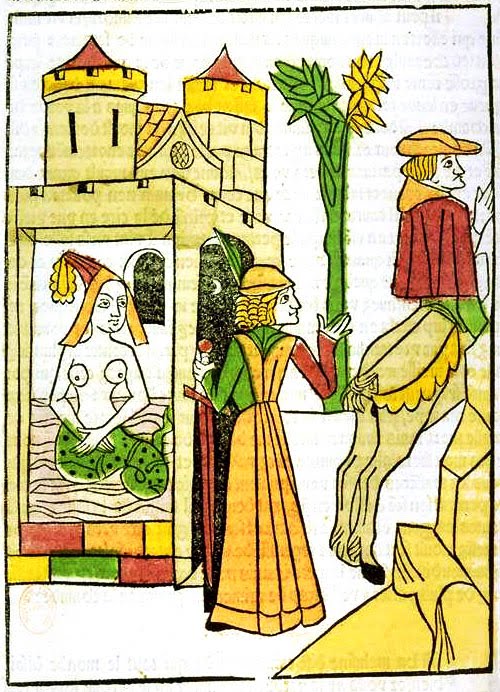
Melusine
Melusines appear to be exceptionally beautiful young women that, in place of legs, possess two mermaid-like tails. Melusines live in rivers and lakes. They crave the companionship of men, but are easily insulted if not given proper respect. The offspring of unions between humans and melusine are always melusines if female, or future magic-users if male. Melusines are fierce protectors of their children. Melusines can polymorph themselves at will into human females or small bronze dragons. One day per week they must assume their natural form and must submerge themselves in water.
Melusine: HD 2; AC 7 [12]; Atk 1 weapon (1d4); Move 6 (Swim 12); Save 16; CL/XP 4/120; Special: Polymorph.
Monocerus
The monoceros is an animal of the savanna often mistaken for a unicorn. It has the face of a sheep, the body of a stag, the rear feet of a goose, the tail of a dog and a long horn growing from its head. They are expert at spearing fish from rivers with their long horns. Although a monoceros horn has no efficacy against poison, it is worth approximately 20 gp on the open market.
Monoceros: HD 3; AC 5 [14]; Atk 1 gore (1d10); Move 15; Save 14; CL/XP 3/60; Special: None.
Monopod (Sciapod)
The monopodes are dwarves with one leg and a massive foot. They live in sunny highlands and use their foot as an umbrella when they take their afternoon naps. Monopodes are extremely strong (+2 to hit and damage) and they can control animals (as charm monster, but up to 6 animals). Monopods are as skilled at blacksmithing as other dwarves. They wear chainmail hauberks in combat and wield heavy maces and spears. Monopod tribes are led by 3 HD chieftains wearing platemail. The chieftain’s bride is always a druid. The chieftain will be guarded by four 3 HD bodyguards.
Monopod: HD 1; AC 4 [15]; Atk 1 kick (1d8) or 1 weapon (1d6); Move 9; Save 17; CL/XP 1/15; Special: None.
Muscaliet
This odd creature from medieval bestiaries has the body of a hair, the tail of a squirrel and a boar’s tusks. The muscaliet is about the size of a large dog. It’s body gives off a blistering heat that eventually kills the tree in which it builds its nest. Muscaliets are not terribly aggressive, but they do respond violently to threats and attacks. The muscaliet is surrounded by a 10 ft radius of intense heat. Creatures within the heat aura of a muscaliet suffer 1d3 points of damage each round. People in metal armor or wielding metal weapons suffer an additional point of damage each round.
Muscaliet: HD 1; AC 7 [12]; Atk 1 gore (1d4); Move 15; Save 17; CL/XP 2/30; Special: Heat.
Musimon (Tytron)
The musimon is a cross between a goat and sheep, having the feet and body of a goat and the head and wool of a ram. The creature has four horns on its head, two curved like a ram and two straight like a goat. Musimons are incredibly strong and will quickly charge creatures that approach their herd. Their gaze acts as a hold person spell on a single creature or a cause fear spell on up to 10 creatures. In any case, a saving throw is allowed to avoid the effect.
Musimon: HD 4; AC 7 [12]; Atk 1 butt/gore (2d6); Move 12; Save 13; CL/XP 5/240; Special: Gaze attack.
Myrmecoleon
The myrmecoleon has the body of a giant ant and the head of a lion. Because the lion head is only attracted to eating meat and the ant body is designed for digesting grain, the creature is usually in a foul mood. Like giant ants, they inject a poison with their bite attack. The poison does 2d6 points of damage if a saving throw is failed, 1d4 points of damage if the saving throw succeeds.
Myrmecoleon: HD 5; AC 4 [15]; Atk 1 bite (1d8 + poison); Move 18; Save 12; CL/XP 6/400; Special: Poison.
Panthera (Pantere, Love Cervere)
Pantheras are intelligent, supernatural felines with iridescent coats and sweet-smelling breath. Pantheras are roughly the size and shape of a leopard. They spend most of their time sleeping in their caves, but emerge once or twice a week to hunt. Pantheras are lawful creatures that will not attack non-chaotic creatures unless seriously provoked. Panthera females are capable of breeding only once, so the breed is quite rare.
Pantheras have a breath weapon that can be used three times each day. The panthera’s breath is a cloud of perfume that fills a 20 ft radius centered on the panthera. Any creature except dragons that breathes this perfume must make a saving throw or be affected as by a charm monster spell. Dragon, on the other hand, are affected as though by a fear spell. Spells like stinking cloud or a troglodytes maliferous odor are neutralized in a 30 foot radius around a panthera. A panthera’s hide, if reasonably intact, retains this property and thus is quite vauable. If a panthera successfully bites a victim, it gains two additional attacks with its rear claws.
Panthera: HD 7; AC 3 [16]; Atk 2 claw (1d4) and 1 bite (1d6); Move 12; Save 9; CL/XP 8/800; Special: Breath weapon, rear claws.
Parandrus
The parandrus resembled a shaggy ox with cloven hooves and a large rack of antlers. Although unintelligent, the parandrus is capable of changing its color and shape. A parandrus will change its color as a means of camouflage, surprising on a roll of 1-4 on 1d6. In general, a parandrus that surprises will choose to flee, rather than attack. If forced to fight, the creature is capable of changing itself into any natural and supernatural beast. The parandrus can change shape each round and still attack.
Parandrus: HD 4; AC 3 [16]; Atk 1 gore (1d6); Move 12; Save 13; CL/XP 6/400; Special: Change shape.
Peluda
A peluda is a river beast that resembled a giant, green porcupine. Its body is covered by stinger-tipped tentacles that can be made erect like quills. It also has the neck, head and tail of a serpent and the legs and feet of a tortoise. The peluda is capable of attacking with its poisonous stingers. Any creature in melee combat with the beast is subject to 1d3 stinger attacks each round. Each stinger inflicts 1d4 points of damage, or half that if the victim succeeds on a saving throw. The creature can also fire off one stinger each round as a missile attack with a range of 60 feet. A peluda has one of three possible breath weapons. The first is poisonous gas, like that of a green dragon. The second is a fiery breath, like that of a red dragon. The third is a gout of acid, like a black dragon. Each peluda will have one of these breath weapons, which it can use three times per day, inflicting 6d6 points of damage.
Peluda: HD 8; AC 2 [17]; Atk 1 bite (2d6), tentacles (see above); Move 9 (Swim 15); Save 8; CL/XP 11/1700; Special: Breath weapon, poison tentacles, only harmed by magic weapons, magic resistance 15%.
Medieval Bestiary IV

European folklore holds a candle to none in the breadth and depth of its imagination. Europeans populated not only their own countries with all manner of strange beasts and monsters, but extended their imaginations over the entire globe. While a good many of these creatures have been given game statistics, several have not. Some of these creatures are, to be sure, simple variations on existing monsters – ogres, giants, fairies, spirits, etc. Others are just not threatening or interesting enough to demand statistics. Those monsters of the folklore of France, Germany and the Low Countries, and those of medieval bestiaries and heraldry, that I thought both unique and challenging are presented below.
Part One, Part Two, Part Three
This post is declared Open Game Content.
Ghouls
The nachzehrer, or “afterwords devourer”, is a foul undead creature from German folklore. Usually the risen corpse of a victim of suicide or disease, the nachzehrer consumes dead bodies in the manner of a ghoul. The creature assumes the shape of a large pig after leaving its grave, and initially targets its own family for consumption.
Gnolls
Through one means or another, the gnoll of modern fantasy games has come to be represented as a humanoid with the head of a hyena. In medieval bestiaries, two creatures can be used as variant gnolls. The first is the chromandi, a hairy, savage humanoid with the teeth of dogs. The second is the cynocephalus, Latin for “dog-head”. These dog-headed creatures were long claimed to have hailed from the mountains India. The dog-heads were hunters who communicated with barking and wore animal skins. Although of ancient Greek origin, they persisted into the Middle Ages. Saint Christoper was often depicted as being a cynocephalus, for he was a member of the tribe of Marmaritae, who were believed to be large and to have the heads of dogs. In game terms, Christopher would be a very rare high level lawful gnoll cleric! In the late Middle Ages, there were stories of such people living in Central Asia. King Arthur had a band in his retinue, inhabitants of the mountains of Eidyn, or Edinburgh. The Chinese admiral Hui-Sheng described an island of dog-heads, a “dog kingdom”, to the east of Fusang. Clearly, the gnolls got around in the days when giants still walked the earth.
Gorgad
Gorgades are hairy demi-humans believed to inhabit islands off the Atlantic coast of Africa. First described by Pliny the Elder, they feature in many medieval bestiaries. In Pliny’s description, it seems likely that what he was really describing was an encounter with apes. There is no reason, of course, that the gorgad cannot be portrayed in a fantasy game as a new race of hairy, primitive humanoids. After all, one can only encounter orcs and hobgoblins so many times before they yearn for something new.
Gorgades are primitive humanoids that are covered in shaggy fur. They dwell in large, extended families of 20 to 50 individuals and are usually led by one or several powerful males (2-5 Hit Dice each). Gorgades use primitive weapons, usually clubs and stones. They are known to be fleet of foot.
Gorgad: HD 1+1; AC 7 [12]; Atk 1 weapon (1d8+1); Move 15; Save 17; CL/XP 1/15; Special: None.
Gulon (Jerff, Vielfras)
The gulon appears to be a large, brown, shaggy wolf with the head of a wild cat and the tail of a fox. The gulon kills quickly and then gorges itself on its prey, eating rapidly and until swollen. A frenzied gulon can devour most of a man-sized corpse in three rounds. Once gorged, its movement is reduced to 6, it suffers a -2 penalty to hit, and its Armor Class is reduced by 2 points. A creature devoured by a gulon cannot be raised from the dead or resurrected, but can be brought back to life with a wish.
Gulon: HD 3; AC 3 [16]; Atk 1 bite (2d4); Move 15; Save 14; CL/XP 3/60; Special: Devour corpse.
Humans & Demi-Humans
Pliny the Elder described many strange humanoids who can statistically be represented as bandits or men-at-arms. The hippopodes, or “horse-feet”, were a tribe of humans with equine feet that lived on an island with two other strange tribes. The panotti were humans with ears so large and long that they could cover the creature’s entire body. The other tribe was the oeonae, humans who only ate oats and marsh bird eggs (but not the eggs of the barnacle goose, for that creature does not lay eggs!) The struthopodes are a tribe of humans in which the male has very large feet and the female very tiny feet. The machlyes are a race of hermaphroditic humanoids that look generally like human beings with male and female halves.
Ichneumon (Echinomon)
The ichneumon was believed to be the enemy of dragons. When the creature spotted a dragon, it would cover itself with mud and close its nostrils with its tail in order to surprise the dragon and pounce upon it and swiftly kill it. The name was later used to designate the mongoose, legendary enemy of poisonous snakes. For our purposes, we’ll consider the ichneumon to be a giant mongoose that is incredibly swift (per the haste spell) and immune to dragon breath and poison. Against dragons and other reptiles, the ichneumon enjoys a +2 bonus to hit and damage.
Ichneumon: HD 6; AC 3 [16]; Atk 2 bites (2d4); Move 18; Save 11; CL/XP 8/800; Special: Haste, immune to dragon breath and poison.
Klabautermann
Klabautermann are aquatic gnomes of a kindly disposition who aid fishermen and sailors at sea. These gnomes are expert sailors and musicians. They appear to be small, gnomish sailors in yellow clothes, woollen caps and gripping a sailor’s pipe in its mouth. Unfortunately, a klabautermann is naturally invisible, and will only appear to sailors if their ship is doomed to sink. A klabautermann is skilled at the hornpipe, and can play a tune that grants the sailors of a ship a +2 bonus to hit, damage and on all saving throws.
Klabautermann: HD 1d6; AC 3 [16]; Atk 1 weapon (1d4); Move 9; Save 18; CL/XP 3/60; Special: Invisibility, rousing music, only harmed by silver or magic weapons.
Mandragora
A mandragora is a little doll or figurine in the shape of a beardless man. They are given to magic-users by the nether powers to act as familiars. In terms of game statistics, the mandragora can be considered a homunculus. Its possession allows a magic-user to Contact Other Plane once per week. The mandragora must be fed the blood of an innocent to keep it alive. They are immune to fire, and can actually travel back to their hellish plane of origin by entering a fire.
Matagot (Mandagot)
The matagot is an evil spirit that takes the form of a black cat, rat or fox. Matagots can bring wealth to a person, but in turn condemn their soul to torment after death. If the owner of a matagot gives it the first bite of food and drink at every meal, it is rewarded the next morning with a single gold coin. Each gold coin the person collects condemns his soul to torment for 1 year, thus making it impossible to resurrect or raise that person from the dead until his soul is freed. Moreover, the owner of a matagot suffers a -1 penalty to Armor Class and 1 extra point of damage per damage dice in combat – all the better to hasten his soul’s arrival in Hell.
Matagot: HD 1; AC 6 [13]; Atk 1 bite (1d3); Move 15; Save 17; CL/XP 2/30; Special: Only harmed by silver or magic weapons, misfortune.
Medieval Bestiary – Part Three

European folklore holds a candle to none in the breadth and depth of its imagination. Europeans populated not only their own countries with all manner of strange beasts and monsters, but extended their imaginations over the entire globe. While a good many of these creatures have been given game statistics, several have not. Some of these creatures are, to be sure, simple variations on existing monsters – ogres, giants, fairies, spirits, etc. Others are just not threatening or interesting enough to demand statistics. Those monsters of the folklore of France, Germany and the Low Countries, and those of medieval bestiaries and heraldry, that I thought both unique and challenging are presented below.
This post is declared Open Game Content.
Caleygreyhound
This odd beast of medieval heraldry had the body of an antelope, the head of a wild cat with the antlers of a deer, the forelegs of an eagle and the hind legs and tail of either a lion or ox. The caleygreyhound is a predator with amazing speed; in effect, it is always under the effects of the haste spell. A similar creature is the enfield, with the head of a fox, chest of a greyhound, body of a lion, hindquarters and tail of a wolf and forelegs of an eagle.
Caleygreyhound: HD 3; AC 1 [18]; Atk 2 bite (1d4) and 4 claws (1d3); Move 18; Save 14; CL/XP 5/240; Special: Haste.
Carcolh
The carcolh is one of the folkloric beasts that makes you half-wonder if our medieval ancestors did play fantasy roleplaying games, because it is simply made for them! The carcolh is a giant serpent with a mollusk shell on its back. It is covered in sticky slime. Around its gaping mouth, the creature has dozens of long tentacles – some as long as a mile. The beast dwells in a cave and unfurls its tentacles, extending them well into the countryside. When something approaches too close to a tentacle, it is grabbed and squeezed and pulled back to the creature’s waiting mouth. In game terms, these tentacles might be found anywhere in a dungeon, and in fact 90% of random carcolh encounters are actually with a tentacle. The tentacles surprise creatures on a roll of 1-4 on 1d6. If a tentacle successfully attacks, it wraps around its victim quickly, squeezing for 1d4 points of damage each round and dragging it back 10 feet per round to the creature’s mouth. The tentacles have an Armor Class of 6 [13] and can be severed by inflicting 8 points of damage on them. The bite of the carcolh is +5 to hit a grappled creature, and if the bite attack beats the victim’s Armor Class by more than 4 points, the creature is swallowed whole.
Carcolh: HD 9; AC 4 [15]; Atk 1 or more tentacles (1d4 + grappled) or 1 bite (2d6); Move 9; Save 6; CL/XP 11/1700; Special: Tentacles, swallow whole.
Chichevache
This odd creature began as an unkind joke of Geoffrey Chaucer. The creature is said to resemble an emaciated cow with a human face. Its diet consists entirely of obedient and faithful wives, and the scarcity of such women, according to Chaucer, explains why it is so thin. The word may be a play on the French chichifache (“thin face”). In game terms, the creature can be turned into a fairly disturbing creature. Imagine an emaciated grey cow with a human face (a good start, in terms of being disturbing). Now imagine that this creature is an undead spirit, roaming the countryside looking for lawful females that it might devour their souls. In essence, it becomes a wraith wrapped in a new form.
Chichevache: HD 4; AC 3 [16]; Atk 1 touch (1d6 + level drain); Move 12; Save 13; CL/XP 5/240; Special: Drain 1 level with hit.
Dipsa
The dipsa is a tiny serpent or worm, covered in a mucus membrane and so poisonous that its victims die before they are aware that they were bitten. The dipsa is a perfect creature to have lurking in swamps or dank dungeons, often buried in the soft mud or living in a puddle of water. It gets a single attack that forces its victim to save or die. The creature is so small that it can be killed with a single hit.
Dipsa: HD 1 hp; AC 9 [10]; Atk 1 bite (poison); Move 3; Save 18; CL/XP B/10; Special: Deadly poison.
Dragons
Dragons feature prominently in French folklore. Gargouille was a river dragon that spouted water. It was tamed by Saint Romain and then slaughtered and burned. Gargouille’s head and neck, however, would not burn, and were instead affixed to the cathedral, thus beginning the use of carved gargoyles as water spouts. The Tarasque was a legendary dragon from Provence. It was a dragon with six short legs, like those of a bear, an ox-like body covered by a turtle’s shell, a lion’s head and a tail that ended in a scorpion’s sting. The Tarasque was the offspring of the Biblical Leviathan and the Onachus, a scaly, bison-like beast from Galatia that burned everything it touched. The beast was impervious to the armies thrown against it, but was finally charmed by Saint Martha and led back to a city where it was killed by the people, offering them no resistance. The city was then renamed Tarascon. La Fertre’-Bernard, France, was terrorized by a dragon called Peluda, or “Shaggy Beast”. Peluda is unique enough to deserve its own entry below.
Note: Some fantasy games include rules for subduing dragons. Using these legends as a guide, a Referee might allow lawful or good clerics in his campaign the ability to charm dragons as though attempting to turn undead. If successful, treat the dragon as though it has been subdued.
Drude
The drude is a strange spirit from German folklore. It appears as a hag, and is in fact the evil portion of a virginal or holy woman’s soul. Sometimes, these women voluntarily undergo the Drudenfluch, or drude‘s curse to split their soul in two, and other times it is forced upon them by a demon or witch. The drude is very heavy and is as powerful as an ogre. It has a foot print that looks like a pentacle, and this symbol, called the Drudenfuss, can ward them away as a protection from evil spell. Drudes are capable of assuming gaseous form and seeping into a house through the tiniest cracks. Once inside, they attempt to suffocate their victim by sitting on its chest; in essence, this is handled as a fist attack. If successful, the victim must succeed at a saving throw or be grappled and suffer 1d3 points of constitution damage each round. When the victim is reduced to 0 consitution, the drude possesses them, bringing them back to full health and gaining complete control over them until forced out, which can be done by a cleric’s turn undead attack or with other spells.
Drude: HD 4; AC 5 [14]; Atk 1 fist (1d6); Move 12; Save 13; CL/XP 7/600; Special: Grapple, possession, only harmed by silver or magic weapons.
Forest Cattle
Pliny the Elder placed these cattle in Ethiopia. Forest cattle are twice the size of normal cattle and bright red in color. They are capable of turning their horns in any direction, thus allowing them to make two separate horn attacks each round. Bulls inflict 1d6 points of damage with each horn, while cows inflict only 1d4 points of damage. The forest cattle may be related to the yale of English folklore.
Forest Cattle: HD 6; AC 5 [14]; Atk 2 gores (1d6); Move 18; Save 11; CL/XP 6/400; Special: Can gore two different creatures in the same round.
Ged
Ged was the original word used for the pike. It is derived from the Old Norse gaddr, or “spike”. For our purposes, the ged is a giant pike that lurks in lakes and rivers. Ged are quite sneaky, and surprise on a roll of 1-3 on 1d6.
Ged: HD 4; AC 5 [14]; Atk 1 bite (3d6); Move 0 (Swim 24); Save 13; CL/XP 4/120; Special: Surprise.
Medieval Bestiary – Part Two

European folklore holds a candle to none in the breadth and depth of its imagination. Europeans populated not only their own countries with all manner of strange beasts and monsters, but extended their imaginations over the entire globe. While a good many of these creatures have been given game statistics, several have not. Some of these creatures are, to be sure, simple variations on existing monsters – ogres, giants, fairies, spirits, etc. Others are just not threatening or interesting enough to demand statistics. Those monsters of the folklore of France, Germany and the Low Countries, and those of medieval bestiaries and heraldry, that I thought both unique and challenging are presented below.
This post is declared Open Game Content.
Barbegazi
A creature from the folklore of the Swiss, the barbegazi resembles a dwarf covered in white fur and sporting a long beard and two enormous feet. They dwell in large, extended families in the highest mountains, traveling through the snow cover using their feet as skis or snowshoes. In the summer months, they doze away in caves and tunnels, not awakening until the first snowfall. The barbegazi are generally kind, warning people of impending avalanches and helping shepherds find lost sheep. They are usually encountered in bands of 6 to 10 individuals traveling from one community to another. These parties are armed with clubs and darts made of ice. They are not slowed by the snow, and can reach high speeds when skiing down hill.
Barbegazi: HD 1; AC 7 [12]; Atk 1 weapon (1d4+1); Move 9; Save 17; CL/XP 1/15; Special: Immune to cold, weapons cause +1 point of cold damage.
Birds
Several strange species of birds are described in medieval bestiaries. Most of them are not fit for a combat encounter, but they make for interesting non-combat encounters, or the goal of quests for magical ingredients.
The avalerion was a bird without a beak and with stumpy, feathered legs. After two avalerion mate and lay a pair of eggs, they drown themselves.
The barnacle goose is another interesting creature of European folklore. It was a small marsh goose that was believed to be born from a piece of driftwood, in much the same way that it was believed that flies were born out of rotting flesh and mice out of grain.
The hercinia was a bird of the Hercynian Forest. Its feathers glowed brightly, illuminating the forest at night.
Bishop Fish
The bishop fish, or sea bishop, is a bipedal fish with a human face and a pointed head that resembles a bishop’s mitre. A couple specimens were said to have been captured in the 16th century. One, while being studied by a group of bishops, plead to be released through gesturing. When the bishops acquiesced, the bishop fish made the sign of the cross before disappearing into the waves.
In game terms, the bishop fish can be treated as a more lawful version of the locathah. Bishop fish communities are led by low- to mid-level clerics of lawful deities. The bishop of a community is served by a bodyguard of 3 to 6 monk-fish. Monk-fish have maximum hit points for a bishop fish and can cast spells as 2nd level clerics. Bishop fish cannot speak out of water, but are capable of making themselves understood to humanoids with hand gestures.
Blemmye (Acephali)
Blemmyes are a race of headless men and women who have their faces in their chests. Pliny the Elder, the champion monster creator of his day, placed them as inhabitants of Nubia, Kush or Ethiopia. Others placed them in India. Sir Walter Raleigh wrote about a tribe of the creatures living in the Caribbean.
The blemmyes are humanoids without heads. They have eyes, mouths and noses in their chests, but are without ears and thus deaf. They live in small bands of 20 to 40 individuals, living by hunting and gathering. They are known to eat sentient humanoids, so one must take care when interacting with them.
Blemmye: HD 1+1; AC 7 [12]; Atk 1 weapon (1d6) or 1 bite (1d4); Move 12; Save 17; CL/XP 1/15; Special: Surprised on 1-2 on 1d6, immune to affects that work through sound.
Bonnacon (Bonasus)
The bonnacon was believed to be a species of bison native to the steppes of Asia. The bonnacon had curled horns and a most unpleasant form of self-defense. When attacked, the creature flees and sprays behind it a cone of acidic dung. Pliny describes the creature as a bull with the mane of a horse and horns curled back in such a manner as to be useless for fighting. The bonnacon’s “cone of dung” is 120 feet long and 50 feet wide at the base. Creatures caught in the shower suffer 1d6 points of damage (or half with a successful saving throw). Creatures hit by the dung suffer an additional point of damage each round thereafter, as it adheres to the skin and can only be removed completely by washing with some form of liquid.
Bonnacon: HD 3; AC 6 [13]; Atk 1 bite (1d3) or 1 kick (1d4); Move 15; Save 14; CL/XP 4/120; Special: Cone of dung.
Bugul Noz
The Bugul Noz, or “Night Shepherd”, is a fairy of Brittany. The last of its kind, it lives a solitary life due to its incredible hideousness. Any creature that views the face of Bugul Noz must pass a saving throw or be affected by its frightening visage. Creatures who fail their saving throw by 10 or more are killed on the spot. Those who fail the saving throw by at least 5 points faint dead away, and remain unconscious for at least an hour. Upon waking, they will discover that their hair has turned snowy white and that their sanity has been ever so shaken. Those who fail the saving throw by less than 5 are merely panicked and flee at top speed in a random direction until they collapse from exhaustion. Should one manage to control themselves, they will discover that the Bugul Noz is a kind and generous creature, and very knowledgeable about its home forest. Attacking so pitiable a creature may draw the ire of the seelie (i.e. holy) fairy court.
Caladrius (Dhalion)
The caladrius was represented in medieval bestiaries as a white bird that would take sickness upon itself, thus curing the sick. The bird would then fly away, dispersing the sickness to others. In game terms, the caladrius seeks out strong individuals and attempts to divest it of whatever disease it is carrying by pecking at them, in the hopes that they are strong enough to withstand the disease that a weaker person could not. The bird will appear in the sky, dive at the humanoid with the highest constitution, and attack until making a hit. At that point, the victim must make a saving throw against the effects of a cause disease spell (the reverse of cure disease). Whether the victim saves or not, the caladrius will flee, looking for another victim. The caladrius’s high Armor Class is due to its speed and savvy.
Caladrius: HD 1d4; AC 3 [16]; Atk 1 beak (1 + disease); Move 9 (Fly 24); Save 18; CL/XP B/10; Special: Cause disease.
Medieval Bestiary – Part One

European folklore holds a candle to none in the breadth and depth of its imagination. Europeans populated not only their own countries with all manner of strange beasts and monsters, but extended their imaginations over the entire globe. While a good many of these creatures have been given game statistics, several have not. Some of these creatures are, to be sure, simple variations on existing monsters – ogres, giants, fairies, spirits, etc. Others are just not threatening or interesting enough to demand statistics. Those monsters of the folklore of France, Germany and the Low Countries, and those of medieval bestiaries and heraldry, that I thought both unique and challenging are presented below.
This post is declared Open Game Content! Enjoy.
Abarimon
First described by Pliny the Elder in his Natural History, the abarimon lived in a country, also called Abarimon, in a great valley of Mount Imaus (i.e. the Himalayas). Despite their feet being turned backwards, or perhaps because of it, they were incredibly swift runners. The abarimon were terribly savage, and lived alongside wild animals. The air in the valley of Abarimon is so pure, that once one has become accustomed to it, they cannot leave the valley again without dying.
In game terms, the abarimon are humanoids who have backwards pointing feet. They dwell in mountain valleys and live the life of hunter-gatherers. They are swift runners, and as cunning as any animal. The abarimon speak a simple dialect of grunts and gestures, and place no value on treasure other than weapons.
Abarimon: HD 1; AC 7 [12]; Atk 1 weapon (1d6) or 1 unarmed (1d3); Move 18; Save 17; CL/XP 1/15; Special: None.
Alce (Keythong)
The alce is a wingless griffon, the offspring of a true griffon and a lion. Although lacking the ability to fly, it makes up for this with a coat of spikes, not unlike that of a hedgehog. Because of these spikes and the beast’s vicious disposition, creatures engaged in melee combat with an alce must make a saving throw each round to avoid suffering 1d4 points of damage from the spikes. Alces usually live in highlands bordering mountains inhabited by griffons.
Alce: HD 6; AC 2 [17]; Atk 2 claws (1d4), 1 bite (2d6); Move 12; Save 9; CL/XP 7/600; Special: Spikes.
Allocamelus
The allocamelus is the offspring of an ass and a camel. The allocamelus has the head of an ass and the body of a camel. The creature is used as a pack animal throughout Venatia and the Golden Coast. It is not as tolerant of the desert heat as the camel, but can in most respects be treated as that creature.
Alp (Schrat, Walrider)
In German folklore, the alp is a creature that resembles the incubus (the male version of a succubus) and the vampire. The word “alp” is related to the word “elf”.
The alp is a minor demon that appears as a demonic satyr wearing a hat in a style common to the region. The female version is called a “mara”. In either case, the creature attacks sleeping people, controlling their dreams and trapping them in terrible nightmares. While the victim is unable to rouse himself, the alp sits upon his chest, making it difficult to draw breath. The alp might also attempt to suckle on its victim, male or female, drawing blood if no breast milk is forthcoming. Alps can change themselves into the form of a boar, cat, viper, wolf or a small, white butterfly, and it is in this last guise that it often infiltrates a home. The alp’s hat, or tarnkappe, acts as a cloak of invisibility, though the hat itself always remains visible. Besides being able to use the nightmare spell at will (but only at night), the alp’s gaze can either cause disease or bestow a curse. In either case, a saving throw is allowed to negate the effect.
Alp: HD 5; AC 4 [15]; Atk 1 horn (1d4) and 1 bite (1d3); Move 12; Save 12; CL/XP 7/600; Special: Nightmare, gaze attack, change shape, cap of invisibility, only harmed by silver or magic weapons.
Alphyn
The alphyn’s name means “chaser”. A heraldic creature, it resembles a large wolf with the forelegs of an eagle and the hind legs of a lion. It has a long tail that is invariably knotted in the middle, and a long, flicking tongue like that of a snake. The alphyn is a powerful predator of the forest and highlands. As large as a tiger, it has multiple, vicious attacks and the tracking abilities of a wolf. In combat, an alphyn that hits the same target with both foreclaws gets two additional attacks on that target with its rear claws. Alphyns often run in small packs of 2 to 5 monsters. Their baying can be heard for miles. Up close, it causes fear (saving throw to negate), but even from afar is makes ones hair stand on end. Some hold that the alphyn is the executioner of the fairy court.
Alphyn: HD 6; AC 6 [13]; Atk 2 claws (1d4), 1 bite (1d6); Move 15; Save 11; CL/XP 7/600; Special: Rear claws, immune to fear, can track creatures on a roll of 1-5 on 1d6.
Amphiptere
The amphiptere is a small, legless wyvern. The creature is faster and more flexible than the wyvern and it is also more clever. An amphipteres is capable of folding its wings close to body and hiding in small (for a large creature) spaces and then springing out. This gives it the ability to surprise on a roll of 1-2 on 1d6. The amphiptere retains the wyvern’s stinging tail.
Amphiptere: HD 6; AC 3 [16]; Atk 1 bite (2d6), 1 sting (1d6); Move 9 (Fly 24); Save 11; CL/XP 8/800; Special: Poison sting, flight.
Apes
The callitrix, or cericopithecus, was a monkey with a long beard and wide tail that always gave birth to twins, loving one and hating the other. While this does make it something of a jerk, it doesn’t make for an interesting encounter. If the need arises, use the gorilla’s statistics for a callitrix.
Aspidochelone (Fastitocalon, Jasconius, Pristis)
The aspidochelone, or “asp-turtle” is either a whale or sea turtle or an amalgam of the two, that has grown to such a massive size as to be, in essence, a living island. In game terms, the creature is a massive sea turtle with a craggy shell that can easily be mistaken for a small island. The shell is caked with soil from which grows trees and flow small streams. The aspidochelone is among the largest creatures in creation, its shell having a diameter of approximately 300 feet. Unfortunately, the aspidochelone is a cruel beast. It surfaces and allows desperate sailors to land on its back. After they have tied their ships down and made camp, it suddenly submerges again, plunging them into the ocean and then gobbling them up as they flail about helplessly. A victim of the creature’s bite attack must pass a saving throw or be swallowed whole. Creatures inside the aspidochelon’s stomach suffer 1d6 points of damage each round from the stomach acids and poisonous vapors. From the inside, the creature has an Armor Class of 6 [13]. Escaping into the esophagus requires an open doors roll.
Aspidochelone: HD 20; AC 1 [18]; Atk 1 bite (3d6); Move 3; Save 3; CL/XP 21/4700; Special: Swallow whole.
Nabu – Hags, Sandy Beaches and Lillith
 And now for the meat of the sandbox (meat of the sandbox?) – now for the sand of the sandbox.
—
4012 Sandman Beach: A gang of 12 sandmen dwells on this beach. When foolish mortals intrude, they use their sleep power to disable them, steal their possessions (throwing them into the sea to be carried away by the tide) and then carry them into the hills.
4503 Lone Samurai: A lone samurai, in poor health, rests against a rock writing something in a thick book. Although he will know the adventurers approach, he will make no move until they are within 60 feet, at which point he will ask their business. If the adventurers want to fight, he will prove a significant challenge.
If engaged in conversation, the samurai will reveal that his name is Mizaki, and he is a servant of the Empress of Mu-Pan. He and six comrades were charged with charting the coastline of the Sea of Stars , from start to finish. They embarked on this mission many years ago and through the years all of his comrades have perished. Only Mizaki remains, and he knows that his time is drawing close. Will the adventurers be willing to take up his mission and maintain his honor? If not, the samurai will never be seen again. If they do, he will accompany them for as long as possible. Those who make it back to Mu-Pan will discover that a new empress sits on the throne, and Mizaki’s mission has been forgotten. Mizaki’s main treasure is his book, which contains charts and commentary on the lands he has visited. The book is in a difficult code, but can be understood by most magic-users and bards with some effort.
Lord Mizaki, Fighting-Man Lvl 10: HP 45; AC 2 [17]; Save 9; Special: Str 14, Dex 14, Con 8, Wis 14; Long sword, splint armor, longbow, 8 arrows, throwing axe, silver dagger, maps & charts, 8 gp.
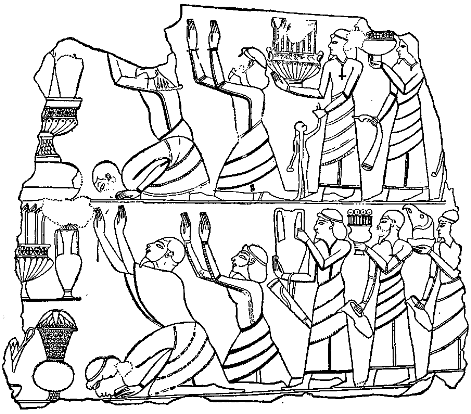
4723 Stone Prism: A stone prism rises seven feet above the desert sands. Egyptian-style bas-reliefs cover the sides; the northwest side shows a hippo with a crocodile in its mouth, the south shows three women hanging from an acacia tree with a lotus at their feet and the northeast side a stately pharaoh with dead eyes sitting on a throne, small humans under his feet. Sitting atop the monolith is a wailing desert hag in tattered black robes plucking flakes of manna from the air and groveling before unseen masters.
Desert Hag: HD 6 (36 hp); AC 3 [16]; Atk 2 claw (1d6), 1 bite (1d4); Move 12; Save 11; CL/XP 9/1100; Special: Confusion, magic resistance 25%, spells, vulnerable to lapis lazuli.
5020 Angel Statue: A stone statue of an angel juts up from the sands at a strange angle. Appeals to lawful powers have a +5% chance of being heard and acted upon when made below this statue. Blasphemies are met with a curse that doesn’t allow natural healing. Appeals to Astarte by name result in all non-chaotic creatures present being healed of 1d6 points damage. This healing will only occur once for a given creature.
5402 Igniguana Lair: A craggy depression serves as the lair for four young igniguanas. Several humanoid and animal skeletons litter their lair, including one still wearing a golden band inscribed with the name “Lorna” (50 gp).
Igniguana (4): HD 4 (20, 19, 17, 10 hp); AC 4 [15]; Atk 1 bite (1d6); Move 6; Save 14; CL/XP 6/400; Special: Breathes fire (20’ cone, 2d6).
5422 Stone Prism: A stone prism rises 7’ above the desert sands. Egyptian-style bas-reliefs cover the sides; the north side shows a vulture poised atop a lion’s corpse, the southwest a dog-headed man with a human hand grasped in its jaws and the southeast side a stately pharaoh with dead eyes sitting on a throne, small humans under his feet. Sitting atop the monolith is a wailing desert hag in tattered black robes plucking flakes of manna from the air and groveling before unseen masters.
Desert Hag: HD 6 (36 hp); AC 3 [16]; Atk 2 claw (1d6), 1 bite (1d4); Move 12; Save 11; CL/XP 9/1100; Special: Confusion, magic resistance 25%, spells, vulnerable to lapis lazuli.
5508 Fiendish Centaurs: In a high cave over-looking a sandy valley live three fiendish centaurs who call themselves the “Daughters of Demogorgon”. Their names are Mala, Dione and Hadai. When intruders enter their valley they descend from their cave at a gallop, intent on killing all but one, who they will tear limb from limb on their father’s altar. In a hidden compartment behind the altar there is 11,880 cp, 283 sp, 270 ep and 19 gp.
Fiendish Centaur: HD 4+4; AC 4 [15]; Atk 2 kicks (1d6), 1 flail (1d6+1); Move 18; Save 13; CL/XP 8/800; Special: Immune to fire, magic resistance 10%, heat metal.
5725 Stone Prism: A stone prism rises 7’ above the desert sands. Egyptian-style bas-reliefs cover the sides; the north side shows a mass of worms in a roughly humanoid shape, the southwest a swirling shape with a small, round depression in the middle and the southeast side a stately pharaoh with dead eyes sitting on a throne, small humans under his feet. Sitting atop the monolith is a wailing desert hag in tattered black robes plucking flakes of manna from the air and groveling before unseen masters.
Desert Hag: HD 6 (36 hp); AC 3 [16]; Atk 2 claw (1d6), 1 bite (1d4); Move 12; Save 11; CL/XP 9/1100; Special: Confusion, magic resistance 25%, spells, vulnerable to lapis lazuli.
6022 Mysterious Platform: A square stone platform with sides 60’ long. The platform is 10’ tall, but half of it is buried in the sand. The platform is built with massive, greenish-grey stone blocks. Four ramps, at each of the cardinal directions, leads up to the top of the platform. On the top, lights that glow at night are set into the platform’s surface. A mage might recognize the constellation Hydra.
A secret door on the northern side of the platform, to the right of the stairs, leads into a dark tunnel approximately 15’ long ending in a locked steel door. Beyond the door the corridors are metallic tubes that show no signs of joins or seams. The tube corridor snakes around a bit, ending in another locked, sealed steel door. A dwarf or gnome might be able to tell that the corridor slopes down-ward.
Beyond the second door there is a 15’ x 15’ room constructed with the same metal. The ceiling in this chamber is 20’ high. The walls of the chamber are studded with glass bulbs, levers and wheels. There is a pile of rubble (metal chairs, wires, and other scraps the adventurers will be unable to identify) in the middle of the room. Amidst the rubble are three humanoid skeletons. Their skulls suggest that they are reptilian. Each wears a tunic of a silver cloth that almost seems metallic (20 gp value) and metallic bands around their forearms with slim, titanium daggers attached by some kind of static attraction. One of the skeletons has a spherical, crystalline stone of scarlet and blue (an ioun stone) under its skull.
Bunches of wires hang from the ceiling, along with three bulging, reddish cysts of some organic material. The cysts are fairly thick, with an AC 18. Each cyst can withstand 20 points of damage before splitting. The cysts are home to Venusian brain bats in hibernation. They were sealed into this chamber by the previous users, having already taken over three of their ancient astronauts. They have been in hibernation for millenia, and will be ravenous when released from their cysts. Once adventurers enter the room, they will detect their body heat and begin regenerating; this process takes 10 rounds. Once fully regenerated, they will burst from their cysts and attack with a normal chance for surprise. If released from their cysts before fully regenerated, they will have half their normal hit points and suffer a -1 penalty to attack and save. When fully regenerated, the three will have 21, 17 and 16 hp.
6208 Nest of Stones: The adventurers might come across a nest built of stones in this hex. The nest contains five petrified eggs that look like geodes. They are worth 100 gp each. After being split, or a few weeks after being found, the crystals will hatch small (2 HD) caterprisms. If not fed stone, they will grow violent. The caterprisms will add 1 hit dice of growth per week until they reach 6 hit dice after a month, at which point they will burrow away.
Caterprism: HD 6; AC 1 [18]; Atk 1 bite (1d8) or 4 legs (1d10); Move 12; Save 12; CL/XP 10/1400; Special: Crystal silk, crystalline mandibles, magic resistance 35%.
6602 Demon of the Storm: Each night, when the moon rises in the sky, a sandstorm of terrible intensity sweeps over this hex centered on a shimmering globe of force. Inside the globe is the form of a sleeping demoness.
The hex is patrolled by a man with no name who appears to be a Roman centurion. The man cannot die, at least not permanently. At each sunrise, he is affected by a heal spell or a true resurrection, as is appopriate to his condition. Only complete disintegration will end his life. The man’s purpose is to prevent anyone from releasing the Lilith, the demoness. Besides his magic spear, the centurion wears an amulet engraved with the names “Senoy, Sansenoy and Semangelof” that protects him from demons and devils.
Lilith’s globe can only be breached by being simultaneous struck by a holy sword and subjected to dispel magic cast by a chaotic magic-user. Lilith’s spells are: Animate dead, charm person, darkness, dispel magic, finger of death (2/day), fireball (2d6), ESP, invisibility, know alignment, lightning bolt (4d6 damage. 1/day), limited wish (other), major image, polymorph self, produce flame, pyrotechnics, read magic, see invisibility, suggestion, teleport without error, tongues.
The Centurion, Fighting-Man Lvl 10: HP 61; AC 2 [17]; Save 9; Special: Str 16, Con 13, Wis 8; Banded armor, shield, +3 spear (lawful, save vs. paralysis), magic amulet (see above).
Lilith: HD 15 (71 hp); AC -2 [21]; Atk 2 tail (2d6) or 1 scimitar (1d8+5) or 2 whip (1d8+5); Move 16 (Fly 30); Save 3; CL/XP 25/5900; Special: Immune to fire, ½ damage from cold and poison, silver or magic weapons to hit, 75% magic resistance, spells, radiates fear in 10’ radius, summon 1d2 marilith demons (60% chance of success), regenerate 2.
6621 Ancient Saucer: Adventurers moving through this hex have a 1% chance of falling through the upper hatch of a flying saucer buried in the sand. The saucer was used by a band of zetans who were caught in the conflagration that destroyed the Nabu empire. While there is no hope of reactivating the saucer or any of its major systems, some power can be restored by collecting power crystals (they can be found throughout the ship) and placing the proper colors into small, hexagonal holes located next to the ship’s instrument panels.
The saucer is fifty feet in diameter and two stories tall. The hatch the adventurers fall into opens onto the outer corridor that circles the ship. The superstructure and interior walls of the saucer are made of titanium alloys in a variety of colors. There are no apparent seams between wall and ceiling or floor. Doors are of the sliding variety, and, since there is no power, must be forced open. From the outer corridor on the top level, one can enter the medical bay, elevator shaft, meditation chamber, science chamber, time chamber and command chamber at the center of the saucer. The bottom level is made up of five sleep chambers and a beam chamber. The ship is inhabited by various oozes, vapor rats and phase spiders.
[NOD #3 will have more details on the saucer and its contents]
6703 Nomad Camp: Atop a rocky rise there is an ancient fort of weathered sandstone. The fort’s walls are cracked and unsteady, the steps leading up to the entrance almost weathered into a ramp and crumbling in places, and the entrance itself now lacking a portcullis. Inside this structure a band of nomads descended from the survivors of Nabu’s cataclysm often make camp. When they are in residence (4 in 6 chance), the courtyard of the fortress is entirely filled with their brilliant white pavilions. The nomads number 200. They herd camels and work metal into ornaments and broad swords. The warriors wear mail shirts beneath their robes and carry javelins and broad swords. They are led in battle by 20 sergeants. Their chief is Omblud, a tall man with piercing green eyes. Omblud’s wife is the witch-woman Shamavar. The nomads are often preyed upon by the shadow wolves [Hex 6802] and know about the demon of the storm to the northwest [6602].
Nomad: HD 1; AC 5 [14]; Atk 1 weapon (1d8); Move 12; Save 16; CL/XP 1/15; Special: Avoid blows.
Shamavar, Druid Lvl 3: HP 12; AC 6 [13]; Save 14; Special: Spells (1st); Leather armor, shield, curved long sword, curved silver dagger, potion of healing.
Omblud, Fighting-Man Lvl 5: HP 25; AC 3 [16]; Save 14; Chainmail, shield, long sword, curved dagger, longbow, 20 arrows.
6716 Deserted Friary: Two limestone walls are all that remains of an ancient friary dedicated to Thoth. It was here that the scientist-priests experimented with the technology of their forebears, and ultimately destroyed themselves. The land around the friary is home to all manner of strange plants (assassin vines, shambling mounds) and the area is thick with radiation (saving throw each day or suffer 1d4 points of constitution damage). A sealed and locked iron trapdoor under the sand opens to reveal a 40’ deep winding staircase. The staircase leads down to a small laboratory complex.
SHRINE – At the center of the complex is a small shrine to Thoth. The small idol here is cast from mithral (500 gp). It sits in a small niche framed with ebony. A number of tiny prayer scrolls have been nailed to the wooden frame, most of them pleas (in the strange pictograms of ancient Nabu) for success in one scientific endeavor or another.
ENERGY – This room contains a reactor core glowing so brightly that one must shield their eyes to approach it. The reactor is connected to the walls by lines of gold inlaid into the floors and running along the walls, which are also decorated with images of Ra and his solar barque. Staying in the room for more than a minute results in 1d6 points of constitution damage and the equivalent of sunburns. Attempts to manipulate the levers and buttons on the reactor proper result as follows:
1. The reactor explodes, causing 6d6 points of fire damage and 1d6 points of constitution damage
2. The reactor dims, sputters and dies
3. Nothing occurs
4. A low hum fills the room and all present suffer 1d10 points of fire damage as the reactor flares briefly
5. An arc of lightning leaps from the controls into the would-be controller, inflicting 3d6 points of damage
6. The reactor flares (as 4 above) and then collapses inward, creating a sphere of annihilation
PSYCHOLOGY – Numerous experiments with zetan mind-helmets were performed in this room on test subjects. All of them either died or went insane, with the exception of the subject now trapped in the biology laboratory. At the end of the room is a curious throne of flint connected to the walls by lines of gold (see Energy above). A strange silvery headband rests on the throne, connected to it by gold wire. This headband should activate psychic powers in its wearer, but is faulty and instead forces the wearer to make a saving throw. If successful, they gain the ability to use ESP for 1 week at will and then lose the power forever. If the save is failed, they are struck with insanity (see spell).
BIOLOGY – Test subjects were kept behind mithral bars (100 gp each) in this room. The cages are now empty. In the middle of the room there is a flat table of bronze. The surface of the table is glassy, and appears to have the image of a gorilla with a white face. The table is connected to the walls via gold lines. The table is actually a form of stasis chamber. If the dials on the side of the table are meddled with or the gold lines severed, the creature in stasis, a reigon, will be released to wreak its terrible vengeance on the world.
Reigon: HD 5 (30 hp); AC 4 [15]; Atk 2 claws (1d6), bite (1d8); Move 12 (Climb 12); Save 12; CL/XP 8/800; Special: Psychic resistance 15%, mind blast, psychic defense, telekinetic force.
6719 Citadel of the Black Panther: A basalt citadel rises here from the desert sands, its black color striking against the sand. The citadel is topped by a brass dome. Its gateway is carved from obsidian and features bars of blackened meteoric iron. Above the gateway is a granite carving of the symbol of Seth, the god of darkness.
The citadel is a bulky tower roughly three stories tall. From above, it looks like a circle (the dome) within a diamond (the upper stories) within a square (the ground floor). Each of the upper stories have exits leading to ledges protected by battlements. These ledges are patrolled by scalefolk.
The interior of the citadel is maze-like, with myriad twisting passages ending either in dead ends or oddly shaped chambers. These chambers include sitting rooms, a kitchen dominated by a brass cauldron and a wizened old cook (a desert hag made obedient by powerful magic), an armory containing polished bronze maces (lead filled), shields and scale armor, shrines to Apophis and Typhon, barracks for the scalefolk warriors and human acolytes, a large temple dedicated to Seth and plush living quarters for Kemnabi, the Black Panther, and his scaly allies.
The temple is a hexagonal chamber dominated by a central idol of Seth in a pose of victory, his brother’s body below his feet and the goddess Isis on her kneels, a golden chain around her neck. The idol rests on an obsidian platform and is surrounded by a dozen hepatizon (black bronze) braziers burning cones of stinging incense. Torches line the walls at various levels and above one can see the great bronze dome. The temple is always guarded by 2d6 chaotic acolytes armed with heavy maces and wearing scale armor beneath their black robes.
Kemnabi’s private chambers are accessed via a secret door in the temple. The private apartments include rooms for his serpent man allies, a laboratory for same and a sprawling apartment for Kemnabi himself. Kemnabi’s apartment features a down-filled mattress, velvet pillows, a mahogany wardrobe (robes, courtier’s outfit), a private altar to Seth (an obsidian idol in an ebony cabinet), a porphyry brazier (50 gp) and a terracotta bust of his mother (3 gp). The apartment also includes a private bath. Kemnabi shares his apartment with the wereserpent Ekibe, who wears a turquoise pendant (30 gp) and a gold toe ring (80 gp). Locked iron chests contain 14,000 sp, 9,600 ep, 60 gp, 28 pp, and three gemstones worth 100 gp each – chalcedony, jacinth and alexandrite.
Yellow Scalefolk (24): HD 1; AC 4 [15]; Atk 2 bite (1d3), 1 weapon (1d8) or 2 claw (1d2); Move 12; Save 17; CL/XP 3/60; Special: Acid spit (60’, 1d4 damage for 2 rd), level 1 thieves.
Acolytes (12): HD 1; AC 3 [16]; Atk Weapon (1d8); Move 12; Save 16; CL/XP 2/30; Special: Command undead.
Serpent Folk (6): HD 6; AC 3 [16]; Atk 2 claws (1d4), bite (1d3) or weapon (1d8); Move 12; Save 11; CL/XP 8/800; Special: Spells (cause fear, darkness, neutralize poison, snake charm, sticks to snakes, suggestion, polymorph other), magic resistance 20%.
Kemnabi, Cleric Lvl 12: HP 54; AC -5 [24]; Save 5; Special: Dex 16, Wis 16, Cha 13; Spells 6th; Special: Spells (5th); Platemail, shield, heavy mace, potion of diminution.
—
The Stone Prisms, if you were wondering, lead to another encounter (which will appear in NOD #3 – hey, I have to hold something back).
On Being Chaotic, Shiny and Random
A few posts ago, I put together some creatures using the random generators at Seventh Sanctum. Today I’m doing the same with Chaotic Shiny, another favorite website of mine. The following critters are open game content.
Aeloll: The aeloll is a large, arachnoid horror that dwells in narrow mountain passes. The creature’s mottled, grey hide helps it hide among the stones, allowing it to surprise prey on the roll of 1-3 on 1d6. It waits for prey to move beneath it and then expels a gout of scorching gas from its abdomen. The gas inflicts 2d6 points of damage (saving throw for half) and forces creatures to make a saving throw or be blinded for 1d4 rounds. While its prey is confused and blind, the aeloll descends down the side of the pass. The spider has especially long legs that end in loops. Using four legs, it places these loops around the necks of its prey and lifts them just a few feet off the ground, choking them. It can release prey that put up too much of a fight.
- Aeloll: HD 5; AC 3 [16]; Atk 4 loops (strangle for 1d4 damage per round); Move 12 (Climb 12); Save 12; CL/XP 7/600; Special: Goat of scorching gas, choking, surprise on 1-3 on 1d6.
Byn: The byn, or siren lizard, is a dungeon predator. It is a 3-ft long lizard with horn-like protrusions above its eyes. The byn has slate colored scales and a speckled underbelly of green and blue. A clutch of four to eight byns will emit a low groan that acts as a hypnotic song. The song echoes through a large portion of a dungeon, attracting humanoid creatures who fail a saving throw. The humanoids walk, zombie-like, toward the song. When they are close enough, the byns make a grab for whatever obvious valuables are closest and then scurry away. The hypnotic trance lasts for 1d4 rounds after the byns stop singing.
- Byn: HD 1d6; AC 7 [12]; Atk 2 claws (1d4); Move 15 (Climb 15); Save 18; CL/XP 1/15; Special: Song.
Dreak: Dreaks look like pollywogs with the faces of human children and grey, pupil-less eyes. They live in deep lakes, swimming in large schools and attacking anything they come upon when hungry. They are quick in the extreme, and their limited, unconscious control over water forces their prey to make a saving throw each round in order to do anything other than attack at a -3 penalty. Their water control ability enables large schools to create waves large enough to sink small boats. The bite of a dreak is poisonous, causing extremities to swell up with water. This has the effect of reducing movement by half and dehydrating a creature, inflicting 1d6 points of damage per day.
- Dreak: HD 1d4; AC 7 [12]; Atk: 1 bite (1 + poison); Move (Swim 18); Save 18; CL/XP 1/15; Special: Poison, water control.
Frosseleth: A frosseleth is a smallish woodland creature, possibly a dinosaur, with dull, green scales and a mane of light green feathers. The creature is bipedal and has a long tail, forelimbs ending in claws and a narrow snout and mouth full of sharp teeth. Frosseleths travel in prides of 3 to 18 creatures. They are pack hunters and capable of taking down beasts much larger than themselves. Frosseleths are surrounded by an eldritch aura that randomly activates spells and magic items. Each creature within the aura that can cast spells must concentrate and make a saving throw each round to avoid one of their memorized spells from being cast (through no effort of their own). The target of such a spell is randomized, and could include a frosseleth. Magic items that can be activated (wands, scrolls, etc) have a 2 in 6 chance each round of activating. When a combat goes poorly for a pride of frosseleths, they can excrete an oil from their skin that gives off terrible, noxious fumes (saving throw or spend a round retching).
- Frosseleth: HD 2; AC 5 [14]; Atk 2 claw (1d3), 1 bite (1d4); Move 15; Save 16; CL/XP 3/60; Special: Eldritch aura, noxious fumes, magic resistance 25%.
Idekel: Idekels are bulky crosses between alligators and boa constrictors. It lives in bogs and can produce an effect similar to the spell hallucinatory terrain, making itself appear as an inviting stump on a dry piece of land. When someone sits on the stump, the coiled idekel quickly wraps itself around the poor victim, squeezing for 1d6 damage each round and heating its body to inflict another 1d4 points of damage. Moreover, the beast can attack others who come near with slashing claws and a gaze that turns people into driftwood (as a basilisk turns people into stone). Idekels fear holy symbols, and can warded away with them.
- Idekel: HD 4; AC 2 [17]; Atk 2 claws (1d4); Move 9 (Swim 12); Save 13; CL/XP 8/800; Special: Petrifying gaze, constriction, extreme heat, hallucinatory terrain, fears holy symbols.
Isaelen: The isaelen is a titanic beast that dwells in rain forests on isolated islands. The creature has only rarely been glimpsed, and is said to be a monstrous black beast with a conical body, one large red eye that can see into other dimensions and seven large, stubby protrusions around its base that look like a cross between clawed thumbs and tentacles. An isaelen can shift between the ethereal and material planes at will. It hunts by finding a well traveled location, nestling down on the ground and shifting into ethereal plane. When a creature passes through the isaelen, it shifts back into the material world, trapping the poor creature inside its stomach. The beast has no esophagus, and thus there is no escape from the creature other than by slaying it. The isaelen’s stats below represent its stomach, for none have ever encountered the beast from without.
- Isaelen: HD 9; AC 3 [16]; Atk see special; Move 0; Save 6; CL/XP 10/1400; Special: Stomach acid (1d6 damage each round, potential for drowning).
Jeyah: Jeyah are tiny, subterranean creatures that look like a cross between an opossum and gecko. Physically unimposing, they are surrounded by a field of psychic static that disrupts the synapses of other creatures, causing an effect like the confusion spell in an 8-ft radius. Jeyahs hunt in large family groups, spreading out and then converging on their prey.
- Jeyah: HD 1d4; AC 8 [11]; Atk 1 bite (1d3); Move 15 (Climb 15); Save 18; CL/XP B/10; Special: Confusion.
Nanc: Nancs look like a cross between a capybara and raccoon, having the general size and shape of the former and the nimble fingers of the latter. They dwell on jungle islands and are as intelligent as humans. Nancs are solitary creatures. They arm themselves with simple clubs and slings, but can also attack with their tails. A nanc’s tail is tipped with long, sharp spines that inject a mild poison. The poison is terribly painful, imposing a -2 penalty to all actions for 1 hour. Nancs are capable of casting phantasmal force once per day, and often do.
- Nanc: HD 3; AC 6 [13]; Atk 1 weapon (1d4) and 1 tail (1d6 + poison); Move 12; Save 14; CL/XP 5/240; Special: Phantasmal force, poison.
Vazin: Vazin are runty, fey reptilians that dwell in deep canyons. They are sensitive to light and dislike visitors. Vazin live in small bands of 1 to 4 creatures. Vazin look like sinuous lizards with long, curled claws, black scales and purple underbellies. Like some eels, they are capable of giving off an electric shock about once per hour. The drippings from a roasted vazin have hallucinogenic properties and the flesh keeps as well as iron rations, with one vazin capable of feeding one person for one week.
- Vazin: HD 1d6; AC 6 [13]; Atk: 4 claws (1d4); Move 12 (Climb 12); Save 18; CL/XP 1/15; Special: Electric shock (1d6 damage).
It Came from the SRD – Part Four
 This post is the fourth of four posts converting the unconverted monsters from the SRD to S&W. There is, naturally, a part one, part two and part three. This post is open game content.
Sahuagin Mutant
About one in two hundred sahuagin has four arms. Such creatures can make four claw attacks or use extra weapons, in addition to the claw and bite attacks. A Referee in possession of a game that utilizes random mutations may want to add other mutations to the sahuagin mutant (laser eyes, a winning personality, etc).
- Sahuagin Mutant: HD 2+1; AC 5 [14]; Atk 4 claws (1d4) or 2 weapons (1d8); Move 12 (Swim 18); Save 16; CL/XP 3/60; Special: None.
Scrag (Sea Troll)
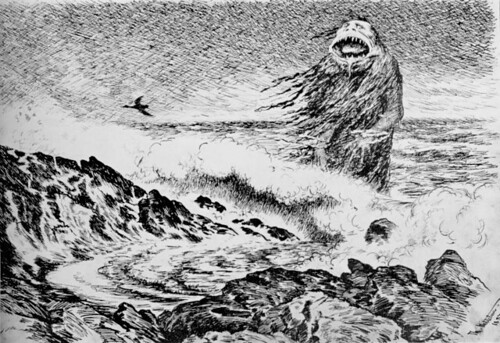
These cousins of the troll dwell in any body of water in any climate. They regenerate only if mostly immersed in water.
- Scrag: HD 6+3; AC 4 [15]; Atk 2 claws (1d4), 1 bite (1d8); Move 12 (Swim 18); Save 11; CL/XP 8/800; Special: Regenerate 3 hp/round.
Shadow, Greater
Although no more intelligent than an average shadow, a greater shadow is more loathesome and dangerous because it can spawn. Creatures drained of all their strength by a greater shadow become shadows under the control of their killer.
- Greater Shadow: HD 9+3; AC 6 [13]; Atk 1 touch (1d6 + strength drain); Move 12; Save 6; CL/XP 10/1400; Special: Drain 1d4 points of strength with hit, hit only by magic weapons.
Shield Guardian
Shield guardians are magical constructs created to protect whoever wears a certain amulet. They obey verbal commands, but are fairly stupid. All attacks against the amulet wearer in the presence of a shield guardian suffer a –2 penalty to hit. A shield guardian can store one spell of level 4 or lower that is cast into it by another creature. It “casts” this spell when commanded to do so. If a shield guardian’s amulet is destroyed, the guardian ceases to function until a new one is created. If the wearer dies but the amulet is intact, the shield guardian carries out the last command it was given.
- Shield Guardian: HD 15; AC 0 [19]; Atk 2 slam (2d6); Move 12; Save 3; CL/XP 16/3200; Special: Shield other, spell storing.
Skum
Skum are humanoid algae that serve aboleths and other aquatic dark lords. They are amphibious and have raking claws.
- Skum: HD 2; AC 7 [12]; Atk 1 bite (2d6), 2 claws (1d4); Move 9 (Swim 15); Save 16; CL/XP 2/30; Special: None.
Spider Eater
A spider eater is 10 feet long and 4 feet high, and has a wingspan of about 20 feet. A spider eater attacks with its venomous sting and powerful mandibles. Female spider eaters lay their eggs inside large, paralyzed creatures. The young emerge about six weeks later, literally devouring the host from inside. Creatures stung by a spider eater must pass a saving throw or be paralyzed for 1d8+5 weeks. Spider eaters have a continuous freedom of movement ability as the spell. They can be trained as mounts.
- Spider Eater: HD 4+1; AC 5 [14]; Atk 1 sting (2d4) and 1 bite (1d8); Move 12 (Fly 24); Save 13; CL/XP 5/240; Special: Implant eggs, poison.
Thoqqua
The thoqqua is a 5’ long, reddish-silver worm-like creature that radiates intense heat. When it burrows through rock it leaves a 3-ft diameter tunnel glowing red with heat; anyone touching this tunnel within 1 minute of it being made will suffer 2d6 points of damage. It can charge 120’ in one round, dealing 5d6 damage to whomever it hits. Creatures struck must make a saving throw or lose a prominent item worn to the creature’s intense heat. A thoqqua is healed by fire damage. It suffers double damage from cold.
- Thoqqua: HD 3; AC 1 [18]; Atk 1 touch (2d6); Move 12 (Burrow 3); Save 14; CL/XP 4/120; Special: Healed by fire, double damage from cold.
Troll Hunter
Some trolls, more cunning than most, are not satisfied with merely eating civilized beings but train to hunt them relentlessly. These troll hunters are fearsome creatures who focus on slaying and devouring humanoid prey.
- Troll Hunter: HD 12+6; AC 1 [18]; Atk 2 claws (1d4), 1 bite (1d8) or battle axe (2d6) or javelin (1d8); Move 12; Save 3; CL/XP 15/2900; Special: Regenerate 3 hp/round, +2 bonus to hit humans and elfs, speak with animals at will, cast resist fire once per day.
Vampire Spawn
Vampire spawn are undead creatures that come into being when vampires slay mortals. Like their creators, spawn remain bound to their coffins and to the soil of their graves. Vampire spawn appear much as they did in life, although their features are often hardened, with a predatory look. Like vampires, vampire spawn have a variety of special abilities. They can only be harmed by magic or silver weapons, regenerate 1 hp per round, can turn into gaseous form at will and can drain one level with their bite. Looking into a vampire spawn’s eyes forces one to make a saving throw or be charmed (as the charm person spell). Vampire spawn have the same weaknesses and vulnerabilities as true vampires.
- Vampire Spawn: HD 4; AC 4 [15]; Atk 1 bite (1d6 + level drain); Move 12; Save 13; CL/XP 7/600; Special: See description.
Xill
Xill are four-armed, red-skinned hooligans. Xill are asexual. They reproduce by laying eggs in the stomachs of living humanoids. They can shift from the ethereal to the material plane instantly, or the reverse in 2 rounds during which it loses its magic resistance. Despite their magic resistance, xill can be warded with protection from evil. The xill’s claws can inject a paralyzing venom into grappled opponents (a saving throw applies). Once a victim is secured and subdued, the xill will take its victim to the ethereal plane for egg laying. If attacked in its lair, the xill will first save its eggs and any egg-bound victims. Xill eggs hatch in 1d4 days; over the next 2d4 days they will inflict 3d6 damage per day as they mature. Once they emerge they kill the victim instantly. The eggs will produce 2d8 small xill that mature to adulthood in only 1d4 hours.
- Xill: HD 5; AC 2 [17]; Atk 4 claws (1d4) weapons (1d8); Move 15; Save 12; CL/XP 12/2000; Special: Attack as 8 HD creatures, only harmed by magic weapons, magic resistance 70%, ethereal shift.
Yrthak
A yrthak is a large, blind avian. It senses sound and movement by means of a special organ on its long tongue. It emits powerfully focused beams of sound from the protrusion on its head. The creature is a yellowish-green color, with the wings and fin being more yellow and the head and body more green. The teeth are yellow. A yrthak is about 20 feet long, with a wingspan of 40 feet. Despite their intelligence, yrthaks do not speak. They can focus sonic energy into a ray every 2 rounds. The ray inflicts 6d6 damage. It can also focus the ray on stone, causing an explosion that deals 2d6 damage to all within 10 feet of the impact.
- Yrthak: HD 12; AC 3 [16]; Atk 2 claws (1d6), 1 bite (2d8); Move 9 (Fly 24); Save 3; CL/XP 13/2300; Special: Sonic attacks.
Templates
Templates are, in my opinion, a sound idea. Why have separate stats for skeletons and monster skeletons and dragon skeletons, when you can instead apply a simple template to any monster and turn it into a skeleton. Nice and simple. Unfortunately, here is where the idea runs smack-dab into one of my least favorite parts of the d20 experience – monster stats. When I used to run a d20 game, I would dutifully go about the business of template-ing a monster to throw a twist to my players. I would go down the list, make the changes, do the calculations, and in the end come up with a slightly new monster that would probably still bite the dust in the course of three or four rounds of combat. For me, not enough bang for the buck. Enter the Swords & Wizardry Core Rules and the sheer joy that is monsters with only SEVEN stats. Compare that to the 23 to 25 statistics for a d20 monster that is going to last just about as long and do just about the same things in combat. Of course, templates often are used to create fairly bizarre, tongue-in-cheek creatures, but I have room for a little comedy in my games. So, here is an attempt at converting some d20 templates into an old school format.
Celestial Creature
The celestial creature template can be applied to any kind of creature.
- Celestial creatures are subject to spells that repulse conjured creatures.
- Once per day a celestial creature can “smite evil”, dealing bonus damage equal to its own hit dice on a successful attack against a evil creature.
- Celestial creatures take half damage from acid, cold and lightning and have 10% magic resistance. A celestial creature with four or more hit dice can only be harmed by magic weapons.
- Celestial creaures have challenge levels 3 or 4 points higher than normal creatures of the same type.
Sample Celestial Creature
- Celestial Polar Bear: HD 7; AC 6 [13]; Atk 2 claws (1d6+1), 1 bite (1d10+1); Move 12; Save 9; CL/XP 7/600; Special: Hug, smite evil, half damage from acid, cold and lightning, magic resistance 10%, only harmed by magic weapons.
Fiendish Creature
The fiendish creature template can be applied to any kind of creature.
- Fiendish creatures are subject to spells that repulse conjured creatures.
- Once per day a fiendish creature can “smite good”, dealing bonus damage equal to its own hit dice on a successful attack against a good creature.
- Fiendish creatures take half damage from cold and fire and have 10% magic resistance. A fiendish creature with four or more hit dice can only be harmed by magic weapons.
- Fiendish creaures have challenge levels 3 or 4 points higher than normal creatures of the same type.
Sample Fiendish Creature
- Fiendish Giant Viper: HD 4; AC 5 [14]; Atk 1 bite (1d3 + poison); Move 12; Save 13; CL/XP 6/400; Special: Lethal poison, only harmed by magic weapons, half damage from fire and cold, magic resistance 10%, smite good.
Half-Celestial
The haf-celestial template can be applied to any humanoid creature. No matter the form, half-celestials are always comely and delightful to the senses, having golden skin, sparkling eyes, angelic wings, or some other sign of their higher nature.
- Half-celestials have feathered wings, giving them a fly speed equal to twice their land speed.
- A half-celestial’s armor class improves by one.
- Once per day a half-celestial can “smite evil”, dealing bonus damage equal to its own hit dice on a successful attack against an evil creature.
- Half-celestials can use the spell light at will, and can always counter magical darkness.
- Half-celestials can cast cleric spells. They can cast one spell of each cleric spell level, with the maximum level of cleric spells equal to their hit dice.
- Half-celestials are immune to disease, suffer only half damage from acid, cold and lightning, are only harmed by magic weapons, have 25% magic resistance and are +2 to save vs. poison.
- A half-celestial’s challenge level is 5 points higher than a normal creature of its type.
Sample Half-Celestial
- Half-Celestial Elf: HD 1+1; AC 4 [15]; Atk 1 sword (1d8) or 2 arrows (1d6); Move 12 (Fly 24); Save 17 (15 vs. poison); CL/XP 6/400; Special: Smite evil (+1 damage), bless once per day, light at will, immune to disease, half damage from acid, cold and lightning, only harmed by magic weapons, magic resistance 25%.
Half-Dragon
The haf-dragon template can be applied to any living creature. Half-dragon creatures are always more formidable than others of their kind that do not have dragon blood, and their appearance betrays their nature; scales, elongated features, reptilian eyes, and exaggerated teeth and claws. Sometimes half-dragons have wings.
- Half-dragons have +1 hit point per hit dice.
- A half-dragon that is larger than man-size gains leathery wings and a fly speed equal to twice its land speed.
- A half-dragon’s armor class improves by two.
- Half-dragons have one bite attack for 1d6 damage and two claw attacks for 1d4 damage. Damage can be increased for creatures larger than man-sized, or decreased for smaller creatures.
- Half-dragons gain one breath weapon of the breed of their dragon parent (i.e. frost if a half-white dragon, fire if a half-red dragon). A half-dragon’s breath weapon deals 5d6 points of damage and is usable once per day.
- Half-dragons are immune to sleep and paralysis.
- A half-dragon’s challenge level is 2 or 3 points higher than a normal creature of its type, depending on whether or not it can fly.
Sample Half-Dragon
- Half-White Dragon Mammoth: HD 12+12; AC 5 [14]; Atk 1 trunk (1d10), 2 gore (1d10+4), 2 trample (2d6+4) or 2 claw (1d8), 1 bite (1d10); Move 12 (Fly 24); Save 3; CL/XP 16/3200; Special: Breath cone of frost (5d6 damage) once per day, immune to sleep and paralysis.
Half-Fiend
The haf-fiend template can be applied to any humanoid creature. No matter its form, a half-fiend is always hideous to behold, having dark scales, horns, glowing red eyes, bat wings, a fetid odor, or some other obvious sign that it is tainted with evil.
- Half-fiends have bat-like wings, giving them a fly speed equal to their land speed.
- A half-fiend’s armor class improves by one.
- Half-fiends have one bite attack for 1d6 damage and two claw attacks for 1d4 damage. Damage can be increased for creatures larger than man-sized, or decreased for smaller creatures.
- Once per day a half-fiend can “smite good”, dealing bonus damage equal to its own hit dice on a successful attack against a good creature.
- Half-fiends can cast the reverse versions of cleric spells. They can cast one spell of each cleric spell level, with the maximum level of cleric spells equal to their hit dice.
- Half-fiends are immune to poison, suffer only half damage from acid, cold, fire and lightning, are only harmed by magic weapons, and have 25% magic resistance.
- A half-fiend’s challenge level is 5 points higher than a normal creature of its type.
Sample Half-Fiend
- Half-Fiend Berserker: HD 1; AC 7 [12]; Atk 1 weapon (1d8) or 2 claws (1d4), 1 bite (1d6); Move 12 (Fly 12); Save 17; CL/XP 7/600; Special: +2 to hit in berserk state, smite good (+1 damage), cast inflict light wound once per day, immune to poison, half damage from acid, cold, fire and lightning, only harmed by magic weapons, magic resistance 25%.
Lycanthrope
The lycanthrope creature template can combine any humanoid creature with any beast.
- A lycanthrope’s hit dice are equal to the hit dice of his humanoid form plus the hit dice of his animal form.
- Lycanthropes can shift between their humanoid form, their animal form, and a hybrid form.
- A lycanthrope’s armor class improves by two.
- Lycanthropes gain special movement types of their animal form while in hybrid form.
- A lycanthrope in hybrid form gains two claw attacks that deal 1d4 damage and one bite attack that deals 1d6 damage. Damage can be increased or decreased as the Referee deems appropriate.
- A lycanthrope spreads its curse to other creatures through its bite attack. Creatures bitten by the lycanthrope must pass a saving throw to avoid the curse.
- Lycanthropes can only be harmed by silver or magic weapons.
- Lycanthropes can communicate with animals of their kind in any form.
Sample Lycanthrope
- Hill Giant Were-Orca: HD 20+2; AC 2 [17]; Atk 1 weapon (2d6) or 2 claws (1d6), 1 bite (1d8); Move 12 (Swim 24); Save 3; CL/XP 9/1100; Special: Throw boulders, only harmed by silver or magic weapons, communicate with orcas, curse of lycanthropy.
Vampire
The vampire template can be applied to any humanoid creature.
- If the creature has fewer than seven hit dice, increase their hit dice to seven.
- Improve the creatures armor class by two.
- The creature gains a bite attack that deals 1d10 points of damage and drains one level.
- As a vampire, the creature gains the following special abilities: Can only be hit by magic weapons, regenerate 3 hp each round, turn into gaseous form or giant bat at will, summon a swarm of bats or 3d6 wolves from the night, eyes that charm (as the charm person spell, save at -2 to negate), and the ability to turn humanoids into vampires by killing them.
- As a vampire, the creature gains the following vulnerabilities: They can be killed by immersion in running water (unless they are natural swimmers), exposure to sunlight, or having a stake driven through their hearts (which, to be honest, kills non-vampires as well); they retreat from the smell of garlic, the sight of a mirror and the sight of “good” holy symbols.
- Vampiric creatures have challenge levels 3 points higher than normal creatures of the same type, plus any additions due to extra hit dice.
Sample Vampire
- Vampiric Lizardman: HD 7+1; AC 6 [13]; Atk 2 claws (1d3), 1 bite (1d10 + level drain); Move 6 (Swim 12); Save 9; CL/XP 10/1400; Special: See description above.
Art by Theodor Kittelsen – Sjøtrollet 1887 (The Sea Troll)
 Land of Nod