Ten Uncommon Coins

1. Compacted Cubits: A compacted cubit is a full ton (2,000 lb) of silver dust stuffed into an extra-dimensional space sealed inside a tiny cylinder (coin shaped) of force. They look like grainy, silvery coins but feel perfectly smooth. God forbid you have a few of these in your backpack when somebody casts dispel magic. Depending on how you value coinage, a compacted cubit is worth 20,000 sp or 200,000 sp. And yeah, I know a cubit isn’t a measure of weight. You can blame Battlestar Galactica.

2. Soultaker: Appears as a blank, gold coin. When pressed on the forehead of a recently dead body, it absorbs the person’s soul and their image appears on the coin.

3. Dragon Tokens: Dragon tokens are wooden coins that are steeped in the blood of a freshly slain dragon and then coated with wax to keep the draconic goodness locked inside. Value depends on how much you value dragon blood, but probably not more than 10 gp.

4. Token of Friendship: A tarnished brass coin. Creates a vague emotional connection between you and the person who presented it to you – i.e., you know when they are frightened, happy, etc. The coin can summon the person bodily to you if you call out their name while holding it.

5. Platinum Cone: A small platinum cone, worth 2 pp. When the tiny end is held to the ear it implants a random magic-user spell (level 1d3) in your head, making you capable of casting it if not wearing armor. There is a 1 in 6 chance that the spell is actually reversed, or just not what you thought it was.
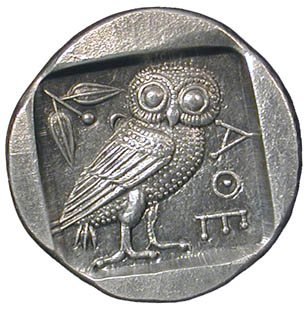
6. Pennywise: A copper coin bearing the image of an owl. It increases one’s Wisdom score by +3 (to a maximum of 18), but makes that person very tight with money.

7. Golden Rad: Radioactive gold coinage, with all that radiation brings (poison, mutation – depends on your campaign). Each coin has a 1 in 20 chance per month of transmuting back to lead.

8. Silver Sylph: A silver coin with a hole in the center. If one blows through the hole, the coin produces bubbles of perfume, with a 1% chance of instead producing a sylph. You have no control over the sylph, and if you dragged her away from something important, she might be quite cross with you.

9. Gold Spiral: Gold coin with a spiral design, it can absorb one lightning bolt (no save needed) and then discharges it one hour later. While holding the charge, the holder is immune to electricity.

10. Corpse Coins: Copper coins. If placed on the eyes of a corpse, they completely stop decay. If held over a single eye of a living creature, it makes them invisible to corporeal undead. Of course, one could hold coins over both eyes, but they’d probably run into things.
Merry Christmas and a Magic Item

Nothing fancy in this post – just my wishes that everyone who reads this blog (and everyone who doesn’t) has a fun, healthy Christmas and prosperous, successful New Year – keep on gaming and good luck in all your endeavors!!!

Oh, and since I feel like I should do something game related …

Wand of Ice Missiles: The wand of ice metals is a cobalt blue tube about 12 inches long. By blowing in one end, you can launch a magical dart of ice out the other. The ice darts have a maximum range of 30 feet and deal 1d4 points of physical damage and 1d6 points of freezing damage. The ice darts also numb (effectively paralyze) the body part they hit. Roll 1d10 on the following table:

1-2. Right leg – movement reduced by one half, cannot run
3-4. Left leg – movement reduced by one half, cannot run
5. Left arm – unable to use shield or weapon
6. Right arm – unable to use shield or weapon
7-9. Torso – paralyzed for 1d4 rounds
10. Head – Unconscious for 1 hour

In all cases, the target receives a saving throw to avoid the numbness. Attacking with the ice dart requires a successful ranged attack. The wand can be used four times per day, but only once per hour, unless you are in a cold environment, in which case it can be used once per round, up to 10 times per day.

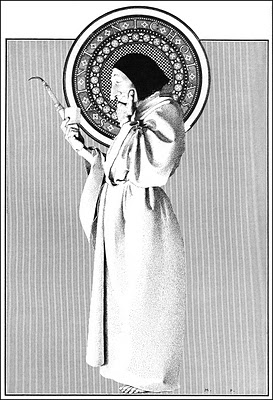
Image is Maxfield Parrish’s idea of Santa Claus via Golden Age Comic Book Stories.

Zarmon’s Hammer, a minor artifact

This is a minor artifact I worked up for Jeff Rient’s open call.

Zarmon’s Hammer
Zarmon was a great smith, maybe the greatest smith in the world, or perhaps in all the Motherlands. This is a point of dispute among sages and was a point of honor to Zarmon when he yet drew breath. One winter, in the depths of the twilit season and in the throes of a pernicious melancholy, Zarmon resolved to seal his fame and forge a magical weapon, a sword. As a master smith in great demand, he had many opportunities to consult with great mages, and peppered each one who walked into his workshop with questions about the forging of magical things. While most had not the skill or knowledge to help him, a few truly learned men and women advised him that his endeavor must end in failure, for he had no command over things arcane. Finally, one archimage (possibly the magnificent Baloc) told him that, indeed, an enchanted weapon was not beyond his abilities if he was completely dedicated to the task. He would have to forge the weapon in the presence of raw elemental power and mingle his own blood, his own soul, with the weapon.

Following Baloc’s instructions, Zarmon moved his factory and household to the southern island of Taprobane, to a place where hot magma flowed into the pounding surf. There, on a windswept ridge, he constructed a forge and began working on his sword. For a year and a day he worked at refining the steel and folding it, pounding it every day with his trusty hammer, firing it in the flowing magma, quenching it in the pounding surf and anointing it with his very lifeblood. For a year and a day he poured his every waking moment into the sword, the great sword, the greatest sword forged by mortal man. And on the final day of his task, at the completion of his work, he laid his hammer on his anvil and held aloft the unadorned blade and watched it cut the wind and throw the sunlight off its back and a tremor shook Zarmon. He dropped to his knees, gasped a final breath, and toppled with his masterpiece into the flowing magma, and smith and sword ceased to be. All that was left of Zarmon the Smith was his old, trusty hammer, with which he had forged a thousand swords and known a thousand joys and sorrows and built for him a reputation as a worker of wonders.

Zarmon the Smith did not leave behind an enchanted sword for the ages, but he did leave an enchanted hammer that passed into the hands of his sons and made them almost as great as their father, and then passed into the mists of time when their workshop on the shores of Taprobane was sacked by pirates. The hammer exists to this day, looking for all the world like an old smith’s hammer and still working wonders in steel.

2 x I: ____________, ____________
1 x II: ____________
1 x III: ____________

Art: The Smithy by Martin Driscoll.

Candle of Thought

Candle of Thought
This appears as a normal candle. When lit and held in one’s hand it casts a soft, steady white light, never flickering, even in a breeze (though a strong wind will extinguish it.) When the melting wax from the candle hits a creature’s flesh (a painful experience, maybe worth 1 point of damage), forgotten events in that person’s past will appear projected on the wall or floor within the area of the candle’s light. The person holding the candle can summon up these memories if he is concentrating on them (i.e. – what was that person’s name), otherwise they are random. The candle will burn for one hour before used up, with each memory extraction taking 1 minute.

Books and Scrolls

I was looking through some notes I made a while back concerning books and scrolls, and thought they might be of interest. Probably no blog post tomorrow – my company is hosting a charity golf course for most of the day, and then I’m going to see my daughter in a performance of Alice in Wonderland (she’s the door mouse). Until Tuesday …

Books and Scrolls

Clay Tablet: A tablet made of clay (terracotta) and either fired in a kiln to make it permanent, or simply erased if to be recycled. Writing on a clay tablet was done with a reed using cuneiform characters. A typical, large tablet weighs 15 pounds. Clay tablets cannot holds spells of more than 1st level.

Bamboo Scroll: A bamboo scroll is a collection of long, narrow bamboo slips joined together with thread. Each slip can hold dozens of pictographs. When joined together, the slips can be rolled like a scroll. Because these scrolls were heavy, they were replaced upon the invention of paper. A typical scroll weighs 10 pounds and can hold any level of spell, with such spell scrolls weighing 2 pounds per spell level so inscribed.

Papyrus Scroll: Papyrus is a thick, paper-like material produced from the pith of the papyrus plant, a wetland reed. Papyrus was cheap, but could not be folded, and thus had to be used in large, heavy scrolls. Papyrus is fragile and susceptible to damage from moisture and dryness, and it presented an uneven surface for writing unless of the very highest quality. Papyrus was abandoned for parchment by the 12th century, with Papal Bulls being some of the last things written on papyrus. Papyrus is manufactured by stripping the outer rind of the stem and cutting the interior into strips. The strips are laid side by side, horizontally. Another layer is then added atop the first, placed side by side vertically. While still moist, the two layers are hammered together. The sheet is then dried under pressure. After drying, the sheet is polished with a stone, shell or piece of wood. A typical scroll is assumed to weigh 25 pounds, with much of the weight coming from the rollers. Scrolls can hold spells of any level and should weigh approximately 5 pounds per spell level.

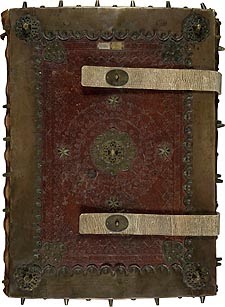
Book: A typical medieval book weighed between 40 and 165 lb. The Codex Gigas, for example, was 3.2 feet long, 20 inches wide and weighed 165 pounds. A rare Hebrew manuscript contained 1,042 pages and weighed 57 pounds. Given these dimensions, we can pretend that a basic book weighs 0.5 ounces per page, while a large tome weighs twice that much and provides twice as much surface for writing. A sheet of paper or parchment was called a bifolium, being a single folio folded in half to produce two leaves. Books were often bound between two thin sheets of wood that were covered by leather. When books were rare (i.e. before the printing press) they were often chained to desks.

Page Measures
Quire = 24 folio

Ream = 20 quires = 480 folio

Bundle = 2 reams = 960 folio

Bale = 5 bundles = 4,800 folio

Books can be printed on one of several mediums:

Parchment: Made from the skin of sheep, goats, deer and other animals. The parchmenter begins the process by selecting a disease and tick-free animal. The animal’s skin is washed thoroughly and soaked in a vat of water and lime for about a week, stirring several times a day with a wooden pole. The pelt is removed and laid over a curved, upright shield of wood. The hair is scraped out using a long, curved knife with a wooden handle on each end. The dehaired pelt is then rinsed in cold water for two more days to remove the lime. The skin is dried while stretched on a frame. The skin is secured to the frame by pushing pebbles into the skin every inch or so to make knobs, to which strings were tied. It was not uncommon to see holes in finished parchments where tiny tears made in the scraping process were stretched out in the stretching process. The parchmenter now ladles hot water over the stretched skin while scraping with another curved knife called a lunellum. The parchment is finally allowed to dry completely, shrinking and tightening as it does. Once dry, the scraping begins anew. Finally, the parchment can be removed and rolled up for transportation or sale. A scribe would purchase the parchment in this condition, cutting it to his desired size and buffing it before use with chalk. Parchment sheets were usually sold by the dozen.

Vellum: High quality parchment made from calf skin.

Paper: Made from plant pulp, fibers, rags or cellulose. Paper is cheaper than parchment, but not as long lasting.

Types of Books

  1. Atlas (Geography)
  2. Bestiary (Fauna)
  3. Chronicle (History)
  4. Cookery (Recipes)
  5. Dialogue (Philosophy)
  6. Grimoire or Grammary (Magic)
  7. Herbal (Flora)
  8. Lectionary (Religion)
  9. Lexicon (Language)
  10. Manual (“How-to” on war, hunting, politics, etc.)
  11. Principia (Science, mathematics, alchemy)
  12. Romance (Stories meant for entertainment)

Image from here.

Magic Rings

Here are a couple magic rings inspired by the world of comic books (and their modern simulacra).

Rings of Elemental Earth
This pair of rings is carved from citrines and are worth 1,000 gp as jewelry. If worn one on each hand and slammed together while chanting “Res orbis operor vestri res”, the wearer becomes an 8 HD earth elemental for 10 minutes. This can be done but once per day.

Ruby Ring
The ruby ring is made of admantine and set with a highly-polished ruby lens. It was forged to be a weapon against evil and can only be used by benevolent creatures. The ring must be re-charged once every 24 hours at the altar of a benevolent deity. When fully charged, the ring allows the caster to produce several spell-like effects by succeeding at a wisdom check, for use of the ring requires an act of supreme will. The wisdom check must be made every round in combat or every ten minutes outside of combat to maintain willpower. Multiple effects can be manifested simultaneously, but the required wisdom checks are made at a -2 penalty for every effect beyond the first. The ring can duplicate the following spells: crushing hand, fly, forcecage, forceful hand, grasping hand, interposing hand, magic missile (1 missile), shadow conjuration, shield and wall of force. All spell effects manifest as a ruby-colored construct of pure force. If the bearer of the ring is killed, the ring teleports to the nearest person worthy of wielding it.