 |
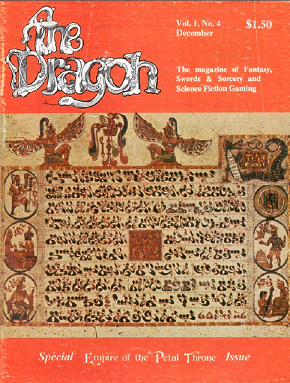
| I dig this cover – this is what D&D games should look like! |
Three months into the new year of a new game! Before I get into this issue, I’d like to direct folks over to White Dwarf Wednesdays at Tim Brannan’s blog.
What did the oldsters come up with for this issue? Let’s take a look …
A fantasy story by Gardner Fox shows up in this issue – it’s amazing how many “real authors” showed up in the pages of what was still a pretty new magazine that represented a very new hobby. Maybe these guys didn’t have many offers in the late 1970’s – the golden age of magazine stories and illustration had passed, but still, it’s pretty cool.
The big deal in this issue is the Witchcraft Supplement for Dungeons & Dragons – a title I’m sure served as ammunition for the anti-D&D crusade back in the day. What’s awesome about this article, right off the bat, is that they didn’t know who wrote it, but published it anyhow! Right under the title is a request that the real author please let them know who the heck he or she was.
The article starts off with a bit on how witches can show up on the wilderness encounter table. I always love this stuff – the idea that there is a single, unifying wilderness encounter table for all of D&D, and if we add witches to D&D we have to shoehorn them into the table. Reading these articles, you can’t help but love this weird, new world of gaming that was being grown back in the day.
The first thing you need to know about witchcraft is that witch spells do not affect djinn, efreet or clerics of any alignment. All witches have saves equal to warlocks (I love when they used level titles in place of the level number). Good (i.e. Lawful) witches can perform 7 spells per day, but there is a 4% chance that she is ancient, and is thus a Priestess who can cast 10 spells per day and 1 of her own special spells once per week. Why 4%? God only knows.
A few of the new Lawful witch spells are calm (which turned into calm emotions), summon elemental (12 HD) – which lasts while she concentrates, rejuvenation (reduces age by 5 years), dissipation (disperses elementals, clouds, mist and magic wall spells) and comfort. Priestesses get several new spells – youth, influence, banish any one creature, enchantment (produces any one magic ring, potion, misc. weapon, misc. magic item) and seek.
Black witchcraft includes pit, fire box, diminish plant/animal/men, plant entrapment, paralyzing pit (!), undead control, aging, circle of blindness, curse, poison touch and curtain wall. Many of these spells have modern versions – I don’t if they originated in this article or if it’s just a coincidence.
Now we get an explanation for the Secret Order witches … they were designed to challenge high level wizards and magic weapon-armed lords when traveling through the wilderness. Necessity is the mother of witches, apparently. They have some additional new spells and several special weapons. Lots of great material here – hornet cape, assassin’s eyes – find this issue and read away.
James M. Ward now chimes in with “Some Ideas Missed in Metamorphosis Alpha” – basically some things that should have been in the rulebook but were not. Kinda taking a mulligan here. He also adds “Tribal Society and Hierarchy on Board the Starship Warden”. Good stuff – apparently the dominant lifeforms on the Warden are the wolfoids and androids.
This issue’s Creature Feature is the ankheg. Again, the statblock is a bit chaotic. Since the ankheg is open content (and old as the hills), I’ll reproduce it below …
Number appearing: 1-6
Description: 10-20 feet long, brown chitin overall, pink underside
Armor class: 2 overall, underside class 4
Movement: 12/6 through ground
Hit die: 3-8 (8 sided die)
% in lair: 25%
Treasure: B2
Squirt acid for 1-6 die of damage according to size
Bite for 3-18 points damage
Magic resistance: none
Alignment: neutral
These babies can sure deal some damage!
Next is the letters section. My favorite bit is a guy describing his campaign world:
“Although it is not our own Earth, it is only about eleven light years from our world, and therefore most of the culture is a parallel of our ancient cultures.”
True scientific realism, indeed!
Gygax now chimes in with How Green Was My Mutant, with random tables on determining the appearance of humanoids in Metamorphosis Alpha. Naturally, I need to roll one up:
Skin/Hair Coloration: Brown
Skin Characteristic: Knobby
Color Pattern: Whorles
Head: Bulbous
Neck: Wattled
Body: Long
Facial Features: No nose
Hands and Feet: Wide
Fingers and Toes: Four of each
Arms: Normal
Legs: Thin
Damn – that’s one good looking fella! Best thing about the tables, to me, is that it’s almost impossible to roll anything like a normal looking human being, which is as it should be.
I won’t cover Fox’s tale Beyond the Wizard Fog, as Jamie Mal has done a fine job of that himself. (Google it, darlings)
Charles Preston Goforth, Jr. (fake name? has to be a fake name) provides new rules for magical research with one year of playtesting (real time) and nine years in game time!
Essentially, they give you 10 levels of spells with a percentage chance of success, time required and the gold piece investment. The chance of success appears to always be 20% or 100%, depending on how much gold is spent. A 1st level spell, for example, costs you 2,000 gp for a 20% chance of success, or 10,000 gp for a 100% chance of success. 10th level spells (whatever the heck they are) cost 5.12 million gp for a 100% chance of success.
There are some restrictions on spells to permanently increase stats (including spell levels up to 18th). I pity the poor wizard who sunk several million gold pieces into increasing their intelligence when they could have waited a couple decades for 3rd edition and done it for free.
Armor and weapons can be enchanted up to +1 with 2 months of work and 2,000 gp. “Serious enchanting”, as he puts it, requires 10 months and 10,000 gp. I have a weird feeling this system would very quickly get out of hand!
Bill Seligman now gives us one of the classic articles of the old school – Gandalf Was Only a Fifth Level Magic-User. The best point of the article, to me, is to hopefully make people see just how incredible the average 1st level magic-user really would be in the “real world”. Still, Seligman was clearly an early model of Raggi in terms of bringing out the nerd rage.
Garrison Ernst now presents another installment of The Gnome Cache. No – I didn’t read this one either – too dang much writing to get done.
And that rounds up the first issue of 1977. The vitality in the early game, and the presence of so many gamer archetypes that linger to the modern day makes these magazines great fun to read.
 Land of Nod