The Glooms – Landsharks!

Still working diligently on Hell. Almost finished with the north half of the first ring, and then I need to sprint in October to finish the north half of the next few rings. Should fill quite a few pages. I’m also working on a Demonologist class based on the Elementalist I published a few months back and a class that will present a few underground creatures as playable races, for those who want to run a campaign set entirely in the underworld. I’ve commissioned some art from Jon Kaufman, who did the race images for PARS FORTUNA and requested an old-style bugbear (a’la DCS), orc (pig-nosed of course), goblin (a’la DAT), kobold (scaled dog dude), hobgoblin (samurai armor wearing), svirfneblin (a’la Russ), drow (a’la Willingham), duergar (a’la Holloway) and a new critter. I can’t wait to see what he comes up with.

I should also mention – if these encounters sound tough, they’re meant to be. Most Land of Nod hex crawls are designed with characters in the fourth to eighth level in mind. These are meant to challenge characters who have gone past 12th level and want to invade Hell instead of settling down and playing the end game (stronghold, armies, etc). For example, Cocytus, the lowest plane of Hell, will be geared towards challenging a party of 30th level characters.

66.4. Fishing Trolls: A tribe of trolls (50 males, 50 females and 60 young) dwell here on the banks of the Acheron. The trolls are whalers. They sail a boat made from the ribs and hardened skin of abyssal whales. They head out into the Acheron each day seeking abyssal whales to harpoon and pull out of the water. The whales are then processed, producing black ambergris that is highly valued (1,000 gp per pound; the trolls usually have 2d10 pounds on hand).

The trolls dwell in a white mount that abuts the river, in caves chewed out of the chalky stone. These caves wind through the white stone like a maze, but the trolls always know their way, especially the secret doors and passages.

The trolls are led by a jarl called Svalmad and his five brothers, who serve as his huscarls. The tribe also includes a shaman called Bearlang, who prays to Hel and Angrboda and has been given a nidhund by those demons for his loyal worship. The trolls of White Mountain have oddly elongated arms, giving them a +1 bonus to hit in melee combat. They wear bits and pieces of leather and metal armor (equivalent of ring mail) and carry axes and harpoons. Svalmad is growing old for a troll, and his brothers know it. They plot against him with Bearlang.

Besides the aforementioned ambergris and a fair amount of scrimshaw art (maybe 1d4 x 100 gp worth), the trolls have a treasure of 3,500 ep, 45,400 gp, 520 pp, a silver idol of Hel (800 gp), an emerald (4,000 gp), an aventurine (1,250 gp) and eight casks of fine wine (12 gal./100 lb. each, worth 600 gp/gal.)

TROLLS: HD 6+3; AC 4 [15]; Atk 2 claws (1d4), 1 bite (1d8); Move 12; Save 11; CL/XP 8/800; Special: Regenerate 3hp/round, +1 to hit.

NIDHUND: HD 4; AC 5 [14]; Atk 1 bite (1d6) and 2 claws (1d6); Move 21; Save 13; CL/XP 7/600; Special: Immune to cold and poison, rake with claws, magic resistance (10%).

HUSCARLS: HD 7+3; AC 4 [15]; Atk 2 claws (1d4), 1 bite (1d8); Move 12; Save 9; CL/XP 9/1100; Special: Regenerate 3 hp/round, +1 to hit.

BEARLANG: HD 6+3 (38 hp); AC 4 [15]; Atk 2 claws (1d4), 1 bite (1d8); Move 12; Save 11; CL/XP 8/800; Special: Regenerate 3hp/round, cast spells as a 3rd level anti-cleric, +1 to hit due to elongated arms.

SVALMAD: HD 9+3 (33 hp); AC 4 [15]; Atk 2 claws (1d4), 1 bite (1d8); Move 12; Save 9; CL/XP 9/1100; Special: Regenerate 1 hp/round, +1 to hit due to elongated arms.

90.11. Igho-Kih: Igho-Kih is a dready city of 12,500 grimlocks and their thelidu masters. The city is hewn from the very stone of the underworld in a lopsided radial pattern – meaning circles off-set from one another in such a way that they intersect at weird angles. The city-state is surrounded by a tall karst wall that looks like a picket of giant stalactites. These walls have been carved into battlements and towers at places, and form a massive fortress. Each buttressed balcony is patrolled by 1d4 grimlocks who carry spears and wear chainmail. Within the city-state there are tall towers that rise above the canyon-like streets. These black, 3-story towers contain acid that can be released into the streets like a flood at the direction of the city’s masters, a council of thirteen thelidu, squid-headed humanoids with tremendous powers.

These thelidu dwell in a domed palace in the center of the city-state. The palace and city are ensorcelled to be completely dark. Even magical light can only penetrate about 5 feet into the darkness, and even then only with the brightness of twilight. Within the domed palace there is a series of pits and tower platforms. There is no way to move between them other than magic or difficult climbing. At the center of the dome there is a deep pit lined with mirrors that scry into the worlds beyond Nod (i.e. Mercurius, Veneris, Martis, etc).

The thelidu plot the downfall of all creation, though they are so plodding and intellectual they’ll probably never get around to actually doing anything grandiose and meaningful. In the meantime, the grimlocks raise worms and fungus. They live in warrior bands under violent chiefs and enslave their (and other races’) women to use as domestic servants and for mating. The council watches all and knows all, and rewards or punishes the chiefs as they see fit.

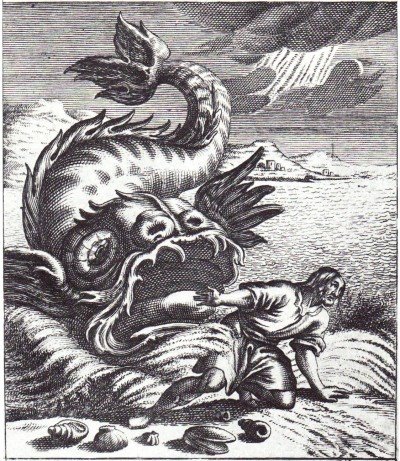
109.7. Rats & Sharks: There is an old stone fortress here, probably built by the drow ages ago. The fortress has a courtyard and three towers. The two smaller towers have tumble at some time in the past and now exist as a ruin. The larger tower, though shabby, is still strong and is inhabited by a gang of 20 ratling reavers. Ratlings are, of course, little threat to the denizens of Nifol, but these ratlings are smart and they control five landwalking sharks, which they use in the manner of war elephants. The sharks are kept chained in the courtyard. The ratlings must use extreme caution when mounting them, jumping on the large leather and wood harnesses affixed to their backs from above and then guiding them with gibbets of meat tied with sinew to long sticks or bones. Patrols of three of these war sharks are constantly active in these tunnels, and may be encountered randomly (see above).

The tower of the ratlings contains a shrine to their goddess, the Mouse Lord. Here, they keep a silver idol with ruby eyes and the living manifestation of their goddess (or so they think), a wererat named Tefnuin who wandered into Nifol as an adventurer and managed to hook up with the ratlings after her partners were killed. Tefnuin dwells in luxury, her every need catered to. She wears silk veils that accentuate her semi-humanoid curves, enticing perfume (well, enticing to a ratling) and carries a poisoned dagger. Her soldiers are armed with crossbows with poisoned bolts, short swords and, when on their landwalking sharks, harpoons that are used to reel in prey.

The ratlings have a treasure of 9,790 gp, 860 pp and a lapis lazuli charm worth 200 gp.

LANDWALKING SHARK: HD 13; AC 5 [14]; Atk 1 bite (1d10+8); Move 9 (S18); Save 4; CL/XP 13/2300; Special: Amphibious, feeding frenzy.

RATLING: HD 1; AC 9 [10]; Atk 1 bite (1d6+poison) or weapon; Save 17; Move 12; CL/XP 2/30; Special: Diseased bite.

TEFNUIN, WERERAT: HD 9; AC 6[13]; Atk 1 bite (1d3), 1 weapon (1d6); Move 12; Save 7; CL/XP 10/1400; Special: Lycanthropy, control rats, surprise (4 in 6).

Going to Hell!!

Here’s a first glimpse at my Hell hex crawl. Came out a little lopsided, but hey – nobody is perfect. The uppermost layer is Ante-Hell – essentially a 9th level dungeon level writ large. It is divided from Asphodel – a twilight land of rolling meadows grazed on by stench kows and populated by shades – by the river Acheron. The hexes on this one are 12-mile rather than 6-mile. It is designed to force adventurers to circumnavigate each layer to go from “entrance” to “exit”. So, roll up some paladins and clerics and you can send them on the ultimate hex crawl, beginning in a couple months!

A Notion on Alignment

Every good blog / magazine / forum devoted to fantasy gaming needs to address alignment eventually, especially if it can find a way to annoy its readers in doing so. Today is the day for The Land of Nod …

And before I go any further, this entire blog post is declared Open Game Content.

Law Means Sacrifice
Let’s assume, for the moment, that human beings, and therefore characters in an RPG, have free will. They can choose to kill the goblin children or leave them alive, steal the sacred goblet or leave it alone, etc. Adhering to a code – call it Law or Good or Lawful Good or whatever – means choosing to sacrifice your freedom to do things that might seem tactically or strategically wise, or just emotionally satisfying, in deference to a higher authority. In AD&D there was a hint of this in terms of which alignments were allowed to use poison and flaming oil. Clearly, poisoning a weapon (especially when poison usually meant save or die) was tactically a smart thing to do for adventurers. Kill your opponents more quickly, save your hit points for later battles, collect more treasure and thus collect more XP. The paladin, however, chooses not to do such a thing – just isn’t cricket you know! So, the notion here is that characters who choose to obtain their XP the hard way receive “compensation” from the higher powers.

Assumptions
Besides the assumption of free will above, an alignment system like this one makes a couple other assumptions that probably make it anathema to many campaign worlds and play styles. Understand – I’m only proposing this as a notion of how an alignment system could be modeled, not how an alignment system should be modeled. Therefore, if you feel the need to comment something like “No, this system is wrong, alignment shouldn’t be handled this way at all”, save yourself the trouble – I already know.

Assumption #1 – The God/Goddess/Deities of Law created the universe. This isn’t too far afield for a fantasy game – many mythologies work on this concept. First their was chaos, then there were titans/giants who gave birth to the gods who destroyed their parents and used them for spare parts while creating the universe and setting up its laws physical and spiritual. If you’re working on a more temporal universe or a Lovecraftian universe, this alignment system is almost certainly not for you.

Assumption #2 – The good gods are doing their best to hold back or defeat the bad gods/demons and they reward mortals for toeing the line. This alignment system operates on the idea of XP rewards for good behavior, which means experience points don’t just represent training and skill, but also the blessings of higher powers. It also means there is a universal establishment of right and wrong in the campaign, and those who submit themselves to it gain a palpable benefit. If this does not fit with your or your player’s sensibilities about life or how things should operate in a campaign, then this system is probably not for you.

Virtue and Vice
Now that we have the assumptions out of the way, we get to the system. Since this is a blog for rules light, old school gaming, the system is simple and draws on an existing system in the game – XP bonuses. You can use this system alongside XP bonuses for high ability scores or have it replace the existing system as you like.

Before we get into the rewards, let’s discuss virtue. This article will present virtue on quasi-Abrahamic grounds, since the Abrahamic religions were kind enough to put down things like Commandments and Cardinal Virtues and Seven Deadly Sins in writing. The point here isn’t to promote one faith over another. Feel free to rewrite the commandments.

Using the medieval concept of the chain of being, I’m going to put down a few commandments for adventurers in an order based on how difficult these rules would make dungeon delving. Commandment 1 is the most difficult to keep, Commandment 10 the easiest. I am then going to write down three systems of rewarding player characters with XP bonuses based on how they interact with these commandments.

Ten Commandments for Adventurers
1. You shall not murder/kill
2. You shall not steal (even from evil temples, though feel free to destroy their idols)
3. You shall defend the innocent and helpless with your life
4. You shall donate a minimum of 10% of your acquired wealth to the poor / the temple / etc.
5. You shall not use wicked tactics in combat (i.e. poison, flaming oil)
6. You shall not lie
7. You shall share treasure equally with other adventurers
8. You shall obey legal authority anointed with legitimacy by Law
9. You do not have improper relations with tavern wenches / stable grooms / etc.
10. You shall only worship (i.e. tithe, sacrifice to, call on) Law

Note that you can interpret “Law” in the above commandments as The God of Law, Creator of the Universe or The Deities of Law, Creators of the Universe or however it makes sense in your campaign.

Reward System One – Humans are Basically Evil
System one establishes that human beings are basically wicked and incapable of following any of these rules, and therefore rewards adventurers for adhering to any of these commandments. After an adventure, the Referee should award a +3% bonus to earned XP for each commandment an adventurer obeyed, working up from #10. As soon as you come to a broken commandment, the accrual of bonus XP stops.

For example, Sir Rodd of Todd gets back to town after delving in the Caves of Chaos. During that foray, he never called on Neutral or Chaotic gods, had no improper relations with men or women, obeyed the castellan and paid his taxes, shared treasure equally with the other adventurers, but did tell a lie to an orc sentry. So, he managed to obey the first four commandments, and thus earns a +12% bonus to earned experience points on the adventure.

Reward System Two – Setting Saintly Standards
In system two, we divide the commandments into the Greater Commandments (1-5) and Lesser Commandments (6-10). This scheme works much as the first, except one starts with an XP penalty and gradually lessens the penalty before it becomes an XP bonus. So, the commandments now look like this …

1. You shall not murder/kill [+15%]
2. You shall not steal (even from evil temples, though feel free to destroy their idols) [+12%]
3. You shall defend the innocent and helpless with your life [+9%]
4. You shall donate a minimum of 10% of your acquired wealth to the poor / the temple / etc. [+6%]
5. You shall not use wicked tactics in combat (i.e. poison, flaming oil) [+3%]
6. You shall not lie [-3%]
7. You shall share treasure equally with other adventurers [-6%]
8. You shall obey legal authority anointed with legitimacy by Law [-9%]
9. You do not have improper relations with tavern wenches / stable grooms / etc. [-12%]
10. You shall only worship (i.e. tithe, sacrifice to, call on) Law [-15%]

With this scheme, you again look for the highest level of “goodness” you manage to achieve, and are rewarded accordingly. Using the above example of Sir Rodd, the best he manages to do is share treasure equally, so he suffers a 6% penalty to earned experience points.

Obviously, this represents a much more severe attitude by Law to vice and virtue, and chaotic types had better make sure they score lots of experience points with their evil, because the universe is going to be acting against them at every step of the way.

System Three – Karma
Our last system is a modification of system one. In this case, you receive a +3% bonus for each commandment you obey and a 3% penalty for each commandment you break. All commandments are considered equal in this scheme – there is no chain of commandments from low to high – every one kept is a bonus, every one broken is a penalty.

Let’s again look at Sir Rodd. In our first example, we know that he kept the first four commandments and then broke the fifth. Perhaps he also abstained from wicked tactics, gave 10% of his treasure to the poor and defended the innocent with his life. That would give him 7 commandments kept (+21% XP) and 3 broken (-9%), giving him a total XP bonus of +12%.

Conclusion
Obviously, this is not a system for everyone. Take it as nothing more as a notion that struck me one day about how one might design an alignment system based on deeds (i.e. what you do) rather than words (i.e. what alignment you profess). If you find something of value in it, feel free to play with it, modify it and use it. If you think it sucks, feel free to ignore it.