Gehenna – Introduction

Mammon by George Frederick Watts (1885)

Time for my first preview of Gehenna, with an overview of this rather warm circle of Hell.

Although Gehenna is a dry, inhospitable wasteland of black, burning metallic sand, it almost looks like paradise to travelers who have just slogged their way through many leagues of sewage and decay in Abaddon.

Getting into Gehenna is dangerous. When one is one the very edge of Abaddon they cannot see into Gehenna. Instead, they see nothing but miles of sewage and junk as far as the horizon. When they place one over the border, though, they suddenly find themselves in the midst of a howling, raging storm of burning metallic sand and fire (per the fire storm spell). This persists for 1d6 rounds, and when it ends, one sees nothing but Gehenna, with no trace or sign of Abaddon.

Gehenna, as mentioned above, consists of mile after mile of rolling dunes of metallic sand. The sand is mostly black, but there are lines of coppery red, golden brown and silvery white worked into the landscape, making it almost pretty for a circle of Hell. Rivers of molten metal flow through the landscape aimlessly, ending in bubbling lakes. There are also great mesas of basalt to be found in Gehenna, and it usually on these that the landforms that the various tribes and lords of Gehenna dwell.

No plants exist in Gehenna, but the landscape is often broken up by growths of metallic crystals, some tall and branched like trees, others in spiked clumps.

All of the animals of Gehenna are immune to fire. Most are reptilian or insect in nature.

Gehenna is the ring of Hell allotted to the souls of the avaricious and prodigal. Avarice (also known as greed or covetousness) is the rapacious pursuit of wealth, status and power. While all people have ambitions, the covetous take this to an extreme, casting aside the eternal (and Lawful) for the temporal. In time, these things they sought fall through their hands as dust and escape them.

In Gehenna, the shades of the avaricious are turned into “misers”. Misers take the form of slaves in Gehenna, being driven by the Gehennites to push around great stones for their pointless monuments to the glory of Mammon, Amon or one of the other lords of the circle. The misers have lost their humanity and their individuality, and are now little more than beasts of burden.

The shades of the prodigals, on the other hand, become small in stature – nimble little thieves who try their best to steal from travelers and others, but find their bodies become immaterial whenever they attempt to hold onto anything, their newly acquired wealth quickly slipping through their hands. They are naked and hunched, and would be pitiable if not for their rapacious faces.

Races of Gehenna
Gehenna, as lifeless as it might seem, has its own inhabitants. These are the seven tribes of Gehenna, all of them races known to people of the surface world but altered by their habitation in Hell.

Arkusites: The Arkusites are hairless gnolls with pallid skin and icy blue eyes. The Arkusites build strongholds of gold and ride out from them on feral centaurs to raid and plunder. Arkusite warriors wear glistening scale armor, amply decorated with gold and tall, golden conical helms and wield long horseman’s axes and shortbows. Warriors are extensively tattooed.

Arkusites worship various demon lords, and change their allegiance often. Their priests use drugged wine to bring on prophetic dreams and practice ritual cannibalism.

The Harrites: The Harrites are kobolds that look like pteradactyls with golden scales and eyes like multi-faceted garnets. They roam Gehenna in great swarms, swooping down on victims from above with their cruelly barbed and hooked spears, snatching people up into the sky to be roasted alive in their towers. The Harrites dwell in great fluted towers of blue metal (cobalt, in fact). In the base of these towers, which rise in clumps from the landscape, they keep great fires burning at all times. The towers are open from base to ceiling and ringed with platforms and shelves on which the kobolds dwell. They hang their captives over these fires from chains and allow their screams and moans of torment to echo up through the tower. On the ceiling of the tower they keep strange ooze, which feeds on these screams and produces weird, sticky nodules that the kobolds collect and sell. The nodules are eaten by the inhabitants of Hell like candy. The Harrites usually worship Pazuzu.

The kobolds can exhale plumes of burning ash. Alone, a kobold can spew this into the face of an opponent once every 1d4 rounds, the victim having to pass a save or be blinded for 1d4 rounds. In groups of 30 or more, the kobolds can swoop down and exhale in unison, creating the equivalent of an incendiary cloud that lasts for 1 round.

Lamuresti: The Lamuresti are the elves of Gehenna, with warm, copper skin and entirely black eyes. They are graceful in appearance, with sharp, severe features. The Lamuresti are completely loyal to Mammon, whom they call their divine king. Each lamuresti village is governed by a priestly steward (an anti-cleric of level 1d4+2). They construct two-towered bronze ziggurats to Mammon and decorate their walls with bas-reliefs and metallic tiles depicting woodlands and marshes they may never visit. They are particularly known for their bronze lions.

The villages of Lamuresti contain eternal flames fed by the bodies of the shades punished in Gehenna (or any other captive they can get their well-manicured hands on). The Lamuresti are known for their harsh punishments and cruelty (pyramids of skulls, flaying captives alive, walling people into their city walls, etc.). The males wear flowing robes of cloth-of-gold and conical caps, with tighter dresses and feathered head-dresses on the females.

Lamuresti warriors wear scale armor and carry short swords, spears and longbows.

Sarrimites: The Sarrimites are changeling goblinoids. When first encountered, they look like hunched and muscular goblins, with short, bandy legs and bearded faces with over-large teeth jutting from their grim, low-set mouths. They wear iron masks that depict noble-looking men with dead eyes and long beards. When joined in battle, they shout their war-cries and become large hobgoblins. If reduced to half their normal hit dice, they grow into ogres (their equipment growing with them), gaining 2 extra hit dice and doing +2 points of damage with their attacks. The Sarrimites wear iron scales and horned helms. They attack with axe, spear and hand cannon (per heavy crossbow).

The Sarrimites are usually loyal to Mulciber, but worship his wife, the sensuous demoness Tyrana, a winged lilin only marginally loyal to Lilith of Erebus. Her temples grace the citadels of the Sarrimites and are attended by the female goblins. The citadels are ruled by the high priestess of Tyrana, the goblin king being subservient (and married) to her – a situation no goblin king cares for.

The goblins are expert engineers and smiths. Their villages are joined by iron-shod roads that rise above the burning sands of Gehenna, and they have canals that channel the molten rivers of metal to their foundries where most of the weaponry, armor and ordnance of Hell is manufactured.

Uccenites: The Uccenites, or “wolves of Gehenna” are sahitim, demonic humanoids who dwell in some of the deserts of Nod. Like their surface kin, the Uccenites are lean and lank, with golden-orange skin, with black horns like those of an antelope rising up to 3 feet tall. They swathe themselves in black robes, the men veiling their faces, the women adorning theirs with black tattoes.

The Uccenites are nomads, setting up temporary camps around large sepulchral tomb mounds in which they store their mummified dead. These mummies are animated, of course, and appear as naked, hunched sahitim (they are interred in a fetal position that bends their spines) covered in red ochre paint and in a state of decay. These mounds look like conical pyramids, wider than they are high, made of various metal blocks. The Uccenites also raise megalithic monuments to Amon, whom they worship exclusively. In honor of their demon lord, they sacrifice captives by slowing carving up their bodies while alive – first the ears, nose and lips, then the fingers and toes, etc.

Uccenite warriors wear mail tunics and carry bronze shields, scimitars and jezzails (as crossbows). They ride beasts that look like a cross between wolves and camels.

Xshayathiyans: The most grandiose and powerful of the peoples of Gehenna are the Xshayathiyans, also known as ophidians. They were worshipping demons before it was cool – perhaps before there actually was a Hell. Here they preside over stately cities of silver and gold, encrusted with gems and inlaid with serpentine and lapis lazuli. They wear kilts and loose tunics of cloth-of-gold and –silver and tall crowns (even the lowliest wear crowns). Warriors wear bulbous helms with golden face masks depicting demons, gorgons, medusas and other monstrous creatures. They are armed with iridescent scale coats, oblong shields, spears, axes, short swords and longbows.

The Xshayathiyans are ruled by their magic-users, who preside in palatial temples that are home to powerful glabrezu demons, the ruling class of the ophidians, who serve as the various satraps under their emperor, Mammon from his capitol, the Burnt City. These temples also hold ritual vats in which the priests bathe in oil or in the blood of sacrifices. The temples are guarded by winged gorgons and serpoleopards.

Xshayathiyan magi possess the most useful objects in Gehenna – at least for adventurers. These are stones that look like pure, white quartz spheres that, when buried one foot beneath any soil, cause a spout of pure, fresh water to erupt into a fountain for 1d4 minutes. One waterskin can be filled from the fountain per minute. The stones, called stones of necessity, function once per day, and there is a 5% chance per use of them crumbling into dust.

Xulites: The Xulites are bronze men – humans with skin not only the color of bronze, but the consistency as well. The Xulites build citadels of brass, decorated with gynosphinxes with golden bodies and ivory faces. Within these citadel they keep gorgons who feed on the metallic sands (they are immune to their petrifying breath) and grow crystalline trees of emerald and ruby.

The Xulites are slavers, capturing the zombie-like prisoners of Gehenna and using them as beasts of burden. They wear pointed helms and scale hauberks and wield longswords, spears, daggers and crossbows that throw metal darts. The elite Xulite warriors ride scaled lions (like miniature dragonnes) into battle, their roars driving their foes in fear before them.

Lords of Gehenna
Mammon, the Grand Prince of Avarice, rules the Circle of Gehenna with subterfuge and double dealing. There are those who say he commands a power greater than himself, and uses it to get his opponents out of the way. Four demon lords have proven too powerful for Mammon to unseat, they being Amon, Maphistal, Paymon (king of the glabrezu demons) and Pazuzu. The smith of Hell, Mulciber, also dwells in Gehenna, though he shows no interest in the politics of Hell and is not seen as a rival by any of the other lords.
The Glooms – Ghoul Town

110.100 Ghala-ghilan: Ghala-ghilan is the gruesome city-state of the ghouls and ghasts and their hideous lords. The city houses 5,000 ghouls, 1,500 ghasts and their slaves/cattle, which number 1d10 x 1,000 humanoids at any given moment. Ghala-ghilan has sandstone walls topped by a hundred onion domes cast in bronze and painted with black enamel. In each tower there is a squad of ghouls armed with slings and crude axes. The streets of Ghala-ghilan are wide and covered with a damp, slimy film. The buildings are sandstone towers rising 30 to 50 feet in height, with flat roofs topped by memorial statues stolen from cemeteries all over the world. Amidst these towers there are long palaces with colonnades.

The ghouls need not eat often, so when they do slaughter their herds of humanoid slaves, they hold grandiose feasts with strangely sedate and dainty entertainments.

112.99 Celestial Army: An army of luminous aasimar has gathered here for an assault on Ghala-ghilan, the city of ghouls [110.100], for the ghouls have stolen something precious to the powers of Law, the legendary Pistis Sophia. The paladin Eaduvenius leads the bright host, who are now camped in white pavilions (regrettably sullied by their long trek through the Underworld) flying white pennons emblazoned with various symbols holy to the forces of Law. The army numbers 25 companies of heavy infantry and 50 companies of light infantry and archers. Almost all of them are drawn from the Farukh, the descendants of the Heavenly Host that once descended to Nod to destroy the wicked city of Irem and stayed to long. The Farukh dwell in the hills outside of the city-state of Guelph. In addition to the warrior, the army has about 300 bearers and handlers to look after the giant lizards used as pack animals, and ten packs of blink dogs.

117.64 Hot Cave: There is a deep, dank, damp cave here that is heated by a thermal vent and mineral spring. The interior of the cave and much of the exterior is covered by a massive yellow musk creeper. The cave is always filled with 3d6 yellow musk zombies and encounters with 2d4 zombies occur in this hex on a roll of 1-4 on 1d6 per day.

120.63 Exploding Pool: A simple pool in this hex is bordered by white stones that glow lightly. Should a person try to drink from it, the fountain explodes into a water spout, throwing them 1d10 x 10 feet into the air. Should one attempt to ride this spout to the top (requires a dexterity check on 2d6+12) find they can access a chamber carved into the ceiling that contains a great trove of treasure guarded by an ancient water elemental.

121.66 Tormented Mephits: Ten fire mephitis have been chained to the ground here near a frosty cave. The cave is inhabited by three frost giant brothers, Frimli, Giri and Hundi and their pet small white dragon, Snurl. The giants torment the mephitis from time to time, carrying small torches near them and then snapping them away.

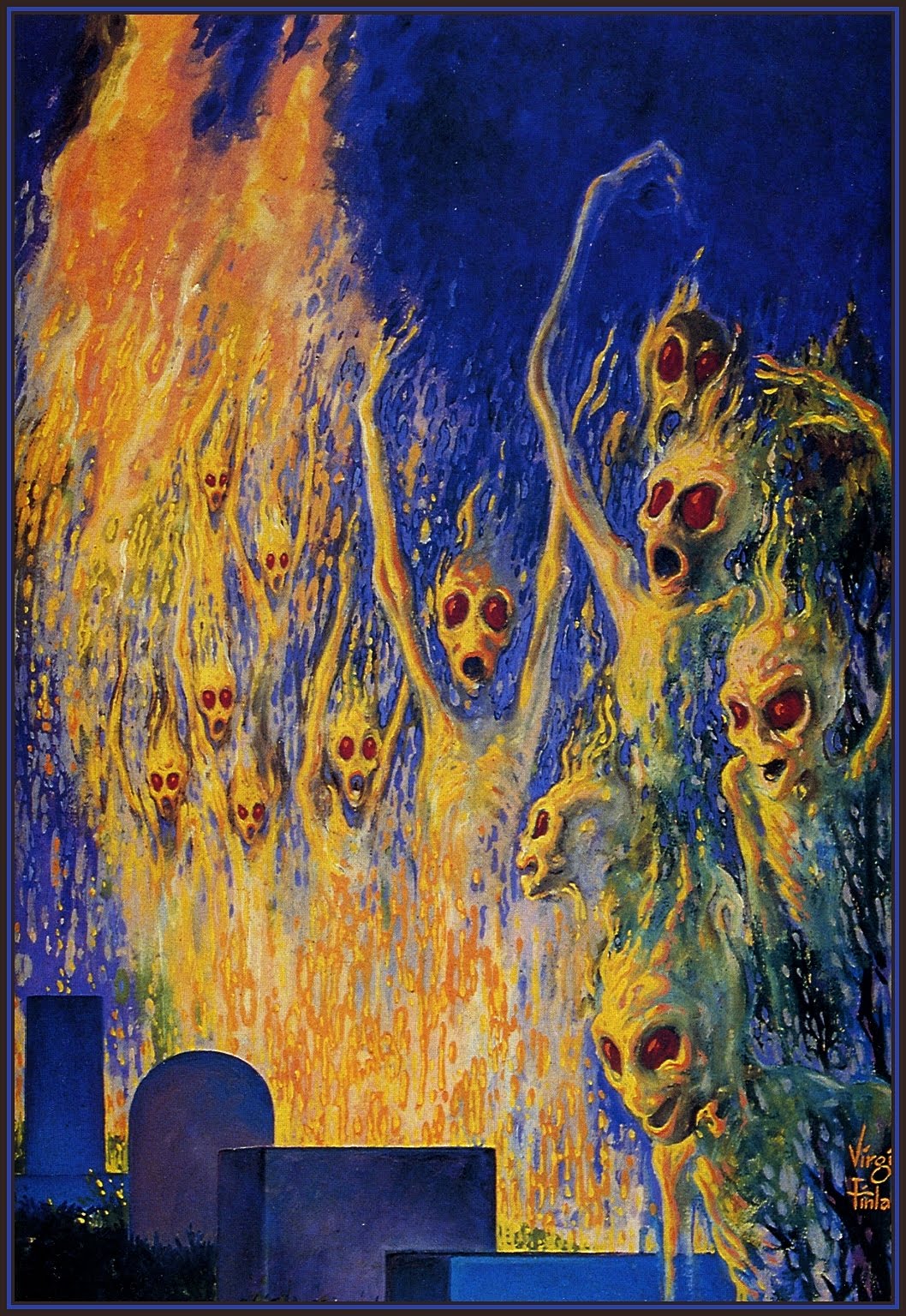
Image from Golden Age Comic Book Stories; by Virgil Finlay

Asphodel, First Circle of Hell

Rather than post some locations, I thought I’d post the draft for my description of the first circle of Hell, Asphodel.

Asphodel
The First Circle of Hell

Once one has crossed the Acheron, they see looming above them a wall greater and more hopeless than any other in the cosmos. Hell, you will remember, is a prison and the demons and devils within Hell prisoners. The walls are composed of impossibly thick stones, and thus for all intents and purposes impossible to bore through or knock down. The walls are also proof against ethereal creatures and the passwall spell. Within Hell, it is impossible to teleport or open dimension doors or gates to anywhere outside of the confines of Hell.

Hell’s ramparts from the outside are a sheer face of dark gray stone about 500 feet high. The battlements are not unlike those of a mortal fortification, being crenellated and manned by barbed devils. The walls are 80 feet wide at the bottom and about 40 feet wide at the top, providing ample space for the terrible bronze guns of Hell – massive cannon 30 feet long and 6 feet in diameter that launch exploding cannon balls that inflict 12d6 points of damage in a 10-ft radius, 9d6 in a radius from 11 to 30 feet, 6d6 in a radius from 31 to 60 feet, 3d6 points of damage in a radius from 61 to 90 feet and 1d6 points of damage in a radius from 91 to 120 feet. Folks within 60 feet of the impact must pass a saving throw or be permanently deafened. The cannon have a range of 600 feet and the shells can explode in mid-air at a range chosen by the firer. These shells leave massive craters, many of which are in evidence on the gray-green plains of Asphodel just beyond the walls.

The key point about the cannons is that they point inward, not outward. Likewise, the demons on the parapets do not resist people flying into Hell – only people trying to fly out. For those attempting an escape, assume that every mile of the wall is patrolled by 1d4 squads of barbed devils (i.e. 1d4 x 10 barbed devils) and one cannon. When one section of the wall is “attacked”, barbed devils from nearby sections quickly join the fight. Fortunately, the barbed devils that guard the walls of Hell are prisoners themselves, and thus cannot go beyond the walls to chase down escapees. The gods of Law and the masters of Hell use other resources to deal escaped shades.

Most escape attempts are aimed at the Hellmouth, or Gates of Hell. The gate is unimpressive on the exterior wall – an arched portal 40 feet tall and 25 feet wide barred by a portcullis that, like the walls, is proof against ethereal creatures. The bars are 6 inches thick and made of adamant, and thus quite difficult to bend. The 80 foot tunnel beyond the front portcullis has another adamant portcullis located every 20 feet. All of these are operated by barbed demons looking down from chambers constructed around the tunnel via arrow slits. Murder holes abound, through which the demons pour such things as molten lead, acid and boiling oil. Arrow slits located about 20 feet above the floor allow them to rain arrows on those who are attempting to force their way through.

On the interior wall of Hell, the gate is more heavily defended, situated as it is between two 500-ft tall towers pierced by numerous arrow slits. Each tower is manned by three companies of barbed devils. The terrible hound Cerberus stands guard just outside the inner portcullis.

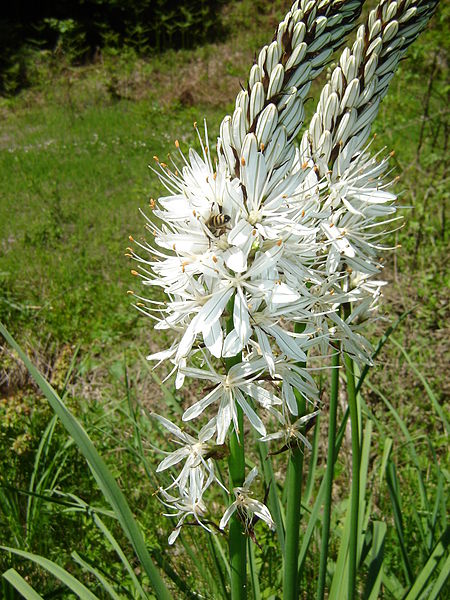
Beyond the walls of Hell, Asphodel is a wide-open, undulating savannah of long, gray-green grasses, thorny, twisted trees and tiny white flowers called asphodels, the circle’s namesake. The plains are roamed by a variety of demonic humanoids and animals in a sort of parody of Africa’s savannah. Many fortresses and even cities dot the savannah, where the lords and dukes of Hell hold court.

There is no Sun in Hell, of course, but the whole of Asphodel is swathed in a twilight gloaming, allowing creatures to see about 1 mile away, double for creatures with “darkvision”. The air of Asphodel is unnaturally still and almost suffocating in its stillness. There is no wind to move the grasses or bend the boughs of the prickly trees, and the range of wind-related magic on Asphodel is cut in half. Storms cannot be raised here nor lightning called.

Races of Asphodel
Asphodel, like most of the other circles of Hell, is not only inhabited by pitchfork-carrying devils and their victims. Four races known to people of the surface world dwell in Asphodel, though these races have been changed by their habitation in Hell.

Asphodelian Gnoll: The gnolls of Asphodel are tall and thin, with greenish hair spotted with black and glaring white eyes. They arm themselves with spears, ring armor and large, round shields. The Asphodelian gnoll utters an insane, demonic laughter while fighting, forcing people to pass a saving throw after three rounds of combat or become so unnerved that they suffer a -2 penalty to fight.

GNOLLS: HD 2; AC 4 [15]; Atk 1 bite (2d4) or weapon (1d10); Move 9; Save 16; CL/XP 3/60; Special: Unnerving laughter.

Asphodelian Goblin: The goblins of Asphodel have rear legs like those of a grasshopper. They have mottled blue skin and long fangs jutting down from behind their upper lips. These goblins carry spiked maces and wear leather armor. Their touch causes people to revert in age by one year unless they pass a saving throw.

GOBLINS: HD 1d6 hp; AC 5 [14]; Atk 1 weapon (1d6); Move 9; Save 18; CL/XP B/10; Special: -1 to hit in sunlight, touch de-ages people.

Asphodelian Halfling: Asphodelian halflings are willowy and relatively tall for their race. They have spidery arms and legs and droopy eyes, like those of opium eaters, on small heads with beetle-brows and pronounced overbites. The halflings are bald and have four gleaming white eyes spaced evenly around their heads, making it impossible to surprise them. They arm themselves with barbed nets and whips, dropping from trees to capture travelers.

HALFLINGS: HD 1d6 hp; AC 5 [14]; Atk 1 weapon (1d6); Move 9; Save 18; CL/XP B/10; Special: -1 to hit in sunlight, cannot be surprised.

Asphodelian Hobgoblin: Asphodelian hobgoblins are squat, apelike creatures always encased in black lacquered platemail and gripping their beloved axes and blunderbusses. They are deeply paranoid creatures, positive that everyone and everything is out to get them, and this makes them even more militant than usual for hobgoblins.

HOBGOBLINS: HD 2+2; AC 1 [18]; Atk 1 weapon (1d8+2); Move 9; Save 16; CL/XP 2/30; Special: Magic resistance (10%).

The Glooms – Caged Imps, Forlorn Golems and Shadowy Theatres

Three more from the Ante-Hell. Perdition awaits …

110.5. Imp-N-Cage: Somewhere in this hex of magma pools and basalt landforms, hanging from a chain beneath a natural land bridge that spans a flow of magma, there is an imp inside a cage constructed of logical fallacies. The cage is too convoluted for the imp, but perhaps a character with high intelligence could solve it. To simulate this, the Referee can prepare three riddles. If a player can answer all three of them, they succeed in freeing the imp, which will swear eternal loyalty (ha!) to its rescuer and even become their familiar if they are a magic-user. Each riddle that is answer incorrectly, however, costs the character one point of their intelligence score, permanently, as they find themselves trapped in logical fallacies. Of course, as difficult as answering the riddles is, the swarm of adamantine wasps that guards the bridge is even worse.

ADAMANTINE WASP SWARM: HD 15 (76 hp); AC 0 [19]; Atk 1 sting (3d6+poison); Move 5 (F14); Save 4; CL/XP; 16/3200; Special: Poison (harden into ice, 1d6 damage per round, shatter when dead), magic resistance (12%).

IMP: HD 2; AC 2 [17]; Atk 1 sting (1d4 + poison); Move 6 (F16); Save 16; CL/XP 6/400; Special: Poison tail, polymorph, regenerate, immune to fire.

110.29. Forlorn Golem: A stone golem sits on the banks of the Acheron, its feet in the black waters, chin on hands, elbows resting on knees. The golem was created by a mad wizard to besiege Hell, the wizard miscalculating the width and depth of the Acheron. Abandoning the concept, the wizard moved on and left his creation by the river to await new orders. He sits there to this day.

STONE GOLEM: HD 15 (60hp); AC 5 [14]; Atk 1 fist (3d8); Move 6; Save 3; CL/XP 16/3200; Special: +1 or better magic weapon to hit, immune to most magic.

118.51. Natural Amphitheatre: There is a natural amphitheater located in this hex. The amphitheater has been accentuated with seating carved into the reddish-brown rock. Against the back of the amphitheater there is what appears to be a bas-relief (deep relief) of a warrior in Greek armor, spear and shield in hand. He appears to be fighting, with his back against the wall. The statue is actually a warrior who was turned to stone while fighting the guardians of this shrine, for the amphitheater is a shrine dedicated to the Tenebrae, the daughters of Nyx and Eerebus. It is guarded by eight sisters, medusas with black-bronze skin and cool, green eyes. Each of these medusas, as a priestess of the Tenebrae, can cast three cleric spells, one of first, second and third level, each.

The statue is still inhabited by the warrior’s spirit, now an ethereal shade. The shade appears when people walk on the “stage” and attempts to force a female adventurer touch his statue body. Doing this releases him from the curse, in which case the restored warrior can introduce himself as Damali, a crusader from ancient days. Damali is a 10th level paladin.

ETHEREAL SHADE: HD 8; AC 1 [18]; Atk Icy touch (2d6) or special ability; Move 9; Save 8; CL/XP 10/1400; Special: Hard to see, immune to non-magic weapons, befuddlement.

Image from HERE.