En Garde: The Duelist

When I dove into the Blood and Treasure project, I had two goals in mind. First and foremost, make it as rules light as possible so that the game is compatible with old school games – that also means reining in some of the power creep that was present in the 3rd edition. Second – use as much of the material in the SRD as humanly possible. Now, sometimes the first goal precludes the second. Some spells – primarily the “mass” spells were, in my opinion, part of the power creep issue. If such a spell wasn’t in an older version of the rules, it didn’t make it into Blood and Treasure. Other spells and feats played off of rules or minutia that I ejected, so they didn’t quite make it in. In all, I retained 95% of the spells, all of the monsters and probably 95% of the magic items.

One thing that didn’t make it in, however, were prestige classes. Initially, I wanted to find a way to use them. The concept isn’t as new school as some folks might thing. The paladin was originally open only to mid-level fighters of lawful alignment – i.e. a prestige class, and the bard that made it into AD-n-D was largely the same. The problem, though, was one of special abilities. So many of the special abilities of the prestige classes just no longer worked in the rules lite environment, and of course many of the prestige classes in the SRD were just patches to get around the fact that multi-classing in the d20 rules did not work properly for spellcasters.

Still, I’m a scavenger at heart, so I was determined to get something out of those prestige classes. The assassin was already slated to become a full class in Blood and Treasure, and looking at the other classes, I saw another that I thought had the makings of full class-hood – the Duelist. Truth be told, I’ve long been a fan of the duelist concept, starting from the first time I watched Cyrano de Bergerac in a freshman English class. So, without further ado, I present the Duelist in “rough draft” form – some changes may occur before it’s official.

DUELIST
Duelists are warriors who learn to fight using trickery, fancy swordplay and quick reflexes rather than armor and shields. Duelists may be swashbuckling rogues or serious and studious masters of fence.

Requirements: Duelists must have dexterity and intelligence scores of 13 or higher.

Hit Dice: d8 (+3 hit points per level from 10th to 20th).

Armor: Leather armor.

Shield: No.

Weapons: Any.

Skills: Balancing and jumping (see Heroic Tasks below).

CLASS FEATURES
A duelist adds her intelligence bonus (if any) as well as her dexterity bonus to her Armor Class while wielding a melee weapon.

Duelists can make special attacks with a +2 bonus to their attack roll.

When fighting defensively, a duelist enjoys a +4 bonus to Armor Class instead of the normal +2 bonus.

At 4th level (romantic), a duelist gains a +2 bonus on initiative rolls.

At 8th level (avenger), a duelist gains an additional +2 bonus on all reflex saving throws and on will saving throws against fear.

At 9th level (duelist), a duelist can choose to establish a stronghold in the wilderness and gain followers (see High Level Play below). A duelist who becomes a lord or lady attracts 1d6 men-at-arms per level, 1d6 first level duelists who wish to train under them and one 3rd level duelist to serve as a lieutenant. These duelists should be generated as characters under control of the player.

At 10th level (duelist), a duelist gains the ability to strike precisely with a one-handed piercing weapon, such as a rapier or dagger, doing double damage on a successful hit. The precise strike can only be attempted in the round after the duelist’s opponent has missed with one of their own attacks. When making a precise strike, a duelist cannot attack with a weapon in his other hand or use a shield. A duelist’s precise strike only works against living creatures with discernible anatomies. At 20th level, the extra damage on a precise strike increases to triple.

At 14th level (duelist), if a duelist chooses to fight defensively, one successful attack against him each round must be re-rolled.

At 18th level (duelist), a duelist using a one-handed piercing weapon may deflect one successful ranged attack per round.

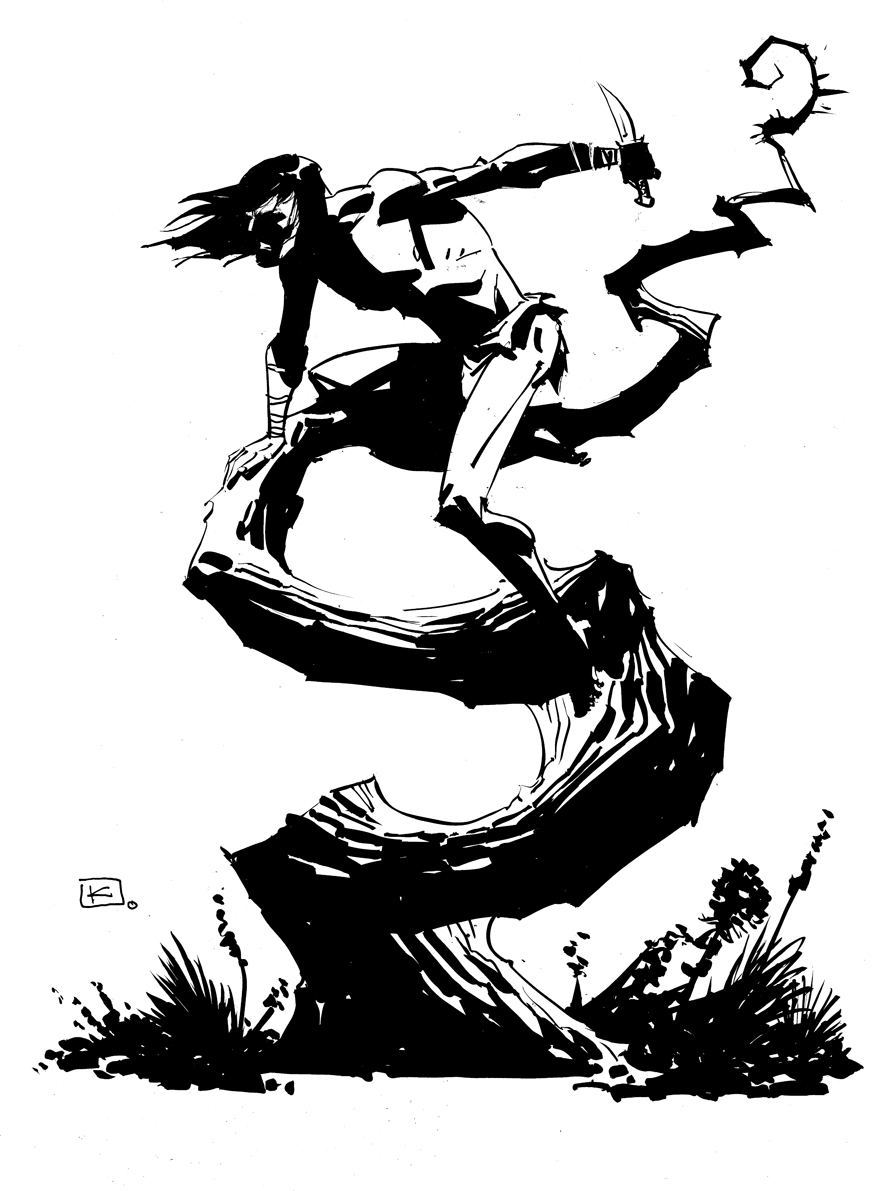
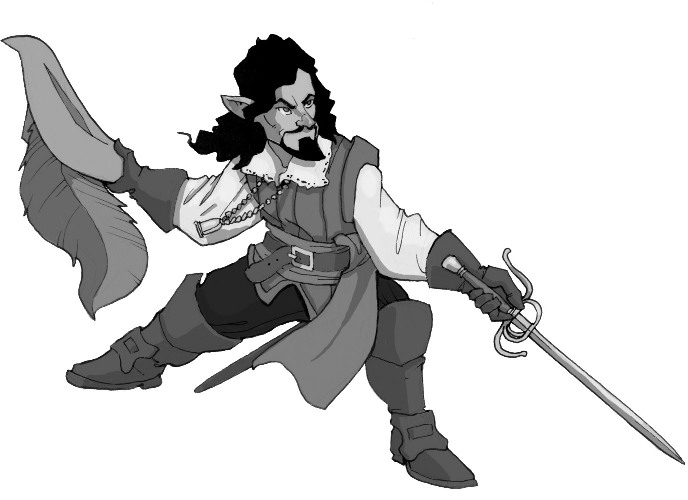
Illustration of a gnome duelist by Jon Kaufman.

The Beastmaster

The beastmaster is a human or humanoid raised in the wild by animals. Perhaps the earliest beastmaster in literature was Enkidu, the wild man encountered by the mythic hero Gilgamesh. Romulus and Remus, the legendary brothers responsible for founding the city of Rome, are raised by a she-wolf, though there are no accounts of them having acquired extraordinary abilities.

The earliest beastmaster in modern literature is likely Mowgli, the jungle boy of Rudyard Kipling’s Jungle Book, first published in the story “In the Rukh” in 1893. Mowgli is raised by wolves after becoming lost in the jungle as an infant. Because of this upbringing, Mowgli learns the language of animals. Mowgli also has a loyal animal friend, Bagheera the black panther.

A female beastmaster appeared in 1904 in the form of Rima the Bird Girl in W. H. Hudson’s novel Green Mansions: A Romance of the Tropical Forest. Rima lived in South America, and was feared by the natives for her “magical” powers, which included talking to the birds, befriending animals and plucking poisoned darts from mid-air. Unfortunately, Rima’s story ends in tragedy, as she was burned alive by the native tribesmen.

In 1912, Edgar Rice Burroughs created the most famous beast-master in literature in Tarzan of the Apes. Tarzan was a child raised in the African jungles by intelligent great apes called Mangani. In the wake of Tarzan’s popularity came a wave of books, comic books, movies, radio shows and television shows starring the “Lord of the Apes”. This lead to dozens of imitators, from Bomba the Jungle Boy to Marvel’s Ka-Zar.

From Mowgli, Rima, Tarzan and their many imitators, we can sketch out the special abilities of the beastmaster archetype. He or she must be a person raised since infancy or childhood by animals in the wilderness. The beastmaster’s feral childhood gives them a number of special abilities, but also makes them an outside in the society of human beings.

Prime Attribute: Constitution
Hit Dice: 1d6+3 (+4 hit points per level after 9th)
Armor Permitted: Shields, no armor.
Weapons Permitted: Any
Attack: As fighting-man
Save: As fighting-man

Beastmaster Class Abilities
Beastmasters cannot speak anything but the language of animals at 1st level. They can pick up a few words of common by 2nd and speak it haltingly by 3rd level.

The beastmaster can move as silently as a panther in the wilderness. This means he surprises his enemies more often than normal men. His own senses, made keen by a life in the wild, mean he is surprised less often than normal men.

The beastmaster can camouflage himself in the foliage to the point of becoming virtually invisible if he does not move.

Beastmasters are skilled trackers. When attempting to follow tracks, they can make a saving throw to avoid losing the trail.

The beastmaster is as swift as the animals who raised him. He increases his speed by +3. An unarmored and unencumbered beastmaster therefore has a speed of 15 rather than 12.
Since they are used to fighting without the benefit of armor, beastmasters develop a fluid, mobile fighting style that grants them a flat -2 [+2] adjustment to their Armor Class.

Beastmasters can banish or control animals (but not monsters) the same way a cleric can banish or command the undead. The beastmaster rolls using the same table. For beastmasters, a result of “D” indicates that the animals are forced into his command for a period of 24 hours.

A 1st level beastmaster can choose to have one animal with no more than 1 HD into his loyal animal companion. The animal friend will only accompany the beastmaster if it is treated like a friend. More powerful animal friends can be acquired at higher levels; an animal of 2-5 HD can be chosen at 6th and an animal of 6-10 HD can be chosen at 12th level.

Sample Beastmasters

W. H. Hudson’s RIMA the Bird Girl

Rima lives in the tropical forests of Guyana. Rima is the daughter of woman who could also speak the secret language of the birds. Rima’s people, it is revealed, were a pacifistic, vegetarian tribe who were wiped out by native tribesmen and plague. Rima is herself hated by the tribesmen who know of her, for they fear her unnatural abilities.

Human Beastmaster Lvl 3
Str 13, Int 9, Wis 15, Con 13, Dex 13, Cha 11
HP 23; AC 6 [13]

Unlike Mowgli and Tarzan, Rima is not portrayed as a warrior. She is a slight girl with dark hair who wears a smock made from spider webs.
Rudyard Kipling’s MOWGLI, “Little Frog”

Mowgli is a young man from India who was raised from infancy by a pack of wolves. Mowgli’s many adventures include his killing of Shere Khan the tiger and his rescue of the civilized couple who adopted him, his discovery of a great treasure in a ruined temple (and his discovery of what men will do to one another to claim such a treasure) and his leading of the wolves in their war against the dholes.

Human Beastmaster Lvl 6
Str 13, Int 10, Wis 12, Con 13, Dex 16, Cha 10
HP 46; AC 6 [13]

Mowgli fights using his “tooth”, a long knife that deals 1d4 points of damage. His high strength grants him a +1 bonus to hit and damage in combat. Mowgli’s boon companion is a black panther named Bagheera (HD 3, 18 hp, treat as a leopard).
Edgar Rice Burrough’s TARZAN, Lord of the Apes

Tarzan is actually John Clayton, Lord Greystoke. As an infant, his family was stranded on the West coast of Africa by mutineers. He is raised by a tribe of intelligent great apes after his mother died of natural causes and his father is killed by the leader of the apes. Over the course of his adventures, Tarzan marries an Englishwoman named Jane Porter, fights Germans, explores lost cities and even delves into the subterranean world of Pellucidar.

Human Beastmaster Lvl 12
Str 16, Int 14, Wis 13, Con 15, Dex 15, Cha 14
HP 85; AC 6 [13]

Although he can pass in civilization, Tarzan prefers his life in the jungle. He usually carries a knife into combat. Tarzan is often accompanied by his faithful Waziri warriors and Jad-bal-ja, the Golden Lion (HD 5+2, 32 hp).

Image by Andy Kuhn. He draws comics.

Cyclopeans – Playable Race for PARS FORTUNA

Having watched Krull over the weekend – a dandy fantasy movie, in my opinion – I was inspired to do something inspired by the cyclops in that movie. The cyclopean is designed for PARS FORTUNA, but should be readily usable in other old school-style games …

CYCLOPEAN (ARIMASPIAN)
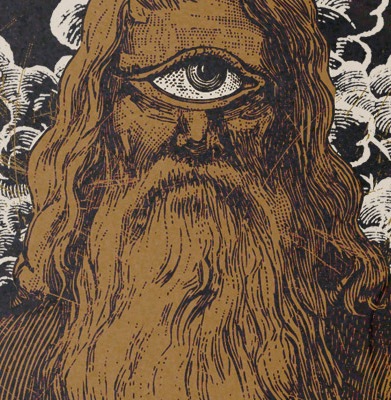
The Cyclopeans are tall, rugged humanoids with a single, large eye located in the center of their face. Cyclopeans have skin tones that range from the color of aged parchment to a rich, glossy umber. Their hair is usually worn long and shaggy, and is always blue-black in youth and adulthood, turning white as a Cyclopean enters his or her later years. The Cyclopeans eye might be any color in the spectrum, with amber and blue being the most common colors, and mauve and mottled green/brown being the rarest.

A warlike people, the Cyclopeans nonetheless have a philosophical side – probably an artifact of their unique ability to see into the future. Born fatalists, they know well the curse that accompanies their power, and take care to only pierce the veil of time when their lives, or the lives of their loved ones, depend on it. Most Cyclopeans dwell in the wilds or on the fringes of civilization, making a living as trappers, hunters and bandits. They have a passion for fighting, but lack the organization of the Oraenca or their flair of the Ilel. Cyclopeans like to rush into battle, casting their military forks and then drawing their hand weapons to close with the enemy. Cyclopean warriors usually wear light or medium armor and carry shields, military forks and broadswords. They might also carry slings and knives.

Cyclopeans see in the Skathra kindred spirits, both for their wild ways and their divinatory powers. They respect the Bo’al, Oraenca and Olvugai as worthy warriors, and though they fear the deadliness of the Ilel, they can’t quite bring themselves to respect them.

Cyclopean names are short and to the point, and are usually followed with a wad of spittle if the name is despised or a clang of the fork on the ground if revered. Common names include Bach, Brel, Cert, Oban, Tohr and Venn for males and Azra, Jula, Kento, Mala and Trena for females.

Cyclopeans adventure for money, fame and a love of action. Cyclopeans like to stay on the move and stay in the action, for it helps to keep their fatalistic moods at bay.

Racial Abilities
All cyclopeans have the following special rules:

1. Cyclopeans have poor depth perception and peripheral vision. All opponents are treated as though they have a knack for surprising them. Cyclopeans suffer a -1 penalty to hit with ranged attacks, except when using their military forks, with which they train from childhood.

2. Cyclopeans have a knack for wilderness survival and reading people’s faces. This helps them discover falsehoods and guess at intentions.

3. No more than once per day, a Cyclopean can peer into the future. They will either glimpse a moment of Weal or a moment of Woe (50:50 chance). The moment glimpsed will be connected to their current endeavors or goals, and can be described with as much or as little detail as the Referee thinks appropriate. A Cyclopean might, for example, glimpse himself or a friend opening a door and being struck dead by a trap, or looking behind a curtain and discovering a secret door. Perhaps the door or curtain is unique and the Cyclopean will easily recognize it when they come to it – perhaps not. Perhaps the Cyclopean will never come across the possible future they have glimpsed. In general, this power acts as a free “clue” to something in the Cyclopean’s current adventure.

4. Whenever a Cyclopean glimpses the future, they hasten their own demise. For the next 24 hours, the Cyclopean suffers a -2 penalty to saving throws made to avoid death, damage or danger.

Class Abilities
Cyclopeans have the following class abilities:

Prime Requisite: Constitution (+5% bonus to earned XP if 13+)
Hit Dice: 1d6+2 (or 1d10), +2 hp per level after 9th
Saving Throws: As warrior
Attack Bonuses: As warrior
Restrictions: Cyclopeans can use any weapon, light and medium armor and shields.
XP Advancement: As the Oraenca

Cyclopean characters turn their racial knack for reading faces into a skill.

Cyclopeans can go berserker once per day. This berserkergang can only be entered once they have suffered damage in battle or once they have inflicted damage in battle. Once the berserker state is entered, the Cyclopean remains in it for a number of rounds equal to their Constitution divided by 3. They cannot exit the berserker state prematurely without passing a saving throw, and will attack anything in reach while under its spell. While berserk, a Cyclopean gets two melee attacks per round and inflicts +1 damage with melee attacks, but suffers a -2 penalty to Armor Class. A Cyclopean suffers from exhaustion for a number of hours equal to the rounds of combat they spent while berserk unless they spend a full turn after the battle resting.

Picture nabbed from HERE

Retro-Engineering: Darkness and Dread

In the annals of the old school wave that hit the d20 system in the 2000’s, Darkness & Dread from Fantasy Flight Games is generally, and unfairly, overlooked. Ostensibly, Darkness & Dread was intended as a tool box for running dark fantasy, horror-style games with the d20 rules. In fact, it plays very much like a weird love child of old D&D and Warhammer Fantasy Roleplay, with d20 serving as a surrogate mother.

This is most obvious in the classes – all 24 of them. All of the classes have either five or ten level, and all can be entered into after first level (remember, in d20 you don’t gain levels in a class, you just gain levels, choosing to take that level in whatever class you like) only if one has a requisite number of points in a given skill – a nod to WFRP’s career system. Moreover, they divide the careers into categories (Academic, Expert, Laborer and Orator) and have an optional rule that permits one to randomly determine their profession at 1st level – another nod to WFRP. Like old school D&D, the classes are much lower powered than their d20 equivalents. The spell casting classes (Acolyte, Alchemist, Apprentice and Herbalist), for example, never make it past 4th level spells (the apprentice). The game also suggests that treasure be doled out at 10% the normal level (i.e. fewer magic items – and in d20, you get loaded down with magic items). Most of the classes depend on the skill point system in d20, so don’t necessarily translate well into older editions that tend to hand-wave skills and ignore professional and craft skills. A few make for nice additions to a low-powered game, or interesting variations on the old standbys.

Acolyte (Academic)
Within a religious hierarchy, the acolyte is an administrator, a priest assigned to a small village, or a similar minor underling.

Prime Requisite: Wisdom and Charisma, 13+ earns +15% experience
Hit Dice: 1d6
Armor Permitted: Leather
Weapons Permitted: Club, dagger, staff, light and heavy crossbow
Attack As: Cleric
Starting Gold: 1d4 x 10 gp
Entry Requirements: To take levels in acolyte after 1st level, one must gain the sponsorship of a religious organization and complete training in its basic tenets.

Special Abilities
Acolytes gain access to a small number of divine spells. Acolytes prepare and cast spells as clerics. They can select spells from the following list:

Level 0: Detect magic, detect poison, light, purify food & drink
Level 1: Cause fear*, cure light wounds*, detect evil
Level 2: Bless, find traps, hold person, speak with animals
Level 3: Continual light, cure disease*, darkness, prayer

* Denotes a reversible spell

Ward the Unholy: Acolytes can call on their god to hold supernatural creatures at bay. This divine blessings grants the acolyte and her allies a +1 bonus to AC and a +1 bonus to saving throws against magic and mind effects. To use this ability, the acolyte must have 5 gp worth of incense, holy water, and other religious paraphernalia at hand. These items are consumed when the acolyte uses this ability. The acolyte can do this once per day at 1st level, gaining an additional use at 3rd, 6th and 9th levels.

Tend to the Flock: At 5th level, an acolytes time spent dealing with the people in his parish makes him skilled at managing large crowds and leading mobs of commoners and other folk who adhere to his faith. By chanting prayers and benedictions, the acolyte can calm others and steady their nerves. All allies within 60 feet of the acolyte who are 3 or more levels below the acolyte’s total level gain a +2 bonus to save vs. fear and a +1 bonus to hit in combat. The acolyte can use this ability twice per day, and each use lasts for 5 rounds + the acolyte’s Charisma modifier.

Strength of the Faithful: At 10th level, the acolyte is perhaps one of the most accomplished members of his church hierarchy. His faith is unshakable in the face of the horrors that lurk just beyond the knowledge of mortal men. He gains a +2 bonus to saving throws against fear. In addition, once per day he can choose to automatically succeed at a single save against fear.


        Spells
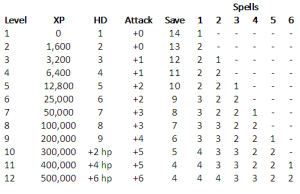
Level XP HD Save 0 1 2 3
1 0 1 15 1
2 1,000 2 14 1
3 2,000 3 13 1 1
4 4,000 4 12 2 1
5 8,000 5 11 2 1 1
6 16,000 6 10 2 2 1
7 32,000 7 9 3 2 1 1
8 64,000 8 8 3 2 2 1
9 100,000 9 7 3 3 2 1
10 140,000 10 6 4 3 2 2

Prospector (Expert)
Prospectors seek out veins of gold and other precious metals, but many of them also delve into forgotten ruins in search of lost treasures and valuable relics from an earlier era.

Prime Requisite: Dexterity & Intelligence, 13+ earns +15% experience
Hit Dice: 1d8 (or 1d6+1 if you prefer)
Armor Permitted: Leather
Weapons Permitted: Club, dagger, dart, javelin, mace, morningstar, sling, spear, staff, light and heavy crossbow
Attack As: Thief
Starting Gold: 2d4 x 10 gp
Entry Requirements: To take levels in prospector after 1st level, one must already have the ability to search for and disable traps.

Special Abilities

Skills: Prospectors can use the following skills as a thief (using whatever rules you prefer for thieves): Climb Walls, Find & Remove Traps and Open Locks. They are also capable of appraising the value of metals and stones and they can survive in the wilderness.

Trap Mastery: Prospectors are experts at setting traps and concealing pits. Damage from these traps depends on the prospector’s level, with traps doing 1d6 damage at 1st level, 1d8 damage at 2nd level, 2d6 damage at 3rd level, 3d6 damage at 4th level and 4d6 damage at 5th level.

Oiled Reflexes: If a 3rd level prospector is about to set off a trap due to a failed attempt at removing it, he can immediately make a second remove traps attempt to keep it from triggering. If this second attempt fails, the trap is triggered. If it succeeds, the trap is not removed, but does fail to trigger.

Danger Sense: 5th level prospector’s can re-roll failed saving throws against traps once per day, or twice per day if their intelligence score is 13 or greater.


Level XP HD Save
1 0 1 14
2 1,000 2 13
3 2,000 3 12
4 4,000 4 11
5 8,000 5 10

Pit Fighter (Laborer)
Pit fighters are down-and-dirty gladiators who fight for money, fame and glory.

Prime Requisite: Strength & Dexterity, 13+ earns +15% experience
Hit Dice: 1d10 (or 1d6+2 if you prefer)

Armor Permitted: Leather and shield
Weapons Permitted: Any weapon
Attack As: Fighting-Man
Starting Gold: 2d4 x 10 gp
Entry Requirements: To take levels in pit fighter after 1st level, one must already have an attack bonus of at least +1 and must train as a gladiator for 1 month.

Special Abilities

Frenzy: Once per day, a pit fighter can enter a berserk fury for 5 rounds + the pit fighter’s constitution bonus. During the frenzy the pit fighter gains a +1 bonus to hit and damage, +1 hp/level, +2 on all saves against fear and a -2 penalty to AC. When the frenzy ends, the penalty to AC continues until the encounter is over.

Dirty Fighter: Pit fighters do whatever it takes to overcome their enemies. If a pit fighter of 3rd level or higher attacks from the rear or attacks an opponent who is surprised or flanked by an ally, he does double damage.

Fearless Frenzy: At 5th level, pit fighters gain a second use of frenzy each day and are completely immune to fear.

Level XP HD Save
1 0 1 14
2 1,000 2 13
3 2,000 3 12
4 4,000 4 11
5 8,000 5 10

Medium (Orator)
Mediums are those rare, special individuals who have the ability to pierce the psychic veil, using ESP, object reading and other talents.

Prime Requisite: Wisdom & Charisma, 13+ earns +15% experience
Hit Dice: 1d6

Armor Permitted: None

Weapons Permitted: Club, dagger, staff, light and heavy crossbow

Attack As: Magic-User
Starting Gold: 1d6 x 10 gp
Entry Requirements: To take levels in medium after 1st level, one must already have a wisdom score of 13 or higher and must have failed a saving throw vs. fear from some supernatural creature.

Special Abilities

Skills: Mediums can pick pockets as well as a thief of equal level. In addition, they receive a +1 bonus to reaction checks when speaking for their party and collect double the normal number of rumors.

Sense the Unseen: With quiet study and meditation, mediums can read the emotional background of a specific area, such as a room, a forest clearing or a short section of road. By studying the area for a peaceful hour, the medium can learn if a traumatic event took place there by making a successful saving throw with a -2 penalty per year since an event took place. If the medium doesn’t know about a particular event, she can use this method to learn of the last traumatic event that took place there. If the saving throw is successful by more than 3 points, the medium gains a hazy, incomplete mental picture of the event. If she beats the saving throw by 6 or more points, she gains a perfect mental picture of the event, but will suffer any fear effects associated with the event. This power can also be used to read a specific object, like a dagger or article of clothing.

Sixth Sense: At 3rd level, a medium can make a saving throw to detect any supernatural or undead creature that comes within 100 feet of him. If the check succeeds, he senses the creature’s general location. The power of the sensation depends on the Hit Dice of the creature detected: It is faint for creatures with 1-3 HD, disturbing for creatures to 4-8 HD, powerful for creatures with 9-12 HD and overwhelming for creatures with 13+ HD.

Pierce the Veil: A 5th level medium can cast her sight into the land of the dead. She may cast speak with dead once per day.

Level XP HD Save
1 0 1 15
2 1,000 2 14
3 2,000 3 13
4 4,000 4 12
5 8,000 5 11

Other excellent mini-classes include the antiquarian, engineer, physician, sage, artisan, kennelmaster, merchant, thief, tracker, grave robber, sewerjack, veteran, worker, beggar, gambler, grifter and minstrel. One immediately recognizes some old class titles from old D&D.

Darkness & Dread, written by Mike Mearls, has many more excellent ideas that I’ll cover in future editions of Retro-Engineering. In the meantime, if you’re heading into Middenheim or considering sending your players into Hammer Film territory, check Amazon for a copy – the book is pretty easily adapted to older editions of the rules.

PARS FORTUNA Discount and the Zwunkers

I present the Zwunker from the aforementioned PARS FORTUNA as a playable race.

Zwunkers (Sea Dogs)

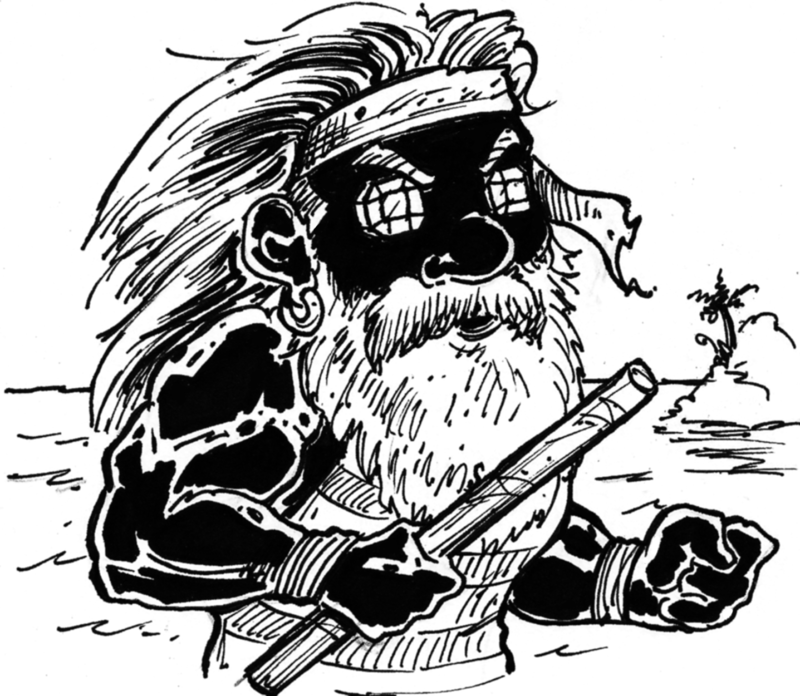
Zwunkers are black-skinned dwarves with long manes of gold hair. Their eyes are faceted and resemble yellow diamonds.Zwunkers stand anywhere from 3 to 4 feet tall, and they are heavier than they look. Zwunkers are usually found working as sailors or hired muscle, so they tend to dress simply and prefer to let their arms be bare to show off their mighty thews.

In the PARS FORTUNA setting, Zwunkers seemingly have no home. Most ports have an itinerant population of the little buggers working as sailors, bodyguards, thugs or laborers. Zwunkers like to move around, and in fact often need to move around to stay ahead of the trouble they get into. When they do settle down, it is usually to dwell in caves overlooking the sea. These caves are decorated with flotsam and jetsam and all the bric-a-brac you would expect a person to collect in the course of dozens of sea voyages.

Zwunkers are wanderers and, often, troublemakers. They enjoy stirring things up and seeing what happens – introducing a little chaos into otherwise staid and steady lives. Although not overly fond of alcohol, they are downright obsessive over gambling and wagering, and most of the trouble they get into starts as a dare-turned-wager. Zwunkers are hard, diligent workers, taking great pride in out-working other folk. This makes them popular with Oraenca. Their disregard for authority makes them popular with the Kyssai. Most other races see them as a nuisance.

Zwunker adventurers aren’t much different from normal zwunkers – they like to see new things, annoy new people, walk further, climb higher, etc. Many Zwunker adventurers got their start when somebody bet them they wouldn’t climb into a hill or plunder a tomb.

Zwunker names are little more than nicknames. They are usually monosyllabic – names like Zurk, Yan or Gord for males and Tua, Offa or Zee for females.

RACIAL ABILITIES
Zwunkers have a knack for seamanship, including navigation (even away from the sea – they have an excellent sense of direction), climbing and swimming. Zwunkers are also very anti-magical in nature, receiving a +1 bonus to save vs. magic, and actually creating a zone of magical interference within 30 feet that creates a 5% chance of spells cast in that zone or into that zone going awry and not working.

CLASS ABILITIES

Prime Requisite: Constitution, 13+ (5% experience)

Hit Dice: 1d6+1 (+2 hp per level after 9th level)

Armor Restrictions: Zwunkers can wear light and medium armor and use shields.

Weapon Restrictions: Zwunkers can use any weapon except two-handed swords and pole arms.

Special Abilities: A Zwunker character’s anti-magic zone increases in power as they increase in level, adding a 1% chance per level of spells going awry (i.e. a 1st level zwunker’s zone has a 6% chance of ruining spells, while a 10th level Zwunker’s zone has a 15% chance of doing so). Once per day, a zwunker can control winds (and only winds) per the spell Control Weather. A 10th level Zwunker gains the ability to use the Control Weather spell, as written, once per day. Finally, Zwunker characters are skilled at climbing, navigating and other nautical tasks.

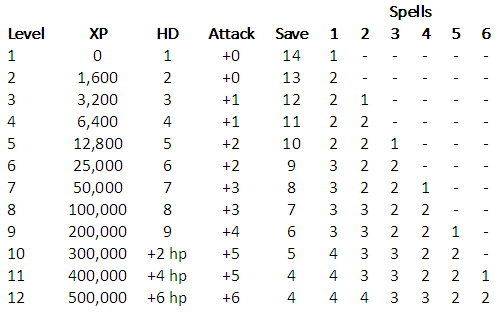
Zwunker Advancement

Level Experience Hit Dice Hit Bonus Saving Throw
1 0 1 +0 15
2 2,000 2 +0 14
3 4,000 3 +1 13
4 8,000 4 +1 12
5 16,000 5 +2 11
6 32,000 6 +3 10
7 64,000 7 +3 9
8 128,000 8 +4 8
9 256,000 9 +5 7
10 350,000 +2 hp +5 6
11 450,000 +4 hp +6 5
12 550,000 +6 hp +7 4


New Class for Thanksgiving: The Puritan

A while back, I got it into my head to design classes based on characters from fiction, since there are indications that AD&D rangers are really just Aragorns (why else can a woodsman specifically use crystal balls?) and the barbarian class owed a bit to everybody’s favorite Cimmerian. Thus were born the Beastmaster (to be published one day), the She Devil (again, you’ll have to wait) and today’s blog post, the Puritan. The Puritan can be regarded as a darker alternative to the Paladin (the turkey leg to the paladin’s turkey breast, so to speak). Enjoy – and HAPPY THANKSGIVING!

Historically, the puritans were an English religious sect that operated in the 16th and 17th centuries. The terms “puritan” and “preciseman” were coined as insults; the people called themselves “the godly”. The puritans, by and large, were interested in returning Christian worship to what they believed was a purer form. In general, this involved problems they had with the trappings and rituals of the Catholic Church and its progeny, the Anglican Church. In England and the United States, puritans are often associated with strict moral guidelines, religious zealotry and witch hunts.

Religious reformers offer little grist for the mill when creating a new character class, unless Robert E. Howard enters the picture. In 1928, Howard introduced Solomon Kane in a story entitled “Red Shadows”.

Solomon Kane is an English puritan who leaves his country to adventure. As with many adventure-oriented characters of the time period, very little time is dedicated to Solomon Kane’s history, although the poem “Solomon Kane’s Homecoming”, we learn that he lost his love, Bess, at some point before he became an adventurer. During the course of his adventures, Kane battled brigands, sorcerers, pirates, vampires and slave-traders. Most of his adventures take place in Europe and Africa.

Prime Attribute: Wisdom (13+ for 5% XP bonus)

Hit Dice: 1d6+2/level (Gains 2 hp/level after 10th)

Armor Permitted: Leather, ring armor, buckler.

Weapons Permitted: Any.

Puritan Class Abilities
Puritans have a +2 bonus on saving throws made against fear and its effects. In addition, they have a +2 bonus on saving throws made against the spells and magical effects of creatures of chaos or evil.

Puritans enjoy a +1 bonus to hit and damage creatures of chaos or evil. Moreover, their weapons are capable of damaging creatures normally only damaged by magical or silver weapons.

When a puritan turns his gaze on a creature for at least one minute, he can determine that creature’s alignment. This cold stare is unnerving to those of a chaotic or evil disposition, forcing them to succeed at a saving throw or hurry away.

A puritan’s devotion to the gods of law grants him the ability to turn undead, as a cleric, but at a -2 penalty. In addition, he can call down one minor miracle (i.e. level one cleric spell) each day simply by grasping a holy symbol or book and invoking the name of his Creator. The puritan does not have to memorize or prepare this spell in advance. At every odd level, the puritan gains the ability to call down one additional level one cleric spell, thus two at third level, three at fifth, four at seventh, and so on.

Level
Experience
Hit Dice
Attack
Save
Title
1
0
1
+0
15
Confessor
2
2,200
2
+0
14
Penitent
3
4,400
3
+1
13
Pilgrim
4
8,800
4
+2
12
Preciseman
5
17,000
5
+2
11
Firebrand
6
35,000
6
+3
10
Hexenhammer
7
70,000
7
+4
9
Shepherd
8
140,000
8
+5
8
Zealot
9
280,000
9
+6
7
Puritan
10
380,000
+2
+7
6
Puritan
11
480,000
+4
+7
5
Puritan
12
580,000
+6
+8
5
Puritan

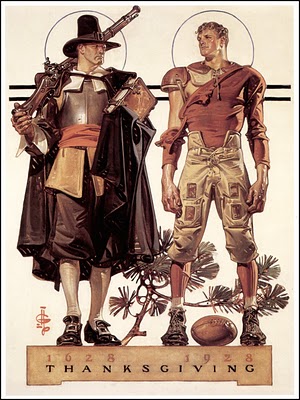
Image: Puritan Jemuel Landes regards traveler “Steel” Sullivan with some suspicion – he claims to be a “football” star from the land of Cleve, but he’s probably a witch. Art by J. C. Leyendecker via Golden Age Comic Book Stories.

The Traveler

An astounding array of creatures passes through the Land of Nod, from elves to native-born humans to  ambulatory fungi and floating brains. But among the more interesting are the so-called Travelers. Travelers are human beings, often from our own waking world, who navigate the Land of Nod with the power of their dreaming mind. Although seemingly awake and aware, all travelers actually exist in a state of semi-consciousness, living out their fancies thanks to the shaky fabric of reality that makes up the nonsensical tapestry called Nod. Travelers are adventurers first and foremost, with a thirst for new and strange vistas. Travelers are imaginative and creative and often impulsive, for they are used to reality shifting to please them and sometimes taken back when events do not comply with their wishes.

PRIME REQUISITES: Charisma and Wisdom
 
HIT DICE: 1d6+1 (+2 hit points per level after 9th)
 
WEAPONS PERMITTED: Any.
 
ARMOR PERMITTED: Leather, ring, chainmail, shields.
 
FOCUS: To use his special abilities, a traveler must possess a focus object and must be holding it in his hand. To use his abilities, the traveler must activate them with a successful saving throw. He must then remain in a somewhat calm reverie; emotional and physical disruptions can stop the traveler in his tracks and necessitate further saving throws to maintain the reverie.
 
From 1st to 4th level, a traveler can impose his will upon his immediate surroundings. To use these abilities, he must be grasping a walking stick with a silver tip. Such a stick can be obtained for 30 gp, and can be used as a club in combat.
 
From 5th to 8th level, a traveler can use his powers to explore on a global scale. To use abilities gained from 4th to 6th level, the traveler must possess a golden compass. Such a compass can be constructed by an expert jeweler at a cost of 500 gp.
 
From 9th on, the traveler learns to pierce the veil of time itself. In order to use his new abilities, he must possess a pocket watch made of gold and studded with diamonds. Such a device can be constructed by an expert jeweler at a cost of 3,000 gp.
 
Creatures wishing to accompany the traveler on his extra-dimensional trips must take care. The traveler can travel with one person per two levels. These hangers-on must keep their eyes closed tight while traveling or go mad. Even with their eyes closed, they are ripped from their own sense of dimension and time, and thus must pass a saving throw or become nauseous for 1d4 rounds after they finish their trip.
 
SLEEP RESISTANCE: Although not immune to sleep, travelers enjoy a +2 bonus to save against sleep spells and effects. Strangely, when knocked into unconsciousness by a sleep spell a traveler still perceives the world around him, and can act on it by animating inanimate objects. The traveler can animate one small object at 1st level, one man-sized object at 4th level and one large object at 7th level. The object acts with the traveler’s will. If destroyed in combat, the traveler loses 1d6 hit points for a small object, 2d6 for a man-sized object and 3d6 for a large object.
 
ECCENTRICITIES: The traveler’s ability to perceive the spaces between dimensions gives them a slightly alien mindset that reveals itself in their eccentricities. At each level beyond 1st, a traveler must roll on the following table. The term “unnerved” indicates that the traveler suffers a -1 penalty to all d20 rolls while in the presence of the thing that unnerves him. Rolling an eccentricity a second time makes it more intense (i.e. being unnerved imposes a -2 penalty, etc).
 
D20
Eccentricity
1
Unnerved by a certain color
2
Unnerved by small animals or children
3
Must stand next to the tallest or shortest or fattest or thinnest person in a room
4
Frightened by gourds and melons
5
Can only eat or never eat with his fingers
6
Accidentally reverses the meanings of words
7
Becomes unnerved, morose, angry or giddy when traveling in one of the cardinal directions
8
Suffers from agoraphobia
9
Stares at people and takes long pauses before he speaks
10
Will not drink water, only wine
11
Unnerved by sea creatures and seafood
12
Laughs at innapropriate moments
13
Unnerved (or even frightened) by an innocuous word or phrase
14
Never calls people by their names, only nicknames that change from day to day
15
Only walks backwards across bridges or under arches
16
Feels the need to touch people while talking to them
17
Unnatural fear of cabbages and other leafy vegetables – this becomes panic at the sight of leafy plant monsters
18
Will not willingly get on a boat – mumbles something about the stars when asked to
19
Talks to himself, often in the middle of the night, increasing the chance of wandering monsters by 1
20
Super fastidious and clean
 
NON-EUCLIDIAN PRINCIPALS: A 1st level traveler perceives that the shortest route between two points is a non-Euclidian curve and increases his speed by 3 (or by 30 ft in some system or 5 ft in others). To use these abilities, he must be grasping a walking stick with a silver tip. Such a stick can be obtained for 30 gp, and can be used as a club in combat.
 
MAKE HASTE: For exactly one minute per day, the 2nd level traveler can operate under the effects of a haste spell. The traveler must take care not to exceed one minute of hasted movement, for beyond this he begins aging 1 year for every minute of hasted activity.
 
BETWEEN DIMENSIONS: The 3rd level traveler’s inherent perception of the space between dimensions allows him to slide between them, duplicating the effects of the dimension door spell. He can do this once per day without incident, but additional uses carry with them an increasing chance of attracting the attention of an inter-dimensional being such as a demon or ethereal marauder. The second time in a day that a traveler uses dimension door carries a 1 in 6 chance of a weird encounter. Each additional use increases the chances by 1.
 
NORTH STAR: At 4th level, a traveler always knows which direction is north and can duplicate the effects of a Find the Path spell by making a successful saving throw. A failed saving throw gives the traveler false information, usually sending him in the opposite direction that he desired.
 
THROUGH THE SHADOWS: The 6th level traveler learns the true nature of shadows, and gains the ability to step into them and emerge many miles away as though using the spell teleport. The journey through the shadows seems to take a normal amount of time to the traveler (i.e. covering 6 miles on foot in 8 hours of travel), but in fact takes only 1 minute per mile traveled. The traveler suffers the same possibility of error while navigating the shadow realm, but does not run the risk of teleporting low or high, though their soul can be lost in the spaces between realities.
 
AMONG THE STARS: At 8th level, the traveler can fall into a deep sleep and travel in astral form, per the Astral Spell. If awakened while so travelling, the shock of returning to his senses robs the traveler of half his hit points (the heal naturally) and his bloodcurtling scream may attract wandering monsters.
 
PLANE SHIFT: The 10th level traveler can use his ability to slide between dimensions to visit other planes and realities. Traveling to another reality does not necessarily mean the traveler has the ability to survive in that reality, so care must be taken not to visit a place hostile to life.
 
FOURTH DIMENSIONAL THINKING: The 12th level traveler reaches the pinnacle of his art and learns to move frictionles between the falling sands of time, effectively stopping time around himself per the spell Time Stop.
 
Level
XP
HD
Attack
Save
Title
1
0
1
+0
15
Rover
2
1,500
2
+0
14
Wanderer
3
3,000
3
+1
13
Vagabond
4
6,000
4
+1
12
Navigator
5
12,000
5
+2
11
Explorer
6
30,000
6
+2
10
Discoverer
7
60,000
7
+3
9
Psychopomp
8
120,000
8
+3
8
Imaginant
9
175,000
9
+4
7
Traveler
10
230,000
+2
+5
6
Traveler
11
300,000
+4
+5
5
Traveler
12
370,000
+6
+6
5
Time Lord

+300,000 XP per level thereafter

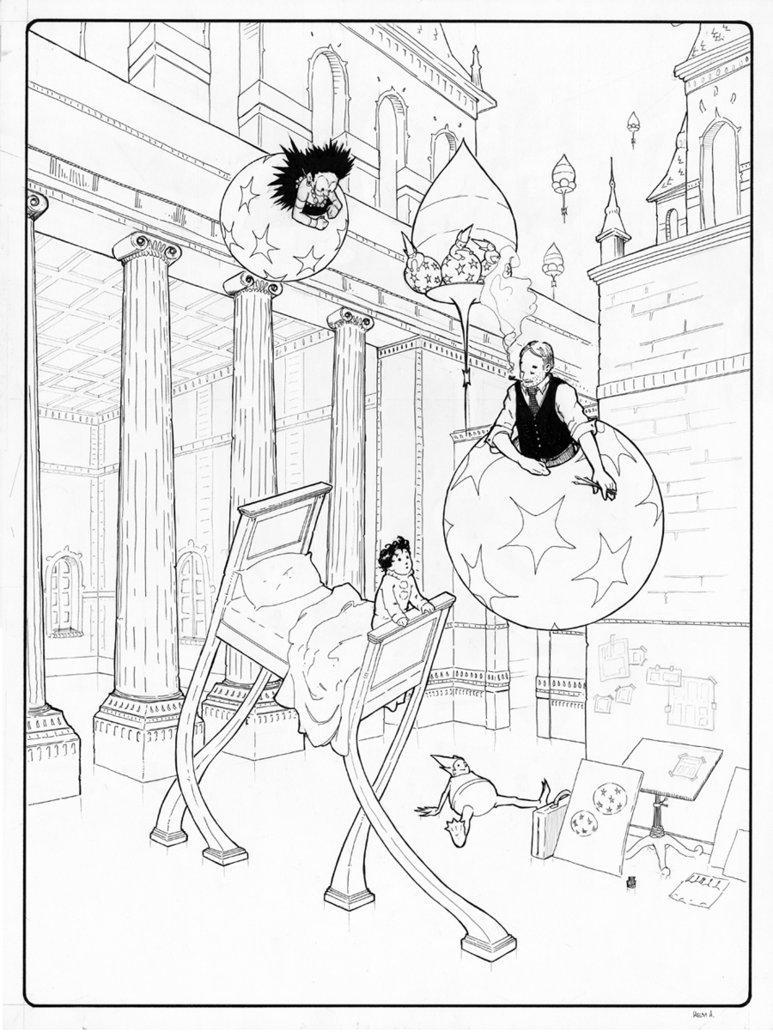
Top illustration by Helsa Amadi
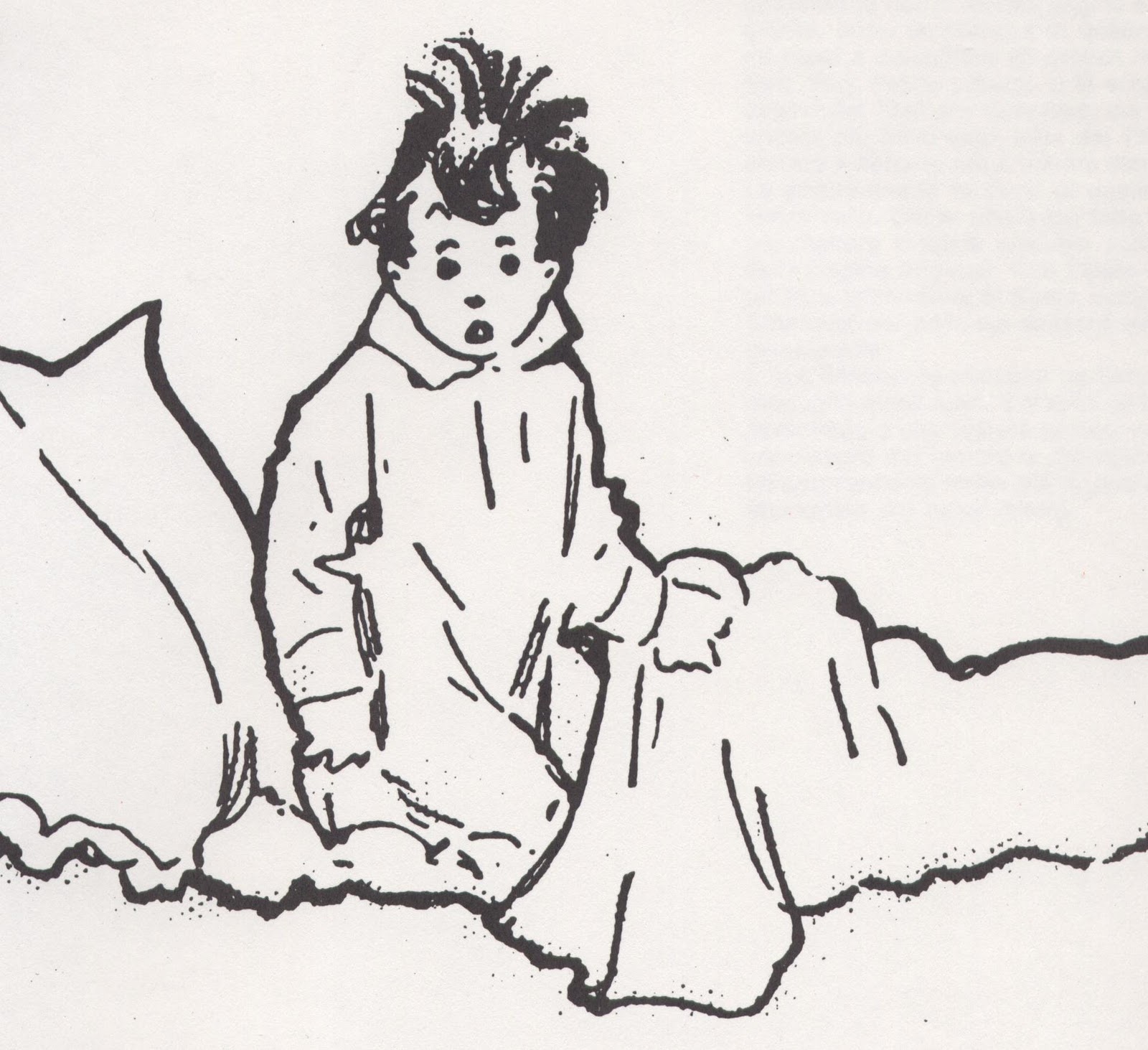
Bottom illustration by Winsor McCay

On the Classic Elements and Their Masters

So, I was pondering doing an elementalist class a couple weeks ago, and today jotted down some ideas. Here’s the class “in progress” – I’d love to know what people think …

Elementalist
Command elemental spirits to perform tasks – the effect is the equivalent of casting spells. An elementalist can attempt to command these spirits a number of time each day equal to his Charisma score divided by 3, rounding down. [maybe at 6th level, this increases to Charisma divided by 2, rounding down?]

Elementalists must own and carry a grimoire of the true names of known spirits – they add to this as they adventure, but not in the manner that magic-users add spells to their spell books

An elementalist is a ritual caster; each day he chooses to focus himself on a particular element and in turn must wear an appropriately colored robe (red, blue, yellow or white) and carry a ritual tool – athame, goblet, censer or wand. Without the robe and the tool, he cannot command elemental spirits.

Elementalists cannot command spirits opposed to their chosen element for the day, but they can command all spirits that are not opposed to them. When commanding elementals spirits that match their daily focus, they receive a +1 bonus to their command checks (see below).

Command checks are the equivalent of a cleric’s ability to turn undead, and use the same table substituting the spell level for the undead’s Hit Dice. Elementalists can also turn elementals opposed to him and command elementals favorable to him. Elements refers to elementals, genies (efreet, djinn, janni), sylphs, salamanders and other creatures composed entirely or mostly of elemental stuff.

The elementalist has four spell lists, each tied to a different element (with a few spells appearing on all four lists). Spells marked with an asterisk (*) are new and described below.

[Maybe his communications with spirits helps him avoid surprise (i.e. surprised on 1 in 1d8 instead of 1 in 1d6), avoid pit traps, find secret doors – essentially, he’s in communication with the landscape/dungeon and maybe gets some forewarning]

Level One
1 Burning Hands (F)
2 Feather Fall (A)
3 Magic Stone (E)
4 Produce Flame (F)
5 Purify Food & Drink (W)
6 Ray of Frost (W)

Level Two
1 Fog Cloud (W)
2 Heat Metal (F)
3 Levitate (A)
4 Pyrotechnics (F)
5 Stinking Cloud (A)
6 Strength (E)

Level Three
1 Fireball (F)
2 Fly (A)
3 Lightning Bolt (A)
4 Protection from Normal Missiles (A)
5 Stone Shape (E)
6 Water Breathing (W)

Level Four
1 Create Water (W)
2 Ice Storm (W)
3 Solid Fog (A)
4 Spike Stones (E)
5 Wall of Fire (F)
6 Wall of Ice (W)

Level Five
1 Cloudkill (A)
2 Cone of Cold (W)
3 Conjure Elemental (U)
4 Passwall (E)
5 Transmute Rock to Mud (E)
6 Wall of Stone (E)

Level Six
1 Find the Path (E)
2 Invisible Stalker (A)
3 Lower Water (W)
4 Move Earth (E)
5 Part Water (W)
6 Stone to Flesh (E)

Level Seven
1 Aerial Servant (A)
2 Control Weather (A)
3 Delayed Blast Fireball (F)
4 Earthquake (E)
5 Reverse Gravity (E)
6 Wind Walk (A)

Level Eight
1 Horrid Wilting (W)
2 Incendiary Cloud (F)
3 Repel Metal or Stone (E)
4 Whirlwind (A)

Level Nine
1 Imprisonment (E)
2 Meteo Swarm (F)

Prime Req: Charisma
Fights As: Magic-User
Hit Dice: Magic-User
Saving Throws: Magic-User
Armor & Weapons: Leather, magic-user weapons

Level Titles
1. Grammarian
2. Reciter
3. Incantator
4. Lector
5. Elementalist
6. Dracunculus
7. Draco
8. Pentalpha
9. Solomon

Thoughts –

1. I might need to invent a few spells to fill in the gaps. I wanted about three spells per level per element up to level 5, and then one or two from 6-9.

2. The big question is the use of the Turn Undead table for casting spells. As written, a 1st level elementalist would be able to make, on average, three or four attempts at casting a spell each day. They could attempt to cast 5th level spells (5% chance of success), 4th level spells (10% cos), 3rd level spells (25% cos), 2nd level spells (40% cos) and 1st level spells (55% cos). Limited number of tries, limited chance of success – but is it too limited? Not limited enough?

A 1st level elementalist that sticks to 1st level spells can, on average, cast about 2 spells per day, so double that of most magic-users. If that elementalist tries to get off a fireball, he only has a 25% chance to do it, and even if he does it, it will only do 1d6 damage. This is probably okay.

At higher levels, the elementalist is still limited to just a few attempts per day, meaning he falls behind the magic-user as a spell caster – fewer spells and less variety. In exchange, I’m giving him leather armor and the ability to turn (and command) elemental creatures – not bad, but maybe not good enough. He might still be worth it if he advances in level faster than the magic-user, but advancing quickly in a crappy character class is little compensation.

So, still some work to be done here. If you have any suggestions, let me know.

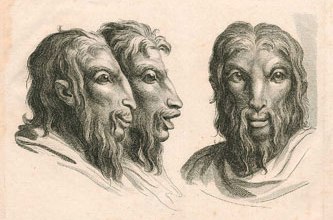
On the Beastmen of Nabu – Part Three

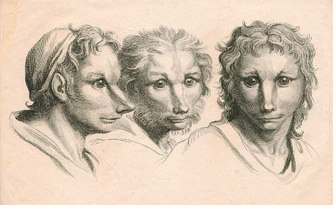
Two more beastmen round out the blog series. Click to read Part I and Part II. The final article that will appear in NOD #3 will include cattle people, horse people, monkey people, raven people and swine people.

Aigosy (Goat People)
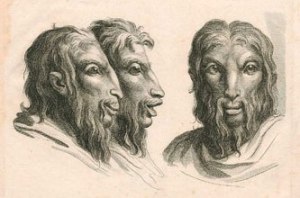
The aigosy are an eccentric race of mystics who dwell in irregularly shaped, or stepped, towers made of sun-dried bricks. Aigosy men always cultivate beards, sometimes small and neat, often curly and tangled, and all aigosy have thick, tangled hair that is usually black. Aigosy are tan to dusky in complexion and have long, flat noses. They traditionally wear felt skullcaps with small felt horns on them, rough tunics, cloaks and leggings and thick leather sandals. Aigosy have little use for jewelry, but do appreciate colored beads, especially glass beads, and often wear strings of them as necklaces and bracelets. Aigosy warriors wear ring mail under their robes and carry shields covered with leather and such weapons as flails, maces and slings. Most aigosy carry a set of pan-pipes.

An aigosy village consists of a dozen or so “towers”, each housing anywhere from three to seven aigosy. Aigosy men and women do not marry, and often do not even live together. Children are raised by the community, with the men cuffing any child that gets out of hand and women, after nursing, doing their best to mother any child within reach. The towers are decorated simply, with the most noticeable articles of furniture being the tall stools and chairs that they prefer. Each aigosy community has a large oven in which they bake their daily bread; flat loaves decorated with seeds in mystic patterns.

The aigosy live by herding goats and sheep and growing a few crops. Rugged and tough, the aigosy have an amazing ability to grow crops in very difficult environments. For this reason, they are considered lucky by many farmers, and should a family of aigosy wish to establish themselves on the fringes of a human settlement, they are usually welcomed (though not too warmly, for they are known to be a bit odd and disruptive).

The aigosy are unflappable, ignoring danger and keeping their cool in just about every situation except being near attractive members of the opposite sex. The truth is, the aigosy are a bit lecherous. They are also eccentric in their speech and manners. They have a cackling laughter that is more unnerving than contagious, and their eyes never seem quite right. They enjoy pondering things over, smoking a clay pipe and, if male, pulling on their beards. When they finally come to a decision, they become a flurry of excited activity.

Racial Characteristics: Aigosy are natural climbers, climbing very difficult surfaces on the roll of 1-2 on 1d6, and rarely failing to climb a surface that provides even small hand and foot holds. They enjoy a +1 bonus on saving throws against spells and effects that affect the mind (i.e. fear, charm, etc). An aigosy’s iron stomach allows them to digest just about anything and makes them more resistant (+2 bonus on saving throws) to poison and disease from ingested articles.

Aigosy Racial Class
The aigosy are often considered to be wild-eyed mystics and, frankly, weirdos. They come by their odd mannerisms honestly, though, for most aigosy are born with what one might call “fairy-sight”. Many aigosy can see spirits and can glimpse the future and past. Besides the racial characteristics mentioned above, a member of th aigosy racial class also gains some spell casting ability and the ability to see spirits.

Prime Requisite: Wisdom (13+ gets +5% bonus to earned experience).
Hit Dice: 1d6 (+2 hit points per level after 9th).
Weapons Permitted: Club, dart, mace, sling, staff.
Armor Permitted: Leather and shields.

Spells: Aigosy can cast divination spells in the same manner that clerics cast spells (i.e. they do not need spellbooks).

Level 1: Comprehend Languages*, Deathwatch*, Detect Evil, Detect Magic, Detect Secret Doors*, Detect Snares & Pits*, Detect Poison*, Detect Undead*, Hide from Undead*, Identify*, True Strike*

Level 2: Augury*, Detect Invisibility, ESP, Find Traps, Locate Object, Speak with Animals, Status*

Level 3: Clairaudience, Clairvoyance, Darkvision, Speak with Dead, Tongues*

Level 4: Detect Scrying*, Discern Lies*, Divination*, Locate Creature*, Speak with Plants, Scrying*, Wizard Eye

Level 5: Commune, Contact Other Plane, Prying Eyes*, Speak with Monsters

Level 6: Analyze Dweomer*, Find the Path, Legend Lore, True Seeing*

* – New spell – see end of article

Spirit Sight: Aigosy are capable of peering into the ethereal plane, and thus have a 1 in 6 chance (increasing by 1 every three levels) of spotting creatures either on the ethereal plane or creatures that are invisible.
Esou (Sheep People)
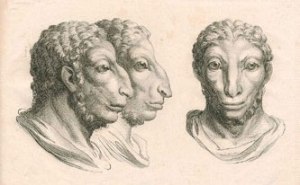
The esou live in tight-knit communities of 100 to 300 men and women led by a lord and his retainers. Esou communities are herding communities, keeping cattle, sheep and sometimes goats and swine. The esou are skilled at controlling their animals with horns, thus relieving them of the necessity of keeping dogs, which make them nervous. They build their communities on hills, usually constructing a large shell keep. Animals are, as much as possible, kept within the walls of the keep or very near, for the esou tend toward paranoia and are always certain that rustlers are just over the hill waiting to pounce.

Esou have dusky skin and curly blond hair. They wear woolen clothes, including long tunics, leather aprons and sandals. Most esou wear steel skullcaps with a curled ram-horn motif worked into the sides. Warrior equip themselves with ring armor or chainmail, shields and maces that are often tipped with steel heads shaped like a ram’s head. The esou are close-minded and suspicious. It is difficult to work oneself into their confidence, and easy to lose that confidence. Many esou expect visitors seeking hospitality to prove themselves with painful, physical ordeals.

Racial Characteristics: Esou are trained in defensive combat, giving them a base armor class of 8 [11]. They are only surprised on a roll of 1 on 1d8 and sense dangerous traps on a roll of 1 on 1d6.

Esou Racial Class
Esou warriors are experts at defensive combat, and thus very valuable to armies and parties of adventurers. Once an esou adopts a band of adventurers or soldiers, he becomes very protective of them. Esou are always on the lookout for danger, and often drive their comrades crazy with their constant fretting.

Prime Requisite: Constitution (13+ gets +5% bonus to earned experience).
Hit Dice: 1d6+2 (+3 hit points per level after 9th).
Weapons Permitted: Any.
Armor Permitted: Any.

Defensive Stance: When adopting a defensive posture, an esou gains a +1 bonus to hit and damage, a +2 bonus on all saving throws and a +2 bonus to Armor Class. In exchange, he cannot move during combat. A defensive stance lasts for 4 rounds, after which he suffers a -1 penalty to hit and damage for the remainder of the encounter. An esou can adopt his defensive stance a number of times per day equal to his level divided by two, rounding up.

Ignore Damage: At level 6, an esou can ignore 1 point of damage from melee, missile and spell attacks.

Trap Sense: Besides his 1 in 6 chance of noticing traps, an esou who takes levels in this racial class also gains a +1 bonus on saving throws to avoid traps.

NEW SPELLS –

ANALYZE DWEOMER
Level: Magic-User 6
Range: 30 ft.
Duration: 1 round per level

You learn all of the magical functions, effects and triggers on any magic item or any person under the effect of a spell that you look at. The person being analyzed or holding an object being analyzed may make a saving throw to foil your analysis. Casting this spell requires a tiny lens of ruby or sapphire set in a small golden loop, costing approximately 1,500 gp.

AUGURY
Level: Cleric 2
Range: Personal
Duration: Instantaneous

An augury can tell you whether a particular action will bring good or bad results for you in the immediate future. The base chance for receiving a meaningful reply is 70% + 1% per level, to a maximum of 90%; this roll is made secretly. A question may be so straightforward that a successful result is automatic, or so vague as to have no chance of success. If the augury succeeds, you get one of four results: Weal (if the action will probably bring good results), Woe (for bad results), Weal and woe (for both) or Nothing (for actions that don’t have especially good or bad results). If the spell fails, you get the “nothing” result. A cleric who gets the “nothing” result has no way to tell whether it was the consequence of a failed or successful augury. The augury can see into the future only about half an hour, so anything that might happen after that does not affect the result. Thus, the result might not take into account the long-term consequences of a contemplated action. All auguries cast by the same person about the same topic use the same dice result as the first casting.

COMPREHEND LANGUAGES
Level: Cleric, Magic-User 1
Range: Personal
Duration: 10 minutes per level

You can understand the spoken words of creatures or read otherwise incomprehensible written messages. In either case, you must touch the creature or the writing. The spell enables you to understand or read an unknown language, not speak or write it.

DEATHWATCH
Level: Cleric 1
Range: 30 ft.
Duration: 10 minutes per level

You can determine the condition of creatures near death within the spell’s range. You instantly know whether each creature within the area is dead, alive and wounded with 3 or fewer hit points left, alive with 4 or more hit points, undead, or neither alive nor dead (such as a construct).

DETECT POISON
Level: Cleric, Magic-User 1
Range: 30 ft.
Duration: Instantaneous

You determine whether a creature, object, or area has been poisoned or is poisonous.

DETECT SCRYING
Level: Magic-User 4
Range: 40 ft.
Duration: 24 hours

You immediately become aware of any attempt to observe you by means of a scrying spell or effect. The spell’s area radiates from you and moves as you move. You know the location of every magical sensor within the spell’s area. If the scrying attempt originates within the area, you also know its location; otherwise, you and the scrier immediately make opposed caster level checks (1d20 + caster level). If you at least match the scrier’s result, you get a visual image of the scrier and an accurate sense of his or her direction and distance from you.

DETECT SECRET DOORS
Level: Magic-User 1
Range: 60 ft.
Duration: 1 minute per level

You can detect secret doors, compartments, caches, and so forth. Only passages, doors, or openings that have been specifically constructed to escape detection are detected by this spell.

DETECT SNARES & PITS
Level: Druid 1
Range: 60 ft.
Duration: 10 minutes per level

You can detect simple pits, dead falls, and snares as well as mechanical traps constructed of natural materials. The spell does not detect complex traps, including trapdoor traps. The spell detects certain natural hazards, including quicksand, a sinkhole, or unsafe walls of natural rock.

DETECT UNDEAD
Level: Cleric, Magic-User 1
Range: 60 ft.
Duration: 1 minute per level

You can detect the number of undead creatures within range of the spell and their relative strength (i.e. hit dice or challenge level).

DISCERN LIES
Level: Cleric 4
Range: 30 ft.
Duration: 1 round per level

You know if the subject of your scrutiny deliberately and knowingly speaks a lie. The spell does not reveal the truth, uncover unintentional inaccuracies, or necessarily reveal evasions.

DIVINATION
Level: Cleric 4
Range: Personal
Duration: Instantaneous

Similar to augury but more powerful, a divination spell can provide you with a useful piece of advice in reply to a question concerning a specific goal, event, or activity that is to occur within one week. The base chance for a correct divination is 70% + 1% per caster level, to a maximum of 90%.

HIDE FROM UNDEAD
Level: Cleric 1
Range: Touch
Duration: 10 minutes per level

Undead cannot see, hear, or smell the warded creatures. Even extraordinary or supernatural sensory capabilities cannot detect or locate warded creatures. Non-intelligent undead creatures are automatically affected and act as though the warded creatures are not there. An intelligent undead creature gets a single saving throw.

IDENTIFY
Level: Magic-User 1
Range: Touch
Duration: Instantaneous

The spell determines all magic properties of a single magic item, including how to activate those functions (if appropriate), and how many charges are left (if any).

LOCATE CREATURE
Level: Magic-User 4
Duration: 10 minutes per level

This spell functions like locate object, except this spell locates a known or familiar creature.
You slowly turn and sense when you are facing in the direction of the creature to be located, provided it is within range. You also know in which direction the creature is moving, if any.

PRYING EYES
Level: Magic-User 5
Range: One mile
Duration: 1 hour per level

You create a number of semi-tangible, visible magical orbs (called “eyes”) equal to 1d4 + your level. These eyes move out, scout around, and return as you direct them when casting the spell. Each eye can see 120 feet (normal vision only) in all directions. Each eye has 1 hit point and an AC of 18. You give each eye some basic instructions of where to go, and it returns and replays in your mind what it has seen.

SCRYING
Level: Cleric 5, Druid 4, Magic-User 4
Range: See text
Duration: 1 minute per level

You can see and hear some creature, which may be at any distance. If the subject succeeds on a saving throw, the scrying attempt fails. If you have no knowledge of the creature, it gets a +10 bonus to its saving throw. If you have only secondhand knowledge of the creature, it gets a +5 bonus to its saving throw. If you have a picture or likeness of the creature, it suffers a -2 penalty to its saving throw. If you have a possession or garment of the creature, it suffers a -4 penalty to its saving throw. If you have a piece of the creature (body part, fingernail clippings, lock of hair), it suffers a -10 penalty to its saving throw. If the subject is on another plane, it gets a +5 bonus on its saving throw.

If the save fails, you can see and hear the subject and the subject’s immediate surroundings.

STATUS
Level: Cleric 2
Range: Touch
Duration: 1 hour per level

When you need to keep track of comrades who may get separated, status allows you to mentally monitor their relative positions and general condition. You are aware of direction and distance to the creatures and any conditions affecting them. Once the spell has been cast upon the subjects, the distance between them and the caster does not affect the spell as long as they are on the same plane of existence. If a subject leaves the plane, or if it dies, the spell ceases to function for it.

TONGUES
Level: Cleric 4, Magic-User 3
Range: Touch
Duration: 20 minutes per level

This spell grants the creature touched the ability to speak and understand the language of any intelligent creature, whether it is a racial tongue or a regional dialect.

TRUE SEEING
Level: Cleric 5, Druid 7, Magic-User 6
Range: Touch
Duration: 1 minute per level

You confer on the subject the ability to see all things as they actually are. The subject sees through normal and magical darkness, notices secret doors hidden by magic, sees the exact locations of creatures or objects under blur or displacement effects, sees invisible creatures or objects normally, sees through illusions, and sees the true form of polymorphed, changed, or transmuted things. Further, the subject can focus its vision to see into the Ethereal Plane (but not into extradimensional spaces). The range of true seeing conferred is 120 feet. True seeing does not penetrate solid objects. It in no way confers X-ray vision or its equivalent. It does not negate concealment, including that caused by fog and the like. True seeing does not help the viewer see through mundane disguises, spot creatures who are simply hiding, or notice secret doors hidden by mundane means.

TRUE STRIKE
Level: Magic-User 1
Range: Personal
Duration: See text

Your next attack roll (if it is made before the end of the next round) gains a +10 bonus to hit.
On the Beastmen of Nabu – Part Two

Two more beastmen for your enjoyment. Part One, detailing the cat and lion people, is here.

Kawa (Fox People)
The kawa are mostly known as highwaymen and thieves. They wander the River of Death in bands that are like extended families of 10 to 20 individuals, usually under the command (such as it is, for they are a deeply chaotic folk) of the eldest member. The arrival of a band of kawa in a settlement is met with mixed emotions, for while they are known to be thieves, they also bring news and the crafts of their wise women and cunning men to isolated villages.

The kawa are short (4 feet tall, on average) and wiry. They have ruddy skin and platinum blond hair, and eyes they gleam with cunning. They dress in beaded tunics, jaunty leather caps and leather sandals. Belt pouches hold charms and bundles of useful herbs. Kawa warriors carry short, thin swords and long knives, as well as short bows or slings. The kawa are friendly folk, but dishonest and always on the lookout for a sharp deal. They have soprano voices and demoniacal laughs that are deeply unnerving. Kawa often get drunk at night and play tricks, often very cruel ones, on whoever is close at hand.

Racial Characteristics: Kawa are sneaky and cunning. They surprise foes on the roll of 1-2 on 1d6, and because of their acute hearing are only surprised on a roll of 1 on 1d8. Most kawa have a working understanding of herbs and their supernatural and medicinal uses, enough so that their ministrations afford creatures a +1 bonus to save vs. poison and disease. A kawa’s fluid fighting style gives it a +1 bonus to Armor Class.

Ka’wa Racial Class
A ka’wa, despite his reputation, is a useful person to have around on an adventure. Quiet and clever, they make excellent scouts and can help a party of adventurers survive in a hostile wilderness. Moreover, their wandering ways exposes them to useful bits of lore and gossip, including a handful of minor charms. Besides their normal racial abilities, dedicated ka’wa scouts have some minor spellcasting ability and the ability to sneak about and survive in the wilderness.

Prime Requisite: Intelligence (13+ gets +5% bonus to earned experience).
Hit Dice: 1d6+1 (+2 hit points per level after 9th).
Weapons Permitted: Club, dagger, hand axe, javelin, light crossbow, flail, mace, short bow, short sword, sling.
Armor Permitted: Leather and shields.

Herblore: Kawa can spend time each day they spend in the wilderness looking for herbs. There is a 1 in 6 chance each day that they discover a combination of herbs that, with their store of herbal knowledge, can be used to brew a tea that acts as a potion. Roll the type of potion randomly, using the minor potions chart in the core rulebook.

Move Silently: When concentrating and not carrying particularly noisy objects, ka’wa can move about without making any sound. A kawa moving silently and scouting ahead of a party can avoid an encounter entirely if his opponents are surprised.

Perception: A kawa successfully listens at doors and finds secret doors and hidden traps as well as elves (2 in 6 and 4 in 6 chance respectively), and can find pits and traps as well as a dwarf (1 in 6 chance of just noticing, 3 in 6 chance if searching).

Spells: At level 1, 3, 6, 9 and 12, a kawa learns to cast a level 1 magic-user spell. They can cast each spell they know once per day. The kawa’s player can choose to learn a spell known by a magic-using comrade or roll randomly for the spell he learns.

Qamouli (Camel People)
The qamouli are tall, lanky folk often standing over 7 feet in height. They have long arms and a stride that, while loping and ungainly, makes them quite fast. Qamouli have tan skin and curly, golden or reddish hair. They decorate their faces with jewelry, but otherwise dress in simple saffron robes. They cover their misshapen heads, which give them no end of embarrassment, with brightly colored turbans and scarves. Warriors wear ring mail over their robes and carry long spears, sickle-shaped swords (treat as battle axes) and slings. They are obsessive about collecting holy symbols of all kinds of gods and goddesses – major, minor or forgotten, good, evil or otherwise. A qamouli never speaks ill of a divinity, no matter how ancient, unknown or foul.

The qamouli are desert traders. They have thick pads on their feet that protect them scorpion stings and the heat of the desert sands, and so never wear shoes. They roam in bands of 15 to 30 individuals, their long strides and amazing endurance carrying them swiftly across the sands from one village to another.

Racial Characteristics: Qamouli are generally not bothered by heat and cold, though they do suffer normal damage from fire and cold attacks. They need only half as much food and water as normal humans, and are usually (75%) capable of finding food and water in any environment. A qamouli can carry 1.5 times as much weight as a normal human. They have a base movement of 15, but their clumsiness gives them a -1 penalty to Armor Class.

Qamouli Racial Class
Qamouli are natural explorers and adventurers. They like to stay on the move, and always have an eye open for items of value. Besides their racial characteristics, qamouli also know how to protect themselves from wild animals and wicked spirits.

Prime Requisite: Constitution (13+ gets +5% bonus to earned experience).
Hit Dice: 1d6+2 (+3 hit points per level after 9th).
Weapons Permitted: Any.
Armor Permitted: Leather, ring and chainmail and shields.

Desert Songs: The qamouli are especially superstitious, and learn from a young age the secrets of warding away bad luck (+2 bonus to save vs. curses). They also learn ancient songs that keep away dangerous animals and wicked spirits. These songs are sung in a nasally baritone and, in fact, are fairly useful for keeping anything with hearing at bay. In play, these songs act as a cleric’s “turn undead” check, but can be used against normal animals and the undead.

Languages: Qamouli characters are allowed to know 2 bonus languages above and beyond what is allowed by their intelligence score.