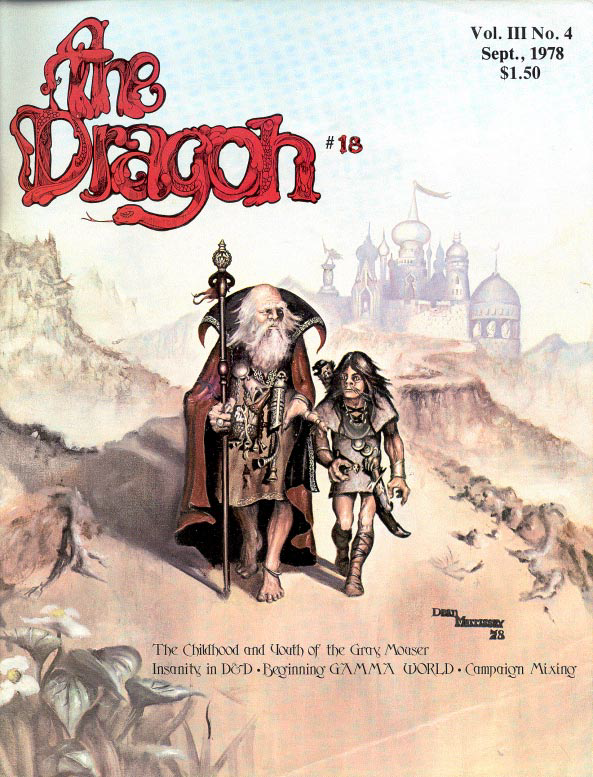
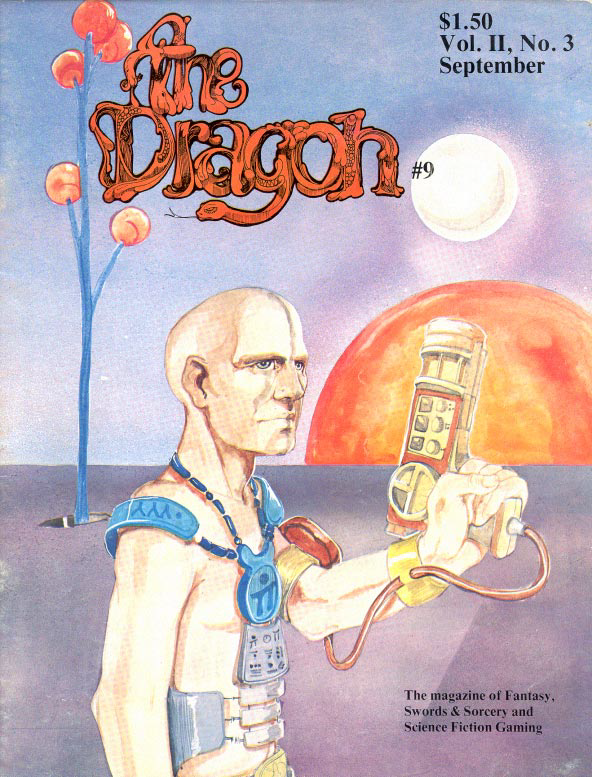
Another week, another Dragon magazine. The last one was chock-full of stuff, how about this issue.
Traveller: The Strategy of Survival by Edward C. Cooper
As I was thinking, “I don’t remember any Traveller articles showing up before in The Dragon” I hit this line in the article, “I took advantage of the opportunity to observe the TRAVELLER phenomenon first hand” – ah – so this is at the dawn of Traveller.
I’ve never played Traveller, but I did create a character once (I was creating one character for every game I had a PDF of … though I skipped Exalted because after the first few steps I realized I just didn’t care enough to bother with it). This article appears to be about – well – keeping a character alive in Traveller. My favorite bit:
“Several other similar occurrences proved to me then that the success or failure of a character in most cases cannot be traced to “dice or chance” as often as it can to poor handling on the part of a player. I was both surprised and disappointed that some players even blamed a character or given situation for their own bad decisions. But then again, I was extremely excited, awed, by the skill some showed in manipulating their character’s life.”
That hits the spot for an old schooler – though it also shows that there were plenty of people back in the old days who were waiting for the new days with baited breath. Different strokes for different folks!
Reviews – Traveller, The Emerald Tablet, Imperium …
Well, imagine that! The reviewer appreciates that Traveller is not just D&D in space, but rather has its own “unique flavor and style”. The review is quite extensively, and I highly recommend it (yeah, I’m reviewing a review) for folks who don’t really know what Traveller is all about.

The Emerald Tablet is a set of fantasy wargame rules. The reviewer likes them, but admits he doesn’t know much about wargames. He likes that the magic system is based on ritual magic, which I know some people dig, but I always think it’s overrated. On the other hand – dig this sheet of Astral Force cards (click to enlarge … trust me, click it – click it now) I found at Boardgamegeek.com …
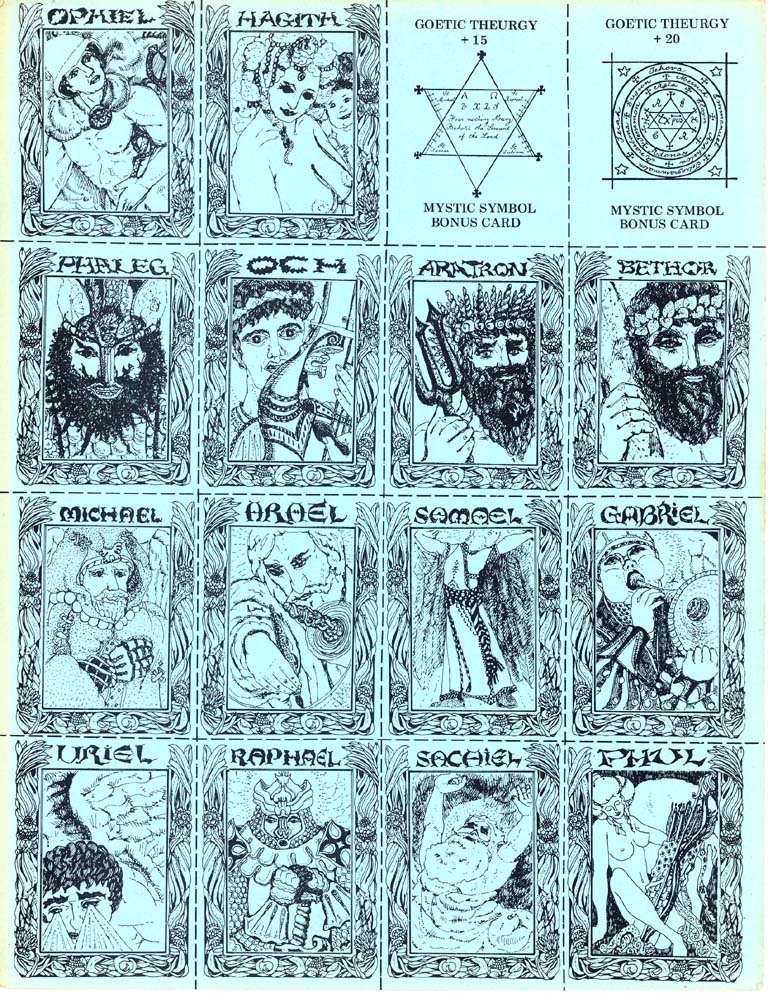
I don’t know what Phul does, but, hmm – anyways.

Imperium is another Game Designer’s Workshop product, a board game written by people who really love sci-fi literature. Apparently, Imperium is a game about the Terrans bumping up against the Imperium and the two sides fighting.
Pellic Quest is a computer moderated RPG (apparently a good thing, because computers are jerks like Dungeon Masters – see, the seeds of the new school were always there). Another sci-fi game, you start controlling a small planet in one of six roles (emperor, crusader, brigand, trader, droyds (robotic destroyers) or the zente (insect alien warriors). Each role needs different “winning points” and then go about making it happen.
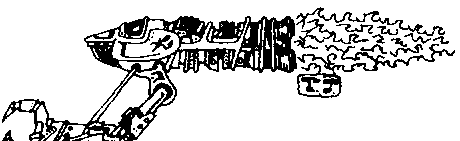
Oh, and those zente …

Pretty sweet.
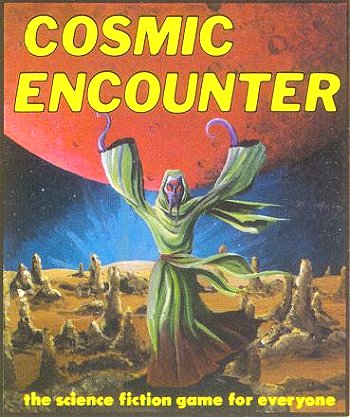
Cosmic Encounter is a sci-fi variation on draw poker. Apparently it is simple and easy to learn, and, most importantly, fun, although the hype that one really has to get into the head of the alien race they control is wrong. The game combines several elements of classic, abstract games, and I want people who think they’re game designers to embrace this notion. Don’t begin with setting, begin with rules and get to know all sorts of old card games, board games, etc. Then apply setting to the game rules. This is how D&D was born and manages to remain so popular – it works as a game. Well, it used to, anyways.
INSANITY, or Why is My Character Eating Leaves? by Keven Thompson
A worthwhile article – insanity is tough to handle in games. Kevin Thompson devises first a saving throw vs. insanity (which makes sense given the time period). The saving throw is based on a matrix between Intelligence and Wisdom – find the number, add character level to it, and then try to roll 1d20 beneath that number. Neat idea (and I’ll be using it in a post this week).
If you fail the save, you roll d12 (always nice to see the d12) on an insanity chart.
INSANITY CHART
1. Nutty
2. Kleptomaniac
3. Perverse
4. Psychotic Hatred
5. Childlike Trusting
6. Schizoid
7. Severe Paranoia
8. Acute Paranoia
9. Gibbering
10. Suicidal
11. Violent
12. Catatonic
The good thing about this list is that it is more behavior based than clinical. It’s pretty easy to see how these “insanities” could impact actual play in a game.
New Spells in D&D! by Paul Suliin
(Love the use of the exclamation point)
This article introduces new spells created by an actual play group using the rules for spell research in Dragon #5. The editor chimes in with the admonition that every spell needs to have a loophole via which it can negated somehow.
The new spells include Nature Call, Magic Missile II, Moon Runes, Flamebolt, Mystic Rope, Pit of Flame, Word of Warding, Force Field, Extend I, Shatterray, Wall of Water, Extend II, Beam of Blasting, Conjure Djinn/Efreet, Density Control, Extend III, Combine I, Call Spirit, Rust Monster Touch and more.
Let’s convert a couple to Blood & Treasure …
Magic Missile II
Level: Magic-User 2
Range: Medium (150 ft.)
Duration: Instantaneous
As magic missile, but this spell conjures either one +2 arrow or two +1 arrows, with a like amount added for every fifth level advanced beyond 3rd (i.e. two +2 arrows or four +1 arrows at 8th level, three +2 arrows or six +1 arrows at 13th level, etc.)
Density Control (which would also make a great power for Mystery Men!)
Level: Magic-User 6
Range: Personal
Duration: 3 minutes
The spellcaster can alter the density of his body from a gas to steel. Such changes alter the spellcaster’s Armor Class, so that at minimum density he is immune to physical weapons, and at maximum density he is AC 18 and his hands strike as swords (1d6 damage). Density may be altered throughout the duration of the spell, and items in contact with the spellcaster’s body when the spell is cast are altered along with him.
Magic: Governed by Laws of Theory by Thomas A. McCloud
Man, I used to roll my eyes at these when I was a kid – theory? dude, I want a new class, new race, new spells, new adventures, etc. But I’m an adult now, so … naw, I still think the same way.
This one attempts to draw inspiration on the how’s and why’s of magic in D&D by examining such sage tomes as the 1960 Encylcopedia Britannica and Frazer’s The Golden Bough. Dude – it’s a game. Of course magic is treated casually. Real estate is treated pretty casually in Monopoly because it’s also a game – move and countermove, risk taking, a random element. Don’t overthink it!
Let Your Town Have A Purpose, or, How To Design A Town In Boot Hill by Mike Crane
Sometimes I think Jay Ward wrote the titles of these articles (bonus Nod points to anyone who gets that reference). Mike covers the best scale (1″ = 20′) to draw the map, the need to think about why the town is there in terms of who settled it and what they do (dude, it’s there to give gunslingers a place to have gun fights), etc. To be completely honest, articles like this are a waste. A bunch of random tables for generating an Old West town would have been much more helpful, or just a suggestion of watching some old episodes of Bonanza. Sorry – guess I’m in a salty mood at the moment.
Reviews Continued … Alpha Omega

Okay, apparently we’re not done with reviews yet. Alpha Omega was Battleline’s first stab at a sci-fi game. The reviewer thinks it reminds him of Buck Rogers or Star Wars … and that’s not an endorsement, according to the reviewer. After all, if we can’t beat all the fun out of sci-fi and make it boring and cerebral, then what’s the f-ing point? (I am in a mood). Here’s a sample of the review …
“Alpha Omega is billed as “A game of tactical combat in space,” a claim supported by the rules.”
Okay then. Apparently, the art is superb on the counters, but they’re hard to read, and the scale (one hex equals one light second) and turn time (6 seconds) are weird for space fights. The game is also two-dimensional, rather than three-dimensional, although the reviewer doesn’t think three dimensions would have any bearing on the game, and thus might as well not be there. The game is really just naval combat on a board that looks like space. The weapons are not realistic (just names, really), so the game also lacks believability (a bugaboo that has never bothered me personally) – hell, they named a couple alien ships Akroid and Balushi – the bastards. Uggh – life’s too short for this. Game looks fun to me, and the cover is pretty cool.
The Chamber of the Godgame by Mick McAllister
The what of the what? It’s a short article describing a dungeon chamber based on a scene in John Fowles’ “grand metaphysical dungeon novel” The Magus. I won’t go into it – find the article or find the book.
Gamma World: Fire Report; Setting Up The Campaign by James M. Ward and Gary Jaquet
Neat little behind the scenes look at the why’s and wherefore’s of turning Metamorphosis Alpha into Gamma World.
Birth Tables – Boot Hill by Stephen Blair
This one’s a collection of random tables. Let’s roll on them and see what we get …
Social Class: Ranch Related (didn’t know that was a social class, but okay)
Profession of Father: Homesteader (ah, now I get it)
Birth Order: Bastard (makes sense)
Skills: Facility with numbers (this bastard can multiply!)
Initial Purse: $75
Size of Spread: 5,120 acres
Guidelines for Mixing Campaigns: Androids, Wizards, Several Mutants, and Liberal Doses of Imagination, Well Blended by James M. Ward
This article is a quick guide to converting D&D characters to MA characters. D&D characters get a radiation resistance of 3, and MA creatures get no save vs. magic. Magic armor completely disrupts protein and disruptor blasts (good to know). The shielding, metal and energy fields of the Warden stop crystal balls and helms of teleportation from working (it’s science, dude, deal with it). Good article – reminiscent of the treatment in the old DM’s Guide.
Monkish Weapons and Monk vs. Monk Combat by Garry Eckert
Apparently, Garry read a book about Japanese weapons and decided to apply what he learned to monks (who are drawn from Chinese fact and folklore, not Japanese – oi!). Skip it.
Effective Use of Poison by Bill Coburn
Quick article that defines poison as Class A, B or C.
Type A is in potion form, and includes Arsenic and Hemlock. It kills 80% of the time in 2d4 minutes and if it doesn’t kill, leaves a person stricken for 1 week (meaning half strength, dexterity, constitution and movement).
Type B is in the form of gas, darts, cobras and needles. A neurotoxin, it brings death 50% of the time in 4d4 days and leaves people stricken for 1d3 days after being unconscious 30 minutes after poisoning for 1d4 days.
Type C comes from monsters. A hemotoxin, is has a 10% chance of killing a character in 1d4 days, and leaves people stricken for 1d10 days after being unconscious 1 hour after poisoning for 2d4 days.
Armor in this scheme provides a bonus to save vs. poison (-2 penalty for no armor, no adjustment for leather, +1 for chainmail and +2 for platemail).
Not a bad little system, really.
Comics!
Finieous Fingers and his pals meet the evil wizard, and discover that a good initiative roll and a magic wand go a long way towards evening the score between fighters and magic-users.
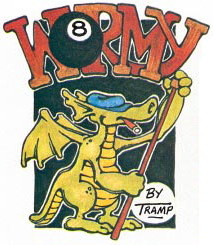
In Wormy, the trolls make the mistake of breaking one of Wormy’s pool balls. Jeez I miss this comic. Who has the next Wormy in them?
The Childhood and Youth of the Gray Mouser by Harry O. Fischer
This is Harry’s version of the Gray Mouser’s youth, Harry having been a major help in creating all of the major characters of Nehwon back in the day. It begins …
“Mokker was the Prince of Pimps in the Street of Whores in Lankhmar. He could just as easily have been King. He was tastefully and expensively dressed, with massive gold and jeweled rings one or more to a finger. He was exceedingly complex; calculating, sometimes ruthless, vulnerable to fits of whimsy, possessing an almost perpetual erection (as it behooves a whore-master to have), and more. He was generous, and delighted in both the giving and getting of surprises. His whores loved him for this, in addition to the fact that he felt not the slightest hesitation about correcting or revenging a wrong to one of his, no matter how slight the transgression. Mokker was a thorough and practical rogue given to sudden impulses, possessing large eyes, a sensual mouth and plump cheeks; a merry companion and a deadly enemy. He was clever, aware of it, and arrogant.”
No, D&D wasn’t for kids just yet.
Next we have this …

Okay then.
Non-Player Character Statistics by ???
This is another quickie – random tables for determining NPC stats based on their personality. Kinda cool. I’ll roll one up – we’ll say a madame from Tremayne named Durla …
Pride (Ego): Little – =1-% greed, -1% work quality
Greed: Loans things, sells items for normal* prices
Quality of Work: Normal
Okay, well, now I know. I think I’ll stick to my method in Blood & Treasure (on sale now!)
—
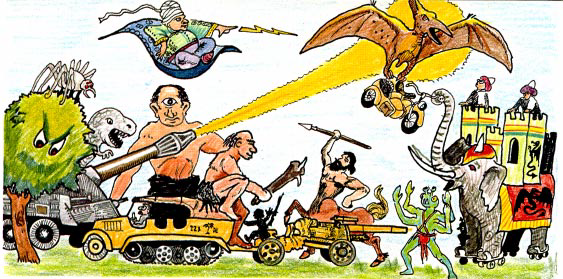
And there you have it, along with some nice little comic panels from McLean. Lots of stuff packed into 34 pages, and not a bad read overall. The spells were fun, and I like the poison rules. The reviews got me to look up some old games I’d never heard of, and the insanity rules put an idea in my head I’ll explore more this week.
Have fun boys and girls, and don’t be the last geek on your block to get Blood & Treasure




 Land of Nod