Lucky Bastards

There are two ways to survive as an adventurer – you can be good, or you can be lucky. The lucky bastard uses the latter approach. For him, the luck comes naturally – he’s always had it, and hope he always will.

Requirements & Restrictions
There are no ability score or alignment requirements for lucky bastards.

They are capable of wearing up to leather armor, but cannot use shields. They are limited to simple weapons like daggers, staves, spears and darts.

Special Abilities
Lucky bastards can find secret doors as an elf. Elven lucky bastards increase their chances to do this by 1 in 6.

Whenever an event in a game must target a random adventurer, a random determination of the lucky bastard is re-rolled. If the second roll targets the lucky bastard, then he is the target of the event.

Illustration by William Heath Robinson

Each game session, a lucky bastard starts with a luck score of 4. He can increase this by +1 if he holds a lucky rabbit’s foot*, by +1 if he holds a lucky horseshoe*, and by +2 if he happens upon a loose copper piece (only one) in a dungeon and repeats the magic phrase “Find a copper, pick it up, all day long you’ll have good luck”.

The luck score can be used for two things. First, it can be used as a bonus to any sort of d20 roll. Second, it can be used to negate damage. To negate damage, the lucky bastard must roll below his luck score on 1d6. If successful, hit point damage sustained from one attack form is negated. Whenever a lucky bastard uses his luck score (whether successfully or not), it is reduced by 1.

A 3rd level lucky bastard can, once per game, share his luck with another creature within 30’ of him. This means he lends his luck score to another creature for one round. When the luck score is shared and used, it is reduced by 2 points, rather than just 1 point.

A lucky bastard can re-roll one failed d20 roll per game session for every four levels he has attained (thus once at 4th level, twice at 8th level, thrice at 12th level, etc.).

A 6th level lucky bastard can steal an opponent’s luck once per day. When an opponent rolls a d20, the lucky bastard can, once he knows the result of the roll, take it for his own. The opponent must re-roll, and the lucky bastard must use his opponent’s first roll as his next d20 roll.

Lady Luck has smiled on the lucky bastard … but for how long. Every session a lucky bastard is played carries with it a cumulative 1% chance that Lady Luck turns her back on him. If this happens, the lucky bastard loses all special abilities for that session and the cumulative 1% chance resets itself for the next session.

A 9th level lucky bastard can build and operate a tavern/inn in a settlement, attracting 1d6 servers (one is an ex-thief, level 1d4), a bartender (ex-fighter, level 1d4), a groom and 1d10 regular customers (roll their identities as though they were henchmen). The tavern will, of course, be very successful. For every regular customer the lucky bastard has, he earns 1 gp per month. The tavern earns an additional 1d10 gp per month beyond the regulars. The lucky bastard can call on one favor per month from his regular customers, including using them as henchmen on his continuing adventures. If a regular customer is killed on an adventure, he is not replaced, and the lucky bastard must pay a 100 gp fee and lose all favors for 1d6 months.

* A rabbit’s foot and horseshoe are made lucky when they are blessed by a cleric (Lawful, if you use three alignments, Chaotic Good if you use nine) of at least 6th level.

Easy Peasy Wracked with Diseasy

Illustration by Jon Kaufman

For the second edition of Blood & Treasure, I had a few goals in mind: 1) Better layout. 2) Incorporate errata and edit like crazy. 3) A little more gonzo, a little less standardized. 4) Streamline anything you can streamline.

That brings me to disease. The rules I used before were relatively easy, but I wasn’t really satisfied with them. I hit on this point in a post a while back, and developed a disease system that I published in NOD 28 that focuses on symptoms rather than on named diseases. For Blood & Treasure, I decided to use a simplified version of this. While somewhat random, it takes into account the monster or dungeon level delivering the disease, and hopefully sets up a race against time aspect that will add to rather than diminish the drama of an adventure.

DISEASE

When a character is injured by a contaminated attack, touches an item smeared with diseased matter or consumes disease-tainted food or drink, he must make an immediate Fortitude save. If he succeeds, his immune system fights off the disease and he suffers no ill effect.

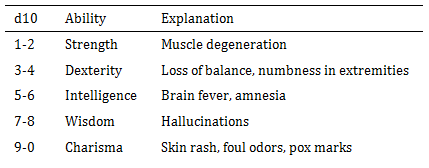
If he fails the saving throw, the TK rolls 1d6 and adds the Hit Dice of the monster that infected him, or the level of the dungeon on which he was infected. Consult the table below. The infected creature will suffer all of the effects on the table up to the number rolled. The effects start at the times indicated on the table.

For example, a character who is both fatigued and sickened with feel the effects of fatigue in one round, and the effects of being sickened in 1 turn.

If an ability score is indicated, roll 1d10 to determine which score is affected:

Each day, the creature can attempt a new Fortitude save against the disease. If the roll is a failure, he continues suffering the ill effects as indicated on the table. If he succeeds, those ill effects are reduced by one level. When the character suffers no further ill effects, the disease has run its course.

While the character is diseased, they do not benefit from natural healing, although magical healing works on them. A cure disease spell will, of course, completely eradicate the disease, ending all ill effects.

Of course, once “cure disease” shows up, it just doesn’t matter, which is why the system is short.

I MIGHT CHANGE SAVING THROWS

This brings up the other part of the game I might streamline. I say might, because I haven’t made the change yet.

Saving throws in the game currently use three categories – Fortitude, Reflex and Will. As categories, they make sense and players can generally figure out what save they should be making when a situation comes up.

A post over at Delta’s D&D Hotspot got me thinking of another way that is more “gamist”, but which I think might be an improvement.

Delta was showing how the OD&D fighter’s saving throws went in an order from easiest to hardest, with the easiest saves being the one’s against the most dire circumstances. I like this idea. Why should it be easiest to save vs. petrification? Because failing that save means your character is dead, unless you have a high enough level magic-user who can turn you back. It treats saving throws more as “get out of jail free” cards than as simulating something real. I know this will bug the heck out of some folks, but I like it. It keeps the game a game.

This got me thinking about using a single saving throw number for each level – so only one number on the sheet, which fits into streamlining – with a blanket +3 bonus against instant effects that are (almost) unalterable – things that really screw up your precious character like instant death, polymorph, paralysis, petrification and the like. The classes would then have their own little +1 to save vs. something – fighters vs. dragon breath, spellcasters vs. spells – that sort of thing.

If I’m honest … it also saves lots of room in the books and makes monsters a bit easier to run.

Again, I haven’t made this change yet, but I think I’m going to.

I’m like 90% certain I’m going to.

Probably.

I think.

Dragon by Dragon – November 1980 (43)

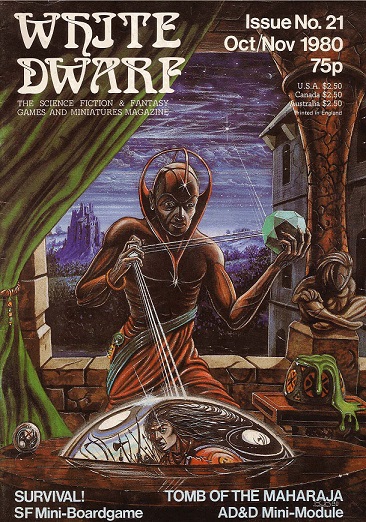
It’s time for another review of the grand old Dragon, and this time with a special guest appearance by White Dwarf #21. I figure, why not look at what WD was up to during the same month of Dragon I’m reviewing – see how the gaming communities in the US and UK differed.

First, though, we’ll dip into the Dragon and see what $3 got you back in 1980.

As you might be able to tell from the cover, this issue presents a new version of the Witch as an “NPC” class, written by Bill Mulhausen and revised and edited by Kim Mohan and Tom Moldvay. The first was back in Dragon #20, from November of 1978. I guess November is the month for witches.

This version is much like the one that will appear a few years later, dividing the witch into low (level 1-16) and high (level 17-22) orders. This is reminiscent of the AD&D druid. Here are a few of the essentials of the witch:

Requirements: Intelligence and Wisdom must be 15 or higher, must be human or elf (and elves are limited to 9th level, and can multi-class as witches).

Hit Dice: d4 to 11th level, +1 hit point per level thereafter.

Attack and save as magic-users.

Witches receive bonus spells for high Intelligence, as a cleric does for high Wisdom. Their chance to know each spell and such are as for a magic-user. For younger readers, AD&D magic-users had a percent chance to be able to learn any given spell of a level. This was based on their intelligence. You had to roll for each spell to see if a magic-user could learn it. So yeah, you could conceivably have a magic-user who couldn’t learn magic missile, fireball or lightning bolt.

The witch has rules for followers (gains 1d10x20 at 9th level if she establishes a place of worship), and rules about how many apprentices she can have.) She can apply for membership in the high order at level 10 if her Intelligence and Wisdom are 16 or higher and if she possesses a magic crystal ball, mirror or libram. High order witches can advance to 22nd level, and they receive special high order spells at each level from 16 to 22.

Besides their spells, they can brew poisons and narcotics, which they learn as they advance in level. This includes sleep (3rd level), truth (4th level) and love potions 6th level). She can read druid scrolls with no chance of failure, magic-user and illusionist scrolls with a 10% chance of failure and cleric spells if the spell is also on the witch’s spell list (8th level).

Witches can manufacture one magic candle per month at 9th level. The candles can cause love, offer magical protection, heal damage and other effects. She gets a familiar at 10th level, can brew flying ointment at 13th level, control dolls at 15th level, can fascinate with her gaze at 17th level, use limited wish at 21st level and shape change at 22nd level.

The witch has 8 levels of spells, which involve lots of charming, divination, some healing and a few offensive spells. It’s a cool class, but I can’t help but think you’d be just as well off with a magic-user.

Dave Cook (that one) offers some survival tips for the Slave Pits tournament at GenCon XIII. I only mention it here because those adventures went on to be classics when they were published as modules.

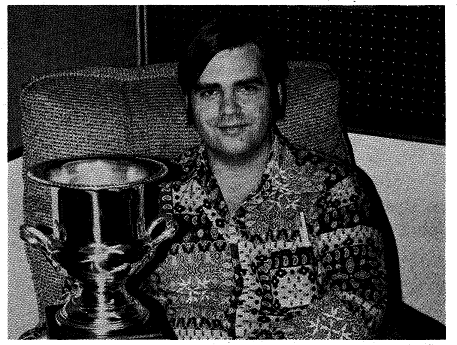
We also learn in this issue that Frank Mentzer won the 4th Invitational AD&D Masters Tournament at GenCon XIII. Dig that crazy shirt …

Speaking of great Dungeon Masters, this issue has a DM Evaluation Form for players to fill out. Here’s a sample …

This runs on for several pages and 43 questions! A couple issues ago, a reader complained that the adventures in the magazine were filler. This, ladies and gentlemen, is filler. I’m guessing GenCon kept them busy.

The Bestiary has some choice bits …

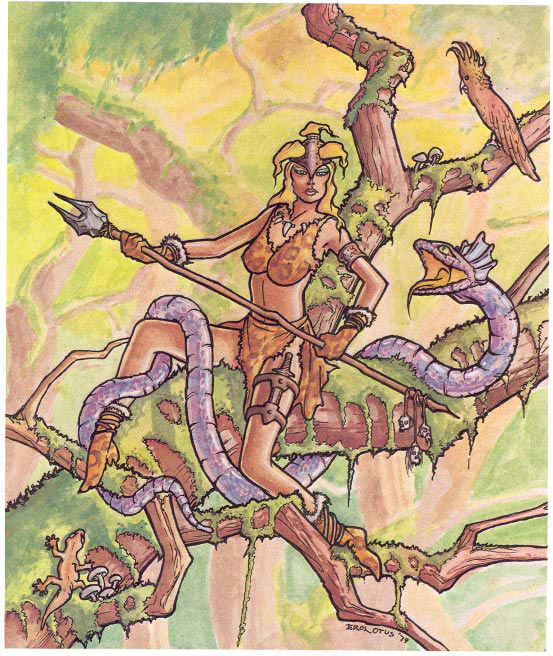
This is an amazon, art by Erol Otus (of course), monster by Roger E. Moore. I’d detail the monster stats here, but frankly, they’re humans and the women do all the “men’s work” and vice versa. Not much to see here – but the art is cool.

Todd Lockwood has a monster called a Tolwar that is basically a trunkless elephant who can telekinetically throw boulders (2d12 damage). They serve as loyal mounts.

Tolwar, Large Monster: HD 6, AC 15, ATK 1 slam (2d4) or 2 boulders (900’/2d12), MV 40′, SV F10 R11 W17, AL Neutral (N), XP 600 (CL 7), Special-Hurl boulders, only surprised on 1, telekinesis (100 lb), catch boulders with telekinesis (75%).

Ed Greenwood presents the lythlyx, a weird spiral creature that whips, constrict and drain blood from people.

Lythlyx, Large Aberration: HD 6, AC 19, ATK 1 whip (2d6 + constrict 3d6 + blood drain 1d4), MV 15′ (Fly 20′, Swim 20′), SV F13 R14 W11, AL Neutral (N), XP 600 (CL 7), Special-Blood drain can be used to heal monster (heal 1 hp per 4 hp taken), immune to charm, command, fear, hold monster and sleep, psionic attacks (all).

Now, give me a bunch of amazon warriors on tolwars hurling boulders at a band of adventurers who have stolen some amazon gold and are hiding in a half-ruined wizard’s tower, and you’ve got an adventure.

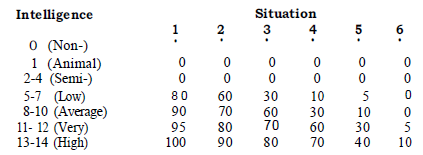
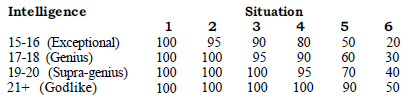
Philip Meyers has an article about disbelieving illusions, or more specifically phantasmal force. He comes up with a little system based on the intelligence of viewer and how suspicious they are about what they’re seeing. In the table below, situation 1 represents a character who has been informed about the illusion, and 6 is where the character expects to see what the illusion is depicting – in other words, 1 is super suspicious, and 6 is not suspicious at all.

The number is the percent chance of disbelief. It is increase by +20% if olfactory or thermal components are expected but not present, +20% if aural components are expected but not present, +10% if victim of illusion is an illusionist, -10% if victim is surprised and +10% if victim’s Wisdom is 15 or higher.

I reckon you can do about the same by giving a bonus to save vs. phantasmal force as opposed to improved phantasmal force or spectral force.

This issue contains a Traveller adventure called Canard. I won’t comment, because I’ve never played Traveller, but if you’re a fan, it’s probably worth checking out.

Two reviews which might be of interest – the first a Game Designers Workshop (not Games Workshop, as I originally posted) offering called Azhanti High Lightning, about fighting aboard a giant starship. The review was positive, but wonders whether or not they should have tried to tie it to Traveller.

They also review SPI’s DragonQuest, their first “serious” foray into Fantasy RPGs. The reviewer likes it – the intentional rather than random character generation, the action points in combat – but does not care for the way experience is handed out. Overall – positive review, and another reminder that Old School gaming was already becoming “Old School” in 1980.

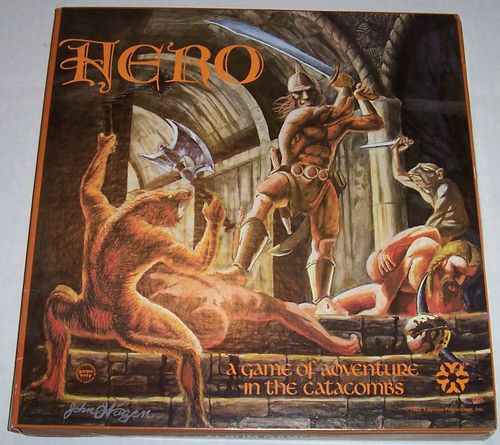
I’ll also note Hero, by Yaquinto Games. It was an “album game” – “The physical layout is like that of a double record album. The components are stored in the pockets, while the playing surface is printed on the two inside faces.”

Very cool idea, and it would be fun to see something similar done these days, especially considering the connection between Old School gaming and bitchin’ Heavy Metal album art.

I liked this comic …

A scroll of illiteracy would be a great cursed item in a game.

A fair issue of Dragon, with a couple notable bits.

So, what was White Dwarf up to in November (really Oct/Nov) of 1980.

First – cool cover, but there are much better WD covers yet to come. You also notice, right off, that the layout of WD is much more professional than for Dragon at this point. Dragon makes some improvements over the years, but frankly never looked as good, and by the 1990’s and 2000’s looked terrible.

In this issue, Andrew Finch presents some cool material inspired by The Chronicle of Thomas Covenant, Unbeliever. We have a new class, Lore Lords, who combine the spell-casting ability of magic-users and clerics, along with d8 hit dice and studded leather armor. Fortunately, this is balanced by a high XP requirement. Similar classes are the Rhadamaerl, who specialize in the lord of stone, and Hirebrand, who specializes in the lore of wood. There are also Bloodguards, who serve as bodyguards for Lore Lords, songs of summoning and words of power. Having never read the Thomas Convenant books, I cannot rate how accurate these classes are, but for fans they’re probably worth checking out. One bit I liked for Lore Lords was their ability to communicate telepathically with one another. A cool house rule might permit magic-users with intelligence and wisdom of 15 or higher to communicate this way with one another.

Roger E. Moore (yeah, that guy) presents a merchant class. It’s actually pretty close to the Venturer class I did, and I promise I hadn’t seen this write up when I wrote mine. Moore’s merchants can open locks, appraise items and use suggestion and command when speaking with people. These are all percentage skills, like those of the thief. Good class.

Azhanti High Lightning gets a review in this issue – positive as in the Dragon.

The Fiend Factory has several cool monsters, the Brothers of the Pine, Chthon, Enslaver, Micemen, Dragon Warriors, Grey Sqaargs and Cyclops. Here are some quick stats:

Brothers of the Pine, Medium Undead: HD 3, AC 15 [+1], ATK 1 weapon, MV 30′, SV F15 R15 W12, AL Chaotic (LE/NE), XP 1500 (CL 5), Special-Cast one 1st level druid spell per day, shrieking wail (save or flee for 1d8 turns), immune to cold, resistance to electricity, vulnerable to fire, only plant-based spells affect them.

Chthon, Medium Aberration: HD 8, AC 20, ATK nil, MV 0′, SV F13 R- W9, AL Chaotic (LE), XP 800 (CL 10), Special-Mineral intellect that hates all animal and plant life, especially intelligent, control up to 20 plants and animals (save to negate).

Enslaver, Tiny Aberration: HD 2+1, AC 14, ATK special, MV 10′, SV F19 R17 W12, AL Chaotic (CE), XP 200 (CL 3), Special-Blindsight 30′, 90% chance of hiding among rocks, dominate creatures that touch them (save negates), hosts freed from domination must make system shock roll or die, hosts are immune to pain and mind effects.

Micemen (crossbreed of brownie and orc!), Small Humanoid: HD 1-1, AC 13, ATK 1 javelin and dagger, MV 30′, SV F14 R16 W16, AL Chaotic (LE), Special-Infravision 90′, shun bright lights, surprise (4 in 6). Despite the picture, I’d like to see these dudes as evil piglets dressed as Robin Hood.

Dragon Warrior (made from dragon teeth), Medium Construct: HD 5+1, AC special, ATK 1 weapon, MV 20′, SV F14 R14 W14, AL Neutral (N), XP 500 (CL 6), Special-Cannot speak, obey commands, last for a number of turns equal to the dragon’s age category, +1 to hit, +2 to damage, attack as 6th level fighters, immune to parent’s breath weapon type, sleep, charm and hold, clad in scale armor and armed with broadsword, disintegrate when killed or dispelled.

Grey Sqaarg, Medium Construct: HD 6, AC 22, ATK 1 grapple, MV 20′, SV F14 R14 W14, AL Neutral (N), Special-Constructs built by ancient dwarves, never initiate attack, fight with strength bonus to hit and damage equal to combined modifiers of attackers, grapples to incapacitate people, made of solid stone, magic resistance 30%.

Cyclops, Large Giant: HD 6, AC 14, ATK 2 claws (1d6), bite (2d6), MV 30′, SV F10 R14 W14, AL Chaotic (CE), Special-Hypnotic stare, -1 to hit melee, -2 to hit ranged, +2 save vs. illusion, prefer to eat demi-humans to humans, breed with human females.

White Dwarf #21 also contains a sci-fi boardgame called Survival and a dungeon called the Tomb of the Maharaja. It is, I’m afraid, quite short and not terribly interesting.

All-in-all, some pretty cool stuff from the Brits in November 1980 – and of course, lots of art by Russ Nicholson.

Well, that does it for this edition of Dragon by Dragon. As always, I leave you with Tramp …

The Saboteur – A New-Old Class

Circa 1984, I was in 6th grade and discovering role playing games – well, Dungeons & Dragons. I’d played a game with a friend who only knew the game based on watching his older brother play. He drew up a dungeon on graph paper, and during recess he ran me through it using a D6.

The next step was me getting Moldvay Basic from Toys ‘R’ Us, then Cook Expert, then into the AD&D line (dude – rangers are cool).

Now, I want to bring the younger readers back into these primitive times. Photocopiers existed, but they weren’t cheap. I convinced my mom to spend a decent chunk of change letting me check out copies of Dragon magazine from the library, take them to Kinkos, and copying articles at $.25 a page. Eventually she found it cheaper to get me a subscription for Christmas. Before I got to that lofty place, though, the way I copied stuff was with a typewriter. I remember borrowing module B1 – In Search of the Unknown – from a friend and typing it page by page – double column (which involved actually making a few spaces and then writing the line of text in the next column) and then tracing the pictures. Hey – it worked – got B1 for free (wish I still had that copy I typed).

Around that time, I decided to write my own game. To say it was heavily influenced by D&D rules would be an understatement, of course, but I was smart enough to know that if the game was to be original, I needed to spin things a bit. Thus, the thief became the saboteur. I don’t remember much about the old saboteur (again, wish I still had those typewritten pages somewhere), but today I got to thinking about that old game, and those old times, and figured I’d make a new saboteur class for Blood & Treasure.

THE SABOTEUR

Hit Dice: d6 per level, +2 hp per level after 10th
Attack: as thief
Save: as thief

Saboteurs must have a dexterity score of 9 or higher and an intelligence score of 12 or higher. They can wear up to leather armor and cannot use shields. Saboteurs can use daggers, flails, clubs, maces, morningstars, crossbows and firearms.

Special Abilities

Saboteurs are skilled at the following tasks: Climb walls, hide in shadows, move silently, open locks, remove traps, use and disable mechanical devices, use magic items (after 8th level) and operate siege engines. For many of these tasks, they require a set of sabotage tools.

Saboteurs are capable of concocting explosives. At 1st level, they can concoct black powder explosives that deal 1d6 points of damage per pound. They can attach fuses that take from 1 round to 1 minute to detonate. One pound of powder requires 1 day and 10 gp for the saboteur to create.

When a 3rd level saboteur strikes a foe that is wearing armor, he can forgo dealing damage and instead lower their effective Armor Class by 1 per 3 saboteur levels. The effective AC of the armor remains lowered after the combat until it is repaired by an armorer.

At 6th level, the saboteur can spend an extra day and an extra 25 gp (so 2 days, 35 gp) to make a more refined and powerful explosive that deals 1d10 points of damage per pound.

Saboteurs always deal double damage with their weapons and explosives against constructs and mechanical devices. This includes magical constructs. A 6th level saboteur can damage golems even without magic weapons, though he does not deal double damage against them. Moreover, when he successfully strikes a golem by rolling a natural ’20’, the golem loses its magic immunity for 1 round.

9th level saboteurs can damage magic items to the extent that they lose their powers for up to 1 day per the saboteur’s intelligence bonus (if she has an intelligence bonus). The saboteur must be able to handle the item, and must employ lodestones, lead wire and a silver hammer to temporarily cancel the magic item’s properties.

Saboteurs do not build strongholds, but they do gain followers. Starting at 7th level, a saboteur attracts one follower per level until they reach 11th level. Followers who die are not replaced. Roll these followers on the following chart:

1. 1d4 gnome tinkerers (0-level)
2. 1d3 rogues (0-level – see henchmen section to determine abilities)
3. 1d2 men-at-arms (leather armor, short sword, light crossbow)
4. Assassin (roll 1d2 for level)*
5. Thief (roll 1d3 for level)*
6. Saboteur apprentice (roll 1d4 for level)*

* Takes a 10% share of the saboteur’s experience points.

Blood & Treasure 2nd Edition – Skills

Part of cover illustration by David Williams

From now until the game is released, I’m going to do some weekly posts on how the 2nd edition of Blood & Treasure is shaping up.

Blood & Treasure was designed to be rules lite and options heavy, and that isn’t changing in the new edition. My goal is to take nothing out of the game, but to, wherever possible, correct old mistakes and streamline old rules to make them easier to understand and play. That brings us to subject #1 – Skills.

Or tasks, as I prefer to call them. I thought the old system was pretty easy – to whit – if a character is unskilled at a task, roll 1d20, beat 18 and succeed. If a character has a knack (such as an elf searching for secret doors), roll 1d20, beat 15 and succeed. If a character is skilled, roll a saving throw to avoid failure at the task. That way, the skilled – such as thieves climbing walls – get better at tasks as they advance.

Apparently, though, it caused some confusion for people, specifically the saving throw idea. So, how do we adjust?

As follows:

To perform tasks outside of combat, one need only tell the Treasure Keeper (TK) what they wish to accomplish. If the TK thinks the task can be accomplished without much difficulty, he merely tells the player they were successful.

If success is in doubt, either because of the degree of difficulty of the task, or conditions that would make success unlikely, the TK can require a task check.

To make a task check, the player rolls 1d20 and adds to this roll the relevant ability score modifier (see table below) and any bonuses they might have for their race, class or other circumstances.

If the roll is 18 or higher, the task check is a success. If the roll is lower than 18, it fails, with the consequences of the failure determined by the Treasure Keeper.

If the task is one in which a character class is “skilled”, they add their level to the task check.

The ability scores associated with various tasks are as follows (though note that the Treasure Keeper may rule that under some conditions a task might be modified by a different ability score.) …

What follow that is a list of possible tasks, and the ability score that modifies them, such as acrobatics modified by dexterity or swimming modified by strength.

Several tasks rely on using tools. Trying to perform these tasks without the proper equipment should be done at a -2 penalty.

The key thing to remember about tasks checks is that if it seems reasonable that a character can do it, there is no need to roll dice! Save the rolling of dice for difficult, dangerous or dramatic tasks.

Here’s where the options kick in. For those who like the 3rd edition approach, I have an optional simplified skill points system:

Skill Points (Optional)

If your players would like more control over their character’s skills – and you want them to have that control – you can allow them to spend “skill points” on the various tasks in this chapter, each point spent giving them a +1 bonus to use those skills in play.

When attempting a task, the player rolls 1d20, adds their skill bonus, ability modifier, bonuses for race or circumstances, and attempts to roll an 18 or higher to succeed.

The number of skill points available to a character to spend at each level depends on the character’s class. Multi-class characters add their class’ skill point totals together.


For those who instead prefer the way old editions handled such things, I have a system inspired partially by the rules for finding secret doors and partially on the original (pre-Gygax) thief class that has been making the rounds in the OD&D blogosphere of late.

Simple Task Checks (Optional)

If you would like to keep task checks extremely simple, you may use the following system:

If characters attempt something at which they are untrained, roll 1d6. On a roll of 1, they succeed.

If they are attempting something at which they excel due to their race, such as elves finding secret doors, roll 1d6. On a roll of 1 to 2, they succeed.

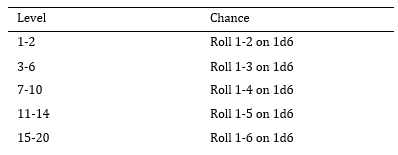
If they are attempting something at which they are skilled due to their character class, consult the following table:


If the task is more difficult than usual, the TK can rule that it must be rolled on a larger dice, usually d8 or d10.

Note that this system does not take into account ability scores, which may disappoint some players.

So, three options on handling skills in Blood & Treasure taking up about a page and quarter in the rule book. As a game master, I would probably let the players use the standard system, and would use the simplified system for monsters and NPCs.

As always, I’d like to hear the opinions of the readership, especially those who are interested in Blood & Treasure.

Next time, I’ll discuss what I might do with saving throws in 2nd edition Blood & Treasure

Thinking About Armor

While playing with Blood & Treasure’s second edition, I was thinking about armor and it occurred to me that you could characterize the armor table as follows (with AAC standing for Ascending Armor Class, and DAC standing for Descending Armor Class):

Leather = AAC 12 / DAC 8

mixture of leather and metal, but mostly leather (like brigandine) = AAC 13/ DAC 7

mixture of leather and metal, but mostly metal (like jazeraint) = AAC 14 / DAC 6

Metal mesh = AAC 15 / DAC 5

mixture of mesh and solid, but mostly mesh (like mirror armor) = AAC 16 / DAC 4

mixture of mesh and solid, but mostly solid (like plate & mail) = AAC 17/ DAC 3

Solid metal = AAC 18 / DAC 2

The values above are for a full or almost full suit of armor – from shoulders to lower arms and torso down to knees. For half-armor – shoulders to upper arm, maybe covering upper legs – you deduct a point from the Armor Class value. You could probably take it further, and drop the bonus by 2 for “quarter-armor” for those punk barbarians out there who like to accessorize with armor without really committing to it.

A shield still gives the normal 1 point bump (or in Blood & Treasure, a 1 point bump for bucklers, and a 2 point bump for larger shields).

The point of this would be to make it easy to figure out what protective value different types of armor should have – not just real armor that doesn’t show up on the old leather-mail-plate table, but also illustrations of fantasy heroes and heroines in the fantastic armor artists often dress them.

Also …

GRIT & VIGOR

In print

200 pages of rules and ideas for modern adventures

Gunslingers, daredevils, private eyes, samurais, scoundrels and even scholars!

Hard cover $26.99 | Paperback $18.99

As always, if you purchase a hard cover and email me the receipt, I’ll send you a download link for the PDF


NOD 28, Revisions and Goodies

It’s a bad sign when you start all of your blog posts with “I’m sorry I haven’t posted lately …”. Still, I’ve been a busy boy, so I have a good excuse. Here are my current RPG projects and a glimpse at what I would like to do moving forward, as well as a few RPG odds and ends mixed in to make this more than an advertisement.

NOD 28

First and foremost – I’ve put NOD 28 out for sale today as a PDF! It’s going for $4.99 – 78 pages, with part one of the Trollheim Mountains hex crawl (trolls, pseudo-Russians, elemental folk, a crazed demigod, etc.), a Swiss mercenary character class, new rules for handling disease in RPG’s and a campaign idea for a “World of Atlantis” game drawing from Theosophy’s notion of “root races”. Tons of fun for $4.99. GET IT HERE or HERE.

BLOOD & TREASURE 2nd edition

I’m about 80% complete with editing and laying out the new B&T Player’s Tome, and about 35% complete with the Treasure Keeper’s Tome. The 2nd edition will not be a major departure from the first, but I’ve made some adjustments to saving throw values, XP requirements, I’ve tried to give the sorcerer some personality and make the ranger the cool cat I remember from youth, streamline any rules that could use streamlining, etc. The goal is still RULES LITE – OPTIONS HEAVY. Most of the work I’ve done is concerned with improving the layout and incorporating the first edition errata. I’ve also commissioned new covers from David Williams, which are being colored now. Here’s a sneak peek – half of this image will be the Player’s Tome, the other half will be the TK’s Tome.


If anybody has an ingenious old school idea they think would improve fantasy gaming, let me know and I’ll see if I can’t incorporate it into the rules.

QUICK MONSTER: GOATMAN

Goatmen live in hidden valleys, deep within forbidding mountains. Half mad, chaos flows through their veins. When the moon is full, they descend into the lowlands, seeking out people to torment or torture.

Goatman, Medium Monstrous Humanoid: HD 1; AC 16; ATK 1 slam (1d6); MV 30; SV F15 R13 W14; XP 250 (CL3); Special-Auras.

Goatmen cause fear (as the spell) to all within 10′ of them. Each time a person succumbs to this fear, the goatman grows larger, gaining 1 hit dice (and all that goes with it). At 6 HD, they become large creatures and their aura changes to one of madness (save or go temporarily mad). Each person that goes mad causes the goatman to gain another HD. At 12 HD, the goatman becomes huge, and the aura becomes one of death. All within 10′ of the beast must save or die. Each creature that dies increases the goatman’s hit dice by 1. At 18 HD, the goatman explodes into shadow and ceases to exist. The land where he explodes becomes permanently blighted and haunted by the souls of those who died.


MYSTERY MEN! Revision

I’m further along with the MM! revision than B&T. The book is laid out, the rules tinkered with, and now I just need to give it a thorough editing. This version will still have the sample Shore City setting and the sample adventure, but will also include several write-ups of heroes and villains.

NEW SPELL: UNWITTING ALLY

Magic-User 2
Range 10′ radius
Duration 1 minute

One enemy helps you despite himself. When this spell is cast, one enemy within 10′ chosen at random must pass a Will save or become your unwitting, unwilling ally. Every move the creature makes has the possibility of helping you. For each action, roll 1d6.

1-2. The creature’s action proceeds as normal.
3-5. The creature’s action proceeds as normal, but has a side effect useful to you.
6. The creature’s action is twisted to your purpose entirely.

Help, in this case, is up to the referee, but would include things like the monster making a move, but also accidentally tripping or running into one his allies, the monster making an attack, but accidentally attacking an ally as well, etc.

BLACK DEATH

The latest Quick and Easy RPG is Black Plague, which really just needs some editing and it’s ready to go. This one is set in the era of Europe’s religious wars (mostly the Hundred Years War), and is intended to be grim and gritty – more survive than thrive. This Q&E is a bit heftier than past editions, due to containing a bit more setting info and some rules for disease and damnation.

QUICK MONSTER: LEAF SWARM

A leaf swarm is a swarm of vicious green insects. They descend on a tree, strip it of leaves, and then take their place. When a creature nears the tree, the leaf swarm strikes, surprising on a roll of 1-4 on 1d6. The monster’s stings cause blindness. The first save a creature fails blurs their vision (-2 to hit and damage), the second failed save blinds them for 1 minute, and the third blinds them permanently.

Leaf Swarm, Tiny Vermin: HD 4; AC 13; ATK 1 swarm (1d3 + special); MV Fly 60; SV F14 R13 W14; XP 400 (CL5); Special-Blindness.

THE FUTURE

What I’d like to start doing next is producing more adventure material for the games I’ve written. No more games for me – just fun, supplemental material.

For GRIT & VIGOR I want to do setting books that cover different eras – the historical events that lend themselves towards adventure, the equipment, the personalities. Each book would also have an adventure for that era. These would be trade paperbacks, probably 40 to 60 pages.

For MYSTERY MEN! I’d like to do some short books of heroes and villains, also accompanied by an adventure or two. They might be themed, or they might just be whatever tickles my fancy. These would maybe run 20 to 30 pages, trade paperback.

For BLOOD & TREASURE I’d like to do some adventures, with a few new monsters, new spells, etc. Again, trade paperback, probably 30 to 40 pages.

I also want to start writing supplements called THE LAND OF NOD that would provide hex crawls, mini-adventures and other setting material. These would probably also be trade paperbacks, maybe in a landscape format. Page count here would probably be around 120 pages. The first step would be to collect and revise the old NOD hex crawls.

I still have a revision of Space Princess and Pars Fortuna slated for the second half of this year, and I have more Bloody Basics I would like to make.

So – that’s what’s on my agenda for 2016. We’ll see how far I get. Hopefully, as the revisions and editing slows down I’ll have more time for blogging. I have tons of ideas that need to be fleshed out, and God willing I’ll start that fleshing process as the year wears on.

Cheers!

Six Dandy Daggers

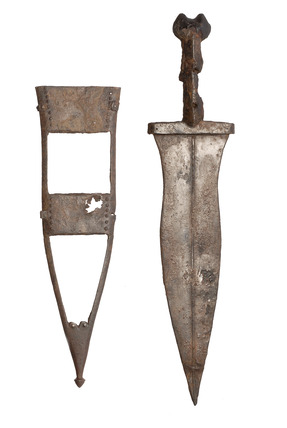
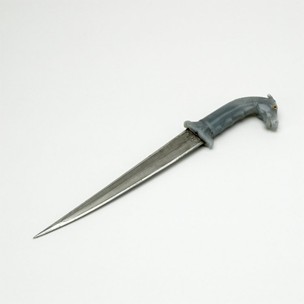
Nothing fancy today, just six magic daggers you might find useful in your game.

Image found HERE

Koroth’s Crippling Blade
This +1 dagger, when it strikes on a critical hit, buries itself in the victim’s body, assuming the victim is not killed by the blow. The dagger continues to deal 1 point of damage each round, and the victim is considered to be crippled (per the condition). The dagger can only be removed by its owner, after a remove curse or dispel magic is cast, or by making a Bend Bars/Lift Gates task check. If the dagger is pulled out, it deals a final 1d4 points of damage on the way out.

Image found HERE

The Blade of Avarice
This +1 dagger, when balanced on left pointer finger (requires a Balance task check), will point towards the largest mass of gold (be it coins, ore, etc.) within 500 feet.

Image found HERE


Knife of the Mason
This +2 dagger deals double damage against stone, be it ordinary stone or animated stone, such as a stone golem or caryatid column. Against flesh, wood or metal, it deals half damage.

Image found HERE

The Hungry Blade of Inzo-Khan
This +2 dagger can absorb one spell of up to 6th level cast in the presence of the dagger. When it does, the pommel glows first a tepid pink (as bright as a candle), then 10 minutes later a rosy red (as bright as a torch), then an hour after that a brilliant yellow (as bright as a lantern). The spell energy must be discharged from the blade to make the glow stop. The energy can either be channeled into a free spells (already prepared or known) of 1st to 3rd level if the dagger’s wielder is an arcane spell caster, or by making a hit with the dagger that beats an opponent’s AC by an amount equal to the level of the spell absorbed.  After 12 hours of glowing yellow, the dagger finally leaps from the wielder’s hands and dances, attacking the wielder with an attack bonus equal to 5 + the level of the absorbed spell for 10 rounds.

Image found HERE


The Resurrection Blade
When this +1 dagger is used to make a backstab attack against a humanoid, and that humanoid dies, it is immediately animated as a zombie under the control of the holder of the dagger. The dagger can only control one zombie at a time, and the animation lasts for 24 hours.

Image found HERE

The Crusader’s Blade
This +2 dagger practically leaps from one’s hands in the presence of Chaotic (Evil) creatures, it is so eager to attack them. The holder, if he or she does not wish to attack, must pass a Will saving throw each round to avoid giving into the dagger’s wishes. If the dagger does kill a Chaotic (Evil) creature, the creature is immediately resurrected with a Lawful (Good) alignment. Neutrals just stay dead. Lawful (Good) creatures killed by the dagger are not reborn, but the dagger’s owner’s alignment immediately changes to Chaotic (CE) and the dagger teleports elsewhere. The owner can only be changed back to their original alignment if they are slain by the Crusader’s Blade.

Laser Mage, Because Why Not?

Image found HERE

Sometimes, you need a weird class to shake things up. The laser mage is one of those classes that starts as a phrase that pops into your head, and then begins to take shape as you let your mind wander and explore. I saw a guy with a wand covered in crystals who could do interesting things with light – something like a combination of illusionist and evoker, but more focused. I pictured something of a magical duelist, a class for people who had played everything and were ready to figure out how to make something new work for them, or people who didn’t want their class abilities to lock them into a particular role.

LASER MAGE

Laser mages are arcane wash-outs. They never quite got the hang of magic in general, but showed a weird interest in, and ability with, the light spell. Light is to the laser mage what read magic is to normal magic-users – the key spell without which they cannot operate. They know it so well, they can cast it from memory.

To produce multiple effects with this single spell, the laser mage needs a light projector. The projector looks like a rod or thick wand. It is a hollow metal tube about one foot long and tipped with a faceted rock crystal. The crystal is cut by the laser mage, so as they progress in level their skill as a gem cutter increases as well. They also learn how to use other translucent gemstones, faceted or curved, to increase the effectiveness of their spell, or produce additional effects.

Requirements
Intelligence and Dexterity of 13 or higher

Armor & Weapons
As magic-user

A 1st level laser mage can cast the light spell at will. Casting this spell through his light projector is how he manifests all of his other abilities, not including his skill as a gem cutter and his ability to appraise the value and quality of precious stones.

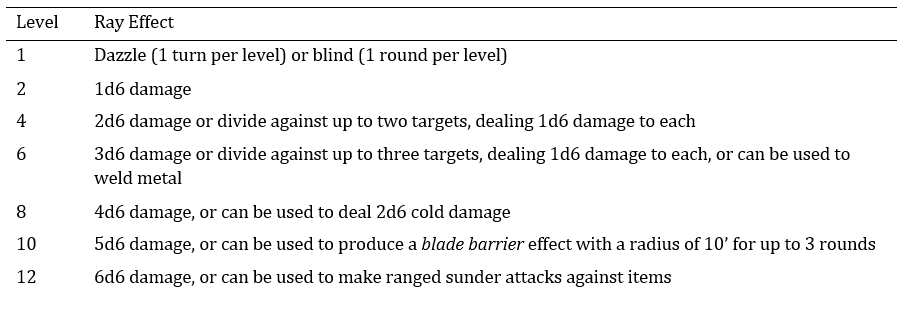
The first thing a laser mage learns to do is project rays of light through the crystal at the end of his light projector. These rays have a range of 20’ and require a ranged attack roll to hit. The ray’s effect depends on the laser mage’s level and, of course, how intense they want it to be.

These improved rays, and the other special light effects gained by the laser mage are dependent on the laser mage improving the main gemstone in his light projector. This must be done at the following levels, with a gem of a stated value (or higher): 4th level, 100 gp, 6th level 500 gp, 8th level 1,000 gp, 10th level 2,500 gp and 12th level, 5,000 gp. The gem must be polished and cut by the laser mage himself, requiring a gem cutting task check (Reflex task, modified by dexterity, skilled).

At 3rd level, a laser mage can project a beam of light from the projector that can be used as a sword. The beam deals damage as the ray would, and requires a melee attack to hit.

By adding additional colored gemstones to the light projector, the laser mage can project 10’ cones that influence emotions (Will save to resist) as follows: Red gems cause rage or dispel fear effects, blue gems calm emotions or dispel charm effects, yellow gems cause crushing despair or grant a +1 bonus to reaction checks, and green gems cause fatigue (for 1 turn) or inspire good hope.

Finally, the 1st level laser mage can use his light projector to analyze materials, gases and liquids. A knowledge task check is required to interpret the results (Will task, modified by Wisdom, skilled), which determine the material’s content, and which can detect magic.

At 3rd, 5th, 7th, and 9th level, the laser mage can add a gemstone worth at least 50 gp to the handle of his light projector to improve the projector’s function. The laser mage determines the improvement gained at each level. Only one improvement can be applied to any given light effect. The potential improvements are: Double range, double duration, impose -2 penalty to saves against the effect and add +1 to hit on ray attacks.

Laser mage’s can create the following additional effects with their light projectors, based on their level and provided they have added the proper stone’s to their light projector:

A 9th level laser mage may open an academy. He attracts 1d6 gem cutters (0-level), 1d6 men-at-arms, 1d6 1st level laser mage students and a 3rd level laser mage to act as his lieutenant.


Dragon by Dragon – August 1980 (40)

It’s chilly outside, but this edition of Dragon by Dragon goes back to the balmy summer days of 1980, with the August issue of Dragon! Fantasy and sci-fi films were all the rage in August 1980, from Smokey & the Bandit II to Xanadu to Final Countdown. Well, the last two are fantasy/sci-fi. The first is sort of fantastic.

Let’s see what fantasy & sci-fi offerings the good folks at TSR were serving up …

AUGUST 1980 DRAGON TOP TEN

#1 – PEOPLE CAN COMPLAIN ABOUT ANYTHING

A letter to the editor:

“Dear Editor:
I must get it off my chest: Why do you print so many modules? I agree that it’s a nice concept, a magazine and a module for only $3.00, but there are some people who could do without them and be able to afford this almost perfect magazine. If you must put a filler of some sort in here, why not. make it a game?”

Apparently, the modules were “filler”.

AD BREAK

I’ve seen some interest in Boot Hill and western RPGs recently on Google+, so I thought this ad might be of interest:

I’ve seen many Boot Hill articles, but this is the first ad I remember seeing.

#2 – THE DUELING ROOM

This will sound odd to some readers, but one of the things I like about early D&D was the lack of desire to make it immersive and real. There was already that strain in some players and game masters, but the early breed seemed content to play it as a game that didn’t have to make much sense. Characters had crazy names and did crazy things.

Thus my appreciation for “The Dueling Room” article by Jeff Swycaffer. It’s a place for two players to pit their characters against one another. Why? Because it sounds like fun. Because my character can beat up your character – no he can’t – yes he can – prove it!

Naturally, the dueling room has some random tables attached to it, because the room changes as the duel proceeds, including some “odd events” like fireballs bursting into the room and absolute, unalterable darkness for 6-11 turns. Sounds like fun.

I seem to remember some folks on G+ doing a D&D fight club – this would be the perfect arena for fights like that.

I think I’ll put designing something similar on my list of articles I need to finish for this poor, neglected blog.

SIDE TREK

“Digging the burial mound or building the funeral pyre requires 1-6 hours of labor, depending on the softness of the soil and the availability of firewood. Another 1-3 hours is required for preparation of the body, final rites and actual interment or cremation.” – George Laking

Now you know.

#3 – FLAMING OIL

Flaming oil (and it’s modern cousin alchemist’s fire) have long been popular because they seem like a way to break the melee rules and kill things that would otherwise be difficult to kill. My players have hurled or prepared to hurl flaming oil quite a few times.

“Don’t Drink This Cocktail – Throw It!” by Robert Plamondon is an examination of the stuff. This is one of those articles that deeply explored a D&D concept … to death one might say. The desire to make gaming very complex was there from the start, and the cycle of “more complexity” to “more simplicity” is ongoing. I’m old and crusty enough now that I’m pretty thoroughly stuck in the “keep it simple” camp.

Still, as long as this article is, the rules are pretty easy to boil down:

Only you can prevent fire damage

1 – Make attack roll. If you miss, roll d12 to determine which direction (1 = “1 o’clock”) it goes.

2 – Roll d20 – on a “1” it didn’t break, on a “2” it didn’t light.

3 – If you hit, you score 2d6 damage in round one, and 1d6 in round two.

4 – Splash is3′, creatures get a saving throw (vs. poison) or take 3 damage. Armor doesn’t help.

The article touches upon the flammability of dungeons, and then includes this gem:

“Additionally, rumor has it that pyromaniac players are sometimes attacked by a huge bear in a flat-brim hat who fights with a +6 shovel.”

#4 – THE OTHER WERE

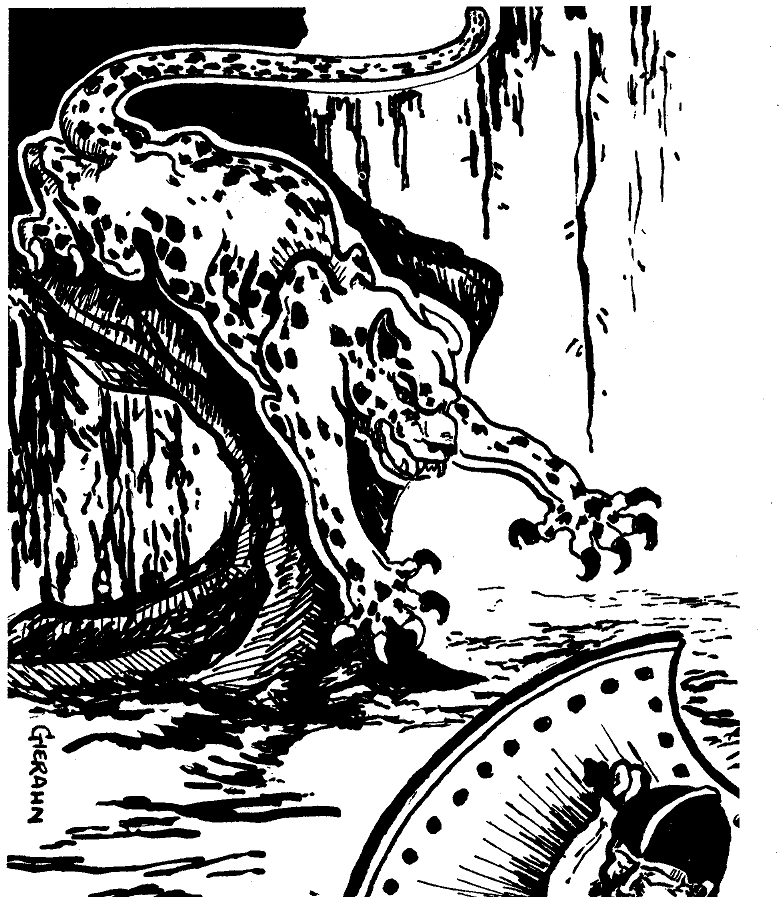
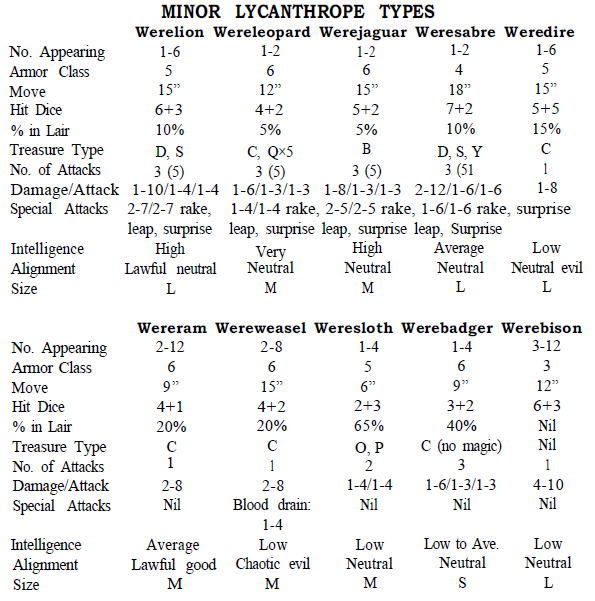
Roger E. Moore presents a number of additional were creatures in this article: Werelions, wereleopards, werejaguars, weresabres (as in sabre-tooth tigers), weredires (as in dire wolves), wererams, wereweasels, weresloths (yep), werebadgers and werebisons.

Not a bad collection. I often just hand wave alternate were creatures and use the existing were creature stats I think are closest – such as using the werewolf for a wereleopard, but why not use this quick and easy chart of monster stats instead:

And dig that werejaguar illustration that accompanied the article.

AD BREAK

I thought this ad was unique:

I’m guessing the art for Spellbinder was late …

#5 – GIVING THE UNDEAD THEIR DUE

The article “Giving the Undead an Even Break” by Steve Melancon starts as follows:

“A 22nd-level Mage Lich approaches a band of adventurers. Suddenly, an 8th-level Cleric presents himself forcefully. The DM rolls 19 on a 20-sided die, and the Lich runs in terror.

Such a scene is ridiculous.”

Is it? If the game is meant to be “realistic” to you, or you’re looking for high drama, I suppose it is. If you’re playing a game, then it’s not so bad. Clerics turn undead. The lich is undead. So be it. Monopoly is equally ridiculous, but it’s just a game. So what?

If this does bother you, though, this article might help. It uses a percentile roll for turning undead, to make the tough undead harder to turn. There’s some cross referencing involved as well.

Personally, I’d just allow “name-level” undead a saving throw against the turning effect, giving them another chance to resist. Simpler, probably just as effective.

#6 – INTERNATIONAL MEN OF MYSTERY

Paul Montgomery Crabaugh wrote a nice little article on globe hopping for international spies, for the Top Secret game. It’s nothing fancy, just a d% table of 100 “fun” places to visit on a spy adventure. The game master can use it to help design a convoluted plot – roll for a starting point, then roll three or four more times for where clues might lead … with a few false clues thrown in to make it tough. I won’t reproduce the table here, but check out the issue and the article, especially if you’re doing a Cold War spy game.

SIDE TREK

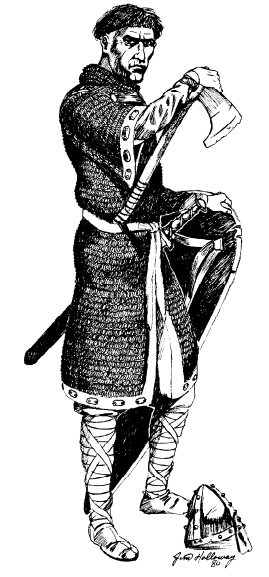
There’s a long article in this issue about how fantasy worlds should operate, which is interesting but, really, “say’s who?” It is a worthwhile article to read, though, with some neat concepts and tables – again, I suggest one find a copy of the magazine – but what I wanted to point out was an early piece by Jim Holloway for TSR.

If I had the money, and the interest was out there, I’d love to do an expanded Sinew & Steel with art like this in it.

AD BREAK

Read more about it

#7 – MONSTERS

Josh Susser created a pretty cool monster for this issue. The fire-eye lizard is something like a tiny dragon (red, orange, yellow, green, blue, indigo or violet) with blazing, luminescent eyes it can use to blind creatures. It can also make a prismatic sphere of its own color that lasts for 3

turns. Lizards of different colors can cooperate to add layers to the sphere or lizards of the same color can make larger spheres with a longer duration.

Here are the Blood & Treasure stats:

Fire-Eye Lizard, Tiny Magical Beast: HD 1+2 (females 1+3); AC 16; ATK 1 bite (1d4 for males or 1d4+1 for females); MV 5 (F120, S30); F16 R13 W16; XP 100; Special-Blind, prismatic sphere.

I also dig Ed Greenwood’s wingless wonder (illustration to the right), but would mostly love to play one in a game. Here are the quick stats:

Wingless Wonder, Small Aberration: HD 2+2; AC 12; ATK 9 or 12 tentacles (1 + constrict); MV 20; F16 R15 W13; XP 200; Special-Radiate continuous anti-magic shell, immune to fire, eats gems (cannot digest them, 1d4+4 in stomach), psionic blast when killed (-4 to save).

The issue also has stats for Pat Rankin’s flitte and Lewis Pulsipher’s huntsmen.

#8 through #10 … well, nothing. Not as much caught my interest this issue. There were some magic items for Runequest, and some D&D magic items folks might like, and the aforementioned very long article about making faerie “real” in your campaign worlds. Tom Wham also wrote some additions for The Awful Green Things from Outer Space.

See you next time, hopefully with some new content for your game.