 |
| It’s the end of the late Bronze Age world, and I feel fine |
If D&D represents a fantasy post-apocalyptic world, it makes sense to look for ancient fallen civilizations to use as inspirations for campaigns. What better than Troy?
THE LEGEND
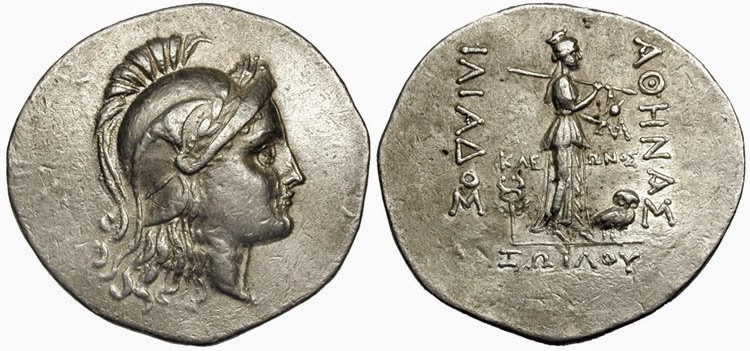 |
| A silver piece from Troy |
Helen was a drop dead gorgeous (and a demigoddess, the daughter of Zeus), apparently, and Paris, prince of Troy, was smitten. So smitten, in fact, that he convinced her to run away with him to Troy where they would live happily ever after.
Well, not so fast. Apparently, Helen’s husband, Menelaus, the King Sparta (those happy-go-lucky fellows) was none too happy about this situation. More importantly, he had managed to extract an oath from all her old suitors (also kings and lords) when he married her. They swore that they would lend him military aid if anyone tried to steal her away as a way to ensure that none of the other great Greeks would try kidnapping her. Menelaus rallies the Greeks and off they go to lay siege to Troy for a really long time. The gods get involved here and there, and ultimately Troy falls due to the trickery of Odysseus more than the rage of Achilles. The Greeks go too far, of course, and sack the temples and are visited with many troubles.
This, ladies and gentlemen, is the Age of Heroes, the days when the great heroes of Greek mythology trod the earth and the gods and goddesses took a very active interest in the world, moving people around like pawns in a great game only they understood.
THE HISTORY
Eventually, the actual existence of Troy was proven, by Frank Calvert in 1865 to be precise. It’s mythic history was then woven into the historic period called the Late Bronze Age Collapse. The Greeks would have called it the Golden Age Collapse, but why quibble – a collapse is a collapse.
 |
| The walls of Troy, as they were |
The collapse involved the transition from the late bronze age to the early iron age, and the disruptions that resulted from this technological shift. Power structures are built on the now, and the new often causes things to tumble. According to Wikipedia, “The palace economy of the Aegean Region and Anatolia which characterised the Late Bronze Age was replaced, after a hiatus, by the isolated village cultures of the Greek Dark Ages.” During this period, from 1206 to 1150 BC, we have the fall of the Mycenaean Kingdoms, the Hittite Empire, the New Kingdom of Egypt. Not only was Troy destroyed (twice, apparently), but also the Hittite capital of Hattusas, and the city of Karaoğlan.
That sounds like D&D – small villages and brand new ruins to loot and plunder.
WHAT’S DIFFERENT?
So what is different about a Post-Troy fantasy campaign than the standard D&D campaign?
Bronze Weapons: The fighting-men of this era are fighting with bronze weapons, rather than iron or steel. Iron was not unknown in this period, but iron weapons were probably still relatively rare – they were the high-technology of the time. With this in mind, it probably makes sense to allow bronze weapons to have the standard weapon statistics in your game (short sword 1d6 damage, etc.), and make iron weapons something akin to magic weapons in your campaign. A +1 bonus to hit probably makes sense, especially since they’re being employed against bronze armor. It might also make sense to treat them something like silver weapons when fighting supernatural creatures, since the manufacture of iron, and thus blacksmiths in general, was considered magical by many people (any technology advanced enough, etc. etc.)
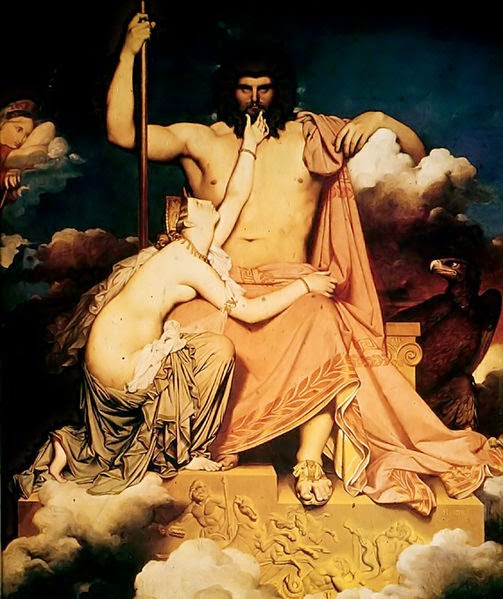 |
| Come on Zeusy – my boy needs a cleric spell. |
Divine Champions: In the Iliad and the Odyssey, we are introduced to the concept of certain characters being favored by the Greek gods and goddesses. This brings up the idea of casting clerics not as simple priests, but rather as extraordinary men and women favored by the gods, and perhaps descended from the gods. Odysseus, for example, had the blood of Hermes flowing through his veins, and Achilles was the son of the nymph Thetis, who could intervene on his behalf with Zeus. The idea here would be that these champions could pray to the gods and get solid, concrete results because they were part of the extended divine family. One might also use the demigod class I came up with in a campaign like this. At a minimum, feel free to make the gods and goddesses active participants in the campaign.
PLACES TO VISIT, PEOPLE TO SEE
First and foremost, the Fall of Troy campaign provides a great megadungeon in the ruins of Troy. Sacked by the Greeks, a battleground (indirectly) of the gods, the famous horse, the sacked temples, the great palace, etc. Obviously, we’ll need to bring in a subterranean aspect to the city – catacombs, caverns, etc. Making Troy a total ruin allows one to populate it with monsters – goblins and the like – bubbling up from the Hades’ realm.
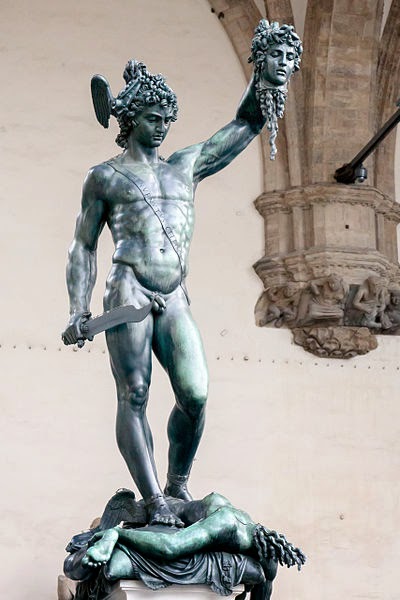
Any spot in Greek mythology is fair game, of course. The island of the gorgons, entrances to the underworld, the amazons’ queendom (or its remnants), the oracle at Delphi (imagine the dungeon that exists below the oracle, from whence come the strange fumes that drive her prophecies), etc.
Maybe the perfect campaign in this setting is one patterned on the journeys of Odysseus. This would be an island-hopping campaign, with the adventurers and their henchmen traveling from place to place, maybe trying to get home, maybe searching for a new home (i.e. Aeneas) and maybe just looking for treasure and adventure.
For another wrinkle, the Late Bronze Age Collapse might have also been the time period in which a prince of Egypt, by the name of Moses, led his people across the wilderness to a land promised to them by a mysterious deity who was really going to shake things up on the deific scene. Adventurers might have a chance to meet the guy who pretty much invented the Sticks to Snakes spell (or at least, the guy who cast it first).
 |
| Partial spell list: Sticks to snakes, part water, insect plague … |
A Fall of Troy campaign offers up an addition opportunity – brand new places to see. One of the famous stories that comes from the Fall of Troy is the founding of Rome by the exiled Trojan prince Aeneas. In a traditional D&D campaign, high level characters work hard to found strongholds, essentially medieval fiefs. In a Fall of Troy campaign, high level characters can work to lead their followers to a new land to found new city-states. The follow-up, of course, is a campaign of ancient war, the forging of new empires and ultimately the redrawing of the map of the ancient Mediterranean.

 Land of Nod