Dragon by Dragon – August 1981 (52)

With the 2nd edition of Blood & Treasure essentially done (well, almost done), I can get back on track with these Dragon reviews. Number 52 is from August of 1981, and features a Boris Vallejo cover of a butterfly-winged dragon and beautiful naked woman … which of course is a rarity for a Boris painting. Boris gets a little full article inside the magazine as well.

So – I’ve got Mystery Science Theater 3000 on the television and a gin gimlet in my belly, and I’m ready to show off the bits and pieces that I found useful and/or inspirational in #52 …

First and foremost, a nice piece of comic/advertising work by Bill Willingham, one of my favorites from the olden days.
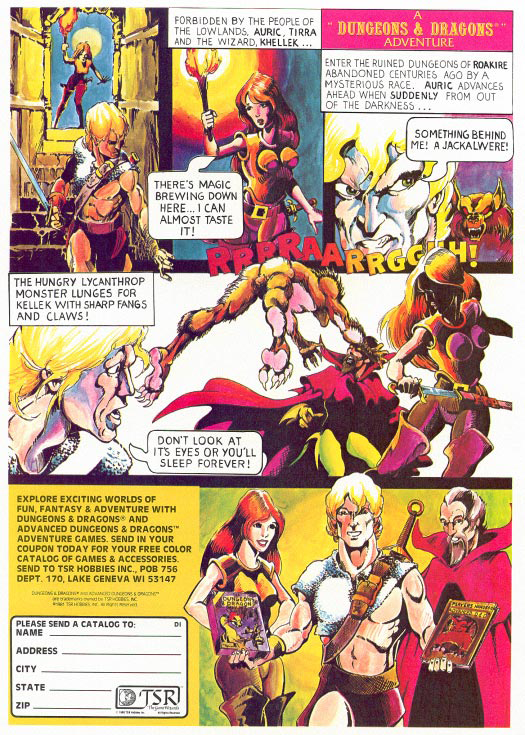
This involves the adventurers Auric, Tirra and the wizard Khellek (who does not appear to be this guy – scroll down a bit). Auric is an ill-armored fighter, Tirra could be a thief or fighter and Khellek is a wizard. They tangle briefly with a jackalwere and then … to be continued.

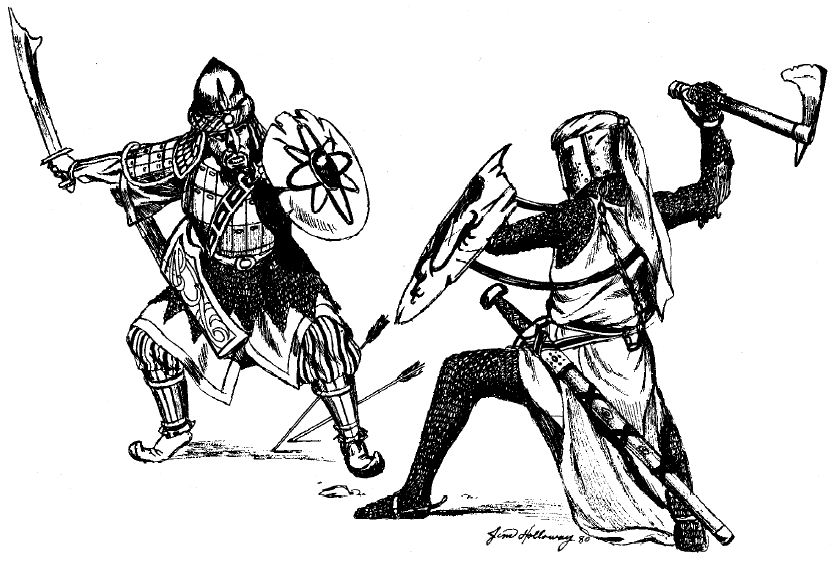
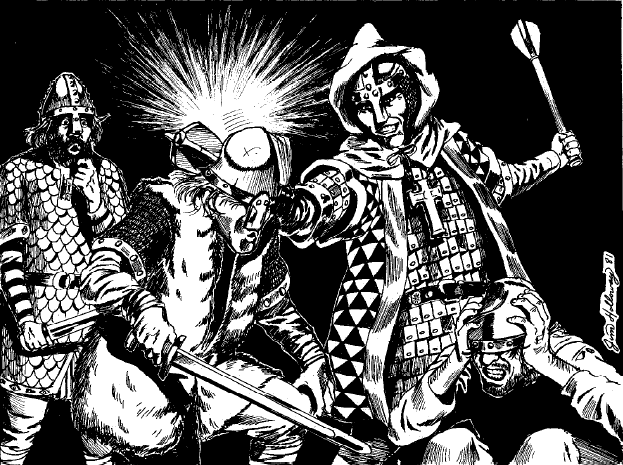
The first real article is dedicated to the much maligned cleric class. “The Role of the Cleric – Warriors with Wisdom” is by Robert Plamondon, and it does a nice job of explaining the class, some of its inspirations and ways to play it well. If the image below, by Jim Holloway, doesn’t make you want to play the class, I don’t know what will …
The article has a few nice bits that might stir the creative juices of players and GM’s out there, such as a list of acts of worship, in order of potency:

1. Thinking religious thoughts.
2. Formal prayer.
3. Attending rites or church services.
4. Feasts, festivals, fasts, self-punishment, vigils- as part of religious rites.
5. Sacrifice of valuables.
6. Dying in a holy conflict.
7. Killing an enemy in a holy conflict.
8. Sacrifice of an unbeliever.
9. Sacrifice of an unwilling believer.
10. Sacrifice of a willing believer.

#10 seems like a dicey prospect for Lawful clerics.

Douglas Loss adds a bit more with his article “The Land is My Land …”, including this bit about clerics and swords, including this from The Song of Roland

Turpin of Rheims, finding himself o’erset,
With four sharp lance-heads stuck fast within his breast,
Quickly leaps up, brave lord, and stands erect.
He looks on Roland and runs to him and says
Only one word: “I am not beaten yet!
True man never failed while life was in him left!”
He draws Almace, his steel-bright brand keen-edged;
A thousand strokes he strikes into the press.
Soon Charles shall see he spared no foe he met,
For all about him he’ll find four hundred men,
Some wounded, some clean through the body cleft,
And some of them made shorter by a head.
— The Song of Roland, Laisse 155

So Turpin got to swing a sword, why doesn’t your cleric? Well, to start off with, Turpin also doesn’t get to cast spells or turn undead. Douglas thinks the rule should be thrown out, because its not “realistic” and because in AD&D the mace is as good as sword. I disagree – swords are more than just a damage range, but the “no sharp weapons” rule also takes many magic weapons out of a cleric’s hands, thus helping the old fighter stay relevant.

Douglas Loss is back with “The Sense of Sacrifices”, and this is a neat one about the chances of deities granting clerics spells they aren’t high enough in level to cast. It all hinges on sacrifices of inanimate objects (valuable or symbolic, of course), animals and sentient creatures of a wildly different alignment than the cleric. To boil it down – 2% per 100 gp value of inanimate objects, symbol items 5%, animals 2% (or 3% if it is favored by the deity) and 5% for sentient beings. The chance shouldn’t be higher than 50%, and each subsequent miracle should have a 5% penalty applied if the cleric tries this too often.

Sage Advice is cleric-centered as well. I enjoyed how this answer began:

Q: What happens when a Resurrection or a Raise Dead is cast on an undead?

A: Hmmm. It stands to reason …

In other words – crap, we hadn’t thought of that.

For lovers of the old school, the cleric stuff is followed by two articles concerning the new Basic D&D set. The first is written by J. Eric Holmes, author of the first edition, and the second by Tom Moldvay himself. Holmes has the longer article, and it explains the hows and whys of Basic D&D. Holmes fans have probably already read it, but if they haven’t, I would highly suggest it.

For modern gamers, Paul Montgomery Crabaugh’s “The Undercover Job Guide” can be useful … especially if they’re setting a game in 1981. Written for TOP SECRET, it covers a number of jobs and gives you some ideas on their access to travel and their salaries. Here are a couple of items:

Home Economics: travel potential moderate to high; starting salary $20,000/year (variable); almost no connection with what the field is normally thought of to include: agents in this field will very likely be chefs, or connected with the creation of fashion or decoration: female agents have a good chance of being models (salary quite variable).

Physical Education: travel potential high; starting salary quite variable; almost certainly an agent will be an athlete in this AOK: by preference, one in a sport played throughout much of the world. Tennis is an excellent choice; golf, soccer and track & field are also good.

Yeah, a pair of spies who work in a high school would be pretty fun.

This issue’s Giants in the Earth by Katharine Brahtin Kerr covers Prospero (Lawful Good 14th level magic-user), his pals Ariel (a neutral “high-grade” air elemental – I would have gone sylph, mostly because Ariel is a sylph) and Caliban the chaotic evil half-orc, and Circe (chaotic neutral 18th level magic-user). Here’s a nice bit …

The best way to get the upper hand over Circe is to possess the strange herb known as moly. The god Hermes gave Ulysses some of this herb, said to grow only in Olympus. With it, Ulysses mastered Circe’s magic and made her turn his crew back into men from swine. If the DM wants moly available in the campaign, it should either be fantastically expensive or else a gift to a cleric from his or her god.

If a character wears moly, all of Circe’s polymorph spells will fail against that character, and the power of her other spells against that character will be weakened considerably; the character should get a +2 on all saving throws against her magic. Circe cannot touch this herb to steal it away, nor can her maidservants.

For more information on moly, click HERE.

We also learn Circe’s spell list: 1st-charm person, comprehend languages, friends, read magic, sleep; 2nd-detect invisibility, ESP, forget, ray of enfeeblement, web; 3rd-fly, hold person, dispel magic, slow, suggestion; 4th-charm monster, confusion, fear, polymorph other, massmorph; 5th-animal growth, feeblemind, hold monster, passwall, transmute rock to mud; 6th-control weather, enchant an item, legend lore; 7th-charm plants, mass invisibility, vanish; 8th-mass charm, polymorph any object; 9th-imprisonment.
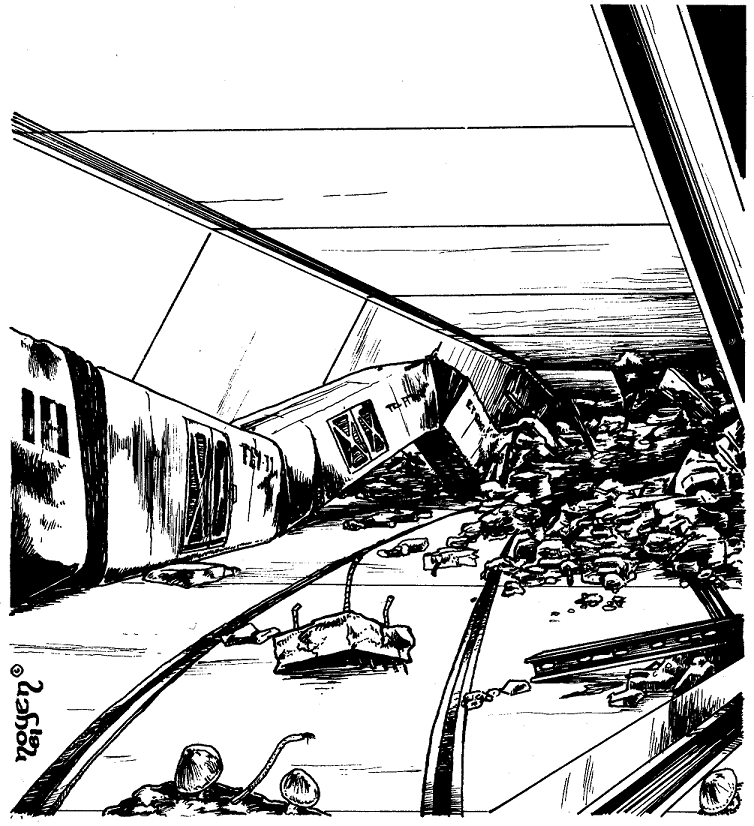
Dragon #52 also has a groovy little Gamma World adventure by Gary Jaquet called “Cavern of the Sub-Train”. This might sound like a subway romp in the ruins of New York, but it’s actually a romp through something more like Elon Musk’s hyperloop. This network spanned the entire North American continent.

The adventure is left open-ended, so should come in handy to folks playing post-apoc games.

Victor Selby and Ed Greenwood introduce the Rhaumbusun in Dragon’s Bestiary. Here’s a quick B&T-style statblock:

Rhaumbusun, Small Monster: HD 1+2; AC 13; ATK 1 bite (1d3); MV 20′; SV 16; Int Low; AL Neutral (N); NA 1d2; XP/CL 100/2; Special-Gaze attack (40′ range; paralyze for 3d4 turns)

Lewis Pulsipher has some interesting, peaceful gas-filled beasts called pelins. Not much for a fight, but they’re semi-intelligent, so maybe they could be helpful in completing a quest if the players are smart enough to be nice to them and attempt communication.

Michael Kluever gives a nice history of siege warfare in “Knock, Knock!”. Worth a read for people new to the subject.

Up next are three – count ’em three – takes on the bounty hunter class by Scott Bennie, Tom Armstrong, and Robert L Tussey and Kenneth Strunk. Lets judge them by the most relevant part of the class – the class titles!
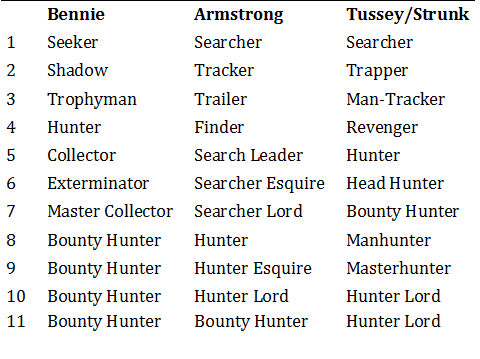
The use of revenger, head hunter and manhunter are nice, but the inclusion of esquire by Armstrong wins the competition. Anything that can bring Bill & Ted into the conversation can only be good for a D&D game.

Hey – what the heck is this?

A Google search brings up a computer game designed for use with the Fantasy Trip. Pretty cool!

There are reviews of some cool miniatures from Ral Partha (hill giant, storm giant, cold drake), Heritage USA (hill giant and beholder and superheroes and supervillains), Castle Creations (condor and skull splitter giant), Penn-Hurst/Greenfield (a plastic castle), Citadel (ogre, giant spider) and Grenadier (the dragon’s lair), as well as Basic Role-Playing, TIMELAG and Dungeon Tiles.

Not a bad issue – more advice-centric than number-y, but you get bounty hunters and a paralyzing lizard, so what the hey!

I leave you as always with Tramp

Remember – never trust gamers discovered in the wild!!!

Dragon by Dragon – September 1980 (41)

September 1980 is the time.

Between the covers of a Dragon Magazine is the place.

I’m pressed for time today, so let’s get down to business and discover the top ten best things about Dragon Magazine #41 (then I need to kill weeds, mow the yard, get a haircut, edit Mystery Men! and commission art).

1. METHODISTS AND MELEE
Our first article is a time capsule of what was going on in the RPG world at the time, namely the backlash by pseudo-religious folks against D&D. 

Written by Arthur W. Collins … or more properly Reverend Arthur W. Collins … who created the neutral dragons from a few issues ago, this one seems like a “let’s get a religious guy who digs D&D to write an article about how great the hobby is, so the other religious people who hate D&D will look worse.”

For example …

“The non-churched population generally views the Christian faith (and religion in general) in terms of a body of rules and regulations designed to keep one from enjoying oneself. This is a false view, but a prevalent one, and voices in the Christian community have been raised of late saying that such things as Dungeons & Dragons are questionable at best (damnable at worst). The double effect of misunderstanding and misguided righteousness on either hand have made fantasy role-playing games a hot topic in the religious community. It is my purpose to lay out a Christian understanding of the uses of fantasy, and then speak from a pastoral perspective on the value of role-playing games.”

It’s a fine article, and worth reading.

Side note – although I cannot be sure, this might be the fellow himself.

2. JIM HOLLOWAY

Holloway is beginning to appear in Dragon at this point (I think I mentioned him in the last review), which is cool with me. I was always a big fan of his stuff – it had an Osprey quality about it that I always liked – grounding the fantasy in some gritty reality. He’s still learning at this point – the cover is him as well, and isn’t as crisp as later Holloway covers will be. Still – it’s fun watching these artists grow.

3. MOLDVAY’S GIANT IN THE EARTH

Such a great series of article, if for no other reason they offer wonderful opportunities to argue with other nerds about which fictional character could kick which fictional character’s ass.

This one includes stats for some female fantasy favorites, and a couple fellows from the sagas.

C.L. Moore’s Jirel of Joiry (14th level fighter with 18/49 strength)

H. Rider Haggard’s Ayesha (27th level cleric, 9th level fighter with ability scores ranging from 15 to 18/00 – I’m guessing her player used the “roll 20 dice, take the best 3 method”)

Robert E. Howard’s Valeria (17th level fighter, 8th level thief)

Sigurd Fafnirsbane (20th level fighter, 12th level magic-user, 8th level cleric) – this fellow also includes a bit on the Norse runes

Starkad (23th level fighter)

4. DRAGONS HAVE ONE MORE REASON TO WORRY

This issue has two interpretations of the effects of bathing in dragon’s blood, via the sage of Sigurd / Siegfried.

The first is by Robert Plamondon, who gives us the following:

1. AC benefit is one step for every 10 hit points of the dragon, dropping fractions.

2. Successive applications are cumulative to AC 0 (or AC 20 using ascending AC).

3. The only way to beat AC 0 is to slay Tiamat or Bahamut, who give AC -2 and AC -6 respectively.

4. The formula for combining armored skin with actual armor is AC = AC of armor + AC of skin -10. So, AC 9 skin and AC 8 armor combine for AC 7 (=9+8=17-10=7). The formula works for ascending AC as well.

5. The dragon must be dead and must have been slain with edged or piercing weapons. Initial damage cannot have been delivered by heat, cold or electricity. Poison ruins the blood. The magic in the blood lasts for 1 hour. Only one person may bathe in the blood.

6. The toughening of skin is permanent, and only protects against attacks that would pierce the skin, so the bonus can be added to saves against poison needles).

7. There may be a weak spot, where the blood did not cover. The DM knows this, and perhaps assassins could discover this weak spot as well.

The second way to go is Moldvay’s. He points out in the original myth, Sigurd does not bathe in blood, but rather accidentally sucks a blood-covered finger and gains the ability to speak with animals.

To Robert’s system, Moldvay would make the following changes:

1. Armored skin and armor do not stack – use the better of the two.

2. The blood must be the dragon’s heart blood.

3. Only the character that delivered the killing blow can get the benefit of the blood.

5. MAGIC DOORS

Alan Miller in the Bazaar of the Bizarre has a nice random table of magic door abilities, which include intelligent doors, wizard locked doors, illusions, doorknobs that cast fear and doorbells.

6. PRIMITIVE COMPUTER GAMES

There’s a nice article reviewing several Avalon Hill computer games from back in the day. These babies were for the TRS-80 and Apple Pet, and were loaded via cassette. They cost $15 in 1980, which corresponds to about $43 today.

What I really found interesting was the size of these programs, which ranged from a low of 8.5 K to 15 K. Boy, they could do a lot with a byte back in the olden days.

Also this:

“A final note here about pirate copies. Computer programs are just like books and games; they have copyrights. The manufacturer charges the customer for what it costs to research, produce, package, and distribute the games. Some profit is thrown in on top of all this. Without the profit they wouldn’t be in business . . . and you wouldn’t get the games! They are not out to gouge the public. Our markets (oil excluded) are still competitive; if someone else can make a better product for less, the expensive line will either lower prices or fail.

Unlike the recorded music industry, the home computer game field is in its infancy, and there is no real standard yet for just how to market such things. Some companies cloud their programs in machine language, which makes the game harder, but still not impossible, to copy. What it does do is make the program, and the game, next to impossible to change. Other manufacturers, and I heartily applaud Avalon Hill for doing so, put their programs in BASIC (the language most hobby computers speak). This allows the gamer to “play” with his game. You can modify each program in a thousand ways to customize it as you see fit. A gamer can look at every facet of his copy of a board game, throw out the rules he doesn’t like, and make up new ones to suit his fancy. A computer program is no different; let’s keep it this way—and respect those copyrights!”

7. NAPOLEONICS

William Fawcett has a neat article with skirmish rules for 25mm Napoleonic figures. Obviously, I won’t republish them here, but they are well worth a look. If you just added a fantasy supplement to these bad boys …

SIDE TREK – RIDES NEEDED

Yeah, the old days were sure different. Dig this little tidbit …

RIDE NEEDED: I would like to go to Dundracon ’81 and I need a ride from the Los Angeles area. I will help pay for transportation. John Salguero, 449 East Avenue R-7, Palmdale CA 93550.

(Note: Requests and offers for rides to/from convention sites will be printed in this space free of charge for anyone who sends notification to Rides, c/o Dragon Publishing, P.O. Box 110, Lake Geneva WI 53147.)

8. MONSTER ART

The “Dragon’s Bestiary” in this issue features the Silkie by Tom Moldvay. Good monster, and indicative that the game had already started moving beyond the dungeon.

What I really liked about this, however, was the art by Roslof.

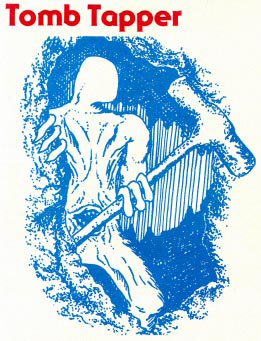
Likewise – Ed Greenwood’s Tomb Tapper is all well and good, but dig the art!

9. FINIEOUS FINGERS

I didn’t love this strip like I loved Wormy, but it was probably more D&D than Wormy and probably the first good effort of translating the game into a comic strip. Here’s a nice collection of NPC’s for your own game:

10. THE HALLS OF BEOL-DUR

This is a full adventure by Dave Luther, Jon Naatz, Dave Niessen and Mark Schultz. You have to love an adventure that starts with this:

“It is highly preferable that a large party begin the adventure (attrition will take its toll), and it is essential to the success of an expedition that most, if not all, party members be 8th level or higher.”

It also has a formula for an “original procedure for saving throws” which is really a system for ability checks:

“Roll 3, 4, or 5d6 (the number of dice varies) and subtract one point from the dice roll for every two levels of experience the character has attained. Compare the resulting number to a specified ability (this also varies), and if the adjusted dice roll is less than the character’s score for the ability in question, the saving throw is considered made.”

It’s a solid dungeon delve, with tricks, traps and monsters galore. Also some pretty neat art.

  
That will do it for Dragon 41, folks. Not the best issue, but a good one overall. Enjoy the day, the Super Bowl, the sunshine, etc. 

Dragon by Dragon – May 1980 (37)

To be completely honest, The Dragon was not the biggest thing that happened in May 1980.


That being said, it may have been the biggest thing that happened in RPG’s that month, and that’s good enough for me. Let us delve into the top ten things about The Dragon #37.

#1. NEUTRAL DRAGONS

Arthur W. Collins fills in the alignment gap of dragons in this article, and introduces the gemstone dragons we have all come to know and love (well, some of us). These are dandy creatures, especially if you’re into psionics. What follows are some quick stat blocks in Blood & Treasure style for the gemstone dragons (all adults, max. hit dice):

Crystal Dragon, Large Dragon: HD 6; AC 18; ATK 2 claws (1d4) and bite (2d6); MV 20′ (Fly 50′); SV F9 R9 W9; AL Neutral (N); Special: Breath weapon (2/day dazzling cloud that cause blindness, 10′ cone), entrance (10% cumulative per minute of talking), implant suggestion (35%), telepathic, 50% chance of psionics, 50% chance of speaking, 30% chance of magic-use, druid spells (1/1/1/1), magic-user spells (1/1/1), save aura (+4 to save against), blink 6/day

Topaz Dragon, Large Dragon: HD 7; AC 19; ATK 2 claws (1d4+1) and bite (2d8); MV 20′ (Fly 50′); SV F9 R9 W9; AL Neutral (N); Special: Breath weapon (2/day dehydration gets rid of 3 cubic feet of liquid per dragon hp and deals 1d6+6 Str damage to creatures, 10′ cone), entrance (10% cumulative per minute of talking), implant suggestion (40%), telepathic, 50% chance of psionics, 60% chance of speaking, 35% chance of magic-use, druid spells (2/2/2/1), magic-user spells (2/2/2), save aura (+4 to save against), blink 6/day

Emerald Dragon, Huge Dragon: HD 8; AC 20; ATK 2 claws (1d6) and bite (3d6); MV 20′ (Fly 60′); SV F6 R8 W8; AL Neutral (N); Special: Breath weapon (2/day; sonic vibration knocks people unconscious for 1d6 x 10 minutes or deafens them for same if they save), entrance (10% cumulative per minute of talking), implant suggestion (50%), telepathic, 50% chance of psionics, 70% chance of speaking, 40% chance of magic-use, druid spells (2/2/2/1), magic-user spells (2/2/2/1), save aura (+4 to save against), blink 6/day

Sapphire Dragon, Huge Dragon: HD 9; AC 21; ATK 2 claws (1d6) and bite (5d4); MV 20′ (Fly 60′); SV F6 R8 W6; AL Neutral (N); Special: Breath weapon (2/day, sonic vibration disintegrates a number of hit points equal to the dragon’s hit points), entrance (10% cumulative per minute of talking), implant suggestion (55%), telepathic, 50% chance of psionics, 80% chance of speaking, 45% chance of magic-use, druid spells (2/2/2/2), magic-user spells (2/2/2/2), save aura (+4 to save against), blink 6/day

Amethyst Dragon, Huge Dragon: HD 10; AC 22; ATK 2 claws (1d8) and bite (5d6); MV 30′ (Fly 80′); SV F5 R7 W5; AL Neutral (N); Special: Breath weapon (2/day shriek like a banshee), entrance (10% cumulative per minute of talking), implant suggestion (65%), telepathic, 50% chance of psionics, 90% chance of speaking, 50% chance of magic-use, druid spells (2/2/1/2/2/1), magic-user spells (2/1/2/2/2), save aura (+4 to save against), blink 6/day

Sardior the Ruby Dragon, Huge Dragon: HD 11; AC 23; ATK 2 claws (1d10) and bite (5d8); MV 30′ (Fly 80′); SV F5 R7 W5; AL Neutral (N); Special: Breath weapon (2/day shriek like amethyst dragon or dazzling cloud like crystal dragon), entrance (10% cumulative per minute of talking), implant suggestion (75%), telepathic, 50% chance of psionics, 100% chance of speaking, 100% chance of magic-use, druid spells (3/3/3/3/3/3/3/3), magic-user spells (3/3/3/3/3/3/3/3), save aura (+4 to save against), blink 6/day

Inflict one on your players today!

Side Trek #1 – Fiends!

“On other fronts, it seems likely now that TSR and Games Workshop have reached a final agreement regarding the publication of the Fiend Folio …”

Love the Fiend Folio. Love it.

Side Trek #2 – Calling Mr. Hall

“Question: My character is a 9th-level Druid changed to a Magic-User (he is now 10th level as a M-U). I want to be able to put my previously owned Apparatus of Kwalish inside my newly acquired Mighty Servant of Leuk-O. Then I would have the ultimate weapon …”

#2. Happenstance

So I’m knee-deep in writing Black Death, which is set, vaguely, during the Thirty Years War and the Wars of Religion. What article do I happen to come across, but “Armies of the Renaissance by Nick Nascati Part VI – Landsknect and Reiters”.

Apparently, the Landsknecht army (and my game) should include:

Infantry – pike-armed, in the style of the Swiss pikemen they were trying to counter

Light Cavalry – dressed as landsknechts, armed with arquebus or crossbow – trained as skirmishers and scouts

Ritters – armored lancers with full plate, battle lances and longswords, and plate barding for the horse

Reiters – black-armored pistoliers, they took two form – light reiters wore a shirt of mail and heavy reiters wore half-plate; both carried three wheellock or matchlock pistols and an estoc

The landsknechts were true mercenaries – a good war to them was one with lots of prisoners they could ransom!

#3. Magic-Users are Experience

T. I. Jones presents a very long article about magic research for magic-users and clerics. I think it’s one of those interesting pieces that tried to deal with all that treasure that was floating around in AD&D. The idea, which I generally ascribe to, is to keep the players needing money, and that keeps them delving into dungeons. The DMG had training costs, which we never used when I was a kid and which I now understand were kind of important to the game. There was also the expense of one day setting up a stronghold. This article gives another – magic research. For example:

“Research in one’s own library will require that such a library have been acquired and built up over the course of several levels of experience. It should be not only difficult but expensive to acquire such a library—a minimum expenditure of 10,000 gold pieces per level of the spell to be researched is recommended. That is, if a Magic-User is to research a second-level spell, he should have spent at least 20,000 gold pieces on his library.”

#4. Libraries

Speaking of libraries, the next article, by Colleen A. Bishop, is a random book generator. Let’s build a library shelf by rolling some percentile dice:

Our shelf contains 250 scrolls (holy cow! – I’m not rolling up all of those) and five books. There’s a 4% chance of a scroll being magic, so there should be 10 magic scrolls on the shelf. The books are two histories of particular castles, a book about the inferiority of kobolds to human beings, and another about how humans are better than dwarves and an alchemist’s notebook in which the writing is too difficult to read.

This would be an excellent random table to automate, to produce large libraries quickly.

#5. Giant in the Earth

Lawrence Schick and Tom Moldvay present another batch of literary heroes for D&D. This time, the article does not include any character stats. Rather, it describes the rationale used by the authors for creating their stats. The article includes a great passage about doing stats for Tolkien’s creations …

“As far as writing up the characters from Tolkien’s Ring Trilogy, we would love to try our hand at them. Unfortunately, the Tolkien estate is known to be fanatically paranoid about the slightest possible infringement of rights (whether real or imagined). We were also unwilling to attempt them because 90% of the Tolkien fans would be unhappy with the results, regardless of what they were. In the end, we decided it was simply too much hassle to write up Tolkien characters.”

Yeah, this would be post-lawsuit.

The article has a nice table comparing AD&D to D&D levels, which I reproduce:

AD&D 21+ = D&D 40+ / equivalent to demigods, for characters with magically extended lives or who are in close contact with the gods

AD&D 17-20 = D&D 30-30 / the max. an exceptional character would obtain in a single lifetime

AD&D 13-16 = D&D 20-29 / average for heroic characters

AD&D 9-12 = D&D 10-19 / normal minimum for any hero

AD&D 5-8 = D&D 5-9 / this line was actually missing from the article

AD&D 1-4 = D&D 1-4 / low-level cannon-fodder

#6. Urban Encounters

Here’s a nice table folks should find some use for …

#7. Nothing New Under the Sun

From the letters to the editor …

“Unfortunately, I do not feel so good about Mr. Fawcett’s article, “Angels in Dungeons and Dragons.” Yes, I did read the article’s opening statement about the source material being both religious and fictional in nature. As a DM, I will admit that the concept of having angels for the deities of a mythos is intriguing. However, it is the source material that bothers me. Let us remember that much of the article was derived from the Holy Bible, and as far as I’m concerned that is not a book to be taken lightly! Games are games, but the Word of God is not something to be used in such a manner.

I happen to believe in the Bible. However, I also happen to believe in the Constitution, and I respect your right to print what you wish. But I think that “Angels in Dungeons and Dragons” was in extremely poor taste.”

#8. Magic Items

Some goodies in the Bazaar of the Bizarre this month. Here’s an inventory:

Mirror of Speed
Mirror of Confusion
Mirror of Memory
Mirror of All-Seeing
Yefar’s Great Mirror (all by Gerald Strathmann)
Rod of Singing by Robert Plamondon (cursed  item)
The Discus Shield by Roger E. Moore

#9. Vulturehounds

A cool monster by Chris Chalmers and Dan Pollak. Quick stat block

Vulturehound. Small Magical Beast: HD 2; AC 15; ATK 2 claws (1d3) and bite (1d6); MV 50′ (fly 30′); SV F13 R11 W18; AL Neutral (N); Special-None.

They run around in groups of 4d6, and have voracious appetites. I think they’d be a great encounter in dry hills.

Side Trek #3 – I love McLean!

Always loved the art style, and the humor

#10. The Pit of the Oracle

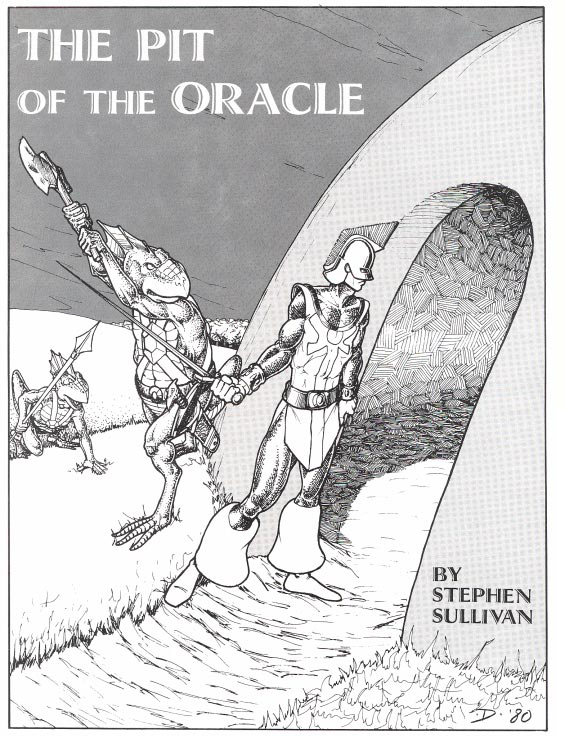
A module by Stephen Sullivan, with a nice cover image by Jeff Dee in which a fighter is either doing a bad-ass, casual back strike against a troglodyte, or in which a fighter is about to get his ass kicked by a couple troglodytes.

The module contains a dungeon and a town (and a Temple of Apathy), as well as some other nice art pieces by Dee, Roslof, Otus and Sutherland. You can tell the elements of D&D’s most classic phase are all coming together.

The map has all sorts of notations on it, which makes me think the adventure is a bit complex … but it also looks really cool. Hey, maybe that’s just the art talking.

And that’s Dragon #37 – happy Sunday folks and have a groovy week ahead.

Dragon by Dragon – February 1980 (34)

One of the fun things for me about doing these reviews, besides just exploring all the great “forgotten” material produced for our favorite games, is the covers. I didn’t get into D&D until around 1984, and didn’t know about Dragon Magazine until maybe a couple years after that, so these are all new to me. This month’s cover is, I think, particularly cool. An army working its way down a defile to face a decidedly chaotic-looking castle. The cover was painted by Ken Rahman, aka Elladan Elrohir.

Well, what are the top ten cool things to be found in The Dragon #34? Let’s see …

I. THIS IS WHY I KEEP IT VAGUE …

From “Out on a Limb”, a letter by Robert T. Willis III

“I would like to correct some numbers that appeared in “How Tall is a Giant?” (TD31). In the article, 3mm figures were equated with 1/500 scale, and the reader was led to expect that his rational guess of 1/600 was blatantly wrong. As a math major at the Massachusetts Institute of Technology, I would like to point out that the article was wrong—3mm figures are actually 1/600 scale (1/609.6 is the exact number).

Since 3mm = 3/25.4 inches = 3/(25.4 x 12) feet = 3/304.8 feet, the scale is (3/304.8)/6 because the figure represents a man 6’ tall. This number is 1/609.6 which can be rounded to 1/600.”

II. MINING IDEAS

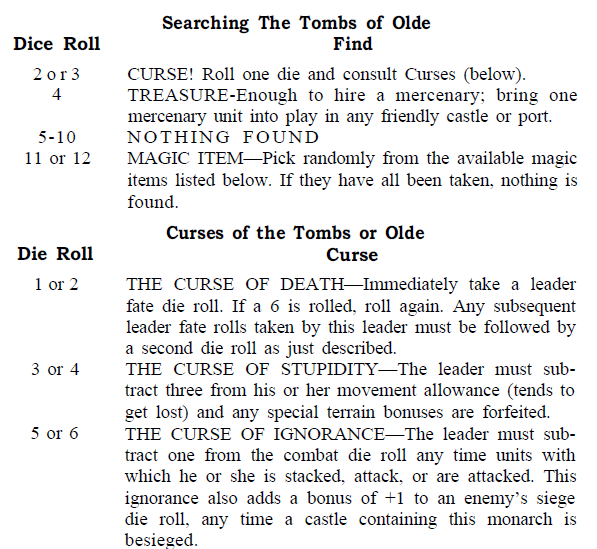
I know next to nothing about Divine Right by TSR, which is unfortunate since this issue devotes a great deal of time and energy to that game. That said, there’s usually something useful to be found in any game, and I thought these two tables might be useful:

Tombs and curses. I can imagine using this when dealing with large armies tromping across hex maps on the way to besiege a stronghold and coming across some mini-dungeon. Roll on the dice, lose the dice roll as a percent of your troops, and use that percentage chance for each named character in your army to die (allow a saving throw if you must – if they save, they do not die, but they may not participate in the battle).

III. WARGAME WHAT-IFS

Samuel Gill, in “Up on a Soap Box” presents a few ideas for wargame campaigns that twist actual history around a bit, such as a Mexican-Texican War in 1842 (which kinda sorta happened, though not on a huge scale), Mediterranean fleet action in WW1, assuming the Italians had not defaulted on their commitments to Germany and Austria-Hungary, and a revival of hostilities between France and Prussia in 1886.

This brings up not only the idea of using similar historical what-ifs for RPG campaigns, modern and medieval, but also twisting the history of your own campaign world. Imagine the characters in a long-standing campaign waking up to find the world they know changed in major ways, and having to figure out how the bad guys (or good guys, if the party is evil) did it, and how to get things back to normal – or maybe they cannot and now have to start from square one!

Sam’s article gives numerous other examples of alternate history, which are well worth the perusal.

IV. OH, I THINK GARY CAN ANSWER THAT …

A question from “Sage Advice”:

“Question: I have just started playing AD&D and I don’t know what the following weapons are: Bardiche, Bec de Corbin, Bill-Guisarme, Fauchard, Fauchard-Fork, Flail, Glaive, Glaive-Guisarme, Guisarme, Guisarme-Voulge, Lucern Hammer, Partisan, Pick, Ransuer, Scimitar, Spetum and Voulge.

Can you tell me what they are?”

Now we would just tell him to Google it.

V. MONSTER TABLES

If you’re playing a 1st edition AD&D game and like to keep it pristine, Blake Ward’s “Familiar Fiends” article might be just for you. It collects all the monsters in the AD&D Monster Manual and puts them into a random table for stocking dungeons. He also has a random table for determining what level of monster to use based on the dungeon level you’re stocking:

Very nice.

AWESOME ADVERT

Dig this ad for Judge’s Guild:

Love the fighter and his horse.

VI. RISKING THERMONUCLEAR WAR

Funny, isn’t it. We went from “Atomic War” to “Nuclear War” to “Thermonuclear War” and then back to “Nuclear War”. Anyhow …

A rare article in The Dragon for good old-fashioned RISK. This one, by George Laking, gives some variants on the old game, including the addition of nuclear weapons. I won’t go into the details, but they would certainly make for an interesting game … or you could just play Supremacy. Boy, we had a lot of fun with that game back in the day, and RISK and Axis & Allies as well.

VII. ONI VS. MINIATURES PAINTERS

Fantasysmith gives a guide to properly carrying your miniatures around without ruining them. What drew my eye was this illo:

When going to play wargames, always beware lurking ogre magi. Especially, one must presume, when in Japan.

VIII. GRIMTOOTH HAS COMPETITION

Look out for Gerard Moshofsky of Eugene, Oregon, Grimtooth, because he’s a devious guy. Check out this dandy trap:

This used to be quite the thing in old dungeon design. I think 3rd edition, by standardizing traps and attaching more rules to them, kind of killed this old creativity. Maybe I’m wrong.

IX. NAME GENERATOR

Love this name generator by Mark Whisler – it would be perfect for the barbarian mini-game I’m going to publish soon (from the “B for Barbarian” article in NOD).

Roll a d10 and d6 and cross-reference them on the table to get the first name element, then do it again for the second.

X. WEIRD OLD D&D

Tom Holsinger and Candy Peterson have a nice article on quirks and curses for magic items. Several tables, all good brain fodder, but I’ll point out these minor curses:

3) Develop highly unpopular sexual perversion (necktie party if you’re caught).

4) Develop socially unacceptable sexual perversion (Charisma reduced to 3 if you are discovered—Hint: It has to do with graveyards).

D&D was once for “weird adults” more than for “nerdy teens”.

AWESOME ADVERT

Broadsword Miniatures operated during the 1980’s out of Georgia USA. I liked the miniatures in the ad, so I did a little searching and found some more, like these goblins.

Man, I love those old miniature illustrations.

XI. DOOMKEEP

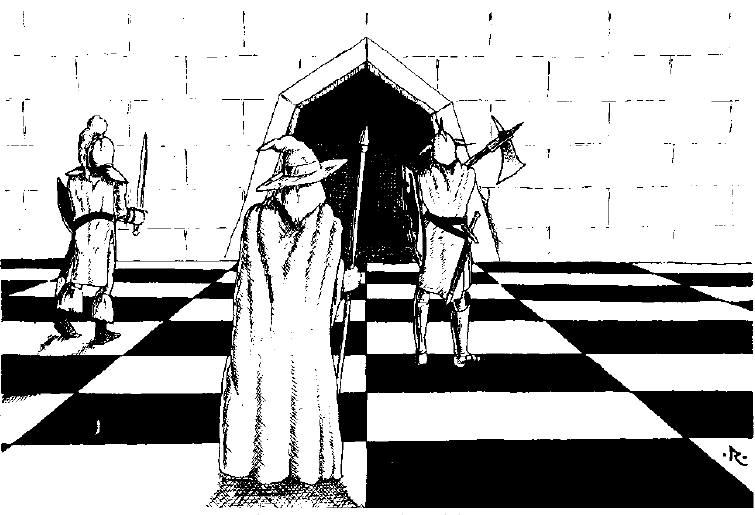
Last month’s adventure went well, so The Dragon included Doomkeep in this one, a dungeon by Brian Blume used as the Second Official Invitational AD&D Masters Tournament module. Obviously, I don’t have room in this issue to do a major review, but it has a chessboard room, which I love (see art below), and it includes the hand mirror of hoping, which has the following effects when used:

1. A Death Ray emerges (normal saving throw allowed).
2. A 5-die fireball explodes 32’ away from the mirror.
3. A twin of the object pointed at appears and aids the object pointed at (if possible).
4. 27 Blackbirds fly out of the mirror and confuse (saving throw allowed vs. spell) everyone in the area for 2 melee rounds.
5. The object pointed at is sucked into the mirror, never to return.
6. The object pointed at turns into a Type I Demon which attacks the holder of the mirror.
7. A 6-die lightning bolt shoots out 60’ from the mirror.
8. A Cure Critical Wounds spell is emitted at the thing pointed at.
9. A mist appears which obscures all vision in a 20’ x 20’ area (treat this as a Confusion spell if melee occurs in the mist).
10. Poison gas fills an area 30’ x 30’ (+2 on s.t).))

Also this …

Damn, I love old D&D.

OTHER GOODIES

This issue was actually pretty packed with interesting stuff …

“Minarian Legends” – huge article about the Muetarian Empire. Great art!

“Getting into the Flow of Magic Fountains” – random tables for generating magic fountains. I won’t reproduce the tables, but I will roll up a random fountain:

This fountain contains four drinks (weird, but okay). With each drink, a person gains an extra spell level (if they can cast spells), but also glow in the dark and suffer the effects of reduce person (save allowed).

“Dragon’s Bestiary” – this issue has the Vilkonnar by Charles Carson – a neutral evil underground humanoid race along with their slightly different cousins, the Kailiff.

“Dragon’s Mirth” – a standardized disaster scale by Jeff Swycaffer – fun, if nothing else for the U.S. regionalisms:

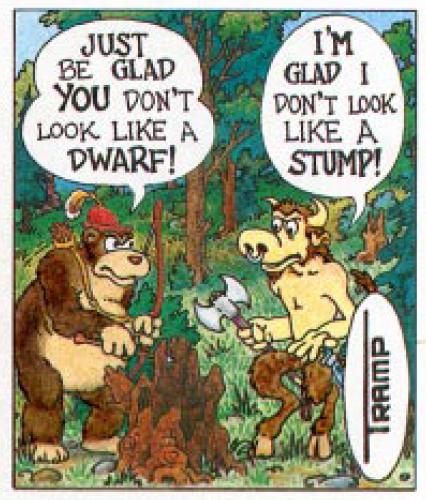
As always, I’ll leave you today with a tiny taste of Tramp …


Dragon by Dragon – December 1979 (32)

Depending where you are when you read this, good morning, good afternoon, good evening or good night. It’s Sunday, which means it’s time to crack open the vault and review another issue of The Dragon. Technically not the last of the 1970’s (that would be December 1980), but for most folks, the end of the decade.

Let’s take a look at the Top 10 Cool Things in The Dragon #32

Side note – cover by Phil Foglio, which means his contributions to the magazine’s comics section shouldn’t be too far away. Always a highlight for me back in the day.

Yes, because of Dixie. I’m a red-blooded American male, and I make no apologies for it.

ONE | GOOD ADVICE

When question about super high level characters (as in, “no freaking way they got there fairly), ED gives the following sage advice …

“Cheating, yes, but who? If you refuse to play with these sorry individuals, they are only cheating
themselves of the feeling of accomplishment that comes from having honestly earned a level advancement. To each his own . . .”

Good advice then, and good now. Learn to enjoy losing spectacularly at games, and you will find them twice as enjoyable as you used to.

TWO | POISON

Charles Sagui has an article on “Poisons from AA to XX” that I enjoyed. I always like articles written from a position of authority concerning make-believe stuff, and this one has several firm rules for poisons that you might not have known:

1) Poison is restricted to Neutral and Evil characters when used against human or humanoid types … against dungeon monsters, anyone can use poison.

2) Alchemists alone distill and manufacture poisons – magic-users, thieves and assassins who are caught making poisons are told immediately to “cease and desist” – imagine, slapping a cease and desist order from the Alchemist’s Guild on a PC! Apparently, if the order is ignore, the PC “will receive a visitor who will see to it that he stops permanently.” – Sounds like a fun encounter to run.

3) Alchemists learn to make poison at one strength per level of experience up to the 5th, beginning with level 0, strength “AA”. At 6th, the alchemist can make strength “S” sleep poison. After 6th, he learns to make one strength per two levels, through strength “J” at 16th level. Type “X” can be made by 20th level alchemists, type “XX” by 25th level alchemists. Alchemists through 4th level make only ingested poisons. From 5th to 8th level, they make ingested plus water-soluble poisons. From 9th to 16th they learn to make contact and gaseous poisons.

4) Assassins are the main customers, and they dictate to the alchemists who can buy poison. Locksmiths are granted permission by the assassins to put poison needles and gases in locks and chests so the rich can keep their possessions safe. – This suggests that the thieves and assassins are not on the best of terms.

5) Any character is permitted to buy strength “S” sleep poison. Thieves, by paying the assassins 500 gp per level, are permitted to buy strengths “AA”, “A” and “B” poison. They may buy up to 60 vials of “AA” per year, up to 30 vials of “A” and up to 15 vials of “B”. Magic-users can pay 1,000 gp per level to get the right to coat darts and daggers with “AA” and “A” poison. The same buying restrictions for thieves apply.

6) A small vial of poison is enough to coat 6 arrowheads, 8 darts, 12 needles or 1 dagger or spear point. Two vials will coat a short sword. Three will coat a long or broadsword, four a bastard sword and five a two-handed sword. Each coating lasts for 2 successful hits, and up to 5 coats can be applied to a blade at a time. One vial is equal to one dose when swallowed.

7) Evil humanoids should never use more than “AA” poison. If they are employed by a powerful evil NPC, they may use up to “D”.

8) Poisons found in dungeons are:

0-50% – ingested
51-80% – water-soluble
81-90% – contact
91-100% – poison gas

9) Damage from poison is taken at a rate of the minimum hit point damage for the poison per melee round (which would have been a minute, back in the old days) until max damage rolled is met. So, a poison that deals 1-10 damage would do 1 point of damage per round. If you rolled “6” damage, it would deal 1 point of damage per round for 6 rounds. A poison that did 5-100 damage would deal 5 points of damage per round.

10) When you save vs. sleep poison, you act as though slowed for 3 rounds.

11) When using poison-coated weapons, each time you draw the weapon or return it to its scabbard, you have to save by rolling your Dex or less (on 1d20, I assume), minus 1 for water-soluble and -3 for contact, or you suffer max poison damage. You also have to make a Dex save every other round for water soluble and every round for contact poison that the weapon is used in combat to avoid poisoning yourself. This applies until the weapon is washed, even if the weapon does not have enough poison left to poison opponents in combat.

12) Silver weapons will not hold poison, not will magic weapons. Normal weapons that are poison-coated gives them a dark discoloration, so everyone will know the weapon is poisoned.

Lots of rules, but actually pretty useful ones. The article then goes on to detail the different poison strengths – I won’t reproduce those here.

THREE | WEAPONS OF ASIA

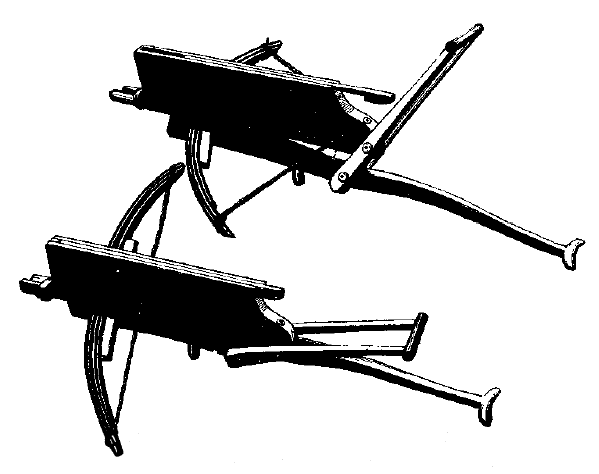
This is a companion article to the armor article from last issue, also by Michael Kluever. Here’s a bit on the Chu-ko-nu, or repeating crossbow.

“An interesting variation was the repeating crossbow (Chu-ko-nu). It propelled two bolts simultaneously from its wooden magazine, which held a total of 24 featherless quarrels, each approximately 8.25 inches long. The bolts were contained in a box sliding on top of the stock and moved into firing position by a lever pivoted to both. The throwing of the lever forward and back drew the bowstring, placed the bolt in position and fired the weapon. Chinese annals relate that 100 crossbowmen could project 2,000 quarrels in fifteen seconds. The repeater crossbow was used as late as the Chinese Japanese War of 1894-95.”

Apparently I need to include it in Grit & Vigor.

FOUR | SINISTER SEAWEED

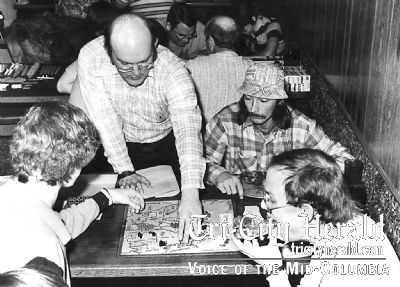
You got some interesting articles back in the day. This one, by George Laking, is about aquatic megaflora, and its danger to adventurers. The info in the article was designed by the Mid-Columbia Wargaming Society of Richland, Washington. With a little searching, I found a picture of Mr. Laking and some society members from a 1978 newspaper. The internet!

So, you’re first thought it – screw seaweed, bring me dragons!

You fool!

Apparently, megaflora stands capture oxygen in vast bubble domes within their branches. Within this bubble dome, there is a bunch of dry limbs and twigs from this megaflora. The interior of the dome resembles a quiet, dry forest surrounded by thick trunks. Bubble dome heights range from 4 to 40 feet, depending on the size of the stand.

Where’s the danger. Well, the stands can capture ships for 1-12 hours, making them vulnerable to aquatic monster attacks.

The bigger danger is bubble dome “blows”! The domes are temporary structures. In some cases, the gas cannot escape and pressure builds up until it explodes, throwing dry branches and limbs 2d10 x 10 feet into the air in a huge fountain of water and foam! Ships will fall into the void left, and then be slammed by the walls of water rushing back in, possibly destroying the ship. A blown stand looks like a peaceful lagoon with walls of megaflora around it, quickly growing in to fill the clearing. This will be the lair of aquatic monsters, guarding the treasure left by ships destroyed in past blows.

A third danger is that pure oxygen is poisonous to people. Divide the height of the dome by 10 and take this as a percentage chance per hour that a character absorbs too much oxygen into her bloodstream. A character who reaches this threshold, upon leaving the dome, must make a save vs. poison or immediately die.

Also – pure oxygen is extremely flammable. Let’s say you light a torch inside the dome …

“(1) The initial explosion of gas would create a 6-20 die fireball of incandescent oxygen, depending on the size and depth of the bubble dome (depth of dome divided by ten equals hit dice). The size of the fireball would be half as large as the initial dome after the explosion of the gas. Saving throws would be applicable.

(2) Following the initial explosion, the fireball would immediately rise to the surface with a subsequent catastrophic inrush of ocean water onto the previously dry dome interior. Each character would have to undergo a check for system shock as the walls of water met with implosive fury. A character saving vs. system shock would only take 3-10 (d6) of damage. Failing to save means immediate death!

(3) Finally—should the character survive—an immediate check vs. oxygen poisoning would be necessary to determine if he/she had exceeded the critical threshold at that point. If so, that character would have to make an additional save vs. poison per oxygen poisoning (above).”

Frankly, a weird bubble dome dungeon would be awesome, and a great challenge. A ship gets stuck and attacked by aquatic ogres. Adventurers follow them down to retrieve something important, find a massive bubble dome with a dead, maze-like forest within it. They have to work fast to avoid being killed by too much oxygen, and there is a chance that it explodes and the ship is drawn down into sea and crushed.

FIVE | THE BEST LAID PLANS

From Gygax’s “Sorcerer’s Scroll”:

“In a previous column I mentioned that I would set up an adventure where the players would end up in the city streets of the 20th century. Well, I knocked together some rules, put the scenario together, stocked the place with “treasures” of a technological sort, and sprinkled some monsters (thugs, gangs, police, etc.) around.

Much to my chagrin, Ernie the Barbarian was leading the expedition. When his party emerged from the subway—and despite the general blackout in the city due to the power failure caused by their entry into this alternate world—he stopped, looked, listened and then headed back for the “safety” of the “real world!” Some people really know how to spoil a DM’s fun …”

Damn players.

SIX | SAGE ADVICE

From Jean Wells in “Sage Advice”:

“The subject is dwarven women and whether or not they have beards. Last spring when we were working on the final editing of the Dungeon Masters Guide, I tried to get Gary Gygax to change the section on dwarves so that dwarven women would not have beards. Needless to say, I was not very successful.

What I didn’t realize was that for some strange reason (completely unknown to me), I had started something. I did not understand the full impact of what I had done until I went to GenCon this year. Many people stopped me in the hall to either agree with me wholeheartedly, or disagree with me and then tell me that I was crazy. Everyone knows that dwarven women have beards, they said. It did not stop there. Oh, no! We have even been getting mail on this issue. It is not too bad, but I don’t like being accused of making an issue out of the subject.

One thing that everyone who has taken sides in this issue fails to remember is that Gary Gygax wrote the Dungeon Masters Guide and it is his book. He can say whatever he wants to. You can agree with him or side with me, but either way, the person who has final say in his or her campaign is the DM. So, for all the people who have written in to agree with me or to agree with Gary, and for those who haven’t yet but were planning to, please save your breath. Gnome women don’t have beards (this is true and I am glad). Dwarven women may indeed have beards, Gary, but not in my world.”

Yeah, there have always been gamers who A) didn’t get that it was make-believe, and there was therefore no right or wrong, and B) didn’t get that their own opinion isn’t law.

Also this question:

“Question: We are having an argument over an issue that has us divided. My friends say that with a ring of telekinesis they can make an arrow spin at the speed of light and then release it, having it do between 100 and 600 points of damage to their target. I say this is impossible! What do you think?”

God – I remember these fools.

Finally:

“Question: I am having a romance with a god, but he won’t have anything to do with me until I divorce my present husband. How do I go about divorcing my husband?”

Ye Gods!

BONUS AD!

For sale – crappy t-shirts.

Actually, I would wear one of these with a ridiculous amount of pride. I’m super tempted to lift the graphic and make one online for myself.

Looks like the Barbarian Shop was in a private residence:

SEVEN | INSECTOIDS

Len Lakofka presents in this issue his insectoids, which are just the humanoid races with insect characteristics grafted on. For example: Scorpiorcs. For Blood & Treasure, they would look like:

Scorpiorc, Medium Monstrous Humanoid: HD 2; AC 16; ATK 2 pincers (1d6) and weapon; MV 40; SV F15 R12 W13; XP 300 (CL 4); Special-Surprised on d8 (due to eye stalks), move silently (70%), back stab x2.

Scorpiorcs never use flaming swords or carry any sort of flame. They also never use armor, but may carry a shield. They speak Scorkish and broken Orcish. They can advance as fighters from a beginning “level” of 2 to a top rank of 4.

I also have to mention the “skags”, which are a blend of scorpion, kobold, ant and goblin. This is actually a sort of “monster class” – dig it:

BONUS AD

Great title. Found HERE at Boardgame Geek. Stephen Fabian did the art, so it has be worth a few bucks based on that alone.

EIGHT | TRAVELER POLITICS

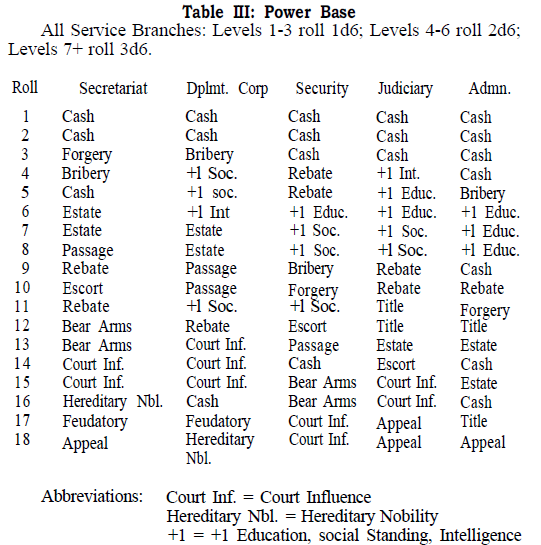
I’ve never played Traveler, so I can’t comment on the utility of this article about diplomats in the Traveler Universe. I can, however, draw attention to this table, which may prove useful to people:

I’m sure somebody can adapt this to their game, when trying to figure out an NPC’s s power base in some fantasy or sci-fi city.

NINE | DRUIDS

William Fawcett has a long article on “The Druid in Fact and Fantasy”. A tough subject, because so little is known, or at this point, can be known. I’m not going to dwell on the historical bits in the article, but I did like this:

“DECLARATION OF PEACE
A new Druidic ability

Although the Druid, due to his involvement with life, is unable to turn undead, his role of the peacemaker gives him a similar ability with most humanoids. Before or during any armed combat if he has not struck any blow, a Druid has the ability to make a Declaration of Peace. This declaration has a 10% plus 5% per level (15% 1st level, 20% 2nd, etc.) chance of causing all armed combat to cease for two rounds per level of the Druid. This does not affect magical combat in any way, nor will it stop a humanoid who is in combat with any non-humanoid opponent. Once the combat is stopped, any non-combat activities may take place such as cures, running away (and chasing), blesses, magic of any form, or even trying to talk out the dispute.

After peace has been successfully Declared, combat will resume when the effect wears off (roll initiatives), or at any time earlier if anyone who is under the restraint of the Declaration is physically harmed in any way. This could be caused by an outside party or even by magic, which is not restrained by the Declaration. A fireball going off tends to destroy even a temporary mood of reconciliation. Once a Druid strikes a blow or causes direct harm in any way to a member of a party of humanoids, he permanently loses his ability to include any member of that party in a Declaration of Peace. The Declaration of Peace affects all those within the sound of the Druid’s voice, a 50’ radius which may be modified by circumstances.”

He also has quite a few magic cauldrons and some thoughts on herbs. Good read overall.

TEN | MIRTH

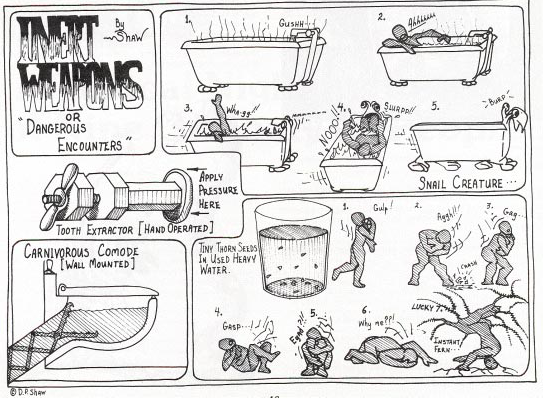
Well, it’s funny to DM’s

ELEVEN | THE FELL PASS

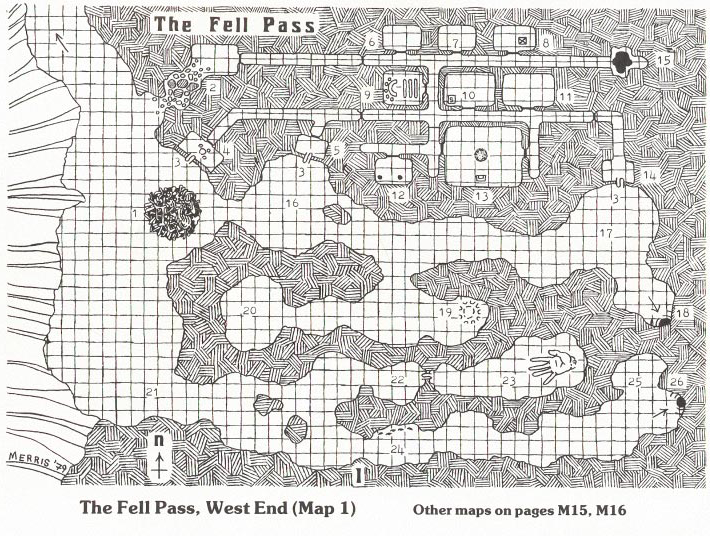
An adventure in this issue – “The Fell Pass” by Karl Merris!

Check out the map:

That hatching seems reminiscent! A also hereby challenge Dyson Logos to include more giant, disembodied hands on his very excellent maps.

The adventure takes place in geothermally heated caverns, and includes cave bears, ogres, a spidersilk snare, gray ooze, manticores, griffons, shadows, trolls, pit vipers, Vlog the Ogre …

… and Xorddanx the Beholder:

I love the heck out of that art, which is by Merris himself!

I did some searching, and I’m pretty sure I’ve found him online. He appears to be a Brony now, and might have no interest left in D&D, but if I can commission a piece of fantasy art from him, I’ll let you know …

FINAL SHOT