Over In a Nonce – Deadly Dueling

I’ve done a similar combat system to this one in the past, so consider this a revision or just forget the last one.

Once again, I’m thinking in terms of a deadly combat system, more realistic perhaps than the traditional hit points/armor class system, and potentially over quickly.

The system is written for Blood & Treasure, but should be easy to adapt. It assumes you are using the combat advantage system in Blood & Treasure. It works as follows:

A. Each character makes an attack roll, add half armor class bonus from natural armor or worn or carried armor (i.e. shields) to this roll

B. Compare the attack rolls – high roll wins the combat round

B1. If a combatant rolls a natural ’20’, their opponent is either killed or, if they are merciful, knocked unconscious or left prone and disarmed (and dishonored)

B2. If a combatant rolls a natural ‘1’, they suffer a catastrophe – roll 1d6

1. Disarmed (must draw another weapon or fight unarmed)
2. Trip or slip (fall prone, Reflex save or lose weapon as well)
3. Backed into corner (opponent gets an advantage, as you cannot maneuver)
4. Face cut (blood in your eyes, opponent gets an advantage)
5. Hand cut (must fight with other hand, giving opponent an advantage unless you are ambidextrous)
6. Roll again (or if anyone has another good idea for a catastrophe, let me know!)

B3. The loser must pass a Fortitude saving throw or is fatigued, suffering the normal penalty to attack rolls, but also extending their fumble range by 1 (i.e. from 1 on 1d20 to 1-2 on 1d20, etc.) A combatant with armor must take a penalty on this save equal to half their armor class bonus.

B4. The winner need only make a Fortitude save vs. fatigue in even rounds of combat. Each round that they win, they increase their critical threat range by 1 (i.e. from 20 on 1d20 to 19-20 on 1d20, etc.)

C. Keep rolling combat rounds until somebody is dead (or unconscious) or surrenders

Multiple Opponents – the outnumbered foe has to roll against each attacker, all of whom derive a combat advantage from the situation, and might have to make multiple saves against fatigue. Only the attacker’s first attack roll counts against a chosen opponent in terms of causing fatigue or death. Unlike with normal rules, heroes sallying forth against multiple foes are probably doomed unless they well out-level them.

Multiple Attacks – Monsters or characters with multiple attacks make those attacks as normal, with each defender making their own attack roll against them, or a defender making multiple rolls against them; as above, only the character’s first attack roll counts towards causing fatigue or death.

Missile Combat – This system doesn’t work for missile weapons, but consider this idea: Make attack rolls against AC as normal. Roll the hit location (you can devise your own table) with that body part being made useless unless the struck character passes a Reflex save. Obviously, hit locations like head, throat or heart would carry with them instant death.

Other Sources of Hit Point Damage: To get rid of hit points, you’d need to deal with things like fire breath or falls. If you like things to be super dangerous, you could always go save or die – or perhaps save vs. being crippled, severely burned (you’d have to determine just what that entails), frostbitten, etc. with a roll of “1” indicating that the attack killed you outright.

Impact of System

A system like this opens some interesting possibilities. High level characters are still hard to kill, but maybe not as hard as before – even a first level character can get lucky against a high level character with a system like this in a way that is essentially impossible using traditional combat. Likewise, first level characters are going to have a tough time surviving, but might actually last many more rounds than they would using the traditional system.

If you try this system out, let me know how it worked.

The Trophy Case – a Magazine to Check Out

Hey folks,

Busy scribbling away at my monster book (I think I have the layout figured out) and GRIT & VIGOR, and finishing up NOD 23 (Zombies and Apes!), but I wanted to take a couple moments and point people to a gaming zine called The Trophy Case.

Written by Scott Casper, the writer of Hideouts & Hoodlums, a Swords & Wizardry-inspired superhero game, the zine focuses on golden and silver age heroes, with plenty of stats for H&H, comic book reviews and a nice locale for heroic adventures – the Double L Dude Ranch. Volume 2 – Issue 7 also features a very kind review of Mystery Men!

If you have the time and $0.50 (yes folks, just two thin quarters, four bits!) you can visit Scott’s page at Drive Thru RPG or RPGNow.com, and pick up The Trophy Case and get your golden age on.

Now then – back to work!

The Superman Theory of Interesting Monsters

When Superman was first introduced to the world in the late 1930’s in comic strips and comic books, he really wasn’t so much an adventure character as he was a wish fulfillment character – the ultimate big brother who could beat up anyone the author thought was deserving of it. Superman’s earliest battles were against normal folks who really never had a chance at defeating him – think of it something like a group of 20th level characters wandering into the Caves of Chaos. The point wasn’t to challenge Superman, but to live vicariously through him.

As the character went on, though, things had to change. For one thing, stories like that can become boring. Stories like that are still written, of course, and will be for as long as people daydream about getting everything they have ever dreamed. But there were other forces at work … competition! Superman was soon joined by many other heroes, and not all published by the same company. National Comics needed to keep things fresh!

Yes, I got there before Lex Freaking Luthor!

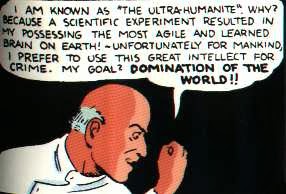
In 1939, the first supervillain appears on the scene – The Ultra-Humanite in Action Comics #13. The Ultra-Humanite represents the “opposite attracts” concept in comic book super-villainy – a physically powerful hero countered by a mentally powerful villain. The point here was simple – Superman can overpower anyone on Earth, but how will he fare against a superior mind? In other words – “how is he going to beat THIS guy?”

It strikes me that this lies at the heart of much of the monster creation in fantasy role playing games, especially during the old school phase when Arneson and Gygax and many others were building the foundation of what was to come. After the initial phase of dragons and balrogs, we begin getting into the weird Gygaxian ecology that includes rust monsters and lurkers above.

The idea was the same as above – the players have discovered tactics that work against bands of orcs and hordes of kobolds and fire-breathing dragons, but how will they defeat a monster against which metal is useless? How will they defeat monsters that drain levels every time they hit, monsters you dare not get close to? How will they defeat monsters who are resistant or even immune to magic spells? The monsters created by this process were weird and goofy and didn’t make the least bit of sense, because they weren’t monsters in the traditional sense, but rather puzzles disguised as monsters.

Okay, smarty pants – now what?

When I invent new monsters that are not based on creatures from myth or folklore (and sometimes even when they are), I try to make sure that that concept lies at the heart of what I’m doing – How do I force players to invent new tactics to overcome this new threat?

I think that what lies at the heart of what makes role playing games fun is the challenge they represent to the player, rather than the character. By forcing players outside of what is familiar, their interest is sparked and the game is more fun, even if at the same time they’re cursing you for your new innovation in killing their character. I think that at the heart of the game lies the basic puzzle of how do I overcome the challenge (monster/trap/riddle) to receive the prize (treasure/kiss/power).

When next you’re designing a new menace, or even if you’re using tried and true monsters, I suggest you put some thought into how this encounter will be different than all the other encounters your players have faced – what is the “gotcha” moment that will force the players to pause, give each other that worried glance, and then get their brains buzzing as they look for a solution. The treasure chest behind the monster is just a token, really – the real prize is the satisfaction of solving the puzzle the monster represents.

Grand Curses

First post of 2014!!!

GRAND CURSES

Sometimes a simple spell just is not enough. Sometimes, that damn village that ran you out of town because your barbarian is a half-orc needs to learn what for. Sometimes that pompous duchess who stiffed you after you slayed the local dragon needs to find out you’re not to be messed with. Sometimes, a simple spell is not enough – you need a Grand Curse!

Grand curses are not unlike normal spells in their overall effect, but they strike many more targets than a normal spell. Grand curses spread like plagues. They are cast on a single person and from that person affect all others with which they have contact. In this way, a grand curse can impact virtually every person in a village, town, castle or even kingdom. Grand curses are no more difficult than the normal spells they mimic, but their cost is much higher for the spellcaster.

A spellcaster can turn any spell he or she knows into a grand curse. To do so, they must know the spell the grand curse is to mimic, and they must be willing to sacrifice a pound of their own flesh, metaphorically. Each person affected by a grand curse costs the original spellcaster 10 experience points per level of the mimicked spell. Affected, in this case, means any creature forced to attempt a saving throw versus the spell. If a village of 100 people is affected, for example, by a sleep spell in the form of a grand curse, the spellcaster would lose 4,000 XP. These lost XP can force a spellcaster to lose a level, so when you unleash a grand curse, beware! In addition, the grand curse counts as a spell four levels higher than the spell it mimics.

In all cases, the spellcaster casts the grand curse at one initial victim. This person receives a normal saving throw, but at a -4 penalty. If they pass their saving throw, the grand curse fails. Otherwise, they suffer the effects of the spell with a permanent duration until dispelled with dispel magic spell or remove curse. Each person that sees or has some sort of contact with the victim of the grand curse while they are feeling its effects must succeed at a saving throw themselves or become a victim of the grand curse themselves. The effects of the grand curse affect a victim 1d6 turns (i.e. 10-60 minutes) after they fail their saving throw, so it is possible for the victims to move about quite a bit – all the better to spread the curse.

And before you ask – yes, grand curses must have a negative effect on their victims. No cursing people with cure light wounds!

The following are examples of grand curses.

Beauty’s Sleep
Level: Magic-User 4

This grand curse mimics the sleep spell. Each person that sees a sleeping victim of the spell must pass a Will saving throw or fall to sleep themselves.

Black Mood
Level: Magic-User 8

This grand curse mimics the crushing despair spell. Each person that sees a weeping or otherwise saddened victim of the spell must pass a Will saving throw or fall into despair themselves.

Confusion of Tongues
Level: Magic-User 7

This grand curse mimics the garble spell. Each person that speaks with an addle-brained victim of the spell must pass a Will saving throw or become addle-brained themselves. The garble spell appears in The NOD Companion.

Danse Macabre
Level: Cleric 7

This grand curse mimics the cause disease spell. Each person that comes within 10 feet of a diseased victim of the spell must pass a Will saving throw or fall sick themselves.

Infectious Laughter
Level: Magic-User 6

This grand curse mimics the hideous laughter spell. Each person that hears a laughing victim of the spell must pass a Will saving throw or laugh themselves.

Mass Hysteria
Level: Magic-User 8

This grand curse mimics the confusion spell. Each person that comes within 10 feet of a confused victim of the spell must pass a Will saving throw or become confused themselves.

Plague of Accidents
Level: Magic-User 8

This grand curse mimics the fumble spell. Each person that sees a person drop something must pass a Will saving throw or become clumsy themselves. The fumble spell appears in The NOD Companion.

St Vitus’ Dance
Level: Magic-User 12

This grand curse mimics the irresistible dance spell. Each person that sees a dancing victim of the spell must pass a Will saving throw or dance themselves. Oh, and I know – there are no 12th level spells – but damn this would be cool. Maybe save it for an evil demigod.

The NOD Companion Released (About Damn Time)

So I finally went and done it – I finished The NOD Companion for Blood & Treasure. What is it?

This supplement for the Blood & Treasure RPG collects in one place articles that players will find useful from NOD Magazine, including more than a dozen new character classes, new character races, new spells, new equipment and several optional rules to help customize your game experience. You’ll also learn the history of the NOD campaign setting and get a glimpse at just how large that setting is!

In more detail, the following is included in the game:

* An overview of the NOD campaign setting

* The History of NOD and its races

* Racial Class Variants – Half-Orc Thug (Barbarian), Elven Gallant (Paladin), Dwarf Prospector (Thief), Gnome Prankster (Thief), Halfling Gypsy (Thief),

* New Races – The Macabre, Notac-Ichat and Utu (the fellows on the cover)

* New Classes – Anarchist, Beastmaster, Charlatan, Chevalier, Curmudgeon, Demoniac, Demonologist, Diablo, Elementalist, Gourmand, Jack-of-all-Trades, Leech, Psychic, Puritan, Scientist, Shadowdancer, She-Devil, Slave Girl, Soulknife, Tomb Raider, Valkyrie, Vampyre, Venturer, Vigilante, Wushen

* New Weapons and Weapon Variations

* New Armor

* Partial Armor

* Used Armor

* New Henchmen and Hirelings

* Clothes Make the Adventurer

* New Spells – for the Charlatan and Elementalist, but most are available to other classes as well

* Optional Rules –

* Proficiency System for Weapons, Tasks and Spells

* Psionic Powers for All (including psychic duels)

* New Heroic Tasks (Appraise Value, Attend Court, Communicate, Disguise, Drive Wagon, Gather Rumors, Identify Specimen, Note Unusual Stonework, Seafaring, Spelunking, Tumble)

* Zero-Level Characters

All packed into 102 pages

So, if you like extras for role playing games and you like Blood & Treasure, you might want to look into grabbing this book.

E-Book is $5.99

Soft Cover is $9.99

Hard Cover is $19.99

AND – if you buy the hard cover, I’ll throw in the PDF for free. Just send me an email (check the right-hand column) with a copy of the receipt. That deal’s so good, I must be CRAZY!

A good way to end 2013, now I need to get busy writing for 2014!

Support the Illustrated Bestiary of Fantastic Creatures

Got an email yesterday from Casey Sorrow, who is starting a Kickstarter to finance his An Illustrated Bestiary of Fantastic Creatures. Casey produces some amazing art, and the book promises to be game rules-neutral. That being said, it sure has an old school feel to me. Throw some bucks his way, so the mighty Casey doesn’t strike out! (Yes, I deserve whatever punishment the universe summons up for that one.)

You can find the Kickstarter HERE

You can find Casey’s website HERE


ACTION X is dead … Long live GRIT & VIGOR

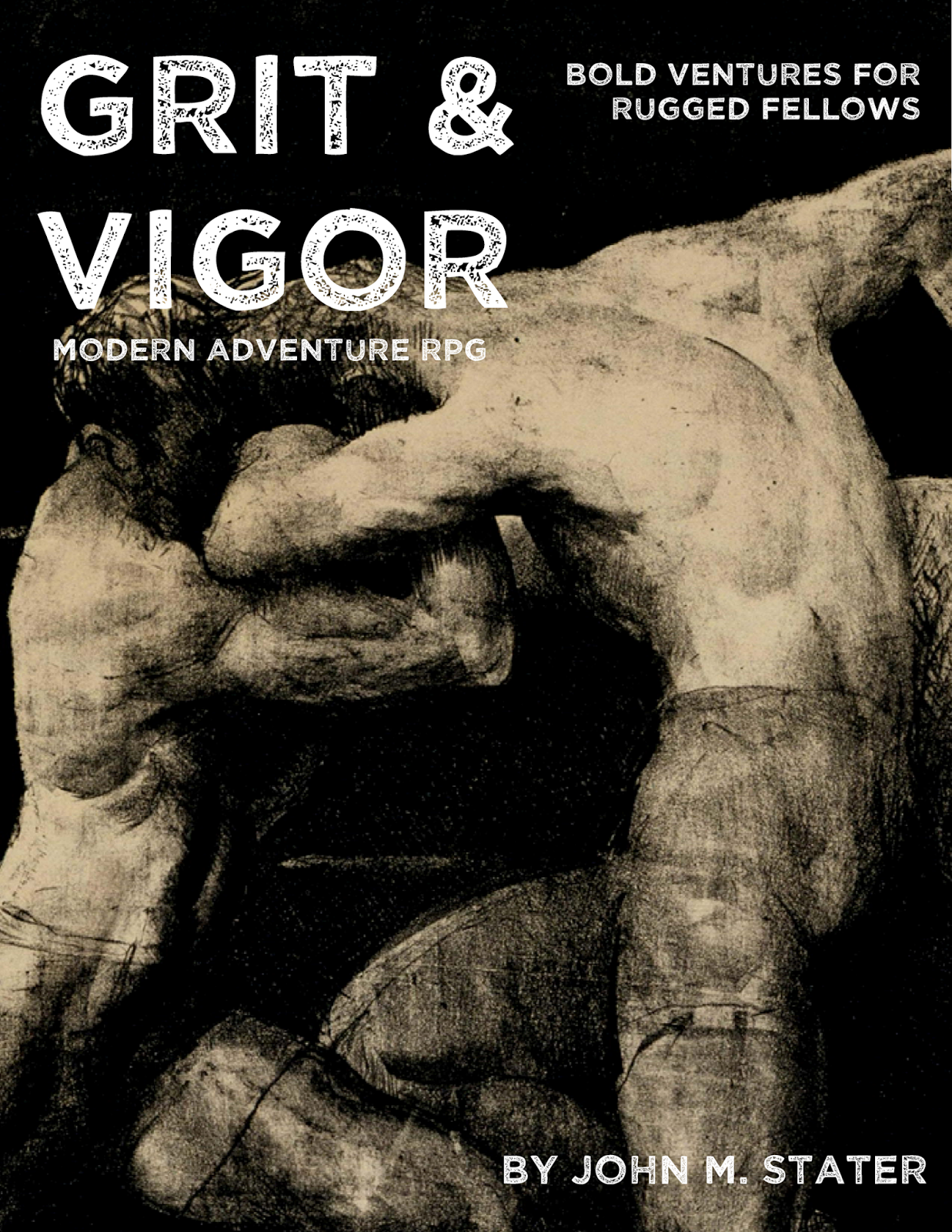
Cover art by George Bellows

I tried. So help me I tried. But I just couldn’t get into the thing.

The idea was to do to the Modern SRD what I did with the fantasy SRD – i.e. turn it into a modern version of Blood & Treasure. The problem – I just couldn’t find the hook, the energy, the right feel that would make the thing gel. It’s tough to make something good if you don’t love it, you know.

And then the revelation.

I was musing on what kind of RPG Ron Swanson would play. I know – ridiculous – but an hour on a treadmill can send the mind into all sorts of odd places. Of course, the answer is that Ron Swanson wouldn’t play an RPG. He is, however, the closest thing modern America has to a folk hero, and symbolic of a movement by modern men to get in touch with their roots. I needed a subject that I found interesting, fun and inspirational – and by Ron Swanson’s mustache, the manly adventure of yesteryear was going to be it. Surviving in the wilds, steering tall ships, plunging into the mysterious corners of the globe in search of loot, hunkering down in a trench, preparing to dash into the oncoming bullets of the hun! – that was the ticket.

So, Action X is dead, may it rest in peace. I’m replacing it with GRIT & VIGOR – BOLD VENTURES FOR RUGGED FELLOWS. I’ve been writing the crap out of it for the last week, and think I can begin play-testing it on Google + in January and publishing it sometime in the Spring or Summer.

GRIT & VIGOR draws on the literature of Kipling, Conan-Doyle, Conrad, Hemingway, REH, London, Burroughs and their ilk. It’s about larger than life men going on adventures in search of money, power and freedom. Yes, women can play G&V – either as male characters (it is role playing, after all), or by flipping all the pronouns in the book from masculine to feminine – any woman worth her salt will do anything she likes with my game rules – she doesn’t need me to give her permission or molly-coddle her.

A FEW SPECIFICS

Characters, also called “rugged individualists” in G&V, do not belong to a permanent “class”. Special abilities, skills and weapon proficiencies are handled with feats. You get several at first level, many of them are rolled randomly on one of four tables meant to represent your character’s background (you can Go Rogue, Go to School, Go to Work or Go to war), though the referee could allow players to simply choose them if they preferred. All of the feats are given one of four classifications – Mental, Martial, Red-Blooded and Underhanded.

Whichever of those categories the majority of your character’s feats fall into determines your character’s “class” at that level, with their class determining what dice they roll for hit points, and what ability scores they can boost at levels 4, 8, 12, 16, etc. So, at 1st level, a character with mostly Martial feats is classed as a Fighter, and rolls 1d10 for hit points. By level 3, he may have more Red-Blooded feats than any other, so now he’s classed as a Daredevil that rolls d8 for hit points. Other than that, attack bonuses and saving throws are the same for everyone, though they are modified by ability scores and feats.

Combat, saving throws and task checks work as they do in Blood & Treasure, as do hit points, Armor Class, ability scores, etc. Aerial combat and vehicle rules will be included, of course. Psychic powers are included in the game, but are optional. For opponents, the game primarily uses animals and human beings, but a few monsters (vampires, werewolves, morlocks) are included as well for those who want a paranormal or science-fiction element in their game.

The game will also include what I’m calling an Almanac of Adventure. This will be a series of articles covering different time periods and genres that referees (Venture Masters) can use to build their campaigns. One might be “Wild West”, and will provide some tips and information relevant to that era, as well as any additional rules or equipment to run that setting. Another might be “Mystery”, and will discuss running mystery-oriented games. Hopefully you get the idea. There will also be “Steampunk”, “Atomic Super-Science”, “The Jazz Age”, etc.

I’d also like to include an element of taking the manly virtues expounded on in the game and applying them to one’s real life. Maybe XP awards for overcoming real life challenges that players can apply to their characters – a good chance for members of a gaming group to support one another outside the gaming table. Sounds corny, I guess, but I am corny so I don’t give a damn!

That’s the plan, ladies and gents. I’ll let you know when the playtesting is about to begin, in case you’d like to join in.

History of NOD Part IV

Wow – so I let myself get lax on updating the blog again. In my defense, I’ve been super busy at work (real work, that one that plays for my mansion and gold-plated yacht) and super busy at home (NOD Companion just needs a little editing and layout work, NOD 22 is coming along nicely, Mystery Men! got a small revision and ACTION X has been reborn as GRIT & VIGOR and is also coming along nicely). So, there’s my excuse. Here’s my post …

HISTORY OF HUMANS AND HALFLINGS

With the power of the elves and dwarves broken, the world was left to the humans and their ilk. We now reach a time a scant five thousand years ago.

As the dragons of Mu-Pan slowly retired into secret places, they left their scions in charge of their warring kingdoms. In time, they would be united in an empire that would have to tolerate numerous dynastic changes and revolutions and stand up to the machinations of the weird lords of Tsanjan.

Thule harbored a rogue elven land called Pohiola. This nightmare kingdom would slowly give way to the invasions of the horsemen of the steppe, as they laid the foundations for such kingdoms as Mab, Luhan and Azsor.

Antilia and Hybresail would remain largely wild places, home as they were to the shattered homeland of elves and dwarves, its human and demi-human populations reduced to barbarism.

In the Motherlands and Lemuria, the human populations learned well from their former elven masters, and founded sorcerous empires founded on demon worship. In time, such empires as Irem, Nabu and Kolos would fall in spectacular eldritch fashion. In their ashes, a new empire was born that would rule much of the Motherlands – Nomo. Nomo was founded when a band of elven adventurers led by Prince Partholon left the shores of Antilia in a dozen longships and make their way to the Motherlands. Finding themselves among a tribe of human barbarians, they soon asserted themselves as their masters, founding the city-state of Nomo and eventually extending their control over much of the sub-continent. Under Nomo’s emperors and empresses a 2,000 year empire was begun which would end only with the disappearance of the Emperor during adventures in the mysterious West.

With the emperor’s disappearance, Nomo fell into factional fighting, with each faction supporting its own candidate for emperor. The former tributary kings and queens in the empire also staked their claims on the throne.

Thus it is in today’s land of NOD. City-states built on the ruins of kingdoms built on the ruins of empires, all threatened by encroaching chaos.

RACIAL CLASS VARIANTS
In Blood & Treasure, I introduced the notion of variant classes. These were meant to illustrate the way one might create new classes using old classes as a base, with fairly minor changes.

BARBARIAN VARIANT: HALF-ORC THUG

Half-orcs often grow up on the mean streets, learning to excel not as trained fighters but as street brawlers. These half-orc thugs advance as barbarians, save for as follows: They may only use padded or leather armor and bucklers, they have the following skills: Bend Bars, Break Down Doors, Climb Sheer Surfaces, Gather Rumors, Hide in Shadows, Jump, Move Silently and Pick Pockets.

PALADIN VARIANT: ELVEN GALLANT

Gallants are elven paladins as dedicated to romance and wooing women as they are to righting wrongs and protecting the weak. While most paladins can be a bit stodgy, elven gallants are rather dashing and devil-may-care.

In a three-fold alignment system, gallants must be Lawful. In a nine-fold system, though, they need only be Good. Gallants cast spells from the bard spell list rather than the paladin spell list.

THIEF VARIANT: DWARF PROSPECTOR

As adventurous as dwarves can be, their first loves are always gold, gems and silver. Many, if not most, get their first taste of adventure as prospectors, heading into the hills or depths in search of metals or stones to mine.

Dwarf prospectors have the following skills: Climb Sheer Surfaces, Find Traps, Hide in Shadows, Listen at Doors, Move Silently, Notice Unusual Stonework, Open Locks, Remove Traps and Spelunking. In addition, they can wield picks and hammers.

THIEF VARIANT: GNOME PRANKSTER

Gnomes are innately magical folk, and some learn from a young age to tailor their magical abilities to the profession of thievery. These gnome thieves are noted for their enjoyment of taunting their victims with pranks and riddles, leaving calling cards and boasting of their thefts before they happen.

In place of a gnome’s normal innate spells, a prankster can cast the following spells: Mage hand, open/closer and ventriloquism.

THIEF VARIANT: HALFLING GYPSY

Many of the halflings that people meet are of a breed known as the pikey – wanderers from the east who live a semi-nomadic life among the larger races, making a living telling fortunes, picking pockets, stealing pies (they love pies) and bilking the naive.

Gypsies have the abilities of thieves, save they replace the backstab ability with the bard’s ability to fascinate. Their skills are as follows: Balance, Climb Sheer Surfaces, Escape Bonds, Gather Rumors, Hide in Shadows, Move Silently, Pick Pockets, Train Animals and Trickery.

The Canting Crew

Before we get on with the new class (which may or may not work, but it’s a fun experiment), I want to announce that all my hard copy books are 10% off right now at Lulu.com. Go check ’em out if you’ve been waiting, and keep your eyes open for Lulu.com sales to make the deals even sweeter.

THE CANTING CREW

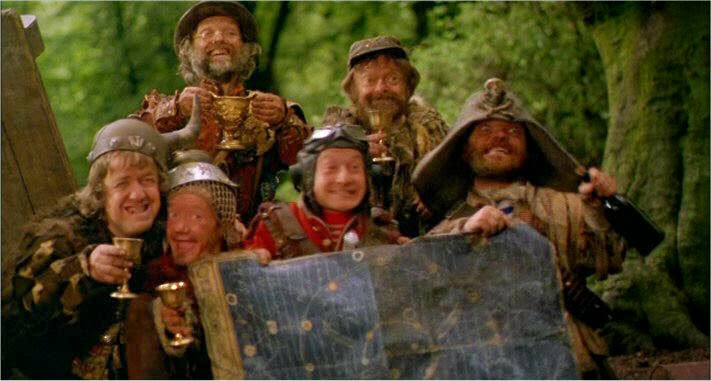
In my quest to create yet another odd character class, I have dreamed up the canting crew. Actually, the inspiration for the class was a small band of robbers cutting a swathe through time after stealing a map of creation. You’ve probably heard of them. Watching Time Bandits made me think of a band of halflings causing trouble, and that made me think of the swarm rules in d20 and one thing led to another and … the canting crew. Obviously, this is not a traditional character class, so it’s not only not for every player, but not for every campaign. Truth be told – I have no idea if this will even work.

REQUIREMENTS
Dexterity 9+, Charisma 13+
Non-lawful, non-good; robber gangs are not necessarily evil, but they are certainly not good
Halfling or gnome (or other small races, if allowed in your games)

ARMOR ALLOWED
Padded and leather armor; no shields

WEAPONS ALLOWED
Club, dagger, dart, hammer, light mace and sling

SKILLS
Hide in Shadows, Move Silently

CLASS ABILITIES

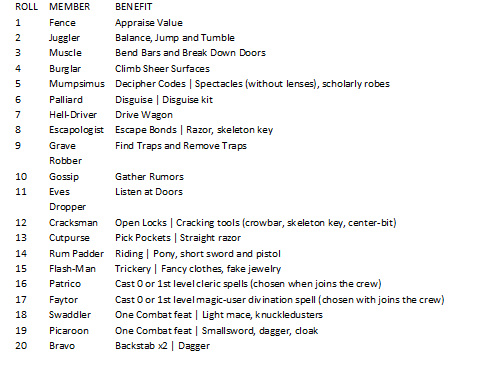
A canting crew starts out as a single rogue, the boss. As the crew gains levels, it also gains members, with each member representing one hit dice, or level, of the crew. Each time a new member is added to the crew, that member should be named, and a dice should be rolled on the following table to get an idea of what that new member brings to the crew.

When a member of the crew brings a competence in a task, that particular member is skilled in that task, and his presence and tutelage makes Gives rest of the members a knack in that task. If a canting crew is divided, this distinction might be important.

The canting crew attacks as a swarm. Attacks against the crew deal damage to the band’s collective hit points. The crew can split up to make attacks, or even choose not to throw all their weight against a single opponent. For however many members of the crew are attacking a single foe (usually no more than eight against a medium-sized creature), treat the attacks as coming from a robber crew of that level. Thus, three robbers attacking a creature attack as a 3rd level crew, i.e. with a +2 attack bonus. The crew, no matter how they are split up, uses saving throw values for their crew’s full level. Any feat taken by the robber crew is assumed to be held by all members of the crew. Feats or abilities that come with individual members are possessed only by that member.

On the downside, robber crews are composed of multiple halflings or gnomes, and each member requires his or her own equipment and rations. This makes running a robber crew a bit expensive, so make sure you don’t pass up a chance for treasure or theft!

Damage against a robber crew must also be addressed. When a robber crew’s hit points are reduced to 0, it is assumed that all of the members have been killed, the boss being the last to fall. For every three points of damage a crew suffers, there is a 10% chance that one member, chosen at random, is killed and must be replaced when the crew next reaches civilization. While the crew is short a member, they are also short that member’s skills or abilities and their help in a fight. When the crew does reach civilization, a new random member is added to the crew.

A 3rd level canting crew learns how to cover one another’s retreats. Members of the crew can retreat at a full run without drawing an attack from their foes.

A 5th level canting crew’s chattering and dodging about has a chance of confusing their opponents. Each round a crew decides to caper instead of actually attacking, their foe must pass a Will saving throw or be stunned for that round. To confuse an opponent, at least three members of the crew must be engaged in combat with that opponent.

A 7th level canting crew learns how to look out for each other. They roll their chance of being surprised on 1d8 instead of 1d6. In addition, when they fight, each member of the canting crew engaged with a single creature over the first member increases the Armor Class of the group fighting that creature by one.

A 9th level canting crew can establish a hideout for themselves, per the thief class. The canting crew does not attract a lieutenant, but they do attract a number of lesser rogues and thieves, with the members of the canting crew each taking on a small gang of their own to tutor and control.

History of Nod, Part III – The Dwarves

Today, we cover the ancient history of the dwarves of NOD, with a special bonus at the end covering the identities of the major Kabir and Igigi.

Image by Jon Kaufman (pachycrocuta at DA – check him out for commissions!)

The ancient elves, being fey creatures, were physically malleable. Not to the extent of the Kabir, of course, who could assume any shape they pleased. The elves were humanoid in shape, and humanoid they would stay. But when they were angry, their faces twisted and their bodies distorted (sometimes called a warp spasm), and when they were happy, they almost glowed with joy. An elf’s children were physical duplicates of their parent’s emotional and spiritual selves.

As the ancient elves grew darker, their children grew uglier. Thus were born the orcs, goblins, bugbears, hobgoblins and dwarves. These waifs were turned out into the wilderness by their disgusted parents to die, but many were rescued by entities who saw them either as useful pawns in their own sinister games, or in the case of the dwarves, who were born of greed, by the compassion of Ys, who believed they might be brought up to do good in the world despite their parentage.

Ys was correct about the dwarves, hiding them in the mountains and under the hills, and shepherding their development until they were honorable men and women, industrious, clever and just. Of course, they were still greedy and stubborn as all get out, but nobody is perfect.

As was mentioned before, the dwarves were no match for the ancient elves, and were forced to pay tribute to them. A dwarf loves his gold, and being cheated of it brought a terrible hatred for the elves among the dwarves, and they bent their minds to one day throwing off this indignity. They were a patient folk, the dwarves, and they had much time to plan and scheme. They forged weapons of power and hid them away, and watched as the debauched elves grew insular and petty. They had long ago stopped having children with one another, choosing instead to produce children with their more handsome human slaves, that they might escape the aforementioned curse of “ugly children”. In time, there were many more humans and half-elves in their kingdoms and empires than true elves. The time the dwarves had waited for had finally arrived.

In this time, the disparate elven kingdoms had come under the control of a queen-of-queens, an elf called Vinrix. Vinrix was the most powerful elf of her age, and nothing to be trifled with. When her people came to the high king of the dwarves, Dvalinn, with demands that a hundred-thousand of his people be delivered into slavery to build her monuments, he declined, and sent back from his halls a few bloodied and blinded survivors carrying the heads of their comrades. This, of course, meant war.

War between the elves and dwarves centered around the dwarven holds in the Bleeding Mountains, which in those days were known as Golden Mountains. The elves besieged the dwarves in their mountain holds, as Dvalinn had desired, and slowly but surely the dwarves chipped away at the strength of the elven armies, slaying their great wizard-lords with such mundane things as rockets and cannon. More importantly, they undermined the positions of the elves, and bypassing their enemy’s lines worked their wiles on the human slaves that formed the bulk of the elves’ strength. Before the elves knew it, their human subjects were in open revolt, and they were forced to divide their armies again and again until they were spread thin across the globe.

It finally came about that the dwarves left their strongholds to challenge the army of Vinrix in the field. The elves had made camp around the base of the Crown Stone, the keystone their magical network of standing stones, which augmented their eldritch power and denied it to most other folk. There the dwarves went with humans and others in tow, and joined battle with their ancient enemies. Eventually, it was a matter of High King against Empress, and finally, her back pressed against the Crown Stone itself, the dwarf made a last mighty swing with his hammer and missed. The hammer, forged in the raging elemental fires beneath the earth, tempered in the immaculate grudges of the dwarves, cracked the great stone his people had raised, and everything was cast in a brilliant white light.

Those who were far enough away to have seen the event and survived tell of a great white light that lasted but an instant and then disappeared, followed by a great rush of wind. Vinrix and Dvalinn and their armies were gone, as was the Crown Stone and, with it, the network of standing stones. Some toppled physically, others remained standing, but the great network that channeled magical energy was gone. Where once there stood the Crown Stone on a lush prairie, there was now a great, gaping gulf – a piece torn from the Material Plane. A few bits of land floated in this black gulf, this void-scar on the landscape, but the rest was gone.
With the magic dissipated across the globe, the impossible cities of the elves toppled and those who were left found themselves the inheritors of wrack and ruin.

Needless to say, the elves were none too happy about this. To be sure, the greatest of their cities still stood, fabled Tara Tilal, but most of the others were gone. The elves were now weakened, and they were forced into the wilderness by their former slaves. While some repented and turned back to their ancient gods, many others had revenge on their minds, and magical communications sent a great many (perhaps two-thirds) of the surviving warriors and wizards marching to the wondrous western mountains known as the Pillars of Asur, where that grand old kabir’s great temple stood. They gathered in the foothills and swore oaths and forged weapons and summoned demons, and then started up those slopes to topple their ancestor-god’s house of worship.

They did not get far, though, before the old god himself did appear and whisper a single curse. The sun would be denied these elves for all eternity; it would become to them a hateful thing of pain, burning eyes and flesh, an eternal reminder of their fall from grace and final punishment. These elves turned and fled from their god and the sun, which burned their skin black, and hid themselves in dark places under the earth, and would come to be known in future centuries as the drow. They would eventually have their revenge on the dwarves, though, as they excited the fires that burned beneath the Golden Mountains and gathered the foul goblin folk who dwelled near them and finally freed the last of the elder things that were chained therein. As hundreds of volcanoes exploded simultaneously, the skies were blackened and the holds of the dwarves were cracked and destroyed. The goblins swarmed these strongholds and the dwarves were forced to flee. The Golden Mountains had become the Bleeding Mountains, so named for the red rivers of lava that now flowed there and for the copious amounts of dwarf blood spilled by the goblins. The dwarven diaspora had begun.

THE MAJOR KABIR

ASUR: Kabir of the Sun; ruler of The Noble Procession (the aristocratic and beautiful, chivalrous and vain fey, especially the ancient elves and even the rebellious drow who are their closest relatives)

BEL: Kabir of death and rebirth; rules the Mourners (fey concerned with the dead, such as banshees)

GHOBB: Kabir of geology; rules the Keepers of Kitchen and Pantry (the household fairies, as well as the useful folk of the fairy world such as leprechauns and brownies)

KARN: Kabir of the hunt; rules the Bloody-Minded Lot (mean-spirited killers and torturers, such as red caps and trolls)

NUDD: Kabir of the oceans, the “ancient mariner”, who went to sea and never again set foot on land; he might be said to rule the fey of the water, though he shows little interest in doing so and generally leaves them to their own devices

TUT: Kabir of mischief; rules the Merrie-Met (tricksters, dancers, and makers of mischief like satyrs and sprites)

YS: Kabir of fertility; rules the Painters of Flowers and Dapplers of Dew (the fey that make the world go ‘round, the nature-workers of Nod such as the flower fairies, nymphs and dryads, as well as the storm giants – though nobody really rules those folks)

THE MAJOR IGIGI

ALAD: Igigi of Benevolence (NG)

AZAG: Igigi of Morbidity (NE)

AZUR: Igigi of Virtue (LG); After Azur’s destruction by Zid during its crusade in the Material Plane against evil, when it stretched itself too thin and made itself vulnerable, Azur was shattered into seven archangels (solars), generally known as the Seven Virtues.

GUZU: Igigi of Rage (CE)

NIM: Igigi of Love (CG)

SUUL: Igigi of Madness (CN)

ZID: Igigi of Logic (LN)