Adventurers Face Death, Yes, But Also Taxes

Image found HERE – Click through for more info on medieval taxes

We all know the formula. Start in town, buy equipment, journey into the unknown, hopefully find lots of money, come back to town, buy more and better equipment (and maybe healing), rinse and repeat.

I have found that in practice, there are three ways this can go. The first, of course, is perfectly. More often, adventurers either come back without enough to support themselves in the hyper-inflationary economy they’re all creating in town, or they come back with more dough than they can spend (assuming they’re like mine and stubbornly refuse to hire men-at-arms).

It seems like the latter might have been more of a problem than the former in the old days. In AD&D, Gygax introduced “training costs” to, as I understand, siphon money away from successful mid- to high-level adventurers.

Another option is the bane of man’s existence from the earliest days of civilization … The Taxman!

Folks who regularly read the blog will know I was recently delving into the pages of Adam Smith’s Wealth of Nations. He does a long chapter on taxes, and as I was reading about the myriad forms of taxation that existed in the 18th century, it occurred to me that a random taxation table could be fun, with adventurers never sure just how the local prince was going to steal their money.

The idea here, of course, is not to make life needlessly difficult for adventurers. If they’re relatively poor, the taxes will be relatively light, and an inability to pay them will result in being impressed into doing work for the sovereign, which can be used as a way to introduce new adventures and even entire campaigns (Robin Hood, anyone?). Adventurers tend to be outsiders and ne’er-do-wells anyways (why else are they delving in dungeons instead of holding down respectable jobs?), so another reason to bristle at authority should help to keep them on the adventuring path.

To get this rolling, we need to determine how heavy the taxation is in the locality, who is collecting it, and what the actual taxes are.

HOW HEAVY ARE THE TAXES?

Different kingdoms/city-states/whatever have different expenses, and folks who spend tax money tend to overspend rather than underspend.

Each community will impose 1d4+1 taxes (see below) on adventurers.

THE TAXMAN

The tax collector is usually a normal human, but might also be a captain (5 HD) or an aristocrat (3 HD). In rare cases (1%) he is a fighter or thief of 4th to 7th level.

The tax collector is not a popular fellow, so he is always accompanied by 1d6+4 men-at-arms (light infantry usually).

Not all tax collectors are created equally, of course, so we will differ them by their alignments. Roll as follows:

LAW vs. CHAOS (D6)

1-2. Lawful = Cannot be bribed or frightened easily from his appointed duties

3-4. Neutral = Can be bribed (Charisma check, -2 penalty) with an amount of money equal to half the taxes owed; can be frightened, but will return with triple the number of men-at-arms

5-6. Chaotic = Can be bribed (Charisma check) as above, but there is a 1 in 6 chance he will return later and pretend no taxes were ever collected; can be frightened, but will hire 1d6 assassins or thieves to get revenge.

GOOD vs. EVIL (D6)

Note, if you use the three-fold alignment system, consider Good to be implicit in Law above and Evil to be implicit in Chaos above.

1-2. Good = Is willing to fudge the tax bill down a bit (maybe 10%) if people look hard on their luck.

3-4. Neutral =No special behavior.

5-6. Evil = Will overestimate taxes by at least 10% if one is not very careful.

Where’s the Taxman?

The taxman is usually stationed at the front gate of a stronghold, village, town or city, but may be encountered as a random encounter outside of town, but rarely in the wilderness.

THE TAXES

1. Tax on coins: A tax of 1d4 x 5% on all coinage carried is assessed.

2. Tax on cargo: A tax of 1d6 cp is assessed for every 20 pounds of goods, above and beyond one’s own clothing, they carry into the settlement. If the goods are “valuable”, this is increased to 1d6 cp per pound.

3. Tax on arrows and bolts (and quarrels): The arrow tax is 1d6 cp per arrow, bolt or quarrel. There is a 1 in 6 chance they will also assess a 1d6 cp tax per foot length of bows and crossbows. This protects the local bowyers and fletchers.

4. Tax on iron and steel: A surtax of 1d6 cp is assessed for every pound of objects composed mostly of iron or steel. This protects the local iron industry.

5. Tax on copper: A surtax of 1d4 cp per pound of copper (including coins), bronze and brass carried into the settlement.

6. Tax on silver: A surtax of 1d4 sp per pound of silver (including coins) and electrum carried into the settlement.

7. Tax on gold: A surtax of 1d4 gp per pound of gold (including coins) and platinum carried into the settlement.

8. Tax on gemstones: A tax of 1d4 x 5% of the value of gemstones carried into the town; those who cannot pay have their stones confiscated until they can pay, but must pay an additional 10% fee for failure to pay and for storage.

9. Tax on magic items: Obviously, this requires the presence of a person in the tax collector’s retinue who can cast detect magic, or obviously magical items. A premium of 10 gp per item is collected, and items of a demonic or diabolic nature will be confiscated by local church authorities, with 10% of the item’s value (determined by the church authorities) to be paid to the original owners, unless they are determined to be Chaotic (Evil), in which case they are clapped in irons and sent straight to the dungeon.

10. Tax on magic-users: Those who appear to be magic-users (the spellbook is a dead giveaway) must spend 1d6 nights patrolling with the night watch, or else must buy out of this duty at a rate of 1d10 sp per night.

11. Tax on holy symbols: Foreign holy symbols are assessed a blasphemy tax of 10 sp (wooden or stone or common metal holy symbols) or 10 gp (precious metal holy symbols). Each healing spell cast in court on behalf of the king/mayor/prince/etc. is the equivalent of 5 sp of the assessed tax.

12. Tax on strength: Settlements always have hard work that needs doing on civic projects. Characters who look sturdy (i.e. Strength of 10 or higher) are impressed into a work gang for 1d6 days, or else must buy out of this duty at a rate of 1d10 cp per day for able-bodied folk, 1d10 sp per day for muscular folk (i.e. Strength of 13-15), and 1d10 gp per day for the truly mighty (i.e. Strength of 16+). If a creature does not look as strong as he or she is, use your best judgment as  TK as to whether this applies to them.

13. Tax on beauty: The local ruler has an eye for beauty; those with Charisma scores of 13 or higher are tasked with attending court in their finery (or finery will be provided) for 1d6 days while in the settlement to impress visitors, or else must buy out of this duty at a rate of 1d10 sp per day.

14. Tax on feet: A tax of 1 cp per unshod foot/hoof, 1 sp per sandaled or shoed foot or shoed hoof or 1 gp per booted foot is assessed. If your game includes centipede men, they’re going to hate this!

15. Tax on wheels: A tax of 1d6 sp per wheel is assessed.

16. Tax on beards: The locals have had trouble with dwarves, and so they assess a tax of 1 gp per inch of beard length on all (not just dwarves) who enter town. If you don’t know how long a character’s beard is, guess or roll randomly. If the dwarf’s player has ever mentioned looking like “the dudes from ZZ Top”, he’s going to regret it.

17. Tax on warriors: The locals need strong warriors to deal with the humanoids and monsters of the wilderness. Anyone who looks the part of a warrior (leather armor or more) is impressed into patrol duty for 1d6 days, or else must buy out of this duty at a rate of 1d10 sp per day.

18. Tax on finery: Jewelry, silks, mithral, adamantine, cloth-of-gold and the like are assessed a tax equal to 1d4 x 5% of their value.

19. Tax on hides and pelts: Hides and pelts are assessed a tax of 1d10 sp for animal skins, 1d10 gp for magical beast skins (and similar) and 1d10 pp for dragon skins. If the tax cannot be paid, the hides are confiscated into the treasury of the settlement or king.

20. Tax on retinues: In order to support the local labor market, a tax of 1 sp per hireling or man-at-arms is assessed.

You’ll note that there is no tax on thieves’ tools – that’s because they’ll probably just arrest a person who has them or toss them out of town.

If taxes cannot be paid, the offenders are either barred entry to the settlement and its environs (i.e. sent back into the wilderness under armed guard) and threatened with being declared outlaws if they again return without their assessed taxes, or is taken into custody until they can work their bill off (i.e. a great adventure hook!).

I Love Paleontology

I’ve said it before, and I’ll say it again – I love the internet, with the emphasis on “net”. It’s fabulous having so much information so easily accessible, but what’s even better is that you find so many wonderful things you weren’t looking for, and in fact that you never knew existed. For example …

Illustration by Pavel.Riha.CB at the English language Wikipedia, used via Creative Commons Attribution-Share Alike 3.0 Unported license

The Odobenocetops, or Walrus-Faced Whale, or Walrus-Whale for short. Who knew? I’m just waiting for some lucky paleontologist to pull the first owlbear skeleton out of the ground.

So, in honor of this new addition to my brain matter, I present some quick monster stats. Please bear in mind, though, that I’m not going to stat up an inoffensive ancient whale that dined on mollusks. No sir – this is D&D, and that means we need an aquatic bad-ass!

ODOBENOCETOPS (WALRUS-WHALE)
Large animal, Neutral (N), animal intelligence; Pod (1d8)

HD: 8
AC: 18
ATK: Slam (1d6) and tusk (1d10)
MV: 0 (Swim 60)
SV: F8 R8 W14
XP: 800 (CL 9)

The walrus-whale is a sea mammal of the Pliocene era. The walrus-whale has a single long tooth that jutted back from its mouth and can be used as a tool and a weapon.

In combat, a walrus-whale attacks by slamming into opponents and by slashing and spearing with its tooth. Creatures hit by the monster’s tooth attack with a natural roll of ’20’ are punctured if they fail an Armor Saving Throw (i.e. roll 1d20 below one’s armor bonus, including any natural or magical armor bonuses, but excluding dexterity bonuses to AC). A punctured creature suffers 1d4 points of Constitution damage as organs are punctured, and thereafter suffers 1 hit point of bleed damage each round until healed.

Special Qualities: Resistance to cold

Astral Anglers

Saw a picture of ice fishing, and this idea popped into my head.

ASTRAL ANGLER

Large Outsider, Chaotic (NE), Average Intelligence; Solitary

Astral anglers look something like crystaline gulper fish, with massive mouths and long, thick bodies. Their bodies are largely transparent, but the creatures organs are a pulsating pink, and thus can be seen through the monster’s flesh.

HD: 8
AC: 18
ATK: Bite (2d6 + swallow whole)
MV: 40
SV: F8 R9 W9
XP: 800 (CL 9)

Astral anglers appear to exist for the express purpose of eating and swimming. They never speak, and their eyes show not a glimmer of intelligence. In fact, they explorers, slowly mapping the myriad psychic eddies and flows of the Astral Plane, imprinting their knowledge on their gemstone brains.

Mapping an infinite plane is hungry work, of course, which leads to the astral angler’s strategy for hunting. The monster extends a lure into the Material Plane, and when something grabs it, the monster yanks them into the Astral Plane to be swallowed.

SPECIAL ABILITIES
An astral angler opens portals into the Material Plane by opening its mouth and expelling a weird humming sound. This weakens the barrier between planes, creating an invisible portal that can be noticed by some creatures as a ripple in space.

Through this portal, the beast extends something like a tongue. This tongue is long and pink in reality, but it is charged with psionic particles, such that in the Material Plane it appears as something the monster’s prey envisions as their fondest desire. The particles pick up needs and wants that a group has in common, so the tongue appears as the same to thing to all. This is an illusion effect, and can be overcome in the normal way.

When a creature touches the tongue, they stick fast to it unless they pass a Will saving throw. A person stuck to the tongue is suddenly jerked through the invisible portal and into the Astral Plane. The portal remains open for 10 minutes, and others can move through it without difficulty.

The original victim that is jerked in is immediately attacked by the astral angler using its bite attack.

Preview Time

Wow – it’s been almost a week since last I posted. What have I been up to? Well, aside from work, a little economics-oriented freelance stuff, and doing the family thang, I’ve been working on NOD 22 and the Tome of Monsters. So – time for a preview post!

[Oh – and the physical version of NOD 22 is now up for sale at Lulu!]

NOD 23 – The Ende Hexcrawl

Foreigners have called the plateau of Ende the land of monsters, and rightly so. In ancient days past, the elves dominated the west and the dragons the lands of Mu-Pan, but the rest of the planet was given over to monsters, especially the colossal mountains called the Great Yamas.

In the primordial days, the Kabir did battle on this plateau where the ancient river Ende runs down from the mountain glaciers. They clashed with the demons and other outsiders who sought to colonize Nod, leaving behind small pockets of these monsters and their servants, and a great fortress-temple called Aornus, wherein was hidden a mighty artifact of the kind they had used to defeat the demons and push them into the underworld beneath the Great Yamas.

Before the receding of the waters of Mother Ocean and the South Seas, Ende was a hilly peninsula jutting from the Yamas and dominated by two tribes, the Rakshasa and the Naga. The Rakshasa dominated the goblins and ogres, while the Naga dominated tribes of lizard-men and ophidians. Between them, the Rakshasa and Naga constructed the fortresses that would become the four great city-states of the plateau.

Eventually, the waters did recede and revealed the vast lowlands that would become the plains of Gondar and the tangled jungles of Djangala. These virgin territories attracted human, demi-human and humanoid tribes, who came under the sway of the monstrous tribes of the plateau for a time, before asserting their independence.

Due to the presence of the fortress Aornus and the mythical engine of destruction concealed within, the plateau has been visited by many armies over the centuries, including diving armies of demons and angels. As a result, the plateau is home to many more aasimar (called aasura in Ende) and tieflings (called teivas in Ende) than can be found throughout most of Nod.

Ende today is much as it has been for centuries, a land of adventure, danger and potential wealth. After many millennia of settlement, the land is rife with ruins hiding treasures beyond belief. The cities of the plateau, constructed over a thousand years ago, sit atop ancient iterations of them-selves, one city atop another, forming vast dungeons clogged with treasure and the non-human tribes that originated the cities before humans settled on the plateau.

TOME OF MONSTERS

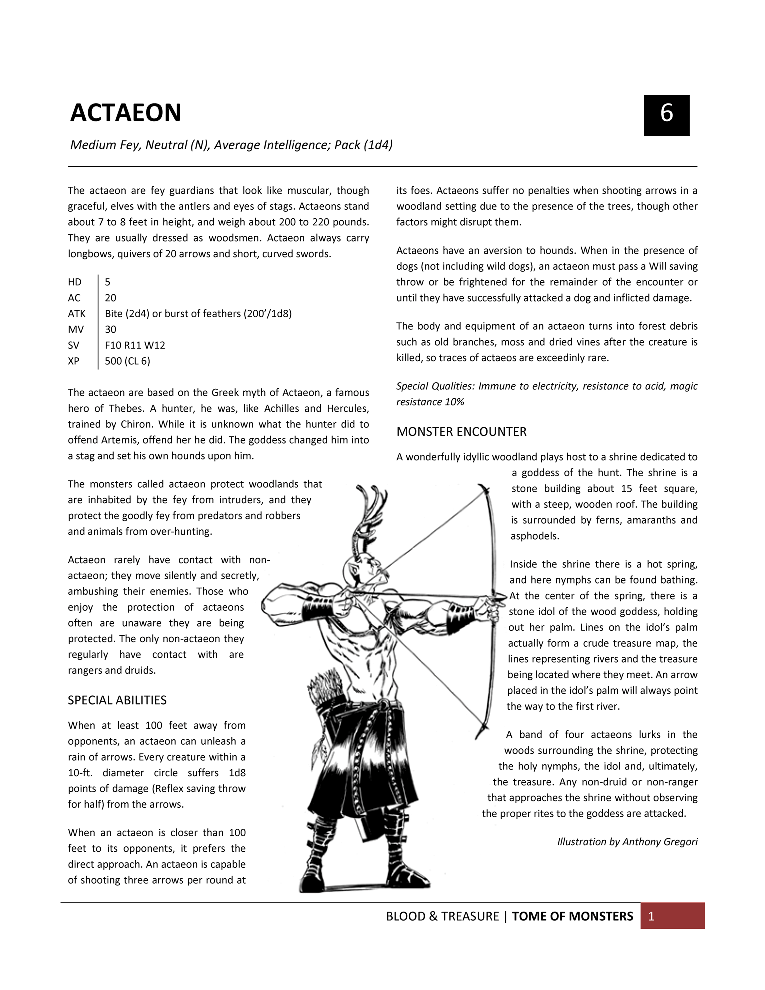
This is shaping up pretty nicely. Art is being commissioned and is flowing in – below is a sample page as the layout now stands. Looks like this one will feature 145 new entries (some with multiple monsters per entry).

Okay folks – back to work!

The Greyhawk Tomb of Horrors Company – A Campaign Notion

I’m still reading Adam Smith’s Wealth of Nations (it’s not a small book), and I’m now reading about the various merchant companies that held monopolies to trade with various colonies of the U.K. This got me thinking about using a similar concept in fantasy rpg’s.

In this case, you would have countries or city-states establish control over a mega-dungeon and the immediate region around it. This actually makes some sense, when you consider the incredible wealth (monetary and magical) held in a mega-dungeon. For a fun campaign, you would probably want to establish multiple mega-dungeons in a campaign world, with different countries controlling them.

Each of these mega-dungeons has a different adventurer company that holds a monopoly on its exploration and exploitation, with a percentage of all proceeds going to the government that gave it the charter. The adventurer company might be a joint stock company, in which different NPC’s (wealthy merchants, sinister types, aristocrats, and the adventurers themselves) hold stock, with an annual dividend based on how well the adventurers have done in their explorations. The adventurer company could have multiple adventurers in it, of varying levels – so players could have multiple adventurers, bringing new ones in at times as old adventurers die off or rise to higher levels and need apprentices and squires.

Moreover, as the adventurers hit the name levels, the strongholds they establish could be in the region of the mega-dungeon, as a means for the company to control the area. Of course, rival nations would want to wrest control of the dungeon away from the company and its country, so now wargaming can enter into the campaign. The adventurers might also get involved in conquering other mega-dungeons, and even establishing their own companies to exploit them.

As adventurers become more wealthy, they can attempt to buy more shares in the company, maybe rising the level of directors and having to engage in all the intrigue that surrounds big money and royal courts.

I imagine this could make for a fun framework for running a campaign.

Human and Humanoid Armies, the Adam Smith Way

I have of late been reading Adam Smith’s Wealth of Nations. It’s a great book, and very enlightening, not only for his insights into the operation of economics, but also for his asides regarding the evils of slavery, the American revolution and, in a latter chapter, his investigations into war.

Specifically, his investigations into the costs of maintaining an army in times of war and peace. He doesn’t get too deep into the weeds, of course, but reading Book V: Chapter I: Part I reminded me a bit of reading the demographics that Gygax inserts, piecemeal, into the Monster Manual and elsewhere in the AD&D canon.

The chapter in question regards the costs to a sovereign in maintaining an army. It gives some ideas on different phases of human development, and their effect on manpower and expense.

Smith divides human development into three categories, with the earliest being hunters, the second shepherds and the third farmers and craftsmen. In Gygaxian, D&D terms, we could think of the humanoids (orcs, goblins, etc.) and human tribesmen as hunters, the human nomads and dervishes as shepherds, and the settled humans and demi-humans as the farmers, husbandmen and craftsmen.

I found the following paragraphs interesting:

“Among nations of hunters, the lowest and rudest state of society, such as we find it among the native tribes of North America, every man is a warrior, as well as a hunter. When he goes to war, either to defend his society, or to revenge the injuries which have been done to it by other societies, he maintains himself by his own labour, in the same manner as when he lives at home.”

“An army of hunters can seldom exceed two or three hundred men. The precarious subsistence which the chace affords, could seldom allow a greater number to keep together for any considerable time.”

In other words, most humanoid encounters are going to be with warriors and their wives and children. To put it another way, the wild folks you encounter in the wilderness in D&D are all warriors. He would also place the size of these tribes at a maximum of 300 warriors.

“Among nations of shepherds, a more advanced state of society, such as we find it among the Tartars and Arabs, every man is, in the same manner, a warrior. Such nations have commonly no fixed habitation, but live either in tents, or in a sort of covered waggons, which are easily transported from place to place. The whole tribe, or nation, changes its situation according to the different seasons of the year, as well as according to other accidents. When its herds and flocks have consumed the forage of one part of the country, it removes to another, and from that to a third. In the dry season, it comes down to the banks of the rivers; in the wet season, it retires to the upper country. When such a nation goes to war, the warriors will not trust their herds and flocks to the feeble defence of their old men, their women and children; and their old men, their women and children, will not be left behind without defence, and without subsistence. The whole nation, besides, being accustomed to a wandering life, even in time of peace, easily takes the field in time of war. Whether it marches as an army, or moves about as a company of herdsmen, the way of life is nearly the same, though the object proposed by it be very different. They all go to war together, therefore, and everyone does as well as he can. Among the Tartars, even the women have been frequently known to engage in battle. If they conquer, whatever belongs to the hostile tribe is the recompence of the victory; but if they are vanquished, all is lost; and not only their herds and flocks, but their women and children become the booty of the conqueror. Even the greater part of those who survive the action are obliged to submit to him for the sake of immediate subsistence. The rest are commonly dissipated and dispersed in the desert.

The ordinary life, the ordinary exercise of a Tartar or Arab, prepares him sufficiently for war. Running, wrestling, cudgel-playing, throwing the javelin, drawing the bow, etc. are the common pastimes of those who live in the open air, and are all of them the images of war. When a Tartar or Arab actually goes to war, he is maintained by his own herds and flocks, which he carries with him, in the same manner as in peace. His chief or sovereign (for those nations have all chiefs or sovereigns) is at no sort of expense in preparing him for the field; and when he is in it, the chance of plunder is the only pay which he either expects or requires.”

“An army of shepherds, on the contrary, may sometimes amount to two or three hundred thousand. As long as nothing stops their progress, as long as they can go on from one district, of which they have consumed the forage, to another, which is yet entire; there seems to be scarce any limit to the number who can march on together.”

In D&D terms, this applies to nomads and dervishes, and maybe those barbarian tribes a high level barbarian can summon. Smith would again make warriors of all the men in the tribe, and a even a few women.

“Agriculture, even in its rudest and lowest state, supposes a settlement, some sort of fixed habitation, which cannot be abandoned without great loss. When a nation of mere husbandmen, therefore, goes to war, the whole people cannot take the field together. The old men, the women and children, at least, must remain at home, to take care of the habitation. All the men of the military age, however, may take the field, and in small nations of this kind, have frequently done so. In every nation, the men of the military age are supposed to amount to about a fourth or a fifth part of the whole body of the people.”

So now we’ve reached settlements, and we find that their men-at-arms number about 20% to 25% of the population. An encounter with 500 nomads might include 250 warriors (assuming about 50% male/50% female), while you would need a settlement of 1,000 people to muster up 250 men-at-arms.

“The number of those who can go to war, in proportion to the whole number of the people, is necessarily much smaller in a civilized than in a rude state of society. In a civilized society, as the soldiers are maintained altogether by the labour of those who are not soldiers, the number of the former can never exceed what the latter can maintain, over and above maintaining, in a manner suitable to their respective stations, both themselves and the other officers of government and law, whom they are obliged to maintain. In the little agrarian states of ancient Greece, a fourth or a fifth part of the whole body of the people considered the themselves as soldiers, and would sometimes, it is said, take the field. Among the civilized nations of modern Europe, it is commonly computed, that not more than the one hundredth part of the inhabitants of any country can be employed as soldiers, without ruin to the country which pays the expense of their service.”

This now creates a distinction between the ancient civilizations and the modern (i.e. 18th century) – the ancient putting about 20% of the population in the field to fight, the 18th century about 1% of the population.

“A shepherd has a great deal of leisure; a husbandman, in the rude state of husbandry, has some; an artificer or manufacturer has none at all. The first may, without any loss, employ a great deal of his time in martial exercises; the second may employ some part of it; but the last cannot employ a single hour in them without some loss, and his attention to his own interest naturally leads him to neglect them altogether. Those improvements in husbandry, too, which the progress of arts and manufactures necessarily introduces, leave the husbandman as little leisure as the artificer. Military exercises come to be as much neglected by the inhabitants of the country as by those of the town, and the great body of the people becomes altogether unwarlike. That wealth, at the same time, which always follows the improvements of agriculture and manufactures, and which, in reality, is no more than the accumulated produce of those improvements, provokes the invasion of all their neighbours. An industrious, and, upon that account, a wealthy nation, is of all nations the most likely to be attacked; and unless the state takes some new measure for the public defence, the natural habits of the people render them altogether incapable of defending themselves.”

Here we see a justification for 1 HD nomads and humanoids versus 0-level humans. The humans are mostly farmers and craftsmen, and don’t have much time for training. Maybe we could say 1d8 hit points of nomads and hunters, 1d6 for farmers and 1d4 for city folk would be about right.

“In these circumstances, there seem to be but two methods by which the state can make any tolerable provision for the public defence.

It may either, first, by means of a very rigorous police, and in spite of the whole bent of the interest, genius, and inclinations of the people, enforce the practice of military exercises, and oblige either all the citizens of the military age, or a certain number of them, to join in some measure the trade of a soldier to whatever other trade or profession they may happen to carry on.

Or, secondly, by maintaining and employing a certain number of citizens in the constant practice of military exercises, it may render the trade of a soldier a particular trade, separate and distinct from all others.

If the state has recourse to the first of those two expedients, its military force is said to consist in a militia; if to the second, it is said to consist in a standing army. The practice of military exercises is the sole or principal occupation of the soldiers of a standing army, and the maintenance or pay which the state affords them is the principal and ordinary fund of their subsistence. The practice of military exercises is only the occasional occupation of the soldiers of a militia, and they derive the principal and ordinary fund of their subsistence from some other occupation. In a militia, the character of the labourer, artificer, or tradesman, predominates over that of the soldier; in a standing army, that of the soldier predominates over every other character; and in this distinction seems to consist the essential difference between those two different species of military force.”

The distinction between militia and standing army is interesting. In D&D terms, the militia are the 0-level humans and the soldiers are the 1 HD men-at-arms, with perhaps a few of the better of the men-at-arms being capable of becoming 1st level fighters.

So – read your Adam Smith, and everything else you can find – for you never know where you’ll glean something useful for your hobby.

Giants Modified

I love D&D and its tropes, if for no other reason than that they give players a frame of reference that you can shatter by taking the “mundane” and making alterations to it. Take the giants, for example – six varieties that can be modified in wonderful ways to stump those veteran “know-it-alls” that tromp through your campaigns with a copy of the Monster Manual in their brains.

Some of the modifications refer to Blood & Treasure, which is awesome and you should own (and the complete game, e-book, is now on sale at rpgnow.com / drivethrurpg.com – eventually I’ll have all my material up for sale there as pdf’s and hard copies).

GIANT VARIATIONS

(Apply One or More; use a d30 if you’d like)

1. Armored: Giant has a turtle shell, chitin or skin of metal or stone – boost AC accordingly, and add spikes (+2 damage) if you like.

2. Artillerist: Giant carries a cannon or ballista as his personal ranged weapon (just use damage equal to stone throwing damage if you want to keep it simple and just use the weapon for a dash of flavor).

3. Beauteous: The giant is gorgeous, and gains the nymph’s blinding beauty and charm abilities. In terms of giantesses, imagine hill giantesses like junoesque shepherd women, stone giantesses like living, regal sculptures, frost giantesses with cool, calculating beauty, fire giantesses like giant-sized Sophia Lorens, etc.

4. Bellowing Roar/Piercing Scream: The giant has quite a pair of lungs – once per day it can holler/scream/shriek/roar per the dragonne special ability.

5. Bestial: The giant has bestial characteristics (use the hybrid template in B&T). Combine hill giants with giant boars, stone giants with cave bears, frost giants with worgs, fire giants with giant lizards, cloud giants with giant eagles and storm giants with giant rams – or use whatever animals you think are most appropriate (elephants and tigers offer great possibilities).

6. Bigger & Dumber: Why do things get dumber when they get bigger? I’d probably know if I was smaller. For this one, just use the “giant” template in B&T and knock the intelligence down a notch. If the giant should have spell-like abilities, nix them. Huge giants get a trample attack (damage equal to strike damage) and giants that go from huge to huger gain a stomp attack (per the stomp spell).

7. Builder: Giant has the abilities of an NPC engineer, as well as the tools and a giant ox or draft horse to help him work.

8. Breath Weapon: The giant can exhale an appropriate breath weapon in a 20-ft. cone. Frost giants exhale cold (3d6 cold damage), fire giants fire (3d6 fire damage), storm giants and cloud giants spit lightning (4d6 electricity damage) and the rest just blow a gust of wind (per the spell).

9. Centaur: Giant has an animal body (see bestial above), gaining any appropriate attacks (claws, for example) and the trample ability.

10. Chariot: Giant drives a giant chariot drawn by appropriate animals (see bestial above for ideas).

11. Class: Giant has the abilities of a PC class with a level equal to half its hit dice. Hill giants make good barbarians, stone giants rangers (yes, because of Wormy), frost giants bards, fire giants fighters, cloud giants magic-users and storm giants druids – but any will do.

12. Claws: Giant gains 2 claw attacks (2d4 damage for large, 2d6 for huge)

13. Drunk: Giant is drunk 90% of the time. He loses 2 points of AC and suffers a -2 penalty to hit in combat, but ignores half of all physical damage inflicted on him. When he misses in melee combat, he must pass a Reflex save or fall prone – anyone who might be flattened must pass their own Reflex save or suffer 2d6 points of damage.

14. Elemental: The giant is kin to the earth elementals; use the elemental template in B&T.

15. Evil Eye: Giant can curse with its gaze (per bestow curse)

16. Godson/Goddaughter: Giant has the half-fiend or half-celestial template from B&T – mommy or daddy is divine!

17. Hideously Ugly: Giant is so ugly, those who see it must pass a Will save or be frightened.

18. Knightly: Like the giant Russian knights of old, the giant is not only in platemail and carries a giant sword and lance, but also rides upon a warhorse sized for him or her. Giant knights might have the abilities of a chevalier (see NOD Companion) of a level equal to half their hit dice, if the referee so desires. Giant will definitely be more civilized than most of its kin.

19. Magic Resistance: Giant enjoys magic resistance equal to half their Hit Dice x 5%.

20. Man-Eater: Giant gains the swallow whole ability against creatures two sizes (or more) smaller.

21. Pet-Lover: Giant is accompanied by a dragon or magical beast (or dinosaur?) appropriate to his environment.

22. Primitive: Giant is more primitive than its kin; it can wear nothing more than leather armor and carries nothing more than a giant club, but it’s strength gives it a +2 bonus to damage. Note that hill giants aren’t too swift to begin with, so primitive hill giants wear no armor and fight with their fists.

23. Sage: Giant is old and wise, and has the abilities of an NPC sage.

24. Size-Changer: Giant can change size once per day, per the shrink or enlarge spells.

25. Shape-Changer: Giant can polymorph self once per day.

26. Smoker: Giant smokes a large clay pipe, and can exhale the equivalent of a fog cloud once per day. Creatures in the smoke must pass a Fortitude save (vs. poison) or start choking (tactical disadvantage).

27. Sun-Hater: Giant turns to stone in daylight, but regenerates as a troll (though the damage they are vulnerable to might be different than fire and acid).

28. Trickster: Like old Utgard-Loki, the giant has natural illusionist abilities. Allow them to cast spells as an illusionist (specialist magic-user) with a level equal to half their hit dice, and knock their intelligence up a category.

29. Two-Headed: Per the ettin.

30. Tusks or Horns: Giant has a gore attack (2d6 damage for large, 2d8 for huge).

Okay, a few more ideas:

31. Field Marshall: Giant is an exile who has taken up with lesser humanoids, becoming their de factor leader. Scale the humanoids to the giant: Hill giant with kobolds, stone giant with goblins, fire giant with orcs, frost giant with hobgoblins, cloud giant with gnolls and storm giant with bugbears.

32.  Undead: Combine the giant hierarchy with the sentient undead hierarchy, thus barrow giants (hill giant + wight), shadow giants (stone giant + wraith), smoke giants (fire giant + spectre), ice giants (frost giant + mummy – I’m thinking about the ice mummies here), mist giant (cloud giant + vampire) and tomb giant (storm giant + lich).

33. Friendly: Giants can be friendly, of course, but you don’t want to ruin the rep of the traditional giants. So – hybridize them with some of the friendly demi-human species. Combine hill giants with gnomes for forest giants, stone giants with dwarves for rock giants or fire giants with dwarves for iron giants, frost giants with elves for taiga giants, etc.

Notions on Potions

Potions are one-use magic items that need to make contact with the skin in order to deliver their effect, which is usually based on a magic spell. Simple, right?

By and large, potions show up in treasure hordes in the form of edible concoctions (referred to as potions) and oil. In either case, they are presumably kept in little bottles that hold maybe a fluid ounce of liquid. I wouldn’t be surprised if more than a few referees even come right out and tell their players that they’ve found a potion.

Potions do not have to take the form of little bottles of liquid magic, though. And even when they do, they do not need to be distinctive from other common liquids. Keep your players guessing with a few of these alternate or variant forms for magic potions and oils:

Acid – something must be burned to release the magic

Beer – magical beers work well with rustic folk, like halflings – naturally one can use magical ales, stouts, etc.

Blade – a small blade, it must be run across the palm and draw blood – the mixture of blood and steel releases the magic worked into the blade

Brackish water – just because it’s disgusting, doesn’t mean it isn’t also magical; it will force players to check out those seemingly useless puddles on dungeon floors

Candies

Candle – this could be a delayed release version of a potion, or a potion that affects a group of people (say a potion of invisibility sphere, for example); could also require a person to burn themselves to release the magic or perhaps the candle must be snuffed to release the magic

Cheese – or any dairy – “From enchanted cows …”

Chicken – gruesome, perhaps, but the chicken or other small animal must be snuffed out to release the magic – perhaps appropriate for the temples of evil cultists

Cord – perhaps it must be cut, or maybe it must be tied into a bow to release the magic

Cosmetics – lipstick, rouge, eye shadow – could be embarrassing for rugged adventurers; with lipstick, one person might have to put it on, but another might have to kiss them to release the spell, which then affects them both

Cracker – not the biscuit, but the Christmas favor; several crackers that must be pulled simultaneously by a group could be even better

Dye – the dye must be spilled on an item or one’s skin to release the magic, and the stain remains long after

Eggs – they must be cracked open, releasing a poof of foul-smelling gas that is sniffed to gain the benefit

Elixir – just a variant term for potion

False mustache – the mustache must be applied, and lingers thereafter until shaved off

Firecracker – see the cracker above; especially good for an Asian-themed campaign or dungeon

Flower – pluck a petal to release the magic; this could also work for a multi-charge (but not rechargeable) magic item

Fortune Cookie – the magic is released by cracking the cookie, and if the spell released is a divination, maybe the knowledge to be delivered is on the slip of paper inside

Glass sphere – not unlike the egg above, though perhaps not as disagreeable to the nose; could also just be a stone ball that is struck against something
Grease – a variation on oil, but might have the effect of making a person slippery

Horn – one blast from the horn releases the magic; the horn thereafter is either inert, or it disappears; the same could be done with a trill of a flute or by striking a tuning fork

Image – not a treasure item, but a magical image could be imprinted on a person’s eye and hidden beneath an eye patch – when the patch is risen, the image appears before the person and the magic is released

Lamp oil – like the candle above

Liqueur – Brandy of Invisibility, Scotch of Heroism; carries with it a chance of becoming intoxicated

Locket – the magic is hidden inside, and released when opened

Match – must be struck to release the magic

Mud – another variation on oil; remember when you twisted your ankle and your coach told you to rub some dirt on it and walk around? Same principal

Needle – a finger must be pricked, and perhaps the magic only works on a particular finger

Nosegays and asphidity bags – one strong sniff is all it takes – maybe the scent ends when the duration of the magic ends, or maybe it lingers

Paint – maybe applied to the body, or maybe to a surface (for a dimension door effect, for example)

Perfume – in this case, not all that different from oils – make the barbarian smell like lilacs if he wants the potion of healing!

Pies – after all, you’ve seen how quickly a Hostess fruit pie can take down a super villain

Pills – the higher the level of spell, the bigger the pill

Plaster – in Elizabethan times (and I think beyond), small plasters in the shapes of stars, crescent moons, etc. were applied to the face as beauty marks; perhaps these must be applied, or perhaps they must be ripped off to release the magic

Powders – inhale them, swallow them or powder your face with them

Riddle – when it is solved, the answer releases the magic

Salve – apply generously; brings to my mind the Three Stooges bit with limburger cheese; also unguents, creams and lotions

Secret – not a treasure item, but a magic-user could write a secret message on a person’s back with magical inks that releases the spell when another person reads it

Soap – you must bathe with the stuff to get the effect; this conjures up granny women and their lye soap to me

Stick – the stick must be snapped in two to release the magic

String – could be for a bow or for a musical instrument – must be strung and then plucked, at which point the magic is released and the sting snaps

Syrup – perhaps it must be mixed with carbonated water and then consumed

Tinctures – an alcoholic extract of some plant or animal, not terribly different from a potion, though maybe the tincture is applied to the eye as a drop

Tobacco – or other potent weeds, of course; must be smoked to release the magic

Tune – a slip of paper with a seemingly harmless tune, singing or whistling or humming it releases the magic; unlike a scroll, anyone could release this magic and it cannot be transferred into a spellbook, but like a scroll it only works once

Tonic – just a variant term for potion

Wafers – and cookies, biscuits, breads, etc.

Wine – many wines were spiced in the old days, and one could imagine such a preparation having arcane applications as well; or perhaps the grapes are enchanted while on the vine

The Evils of Drink and Other Intoxicants

From Wikipedia

A little preview of GRIT & VIGOR here for you. When you base a game on manly exploits of the olden days, you have to put some thought into rank drunkenness and other intoxicating past times. How can you run a Victorian-era game without using an opium den as a set piece, and how can you run a game set in the Old West without a drunken brawl in a saloon? You can’t – it’s somewhere in the bylaws I think – and so you need some rules to cover intoxicants and their effect on the human body (specifically, the PC’s bodies and those NPC bodies they’re going to be clashing with).

Why I never thought of writing these rules for Blood & Treasure, I don’t know, but they would work for that game and most other old school games I should suppose. Obviously, the rules are kept simple and abstract – they’re meant to take up a column of the rulebook, not a chapter – but I think they’ll do the job.

INTOXICANTS

Strong men often crave strong drink to dull the pain of living, or to celebrate a hard-fought victory. Of course, alcohol isn’t the only intoxicant a man or his enemies might use. Intoxicants are treated as poisons, and thus require a Fortitude saving throw to resist. They come in three broad varieties: Depressants, stimulants and hallucinogenics.

Intoxicants are also given two levels of efficacy – mild and strong. A strong substance not only has a greater effect than a mild one, and it imposes a -10 penalty to save against it.

The dosage of intoxicants varies widely, so use your best judgment. Mild intoxicants have a duration of 1d6 turns, while strong intoxicants have a duration of 1d6 hours.

If a character already under the effects of a mild intoxicant takes another dose and fails his saving throw, treat him as though he has taken a strong intoxicant.

Each time a character falls prey to the effects of a mild intoxicant, there is a 5% chance they will develop an addiction to that intoxicant (rules for that to follow). Strong intoxicants have a 10% chance per use of causing addiction.

MILD DRUG EFFECT

Depressant: -2 penalty to sensory task checks and balance and tumbling task checks, -2 penalty to AC and to all attack rolls, 10% chance per hour of falling asleep

Stimulant: -2 penalty to all wisdom=based task checks and Will saves and saves vs. sleep effects, +2 bonus to all other saving throws and to attack, -2 penalty to AC

Hallucinogenic: Confusion (there would be a page reference here in the rulebook, but if you’ve played ye old fantasy rpg, you know what confusion does)

STRONG DRUG EFFECT

Depressant: -4 penalty to sensory task checks and balance and tumbling task checks, -4 penalty to AC and to all attack rolls, 10% chance per turn of exhaustion of falling asleep

Stimulant: -4 penalty to all wisdom-based task checks and Will saves and saves vs. sleep effects, +4 bonus to all other saving throws and to attack, -4 penalty to AC, suffers 1d6 points of damage to body per hour of duration, after duration the character is left fatigued for equal duration

Hallucinogenic: Confusion, with a 10% chance that the condition is permanent

Some common intoxicants include the following:

Alcohol: Mild or strong depressantAmphetamine: Strong stimulant
Caffeine: Mild stimulant
Cannabis: Mild depressant and Hallucinogenic
Cocaine: Strong stimulant
Heroine: Strong depressant
LSD: Strong hallucinogenic
Mescaline: Strong hallucinogenic
Morphine: Strong depressant
Mushrooms: Mild or strong hallucinogenic
Nicotine: Mild stimulant
Nitrous: Oxide Mild hallucinogenic
Opium: Strong depressant

Haunted Armor

I don’t think it’s possible to be a member of my generation without having seen a haunted suit of plate armor at some point in a movie or television show. Even if it was just a cunning ruse by a Scooby Doo villain (who knew so many people tried to use the supernatural to cover up their crimes?), the haunted armor was a well worn trope in my day. These days, it shows up as nothing more than lazy comedy … or, in today’s post, as a way to kill those precious little snowflakes better known as Player Characters.

When a warrior dies with his armor, fighting to the end, his spirit often hesitates to leave its last post. When this happened, the spirit animates the armor and continues doing what it did in life. Haunted armor is a close kin to poltergeists – undead spirits that have opted out of the afterlife for a career in deviltry.

HAUNTED JAZZERAINT
Medium Undead, Chaotic (CE), Average Intelligence; Troop (1d6)

HD: 4
AC: 14
ATK: Strike (1d6) or scales (30’/1d4)
MV: Float 30
SV: F14 R14 W11
XP: 400 (CL 5)

A haunted jazzeraint appears as an empty suit of scale mail, floating about 3 feet above the ground, with a helmet and two burning yellow eyes floating above it. Creatures with one or fewer levels of hit dice and warriors of any level that see a haunted jazzeraint are struck by the plight of the spirit within it, and must pass a Will saving throw or be frightened.

A haunted jazzeraint has no hands, and thus cannot wield weapons. Instead, it attacks by either flailing its arms, or slamming with its helmet (per strike above) or by launching a fusillade of razor-sharp scales from its body. These scales seem to regenerate after being thrown, so the haunted armor has no end of them. Just the same, it can only launch a volley once every 1d4 rounds. When a volley of scales is thrown, the jazzeraint makes a separate ranged attack against all creatures within 30 feet and within a 90-degree arc.

Special Qualities: Weapon resistance (silver or magic), immune to cold, electricity and fire

HAUNTED MAIL
Medium Undead, Chaotic (CE), Average Intelligence; Solitary

HD: 5
AC: 15
ATK: 4 chains (1d6 + constrict + energy damage )
MV: 30
SV: F13 R13 W11
XP: 1250 (CL 7)

Haunted mail appears as a suit of chainmail. Creatures with one or fewer levels of hit dice and warriors of any level that see a haunted jazzeraint are struck by the plight of the spirit within it, and must pass a Will saving throw or be frightened.

Suits of chainmail attack with 20-ft. long chains that hang from the monster’s arms. Creatures struck by these chains may be constricted; if they are, they suffer one level of energy damage each round they are held. A creature that is completely drained becomes a zombie; the chain remains around its neck and the zombie is under the control of the haunted mail.

Special Qualities: Weapon resistance (silver or magic), immune to cold, electricity and fire

HAUNTED O-YOROI
Medium Undead, Chaotic (CE), Average Intelligence; Solitary

HD: 6
AC: 16
ATK: 2 strikes (1d6) or whirlwind (see below)
MV: Float 30
SV: F12 R12 W10
XP: 1500 (CL 8)

A haunted o-yoroi looks like a suit of Japanese samurai armor with a grimacing demon mask. Creatures with one or fewer levels of hit dice and warriors of any level that see a haunted jazzeraint are struck by the plight of the spirit within it, and must pass a Will saving throw or be frightened.

Haunted o-yoroi enter combat with a blood-curdling scream. All in earshot must pass a Will saving throw or be stunned for one round. In combat, they can strike with their arms, and specialize at sundering items (items suffer a -2 penalty to item saving throws to avoid being broken).

Once per combat, a haunted o-yoroi can turn into a veritable whirlwind, striking all foes within 5 feet of it. A separate attack roll must be rolled against each opponent, and each hit suffers normal damage plus one level of energy damage. Any creature reduced to 0 level or hit dice from this attack rise as zombies under the control of the haunted o-yoroi. These zombies have the two attacks of a berserker.

Special Qualities: Weapon resistance (silver or magic), immune to cold, electricity and fire

HAUNTED GOTHIC PLATE
Medium Undead, Chaotic (CE), Average Intelligence; Solitary

HD: 8
AC: 18
ATK: 2 strikes (1d6 + 1d6 fire or cold + energy damage) or by weapon (+ 1d6 fire or cold)
MV: 30
SV: F11 R11 W9
XP: 2000 (CL 10)

Haunted Gothic plate armor looks like the moving armor often seen in movies. It is fully articulated and usually armed with a greatsword, halberd or shield and longsword. If armed with a shield, the haunted armor improves it AC by 2. Creatures with one or fewer levels of hit dice and warriors of any level that see a haunted jazzeraint are struck by the plight of the spirit within it, and must pass a Will saving throw or be frightened.

Haunted gothic plate is either freezing cold or burning hot. All creatures within 10 feet of a chilly suit of armor suffer 1 point of cold damage each round, and must pass a Fortitude saving throw or be slowed, per the slow spell. Creatures within 10 feet of a burning suit of armor suffer 1 point of fire damage each round and must pass a Fortitude saving throw or swoon from the hear (i.e. fatigued).

Foes hit by the armor’s strikes, but not its weapons, suffer one level of energy damage. Creatures brought down to 0 hit dice or levels by the haunted armor rise as zombies with iron-hard hides, and thus an Armor Class of 18.

Special Qualities: Weapon resistance (silver or magic), immune to cold, electricity and fire