A Sword by Any Other Name

Weapons are a big part of fantasy role-playing. They are one of the main tools of the trade for vanquishing evil (or promoting it) and relieving the local humanoids of their ill-gotten booty. They are also a way that many players, especially those playing fighting-men, define their characters – archer vs. swordsman vs. weird guy who specializes in the flail.

The thousand variations on the D&D theme have introduced a few different ways of handling weapons in play, from the concept of everything doing 1d6 damage in 0E, to the introduction of variable damage types soon after, to 3rd edition’s variable damage + variable critical hit ranges + variable critical hit multipliers + different sizes + different weapon types (bludgeoning/piercing/slashing and simple/martial/exotic). AD&D’s weapon speeds and weapon vs. AC table was another way of differentiating one weapon from another, i.e. making one’s choice of weapon (or weapons) an element that could influence success or failure in the course of play.

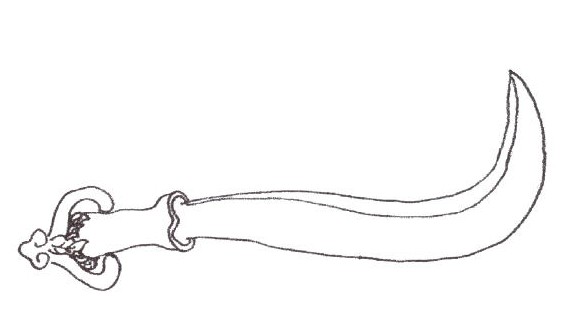
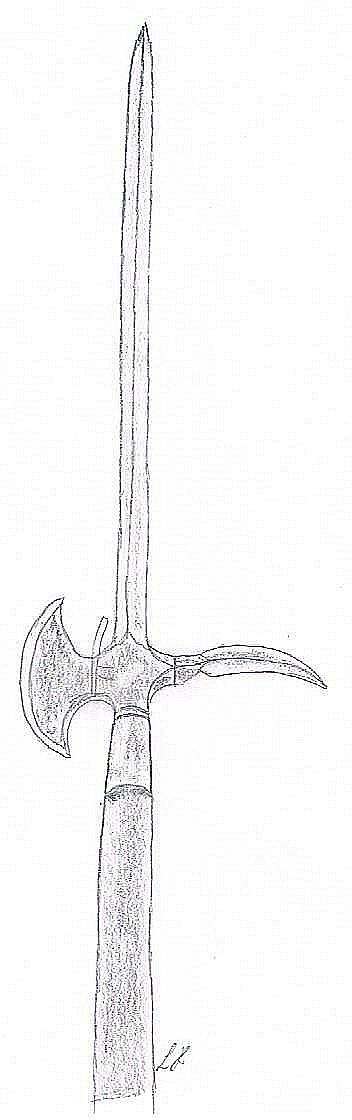
Now, I like lots of variety in gaming, but I also like enough simplicity that I can store the vital game rules in my brain so that I rarely have to consult a book or table during play. For this reason, my desire for weapon differentiation extends about as far as variable weapon damage. Unfortunately, as a person who likes to write game material, and as an ardent devotee of Clark Ashton Smith, describing NPCs with maces and short swords can get a bit boring. So, using my dog-eared copy of Palladium’s Compendium of Weapons & Armor (one of the essential books for a Referee or a write of game material in my humble opinion), I present this handy list of weapon synonyms, along with their region of origination or most common use. The weapon types are based on Moldvay’s Red Book.

Axe, Battle (1d8)
• Africa – Elephant Axe
• Ancient – Khetan (Egypt)
• Central & South America – Maquahuilt
• East Asia – Masakari
• Europe – Bearded Axe, Bipennis, Doloire (wagoner’s axe), Sparte, Taber Axe, Toporok, Tuagh-gatha, Woodsman’s Axe
• India – Bullova, Tabar, Tabar-i-zin, Tungi, Venmuroo
• Near East – Ay-Balta
• Oceania – Balestarius, Head Axe, Udlimau

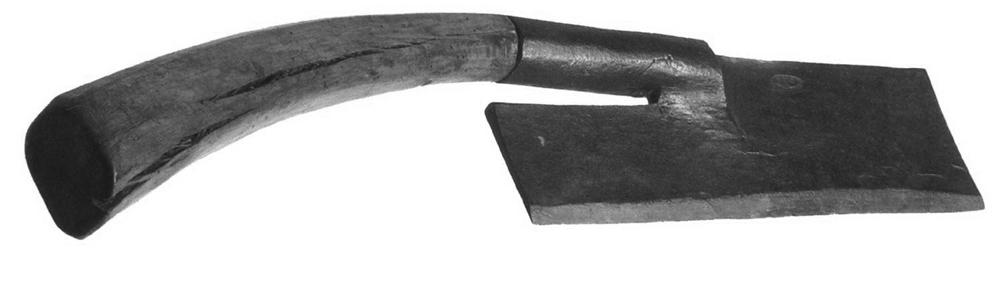
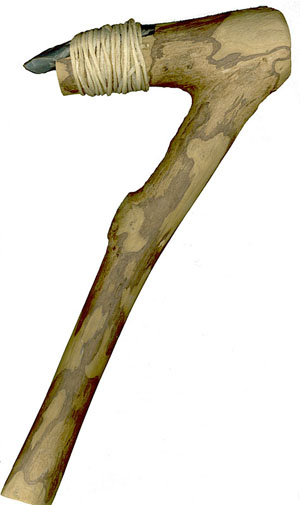
Axe, Hand (1d6) – includes sickles (*)
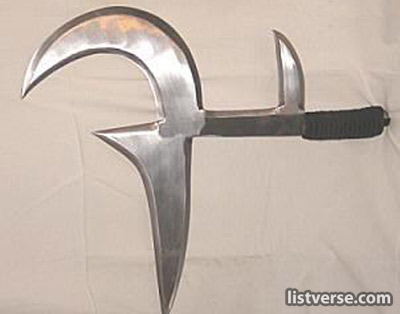
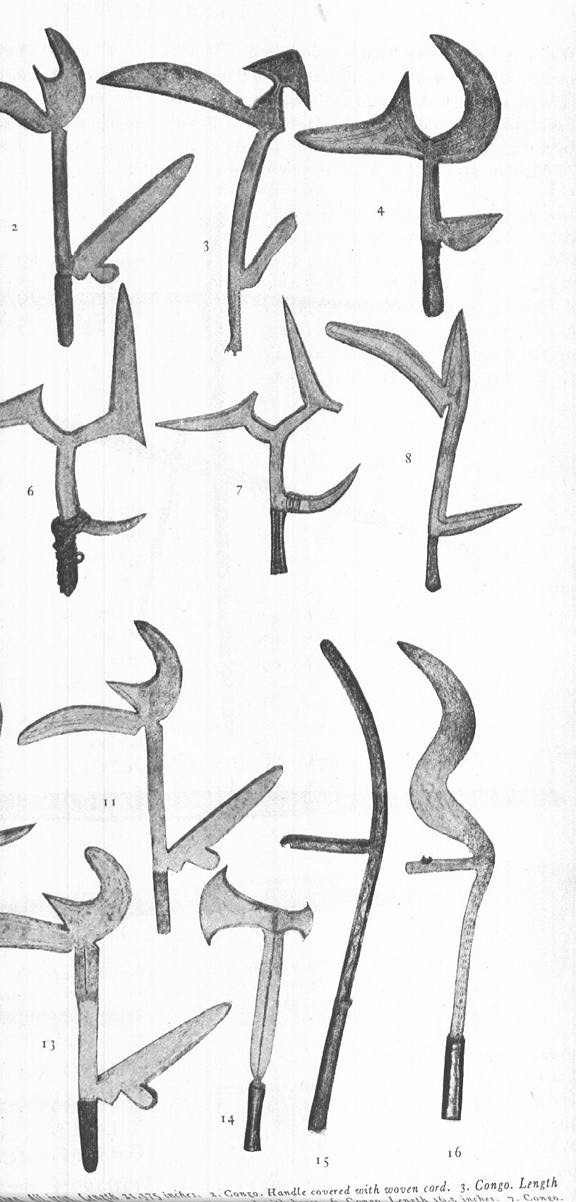
• Africa – Hunga-Munga, Shoka, Silepe, Throwing Irons
• Ancient – Dolabra (Rome), Epsilon Axe (Mid-East), Eye Axe (Mid-East), Novacula (Cyprus *)
• East Asia – Biliong, Kama, Kusarigama* (attached to chain), Toki Kakauroa, Piau
• Europe – Francisca, Hatchet, Hurlbat, Miner’s Axe, Thin Axe, Thrusting Axe
• India – Ancus (elephant goad), Galraki, Hoolurge, Kharga (sacrificial axe), Kodelly, Tongia
• Near East – Balta
• North America – Tomahawk
• Oceania – Adze, Arit, Kadjo, Kapak, Keerli, Pareh

Club (1d4) – includes staves (#)and throwing sticks (*)
• Africa – Kasrullah, Kerrie *, Rungu, Trombash *
• Ancient – Aclys * (Rome), Lisan (Egypt), Naboot # (Egypt)
• Central & South America – Iverapena, Macana, Pagaya
• East Asia – Bo #, Bokken (practice sword), Jo #, Kiam Bokiam, Tonfa, Yoribo
• Europe – Baculus, Blackjack, Cudgel, Maul, Quarterstaff #, Sap, Slung Shot, Truncheon
• India – Kirasoo *, Mugdar
• North America – Ga-Ne-U-Ga-O-Dus-Ha (deer antler club), I-Wata-Jinga, Ja-Dagna, Ja-Weti, Mandehi-Liguje (coup stick), Tiglun
• Oceania – Baggoro, Bi-Teran, Boomerang *, Burrong, Dowak *, Flat Club, Hoeroa, Japurunga, Kangaroo Rat *, Kauah, Kotiate, Kujerong, Kunnin *, Leonile, Lil-lil, Mabobo, Mattina, Meeri, Merai (jade club), Muragugna, Nil-li, Pacho, Pahu, Patu, Periperiu, Potu, Purijimala, Quirriang-an-wun, Rang-kwan, Sapakana, Siwalapa, Tambara, Tabutje, Tawha-tewha, Tindil, U’u, Ulas *, Uramata *, Waddy, Wahaika, Wairbi, Wakerti, Watilikri *, Weerba, Wirka, Yeamberren

Dagger (1d4) – includes knives
• Africa – Baswa Knife, Bracelet Dagger, Fantail Dagger, Forked Tongue Dagger, Kummya, Mongwanga, Pokwe, Telek
• Ancient – Falx Supina (Rome), Harpe (Greece), Parazonium (Greco-Roman), Pugio (Rome), Sica (Rome)
• East Asia – Aikuchi, Bade-Bade, Chopper, Dhaw, Golok, Hamidashi, Heyazashi, Himogatana, Koshigatana, Kozuka, Kubikiri, Kujungi, Kwaiken, Mit, Parang Ginah, Parang Latok, Piso Raut, Pisu Tonkeng, Raut, Rentjong, Siangkam (not quite a dagger, but close enough), Tanto, Tjaluk, To-Su
• Europe – Batardeau, Bodkin, Cinquedea, Chuchillo (folding knife), Degan, Dirk, Estradoit, Kidney Dagger, Main Gauche, Mattucashlass, Misercorde, Pavade, Poignard, Roundel Dagger, Scramasax, Sgain Dubh, Skain, Stiletto, Triple Dagger
• India – Bank, Buhj, Bich’hua, Bundi Katari, Chilanum, Choora, Haladie, Horn Dagger, Jamdhar Katari, Karoula, Katar, Katar Bank, Katar Dorlicaneh, Kukri, Maushtika, Moplah, Paiscush, Para-i-tutti, Phurbu, Pichangatti, Piha Kaetta, Saffdara, Vinchu
• Middle East – Acinaces. Bichaq, Chaqu (folding knife), Jambiya, Kard, Khanjar, Khanjarli, Khyber Knife, Kindjal, Pesh-Kabz, Qama, Zirah Bouk (mail-piercer)
• Oceania – Badik, Barong, Bayu, Beladau, Bolo, Buyu Knife, Halasan, Karambit, Kira (quartz blade), Kudi, Kudi Tranchang, Labo Belange, Lading, Mandaya Knife, Pahua (wooden), Palitai, Panabas, Sabit, Sadoep, Sakin, Sekin, Sewar, Tadji, Todo, Tolaki, Tombak Lada, Tuba,Wedong

Flail (1d6) – includes whips (*)
• Ancient – Flagellum (Rome)
• East Asia – Hui-Tho (bladed rope), Kau Sin Ke, Manriki Gusari, Nagegama, Nunchaku, Rante, Rante Ber Gangedug
• Europe – Ball & Chain, Bullwhip *, Cat-o’ Nine Tails *, Goupillon, Mace & Chain, Military Flail
• India – Binnol, Cumber-Jung
• Middle East – Kamcha *
• Oceania – Chemeti *, Kalus *, Laingtjat, Petjut *, Sa Tjat Koen

Mace (1d6)
• East Asia: Gunsen (war fan), Kiseru (smoking pipe), Suang-tu-fung
• Europe – Bouzdykan, Bulawa, Chacing Staff, Fist Mace, Hercules Club, Holy Water Sprinkler, Massuelle, Mazule, Pernat, Plombee, Quadrelle, Schestopjor
• India – Dhara, Gargaz, Garz, Lohangi, Ox Mace, Quoit, Shashpar, Sickle Mace, Singa (steel boomerang)
• Middle East – Dabus, Ox Mace
• Oceania – Gada, Ganjing

Pole Arm (1d10) – includes pikes (#) and tridents (*)
• Ancient – Romphaea (Greece), Sarissa # (Greece), Taru # (Egypt)
• Central & South America – Tepoztopilli
• East Asia – Bisento, Fang, Feruzue (concealed ball & chain), Half Moon, Hwa-Kek, Kongo-Zue, Kumade, Lajatang, Magari Yari *, Nagamaki, O-No, Shakujo Yari (concealed blade), Shinobi-Zue (concealed blade), Sjang Sutai, Shakwo, Sode Garami (sleeve tangler), Tetsubo, Tiger Trident *, Toyak
• Europe – Ahlspiess #, Awl Pike #, Beaked Axe, Berdysh/Berdiche, Bill, Bohemian Ear-Spoon, Brandestoc, Chauves-Spuris, Couteau De Breche, Croc, Falcastra, Falx, Feather Staff (concealed blades), Fuscina *, Glaive, Godendag, Halberd, Half Moon, Hippe, Jedburg Axe, Korseke, Langue De Boeuf (Ox Tongue), Lochaber Axe, Lucerne Hammer, Military Fork, Partizan, Pike #, Pitch Fork, Plancon A Picot #, Pole Axe, Runka, Sabre Halberd, Scaling Fork, Scorpion, Scythe, Spetum, Spontoon #, Sudis #, Voulge
• India – Khatramkha *, Kunjukdan, Saintie #, Veecharoval
• Oceania – Arbir, Hani

Spear (1d6) – includes lances (*) and throwing spears (#)
• Africa – Assegai #, Golo, Hinyuan, Kikuki, Koveh, Mahee, Makrigga, Mkuki, Sudanese Spear
• Ancient – Angon # (Franks), Cateia # (Celtic), Contus * (Rome), Egchos (Greece), Falarica (Rome), Framea * (Franks), Gaesom # (Rome), Jaculum # (Rome), Javelin # (Greece), Pelta # (Greece), Pilum # (Rome), Saunion # (Samnites), Spiculum # (Rome)
• East Asia – Dung, Hak, Hoko, Jarid #, Kamayari, Ken Shoka #, Lembing, Makura Yari, Nageyari #, Su Yari, Te Yari #, Yari
• Europe – Boar Spear, Harpoon #, Lance *, Lance-Ague * #, Pill, Zegaye *
• India – Ballam, Barchi, Bhala *, Garvo, Khundli P’Hansi, Laange, Patisthayana, Sang * (from camel back), Sangu, Shail *, Tschehouta
• Middle East – Rummh, Sinan
• North America – Ja-Mandehi *, Kahsita #
• Oceania – Aunurgith, Bandang, Bilari #, Budiak, Chimbane, Do-War, Enhero, Fal-Feg, Granggang, Irpull, Jiboru, Kadji, Kannai, Kapun, Kiero, Koy-Yung, Kujolio, Kuyan, Larna-Pe, Mon-Gil Mon-Gil, Mongile, Mu-Rungal, Nandum, Nerau, Pillara, Pouwhenua (also a staff), Sangkoh, Sanokat, Shanen Kopaton, Siligis #, Simbilan #, Sligi, Tahr Ruan, Tao, Tawok, Telempang, Tirrer, Tjunkuletti, To-Ono, Tombak, Tumpuling, Wainian, Wallunka, Wi Valli

Sword (1d8)
• Africa – Flyssa, Kaskara, Seme, Shotel
• Ancient – Spatha (Rome)
• East Asia – Dha, Dukn, Han Dachi, Katana, Sondang, Tashi
• Europe – Broadsword, Colichemarde, Craquemarte, Estoc, Falchion, Fleuret, Foil, Halstatt Sword, Karabela, Longsword, Pappenheimer, Rapier, Reiterpallasch, Sauschwerter (boar sword), Schiavona, Schnepfer, Spadroon, Tuck, Verdun
• India – Abbasi, Ahir, Dao, Firangi, Fish Spine Sword, Goliah, Gupti, Halab, Kastane, Katti Talwar, Khanda, Nagan, Pata, Pattisa, Pulouar, Ram Da’o, Sapola, Sirohi, Sosunpattah, Sultani, Talwar, Tegha
• Middle East – Karabela, Killj, Pala, Quaddara, Saif, Scimitar, Shamshir, Shashqa, Zulf-I-Khar
• Oceania – Campilan, Isau, Jumgheerdha, Pakayun, Peudeueng, Sikim Gala

Sword, Short (1d6)
• Africa – Babanga, Manople, Takouba, Wasa
• Ancient – Carp’s Tongue Sword (Europe), Gladius (Rome), Herebra (Phoenicia), Kledyv (Wales), Kopsh (Egypt), Machera (Greece), Sapara (Assyria), Seax (Anglo-Saxon), Xiphos (Greece)
• East Asia – Ama-Goi-Ken, Kamashimo Zashi, Ken, Kenuki Gata Tachi, Klewang, Luris Pedang, Ninjato, Opi, Pedang, Pira, Senangkas Bedok, Wakizashi
• Europe – Backsword, Badelaire, Baselard, Bilbo, Braquemar, Coustil A Croc, Cutlass, Dusack, Kantschar, Katzbalger, Palache, Sabre, Small Sword, Straight Sword
• India – Alamani , Ayda Katti, Kapee Dha, Kora, Shah Nawaz Khani, Surai, Zafar Takieh
• Middle East – Chereb, Goddara, Sassanid Sword, Yatagan
• Oceania – Beledah, Chundrick, Kris, Lopu, Manpau, Mentok, Perang Bedak, Parang Nabur, Parang Pandit, Piso Podang, Talibon, Tapak Kudak, Thinin

Sword, Two-Handed (1d10)
• Ancient – Dacian Falx (Celts, Germans)
• East Asia – Beheading Sword, No Dachi
• Europe – Bastard Sword, Claymore, Espadon, Executioner’s Sword, Flamberge, Zweihander
• India – Mel Puhah Bemoh
• Oceania – Dalwel

War Hammer (1d6) – includes picks (*)
• Europe – Bec-de-Corbin, Bisacuta *, Crowbill, Dagger Mace, Horseman’s Hammer, Martel de Fer, Oncin *, Tschekan Hammer
• India – Lohar *, Sabar *, Zaghnal *
• North America – Taavish

A few things I noticed while compiling this list …

Axes loom large in every culture. I’m no expert in weapon making, but my understanding is that axes only require a small strip of really good steel for their edge, so they’re much cheaper to make and maintain than swords.

Africa has some really cool axes, especially the throwing axes.

A band of kshatriyas armed with cumber-jungs sounds cooler than a band of fighting-men with flails. I would run away from both, but the former would make for a more picaresque story if I survived the experience.

Any player who was cool enough to have his fighter specialize with the Bohemian ear-spoon would probably get a secret +1 to all saving throws from me.

Oceania is club central, and if you set a game there you would probably want to differentiate the different types of clubs with different damage values.

East Asia has a penchant for making weapons that defy categories. The jitte, for example, is a parrying weapon that might be considered a mace. Other parrying weapons are the sai, segu, tau-kiev and tjabang. The adarga is a Moorish combination of spear and shield used for parrying. Europe had similar weapons; the lantern shield and sword shield. The bagh nakh, or “tiger claw” is an Indian weapon that is a bar with four or five curved blades sticking from it. Entangling or capturing weapons incude the bolas, lasso/lariat and catch pole (or mancatcher). I might do a post on exotic, strange weapons at a later date.

Daggers are ubiquitous. I’m convinced that every NPC you ever deal with should have a dagger on his or her person.

Six from the Sanctum

I was playing with Seventh Sanctum’s alien and fantasy race generators today, and decided to stat up some of the results. If any enterprising artist wants to draw one of these oddballs, I’d love to see the result. The following is open game content.

Caledjula
Caledjula are tall, statuesque creatures with angular bodies and reddish-orange skin. Their heads are pointed and their jaws and foreheads jut out about three inches beyond their flat faces. Their eyes are large and brightly colored, and surrounded by long lashes. Their arms (wings, actually) and legs end in hands with seven long fingers. Caledjula have a radar-like sense reminiscent of bats. Caledjula are capable of imitating all sorts of speech, and their pleasant, deep voices and calm demeanor makes them successful negotiators. Caledjula are advanced in the areas of illusions and healing, and have more than their fair share of illusionists and clerics. The caledjula come from a barren world. They live beneath the surface in cave systems dug into the permafrost. They adorn themselves with leather armor, sometimes studded, in battle and carry long, thin blades and bolas.

Caledjula characters are capable of finding their way even in complete darkness. They can also fly. Caledjula enjoy a +2 bonus to save vs. illusions and every caledjula begins play knowing one minor illusion that they can cast once per day.

  • Caledjula: HD 1; AC 9 [10]; Atk 1 weapon; Move 12 (Fly 9); Save 16 (14 vs. illusion); Special:Radar sense, know one illusion spell.

Ifnut
Ifnuts have bulky, spherical bodies with thick, rubbery skin the color of damask. They have three heads that resemble elephant trunks tipped with black, beady eyes and three stubby limbs that end in three long finger/toes. These limbs are used for both movement and manipulation. Although omnivorous, ifnuts prefer to browse on vegetation. Ifnuts tend to be narcissists, and find it difficult to work with others on a permanent basis. Other races find them to be corrupt and untrustworthy. Ifnut armorers can fashion all manner of armor for ifnuts, with their suits of plate mail making them look like pot-bellied stoves. They can wield short weapons (short swords, daggers, light maces) and their heads are capable of casting stones as if they were slings.

Ifnut characters are only surprised on the roll of 1 on 1d8. Their thick skin improves their armor class by one. They can make one ranged attack each round for 1d4 points of damage, provided they have ammunition in the form of sling stones or bullets. Their limb placement does not allow for the use of other ranged weapons with the exception of light crossbows, with which they suffer a -2 penalty to hit.

  • Ifnut: HD 1; AC 8 [11]; Atk 1 weapon (1d6) or 1 thrown stone (1d4); Move 9; Save 16; Special: None.

Nif’nef
The nif’nef look like elves with honey-colored skin and wasp-shaped bodies (i.e. extremely thin waists). They have ashen hair, beady, black eyes, and thin mouths and noses. The nif’nef have a shamanistic belief system (i.e. druids in place of clerics) and they worship creatures of elemental earth. A group of five nif’nef can, with 3 rounds of ritual chanting, conjure an earth elemental from the ground. Nif’nef practice ritual cannibalism of deceased friends and family, preserving the flayed skins in alabaster boxes marked with angular runes. They dwell on a rich island chain that is the site of a lost civilization.

Nif’nef characters are light and graceful, gaining a +1 bonus to dexterity rolls at character creation, but suffering a -1 penalty to strength rolls. These modifications cannot send an ability score over 18 or below 3. Their quiet natures give them a +1 bonus to surprise (or sneak). Nif’nef have slow metabolisms that allow them to eat half as much as humans.

  • Nif’nef: HD 1d6; AC 8 [11]; Atk 1 weapon (1d6); Move 15; Save 17; Special: Surprise on 1-2 on 1d6.

Olvu’gai
The olvu’gai resemble nothing so much as giant potatoes covered in velvety, yellow fur. Sprouting from their “middles” are from eight to twelve thin tentacles, each about 10 feet in length. The tentacles are used to move, almost in the manner of a spider, and to manipulate objects. There are numerous patches of what appear to be long, black hairs sprouting from the bodies of the olvu’gai. These hairs are used to collect sensory data (smell, sight, sound). The creatures communicate by vibrating their tentacles, creating sounds reminiscent of the glass armonica. The creatures can also use these vibrations to render themselves invisible (as the spell). Olvu’gai are natural bureaucrats, with a love for classification and “everything in its place” thinking. They spend much of their time in endless debates about the minutiae of an idea, and only rarely move ahead with anything. Their home world is barren and craggy, which most of the life living in the soil. The world has no moon and suffers frequent catastrophes. The wildlife is as bizarre to an “earthling” as the olvu’gai themselves.

Olvu’gai characters retain their ability to become invisible, but may only use it once per day. Their very ordered thinking helps them find secret doors and traps on a roll of 1-2 on 1d6, but it takes them twice as long to search for them. Olvu’gai can learn to understand humanoid languages but not speak them. Likewise, their language can be learned by humanoids but cannot be spoken by them.

  • Olvu’gai: HD 1; AC 9 [10]; Atk 3 tentacles (1d6); Move 12; Save 16; Special: Invisibility.

Vindlu
Vindlu resemble long, thin lions covered in silvery scales tipped with aquamarine and they have long “whiskers” like those of a carp. These whiskers are extremely sensitive, making vindlu difficult to surprise and allowing them some insights into the emotions of others. Their four legs end in clawed hands. Outside their home city, they live in tight-knit family bands, hiring themselves out as assassins. They are very skilled at poison making.

The vindlu originate in a huge, prosperous city state located in the “Crawling Canyon”, a canyon that seemingly moves about their native highlands. The city-state is composed of circular brick “shell-keeps” centered around fire pits fueled by coal and always kept burning. The vindlu sleep on shelves overlooking the pit, with the interior of their buildings given over to storage rooms, kitchens, libraries and armories. Most of the city-state’s revenue comes from intricately died cotton textiles, the cotton harvest being a highlight of their year. Although not particularly religious, the vendlu give a nod to a hermaphroditic divinity they call Magfa. Magfa is aloof and mysterious, and works its wonders through earth-bound messengers and servants.

Vindlu characters enjoy a +1 bonus to save vs. poison, and are capable of using poison on their weapons safely and effectively. They also have a +1 bonus to save vs. fire damage. Their whiskers make them susceptible to surprise only on a roll of 1 on 1d8, and give them the ability to detect lies.

  • Vindlu: HD 1; AC 8 [11]; Atk 1 bite (1d4) or 1 weapon (1d8 + poison); Move 15; Save 16 (15 vs. poison and fire); Special:Surprised on roll of 1 on 1d8, detect lies / read emotions.

Zwunker
Zwunkers are an offshoot of dwarfs. They are black-skinned and have long manes of gold hair. Their eyes are faceted and resemble yellow diamonds. Zwunkers live in caves overlooking the sea. They are skilled sailors and love nothing more than to feel the wind whipping through their manes. Once per day, a zwunker can control the winds, either calming them or whipping them into a frenzy. Zwunkers are highly resistant to magic, and their presence actually absorbs magical energy. Essentially, their “magic resistance” applies to all magical effects within 30 feet of them. Zwunkers make elaborate leather armor (always black) and carry steel rods for weapons.

Zwunker characters enjoy the same benefits as normal zwunkers. They have a +2 bonus to save vs. magic. Their hair can be shaved and melted down into the equivalent of 5 gold pieces, though no zwunker would willingly do this save to avert his own death or that of a loved one. Zwunkers cannot work magic, and thus are barred from becoming clerics and magic-users, though they can become psychics.

  • Zwunker: HD 1; AC 6 [13]; Atk 1 weapon (1d6); Move 9; Save 16 (14 vs. magic); Special:Control wind, magic resistance 10%.

Magic Rings

Here are a couple magic rings inspired by the world of comic books (and their modern simulacra).

Rings of Elemental Earth
This pair of rings is carved from citrines and are worth 1,000 gp as jewelry. If worn one on each hand and slammed together while chanting “Res orbis operor vestri res”, the wearer becomes an 8 HD earth elemental for 10 minutes. This can be done but once per day.

Ruby Ring
The ruby ring is made of admantine and set with a highly-polished ruby lens. It was forged to be a weapon against evil and can only be used by benevolent creatures. The ring must be re-charged once every 24 hours at the altar of a benevolent deity. When fully charged, the ring allows the caster to produce several spell-like effects by succeeding at a wisdom check, for use of the ring requires an act of supreme will. The wisdom check must be made every round in combat or every ten minutes outside of combat to maintain willpower. Multiple effects can be manifested simultaneously, but the required wisdom checks are made at a -2 penalty for every effect beyond the first. The ring can duplicate the following spells: crushing hand, fly, forcecage, forceful hand, grasping hand, interposing hand, magic missile (1 missile), shadow conjuration, shield and wall of force. All spell effects manifest as a ruby-colored construct of pure force. If the bearer of the ring is killed, the ring teleports to the nearest person worthy of wielding it.

On Allegory

Your average fantasy rpg is set in a medieval world, which means knights and dragons and disease. Knights and dragons are easy enough to stat up, or I suppose they are since every game has them in one form or another. Disease, on the other hand, can present a few problems. If disease is going to play a roll in the game, it needs to be a real obstacle. If we’re being realistic, we know that many diseases, if contracted, must have the power to kill or really screw up a PC. That’s problem number one – explaining to a player why the character he has lovingly nursed through countless acts of daring to a lofty level is now dying from some pox he picked up when he was foolish enough to enter a town to buy supplies and train. It’s a real anti-climax and seems either terribly random or terribly unfair – a couple rolls of the dice, and microscopic entities that the locals haven’t even discovered have just accomplished what the Dark Lord and all his minions could not. Problem number two, of course, is that none of this will actually happen, because the chance that the afflicted cannot find a cleric to cast cure disease (or remove disease, depending on your edition) is slight. So, you go to the trouble of introducing the black plague, the disease that ravaged Europe and and maybe changed the course of human history, and the players see it as a mere inconvenience – slightly less annoying than death, but nothing that can’t be handled. To me, this just won’t do.

When designing my campaign, I wanted disease to be represented and I wanted it to be a problem. I looked at many different disease systems, from Arneson’s in Supplement II to Gygax’s in the old DMG and the ability score damage in 3rd edition, and none of them solved the aforementioned problems for me. And then, I started thinking allegorically.

I don’t run a historically realistic campaign. Nod is a world of folklore, fairy tales, mythology and superstition. The medieval mind did not see disease for what it was. Rather, it imagined that disease was a punishment from God. The Black Plague was God’s judgment on mankind. It was one of the most morally, spiritually and psychologically damaging event in European history, right up there with the First World War and its trench warfare and chemical weapons (which were a major inspiration for Tolkien’s Mordor.) This “psychic damage” is quite apparent in Peter Brueghel’s Triumph of Death (a detail of which can be seen above). And that painting got me thinking. A disease is terrible on a personal scale because it scars, weakens and kills. But disease is terrible on a grand scale because it infects and spreads. What monsters in the game we all love infect and spread? The undead, of course – or at least some undead. That’s when I decided to embrace the medieval and ancient allegories (symbols) that fantasy role-playing turns into creatures and makes real with stats. So, those disease rules that I could never quite get right were out, and plagues of undead took their place. The Black Death in Nod would not be an outbreak of bubonic plague transmitted by fleas and rats, but rather a terrible judgment from Heaven by which the dead rose from their graves and spread devastation and madness throughout the land. This was something that players could deal with – opponents to be overcome and mysteries to be solved (why are the gods angry? how can we placate them?) – with their skill at the game rather than a couple arbitrary dice rolls. Of course, mummy rot and lycanthropy were still in – you can’t have a proper campaign without mummy rot and lycanthropy. But otherwise, the undead, especially those who can spawn with a touch of their spectral hands, would take the place of disease in my campaigns.

On Science

My last post mentioned a scientist. This is a class I came up with as an alternative to the magic-user. Essentially, I got on a “turn-literary-archetypes-into-classes” kick, and this was one of the results. It was never play-tested, so maybe we’ll technically call this one an NPC class.

Scientist
The scientist is an NPC dedicated to understanding the World of Nod and its bizarre, supernatural physics and applying this knowledge to the discovery and creation of new inventions. In laymen’s terms, what the magic-user does with spells, the scientist does with gadgets, gizmos and chemical formulas.

Scientists have been a staple of pulp fiction for a century, though they are most often encountered in “Sword & Planet” and “Scientifiction”, as it was once called. The archetypal scientist is an older man with a brilliant mind and a collection of fantastic inventions that help the hero of the story (which is sometimes him, but more often not) overcome obstacles. Just as wizards often play the role of villain in “Sword & Sorcery” stories, the mad or evil scientist is often the antagonist to the heroic swordsman’s protagonist.

Although one could draw inspiration from any number of the “natural philosophers” of the Middle Ages and Renaissance, no person better exemplifies the scientist we are seeking to create than Leonardo Da Vinci. Had he only lived in a fictional, fantastic world such as Nod, Da Vinci might have invented any number of mechanical contrivances.

Benjamin Franklin is the next major inspiration for our scientific adventurers, not the least of which because he “discovered” electricity (or “electrical fluid” as it was called in the 18th century) and invented and named the battery which serves as the foundation for our scientist’s make-believe inventions.

The original mad scientist in literature was Victor Frankenstein from Mary Shelley’s 1818 novel Frankenstein; or, The Modern Prometheus. Victor Frankenstein discovers the ability to return life to dead tissue and in the process creates the first flesh golem, though rather than being a mindless automaton, Frankenstein’s creature is quite intelligent.

As a counterpoint to the mad scientist, one need only look to Dr. Hans Zarkov, comrade of “Flash” Gordon. Over the course of the Flash Gordon comic strips, movies and books, Zarkov invents flying machines and invisibility rays, all while assisting his erstwhile ally in defending the Earth from the depredations of Emperor Ming.

The following is open game content.

Scientist
Prime Attributes: Intelligence, 13+ (5% experience)
Hit Dice: 1d4/level (Gains 1 hp/level after 10th.)
Armor/Shield Permitted: None.
Weapon Permitted: Dagger, club, staff, dart, light crossbow.

Scientists begin play with one small invention or three formulas (see below) and only 1d6 x 10 gp to spend on equipment. They must own a journal, their equivalent to the magic-user’s spell book.

Scientists spend most of their lives reading books and absorbing all sorts of knowledge and wisdom. At the Referee’s discretion, the scientist can recall old legends and/or lore on the roll of 1-2 on 1d6. In addition, they can make a saving throw in order to recall, understand or learn a new language (regardless of their intelligence score or the number of languages they already know).

A scientist’s powers of observation give them an improved chance of noticing secret or concealed doors and detecting the presence of noxious gases (i.e. detect on a roll of 1-2 on 1d6). Unfortunately, a scientist’s fascination with minutia makes them more likely to be surprised than others.

A scientist is capable of brewing formulas (i.e. potions) and discovering and creating new inventions (see below).

When a scientist reaches 9th level (genius) he will attract a level 1 scientist as his lab assistant if he builds a laboratory overlooking a major metropolitan area.

Inventions & Formulas
Scientists are capable of building machines and brewing chemical formulas that duplicate the effect of magic-user spells. Formulas are single-use items that work exactly like potions. Inventions are multiple use items that must be powered by “batteries” of the sort Ben Franklin invented (or miniature versions of the same). An invention can be used 1 time plus 1 time per scientist level minus the level of the duplicated spell before it must be recharged over night.

Before a scientist can brew a formula or build an invention, he must discover how to do so. This process of discovery cost 1,000 gp per spell level to be duplicated for standard spells, and 2,000 gp per spell level for entirely new creations. One week is required per spell level, with a chance of success equal to 25% plus 5% per level of the scientist minus 10% per level of the spell. The maximum chance of success is 95%.

Inventions and formulas must be discovered separately, even if they have the same effect.

Inventions come in three sizes: Small, Medium and Large. Small inventions can be held in one hand and rarely weigh more than 10 pounds. Medium sized inventions can be moved about clumsily by man-sized creatures using both their hands. A medium-sized invention uses 10 times the materials of a small invention, and costs 10 times as much to build. A large invention will fit (or nearly fit) inside a 10’ x 10’ room. Large inventions use 100 times the materials of small inventions, and cost 100 times as much to build. Formulas are treated as small inventions and weigh as much a standard coin or gem.

The level of spell a scientist can “fit” into an invention of a given size is as follows:

  • Scientists of level one to three can fit level one spells into small inventions, level two spells into medium inventions and level three spells into large inventions.
  • Scientists of level four to six can fit level one and two spells into small inventions, level three spells into medium inventions and level four spells into large inventions.
  • Scientists of level seven to nine can fit level one to three spells into small inventions, level four spells into medium inventions and level five spells into large inventions.
  • Scientist of level ten to twelve can fit level one to four spells into small inventions, level five spells into medium inventions and level six spells into large inventions.

Brewing a formula costs 25 gp times the spell level times the level of the scientist. A level one formula brewed by a level three scientist, for example, costs 25 x 1 x 3 gp, or 75 gp, to concoct. A level four formula brewed by a level nine scientist costs 25 x 4 x 9 gp, or 900 gp, to concoct. The Referee may want to create a list of rare ingredients for each formula the scientist discovers in lieu of the scientist just making a check.

Inventions cost 500 gp per spell level to create, and their manufacture requires five days plus two days per spell level. Thus, an invention that duplicates the level two spell acid arrow would cost 1,000 gp and require nine days of work to realize.

Players and Referees should come up with fantastic, quasi-scientific names for a scientist’s inventions, whether they are inspired by the natural philosophers of the Renaissance or the mad scientists from pulp fiction.

Level Experience Hit Dice Attack Save Title
1 0 1 +0 17 Tinkerer
2 2,600 2 +1 16 Chemist
3 5,200 3 +1 15 Scholar
4 10,400 4 +1 14 Philosopher
5 20,800 5 +1 13 Sage
6 42,500 6 +2 12 Professor
7 85,000 7 +2 11 Polymath
8 170,000 8 +2 10 Doctor
9 340,000 9 +2 9 Genius
10 500,000 10 +3 8 Genius
11 750,000 +1 hp
+3 7 Genius
12 1,000,000 +2 hp
+3 6 Genius

S&W Format

Hit Dice: 1d6-1 per level, +1 hit point per level after level 9

Level Experience Hit Dice Attack Save Title
1 0 1 +0 15 Tinkerer
2 2,200 2 +0 14 Chemist
3 4,400 3 +0 13 Scholar
4 8,800 4 +1 12 Philosopher
5 17,600 5 +1 11 Sage
6 35,000 6 +2 10 Professor
7 70,000 7 +2 9 Polymath
8 140,000 8 +3 8 Doctor
9 280,000 9 +3 7 Genius
10 430,000 +1 hp
+4 6 Genius
11 580,000 +2 hp
+5 5 Genius
12 730,000 +3 hp
+5 4 Genius

Wyvern Coast – Village of the Drowned

Here are a few more encounters for the Wyvern Coast map.

0203 Begros: Begros is a mountainous island. Though uninhabited now, signs abound that point to an advanced civilization once existing on Begros. The island’s lone harbor bears traces of ancient foundations and the remnants of a wall. The island’s topography is particularly difficult to negotiate, but a narrow path leads from the harbor into the mountains. The mountains of Begros are really a collection of jagged plateaus separated by twisting canyons. At the highest point in the island, the canyons converge into a hidden valley. The sheer cliffs surrounding this valley have been carved to approximate hundreds of deities now forgotten by mankind (if, indeed, they were ever known to mankind). These gods have the forms of human beings, but their limbs twist and contort in slightly unnatural ways, and their long faces and grave expressions remind one of demons more than gods. In the center of this valley, which is quite lush and is often grazed on by giant goats, is a deep, green pool. Rising from the center of the pool there is a green copper statue of a pot bellied god with a long, thick tongue extending from its mouth. Those who visit the pool would be wise to make a valuable offering to the god in the pool, for if they demur they will find it impossible to get back to the harbor and escape the island. Canyons shift, forcing adventurers back to the central valley. Should the visitors think about aerial means of escape, they discover that their host is one step ahead of them, for the walls of the valley are now thick with peryton, eyes trained on the ungrateful guests. If the adventurers find themselves on the island after dark, they might witness the dance of the nameless gods. As the sun sinks behind the cliffs, the pool gives off an eerie glow that soon fills the valley with flickering, green light. The play of the light and shadow on the cliffs makes the figures carved thereupon appear to be dancing. The keen observer soon discovers that the figures are indeed dancing. Having left their perches on the cliff face, they wind their way in a weird procession toward the pool, their sinuous arms and legs in constant movement, their grave, unmoving faces bobbing to and fro. The entire dance is performed in silence, and viewers will find themselves unable to resist the lure of the dance. They will dance all night with the nameless gods, their forms becoming more like the gods and less like their own, until, when the sun dawns, they join them on the cliff face. Visitors who hide their eyes are unharmed and unmolested, but face the same event the next night until they eventually join the nameless gods on the cliffs or make their offering.

  • Peryton: HD 4; AC 6 [13]; Atk 1 antlers (2d8); Move 9 (Fly 24); Save 13; CL/XP 6/400; Special: Immune to non-magic weapons.
  • Nameless Gods: HD 12 (60 hp); AC 0 [19]; Atk 1 fist (3d6); Move 6; Save 3; CL/XP 16/3200; Special: Immune to slashing and piercing weapons, immune to magic (per a stone golem), irresistable dance.

0409 Abode of the Gull Lords: Built atop the coral reef here there is a small keep of limestone, heavily weathered by wind and wave. This keep houses a band of 30 bandits who attack the shipping lanes and nearby islands atop giant seagulls. The bandits wear brigadine armor (AC +4) and carry short bows, long spears, and weighted nets. Their leader is a robber baron called Sablene, who has two adopted daughters called Phale and Rorta. Phale and Rorta are undine witches and much older than their “mother”. The band’s treasure is locked in a vault in their keep and consists of 2,000 gp, 2,000 sp, 14 lb of tobacco (worth 100 gp per lb), 1 cask of good wine (12 gallons, weighs about 100 lb).

  • Giant Gull: HD 3; AC 7 [12]; Atk 1 beak (1d8); Move 6 (Fly 21); Save 14; CL/XP 3/60; Special: None.
  • Phale & Rorta, Undine Cleric (Druid)/Magic-Users Lvl 5: HP 23 and 15; AC 9 [10]; Save 10; Special: Cleric (druid) spells (3rd), magic-user spells (3rd), telepathy with sea creatures; Staff, dagger.
  • Sablene, Fighter/Thief Lvl 6: HP 22; AC 4 [15]; Save 10; Special: Backstab for triple damage, thievery; Brigandine, short bow, long spear, dagger (pommel of ram horn).

0520 Sunken Treasure: A merchant galley originating in Ibis recently sunk here on its way to trade in Tremayne. It carried iron ingots (3,500 lb worth 350 gp), several bales of raw cotton and amphorae of grain (ruined by the seawater), eight suits of scale armor and twenty scimitars. The wreck is being guarded by two dolphins who, if presented with a chance of parlay, will inform adventurers that the survivors, an old sage and his daughter and a strapping sailor are now languishing in the dungeons of the sahuagin in [0619].

0619 Unfinished Ziggurat: This basalt ziggurat is home to a tribe of 69 sahuagin males, 74 females, 34 hatchlings and a clutch of 153 eggs. The sahuagin are commanded by Krlo’kel with the assistance of four grandees. Overseeing the spiritual health of the tribe is its high priestess, Phakella and her three assistants. The ziggurat remains uncompleted and is currently being constructed by 110 oktomon slaves. The sahuagin are even now preparing to raid nearby settlements for slave labor. They have recently captured Sipneton, a scientist, along with his daughter Neveth and Brutu, a sailor aboard the merchant galley that was carrying them to Tremayne before it sunk. The three wear clever helmets invented by Sipneton that allow them to breath underwater, though their air supply is not infinite. The sahuagin’s treasure consists of 1,000 sp, 2,100 gp, 10 pp and a copper locket worth 3 gp taken from Neveth. The waters around the ziggurat are protected by 19 small sharks under the control of Phakella. Krlo’kel and Phakella are locked in a bitter struggle for dominance over the tribe, a struggle which Phakella is winning. This is why Krlo’kel now holds Sipneton and his party in his dungeon, hoping that the scientist can create something to give him the advantage.

  • Krlo’kel, Sahuagin Fighting-Man Lvl 6: HP 41; AC 2 [17]; Save 11; Coat of bronze scales, steel trident forged in [2523], shark’s tooth dagger.
  • Sahuagin Grandees: HD 4+4; AC 3 [16]; Atk 1 weapon (1d10); Move 12 (Swim 18); Save 16; CL/XP 4/120; Special: None.
  • Phakella, Sahuagin Cleric Lvl 6: HP 36; AC 5 [14]; Save 9; Special: Cleric spells (3rd); Jade mace (worth 40 gp), holy symbol consisting of a necklace teeth, the most prominent being a shark’s tooth.
  • Sahuagin Under-Clerics: HD 3+3; AC 5 [14]; Atk 1 weapon (1d8); Move 12 (Swim 18); Save 14; CL/XP 4/120; Special: Cleric spells (1 x 2nd, 2 x 1st).

0802 Ephne the Oceanid: Towering above the sea floor, and visible from the surface on certain days, is the palace of Ephne, oceanid of the Tepid Sea. Like the body of water she rules, Ephne is mild in manner and bored in demeanor. She spends her days in repose, sometimes taking lovers from among the subjects in her kingdom or stealing them from passing ships. She grows tired of them in due time, returning them to their homes to pine away for her for the rest of their lives. The palace is a collection of spires apparently carved from coral and tipped with dome of gold. Furnishings are sparse within the palace, but art abounds in the form of sculpture and mosaics, many made with expensive stones. The household consists of Livanda, the major domo, dozens of ladies-in-waiting (all mermaids), an elite guard of twenty triton warriors and one hundred giant crab guardsmen. Ephne also keeps a stable of 50 hippocampi. Each spring, representative of the different sea people who dwell in the Tepid sea travel to the palace to pay tribute. These treasures are kept in a vault deep within the recesses of the palace. The vault is guarded by a stone golem shaped like a kraken. It contains 100,000 cp, 51,000 sp, 21,400 gp, 30 pp, a diamond (1,100 gp), a sardonyx (65 gp), plate mail of the deep*, five amphorae of perfume (worth 500 gp per amphora), an exquisite teak figurehead in the shape of Juno (2,400 gp) and a large bronze statue of Hercules (7,200 gp). Ephne wears a dozen pearls strung on a golden chain (100 gp) and a golden crown inlaid with mother of pearl and sapphires (7,700 gp).

  • Giant Crab: HD 3; AC 3 [16]; Ark 2 pincers (1d6+2); Move 9; Save 14; CL/XP 3/60; Special: None.
  • Triton Guardsman: HD 6; AC 3 [16]; Atk 1 trident (2d6); Move 1 (Swim 18); Save 14; CL/XP 7/600; Special: Magic resistance 90%, immune to fear.
  • Livanda, Undine Magic-User Lvl 6: HP 14; AC 9 [10]; Save 10; Special: Magic-user spells (3rd); Staff, obsidian dagger, grimoire.
  • Ephne: HD 17 (60 hp); AC 2 [17]; Atk 1 weapon (2d8); Move 21; Save 3; CL/XP 19/4100; Special: Spells (2 spells per level, from level 1 to 7, magic-user and cleric (druid) spells).

* This is +1 plate mail of the deep lacquered pale blue and green. In it, one can swim in it as though unarmored. It also grants its wearer the ability to breath water and communicate telepathically with sea life.

1011 Captain Saemet: There is a 4 in 6 chance that ship’s passing through this hex will meet the pirate galley of Saemet the Seadevil. Saemet’s nickname is not merely a reflection of his demeanor, as he is a cambion, born of a demon and a human woman. Saemet is tall and gaunt, with pronounced cheekbones, a forked chin, amber skin, eyes of jet and small, black horns flecked with gold. He dresses in a black leather jack, red silk sash, a saffron turban held by a mummified monkey’s paw and short breeches. Saemet never wears shoes, as they irritate his taloned feet. He arms himself with a curved dagger and scimitar. Saemet’s ship is called the Beautiful Abomination. It is crewed by three dozen pirates. Saemet’s first mate is a short, stocky woman named Theoda. Theoda has bleached blonde hair, coppery skin and a broad, devious smile. She wears leather armor and carries a buckler and hand axe with 18 notches in its handle. Saemet’s home port is Corsair Cove in [3119]. His shipboard treasure depends on how active he has been, but usually amounts to 1d4 x 100 gp in coinage and 2d6 x 100 gp worth of cargo.

  • Theoda, Human Fighting-Woman Lvl 5: HP 32; AC 6 [13]; Save 12; Leather armor, shield, hand axe.
  • Saemet, Cambion Fighting-Man 9: HP 55; AC 2 [17]; Save 7; Special: Half damage from fire, bestow a curse once per day; Dagger, magic short sword (see below), magic chainmail (see below), mystic monkey’s paw (+1 to saving throws, already figured into stats).
  • Saemet’s Chainmail: Saemet wears +2 chainmail emblazoned with the glyph of Oceanus, elder demon of the sea. The leather parts of the mail have been died crimson. The chainmail allows Saemet to create a wall of water once per day.
  • Saemet’s Sword: Saemet’s scimitar is a +1 weapon with a hilt wrapped in green leather (the skin of a sea hag). Once per month, he can use it to summon 1d6 merrow.

1202 Isaranos: Isaranos is an island with a coastline that varies between rocky cliffs and white beaches. The interior of the island is forested highlands of cedars and pines. The forests of Isaranos are inhabited by dozens of nymphs and dryads and a single human being, Kelan the Nimble. Kelan was an adventurer who came to the island with a brave band in search of treasure. Upon first discovering a bathing nymph they foolishly attempted to capture her. Kelan was blinded while his companions were turned into gulls. Kelan looks after them to this day, and has become a pitiable figure due not only to his drawn appearance, but also his obsession with finally capturing a nymph. Kelan is an able magician, and he does not willingly accept intruders on his island. The nymphs torment and taunt the poor fellow.

  • Kelan the Nimble, Magic-User Lvl 5: HP 10; AC 9 [10]; Save 11; Special: Magic-user spells (3rd); Gnarled oak staff, silver dagger, a tourmaline necklace (50 gp), grimoire (he studies it with the help of his imp familiar).
  • Ratik, Imp Familiar: HD 2 (15 hp); AC 2 [17]; Atk 1 sting (1d4 + poison); Move 6 (Fly 16); Save 16; CL/XP 6/400; Special: Poison tail, polymorph, regenerate, immune to fire.

1314 Hunting Ground: A pod of 15 tusked whales has made this its hunting ground. Encounters with the whales happen on a roll of 1-4 on 1d6. The whales are not afraid to attack vessels en masse.

  • Tusked Whale: HD 12; AC 4 [15]; Atk 1 bite (3d10); Move (Swim 24); Save 3; CL/XP 12/2000; Special: None.

1608 Slave Mine: An enterprising band of 20 sahuagins is operating an aventurine mine in this hex using 36 hobbled merrows for their slave labor. The sahuagins are led by Zhachak, a mutated member with four arms and eyes that cause confusion (as a gaze attack). The merrow are all lame, but capable of fighting their oppressors if freed from their chains. The sahuagins dwell within the labyrinthine mine. They keep a treasure of 400 gp and 1,600 gp worth of aventurines in locked chests.

  • Zhachak, Mutant Sahuagin: HD 4+2 (HP 27); AC 5 [14]; Atk 4 claws (1d8); Move 12 (Swim 18); Save 13; CL/XP 6/400; Special: Confusion gaze attack.

1609 Meritrael’s Rest: In the base of a large seamount there is what appears to be the entrance to a barrow-style tomb. The entrance is an arch of large granite blocks sealed by a single block of granite that must weigh several tons. Beyond the gateway there is a long, narrow passage inlaid with phosphorescent rock in geometric knot patterns. This passage is studded with traps, including spring-loaded spears and poisoned needles hidden in the silt covering the floor. This passageway leads to stairs that ascend to an air-filled limestone grotto lit by a glowing statue of a angel. Three passages lead from this grotto, entering a sprawling dungeon complex of blinded merrow slave-warriors, spirits of avenging law, elementals of water, steam and ooze, mithril automatons shaped like squid with obsidian beaks and mother-of-pearl eyes that squirt acidic ink and all manner of traps and tricks. At the heart of this tomb complex lies a slumbing solar, a divine champion of law. This solar, called Meritrael, was laid here by a cabal of undersea wizards, that it might be awakened centuries later to make war on a prophesied evil.

2510 Undersea Meadow: A submarine meadow of seaweed stretches across the sea floor here. The meadow supports a vast herd of 300 giant seahorses. It is also occupied by three dozen petrified trilobites that will animate and attack if the sea horses are disturbed.

  • Petrified Trilobite: HD 6; AC 3 [16]; Atk 1 bite (3d6); Move 9; Save 12; CL/XP 8/800; Special: Immune to turning, unaffected by sleep, hold and charm, immune to non-blunt weapons.

2523 Hydrothermal Smithy: This hex contains a hydrothermal vent. The land around the vent, which consists of multiple black and white smokers, is rich in many minerals and inhabited by giant clams, flail snails and giant shrimp. Encounters with these creatures occur on the roll of 1-2 on 1d6.

Amidst the chimneys a small band of twenty automatons collect the minerals and work a submarine forge where they craft armor and weapons of bronze, mithril and a steel that is resistant to rust due to its phosphorus content. The automatons look like muscular maidens made of bronze. Crafted in elder times by Volcanus himself, they retain his patronage and protection. The automatons have a workshop composed of dozens of brightly-colored flail snail shells held together with lead. The automatons do not speak, but can make bargains using a unique sign language that most aquatic folk in the Tepid Sea have come to understand. They keep their treasure in locked chests. It consists of 2,000 sp, 200 gp, 10 pp, a set of golden scales (80 gp), 20 ounces of phosphorus (worth 7 gp per ounce), an 8 lb mithril ingot (worth 400 gp), 30 lb of bronze ingots (worth 12 sp per lb), 80 lb of copper ingots (worth 10 gp per lb), 100 lb of iron ingots (worth 8 sp per pound) and 120 lb of tin ingots (worth 30 sp per pound).

  • Automaton: HD 1+1; AC 4 [15]; Atk 1 hammer (1d8+1); Move 12; Save 17; CL/XP 2/30; Special: Immune to most mind effects, half damage from fire and lightning.
  • Flail Snail (1-6 appearing): HD 5; AC 3 [16]; Atk 6 tentacles (1d8); Move 3; Save 12; CL/XP 7/600; Special: Immune to fire, scintillating colors.
  • Giant Clam: HD 4; AC 5 [14]; Atk 1 clamp; Move 0; Save 13; CL/XP X/X; Special: Clamp (creature trapped inside clam if attack is successful, takes 2d6 damage per round and may drown).
  • Giant Shrimp (10-60 appearing): HD 1d2 hp; AC 9 [10]; Atk 1 bite (1d2); Move 13; Save 18; CL/XP A/5; Special: None.

2115 Ghostly Lovers: This hex is inhabited by two ghosts. In life, he was a prince of the house of Arkad (see 3413) and she a commoner. In a fit of passion, and in defiance of his father, the prince and his love fled in a small boat bound for Ibis. Unfortunately, rough seas sunk their little vessel and the girl drowned. Returned to his father, the boy languished for a few months until finally killing himself with poison-laced wine. To this day, his restless spirit may be encountered in this hex, appearing as a young man in a small boat holding a lantern and calling out the name “Phaedra”. The ghost will investigate ships he encounters, and may attempt to embrace any beautiful young women he finds. In the meantime, the spirit of Phaedra rests on the sea floor, appearing a beautiful young maiden in a silver cage, reaching toward her lover above, but unable to catch his attention.

  • Ghost: HD 10; AC -1 [20]; Atk 1 slam (rapid aging); Move 12; Save 5; CL/XP 14/2600; Special: Aging touch (1d4 decades, double for demi-humans, elves immune), frightful moan, incorporeal, only harmed by magic weapons, telekinesis (as the spell).

2704 Village of the Drowned: An ancient, maze-like village lies here, half-buried in silt. The village is occupied by 140 pale humans with large, green eyes and white hair. The humans keep fish in corals made of netting and process shells and bits of stone into tools. The villagers are remnants of slave stock created by the aboleth. They were once owned by the sahuagin of [2603], but freed themselves in a bloody revolution. The 20 warriors of the village wear shelly-coat armor (protects as well as scale armor, inspired by this) and wield flint spears and axes. They are commanded by a level 6 fighting-man named Dusheel and his two level 2 assistants, Brina and Pered. The village is governed by a council of elders. The council’s speaker is Ilmot, a vigorous old man with a long beard tied into braids with kelp. The villagers are wary of outsiders.

  • Aquatic Human: HD 1; AC 5 [14]; Atk 1 weapon (1d6); Move 12 (Swim 6); Save 16; CL/XP 1/15; Special: Breath water.
  • Dusheel, Aquatic Human Fighting-Man Lvl 6: HP 35; AC 3 [16]; Save 11; Special: Breath water; Shelly-coat armor, flint battle axe.
  • Brina & Pered, Aquatic Human Fighting-Men Lvl 2: HP 14; AC 4 [15]; Save 15; Special: Breath water; Shelly-coat armor, shield, flint battle axe.
  • Ilmot, Aquatic Human Sage: HD 1d4 (3 hp); AC 9 [10]; Atk 1 weapon (1d4); Move 12 (Swim 6); Save 18; CL/XP B/10; Special: Knows the following spells – comprehend languages, ESP, identify and sleep.

3813 Ambush: A band of seven highwaymen and their leaders hide in niches in the walls of a narrow canyon. From their hiding places, they surprise travelers on a roll of 1-3 on 1d6. The highwaymen always announce their presence by shooting a crossbow bolt into the ground before the lead rider. They then demand the travelers leave their valuables on the ground and then depart at all possible speed. The highwaymen are led by Koret assisted by Namis and Odagus. The highwaymen have a permanent hideout in a cave a couple miles away from the canyon. The hideout consists of a small cave complex trapped with a few rock traps and furnished with bedrolls and a large chest containing 10,000 cp, 1,000 sp, 300 gp, 120 pp, a piece of amber worth 4 gp and a fabulous ruby worth 3,000 gp (stolen from a noble of Ophir, there is a reward for the return of the gem with the heads of the highwaymen). They also have three casks (12 gallons each, weigh 100 lb each) of spiced wine.

  • Highwayman: HD 4; AC 6 [13]; Atk 1 weapon (1d8); Move 12; Save 13; CL/XP 4/120; Special: +1 damage with ranged weapons, surprise on 1-3 on 1d6.
  • Namis, Fighting-Man Lvl 4: HP 26; AC 3 [16]; Save 13; Chainmail, wooden shield, pointed helm, heavy crossbow, 10 quarrels, khopesh sword (1d8 damage).
  • Odagus, Dwarf Thief Lvl 5: HP 24; AC 5 [14]; Save 11; Special: Backstab for double damage, thievery; Studded leather armor, wooden shield, crossbow, 10 quarrels, hand axe.
  • Koret, Thief (Assassin) Lvl 7: HP 22; AC 5 [14]; Save 9; Special: Death attack or backstab for triple damage; Studded leather armor, wooden shield, crossbow, 10 quarrels, 3 poisoned quarrels, short sword.

The Gods of Nod: Ophir

What follows is the pantheon I worked up for the city-state of Ophir on the Wyvern Coast. The gods and goddesses are based, more or less, on Phoenician and Levantine deities. Each of the deities has a cult spell for his clerics and/or druids. For the neutral deities I list some sacred animals that their druids may turn into with their shape-change power. The portions in italics are open game content.

Adonis
Also called Lord
Deity of youth, beauty and rebirth
Wields a club
Served by nymphs
Symbolized by a boar
Aligned with Neutrality
Druids may learn the spell Lamentation (see below)
Sacred animals are the boar, bull and ram

Adonis is the god of youth, beauty and rebirth. His mother, Myrrha, was turned into a myrrh tree by Derceto to protect her from her father. Adonis was born from the tree when its bark was rent by a boar’s tusks. At birth, the boy was so lovely that Derceto hid him in a chest that she gave to Kore for safe keeping. But the goddess of death was so taken with the youth that she would not give him up. Ultimately, it was decided that Adonis would spend six months with Derceto on earth and six months with Kore in the Underworld.

The cult of dying Adonis belongs to women. They celebrate a two day festival at midsummer. The first day is spent in mourning, with worshipers uttering lamentations and beating themselves. The second day, celebrating his rebirth, is spent in feasting and merriment.

LAMENTATION (Druid Level 1)
Range: Earshot
Duration: 1 round + 1 round/druid level

By uttering loud lamentations to Adonis, a druid can cause all humanoids in earshot to fall into tears for the duration of the spell. While overcome with sorrow, creatures cannot perform any action beyond self defense.

Asclepius
Also called The Eighth
Deity of healing
Wields a short bow
Served by angels
Symbolized by a caduceus
Aligned with Law
Clerics learn the spell Soothing Touch (see below)

Asclepius is the god of healing. He was fathered by Zadok with one of the seven Titanides after he had already fathered seven other sons. Asclepius was once pursued by Astarte to the point that he castrated himself and died. Seeing the error of her ways, Astarte restored him to life with the warmth of her body and made him a demigod.

Worshipers of Asclepius make votive offerings of statuettes of people healed by him, especially babies and children. Asclepius temples may be carved into the rock of the earth or built atop massive limestone pedestals measuring 230 ft wide, 160 ft long and 70 ft high. They often include paved pools, sculptures of sphinxes and lions and bas-relief sculptures of hunting scenes.

SOOTHING TOUCH (Cleric Level 2)
Range: Touch
Duration: 1 minute

This spell temporarily restores 1d4 points of damage per level of the subject. These temporary hit points disappear after one minute.

Astarte
Also called Face of the Lord, Queen of Heaven
Deity of fertility, love and war
Wields a spear
Served by angels and the fey
Symbolized by a pentagram
Aligned with Neutrality
Druids learn the spell Crown of Stars (see below)
Sacred animals are the antelope, lion and horse

Astarte is the goddess of fertility, love and war. She is depicted as a naked woman, enthroned, flanked by sphinxes and holding a bowl beneath her full breasts. Her symbols include the horse, sphinx, dove and circled star (pentagram).

Astarte is the daughter of sky and earth, the sister-wife of Shedu. She has seven daughters, the Titanides, and two sons, Pothos (Longing) and Eros (Desire).

At Astarte’s festival, worshipers bake small cakes, burn incense, pour out drink offerings and raise sacred poles in her honor.

CROWN OF STARS (Druid Level 5)
Range: Sight
Duration: 1 turn/cleric level

With a word, a crown of stars appears above the druid’s head. Lawful (or benevolent) creatures that view the crown must succeed at a saving throw or be unable to attack or otherwise harass the druid. Neutral creatures (including animals) who see the crown must succeed at a saving throw or fall under the control of the druid. Chaotic (or malevolent) creatures who view the crown must succeed at a saving throw or be struck blind.

Baalzebub
Also called Lord of Flies
Deity of disease and falsehood
Wields a whip
Served by demons
Symbolized by a fly
Aligned with Chaos
Clerics learn the spell Infestation (see below)

Baalzebul, the Lord of Flies, is one of the fallen spirits who reigns in Hell as second in command to Lucifer. He is the patron of disease, falsehood, flattery and death. Sacrifices, sometimes of children, are made to him to bring relief from plagues. Baalzebul and his worshipers work to undermine and ultimately control civilization. His priests are silver tongued and crafty, tempting princes and the priests of other gods to do their work for them. Baalzebub appears either as a giant fly or a fly-headed man.

INFESTATION (Cleric Level 2)
Range: 20 ft
Duration: 1d6 rounds

The cleric causes one creature per level (up to 10) to feel the sensation of maggots crawling beneath their skin. Subjects who succeed at a saving throw see through the illusion but are still harassed by the sensation and suffer a -1 penalty to all actions for 1 minute. Those who fail their saving throws fall to the ground, tearing and rending their flesh, inflicting 1d3 points of damage to themselves for 1d6 rounds. Fortunately, the poor souls will pass out before they kill themselves.

Derceto
Also called Lady Goddess of the Sea
Deity of the sea and fertility
Wields a spear or mace
Served by the fey
Symbolized by a mermaid
Aligned with Neutrality
Druids learn Derceto’s Transformation (see below)
Sacred animals are the dolphin, hawk and lion

Derceto is a mermaid goddess of the sea and fertility. She is the inventor of useful tools, patron of astrology and mistress of destiny. She usually appears as a mermaid with two tails or as a naked woman riding atop two lions or riding in a lion-drawn chariot. Her symbols include the lion, crescent moon, scepter and fish-spear.

Derceto is a strict mistress. Her cultists are beggar-priests who must emasculate themselves and are forbidden from eating fish. They carry copper coins bearing the likeness of the goddess.

DERCETO’S TRANSFORMATION (Druid Level 4)
Range: Personal
Duration: 1 hour

The druid takes on the form of abilities of a merfolk for 1 hour. In addition to gaining the lower torso of a fish and the ability to breath water, the druid grows fierce claws on his hands, gaining an attack that deals 1d6 damage.

Kothar-wa-Khasis
Also called Skillful-and-Wise, Deft-with-both-hands
Deity of craftsmanship, smiths, magic
Wields a war hammer
Served by elementals
Symbolized by a hammer
Aligned with Law
Clerics learn the spell Perfect Object (see below)

Kothar-wa-Khasis is the god of craftsmanship. He is the patron of smiths, engineers, architects and inventors. As the creator of sacred words and spells, he is the patron of sooth-sayers and magicians. Besides crafting the weapons of the gods, Kothar also built Shedu’s magnificent palace of silver, gold, lapis lazuli and fragrant cedar wood. When Shedu sends rain to earth, it is Kothar who first opens the window of his palace.

PERFECT OBJECT (Cleric Level 2)
Range: Touch
Duration: 1 hour

An object touched by the cleric becomes perfect in composition and construction. Armor will have a +1 bonus to AC, weapons a +1 bonus to hit, etc. The items are not magical, and perfected weapons cannot be used to strike creatures only harmed by magic weapons. This effect lasts for one hour.

Lotan
Also called Lord of the Land
Deity of the sea and chaos
Wields a spear
Served by demons and water elementals
Symbolized by a scourge
Aligned with Chaos
Clerics learn the spell Seven Deadly Stings (see below)

Lotan is the god of the primordial seas. He rules storm and destruction, and was cast out of Heaven because of his evil temper. Lotan is the brother of Shedu, Melkarth and Astarte. He has had occasion to war with both of his brothers. He can take the form of a powerful merman with a curled, blue-black beard or that of a seven-headed sea serpent. His palace is in the deepest depths of the oceanic Abyss. Lotan’s consort is Belatu.

Lotan’s temples are often built near the sea. They are black buildings, imposing and terrible. His priests wear black robes and hunt the streets at night for sacrificial victims to quell the primordial rage of their master.

THE SEVEN DEADLY STINGS (Cleric Level 4)
Range: Touch
Duration: 1 round/cleric level

By anointing a staff with sea water, the cleric can bring forth seven serpentine heads from its tip. In battle, the staff strikes once per round for 1d6 points of damage. Creatures hit by the staff must make a saving throw against poison or suffer one additional point of damage per level of the cleric.

Melkarth
Also called King of the City
Deity of sailors, warriors, traders
Wields a sickle-sword
Served by cherubim
Symbolized by a murex shell
Aligned with Law
Clerics learn the spell Whirling Death (see below)

Melkarth is the god of sailors, heroes, the fighting arts and traders. Melkarth is invoked in oaths and contracts. He is known to send visions to warlords and kings. Most importantly, he is the inventor of the rare and expensive purple die that is the basis of his worshipers mercantile success. His worshipers can be seen leaping in the air and falling to their knees, on which they spin like tops. He is celebrated each February in what is called the “Awakening”. His temples are large affairs and always feature two pillars of bronze or gold.

WHIRLING DEATH (Cleric Level 1)
Range: Personal
Duration: 1 round/cleric level

The cleric begins spinning wildly, gaining an additional attack each round and a +1 bonus to AC and melee damage.

Moloch
Also called King
Deity of fire, evil
Wields a mace
Served by demons and fire elementals
Symbolized by a golden calf
Aligned with Chaos
Clerics learn the spell Consuming Fire (see below)

Moloch is a wicked spirit cast out from Heaven who is worshiped as the god of fire. He is depicted as a man with golden skin and the head of a bull or oxen. Great brazen idols of Moloch are constructed like ovens, with sacrificial victims placed inside to be burned to death. During these sacrifices, priests beat drums to drown out the cries of the victims. Moloch is a revered by those who worship power over all things. His priests and worshipers are warlike, overbearing and violent. Sacrifices to Moloch are made to ensure victory in war and to call down rain.

CONSUMING FIRE (Cleric Level 5)
Range: 30 ft
Duration: See below

This spell lasts for one round per cleric level, up to a maximum of five rounds. During the first round of the spell, the target suffers 1d4 points of damage and feels searing pain in his hands and feet. He must succeed at a saving throw or drop whatever he is carrying. During the second round, the victim suffers 1d6 points of damage and feels the lick of flames on his arms and legs. He must succeed at a saving throw or suffer a -1 penalty to hit and to AC. In the third round, he suffers 1d8 points of damage and feels that his torso is on fire. If he fails a saving throw, he is compelled to strip off his armor and douse himself with water. In the final round, he suffers 1d10 points of damage and feels as though his face and hair are aflame. He must succeed at a saving throw or be stunned for 1d4 rounds.

Shedu
Also called Bull God, Patriarch, Creator of Creatures
Deity of creation, the sky, rainfall, fertility
Wields twin clubs
Served by angels, shedu and lammasu
Symbolized by a human-headed bull
Aligned with Law
Clerics learn the spell Blinding Light (see below)

Shedu is the supreme deity and creator of human beings. He is the lord of the sky and sun who governs rainfall and thus the growth of crops. Shedu is the protector of life whose absence results in famine, death and chaos. His brothers are Melkarth and Dagon (his terrible rival) and Astarte is his sister-wife. Shedu either appears as a golden skinned man wearing a horned helm and bearing twin clubs or as a human-headed bull. His earth-bound servants include androsphinxes, shedu and lammasu.

BLINDING LIGHT (Cleric Level 4)
Range: See below
Duration: 1 round/cleric level

The cleric’s head is surrounded by a halo of bright light. Those within 60 feet must succeed at a saving throw or be blinded for 30 minutes. While the spell lasts, creatures are unable to directly look at the cleric, giving them a -5 penalty to hit him in combat.

Psychic Phenomena

In my previous post of encounters on the Wyvern Coast, I referenced a psychic class, which I now present here. What follows is open game content.

The Psychic Sub-Class
The psychic is a sub-class of magic-user that learns to focus his innate mental powers to create astrounding psychic phenomena. Psychics must go though a training regimen not dissimilar to monks. But where monks train their bodies, psychics train their minds.

  • Prime Attribute: Intelligence & Wisdom, 13+ (+5% experience)
  • Hit Dice: 1d4 (Gains 1 hp/level after 10th level.)
  • Armor/Shield Permitted: Leather, padded.
  • Weapons Permitted: Club, dagger, dart, hand axe, light hammer, short bow, sickle, sling, spear, staff.

The most basic ability a psychic has is his “sixth sense”, which warns him of danger. Because of their sixth sense, psychics are only surprised on a roll of 1 on 1d8. Psychics receive a +1 bonus on saving throws made to avoid traps, and can spot secret or hidden doors as well as an elf.

Psychics train their minds to be a veritable fortress of intellect. This gives them a +1 bonus on saving throws against mental magics (ESP, charm person, etc) and the powers of other psychics. At 6th level, their intellect fortress becomes a tower of iron will and their saving throw bonus improves to +3.

At levels 1, 3, 5, 7, 9, and 11 the psychic opens the door to a new psychic power from the following list. To use a power, the psychic must succeed at a saving throw, and his victim (if there is one) must fail a saving throw. The subject of a psychic power must be within the psychic’s field of vision. If, during the day, a psychic fails a saving throw to activate a power, that power closes to him for the remainder of the day and until he spends one hour in meditation the next day.

Psychic Powers
Astral Projection: The psychic can enter a trance and project his astral spirit from his physical body. This astral spirit is incorporeal and unable to interact with the physical world. Astral spirits can only communicate using the power of telepathy. An astral spirit can travel freely over the physical world, and can enter the ethereal and astral planes at will. The astral spirit can interact with objects and creatures on the ethereal and astral planes, and can communicate normally therein. If a psychic’s astral spirit is killed, his physical body dies as well.

Channeling: By opening his mind to the cosmos, the psychic can commune with higher planes (as the magic-user spell contact other plane). Channelling is a difficult power to control, and imposes a -5 penalty on the psychic’s activation saving throw. A failure to activate this power results in the psychic’s personality (or alignment) changing (as determined by the Referee) for 1d6 days.

Clairaudience/Clairvoyance: A psychic with these abilities can see or hear the going’s on in a different place. If the psychic has never been in this place, or does not know somebody present, his saving throw to activate this ability is made at a -5 penalty. Separate saving throws must be made to use clairaudience (remote hearing) and clairvoyance (remote seeing).

Cloud Minds: With this ability, a psychic can cloud people’s minds, making himself invisible to them. Just as with the magic-user spell invisibility, an attack by the psychic spoils the effect. If used on multiple subjects, the psychic suffers a -1 penalty to his saving throw to activate the power for each subject beyond the first.

Dowsing: Using a simple dowsing rod, the psychic can find the nearest source of fresh water. He can also use this power to discover the location of precious metals and gems (as a wand of metal detection), but suffers a -3 penalty to his activation saving throw.

Ego Whip: This is the psychic’s ability to stun another sentient creature by causing terrible pain and trauma in their mind. A stunned creature remains stunned for a number of rounds equal to the psychic’s level. An ego whip can only be used on a single creature.

Empathic Projection: This is the ability to project powerful emotions (anger, joy, sorrow, fear) in the mind of a subject. It is up to the Referee to determine the effects these emotions might have on a situation. A psychic who fails his saving throw to activate this power must make an additional saving throw or be struck with the emotions himself.

ESP: With this ability, the psychic can read a subject’s mind, as with the magic-user spell of the same name.

Id Insinuation: By insinuating his own thoughts and memories in an opponent’s mind, the psychic causes either confusion (as the magic-user spell) or insanity (as the magic-user spell). Attempting to cause insanity imposes a -10 penalty on the psychic’s activation saving throw. A failure to activate this power properly forces the psychic to make a saving throw himself or suffer the effects of the power himself.

Illusion: The psychic can use this ability to plant powerful illusions inside a person’s mind. In general, these illusions will correspond to the basic spells of an illusionist, with a penalty equal to the illusion’s level assessed to the psychic’s activation saving throw.

Mesmerism: This is the ability to put others into a trance, thus gaining the ability to question them truthfully or implant suggestions in their mind. Implanting a suggestion works as the magic-user spell of the same, and imposes a -5 penalty on the psychic’s saving throw to activate the power.

Mind Thrust: With a sharp thrust of his mental powers into the mind of one sentient opponent, the psychic inflicts 1d6 points of damage plus one point of damage for every point difference between his own and his opponent’s intelligence scores. If an opponent’s intelligence score is unknown, assume that it is a 10.

Psionic Blast: A psionic blast works like an ego whip, but instead stuns creatures in 30-ft cone emanating from the psychic’s forehead. A psychic suffers a -5 penalty to activate a psionic blast.

Psychic Surgery: Psychic surgery can be used to double a creature’s natural healing or to grant a subject a +1 bonus to save against diseases. It can also be used to heal or inflict 1d6 points of damage. This requires the psychic to physically touch the subject, and the psychic’s saving throw to activate the power is made at a -5 penalty. At 5th level, the psychic can heal or inflict 2d6 points of damage. At 10th level, the psychic can heal or inflict 3d6 points of damage.

Psychometry: This is the psychic’s ability to read the psychic vibrations given off by an object or place, allowing him to learn elements of its history such as who last held the device, how it is used, or traumatic events that took place there. In effect, it works like the magic-user spell legend lore. The Referee might impose penalties on the psychic’s saving throw to activate this power depending on the age and provenance of the object or place being read.

Pyrokinesis: This is the ability to cause objects to burst into flames. The ability can only be used on flammable objects, and inflicts 1d4 points of damage per psychic level. Activating the power requires a full round of concentration on the part of the psychic. Failure to this activate this power requires the psychic to make an additional saving throw to avoid being damaged himself.

Telekinesis: This is the ability to move small objects with one’s mind. For precise telekinetic control of a small object, a -5 penalty is imposed on the psychic’s saving throw to activate this power. Otherwise, impose a penalty of -2 per 10 pounds of the object being moved.

Telepathy: With this ability, the psychic can project his thoughts into the minds of other sentient creatures. Penalties may be applied to this ability based on the distance of the psychic’s target or when he tries to communicate with several people at once.

Teleportation: This power allows a psychic to teleport (as the magic-user spell) objects. The psychic can teleport creatures, but suffers a -5 penalty to his saving throw to activate the power. Teleporting multiple objects or creatures imposes a -1 penalty to his activation saving throw per creature or object beyond the first.

Transvection: A psychic can use transvection to cause himself to levitate (as the magic-user spell). It can also be used to fly (as the magic-user spell), but such use imposes a -5 penalty to the psychic’s activation saving throw.

.nobrtable br { display: none }

Level Experience Hit Dice Attack Save Title
1 0 1 +0 17 Learner
2 2,200 2 +1 16 Mentalist
3 5,000 3 +1 15 Sensitive
4 10,000 4 +1 14 Channeler
5 20,000 5 +1 13 Esper
6 40,000 6 +2 12 Savant
7 75,000 7 +2 11 Yogi
8 150,000 8 +2 10 Guru
9 300,000 9 +2 9 Mind Lord
10 450,000 10 +3 8 Mind Lord
11 750,000 +1 hp +3 7 Mind Lord
12 950,000 +2 hp +3 6 Mind Lord

S&W Format
Hit Dice: 1d6 per level, +1 hit point per level after level 9
Armor/Shield Permitted: Leather.
Weapons Permitted: Club, dagger, dart, hand axe, short bow, sling, spear, staff.

Level Experience Hit Dice Attack Save Title
1 0 1 +0 15 Learner
2 1,800 2 +0 14 Mentalist
3 3,600 3 +0 13 Sensitive
4 7,200 4 +1 12 Channeler
5 14,400 5 +1 11 Esper
6 30,000 6 +2 10 Savant
7 60,000 7 +2 9 Yogi
8 120,000 8 +3 8 Guru
9 240,000 9 +3 7 Mind Lord
10 390,000 +1 hp +4 6 Mind Lord
11 540,000 +2 hp +5 5 Mind Lord
12 690,000 +3 hp +5 4 Mind Lord

A Moment of Nerd Love …

TalCover
TalCover,
originally uploaded by jmstater.

Most folks who tool around the old school blogosphere are probably aware that Talislanta is being released as free PDFs. What most people don’t know (or care about) is that Talislanta is, without question, my favorite game in the world I have never had the chance to play.

I first picked up Talislanta, the 2nd edition, at a long-gone gaming/hobby store whose name I have forgotten. I do remember that the owner was not well regarded. He had a great selection of Warhammer miniatures, which was my money-waster of choice when I was in college. Unfortunately, the owner had also had a fight with Games Workshop, and was no longer ordering new Warhammer miniatures. So, I’d go in every few days inbetween classes and look over the unchanging shelves of leaded sculpture. On the plus side, he also had a small selection of old RPG material – some old Dragons, some 2nd edition AD&D and Talislanta.

I remembered Talislanta from the ads in the Dragon, but they never really appealed to me. First of all, they seemed a bit condescending towards good old D&D. And besides the “No Elves” bit, the ads also weren’t all that eye catching – the ads for Bushido, Flashing Blades and Villains & Vigilantes did more for me back in the day. A quick jaunt through the pages of Talislanta, though, and I was hooked. More than Greyhawk and the Realms and all the other settings floating around back in the day, Talislanta was something really new. Bizarre races, different kinds of magic, a whole continent of weirdness to explore – the Encounter Critical of its day, one might say.

So I bought the book for the campaign world, but I after reading them I came away a firm fan of the system. Long before WOTC invented their “universal system”, Talislanta had a very easy to use universal system that really was universal. One table for everything, compare your skill versus your opponent’s (or a difficulty determined by the ref), roll a d20 and see how you do. The table had ranges for complete failure, failure, success, and complete success. Once you learned the ranges, you were set. I also liked the way this table interacted with combat. On any given round, you could announce some sort of special maneuver – grappling, knocking people over, etc. If you scored a success, you just did plain old damage. If you scored a complete success, you got to perform your maneuver. And if you didn’t want to perform some maneuver, complete success gave you double damage. Short and sweet, infinitely easy to learn and adapt. And yet, I’ve never played the game. The folks I played with were always D&Ders, and D&D, in one form or another, is always what we ended up using.

So – here’s some full-on nerd love for Talislanta. May I live long enough to finally play it!