Dig Deep

You never know what will inspire an idea, and this one came from watching an episode of Father Knows Best before driving to work. In this particular episode, good old dad tells Bud to use his charm when trying to apologize/ask out a girl. Now, Bud was already in the position of apologizing to the girl because of his so-called “charm”, so the interchange got me thinking about the value of putting extra effort behind a task.

In games, we often have characters making skill or ability checks of some kind, assuming they are putting forth their best effort to accomplish the task at hand. Maybe they are … but I suppose we’ve all been in the situation of “coasting” by on things we’re good at, or even of not trying all that hard to do something we know we’re bad at. There are times, though, when something must be done, and so we focus just a bit harder on success. In terms of Charles Schultz’s Peanuts strips, it looks something like this:

That tongue sticking out means Charlie Brown is digging deep and putting all his effort into it. So, how do you do this in a game?

The simplest way is to give the players a once a session or even “once per day” chance to really focus on a task or saving throw or maybe even an attack. For attacks and saving throws, you might give a +1 bonus, while for skill and ability checks, a +2 or +10% bonus. You could also just allow a single re-roll on a failed try at something.

So – what does this extra effort cost?

Maybe nothing. I’ve heard some supposed experts speak on the subject of will power, forwarding the idea that we all have it, but in limited supply. This “extra effort” bonus could just be a free gift to the players.

You could also make it a trade off. Maybe putting forth extra effort involves becoming fatigued for a period of time – say an hour. You could even split mental fatigue from physical fatigue.

If the group is touchy-feely, perhaps the player has to share an episode in his or her past in which they had to dig deep to do something, or in which they goofed off and really screwed up.

If you want to get really nasty, make players spend a few XP for that extra effort – not a huge amount of XP, of course, but maybe 10 or 25 points.

Oh – and make the player stick their tongue out of the side of their mouth while they’re rolling the dice. That I insist on!

What are Powerful Friends For?

Answer: To get you in trouble!

Quick post today on a trope not uncommon in fantasy fiction, but which doesn’t see much use in gaming (at least, not that I’ve seen). Allow me to paint a picture for you …

A powerful wizard appears before a startled group of people and declares that seven of them must at once come with him on an errand of terrible importance. Seven step forward, and once they have grabbed what gear they can, they set off from their safe home and into the wilderness. With the wizard’s help, they overcome their first challenge, a small army sent by the Adversary to stop them, but must then part ways with the powerful wizard and sally forth alone.

High and mid levels in the back, low levels in the front, please

You’ve certainly seen something like this if you’ve read your Tolkien, and I’m sure in other places as well. In game terms, a high level character partners with several low level characters, gets them started on an adventure, and then leaves them to their own devices.

In games, the adventurers are usually the same level (or close to it), and the accompaniment of a much more powerful NPC under the Referee’s control would appear to be a colossal mistake. In fact, it would be if that powerful NPC was to follow along for an entire adventure, getting everyone out of scrapes and leaving little for them to do. As the adventure-starter, though, there are possibilities.

For one thing, the instigator, as we’ll call them, can fill the players in on the background of the adventure – the whos and wheres and wherefores.

For another, their presence for the first big challenge of the game permits the Referee to make it a whopper – something epic and un-survivable without the instigator. For a long term campaign, this can be an early shot in the arm of XP for the low level adventurers, to help them on their way. More importantly, it is a way to immerse the players into the setting and the quest in a dramatic way.

Finally, when the instigator leaves, the players will find themselves in a position similar to the conquistadors of Cortes. The adventurers might not be able to turn back, and so they must go forward. The challenges they face from this point on are a bit more keyed to their abilities (though some will be deadly if they are not handled properly), but they will always remember the instigator and their first taste of dangerous adventure.

Mannix!

Mike Connors recently passed away. He’s best known for playing Joe Mannix, private investigator, on the TV show Mannix, which ran from 1967-1975. Great show, and one of my all-time favorites. It was also an odd duck for its time because it forewent the idea of a detective with a gimmick (fat, wheelchair-bound, old, etc.) and just created a detective in the hard-boiled tradition.  James Rockford was probably Mannix’s spiritual successor on television.

Mannix is an interesting character with an interesting history, and that interesting history makes him a perfect character for a game of GRIT & VIGOR.

R.I.P. Mike Connors, and thanks for the fine entertainment.

Joe Mannix
High school football and basketball star, Korean War veteran, former P.O.W., mercenary in Latin America and current private investigator

5th level fighter, 7th level private eye

Strength: 13 / +1
Dexterity: 14 / +1
Constitution: 16 / +2
Intelligence: 11
Wisdom: 13 / +1
Charisma: 11

Hit Points: 3d6 + 4d10 +14
Armor Class: 11
Attack: +4
Saves: F11 R10 W12

Feats: Pugilist, Power Attack

Knacks: Athletics, Communicate, Drive Car, Endure, Pilot Aircraft

Fighter Skills: Bend Bars, Break Down Doors, Endure*, Jump, Lift Gates, Ride Mount

Private Eye Skills: Cant, Crack Code, Gather Intelligence, Hide in Shadows, Listen at Doors, Move Silently, Search, Sleight of Hand, Track (humans only)

Class Abilities: Note clues and concealed items, mull things over, backstab +2d6, extra attack vs. opponents with 3 or fewer Hit Dice

Equipment: Colt Detective Special (1d6), 1975 Chevrolet Camaro (in the show’s final season, but Mannix drove an astounding array of cool cars over the course of the series – check Wikipedia’s entry for a list)

The Coming of the Triphibians

The triphibians have their origin in a delightful Japanese film with numerous titles, the most common in the U.S. of A. being The Monster from a Prehistoric Planet. Another title (Gappa: The Triphibian Monster) refers to the monsters in question being triphibians. I really dig that word, so I decided to make them into more useful monsters for the average fantasy/sci-fi game – i.e. I resized them as humanoids rather than uber-massive kaiju. Here then, are the triphibians, compatible with Blood & Treasure and other OSR games.

Triphibian

Type: Humanoid
Size: Medium
Hit Dice: 2
Armor Class: 15
Attack: Slam (1d4) or by weapon
Movement: 30′ (Fly 90′, Swim 30′)
Save: 16; +3 vs. poison
Intelligence: Average
Alignment: Neutral (N)
No. Appearing: 1d6*
XP/CL: 200/3

SD—Immunity (electricity), resistance (fire)

Triphibians look like beaked humanoids with scaly skin and large wings which they can fold onto their backs, nearly hiding them. They are emotional creatures, and their scales change colors to match their emotions. They are not desirous of contact with other species, and do their best to maintain a wide buffer between their lands and those of other creatures. In their own territory, they are highly aggressive towards intruders, especially when they are protecting their eggs and their young. In battle, they fight with swords, spears, bows and javelins, and sometimes use shields.

Triphibians can fly and they can breath underwater, making them a triple threat. Nations that have gone to war with them find their skies blackened by their warriors dropping heavy stones or bombs, and their boats falling prey to their attacks from underwater. Triphibians do not believe in fair fights, and use their abilities to the fullest to get an advantage.

Triphibians dwell in tribes of 1d6 x 60 warriors and twice as many noncombatants. They usually make their home underwater near thermal vents or in secluded mountain strongholds near lakes. It is not unusual for 1d6 tribes to live within a mile of one another, forming a confederation.

Triphibian tribes are commanded by a 6 HD king or queen who can breath a 10′ cone of electricity (2d6 damage) three times per day. These kings and queens undergo a secret ritual that increases their size to Large and their intelligence to High. The king or queen is attended by a bodyguard of 3d6 warriors with 2+1 Hit Dice. There is a 36% chance that a tribe has a spell caster, usually an adept (roll 1d4 for level). This philosopher, as the triphibians call them, is a spiritual teacher to the people, attends the king or queen on matters of state, conducts public rituals (including coronations) and joins the tribe in battle.

NOTE: These monsters would work very well in a PARS FORTUNA campaign, substituting for the larger humanoids like gnolls and bugbears that appear in traditional fantasy. By adding ray guns and such to their weaponry and putting them in serene bubble architecture above or below the sea, they would also work in a sci-fi setting such as Space Princess.

Bloody Basic (Revised) Stats

Size: Medium
Type: Humanoid
Hit Dice: 2
Armor Class: 16
Movement: 30′ (Fly, Swim)
Attacks: Slam or Weapon
Saving Throw: 16
Alignment: Neutral
CL/XP: 3/300

Spider Mage

I’ve been needing to get back into the nitty gritty of daily blog updates for a while – it’s just hard with all the writing and layout and editing and such that I’ve involved myself in. So, here’s another shot at it, based on tiny inspiration and a bit of “hmm – I guess nobody has done that before”.

The Spider Mage

Not every apprentice magic-user has it in them to be great wizard (see the Laser Mage, for example). This drives some into weird cults, such as that of the Arachno, the Spider God. Whispered about by the apprentices in the corners at wizard gatherings, Arachno is a secretive god who grants great powers upon those mages willing to enter his service. His living idols are said to lurk under most great cities, in some otherwise abandoned cellar or sewer tunnel or whatnot.

An apprentice willing to enter Arachno’s service must first find one of his living idols (a giant spider) and then parlay with it, offering gifts and oaths and the like. If the giant spider finds the apprentice acceptable, he sheds a spiky hair, which the little magi must use to tattoo Arachno’s symbol onto his forearm. This allows the apprentice to enter the spider mage class. Most spider mages will go on to make their tattoo really boss, and they will add others to their body as they advance.

Requirements and Restrictions

As the normal magic-user class

Spider Mage Skills

Climb Walls—As the thief skill of the same name.

Lore—As the magic-user skill of the same name.

Poison Use—As the assassin skill of the same name.

Spider Mage Abilities

Spider mages cast magic-user spells using the same rules as magic-users. To learn advanced spells, spider mages have a percentage chance equal to their intelligence score minus the spell level.

Spider mages enjoy a +2 reaction bonus with spiders and spider-like creatures, and a +2 bonus to save vs. their poison.

Starting at 2nd level, and at every even level thereafter, a spider mage grows an additional arm. This arm is a normal human arm in every respect, and it bears the same tattoo on its forearm that the spider mage gave himself when he became a spider mage.

For every two additional arms a spider mage grows, he can cast one additional spell per round.

Spider mages learn how to prepare their spells with modifications. Attack spells come in the form of touches, rays, lines (like lightning bolt), cones and blasts (like fireball). Spider mages can prepare an attack spell of one type as an attack spell of another. This sometimes changes the level of the spell.

Lines and rays retain their same range. Cones have a length equal to half the length of a ray or line version of the spell; likewise, ray or line versions of a cone spell have a range equal to twice the length of the cone. Blast spells have a range as line and ray spells equal to their blast radius, and a length as cone spells equal to half this.

Turning lines into cones and vice versa does not change a spell’s level. Turning a cone or line into a ray lowers the spell level by one. Turning anything into a blast increases the spell level by 1. Turning a blast into a line, ray or cone lowers the spell level by 1, and into a ray by 2.

At every even level, a spider mage must bring a sacrifice with levels or hid dice equal to the level he wishes to attain to feed his spider patron. This gruesome feast increases the giant spider’s hit dice by +2 and gives it magic use . This magic use starts at first level magic-user spells, and advances by one spell level with each subsequent feast.

Spider Cult
To advance to 12th level, a spider mage must kill his spider patron and bathe in its ichor. When he does this, he starts a spider cult to Arachno, gaining 3d6 adherents (normal humans), 2d6 guardsmen (men-at-arms), 1d6 acolytes (1st level anti-clerics) and a consort (male or female) who is a 3rd level spider mage, as well as a giant spider (large size, 4 HD) to serve as his mount and as the cult’s living idol.

Spider Mage Advancement


Rediscovering Pars Fortuna

Bo’al, Ilel, Caledjula and Cakrol

It was about seven years ago that I published Pars Fortuna, my first game. It used the Swords & Wizardry engine, with a few alterations by myself just to test out ideas for alternate mechanics. Seven years, and now it’s time for a little revision.

Revising seems to be my main hobby at the moment. I’ve just done a 2nd edition of Blood & Treasure, so I’m now working on revising the two B&T supplements, the Monster Tome (to be re-titled Monsters II) and the NOD Companion (to be re-titled Esoterica Exhumed). That goes on apace, one piece at a time. Now I’ve started delving into Pars Fortuna, and it has been fun to explore that weird little book.

The idea at the time was to make a random RPG. This meant removing the races, classes, spells, monsters and magic items that we all knew and (mostly) loved, and replacing them with things that had their genesis from random generators. At the time, I described it as reminiscent of Talislanta (“no elves”). For the most part, that’s what I did. Random classes just were not workable at the time, though I later developed a random class generator. To deal with classes, I went the race-as-class route. Random spells had the same problem, so I just rolled randomly on some lists of OGL, but non-SRD, spells.

Now I’m revising, and that means re-reading, and I’m amazed at how much I wrote that I do not remember writing. A couple of the races receded from memory and were nice surprises to me now. Many of the monsters were forgotten, and now I’m realizing how much monster art I’m going to need.

In Pars Fortuna Revised, I’m going to bring the rules more in line with what will be, next year, a revised Bloody Basic. Mostly just messing with saves and skills – nothing earth shattering. The race/classes will get some more options (essentially a warrior, skill monkey and magician class for each race). Pars Fortuna’s spell system will remain intact, and I’ll add in a few extras that I created after it was published and maybe a few things that have been bouncing around my head for a while.

Speaking of art … art was the weak spot for me when I wrote Pars Fortuna. At the time, I had zero budget to work with, so I convinced my wife that sinking $120 or so of our money into this silly project was a good idea. I contracted with Jon Kaufman to give life to the bizarre races in the setting, and I still remember the feeling of absolute delight when I got that first illustration (at the top of the post) from him. It’s still one of my favorite things ever from my years of commissioning art for games.

And then came the monsters. I tapped a fellow named Michael Stewart for a few pieces (gongthrottle over to the left is among my favorite, but the hamazak and qward are also awesome), as well as Russ Nicholson (who I’m proud to say is now working on a cover for B&T Monsters II) and Rhiannon McGuiness (who did the delightful illustration of ouphs). All great illustrations, but … there were so many more monsters to be illustrated! Almost all of the monsters in the book are original (to some extent), but I didn’t have the money to commission more art for them. Seven years later, I have a bigger budget to play with, so I plan to commission quite a few more monster illustrations. Here are a few that are on my list of potential targets for illustration:

Arahkhun – giant racoons, as big as bears and excellent grapplers

Armadillox – armadillos the size of oxen and used as draft animals; a cakrol (pangolin man) mounted on an armadillox would be just dandy!

Bebb – bears with curled goat horns

Gangarou – glossy black giant kangaroos, sometimes used as mounts

Haloot – owl-lions – quadrupedal raptor, with cheetah speed

Jumart – horned horses with shaggy hair

Mursa – furry, white walruses with bear-like legs

Olph – carnivorous sheep with wide faces and toothy maws

Opur – penguins the size of orcas, filling a similar niche

Woin – sleek wolverines with skin membranes that allow them to glide

Abominid – a giant spider stitched together from humanoid arms and legs by a vivimancer

Fulminator – five bronze spheres joined together by arcs of electricity and moving like a humanoid

Mercurial – animated mercury in the vague shape of a rat

Ningyo – animated wooden puppets with demon faces

Retriever – clockwork dingo

Sanctus – animated statue of a saint

Skeloid – animated skeleton bound in silver and gold wire with its head replaced by a wooden raptor or crow head

Tinker King – mechanical man with gemstone eyes

Nine – furry humanoids that look something like otters or seals, but with four eyes; extremely fast

Nizzertit – slimy burrowers with big eyes; keep guard cats

Nurg – short, hairy men with savage tempers; have large fists

Spenwanan – spider people of dungeons and grasslands

Zimbad – humanoid pterosaurs

Goon – evil underground humanoids who wear crowns and cause trouble

Ingalas – amazon nymphs of the jungle

Meagle – stunted moor-folk who like like a combo of hedgehog and bat

Osk – golden humanoids with sharpened teeth; covet jewelry

Tomb Robber – tiny men with grey skin, white eyes and oversized black claws

Azimok – towering crimson humanoids with protruding foreheads; urbane philosophers in daylight, raving madmen at night

Booglemoon – bear-sized wingless turkeys with crushing beaks

Cavern Crawler – terrestrial octopi

Crystalline tree – can throw beams of searing light

Dreak – look like polliwogs with the faces of human children; lake predators

Floating Horror – floating eyeball formed of protoplasm

Hyari – feathered carnosaurs with long snouts and who can leap like fleas
Idekel – cross between alligator and boa constrictor with illusion powers

Lady-of-the-depths – plant that uses illusion to look like a dainty woman; enslaves people with tendrils, who then serve as her handmaidens

Nanc – coppery capybaras with spiny tails

Oroboros – worms with lamprey mouths on either end; Pars Fortuna’s answer to color-coded dragons

Palasm – look like faceless baboons with distended bellies

Pellucid – colonies of translucent crystals

Pyroceros – stone rhinos with cores of magma

Sand rat – scaled rats with sapphires embedded in their foreheads

Sagebane – large frogs with psychic powers

Snurl – mastiffs covered in lobster-like armor

Wyveroon – like little wyverns; they adore magic rings

Zavvo – body of giant serpent, head of bat, wings of vulture; surrounded by darkness

Archfiends – Haaqugo the Burning One, Ac’ishlath the Elder Goddess and Y’dhortshagg

Lunarch – slightly amorphous silvery bear with a cluster of spider eyes on its head

Malhora Swarm – tiny moths that accelerate time

Nokt – evil spirit that looks like a five-headed green crow

Pillar of Fire – ’nuff said

Volp – crystalline wolves

Zax – energy creatures (look something like 9-bit designs from old arcade games)

If I can manage to commission a third of these, I’ll be pretty happy. If I can do more than that, I’ll be ecstatic. If you have any favorites from the list above, let me know in the comments.

I’m thinking of doing a separate setting book for the game, and both rule book and setting book (if I do separate them) will have adventures in them as well. Should be a fun project, and a nice chance to resurrect one of my first attempts at making games.

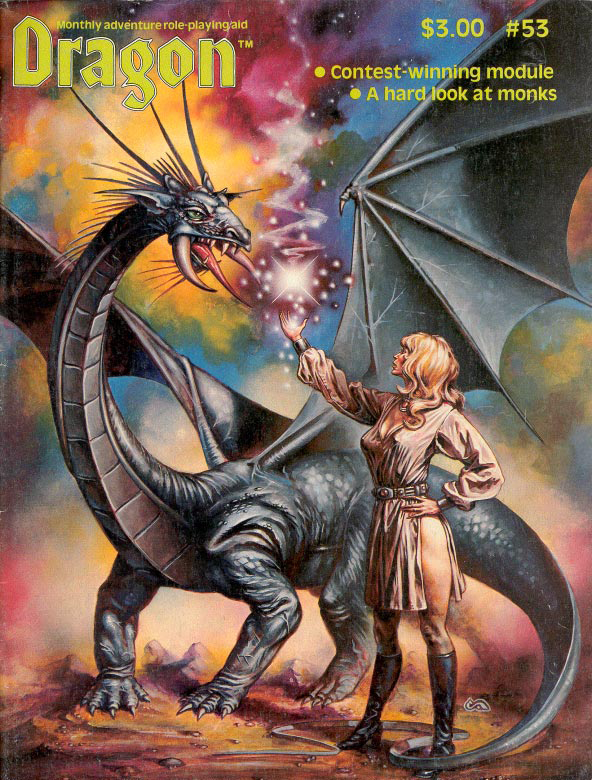
Dragon by Dragon – September 1981 (53)

Glory be – I finally have enough time this weekend to do another Dragon by Dragon, this one on issue #53 from September 1981.

The first thing I noticed about this issue was the cover. This was not an issue I had as a young nerd, but the cover painting by Clyde Cauldwell, which makes it seem very familiar.

I started playing D&D in 1984, introduced by a friend, Josh Tooley, in 6th grade. He watched his older brother play with some friends, and so with a hand-drawn map on notebook paper, a d6 and a vague recollection of what went on, he ran me through a dungeon during recess. I was hooked, and convinced my parents to get me the game – in this case Moldvay Basic purchased at Toys ‘r’ Us – for Christmas. Good times.

So, let’s see what TSR had to offer 35 years ago.

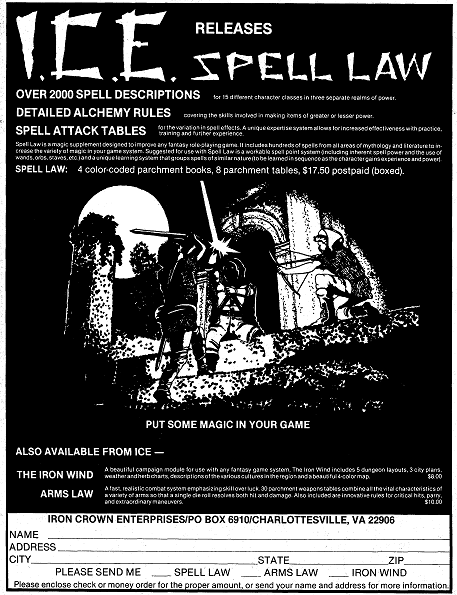
One of the best things about these magazines in the old days were the advertisements. All these games – and God knew what they were – with all this art. It was all so new to me when I was a kid. Take this ad from I.C.E.

I never had any of their games, but I always admired the art in the adverts – and can you have a cooler name for a company than Iron Crown Enterprises?

Jake Jaquet’s editorial this issue was just the tip of the iceberg …

“There is a bit of a new trend in gaming that I find a bit disturbing, and perhaps it should be food for thought for all of us. I refer to the recent interest in so-called “live” games, especially of the “assassin” or “killer” varieties.”

I remember back in 7th grade some kids running T.A.G. – The Assassinatiom Game. All who participated had to draw the name of another player and kill them – which meant pointing at them and saying “bang”. The victim would then hand his slip over to his assassin, and so it would go until the game was over. Alas, but 2nd period it was all over – a couple morons tried to assassinate their victims in class, and the administration called the game off. I suppose now we would have all been expelled.

Enough of this memory lane stuff, let’s get on to the offerings:

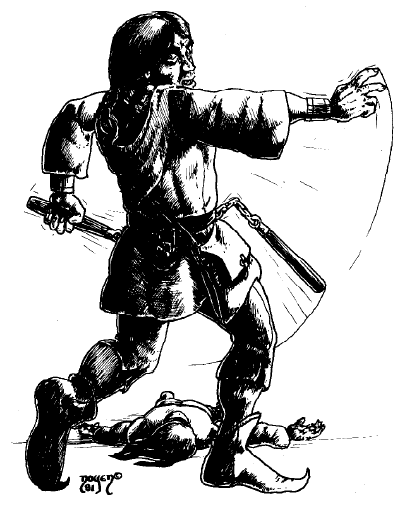
“Why Isn’t This Monk Smiling?” by Philip Meyers brings up the shortcomings of the monk class, and tries to improve on it. The point is actually well made – the idea of suffering through many very weak levels to be powerful at high levels may appear balanced, but it doesn’t work well in practice. To fix things, Philip introduces a new level advancement chart, plays with the rate at which the monk improves its abilities, and adds some new special abilities, some of them psychic. He also makes it easier for the monk to hit those higher levels, without always having to fight another monk.

The monk isn’t out of the fire yet. Steven D. Howard writes in “Defining and Realigning the Monk” a few questions and answers about the monk, mostly to cover why they can’t do some things (answer – I guess it wouldn’t be lawful) and how to once again handle the whole limited number of monks over 7th level. This issue’s Sage Advice keeps the hits coming, with more discussion of the good old monk.

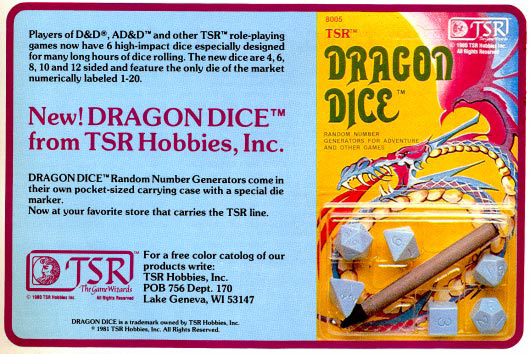
Dude – I had those. Still have some of them, as a matter of fact. Love that packaging, and I always dug that logo.

Next up is Andrew Dewar’s “The Oracle”. This character class always seems like a obvious choice for gaming, but because it deals with the future (which turns out, it is not possible to predict), pulling it off is always tough, both in terms of the abilities, and making it a playable class. Of course, the oracle here is an “NPC class”, meaning not meant for players, but we all played them anyways.

The oracle can cast divination spells, and can use some other divination abilities. It must have an Int and Wis of 14 or higher. Oracles can be human, elf or half-elf. Advancing beyond 11th level requires the oracle to challenge a higher level oracle to a game of riddles (which makes no sense if this is an NPC class … and there is actually half a page spent discussing advancing in level over 11th level).

The innate abilities are various forms of divination – rhabdomancy, arithomancy, etc. – which the class has a percentage chance of using successfully at different levels.

Lewis Pulsipher has a nice introduction to heraldry in “Understanding Armory”. It’s a great primer for those interested in the subject.

Roger E. Moore has the lowdown on “Some Universal Rules – Making Your Own Campaign – and Making It Work”, which covers exactly what he says. He gives a step-by-step on how he designed an original campaign world, based on nothing but his imagination. He also gives a nice set of ways from getting from one universe to another:

1. Cross-universal caves – always go from one world to another.
2. Teleport chains – a length chain of a weird metal that, when surrounding a group and the ends joined pops them into another world.
3. Rings or amulets – like the fabled Ring of Gaxx
4. Rooms and corridors at the bottom of a dungeon
5. Cursed scrolls
6. Angry wizard with a new spell
7. Wish
8. Magical items causing etherealness
9. Psionic probability travel
10. Magic spells (astral spell, plane shift)
11. Mutational planar travel (i.e. Gamma World)
12. Artifacts
13. Advanced technology
14. Acts of the gods

He also notes Dorothy’s ruby slippers

Judith Sampson has a really interesting article called “Adventuring With Shaky Hands”, in which she describes playing the game with choreo-athetoid cerebral palsy. Worth a read.

In “Larger than Life”, David Nalle covers “The Bogatyrs of Old Kiev”. Here are a few highlights:

Prince Vladimir I, The Saint, is a LG 13th level fighter in +5 chainmail with a +3/+4 broad sword. Ilya Muromets is  a LG 20th level fighter – a Cossack with long blond hair – with a mace that scores 2d10 damage.

He also has stats for Baba Yaga, though I don’t know how they compare to the later version in the famous Dancing Hut adventure.

Speaking of adventures, this issue has “The Garden of Nefaron” by Howard de Wied. This adventure won first place in the Advanced Division IDDC II, so it has that going for it, which is nice. This puppy includes some wilderness and a dungeon, and is meant for a large group of relatively high level characters. It also includes some nice Jim Holloway art, one of my faves.

The dungeon has a ki-rin as its caretaker, there are corridors and rooms filled with magic mists, illusions and a really great map (with Dyson-esque cross-hatching).


#53 also has some Top Secret material by Merle M. Rasmussen, with scads of spy equipment.

The Dragon’s Bestiary covers Argas (by James Hopkins II), lawful good reptilian humanoids that gain powers from devouring magic, Oculons (by Roger E. Moore), which are enchanted monsters created by magic-users as guardians (and which look super cool) and Narra (by Jeff Goetz), which are lawful human-headed bulls.

Len Lakofka has some extensive info on doors in his Tiny Hut and Matt Thomas does some work on the AD&D disease rules in “Give Disease a Fighting Chance”.

If you like triffids, you’ll like “The Way of the Triffids” by Mark Nuiver. Let’s do a triffid in Blood & Treasure stats:

Triffid

Type: Small to Large
Size: Plant
Hit Dice: 6
Armor Class: 7
Attack: Stinger (10′/1d3 + poison)
Move: 10′
Save: 14
Intelligence: Low
Alignment: Neutral (N) with evil tendencies
No. Appearing: 1
XP/CL: 600/7

They can hide in foliage with 94% chance of success, and they attack with a stinger. The stinger requires two saves vs. poison. If the first is saved, it means instant death. If the second is failed it means blindness and 2d4 additional points of damage.

For the Traveller fans, Dennis Matheson presents “Merchants Deserve More, Too”, which covers character creation for merchants.

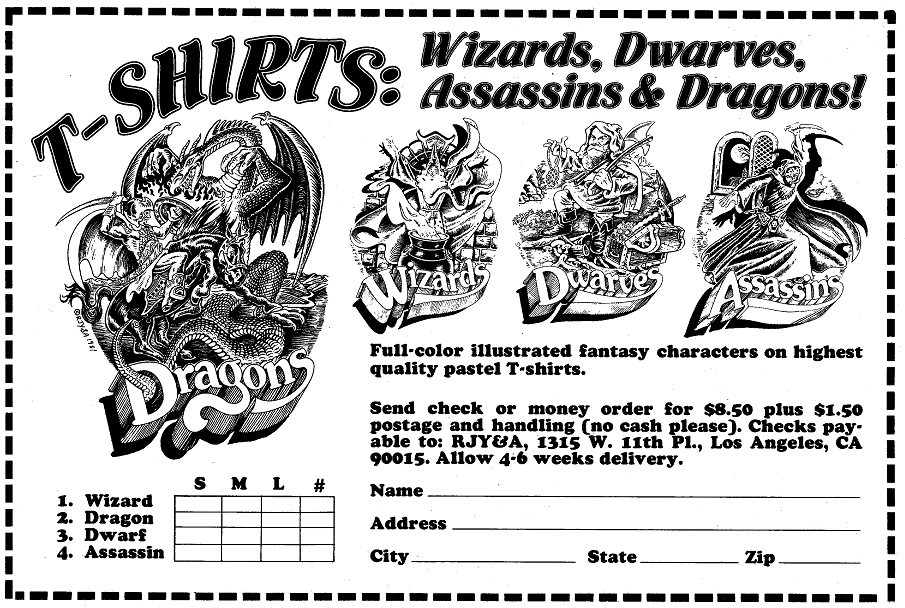
Another great ad. I’d dig one of these shirts.

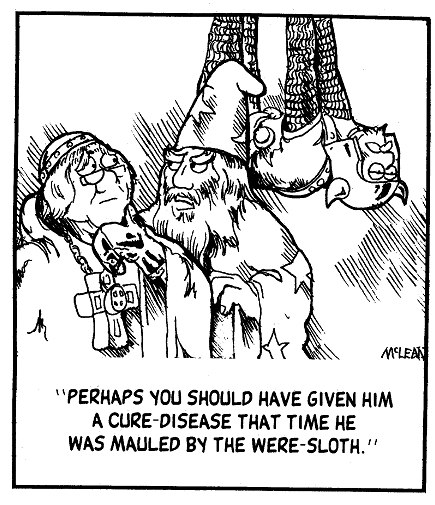
Besides reviews and such, that’s it for September 1981 … except for the comics.Here’s a dandy from Will McLean …

And though no Wormy this month, here’s one of the nifty D&D comics by Willingham …

Khellek shouldn’t be confused with Kellek

“That’s the pepper – right down the middle!”

Or Kelek, Evil Sorcerer

Apparently a popular name among magic-users.

Have fun, guys and gals!

The Evolution of Method

Today I’m going to chime in with a couple helpful tips for those out there writing their own hex crawls. I’ve written more than a few of these suckers, and my usual m.o. was to take a map, divide it in two, and write one half of the hex crawl for one issue of NOD, and the other half for the next, or sometimes with an issue devoted to cities in between.

For the Nomo hex crawl (coming out soon in NOD 31), I had initially meant to use this method, but shifted midway through. It turns out that I was making progress quite a bit faster than normal, and thus doing both halves of the hex crawl in a single issue became a possibility, and one I preferred. There were two things I did differently this time around which I think sped up the process, so I thought sharing them was a good idea.

TIP #1 – Free Association

For most hex crawls, I come up with a general idea for the crawl – a theme – and then draw out the map, generate some random hex contents, some of which I throw out, and many of which I move a round a little to get a good spread, and then I do some research. For an ancient Rome hex crawl, I’ll read through some articles on Roman government, and the legions, and look at Roman mythology and Italian folklore and such to generate some ideas that I can work into the crawl.

This time around, and before I had decided on my theme, I spent a couple hours generating ideas for hex crawls. In this case, I did it by perusing the folks I follow on Pinterest and just free associating the things I saw into things one might meet. I mostly did this to alleviate boredom one night, and if you look at my old Google + posts you’ll find where I posted the results.

Having this list of ideas on hand made writing this hex crawl much easier – it was easier to flesh things out and fit the stream of consciousness ideas into the Roman (and Arabic) milieu of the crawl. Free association is always a good idea when you’re feeling a bit of writer’s block, and it certainly helped me write the Nomo crawl.

Also – I have plenty left over for the next crawl, but will make another attempt at free association before I do.

TIP #2 – Regions

For most hex crawls, I start writing at hex 0101, and work my way down each column. I usually set a goal for myself each night to go through anywhere from 10 to 20 entries. Some randomized contents are thrown out, so I probably write 8 to 16 entries a night. I have no good reason why I’ve done it this way – I just did it without really thinking. I would skip ahead sometimes to write up a city-state or some encounter that I had already generated when NOD was a campaign world of mine, but I mostly just did things in order.

This time, I plotted everything out on a map in advance. I did this because I needed to get the maps to sync up with previously published maps, and to do this dropped them all into an excel document. Having the excel doc right there, it was easy to go through and drop color-coded dots onto the hexes to represent what was supposed to go there – monsters, settlements, dungeons, wonders, etc. With all of these dots, it was also easy to draw circles around groups of them, and then each night to pick one of these “regions” and write up the encounters therein.

Not only did this prove to go muh faster than the old way, I did a much better job of making the encounters more a part of a whole than just a bunch of non-connected things one might meet. I still kept some of those non-connected bits – quite a few, really, because I like the weirdness – but creating connections between encounters was much easier.

So, free association independent of the theme, and regional writing – two evolutions of my method that allowed me to be far more productive. The next crawl covers the entire map below, and so the next issue will be around 130 pages. My next crawl, located to the east of the map below, will hopefully be just as easy to write.


Nomo – Strongholds and Settlements

Yes, it’s another pseudo-lazy blog post. I’ve been busy as a beaver writing the latest hex crawl (and you have to assume a beaver would be incredibly busy trying to write a hex crawl, what with their lack of opposable thumbs – dams and hex crawls require completely different skill sets), and haven’t had time to do much non-hex crawl writing. I’m doing pretty good at this point – about 45 more entries to go. This time around, I’m trying to do an entire map in one issue. In the old days (I’ve been writing long enough I think I can call them “old days”) I broke the maps in two, east and west, and handled each in a different issue, sometimes with an issue focusing on cities in between. If I had done the Nomo hex crawl the old way, I would have been done writing a few weeks ago for NOD 31.

The reason behind this move was not a burning desire to work harder, but rather that I had a request for a Mesopotamia hex crawl, and in preparing to write that, I realized that my version of Mesopotamia, the dread plain of Kisthenes, was next door to my Rome, and that the one would actually make more sense if I did the other first, since there’s some cross-pollination in terms of campaign themes stuff.

Which is a long winded way of saying that this blog post will also feature some material from the next hex crawl. In this case, I wanted to highlight a few of the heraldic designs I’ve made using good old Excel, with the hex entries that go along with them.

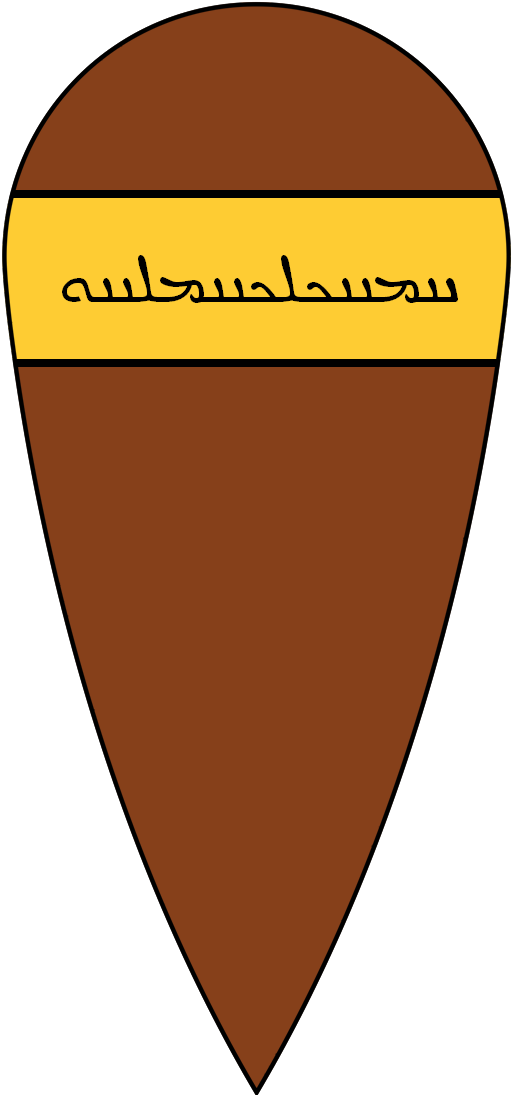
Talabar | Stronghold

(I mostly liked this design because it involved making up a silly phrase and badly translating it into an Aramaic font. The final came out pretty nice.)

Atop a dusty, rocky plateau rests a grand castle, a large con-struction with outer and inner walls and towers, brilliant white in the blazing sun and quite noticeable against the reddish backdrop of the desert sands.

The castle is held by the Amirah Marusha zal-Sifi and her small force of 24 archers and 48 light cavalry. The Amira is a lusty woman, seemingly as delicate as a desert rose, but with iron sinews and a blaze to rival Iblis in her belly. An adven-turess, she fought her way across the Crimson Waste and Kisthenes and deep into the Golden Steppe to get where she is now.

The castle is surrounded by a collection of rock-and-hide hovels occupied by 540 goatherds, farmers and artisans. The people are a superstitious lot, and easily spooked. Their ex-istence here is tenuous at best, and the Warudi tribesmen, who resent her intrusion here, have left many frightening warnings of what will happen if she does not quit this place.

The castle holds a chapel dedicated to the goddess Allat. It is overseen by Marusha’s boon companion Uvart (LN human druid 3), a stony-faced woman of Kisthenes, with black ring-lets cascading down her back and a cherubic face with bright, darting eyes.

Rama | Settlement

Rama is a large oasis town (pop. 5,250) situated between two long ridges of red sandstone on a wadi that extends from the badlands out into the Crimson Waste. The oasis has rich soil and many springs, and supports the growing of date palms and herds of sheep, goats and horses. The oasis beyond the town walls is inhabited by 42,000 peasants. The peasants grow dates, figs, pistachios and barley using a net-work of canals first built by the Warudi and improved by Nomo.

The town was controlled by the Nomo Empire for many years and served as the capital of their Varudia province. With the disappearance of the empire, Queen Zabbai has declared her independence from Nomo and her suzerainty over all the Crimson Waste, a claim it is doubtful she can support.

The city has an outer wall of white stone that gleams for miles out into the desert air and five gates, each named for an ancient god of the Iremites, but commonly named for the color of the stone facings – i.e. the Red Gate (sandstone), the Blue Gate (lapis lazuli), Green Gate (malachite), Purple Gate (porphyry) and White Gate (marble). The outer portions of the town are given over to the adobe dwellings of the peas-ants and artisans, while the inner town, surrounded by a second wall (decorative, not defensive) is home to the royal family, government officials, priests and wealthy merchants in service to the queen.

The outer town is divided into four sections, each for one of the clans native to Rama, namely the Katare, Mabor, Malbizu and Mandilar. The clans can be identified by the color and style of their headdress and numerous other signs obvious to the locals. They are antagonistic towards one another, but not openly hostile.

The inner town is divided by a grand boulevard 30 feet wide and lined with 30-ft tall columns of white marble. The street runs from the Temple of Baal (dedicated to Jove by the Nomoi) on the east to the Temple of Nergal (dedicated to Pluto) on the west. At the center of the boulevard there is a great marble victory arch. On the north side of the street are the town’s baths, the Queen’s citadel and temples of Nabu (Mercury) and Allat (Venus). On the south side of the street one finds the building of the council of elders and the great Court of Tariffs, where tax collectors levy taxes and tariffs on visiting and local merchants.

Just outside the town proper there is a tall hill on which is built a fortified shrine of Moloch, who the Nomo had re-dedicated to Saturn while they held the town. The shrine is within a defensive tower manned by Moloch’s six priests.

Located outside the town in the desert is the Valley of the Dead, where the locals bury their dead in tombs. Some are simple caves while others are tower tombs or large under-ground sepulchers. The dead of the poor are cremated in the Temple of Moloch and placed in caves in terracotta urns. The wealthy are mummified by the priests of Nergal and placed in sarcophagi, dressed in their bejeweled finery.

Now that the Nomo have quit Rama, the locals have become fairly xenophobic. Foreign merchants with items to trade are permitted in the city, but not welcomed with open arms, and adventurers and other vagrants are kept outside, staying in one of the small roadhouses established for them.

Rama’s army consists of 9 squadrons of town guards, armed and armored as heavy infantry, under the direct command of Queen Zabbai, and 9 companies of soldiers under the command of Queen’s captain, her cousin Thamaba. The town’s cavalry operate outside the oasis, pa-trolling the desert sands and intercepting caravans to give them the once over before they come closer to Rama.

Ursa | Stronghold

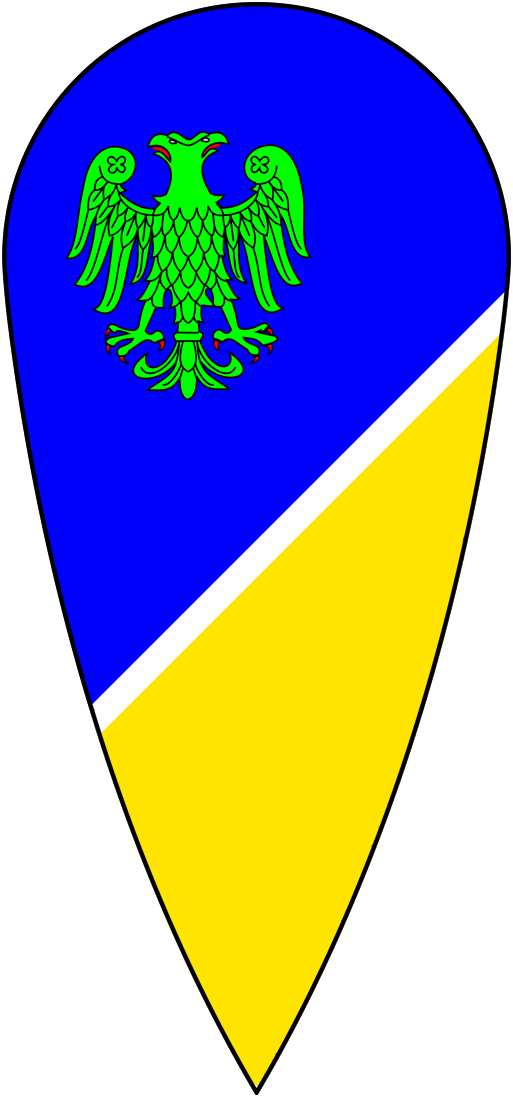
(Some of the locales in these hex crawls are based on real places, and some are based on some idea I had. Many are as simple as “a tower keep of a 9th level paladin”, which require me to make up something to make this paladin’s keep different than the others I’ve already written. In this case, it was boring until I started designing the shield, which was going to have a bear on it – Ursa – but ended up with the double-headed eagle because I accidentally double-clicked it. The double-headed eagle made me think of the Holy Roman Empire, which brought me to the Holy Nomo Empire, etc.)

Pixta Adamia Ursa is a paladin of Minerva who commands a tower keep in this hex. She is gathering together a mercenary army of retired legionnaires and other warriors dedicated to the task of saving the empire by leading an army of loyalists into Nomo and dislodging the emperor’s shade from the throne that an angel of Jove might be placed there in its stead. Ursa is assisted in this task by an ex-Vestal virgin named Caia Spadaea Artia, a veritable she-devil with a sword.

So far, Ursa has assembled 25 veteran legionnaires (HD 1+1) and eight elite cataphracts (3 HD) whom she leads personally into battle. They have sharpened their skills against raiding Warudi, but know their toughest challenges lie ahead.

Ursa is now assembling the elements she needs to conjure a powerful angel. The ceremony requires a set of golden plates that are scattered around the region. These plates, when placed together, reveal the true name of Sabrathan, a plane-tar who they believe can become the emperor of a new Holy Nomo Empire dedicated to all the gods of Law.

Horologium | Settlement

(This is one of the “hex crawl jambalaya” sorts of entries, where I start with mechanical men, and then start throwing in all sorts of stuff from the ancient world that involved mechanical men and try to make something fun to visit. So you get Vulcan’s clockworks, and Talos and then Archimede’s laser rays for good measure. I particularly liked the name Artifex Maximus.)

Horologium is an island and city-state left of Vulcan’s creations, just doing their best to avoid corroding in the salty air. The island has a variety of coastlines, including beaches, harbors and cliffs, and many natural springs.

The city-state is contained in a dormant caldera that still has enough geothermal energy to power the creations of the clockworks. The rim of the caldera is fashioned into ram-parts, with nine towers, each equipped with one of Archimedes’ burning mirrors (i.e. laser ray, deals 2d6 points of fire damage each round it is held on the target; small targets require a hit roll each round).

The automata (pop. 168) are metalworkers mostly, mining metals from the slopes of the old volcano and fashioning it into fine weapons, armor and clockworks for sale. They have a fortified harbor on the north side of the island where they permit non-automatons to dock and take on cargo.

At the center of the city-state is the palace of King Talos, a giant bronze man. Talos is attended by 20 golden keledones, maidens of gold who sing and, when their king is threatened, turn into flailing death bots. Silver and gold watchdogs patrol the palace grounds. The captain of the city guard is called Incubito, a man of steel fashioned in the image of a gladiator, with interchangeable weapon arms!

The automatons worship Primus of the polyhedroids as Artifex Maximus. His high priest is the high scientist Excogitatoris, who fashioned the blazing mirrors and guard dogs.

Mantu | City-State

Mantu is the chief port of Nomo. Few vessels are permitted to pass by Mantu towards Nomo, mostly just imperial war-ships or the pleasure boats of senators and such.

The city is enclosed by a great wall on land, and a smaller sea wall. The walls of the city are greyish green, and embossed every 120 feet by the city’s arms. The city is built on a ring of hills that gradually descend towards the sea. The manses of the wealthy and the city offices are on the high hills, with the middle classes living below them and the lowlands, which sometimes flood, occupied by warehouses, tabernas, flop-houses and tiny shrines to a multitude of foreign gods. The buildings of Mantu have rooves of scarlet tiles, and many feature trellises climbed by vines of wild roses. The city is known for its cuisine, which includes roasted mutton, stews of garlic and fennel and lamb, fried fish, barley soup with fish sauce.

Temples are distributed throughout the city, with the Basilica of Neptune located in the high city. Other temples are dedicated to Salacia, goddess of sea water and wife of Nep-tune, Mater Matuta, protector of mariners, Angerona, reliev-er of pain and sorrow, Dispater in his role as god of wealth, the Aurae (breezes), the Venti (winds), Averruncus, propiti-ated to avert calamity, Hercules and Juno.

Mantu is known for its mines and those occupations related to mining, processing minerals and crafting with them. The traders of Mantu specialize in rare spices from the south. The hinterlands of Mantu are dotted with 49 villa rustica where people herd sheep and miners quarry granite, porphyry, copper and chrysoberyls. Chrysoberyls decorate the staff of office of the legate, who also wears sea blue robes of silk decorated with embroidered white roses.

With Nomo descending into chaos, many powerful families have fled to Mantu. The city-state has hardened its defenses, and there is talk of declaring the city-state independent of Nomo and preparing for war.

The city is protected by cohors I Mantu Nautae, which con-sists of 23 companies of legionnaires, many of them trained as marines, and 5 squadrons of equites. The cohort is commanded by Dux Ailio Cynon Gonzorgo, a veteran of many campaigns against pirates and a key conspirator with the nobles in declaring independence from Nomo (and he’s angling to be named Princeps). The cohort is responsible for protecting the city, patrolling the waterways and protecting the road that connects Mantu to Nomo. The Mantu city guard consists of 9 squadrons of guardsmen.

Nomo – Lakes, Snakes and Sea Phantoms

Thomas Cole’s Destruction (1836) from Course of Empire

I’m deep into writing the Nomo hex crawl and thought I’d share a few of the encounters with you. I’m having fun writing it, combining a bit of the late Roman Empire + Byzantium about to fall, and running my Latin through a Gaulish filter to make it familiar and strange at the same time. Just north of Nomo’s heartland is the Crimson Waste, a desert that used to be a green and pleasant empire called Irem. The Iremites got into a devil worship and ultimately were destroyed in a war with the Nabu Empire (which you might have met in my Wyvern Coast/Nabu hex crawl from way back in NOD 1 to 3). Now that land is roamed by their descendants, the Warudi nomads, with a few monasteries and settlements that were spared in the cataclysm.

Lots of casual research goes into these things, so I always learn a few things. At the moment, I’m agonizing over Nomo’s legions and their emblems, mottoes and cohorts and such.

Anyhow … on with the show:

0411 Glassy Lake | Monster

This hex holds a vast, pristine lake with a glassy surface that seems unaffected by the wind. The banks are thick with acacias and great clouds of butterflies. At the center of the island there is a small, rocky island topped by a pretty little stronghold of lavender stone, with latticed windows and crenelations topped by golden pyramids. Splashing around the base of the island are pretty children – nixies – who sometimes climb the steps of the stronghold, which descend into the water, and slide through the doors.

Within the stronghold, a tower keep, which the nixies are pledged to defend, there is a throne of crushed shell, tall and fine, on which sits a woman composed of living glass. Princess Vyrna is the spirit of the lake, which was once much larger and much beloved by the Iremites. She was once a nixie queen, but took on her present form when she made a deal with the devil (literally) to save what remains of her home from the cataclysm. At night, the nixies of the lake take on a demonic aspect, and commit horrors upon any foolish enough to be found in the stronghold.

0512 The Snake Women Cometh | Monster

The desert sands here funnel into a deep cave of basalt. As one proceeds into the earth, about 500 feet, the air becomes warm and damp, and pools form on the floor. This opens into several interlocked caverns that are very wet and warm, with opalescent slime growing on the walls in great furry strands. These caves are inhabited by a trio of giant vipers that are controlled by the true masters of the cave complex.

Hidden behind one of these curtains there is a stair that proceeds another 400 feet into the earth. This passage is blocked by an adamantine gate with a complex, electrified lock.

At the base of this winding stair is a complex of ophidian amazons. Tall, statuesque women, they have pale scales that darken to rust on their lower arms and legs and carmine on their fingers and toes. This tribe of warrior-scientists consists of 85 females (lesser ophidians) and 27 smaller males who are left behind to tend the eggs and the machinery that pro-duces the warm, wet air that fills the cave.

In these caves, they work night and day on developing a method to clone themselves using concentrated quintessence, blood and whatever humanoid remains they can recover from their vipers. They have not yet struck upon the proper formula, but when they do, they have plans for Nod.

0610 Dirhab | Stronghold

Dirhab is a dervish abbey from olden times. The abbey is constructed of white marble, pock marked after a thousand years of windblown sand. The walls are 40 feet high, and there is a 50-foot tall tower at each corner. The gates of the abbey are composed of ebony, and are 1 foot thick, 10 feet tall and can only be opened using a winch found on the inside.

Within the front gate there is a broad courtyard, rectangular, that supports numerous flowering bushes. The courtyard is floored in reddish tiles decorated with white lilies. On the walls are mosaics of Marduk’s battle with Tiamat and Kingu, and his creation of humanity.

From the courtyard, one can pass into the living quarters and temple of the order. The buildings that surround the courtyard are three stories tall. The halls are hung with rich tapestries depicting the destruction of Irem by avenging angels raining down fire and the scattering of the Warudi across the Crimson Waste. In each of the towers is a large bell of meteoric iron, the dervishes striking them at noon and midnight to call the order and their families to prayer.

In a second courtyard, well-protected, are kept dozens of small white goats with pearly horns. These goats are kept as sacred animals, and are feted on Marduk’s holy day from silver bowls while the priests dance and play flutes carved from lapis lazuli.

The patriarch of the order is old Gazim (NG human cleric 10), whose body has twisted as he has grown older. He has lived through 500 summers, as all of the dervishes are extremely long-lived due to the blessing of Marduk.

The abbey houses 18 dervish priests, 40 dervishes and 180 noncombatants. The dervishes are mostly armed with shields and kaskaras, though 20 of them carry light crossbows and wear leather armor. They all fight like berserkers.

0927 The Sea Phantoms | City-State

Deep beneath the waves of this hex there stands a tall spire, raised from the sea floor, 40 feet thick at the base and 200 feet tall, rounded at the top and carved from top to bottom with skulls in an alien, geometric design.

Around this spire is a town of 1,500 sea phantoms, men and women of the Ethereal Plane with only the merest presence on the Material Plane. These people are not undead, but they are insubstantial and appear indistinct to people who dwell wholly on the Material.

These sea phantoms survive on the dying screams and lamentations of doomed sailors, though they are never the cause of these dooms. They merely float to the surface when they detect fear, and holding out their hazy hands collect these collected sufferings in the form of a black nodule that is not unlike a large, black pearl. They place these pearls, which exist on both the Material and Ethereal Planes, in the eye sockets of those aforementioned skulls. These pearls bathe the Ethereal Plane in a strange radiation which nourishes and sustains the enigmatic sea phantoms.

On the Ethereal, the sea phantoms appear as normal human beings with pallid skin, silvery hair and slate grey eyes. They dress in gauzy robes and carry thin silver swords and daggers at their sides to fend off ethereal marauders and other such dangers of their plane. On the Material Plane, they appear as vague, shimmering outlines of human beings, with eyes like faint lights gleaming through a thick fog, and their voices, normally quite distinct, sound hollow and wispy. Their buildings and houses look like white shapes seen through a thick fog bank, and feel to those on the Material Plane like cold, slushy water.

The sea phantoms are not evil, nor are they good. They want nothing from the Material Plane beyond the desperation of doomed men and women. They seek no agency over the material world, but are willing to communicate the secrets they have gathered to people if they are willing to pass through to the Ethereal Plane with rich gifts.

1719 Natanos | Stronghold

Natanos is a small fishing hamlet (pop. 50) on the shores of the Green Sea. The hamlet consists of several stone cottages on a gentle rise overlooking the beach. Within the hamlet on will find a mysterious staircase between two buildings. The stairs are painted many colors and seem to climb nowhere. Numerous orange cats sit on the stairs.

The cats are intelligent, and live with the sorceress Philia. The stairs head up to her tower, which is tucked between dimensions. The tower, if one could see it, is about 60 feet tall and pure white, topped with a conical azure roof. The interior is elegant and simple, with many bookshelves, blue carpets and furniture that is best described as “Danish modern”.

One chamber holds a small gallery of abstract art, all of it carved from blue stone, ranging from light to very dark blue. Another holds a pool of sea water and an elegant white boat – the pool serves as a portal to the sea, and is activated by pouring wine mixed with a drop of blood into the pool. All of the chambers equipped with floor to ceiling mirrors, for the only thing Philia loves more than her cats is her own face.

Philia is in the middle of the process of forging a magic staff, and she is using the pounding surf and sea winds to do it. The staff is being held by a living statue that she has sent out into the waves – only its forearm and hand, and the staff, are visible to those on the beach, and one might guess it is nothing but a bit of driftwood.