Lyonesse, The Gleaming City – The Citadel

[No numbers on this map yet – just place buildings where you’d like for now]

The Citadel
The citadel is a massive fortress, the center of government in Lyonesse and home to its king and many members of his court. The citadel is constructed from brilliant, white lime-stone. Its towers have conical roofs of sapphire blue slates. The walls of the citadel stand 40-feet tall, its towers 60-ft tall, and they are routinely patrolled by crossbowmen.

Within the citadel dwells King Tristram, his wife Queen Lenore and their children, Burgon, Damoun, Juliada and Pontinae. Princess Juliada is in line to take the throne when her father passes, while her brother Burgon has been promised the Duchy of Lutece as his own. Pontinae is slated for education by the church and a prominent place in the priesthood of Ceres, while Damoun will be apprenticed to Master Odumnovice when he comes of age. Other inhabitants of the citadel include the aforementioned court magician Odumnovice, Tristram’s personal chaplain Father Roquelaure, lord high constable Ramee, the commander of the royal guard, the royal surgeon Dr. Menet and Fraien, giant, blue-black beaded master of the hunt. Various ladies-in-waiting and squires drawn from the nobility dwell in the citadel, and visitors from the countryside are common.

The citadel rests upon a fortified mount 20-ft tall. In front of this mount is the large, round bailey. The bailey is actually an open courtyard that is used for military demonstrations. A troupe of seven heavy infantry occupy the bailey at all times and the walls above are manned by fifteen crossbowmen, all elite men-at-arms (HD 2).

The City Wall
The city wall of Lyonesse is constructed from the same limestone as the citadel, and like the citadel is kept immaculate and gleaming. The wall is set upon a massive embankment (colored light gray on the map) that rises 30-ft above the surrounding land and is buttressed by 10-ft thick walls of limestone. The actual city walls are 40-ft tall. The guard towers are 50-ft tall, while the gatehouse stands 60-ft tall. The walls and towers are always staffed by soldiers – assume any 100-ft span of wall is manned by five cross-bowmen, while each tower holds five crossbowman and five heavy infantry with a sergeant-at-arms in command.

Gatehouse: The gatehouse, also called the Bridge Gate sports two steel portcullises and foot-thick doors of oak studded with hundreds of bronze nails in the outline of a lion rampant. The doors and portcullises are left open during the daylight hours, but closed (and never opened, save by direct order of the king) at night.

During daylight hours, two heavy infantry and four crossbowmen guard the entrance to Lyonesse, collecting tolls for an exciseman (1 cp per foot, 1 sp per wheel). The exciseman sits at a wooden desk with an iron strongbox that typically holds 1d10x10 cp and 1d6x10 sp per hour after daylight. The towers are used as barracks for twenty heavy infantry and twenty crossbowmen, who take their turns patrolling the walls and standing guard. The guardsmen are under the direct command of Captain Calie, an aging elven woman in platemail with skin the color of ancient ivory, hair of burnt umber and gentian eyes. Her natural grace and optimistic attitude have made her popular with the men-at-arms. Calie is one of the three famous “Harpies of the Bridge”, along with the female sergeants that command the guard towers that flank the gatehouse.

Mithras’ Grotto: This 20-ft tall building has a peaked roof of stepped stone and bears no decoration other than a bas-relief of a bull’s head over the iron door that serves as its entrance. The building is a temple to Mithras, the patron deity of soldiers. The upper portion of the building is an empty chamber decorated with frescoes depicting Mithras slaying a bull on the east wall and Mithras slaying a dragon on the west wall. In the middle of the room there is a secret trapdoor that can only be activated by simultaneously depressing hidden buttons in the frescoes, one on the bull’s neck, the other on the dragon’s breast, with a spear or sword point. Once opened, the trapdoor reveals a vertical shaft one can traverse using stubby iron bars that jut from the walls. At the bottom of the shaft one must let themselves drop about 8 feet to the floor of a man-made cavern. The cavern holds a shallow pool and behind it a sacrificial altar and idol of Mithras slaying a bull. The idol is made from marble and painted to look real. Here, soldiers gather under the guidance of Guson, the resident priest of Mithras, to sacrifice bulls and pay homage to their patron. The bulls are brought in through a secret tunnel that connects the cavern to the Corn Market.

Guson dwells in his own chambers in the gatehouse. He is a suave, well spoken man with black hair tinged white at the temples and an elegant pointed chin and aquiline nose. Guson always dresses in robes of blue linen over his plate-mail. He carries a shield bearing an image of Mithras and wears a red Phrygian cap in imitation of his deity.

West Tower: The west tower is commanded by Cwenen, young sergeant-at-arms with skin bronzed by many campaigns against Tristram’s enemies, chestnut hair and large, hazel eyes that flit constantly about a room looking for threats. An overbearing disciplinarian, her soldiers also know her to have a heart of gold – many soldiers down on their luck have found a few extra silver coins dropped in their laps as Cwenen walks by. Cwenen nearly became a priestess, but her lack of patience for book learning and love of swordplay sent her into the military life. Cwenen’s blade was taken as a prize when she faced down an orc chieftain many years ago on the field of battle. It is a bastard sword +1 of azure metal that grants its owner a +1 bonus to save against magic and, if it beats an opponent’s AC by more than 6 points transmutes metal armor to leather and leather armor to cloth. The bastard sword was forged for the bard Longorius, aid-de-camp of King Rollo of Lyonesse during his wars to conquer Western Venatia. The sword is aligned to Law and does not permit its user to lie.

East Tower: The east tower is commanded by Sergeant Ursuin, third of the three Harpies of the Bridge. Ursuin is a young woman from Blackpoort who entered Tristram’s service after saving Yarvis Krumm from bandits on one of his travels between Lyonesse and Blackpoort. Ursuin is tall and muscular, with tanned skin, bushy black hair and a heavy frame. Ursuin has a forceful personality, and few care to get in her way, though she is also very forgiving and great fun in a tavern brawl. During combat, she can choose to accept a -1 penalty to hit in exchange for a +1 bonus to inflict damage. Unlike her sister Harpies, she wields a battle-axe, a gift from Yarvis Krumm that is so finely forged it gives her a +1 bonus to hit.

All-Saints StreetAll-Saints Street is a fashionable promenade of sepia tiles and tall, imposing buildings of dark oak and yellow-white plaster. It is usually crowded with strutting students, aristocrats on parade, chattering bourgeois on the hunt for fun, strolling minstrels mingling their voices and lute-songs with the murmuring of the crowds, street performers in gaudy costume, coy prostitutes in their mandated yellow cloaks and partridge feathers tucked into their hair, beggars who look as though they’ve never missed a meal and craft pick pockets. The most impressive displays on the street, however, are made by the nuns of Nunnery of Proserpina. Each Sunday they emerge from their cloisters in vibrant blue robes and black shawls marked with the three golden pomegranate seeds that are the emblem of their order. Four nuns hold aloft a small golden altar of their patron goddess while the others hold sheaves of golden wheat and chant hymns in honor of Proserpina and Ceres. Young members of the order scatter pomegranate seeds while the senior members distribute silver coins bearing the goddess’ likeness to the poor who line the street.

Nunnery of Proserpina: The abbey is a fine building of limestone, two stories tall, with a tall, peaked roof clad in copper. The abbey has an almshouse on Bulwarks Lane, where copper coins and porridge are distributed to the poor, a hospice for those who cannot pay for their care, especially farmers, a chapel, rectory and dormitories. The abbess is Damma (2 hp), a plump woman with short hair the color of dark chocolate (a well known vice of the abbess, who spends rather more of the abbey’s budget on cocoa than she should) and olive skin. Damma is a devious woman, well versed in church politics and opposed to Bishop Bob, a member of the Kaspars, rivals to her own Papelard family. All nuns are technically married to Pluto, but Damma has been known to see men on the side when it was advantageous to her politically.

All-Saints College: All-Saints College was endowed by Queen Yvette-Mimi about 350 years ago. It occupies an ancient building of limestone, four stories tall and housing dormitories for the four sages and their fifteen to twenty students, lecture halls, a dining hall and kitchen and a small library with five tomes, these tomes composing the curriculum of the college. The dean of the college is one Malbot, a willowy man with thin arms and fingers and a face like a tack. Despite his imposing appearance, Malbot is a gregarious, good-natured old gentleman and much beloved by the students. Malbot is a devout worshiper of Ceres, but shares rooms with his good friend Guson, the cleric of Mithras who would like to overturn the old faith in Lyonesse and institute the worship a more robust and virtuous worship geared towards Law. Malbot often lectures his students on matters of divinity while walking through the streets of Lyonesse, sampling the wares of local pedlars and restauranteurs while he talks.

The Hôtel Kaspar: The hôtel of the Kaspars, the dukes of Brioche, is an imposing structure with a large armorial emblazoned on the third story wall. The house has four floors and a peaked roof with a copper roof. Two guards (heavy infantry) stand guard outside the thick oak front door at all times. Entrance can only be gained by getting past the butler. The hôtel is often visited by spies and various cousins and children of the Duke, who rarely enters Lyonesse for fear of assassination by his enemies. The main inhabitant is Tadoc, the Duke’s son and an infamous rake who spends his time drinking, whoring and keeping ill company (including dwarves!).

The Yellow Queen: The Yellow Queen is a restaurant and tavern run by Ywell (3 hp), a halfling chef with a puffy face and nut-brown skin, grey eyes and shoulder-length black hair always kept perfumed and curled. The restaurant derives its name from a marionette of a queen in yellow that hangs from an upper window. Most folk in Lyonesse know the story of how a very drunk Ywell got the marionette hurled at him by an angry Maggi when he got rowdy in her puppet theater some years back. He never gave the marionette back, and the two would be enemies yet had not a basket of warm muffins not appeared on Maggi’s doorstep the next night, and once a week thereafter. Ywell serves plates of trout in generous portions, steaming platters of escamoles in coriander sauce, bread dipped in cream and then fried in dill oil and ginger beer. His staff are all relations, and they are known to help themselves to patrons purses, replacing them after extracting a few gold coins or tiny gems. The restaurant has eight tables and five booths shrouded by curtains of light blue linen. The waiters and waitresses are famous for their copper helmets, essentially little kettles of hard cider worn on the head and in which patrons can dip their copper mugs. The upper floor is reserved for the “nobs”, and no pilfering is allowed there. Ywell can’t personally stand the nobles, so he spends his time on the ground floor with the bourgeois and peasants, smoking his ivory pipe and swapping stories.

Mystery Men! Anyone?

Well, I’ve finished my draft of the Mystery Men! Beta Document and put it on the free downloads page. Here’s what you in the studio audience can do to help me produce a free/cheap superhero game that everyone can enjoy:

* If you read it, please let me know what you like and what you dislike and any errors that you notice.

* If you play it, please let me know what works and what doesn’t, and when you email me include your name and the names of other play-testers so I can credit you in the finished product.

I’m going to initiate some play-testing myself, but I really value the opinions of people outside my little circle of friends. In the coming weeks, I’m going to put some stats for the heroes and villains that will appear in the final product up for people to use as they see fit. In the meantime, make some heroes and villains and have a fight or two. Enjoy!

Deviant Friday: Dustin Nguyen Edition

I hope you like comic books, and more specifically, Batman comic books, because this week we checking out the work of Dustin Nguyen, duss005 on DeviantArt. Dustin has done lots of work for DC, and I really love his style, especially the water color feel of the pieces. Enjoy.


Blackpoort, City of Thieves – Crooked Street

By gum, I’m busier than a one-armed paper hanger lately. Here’s the Blackpoort post I promised yesterday – I got busy writing Lyonesse and forgot to post. Enjoy.

Crooked Street

Crooked Street (often just called “The Crook”) is a lively street of bustling crowds, where rich and poor mingle. The center of activity on The Crook is the Music Hall [18], of course, and the old street has become a center of the “Bohemian” art set in Blackpoort, drawing jongleurs, prostitutes, street artists, minstrels and clowns at twilight and lasting into the night.

17. Brigtan the Assassin: Brigtan is a young woman of modest means who makes a living as a duelist. Aloof and scheming, she appears to have been educated somewhere, but never speaks of her past. Her home is a single-story brick building with a slate roof and a conservatory in which she raises a number of “medicinal” herbs. Hidden beneath the conservatory, under a removable floor tile, is a small coffer holding 450 pp and a large, leather-bound bestiary. Brigtan is very short, with tanned skin, blond hair that always seems to be falling in her face, and hazel eyes. She is always dressed neatly, in a black doublet (actually a jack of plates) and black breeches, with an ornate longsword on her hip and daggers hidden in her tall boots.

18. Music Hall: Always surrounded by hustle and bustle, the music hall is the center of the Crook’s cultural life. Owned by Leona Tattlewit, a young woman with alabaster skin, dark brown hair cut in a bob and aloof chestnut eyes with a touch of crimson. Tattlewit is tall and thin, graceful and with an airy, sylph-like beauty that belies her very precise and business-like mind. Her former husband, Sceath Tattlewit (RIP) was a well regarded actor, and she inherited the theater when he died. The music hall plays two-penny (well, 2 sp) operas to boisterous, noisy crowds. Halflings work the audience selling greasy viands and fruit and picking pockets (Leona gets 20%). The hall is a building of red bricks painted in bright, garish colors (blue, yellow, purple) and an old copper roof that leaks. Next week, they are putting on a musical production of a new play called The King in Yellow.

19. Foundryman’s Club: This dimly lit social club is frequented by laborers of all stripes in Blackpoort, including poor adventurers. The club consists of a single story brick building with a tall, peaked, slate roof and a long, brick chimney. Inside, there is a common room with three round tables (old oak, varnished by several generations of use), four long tables painted red and a few semi-private booths hidden by lank, greasy curtains. The inn is run by Wolvine, a youthful woman with olive skin, thick, blond hair pulled back in a bun and hazel eyes always cast down in a serious look. Wolvine is a bit heavy-set, and usually wears a peasant dress. She inherited the club from her father, Olvus. The club serves black beer and pungent mead in wooden goblets. Steaming trenchers of eel and white fish are set on the tables every hour, and patrons are expected to drop a few coppers on the trencher after eating their fill. Wolvine, despite her surly exterior, is brave and virtuous. A widower who lost her husband, a man-at-arms, to some damn fool dungeon exploration, treats her patrons like her own children, doing her best to keep them on the straight and narrow and true to their lives and children.

20. The Old Miser: This imposing five story tower is the home of Nevenbak, a wealthy miser. Nevenbak’s home, though once quite grand, has fallen into disrepair. The stone is black with soot and the roof is missing slate tiles. The corners of the roof were once protected by sculptures of eagles, but all but two of them have long since fallen into the overgrown garden. The garden is surrounded by a tall wall with a tarnished bronze gate. Nevenbak lives alone, having long ago driven away friends and family with his over zealous thrift and inhuman lust for money. He maintains a vault beneath his house that has yet to be cracked by the thieves of Blackpoort, though many have tried. Their remains now decorate the vault’s antechamber, where dwells a captive owlbear, possibly Nevenbak’s only remaining friend. Nevenbak spends his days in his counting house in the southern portion of Blackpoort, and his nights in the vault with his owlbear, counting his money (the horde now amounts to XXX and a potion of green dragon control in a dusty wine bottle. One of Nevenbak’s arms is twisted, the hand atrophied into a hook-like claw.

21. Madhouse: Blackpoorters usually hurry past this somber, three-story building. Once a manor belonging to the extinct Usher family, the building is now a madhouse under the supervision of the priests of Mercurius, specifically Brother Candle, a well curtal friar with sun-kissed, happy wrinkles framing his eyes and light brown, tonsured hair. Candle’s own mother went mad, so he has dedicated himself to caring for the insane and using what few powers he has to keeping them healthy. The other priests who work in the madhouse consider it a punishment, which is usually is, and often react accordingly to the needs of the inmates. It is also known to be a place where enemies of high placed men and women end up, often without the knowledge of Brother Candle. The windows of the madhouse have thick curtains of black velvet, used to keep the moonlight and its mind-bending power from worsening the condition of the mooncalves, lunatics and melancholics interred within.

Scaling Speed in Mystery Men!

I’ve mentioned before that the trick of writing a super heroic RPG is dealing with scale. Whatever system you use has to be able to handle 98 lb weaklings and guys who can bench press locomotives, and it needs to do so in such a way that the two can adventure together – i.e. you have to part ways with reality a bit to make it all work.

If scaling Strength in a comic book hero game is hard to do, scaling speed is just as hard. Again, you need to have a system that accommodates normal (even slow) human beings and folks who can zip around at the speed of light, and you need to integrate speed with the other rules systems to make super speed meaningful, but not overpowering.

My initial idea was to use the traditional movement rate concepts from old school games, but expressed in yards or meters per minute. Thus, a movement rate of 100 became standard. The problem, of course, was that cars, for example, would have a normal movement of about 900, and other vehicles higher than that. That means super speedsters would have the same speed advantages. With most of the action in a comic book hero game taking place in fairly confined quarters, speeds of 900+ don’t have much relevance, and when you get into the 1000’s they become fairly unwieldy. So, I decided to change my scale.

Playing around on Wikipedia, I discovered the concept of “orders of magnitudes of speed”, and decided alter it to fit my purposes. Mystery Men! will have ten speed bands, ranging from 1 (slow humans) to 2 (normal humans) to 10 (speed of light). People can move from one speed band to a higher speed band by running, maintaining the higher speed with feats of Constitution, and reaching even higher speeds (just momentarily) by a feat of Strength.

The speed scale is as follows:

1 – 50 yards/round – old folks, children
2 – 100 yards/round – healthy adult human
3 – 200 yards/round – bicycles, many animals
4 – 500 yards/round – cars, motorcycles
5 – 1500 yards/round – high-speed rail, airplanes
6 – 5000 yards/round – jet airliners
7 – 20,000 yards/round – sound
8 – 100,000 yards/round – supersonic speed
9 – 10,000,000 yards/round – sub-light speed
10 – 20,000,000 yards/round – light speed

Obviously quite a leap from “old lady” to “light speed”, but I think in the context of the game it should work. You’ll have your normal speed, rated 1 to 10 – characters begin with a normal speed of 2. You can run at the next highest speed for 1 round, and thereafter can continue at that speed with a feat of Constitution each round. You can generate a burst of speed at 2 speed levels higher than your normal speed by making a feat of Strength, but the burst only lasts 1 round, max. You always have the option to move at a slower speed, of course. The table included in the rules will show speed per round, speed per turn and mph/kph for each speed rating.

Initiative. which was to be determined by speed, will now be determined by a d10 roll modified by your Dexterity bonus and speed (so, with a 30 Dex and 10 Speed, you’d end up with a +19 to initiative – pretty hard to beat). Speed will also govern how many actions a character can take during a round. When engaged in combat with a foe, compare your speed to his speed. If your speed is twice his speed, you can make two actions (move, attack, activate power, etc) per round. If your speed is triple his speed, you can make three actions. In order to keep super speedsters from being unbeatable, we’ll cap it at three actions per round for now.

Hopefully, this will make speed a relevant ability in the game, while keeping it easy to track and not something that will break the game.

And yes, I think I’ve decided to drop the panel/page/issue time concept for the more traditional rounds/turns, etc. MM! is supposed to be a reworking of old school games to make learning it simpler, so it makes sense to stick with language most gamers already know.

Art by Mike Wieringo

RANDOM ANNOUNCEMENTS

Currently, I’m working on NOD 7, which will feature 3 cities. Blackpoort is written and I’m working on Lyonesse now and then have to write Antigoon. Right now, I’m on schedule to publish in the middle of February.

After I adjust the speed rules, I’ll be ready to put the Mystery Men! beta rules out for play testing. If this project interests you, please consider downloading the rules and running a quick game, or even just going through character generation and running a fight. If you do play with the rules (or even just read them), I hope you’ll give me some feedback. The beta rules won’t include the sample setting or all the explanatory text on “what is role playing”, “how you roll dice” – that will be included in the final product. Right now, looks like the final game will come in at a slim 60 pages, so it should be pretty affordable in print, and the e-book will be free.

I’m also working on writing my third Hexcrawl Classic for Frog God Games. The first should see print in February – very excited, as it’s my first freelance sort of gig. I’ve just been tapped to be a part of a much larger project for the Frog God, which I’ll be cranking on for the next couple months. Despite the work load (being busy is a blessing!), I’ll continue to post to the blog just about every day.

Speaking of posting – I’m getting lots of page views on the Megacrawl 3000 posts, but nobody is playing along in the comments – not for the last 2 posts. Since I inteded Megacrawl 3000 as a game for the community at large and not a creative writing exercise for me, I’ll probably drop it after this last episode for lack of participation. If you want to see it continue, by all means get involved!

That’s all for now. Should make another Blackpoort post tonight, and then start posting on Lyonesse later this week. I also want to do some more retro-engineering on Darkness & Dread, have Noble and Everyman classes that need to see the light of day, and want to begin statting out some demon lords for NOD. Lots to do.

Ruminations on Doctor Who and the Failings of the Imperial Office Corps

Over Christmas, the fam and I bought a router so I could be productive on my new laptop. As an added bonus, we discovered how ridiculously easy it was to hook the Wii up to the internet. I now have access to Netflix via the Wii on the TV, which brings me to Doctor Who.

A while back, I briefly got into watching the new Doctor Who series on BBC America, and I almost enjoyed them. They were okay, I guess, but didn’t totally click with me. This tends to be the case with me and new sci-fi – it’s not a matter of dislike (well, sometimes it is), but more often a case of “meh”. Strangely enough, I like sci-fi but I’m not that big on special effects, and I’m really bored with computer generate effects. Anyways … with the Netflix hook-up, I’ve started watching old Doctor Who episodes, specifically the ones starring Tom Baker. I’ve never seen them before, but I instantly fell in love with them – right up my alley. I just finished watching “City of Death” and that brings me to the Imperial Office Corps.

The villain in “City of Death” is Julian Glover, who played General Veers in Empire Strikes Back. As with most people my age who are into sci-fi and fantasy (and science-fantasy), I’ve probably spent a tad more time thinking about Star Wars than is healthy, and in those ruminations it occurred to me that Veers was really the only Imperial in all the movies who ever succeeded at, well, anything. Grand Moff Tarkin and all his little moffs failed to destroy the rebellion with their technological terror, the various admirals were like the Keystone Cops (clumsy and stupid) and even Vader was a big failure – never caught Luke, never turned Luke, eventually got his ass kicked by Luke. The Emperor also failed in his attempts to turn and kill Luke, undone by his earlier (and maybe only, for all we know) success of turning Vader and establishing the Empire. Veers alone, in true British bad-ass style, didn’t screw up – he took out the force field on Hoth and his forces over-ran the secret base.

Now, most students of military history will not be surprised about this. Totalitarian states tend to have crappy officer corps because the ruling elite fear putting competent people in charge of their military – that’s a recipe for a coup. Incompetence among the overlord’s minions isn’t just a Hollywood invention.

So here’s to Veers, the finest officer in the clown college of evil incompetence that was the Galactic Empire!

HUZZAH!


And Boba Fett doesn’t count, he was an independent contractor.

Deviant Friday – Mike Dubisch Edition

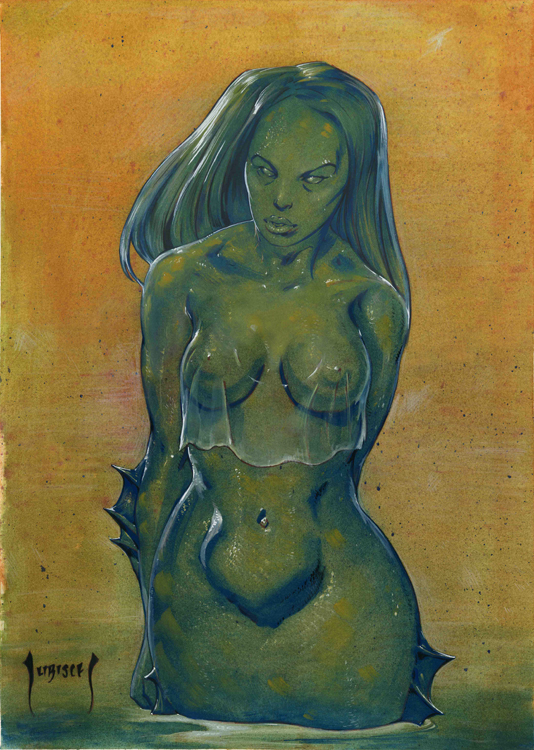
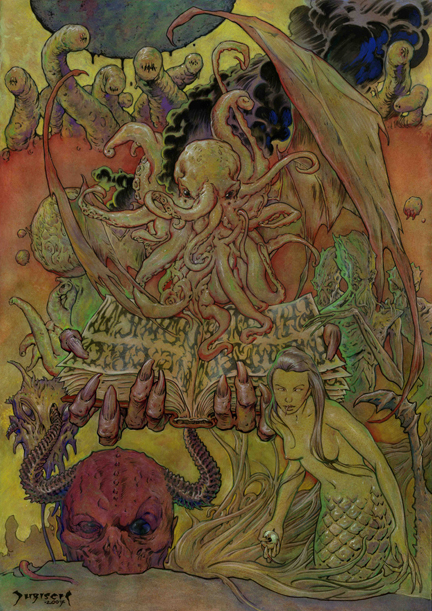
Mike Dubisch does some wonderfully creepy drawings, mostly in the Cthulhu vein. Check it out boys and girls and then check your SAN. Some are a bit NSFW, unless you work in a topless bar, so beware.

Probably won’t be found singing with a crab any time soon, but she might run into trouble with a tentacled horror.
I understand Alan Gribben will be releasing a new version of the text that excludes the word F’tagn – shocking.
It’s not surprising to me that he doesn’t have a Red Sonja or Dejah Thoris in his gallery, but man would I be interested to see what he would do with them!

Blackpoort, City of Thieves – Guild Street

Clanker Row and Guild Street
Clanker Row intersects with Guild Street in this portion of the map, but is otherwise hemmed in by the city walls. If Blackpoort is known for its soot and grime, Clanker Row is the reason for it. Clanker Row is the chief industrial corridor of the city-state, being home to dozens of smiths and iron foundries. Most of the traffic on Clanker Row is in the form of apprentices, journeymen and master artisans on their way to and from work or other appointments. Coal wagons and other carts carrying raw materials and supplies make their way up and down the street with distressing regularity, forcing pedestrians to the margins of the narrow, brick-paved path.

6. Grizelda the Smith: Grizelda’s smithy is a single-story brick building with a large forge and well tended tools hanging on the walls. Grizelda is a blacksmith, focusing on tools and other non-violent goods, though she is capable of cleaning and making minor repairs to weapons, and might have a few old weapons and shields for sale, taken in trade from down-on-their luck adventurers. A mature woman, she was widowed many years ago and her son, the apple of her eye, serves in the Blackpoort guard. Grizelda has light olive skin, grey hair and green eyes. Her appearance is usually ragged – she is a hard worker, and can usually be found clanging away well after dark. Pessimistic by nature, she is not given to working on account. She has a large diamond worth 450 gp hidden in a wooden box nailed to the inside bottom of a barrel filled with sand and used for cleaning the rust from armor. She sleeps in a backroom.

7. Morgan the Smith: Morgan is a hot tempered and sadistic young man who hates his job, hates his life and hates everybody around him. He has tan skin and sandy-brown hair and always wears a perpetual scowl on his handsome face. His smithy has two stories, with living quarters for two in the upper story. A widower, he drowned his young bride in the Swiven River, attracting the ire of the nixies living there, who have conspired with other fey to ruin the young man’s life.

8. Tatlana the Stable-Master: These stables, owned by Barno [26] and mostly serving the farrier [9] next door, are managed by Tatlana (5 hp), an expert groom and very attractive young woman underneath the grime and dirt she normally wears. With her olive skin, bright, hazel eyes and infectious smile, she has charmed more than a few travelers out of a meal and several mugs of ale – after a bath, of course. Tatlana is a solitary sort who prefers the company of horses to humans (again, outside of a brief tete-a-tete). Intelligent and inquisitive, she can also be quite violent when threatened.

9. Fridd the Farrier: Fridd is an ex-soldier who now works as a farrier, a sort of combination blacksmith and horse veterinarian. A mature man with deep wrinkles on his broad, expressive face, he has olive skin, thinning grey hair and dark, soulful brown eyes. A tape worm keeps him looking thin and drawn, even when times are good. Fridd carries a torch for Tatlana next door, but his craven and argumentative personality keeps her away. Fridd once took a bribe from the assassins’ guild to mis-shoe a horse, causing it to rear and kill its rider, the son of a minor noble.

Fridd: HD 1 (5 hp); AC 9 [10]; Atk 1 hammer (1d4) or crossbow (1d6); Move 12; Save 17; CL/XP 1/15.

10. Iron Monger’s Guild: This ornate, four-story building is home to the Humble Brotherhood of Iron Mongers. The iron mongers own mines and sell iron to the local smiths and export ingots of iron and steel to merchants and smiths in Antigoon, Lyonesse, Pfeife. The front door is made of iron and covered in bas-relief sculpture of oreads and miners in mines. It is flanked by caryatid columns (non-animated) of miners carved from porphyry. The current master of the guild is Yavvoo, an old man who immigrated from Kirikersa as a youngish man who tired of his life at sea. Yavvoo has swarthy skin, curly black hair and green eyes. He only wears the latest fashions from Antigoon, and generally cuts a fine figure, all 5-ft of him strutting down the avenue with a gold-tipped walking stick and two burly guards in mail. Yavvoo has three wives and many children at home, and thus often sleeps in his room in the guildhall. A sober and honorable man, he indulges in no vice but does have a rather short temper that often leads him into confrontations he regrets.

Honestly, I don’t remember where I found the art above, but there’s about a 90% chance that it came from Golden Age Comic Book Stories.

Thinking About Feats in Mystery Men!

So, one thing to come out of my little play-test of Mystery Men! yesterday was that my “feats” concept had some serious flaws. Essentially, feats in MM! are meant to be a catch-all ability check, skill check, saving throw system. It was inspired by the old “X in 6” method of old school fantasy games and the “roll under your ability” score concept we also used back in the day. The trouble with Mystery Men! is one of scale.

Traditional fantasy games have ability scores ranging from 3 to 18. This encompasses the whole of human experience, with a 3 being fairly pitiful and an 18 being the human maximum. Characters in old school fantasy are either human or close enough to human that a simple X in 6 chance works pretty well. Most folk have a 1 in 6 chance to do things, extraordinary folk knock this up to 2 in 6 or 3 in 6. For ability checks, you can roll 1d20, with pitiful characters having a 15% chance of success and amazing characters a 90% chance of success.

In Mystery Men! you need a system that will handle both Willy Lumpkin and The Hulk. This makes a flat 1 in 6 chance a problem, because the Hulk can do things that Lumpkin does not have a 1 in 6 chance of doing. Likewise with “roll under ability score”.

My first instinct was to roll different dice ranges for different types of tasks, trying to roll under an ability score. Initially, I was going to do 1d10 for normal feats (i.e. things a normal person could do with great effort and a bit of luck), 1d20 for heroic feats, 1d20+10 for super feats (things well beyond the capacity of normal human beings) and 1d20+20 for epic feats (things best left to the gods). This meant that Willy Lumpkin, with ability scores probably ranging from 1 to 3, had no chance of performing super or epic feats, and only 10-30% chance of performing normal feats and a 5-15% chance of performing heroic feats. Okay, problem solved.

And then I started playing out the combat. Resisting a power or attack was going to be classed as normal, heroic, super or epic based on the level of the attacker or power user. With Catwoman being 16th level, resisting her attacks and powers would be a super task, and usually beyond the ability of Invisible Woman. A game where a hero or villain always succeeds or always fails against another one is not terribly playable, especially when Invisible Woman and Catwoman were not that far apart in levels.

In my combat example, I decided to change the dice rolls from 1d10 / 1d20 / 1d20+10 / 1d20+20 to 1d10 / 2d10 / 3d10 / 4d10. That removes the problem of Invisible Woman not being able to resist Catwoman, but it reintroduces the problem of Willy Lumpkin having a slim chance (5%) of performing super feats, like leaping over buildings. So, no solution there.

I could bump the feat bonus a character gets, having it match the character’s level. But then level trumps raw ability, and Invisible Woman, with human levels of Strength, can leap over buildings. Not going to work.

I could ditch the idea of using feats for saving throws, and institute a single save value a’ la Swords and Wizardry (which means high level heroes are almost never taken down by powers, and low level heroes are almost always taken down by powers) or even institute different types of saves (Death Rays, Poison, etc) with generally the same effect.

What I’m thinking of doing is giving feats a flat number that one must meet or beat by rolling 1d10 and adding ability score bonus and feat bonus (and also ditching the “normal” feat category) –

Heroic Feats  – meet or beat a 10
Super Feats – meet or beat a 15
Epic Feats – meet or beat a 20

Resisting an opponent’s powers requires you to meet or beat 5 + your opponent’s feat bonus. That would put even 20th level characters in the upper ranges of the heroic level, giving most heroes some chance to resist the powers of their opponents. I’m going to drop the “save vs. attacks” angle, because it’s a pain in the rear and easier to just ditch the “instant knockout” idea. This means the more powers you have the lower your level and thus the easier your powers are to resist, and vice versa.

Now, pathetic man, a 1st level hero with an ability score of 1, is rolling 1d10-1, meaning he can’t perform heroic feats. I can live with that. Not everyone can be a hero all the time, and if this is a character, he doesn’t have a score of 1 in every ability.

Normal woman, a 3rd level hero with an ability score of 3, is rolling 1d10+1, meaning she can perform heroic feats 20% of the time.

Excellent dude, a 6th level hero with an ability score of 6, is rolling 1d10+3, meaning he can perform heroic feats 40% of the time.

Amazing woman, a 10th level hero with an ability score of 10, is rolling 1d10+7, meaning she can perform heroic feats 80% of the time, and super feats 30% of the time.

Maxi-Man, a 20th level hero with an ability score of 30, is rolling 1d10+18. He cannot fail at heroic or super feats, and he performs epic feats 80% of the time. Since this character represents the absolute pinnacle, I think I’m okay with this.

I might also add an optional rule wherein a roll of “1” always introduces a complication to the situation – i.e. you leap over the building, but land on the mayor’s car or crash through the street on the other side. That way, Maxi-Man still has to roll for heroic and super feats, and though he’ll always succeed, the Referee can introduce a complication of some kind 10% of the time.

I’m open to suggestions on this one – what do you think?

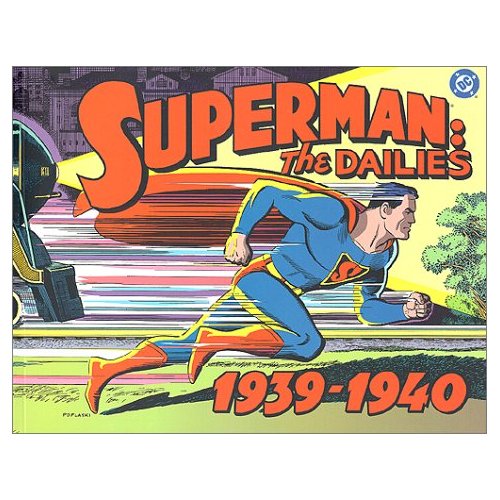
Picture taken from Amazon. I just finished reading Superman: The Dailies, 1939-1940, and it was great.

Catwoman vs. Invisible Woman

Now there’s a blog title that has to get some attention, right?

Well, a couple weeks ago I statted up Catwoman and Invisible Woman using the alpha rules I’m writing for Mystery Men! I’m about one or two weeks away from putting my beta rules out there for the world to playtest. The stats below take into account a couple changes from alpha to beta …

Invisible Woman (Sue Richards)

Class: Adventurer
Level: 11
Hit Points: 51
Armor Class: 15 (+1 Dex, +4 Armor)
Feat Bonus: +5
Attack Bonus: +11

Abilities: Str 3 (+0), Dex 5 (+1), Con 5 (+1), Int 10 (+3), Wis 14 (+4), Cha 11 (+3)

Permanent Powers: Force Missile, Invisibility II, Shield
Limited Powers: Force Sphere, Invisibility Sphere, Wall of Force

Catwoman (Selina Kyle)

Class: Adventurer
Level: 16
Hit Points: 53
Armor Class: 18 (+6 Dex, +2 Armor)
Feat Bonus: +7
Attack Bonus: +16

Abilities: Str 5 (+1), Dex 19 (+6), Con 3 (+0), Int 5 (+1), Wis 3 (+0), Cha 10 (+3)

Permanent Powers: Alarm, Feather Fall, Find Clue
Single-User Powers: Moment of Prescience

Now that I have some stats for a hero and a villain, the only thing left to do is have them fight.

Getting wind that a valuable statue of Bast taken from the tomb of the Living Mummy was recently locked in the vault at the Baxter Building, Selina Kyle decides a trip to New York is in order. Doing her homework, she discovers that on one particular night, three of the Fantastic Four will be away from home, Johnny doing some publicity stunt in L.A., Reed lecturing at Medfield College on the possibility of a computer’s circuits being impressed upon a human mind, and Ben Grimm involved in some sort of team up. That left the Invisible Woman alone to hold down the fort, giving the infamous Catwoman odds she could live with.


Having picked her way through the building’s security (involving many heroic feats of Dexterity and Intelligence – see the rules document for an explanation of feat rolls), she finally gets to the vault. Unfortunately, one of those feats was unsuccessful, and the Invisible Woman, getting the alert, proceeds to the vaults to confront what she figures is a routine malfunction. As she enters, the Catwoman strikes …

Panel One
Since CW and IW have the same movement rate, initiative is decided with the roll of 1d10 + Dexterity Modifier. CW rolls 8 while IW rolls a 6. With the initiative, Catwoman decides she better try to knock IW out quickly. In Mystery Men!, you can declare a special attack every round. If you beat your opponent’s DC by 5 or more, you succeed on your special attack. If you beat your opponent’s DC without beating it by 5 or more, you still score a hit and do damage. If you don’t wish to do a special attack, you simply score double damage if you beat your opponent’s DC by 5 or more. For this attack, CW is going to try to knock IW out – if successful with her attack, she’ll score normal damage and IW will have to roll a feat of Constitution to maintain consciousness. So, CW lunges at IW and rolls a 21 (4 + 1 for Str +16 for attack bonus). This not only scores a hit for 2 points of damage, but also forces IW to roll a feat of Constitution to avoid being knocked cold.

Feats replace skills and saving throws in Mystery Men! The dice you roll for a feat depends on the difficulty of the feat, rolling 1d10 for normal feats, 2d10 for heroic feats, 3d10 for super feats and 4d10 for epic feats. To succeed at the feat, you must roll under your ability score + your feat bonus. In IW’s case, she needs to roll under a 10 to make a feat of Constitution. Since CW is 16th level, avoiding her powers and attacks requires a super feat, thus rolling 3d10. IW gets lucky, rolling a 9 and maintaining consciousness.

IW backs off a bit and launches some force missiles. Although based on the magic missile spell, I decided that a power that can potentially be used every round had better require a ranged attack, in this case against a DC of 10 + the opponent’s Dexterity modifier, or 16 in CW’s case. As an 11th level adventurer, IW can launch five missiles, rolling 26, 28, 21, 26 and 13, and thus hitting with four missiles for 4d6 damage + 1 per die for IW’s Dexterity bonus, rolling a 13.

IW still has 49 hit points, while CW is down to 40.

Panel Two
CW rolls a 14 for initiative, IW a 9. CW decides to use her whip this round, making a ranged attack against IW’s DC of 15. Her special attack this round will be tripping, needing a 21 to trip IW and knock her prone. CW has an attack bonus of +16 and a Dex bonus of +6 and rolls a 23 total, scoring 12 points of damage (1d6+6 for high Dex) and forcing IW to make a super feat of Strength to avoid being knocked over. She rolls an 18 and needed to roll an 8 or lower, meaning she hits the floor.

IW has had enough of this nonsense and fortunately can use her Force Sphere while flat on her back. She tries to capture the Princess of Plunder, who must make a heroic feat of Dexterity (roll 2d10) under 27 to avoid it – in other words, she can’t help but flip out of the way, and IW is going to have to take another tack if she’s going to win this fight.

IW has 37 hit points and CW still has 40.

Panel Three
CW rolls 10 for initiative, and IW 4. CW is going to try to knock IW out again, rolling 27 against a DC of 15 and scoring 3 damage and forcing another super Con feat to avoid falling unconscious for 1 page. IW rolls an 18 this time, passing out and leaving CW to make another stab at cracking the vault.

Cracking the vault will also take 1 page, meaning she’ll be dealing with a conscious IW whether she succeeds or not. Cracking the vault, designed by Reed Richards himself, will require a super feat of Intelligence. Catwoman needs to roll a 12 or lower on 3d10, getting a 17 and failing, just as IW returns to consciousness.

IW has 37 hit points and CW still has 40.

Panel Four
CW rolls 9 this time and IW 10. IW decides to activate her invisibility power. Catwoman, noticing that her foe has disappeared, decides to make a run for it. She climbs the wall (a heroic feat, which, with her 19 Dexterity and feat bonus of +6, she can’t fail). Normal climb speed is 30 yards per page (or 3 yards per panel), and we’ll say the vent CW is heading for is about that high off the ground, meaning she makes it to the vent opening on this round and begins crawling through it.

IW has 37 hit points and CW still has 40.

Panel Five
CW rolls a 16 for initiative, IW 6. CW climbs into the vent. Frustrated, but happy that the vault was not breached, IW heads for an elevator to see if she can catch CW on the roof and continue the fight there.

So, the rules are still pretty rough, but I think they’re workable. I think I might lower the attack bonus progression, since Defense Class in Mystery Men! is generally not going to keep pace with attack bonuses the way AC in d20 games kept pace with attack bonuses. I think this makes special attacks too easy to pull off. For that matter, I might change the “knocking out” special attack to a stun for 1 panel special attack. I still need to run some tests with lower powered heroes and something with epic heroes to see how things work at those levels.

Art by Bruce Timm – originally two separate pieces that I combined.