Monsters of Space Princess

Here are a few sample monsters – “aliens”, in fact, from the Space Princess game. The game is coming along pretty well – just a bit more writing to do and then some artwork and she’s ready for testing!

Devil Girl
Devil girls come from a female dominated society with a declining male population. Devil girls are undeniably attractive, but merciless in their treatment of others. They wear uniforms of a black, vinyl-like substance that is a surprisingly good armor. Devil girls suffer only half damage from cold, electricity and fire and they can blanket a 60-ft radius area around themselves in complete darkness once per day for 10 minutes. Devil girls are capable of seeing in this weird darkness, but other creatures are not, giving the devil girls a +5 bonus and the others a -5 penalty to attack.

DEVIL GIRL: HD 4; DEFENSE 12; FIGHT 9 (strike +1); SHOOT 9 (ray gun +5); MOVE N; STR 13; DEX 13; MEN 9; KNO 12; DL 5; Special: Darkness, resistance to damage.

Space Amazon
Space amazons are women of tremendous strength and dexterity who are sometimes hired as elite guards in a space fortress, or perhaps were captured and subsequently escaped, living as outlaws in the fortress’s myriad tunnels and chambers. Space amazons stand about 8 feet tall and have green skin, white hair, and long antennae. Large groups of space amazons are commanded by a myrmidia. Each myrmidia has a 5% chance of secretly falling in love with a male star warrior and betraying her sisters on his behalf. If spurned by him, her berserk fury is doubled against him.

SPACE AMAZON: HD 4; DEFENSE 8; FIGHT 10 (axe +2); SHOOT 8 (ray gun +5); MOVE N; STR 15; DEX 12; MEN 12; KNO 10; DL 5; Special: Berserk Fury (+2 FIGHT and +2 damage vs. males).

MYRMIDIA: HD 6; DEFENSE 10; FIGHT 13 (axe +2); SHOOT 10 (ray gun +5); MOVE N; STR 16; DEX 13; MEN 13; KNO 11; DL 5; Special: Berserk Fury (+2 FIGHT and +2 damage vs. males), chance to fall in love, double fury when spurned.

Trilodite
Trilodites are protoplasmic aliens consisting of a ooze-like interior and a pink, rubbery exterior. Trilodites “stand” about three feet tall, usually on three pseudopods. They often have three additional pseudopods emerging from higher on their bodies that they use as arms. Trilodites can use these pseudopods to manipulate small objects as a human uses hands, and can retract or grow additional pseudopods as they like, though eight seems to be their useful limit. Trilodites have a high sensory awareness, and are thus rarely surprised. Because of their alien structures and minds, they enjoy a +2 bonus on tests to resist psychic powers that attempt to control or influence them. Their elastic forms give them a +2 bonus to DEFENSE to resist attempts to grab or hold them.

TRILODITE: HD 2; DEFENSE 8; FIGHT 7 (weapon +2); SHOOT 5 (ray gun +5); MOVE S; STR 14; DEX 8; MEN 10; KNO 10; DL 2; Special: Resist psychic powers, hard to hold.

Voltan
Voltans are a humanoid species with slightly pointed ears and bald heads covered with peaked ridges. They are quite strong and very intelligent. Some voltans have red skin, while others have blue skin. The red voltans tend towards contemplation and a love of logic, while the blue voltans are emotional, over-bearing and militant. Blue voltans arm themselves with jagged blades and ray guns and wear steel mesh tunics. Red voltans do not wear armor or carry hand weapons, but do use ray guns.

BLUE VOLTAN: HD 3; DEFENSE 9; FIGHT 9 (weapon +2); SHOOT 7 (ray gun +5); MOVE N; STR 16; DEX 10; MEN 14; KNO 14; DL 3; Special: Immune to fear.

RED VOLTAN: HD 1; DEFENSE 5; FIGHT 7 (open hand +1); SHOOT 5 (ray gun +5); MOVE N; STR 16; DEX 10; MEN 14; KNO 14; DL 3; Special: ESP, stunning grasp, immune to fear.

Spaceship Combat in Space Princess

Alternate title – if you’re expecting Rient’s Fleet Captain, boy are you going to be disappointed!

I’m writing the spaceship combat rules now for Space Princess and thought I’d bounce a few things off of my readers (wow – it feels both cool and pretentious as Hell to say “my readers”).

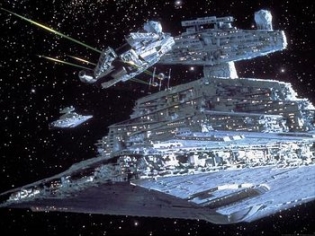
The Basics: Space Princess’ spaceship combat rules are designed to do one thing – simulate the rescuers of the “space princess” escaping into light speed from the Dark Lord’s minions. That’s it. If the game is successful, maybe an expansion could add more to the rules, but for the game, I want to simulate one thing and one thing only to keep it simple.

The Procedure: As it stands, the spaceship combat procedure works as follows:

1 – Maneuver: The player of the character piloting the escape ship make a pilot test to attempt to stay away from the pursuing ships. If he fails, they come closer (and closer means it’s easier to hit with weapons), if he succeeds they either stay at the same range or fall behind. There are penalties attached to his roll based on how many pursuers he’s trying to dodge, whether there are obstacles to maneuvering (the ground, canyon walls, asteroids) and damage his ship might have taken.

2 – Fire Weapons: Good guys and bad guys fire their weapons. Each hit means a damage roll for the affected ship. These damage rolls are not in terms of “hit points” or “hull points”, but rather an actual effect on the ship. The smaller the ship, the more dire a hit is likely to be. The worst forms of damage are hull breach (can suck players out into space, where they die) or complete destruction of the ship. Complete destruction is rare – the pursuers are usually trying to disable your ship and capture you.

3 – After all weapon fire is resolved, the player whose character is in charge of navigation (scientists are the best at this) makes a roll to see if she’s calculated the proper formula for light speed. The chances of doing this on the first round are very remote, but the difficulty of the roll is lessened with each failure. This means you don’t know how long it will take to jump into light speed (and safety) – should make each such roll dramatic.

That’s the basic procedure. For ship types, I’m keeping it pretty generic. In order of size, they are: Starfighter, Shuttle, Freighter, Blockade Runner, Corvette, Cruiser and Dreadnaught. Smaller ships are more maneuverable, larger ships have better armor (which actually doesn’t make sense in Zero-G, but I’m working off pulp sci-fi and movie tropes, not reality).

So here’s where I want to access your brains. I’m thinking about possible damage results on ships. Ships are rated based on Speed (includes maneuverability), Armor, Number of Engines and Different Weapon Systems (laser banks, torpedoes and tractor beams for the dreadnaughts). Here’s my list of damage effects so far:

1 – Engine Damage – penalty to speed/maneuvering; once a ship has lost all engines it is dead in space

2 – Computer Damage – maybe hits different systems – damaged Nav-Computer means you cannot jump into light speed until fixed. Weapon Systems Computer might turn off all weaponry until fixed. Maybe the engines can be knocked off line as well. Possible damage to characters from the boards sparking and going up in flame, a’la Star Trek.

3 – Artificial Gravity Lost – this would potentially damage characters on the ship from things floating about (or from them floating about).

4 – Weapon Destroyed – One of the ship’s weapon systems is destroyed.

5 – Hull Damage – lowers the ship’s Armor rating by one. Probably the best result you can get from damage. Somebody will probably mention force shields here – I’d rather just consider them part of the “armor package” – to keep things simple, if two things essentially serve the same function, I’d rather merge them together.

6 – Hull Breach – chance of sucking people into space

7 – Ship Destroyed – this would be a “roll again, if comes up again, spaceship destroyed and all aboard killed” – it’s old school, so yeah, instant death is a possibility.

All of the results except ship destroyed would be repairable – again, a scientist would be best at this (or maybe somebody invents an engineer class to lend a hand).

The Monsters of Space Princess

While I’ve been writing Mu-Pan and plotting out Hell (previews to come soon), I’ve also been slowly filling in the gaps on Space Princess. At this point, I’m about 80% done writing it, having put some yeoman’s work into the monster section yesterday. Most of the beast are re-purposed from Ye Olde Game or d20 Modern, with a couple originals stuck in as well. I still want to invent some more aliens that might lurk in the bowels of a space fortress, but the following list should give you an idea at what adventurers might find in the game. The “danger level” gives an idea of how powerful the monster is.

Now I just need to finish up the starship battle rules, the sample space fortress (or one sector therein) and sort out the art, do some play testing and I’ll have a nice little pulpy beer and pretzels sci-fi game. Should come in at around 50 pages, and therefore be pretty affordable.

Target 10!

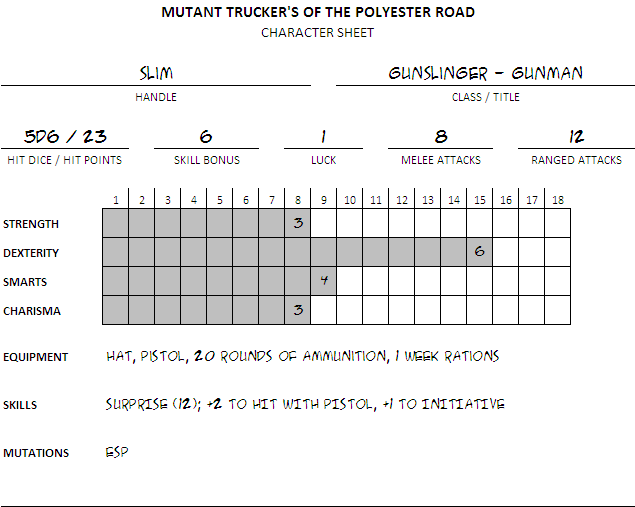
When I started writing Space Princess, I decided I wanted to do a really simple game – thus four ability scores, four classes with three “levels” each, etc. When I came up with 1800 – American Empires, I decided to use the same rules concept, and then again with Mutant Truckers of the Polyester Road, especially because MTotPR was going to be a mini-game for NOD. As I played with the concept, I came up with an easy system I’m calling Target 10 – all tests (skill tests, saving throws) and combat involve rolling 1d20, adding a modifier and trying to roll a ’10’ or higher to succeed. The following excerpt shows where the rules stand at the moment. They were written specifically for American Empires.

Tests
A test is a roll made to determine whether an action succeeds when the outcome of the action is in question. Every action made in a game does not need to be tested. Getting dressed in the morning, for example, does not require a test. Of course, getting ready in the morning and out the door in 10 minutes or getting dressed with two broken arms might require a test of dexterity.

A test is made by roll 1d20, applying modifiers (see below) and trying to roll “10” or higher.

Man vs. Man
When a test pits one person against another (or one creature against another), the test is modified by comparing the relative skill and raw ability of the two opponents. Each opponent calculates their Test Value (TV). A character’s TV is equal to their modifier in whatever ability score governs the test. If the character possesses the skill being tested (see Classes above), they also add their skill value to the TV. Situational modifiers, as determined by the Referee, might also apply, but should never be higher than +3.

Compare the acting character’s TV to the opposing character’s TV. The difference is the bonus or penalty applied to the acting character’s test roll.

When two characters are both trying to “act”, the character with the higher TV always rolls their test first. If the TV’s are equal, defer to the character with the greater skill. If the skill values are equal, defer to the character with the higher ability score. If the ability scores are equal, flip a coin.

In many cases, the outcome can be determined with a single test roll. In some cases, a Referee can require multiple successes to finally succeed, usually no more than 3. He might even a bad consequence if either or both parties rack of too many failures.

Example: Two venturers, Juan and Susan, are trying to sway an Apache chief to cement an alliance with their country. This requires a test of the Negotiate Treaty skill.

Juan has Skill 9 and Charisma 12 (+1), while Susan has Skill 6 and Charisma 18 (+4). This means Juan has a TV of 9 + 1 = 10 and Susan a TV of 6 + 4 = 10. Since the TV’s are equal, there is no modifier to either character’s test roll. Since Juan has the higher skill, he tests first.

The Referee decides it will be more exciting to require three successes to sway the Apache chief. Moreover, he rules that if the two together rack up four failure before either has succeeded, the Apache chief will call off the negotiation and have both venturers killed.

Juan’s first test roll is a “4”, indicating one failure. Susan now rolls an “11”, a success! Three more failures and the Apache chief loses his cool. Juan now rolls a “7”, followed by a “9” for Susan – two more failures. Juan rounds it out with a “13” and Susan with an “8”. That does it – their arguing has angered the Apache chief, who finds neither of them worthy of an alliance and summons his braves to take them into the desert and bury them to their necks in the sand.

Man vs. Nature
Whenever a test pits a character or creature against the natural world – for example, shifting a heavy boulder or predicting the weather, the actor’s Test Value is compared against a Test Value of 1 to 10 chosen by the Referee. In most cases, the test value is “5”. Nature, in these cases, does not “act”, and therefore does not make a test roll. A Referee can still require multiple successes to succeed and can still impose consequences for multiple failures.

Luck Points
Luck Points are a simple mechanic that allows groups of characters of differing skill levels to adventure together without the more skilled completely dominating play. A Luck Point can be spent to automatically succeed at any test, or, in the case of combat, to ignore an opponent’s success.

Luck Points can be earned while exploring (see Occurrences below), but a character can never have more points of luck than they started with. In other words, low skill characters can never have more than 3 luck points at one time, mid-skill level characters can never have more than 1 luck point at a time and high-skill characters cannot have any luck points at all – they have to rely on their skill alone to survive.

Combat Tests
Combat occurs whenever two or more creatures or characters seek to do violence upon one another, whether their aim is to kill, disable or knock unconscious. Combat is conducted in “rounds”. A round is roughly one minute long. During a round, a character may declare how his character is moving and how (or if) they are acting.

The first step in running a combat round is for all players to declare their actions for the round. Possible actions are as follows:

Movements: Advance, Charge, Flee, Hold Ground, Maneuver, Stand and Withdraw.

Actions: Defend, Disarm, Grapple, Kill, Negotiate, Subdue and Trip.

Other actions are certainly possible – a player need only be limited by their imagination.

The next step is to determine the order of play. Each person involved in the combat rolls 1d6 and adds their dexterity bonus. The highest score goes first and play proceeds through the remainder of the scores. In the case of a tie, movement and actions are considered to happen simultaneously. This makes it possible for two combatants to kill one another during the same round of combat.

The acting character then rolls a combat test (see below).

Movements

Advance: And advancing combatant keeps their guard up and moves forward 3 paces.

Charge: A charging combatant goes full speed ahead (and damn the torpedoes!). They move at triple their normal speed (i.e. 30 paces for humans). A charging character does not add their dexterity bonus to their defense score during the round, but adds double their strength bonus to their attack score.

Flee: A fleeing character runs at full speed (i.e. 30 paces for humans), turning their back on their enemy. If they go after their attacking opponent in combat, their opponent’s attack is automatically successful.

Hold: A character that holds does not move at all, unless forced to move by an opponent’s attack.

Maneuver: A maneuvering character attempts to maneuver their opponent into a certain position by the way that they attack – maybe driving them back towards an open pit or maneuvering so that the character gains the high ground or places their back against a wall. When a maneuvering character attacks, they score no damage, but do move their opponent 3 paces in whatever direction they like.

Stand: Whether the character was sitting or lying down at the beginning of combat or they were knocked down, this movement puts them back on their feet. A character cannot stand if they are being attacked.

Withdraw: A withdrawing combatant keeps their guard up and moves backward 3 paces. They may still attack if their opponent is advancing.

Actions

Defend: A defending character increases their DV by dexterity bonus (i.e. they double their bonus) or +1, whichever is higher.

Disarm: A character trying to disarm an opponent does not roll damage against them on a successful test; rather, they knock whatever they are holding (weapon or otherwise) from their hand. The item flies 1d6 paces in a random direction. A disarm attack is made using the attacker’s RAV instead of MAV.

Grapple: A character trying to grapple an opponent does not roll damage against them on a successful test; rather, they lock their opponent in a hold. A creature or character locked in a pin suffers a -1 penalty to attack and defend, and must make a grapple attack of their own to break the hold.

Kill: A character trying to kill scores normal damage against an opponent, and that damage can reduce the opponent’s hit points below 0, killing them.

Negotiate: A negotiating character attempts to engage their opponent in conversation, usually to buy time or simply stop an unnecessary combat from occurring. Only venturers have the ability to negotiate in combat. With a successful skill roll, they keep their opponents from attacking for one round, provided they are not themselves attacked.

Subdue: A character trying to subdue scores normal damage against an opponent, but that damage cannot reduce the opponent’s hit points below 0, leaving them unconscious for 1d6 turns.

Trip: A character trying to trip an opponent does not roll damage against them on a successful test; rather, they knock the opponent to the ground. A creature or character on the ground suffers a -2 penalty to attack and defend.

Combat Tests
Combat tests work like other tests – one compares two values to determine if there is a bonus or penalty on the roll and then rolls 1d20, applying the modifier. If the roll is a “12” or higher, they succeed.

Where most tests use a characters skill + ability modifier, combat tests use three values:

Melee Attack Value (FIGHT) = Hit Dice + Strength Modifier + Weapon Bonus

Ranged Attack Value (SHOOT) = Hit Dice + Dexterity Modifier + Weapon Bonus

Defense Value (DEFENSE) = Hit Dice + Dexterity Modifier + Armor Bonus

When attacking with fist, feet, claws, bites or hand held weapons, the attacker compares their FIGHT to the defender’s DEFENSE to determine the bonus or penalty to their test.

When attacking with thrown items, spittle, pistols, muskets and bows, the attacker compares their SHOOT to the defender’s DEFENSE to determine the bonus or penalty to their test.

As with regular tests, a bonus cannot be higher than +10 and a penalty cannot be lower than -10.

Situational modifiers can also be added to a test roll, as determined by the Referee. Situational modifiers can include a bonus for higher ground, sun in the eyes, etc. They should not amount to more than a total modifier of +3 or -3.

Example: Captain Cole, a soldier, is locked in combat with a leatherstocking named Francois. Captain Cole has Hit Dice 6, Strength 15 (+3), Dexterity 12 (+1) and he is fighting using a Saber (+2). Francois has Hit Dice 7, Strength 14 (+2), Dexterity 15 (+3) and he is fighting using a Knife (+1). Neither gentleman is wearing armor.

Captain Cole has a FIGHT of 6 + 3 + 2 = 11 and a DEFENSE of 6 + 1 = 7.

Francois has a FIGHT of 7 + 2 + 1 = 10 and a DEFENSE of 7 + 3 = 10.

When Cole attacks Francois, he compares his FIGHT of 11 to Francois’ DEFENSE of 10, indicating a +1 bonus to attack.

When Francois attacks Cole, he compares his FIGHT of 10 to Cole’s DEFENSE of 7, indicating a +3 bonus to attack.

Damage
Damage is rolled with 1d6, adding the attacker’s Strength modifier if using a melee weapon or Dexterity modifier if using a ranged weapon. In either case, an ability penalty cannot reduce damage below 1.

Ending Combat
Combat continues, round after round, until all combatants on one side are either dead, unconscious or have fled.

1800 – American Empires

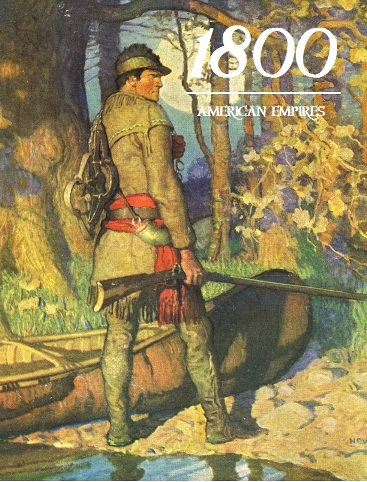
I swear I wasn’t looking for another project. It’s just that I’m a history guy – majored in it in college – and this idea has just worked it’s way into my imagination. 1800 is a pretty interesting time in American history – even an alternate history – and couched as it is between the Revolutionary War and the Civil War it gets less attention that it probably should.

So, what is 1800 – American Empires going to be? At its heart, a homage to old school RPGs and the greatest school video game ever conceived – The Oregon Trail.

Simple RPG based around wilderness exploration, so old school logistics looms large (i.e. how much gunpowder should you pack for a 6 months – 2 year foray into the wilderness?)

Four classes – scout (man vs. nature), soldier (man vs. man), venturer (does the caller and mapper) and magician (with three “traditions” – free mason, missionary and shaman/witch, each with their own small list of usable spells). I’m going to go with the Space Princess concept here of three-tiered classes based on what you want to play rather than “start and level 1 and work your way up”. If you start young (a lieutenant, for example), you begin with more luck. If you start old (a colonel), you begin with no luck and have to rely on skill. Major discoveries and acts of heroism can earn anyone luck.

Rules for exploration and combat – wilderness exploration rules adapted from an early issue of NOD, combat from old versions of “the original fantasy RPG”

A few set hex encounters (major settlements, mostly) + a BIG set of random exploration tables based on the different environments. That way, every campaign will present a different American interior, complete with what you would expect (Native American settlements, herds of buffalo, droughts and blizzards, new rivers, diseases and mishaps), things our forefathers thought they might discover (Welsh indians, cities of gold, mammoths, a Northwest Passage) and things they never imagined (griffons and storm giants in the Rocky Mountains, bulettes on the Great Plains).

A big list of monsters, including many from Native American folklore and some of the “fearsome critters” of lumberjack folklore. I’ll probably also throw in some stats for actual and fictional personalities of the time – Daniel Boone, Natty Bumppo, Johnny Appleseed and Black Hawk, for example.

Settlement rules – what we in the old school would call “domain rules” – establishing forts, attracting settlers, defending the fort from other proto-Empires. Mass combat rules will probably be adapted from Swords and Wizardry to keep them simple.

So, that’s the basic idea. An old school RPG that swaps out the mega-dungeon for a mega-wilderness, with enough heft that one could spin it into other directions – maybe a spy mission in New Spain, fighting night hags in Salem or helping in the Free Mason’s conspiracy to actually unite the independent states of America into a single nation.