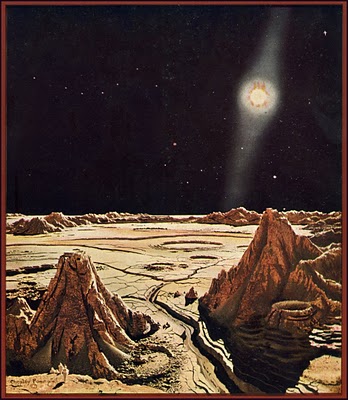
If you’re heading to Titan to investigate those methane-based life forms, you might as well conquer space while you’re there.
Sci-Fi
New Life and New Civilizations
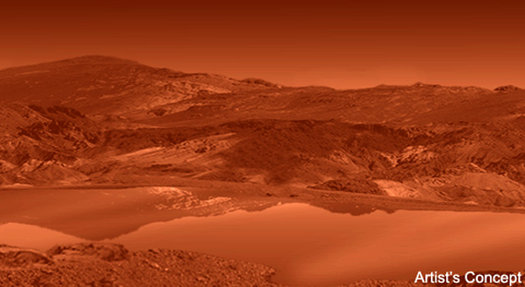
Methane-based life on Titan? Maybe …
More Inspiration
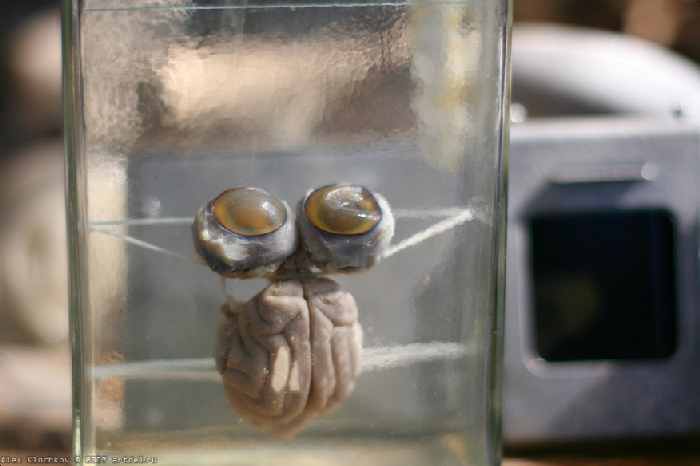 I can’t think of any genre where something like this wouldn’t work – A secret Soviet brain lab! Go here for more images … if you dare.
Future Inspiration
This site has some images that might be of interest to folks playing around with Terminal Space or just interested in the WORLD … OF … TOMORROW!!! [insert echo here].
 Floating Botanical Cities!

Mega-Pyramid Cities!
A sci-fi megadungeon just waiting to happen
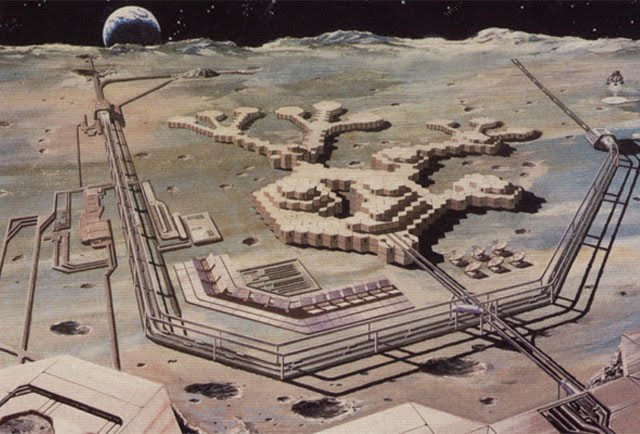
Lunar Bases!
Don’t mess with the farmer’s robot daughter.

Desert Aqua-Net!
not related to a hair care product from the 1970s
Quick Review – Star Trek 2
 I finished reading Star Trek 2, adapted by James Blish. Now, this is not a novelization of the Wrath of Khan, but rather an adaptation of several Star Trek episodes (including “Space Seed”, from which we get Khan) originally published in 1968. Apparently, there are multiple volumes of this series. The volume contains the following adaptations: “Arena”, “A Taste of Armageddon”, “Tomorrow is Yesterday”, “Errand of Mercy”, “Court Martial”, “Operation – Annihilate!”, “The City on the Edge of Forever” and “Space Seed”.
I’ve seen all of these episodes of course, so you might wonder the point of reading them. While adaptations of books to film are often lacking, primarily because of all that has to be left behind and the penchant of Hollywood for re-writing the source material, I have often found novelizations of movies to be an improvement. The written word has an unlimited special effects budget for one thing, and the writers of adaptations usually fill in the gaps of characterization in interesting ways.
The fun of this book is that it predates the fan-boy “canon” of modern Star Trek, where everything has been organized, classified and filled in. In 1968, Star Trek was still something of an unknown quantity, much as Star Wars was in the late 1970’s, when we had only seen one film and were still able to fill in the details with our own young imaginations.
Since it predates canon, we discover some interesting details that might be fun to explore in a role-playing game set in a more pulp sci-fi Star Trek setting. A couple that spring to mind are the description of the gorn in “Arena” –
“The first thing he saw was the Gorn. It was a biped, a reptile, a lizard that walked like a man. It stood about six feet four, with tremendous musculature, dully gleaming skin, a ridge of hard plate running down its back, and a strong, thick tail. The tail did not look prehensile; rather, it seemed to be a balancing organ, suggesting that the creature could run very fast indeed if it wished. The head was equipped with two tiny earholes and a wide mouth full of sharp teeth.”
Not terribly different from what we saw on screen, except for the “run very fast indeed”. The adaptation gives you a much better sense for the fact that Kirk was supposed to be completely outmatched physically by the gorn, and that his only hope for winning was to use his brain.
In “Errand of Mercy”, we learn about the Klingons –
“The Klingons were hard-faced, hard-muscled men, originally of Oriental stock.”
Surprise – the Klingons are humans, though obviously separated from the rest of humanity at some point in the past and thus of slightly different stock, larger and more militaristic. In effect, hobgoblins to the Federation’s humans.
Kirk comes off as more of a Flash Gordon-type in the book and Spock is more half-human than Nimoy portrayed him. The book contains other little notions that might make old Trek fans see the series in a new light, and for that reason the book is worth reading. Understand, it is a thin volume (112 pages) and a very quick read, but since I picked it up for $2.80 at a used book store, I would say I got my money’s worth.
Emphyrio by Jack Vance
 While I was on my trip to Chicago, I managed to finish Emphyrio by Jack Vance, published in 1969. In enjoyed the book, but I always enjoy Jack Vance, so that might have had something to do with it. Like all of his works, it was full of lovely (or at least interesting) descriptions; full of wonder yet believable – the wondrous mundane, if you will.
The story concerns the life of one Ghyl Tarvoke, inhabitant of the planet Halma and member of a slightly repressive society. The story follows Ghyl’s life from boy to man, and is reminiscent of the journeys of Cugel (but with a more respectable protagonist). The story is science fiction, but really only in terms of the setting. Like all of Vance’s material, Emphyrio is about the characters and the interplay of the characters and the world they find themselves in. I was satisfied with the story’s conclusion, though the “twist” that leads to it was pretty obvious in retrospect, and I’m surprised I didn’t pick up on it until Ghyl did.
Vance is always a fun read for me. He does a good job of writing into his stories a pervasive danger derived from the way the stories within the story so rarely play out the way they “should”, and from Vance’s willingness to deny characters, important and unimportant, a pleasant ending.
 Land of Nod