Because setting yourself up for failure is fun, I’m going to take a shot at getting a post up each weekend in 2020. They might not all be strictly gaming related … but what the heck – it’s my blog and I suppose I can do what I want with it!
To kick 2020 off, I’ll do some “timely” game reviews. I had some time off this Christmas season, so the family had time for a couple family game nights. We had a few games recently purchased and un-played, so we gave them a twirl.
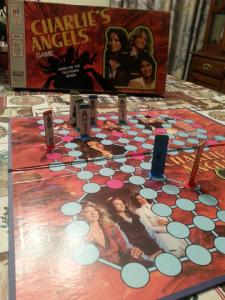 First up is Charlie’s Angels, published in 1977 by Milton Bradley. I’m a total sucker for any board game involving a 1970’s or 1980’s TV property (well, almost all of them), so when we saw this baby priced $20 in an antique shop, it was a shoo-in.
I instantly called Sabrina when we got the game home, but we soon discovered that each player takes control of their own team of Angels for the game, so no fighting over the individual Angels is required. The game concept is kinda cool. You have a board that is a sort of a modified grid. Onto this grid you place the Villain. The Villain moves one space on each player’s turn, the direction of the move chosen by the player in question. The player then rolls two dice and can move one of his or her angels each with each dice. If you can’t move the entire number on the dice with an Angel, you give up your move.
The goal is to trap the Villain – sort of a Charlie’s Angels checkmate. Each Angel that is in on the trapping is worth one point for their player. You play three games, total the points, and determine the winner. There are some cards that can be helpful … or harmful … so you take a risk pulling one. You also have to think a bit about how you want to move the Villain – you don’t want to be left out of the capture, so sometimes you’re really on the Villain’s side in the game. We had a good time with Charlie’s Angels, with the game ending in a three-way tie – not a bad ending for a family game.
One issue – I noted that the rules did not specifically disallow moving back on your path on your turn. They probably should have, because this seemed to make the game too easy, and it just didn’t feel right.
Next up was a funny little dice game – really a packaged version of old dice rules – called Skunk. Simple concept – you have two dice to roll. The dice replace the “1” with a skunk. On their turn, a player takes the dice and can roll them as often as they like, totaling the points rolled. If they roll a skunk, they get no points for this turn and have to pay a penalty (1 chip, or 2 if you rolled a skunk and a “2”). If you roll two skunks, you lose all the points you’ve acquired and pay a 4 chip penalty. To win, a player must get his total above 100 – she can go as high above 100 as she dares. Once a player goes over 100, the other players have to try to beat them on their next turn. The chips in the pot do to the winner of each round.
The game is really all about risk – how daring are you, and how lucky?
In our first game, I managed to zero-out midway through. When my daughter went over 100, I needed something like 60 points to beat her. I started rolling, got hot, and actually won the game. On our third game, I decided to do exactly that each turn, figuring I might eventually get hot again … and wound up rolling a skunk every time on my first or second roll.
We had a fun time with Skunk, and since up to 8 people can play it would probably make a fun party game. To make it more “grown up” you could turn it into a drinking game, with a drink taken on every skunk or double skunk. I suppose you could also play Strip Skunk … but then again, maybe not.
Finally, we have Buffy the Vampire Slayer: The Game, published in 2000, also by Milton Bradley. We bought this one for my daughter for Christmas, and she was raring to play it. It took a while to read the rules, but they weren’t too complicated and we had a good time playing it.
I took control of the bad guys, while my wife had to play Oz and Xander and my daughter got Buffy and Willow. The game is fun, pretty fast paced, and pretty easy to figure out. Evil sure looked like it was going to win this one – in short order, two of the goodies were out of the game and Evil had all the magic items. In the end, though, Buffy and Willow knocked off the evil minions and then teamed up on the Evil vampire and snuffed him out. Fortunately for them, the main villain doesn’t automatically get to move every turn. My guy spent three turns in a row not moving while they beat the crap out of him. C’est la vie.
So there you have it – three fun games for the family. All were purchased in antique stores for low prices and all were well worth it.
 Playing around on the Internet Archive recently, I came upon some old issues of Different Worlds magazine. This was a magazine I was unaware of in my youth, and I’ve enjoyed looking at another take on the RPG world in its infancy. One article in particular, “Kirk on Karit 2” by Emmet F. Milestone in issue No. 4 (1979) brought to my attention the first licensed Star Trek RPG, Star Trek – Adventure Gaming in the Final Frontier. I did a little hunting, and found a copy for sale, and I’m glad I did.
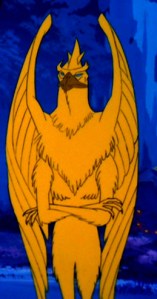 The game is very focused on its mission, which is to simulate Star Trek landing parties – I think it does this pretty well. In fact, you could spin this thing into doing Star Trek dungeon crawls with very little trouble.

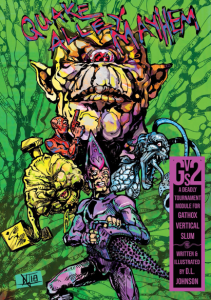 After having reviewed David Lewis Johnson‘s fine
  I have recently been given the priveledge of perusing Gathox Vertical Slum by its author and artist, David Lewis Johnson. For readers of this blog who also read my NOD magazine, Johnson should be well known, as his art has graced many issues of NOD (and will grace many more, God willin’ and the crik don’t rise).
 The Clyde Caldwell cover to the February 1982 Dragon Magazine is chock-full of fantasy tropes. You have the warrior woman in weird, revealing armor and a gnome fighter mounted on a giant lizard. You also get a Clyde Caldwell trope, namely lots of feathers. That said, I adore Caldwell’s work, and consider it fundamental to 80’s D&D.


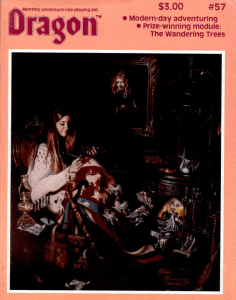 Wow – 1982. I was ten years old (well, nine in January) and still a couple years away from learning about Dungeons & Dragons. Thirty-six years ago – much as changed, and much has not. I guess all these years later, we can be happy that people are still playing D&D and AD&D and other “old school” games. Let’s start the new year by looking at the new year in 1982 in gaming …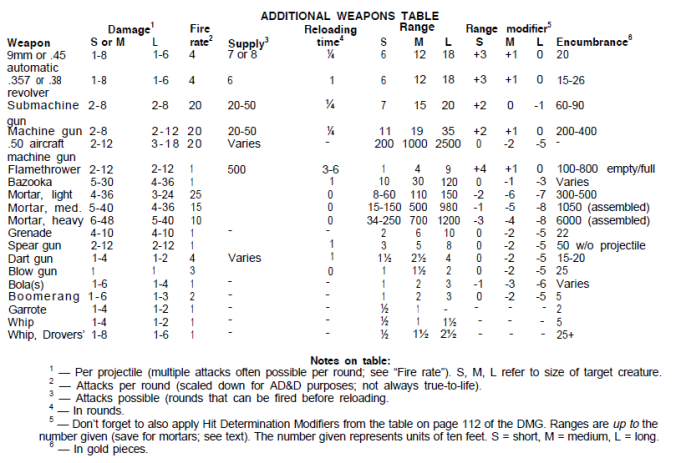
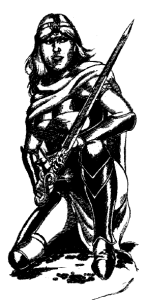 This issue’s Giants in the Earth covers a couple characters I don’t know – C. J. Cherryh’s Morgaine and Vanye (with art by Jim Holloway) from the books Gate of Ivrel, Well of Shiuan and Fires of Azeroth, Lynn Abbey’s Rifkind from Daughter of the Bright Moon and The Black Flame, and two characters created by Robert E. Howard – Belit and Dark Agnes. Howard. Belit is a Chaotic Evil 10th level fighter in this write-up, though I would probably go Neutral Evil given her devotion to Conan since I conceive of Chaotic Evil as being utterly self-interested.
 I’ve finally found the time, between impromptu trips to Iowa and too dang much work (the real work, not the silly game writing work), to peruse
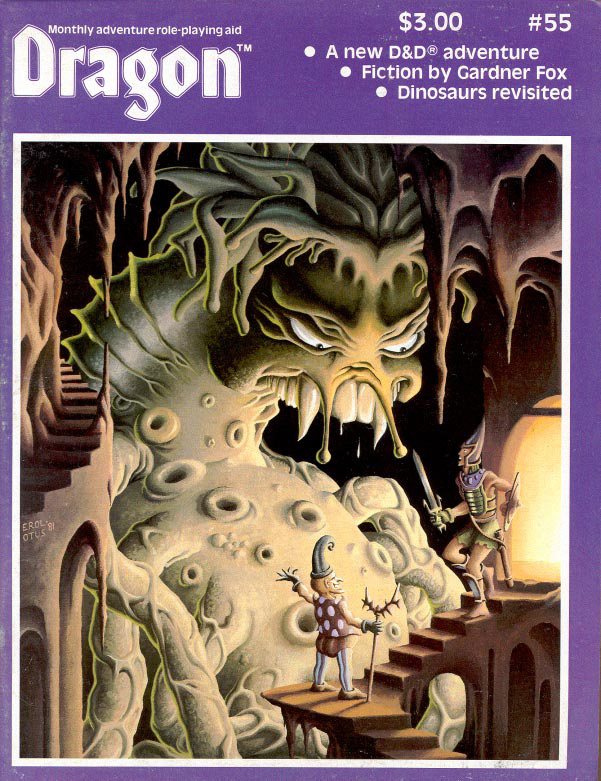
  Ho ho ho – Merry Christmas 1981!


 Land of Nod