Dragon by Dragon – December 1979 (32)

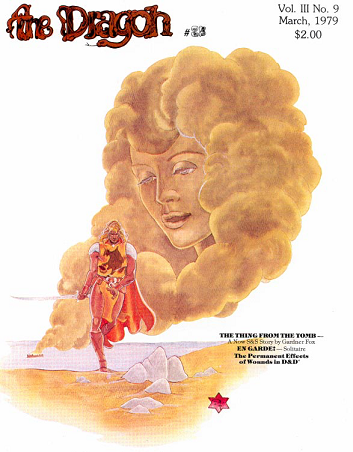
Depending where you are when you read this, good morning, good afternoon, good evening or good night. It’s Sunday, which means it’s time to crack open the vault and review another issue of The Dragon. Technically not the last of the 1970’s (that would be December 1980), but for most folks, the end of the decade.

Let’s take a look at the Top 10 Cool Things in The Dragon #32

Side note – cover by Phil Foglio, which means his contributions to the magazine’s comics section shouldn’t be too far away. Always a highlight for me back in the day.

Yes, because of Dixie. I’m a red-blooded American male, and I make no apologies for it.

ONE | GOOD ADVICE

When question about super high level characters (as in, “no freaking way they got there fairly), ED gives the following sage advice …

“Cheating, yes, but who? If you refuse to play with these sorry individuals, they are only cheating
themselves of the feeling of accomplishment that comes from having honestly earned a level advancement. To each his own . . .”

Good advice then, and good now. Learn to enjoy losing spectacularly at games, and you will find them twice as enjoyable as you used to.

TWO | POISON

Charles Sagui has an article on “Poisons from AA to XX” that I enjoyed. I always like articles written from a position of authority concerning make-believe stuff, and this one has several firm rules for poisons that you might not have known:

1) Poison is restricted to Neutral and Evil characters when used against human or humanoid types … against dungeon monsters, anyone can use poison.

2) Alchemists alone distill and manufacture poisons – magic-users, thieves and assassins who are caught making poisons are told immediately to “cease and desist” – imagine, slapping a cease and desist order from the Alchemist’s Guild on a PC! Apparently, if the order is ignore, the PC “will receive a visitor who will see to it that he stops permanently.” – Sounds like a fun encounter to run.

3) Alchemists learn to make poison at one strength per level of experience up to the 5th, beginning with level 0, strength “AA”. At 6th, the alchemist can make strength “S” sleep poison. After 6th, he learns to make one strength per two levels, through strength “J” at 16th level. Type “X” can be made by 20th level alchemists, type “XX” by 25th level alchemists. Alchemists through 4th level make only ingested poisons. From 5th to 8th level, they make ingested plus water-soluble poisons. From 9th to 16th they learn to make contact and gaseous poisons.

4) Assassins are the main customers, and they dictate to the alchemists who can buy poison. Locksmiths are granted permission by the assassins to put poison needles and gases in locks and chests so the rich can keep their possessions safe. – This suggests that the thieves and assassins are not on the best of terms.

5) Any character is permitted to buy strength “S” sleep poison. Thieves, by paying the assassins 500 gp per level, are permitted to buy strengths “AA”, “A” and “B” poison. They may buy up to 60 vials of “AA” per year, up to 30 vials of “A” and up to 15 vials of “B”. Magic-users can pay 1,000 gp per level to get the right to coat darts and daggers with “AA” and “A” poison. The same buying restrictions for thieves apply.

6) A small vial of poison is enough to coat 6 arrowheads, 8 darts, 12 needles or 1 dagger or spear point. Two vials will coat a short sword. Three will coat a long or broadsword, four a bastard sword and five a two-handed sword. Each coating lasts for 2 successful hits, and up to 5 coats can be applied to a blade at a time. One vial is equal to one dose when swallowed.

7) Evil humanoids should never use more than “AA” poison. If they are employed by a powerful evil NPC, they may use up to “D”.

8) Poisons found in dungeons are:

0-50% – ingested
51-80% – water-soluble
81-90% – contact
91-100% – poison gas

9) Damage from poison is taken at a rate of the minimum hit point damage for the poison per melee round (which would have been a minute, back in the old days) until max damage rolled is met. So, a poison that deals 1-10 damage would do 1 point of damage per round. If you rolled “6” damage, it would deal 1 point of damage per round for 6 rounds. A poison that did 5-100 damage would deal 5 points of damage per round.

10) When you save vs. sleep poison, you act as though slowed for 3 rounds.

11) When using poison-coated weapons, each time you draw the weapon or return it to its scabbard, you have to save by rolling your Dex or less (on 1d20, I assume), minus 1 for water-soluble and -3 for contact, or you suffer max poison damage. You also have to make a Dex save every other round for water soluble and every round for contact poison that the weapon is used in combat to avoid poisoning yourself. This applies until the weapon is washed, even if the weapon does not have enough poison left to poison opponents in combat.

12) Silver weapons will not hold poison, not will magic weapons. Normal weapons that are poison-coated gives them a dark discoloration, so everyone will know the weapon is poisoned.

Lots of rules, but actually pretty useful ones. The article then goes on to detail the different poison strengths – I won’t reproduce those here.

THREE | WEAPONS OF ASIA
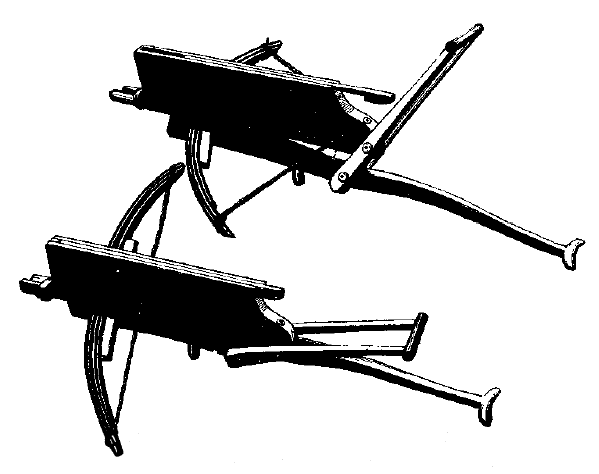
This is a companion article to the armor article from last issue, also by Michael Kluever. Here’s a bit on the Chu-ko-nu, or repeating crossbow.

“An interesting variation was the repeating crossbow (Chu-ko-nu). It propelled two bolts simultaneously from its wooden magazine, which held a total of 24 featherless quarrels, each approximately 8.25 inches long. The bolts were contained in a box sliding on top of the stock and moved into firing position by a lever pivoted to both. The throwing of the lever forward and back drew the bowstring, placed the bolt in position and fired the weapon. Chinese annals relate that 100 crossbowmen could project 2,000 quarrels in fifteen seconds. The repeater crossbow was used as late as the Chinese Japanese War of 1894-95.”

Apparently I need to include it in Grit & Vigor.

FOUR | SINISTER SEAWEED
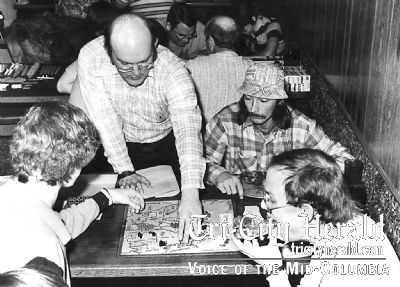
You got some interesting articles back in the day. This one, by George Laking, is about aquatic megaflora, and its danger to adventurers. The info in the article was designed by the Mid-Columbia Wargaming Society of Richland, Washington. With a little searching, I found a picture of Mr. Laking and some society members from a 1978 newspaper. The internet!

So, you’re first thought it – screw seaweed, bring me dragons!

You fool!

Apparently, megaflora stands capture oxygen in vast bubble domes within their branches. Within this bubble dome, there is a bunch of dry limbs and twigs from this megaflora. The interior of the dome resembles a quiet, dry forest surrounded by thick trunks. Bubble dome heights range from 4 to 40 feet, depending on the size of the stand.

Where’s the danger. Well, the stands can capture ships for 1-12 hours, making them vulnerable to aquatic monster attacks.

The bigger danger is bubble dome “blows”! The domes are temporary structures. In some cases, the gas cannot escape and pressure builds up until it explodes, throwing dry branches and limbs 2d10 x 10 feet into the air in a huge fountain of water and foam! Ships will fall into the void left, and then be slammed by the walls of water rushing back in, possibly destroying the ship. A blown stand looks like a peaceful lagoon with walls of megaflora around it, quickly growing in to fill the clearing. This will be the lair of aquatic monsters, guarding the treasure left by ships destroyed in past blows.

A third danger is that pure oxygen is poisonous to people. Divide the height of the dome by 10 and take this as a percentage chance per hour that a character absorbs too much oxygen into her bloodstream. A character who reaches this threshold, upon leaving the dome, must make a save vs. poison or immediately die.

Also – pure oxygen is extremely flammable. Let’s say you light a torch inside the dome …

“(1) The initial explosion of gas would create a 6-20 die fireball of incandescent oxygen, depending on the size and depth of the bubble dome (depth of dome divided by ten equals hit dice). The size of the fireball would be half as large as the initial dome after the explosion of the gas. Saving throws would be applicable.

(2) Following the initial explosion, the fireball would immediately rise to the surface with a subsequent catastrophic inrush of ocean water onto the previously dry dome interior. Each character would have to undergo a check for system shock as the walls of water met with implosive fury. A character saving vs. system shock would only take 3-10 (d6) of damage. Failing to save means immediate death!

(3) Finally—should the character survive—an immediate check vs. oxygen poisoning would be necessary to determine if he/she had exceeded the critical threshold at that point. If so, that character would have to make an additional save vs. poison per oxygen poisoning (above).”

Frankly, a weird bubble dome dungeon would be awesome, and a great challenge. A ship gets stuck and attacked by aquatic ogres. Adventurers follow them down to retrieve something important, find a massive bubble dome with a dead, maze-like forest within it. They have to work fast to avoid being killed by too much oxygen, and there is a chance that it explodes and the ship is drawn down into sea and crushed.

FIVE | THE BEST LAID PLANS

From Gygax’s “Sorcerer’s Scroll”:

“In a previous column I mentioned that I would set up an adventure where the players would end up in the city streets of the 20th century. Well, I knocked together some rules, put the scenario together, stocked the place with “treasures” of a technological sort, and sprinkled some monsters (thugs, gangs, police, etc.) around.

Much to my chagrin, Ernie the Barbarian was leading the expedition. When his party emerged from the subway—and despite the general blackout in the city due to the power failure caused by their entry into this alternate world—he stopped, looked, listened and then headed back for the “safety” of the “real world!” Some people really know how to spoil a DM’s fun …”

Damn players.

SIX | SAGE ADVICE

From Jean Wells in “Sage Advice”:

“The subject is dwarven women and whether or not they have beards. Last spring when we were working on the final editing of the Dungeon Masters Guide, I tried to get Gary Gygax to change the section on dwarves so that dwarven women would not have beards. Needless to say, I was not very successful.

What I didn’t realize was that for some strange reason (completely unknown to me), I had started something. I did not understand the full impact of what I had done until I went to GenCon this year. Many people stopped me in the hall to either agree with me wholeheartedly, or disagree with me and then tell me that I was crazy. Everyone knows that dwarven women have beards, they said. It did not stop there. Oh, no! We have even been getting mail on this issue. It is not too bad, but I don’t like being accused of making an issue out of the subject.

One thing that everyone who has taken sides in this issue fails to remember is that Gary Gygax wrote the Dungeon Masters Guide and it is his book. He can say whatever he wants to. You can agree with him or side with me, but either way, the person who has final say in his or her campaign is the DM. So, for all the people who have written in to agree with me or to agree with Gary, and for those who haven’t yet but were planning to, please save your breath. Gnome women don’t have beards (this is true and I am glad). Dwarven women may indeed have beards, Gary, but not in my world.”

Yeah, there have always been gamers who A) didn’t get that it was make-believe, and there was therefore no right or wrong, and B) didn’t get that their own opinion isn’t law.

Also this question:

“Question: We are having an argument over an issue that has us divided. My friends say that with a ring of telekinesis they can make an arrow spin at the speed of light and then release it, having it do between 100 and 600 points of damage to their target. I say this is impossible! What do you think?”

God – I remember these fools.

Finally:

“Question: I am having a romance with a god, but he won’t have anything to do with me until I divorce my present husband. How do I go about divorcing my husband?”

Ye Gods!

BONUS AD!

For sale – crappy t-shirts.

Actually, I would wear one of these with a ridiculous amount of pride. I’m super tempted to lift the graphic and make one online for myself.

Looks like the Barbarian Shop was in a private residence:

SEVEN | INSECTOIDS

Len Lakofka presents in this issue his insectoids, which are just the humanoid races with insect characteristics grafted on. For example: Scorpiorcs. For Blood & Treasure, they would look like:

Scorpiorc, Medium Monstrous Humanoid: HD 2; AC 16; ATK 2 pincers (1d6) and weapon; MV 40; SV F15 R12 W13; XP 300 (CL 4); Special-Surprised on d8 (due to eye stalks), move silently (70%), back stab x2.

Scorpiorcs never use flaming swords or carry any sort of flame. They also never use armor, but may carry a shield. They speak Scorkish and broken Orcish. They can advance as fighters from a beginning “level” of 2 to a top rank of 4.

I also have to mention the “skags”, which are a blend of scorpion, kobold, ant and goblin. This is actually a sort of “monster class” – dig it:

BONUS AD

Great title. Found HERE at Boardgame Geek. Stephen Fabian did the art, so it has be worth a few bucks based on that alone.

EIGHT | TRAVELER POLITICS

I’ve never played Traveler, so I can’t comment on the utility of this article about diplomats in the Traveler Universe. I can, however, draw attention to this table, which may prove useful to people:
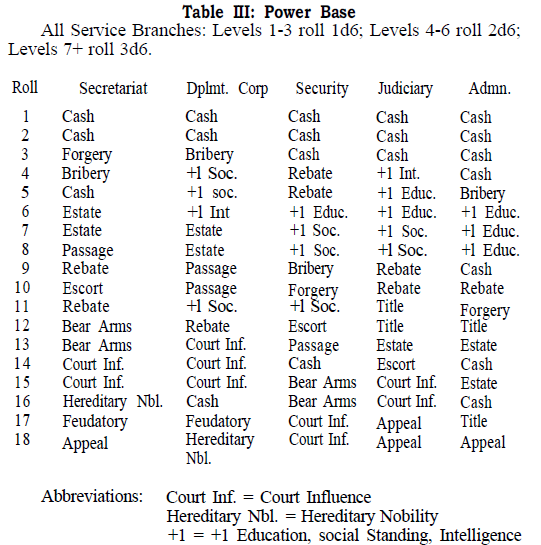
I’m sure somebody can adapt this to their game, when trying to figure out an NPC’s s power base in some fantasy or sci-fi city.

NINE | DRUIDS

William Fawcett has a long article on “The Druid in Fact and Fantasy”. A tough subject, because so little is known, or at this point, can be known. I’m not going to dwell on the historical bits in the article, but I did like this:

“DECLARATION OF PEACE
A new Druidic ability

Although the Druid, due to his involvement with life, is unable to turn undead, his role of the peacemaker gives him a similar ability with most humanoids. Before or during any armed combat if he has not struck any blow, a Druid has the ability to make a Declaration of Peace. This declaration has a 10% plus 5% per level (15% 1st level, 20% 2nd, etc.) chance of causing all armed combat to cease for two rounds per level of the Druid. This does not affect magical combat in any way, nor will it stop a humanoid who is in combat with any non-humanoid opponent. Once the combat is stopped, any non-combat activities may take place such as cures, running away (and chasing), blesses, magic of any form, or even trying to talk out the dispute.

After peace has been successfully Declared, combat will resume when the effect wears off (roll initiatives), or at any time earlier if anyone who is under the restraint of the Declaration is physically harmed in any way. This could be caused by an outside party or even by magic, which is not restrained by the Declaration. A fireball going off tends to destroy even a temporary mood of reconciliation. Once a Druid strikes a blow or causes direct harm in any way to a member of a party of humanoids, he permanently loses his ability to include any member of that party in a Declaration of Peace. The Declaration of Peace affects all those within the sound of the Druid’s voice, a 50’ radius which may be modified by circumstances.”

He also has quite a few magic cauldrons and some thoughts on herbs. Good read overall.

TEN | MIRTH
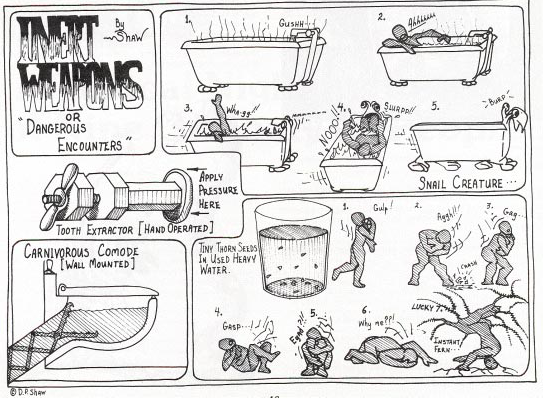
Well, it’s funny to DM’s

ELEVEN | THE FELL PASS

An adventure in this issue – “The Fell Pass” by Karl Merris!

Check out the map:
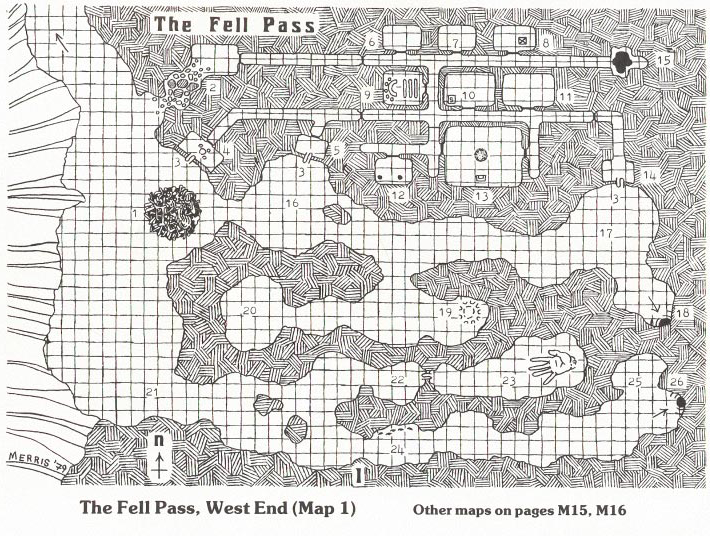
That hatching seems reminiscent! A also hereby challenge Dyson Logos to include more giant, disembodied hands on his very excellent maps.

The adventure takes place in geothermally heated caverns, and includes cave bears, ogres, a spidersilk snare, gray ooze, manticores, griffons, shadows, trolls, pit vipers, Vlog the Ogre …

… and Xorddanx the Beholder:

I love the heck out of that art, which is by Merris himself!

I did some searching, and I’m pretty sure I’ve found him online. He appears to be a Brony now, and might have no interest left in D&D, but if I can commission a piece of fantasy art from him, I’ll let you know …

FINAL SHOT
Dragon by Dragon – November 1979 (31)

November 1979

The Iran Hostage Crisis

Morning Edition premiers on NPR

The last cargo of phosphate shipped from Banaba Island

Obviously, they were troubled times for the world.

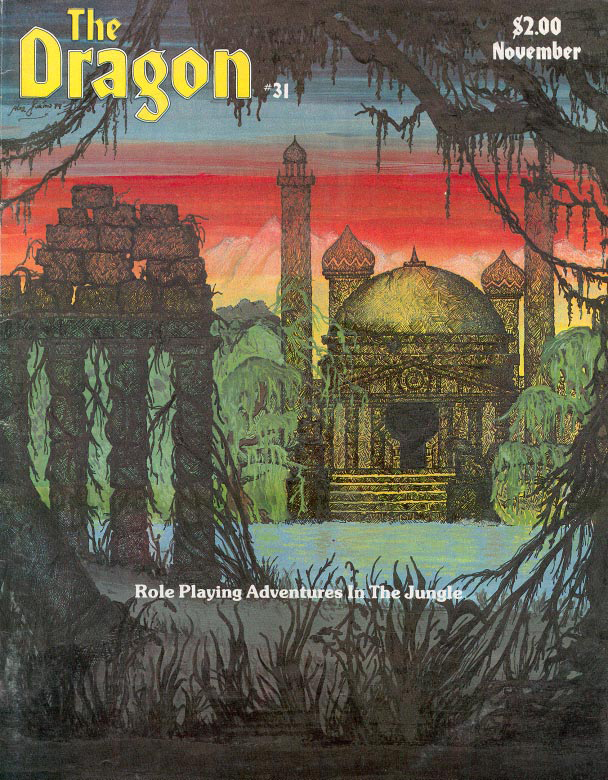
But take heart, gentle reader, for the game wizards blessed our eyeballs and brains with The Dragon #31.

I’m going to start doing these reviews a little different (since they take about 3 or 4 hours otherwise), and focus on the Top 10 Cool Things in each issue. They might be articles, they might be ads.

COOL THING NUMBER ONE: RAL PARTHA

Click for the larger version. Those are some pretty slick landsknechts (and such). I love the idea of the Thirty Years War as a campaign setting (even wrote about it), and these would make great miniatures for it.

Side note – when I looked up those colorful plastic robots on Amazon that I showed in my Manbot Warriors post, I found a few other great sets that I remember from my childhood. Now I want to write a little mini-game for all of them – cowboys and indians, plastic army men, Romans, plastic knights, firemen, etc. Just need to get the rules for Manbots right, and then I can expand.

COOL THING NUMBER TWO: JOHN ERIC HOLMES

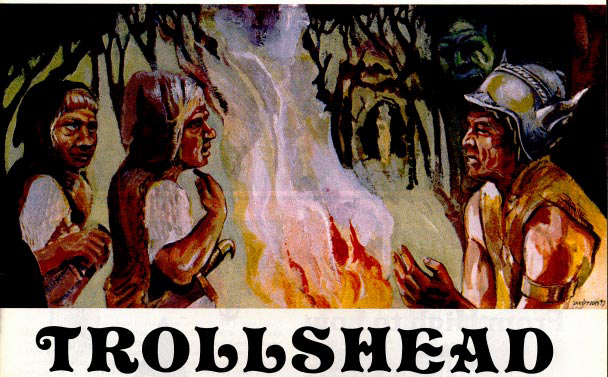
If you love the old game, you probably love (or at least like) Mr. Holmes. This issue has an excerpt from a novel he was writing called Trollshead. Here’s the first paragraph:

“The campfire cast flickering shadows into the surrounding trees and across the face of the lean man squatting opposite. He wore an iron cap with a leather lining which cast a shadow over his thick brows. A ragged scar ran from the comer of his left eye down the cheek to vanish in the folds of a woolen tunic at his neck. A tough customer, Boinger thought to himself.”

Boinger? Well, I don’t know if the novel was ever finished – couldn’t find it on Amazon.com. Here’s another taste:

“’I think we can take them,’ said the halfling confidently. ‘Four half-orcs, old scar face, and that damned troll.'”

I like that halfling’s moxie. He doesn’t look so confident in the accompanying art by Chris Holmes.

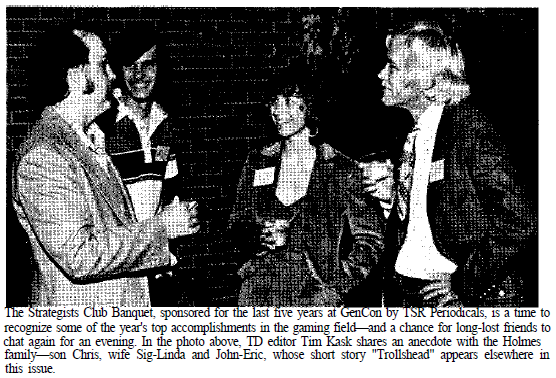
Bonus – Later in the issue they cover the 5th annual Strategists Club Banquet and Awards, which features a picture of Tim Kask talking with the Holmes family, son Chris, wife Sig-Linda and John-Eric himself.

Sometimes, I miss the 1970’s. But only sometimes, and only a little.

COOL THING NUMBER THREE: STRAIGHT TALK
In his article on using jungles in D&D, Tim Kask says it like it is:

“Traditional accounts of the jungle, from Bomba the Jungle Boy to Jungle Jim to Tarzan, have always depicted the jungle as a place of peril—but there has always been justification for jungle adventures. We’ll leave aside the philanthropic wanderings of Livingstone and Schweitzer and look at jungles from a more typical D&D viewpoint: greed.”

The article is pretty long, and covers jungles in Asia, Africa and South America. A few takeaways:

1 – He notes that any rules for wilderness exploration will do, but he likes Source of the Nile. This reminds me of the use of Outdoor Survival in old D&D games. Does this happen much anymore? Using another game to fill in the gaps. I’ve read so much about Source of the Nile in these old Dragons that I kinda want to buy the game. Doesn’t appear to be in print anymore, so I guess I need to look around.

2 – Rain forest plant growth is so quick that a trail blazed through it disappears in a few days (I’d go 1d4+1 days, personally).

3 – “With the restrictions placed on poison within D&D and AD&D, the DM may wish to eliminate some or all of the natural poisons found in the jungle.”Sorry jungle, but you’re just to poisonous for the rules as written. We’re going to have to make some changes.

4 – “The Jivaro, known for their practice of shrinking heads, are so surrounded by myth and misinformation that it is hard to distinguish fact from fancy without serious study. It can be safely stated that they were fierce and deadly foes.”

5 – “In the tropical rain forest jungles, the humidity never falls below 85 or 90 percent. This high moisture rots and mildews cloth and leather, unless they are assiduously treated to prevent it All metals will oxidize; armor will rust and swords and daggers will lose their edges. The humidity affects people by lowering resistance as a result of overworking the sweat glands, thereby causing wounds to heal at a greatly retarded rate, if at all.” So, rules wise – maybe force item saving throws once a week if things are not cared for, and reduce non-magical healing to 2 hit points (or hit points per level) every three days.

6 – Typical weapons of jungle cultures are blowguns (with poison darts), spear, club, throwing knives (treat as hand axes, maybe), assegai (treat as short swords).

7 – Kask writes a whole bit on how the presence of a 25th level magic-user might affect a local jungle. It includes using stone shape to make a hill into a fortified abode, permanently charming a panther and permanently enlarging it to use as a guard beast, attracting a spider monkey with find familiar, and then impressing the locals with his magic and being worshiped by them as a jungle god. The tribe that follows him flourishes, he starts experimenting with the local flora and fauna, and then the last experiment goes to far – instant ruined jungle city for adventurers to loot. I like the ways this guy thinks!

COOL THING NUMBER FOUR: WHAT THE?

Lou Zocchi had a ventriloquist act. ‘Nuff said.

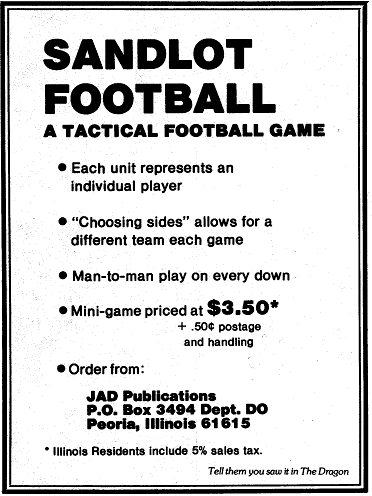
COOL THING NUMBER FIVE: MINI-GAMES

The rules aren’t in this issue, just an add, but this sounds cool:

Also makes we want to write a game for these guys:

And, surprise surprise – it’s on BoardgameGeek.com.

Check it out

COOL THING NUMBER SIX: LOU SCHEIMER AS A MUSE

From Kenneth W. Burke’s article “Will Jason Destroy The Dragonship? Stay Tuned …”

“The following Alpha Omega variant has been derived from the “Victory of Star Command’ episode of the Jason of Star Command television mini-series. To play it, you need one or two Alpha Omega games.”

You might be asking yourself, “What is Jason of Star Command?”

Now you’re asking yourself, “Why, God? Why?”

James Doohan was a regular in other episodes – God bless him.

COOL THING NUMBER SEVEN: RANDOM TABLES

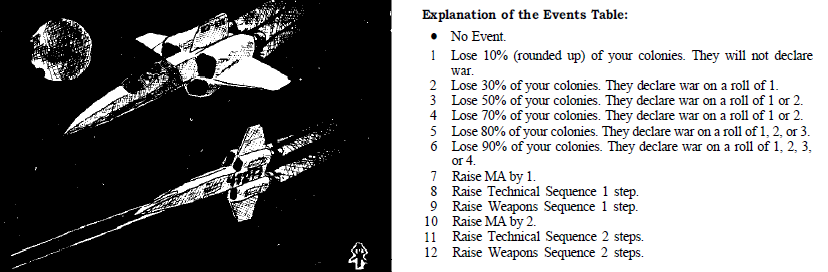
Here’s a new table for STELLAR CONQUEST that just has to be useful to somebody:

I don’t know what MA stands for, but I think it has something to do with movement.

COOL THING NUMBER EIGHT: SIZE CHARTS

In the Fantasysmith article they ask “How tall is a giant?” What I liked in the article was the two drawings comparing fantasy folk:

Elves dressed up as Peter Pan is so outside the mainstream now, that I think it rocks on toast.

Check out the giants:

You’ll perhaps note that it looks as though the storm giant has just finished beating the crap out of the rest of them.

COOL THING NUMBER EIGHT: JAPANESE ARMOR

Michael Kluever comes across with an article about the armor of the Far East. The article covers the armor of China, Tibet, Korea, Mongolia, and Japan. All text, but it does a nice job of covering the basics. Here are the basics:

China: Padded, ring, scale and brigandine (studded leather); mail and plate rarely utilized; paper armor was used in the Tang Period, especially in Southern China – 10 to 15 thicknesses was adequate to stop an arrow or musket ball. Shields were often the only form of protection for foot soldiers; rhino hide was prized for making shields.

Mongolia: Horse armor (barding) of leather scales

Korea: Like the Chinese, but lower quality materials and the helms were black laquered

Tibet: Lacquered hide armor in red and black, with engravings, in the form of a long coat – awesome. Barding was leather.

Japan: Lamellar armor (banded mail in AD&D, more or less), with small hand shields (Te-date)

COOL THING NUMBER NINE: OLD SCHOOL PLAYERS

From Jean Wells’ “Sage Advice” column:

“Question: We have a group of players here who insist that they can ride on a mule in a 10-foot-wide and 10-foot-high corridor and shoot arrows from longbows. Now, there are two characters who say they ride side by side and do this over the objections of the rest of the party members. I think this is wrong. Am I right?”

Right or wrong, I like the cut of those players’ collective jibs. I solemnly swear that I am going to commission this as a piece of art this weekend.

Also – Jean Wells was trying to write an article about female gamers and they put in this ad:

COOL THING NUMBER TEN: THE JUNGLE HYDRA

You have to love this monster from an unknown author – not a hydra in the “guarding the Golden Fleece” since, but more in the giant version of the microscopic hydra sense. It’s called the Ukuyatangi, and it looks like a blob with tentacles. It sits on a stump in the jungle and spreads the tentacles into the rank undergrowth to blend in. Due to the camouflage, there is a 90% chance for adventurers walking through the area to touch a tentacle, which then makes a free grapple attack. The monster consumes one man-sized creature a day, and regurgitates indigestible bits, which litter its clearing. After it’s full, it just constricts people to death and leaves them to rot. Reptilian in nature, the monster is susceptible to cold, going dormant when under 50-degrees F (or 10-degrees C).

Ukuyatangi: HD 7 to 9; AC 5; MV 1/4″, ATK 2 tentacles per target, up to 4 per round (2d4 + constrict); Special – swallow whole; SZ Large (6-10′ tall, tentacles 20-40′ long)

SPECIAL BONUS COOL: WORMY

Dragon by Dragon – October 1979 (30)

We’re baking here in Vegas , so perhaps a nice magazine from the fall of 1979 will put me into a cooler mindset.

I know – The Dragon #30! That’s the ticket!

But, of course, October isn’t about being cool. It’s about being horrified. ’79 was a good time for that, and not just because of the Carter administration. ’79 was The Amityville Horror, Alien, Phantasm, The Brood, Nosferatu the Vampyre, Dracula … and I never saw any of them. Frankly, not a horror movie fan. Let’s get to the magazine.

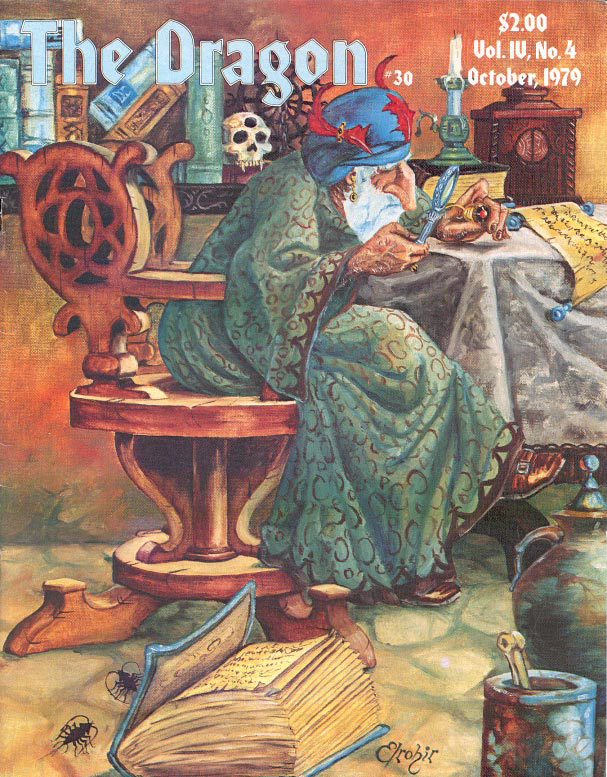
First – the cover. What a great cover. I love covers with lots of little details, lots of things to get the brain ticking.

Dig this from the opening of Kask’s editorial:

“As I am writing this (11 Sep), DUNGEONS & DRAGONS is getting the publicity that we used to just dream about, back when we were freezing in Gary’s basement in the beginning. If we had our ‘druthers’, it would not have happened in such a fashion. By now, as you read this, I hope the mystery surrounding the disappearance of James Egbert has been happily resolved. Whatever the circumstances of the incident, it has been a nightmare for his parents and family, as well as for TSR Hobbies, Inc. It has been speculated that James was involved in some sort of D&D game that went beyond the realm of pencil and paper roleplaying, and may have mutated into something tragic. D&D was seized upon as a possible connection to the disappearance, for a variety of reasons. First, James was an avid player. Indeed, I have met him at past conventions,
and he used to subscribe to TD.”

And so it begins. In case you don’t know, James Dallas Egbert III was a student at … well, you can read about it at Wikipedia. This may have made D&D more famous, but it also started the backlash against it by morons everywhere dedicated to ruining innocent fun. Worst of all, it led to the TV movie Mazes & Monsters, starring a young Tom Hanks. Not all the Money Pit in the world can make up for that.

The Game’s the Thing … and I Used to Think GenCon Stood for General Confusion
by Kim Mohan

You might recognize Mohan’s name. He was a the new kid at TSR when he wrote this review of GenCon XII. In short – he liked it.

Where the Orcs Are
by Steve Brown

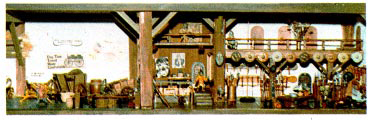
This article features a bitchin’ miniature diorama by Steve Brown. He wanted to enter it into the miniatures contest at GenCon XII, but it didn’t fit into any categories. Nevertheless, it was awesome, and had to get some love, so …

I’m going to assume the picture in the article doesn’t do it justice. Actually, there are a dozen photos, and the underground orc castle looks incredible. Brown says it took him a year to do the thing, and it carried a price tag of $4000 at the con (which would be about $13,000 in todays dollars, proving that the geek community has never been all that swift with their time and money … thank God).

Leomund’s Tiny Hut: Good Evening
by Lenard Lakofka

This was the first of the Leomund’s Tiny Hut’s, which were usually interesting articles that covered all sorts of gaming topics. This one, appropriately enough, is about vampires. It digs into the AD&D vampire, going in depth on its abilities and answering questions gamers might have had about the monster. For example:

1) Once the vampire’s hit points are calculated (it has 8+3 HD), they do not vary – i.e. you do not re-roll hit points when it regenerates in its coffin. Back in the day, there was an idea that adventurer’s re-rolled their hit points for each adventure (an idea I actually kind of like – to represent when people are super on their game, and when they aren’t).

2) Vampires don’t want too many lesser vampires under their control – really no more than 4. It sounds like the vampire wants to make sure there are plenty of living people to feed on, so he has to take care. Like a shepherd and his flock. And lesser vampires don’t create more lesser vampires.

3) Here’s one that got me: “The Vampire’s existence on the Negative Material Plane …” Wow – dig the idea. Maybe it was widespread. A negative material plane, duplicate of our own in some ways – but probably a nightmarish version – inhabited by the undead who also have an existence in the positive material plane. Neat. And what a great place to set an epic adventure!

4) It takes 1-4 segments for a vampire to transform (a segment is a second, for those not steeped in the timekeeping of AD&D), but only 4 if the vampire is surprised. After one segment to adjust, it can be mobile. When a combat round was predicated on segment-by-segment actions, this would be valuable information.

5) It still takes a magic weapon to damage a vampire in bat form.

6) A vampire in gaseous form “scattered to the four winds” can reform in 1-100 segments (i.e. less than 2 minutes). Also – DM’s should pre-set a hit point total at which a vampire will go gaseous.

He also gives some ideas about how to properly dispose of vampires, the spells they are immune to, details on regeneration, “lesser” vampires, summoning and charming, etc. It reminds me of the “Ecology of …” articles they used to do.

Observer’s Report: ORIGINS: Chaos With a Happy Ending
by Fantasysmith

To begin with, a note:

“This OBSERVER’S REPORT is written by the same person that does FANTASYSMITH’S NOTEBOOK. He prefers to do both under the pseudonym FANTASYSMITH, for reasons that he has made clear to us, and which we will honor.”

I think I just realized that Fantasysmith was, in actuality, Richard Nixon! I have no proof yet, but I’m launching a new Kickstarter to raise $1 million to help me get to the truth.

And now, I have to quote the first line of the article:

“Fluid sugar draws bees, fluid filth draws flies, and fluid situations attract the chaotic. This last was the case at ORIGINS ’79.”

Sheer poetry.

And now, an advert …

Cool module. Cool art. And remember, “tell them you saw it in The Dragon”.

From the Sorcerer’s Scroll: New Setting for the Adventure
by Gary Gygax

Here, Gygax talks about the relationship between TSR and TSR Periodicals, and his relationship as publisher vs. Tim Kask as editor and … yeah, I know. Who cares?

He then talks about the “Mugger” article from a couple issues back, and how it is both funny and great inspiration to look at different settings for games, in this case, the mean urban streets. Gary also gives us the lowdown on an adventure he’s working on in which adventurers in a city in the World of Greyhawk delve under that city and somehow end up in a subway tunnel in the modern world. He gives these guides for the particulars:

– In the city setting, magic will work, although cleric spells above third level will not. Of course, firearms also work.

– The perils of the place — police, street gangs, muggers, criminals of other sorts, citizens with
karate training or able to box, those with guard dogs, etc. — will be numerous and different.

– Weapons aren’t difficult to rate according to damage. Electricity will be interesting — low-tension AC giving but 1d6 damage (4d6 if the party is well grounded), low-tension DC doing 1d6 each segment until the victim is freed, and high-tension DC doing 1d20 in the same manner.

– Cars will inflict 1d4 damage for each 10 mph of speed. Small trucks will get a d6, large ones a d8, and trains a d10 for each 10 mph.

– Each special character (guard, policeman, street tough, mugger, etc.) will be given a level roughly corresponding to those of AD& characters, although the type of dice used will be non-standard.

– If the adventurers survive and manage to return to their own place in the multiverse, they will have little in the way of treasure — at least in all probability. Firearms will not work in the World of Greyhawk, of course.

He ends by pointing out that Schick and Moldvay make some of the heroes in their Giants in the Earth series too powerful. Now’s a good time for me to preview the way I’m rating fictional and real NPC’s in GRIT & VIGOR – by the number of years they’ve been active:

The New, Improved Ninja
by Sheldon Price

This is a set of rules extensions for the ninja class, which was published at some point in the past – I don’t remember the issue, and they don’t mention it here.

This version of the ninja is based on the book NINJA: The Invisible Assassins by Andrew Adams, published in 1970 by O’Hara Publications, Inc. of Los Angeles, California. Yeah – you can get it at Amazon.com.

The article starts out with weaponry. Here are some highlights:

In the hands of a ninja, the hankyu (short bow) fires at twice the normal rate.

There is a 5% chance per day of searching that a ninja can find 1d6 plants that work as caltrops.

It takes one week, and costs 2 sp, to make metal claws for the hands and feet.

Staves had small missiles attached to one end that could be thrown by flicking the staff.

Poison water guns have a range of 60′, and produce a cone of water 10′ wide at the base and 60′ high. The main use is to blind eyes – it takes 1d12 rounds to clear the eyes.

The weird signs the ninja makes (called kuji-kiri) are not magical, but they restore his morale and entrance non-ninjas (saving throw allowed).

Ninjas have two kinds of sandals – essentially they can replace the soles. One gave better traction, the other a more silent step.

Ninja can wear up to chainmail, and they can pad it so it remains silent without adding encumbrance.

Ninja can foretell the weather in the short term. Which is nice, because when assassination just ain’t paying, they can becomes TV weathermen.

They are also “earth aware” – can find good places for ambushes – and “man aware” – can manipulate people.

There is a huge list of special ninja equipment, from special torches to swimming flippers and rocket arrows.

There is a section on poison (the substance, not the metal band). Gyokuro is a poison that causes slow death – it kills the ill in a few days, and the healthy in 70. Wouldn’t that be a fun way to end a PC’s life. “Sorry Bill, you suddenly collapse dead in the street while haggling over that beaver tail soup. Turns out a ninja poisoned you a couple adventures back.”

Ninjas can make laugh-inducing poisons at level 4, sleep-inducing poisons at level 6, and insanity-inducing poisons at level 8.

Ninjas also have healing abilities, mostly on themselves, but I would think they would work on others.

Basically, ninjas are awesome.

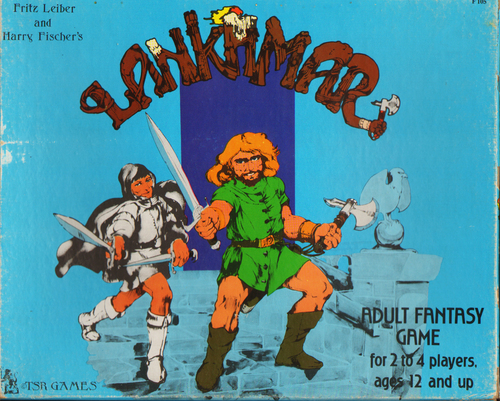
Lankhmar: The Formative Years of “Fafhrd” and “The Mouser”
by Dr. Franklin C. MacKnight

For those not in the know, Lankhmar is not only the setting of Fritz Leiber’s stories of Fafhrd and the Mouser, but also a game. This article is written by a friend of his, and thus witnessed the birth of the Nehwon stories and the game. From the author:

Lankhmar wasn’t just a game, it was an adventure. The pieces were not mere abstractions, but heroes with personalities with which one identified. It provided an esthetic thrill unequaled in my experience in any other game anywhere.”

Starring Barry Gibb as Fafhrd

Add Lankhmar to the list of games I want to play. The article goes on to explain how the game was originally played (before it was turned into something more commercially viable in 1976 – see HERE).

We also get this tidbit about Harry Otto Fischer:

“Harry not only looked like Edgar Bergen’s Charlie McCarthy but had a similarly extroverted temperament and wit. The famous puppet could have been copied from him!”

The article is a must read for folks who love the stories. Great background stuff.

Design Forum: Boot Hill? Sure! But What Scale?
by Ralph Wagner

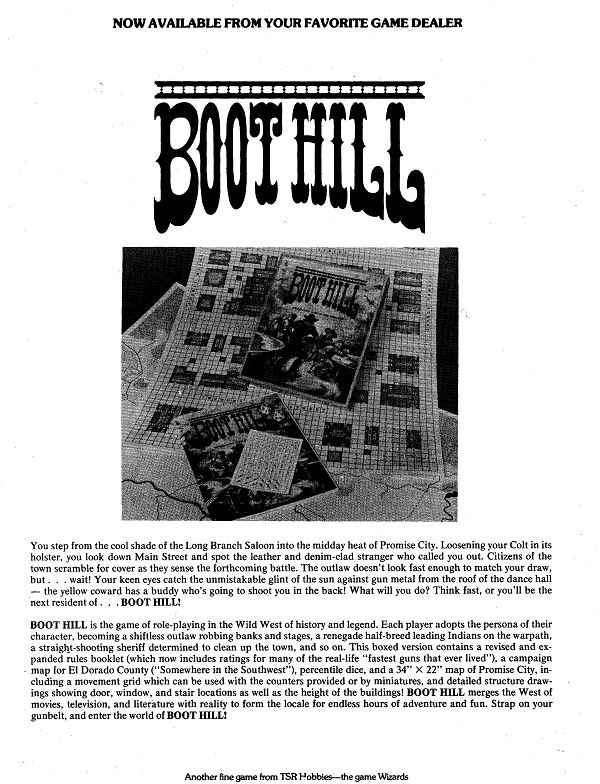
That title is such an artifact of its time. We don’t live in a magazine world anymore, and whenever something passes from now to then to what, so many little things pass with it. I’m only 43 years old, but the then I was born into is rapidly becoming a what. I think my childhood and the childhood of people born in 1900 have more in common than my childhood and people born just 20 years later.

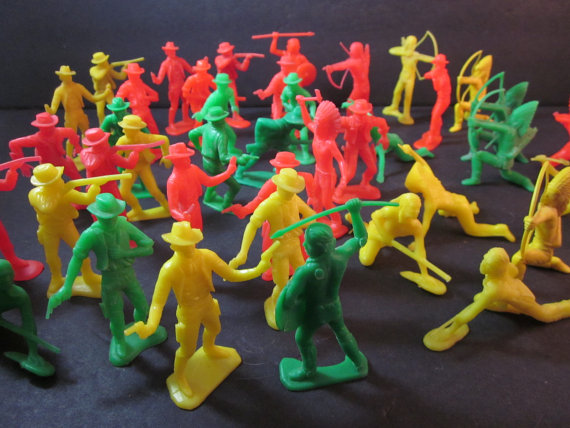
Oh – the article. It’s about what scale miniatures to use with Boot Hill. Personally, I would have gone with these bad boys:

Found at Etsy … already sold. Damn.

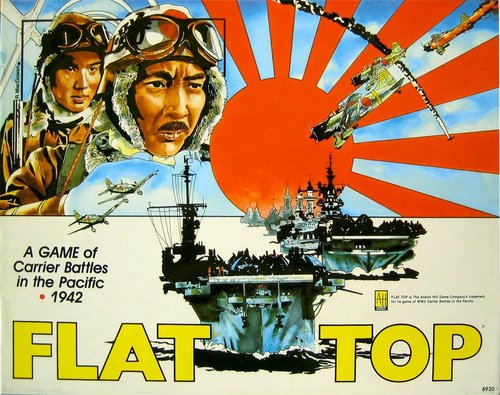
Designer’s Notes: Flattop: A Long Game but a Strong Game
by S. Craig Taylor, Jr.

This is a discussion of Flattop, a game that covers the Coral Sea-Solomon Islands geography during 1942, specifically the three carrier-to-carrier battles of that year, Coral Sea, Eastern Solomons and Santa Cruz. Mr. Taylor was the game’s designer and developer, and he has a few insights about it, in particular about victory points and the difficulty in writing a truly original game. Sounds like a pip. And a great cover, by the way.

Up on a Soap Box: Standardization vs. Playability
by Bob Bledsaw

He discusses the value of standardization in a game, but also its limitations. Wow – I’m sure you didn’t see that coming. Mostly, he describes how he does his own campaigns – how he handles the races and technology and religion. Could be some useful stuff to the newbies – after all, at this point almost everyone playing the game was a newbie. By being a basic framework, D&D opened the doors to a whole new world, and everyone was feeling out what they could and couldn’t do in that world.  What a great time.

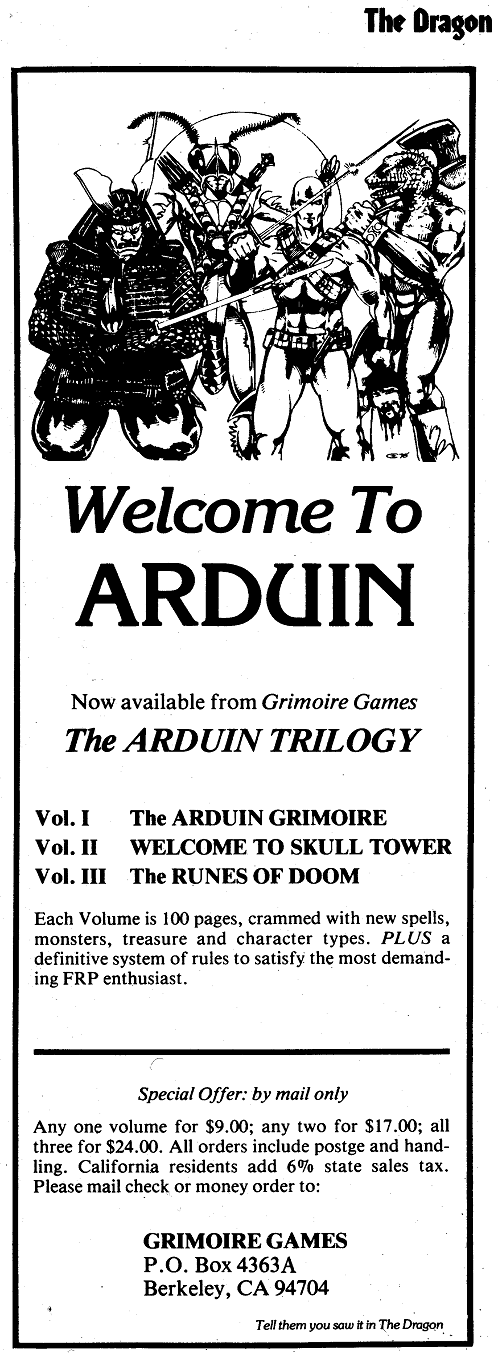
And look at this little ad that popped up on page 21:

Things are about to get weird. If you are reading this and haven’t heard of Arduin, look it up.

Armies of the Renaissance
by Nick Nascati

This is Part V, and covers the armies of Eastern Europe – Poland, Hungary, Russia and the Ottoman Empire. It’s a good article – one page, two column, and covers the basic very nicely. What if we came up with a big d% table with 100 entries that determined a first level fighter’s starting equipment, based on various historical warriors (and maybe Buck Rogers thrown in just for fun). Might have to do that for the blog.

Tournament Success in Six Steps
by Jon Pickens

Tournaments were such a big deal in the old days. I wasn’t a con-goer then (or now, to be honest), so my only exposure to them at all was in some of the old AD&D modules I owned, which had a section on using the module in a tournament, with the points scores, etc.

Here a quick version of Jon’s rules for success:

1) Get in – i.e. sign up for a game. If you don’t get in the first round, sign up for the second.

2) Use magic to get rid of obstacles that would take too long to overcome the old fashioned way.

3) Have a plan (always a good idea).

4) Pay attention to the DM, and if something seems amiss, question him. He might only give out certain bits of information if the right questions are asked.

5) Don’t waste time.

6) Never quit – avoid combat as much as possible, but if you have to do it, do it with extreme prejudice.

Finally, never argue with the DM. If you think he or she screwed up, bring it up politely.

Out on a Limb

Ah – letters to the editor time. Here’s a dandy:

Q: “Something has been bothering me about the Druid class in DUNGEONS & DRAGONS. That is, I know of a couple of people in Chapel Hill who don’t know each other, but they are both the ‘Great Druid’.

A: “The stricture regarding the number of high level Druids is on a per world basis.”

He kindly didn’t add, “dumbass”.

Geek Rage of the Week:

“En garde, Master Rahman and those of you who defend such shoddy pieces of work such as Bakshi’s. (I’ll refrain from referring to it as the ‘Lord of the Rings’).”

Good Advice of the Week:

“It is my contention that all “good” referees should make it their duty to change large portions of the concepts presented in any given role-playing game.”

Terrible Augury of the Future:

“As you may have noticed last month, Wormy has returned. Wormy’s creator got married and moved to California, but he promises that Wormy is back to stay. As to more of Dave’s art, that is up to him and his job in CA. One can always hope . . .”

Cool ad for Dragon Tooth Fantasy Figures:

I haven’t done a random encounter table based on a mini’s ad in a while, so here goes:

d10

1. Rogue or thief (roll 1d4 for level) in leather doublet with short sword, mounted on light warhorse. Wears cloak and floppy hat. Will do anything to steal your purse.

2. Sorcerer (roll 1d5 for level) in the middle of casting one of his highest level spells. Will be extremely cross if you mess it up.

3. Swordsman (roll 1d6 for level) armed with sword and spear.

4. Rictus, the Zombie King; zombie with 12 HD and the strength of a hill giant (+4 damage).

5. Swordsman Kane, a neutral evil 8th level fighter from the terrible north, escaping his love of a good woman who threatened to turn his heart to good. Has +1 scale mail and greatsword.

6. Sorceress (roll 1d8 for level); she holds the mystic Moon Staff of Myrmidor, which can cast all sorts of cool light spells, and confusion and which can cast hold monster, at will, against lycanthropes. She rides a light warhorse.

7. Cleric in mitre with mace. Roll 1d10 for level. He is suffering a crisis of conscience, as he caught mother superior stealing milk and didn’t damn her.

8. Fool or jester, recently released from his master’s service and very hungry. He is a 1st level assassin.

9. Bard or harpist (roll 1d12 for level) in puffy velvet clothes and a great hat. He carries a silver longsword and a golden lyre that charms fey, 4/day. He rides a dapple grey light warhorse. He is arrogant and good-natured.

10. Swordsman Roland (level 9 fighter), with scale mail, +2 shield (axes stick to it on a roll of 1-2 on 1d6) and a major chip on his shoulder towards paladins and rangers (they think they’re so awesome).

Also, found this old issue of Popular Mechanics about painting Dragon Tooth miniatures.

Also, dig this 1978 catalog (which I’ve probably already posted at some point).

Giants in the Earth
by Lawrence Schick and Tom Moldvay

This edition of G in the E features Piers Anthony’s Sol of All Weapons (LN 20th level fighter, 14th level monk), Tanith Lee’s Zorayas (LE 23rd level magic-user) and Clark Ashton Smith’s Maal Dweb (LE 20th level magic-user).

I dug the little advert for Cities, by Stephen Abrams. I did a search and found that he did a few versions of this book, including one for Runequest. I think I’m going to by myself one. I’m intrigued. If I do, I’ll post a review.

The Dragon’s Augury

The games reviewed in this issue are Spellmaker reviewed by Bruce Boegman, Black Hole reviewed by David Cook and Down Styphon reviewed by Kenneth Hulme.

Spellmaker (1978, by Eric Solomon) pits powerful wizards against one another, trying to transport a princess to their castle to win the game. The reviewer calls it a “rare gem”, and I must admit, it sounds pretty cool. The spells are card-based, and I’d love to see a deck of them.

Black Hole (1978, by Robert A Taylor) pits two mining cartels against one another to capture a donut-shaped asteroid with a black hole tethered in the middle. The review is positive, so it might be a good con game for two.

Down Styphon! (1977, by Mike Gilbert) sounds pretty interesting. It is based on the book Lord Kalven of Otherwhen by H. Beam Piper, in which a Penn. State trooper is transported to a parallel earth where the secret of gunpowder is controlled by a bunch of priests. The trooper knows how to make gunpowder, better weapons and he knows something about the “future” of warfare. The game is a miniatures wargame in the musket and pike era. It is apparently a very playable game with only OK layout and some missing stats for artillery (which are provided in the review).

Bazaar of the Bizarre: Orlow’s Inventions Can Liven Up Your Life
by William Fawcett

This article could be a great blog post – a random list of minor magic items that include spoons of stirring, brooms of sweeping, needles of sewing, amulets of caterpillar control, socks of dryness and matches of many lights. This stuff would be so great for putting in a wizard’s tower. Just awesome – if you can find a copy of this issue, find it for this. I’d post the random table, but it’s a little more than I’d be comfortable sharing considering the mag is copyrighted.

So, Different Worlds gaming mag. Never heard of this. I hunted down some descriptions, and apparently some issues you can still buy. I love the art in the ad, and would love to see a sample issue in PDF. There is so much buried treasure out there for gaming!

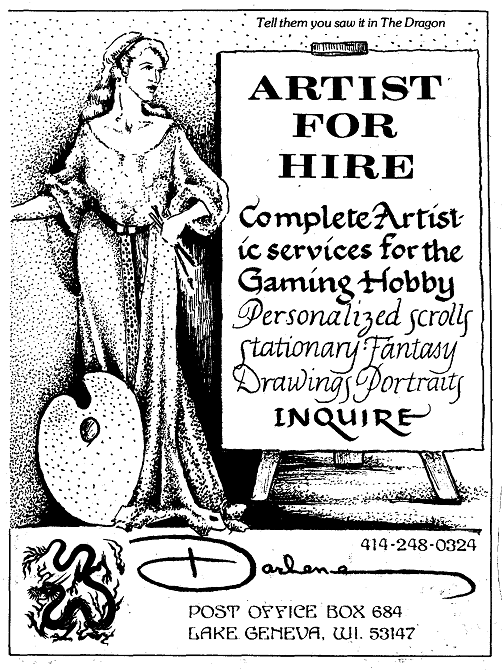
I also have to share this ad, for on heck of an artist for hire …

… who is still out there working, thankfully.

Dig Tramp’s minotaur in Wormy. So cool.

Dragon’s Bestiary: The Curst
by Ed Greenwood

I’m not sure if this is the first thing in the magazine by Ed Greenwood or not. The curst are still roaming about in the Forgotten Realms setting. Humanoids (98% are human stock) that have been cursed and cannot die, they are chaotic neutral, retain their class abilities except psychic powers and magic, gain infravision 90′ and apparently have no sense of smell. In modern parlance, they would be a “template”.

Finieous Fingers shows us what failing a surprise roll looks like.

And that does it for The Dragon #30. A pretty good issue, overall, with lots of interesting artifacts of the old days of gaming that I love. Seriously – find a copy and check out the minor magic items article – well worth it.

Dragon by Dragon – September 1979 (29)

September of 1979, and lots of kids were getting ready to go back to school (and lots of parents were thanking God the kids were going back to school). Maybe the mail brought a few of those kids one last bit of fun before the learning began – Dragon #29.

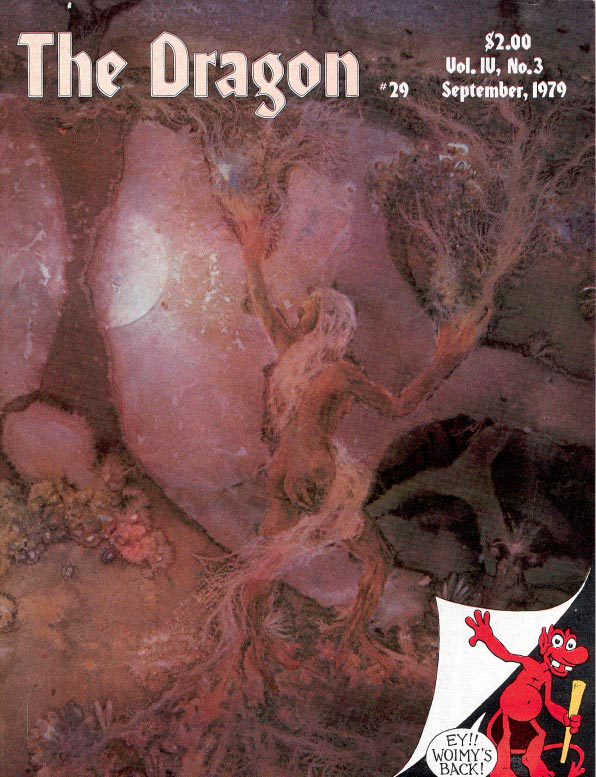
Note on the cover – not terribly impressive to me, except for that little bit in the lower right-hand corner. Woimy’s back!

What does the “premier magazine of games and gaming” have for us this month?

Kask has a few things about subscriptions to discuss in the opening. First, make sure you address things to TSR Periodicals to get things moving fast. Second, let them know when you’re moving. Finally, when you resubcribe, do it before your subscription ends to make sure you don’t miss an issue. All of these things – almost completely moot in the modern world.

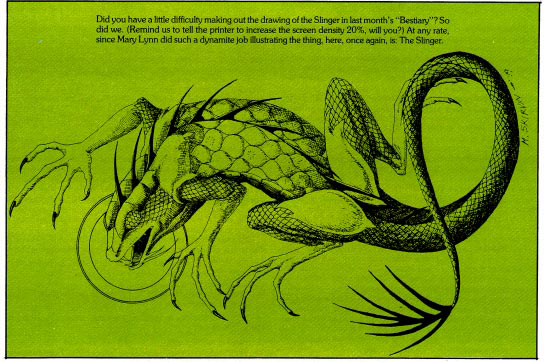
Apparently, this was an issue for clarifications – they had to reprint the image of the Slinger from last month’s Bestiary – they apparently should have told the printer to increase the screen density by 20%. Here’s Mary Lynn’s little masterpiece:

The first article is missing a title, but the TOC calls it “Of the Gods”. Whatever it’s called, its by Craig Bakey and concerns the idea of “campaign gods”. The argument by Bakey is that every campaign should have its own gods and goddesses, rather than just using the mythos in “Gods, Demi-gods and Heroes”. What follows are some guidelines on how to create an original pantheon for your game. A couple points:

1. The power of the gods runs in cycles, so different pantheons can hold sway over the Prime Material Plane at different times, though the other gods are by no means powerless. This is actually a cool idea – different gangs of gods rising and falling in power.

2. Beyond the gods are forces of immeasurable power who have long since lost interest in the universe – i.e. The Old Gods. According to Bakey, there are 24 hyper-physical padrones which manifest themselves as colored jewels of six different disciplines. The concepts of Law and Chaos, and the gods themselves, originated in these jewels.

Note – I love how in the old days, an article that seemed like it was going to be campaign neutral suddenly decides on pretty campaign specific stuff that everyone should use. It’s as though there was still an idea that all D&D campaigns really should be linked with each other, and therefore needed to have a solid foundation underpinning them.

The aforementioned disciplines are:

I – blue gems – abstract religion

II – purple gems – space, dimensions, form, motion

III – green gems – matter

IV – yellow gems – intellect

V – orange gems – individual and intersocial volitions

VI – red gems – affections, personal, moral, religious, etc.

He goes on to describe the basic characteristics all deities should have, and other statistics to define them. Then come the random tables for generating deities – this I like. The main table has a weird entry on it that might come from the digitizing of the magazines, but it covers the basic power level of the deity – from demi-god to “gods of the inner circle” to banished gods and rogue gods. There are tables for determining Armor Class and Hit Points, relations between the gods, alignment, gender, their portfolio, and extraordinary abilities and fantastic possessions. He goes on to present some sample pantheons, which appear to have an alignment factor to them (makes the whole rotating pantheons in power make more sense).

I dig that he includes “Dormamnu” as the god of paradoxes and energy. Ardnha, the “presence of swords and machines” and Quasiman, the goddess of black sorcerers sounds pretty cool as well.

Next is a variant on the Source of the Nile game by the authors, Dave Weseley and Ross Maker (I think). It’s a collection of flow charts that are pretty meaningless without the game rules. Or maybe not – here’s a sample:

Now that I look at them, they might be useful to somebody running a wilderness adventure. In fact, designing some flow charts of my own might be useful.

In the “Fantasy Smith’s Notebook” we have “An Ounce of Preparation is Worth a Ton of Paint”. I always found this to be true when I painted minitures (Warhammer, mostly). A nice primer coat was a must, especially since I sucked at painting a good black undercoat really helped make my minis look way better than they would have otherwise. The article is a good guide to prepping miniatures, using dowels to hold them (wish I’d thought of that), filing them to correct problems with the casting, etc.

An interesting thing that was either an advertisement or a tiny article comes at the end of the previous article, for the Order of the Indian Wars (PO Box 7401, AC 501-225-3996, Little Rock, Arkansas 72217), a group dedicated to studying the American Indian Wars.

The coolest thing – still around! OIW’s website is HERE.

Gary Gygax is up next with “From the Sorcerer’s Scroll”. Here, he introduces “The Half-Ogre, Smiting Him Hip and Thigh”. Here, EGG mentions that he has seen many treatments of the idea, and now he’s wading in with something official – and a warning.

“The character races in AD&D were selected with care. They give variety of approach, but any player selecting a non-human (part- or demi-human) character does not have any real advantage.”

“Consider the various factors which must be taken into account when designing a race for game purposes. Remember that last part, game purposes; AD&D is, first and foremost, a game. Races, just as with classes, must be in relative balance with each other, as well as with the game as a whole.”

Dear old dad

He actually gives some nice design advice on creating character races, and also on why he made the rules he made in AD&D to keep things balanced.

Time to roll up a half-ogre. Half-ogres have the following ability scores: Str 14-18 (use d6, with 5 and 5 equaling 18), Int 3-12 (3d4), Wis 2-12 (2d6), Dex 3-12 (3d4), Con 14-18 (as Str above) and Cha 2-8 (2d4).

Note – I suddenly love the idea of each race rolling different dice for its ability scores, instead of just using bonuses and penalties.

I roll up the following: Str 16, Int 7, Wis 7, Dex 7, Con 17, Cha 3 (or 6 with ogres and half-ogres … so even my own people find me distasteful).

Half-ogres can be fighters (unlimited advancement) or clerics. I don’t qualify as a cleric, so I guess my half-ogre, Zapp Smashigan, will be a fighter. As a half-ogre, I get infravision to 60′, speak ogre, orc and troll (if raised by my ogre parent), a swarthy and dull complexion, dark and lank hair, an average height of 7.5 feet, roll two Hit Dice at 1st level, and then regular progression thereafter. So, as a first level fighter, I roll 15 hit points, plus 3 per hit dice for my high Con, so 21 hit points at first level. Not too shabby, actually. If the others chip in and get me a decent weapon and armor, I can really kick some tail and let the clerics focus on healing the other fighters in the group.

Next, Harold Pitt gives us “Curses: Never Get Even – Get Ahead”. From the second paragraph:

“The curses spoken of here are the ones that the Dungeon Master may lay onto his players as a matter of the course of play, a penalty for acting out of character (alignment), or just as an equalizer for someone who has been exceptionally successful. Or for that character that has just succeeded in demolishing the trap you spent hours agonizing over (frustrating, isn’t it?) and feel that perhaps, somehow, he shouldn’t get away scot free. Remember: never get even—get ahead!”

Harold sounds like a fun DM to play with. “Hmm, Pete’s thief has done pretty well this adventure, even got past that killer trap I set up. Guess it’s time to curse him.”

The advice in the article is sound and common sense – I use it when designing curses in my hex crawls. Basically – figure out what will really challenge a character, and use it. Curses really should be about challenging the players and making the game more interesting. As Harold puts it:

“In conclusion, cursing can be fun. It can become a battle of wits and resources between DM and player.”

Still, I can’t endorse the idea that the DM needs revenge on successful players. No good will come from that attitude.

Time for “Out on a Limb” and some thoughtful letters to the editor. I actually liked this bit in a letter from Marc Jacobs of Allentown, PA:

“Obviously, the feudal class structure of Europe will not work for D&D the way it is usually played. First, ruined castles and dungeons would probably be the property of someone, and adventuring in them would be akin to poaching in the king’s forest. In a magic-intensive world, it would be hard to hide the origins of your wealth.”

Maybe it’s just me, but I don’t see this as a bug, but rather as a feature.

Dig this from the editor:

“To my knowledge, and I’ve been here since there has been a TSR Hobbies, Inc., there has never been an “enemies list” or black list. Not that we don’t take note of who the most vociferous critics are, naturally we do.

I don’t have a bad side; my answers are very much the product of the mood I’m in or how the particular letter struck me at the time. There are dozens of different ways to humiliate people in print that I would never stoop to using.”

Good times. Good times.

Lawrence Schick and Tom Moldvay now come waltzing in with another “Giants in the Earth”. This month, we get Roger Zelazny’s Shadowjack, a 25th level thief, 9th (18th) level fighter and 9th (18th) level magic-user. Also, Jack Vance’s Iucounu, the Laughing Magician, a 20th level magic-user. Along with Iucounu, you get a bevy of Vancian spells: The Charm of Forlorn Encystment, The Charm of Untiring Nourishment, The Excellent Prismatic Spray, Felojun’s Second Hypnotic Spell, etc. I’ll reproduce one of these spells:

Thasdrubel’s Laganetic Transfer or the Agency of Far Despatch: when this spell is uttered, the recipient is bound as if by a hold person spell. A nycadaemon appears (i.e., is gated in), grasps the held recipient and flies him or her either to a point designated by the caster or 10-100 miles in a random direction. Range: 3”. Area of effect: 1 creature. Casting time: 1 round. Saving throw: none.

Idea – everybody picks a character from “GitE” and we hold a Google+ fight club using AD&D rules.

In the “Design Forum”, Doug Green presents “Rewarding Heroism in D&D”. It comes down like so: If a player or a couple players want to act for the entire group in situations where the life or freedom of the entire party is on the line, they attack as though twice their normal level (or apply spell rules as though double level, though they don’t get additional spells), and take half-damage from attacks. All other abilities are +20%.

As Doug puts it, “This rule simulates the effect of adrenalin on a person in a life or death situation and the natural law present in most fantasy stories that good will triumph over evil.”

Doug also gives the point man in the party +20% XP, and anyone praying after sacrificing himself has a percent chance equal to his level of getting a reaction from the gods. Also, heroic acts are worth 1,000 to 5,000 XP.

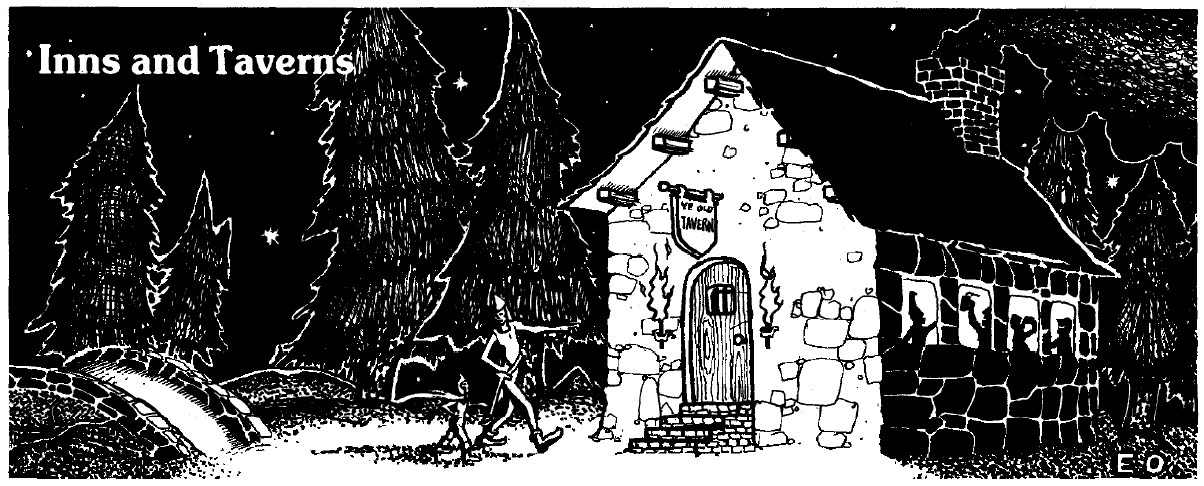
Not sure who wrote this next one, but it’s called Inns and Taverns, and the art is groovy:

The article gives a nice guide to what inns and taverns are (or were), along with percent chance to find on in different sized communities (75% chance in a community with 150 people or less) and what to do without one (beg for lodgings). He notes that in 1453, Paris consisted of three square miles, within which lived 150,000 people and 5,000 inns and taverns.

He also covers prices (5 cp to 5 gp per night – quite a spread), what you get for your money, etc. Good, solid article. I have to reproduce the food prices:

Check out this little inclusion:

So now you know.

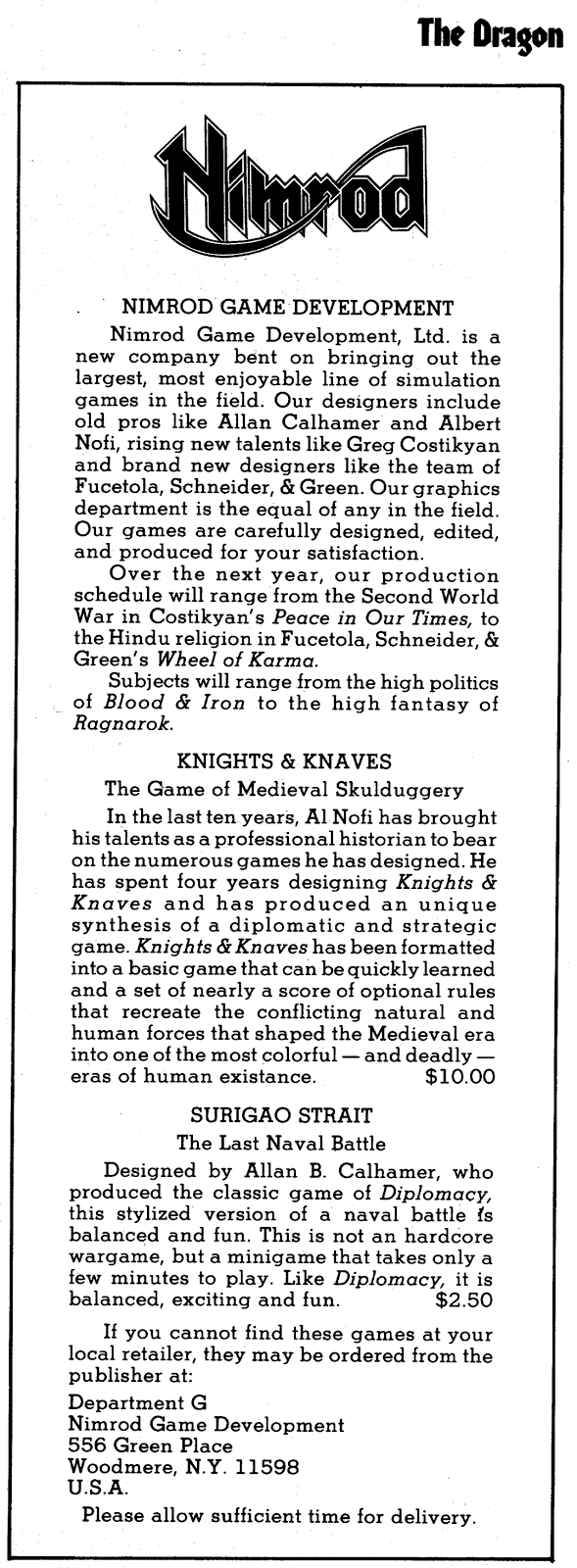
I also enjoyed this ad from Nimrod Games:

A couple links for you – Knights & Knaves and Surigao Strait.

J. D. Webster now gives us a variant – “Air War North Vietnam”. It presents some new scenarios for the game, which I know little about. I do know that my favorite fighter plane when I was a kid was the F-4 Phantom II.

Thomas Holsinger now gives us “Smaller Than Man-Sized Weapons Table”. Simple little article showing weapon damage for weapons as used by gnomes or goblins. Useful table back in the day, probably not as much now.

For those who like costumes and hitting people with sticks, Allen Hammack writes “Anatomy of an S.C.A. Battle – The Sleep War”. This article introduces the ways and means of the Society for Creative Anachronism in terms of their battles.

Paul Karlsson Johnstone now tells us of the “Origins of the Norse Pantheon”. Nice article about where it came from, what it meant, the cults. A good introduction to the topic.

Jerome Arkenberg gives us “The Mythos of Oceania in Dungeons & Dragons”, with sections for Micronesia and Melanesia. I dig the Porpoise Girls (AC 2, HP 50, fight as 1st level fighters). Their ogres can also shapechange into giants, crocodiles, snakes, ospreys, fish, hawks and bears. That’s actually a nice little variation.

How good were these miniatures? FIND OUT HERE!

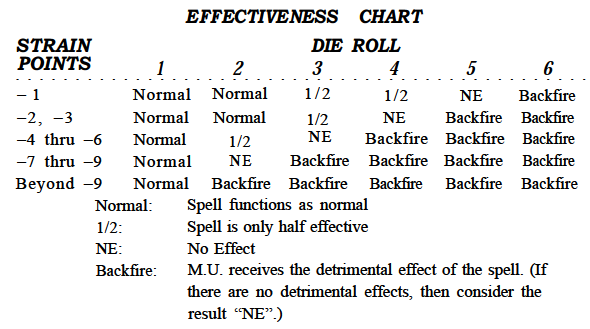
“Strain and Spell Casting” is a nice article by Kevin Thompson. The editor notes that this is the first “spell point” system he has ever liked, possibly because it makes magic-users weaker. It is based on the idea that each spell cast causes strain on the magic-user. The magic-user’s Constitution score determines their “strain multiplier”.

You multiply this by his level to get his total strain points for the game. So, a 5th level magic-user with a 8 constitution has 2 strain points. When a spell is cast, the spell level is deducted from the strain points. Spells from magical implements cause half-strain, while potions cause no strain.

The magic-user can go over his normal daily strain total by consulting the Effectiveness Chart and roll D6.

You also have to roll on the Overstrain Chart:

I dig the system for the most part. It’s pretty similar to what I did in Pars Fortuna. It does seem a bit severe, though, for mid-level magic-users who don’t have great Constitutions.

I have a feeling this is my new half-ogre character

Now we get a few quick, short articles (often the best kind) –

“Trained Animals in Dungeons & Dragons” by Robert Greayer. It deals with using wild dogs, war dogs, wolves, dire wolves, winter wolves, worgs, pigeons, ravens, hawks, falcons, golden eagles and bald eagles as henchmen. I would give Zapp Smashigan a bald eagle for a pet, but I think his Charisma is too low. Poor Zapp.

Mike Crane gives us “Aging in D&D”. He has a neat little chart of the percentile chance, at different ages, that a character keeps his Str, Dex or Con as-is, instead of losing a point or two. Simple and clean – I like it.

“Adventures in the Improbable” by Richard Dienst is a weird little story about using the thieves’ guild charts in Greyhawk. I really don’t know what to do with it.

Rick Krebs tells us “Non-Player Characters Have Feelings Too”, a set of random tables to generate personalities for NPC’s.

“Bazaar of the Bizarre” this month is the “Ring of the Necromancer” by Bill Howell and “A Working Design for Heward’s Mystical Organ” by Steven Widerhoft.

The Dragon’s Augury reviews dice by The Armory in Baltimore, new water-based paints (also by The Armory), Reich: The Iron Dream of German Unification by Chaosium, Raiders and Traders by Chaosium, a couple books on tanks and The Tolkien Quiz Book by Bart Andrews (love the cover).

The Dragon’s Bestiary presents “Whiz-Bang Beetles (Coleoptera Conflagratio Amotensia) by John Hageman. These are tiny beetles that are like living bullets. They attack fire sources, and in their hives there is a 75% chance of finding 1d6 ounces of “whiz-bang honey” that might give people heightened speed (like a potion). I like these guys – they would make a good swarm creature in modern versions of the game.

In Wormy by Tramp, we get a nice summing up of what has happened up to this point, including Wormy stomping on dwarves, the arrival of the blue demon from the 8-ball, etc. I would super love to play a game set in the Wormy world – anyone out there game?

And this ends #29! Lots of interesting little articles in this one, and noticeably less war game-oriented than some of the recent issues. Hope you enjoyed it – have a groovy Sunday and an efficient week ahead.

Dragon By Dragon – August 1979 (28)

It’s August 1979, and you’re standing in front of a magazine rack. Which magazine do you choose?

Well, too bad. I’m not reviewing Playboy (more’s the pity). You’re going to have to be happy with The Dragon #28.

We open this issue with this:

“It is fun to be unique. It is fun to be part of something unique. Sometimes, though, some of us forget just how strange all of this stuff is to the uninitiated. In the eyes of the mainstream of contemporary culture, what we do — play “games” — is decidedly different. Some would even
call it strange …”

Kask ain’t just whistlin’ Dixie. The funny thing is – as much as Gary and Dave’s little game has influence modern video games, those of us who still play the pen & paper varieties are still considered strange. People I work with are always a little surprised – not sure quite how to react – when I mention that I write role playing game books. Interesting to hear in the comments how many of us are “open gamers”.

Well, this issue opens up with a biggee – “The Politics of Hell” by Alexander Von Thorn. Van Thorn has an author page at Amazon.com, and (if it’s him) a Twitter account. If you have any questions about Hellish politics, feel free to contact the author directly.

The first line is: “Author’s note: The following article cannot be considered the official doctrine of either Advanced Dungeons and Dragons or the Roman Catholic Church. However, it is compatible with AD&D, and except for the parts about Asmodeus it is not in conflict with works on demonology as generally accepted by Catholic exorcists, thus enjoying tacit approval by the Church.” You know, just in case you were worried about your AD&D game rubbing the Catholic exorcists the wrong way.

The article pretty much sets up the political landscape of AD&D’s version of Hell, as we came to know it through the Monster Manuals, with Asmodeus on the top of the heap. It also includes stats for Satan, Belial, and Astaroth (with art).

Next, Jake Jaquet presents The Dungeon Master’s Guide – possibly the most useful RPG book ever made. The article is a collection of comments and reminiscences by people who were involved with the project, including Jeff Leason, Len Lakofka, Lawrence Schick, Jean Wells, Allan Hammack, Mike Carr, James Ward, Darlene Pekul and Gary Gygax, in an exclusive interview with The Dragon (I’m sure it was quite a coup to land that interview!)

Up next, Dan Bromberg writes “A Short Course in D&D. This is an interesting article about folks at Cranbrook Prep School setting up a 2 week course in D&D for incoming freshmen. They ended up charging $1.50, plus another $1.50 for low impact dice (the DM didn’t have to pay). The course books were a copy of Basic D&D and the Player’s Handbook. Given the fact that I still find rules in AD&D I didn’t know existed, a course like this might have been useful to me when I was a kid.

Time for some war gaming – “The Cavalry Plain at Austerlitz” by Bill Fawcett. This is a nice description of the battle that pitted the cavalry of Napoleon’s France against Austria and Russia. It is followed up by an article on “Simulating the Cavalry Plain”, also by Mr. Fawcett. He gives a nice overview of the order of battle on both sides, along with victory conditions for each side. Highly useful for folks playing Napoleonic war games.

I didn’t get interested in the Napoleonics until I started reading Military History magazine in college. Now I’m super excited to get GRIT & VIGOR published so I can write up a Napoleonic supplement to it.

Next up – alignment time! Gary Gygax opines on Evil: Law vs. Chaos in “From the Sorcerer’s Scroll”. In this, he defines the characteristics of Chaotic Evil and Lawful Evil … and then let’s Neutral Evil fall where it may. He defines “evil” as the desire to advance self over others by whatever means possible, and always by the foulest means possible (emphasis mine). I like this, because it makes no qualms about what evil characters are in AD&D – they’re villains. They’re not misunderstood, and they’re not necessarily realistic depictions of human beings. Just theatrical villains you can take some enjoyment in beating the crap out of (or in playing, if you’re in the mood to foreclose on orphans and tie maidens to railroads). The Law vs. Chaos element is the desire to create a world ruled by evil vs. evil for its own sake. Now you know.

Dig this ad:

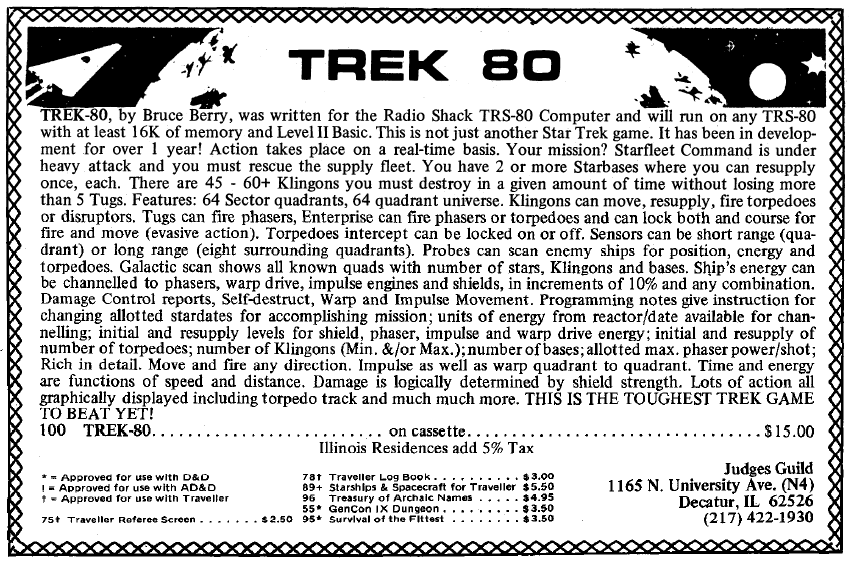
Looks like Judge’s Guild got into computer games early. The only thing I can’t figure is whether or not this was a licensed game. Here’s the article on the game at Wikipedia … and here, apparently, is a clone …

Allen Hammack writes “Six Guns & Sorcery”. If this sounds familiar, you might remember it from the old DMG, where they provided guides for conversions between AD&D and Boot Hill and AD&D and Gamma World. If you need a quick bravery stat, you can use the following:

Subtract the following from 100 for each class:

Cleric: 2 x Wisdom
Fighter and Monk: 1 x Wisdom
Magic-User: 3 x Wisdom
Thief: 4 x Wisdom

Maybe more interesting are the damage dice for some Old West weapons – Derringers do 1d4 damage, other hand guns do 1d8, shotguns do 1d10 and dynamite sticks do 4d6 damage. With these values, I wonder why they were so worried about including firearms in D&D.

Phil Neuscheler now writes “Fantasy Smith’s Notebook”. This was intended as a series of articles concerning the modeling of miniatures for D&D.

“When you have small amounts of cash to start with, you may wish to get adventurer character figures first, and use a substitute for monsters in your miniature games. After all, you will continue to play your own character(s) no matter what kind of monsters you encounter, so you’ll use the character figure more often than any individual monster. Monsters are simply not cost effective.”

The article provides contact information for several miniature makers active at the time. I wondered how many were still in the business today:

U.S. Airfix – I remember these guys making airplane models – maybe snap-together models. They still produce figures, though I’m not sure they have any ancients or medievals anymore.

Archive Miniatures – These guys appear to be defunct.

Garrison (Greenwood & Ball) – Sadly closed for business. Name sounds more like a law firm.

Grenadier – These folks appear to now be owned by Mirliton. Free downloads at the link.

Hinchcliffe Models Ltd – Still alive, but owned by Hinds Figures Ltd.

Heritage Models Inc – now defunct.

Jack Scruby’s Miniatures – there’s a Jack Scruby line at HistoriFigs. Also found a catalog from 1972 at Amazon.

Martian Miniatures – couldn’t find them online.

Miniature Figurines Ltd (Minifigs) – alive and kickin’ with a Tripod site.

Ral Partha Enterprises – still around, and pushing the resurgence of Chaos Wars. I always wanted to get into these minis when I was a kid, but the money just wasn’t there.

Next up is “Armies of the Renaissance – Part IV The English” by Nick Nascati. This covers the Welsh longbow and its importance to the rise of English military power, as well as their deadly combination of bill, pike and musket. They wore less armor than other armies, but appear to have had a high level of discipline. Also notable is the adoption of the red coat in the late 1600’s.

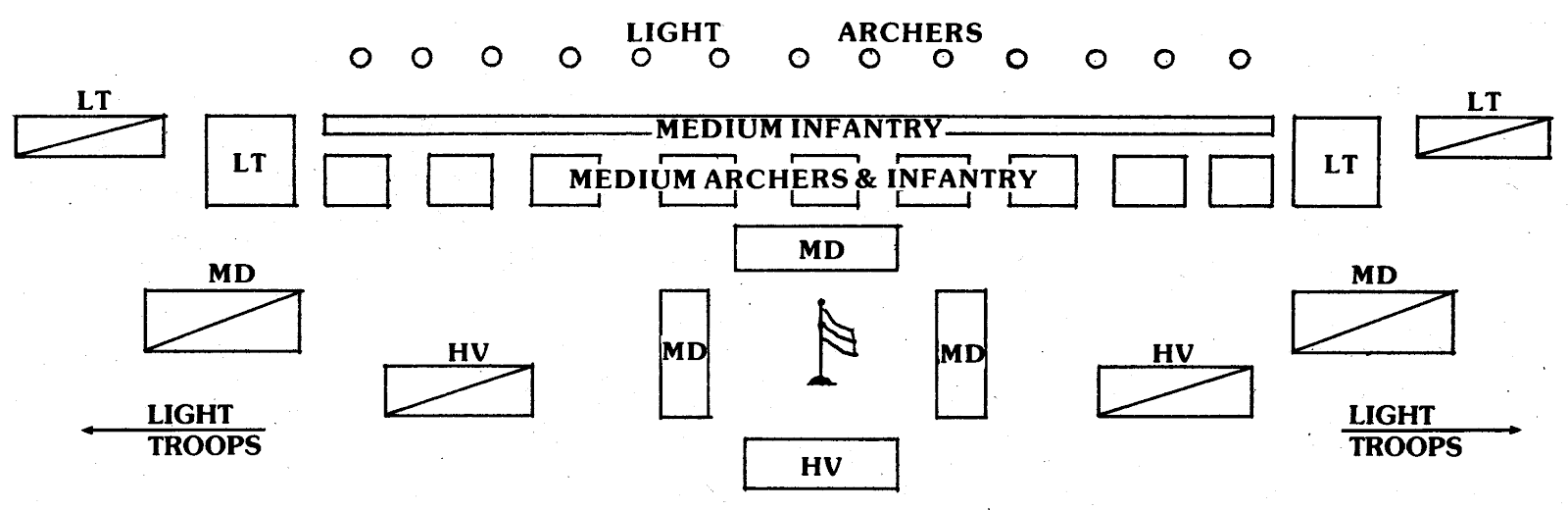
You might remember Lance Harrop from last week’s installment of Dragon By Dragon – this week we’re looking at his “Elvish Tactics in Fantasy Miniatures”. Not surprisingly, elvish tactics are all about speed and maneuverability. Lance gives us the following order of battle:

The light archers, light horse archers and light cavalry are there to harass the enemy. The light archers are protected by the light infantry. The medium infantry are the main line of troops, with the medium archers behind them. The elite heavy infantry are the reserve, and the medium mounted infantry and heavy mounted infantry are fast deployment reserves. The medium cavalry are the shock troops, and the heavy infantry are the elite elvish knights.

As always, Mr. Harrop gives a few notes about elves:

* They use silver to denote rank, not gold
* They do not use red or black leather
* High elves wear blue and white, middle elves green and white, low elves dark green and tan, sea elves sea green and sky blue and dark elves browns and blacks
* Elves are concerned with having a unified front

Next, Gygax sounds off in Up On A Soap Box – in this edition, on manufacturer conventions. You can imagine how fascinating this article is 35 years after it was written.

In Out on a Limb, we present this week’s Great Moments in Nerd Rage:

“This brings me to a point that I didn’t want to write about when I started this letter: spell points. I HAVE HAD ENOUGH OF FORGETTING SPELLS!!!!!!!” – Mark Jacobs

And in response:

“Gee, it’s always so much fun getting letters from unproven critics who think they have some inner track on “the way of things.” As to what may or may not be absurd, let me say this; if you don’t like it, why give me all of this grief? D&D has always made a point of being nothing more than guidelines for structuring a game, and stating so.”

Oh wait – some more:

“Your argument that healing is too slow is specious, and naive. You obviously have never been in a combat situation yourself, nor have you apparently even participated in something such as the Society for Creative Anachronism’s mock battles.”

God, I love this hobby (and God – I hate this hobby).

We now have another installment of The Voyages of Exploration Ship Znutar. An excerpt:

We have next a full board game by Tom Wham – The Awful Green Things from Outer Space. I won’t go into much detail here – the rules look pretty simple, the game is tied in with Znutar above, and I love that they used to do things like this in The Dragon.

Len Lakofka’s Bazaar of the Bizarre presents Potions of Forgetfulness, Rings of Silence, the Horn of Hadies (their spelling, not mine), the Chime of Warning, the Apparatus of Spiky Owns (a play on Spike Jones, God bless him), Leomund’s Plate and Cup, and a slick little guide for generating random magic-user spell books. To whit:

Jon Mattson now gives us “Level Progression for Players and Dungeon Masters”. This is actually a guide to how many XP players and Dungeon Master’s earn for playing different games. I kinda love this – would be a blast to introduce to the blogosphere. I have to reproduce the level charts:

“Giants in the Earth” time! Lawrence Schick and Tom Moldvay (my hero) give us the following literary giants given AD&D stats:

Leigh Brackett’s Eric John Stark (15th level fighter) – I have to admit, I was bored to tears by the one Eric John Stark book I read; they also include stats for Northhounds (4 HD)

Lord Dunsany’s Welleran (A Lawful Good ghost that possesses anyone who picks up his sword)

James M. Ward now gives us “Monty Strikes Back”. He was the original Monty Hall Dungeon Master, you might remember, who gave out tons of great treasure. This is another story of a game played with many of the early entrants into the hobby.

“We were on a winter level tonight and were far from pleased. It was Friday, one of our usual D&D nights and we were going down into a refrigerated level of Monty’s that we had found weeks before. We had all made fur coats for our figures and most of the group was going down. Robert, Jake, and Dave (I) (Tractics boys through and through) were going down as their 20th level fighters; Brian (a tractics lover too, but a fanatic on Western Gunfight) was going as his 21st level thief/fighter/cleric dwarf; Ernie, Dave (II), and I were going down as wizards of the 18th level (just little guys); Freddie was his stupid high level sword carried by a flesh golem from Jake’s golem squadron; Tom and Tim went as druids (probably because they liked all types of herbs).”

In “The Dragon’s Augury”, we have reviews of Divine Right by TSR, Sorcerer by SPI, and a book, America B.C.: Ancient Settlers in the New World by Barry Fell. Still for sale at Amazon, and four stars!

“The Dragon’s Bestiary” gives us Jake Jaquet’s Slinger. Here are the basic stats in B&T format:

Tiny Magical Beast, Low Intelligence, HD 3, AC 17, ATK 1 spine (1d4 + poison IV), MV 60, F15 R11 W15, AL N, XP 300.

These little buggers, which look like iguanas, can throw their tail spines about 20′. They are vulnerable to fire.

Fineous Fingers, Fred and Charly are stealing a Palantir in this issue.

And that wraps up issue #28. It’s always nice to leave with a song, and since Spike Jones was mentioned …

Dragon by Dragon – July 1979 (27)

I just drove in from Cedar City, and boy is my car tired.

Vaughn and Pfundstein – Go watch their play – it is excellent

I use that by way of an explanation for why this post is showing up now, rather than this morning. My daughter and I traveled to the Utah Shakespeare Festival to watch The Taming of the Shrew, starring Brian Vaughn as Petruchio and Melinda Pfundstein as Katherine. It was fabulous. If you get the chance, visit the festival. Now I want to do a Shakespeare edition of Bloody Basic in iambic pentameter. I’m not sure that’s possible, but boy would it be a fun challenge.

And now that I’ve given some love to the USF, it’s time for a review of The Dragon #27, published 36 years ago this month – time for a baby to be born, grow up, and begin yelling at kids born when 4th edition was published to get off his lawn. As he should, the grubby little beggars.

The ads the issue opens up with aren’t new, but I did notice this bit:

Great artifact of the size of the hobby 36 years ago.

The first article in this issue is “Agincourt: The Destruction of French Chivalry”, a game review by Tim Kask. As he writes, “Ah yes, that’s a Dunnigan game.” As in James Dunnigan. As an avid reader of his excellent books How to Make War and The Quick and Dirty Guide to War, this piqued my interest in the game review (I also note that Al Nofi did the historical research – I love his CIC articles at Strategy Page). Kask praises how he makes the game feel like the period, reflecting the fact that the French mostly defeated themselves at Agincourt. He finds it both a very complex game, and a very playable game.

To my delight, the review was followed by an article from Dunnigan himself – “Agincourt: Designer’s Notes”. One extract:

“I would say the single most difficult aspect that I had to incorporate into the design of Agincourt, were the combined arms and doctrine factors that were critical to the outcome of the battle, This is best shown by looking at the rules covering crowding and fugitives and their effect upon morale.”

I note this, because it’s similar to what I try to do with Bloody Basic and articles on fantasy campaigns in NOD (and not always successfully) – how do you interject the feel of the subject you’re covering without making the game needlessly complicated. It brings to my mind the idea of first principals.

Keeping the theme alive, Steve Alvin now writes “The Political and Military Effects of Agincourt on the Hundred Years War”. I love history – majored in it in college – and I know most war game buffs have at least some regard for it, but I wonder how popular articles like this were back in the day. I hope very. I wonder how they would play now?

Get your scissors out, because Jeff Swycaffer‘s article “Elementals and the Philosopher’s Stone” has a full-color cutout. In the article he mentions the four elements of Greek philosophy and the elementals they inspired … and then remarks on the twelve new types of elementals discovered by “a mad philosopher”. These would be the quasi-elementals and/or para-elementals. I can never keep them straight. Swycaffer visualizes the placement of the elementals thus:

“To visualize the placement of the elementals in the scheme of reality, imagine a globe. The equator is divided into eight segments: air, cold, water, moisture, earth, heat, fire, and dry. Thus the circle is complete, with dryness adjacent to air. This is reasonable, as the alchemists of the 1200s depicted the elements in this fashion. Here water is both cold and moist, and both air and fire are dry.

This is merely the plane of the equator, however. At the south pole, evil. Good and evil are the poles of the physical world, and no one element is more evil than good, or vice versa.”

He then goes on to explain how the elements interact with good and evil – these are the qualities, which include pleasure, fertility, beginning, light, ending, darkness, pain and barren. He explains that the “elementals of good and evil” are the demons of Eldritch Wizardry, D&D Supplement III and the angels of Stephen H. Domeman that appears in The Dragon #17. He then goes on to describe, in basic terms, the elementals of qualities. For example:

“ENDING: Appears as a normal human. Closes doors (as a wizard lock), dispels good magic, and curses as an Evil High Priest.”

For those who need to know, the Ending Elemental has 2 HD, movement of 9, does 1d6 damage per hit, has AC 9 (remember, this is old “lower is better” AC), and is friends with air, water and cold elementals.

“From the Sorcerer’s Scroll” this month is by a guest writer – Bob Bledsaw. He created a little something called Judge’s Guild, which produced some of the great little gems of the OD&D era. He covers all the things JG had done at that time for D&D – a nice little bit of horn blowing, but well deserved I think. I liked this quote:

“Ya don’t tug on Superman’s cape, and ya don’t mess around with the play balance …”

Truer words were never spoken.

Next up is an “Out on a Limb”. God, this is classic geek-fight material, and it should surprise nobody that these are the folks that invented the internet. An example, from an extremely long letter to the editor by Ray Rahman of Minnesota. The first paragraph of his letter:

“Upon reading Mark Cummings’ review of Ralph Bakshi’s film THE LORD OF THE RINGS, I became as concerned about Mr. Cummings’ ethics as he was of Mr. Bakshi’s morals. His review of the film begins dramatically with the statement: “Your film is a ripoff! Yes, rip off! I know that the expression has moral connotations, and that you haven’t done anything wrong legally; but I happen to believe that moral obligations often make demands that go beyond the demands of laws. So stay with me for a few paragraphs, and I’ll explain why your film is immoral … Let me start by saying that I’M not an outraged purist.”

Wonderful!

Next up is an ad for Boot Hill, a game I know little about but would love to explore. I’ve been hankering to do a sort of Old West Bloody Basic, but I’m waiting until Grit & Vigor is finished so I can base it on those rules.

Gary Jordan now presents a variant that might delight fans of the recent Marvel movies, “Tesseracts: A Traveller Artifact”. The idea is using these not as a way to confuse mappers (as they had previously been presented to DM’s), but as a boon to the players of Traveller. Really, it comes down to using matter transmitters to move folks around a ship.

Up next is a new cartoon to The Dragon called “The Voyages of Exploration Ship Znutar, A Starship on a Mission of Empire”. I don’t remember this from the era of Dragon magazines I grew up in, so I wonder how long it survived.

Gary Jordan now chimes in with another Traveller article on Star System Generation. This is a scheme for filling hex maps, filling in the presence of planets, star ports, etc.

In the Designer’s Forum, “Divine Right” is covered again (it was TSR’s newest game), by Glenn and Kenneth Rahman (there’s that name again – can’t be a coincidence, can it?).

Lance Harrop now presents “A Quick Look at Dwarves”. This is a long article on how dwarf armies are organized, with an accompanying chart.

Wow – they got into it in the old days, didn’t they. Still, there are lots of great ideas – the dwarven engineers, miners, masons, etc. forming divisions of the army. He adds the following at the end of the article:

On Painting Dwarves: Elite units of dwarves should have white beards (reminds me of the Graybeards units in Warhammer), dwarf armor should be shiny and a mix of metals, dwarves don’t seem to have national colors (“don’t seem” – well, they aren’t real, so I suppose they don’t) but use colors to designate individuals, and whatever you do, don’t make your dwarves too gaudy.

On Dwarvish Tactics: Vanguards always drive towards the dwarf commander, dwarves love to tear into orcs, dwarf morale is very slow to break and dwarves are known to leave the field of battle after their leader is killed, but they do not rout – they just walk off slowly, carrying his body.

The Design Forum continues now with Jay Facciolo writing about “The Emerald Tablet”. This is a miniatures war game published by Creative Wargames Workshop (side note – imagine how many games there are out there that have never been cloned, for good or ill). I love the name. The game was an attempt to make something that was neither too specific or vague, and which incorporated magic into the rules, rather than just overlaying magic atop ancient or medieval warfare. If nothing else, you have to appreciate the cover I found at BoardGameGeek.

It sounds like an interesting take, with each unit in the game begin given one of four orders before the game begins – attack, skirmish, hold or support (another unit). These orders can only be changed during the game by one of the figures representing the players. Interesting idea, and requires a great deal of thought before the game starts. The magic segment of the game requires quite a lot of explanation, and appears to be, if not complicated, then at least engrossing. It even comes with a bibiolography (and a bit of cheesecake)

“Giants in the Earth”, one of my favorite features, comes next. I really need to do something like this myself in NOD – maybe I should let people vote on G+.

This edition includes the following literary giants:

Alan Garner’s DURATHROR (13th level fighter/Dwarvish paladin)

Fritz Leiber’s FAFHRD (20th level fighter/8th level thief) and THE GRAY MOUSER (18th level fighter-thief)

Edgar Rice Burrough’s JOHN CARTER OF MARS (30th level fighter)

Eh – never heard of ’em.

Robert Camino writes “Go Boldly Where No Man Has Gone Before: Expanding Imperium. This is a variant which requires two sets of the game, the boards being connected by eight jump routes which are always charted by the players (whatever that refers to). Love the art!

Great advert comes next, for Tome of Treasures, published by GRP Enterprises of Arlington, VA. The tagline got me “Plumb the depths of the Cube of Time and the Bow of Precognition. Explore the effects on hapless orcs of the Sword of Rout. Gems, jewelry, and 172 brand new, quality magic items are described …”

Jerome Arkenberg now presents “The Mythos of Africa in Dungeons & Dragons. This is one heck of a tricky subject, as treating Africa as though it a single culture is ridiculous. The article presents many gods. For creatures, we get:

“In this category fall: witches, ghosts, were-lions, were-hyenas, and fairies. These are all the same as in the D&D Monster Manual.”

Turns out, we had all the African monsters we ever needed. I have a feeling that either the article was too long and something had to be cut, or the research was just too difficult back in the 1970’s. The article also includes many heroes.

The “Dragon’s Bestiary” presents the Horast, created by Mary Lynn Skirvin. Also known as a “whipper beast”, a very rare creature with a whip-like tail that deals 4d6 damage. This one didn’t make it into the MM, but fear not, for the article ends with this:

“By gracious arrangement with the author of AD&D, Gary Gygax, monsters appearing in this column are to be considered OFFICIAL AD&D MONSTERS.”

So, if you need a monster with a whip tail, D&D has you covered. Officially.

Comic strip time. We have Finieous Fingers (their spelling, not mine), which again includes some nudity of the female variety – D&D was a game for grown-ups, after all.

No, I’m not going to show it this time. Finieous’ butt from the last post will have to suffice.

In “Bazaar of the Bizarre” (the elements are all coming together, aren’t they), Gygax presents the Bag of Wind. Write your own jokes, folks.

Dig the back cover, kids:

Looks like I need to up my game with NOD.

Fun issue, with plenty for D&D’ers and war gamers. Check it out if you can find a copy.

Dragon by Dragon – June 1979 (26)

Two years ago, I was writing a series of weekly blog posts on the old issues of Dragon magazine – something like reviews with a bit of crunch mixed in. And then I stopped. And I don’t remember why.

Well, now I’m starting again. So … journey back in time with me to June of 1979, when the Bee Gees were dominating the charts with Love You Inside Out

Oh – that’s Wanda Nevada. Brooke Shields. Groovy.

Anyhow – into this golden age of entertainment comes Dragon Magazine, Volume III, No. 12 with a kickin’ cover depicting some Napoleonic war game action, and of course much more. Let’s dive right in.

The first thing we’re greeted with is a great full-page Ral Partha advert, noting that “The Little Things Make a Noticeable Difference”. If you’re in my generation of gamers, Ral Partha is just branded into your brain. They were so prevalent in the pages of magazines, and had some great adverts. Honestly, I never messed with miniatures back in the day. I got into the Citadel stuff in late high school and through college, and bought a few Ral Partha minis then, but I really missed the companies hey day. Alas.

On the contents page, we are made aware that this issue marks the beginning of Gay Jaquet’s reign as assistant editor, assisting T. J. Kask, that is. I note this only to point out that TSR appears to be growing.

Another ad now, for the Origins! 79 convention in Chester, Pennsylvania. Do you think the geeks that now trod those halls know the gaming history of the place? Probably not.

https://www.google.com/maps/embed?pb=!1m0!3m2!1sen!2sus!4v1436714251332!6m8!1m7!1scz6zKvyptBHn3Dg5DGMjQA!2m2!1d39.860951!2d-75.353605!3f295!4f0!5f0.7820865974627469

Looks like a cool college – love the brick work. I’m from Las Vegas – we live in a world of stucco and sandstone, so the brick stuff always impresses me. What can I say – I’m a cheap date.

Next, we have a status update on Gencon XII, and a notice that they’re looking for judges and events for the con. We also get a full con schedule, some prices on back issues of The Dragon (back issues are $2.10 a pop, or $6.88 in today’s dollars. Not a bad price).

Oh yeah – and a McLean cartoon involving the confusion between rocs and rocks. I love watching his art style grow in these early issues. There was some solid young talent in gaming back in the day. I wonder what they paid him per cartoon?

Now we reach the first article – “System 7 Napoleonics: Miniatures Meet Boards”, by Kask. I’m not going to delve too deeply into the article itself, which reviews the game System 7 Napoleonics by GDW, which uses cardboard counters in place of miniatures, and is thus cheap compared to using the lead, but I will point this out:

“The problem with establishing a campaign in a college club, whether it be D&D; TRAVELER, or a Napoleonics, is one of continuity. Each semester, some of the stalwarts say goodbye and depart for “the real world.” This can be especially traumatic if one of those departing owns the French Army, or what passed for it in terms of collective club figures.”

Funny to think how wrapped up the game used to be with issues like this. I suppose it still goes on to this day – maybe some college kids could chime in in the comments below and let us know if they still deal with this. Personally, I’m an old fart, and I do my gaming on G+ these days.

This article is followed up by another article on System 7, by Rich Banner (the designer), called “Necessity is the Mother of Innovation”. If you were into this new game, this was your lucky month, because this article is followed up by a Q&A with Banner.

Speaking of GDW (or Game Designers’ Workshop), we are now treated to a full page ad for their new expansion for Traveler, Imperium – Empires in Conflict: Worlds in the Balance. Great title.

From the Dungeon Hobby Shop in Lake Geneva (no longer there, I’m afraid), we have an ad for 4th Dimension, the Game of Time & Space, produced by TSR (sort of – click here for more). Apparently, you play a Time-Lord (does the hyphen grant immunity from BBC law suits?) commanding an army of Guardians, Rangers and Warriors in some sort of board game battle.

Next we get back into some D&D goodness, with “Giants in the Earth”. Great series of articles, giving game stats to literary characters (why don’t I do that in NOD?). This is a particular goody, because we get Jack Vance’s Cugel the Clever (14th level thief, Str 15, Int 18 (56%), Wis 13, Dex 18 (93%), Con 15, Cha 16 – sounds like Vance was cheating on his dice rolls when he rolled up Cugel, and what’s with the percentiles – I thought they only did that with Strength scores in AD&D?), Karl Edward Wagner’s Kane (30th level fighter, 20th level magic-user, 14th level assassin – how many XP would that take?) and Talbot Mundy’s Tros of Samothrace (15th level paladin). I love Cugel, I’ve heard of Kane (but never read him), but Tros was new to me.

Ah – this is included:

Note: For the game purposes of these heroes: Dexterity 18 (00) gives +4 on Reaction/Attacking, -5 Defensive adjustment and three attacks per round for high level fighters. Constitution 18 (00) gives fighters +4.5 per hit die bonus

Oh, and Judge’s Guild (hallowed be their name) was hawking the Treasury of Archaic Names by Bill Owen. Struggle no longer for heroic character names!

Up next, “What of the Skinnies?” by James W. S. Marvin, a Starship Troopers variant. Not going to lie – caught a bit of the movie, never read the book, have never laid eyes on the game they’re referencing here. This might be the greatest article on the topic ever, and I’ll never know it. Moving on.

Edward C. Cooper gives some tips on “The Placement of Castles” in Lord and Wizard. Article aside, L&W sounds like a pretty cool game: “Mighty, magical holocausts, awe-inspiring Dragons, weird and terrible monsters, military battles on a grand scale. Which of the combatants, Order or Chaos, shall win? And can the forces of Neutrality maintain the precarious balance of power . . . An exciting, fast moving game of movement and combat in a fantastic world, where skill and strategy will decide the winner.” Another board game – the RPG’s are still in their infancy, after all, and at this point most RPG’ers have probably come to the game from board games and miniature war gaming. Makes sense.

Joe Curreri writes “35th Anniversary of D-Day Remembered”. There were lots more veterans of that day alive at the time, and their kids were the ones playing all these silly games. The page also has an ad for Lyle’s Hobby & Craft Center in Westmont, Illinois. Sadly, also no longer there.

In the Design Forum, James McMillan writes about “The Solo Berserker for William the Conqueror-1066. This article presents solitaire rules for the aforementioned game, with a little history on the berserkers. He includes the note that Eystein Orre, one of Harald Hadrada’s men, was called “the Gorcock”. If you’re reading this and play a barbarian or berserker in some game, please consider renaming your character “the Gorcock”. For me. For Eystein. For America.

Next up, David Sweet presents game stats for “Chinese Undead”. We have stats for Lower Souls, Lost Souls, Vampire-Spectres, Sea Bonze, Celestial Stags and Goat Demons. Boy, stats were simple in those days:

Also this:

Look out!

Fantasy 15s has a full page ad for 15mm miniatures allowing you to “re-create the mass battles of Middle Earth – at prices you can afford!” I wonder if there’s a source for cheap men-at-arms so fighter lords can do the same thing. The reproduction ain’t great, but the art in the ad is pretty cool …

The next article includes Boot Hill additions, revisions, and triva (!) by Michael Crane. The have a great “Fast Exact Hit Location Chart” that could be useful for duels, but also just combat in general (especially missile combat):

And, because it wouldn’t be a real D&D mag from the old days … “Another View of the Nine-Point Alignment Scheme” by Carl Parlagreco. This article tries to lay out what you can and cannot do with each alignment. Helping people is something Good characters do, apparently, while trusting in organizations is something for Lawfuls. Here are a couple samples:

Chaotic Good … will keep their word to other of good alignment, will not attack an unarmed foe, will not use poison, will help those in need, prefers to work alone, responds poorly to higher authority, and is distrustful of organizations

Neutral Evil … will not necessarily keep their word, would attack an unarmed foe, will use poison, will not help those in need, may work with others, is indifferent to higher authority, and is indifferent to organizations.

I think this is actually a much more useful way to look at alignment that getting philosophical with it, especially for people new to the game. Of course, you need a reward/penalty mechanism with alignment to make these strictures matter.

Next is Kevin Hendryx’s “Deck of Fate”, with illustrations by Grey Newberry. This is a great magical tarot card deck. Characters draw cards, and get magic results based on what they draw. For example:

II – Junon – The Goddess: No effect for non-clerics. For clerics, permanently boosts their Wisdom score to 18 and gains use of one spell of the next higher level.

In other words – it’s a pretty powerful magic item – an artifact really. You could probably make one heck of a quest into a band of adventurers having to retrieve all of these magic cards.

Rick Krebs now provides “D&D Meets the Electronic Age”. Boy, they had no idea. Dig it:

Over the years access to photocopiers and mimeograph machines have aided many Dungeon Masters in copying maps, charts and even publishing their own zines, all to the expansion of their campaign. But, the recent electronics explosion has now brought another tool to those DMs fortunate to have access to them: the micro-computer. We were one of those fortunate groups to gain the use of a 4K (4,000 bit) memory, BASIC speaking microcomputer.

Charles Sagui now writes “Hirelings Have Feelings Too”. It’s a short article that provides some guidelines for paying hirelings to keep them around. According to Charles, hirelings should be payed two years salary in advance, plus a share of the spoils – either an equal share, or a percentage. Non-humans, he says, will not hire on for salary alone – except orcs – but will also demand to be supplied with equipment and weapons to go into the dungeon. Elves, he says, don’t like to go into dungeons as hirelings – they like fresh air and trees too much. They don’t care much for gold, but they will demand a fine cut gem or magic item + 15% of treasure. Dwarves can be greedy at times – they want four years salary and 15% of treasure. And if you try to give a +3 returning warhammer to somebody else, there’s a 65% chance the dwarf will try to steal it. Orcs will go in for one year salary and 2-5% of treasure, and will only work for chaotics. They are prone to run away when confronted with a difficult fight and have a bad habit of killing their employer in his sleep and stealing all his stuff. I guess turn-about it fair play in a dungeon.

Charles also says that hireling NPCs will only go into the dungeon once – after that, they retire to blow their hard-earned gold on “strong drink and their favorite vice.” Once their money is gone, they might go back in with the PC’s – and if the PC’s paid well last time, they’ll be more loyal. Loyalty ratings for hirelings aren’t used much these days, but they were an important system in a time when hirelings and henchmen were the norm for D&D.

Michael Crane also contributes “Notes from a Very Successful D&D Moderator”. This is a chance, he says, for the moderators (i.e. game masters) to share their tips and tricks after many players have shared ideas for beating dungeons. The article is pretty much about one-upmanship between the DM and the players. A nice historical piece, from when the game was (and was supposed to be) a competition between the DM and the players.

Gary Gygax now chimes in with his “From the Sorcerer’s Scroll” with “D&D, AD&D and Gaming”. The article discusses the origins of role-playing games, of fantasy war gaming, and of role-playing within fantasy war gaming. It’s a nice retrospective, and Dave Arneson’s innovation of giving players individual roles to play is mentioned. Gygax also takes pains to explain that AD&D is a different game than D&D – not an expansion or revision. As Gygax explains:

“Where D&D is a very loose, open framework around which highly imaginative Dungeon Masters can construct what amounts to a set of rules and game of their own choosing, AD&D is a much tighter and more structured game system.”

Which also explains why I like D&D better than AD&D. I like my games loose and imaginative. The article lays out the future of AD&D. And then this towards the end:

“For those of you who wondered why I took certain amateur publishing efforts to task, it was because they were highly insulting to TSR, D&D, this magazine, and myself.”

Nerd fights. They never end.

Kevin Hendryx now presents a variant game for D&D in the modern era called “Mugger!”. Welcome to the 1970’s. Technically, it is Mugger! The Game of Tactical Inter-City Combat, 1979. Each player plays a mugger, gaining experience for each successful mugging and gathering loot. The goal is to “… amass as large a horde of experience points as possible while carrying out one’s crimes and eventually gain a seat in the U.S. Congress …” The times, they ain’t a changin’ all that much, are they?

Random encounters include 1d2 cops on their beat, 1d3 roving squad cars, 1d6 tougher muggers, 1d8 street gangs, 1d20 Hare Krishna fanatics and 4d6 stray dogs.

Oh, and you pick up 1,000 XP for stealing 10 kg of plutonium.

Here’s the level chart:

It’s actually a pretty long article, and though tongue-in-cheek would probably be fun to play one night with some friends. It strikes me that the old city map from Marvel Super-Heroes would come in handy on this one.

Lots of articles in this issue. Next is “Birth Tables and Social Status” for Empire of the Petal Throne, by G. Arthur Rahman. EPT was still a major component in gaming in this period, and its generally featured in every issue of The Dragon. It provides a very long table for generating birth and social status, and this translates into skills, spells and the like for the character. Looks good to me.

Apparently, Grenadier was pushing their new line of licensed Gamma World miniatures with a full page ad. You can see some unpainted models HERE and some painted ones HERE.

Len Lakofka’s “Bazaar of the Bizarre” is “Blueprint for a Lich” in this issue. This is an in-depth article on how high level magic-users and clerics become liches, including a recipe that involves 2 pinches of pure arsenic and 1 measure of fresh wyvern venom (under 60 days old). Don’t mix this one up at home, kiddies.

The would-be lich then drinks the concoction and rolls the D%

1-10: No effect whatsoever, other than all body hair falling out
11-40: Come for 2-7 days – the potion works!
41-70: Feebleminded until dispelled by dispel magic. Each attempt to remove the feeblemind has a 10% chance to kill the drinker if it fails. The potion works!
71-90: Paralyzed for 4-14 days. 30% chance of permanent loss of 1d6 dexterity points. The potion works!
91-96: Permanently deaf, dumb or blind. Only a full wish can regain the sense. The potion works!
97-00: DEAD – star over … if you can be resurrected.

First – I can actually use this in the online game I’m running.

Second – awesome random table for generating liches – they’re either a bit paralyzed, could be blind or deaf, or maybe are completely normal. Side-effects are a good idea for major potions.

Gary Gygax now provides tables for “Putting Together a Party on the Spur of the Moment”. This generates a PC party quickly, with tables and rules for generating quick ability scores, level, armor, weapons and magic items. I think this made it into the DM’s Guide. Which DMG you ask – come on, there’s really only one.

Thomas Holsinger provides a “Strength Comparison Table”. He provides a strength table from 0 to 18/00, with monster equivalents, hit bonuses and damage bonuses. It’s inspired by Dave Hargrave’s Arduin Grimoire II. FYI – Leprechauns are stronger than Brownies, and Pixies are stronger than Leprechauns, just in case you were going to run an all-fey remake of Over the Top. (Google it!)

Jeff Neufeld now provides a review of a play-by-mail game called Tribes of Crane (which is mis-written as Tribes of Tome in the first sentence). We also have reviews of Ice War. (Soviet/US confrontation), Mercenary (a Traveller book), The Battle of Monmouth and Grenadier Figure Packs and a very long review of Battle Sphere with lots of cool illustrations.

The Dragon’s Bestiary (formerly Featured Creature) presents the barghest, so you now know which decade to blame for those little bastards.

Next comes “The Adventures of Fineous Fingers, Fred & Charly”.

Who says old school fantasy is all about scantily clad females?

Great article title by Rod Stephens – “The Thief: A Deadly Annoyance”. Amen to that. He laments the misuse of thieves in dungeons, because they’re really meant for urban environments, where they can steal from high-level NPC’s and other players – because PC’s have more money than just about anybody in the game. He isn’t wrong.

We finish up with some full page ads for GenCon XII, TSR’s new game Divine Right (notes that T.M. Reg. has been applied for – so don’t try anything funny) and Space Gamer (subscribe to get a free game – Ogre, Chitin I, Melee, WarpWar or Rivets).

A packed issue, and a reminder that The Dragon was a full-bodied gaming magazine at the time, and not just TSR’s house organ.

Hope you enjoyed the review – have a happy Sunday and a great week ahead.

Dragon by Dragon – May 1979 (25)

May 1979 – the author of this post was 7 and about 5 years away from discovering Dungeons & Dragon. Let’s see what I was missing …

First and foremost – awesome cover. Well done!

A Part of Gamma World Revisited by James M. Ward

Not exactly a title one can conjure with, but the article itself is probably useful to most Gamma Worlders. It covers the history behind the Cryptic Alliances, and might be helpful for campaign play. What I found interesting was the geography of the alliances:

Brotherhood of Thought – started at the University of California, but spread up and down the west coast and into the Rockies.

Seekers – The Seekers are Texans

The Knights of Genetic Purity – don’t say

Friends of Entropy – headquartered in Lincoln, Nebraska

The Iron Society – they’re found in all bombed out areas – seems like Pittsburgh would have been a great headquarters

The Zoopremists – started in the mountain range near Torreon, Mexico

The Healers – Duluth, Minnesota

Restorationists – Boston and Providence

Followers of the Voice – their most successful group is in an underground base in the Appalachians south of Charleston and west of Raleigh – they’re led by a bunny-girl (i.e. female hoop)

Ranks of the Fit – began near Memphis, Tennessee by a circus bear who had its mental faculties increased a thousand fold; their civilization has spread as far north as Cincinnati and as far south as Baton Rouge, presumably along the Mississippi River and its tributaries.

The Archivists – mountains between Butte, MT and Billings, SD and Idaho Falls, MT

Radioactivists – based below Atlanta in the flattened peninsula that was Florida

The Created – have surrounded St. Louis with warbots

Judging and You! by James M. Ward

This is a collection of tricks of the game judging trade, especially for Gamma World and Dungeons & Dragons.

The Tug of the Machine by Allen Evans

A bit of fiction. One column’s worth. And I can’t copy paste it. Sorry.

The Armada Disasters

This is a nice history of naval operations and the clash of nations in the 16th century, and most particularly about the Spanish Armada and its disastrous clash with the English.

From the Sorcerer’s Scroll: The Proper Place of Character Social Class in D&D by Gary Gygax

This covers the introduction of social classes to characters in D&D. It mentions that the initial idea came from MAR Barker’s Empire of the Petal Throne. Gygax points out that Tekumel has a well-thought out culture and social structure, and the lack (or possible lack) of such a structure in D&D makes using social class problematic. He suggests a very simple table for determining social class:

01-75 – Common background
76-95 – Aristocratic background
96-00 – Upper class background

He then goes on to question the use of birth tables and social class, and I have to agree. I suppose if a campaign focuses on social class and the interaction within classes and between classes – something like you’d get in Flashing Blades – it makes sense. If you’re doing the whole Conan thing – plundering tombs and such – I don’t see much point to it.

Armies of the Renaissance by Nick Nascati

Part III of this series, this one covers the Condotierre and The Papacy. Great introduction:

“If Woody Allen would ever decide to turn his comedic talents to writing history, the result would very probably read like a history of Italy in the Age of the Condotierre. Few periods in history could possibly be as full of petty squabbles and pointless maneuvering, as this age when greedy, mercenary captains controlled the destiny of the Italian City-States. Warfare was formalized to the point where it almost became a life-size chess match, with few fatalities. However, their military system does assume a certain importance in our study of the period.”

Well worth the read for wargamers doing this period.

Would the Real Orc Please Step Forward? by Lance Harrop

Here’s an interesting article subtitled “Dealing with the Proliferation of Orcish Miniatures”. Interesting for two reasons.

One is that it covers “orc genealogy and taxonomy” – always fun to see somebody dissect make-believe like that. Lance draws a family tree of evil humanoids, putting orcs, ogres, kobolds, hobgoblins and goblins all on branches of that tree, with hobgoblins and goblins forking off from the same branch. Pretty standard idea these days, maybe kinda new in those days. He then lays out some ideas on how to take this system and use it when selecting miniatures, since back in the day miniatures were a bit more generic – i.e. an ugly humanoid miniature could just as easily be used as a kobold as it could for a goblin.

The other interesting thing about this article is that there was a need to deal with the proliferation of orcish miniatures. I’m guessing that nerds in the Middle Ages were worried about similarly silly things – it runs deep in our breed.

He also provides a picture of several of the miniatures of the day …

Finally, he provides this guide to wargaming with orcs:

1. All goblin races dislike the sunlight, so lower their morale in the daytime.

2. Kobolds and Gnomes will almost instantly attack each other, so have them make obedience checks when they are in charging distance. The same with goblins and dwarves and lesser orcs and elves. Great orcs, man orcs, ogres and hobgoblins will not generally disobey.

3. Orcs of different tribes will also attack each other, as will all goblin races, but powerful leaders can keep them in check, so adjust the die roll against the level of the leader.

4. Usually only great orcs and man orcs will fight in formations, the others will fight en masse.

The Traveller Navy Wants to Join You by R. D. Stuart

An article that covers new career opportunities in Traveller. I don’t play Traveller, so I don’t know that I can comment on how well these are written, but I bet it would come in handy if you were doing a Star Trek-esque Traveller campaign.

Gamma World Artifact Use Chart by Gay Jaquet

This article swaps out the artifact use charts in Gamma World for a more complex and abstract system. Personally – I’ll stick with the charts. I think they’re fun.

An Alien in a Strange Land by James M. Ward

Ward wrote quite a bit for this issue, huh?

This is a bit of Gamma World fiction that seems to be taken from actual play:

“Blern had left those mutated fools of Entropy with an organization that should last until the time it decided to return and take over again. Riding off, on a very reluctant Brutorz, had carried with the act a certain satisfaction in a finished job that was well done. The miles were quickly eaten up under the hooves of the Brutorz and soon Blern was in territory that it had never visited or heard about before. Days passed into a sort of boredom that was unusual for the mutant. It got so that it was wishing for an attack by anything, just to break the monotony, and almost with that thought, Blern spotted the group.”

Excerpt from an Interview with an Iron Golem by Michael McCrery

Interview with a Vampire was written in 1976 – I’m wondering if this article was a play on that. Either way, this one reminds me of the skits that appear in the last 15 minutes of Saturday Night Live. Essentially, another piece of fiction drawn (I’m guessing) from actual play.

War of Flowers by William B. Fawcett

Another nice wargaming article, this one on the Aztecs. I like this bit …

“The Aztec “empire” was in fact a conglomeration of city states that formed rather fluid coalitions which were normally centered on the most powerful cities found in the area of present day Mexico City. In these coalitions there were normally one or two major powers who, by their size and military strength, were able to compel the lesser cities to join in their efforts. When a city was ‘conquered’ the result was the imposition of tribute and economic sanctions rather than social or political absorption, as occurred in Europe or China. This tribute was reluctantly paid to the victorious city only until some way to avoid it was found (such as an alliance to an even more powerful city). Any political or military alliance was then ruled entirely by expedience, and quickly and easily dissolved.”

This is pretty much how I envision all the city-states in NOD. Why? Better for game play in my opinion.

Xochiyaoyotl by Neal M. Dorst

This is a concise set of rules for Pre-Hispanic Mexican wargaming.

Varieties of Vampires by R. P. Smith

This article tackles all the various vampire legends from around the world. It suggests using the same basic game stats for all vampires, but then adds different move rates and environments for the different vampire legends, along with descriptions:

Asanbosam (Africa): Men (9 hit dice), women (8 hit dice), or children (7 hit dice) who look normal except for a pair of books instead of feet. They can charm at minus 3, (except against clerics, whom they avoid) and can throw a single sleep spell per night. They can call 3-18 leopards or 2-12 tigers. Only a cleric can kill the asanbosam.

Burcolakas (Greece): It has a swollen, tense, hard skin. It can scream once per night which deafens all in hearing range for 24 hours, no saving throw. It can also kill, not only by draining life levels, but by naming its victim by name and commanding the victim into a fatal action. It can imitate any voice it hears, with as much of a chance of being detected as an assassin has of being discovered in disguise. It controls 10-100 rats, but no wolves. To defeat: cut off and burn its head.

Great idea – wish I’d thought of it. My favorite bit from the article … “Hence, any body left unguarded without a Bless spell from a cleric will become a vampire within seven days.” Use that rule, and I promise the cleric will hold onto those bless spells. Nobody needs that stupid henchmen you used for cannon fodder coming back to haunt you as a vampire.

To Select a Mythos by Bob Bledsaw

This article covers creating a mythos for one’s campaign. I like that he pushes a “screw reality” concept and chooses fun over strict realism.

Arms and Armor of the Conquistadores by Michael H. Kluever

Another article about fighting on Old Mexico. This one gives a history of the Spanish conquest and then describes the weapons and armor of the different troops.

Not a bad issue. Like the vampire article quite a bit, could have done without so much fiction. The “helpful tips” stuff is helpful for folks new to gaming – not so much for an old fart like myself. If I was doing some Aztec vs. Spanish wargaming, this issue would have really been a boon.

Okay folks – see you tomorrow when I have a new goofy character class you might enjoy.

Dragon by Dragon – April 1979 (24)

April of 1979 – those heady days of stuff that was happening and things and stuff. Okay, I’m too lazy at the moment to look up what was happening back then, but hey – who cares, right? We know the Dragon was happening, so let’s focus on that.

What did the Dragon have to offer in 1979? More importantly, can we use any of this stuff now?

Lost Civilizations (A Fantasy Supplement for Source of the Nile) by J. Eric Holmes

When you see Dr. Holmes as the author, you know you’ve got some quality material in your hands. Hell, I’ve never even played Source of the Nile and I know this article has to have something useful in it. The article is all about adding some fantasy to the more realistic game of African exploration, specifically of the sort you might get in an H. Rider Haggard or E. R. Burroughs novel.

First up, I love the list of explorer types used in Source of the Nile: Missionaries, Doctors, Zoologists, Geologists and Adventurers. If you were doing an RPG of Victorian exploration, you have your class list right there.

His idea is that when you enter a completely uninhabited hex, there is a chance of it containing a lost city (a roll of 2-3 on 2d6). If in a desert, the city is uninhabited. Otherwise, it is inhabited by survivors of lost Atlantis. The people use bronze weapons and wear ornaments of gold and gemstones, and then you roll dice to determine the city’s organization. Roll 1d6; on a 1-3 the city is ruled by a warrior-king with 1d6 x 1d6 x 1d6 + 10 warriors; if the roll is 4-6 it is ruled by an evil high priest and a white goddess who command 1d6 x 1d6 x 1d6 + 5 warriors. I include this bit because it could be adapted to almost any hex exploration style fantasy game.

When exploring an uninhabited desert city for treasure, you roll 1d6: 1-2 he discovers that the ancient gods still live, his expedition is destroyed and he escapes completely mad; 3-4 traps kill half his askaris and bearers, but he escapes with a bag of diamonds and rubies worth $500 and the secret passages are closed off forever; 5-6 he loots the city for $1000 worth of gems and $200 worth of gold.

This brings to mind something I once did for a game. I was starting with characters above 1st level, and they were from various places in my campaign world (Nod – you might have heard of it). For each character, I came up with one past adventure for each level, each adventure leading them from where they were born to where the adventure was to start. In this way, I gave each player a bit of knowledge about the campaign world and some cool tidbits about their characters. Something to consider.

Keeping the Magic-User In His Place by Ronald Pehr

A classic of old Dragon (hell, a classic of modern articles as well, in as much as it addresses the idea of “balance” between characters). Ronald includes a few ideas of controlling these damn wizards so they don’t mess up the game. Interesting, because it introduces the idea of forced fairness to the game – i.e. I want the game to go one way, but the rules aren’t allowing that to happen. Think of the article previous – the explorer explores a lost city and you roll a dice and that determines what happens – amazing wealth or complete insanity. That’s it. Why? It’s a game, and those are the rules, and playing the game is more important than winning. Or, to state it another way, winning or losing should be a product of the game experience, not a preconceived idea that the game play must support. Why not have wizards who “ruin” the game with fireballs and charm spells? Let everybody have their time to shine, and play it smart. A fireball is a tricky thing, and over reliance on them might be a wizard’s undoing.

Chinese Dragons by David Sweet

One day, these fine monsters will appear in the Fiend Folio, and they were always pretty cool. In fact, it might be fun to do something similar with occidental dragons, replacing the red-blue-green-etc. dragons with ones based on the famous dragons of European myth.

Another Look at LYCANTHROPY by Jon Mattson

This article throws in the idea of different types of lycanthropes that a bitten character might turn into. They are as follows (in summary):

A. Turns completely into the lycanthrope that bit him; i.e. new alignment, etc.
B. Remains in human form, but takes on the mentality of the lycanthrope.
C. Character takes lycanthrope form, but retains his own mentality.
D. As A, but only changes under a full moon or great stress.
E. As B, but only changes under a full moon or great stress.
F. As C, but only … well, you know.
G. Under full moon or great stress, changes into a hybrid of beast and man.

Under option G, he actually writes, “This may sound something like the “Incredible Hulk,” but that is the general idea.” Love it.

There is also a percentage chance for figuring out the character’s new alignment. The new lycanthrope has half the character’s spells and abilities while in lycanthrope form and some modifiers to his ability scores.

Another great quote:

Note: To many people it may seem strange that a wolfs constitution would be better than that of say a bear, but remember that wolves often survive through incredible hardships such as hunger and cold, and I’ve yet to see a bear do as well.

What the?

Ultimately, this is a pretty cool article as it allows the chance that a PC can remain a PC and an interesting party member even after succumbing to lycanthropy.

Roman Military Organization, A Classic Warfare Update by Gary Gygax

An interesting article on the organization of the Roman army.

A Viking Campaign in the Caspian Sea by James E. Brunner

This is a nice history of an actual (well, I assume actual) Viking foray into the Caspian Sea for plunder. A sample:

“In the tenth century the Caspian Sea lay like a great pearl in an ocean of endless steppes and towering mountains. The prows that cut its placid waters belonged to poor fishermen and merchants from every land. Unlike the Black Sea that lay to the west, no northern pirate fleets had ravaged its shores and carried off its great wealth. To the north and the east lay the powerful Khazar Khanate whose capital, Itil, on the Volga Delta, controlled the major trade route to the north. Any merchant or pirate that sought wealth in the Muslim lands to the south had first to deal with the Khazar Khan, whose greed was legendary.”

Primarily interesting to me as it reminds me of Howard’s Vilayet Sea and the adventures had in and around it. When you find fantasy that interests you, take the time to find the reality that underlies it. You might find it even more inspirational.

The article also includes rules for fighting the Battle of Barda’a using Classic Warfare.

The Melee in D&D by Gary Gygax

Here, Mr. Gygax offers up some thoughts on how melee combat is supposed to work in D&D, specifically it seems to answer the complaints of folks who would like more realism in the system. A few important points:

– The game is mostly about creating fantasy personas and their adventures, and that means more than just fighting

– Hack and slash shouldn’t be the first resort of characters

– The system isn’t too unrealistic – it’s built to ensure relative speed of resolution without bogging the ref down in paperwork or creating a high probability of character death

Here’s a bit I found interesting:

“Don Turnbull stated that he envisioned that three sorts of attacks were continually taking place during melee:

1) attacks which had no chance of hitting, including feints, parries, and the like;

2) attacks which had a chance of doing damage but which missed as indicated by the die roll; and

3) attacks which were telling as indicated by the dice roll and subsequent damage determination.

This is a correct summation of what the D&D melee procedure subsumes. Note that the skill factor of higher level of higher level fighters — as well as natural abilities and/or speed of some monsters — allows more than one opportunity per melee round of scoring a telling attack as they are more able to take advantage of openings left by adversaries during the course of sparring. Similarly, zero level men, and monsters under one full hit die, are considered as being less able to defend; thus, opponents of two of more levels of hit dice are able to get in one telling blow for each such level or hit die.”

An article well worth the read.

DUNGEON – More Variations on the Theme by George Laking

This is a collection of extra rules for the DUNGEON game. Since it’s being published again, this might be a good article for folks who love it.

Armies of the Renaissance by Nick Nascati

This is the second part of an article from last issue (I think – too lazy to look at the moment). It covers The Swiss. I’ve long thought the Swiss would be an excellent folk on which to model dwarf armies.

Narcisstics by Darrel Plant and Jon Pitchford

Some monster humor of the disgruntled geek variety, statting up jocks and their female groupies as monsters. I’d convert them to B&T format, but the format in the article is hard to make out, and frankly they’re not just worth it.

Psionics Revisited by Ronald Pehr

This variant takes some of the random chance out of the powers psychic characters receive, tying them more closely to their professions (or so the article says). It appears to divide the powers into two categories: Cognitive Powers and Kinetic Powers, adding a few new powers to the game.

Disease by Lenny Buettuer

This is a set of tables for determining how long it takes a disease to kill a person, and what symptoms are suffered in the meantime. The fatality interval goes from immediate to 10 months, based on a percentile dice roll. Another table determines how many symptoms are suffered and a third what those symptoms are. Honestly – a great idea and one I wish I’d thought of. After all, why do I care what the disease is called? All I want to know is how long the adventurer has to live (more on this below) and what happens to him until he can receive healing.

The other thing I got from this article is the point of diseases in the game. There are many ways to die in D&D, and each should offer up different challenges to the players. Disease in this case becomes a race to be cured.

Bergenhome ’77: the CAT’s Test of American Armor by Stanley Schriefer

If nothing else, this article presents an interesting moment in the history of the magazine. The article is about how well American armor (as in tanks) did in a NATO competition. No stats here. None. Not tied to any game. Just military news that might be interesting to wargamers.

The Return of Conan Maol by Paul Karlsson Johnstone

Weird little article about bagpipers and such.

Choir Practice at the First Church of Lawful Evil (Orthodox): The Ramifications of Alignment by Lawrence Schick

Another interesting article about the three-tier alignment system and their relationship to gods and the powers of those gods. It also divides the three alignments into several “sects” or versions of each alignment. Lawful, for example, is divided into the following:

(A) Absolute Order (High Law)
(B) Harmony/Goodness
(C) Justice/Vengeance
(D) Knowledge
(E) Evolution (Social Darwinism )
(F) War

It then gives information on each of these versions of alignment – its tenets, its practitioners, it’s prime deity. Here’s one example:

Law: JUSTICE/VENGEANCE (Monks, Paladins, Assassins)

Tenets: Good (Law) must be rewarded and Evil (Chaos) must be punished. All creatures are judged impartially by weighing their “good’ and “evil” deeds. Transgressors will be punished according to the depth of their depravity. Criminals must be diligently pursued until brought to justice. (Examples of this alignment’s enforcers might include Solomon Kane, The Shadow, Mr. A., and Javert.)

Prime Deity: MARLY
AC: -4 HP: 300 MOVE:24”
MAGIC: Standard plus See Past plus Detect Truth/Lie.

Honestly – one of the most usable alignment articles I’ve yet read. A great take on the subject, and quite usable. Bonus: Nice piece of art!

Naming People, Places and Things in Petal Throne by G. Arthur Rahman

This article provides a random table for generating the rather non-European names common to MAR Barker’s campaign world.

Monty Haul and the Best of Freddie by James M. Ward

Another adventure in the annals of Monty Haul. A sample:

“The Bronze Dragon was of tremendous size for its breed, measuring over 80 hands long and able to rear to a height of more than half that. The creature had gleaming claws as sharp and damaging as scimitars; buffed with gold dust. Its fanged jaws were kept sharp by biting heavy platemail vests that were a part of its horde. Its massive scaled body rested regally on an altar made of its own gold and silver. Chalices of platinum and coffers of gems and jewels were all about, arranged to please the delicate sensibilities of the dragon. Its giant eyes, that had been but a moment before closed in dragonslumber, opened, aware of the tread of footsteps down the echoing marble corridor, designed for just that echoing effect.”

In Defense of Extraordinary Characters by Rodford E. Smith

A very quick bit about why high level characters make sense, giving as examples from literature Odysseus, Daedalus, Hercules, John Carter, Conan and “everyone’s favorite Kryptonian.” So there you go.

The Society for Creative Anachronism by Allen Hammack

An overview of the society and their doings. These days, this would be what we term a “web page”.

And there you have the April 1979 issue of The Dragon. Not a bad issue all told, with at least two or three articles that I think most folks would find useful.

Dragon by Dragon – March 1979 (23)

I haven’t delved into an old Dragon for a while, so I thought tonight was as good a night as any to do a new “Dragon by Dragon”. What does March 1979 have in store for us?

I often like to start with an ad, and this one has a dandy for Fourth Dimension, the game of Time and Space. You get to play a Time Lord in this one, with an army of Guardians, Rangers and Warriors. No dice in this game – all about the strategy.

In terms of articles, the first one up is about playing EN GARDE! (love the days of capitalized game names) as a solitaire game. Folks might find a use in the Critical Hits table.

Die Roll. Result (Damage Points)
1-10. Light Leg Wound (Base 20 + 16-sided die roll)
11-20. Light Left Arm Wound (Base 20 + 16-sided die roll)
21-30. Light Right Arm Wound (Base 20 + 16-sided die roll)
31-40. Light Head Wound (Base 20 + 16-sided die roll)
41-50. Light Body Wound (Base 25 + 16-sided die roll)
51-60. Serious Leg Wound (Base 50 + 120-sided die roll)
61-70. Serious Left Arm Wound (Base 50 + 120-sided die roll)
71-80. Serious Right Arm Wound (Base 50 + 120-sided die roll)
81-90. Serious Head Wound (Base 50 + 120-sided die roll)
91-99. Serious Body Wound (Base 100 + 120-sided die roll)
00. DEAD

Love the 16-sided dice and 120-sided dice – not sure how that was accomplished, though I’m sure a dice whiz can inform us in the comments. If modifying for use in “traditional fantasy games”, you could maybe replace “Base 20 + 16-sided die roll” with 6 + 1d6 or something like that.

Next is some fantasy fiction by Gardner F. Fox – “The Thing from the Tomb”. The first paragraph goes thus …

“Niall of the Far Travels reined in his big grey stallion, lifting his right hand to halt the long column of riders who followed him across this corner of the Baklakanian Desert. In front of him, and far away, he could make out a dark blotch on the golden sands toward which he was
moving.”

Jeff P. Swycaffer presents “Mind Wrestling”, a variation on psionic combat. To be honest, I still regret not throwing in a psionics appendix into Blood & Treasure. The idea here is that two people are attempting to push a cloud of power suspended between them into their opponent’s mind. The system uses a double track to represent the “field” of combat. Attackers secretly declare an outside or center attack, defenders secretly divide their Psionic Strength between outside and center defense, and then the attacker’s Psionic Strength (+40 or doubled, whichever is less) is compared to the defender’s strength. If a ratio of 2:1 is achieved, the marker is moved one space. If a ratio of 3:1 is achieved, it is moved two spaces. The attacker then has his psionic strength returned to normal and loses 3 points, and the defender loses twice as many points as his marker was pushed back. Simple system, and would probably be a fun game-within-a-game, especially for psionics-heavy campaigns.

Carl Hursh has rules and guidelines for water adventures on the Starship Warden. Lots of monster stats, including craboids and gupoids.

Michael Mornard presents notes on armor for fantasy games, maybe the first article to talk about how D&D armor and weapons is heavier than real armor and weapons.

Gygax’s Sorcerer’s Scroll presents the random generation of creatures from the lower planes – always a fun one, and I highly suggest people use it when sicing demons of various types on their players. You can either use it to generate additional “types” of demons, or use it to alter the appearance of existing types.

James M. Ward presents an article I’m excited about – Damage Permanency (or How Hrothgar One-Ear Got His Name). This system is used when a person is reduced to 1 or 2 hit points. When this happens, there is a 50% chance of no permanent damage, a 20% chance of needing magical healing to heal properly, and a 10% chance of being maimed unless wish or a 5th level or better clerical healing spell or device is used.

What follows are a number of tables – one to determine the area of the body damaged, and tables for each body location to determine what happens. Head damage, for example, is as follows:

1-12 Hearing Loss
13-24 Sight Loss
25-36 Speech Impaired
37-48 Charisma Impaired
49-60 Intelligence Impaired
61-72 Wisdom Impaired
73-88 Fighting Ability Impaired
89-100 Spell Ability Impaired

Of course, more detail follows. “Spell Ability Impaired” mean that the person loses one level of spell ability – i.e. a 3rd level magic-user would have the spells of a 2nd level magic-user.

The Design Forum features “Dungeons and Prisons” by Mark S. Day. Essentially, it covers the idea that dungeons should have some prison cells, and gives a few notions about how one might use them.

And that does it for Dragon in March 1979 – a useful little issue. One parting shot …

Ah – the good old days were just getting started in 1979!

Soon, I’ll review the latest adventure offering from Tim Shorts – Knowledge Illuminates!