Generations

In my day …

I made a little post on Google+ today about an ancient Roman aqueduct recently found via a secret door in a chapel. I commented that had elves been real, they would have found it a long time ago, in reference to the ability of elves to detect secret doors more easily than humans can. My buddy Luke commented that, if elves were real they’d probably just remember where the door was located. It was a good point, and one that’s worth thinking about. So, let’s do a little experiment …

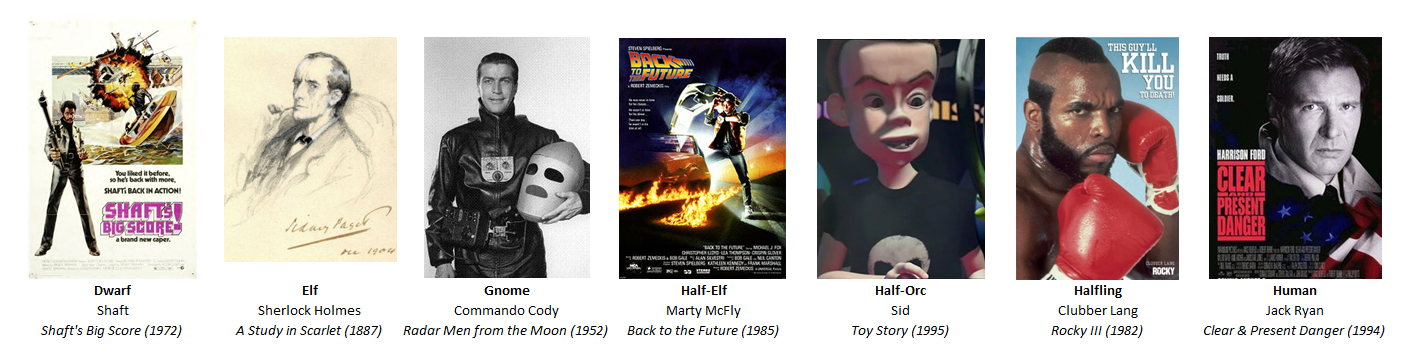
Let’s take some average adventurers from the “core” races as starting adventurers and treat each of them as an action/adventure hero from a movie or book published in the year they were “born”, using 2012 as our current year.

Then, we’ll look at some major event from world history and see how much these characters and their parents and grandparents experienced.

Our team of first level adventurers might look something like this …

That’s a pretty divergent group. The half-orc and humans are the young punks of the group – Gen Y, who never lived without a computer or cell phone. The halfling and half-elf are products of the ’80s and ’90s – Gen X. All in all, those four a pretty close to one another and probably speak the same language – after all, culture doesn’t change so quickly in the faux-Medieval settings embraced by most fantasy games.The dwarf, on the other hand, is going to be a bit less modern in his sensibilities. From the perspective of the human and half-orc, the gnome is practically from another century, and the Victorian elf is a relic in his manners and language. And these are all first level characters (which does bring up a problem of the whole “different life spans” thing in the game, which we’ll happily ignore for the purpose of this article).

Imagine the life experiences they have to draw upon, these characters. Imagine how their manners and mores will clash. They’re all first level, but the dwarf and gnome have to regard the others as young punks, and the elf has to feel a bit superior to them all.

Side Note – This makes me picture elves as a bunch of Doctor Who’s … wearing all sorts of odd fashions and using odd phrases because they remember when they were hip and still see them that way.

Another way to think of it … The human and half-orc are 4th edition D&D, the halfling and half-elf 3rd edition, the dwarf grew up on Moldvay/Cook, the gnome played wargames and the elf plays pinochle.

What They Know

Most of us have a good grip on the history we’ve lived through, and have heard the stories from our parents and grandparents about the history they’ve lived through. We might have also heard a few tidbits second hand about things our grandparent’s grandparents lived through. When you bring super long lifespans into the mix, this opens up a vast amount of historical knowledge to the average party.

Click to increase size; numbers represent the generations

In other words, “Who needs to hire a sage when you have an elf around?”

Generations

Thinking about the way these generations overlap brings up interesting prospects for a first level party. The elf, for example, may have known the humans great-great grandfather, and might easily be the father of the half-elf, who is the issue of a wild May Day fling of the human’s grandmother.

Nomes – New Race

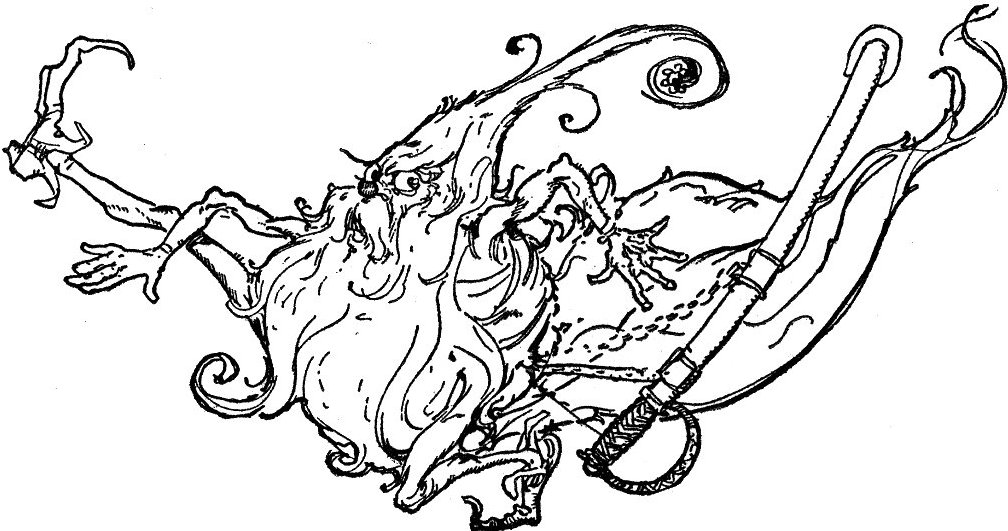
Illustration by John R. Neil, 1921

The nomes are akin to the fey oumphs, and dwell underground with them, sometimes cooperatively, but just as often in opposition. They are natural miners, with eyes that can pierce the blackness of the underworld as easily as human eyes can pierce the daylight; however, in light they are just as blind as a human is in the dark, and must shroud their eyes or use spells of darkness to see even dimly.

Nomes are short, standing only 2 to 4 feet in height (1d3+1). They have spindly arms and legs and skin that ranges from flinty grey to rust brown in color. Their eyes, like little black beads, sparkle in light or dark, and give them a look of conspiracy. Nomes are easily agitated and can fly into a rant or a rage at the drop of a hat, though the more adventurous of the race are moderately better at controlling their temper. They cover themselves with tattoos (really more akin to engravings), and from these tattoos they draw mystic powers.

Nomes adventure in search of “the mother lode” that will make them wealthy and powerful. They adventure with a mind to one day constructing a grand fortified mine, settling down, having children and amassing an army of nomes to do their bidding. They call this “the plan”, and most things they encounter are either “all part of the plan” or “not part of the plan”. When a nome is happy, they’ll muse that, “oh yes, the plan is coming along nicely”. The fact that most folk do not know what “the plan” is, paired with the conspiratorial look in their eyes, makes most people suspicious of nomes.

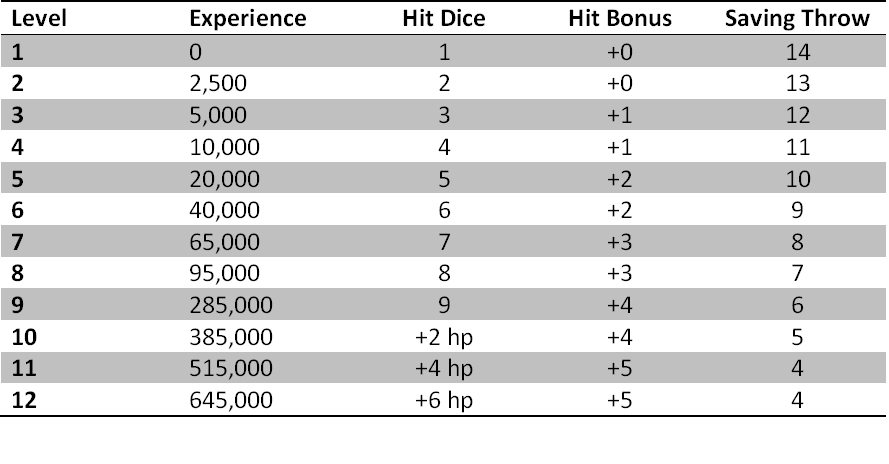
NOME ADVANCEMENT
.nobrtable br { display: none }

Level Experience Hit Dice Hit Bonus Save
1 0 1 +0 14
2 2,000 2 +0 13
3 4,000 3 +1 12
4 8,000 4 +2 11
5 16,000 5 +2 10
6 32,000 6 +3 9
7 64,000 7 +4 8
8 128,000 8 +5 7
9 256,000 9 +6 6
10 350,000 9 +2 hp +7 5
11 450,000 9 +4 hp +7 4
12 550,000 9 +6 hp +8 4

RACIAL ABILITIES
As mentioned above, the nomes can see without light, but do not see well with light. In bright light, they must fight blind unless they have their eyes well shaded, and even then suffer a -1 penalty to hit. Their skin is tough and thick, and provides them a +2 bonus to AC. Nomes have a knack for noticing odd stonework and construction, as well as a knack for finding more cunning traps, picking locks, and sniffing out deposits of copper, silver and gold. Their small size prevents them from using large weapons. Finally, nomes can sense vibrations in the stone, and thus can only be surprised on a roll of 1 on 1d10 while underground.

CLASS ABILITIES

Prime Requisite: Constitution, 13+ (5% experience bonus). Nomes are tough little buggers.

Hit Dice: 1d6+1 (2 hp per level after 9th level). Nomes live a rugged lifestyle, and often come into conflict with other species underground (due to the need for living space as much as their irascible personalities). They are not as militant and well-trained, though, as the Oraenca.

Armor Restrictions: Nomes can use any type of armor, though they prefer to avoid heavy armor because it makes movement through the underworld more difficult.

Weapon Restrictions: Nomes can wield clubs, daggers, flails, maces and swords without trouble. Axes and spears require the use of two hands, and two-handed swords and pole arms are just too large for them. They can use any ranged weapon, but prefer crossbows and slings.

Special Abilities: Nomes are magical folk, though not as skilled as the Caledjula or Nif in the working of spells.

Nomes can use cantraps (level 1 to 3 spells) without any difficulty and using the normal magic rules.

Nomes can cast invocations (level 4 to 6 spells) only by engraving sigils into their skin. These spells can only be spells that affect the nome personally, and once engraved, they can be invoked at any time using the normal spell check mechanism but with a +2bonus to their spell check.

Personal Invocations: Armor of Deflection, Ghost Walk, Touch of the Mystic, Viper Strike

Nomes can likewise work rituals (level 7 to 9 spells) into their skin, powdering the necessary gemstone into their engravings. They must re-apply the crushed gemstone once per month to keep the sigil active and energized, but while it is energized, they receive the same +2 bonus to their spell checks.

Personal Rituals: Body of Fire, Change Form, Consume Soul, Mindshriek, Temporal Abstraction

Nomes are doughty men and women, and their irascible personalities are not inclined towards fear. Whenever a nome must save against fear, there is a 3 in 6 chance that they ignore the fear effect and instead fly into a raging fit. While throwing this fit, the nomes focus their attacks (and are unable to use spells) on the source of the fear. They gain a +2 bonus to hit and damage for 1d6 rounds plus their constitution bonus. At the end of their fit, they are exhausted and must now roll their saving throw against fear.

Needless to say, folk who know nomes well take great pains to avoid startling them.

The Dark Demi-Humans [Art]

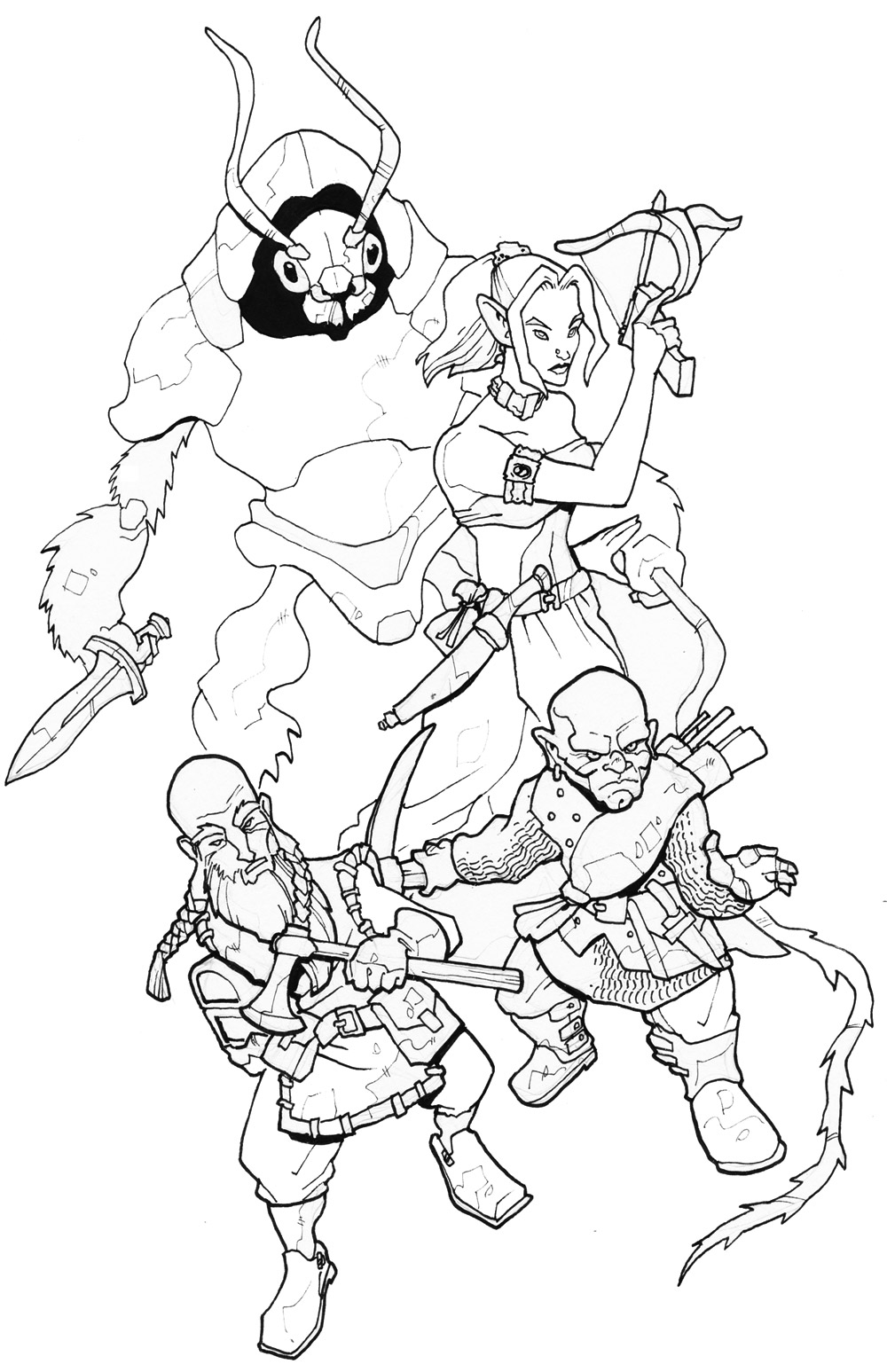
I’m not only working on the second half of the “outer hells” hex crawl for NOD 12, I’m also working on part two of the “Deep Denizens” article. The first part had rules for four humanoid races as PC races – orcs, hobgoblins, bugbears and kobolds. The second part features the drow, duergar, svirfneblin (okay, they’re not dark) and the notac-ichat, an insectoid race I made up for the hex crawl. Here is the depiction of these folk by the great Jon Kaufman (pachycrocuta at DeviantArt).

The first article linked those races with the seven deadly sins – gluttony for orcs, envy for kobolds, wrath for hobgoblins and sloth for bugbears. The three evil races in the next article are also linked – the drow are lustful, the duergar greedy and the notac-ichat prideful. Anyhow – enjoy the art preview – back tomorrow with my first entry in a new series called Mega-Monsters – an attempt to convert some of the epic level monsters in the SRD for Swords and Wizardry, adding an idea at a campaign you could build around that monster.

The Macabre

Once upon a time, the story goes, the fey retreated before the unstoppable spread humanity into the kingdom of Faery, rarely to be seen again. This, of course, is utter rot. Oh, the elves sometimes slip between the dimensions and travel through time as their magic allows, but most of the fey stayed put, learning to blend in and live among, though usually separate from, humans. The elves remained beautiful, of course, and the goblins weird and macabre, and they can be found today as members of a few weird families throughout the world, rarely intermarrying with humankind and otherwise enjoying themselves as best they can in a world that fears them.

The Macabre
The macabre are humanoids (well, mostly) who are, to a man and woman, unwholesome, or at least odd, in appearance. They are possessed of a dark humor and a glee that sometimes runs to the murderous. Encountered outside their close knit clans, the macabre refer to themselves as uncle, aunt, cousin or even grandmother or grandfather, indicating their race’s kinship to mankind. They call themselves by names profane, morbid or macabre.

The macabre are possessed of strange powers. All of them have rather special powers of regeneration, healing at double the normal human rate (i.e. 2 hp per day). Macabres can see in the dark up to 120 feet. Each one has an additional extraordinary ability rolled on the following table:

1. Startling strength (can boost their strength once per day per gauntlets of ogre strength)
2. Half damage from fire
3. Half damage from acid
4. Half damage from electricity
5. +3 bonus to save vs. poison
6. +3 bonus to save vs. disease
7. Menagerie (commands a swarm of spiders, a pack of six giant rats or a single vulture, lion or octopus)
8. Witch or warlock (cast prestidigitation three times per day)
9. Has an assassin vine as a boon companion
10. Has an old crawler (a disembodied human hand) as a boon companion
11. Swordsman (+1 to hit with swords and -1 [+1] Armor Class while fighting with a sword)
12. Explosives (can mix and set off explosives without harming himself)
13. Inhumanly tall (-1 to dexterity, +1 to strength)
14. Inhumanly short (-3 to movement, +1 to strength)
15. Inhumanly fat (-3 to movement, +1 to constitution)
16. Inhumanly thin (-1 to constitution, +1 to dexterity)
17. Raucous cackle (once per day, all within earshot must save vs. fear or flee for 1d6 rounds)
18. Regenerate 1 hp per round up to half normal hit points unless reduced to 0 hit points
19. Covered in thick hair (-1 [+1] to Armor Class)
20. Tunneler (has a burrowing speed of 6)

Macabres can advance as fighting-men up to 7th level, magic-users up to 5th level and as thieves with no level limit.

Illustration by Charles Addams. Found HERE.

Peoples of Namera

There are now three Hex Crawl Chronicles out and a couple more in the can. I’m about to begin writing the next one, and since I’ve had a couple emails recently asking for some more details about the setting – in particular about the folks wandering around causing trouble in it – I thought I’d share a few of the details (well, as many as I know).

(Oh, and you can find the overall map for the setting HERE)

Bucranian
Appearance: HCC 5

The Bucranians of the great island Bucrania are handsome folk, with chiseled physiques and deep olive skin. Their hair and eyes are as black as night.
Noble Bucranians dress in tunics of expensive fabric, most purchased from the Last Men, and square cloaks. They wear leather sandals on their feet and phetas of silk on their heads. Commoners dress as nobles, only with less expensive fabrics. Warriors carry spear, short sword, javelins and oblong shields emblazoned with black bulls.

In Bucrania, all women are wards of the king and live one of his many palaces until they are wed to a man. The most valued men of the kingdom are athletes, and athletic games are frequent and hotly contested. Champions are adopted by the king and become princes of Bucrania. They are gathered into fraternal trios, and in these trios they battle minotaurs in the arena for the honor of their father and the favor of his “daughters”.

As humans, Bucranians can advance in any class. Bucranian priests are usually druids who worship bulls. Bucranian fighters favor spear and javelin.

Centaur
Appearance: HCC 3, HCC 4

A centaur has the head, arms and torso of a human or elf and the lower body of a pony or ass. Centaurs dwell in meadows and glades surrounded by thick woodlands. They are known for their lack of temper and their fondness for women, war and song.

Centaurs are usually seven to eight feet tall from hoof to head. Even though their equine bodies are smaller than normal horses, they are still quite heavy and find it difficult to scale sheer surfaces without help from others. A centaur’s equine body may have any pattern common to normal horses, and the hair on their heads often follows suit. Centaurs usually have nut brown skin.

Centaurs speak their own language and often (50%) the language of elves. They occasionally speak the common tongue of men. Many centaurs learn the languages of gnomes, goblins, halflings, kobolds and orcs. Because of their size, centaurs have booming voices.

Centaurs cannot have a strength or constitution scores lower than 9, nor can they have a wisdom score higher than 14. Centaurs can become fighting-men, advancing to a maximum of 7th level (8th level if strength is 14 or higher, 9th level if strength is 18). Centaurs can carry 150% more than most characters. In addition, their base movement is increased by 6. Because they are quadrupeds, a centaur’s gets a +2 save to avoid being knocked over or grappled. In combat, centaurs can choose to attack with their weapon or their hooves, which deal 1d4 points of damage. A centaur’s armor (really a combination of human armor and horse barding) costs twice as much as normal human armor.

Dwarves
Appearance: HCC 1, HCC 2, HCC 3, HCC 4

The dwarves of Namera are bandy-legged and wrinkled, with narrow eyes and immense noses, splayed toes, large hands (the better for holding hammers and climbing rocks) and snow white hair. Women are as ugly as the men, but their ugliness is made up for by a reputation as being honest, hard-working, and immense fun at parties.

Dwarves don’t like to stand out in a crowd, so they were muted colors that blend in with their surroundings, including hooded cloaks. They adore pockets and sew as many into their clothes as they can. Long, pointed shoes are also a must, to give the illusion of more height. Dwarf warriors look for as much armor as they can wear, and prefer practical weapons like hammers and axes to flashy swords. They usually carry crossbows or hand gonnes over bows. Dwarves are natural animal lovers, and every dwarf has his pet.

Dwarves follow the normal dwarf rules. Their gods are never named or invoked in public, and their clerics stay home to care for the clan (unless your favorite rules allow dwarf clerics, in which case they replace spoken prayers with noisy ululations.

Dwarves of the Aderumdocs
Appearance: HCC 5

Unlike their bandy-legged cousins of the west, the dwarves of the Aderumdoc Mountains are a bit shorter and much rounder, rosy cheeks, gap-toothed smiles (when they bother to smile) and long, nimble fingers. They have gray skin that becomes covered with moss as they grow older, giving them a natural camouflage in ancient forests.

The Aderumdoc dwarves are deliberate and patient, never given to rash action or thoughtless words. They often sit down cross-legged when it is time to think, puffing on their pipes and considering every angle. This makes them wondrous engineers, but can be quite taxing on their fellow adventurers when every fork in a tunnel must be weighed and considered.

The Aderumdoc dwarves follow the normal rules for dwarves.

Elves of the North
Appearance: HCC 4

These northern elves dwell in towers disguised as massive trees by illusions. They are uglier than the trouping elves to the south, having long legs and arms attached to squat bodies and faces that resemble brownies more than fashion models. These northern elves wear long mail byrnies and winged helmets traced with precious metals. They carry hide shields painted in bright colors and carry longswords and daggers.

Northern elves are gruff and forward than their southern kin, and do not bear so much resentment to others (though they dislike the imperious Northmen and their empire). They believe profoundly in freedom and actively sew chaos where societies seem to rigid and structured. The wood elves have learned how to train giant eagles for use as their mounts, and every wood elf warrior aspires to become an eagle rider.

The northern elves follow the same rules as all other elves. They can become fighter/magic-users (level 4 and 8 respectively), thieves (no limit), rangers (level 3) or fighter/magic-user/thieves (level 4/8/unlimited).

Elves of the Pirate Coast
Appearance: HCC 5

The elves of the Pirate Coast have sun-dappled skin and auburn locks they never cut and warm, gray eyes. The coastal elves stand about 5 feet tall and have wiry frames. The elves wear as little clothing as possible, preferring loose tunics and loincloths. In times of battle they put on ornate, polished armor and wield long swords, dagger and longbows.

The elves are natural horsemen, learning to ride at a very young age and not truly achieving adulthood until they are can perform all manner of acrobatic tricks and feats of mounted warfare. They are a carefree folk who have a tough time realizing that other people’s feelings, needs and desires exist. They are persistent, if not always skilled, singers and dancers.

These elves follow the same rules as other elves. Coast elf thieves are usually horse thieves and rustlers, and take as much joy in stealing as the warriors do in fighting and the magic-users in torching villages with fireballs.

Elves of Valley of the Hawks
Appearance: HCC 1

The elves of the Valley of the Hawks are typical for the elves of Namera. They stand about five feet in height and have lithe physiques, pale skin that gives off a glow of health and vitality. They usually wear their hair long and tie it back or weave it into braids. Their hair and eyes might be any color under the sun.

They follow the tradition of the trouping fairies, with every elf a lord or lady in dazzling raiment of mauve, cyan and soft green, riding fine horses and carrying ornate bows and long swords. Elves take great pains to have the most stylish and expensive clothing they can afford – their appearance is a matter of great pride for them.

All elves of the valley hail from a hidden fort that is disguised by illusions and enchantments to look like a grassy knoll. The elves tend moontrees, whose leaves absorb moonlight that distills into the sap. Dead branches have a core of hardened sap which is melted down and alloyed with aluminum and tin to form elven mail. Their cloaks of elvenkind come from the silk of the faerie dragon, which lives in globes of spun silk that look like colored lanterns hanging from the trees. Their boots of elvenkind come from the hides of harts that are killed and slaughtered ritually to gain the blessing of the forest.

The elves of the Valley are haughty and proud, but also terribly dashing and brave. They adhere to the normal rules for elves (or high elves for “advanced” games). Elf fighters of the Valley favor the use of long sword and long bow, or possibly lance.

Embalmers
Appearance: HCC 3

The Embalmers are a race of bronze skinned men with raven hair and violet eyes. They are short and stocky, the women voluptuous and the men given to wide exaggerations and long melancholies.

Male embalmers dress in woolen tunics and trousers and gray cloaks. They wrap their lower legs in leather thongs and wear leather sandals on their feet and intricately patterned conical wool caps on their heads. Women wear loose gowns, a wide leather belt wrapped just under their breasts, shorter cloaks and put their hair in braids. Warriors arm themselves with spear, shields of wood and leather, short bows and long knives.

The embalmers raise sheep, trading wool and foodstuffs for fragrant oils and herbs used in their embalming ritual, the aspect of their culture which gives it its common name. The embalmers make mummies of their dead philosophers and nobles, walling them into their temples and palaces that they may advise future generations through barred windows. Peasant corpses are burned for heat in the furnaces of their palaces.

Embalmers are humans and might be of any class. Paladins are rare among them and most embalmer clerics worship death gods. Embalmer fighters favor the spear or short bow.

Golden Men
Appearance: HCC 1

The Golden Men of the steppe have golden-brown skin and blazing red hair. They wear buckskins in the winter and loincloths when the weather is warm enough. Warriors wear leather armor and carry stout clubs and leather slings, or metal weapons they have scavenged from their victims.

The Golden Men are descended from the ancients and now dwell in small hunter-gatherer bands in the woodlands or as brutal nomads on the prairie. The ancient ruins that once made up their homes are sometimes haunted by them, as they return to their temples to pay homage to such deities as Alberni, the dog-headed moon goddess, Kishrdis, the obsidian-skinned goddess of mining and Thallos, the seven-eyed god of love.

The Golden Men are humans, and can advance in any class. Clerics are as common among them as druids and magic-users are quite rare since they lack the resources to produce books or scrolls. Most Golden Men magic-users use very ancient tomes from the times of the ancients printed on strange, glossy paper in tiny black letters. Golden Men fighters favor clubs and slings.

Half-Orc
Appearance: HCC 5

Half-orcs are not a race, but rather creatures with a mixture of human and humanoid (usually orc, goblin, gnoll, bugbear or hobgoblin) blood. Half-orcs can almost pass for human. They average from six to seven feet in height and are usually stocky. Their skin often has a pink, grey or green cast to it. Half-orcs often have one of the following facial features: Turned up nose, pointed ears, thick eyebrows, a heavy forehead, vestigial tusks and/or pointed teeth. Half-orc hair is coarse and unruly and usually black, dark brown or dark red. Half-orc eyes are almost always brown, brownish green or greyish green.

Half-orcs usually speak the common tongue of men and often (60%) the language of their other parent race. It is not uncommon for them to learn the language of dwarves, goblins, ogres and giants.

Half-orcs can see up to 60 feet in darkness and their sense of smell is as keen as a wolf’s. Their thick skin gives them a natural Armor Class of 8 [11], which can be enhanced with armor. Half-orcs enjoy a +2 bonus to saving throws against poison and disease.

Half-orcs can advance as fighters (up to 8th level), thieves (no level limit), assassins (up to 6th level) or fighter/thieves (up to 8th level as fighter and 12th level as thief).

Hivernians
Appearance: HCC 2

Hivernians have jaundiced, sallow skin and hair that ranges from dark carnelian to fiery orange. Their eyes are icy blue. Hivernians are short and wiry, with long arms, fingers and toes, pug noses, long teeth and heavy jaws. They wear animal skins and long hoods decorated with bones and teeth. Warriors carry spears and short bows and wear the equivalent of leather armor.

Hivernians are as ancient a people as the Golden Men, and have warred with them for generations. Unlike the Golden Men, who seem to be able to lay claim to an advanced civilization in the past, the Hivernians have ever been savages. They are skilled in stalking and hunting, and have no qualms about killing for the sheer enjoyment of it. Hivernians worship the elk-antlered, doe-eyed goddess Yhoundeh.

Hivernians move as silently as halflings and can track as well as rangers of their class level. Hivernians can take levels as fighters (up to 7th), fighter-thieves (up to 6th level in each) or magic-user/thieves (up to 5th level as magic-users and 6th level as thieves). Hivernian fighters favor the spear or short bow.

Last Men
Appearance: HCC 5

The Last Men have olive skin and blond hair always worn closely cropped. Dealing as they do in fabrics, the Last Men dress in heaps and layers of clothing, all of expensive and luxurious fabrics like damask silk and velour. Soldiers of the Last Men carry Bohemian ear-spoons (pole arms) and hand gonnes (treat as heavy crossbows).

The so-called “Last Men” are a population of men and women who consider themselves the last true humans left in Namera. All other peoples are infected with chaos and thus “sub-men” in the eyes of the Last Men. They are emotionless, bland people, their lives ordered by their master, The Golden God, and by an ingrained herd mentality. The Last Men deal in fabrics, growing cotton and mulberry trees. Their factories contain mechanical looms controlled by a difference engine kept in a great, black citadel in their city-state, located to the south of the Pirate Coast. True xenophobes, they fear corruption by others, but still send out traders in longships to trade fabrics for food and other items.

Last Men are humans, and can take levels in any class, but their lack of independent, creative thought makes magic-users among them rare. Clerics of the Golden God are more common. Last Men fighters favor the use of bohemian ear-spoon or hand gonne.

Necrophage
Appearance: HCC 3

Necrophages are tall and lean, with pallid skin that they paint in grotesque patterns using burgundy paint made from crushed elderberries and columbines. Their warriors wear leather or ring armor and carry shields, leaf-bladed short swords, spears and javelins.

The Necrophages are fierce warriors who roam the rolling steppes of the Land Beyond the Black Water with their herds of cattle, riding in war chariots. The necrophages consume the flesh of their dead and of enemy casualties in war. They are berserkers in combat, and while one might expect berserkers to charge into combat screaming, the necrophages fight in complete silence. Necrophage tribes are ruled by undead kings, wights, with worthy challengers raised by force of will when they die to challenge the existing wight-king. The necrophages worship Emntrix, the petty death who claims the souls of soldiers.

Necrophages are humans, and can take levels in any class. Necrophage clerics worship Emntrix, the petty death of soldiers. Necrophage warriors favor the short sword. They can choose to be berserkers, but lose the ability to wear more than ring armor. Berserkers gain a +1 bonus to attack in combat for a number of rounds equal to their constitution bonus plus their level. After they come out of rage, they suffer 1d6 points of damage from exhaustion.

Northmen
Appearance: HCC 1, HCC 2, HCC 4

The Northmen have ebony or chocolate skin and wavy hair of brown or black, often worn long. Most are stout and plump, but a few villages mingled with the elves in elder times and are noted for their height and the electric sparkle in their eyes. The northmen are known for their baggy trousers and long tunics. They favor axes and curved knives and usually wear chainmail or platemail.

Northmen are the architects of a great kingdom that is now tearing itself apart in a terrible civil war between three princesses who seek to replace their dead father. They are industrious folk, not given to flights of fancy, who regard others as just a tad less civilized than themselves. They have a tendency to roll their eyes at outlandish customs and costumes.

Northmen are humans and can take levels in any class. Their clerics worship such deities as Almerla the goddess of healing, Talaunus the god of civilization, Teros the god of war, Vilmarra the goddess of vengeance and Waith, goddess of the underworld. Northmen fighters always favor axes.

Sea Lords
Appearance: HCC 4, HCC 5

The average Sea Lord has pale skin (or deeply tanned skin for the crews of their lion-prowed longships), blond to auburn hair and eyes ranging from blue to gray. Men and women tend to be exceptionally tall, with a pleasant, rough demeanor. Sea Lords dress in leather tricorne hats, padded doublets and baggy pants tucked into tasseled buskins. Sea Ladies wear long dresses covered by shawls and pile their braided hair atop their heads, holding it with wooden pins. Noble Sea Lords and Ladies wear necklaces of bronzed leaves from their old domains in the White Islands. Warriors carry broadswords and pistols and wear steel breastplates over soft leather armor.

The Sea Lords, or Albians, came from across the Briny Sea to escape the sinking of their homeland, the White Islands. Most of the Sea Lords that escaped this cataclysm were men, the crews of ships. The early settlers suffered a distinct lack of women, giving rise to the taking of slaves among female humanoids of the Pirate Coast. For this reason, there are still a good many Sea Lords with goblin, orc or (if they are lucky) elf blood flowing through their veins (i.e. half-elves and half-orcs). Sea Lords always have a tale to tell, and in taverns they tell these tales to the accompaniment of fiddles, mouth harps and percussion provided by stamping feet and by clanging walking sticks and cudgels on whatever surface is handy.

The Sea Lord clerics always worship Albia, the White Goddess who created them and kept them until the betrayal of her father, the Briny Sea. Albia is a goddess of perfection and purity, the gleam in her father’s eye until he consumed her in a fit of pique. Where some religions produce holy water, the priests of Albia produce holy powders. The first were taken from the chalk cliffs of the White Islands, but modern powders, kept in vials of glass or silver, are drawn from chalk outcroppings on the Pirate Coast.

Swamper
Appearance: HCC 3

The swamp folk are albinos with long, kinky hair that they sculpt into a shape reminiscent of large horns or cones. They have broad faces and large, pink eyes. The Swampers dress in soft leather tunics and the more accomplished hunters wear black cloaks made from the pelts of swamp panthers. Warriors carry sickles and staves.

Swampers encountered outside their villages are hunters or gatherers looking for exotic herbs and insects. The gatherers carry horn-handled sickles, often silver bladed, leather slings, wicker holy symbols, spirit rattles and bags of herbs, including healing poultices and bundles meant to repel the undead. Gatherers are usually accompanied by a breed of large, white swine that are used as mounts, pack animals and to sniff out herbs and funguses.

Swampers can be of any class, but most of them are clerics or magic-users. Clerics worship spirits of the dead and of the earth. Swamper fighters favor the use of the staff, and there are probably more Swamper monks than true fighters.

Tevalar Elves
Appearance: HCC 4

The Tevalar elves are aquatic elves who dwell in fresh water. They have blue-green skin and are completely hairless, with large, black eyes. Their warriors wear coats of silvery scales, onion-domed helms of ground and polished river glass (filled with water and connected via copper tubing to brass water tanks on their backs). They are armed with tridents, crossbow and short swords.

The Tevalar are slightly paranoid expansionists, building dams to flood valleys and bringing nearby human and demi-human tribes under their sway. Tevalar elves know how their surface kin have been dimished by the surface folks, and are determined to escape this feat. This makes them easy to offend and quick to deal with situations decisively and, at times, violently.

Tevalar elves follow the same basic rules as elves, with the exception that they can swim as quickly as they move on land and breathe water rather than air. To be sure, they would make challenging player characters, given how reliant they are on their water tanks.

Witchmen
Appearance: HCC 1

Witchmen have tan or olive skin and a great variety of hair and eye colors. They wear long, straight tunics and woolen leggings. Their shoes are leather and pointed, and they wear tall pointed hats with wide brims; both shoes and hats are decorated with buckles of brass or silver. Warriors carry long swords and daggers, and wear either ring armor or chainmail.

The Witchmen come from southern climes and dwell in the swamps at the mouth of the Great River. They are mystics, steeped in eldritch knowledge and taught the arcane arts from childhood. They dwell under the rule a college of witches and warlocks, with young Witchmen accepted in synods when they reach puberty. They are educated in these synods and treat them something like political factions. They worship such deities as Eosinn, the faun goddess of hunting and Onorix, the goddess of wealth.

Their leaders are skilled in swordsmanship and magic, and should be treated as elves in terms of their class choices, though their maximum levels are 3 levels higher than elves. Witchmen favor long swords and daggers.

Oh – also – just finished my little map for HCC 6 – The Troll Hills. Time to start filling this baby up. We’ll have Witchmen colonists on the Great River, an unspeakable troll god and a lair for every troll that I can legally use and few I’ll probably create. Think of it as Against the Giants but for trolls. Should be fun!

Nodian Oddities

When I’m writing a hex crawl for NOD, I like to let my mind wander once and while and create a new species or two on the fly. I’m going to collect a few of these Nodian oddities here, with some guidelines for using them as a playable race. To start with, I have three from Mu-Pan …

DIDI
The Didi are small (halfling-sized) creatures. They look like nothing but skin and bones, with large, round heads and pointed ears. Didi’s are covered with velvety, platinum-blond fur and have ugly, wan, drawn faces. Despite their appearance, they are uncommonly kind and renowned for their knowledge of the healing arts. The didi dwell underground. Seemingly immune to the chill environment of their subterranean home, they do not wear clothing, though they often don leather armor or aprons when they prove useful to their work.

Didi have a knack for medicine and herbcraft. Those under their care heal +1 hit point per night of rest and receive a +1 bonus to saving throws against the effects of diseases. Because of their frail physiques, they suffer a -3 penalty to their constitution roll at character creation, though this penalty cannot reduce their constitution score below 3. Didi have magic resistance equal to their wisdom score (i.e. a 13 wisdom grants 13% magic reistance). Didi can see in the dark as well as dwarves.

Didi are permitted to advance as cleric/magic-users (up to 5th level max.), cleric/thieves (5th/7th level max.) or as pure thieves (9th level max.). Didi clerics worship nature spirits and deities of darkness, healing and generosity.

KETEKete are tall humanoids with stark white skin, black eyes and toothless mouths. They have no hair and wear kilts and tunics of interlocking steel rings (i.e. chainmail, though sometimes so light as to be no more protective than padded armor). Kete are surrounded by an aura of heat, and they require no teeth because food simply burns away in their mouths. This heat aura gives them an unarmed attack damage of 1d4 (or +1 to damage for monks) and the blurry aura gives them a -1 [+1] adjustment to Armor Class. Kete suffer only half damage from fire attacks and enjoy a +1 bonus to saving throws against dragon fire and fire spells. Once per day they can sheath themselves in roaring flames, causing 1d4 points of fire damage to all within 10 feet of them and possibly setting flammable objects aflame.

Kete cannot wear or use objects constructed of wood, leather or cloth (hence their chainmail clothing). They can advance as fighters up to 6th level (7th level with a strength of 14+), thieves of 8th level (9th level with dexterity of 15+) or fighter/thieves up to 5th/7th level.

ZOUSHOU
There are few creatures in Mu-Pan as strange as the zoushou. They look like large, grotesque human heads balanced atop four human legs, forcing them to walk like a crab or to hop about. Zoushou have deep, purple skin. Their long toes allow them to grasp items with fine manual dexterity. While they cannot wield weapons or use shields, they can wear armor that is specially made.

Zoushou can leap five feet vertically and up to 1d6+5 feet horizontally. They can kick in combat for 1d4+1 points of damage. Because of their rugged bodies, zoushou characters begin the game with 2 hit dice (though they are still limited in the total number of hit dice they can have based on their class). Three times per day, they can use x-ray vision per the ring of x-ray vision. In place of this, they can focus this vision one time per day on a single subject within 20 feet, inflicting 1d6 points of damage.

Zoushou advance as fighters up to 5th level (6th level with strength of 13+) or thieves up to 7th level (8th level with dexterity of 15+).

Note: For players of Ruins & Ronin, didi can advance as shugenja up to 6th level, kete can advance as bujin up to 7th level and zoushou can advance as bujin up to 6th level.

At some point I’m going to have to commission art for these oddballs. Should be fun!

Monstrous Evolutions

Today, while thinking of something to do with the blog (and this is one of the best things about having a blog and trying to update it every day – it forces your brain to be productive) I was struck with the idea of evolving fantasy monsters. I mean, we have plenty of beast-people in fantasy games and literature – cat people, dog people, etc. But what about monster? Primates evolve into humans – what might rust monsters evolve into. Since the idea seems to fit with Pars Fortuna, here are a couple such races designed for that game.

Ustte
The ustte are humanoid insects that stand about 4 to 5 feet tall. They have hard, chitinous skin of steel gray, smallish, roundish heads that bear two glossy, black eyes and long, feather-like antennae, wide, slit mouths with long, red tongues (for lapping up corroded metal) and six limbs – two legs, two large arms (like a humans arms) and two smaller, vestigial arms below them. From their abdomen they have long tails that end in “propeller” shaped protrusions.

The ustte dwell wherever there is iron to mine, for though they can corrode most metals and live off of them, iron is their preferred diet. Families consist of a male and multiple females (the species produces roughly three females to one male). Each female is capable of producing a single brood. Broods always consist of four children. These children are given the same name and live with one another as a unit until young adulthood, when they might join with other ustte to form a new family.

Ustte lairs are usually subterranean, though close to the surface. Ustte respect strong physiques and sharp, insightful minds. They compete constantly – in athletic games, tests of skill and craftsmanship and in contests of poetry. Ustte literally wear their “honors on their sleeves” in the form of tracings in gold or silver ink on their chitin. Non-ustte see these fanciful shapes as tattoos, but to an ustte they are a record of their life’s accomplishments and very important.

Racial Abilities
Ustte have thick carapaces that give them a natural Armor Class of 12. Their delicate antennae can detect metals, from iron and copper to gold and platinum, up to 120 feet away, assuming they can conceivably be scented. The touch of their antennae is corrosive to non-precious metals (silver, gold and platinum). Any metal object touched by these antennae (requires a melee attack) has a 1 in 6 chance of being corroded to the point of being useless. Ustte feed on iron and steel, though they can consume other corruptible metals in their place, requiring one pound of metal each day to survive. This makes copper coinage very attractive to ustte adventurers, and some carry the metal as rations.

Class Abilities
Ustte are driven to excel as warriors and artists. Their prime requisite is Charisma. Ustte roll 1d6+2 per level for hit points (+2 per level after 9th). They can wear light and medium armor and use shields and any weapon weighing 3 pounds or less. Ustte are precise warriors, studying the fence as an art and fighting the way a sculptor sculpts. Their passion and drive give them a +2 bonus to save vs. fear effects if already engaged in combat and their ability to draw their opponent into a mistake give them a cumulative +1 bonus to hit and damage every round their foe fails to hit them in melee combat, up to a total of +5. This resets whenever the ustte scores a hit on an opponent. It is for this reason that ustte prefer not to win initiative. This bonus is lost if the ustte is aided in combat by another (i.e. another attacks the same target they are fighting). Whenever an ustte defeats a superior foe in combat, they may apply a new design to their carapace and will always compose a song in their own honor.

Eaoro
The eaoro are a race of tall, bulky humanoids that dwell in farming villages in the midst of wooded regions. They value their privacy; the only eaoro most folk will ever meet are those who must begrudgingly leave their enclaves to trade and those who have suffered exile from their community due to sinful behavior.

Eaoro are sexually dimorphic, the males being much larger than the females. Male eaoro stand about 7 to 8 feet tall, with rather short legs and long, arms. They have narrow shoulders, giving their bodies a distinct “triangular” shape, but are thickly muscled. Females are shorter, averaging 5 to 6 feet in height, and have longer legs and shorter arms. Males are hairier than females, and both sexes have heads covered with feathers rather than hair. Their skin is naturally pale, their eyes large (and telescopic) and they have black, hooked beaks in place of mouths.

Eaoro are vegetarians, though certainly not pacifists. They dwell on farmsteads composed of a central longhouse constructed of stone and logs, maybe one or two outbuildings for storage and a surrounding rampart of earth and stone that stands about 5 feet high. Farmsteads support a family of a bonded male and female, their young (anywhere from three to twelve children) and maybe older relations incapable of surviving on their own. These farmsteads are situated quite near to one another. Eaoro communities are referred to as clusters and usually consist of 20 to 100 farmsteads. Somewhere in the cluster there is a hill cleared of trees that serves as the cluster’s moot.

Eaoro are deeply religious, believing in litany of sins handed down to them from their forebears. When conflicts arise, eaoro must submit themselves to judgment by the moot. Sins are tallied, and judgment always goes to the less sinful eaoro. If this doesn’t cause eaoro to strive for righteousness, it certainly drives them to strive for sneakiness and to pry into the lives of their neighbors, keeping a close “sin count” in case a conflict should arise. Eaoro with too many sins to their names are usually exiled from the community.

While all eaoro are taught magic from a young age, male eaoro tend to be better warriors than mages and females better mages than warriors. For this reason, each is considered separately in terms of class abilities.

Racial Abilities
Eaoro are born farmers – even those who have since been cast out of eaoro society. This gives them a knack for predicting the weather and in all other matters related to the growing of crops and mending of farm implements. They also have a knack for casting cantraps. All eaoro start the game knowing three random cantraps. They can only cast them by making a spell roll and suffer the consequences of failure just like any other spell caster. Their innate strength gives eaoro males a +2 bonus to their strength score and a -2 penalty to their dexterity score at character creation. Females have a bonus and penalty of +1 / -1. These modifications cannot improve a score beyond 18 or lower it below 3. Since most eaoro adventurers are outcasts from their communities and have had to live for an extended time in the wilderness and then on the fringes of society, they have a knack for wilderness survival and pick pocketing.

Eaoro Class – Female
Female eaoro have Intelligence as their prime requisite. They roll 1d6+1 per level for hit points (+2 per level after 9th) and can use light armor, shields and any weapons.

Female eaoro are magicians, and thus can cast magic spells. They have no particular skill at casting a certain kind of spell, being dabblers at the art. They are skilled at picking pockets, palming small objects and at bluffing.

Eaoro Class – Male
Male eaoro have Strength as their prime requisite. They roll 1d6+2 per level for hit points (+2 per level after 9th) and can use light armor, medium armor, shields and any weapons.

Male eaoro are skilled at picking pockets, palming small objects and bluffing. They are known for their ability to present a frightening display when they enter combat, forcing all creatures with 1 hit dice or less to pass a saving throw or flee. Creatures backed into a corner or defending their loved ones will not flee.


Cyclopeans – Playable Race for PARS FORTUNA

Having watched Krull over the weekend – a dandy fantasy movie, in my opinion – I was inspired to do something inspired by the cyclops in that movie. The cyclopean is designed for PARS FORTUNA, but should be readily usable in other old school-style games …

CYCLOPEAN (ARIMASPIAN)
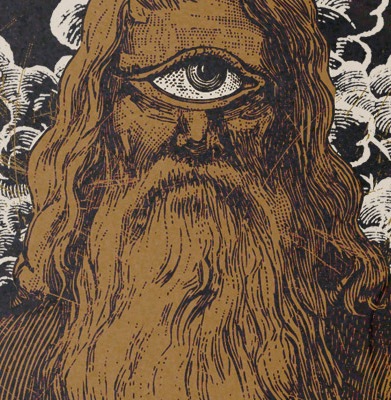
The Cyclopeans are tall, rugged humanoids with a single, large eye located in the center of their face. Cyclopeans have skin tones that range from the color of aged parchment to a rich, glossy umber. Their hair is usually worn long and shaggy, and is always blue-black in youth and adulthood, turning white as a Cyclopean enters his or her later years. The Cyclopeans eye might be any color in the spectrum, with amber and blue being the most common colors, and mauve and mottled green/brown being the rarest.

A warlike people, the Cyclopeans nonetheless have a philosophical side – probably an artifact of their unique ability to see into the future. Born fatalists, they know well the curse that accompanies their power, and take care to only pierce the veil of time when their lives, or the lives of their loved ones, depend on it. Most Cyclopeans dwell in the wilds or on the fringes of civilization, making a living as trappers, hunters and bandits. They have a passion for fighting, but lack the organization of the Oraenca or their flair of the Ilel. Cyclopeans like to rush into battle, casting their military forks and then drawing their hand weapons to close with the enemy. Cyclopean warriors usually wear light or medium armor and carry shields, military forks and broadswords. They might also carry slings and knives.

Cyclopeans see in the Skathra kindred spirits, both for their wild ways and their divinatory powers. They respect the Bo’al, Oraenca and Olvugai as worthy warriors, and though they fear the deadliness of the Ilel, they can’t quite bring themselves to respect them.

Cyclopean names are short and to the point, and are usually followed with a wad of spittle if the name is despised or a clang of the fork on the ground if revered. Common names include Bach, Brel, Cert, Oban, Tohr and Venn for males and Azra, Jula, Kento, Mala and Trena for females.

Cyclopeans adventure for money, fame and a love of action. Cyclopeans like to stay on the move and stay in the action, for it helps to keep their fatalistic moods at bay.

Racial Abilities
All cyclopeans have the following special rules:

1. Cyclopeans have poor depth perception and peripheral vision. All opponents are treated as though they have a knack for surprising them. Cyclopeans suffer a -1 penalty to hit with ranged attacks, except when using their military forks, with which they train from childhood.

2. Cyclopeans have a knack for wilderness survival and reading people’s faces. This helps them discover falsehoods and guess at intentions.

3. No more than once per day, a Cyclopean can peer into the future. They will either glimpse a moment of Weal or a moment of Woe (50:50 chance). The moment glimpsed will be connected to their current endeavors or goals, and can be described with as much or as little detail as the Referee thinks appropriate. A Cyclopean might, for example, glimpse himself or a friend opening a door and being struck dead by a trap, or looking behind a curtain and discovering a secret door. Perhaps the door or curtain is unique and the Cyclopean will easily recognize it when they come to it – perhaps not. Perhaps the Cyclopean will never come across the possible future they have glimpsed. In general, this power acts as a free “clue” to something in the Cyclopean’s current adventure.

4. Whenever a Cyclopean glimpses the future, they hasten their own demise. For the next 24 hours, the Cyclopean suffers a -2 penalty to saving throws made to avoid death, damage or danger.

Class Abilities
Cyclopeans have the following class abilities:

Prime Requisite: Constitution (+5% bonus to earned XP if 13+)
Hit Dice: 1d6+2 (or 1d10), +2 hp per level after 9th
Saving Throws: As warrior
Attack Bonuses: As warrior
Restrictions: Cyclopeans can use any weapon, light and medium armor and shields.
XP Advancement: As the Oraenca

Cyclopean characters turn their racial knack for reading faces into a skill.

Cyclopeans can go berserker once per day. This berserkergang can only be entered once they have suffered damage in battle or once they have inflicted damage in battle. Once the berserker state is entered, the Cyclopean remains in it for a number of rounds equal to their Constitution divided by 3. They cannot exit the berserker state prematurely without passing a saving throw, and will attack anything in reach while under its spell. While berserk, a Cyclopean gets two melee attacks per round and inflicts +1 damage with melee attacks, but suffers a -2 penalty to Armor Class. A Cyclopean suffers from exhaustion for a number of hours equal to the rounds of combat they spent while berserk unless they spend a full turn after the battle resting.

Picture nabbed from HERE

PARS FORTUNA Discount and the Zwunkers

I present the Zwunker from the aforementioned PARS FORTUNA as a playable race.

Zwunkers (Sea Dogs)

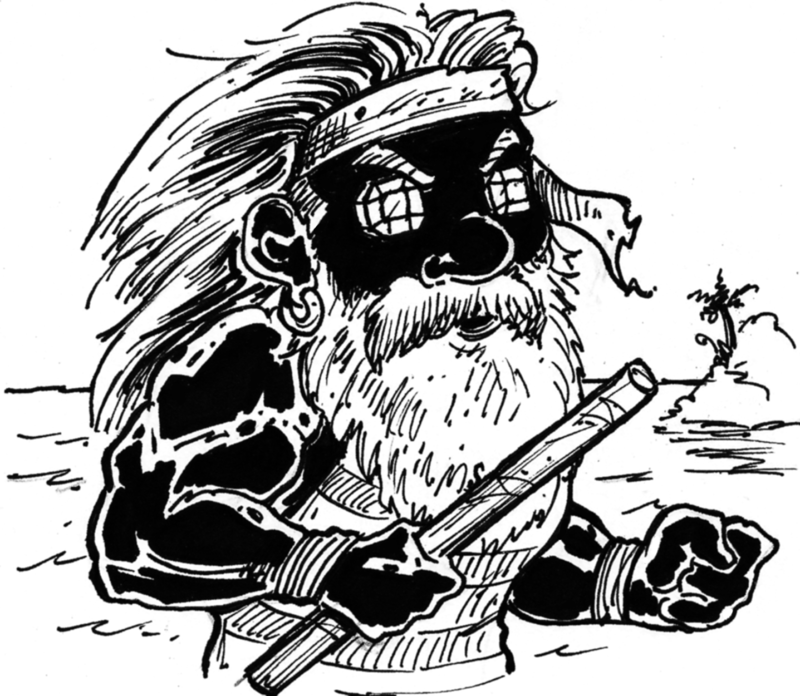
Zwunkers are black-skinned dwarves with long manes of gold hair. Their eyes are faceted and resemble yellow diamonds.Zwunkers stand anywhere from 3 to 4 feet tall, and they are heavier than they look. Zwunkers are usually found working as sailors or hired muscle, so they tend to dress simply and prefer to let their arms be bare to show off their mighty thews.

In the PARS FORTUNA setting, Zwunkers seemingly have no home. Most ports have an itinerant population of the little buggers working as sailors, bodyguards, thugs or laborers. Zwunkers like to move around, and in fact often need to move around to stay ahead of the trouble they get into. When they do settle down, it is usually to dwell in caves overlooking the sea. These caves are decorated with flotsam and jetsam and all the bric-a-brac you would expect a person to collect in the course of dozens of sea voyages.

Zwunkers are wanderers and, often, troublemakers. They enjoy stirring things up and seeing what happens – introducing a little chaos into otherwise staid and steady lives. Although not overly fond of alcohol, they are downright obsessive over gambling and wagering, and most of the trouble they get into starts as a dare-turned-wager. Zwunkers are hard, diligent workers, taking great pride in out-working other folk. This makes them popular with Oraenca. Their disregard for authority makes them popular with the Kyssai. Most other races see them as a nuisance.

Zwunker adventurers aren’t much different from normal zwunkers – they like to see new things, annoy new people, walk further, climb higher, etc. Many Zwunker adventurers got their start when somebody bet them they wouldn’t climb into a hill or plunder a tomb.

Zwunker names are little more than nicknames. They are usually monosyllabic – names like Zurk, Yan or Gord for males and Tua, Offa or Zee for females.

RACIAL ABILITIES
Zwunkers have a knack for seamanship, including navigation (even away from the sea – they have an excellent sense of direction), climbing and swimming. Zwunkers are also very anti-magical in nature, receiving a +1 bonus to save vs. magic, and actually creating a zone of magical interference within 30 feet that creates a 5% chance of spells cast in that zone or into that zone going awry and not working.

CLASS ABILITIES

Prime Requisite: Constitution, 13+ (5% experience)

Hit Dice: 1d6+1 (+2 hp per level after 9th level)

Armor Restrictions: Zwunkers can wear light and medium armor and use shields.

Weapon Restrictions: Zwunkers can use any weapon except two-handed swords and pole arms.

Special Abilities: A Zwunker character’s anti-magic zone increases in power as they increase in level, adding a 1% chance per level of spells going awry (i.e. a 1st level zwunker’s zone has a 6% chance of ruining spells, while a 10th level Zwunker’s zone has a 15% chance of doing so). Once per day, a zwunker can control winds (and only winds) per the spell Control Weather. A 10th level Zwunker gains the ability to use the Control Weather spell, as written, once per day. Finally, Zwunker characters are skilled at climbing, navigating and other nautical tasks.

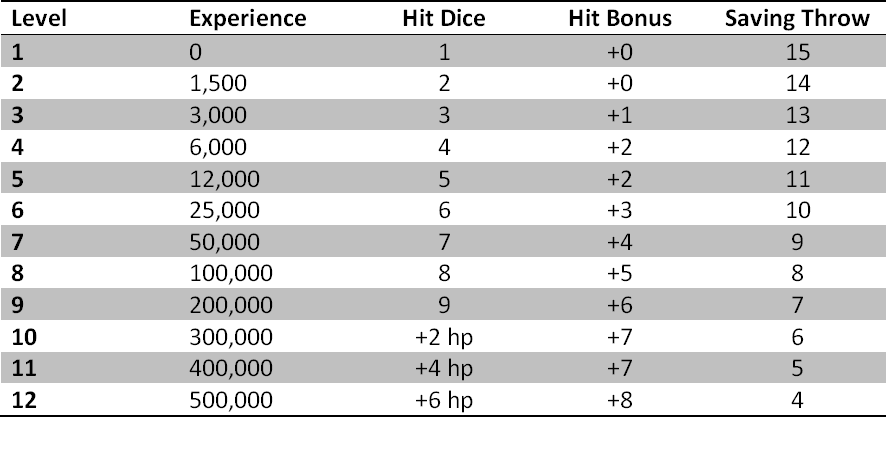
Zwunker Advancement

Level Experience Hit Dice Hit Bonus Saving Throw
1 0 1 +0 15
2 2,000 2 +0 14
3 4,000 3 +1 13
4 8,000 4 +1 12
5 16,000 5 +2 11
6 32,000 6 +3 10
7 64,000 7 +3 9
8 128,000 8 +4 8
9 256,000 9 +5 7
10 350,000 +2 hp +5 6
11 450,000 +4 hp +6 5
12 550,000 +6 hp +7 4


Pars Fortuna Preview #4 – Final 4 Races

These are the final four playable races populating the world of PARS FORTUNA. My next task will be to preview some aspects of magic and a few of the spells.


The attractive quadruped on the crest of the hill is a Skathra. The Skathra look like centaurs with the lower bodies of antelopes and spiral horns atop their heads. They have light brown skin and darker, auburn fur with black markings on their faces and sides. A skathra stands about 5 feet tall from hooves to head. They are wise, though sometimes confounding, creatures who dwell in the wild, green hills. Skathra have a natural wanderlust, and a desire to see everything there is to see before they die.

In game terms, Skathra are one of our magic-using classes. They combine their magical abilities with a talent for archery, lightning quick reflexes, survival skills and a knack for divinatory magic.

Slinking down the hill next to the Skathra is a Vindlu. Vindlu resemble long, thin lions covered in scales of silver tipped with aquamarine. They have long “whiskers” like those of a carp. These whiskers are extremely sensitive, making vindlu difficult to surprise and allowing them some insights into the emotions of others. Their four legs end in clawed hands. Outside their home city, they live in tight-knit family bands, hiring themselves out as “problem solvers”.

In game terms, Vindlu are one of our skill classes. Vindlu are stalkers and pouncers, and have a talent for avoiding traps and getting into places they are not wanted.

In the middle of the group is a Tachi. The Tachi are intelligent macaques who live in lattice-work cities on the thickly forested southern coasts, west of the lands of the Cakrol (and often in competition with them). The Tachi are merchants, moneylenders and bankers extraordinaire, and are always looking for a new path to riches.

Tachi are another skill class. They can literally smell gold and silver, and couple their natural proclivity for finding treasure with a head for business and a silver tongue. Tachi make natural spokespersons for adventuring parties in PARS FORTUNA.

And so we come to the last of the races of PARS FORTUNA – the Oraenca. The Oraenca are a race of stout, heavy warriors with skin like scarlet sandpaper and bones of iron. They measure four to five feet in height and are broad and muscular. Oraenca have flat faces, golden eyes, nose holes set high in their faces and broad mouths filled with chisel-like teeth. They are egg-layers and amphibious, having evolved in a shallow sea that is now a dry, salty wasteland. Exiled from their homeland, they found a home in the Empire of Vex, and have served as the foot soldiers for that empire and its Ilel rulers, for generations.

Oraenca are the heavy warriors of the game – they can use any kind of weapon and armor, and their fighting skills are primarily defensive – they gain an increased bonus with shields and can apply that bonus to a nearby comrade. Unfortunately, they are natural followers, and suffer a penalty when saving against mind-control effects.

And there you have it, the race of PARS FORTUNA – from slightly different to what-the-heck!