Dad’s Den of Pop Culture – A New Venture

Hey folks – I’ve been away from the blog for a bit, but I have not been idle. I’ve decided to give making videos a try, specifically talking about vintage/retro pop culture – toys, television, movies, books, etc. I’m currently posting on YouTube, Rumble and Odysee, if you happen to prefer one over the others. My YouTube videos are embedded below if you’d like to check them out. I haven’t done any regarding role playing games yet … but I certainly will.

My goal for this first year is to post one video a week, with maybe short videos on the weekend when a topic strikes me. My inspiration, aside from watching lots of video creators and thinking it looked like fun, was to share some of the “treasure” I’ve accumulated over the last 50 years in my den.

Oh, and for all those folks who once pondered whether I was a real person, and not a group, because of how many games and magazines I published – here I am, revealed in all my “glory”. Just a guy.

My latest video, looking at the martial arts craze that hit America somewhere in the 1950s, and a particular toy that is a part of that craze, Aurora’s 1975 Kar-a-a-ate Man!
This video is about three public domain books that I think are not only worth reading, but worth adapting to a visual medium for all those budding movie makers, animators and comic book artists out there.
I may not have made any videos about Dungeons and Dragons yet, but I have made a video about a TSR game – in this case the All My Children game they published in the 1980s. I also review, as you can clearly see, the Dallas game published in 1979 by Yaquinto.
On a monthly basis, I’m posting videos highlighting some of the toys (and maybe other items) I’ve acquired. I’m making the February video this weekend, and posting it this Wednesday.
Not too long ago, I recovered some childhood toys from my parent’s old house. This video shows off some of the transforming robots I managed to keep. Future videos will take a look at my childhood G.I. Joes and Star Wars figures.
My erstwhile plea to let shows aimed at kids remain kid-friendly. I’ve been bugged for a while at the way writers have introduced their own teenage angst into Scooby-Doo.
A video about why even pretty “meh” movies from the past can be worth a watch.
My first real video, showing off some toys from the Japanese 100 yen shop, Daiso, that recently opened locations in Las Vegas.

Well, that’s my lineup so far. I’m pretty new at it, and have lots to learn – hopefully I’ll improve as I go. If you give them a try, I hope you enjoy them and tell your friends.

And I’m not done with the blog – I still want to finish my little series about Space Angel, and I’ll post from time to time when the notion hits me.

Family Game Night Reviews

Because setting yourself up for failure is fun, I’m going to take a shot at getting a post up each weekend in 2020. They might not all be strictly gaming related … but what the heck – it’s my blog and I suppose I can do what I want with it!

To kick 2020 off, I’ll do some “timely” game reviews. I had some time off this Christmas season, so the family had time for a couple family game nights. We had a few games recently purchased and un-played, so we gave them a twirl.

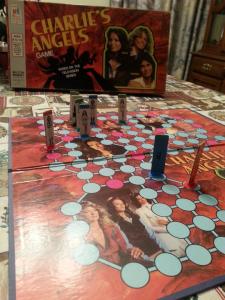
First up is Charlie’s Angels, published in 1977 by Milton Bradley. I’m a total sucker for any board game involving a 1970’s or 1980’s TV property (well, almost all of them), so when we saw this baby priced $20 in an antique shop, it was a shoo-in.

I instantly called Sabrina when we got the game home, but we soon discovered that each player takes control of their own team of Angels for the game, so no fighting over the individual Angels is required. The game concept is kinda cool. You have a board that is a sort of a modified grid. Onto this grid you place the Villain. The Villain moves one space on each player’s turn, the direction of the move chosen by the player in question. The player then rolls two dice and can move one of his or her angels each with each dice. If you can’t move the entire number on the dice with an Angel, you give up your move.

The goal is to trap the Villain – sort of a Charlie’s Angels checkmate. Each Angel that is in on the trapping is worth one point for their player. You play three games, total the points, and determine the winner. There are some cards that can be helpful … or harmful … so you take a risk pulling one. You also have to think a bit about how you want to move the Villain – you don’t want to be left out of the capture, so sometimes you’re really on the Villain’s side in the game. We had a good time with Charlie’s Angels, with the game ending in a three-way tie – not a bad ending for a family game.

One issue – I noted that the rules did not specifically disallow moving back on your path on your turn. They probably should have, because this seemed to make the game too easy, and it just didn’t feel right.

Next up was a funny little dice game – really a packaged version of old dice rules – called Skunk. Simple concept – you have two dice to roll. The dice replace the “1” with a skunk. On their turn, a player takes the dice and can roll them as often as they like, totaling the points rolled. If they roll a skunk, they get no points for this turn and have to pay a penalty (1 chip, or 2 if you rolled a skunk and a “2”). If you roll two skunks, you lose all the points you’ve acquired and pay a 4 chip penalty. To win, a player must get his total above 100 – she can go as high above 100 as she dares. Once a player goes over 100, the other players have to try to beat them on their next turn. The chips in the pot do to the winner of each round.

The game is really all about risk – how daring are you, and how lucky?

In our first game, I managed to zero-out midway through. When my daughter went over 100, I needed something like 60 points to beat her. I started rolling, got hot, and actually won the game. On our third game, I decided to do exactly that each turn, figuring I might eventually get hot again … and wound up rolling a skunk every time on my first or second roll.

We had a fun time with Skunk, and since up to 8 people can play it would probably make a fun party game. To make it more “grown up” you could turn it into a drinking game, with a drink taken on every skunk or double skunk. I suppose you could also play Strip Skunk … but then again, maybe not.

Finally, we have Buffy the Vampire Slayer: The Game, published in 2000, also by Milton Bradley. We bought this one for my daughter for Christmas, and she was raring to play it. It took a while to read the rules, but they weren’t too complicated and we had a good time playing it.

I took control of the bad guys, while my wife had to play Oz and Xander and my daughter got Buffy and Willow. The game is fun, pretty fast paced, and pretty easy to figure out. Evil sure looked like it was going to win this one – in short order, two of the goodies were out of the game and Evil had all the magic items. In the end, though, Buffy and Willow knocked off the evil minions and then teamed up on the Evil vampire and snuffed him out. Fortunately for them, the main villain doesn’t automatically get to move every turn. My guy spent three turns in a row not moving while they beat the crap out of him. C’est la vie.

So there you have it – three fun games for the family. All were purchased in antique stores for low prices and all were well worth it.

Shadowlord! – A Timely Review

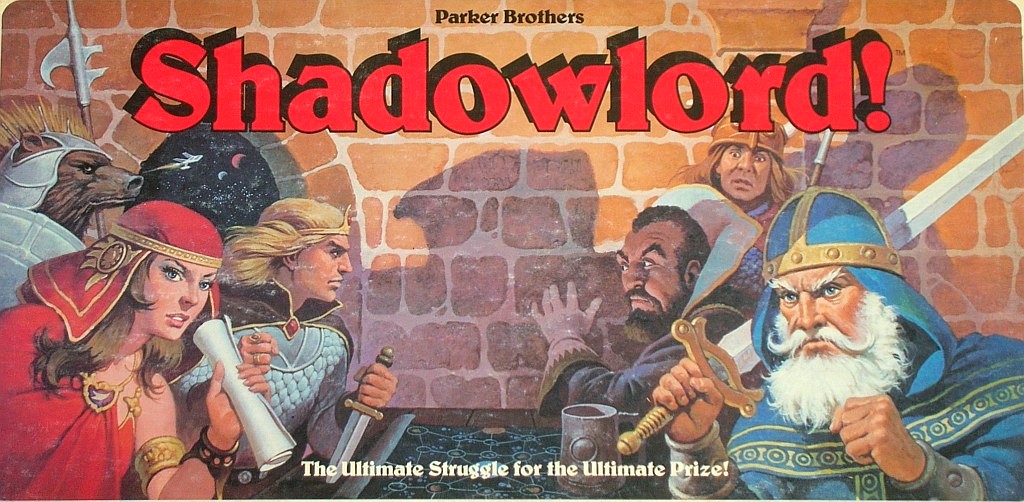
Once upon a time, a young me and my best friend Josh played a wondrous game of universal conquest. I have no idea where Josh got the game – maybe a gift, maybe stole it from his brother’s room. No idea. But it was awesome. There was this board with all these circles on it, and cards with cool pictures of people, including this one really hot chick that Josh and I both wanted on our team, and you did stuff in it and … stuff.

That was around about 1985, and years later I had no freaking idea what game I had played and enjoyed so much, and a few searches based on my scanty memories yielded nothing.

And then, one day in 2017, I was searching games on Etsy for some inspiration and found it. Shadowlord!! There are two exclamation points there because the game has a name ending with an exclamation point. I bought the game on Etsy, it was delivered a couple weeks ago, and last night, I finally played it again, this time with wife and daughter.

So how did it go?

Still awesome. Shadowlord! is a cool strategy game, with some nice random events and a requirement to think things through. This, of course, is why I was out on my second turn after going all in on a silly gambit. I was stupid, and the rules rightfully destroyed me.

The game involves playing one of four factions led by the Fire Lord (actually a lady), Air Lord, Water Lord and Earth Lord. The board is divided into numerous “galaxies”, including the “Lost Fortress” at the center of the board where resides the Shadowlord. The Shadowlord has many minions, who pop up in the galaxies and who can be used to mess with the other players. On your turn, you roll a random event (usually good for you), build spaceships, move around the board finding new allies in the galaxies to add to your faction and maneuvering to fight. I won’t go deep into the mechanics – the rules take a little while to learn, but they seem sound to me and after a few goes the game is pretty easy to play. The art is cool – the game was published in 1983, and the graphics show it in a good way. The game also has a time tracker – eventually, the Shadowlord takes control of the whole universe and beats everyone if the players take too long to win the game.

The game we played ultimately came down to wife vs. daughter, and really to my daughter’s quest to rescue one of her captured merchants, Svein, from one of my wife’s warriors. Svein, you see, is an anthropomorphic pig, and my daughter loves pigs. Yes, it all boiled down to a galactic Pig War, which my daughter ultimately lost. It was getting late, so we didn’t play things out completely to have my wife take on the Shadow Lord for control of the universe, but we had a good time.

UFO – A Timely Review

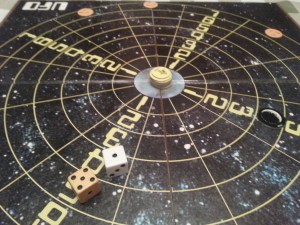
Mismatched dice and a space station standing in for a rocket, but GAME ON!

As long-time readers know, I like to keep my reviews at the Land of Nod timely and relevant, which is why today I’m reviewing a game made in 1976 by Avalon Hill.

Once upon a time (because anything that begins with that phrase has to be timely and relevant), when I must have been in elementary school or thereabouts, I was digging through a closet and came across a box that apparently held a game. The title – UFO: Game of Close Encounters.

These were the days of Star Wars, but they weren’t the days of VCR’s / DVD’s / Netflix / YouTube / watch anything you want when you want no matter what. These were the days when the Charlie Brown Christmas Special was on TV once a year, and if you missed it, you missed it. Star Wars was a phenomenon, and since it was in short supply, anything sci-fi was doing pretty well. I didn’t know much about this UFO game, but it looked like it was at least in Star Wars‘ neighborhood, so I was intrigued.

The game belonged to my father, apparently a gift from somebody. My father isn’t much of a game player, and I’m not sure he ever played the game in his life. He sure didn’t play it with me. The game migrated to my closet as a kid, and then moved with me when I left home. And then, one day thirty-something years later …

“What’s this,” asks my daughter, rummaging through the closet in my office.

And I realize it’s time to end the cycle. UFO must be played.
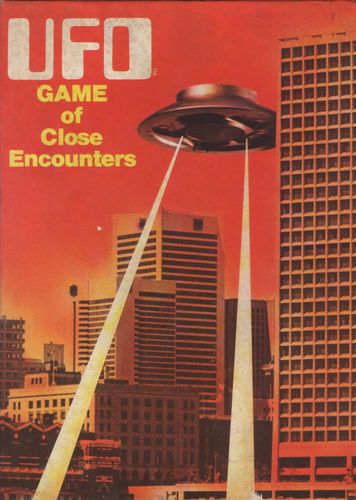
The cover, found at Board Game Geek, of course

I get the game out and check Board Game Geek to see what I’m missing. Apparently, I only managed to lose 2 counters in all the years I messed with the game as a kid. Not too bad, and not really an obstacle to playing the basic version of the game.

The victory conditions in the basic game are pretty simple – the invading UFO player wins by landing five saucers on Earth. The Earth player wins by destroying enough saucers that the UFO player cannot win.

Game play is equally simple. The UFO player places his/her saucers around the outside of the board. The Earth player places his rockets on Earth. Each turn, players roll two dice. Each dice controls the movement of a separate piece. Pieces can move in orbit clockwise. They can move to a different orbit only along four paths, and may not change orbit or move clockwise in the same turn. If a rocket lands on a saucer, the saucer is destroyed. If a saucer lands on a rocket, the rocket is destroyed.

If the Earth player rolls doubles, he loses his turn and the Moon moves in orbit. If the UFO player rolls doubles, she may hyperspace one of her saucers to any empty space on the board.

If the Moon, while orbiting, moves over a piece, it destroys the piece. If the Moon is empty, a piece can be landed on the Moon on its own turn, by exact count. Likewise, Earth can only be landed on by exact count, but either player.

So, them’s the rules. How did the game go?

Pretty fun, actually. The strictures on movement make you think a bit, and the potential for hyperspace makes it tough for the Earth player to cover all his bases. Ultimately, you want to control those orbital paths towards the Earth, but it’s not as easy as you think, because if you just sit there, eventually the UFO player is going to destroy your rocket or hyperspace in behind you. In the game my daughter and I played, it came right down to the wire – four saucers landed on Earth, one saucer left needing a “1” to land. I got the lucky roll the dice  and destroyed the fifth saucer. Earth was saved. All humanity rejoiced.

The advanced game involves space stations and false signals on radar, and we’ll tackle it at some point. The game was pretty fun, actually. Didn’t take long, and didn’t drain the brain, so a nice way to spend a half an hour or so. Afterwards, we played LIFE (the old version with Art Linkletter on the money, of course), and my daughter cleaned my clock.

Of course, there wouldn’t have been an Earth to play the Game of LIFE on if I hadn’t stopped the saucer invasion …
Invasion America!

I came across this article recently positing an invasion of the United States by the Nazis during World War II. It immediately brought to mind two games from my wargaming past – RISK and Axis & Allies (and Invasion America, though I never actually played that one). I got RISK as a kid and immediately fell in love with it – one of those “I didn’t know something like this even existed!” moments.

I was big into militaria and WW2 as a kid – watching Victory at Sea on Sunday mornings on the local TV station (KVVU, Channel 5) and playing war with other kids in the neigborhood. I remember my first game was played against a friend in the neighborhood and my dad. I played the blue army, naturally, and my father the red army. When he finally beat me, I felt like I’d failed the USA and let the Soviets conquer the world – what a lousy feeling. Fortunately, he gave me some pointers – mostly on not spreading myself thin and attacking at all costs – and I improved quite a bit at RISK. I now move at a snails pace, building up so much depth that attacks crash against me like waves on a shore. The last time I played was a few years ago, with my daughter. The first game I played with her she couldn’t roll a bad dice and she won. She decided RISK was a great game. The next two went to me and she decided she was going to take a break from RISK for a while. C’est la vie.

I was introduced to Axis & Allies (one of the greatest game covers ever, by the way) by some guys I worked with at a video store (VIDEO PARK – World’s Largest Video Store). They also introduced me to SUPREMACY. Fun stuff. I learned the hard way that Axis & Allies is designed to replicate the strategies used in WW2 – almost like wargame railroading. You wander too far off the reservation, and things can get tough. I can still remember a good friend of mine and I were going to be playing the Axis in a game and we spent the entire day at work plotting our strategy. We seized on the idea of Germany building an aircraft carrier and threatening the USA with its fighters – the Allies would never expect it – we would be unstoppable. Unfortunately, we were playing with a guy who didn’t think in terms of military strategy, but rather game strategy – and he also had a knack for rolling dice. Germany built its ill-conceived carrier and, like the real carrier built by the Germans, it took forever, was finally stuck in port, and then unceremoniously sunk when the Allies came across the Channel. Still – good times, and very instructive about the importance of understanding the logic of the game rules over the logic of the “real world”, even in terms of old school, rules-lite games.