Monks and Swashbucklers

This post will finish my posting of the hybrid “fighting-man” classes I was using in my last game, and it involves the oft-maligned monk. Now, I grant you that the monks as presented by Gygax lo those many years ago do not fit into a medieval milieu. On the one hand, I want to say – who cares? I run my games for fun, not verisimilitude. On the other hands, lots of folks do want their games to make sense and stick to a sort of “reality”. For those folks, allow me to suggest that the monk is still a usable class. The trick is to ignore the name and the “fluff” and just look at the game stats. What you have is a non-armored combatant who is quick and generally hard to kill. In other words, a very acceptable way to emulate a swashbuckler or two-fisted pulp adventurer. Heck, I’ve even used the class to stat out Popeye (don’t ask). So, before you relegate the monk (or any other class) to the dustbin, think about how you can adapt the flavor to the mechanics.

The following content is Open Game Content.

The Monk Sub-Class
The monk is a sub-class of fighting-man. Monks train themselves in the unarmed martial arts, including wrestling. They develop lightning fast reflexes and iron wills. Most monks are trained in special monasteries, but some simply apprentice themselves to a fighting master. Different masters and monasteries use different techniques, and they (and their students) are often quite competitive.

  • Prime Attributes: Strength & Constitution, 13+ (+5% experience)
  • Hit Dice: 1d12/level (Gains 5 hp/level after 10th.)
  • Armor/Shield Permitted: None.
  • Weapons Permitted: Any.

A monk’s unarmed attack inflict 1d4 points of damage at level 1, 1d6 points of damage at level 2, 1d8 points of damage at level 5 and 1d10 points of damage at level 9.

At level 6, a monk can make a second unarmed strike each round. The secondary strike’s damage begins at 1d4 and improves to 1d6 at level 9.

Monks improve their unarmored AC by +1 at levels 2, 5, 8 and 12.

A monk’s movement improves by +1 at each level. A monk carrying a medium or heavy load loses this extra speed.

A level 1 monk can use a stunning attack once per round, and no more than once per level per day. The monk must declare its use before making an attack roll. A missed attack roll ruins the attempt, and counts towards the monk’s limitation. A foe successfully struck by the monk is forced to make a saving throw. Those struck by a stunning attack always take normal unarmed attack damage, but a failed saving throw results in the foe being stunned and unable to act for 1d4 combat rounds.

At level 2, monks gain the ability to deflect arrows and other non-magical missiles. The monk must have at least one hand empty to use this ability. When a character would normally be hit by a ranged weapon, the character may make a saving throw. If the saving throw succeeds, the monk deflects the weapon and suffers no damage. This can be done once a round at levels 2-6, and twice at levels 7-11 and three times at 12th level. The monk must be aware of the attack to use this ability. An attempt to deflect a weapon counts as the monk’s primary unarmed attack. If a monk is high enough level to have a secondary unarmed attack, the monk may still make the secondary attack. This ability cannot be used against siege weapon ammunition.

At level 3, a monk’s unarmed attack can deal damage to creatures only harmed by +1 magic weapons. A level 5 monk can damage creatures only harmed by +2 or better magic weapons. A level 8 monk can damage creatures only harmed by +3 or better magic weapons, and level 12 monks can damage creatures only harmed by +4 or better magic weapons.

At level 4, a falling monk takes damage as if a fall were 20 feet shorter than it actually is, but must be within 10 feet of a vertical surface that he or she can use to slow the decent.

At level 6, a monk can feign death for a number of turns equal to the character’s level.

At level 7, a monk’s naturally healing increases to 2 hp per day.

At level 12, the monk gains the fabled quivering palm attack. The monk can use this attack once per week. The attack must be announced before an attack roll is made. The monk must be of higher level than the target. If the monk strikes successfully and the target takes damage from the monk’s unarmed attack, the quivering palm succeeds. Thereafter, the monk can choose to try to slay the victim at any later time within 1 round per level of the monk. The monk merely wills the target to die, and the victim makes a constitution saving throw to avoid this fate.

This attack has no effect on undead or creatures that can only be struck by magical weapons, unless the monk is able to inflict damage on such a creature.

The Swashbuckler: If you don’t think that a kung-fu-style monk fits into your campaign, you can rebrand the class as a swashbuckler. In this case, the monk’s “unarmed attacks” are instead made with long sword (rapier) and dagger, and only with these two weapons. The stunning attack can represent a dizzying flourish of arms or a pommel guard to the head. The quivering palm can be renamed “the lunge”, representing that moment when the swashbuckler stabs his foe, who then staggers about for a moment before expiring with a look of disbelief in his eyes.

Level Experience Hit Dice Attack Save Title
1 0 1 +0 16 Postulant
2 1,750 2 +1 15 Novice
3 4,000 3 +2 14 Brother
4 8,500 4 +3 13 Cenobite
5 20,000 5 +4 12 Mendicant
6 40,000 6 +5 11 Monk
7 80,000 7 +6 10 Canon
8 160,000 8 +7 9 Prior
9 325,000 9 +8 8 Abbott
10 550,000 10 +9 7 Abbott
11 750,000 +5 hp
+10 6 Abbott
12 1,250,000 +10 hp
+11 5 Abbott

S&W Format

Hit Dice: 1d6+3 per level, +3 hit points per level after level 9

Level Experience Hit Dice Attack Save Title
1 0 1 +0 14 Postulate
2 2,900 2 +0 13 Novice
3 5,800 3 +1 12 Brother
4 11,600 4 +2 11 Cenobite
5 23,200 5 +2 10 Mendicant
6 45,000 6 +3 9 Monk
7 90,000 7 +4 8 Canon
8 180,000 8 +5 7 Prior
9 360,000 9 +6 6 Abbot
10 480,000 +3 hp
+7 5 Abbot
11 600,000 +6 hp
+7 4 Abbot
12 720,000 +9 hp
+8 3 Abbot

Art by Alison Acton

Wyvern Coast – Shameful Sons, Feeding Frenzies and Demonic Springs

Twenty-seven more sites to explore in the southwest part of the Wyvern Coast map.

0132 Makronissos: Although King Philostos was a noble triton, his unruly sons were a shame to the entire kingdom. As each came of age, the king dutifully granted them leave to construct a fortress and attract whatever followers would have them. Naturally, Philostomes, the eldest, chose to stay by his father’s side, and it is he who now wisely rules Nimos in [0631]. His brother Mathian is the quarrelsome lord of Makronissos, while the youngest, Sthenelaus, lusty rascal that he is, rules Fleves in [0231]. The three rarely have anything to do with one another, though Mathian and Sthenelaus delight in outdoing their older brother and foiling the plans of the other.

Prince Mathian’s fortress is a three-story shell keep constructed from marble blocks on a trefoil pattern, the courtyards topped by onion-shaped domes of glassy-steel. The keep is surrounded by the homes of his fighting-men and women. These homes are constructed of marble blocks, resembling the courtyard homes of the ancient Romans. Makronissos is home to 99 triton warriors, 82 females and 110 young. Prince Mathian, in a fit of madness, constructed a basalt temple to Oceanus, Titan of the Sea. The temple is overseen by Marta with the help of four assistants. The household is overseen by Erigone, Mathian’s wife and a sorceress in her own right. Mathian’s nine household knights, who ride sea horses into battle, can be identified by the deep crimson kelp they wear as sashes. All of the howling warriors of Makronissos carry tridents and shields. They glory in battle. Prince Mathian himself rides in a bronze chariot pulled by seven sea cats. The treasury of Makronissos lies in a pit beneath a heavy stone slab that takes six tritons to lift. It contains 20,000 sp, 29,000 gp, 500 pp and five amphorae of fine wine.

  • Prince Mathian, Triton Fighting-Man Lvl 9: HP 52; AC 4 [15]; Save 8; Special: Magic resistance 90%; Shield, trident.
  • Marta, Triton Cleric Lvl 10: HP 40; AC 5 [14]; Save 5; Special: Cleric spells (5th), banish undead, magic resistance 90%; Shield, trident, holy symbol (gold conch).
  • Assistant Clerics, Lvl 3: HD 3d6+3; AC 5 [14]; Save 12; Special: Cleric spells (1st), banish undead, magic resistance 90%; Shield, trident (silver conch).
  • Erigone, Triton Magic-User Lvl 8: HP 19; AC 6 [13]; Save 8; Special: Magic-user spells (4th), magic resistance 90%; Silver dagger, grimoire.
  • Household Knights: HD 6; AC 5 [14]; Atk 1 trident (1d8+1); Move 1 (Swim 18); Save 11; CL/XP 7/600; Special: Magic resistance 90%.

0134 Expensive Rubble: A large mound of marble blocks rests here, the remnants of construction by the tritons in [0233] and [0631].

0231 Fleves: Fleves is the stronghold of Sthenelaus, brother and rival of Mathian [0132] and Philostomes [0631]. Sthenelaus is wild and unruly, with a massive appetite for war, women and song. His cadre of retainers are nine devotees of Bacchus. Fleves itself is a coral feasting hall capable of holding Sthenelaus, his retainers, his court druid, Helle, and magician, Talthybios, and his 292 followers (93 males, 94 females and 105 young). The hall’s ceiling is covered in beaten bronze and hangs 40 feet above the floor. The tables, benches and chairs are the remnants of a century’s worth of shipwrecks. The walls are lined with trophies and weapons – the warriors of Fleves prefer barbed spears, bucklers and hoplite-style helms. The tables are always loaded down with the harvest of the sea, including stoppered stone crocks of wine. At one end of the hall is a massive marble idol of Bacchus. Heaped around the statue is the treasure of Fleves: 10,000 sp, 5,500 ep, 17,000 gp, 1,020 pp, an aquamarine (450 gp) and a jasper (6 gp). The idol is guarded by Helle’s four assistants at all time. The feast hall is surrounded by a thick forrest of kelp prowled by twelve sea cats trained to ignore the tritons of Fleves, but to attack anyone else on sight. Sthenelaus goes into battle in a chariot drawn by six hippocampi. His maenads ride hippocampi as well, their green hair tied into long braids, their arms bearing ritual scarification.

  • Sthenelaus, Triton Fighting-Man (Barbarian) Lvl 9: HP 50; AC 4 [15]; Save 8; Special: Magic resistance 90%; Buckler, helm, barbed spear.
  • Maenads, Triton Fighting-Women (Barbarians) Lvl 6: HD 6d6+12; AC 4 [15]; Save 11; Special: Magic resistance 90%; Barbed spear, net.
  • Helles, Triton Cleric (Druid) Lvl 11: HP 41; AC 4 [15]; Save 4; Special: Cleric (Druid) spells (5th), magic resistance 90%; Barbed spear, shield, helm, holy symbol (gold vines, worn around neck).
  • Helles’ Assistants (4), Triton Clerics (Druids) Lvl 3: HD 3d6+3; AC 4 [15]; Save 12; Special: Cleric (Druid) spells (1st), magic resistance 90%; Barbed spear, shield, helm, holy symbol (silver vines, worn around neck).
  • Talthybios, Triton Magic-User Lvl 8: HP 18; AC 5 [14]; Save 8; Special: Magic-user spells (4th), magic resistance 90%; Silver dagger, grimoire.

0233 Tomb of King Philostos: As mentioned in [0132], King Philostos is dead, killed three centuries ago in battle with the sahuagin. In his honor, his sons, putting aside their rivalry, constructed a fabulous tomb for their father. The tomb is built of marble and stands 20-ft wide, 20-ft deep and 20-ft tall. Atop the tomb is a 20-ft tall bronze statue of Philostos. The tomb is surrounded by false columns carved onto 5-ft thick walls. The interior of the tomb is dry, and actually cannot be entered by water under any means. At the center of the tomb chamber is a gold-plated sarcophagus suspended from the ceiling by bronze chains over a pit of charcoal. The walls are covered in bright mosaics depicting the life, death, funeral and ascension of King Philostos.

A captive fire elemental called Horogule guards the tomb. He dwells in the fire pit, but copper piping allows him to move rapidly throughout the tomb chamber. His access to the chamber can be closed by depressing the right eye of the images of Philostos in the chamber murals. He is depicted four times, once on each wall. By depressing the right eyes on the images, the fire pit and pipes are sealed, trapping the fire elemental. There are two clues to this course of action; the first is a charred skeleton by one wall reaching toward the image of Philostos. The other is that the bas-relief of Philostos on his sarcophagus has his right hand over his right eye and his left hand grasping a trident that is impaling a fire-breathing dragon.

The tomb treasure is concealed in four floor spaces. Above each of these spaces there is a trap in the form of a crescent axe that falls from the ceiling, splitting would-be thieves in two (attacks as a 6 HD monster, 2d6 damage). The floor spaces contain 10,000 sp, 5,100 gp and a bronze figurine of Neptunus (500 gp).

  • Horogule: HD 16 (43 hp); AC 2 [17]; Atk 1 strike (3d6); Move 12; Save 3; CL/XP 17/3400; Special: Ignite materials.

0631 Nimos: Nimos is the stronghold of Philostomes, the eldest and favored son of King Philostos. Nimos now rules Nimos and its 118 triton warriors, 93 females and 108 young. He is advised by his aged mother, Diomede, a priestess of Amphitrite. Philostomes is philosopher, poet and warrior. His army is well drilled and schooled in the concepts of chivalry. His personal guard consists of eight knightly warriors led by Aristonike, a chaste paladin and Philostomes’ ideal of beauty. Nimos is a marble citadel atop a sea mount. It is built in the ancient Greek style, and within its thick walls there is a fortified palace, a temple of Neptunus and Amphitrite and stables for the prince’s twenty hippocampi. Beneath the sea mount there is a dungeon protected by roving sea cats and cunning traps. The dungeon’s only resident is the undying eye of a wicked sea titan, killed a milennia ago by King Philostos. A vault in the citadel holds 21,000 sp, 5,500 ep, 27,500 gp, 500 pp, a spinel (7,000 gp), a zircon (10 gp)

  • Philostomes, Triton Fighting-Man (Bard) Lvl 9: HP 45; AC 2 [17]; Save 8; Special: Magic resistance 90%; Helm, scale armor, shield, trident, silver dagger, golden horn, gauntlets of dexterity.
  • Aristonike, Triton Fighting-Woman (Paladin) Lvl 8: HP 34; AC 2 [17]; Save 9; Special: Magic resistance 90%; Helm, scale armor, shield, trident, holy symbol (silver conch), potion of healing.
  • Knights of Nimos, Triton Fighting-Men Lvl 6: HP 6d6+12; AC 3 [16]; Save 11; Special: Magic resistance 90%; Helm, scale armor, shield, trident.
  • Diomede, Triton Cleric (Druid) Lvl 11: HP 44; AC 4 [15]; Save 4; Special: Cleric (Druid) spells (Lvl 5th), magic resistance 90%; Helm, shield, trident, holy symbol (gold image of Amphitrite).
  • Diomede’s Priestesses, Triton Cleric (Druid) Lvl 4: HD 4d6+4; AC 4 [15]; Save 10; Special: Cleric (Druid) spells (2nd), magic resistance 90%; Helm, shield, trident, holy symbol (silver image of Amphitrite).

0640 Eador: Eador is a lair of 345 gnome artisans, 114 gnomewives and 64 gnomelings. They dwell in burrows beneath the roots of a large, gnarled oak tree. The gnomes of Eador produce delicate images in stained glass for trade, most of their contact coming via traders from Ophir or clerics interested in decorating their monasteries. Their work can be seen hanging from the branches of their tree and also lodged between gnarled roots, illuminating some of the burrows beneath. The gnome-king of Eador is Kermid. Kermid’s honor guard is composed of six level 3 fighting-gnomes. The community is also served by a cantankerous druid named Thumbar and his three level 2 assistants. The gnomes keep a flock of sixteen giant ravens as guard animals and messengers. Deep in their burrows, the gnomes keep 2,000 sp, 10,100 gp, 110 pp a matching pair of electrum clasps, each set with 11 tiny topazs (35 gp) and 1,000 gp worth of stained glass.

  • Gnome: HD 1d6; AC 4 [15]; Atk 1 weapon (1d6); Move 9; Save 17; CL/XP 1/15; Special: Simple illusions, +4 AC vs. giant creatures.
  • Kermid, Fighting-Gnome Lvl 5: HP 28; AC 2 [17]; Save 12; Light mace, platemail.
  • Honor Guard, Fighting-Gnome Lvl 3: HD 3d6+6; AC 3 [16]; Save 14; Hand axe, chainmail, shield, crossbow.
  • Thumbar, Gnome Cleric (Druid) Lvl 6: HP 30; AC 6 [13]; Save 9; Special: Cleric (druid) spells (3rd); Club, leather armor, shield, holy symbol (wreath of oak leaves).
  • Thumbar’s Assistants, Lvl 2: HD 2d6+2; AC 6 [13]; Save 15; Special: Cleric (druid) spells (1st); Club, leather armor, shield.
  • Giant Raven: HD 3; AC 5 [14]; Atk 1 bite (1d8); Move 2 (Fly 30); Save 14; CL/XP 4/240; Special: None.

0745 Morix: Morix is a relatively new dwarf stronghold built into the mountains. It is inhabited by 360 dwarfs with 135 females and 55 dwarflings. The dwarfs mine tin (about 20,000 gp worth a month), trading it to Ophir for iron and gold. Morix is ruled by King Okolast and Queen Maiu. Okolasts housecarls are six level 3 fighter/clerics. He is assisted in times of battle by two level 2 sergeants. The entrance to Morix is located 60 feet above the ground in the side of a mountain, with supplies being lowered and raised via pulleys and stout ropes. The dwarfs also maintain two escape tunnels that emerge well away from the entrance and can only be opened from the inside. The halls of Morix are patrolled by seven brown bears. Okolast’s main hall has a vaulted ceiling supported by massive pillars engrave with the name of every dwarf from his clan lost when they were forced to quit the Bleeding Mountains across the sea. His throne is cast from bronze and decorated with goblin skulls. The dwarfs of Morix maintain a dozen forges and a multiple shrines to Volcanus, whom they call Weyland. Their heavily trapped vaults contain 10,000 cp, 10,500 ep, 2,500 gp, 1,100 pp, a cymophane worth 40 gp and jewelry worth 30 gp. They generally have 60 tin ingots (5 lb each, worth 15 gp each) on hand and 15 barrels (60 gp each) of slightly sour wine (as dwarfs prefer it that way).

  • Dwarf: HD 1; AC 4 [15]; Atk 1 weapon (1d8); Move 6; Save 17; CL/XP 1/15; Special: Detect attributes of stonework.
  • Okolast, Dwarf Fighter/Cleric Lvl 5: HP 24; AC 1 [18]; Save 10; Special: Cleric spells (2nd); Platemail, shield, military pick, dagger.
  • Housecarls, Dwarf Fighter/Clerics Lvl 3: HD 3d6+6; AC 1 [18]; Save 14; Platemail, shield, hand axe, dagger, crossbow.
  • Sergeants, Dwarf Fighting-Men Lvl 2: HD 2d6+4; AC 3 [16]; Save 15; Chainmail, shield, hand axe, dagger, crossbow.
  • Brown Bear: HD 4+1; AC 7 [12]; Atk 2 claws (1d3), 1 bite (1d6); Move 9; Save 13; CL/XP 4/120; Special: Hug (+1d8 damage if hits with both claws).

0833 Exiled Merrow: A band of ten exiled merrows have taken residence in a dilapidated keep choked with barnacles. The merrows have no mermaids in their harem and are taking their humiliation out on anything that passes by. They are lead by an especially large and stupid male called Kthuk. The merrows are armed with thick spears and nets. Their treasure consists of 500 ep, 400 gp, a rose quartz (165 gp) and a silver statuette of entwined mermaids (7,000 gp).

  • Kthuk: HD 6 (26 hp); AC 4 [15]; Atk 1 weapon (1d10+3); Move 9 (Swim 9); Save 11; CL/XP 6/400; Special: None.

0930 Feeding Frenzy: A merchant galley recently slipped under the waves, victim of a tusked whale. It carried with it over 100 chained slave rowers, whose corpses are now at the center of a feeding frenzy of thirty lacedons and twenty sharks. The lacedons look like water-logged corpses with feral faces. From the tattered clothing they wear, it is obvious that most are former corsairs and sailors. At the center of the lacedons is a female with stringy, black hair, grey skin and wearing the remnants of a silk gown. Bards may be able to identify her as Ivada, Lady of Comiar in the territory of Ophir, lost at sea six months ago. Her return in a more civilized state could be worth a 200 gp reward from her father, as she was his last heir. Amidst the ship’s wreckage one could salvage 75 gp worth of cedar lumber, hides and skins worth 250 gp, an amphorae of spiced wine (40 gp), 60 gold ingots (1 lb each, 100 gp each) and a collection of marble statuary (2,500 gp) intended for the home of a wealthy merchant of Antigoon.

  • Lacedon: HD 2; AC 6 [13]; Atk 2 claws (1d3), 1 bite (1d4); Move 9; Save 16; CL/XP 3/60; Special: Immunities, paralyzing touch.
  • Shark: HD 5; AC 6 [13]; Atk 1 bite (1d6+2); Move 0 (Swim 24); Save 12; CL/XP 5/240; Special: Feeding frenzy.

0933 Zorix: Zorix is a small, rocky island with several sandy beaches. The center of the island is dominated by a craggy upland, from which flow two streams marked by many waterfalls. One flows to the northern shore of the island, the other to the western shore. The upland has many caves, and most show signs of visitation. One has seen more visitation than the others, and contains a crude, blood-stained stone altar and many black candle nubs. Just beyond the altar the cave floor drops away suddenly; thirty feet below is a grotto. The grotto is filled with icy, cold water. The ceiling is marked with dozens of reddish-orange stalagtites and the floor of the lagoon with similar stalagmites. Hidden among the stalagtites are a dozen piercers. The waters of the lagoon hide a submerged, 20-ft long tunnel that emerges in a large vault. This vault measures forty feet in circumference. The periphery is submerged in icy water, while the center rises above the water in a 20-ft tall black pillar. This pillar is actually Zorix, a massive, demonic roper, believed by cultists from Ophir to be the spawn of Baalzebul and one of his avatars on Nod. They are correct in this assumption, and any aggression committed on Zorix will be noted by the Lord of Flies. A century of offerings to Zorix now lie in the water around his dais and amount to 20,000 cp, 5,500 ep, 1,200 gp, 510 pp, a bronze kyton (100 gp) that once held blood wine.

  • Piercers: HD 1; AC 3 [16]; Atk 1 slam (1d6); Move 3 (Climb 3); Save 17; CL/XP 2/30; Special: A piercer scores 2d6 damage on the roll of a natural 20 to hit, the piercer’s belly is coated with acid that deals 1d6 damage to exposed flesh.
  • Zorix: HD 12 (51 hp); AC 0 [19]; Atk 1 tentacle (weakness), 1 bite (2d10); Move 3; Save 3; CL/XP 17/3500; Special: Tentacles grab and cause weakness (save or lose half strength points), smite good once per day (+12 damage to good creature), cleric spells (one per level, up to 9th), immune to poison, half damage from acid, fire and lightning, magic resistance 25%, only harmed by magic weapons.

[Because the 12-year-old in me still likes piercers and wants desperately for them to finally work!]

0936 Tomb of Clever Eksirossa: Eksirossa was, in her day, the greatest thief to have ever pilfered a vault in Ophir, a city-state noted for its thieves. Her tomb was constructed to her special design by a band of duergar who took her right hand and the jewels on her fingers as payment. The tomb is constructed in a cave overlooking the sea. The cave is filled with twenty feet of water at high tide and about 5 feet of water at low tide. The cave’s ceiling is 35 feet above the floor, thus 15 feet above the water surface at high tide and 30 feet above the water’s surface at low tide. Hanging from the ceiling by a thick, iron chain is a bronze sphere 13 feet in diameter. The sphere is hollow, the skin being 3’ thick. The ball has three obvious, circular portals. None of these portals are trapped, per se, but all are dangerous.

The first two portals are located on the upper surface of the globe. Either requires a master thief to overcome its locks. When one is opened, it reveals inky darkness within the globe. This is a portable hole that sends anyone entering into a cramped, empty space several miles away. This space contains a coffer corpse and a treasure of 500 silver-plated lead coins (worth about 1 gp, but weigh 1,000 lb).

  • Coffer Corpse: HD 2+2 (16 hp); AC 7 [12]; Atk 1 fist (1d6); Move 9; Save 16; CL/XP 4/120; Special: Only harmed by magic weapons (though weapons appear to do damage), false death (if “killed” with normal weapons, will fall and then rise again, causing fear), choking (those hit by fist must save or be choked for 1d6 damage per round).

The second portal is much as the first, but leads to a slick tunnel-slide into a cavern filled almost entirely with bubbling magma. In the center of the cavern there is, atop a basalt dais, a pile of gold coins. Suspended from the ceiling of the magma cavern and leading from the entrance to the dais are nine rings suspended from chains. The second, fourth, sixth and ninth rings wil collapse if any weight is placed on them, the others will hold up to 200 pounds before collapsing. The pile of treasure on the dais is a treacherous treasure. The coinage on its surface amounts to 1,100 gp and 500 ep, all of its ancient and counterfeit and bearing very rude messages in a variety of languages.

  • Treacherous Treasure: HD 7 (31 hp), AC 3 [16]; Atk 1 slam (3d6); Move 6; Save 9; CL/XP 7/600; Special: Surprise foes 40% of the time.

The final portal is located on the bottom of the sphere. It is also a portable hole leading into the center of the sphere. Moving up through the hole actually entails coming in from one side. The interior of the sphere is 10 feet in diameter. The center of the sphere is taken up by a circular cage with steel bars from top to bottom. Inside this space is the skeletal corpse of Eksirossa, identifiable by her missing hand and her broad grin, which reveals a mouth full of gold teeth (10 gp worth). The door of the cage has a very complex lock that requires two successful rolls to open. A failure on the first attempt results in the portable hole detaching and falling into the sea below and trapping the would-be thief inside the sphere. A failure on the second roll results in the sphere detaching from the ceiling and plunging into the water below, causing 5d6 points of damage to anyone inside (or beneath it). Eksirossa’s corpse is wearing a single glove of dexterity, a +1 dagger that glows when within 30 feet of precious metals or gems, and her personal burglar’s tools, crafted by masterful hands and giving thieves a +1 bonus to all thievery rolls.

1034 Delec: Delec is a village of 300 loutish copper miners living in adobe huts. The village has few females, for few women can be persuaded to live among the miners. Delec is surrounded by a stone wall, three stout watch towers and a moat filled by a stream. It is ruled by Lord Shemel, a pompous twit every bit as unpleasant as his subjects. The village knows no crime, primarily because Shemel and many of the miners are actually members of the Brotherhood of the Purple Hood, a clan of assassins that has existed since the times of the Purple Kings. Despite Shemel’s buffonish act, he is the shrewdest and most dangerous man on the Wyvern Coast after Zargo, whose rule he plans to usurp. Delec is defended by 60 men-at-arms in chainmail and toting pole axes, short swords and crossbows. The men-at-arms are commanded by seven sergeants, all assassins under Shemel’s ultimate command. Shemel’s treasure is 1,000 copper ingots (1 lb each, 1 gp each), 20,000 cp, 1,000 sp, 500 ep and 2,800 gp.

  • Sergeants, Assassins Lvl 3: HD 3d6; AC 7 [12]; Save 13; Special: Death attack (save or die, otherwise double damage), surprise on 1-2 on 1d6; Leather tunic (backed with steel plates), short sword, dagger, crossbow.
  • Lord Shemel, Assassin Lvl 7: HP 24; AC 6 [13]; Save 9; Special: Death attack (save or die, otherwise triple damage), surprise on 1-2 on 1d6; Leather tunic (backed with steel plates), spring-loaded cane (treat as javelin), silver dagger, poisoned dagger (save or die).

1036 Zonay: Zonay is a village of 100 pious goatherds living in timber huts surrounded by a thicket and moat. Zonay is governed by Difer, a reeve of Prince Zargo recently arrived from Ophir. Zonay is protected by ten men-at-arms (chainmail and shield, battle axe and crossbows) commanded by Sergeant Phaus. A stream rushes by the village and fills its moat. The goats of Zonay were known to produce the finest cheese on the Wyvern Coast, and thus were highly valued by Prince Zargo. Unfortunately, the arrival of Difer has changed this. For untold ages the people of Zonay paid heed to a kilmoulis named Kolong who tended their herds and produced their excellent cheese. In return, they were careful to ever speak his name reverently and leave nothing but dishes of perfume for his meals. Alas, Difer thought these the acts of fools, and has now brought the wrath of Kolong down on the village, for their milk is curdled and sour and their goats growing thin. A party of adventurers capable of rectifying this situation might attract the patronage of Prince Zargo.

1226 Noromina (West): Noromina island is ringed by reefs. It is dotted with a few small farmsteads that mostly raise sheep and garlic. A remote temple of Melkarth was constructed on the island by cultists several centuries ago. It has a caretaker named Grono and hosts athletic games every seven years in honor of Melkarth. At this time, dozens of adventurers, athletes, aristocrats and merchants crowd onto the island, pitching simple tents and grand pavilions and enjoying competitions that include races, swimming, javelin throws, archery and wrestling. Hidden behind a loose stone in the temple are 1,000 sp and an ivory idol of Melkarth worth 105 gp. The shephards have stout locks on their doors and have holy symbols painted on their doors and each wall of their home, for the other end of their island is plagued by vampires.

  • Grono, Gnome Cleric Lvl 4: HP 20; AC 4 [15]; Save 11; Special: Cleric spells (2nd), banish undead, hear noise on 1-2 on 1d6, communicate with burrowing animals; Chainmail (rarely worn, slightly rusty), light hammer (1d4 damage), holy symbol of Melkarth.

1326 Noromina (East): This side of the Noromina island is mountainous and inhabited by bestial vampire spawn called kalikantzaros. The kalikantzaros look like smallish humans with bestial features (tusks, hairy bodies). They fear the sound of bells. They only come up from their subterranean abodes at night in the dead of winter.

  • Kalikantzaros: HD 4; AC 4 [15]; Atk 1 bite (1d6 + level drain); Move 12; Save 13; CL/XP 7/600; Special: See this blog post.

1336 Vignos: Vignos is a sprawling village of timber huts overlooking the sea. The landward side is protected by an earthen rampart and several watch towers. Vignos is inhabited by 500 dour, xenophobic fishermen ruled by Lord Jerig, himself a paranoid with an intense hatred of elves. The villagers get their water from a large reservoir located in the hills beyond their village. Vignos is defended by 100 men-at-arms (leather armor, long bows, spears) and twelve sergeants under the command of Jerig himself. An old woman named Ronia has a vast knowledge of the Wyvern Coast, and will happily hire on to guide adventurers. Jerig’s coffers contain 20,000 cp, 1,000 ep, 2,500 gp, 20 pp, a garnet (70 gp), a silver ring decorated with scaled dolphins (80 gp) and a painted terracotta wine pitcher (115 gp). Vignos has over 100 fishing boats (worth 30 gp each)

  • Jerig: HD 3 (19 hp); AC 2 [17]; Atk 1 weapon (1d8+1); Move 9; Save 14; CL/XP 3/60; Special: Gives soldiers a +1 boost to morale.
  • Ronia: HD 2 (9 hp); AC 6 [13]; Atk 1 weapon (1d6); Move 12; Save 16; CL/XP 2/30; Special: While under her guidance, the chance of surprise and random monster encounters are rolled on 1d8.

1837 Sabre-Tooth Tribe: A tribe of 63 cavemen, 61 cavewomen and 37 cavechildren dwell in a deep, winding complex of limestone caves. The cavemen wield flint knives in combat. They are led by a prudish, tempermental chieftain called Yog along with four sub-chiefs. They worship sabre-tooth tigers under the guidance of a shaman called Jothag. Yog is always accompanied by his six bodyguards. The sabre-tooth people have persisted in these hills since the days when the Wyvern Coast was an archipelago of tiny islands. They are extraordinarily long-lived, with the elders of the tribe reaching well over 300 years of age.

  • Caveman: HD 1; AC 8 [11]; Atk 1 weapon (1d6); Move 12; Save 17; CL/XP 1/15; Special: None.
  • Bodyguards, Fighting-Man (Barbarians) Lvl 3: HD 3d6+9; AC 8 [11]; Save 14; Flint knife, tiger hide.
  • Sub-Chiefs, Fighting-Man (Barbarian) Lvl 4: HD 4d6+12; AC 7 [12]; Save 13; Flint knife, wyvern hide.
  • Yog, Fighting-Man (Barbarian) Lvl 5: HP 31; AC 7 [12]; Save 11; Flint knife, wyvern hide.
  • Jothag, Cleric (Druid) Lvl 3: HP 9; AC 9 [10]; Save 12; Special: Cleric (druid) spells (1st); Gnarled acacia-wood staff, tiger tooth necklace holy symbol.

1946 Magnolia Grove: A large magnolia grove, a hold over from the days when the savanna was a swamp, covers several acres here. The grove offers shade, but the presence of dozens of castaway spears stuck in the ground suggests danger. This danger comes in two forms. The first are the nine dusky-skinned dryads that inhabit and protect the grove. They are particularly adoring of human hunters, and often lure them into their trees, only to cast them away centuries later. Moreover, living in the branches of the magnolias are a species of pseudo-dragon with white scales. The pseudo-dragons feed on the magnolia nectar with long, curled, pink tongues. At any given time, there will be 2d6 of these pseudo-dragons observing intruders and prepared to attack if they show any inclination to harm the trees.

  • Dryads HD 2; AC 9 [10]; Atk 1 wooden dagger (1d4); Move 12; Save 16; CL/XP 3/60; Special: Charm person (-2 save).
  • Pseudo-Dragon: HD 2; AC 2 [17]; Atk 1 bite (1d3), 1 tail sting (1d3 + poison); Move 6 (Fly 25); Save 16; CL/XP 5/240; Special: Magic resistance 25%, poison (25% lethal, otherwise catalepsy for 1d4 days), invisibility (80% effective).

2028 Absalon: Absalon is the name of an island ringed by high cliffs. The cliffs are dotted with dozens of sea caves, one such cave leading to the surface via steps carved into the stone. The walls of this cavern are decorated with images of bearded men dressed as fish. The surface of the island is green and lush. It is composed of verdant meadows with trickling streams and copses of tall pine trees. In the midst of this paradise there is a large granite upland covered by a sparkling town of white walls and tall, white buildings. A single gate permits access to the town, which is peopled entirely by children. The children of Absalon range in age from infancy to twelve years of age. The children perform the roles of adults – tending the miniature, dun cattle that graze in the meadows, making pottery, woodworking, etc. The recognized leader of the children is a boy named Lodeses. Lodeses is wise for his age, but still a child and in over his head trying to lead the 2,000 young citizens of Absalon. Nonetheless, he and his peers are expert slingers; they wear leather armor and carry slings, javelins and knotty pine clubs into battle. They are determined to defend their village, especially the domed church that sits in the center of town.

The domed church consists of a large, central chamber 30 feet in diameter surrounded by a dozen small rooms used for storage. Seven statues of fish-garbed men, like those in the sea cave, stand against the walls of the church, their hands extended in peace. In the center of the room there is a squat dais upon which rests a large vessel carved from malachite and used to burn incense and offerings of meat. A secret catch on the dais shifts this vessel and reveals a narrow set of stairs that leads to a grotto deep benath Absalon. It is here that the people of Absalon, upon reaching their thirteenth year, descend to undergo a monstrous transformation into a hybrid of fish and man. These bizarre creatures welcome these visitors. Young women are mated with, their children eventually being placed at night in the church to be found and raised by the children of Absalon. The fish people, who call themselves oannes, have pallid, scaled skin, lipless mouths and curled beards (on the men) and large, fishy eyes. They are exceptionally bright scholars and philosophers for many years. But they never stop growing, and eventually turn feral and are forced into the sea, where they complete their transformation into tusked whales.

  • Child Soldiers of Absalon: HD 1d4; AC 8 [11]; Atk 1 weapon (1d4); Move 9; Save 18; CL/XP A/5; Special: None.
  • Oannes: HD 6; AC 2 [17]; Atk 1 bite (1d4) or 1 weapon (1d8); Move 12; Save 11; CL/XP 7/600; Special: Spells (change self, dispel magic, ESP, levitate, magic missile, shield, all once per day each), create small, simple object once per day.

2247 Strange Statue: Half-buried in the soil is a bronze statue (60 gp) of a tall, bald woman with two hands at the end of each arm, each hand holding a dagger. The statues eyes are formed of bone chips and the woman’s face bears an inhumanly wide grin. The statue attracts weird parasites that dwell on the astral plane. These parasites will attach themselves to the astral body of any magic-user present and feed off his magical energies, creating a cumulative 1% chance per day of failure when he tries to cast spells. They can only be removed by casting remove curse while on the astral plane.

2429 Lionweres: A pride of seven lionweres, consisting of one male, four females and two cubs, dwells in a cave. The females hunt during the night, taking the form of beautiful, tawny-haired maidens to get close to their prey. If doing poorly in a fight, their yowls will draw the attention of the male, who will arrive in 1d4 rounds to either save them or take revenge. The lionweres have hidden in their caves a gold ring worth 100 gp, a platinum oil lamp worth 950 gp, trade (1,000 gp), 1,000 sp, 400 gp, 500 ep, 20 pp and a hematite worth 35 gp.

  • Lionwere (females): HD 6 (24 hp); AC 2 [17]; Atk 1 bite (1d8) or weapon (1d8); Move 15; Save 11; CL/XP 7/600; Special: Weakness gaze, hit by silver or magic weapons only.
  • Lionwere (males): HD 6 (36 hp); AC 2 [17]; Atk 1 bite (1d10) or weapon (1d10); Move 15; Save 11; CL/XP 7/600; Special: Weakness gaze, hit by silver or magic weapons only.

2839 Ivory Tower of Kinyoth: Rising above the highlands is a 75-ft tall tower of ivory and limestone. This is the tower of Kinyoth the tower hag. Kinyoth is the undisputed master of this hex and the hexes surrounding it. She stands 9-ft tall. She has steel grey skin, black claws and weathered, black teeth, pale yellow eyes and limp, black hair that falls beyond her shoulders.

The tower has five levels. The first level is approximately 20-ft in diameter. The walls of this level are slick, rippled ivory and seem to sweat a yellowish ichor. The first level is a dumping ground of the magical detritus of several centuries – ruined scrolls, broken vials, magical cabinets, scorched wands, etc. Lurking among the ruined items are ten barics. Winding stairs lead to level two.

  • Baric: HD 5; AC 6 [13]; Atk 2 claw (1d4) and 1 bite (1d10); Move 15; Save 12; CL/XP 5/240; Special: None.

Level two looks much like level one. It is furnished with a multitude of torture devices and has seven sets of manacles attached to the walls and two iron cages hanging from the vaulted ceiling. Three prisoners currently occupy this chamber: An ogre called Tundrun that has been shrank to the size of a halfling, a young woman named Marya in an iron cage who appears to be suffering from leprosy, and a naked, scarred man named Lhumler with wild eyes who is chained to one wall. Lhumler was once a paladin, but successive bouts of torture and rape have reduced him to a mere fighting-man. The room is guarded by two headless screamers.

  • Headless Screamer: HD 4; AC 3 [16]; Atk 1 claw (1d6) or 1 thrown head (1d8); Move 15; Save 13; CL/XP 7/600; Special: Throw and retrieve head, scream, immune to cold.
  • Lhumler, Fighting-Man Lvl 6: HP 7 (39 normally); AC 9 [10]; Atk 1 fist (1d2); Move 9 (due to a limp); Save 11.
  • Marya: HD 1d4 (1 hp); AC 9 [10]; Atk 1 fist (1d2); Move 12; Save 18; CL/XP A/5; Special: Leprosy (treat as mummy rot).
  • Tundrun: HD 4+1 (21 hp); AC 5 [14]; Atk 1 fist (1d4); Move 6; Save 13; CL/XP 4/120; Special: None.

The third level is a dank library lit by candles made from the fat of virgins. A large, wooden chair sits in the middle of the room, and chained to the outer walls are six large tomes (30 lb each) containing magical lore (1d4 spells each). The books are guarded by six inaeds.

  • Innaed: HD 3; AC 0 [20]; Atk none; Move 0 (Fly 18); Save 13; CL/XP 7/600; Special: Invisible, spells, immune to all weapons or normal weapons (depending on state).

Above the library is a laboratory of sorts, stocked with vessels containing preserved animals and body parts, a large wooden storage cabinet with a grisly harvest of human feet and shelves filled with all manner of humanoid bones, organized by type and size.

The top level contains Kinyoth’s personal lair and treasury. It is a round room without light and furnished with a greasy, straw mattress atop four large, wooden chests. The chests are locked and trapped with acid, poison or green slime. They contain 10,000 cp, 11,000 sp, 14,400 gp, 1,100 pp, five blocks of ambergris wrapped in waxed paper (100 gp), a rhodochrosite worth 950 gp and a cursed (-1) staff tipped with steel spheres grasped in demonic talons. Curled up along the wall is a 20-ft long gnasher lizard called Phac. Kinyoth is currently attempting to construct a gate deep beneath her tower that would allow the amphorons of Yothri easy access to Nod.

  • Kinyoth: HD 16 (71 hp); AC 0 [19]; Atk 2 claws (2d6); Move 12; Save 3; CL/XP 26/5900; Special: Spit, claws, tower, spells, only harmed by silver or magic weapons, immune to mind effects, magic resistance 70%.
  • Phac: HD 9 (47 hp); AC 4 [15]; Atk 1 bite (2d6); Move 12; Save 6; CL/XP 2000; Special: Behead, swallow.

3029 Dagul: Dagul is a village of 100 peasant farmers living in stone huts. The village is surrounded by an earthen rampart and there is a tall, stone watch tower in the center of the village. Lady Hunnsa, the village reeve live in a house connected to the watchtower. Dagul is defended by 10 stout men-at-arms under the command of Sergeant Foriz. The village is known for its sheep, who produce incredibly soft, white wool favored by weavers throughout the Tepid Sea region. Hunnsa keeps 1,000 sp, 1,200 gp and a rose quartz (125 gp) in a locked chest trapped with a poison needle.

  • Hunnsa: HD 3; AC 5 [14]; Atk 1 long sword (1d8+1); Move 12; Save 14; CL/XP 3/60; Special: None.
  • Men-at-Arms: HD 2; AC 6 [13]; Atk 1 pole-axe (1d10); Move 12; Save 16; CL/XP 2/30; Special: None.
  • Foriz, Fighting-Man Lvl 4: HP 21; AC 3 [16]; Save 13; Chainmail, shield, pole-axe, short sword.

3247 High and Dry: Embedded in the ground and choked with savanna grasses, is the long and petrified skeleton of a basilosaurus, a primitive, toothy whale.

3538 Village of the Dead: Behind a thicket lies a small village of adobe huts with thatched roofs. From afar, one might see people in the village going about their business with a slow, deliberate manner. Closer examination will reveal the villagers to be brain-eating zombies. At the first sign of life, the twenty remaining villagers will swarm. Scattered about the village is 2,000 sp, 500 ep, 600 gp and a piece of polished coral worth 95 gp.

  • Brain-Eating Zombie: HD 3; AC 8 [11]; Atk 1 strike (1d8); Move 6; Save 14; CL/XP 5/240; Special: Absorb spells.

3546 Demonic Springs: In the midst of the savanna you find boiling, bubbling springs. The springs form a deep pool, the banks of which are caked in rare earths and polychromatic mineral deposits. Within the springs lies a demon called Otstatho the Everburning. Otstatho’s skin gives off a tremendous amount of heat (the source of the pool’s boiling), so it commonly remains beneath the surface of the water. Should Otstatho emerge from the water, it would appear to be large, translucent grey amoeba. Otstatho is capable of telepathic communication, and will hammer into people’s heads the things it has heard other poor adventurers scream as it engulfed and roasted them alive. On an attack roll of a natural ‘20’, Otstatho will engulf its foe, inflicting 2d6 points of burning damage each round.

  • Otstatho the Everburning: HD 10 (48 hp); AC 7 [12]; Atk 2 cilia (1d8); Move 9 (Swim 9); Save 5; CL/XP 13/2300; Special: Telepathy, drain magic from items (2d6 rounds), destroys wood by touch, engulf, immune to fire damage.

3927 Sabres Unsheathed: Two sabre-tooth tigers, brothers, hunt here in a pass through the highlands.

  • Sabre-Tooth Tiger: HD 7 (33, 32 hp), AC 6 [13]; Atk 2 claws (1d4+1), 1 bite (2d6); Move 12 (Swim 6); Save 10; CL/XP 8/800; Special: Rear claws rake for 2 extra claw attacks if first two claw attacks hit.

New Monsters
The following monsters are open game content.

Baric
Barics are 6-legged, rat-like animals notable for their duck-like bills filled with needle-like teeth. They usually grow to be 3 feet long, but some males have grown as long as 7 feet. Barics run in packs in wild forests. Barics can be trained as guard animals or trackers, but it is very difficult and dangerous to do so.

  • Baric: HD 5; AC 6 [13]; Atk 2 claw (1d4) and 1 bite (1d10); Move 15; Save 12; CL/XP 5/240; Special: None.

Gnasher Lizard
Gnasher lizards are 10 to 20-foot long reptiles with stone-colored scales and gaping mouths filled with a double row of dagger-like teeth. They are carnivorous and territorial, usually dwelling near sources of water in woodlands and highlands. They are solitary creatures, except during their mating season in spring and early summer. If a gnasher lizard rolls a natural ‘20’ for its bite attack, it will sever the head of its target. Bite victims who are not beheaded must make a saving throw to avoid being gulped down whole, where they will suffer 2d6 points of damage each round from the beasts digestive juices.

  • Gnasher Lizard: HD 9; AC 4 [15]; Atk 1 bite (2d6); Move 12; Save 6; CL/XP 12/2000; Special: Behead, swallow whole.

Hag, Tower
Tower hags are 9’ tall crones with grey skin and black teeth and nails. They are usually allied to otherworldly creatures of chaos and evil, and work to help them enter our world. Every tower hag lives in a towering fortress made of ivory. To create such a tower, the hag must obtain the first adult tooth from a child. This tooth, wrenched from the mouth, is mixed with the hag’s stony saliva and planted into the ground. The tower immediately sprouts from where the tooth was planted, expanding to full size (50 feet in diameter) within one round. Any equipment or items in the tower are teleported from its old location to its new one. Most tower hags carry half a dozen teeth with them at all times. Each tower is similar in design, being fi ve storeys tall. The bottom two storeys are always prisons and traps; the middle two laboratories and libraries and the topmost storey the hag’s personal lair and treasury. Battlements ring the top of the tower, standing 75 feet off the ground.

A tower hag’s spittle is thick and congeals to form a substance as hard as stone. In combat, they can spit at an opponent as a ranged touch attack, inflicting 2d6 points of damage and sticking them to the ground until they make a successful strength roll. Tower hags can also extend their iron claws, increasing their damage to 2d10, but also exposing them to a sundering attack. Finally, they can summon a new tower by spitting a tooth at an opponent or group of opponents. Anyone within 50 feet of the tower suffer 4d6 damage as they are struck by it and must succeed at a saving throw. Those who fail are carried to the top. If the hag is within the area of the tower’s growth, she always ends up atop the tower.

Tower hags can cast the following spells: Animate dead, astral spell, cacodaemon, bestow curse, death spell, detect invisibility, gate, invisibility, monster summoning V, protection from good 10′ radius, (un)holy word and wizard eye.

  • Tower Hag: HD 16; AC 0 [19]; Atk 2 claws (2d6); Move 12; Save 3; CL/XP 26/5900; Special: Spit, claws, tower, spells, only harmed by silver or magic weapons, immune to mind effects, magic resistance 70%.

Headless Screamer
Headless screamers arise from the corpses of the beheaded. They are cruel and chaotic beings who delight in tormenting the living. Headless screamers look something like zombies with a noticeable red slash across its neck. They can throw their heads with alarming accuracy, and in fact do not need to throw their own head, for the headless screamer’s intelligence and animating force are in the body. Many of these creatures keep four or five heads handy. Thrown heads have a range increment of 20’. The thrown head will snap its jaws, dealing 1d8 points of damage to anyone hit and then latching on if the target fails a saving throw. A latched head inflicts 1d4 points of bite damage each round until removed. Headless screamers can telekinetically retrieve these heads and still move or attack each round. Headless screamers can also emit a shrill shriek from the air hole in their necks. Anyone hearing this must succeed at a saving throw or suffer a -1 penalty to hit, damage and save for 1 hour.

  • Headless Screamer: HD 4; AC 3 [16]; Atk 1 claw (1d6) or 1 thrown head (1d8); Move 15; Save 13; CL/XP 7/600; Special: Throw and retrieve head, scream, immune to cold.

On Doughty Woodsmen and Knights in Shining Armor

This post continues the look at the hybrid character classes I used in my last campaign, featuring the ranger and paladin. What follows is open game content.

The Paladin Sub-Class
The paladin is a sub-class of fighting-man. Paladins are chivalrous champions of Law and Goodness. They might resemble the “knights in shining armor” of fairy tales or perhaps the rigid, honorable samurai of Japan. The point of paladins is purity. They do their best to remain mentally, spiritually and physically pure. From this dedication and the iron will required to maintain it, they derive a number of blessings to aid them in their struggle against Chaos and Evil.

  • Prime Attributes: Strength & Charisma, 13+ (+5% experience)
  • Hit Dice: 1d10/level (Gains 4 hp/level after 10th.)
  • Armor/Shield Permitted: Any.
  • Weapons Permitted: Any.

Paladins can detect evil (as the cleric spell) by concentrating. They emanate a permanent aura that protects them as per the spell protection from evil.

Paladins are immune to all diseases, including mummy rot and lycanthropy. Their touch can cure disease (as the cleric spell) once per week at level 1, twice per week at level 6 and three times per week at level 12.

A paladin can cure 2 hp per level by laying on of hands. This can be used on the paladin or on others, and the healing can be divided among recipients as the paladin chooses.

At level 3, a paladin gains the ability to banish undead as a cleric two levels lower.

At level 4, the paladin gains the service of a divine warhorse (or other mount) if he successfully completes a quest to locate the animal. The divine mount is unusually strong, loyal, and ready to serve the paladin in her crusade against evil. Should the paladin’s mount die, a year and a day must pass before another can be called. When riding their divine mount, a paladin gains the mounted combat ability (see Boons).

  • Divine Warhorse: HD 5; AC 6 [13]; Atk 1 bite (1d3), 2 hooves (1d4); Move 18; Save 12; Special: None.

Upon reaching level 6, a paladin becomes immune to fear, natural or supernatural. Allies within 10 feet of the paladin gain a +2 bonus on saving throws against fear effects.

Once per day, a paladin of level 9 or higher may attempt to smite evil with one normal melee attack. Smite evil gives the paladin a +2 bonus to hit, and a bonus to damage equal to the paladin’s level. This ability can only be used on supernatural creature of darkness an evil, such as anti-paladins, demons or the undead. The paladin can attempt to smite evil once per day.

At level 12, a paladin’s touch is capable of removing all ailments from a creature, including disease, poison, ability score damage, level drain, hit point damage, confusion, curses and insanity. The paladin can apply this healing touch but once per day.

Level Experience Hit Dice Attack Save Title
1 0 1 +0 18 Squire
2 2,700 2 +1 17 Scutifer
3 5,500 3 +2 16 Banneret
4 12,000 4 +3 15 Gallant
5 24,000 5 +4 14 Companion
6 48,000 6 +5 13 Knight
7 95,000 7 +6 12 Paragon
8 180,000 8 +7 11 Peer
9 360,000 9 +8 10 Paladin
10 700,000 10 +9 9 Paladin
11 1,000,000 +4 hp
+10 8 Paladin
12 1,300,000 +8 hp
+11 7 Paladin

S&W Format

Hit Dice: 1d6+2 per level, +3 hit points per level after level 9

The Ranger Sub-Class
The ranger is a sub-class of fighting-man. Rangers are warriors trained to operate in the wilderness. They are self-sufficient, cunning and well trained at fighting the barbarian tribes (human, humanoid and otherwise) that lurk on the fringes of civilization.

  • Prime Attributes: Strength & Wisdom, 13+ (+5% experience)
  • Hit Dice: 1d10/level (Gains 4 hp/level after 10th.)
  • Armor/Shield Permitted: Chainmail, leather, padded, ring and shield.
  • Weapons Permitted: Any.

Rangers have a +1 bonus to surprise (i.e. surprise on a roll of 1-2 on 1d6) and a +1 bonus to avoid being surprised (i.e. surprised on a roll of 1 on 1d8).

When fighting tribal humanoids (bugbears, gnolls, goblins, hobgoblins, kobolds, orcs, and the like) or giants (giants, ogres, and the like), a ranger inflicts extra damage equal to their level.

With a successful saving throw, a ranger can find and follow a creature’s trail for 5 hours. When tracking humanoids or giants, the ranger does so at a +2 bonus. The ranger can also determine the approximate number of creatures and their type. Rangers can also use this ability to hide tracks.

Rangers have a 2 in 6 chance to notice traps and concealed openings in a natural surrounding merely by passing within 30 feet of them. They are also capable of disarming and building simple snares and pit traps (1d4 damage).

A ranger’s training includes learning how to survive in the wild, climb cliffs and trees, conceal themselves in natural environments, move silently in natural environments and concoct and counteract natural poisons. When a ranger’s success with one of these skills is in doubt, the player should roll a saving throw to avoid failure.

At level 6, a ranger chooses one specific type of creature (i.e. goblin, gnoll, or hill giant) as his favored enemy. The ranger gets a +2 bonus to hit his favored enemy and a +2 AC when fighting his favored enemy. Further, when tracking his favored enemy, a ranger receives a +2 bonus to the tracking save. The ranger is always able to neutralize poisons of the favored enemy, whether manufactured or natural.

Level Experience Hit Dice Attack Save Title
1 0 1 +0 18 Woodsman
2 2,250 2 +1 17 Scout
3 4,500 3 +2 16 Guide
4 9,000 4 +3 15 Wanderer
5 18,000 5 +4 14 Voyager
6 40,000 6 +5 13 Pathfinder
7 75,000 7 +6 12 Warden
8 150,000 8 +7 11 Hawkeye
9 250,000 9 +8 10 Ranger
10 500,000 10 +9 9 Ranger
11 725,000 +4 hp
+10 8 Ranger
12 950,000 +8 hp
+11 7 Ranger

S&W Format

Hit Dice: 1d6+2 per level, +3 hit points per level after level 9
Armor Permitted: Chainmail, leather, ring and shield.
Spellcasting: If you do not use a druid class, replace druid spells with cleric spells.

Level Experience Hit Dice Attack Save Title
1 0 1 +0 16 Woodsman
2 2,500 2 +0 15 Scout
3 5,000 3 +1 14 Guide
4 10,000 4 +2 13 Wanderer
5 20,000 5 +2 12 Voyager
6 40,000 6 +3 11 Pathfinder
7 80,000 7 +4 10 Warden
8 160,000 8 +5 9 Hawkeye
9 320,000 9 +6 8 Ranger
10 440,000 +3 hp
+7 7 Ranger
11 560,000 +6 hp
+7 6 Ranger
12 680,000 +9 hp
+8 5 Ranger

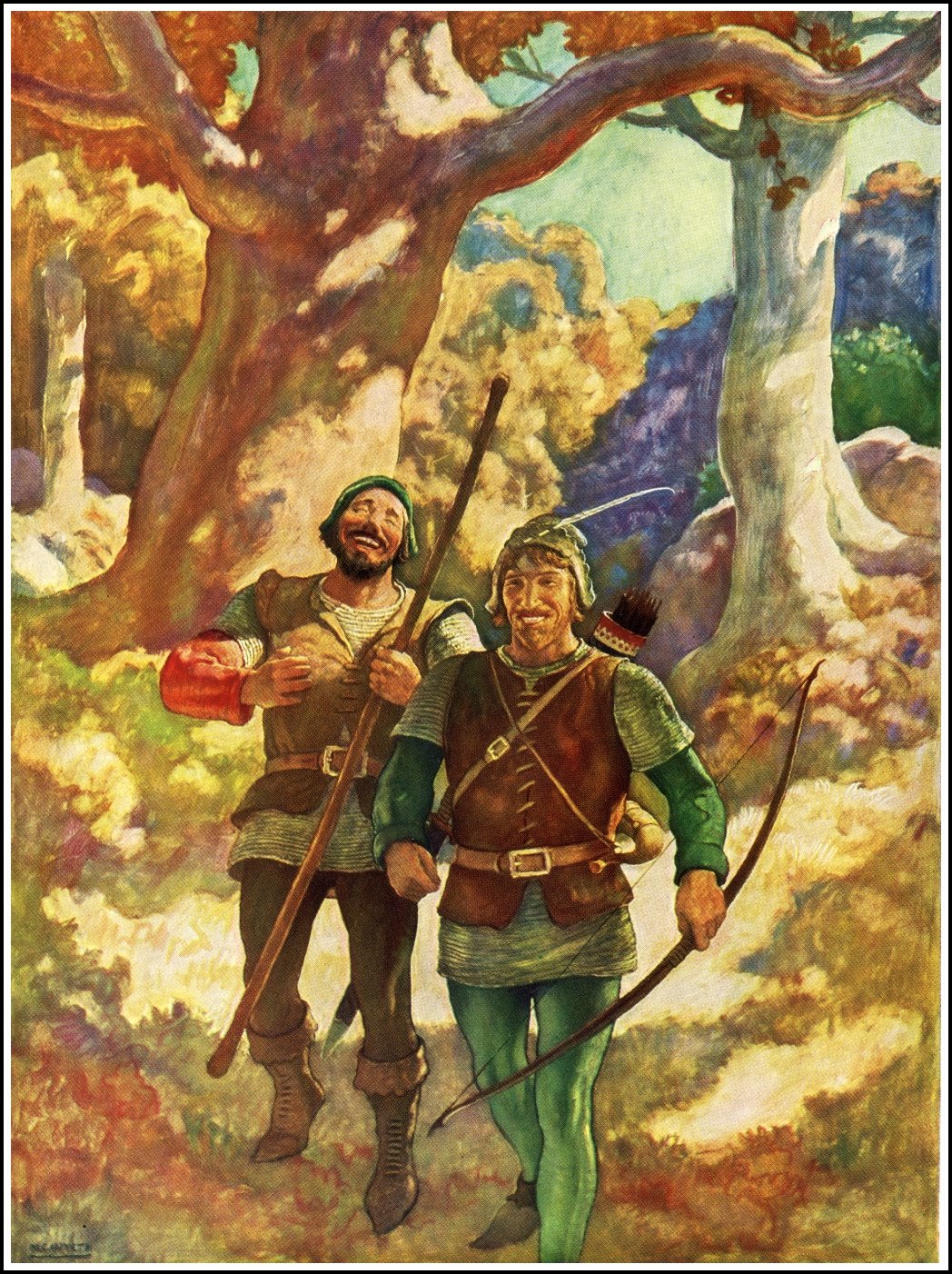
Art by N. C. Wyeth via Golden Age Comic Book Stories

It Came from the SRD – Part Four

This post is the fourth of four posts converting the unconverted monsters from the SRD to S&W. There is, naturally, a part one, part two and part three. This post is open game content.

Sahuagin Mutant
About one in two hundred sahuagin has four arms. Such creatures can make four claw attacks or use extra weapons, in addition to the claw and bite attacks. A Referee in possession of a game that utilizes random mutations may want to add other mutations to the sahuagin mutant (laser eyes, a winning personality, etc).

  • Sahuagin Mutant: HD 2+1; AC 5 [14]; Atk 4 claws (1d4) or 2 weapons (1d8); Move 12 (Swim 18); Save 16; CL/XP 3/60; Special: None.

Scrag (Sea Troll)
These cousins of the troll dwell in any body of water in any climate. They regenerate only if mostly immersed in water.

  • Scrag: HD 6+3; AC 4 [15]; Atk 2 claws (1d4), 1 bite (1d8); Move 12 (Swim 18); Save 11; CL/XP 8/800; Special: Regenerate 3 hp/round.

Shadow, Greater
Although no more intelligent than an average shadow, a greater shadow is more loathesome and dangerous because it can spawn. Creatures drained of all their strength by a greater shadow become shadows under the control of their killer.

  • Greater Shadow: HD 9+3; AC 6 [13]; Atk 1 touch (1d6 + strength drain); Move 12; Save 6; CL/XP 10/1400; Special: Drain 1d4 points of strength with hit, hit only by magic weapons.

Shield Guardian
Shield guardians are magical constructs created to protect whoever wears a certain amulet. They obey verbal commands, but are fairly stupid. All attacks against the amulet wearer in the presence of a shield guardian suffer a –2 penalty to hit. A shield guardian can store one spell of level 4 or lower that is cast into it by another creature. It “casts” this spell when commanded to do so. If a shield guardian’s amulet is destroyed, the guardian ceases to function until a new one is created. If the wearer dies but the amulet is intact, the shield guardian carries out the last command it was given.

  • Shield Guardian: HD 15; AC 0 [19]; Atk 2 slam (2d6); Move 12; Save 3; CL/XP 16/3200; Special: Shield other, spell storing.

Skum
Skum are humanoid algae that serve aboleths and other aquatic dark lords. They are amphibious and have raking claws.

  • Skum: HD 2; AC 7 [12]; Atk 1 bite (2d6), 2 claws (1d4); Move 9 (Swim 15); Save 16; CL/XP 2/30; Special: None.

Spider Eater
A spider eater is 10 feet long and 4 feet high, and has a wingspan of about 20 feet. A spider eater attacks with its venomous sting and powerful mandibles. Female spider eaters lay their eggs inside large, paralyzed creatures. The young emerge about six weeks later, literally devouring the host from inside. Creatures stung by a spider eater must pass a saving throw or be paralyzed for 1d8+5 weeks. Spider eaters have a continuous freedom of movement ability as the spell. They can be trained as mounts.

  • Spider Eater: HD 4+1; AC 5 [14]; Atk 1 sting (2d4) and 1 bite (1d8); Move 12 (Fly 24); Save 13; CL/XP 5/240; Special: Implant eggs, poison.

Thoqqua
The thoqqua is a 5’ long, reddish-silver worm-like creature that radiates intense heat. When it burrows through rock it leaves a 3-ft diameter tunnel glowing red with heat; anyone touching this tunnel within 1 minute of it being made will suffer 2d6 points of damage. It can charge 120’ in one round, dealing 5d6 damage to whomever it hits. Creatures struck must make a saving throw or lose a prominent item worn to the creature’s intense heat. A thoqqua is healed by fire damage. It suffers double damage from cold.

  • Thoqqua: HD 3; AC 1 [18]; Atk 1 touch (2d6); Move 12 (Burrow 3); Save 14; CL/XP 4/120; Special: Healed by fire, double damage from cold.

Troll Hunter
Some trolls, more cunning than most, are not satisfied with merely eating civilized beings but train to hunt them relentlessly. These troll hunters are fearsome creatures who focus on slaying and devouring humanoid prey.

  • Troll Hunter: HD 12+6; AC 1 [18]; Atk 2 claws (1d4), 1 bite (1d8) or battle axe (2d6) or javelin (1d8); Move 12; Save 3; CL/XP 15/2900; Special: Regenerate 3 hp/round, +2 bonus to hit humans and elfs, speak with animals at will, cast resist fire once per day.

Vampire Spawn
Vampire spawn are undead creatures that come into being when vampires slay mortals. Like their creators, spawn remain bound to their coffins and to the soil of their graves. Vampire spawn appear much as they did in life, although their features are often hardened, with a predatory look. Like vampires, vampire spawn have a variety of special abilities. They can only be harmed by magic or silver weapons, regenerate 1 hp per round, can turn into gaseous form at will and can drain one level with their bite. Looking into a vampire spawn’s eyes forces one to make a saving throw or be charmed (as the charm person spell). Vampire spawn have the same weaknesses and vulnerabilities as true vampires.

  • Vampire Spawn: HD 4; AC 4 [15]; Atk 1 bite (1d6 + level drain); Move 12; Save 13; CL/XP 7/600; Special: See description.

Xill
Xill are four-armed, red-skinned hooligans. Xill are asexual. They reproduce by laying eggs in the stomachs of living humanoids. They can shift from the ethereal to the material plane instantly, or the reverse in 2 rounds during which it loses its magic resistance. Despite their magic resistance, xill can be warded with protection from evil. The xill’s claws can inject a paralyzing venom into grappled opponents (a saving throw applies). Once a victim is secured and subdued, the xill will take its victim to the ethereal plane for egg laying. If attacked in its lair, the xill will first save its eggs and any egg-bound victims. Xill eggs hatch in 1d4 days; over the next 2d4 days they will inflict 3d6 damage per day as they mature. Once they emerge they kill the victim instantly. The eggs will produce 2d8 small xill that mature to adulthood in only 1d4 hours.

  • Xill: HD 5; AC 2 [17]; Atk 4 claws (1d4) weapons (1d8); Move 15; Save 12; CL/XP 12/2000; Special: Attack as 8 HD creatures, only harmed by magic weapons, magic resistance 70%, ethereal shift.

Yrthak
A yrthak is a large, blind avian. It senses sound and movement by means of a special organ on its long tongue. It emits powerfully focused beams of sound from the protrusion on its head. The creature is a yellowish-green color, with the wings and fin being more yellow and the head and body more green. The teeth are yellow. A yrthak is about 20 feet long, with a wingspan of 40 feet. Despite their intelligence, yrthaks do not speak. They can focus sonic energy into a ray every 2 rounds. The ray inflicts 6d6 damage. It can also focus the ray on stone, causing an explosion that deals 2d6 damage to all within 10 feet of the impact.

  • Yrthak: HD 12; AC 3 [16]; Atk 2 claws (1d6), 1 bite (2d8); Move 9 (Fly 24); Save 3; CL/XP 13/2300; Special: Sonic attacks.

Templates
Templates are, in my opinion, a sound idea. Why have separate stats for skeletons and monster skeletons and dragon skeletons, when you can instead apply a simple template to any monster and turn it into a skeleton. Nice and simple. Unfortunately, here is where the idea runs smack-dab into one of my least favorite parts of the d20 experience – monster stats. When I used to run a d20 game, I would dutifully go about the business of template-ing a monster to throw a twist to my players. I would go down the list, make the changes, do the calculations, and in the end come up with a slightly new monster that would probably still bite the dust in the course of three or four rounds of combat. For me, not enough bang for the buck. Enter the Swords & Wizardry Core Rules and the sheer joy that is monsters with only SEVEN stats. Compare that to the 23 to 25 statistics for a d20 monster that is going to last just about as long and do just about the same things in combat. Of course, templates often are used to create fairly bizarre, tongue-in-cheek creatures, but I have room for a little comedy in my games. So, here is an attempt at converting some d20 templates into an old school format.

Celestial Creature
The celestial creature template can be applied to any kind of creature.

  • Celestial creatures are subject to spells that repulse conjured creatures.
  • Once per day a celestial creature can “smite evil”, dealing bonus damage equal to its own hit dice on a successful attack against a evil creature.
  • Celestial creatures take half damage from acid, cold and lightning and have 10% magic resistance. A celestial creature with four or more hit dice can only be harmed by magic weapons.
  • Celestial creaures have challenge levels 3 or 4 points higher than normal creatures of the same type.

Sample Celestial Creature

  • Celestial Polar Bear: HD 7; AC 6 [13]; Atk 2 claws (1d6+1), 1 bite (1d10+1); Move 12; Save 9; CL/XP 7/600; Special: Hug, smite evil, half damage from acid, cold and lightning, magic resistance 10%, only harmed by magic weapons.

Fiendish Creature
The fiendish creature template can be applied to any kind of creature.

  • Fiendish creatures are subject to spells that repulse conjured creatures.
  • Once per day a fiendish creature can “smite good”, dealing bonus damage equal to its own hit dice on a successful attack against a good creature.
  • Fiendish creatures take half damage from cold and fire and have 10% magic resistance. A fiendish creature with four or more hit dice can only be harmed by magic weapons.
  • Fiendish creaures have challenge levels 3 or 4 points higher than normal creatures of the same type.

Sample Fiendish Creature

  • Fiendish Giant Viper: HD 4; AC 5 [14]; Atk 1 bite (1d3 + poison); Move 12; Save 13; CL/XP 6/400; Special: Lethal poison, only harmed by magic weapons, half damage from fire and cold, magic resistance 10%, smite good.

Half-Celestial
The haf-celestial template can be applied to any humanoid creature. No matter the form, half-celestials are always comely and delightful to the senses, having golden skin, sparkling eyes, angelic wings, or some other sign of their higher nature.

  • Half-celestials have feathered wings, giving them a fly speed equal to twice their land speed.
  • A half-celestial’s armor class improves by one.
  • Once per day a half-celestial can “smite evil”, dealing bonus damage equal to its own hit dice on a successful attack against an evil creature.
  • Half-celestials can use the spell light at will, and can always counter magical darkness.
  • Half-celestials can cast cleric spells. They can cast one spell of each cleric spell level, with the maximum level of cleric spells equal to their hit dice.
  • Half-celestials are immune to disease, suffer only half damage from acid, cold and lightning, are only harmed by magic weapons, have 25% magic resistance and are +2 to save vs. poison.
  • A half-celestial’s challenge level is 5 points higher than a normal creature of its type.

Sample Half-Celestial

  • Half-Celestial Elf: HD 1+1; AC 4 [15]; Atk 1 sword (1d8) or 2 arrows (1d6); Move 12 (Fly 24); Save 17 (15 vs. poison); CL/XP 6/400; Special: Smite evil (+1 damage), bless once per day, light at will, immune to disease, half damage from acid, cold and lightning, only harmed by magic weapons, magic resistance 25%.

Half-Dragon
The haf-dragon template can be applied to any living creature. Half-dragon creatures are always more formidable than others of their kind that do not have dragon blood, and their appearance betrays their nature; scales, elongated features, reptilian eyes, and exaggerated teeth and claws. Sometimes half-dragons have wings.

  • Half-dragons have +1 hit point per hit dice.
  • A half-dragon that is larger than man-size gains leathery wings and a fly speed equal to twice its land speed.
  • A half-dragon’s armor class improves by two.
  • Half-dragons have one bite attack for 1d6 damage and two claw attacks for 1d4 damage. Damage can be increased for creatures larger than man-sized, or decreased for smaller creatures.
  • Half-dragons gain one breath weapon of the breed of their dragon parent (i.e. frost if a half-white dragon, fire if a half-red dragon). A half-dragon’s breath weapon deals 5d6 points of damage and is usable once per day.
  • Half-dragons are immune to sleep and paralysis.
  • A half-dragon’s challenge level is 2 or 3 points higher than a normal creature of its type, depending on whether or not it can fly.

Sample Half-Dragon

  • Half-White Dragon Mammoth: HD 12+12; AC 5 [14]; Atk 1 trunk (1d10), 2 gore (1d10+4), 2 trample (2d6+4) or 2 claw (1d8), 1 bite (1d10); Move 12 (Fly 24); Save 3; CL/XP 16/3200; Special: Breath cone of frost (5d6 damage) once per day, immune to sleep and paralysis.

Half-Fiend
The haf-fiend template can be applied to any humanoid creature. No matter its form, a half-fiend is always hideous to behold, having dark scales, horns, glowing red eyes, bat wings, a fetid odor, or some other obvious sign that it is tainted with evil.

  • Half-fiends have bat-like wings, giving them a fly speed equal to their land speed.
  • A half-fiend’s armor class improves by one.
  • Half-fiends have one bite attack for 1d6 damage and two claw attacks for 1d4 damage. Damage can be increased for creatures larger than man-sized, or decreased for smaller creatures.
  • Once per day a half-fiend can “smite good”, dealing bonus damage equal to its own hit dice on a successful attack against a good creature.
  • Half-fiends can cast the reverse versions of cleric spells. They can cast one spell of each cleric spell level, with the maximum level of cleric spells equal to their hit dice.
  • Half-fiends are immune to poison, suffer only half damage from acid, cold, fire and lightning, are only harmed by magic weapons, and have 25% magic resistance.
  • A half-fiend’s challenge level is 5 points higher than a normal creature of its type.

Sample Half-Fiend

  • Half-Fiend Berserker: HD 1; AC 7 [12]; Atk 1 weapon (1d8) or 2 claws (1d4), 1 bite (1d6); Move 12 (Fly 12); Save 17; CL/XP 7/600; Special: +2 to hit in berserk state, smite good (+1 damage), cast inflict light wound once per day, immune to poison, half damage from acid, cold, fire and lightning, only harmed by magic weapons, magic resistance 25%.

Lycanthrope
The lycanthrope creature template can combine any humanoid creature with any beast.

  • A lycanthrope’s hit dice are equal to the hit dice of his humanoid form plus the hit dice of his animal form.
  • Lycanthropes can shift between their humanoid form, their animal form, and a hybrid form.
  • A lycanthrope’s armor class improves by two.
  • Lycanthropes gain special movement types of their animal form while in hybrid form.
  • A lycanthrope in hybrid form gains two claw attacks that deal 1d4 damage and one bite attack that deals 1d6 damage. Damage can be increased or decreased as the Referee deems appropriate.
  • A lycanthrope spreads its curse to other creatures through its bite attack. Creatures bitten by the lycanthrope must pass a saving throw to avoid the curse.
  • Lycanthropes can only be harmed by silver or magic weapons.
  • Lycanthropes can communicate with animals of their kind in any form.

Sample Lycanthrope

  • Hill Giant Were-Orca: HD 20+2; AC 2 [17]; Atk 1 weapon (2d6) or 2 claws (1d6), 1 bite (1d8); Move 12 (Swim 24); Save 3; CL/XP 9/1100; Special: Throw boulders, only harmed by silver or magic weapons, communicate with orcas, curse of lycanthropy.

Vampire
The vampire template can be applied to any humanoid creature.

  • If the creature has fewer than seven hit dice, increase their hit dice to seven.
  • Improve the creatures armor class by two.
  • The creature gains a bite attack that deals 1d10 points of damage and drains one level.
  • As a vampire, the creature gains the following special abilities: Can only be hit by magic weapons, regenerate 3 hp each round, turn into gaseous form or giant bat at will, summon a swarm of bats or 3d6 wolves from the night, eyes that charm (as the charm person spell, save at -2 to negate), and the ability to turn humanoids into vampires by killing them.
  • As a vampire, the creature gains the following vulnerabilities: They can be killed by immersion in running water (unless they are natural swimmers), exposure to sunlight, or having a stake driven through their hearts (which, to be honest, kills non-vampires as well); they retreat from the smell of garlic, the sight of a mirror and the sight of “good” holy symbols.
  • Vampiric creatures have challenge levels 3 points higher than normal creatures of the same type, plus any additions due to extra hit dice.

Sample Vampire

  • Vampiric Lizardman: HD 7+1; AC 6 [13]; Atk 2 claws (1d3), 1 bite (1d10 + level drain); Move 6 (Swim 12); Save 9; CL/XP 10/1400; Special: See description above.

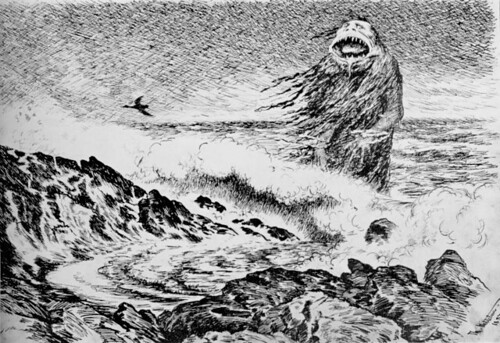
Art by Theodor Kittelsen – Sjøtrollet 1887 (The Sea Troll)

It Came from the SRD – Part Three

This post is the third of four posts converting the unconverted monsters from the SRD to S&W. There is, naturally, a part one and part two. This post is open game content.

Lammasu
Lammasus are servants of the lords of law. They appear as winged lions with the heads of bearded kings. They cast spells as level 7 clerics. In addition, they radiate a protection from evil, 10’ radius effect, can turn invisible twice per day and use dimension door once per day.

  • Lammasu: HD 7; AC 0 [19]; Atk 2 claw (2d6); Move 12 (Fly 24); Save 9; CL/XP 9/1100; Special: Spells.

Lillend
Lillends are protectors of the arts that look like winged women with the lower torsos of snakes. Victim’s of a lillend’s tail slap must succeed at a saving throw or be constricted each round for 2d6 damage. A constricting lillend cannot move, but it can still attack. A lillend can use the following spells: At will – darkness, knock, light, pass plant, polymorph self (humanoid only), speak with animals, speak with plants; 3/day – hallucinatory terrain; 1/day – fire charm, irresistible dance, transport via plants. Each lillend can understand all forms of communication.

  • Lillend: HD 7+2; AC 2 [17]; Atk 1 tail (2d6) or 1 weapon (1d8+4); Move 9 (Fly 27, Swim 15); Save 9; CL/XP 14/2600; Special: Spells, only harmed by magic weapons, immune to poison and life drain, half damage from fire, magic resistance 25%.

Magmin
Magmin look like halflings formed from molten rock and surrounded by an aura of flames. Touching a magmin causes flammables to ignite unless a saving throw is made. Just being within 20 feet of a magmin inflicts 1d6 points of damage. Metal items that touch a magmin melt unless the owner makes a saving throw.

  • Magmin: HD 2; AC 2 [17]; Atk 1 touch (1d6); Move 12; Save 16; CL/XP 3/60; Special: Heat.

Malenti
If a community of undine (aquatic elves) is located within 100 miles of a sahuagin community, about one in one hundred sahuagin looks just like an undine. These creatures, called malenti, can remain out of water for up to 12 hours. They are otherwise statistically identical to sahuagin.

  • Malenti: HD 2+1; AC 5 [14]; Atk 1 weapon (1d8); Move 12 (Swim 15); Save 16; CL/XP 2/30; Special: None.

Mephit
Mephits are minor elemental creatures that appear as small, winged demons. A mephit can use its breath weapon three times per day. Once per day, a mephit can attempt to summon another mephit of the same variety with a 25% chance of success. Mephits regenerate 2 points of damage each round if they are within their “element”.

Air Mephits
An air mephit breathes a 15-foot cone of dust and grit that inflicts 1d8 damage (saving throw for half). Once per hour it can duplicate a blur spell. Once per day it can use gust of wind. An air mephit regenerates if exposed to moving air.

  • Air Mephit: HD 3; AC 2 [17]; Atk 2 claw (1d3); Move 12 (Fly 24); Save 14; CL/XP 5/240; Special: Harmed by magic weapons, breath weapon, blur, gust of wind, regenerate, summoning.

Dust Mephit
A dust mephit breathes a 10-foot cone of irritating particles that deal 1d4 damage (saving throw for half) and imposes a -2 penalty to AC and attack rolls. Once per hour, a dust mephit can duplicate a blur spell. Once per day it can create a mass of roiling dust that duplicates a wind wall. A dust mephit regenerates in an arid, dusty environment.

  • Dust Mephit: HD 3; AC 2 [17]; Atk 2 claw (1d3); Move 12 (Fly 21); Save 14; CL/XP 5/240; Special: Harmed by magic weapons, breath weapon, blur, regenerate, summoning, wind wall.

Earth Mephit
An earth mephit breathes a 15-foot cone of rock shards and pebbles that deals 1d8 damage (saving throw for half). Once per day it can cast soften earth and stone. Once per hour it can magically change its size. An earth mephit regenerates if it is underground or buried up to its waist in earth.

  • Earth Mephit: HD 3; AC 3 [16]; Atk 2 claw (1d3); Move 12 (Fly 18); Save 14; CL/XP 5/240; Special: Harmed by magic weapons, alter size, breath weapon, regenerate, soften earth and stone, summoning.

Fire Mephit
A fire mephit breathes a 15-foot cone of fire that deals 1d8 damage (saving throw for half). Once per hour it can cast burning hands, and once per day it can heat metal. A fire mephit regenerates if it is touching a flame at least as large as a torch.

  • Fire Mephit: HD 3; AC 2 [17]; Atk 2 claw (1d6); Move 12 (Fly 21); Save 14; CL/XP 5/240; Special: Harmed by magic weapons, breath weapon, burning hands, heat metal, regenerate, summoning.

Ice Mephit
Ice mephits breathe a 10-foot cone of ice shards that deals 1d4 damage (saving throw for half) and imposes a -2 penalty to AC and attack rolls. Once per hour an ice mephit can cast magic missile and once per day they can chill metal. An ice mephit regenerates if touching a piece of ice of or if the ambient temperature is 32°F. or below.

  • Ice Mephit: HD 3; AC 1 [18]; Atk 2 claw (1d6); Move 12 (Fly 21); Save 14; CL/XP 5/240; Special: Harmed by magic weapons, breath weapon, chill metal, magic missile, regenerate, summoning.

Magma Mephits
Magma mephits breathe a 10-foot cone of magma that deals 1d4 damage (saving throw for half) and imposes a -2 penalty to AC and attack rolls. Once per hour, a magma mephit can turn into a pool of lava. The mephit can only be struck by +3 or better weapons in this form. The mephit can’t attack while in lava form but can use spells. It can move at a speed of 3. The pool’s touch ignites flammable materials such as paper, straw, or dry wood. Once per day a magma mephit can use pyrotechnics. A magma mephit regenerates if touching magma, lava, or a flame at least as large as a torch.

  • Magma Mephit: HD 3; AC 3 [16]; Atk 2 claw (1d6); Move 12 (Fly 21); Save 14; CL/XP 5/240; Special: Harmed by magic weapons, breath weapon, pyrotechnics, regenerate, shape change, summoning.

Ooze Mephits
An ooze mephit breathes a 10-foot cone of caustic liquid that deals 1d4 points of acid damage (saving throw for half). Living creatures that fail their saves are tormented by itching skin and burning eyes unless they have immunity to acid or are otherwise protected. This effect imposes a -2 penalty to AC and a -2 penalty on attack rolls for 3 rounds. Once per hour an ooze mephit can hurl an acid arrow (2d4 damage for 2 rounds). Once per day it can create a stinking cloud (6 rounds). An ooze mephit regenerates if in a wet or muddy environment.

  • Ooze Mephit: HD 3; AC 3 [16]; Atk 2 claw (1d3); Move 12 (Fly 18, Swim 12); Save 14; CL/XP 5/240; Special: Harmed by magic weapons, breath weapon, acid arrow, stinking cloud, summoning.

Salt Mephits
Salt mephits breathe a 10-foot cone of salt crystals that deals 1d4 damage (saving throw for half) and imposes a -2 penalty to AC and attack rolls. Once per day it can draw the moisture from an area in a 20’ radius. Living creatures within range take 2d8 points of damage (saving throw for half). This effect is especially devastating to plant creatures and aquatic creatures, which take a -2 penalty on their saving throws. A salt mephit regenerates if in an arid environment.

  • Salt Mephit: HD 3; AC 3 [16]; Atk 2 claw (1d6); Move 12 (Fly 18); Save 14; CL/XP 5/240; Special: Harmed by magic weapons, breath weapon, destroy moisture, glitterdust, summoning.

Steam Mephits
Steam mephits breathe a 10-foot cone of steam that deals 1d4 damage (saving throw for half) and imposes a -2 penalty to AC and attack rolls. Once per hour a steam mephit can duplicate a blur spell. Once per day it can create a rainstorm of boiling water that affects a 20-foot-square area and causes 2d6 damage. A steam mephit regenerates if touching boiling water or is in a hot, humid area.

  • Steam Mephit: HD 3; AC 3 [16]; Atk 2 claw (1d6); Move 12 (Fly 21); Save 14; CL/XP 5/240; Special: Harmed by magic weapons, breath weapon, blur, boiling rain, summoning.

Water Mephits
Water mephits breathe a 15-foot cone of caustic liquid that deals 1d8 acid damage (saving throw for half). Once per hour a water mephit can hurl an acid arrow. Once per day it can create a stinking cloud spell (6 rounds). A water mephit regenerates if exposed to rain or submerged up to its waist in water.

  • Water Mephit: HD 3; AC 3 [16]; Atk 2 claw (1d3); Move 12 (Fly 18, Swim 12); Save 14; CL/XP 5/240; Special: Harmed by magic weapons, breath weapon, acid arrow, stinking cloud, summoning.

Merrow
Merrows are the aquatic cousins of the terrestrial ogre. Merrow can live in fresh water or salt water. Salt water merrow often keep large harems of mermaids. The mermaids tolerate the merrow because of the protection he affords, but otherwise find them repulsive. This, in turn, drives the merrow to even greater depths of cruelty and hatred. Instead of the typical ogre’s club, they prefer to use long spears in combat.

  • Merrow: HD 4+1; AC 5 [14]; Atk 1 weapon (1d10+1); Move 9 (Swim 15); Save 13; CL/XP 4/120; Special: None.

Mohrg
Mohrgs are the animated corpses of mass murderers or similar villains who died without atoning for their crimes. Mohrgs are accompanied by 1d4+6 zombies. A mohrg’s long tongue paralyzes those it touches for 1d4 minutes. Creatures killed by a mohrg rise after 1d4 days as zombies under its control.

  • Mohrg: HD 14; AC -4 [23]; Atk 1 slam (1d8) and 1 tongue (paralysis); Move 12; Save 3; CL/XP 17/3500; Special: Tongue attack.

Mummy Lord
Unusually powerful or evil individuals preserved as mummies sometimes rise as greater mummies after death. A mummy lord resembles its lesser fellows, but often wears or carries equipment it used in life. Mummy lords are often potent spellcasters. The mere sight of a mummy lord causes one to become paralyzed with fear for 1d4 rounds unless they pass a saving throw. They are found as guardians of the tombs of high lords, priests, and mages. Most are sworn to defend for eternity the resting place of those whom they served in life, but in some cases a mummy lord’s unliving state is the result of a terrible curse or rite designed to punish treason, infidelity, or crimes of an even more abhorrent nature. A mummy lord of this sort is usually imprisoned in a tomb that is never meant to be opened again.

  • Mummy Lord: HD 10+4; AC 0 [19]; Atk 1 fist (1d12); Move 6; Save 5; CL/XP 15/2900; Special: Despair, rot, hit only by magic weapons, cast spells as a level 10 cleric.

Nessian Warhound
Nessian warhounds are coalblack mastiffs the size of draft horses, often fitted with shirts of infernal chainmail (+1 chainmail barding). Nessian warhounds resemble hell hounds in the same way that pit bulls resemble chihuahuas.

  • Nessian Warhound: HD 12; AC 0 [19]; Atk 1 bite (1d10); Move 12; Save 3; CL/XP 14/2600; Special: Breathe fire (24 hp).

Ogre Berserker
Their inherent bent toward chaos combines with their size and strength to make ogres natural berserkers. Indeed, their leaders are almost always monstrous brutes whose fury in battle is truly fearsome. A raging ogre berserker is an inspiration to other ogres.

  • Ogre Berserker: HD 8+2; AC 2 [17]; Atk 1 weapon (1d10+1); Move 9; Save 8; CL/XP 9/1100; Special: +2 to hit in berserk state.

Phasm
A phasm is an amorphous creature that can assume the guise of almost any other creature or object. If attacked, a phasm transforms into the most fearsome creature it knows (up to 12 feet long) and attacks. A phasm is immune to poison, sleep, paralysis, polymorph, and stunning effects.

  • Phasm: HD 15; AC 2 [17]; Atk 1 slam (1d4); Move 12; Save 3; CL/XP 17/3500; Special: Alternate form.

Rast
A rast has anywhere from ten to fifteen claws, though it can only use four at once. A rast has a body about the size of a large dog’s, with a head almost as large as the body. Any who meet a rast’s gaze must pass a saving throw or be paralyzed for 1d6 rounds. A victim hit by a rast’s bite attack loses 1 point of constitution from blood drain.

  • Rast: HD 4; AC 4 [15]; Atk 4 claws (1d4) or 1 bite (1d8); Move 3 (Fly 24); Save 13; CL/XP 8/800; Special: Paralyzing gaze, blood drain, immune to fire, x2 damage from cold.

Razor Boar
Razor boars are enormous boars with black-bristles and wild, bloodshot eyes. Its tusks are more than three feet long. Razor boars regenerate 2 hp per round. On a natural 20, the razor boars’s tusk attack severs its opponents head (if it has one) from its body.

  • Razor Boar: HD 10; AC -3 [22]; Atk 1 tusk (2d6) and 2 stomps (1d6); Move 21; Save 5; CL/XP 14/2600; Special: Magic resistance 50%, regenerate, vorpal tusks.

It Came From the SRD – Part Two

Here’s part Two of my SRD conversions, letters F through K. I’ll post L-R tomorrow and then round it out on Wednesday with S-Z and some templates.

This post is open game content.

Frost Worm
Frost worm look like white and blue purple worms. They are capable of burrowing through ice, but not stone. They can produce a sonic trill that causes creatures who fail a saving throw to stand stunned for the duration of the trilling. If attacked, a stunned creature may make another saving throw. The worm can breath a cone of cold once per hour that inflicts 10d6 points of damage (saving throw for half damage). When killed, the frost worm turns to ice and shatters, dealing 10d6 damage to all within 100 feet.

• Frost Worm: HD 14; AC 1 [18]; Atk 1 bite (3d6); Move 12 (Burrow 3); Save 3; CL/XP 18/3800; Special: Trill, breath weapon, explode, immune to cold.

Fury
A cruel hunter and roaming brigand, the fury is a harpy that has trained to become a deadly archer. Furies often become mercenaries, selling their services to the highest bidder. When not employed, they make ends meet as highway robbers, forcing merchant caravans to pay protection money. Their siren song is no less effective than a normal harpy’s, and their touch also charms (saving throws apply).

• Fury: HD 7; AC 4 [15]; Atk 2 talons (1d3) and weapon (1d6+2); Move 6 (Fly 18); Save 9; CL/XP 8/800; Special: Flight, siren-song, +2 to hit and damage with bows.

Ghost
Ghosts are restless spirits that dwell between the ethereal and material planes. They can emit a frightening moan (save vs. fear) and their touch ages a person one decade (in the case of most humanoids) or one century (in the case of long-lived demi-humans). Ghosts can also use telekinesis to hurl small objects. As ethereal creatures, ghosts can only be harmed by magic spells and weapons.

• Ghost: HD 6; AC 4 [15]; Atk 1 touch (aging) or 1 hurled object (1d4); Move (Fly 12); Save 11; CL/XP 9/1100; Special: Moan, aging touch, telekinesis.

Girallon
Girallons are 8-foot tall, albino, four-armed gorillas that are as strong as stone giants. Although capable of fighting with their claws and bite, girallons sometimes employ simple weapons in combat. They are tribal by nature and have a simple language. They are fond of gems, jewelry and shiny metal. They are also fond of human flesh. Girallons speak their own simple language. A girallon that hits with two or more claw attacks latches onto the opponent’s body and tears the flesh for double damage.

• Girallon: HD 7+1; AC 16; Atk 4 claw (1d6) and 1 bite (1d8); Move 15 (Climb 15); Save 9; CL/XP 7/600; Special: Rend with claws, track by scent.

Grimlock
Grimlocks are a race of subterranean humanoid that raid the surface world at night searching for humans to butcher and devour. They are completely blind, but with their highly developed senses of smell and hearing they can sense creatures within 20 ft. Although they are immune to spells that require their victims to have sight, they can be partially “blinded” with spells such as ghost sound and sound burst or substances like snuff. Grimlocks have grey skin, black hair and white eyes. Their teeth are large and sharp. Grimlocks speak their own language. Grimlocks sometimes (10%) lair with medusae. In rocky areas, grimlocks are effectively invisible (and require a see invisibility spell to detect) if they remain motionless.

• Grimlock: HD 2; AC 4 [15]; Atk 1 slam (1d6) or 1 weapon (1d8); Move 15; Save 11; CL/XP 4/120; Special: Blind-fight, invisible in rocky areas.

Howler
A howler looks like a massive, emaciated lion with a mane of quills. In the middle of the night, it lies low in the grass and howls for hours on end. Those who hear the howl must make a saving throw each hour or temporarily lose one point of wisdom, with creatures who lose all of their wisdom dropping dead. Creatures engaged in melee combat with a howler suffer 1d4 attacks each round from its quills. With each successful attack, the victim must make a saving throw or have the quill break free and lodge in their flesh. Each quill so lodged imposes a -1 penalty to hit in combat.

• Howler: HD 6; AC 5 [14]; Atk 1 bite (2d8), 1d4 quills (1d6); Move 24; Save 11; CL/XP 8/800; Special: Howl, quills.

Janni
Janni are lesser kin to the djinn and efreet. They are formed of all four elements, and thus dwell on the material plane. They can change a creature’s size twice per day, become invisible three times per day, and speak with animals at will. They can also create food and water once per day (as a cleric) and shift into the ethereal plane for a few rounds at a time. They have telepathy with a range of 100 feet. Most janni are encountered wearing chainmail and armed with a curved sword and longbow.

• Janni: HD 6; AC 3 [16]; Atk 1 weapon (1d8); Move 12 (Fly 15); Save 11; CL/XP 7/600; Special: Spells.

Kapoacinth
Kapoacinth are aquatic cousins of the terrestrial gargoyle that lack wings. I imagine their “skin” might look like coral, and they would perch on a reef waiting for an unlucky sahuagin or undine to swim past.

• Kapoacinth: HD 4; AC 5 [14]; Atk 2 claws (1d3), 1 bite (1d4), 1 horn (1d6); Move 9 (Fly 15); Save 13; CL/XP 5/240; Special: None.

Krenshar
The krenshar is a strange, catlike carnivore with extremely flexible skin on its head. Krenshars use solitary scouts to drive prey into the waiting clutches of the pride. The scout appears from hiding, uses its scare ability, then chases the fleeing target to join the attack. A krenshar can pull the skin back from its head, revealing the musculature and bony structures of its skull. Combining this with a loud screech produces an unsettling effect that works like a scare spell.

• Krenshar: HD 2+2; AC 4 [15]; Atk 2 claw (1d4) and 1 bite (1d6); Move 15; Save 16; CL/XP 3/60; Special: Frighten.

It Came from the SRD – Part One

As I’ve mentioned before, I’m no purist when it comes to the many editions and iterations of the “world’s most popular role-playing game”. My own desire for simplicity draws me toward the older versions of the game and their modern simulacra, but that doesn’t mean I can’t find things to like about most editions. The problem, I think, is when some of these clever notions (kits, feats, templates) become revenue sources for their owners. That said, I think one of the top five best ideas ever concerning our favorite game was the creation of the Open Gaming License and its accompanying System Reference Document. The SRD, and all of the other open content on the internet, are amazing sources from which to mine ideas. Looking over the SRD today, I decided to convert a few creatures (and creature variants) that didn’t make it into S&W:C. All of the following is open game content.

Arrowhawk
An arrowhawk is a predator and scavenger from the Elemental Plane of Air. By twisting its body and varying the cadence of its wingbeats, an arrowhawk can fly at top speed in any direction.

• Arrowhawk: HD 7; AC 3 [16]; Atk 1 lightning bolt (2d8) or 1 bite (1d8); Move (Fly 24); Save 9; CL/XP 9/1100; Special: Immune to lightning.

Barghest
A barghest is a lupine fiend that can take the shape of a wolf or a goblin. A full-grown barghest is about 6 feet long and weighs 180 pounds. It has bluish-red skin and blue-black fur. A barghest’s eyes glow orange when it becomes excited. Barghests can cast blink, levitate and misdirection at will and charm monster and dimension door once per day. A barghest in wolf form leaves no tracks or trail. When a barghest slays an opponent, it can feed on the corpse, devouring both flesh and soul. Feeding prevents any form of raising or resurrection that requires part of the corpse. For every three suitable corpses a barghest devours, it gains one hit dice, and its armor class improves by one. The barghest only advances by consuming the corpses of creatures whose hit dice or levels are equal to or greater than its own current total. A barghest that reaches 9 hit dice through feeding immediately becomes a greater barghest upon completion of the act. A greater barghest gains the ability to cast invisibility and alter size once per day.

• Barghest: HD 6; AC 3 [16]; Atk 1 bite (1d6), 2 claws (1d4); Move 12; Save 11; CL/XP 8/800; Special: Change shape, cast spells, feed, only harmed by magic weapons.
• Greater Barghest: HD 9; AC 0 [19]; Atk 1 bite (1d8), 2 claws (1d6); Move 15; Save 6; CL/XP 12/2000; Special: Change shape, cast spells, feed, only harmed by magic weapons.

Belker
Belkers are wicked spirits of the air. They are composed of smoke, and their wings lend a demonic cast to their appearance. At will, it can take on gaseous form, looking like a pillar of smoke. In combat, it can engulf a victim, sending solidified, smoky claws into its lungs to tear and rend for 2d6 damage each round.

• Belker: HD 7; AC 2 [17]; Atk 2 wings (1d6), 2 claws (1d3), 1 bite (1d4); Move 12 (Fly 21); Save 9; CL/XP 9/1100; Special: Smoke claws, gaseous form.

Bodak
A bodak is the restless, angry spirit of one killed by an act of terrible, senseless evil. They appear as humanoids with rubbery, reddish skin, featureless faces and smoldering, orange eyes. Creatures that meet its pitiless gaze must pass a saving throw or die instantly, re-animating as bodaks 24 hours later. Bodaks loathe sunlight, which inflicts 1 point of damage each round it is in contact with their skin.

• Bodak: HD 9; AC 1 [18]; Atk 1 slam (1d8); Move 9; Save 6; CL/XP 12/2000; Special: Death gaze, vulnerable to light, unharmed by lightning.

Cauchemar
The cauchemar is a horrible, especially malevolent version of a nightmare. The sight of one of these great horrors bearing down is enough to shake the heart of the boldest champion.

• Cauchemar: HD 16; AC -5 [24]; Atk 1 bite (2d6), 2 hoofs (2d8); Move 18 (Fly 35); Save 3; CL/XP 19/4100; Special: Breathe smoke, become incorporeal.

Celestial Charger
A celestial charger is a unicorn blessed by the gods of light and law. They have the same abilities as normal unicorns, but can also cast spells as a level 7 cleric. Once per day, a celestial charger can deal +8 damage on a successful attack against an evil creature.

• Celestial Charger: HD 8; AC 0 [19]; Atk 2 hoofs (1d8), 1 horn (1d10); Move 24; Save 8; CL/XP 11/1700; Special: Double damage for charge, 25% magic resistance, teleport, smite evil, cast cleric spells as level 7 cleric.

Chaos Beast
Chaos beasts have mutable, ever-changing forms. For all its fearsome appearance, whether it has claws, fangs, pincers, tentacles, or spines, a chaos beast does little physical harm. A blow from a chaos beast causes a living creature to become a spongy, amorphous mass unless they pass a saving throw. An affected creature cannot hold or use any item. Soft or misshapen feet and legs reduce speed to 6. Searing pain courses along the nerves, so strong that the victim cannot cast spells or use magic items, and it attacks blindly, unable to distinguish friend from foe. Each round the victim spends in an amorphous state causes 1 point of wisdom drain from mental shock. If the victim’s wisdom score falls to 0, it becomes a chaos beast. A victim can regain its own shape by attempting a saving throw. A success reestablishes the creature’s normal form for 1 minute. On a failure, the victim can still repeat this check each round until successful or drained of wisdom. A shapechange or stoneskin spell does not cure an afflicted creature but fixes its form for the duration of the spell. A restoration or heal spell removes the affliction, but a separate restoration is necessary to restore any drained points of wisdom.

• Chaos Beast: HD 8; AC 3 [16]; Atk 2 claw (1d4); Move 9; Save 8; CL/XP 11/1700; Special: Corporeal instability, immune to critical hits and transformations, magic resistance 20%.

Choker
These vicious little subterranean predators have hands and feet with spiny pads that help grip almost any surface. The victim of a successful tentacle attack must make a saving throw or be strangled for 1d6 points of damage each round. Chokers are so fast, they can make an extra attack or move at the end of each round.

• Choker: HD 3; AC 2 [17]; Atk 2 tentacles (1d4); Move 9 (Climb 6); Save 14; CL/XP 5/240; Special: Strangle, quickness.

Chuul
Chuuls are a horrible combination of crustacean, insect, and serpent. Although amphibious, they are not good swimmers and prefer to attack on land or in shallow water. The victim of a chuul’s claw attack must succeed at a saving throw or be constricted for 3d6 points of damage each round. A chuul can transfer constricted victims from a claw to its tentacles on its next turn. The tentacles grapple with the same strength as the claw. They deal no damage, but do exude a secretion that paralyzes for 6 rounds if a saving throw is failed. While held in the tentacles, a victim suffers 1d8 points of damage each round from the chuul’s mandibles.

• Chuul: HD 11+2; AC -3 [22]; Atk 2 claw (2d6); Move 12 (Swim 9); Save 4; CL/XP 15/2900; Special: Amphibious, constrict, paralyze, immune to poison.

Cloaker
When resting or lying in wait, these creatures are almost impossible to distinguish from common black cloaks (the cloaker’s ivory claws look very much like bone clasps). Only when it unfurls does the horrific nature of the creature become apparent. A cloaker has a wingspan of about 8 feet. Cloakers emit a low moan that can either cause everyone within 30 feet to save vs. fear or cause one creature within 30 feet to save vs. hold monster. Cloakers can manipulate shadows, duplicating the effect of the spells blur or mirror image.

• Cloaker: HD 6; AC 3 [16]; Atk 1 tail (1d6), 1 bite (1d4); Move 3 (Fly 15); Save 11; CL/XP 9/1100; Special: Moan, shadow shift.

Derro
Derro are a degenerate race of albinos that dwell deep underground. At night, they walk the surface world, kidnapping humans for slaves or food. Most derro wear studded leather armor and carry repeating light crossbows with poisoned bolts (see below), fork-fauchards (pole arms that grant a +4 bonus to overbearing attacks) and daggers. Derro bands are often lead by their savants, a sort of combination of magic-user and cleric. Derro lairs contain 20-40 derro, 1d3 savants, 1d6 student savants, 20-30 slaves (80% female) and 1d3 gargoyle allies.

• Derro: HD 3; AC 14; Atk 1 weapon (1d4); Move 12; Save 14; CL/XP 4/120; Special: Magic resistance 30%.
• Savant: HD 7; AC 14; Atk 1 weapon (1d4); Move 12; Save 9; CL/XP 10/1400; Special: Magic resistance 30%, spells.

Destrachan
A destrachan looks something like an eyeless velociraptor with a gaping, lamprey-like mouth. It has a pair of complex, three-part ears that it can adjust to be more or less sensitive to various sounds. It is blind, yet hunts with a sense of hearing more precise than most creatures’ sight. From its tubular mouth a destrachan emits carefully focused harmonics, producing sonic energy so powerful it can shatter a stone wall. So skilled is a destrachan at controlling the sounds it emits that it can choose what type of material to affect with its attack.

A destrachan can blast sonic energy in a cone up to 80 feet long. It can also use this attack to affect any creatures or objects within a 30-foot radius. It can tune the harmonics of this destructive power to affect different types of targets, including a blast that deals 4d6 points of damage to all within 20 feet, stunning all foes within 20 feet (saving throws apply) or shattering a particular material.

• Destrachan: HD 8; AC 1 [18]; Atk 2 claw (1d6); Move 12; Save 8; CL/XP 11/1700; Special: Blindsight, sonic energy.

Dread Wraith
The oldest and most malevolent wraiths lurk in the depths of forgotten temples and other forsaken places. They can sense the approach of living creatures, and hunger for them. Dread wraiths are immune to all non-magical weapons, including silver ones. Arrows, even magical ones, inflict only a single point of damage on their etheric bodies. The touch of a dread wraith inflict 2d6 points of damage and drains 1d2 levels. Humanoids that have all of their levels drained by a dread wraith become wraiths themselves under the control of their killer.

• Dread Wraith: HD 16; AC 0 [19]; Atk 1 touch (2d6 + level drain); Move 9 (Fly 24); Save 3; CL/XP 19/4100; Special: Drain 1d2 levels per hit.

Elder Pudding
The most ancient black puddings are vast pools of inky death. They have the same special abilities as other black puddings, save that weapons and armor of any kind are destroyed with but a single hit.

• Elder Pudding: HD 20; AC 8 [11]; Atk 1 attack (4d8); Move 6; Save 3; CL/XP 21/4700; Special: Acidic surface, immune to cold, divides when hit with lightning.

Ethereal Filcher
Ethereal filchers look vaguely like giant, disembodied hands, the “fingers” each tipped in a hand with long, sinuous fingers. The “palm” contains a rudimentary face. Ethereal filchers can slip in and out of the ethereal plane at will, using this ability to take people by surprise. The creature attempts to seize an item, then quickly shifs back to the ether. Ethereal filchers can detect magic at will.

• Ethereal Filcher: HD 5; AC 2 [17]; Atk 1 bite (1d4); Move 15; Save 12; CL/XP 6/400; Special: Detect magic, ethereal jaunt, pick pockets.

Ethereal Marauder
Ethereal marauders look like bipedal lizards with no forelegs and with gaping, tri-corner mouths filled with fangs. Their coloration ranges from bright blue to deep violet. They live on the ethereal plane, but mostly hunt on the material plane. Once a marauder locates prey, it leaves the ethereal plane to attack, biting the victim and then retreating quickly back to the ether.

• Ethereal Marauder: HD 2+1; AC 5 [14]; Atk 1 bite (1d8); Move 15; Save 16; CL/XP 3/60; Special: Ethereal jaunt.

Coming Soon: I’ll finish up the unconverted SRD monsters and then get to work describing the southwest portion of the Wyvern Coast and the infamous city-state of Ophir.

Six from the Sanctum

I was playing with Seventh Sanctum’s alien and fantasy race generators today, and decided to stat up some of the results. If any enterprising artist wants to draw one of these oddballs, I’d love to see the result. The following is open game content.

Caledjula
Caledjula are tall, statuesque creatures with angular bodies and reddish-orange skin. Their heads are pointed and their jaws and foreheads jut out about three inches beyond their flat faces. Their eyes are large and brightly colored, and surrounded by long lashes. Their arms (wings, actually) and legs end in hands with seven long fingers. Caledjula have a radar-like sense reminiscent of bats. Caledjula are capable of imitating all sorts of speech, and their pleasant, deep voices and calm demeanor makes them successful negotiators. Caledjula are advanced in the areas of illusions and healing, and have more than their fair share of illusionists and clerics. The caledjula come from a barren world. They live beneath the surface in cave systems dug into the permafrost. They adorn themselves with leather armor, sometimes studded, in battle and carry long, thin blades and bolas.

Caledjula characters are capable of finding their way even in complete darkness. They can also fly. Caledjula enjoy a +2 bonus to save vs. illusions and every caledjula begins play knowing one minor illusion that they can cast once per day.

  • Caledjula: HD 1; AC 9 [10]; Atk 1 weapon; Move 12 (Fly 9); Save 16 (14 vs. illusion); Special:Radar sense, know one illusion spell.

Ifnut
Ifnuts have bulky, spherical bodies with thick, rubbery skin the color of damask. They have three heads that resemble elephant trunks tipped with black, beady eyes and three stubby limbs that end in three long finger/toes. These limbs are used for both movement and manipulation. Although omnivorous, ifnuts prefer to browse on vegetation. Ifnuts tend to be narcissists, and find it difficult to work with others on a permanent basis. Other races find them to be corrupt and untrustworthy. Ifnut armorers can fashion all manner of armor for ifnuts, with their suits of plate mail making them look like pot-bellied stoves. They can wield short weapons (short swords, daggers, light maces) and their heads are capable of casting stones as if they were slings.

Ifnut characters are only surprised on the roll of 1 on 1d8. Their thick skin improves their armor class by one. They can make one ranged attack each round for 1d4 points of damage, provided they have ammunition in the form of sling stones or bullets. Their limb placement does not allow for the use of other ranged weapons with the exception of light crossbows, with which they suffer a -2 penalty to hit.

  • Ifnut: HD 1; AC 8 [11]; Atk 1 weapon (1d6) or 1 thrown stone (1d4); Move 9; Save 16; Special: None.

Nif’nef
The nif’nef look like elves with honey-colored skin and wasp-shaped bodies (i.e. extremely thin waists). They have ashen hair, beady, black eyes, and thin mouths and noses. The nif’nef have a shamanistic belief system (i.e. druids in place of clerics) and they worship creatures of elemental earth. A group of five nif’nef can, with 3 rounds of ritual chanting, conjure an earth elemental from the ground. Nif’nef practice ritual cannibalism of deceased friends and family, preserving the flayed skins in alabaster boxes marked with angular runes. They dwell on a rich island chain that is the site of a lost civilization.

Nif’nef characters are light and graceful, gaining a +1 bonus to dexterity rolls at character creation, but suffering a -1 penalty to strength rolls. These modifications cannot send an ability score over 18 or below 3. Their quiet natures give them a +1 bonus to surprise (or sneak). Nif’nef have slow metabolisms that allow them to eat half as much as humans.

  • Nif’nef: HD 1d6; AC 8 [11]; Atk 1 weapon (1d6); Move 15; Save 17; Special: Surprise on 1-2 on 1d6.

Olvu’gai
The olvu’gai resemble nothing so much as giant potatoes covered in velvety, yellow fur. Sprouting from their “middles” are from eight to twelve thin tentacles, each about 10 feet in length. The tentacles are used to move, almost in the manner of a spider, and to manipulate objects. There are numerous patches of what appear to be long, black hairs sprouting from the bodies of the olvu’gai. These hairs are used to collect sensory data (smell, sight, sound). The creatures communicate by vibrating their tentacles, creating sounds reminiscent of the glass armonica. The creatures can also use these vibrations to render themselves invisible (as the spell). Olvu’gai are natural bureaucrats, with a love for classification and “everything in its place” thinking. They spend much of their time in endless debates about the minutiae of an idea, and only rarely move ahead with anything. Their home world is barren and craggy, which most of the life living in the soil. The world has no moon and suffers frequent catastrophes. The wildlife is as bizarre to an “earthling” as the olvu’gai themselves.

Olvu’gai characters retain their ability to become invisible, but may only use it once per day. Their very ordered thinking helps them find secret doors and traps on a roll of 1-2 on 1d6, but it takes them twice as long to search for them. Olvu’gai can learn to understand humanoid languages but not speak them. Likewise, their language can be learned by humanoids but cannot be spoken by them.

  • Olvu’gai: HD 1; AC 9 [10]; Atk 3 tentacles (1d6); Move 12; Save 16; Special: Invisibility.

Vindlu
Vindlu resemble long, thin lions covered in silvery scales tipped with aquamarine and they have long “whiskers” like those of a carp. These whiskers are extremely sensitive, making vindlu difficult to surprise and allowing them some insights into the emotions of others. Their four legs end in clawed hands. Outside their home city, they live in tight-knit family bands, hiring themselves out as assassins. They are very skilled at poison making.

The vindlu originate in a huge, prosperous city state located in the “Crawling Canyon”, a canyon that seemingly moves about their native highlands. The city-state is composed of circular brick “shell-keeps” centered around fire pits fueled by coal and always kept burning. The vindlu sleep on shelves overlooking the pit, with the interior of their buildings given over to storage rooms, kitchens, libraries and armories. Most of the city-state’s revenue comes from intricately died cotton textiles, the cotton harvest being a highlight of their year. Although not particularly religious, the vendlu give a nod to a hermaphroditic divinity they call Magfa. Magfa is aloof and mysterious, and works its wonders through earth-bound messengers and servants.

Vindlu characters enjoy a +1 bonus to save vs. poison, and are capable of using poison on their weapons safely and effectively. They also have a +1 bonus to save vs. fire damage. Their whiskers make them susceptible to surprise only on a roll of 1 on 1d8, and give them the ability to detect lies.

  • Vindlu: HD 1; AC 8 [11]; Atk 1 bite (1d4) or 1 weapon (1d8 + poison); Move 15; Save 16 (15 vs. poison and fire); Special:Surprised on roll of 1 on 1d8, detect lies / read emotions.

Zwunker
Zwunkers are an offshoot of dwarfs. They are black-skinned and have long manes of gold hair. Their eyes are faceted and resemble yellow diamonds. Zwunkers live in caves overlooking the sea. They are skilled sailors and love nothing more than to feel the wind whipping through their manes. Once per day, a zwunker can control the winds, either calming them or whipping them into a frenzy. Zwunkers are highly resistant to magic, and their presence actually absorbs magical energy. Essentially, their “magic resistance” applies to all magical effects within 30 feet of them. Zwunkers make elaborate leather armor (always black) and carry steel rods for weapons.

Zwunker characters enjoy the same benefits as normal zwunkers. They have a +2 bonus to save vs. magic. Their hair can be shaved and melted down into the equivalent of 5 gold pieces, though no zwunker would willingly do this save to avert his own death or that of a loved one. Zwunkers cannot work magic, and thus are barred from becoming clerics and magic-users, though they can become psychics.

  • Zwunker: HD 1; AC 6 [13]; Atk 1 weapon (1d6); Move 9; Save 16 (14 vs. magic); Special:Control wind, magic resistance 10%.

On Science

My last post mentioned a scientist. This is a class I came up with as an alternative to the magic-user. Essentially, I got on a “turn-literary-archetypes-into-classes” kick, and this was one of the results. It was never play-tested, so maybe we’ll technically call this one an NPC class.

Scientist
The scientist is an NPC dedicated to understanding the World of Nod and its bizarre, supernatural physics and applying this knowledge to the discovery and creation of new inventions. In laymen’s terms, what the magic-user does with spells, the scientist does with gadgets, gizmos and chemical formulas.

Scientists have been a staple of pulp fiction for a century, though they are most often encountered in “Sword & Planet” and “Scientifiction”, as it was once called. The archetypal scientist is an older man with a brilliant mind and a collection of fantastic inventions that help the hero of the story (which is sometimes him, but more often not) overcome obstacles. Just as wizards often play the role of villain in “Sword & Sorcery” stories, the mad or evil scientist is often the antagonist to the heroic swordsman’s protagonist.

Although one could draw inspiration from any number of the “natural philosophers” of the Middle Ages and Renaissance, no person better exemplifies the scientist we are seeking to create than Leonardo Da Vinci. Had he only lived in a fictional, fantastic world such as Nod, Da Vinci might have invented any number of mechanical contrivances.

Benjamin Franklin is the next major inspiration for our scientific adventurers, not the least of which because he “discovered” electricity (or “electrical fluid” as it was called in the 18th century) and invented and named the battery which serves as the foundation for our scientist’s make-believe inventions.

The original mad scientist in literature was Victor Frankenstein from Mary Shelley’s 1818 novel Frankenstein; or, The Modern Prometheus. Victor Frankenstein discovers the ability to return life to dead tissue and in the process creates the first flesh golem, though rather than being a mindless automaton, Frankenstein’s creature is quite intelligent.

As a counterpoint to the mad scientist, one need only look to Dr. Hans Zarkov, comrade of “Flash” Gordon. Over the course of the Flash Gordon comic strips, movies and books, Zarkov invents flying machines and invisibility rays, all while assisting his erstwhile ally in defending the Earth from the depredations of Emperor Ming.

The following is open game content.

Scientist
Prime Attributes: Intelligence, 13+ (5% experience)
Hit Dice: 1d4/level (Gains 1 hp/level after 10th.)
Armor/Shield Permitted: None.
Weapon Permitted: Dagger, club, staff, dart, light crossbow.

Scientists begin play with one small invention or three formulas (see below) and only 1d6 x 10 gp to spend on equipment. They must own a journal, their equivalent to the magic-user’s spell book.

Scientists spend most of their lives reading books and absorbing all sorts of knowledge and wisdom. At the Referee’s discretion, the scientist can recall old legends and/or lore on the roll of 1-2 on 1d6. In addition, they can make a saving throw in order to recall, understand or learn a new language (regardless of their intelligence score or the number of languages they already know).

A scientist’s powers of observation give them an improved chance of noticing secret or concealed doors and detecting the presence of noxious gases (i.e. detect on a roll of 1-2 on 1d6). Unfortunately, a scientist’s fascination with minutia makes them more likely to be surprised than others.

A scientist is capable of brewing formulas (i.e. potions) and discovering and creating new inventions (see below).

When a scientist reaches 9th level (genius) he will attract a level 1 scientist as his lab assistant if he builds a laboratory overlooking a major metropolitan area.

Inventions & Formulas
Scientists are capable of building machines and brewing chemical formulas that duplicate the effect of magic-user spells. Formulas are single-use items that work exactly like potions. Inventions are multiple use items that must be powered by “batteries” of the sort Ben Franklin invented (or miniature versions of the same). An invention can be used 1 time plus 1 time per scientist level minus the level of the duplicated spell before it must be recharged over night.

Before a scientist can brew a formula or build an invention, he must discover how to do so. This process of discovery cost 1,000 gp per spell level to be duplicated for standard spells, and 2,000 gp per spell level for entirely new creations. One week is required per spell level, with a chance of success equal to 25% plus 5% per level of the scientist minus 10% per level of the spell. The maximum chance of success is 95%.

Inventions and formulas must be discovered separately, even if they have the same effect.

Inventions come in three sizes: Small, Medium and Large. Small inventions can be held in one hand and rarely weigh more than 10 pounds. Medium sized inventions can be moved about clumsily by man-sized creatures using both their hands. A medium-sized invention uses 10 times the materials of a small invention, and costs 10 times as much to build. A large invention will fit (or nearly fit) inside a 10’ x 10’ room. Large inventions use 100 times the materials of small inventions, and cost 100 times as much to build. Formulas are treated as small inventions and weigh as much a standard coin or gem.

The level of spell a scientist can “fit” into an invention of a given size is as follows:

  • Scientists of level one to three can fit level one spells into small inventions, level two spells into medium inventions and level three spells into large inventions.
  • Scientists of level four to six can fit level one and two spells into small inventions, level three spells into medium inventions and level four spells into large inventions.
  • Scientists of level seven to nine can fit level one to three spells into small inventions, level four spells into medium inventions and level five spells into large inventions.
  • Scientist of level ten to twelve can fit level one to four spells into small inventions, level five spells into medium inventions and level six spells into large inventions.

Brewing a formula costs 25 gp times the spell level times the level of the scientist. A level one formula brewed by a level three scientist, for example, costs 25 x 1 x 3 gp, or 75 gp, to concoct. A level four formula brewed by a level nine scientist costs 25 x 4 x 9 gp, or 900 gp, to concoct. The Referee may want to create a list of rare ingredients for each formula the scientist discovers in lieu of the scientist just making a check.

Inventions cost 500 gp per spell level to create, and their manufacture requires five days plus two days per spell level. Thus, an invention that duplicates the level two spell acid arrow would cost 1,000 gp and require nine days of work to realize.

Players and Referees should come up with fantastic, quasi-scientific names for a scientist’s inventions, whether they are inspired by the natural philosophers of the Renaissance or the mad scientists from pulp fiction.

Level Experience Hit Dice Attack Save Title
1 0 1 +0 17 Tinkerer
2 2,600 2 +1 16 Chemist
3 5,200 3 +1 15 Scholar
4 10,400 4 +1 14 Philosopher
5 20,800 5 +1 13 Sage
6 42,500 6 +2 12 Professor
7 85,000 7 +2 11 Polymath
8 170,000 8 +2 10 Doctor
9 340,000 9 +2 9 Genius
10 500,000 10 +3 8 Genius
11 750,000 +1 hp
+3 7 Genius
12 1,000,000 +2 hp
+3 6 Genius

S&W Format

Hit Dice: 1d6-1 per level, +1 hit point per level after level 9

Level Experience Hit Dice Attack Save Title
1 0 1 +0 15 Tinkerer
2 2,200 2 +0 14 Chemist
3 4,400 3 +0 13 Scholar
4 8,800 4 +1 12 Philosopher
5 17,600 5 +1 11 Sage
6 35,000 6 +2 10 Professor
7 70,000 7 +2 9 Polymath
8 140,000 8 +3 8 Doctor
9 280,000 9 +3 7 Genius
10 430,000 +1 hp
+4 6 Genius
11 580,000 +2 hp
+5 5 Genius
12 730,000 +3 hp
+5 4 Genius

The Gods of Nod: Ophir

What follows is the pantheon I worked up for the city-state of Ophir on the Wyvern Coast. The gods and goddesses are based, more or less, on Phoenician and Levantine deities. Each of the deities has a cult spell for his clerics and/or druids. For the neutral deities I list some sacred animals that their druids may turn into with their shape-change power. The portions in italics are open game content.

Adonis
Also called Lord
Deity of youth, beauty and rebirth
Wields a club
Served by nymphs
Symbolized by a boar
Aligned with Neutrality
Druids may learn the spell Lamentation (see below)
Sacred animals are the boar, bull and ram

Adonis is the god of youth, beauty and rebirth. His mother, Myrrha, was turned into a myrrh tree by Derceto to protect her from her father. Adonis was born from the tree when its bark was rent by a boar’s tusks. At birth, the boy was so lovely that Derceto hid him in a chest that she gave to Kore for safe keeping. But the goddess of death was so taken with the youth that she would not give him up. Ultimately, it was decided that Adonis would spend six months with Derceto on earth and six months with Kore in the Underworld.

The cult of dying Adonis belongs to women. They celebrate a two day festival at midsummer. The first day is spent in mourning, with worshipers uttering lamentations and beating themselves. The second day, celebrating his rebirth, is spent in feasting and merriment.

LAMENTATION (Druid Level 1)
Range: Earshot
Duration: 1 round + 1 round/druid level

By uttering loud lamentations to Adonis, a druid can cause all humanoids in earshot to fall into tears for the duration of the spell. While overcome with sorrow, creatures cannot perform any action beyond self defense.

Asclepius
Also called The Eighth
Deity of healing
Wields a short bow
Served by angels
Symbolized by a caduceus
Aligned with Law
Clerics learn the spell Soothing Touch (see below)

Asclepius is the god of healing. He was fathered by Zadok with one of the seven Titanides after he had already fathered seven other sons. Asclepius was once pursued by Astarte to the point that he castrated himself and died. Seeing the error of her ways, Astarte restored him to life with the warmth of her body and made him a demigod.

Worshipers of Asclepius make votive offerings of statuettes of people healed by him, especially babies and children. Asclepius temples may be carved into the rock of the earth or built atop massive limestone pedestals measuring 230 ft wide, 160 ft long and 70 ft high. They often include paved pools, sculptures of sphinxes and lions and bas-relief sculptures of hunting scenes.

SOOTHING TOUCH (Cleric Level 2)
Range: Touch
Duration: 1 minute

This spell temporarily restores 1d4 points of damage per level of the subject. These temporary hit points disappear after one minute.

Astarte
Also called Face of the Lord, Queen of Heaven
Deity of fertility, love and war
Wields a spear
Served by angels and the fey
Symbolized by a pentagram
Aligned with Neutrality
Druids learn the spell Crown of Stars (see below)
Sacred animals are the antelope, lion and horse

Astarte is the goddess of fertility, love and war. She is depicted as a naked woman, enthroned, flanked by sphinxes and holding a bowl beneath her full breasts. Her symbols include the horse, sphinx, dove and circled star (pentagram).

Astarte is the daughter of sky and earth, the sister-wife of Shedu. She has seven daughters, the Titanides, and two sons, Pothos (Longing) and Eros (Desire).

At Astarte’s festival, worshipers bake small cakes, burn incense, pour out drink offerings and raise sacred poles in her honor.

CROWN OF STARS (Druid Level 5)
Range: Sight
Duration: 1 turn/cleric level

With a word, a crown of stars appears above the druid’s head. Lawful (or benevolent) creatures that view the crown must succeed at a saving throw or be unable to attack or otherwise harass the druid. Neutral creatures (including animals) who see the crown must succeed at a saving throw or fall under the control of the druid. Chaotic (or malevolent) creatures who view the crown must succeed at a saving throw or be struck blind.

Baalzebub
Also called Lord of Flies
Deity of disease and falsehood
Wields a whip
Served by demons
Symbolized by a fly
Aligned with Chaos
Clerics learn the spell Infestation (see below)

Baalzebul, the Lord of Flies, is one of the fallen spirits who reigns in Hell as second in command to Lucifer. He is the patron of disease, falsehood, flattery and death. Sacrifices, sometimes of children, are made to him to bring relief from plagues. Baalzebul and his worshipers work to undermine and ultimately control civilization. His priests are silver tongued and crafty, tempting princes and the priests of other gods to do their work for them. Baalzebub appears either as a giant fly or a fly-headed man.

INFESTATION (Cleric Level 2)
Range: 20 ft
Duration: 1d6 rounds

The cleric causes one creature per level (up to 10) to feel the sensation of maggots crawling beneath their skin. Subjects who succeed at a saving throw see through the illusion but are still harassed by the sensation and suffer a -1 penalty to all actions for 1 minute. Those who fail their saving throws fall to the ground, tearing and rending their flesh, inflicting 1d3 points of damage to themselves for 1d6 rounds. Fortunately, the poor souls will pass out before they kill themselves.

Derceto
Also called Lady Goddess of the Sea
Deity of the sea and fertility
Wields a spear or mace
Served by the fey
Symbolized by a mermaid
Aligned with Neutrality
Druids learn Derceto’s Transformation (see below)
Sacred animals are the dolphin, hawk and lion

Derceto is a mermaid goddess of the sea and fertility. She is the inventor of useful tools, patron of astrology and mistress of destiny. She usually appears as a mermaid with two tails or as a naked woman riding atop two lions or riding in a lion-drawn chariot. Her symbols include the lion, crescent moon, scepter and fish-spear.

Derceto is a strict mistress. Her cultists are beggar-priests who must emasculate themselves and are forbidden from eating fish. They carry copper coins bearing the likeness of the goddess.

DERCETO’S TRANSFORMATION (Druid Level 4)
Range: Personal
Duration: 1 hour

The druid takes on the form of abilities of a merfolk for 1 hour. In addition to gaining the lower torso of a fish and the ability to breath water, the druid grows fierce claws on his hands, gaining an attack that deals 1d6 damage.

Kothar-wa-Khasis
Also called Skillful-and-Wise, Deft-with-both-hands
Deity of craftsmanship, smiths, magic
Wields a war hammer
Served by elementals
Symbolized by a hammer
Aligned with Law
Clerics learn the spell Perfect Object (see below)

Kothar-wa-Khasis is the god of craftsmanship. He is the patron of smiths, engineers, architects and inventors. As the creator of sacred words and spells, he is the patron of sooth-sayers and magicians. Besides crafting the weapons of the gods, Kothar also built Shedu’s magnificent palace of silver, gold, lapis lazuli and fragrant cedar wood. When Shedu sends rain to earth, it is Kothar who first opens the window of his palace.

PERFECT OBJECT (Cleric Level 2)
Range: Touch
Duration: 1 hour

An object touched by the cleric becomes perfect in composition and construction. Armor will have a +1 bonus to AC, weapons a +1 bonus to hit, etc. The items are not magical, and perfected weapons cannot be used to strike creatures only harmed by magic weapons. This effect lasts for one hour.

Lotan
Also called Lord of the Land
Deity of the sea and chaos
Wields a spear
Served by demons and water elementals
Symbolized by a scourge
Aligned with Chaos
Clerics learn the spell Seven Deadly Stings (see below)

Lotan is the god of the primordial seas. He rules storm and destruction, and was cast out of Heaven because of his evil temper. Lotan is the brother of Shedu, Melkarth and Astarte. He has had occasion to war with both of his brothers. He can take the form of a powerful merman with a curled, blue-black beard or that of a seven-headed sea serpent. His palace is in the deepest depths of the oceanic Abyss. Lotan’s consort is Belatu.

Lotan’s temples are often built near the sea. They are black buildings, imposing and terrible. His priests wear black robes and hunt the streets at night for sacrificial victims to quell the primordial rage of their master.

THE SEVEN DEADLY STINGS (Cleric Level 4)
Range: Touch
Duration: 1 round/cleric level

By anointing a staff with sea water, the cleric can bring forth seven serpentine heads from its tip. In battle, the staff strikes once per round for 1d6 points of damage. Creatures hit by the staff must make a saving throw against poison or suffer one additional point of damage per level of the cleric.

Melkarth
Also called King of the City
Deity of sailors, warriors, traders
Wields a sickle-sword
Served by cherubim
Symbolized by a murex shell
Aligned with Law
Clerics learn the spell Whirling Death (see below)

Melkarth is the god of sailors, heroes, the fighting arts and traders. Melkarth is invoked in oaths and contracts. He is known to send visions to warlords and kings. Most importantly, he is the inventor of the rare and expensive purple die that is the basis of his worshipers mercantile success. His worshipers can be seen leaping in the air and falling to their knees, on which they spin like tops. He is celebrated each February in what is called the “Awakening”. His temples are large affairs and always feature two pillars of bronze or gold.

WHIRLING DEATH (Cleric Level 1)
Range: Personal
Duration: 1 round/cleric level

The cleric begins spinning wildly, gaining an additional attack each round and a +1 bonus to AC and melee damage.

Moloch
Also called King
Deity of fire, evil
Wields a mace
Served by demons and fire elementals
Symbolized by a golden calf
Aligned with Chaos
Clerics learn the spell Consuming Fire (see below)

Moloch is a wicked spirit cast out from Heaven who is worshiped as the god of fire. He is depicted as a man with golden skin and the head of a bull or oxen. Great brazen idols of Moloch are constructed like ovens, with sacrificial victims placed inside to be burned to death. During these sacrifices, priests beat drums to drown out the cries of the victims. Moloch is a revered by those who worship power over all things. His priests and worshipers are warlike, overbearing and violent. Sacrifices to Moloch are made to ensure victory in war and to call down rain.

CONSUMING FIRE (Cleric Level 5)
Range: 30 ft
Duration: See below

This spell lasts for one round per cleric level, up to a maximum of five rounds. During the first round of the spell, the target suffers 1d4 points of damage and feels searing pain in his hands and feet. He must succeed at a saving throw or drop whatever he is carrying. During the second round, the victim suffers 1d6 points of damage and feels the lick of flames on his arms and legs. He must succeed at a saving throw or suffer a -1 penalty to hit and to AC. In the third round, he suffers 1d8 points of damage and feels that his torso is on fire. If he fails a saving throw, he is compelled to strip off his armor and douse himself with water. In the final round, he suffers 1d10 points of damage and feels as though his face and hair are aflame. He must succeed at a saving throw or be stunned for 1d4 rounds.

Shedu
Also called Bull God, Patriarch, Creator of Creatures
Deity of creation, the sky, rainfall, fertility
Wields twin clubs
Served by angels, shedu and lammasu
Symbolized by a human-headed bull
Aligned with Law
Clerics learn the spell Blinding Light (see below)

Shedu is the supreme deity and creator of human beings. He is the lord of the sky and sun who governs rainfall and thus the growth of crops. Shedu is the protector of life whose absence results in famine, death and chaos. His brothers are Melkarth and Dagon (his terrible rival) and Astarte is his sister-wife. Shedu either appears as a golden skinned man wearing a horned helm and bearing twin clubs or as a human-headed bull. His earth-bound servants include androsphinxes, shedu and lammasu.

BLINDING LIGHT (Cleric Level 4)
Range: See below
Duration: 1 round/cleric level

The cleric’s head is surrounded by a halo of bright light. Those within 60 feet must succeed at a saving throw or be blinded for 30 minutes. While the spell lasts, creatures are unable to directly look at the cleric, giving them a -5 penalty to hit him in combat.