… wouldn’t the subways of New York city make a dandy place to strip your investigators of their SAN and lives?

You can download the full map at the Big Map Blog, essential reading for the discerning Referee.
… wouldn’t the subways of New York city make a dandy place to strip your investigators of their SAN and lives?
You can download the full map at the Big Map Blog, essential reading for the discerning Referee.
 |
|
| In my day … |
I made a little post on Google+ today about an ancient Roman aqueduct recently found via a secret door in a chapel. I commented that had elves been real, they would have found it a long time ago, in reference to the ability of elves to detect secret doors more easily than humans can. My buddy Luke commented that, if elves were real they’d probably just remember where the door was located. It was a good point, and one that’s worth thinking about. So, let’s do a little experiment …
Let’s take some average adventurers from the “core” races as starting adventurers and treat each of them as an action/adventure hero from a movie or book published in the year they were “born”, using 2012 as our current year.
Then, we’ll look at some major event from world history and see how much these characters and their parents and grandparents experienced.
Our team of first level adventurers might look something like this …
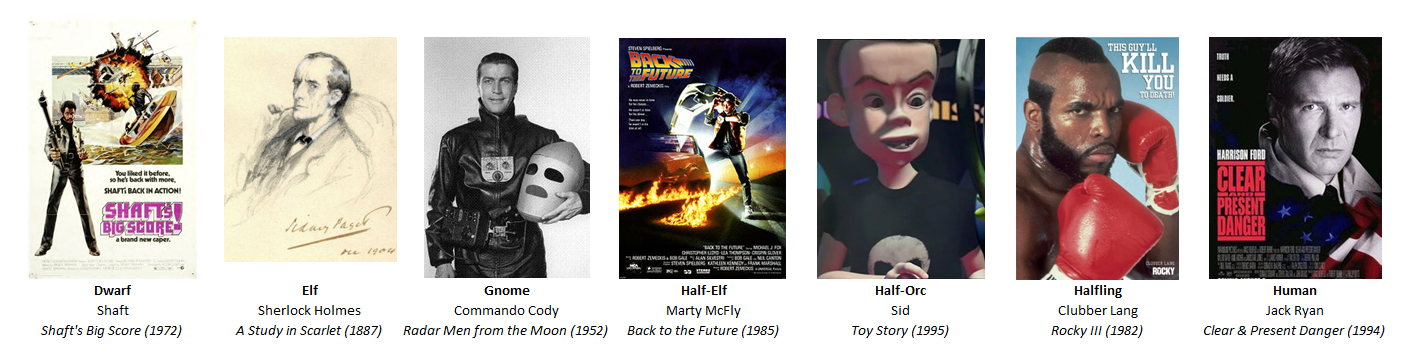
That’s a pretty divergent group. The half-orc and humans are the young punks of the group – Gen Y, who never lived without a computer or cell phone. The halfling and half-elf are products of the ’80s and ’90s – Gen X. All in all, those four a pretty close to one another and probably speak the same language – after all, culture doesn’t change so quickly in the faux-Medieval settings embraced by most fantasy games.The dwarf, on the other hand, is going to be a bit less modern in his sensibilities. From the perspective of the human and half-orc, the gnome is practically from another century, and the Victorian elf is a relic in his manners and language. And these are all first level characters (which does bring up a problem of the whole “different life spans” thing in the game, which we’ll happily ignore for the purpose of this article).
Imagine the life experiences they have to draw upon, these characters. Imagine how their manners and mores will clash. They’re all first level, but the dwarf and gnome have to regard the others as young punks, and the elf has to feel a bit superior to them all.
Side Note – This makes me picture elves as a bunch of Doctor Who’s … wearing all sorts of odd fashions and using odd phrases because they remember when they were hip and still see them that way.
Another way to think of it … The human and half-orc are 4th edition D&D, the halfling and half-elf 3rd edition, the dwarf grew up on Moldvay/Cook, the gnome played wargames and the elf plays pinochle.
What They Know
Most of us have a good grip on the history we’ve lived through, and have heard the stories from our parents and grandparents about the history they’ve lived through. We might have also heard a few tidbits second hand about things our grandparent’s grandparents lived through. When you bring super long lifespans into the mix, this opens up a vast amount of historical knowledge to the average party.
 |
| Click to increase size; numbers represent the generations |
In other words, “Who needs to hire a sage when you have an elf around?”
Generations
Thinking about the way these generations overlap brings up interesting prospects for a first level party. The elf, for example, may have known the humans great-great grandfather, and might easily be the father of the half-elf, who is the issue of a wild May Day fling of the human’s grandmother.
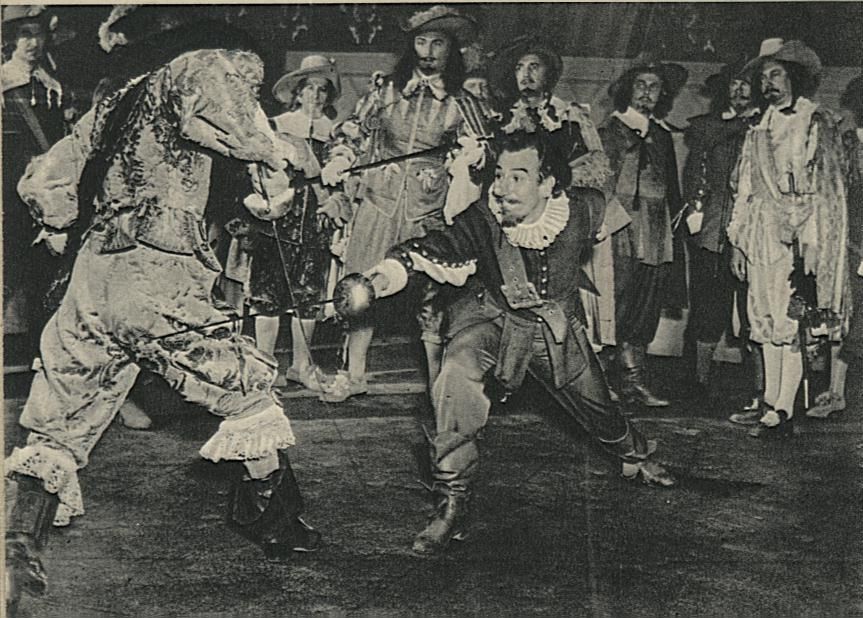
How’s this for a draft for how I’m explaining hit points in Blood & Treasure …
“Hit points don’t represent anything solid or real or concrete in and of themselves. Rather, they are part of a complex calculation that boils down to this: “What are the chances that the next moment of mortal peril you experience will be your last.” That mortal peril might be a sword fight, a poison needle, a trap door … anything that might kill you. Most often, hit points relate to combat.
It is important to remember that hit points are only part of the combat calculation for how likely you are to die. The complete calculation is in two parts. The first part pits your opponent’s fighting skill against your armor and quickness (i.e. his or her attack roll vs. your Armor Class). The second part pits your opponent’s strength and weapon type against your own fighting skill (i.e. his or her damage roll vs. your hit points). While most of the numbers in these calculations are fairly static, hit points moves quite a bit. The more danger you experience, the more likely your next dangerous act will be your last.
This is why a character can go from 100 to 1 hit points without suffering any particular physical hardships. All of those lost hit points represent narrow misses, lucky breaks and scrapes and scratches. Those last hit points lost, though, represent the sword in the heart, the knife in the back, the quaff of poisoned wine or the plunge off a cliff onto the rocks below. It represents the end of the story. (Though if your friends have enough money and are inclined to spend it, that story might have a new beginning).
The alternate dying system (see below) provides an option for translating 0 hit points into injury rather than sure death, of course, but the baseline assumption is that your hit points are merely an abstract measure of your chances of survival. Treasure them, adventurer, and know when to say when.”
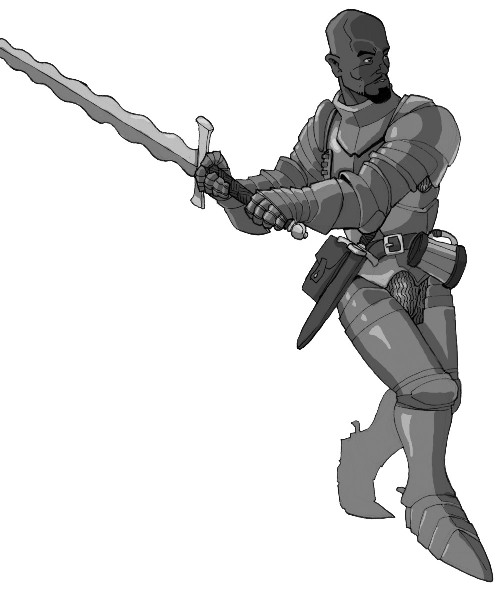
Toying with a mini-game involving sword duels and a deck of cards. I’ll fill you all in as I get further with it, but at the moment it involves playing black cards for offense, red cards for defense, sometimes wanting to go higher than your opponent, sometimes lower, may include some bluffing elements for feints, damage would involve losing cards in your hand and it would take into account the benefits of using a shield. Sound good? We’ll see.
In the meantime, enjoy a small glimpse into HELL!
9.57 Amber Tower: Three hundred cowardly shades dwell here in a village of packed mud houses surrounded by a dry moat filled with pongee sticks coated with a black, tar-like poison that causes people to slip into a comatose sleep for 1d4 days. When they awake, they find themselves changed, their skin scaled and colored deep purple on their extremities and their minds possessed of an animal cunning, though their intelligence score drops to 2.
The shades of the village have ashen skin that is cracked and dry. They are lean and quiet and move stiffly, almost as though they were zombies.
The village is overseen by Leralol, a nalfeshnee minion of Barbatos who dwells in a tower of amber glass that gives off waves of heat. Standing within 100 feet of the tower is uncomfortable. Moving to within 10 feet causes 1d4 point of damage per turn. This damage persists within the tower, which is about 50 feet tall and 20 feet in diameter. Each floor of the tower is circular in shape, with an arched roof and a spiral stair in the center leading to the next floor. All of the glass surfaces in the tower are hot to the touch, causing 1d6 points of damage.
In the lower chambers, Leralol has dozens of newly arrived shades chained to the ceiling, drying like prosciutto. The third level holds changed victims of the black tar poison in cages. These poor souls serve as Leralol’s primary form of entertainment – hunting. The fourth level holds his kennel of nerizo demons, which he uses on his hunts. The fifth level holds his own quarters, a room about twice as big as it should be, given the size of the tower. This room is decorated with all manner of grisly hunting trophies, most of them humanoid, but also many wild, demonic animals as well, a row of seven succubus heads posed most scandalously and the head of a hellephant that has been turned into a headboard on Leralol’s bed. Five servant succubi are chained to this bed, but have enough room to move through the chamber, which connects to a small pantry, kitchen and armory.
—
Image is the iconic fighter from Blood & Treasure, by Jon Kaufman (natch)
Finally, we come to the last post in the series on noble nicknames, this time with dwarf nobles. I went all out on this one and gave each three nicknames – hey, maybe dwarves like their nicknames.
WILDGRAVE OGMUND the Standard Bearer, the Tempest, White Shirt
Ogmund is a ragged, wild-haired dwarf who dwells in the rugged borderlands on the edge of the dwarf kingdom, lands invaded regularly by the goblin races, ettins and trolls. A famed giant-slayer, he is a loyal companion of Jarl Vagn, having gone on many adventures into the giant country with his father, Vagr, when they were both young dwarfs with much to prove. Ogmund’s nephew, Skapti, is rarely far from his side save when Ogmund’s berserkergang comes upon him. His retinue also includes three chroniclers, two dwarf warriors and their sergeant, Odi and Ljot, a 5th level fighter who serves as his champion and bailiff. Ogmund always dresses in a white tunic and white, hooded cloak.
OGMUND: HD 9 (52 hp); AC 2 [17]; Atk 1 weapon (1d8); Move 9 (12 out of armor); Save 5; CL/XP 9/1100; Special: Double normal number of followers, immune to fear, berskerer.
THEGN INGIRID the Treacherous, the Usurper, the Well-Served
Ingirid is the half-sister of Jarl Vagn and his most hated rival. Hated by most of her kin due to her treachery and her dealing with the goblins and orcs, she nevertheless holds fortitided iron mines in the southern mountains that keep her wealthy and influential. Her consort is Vandrad, an exile from the Jarl’s court, two scribes and one orc sergeant, Forox. Her minions are very loyal.
INGIRID: HD 5 (23 hp); AC 2 [17]; Atk 1 weapon (1d8); Move 9 (12 out of armor); Save 12; CL/XP 5/240; Special: Treasure as CL 15, low charisma (6), cast bane (reverse of bless) once per day, +1 morale bonus to soldiers.
JARL VAGN the Springer, Star of the North, the Tail
Jarl Vagn is the young, dashing king of the dwarfs, having taken the throne when his father Vagr finally passed into the halls of his ancestor. Vagn is a lover of gold and luxury, unlike his more stern father, but his glib tongue, handsome features and strong sense of justice have kept him popular with all but his half-sister Ingirid. Vagn is accompanied by the berserker Bersi, the shieldmaiden Hlif (who drives him mad with desire), four clarks (one a 3rd level fighter/thief in service to Ingirid), five dwarf warriors and their sergeant, Olaf the Round.
VAGN: HD 2 (12 hp); AC 2 [17]; Atk 1 weapon (1d8); Move 9 (12 out of armor); Save 16; CL/XP 2/60; Special: Triple normal number of followers, treasure as CL 20, +2 initiative, +2 to all attacks and saves.


For the sample nobles today, we go into the elven wood.
Anwenod the Rebel Earl of Arddus
Anwenod is a raven-haired elf earl who dwells on the fringe of the kingdom and near the border marches of the humans. Grey of eye and lean of build, he is a masterful swordsman with a deep interest in the politics of both elves and men. He is currently attempting to woo the daughter of a human baron as a hedge against perceived enemies in the royal court. Anwenod’s retinue consists of his champion, Keryd (elf ftr 3/m-u 2), four elf warriors, two elf sergeants and Cedric, son of the human Baron Donal, who is a visiting dignitary attempting to secure the marriage of his sister Yulisa to the Rebel Earl.
ANWENOD: HD 9 (48 hp); AC 2 [17]; Atk 1 longsword or longbow (1d8); Move 9 (12 out of armor); Save 5; CL/XP 9/1100; Special: Double normal number of followers, cast darkness once per day.
Kaith the Quick, Duchess of Beor
Kaith is a tall elf woman (5’9”, very tall for an elf) with ebony skin and a sharp jaw line. Her hair is short, curly and as black as pitch and her eyes emerald green and radiant. Kaith is a cynical woman, bored with the tedium of life inside the great elfwood. The high queen is her cousin and a tepid rival. Kaith’s retinue includes three scribes, three elf warriors, the harpist Lhart (bard 3) and the human rake Lardre, whose devious antics and disruptive presence help relieve the duchess’ melancholy.
KAITH: HD 5 (29 hp); AC 2 [17]; Atk 1 weapon (1d8); Move 9 (12 out of armor); Save 12; CL/XP 5/240; Special: Double normal number of followers, treasure as CL 15, +1 to initiative rolls.
Morgannet the Renowned, the Spider, the High Queen of Elves
Morgannet is the high queen of the elfwood, a gentle woman with nut-brown skin, gray-green eyes and golden brown hair that falls down to her ankles. She is fine-boned, but with flashing, lively eyes and a vivacious, cherubic face. Despite her childlike appearance, Morgannet is an expert politician. Her spies, the elven thieves (level 3 and 4) Blathet and Dumnann are frequent visitors to every court in the land, and little escapes their notice. Her retinue includes three maids-in-waiting (lesser nobles), seven scribes (for the elves believe that every utterance of their queen is prophetic and must be recorded), four elf longbowmen and their sergeant, Pathogius, a human found as a waif and reared by the elves.
MORGANNET: HD 2 (10 hp); AC 2 [17]; Atk 1 weapon (1d8); Move 9 (12 out of armor); Save 16; CL/XP 2/60; Special: Triple normal number of followers, treasure as CL 20, Charisma 14, Wisdom 13.

—
Illustration by Arthur Rackham. Found HERE.
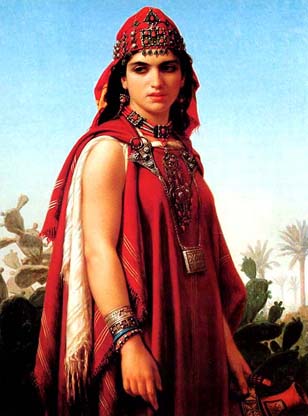
Just to show that these nicknames are good for more than pseudo-European nobility, I offer three pseudo-Arabic nobles (and yeah, I like ’em so much I’m going to use them in NOD eventually).
Mansour the Lion, Bey of Rumm
Mansour the Lion is a handsome man, aging and rugged, who commands a fortress where the desert sands meet the savannah. Caravans of traders and pilgrims move through his land, making him wealthy, and his many wars against the nomads have made him famous throughout the kingdom. He looks upon the Sultana Azzah with hopeful eyes, but her heart lies elsewhere. Mansour’s retinue includes the half-ogre fighter Isaam (F5) and his comrade, the sly Ziyad (F1), four men-at-arms and two scribes.
MANSOUR: HD 9 (45 hp); AC 2 [17]; Atk 2 scimitar (1d8); Move 9 (12 out of armor); Save 5; CL/XP 9/1100; Special: Double normal number of followers.
Shafeeq the Landless, exiled Amir of Pazazabad
Shafeeq the Landless is a the son of Bishr, the former Amir of Pazazabad. That wondrous city-state was overrun by goblins not three years ago, and the young man has wandered ever since with his retinue, seeking support for a reconquest of his land. The retinue includes four scribes, two sergeants-at-arms and his father’s court magician, the cloying Nazihah of the Nine Lamps (M3). He is also accompanied by Intisar, a lesser aristocrat and the rambunctious daughter of Pazazabad’s greatest merchant (and, unknown to others, the traitor who engineered the goblin invasion) Haarith of the Hoary Beard.
SHAFEEQ, FIGHTER LVL 3/THIEF LVL 2: HP 15; AC 2 [17]; Special: Double normal number of followers, treasure as CL 15.
Azzah the Liberal, the Iron Sultana, the Leopardess, Sultana of Keshfar
Azzah is the Great Sultana of all Keshfar. Learned, wise and fierce, she commands the deserts, savannas and sea for hundreds of miles from her domed capital of Nadid. Despite her coteries of handsome petitioners and the adoration of her people, she knows he is not getting any younger and must soon choose a husband that her line may continue. Mansour the Lion seems the logical choice, but her heart burns for Shafeeq the Landless, if only she knew where he was.
Azzah’s retinue includes the rakish sisters Amani and Munirah, the handsome young Izvod, Baron of Esterhafen and his sister, Lady Bezpa, four scribes, three men-at-arms and he sergeant-at-arms, the loyal Tariq.
AZZAH: HD 2 (16 hp); AC 1 [18]; Atk 2 scimitar (1d8); Move 9 (12 out of armor); Save 16; CL/XP 2/60; Special: Triple normal number of followers, treasure as CL 20, +2 reaction from peasants, constitution 14.

And we roll on with TABLE III
Baron Aglos the Gatekeeper
Aglos commands a sizable fortress that guards a mountain pass into the archduchy. He and his warriors have faced countless hordes of goblins and hobgoblins attempting to push their way into the green lands of the archduchy from the frozen uplands. These years of combat have allowed him to perfect a defensive stance that makes him more difficult to hit than the normal heavily armored warrior. His retinue includes two scribes, four men-at-arms and his two boon fighting companions, Aaron of the Golden Harp (a 5th level bard) and Schultz (a 5th level fighting-man).
AGLOS: HD 9; AC 2 [17]; Atk 1 weapon (1d8); Move 9 (12 out of armor); Save 5; CL/XP 9/1100; Special: Double normal number of followers, defensive stance (+2 AC, +1 hp/HD).
Kenne the Imp, Count of Owaith
Count Kenne is a devotee of the dark cult of Mammon, as befits one of his greedy nature. His devotion to Mammon has won him the ability to cast cause light wounds once per day. Kenne has a retinue that includes five clarks (money counters, mostly), a man-at-arms two sergeants-at-arms.
KENNE: HD 5; AC 2 [17]; Atk 1 weapon (1d8); Move 9 (12 out of armor); Save 12; CL/XP 5/240; Special: Double normal number of followers, treasure as CL 15, cast cause light wounds 1/day.
Archduke Scaton the Handsome
Scaton the Handsome is everything a fairy tale prince should be, except that he is an archduke, of course. He is handsome, charming, well-mannered and brave. Unlike fairy tale princes, he has rarely been outside the walls of his city, Gondwane, but he has cultivated quite a retinue of followers within those walls. This retinue consists of his court champion, Aloysius (a 4th level fighting man) and his comrade, Black Albrect, a rake, his paramour the Baroness Uda, ten scribes (one of whom, Ignatio, is a 5th level assassin sent to spy on the archduchy), three men-at-arms and two sergeants, Duff and Yoder.
SCATON: HD 2; AC 2 [17]; Atk 1 weapon (1d8); Move 9 (12 out of armor); Save 16; CL/XP 2/60; Special: Triple normal number of followers, treasure as CL 20, charisma 16.


You know how hard it is to think up a name for a fantasy game that hasn’t already been taken?
Here’s an idea that popped into my head today. I love the old school games and write for them and will continue to write for them until the cows come home. I am pro-retro in all of its glorious forms, from Castles and Crusades to Basic Fantasy RPG to Labyrinth Lord to Swords and Wizardry and beyond.
But … I don’t hate the modern game introduced in the SRD (System Reference Document). I stopped playing it because there were too damned many rules and modifiers to keep straight – I wanted simplicity – but why can’t I have elf druids and dwarf magic-users and what about gnomes and half-orcs and prismatic sprays and you know, those conditions rules were pretty handy and the three saving throw categories weren’t bad, just different.
Today, I’m driving around town and think – maybe it would be fun to just write a rules-lite version of the SRD that has everything in it – nothing (much) removed because it wasn’t there 20 or 30 years ago or because I don’t personally get much mileage from it. Feats could still be there, but optional (remember my Boons article from NOD 1?) for those who hate feats. I can do skills like I did in Pars Fortuna – as saving throws, with a blanket modifier of maybe -5 for difficult tasks and -10 for super difficult tasks – no skill points and all that guff, and anyone without the skill succeeds on a flat 1 in 6. The diplomacy and intimidate stuff can be optional for people who prefer to leave that up to the players’ skill rather than dice rolls. About the only thing I can imagine leaving out is some of the alignment specific spells (i.e. keep it simple with Law/Good vs. Chaos/Evil instead of nine alignments). Prestige classes – why not? You can jump in at 6th level from certain classes, because dwarven defenders are cool. Yeah – we walk back the power level, because the game was overpowered and tended to make super heroes rather than adventurers. Basically, I don’t want to be the GOD OF THE RULES who issues commandments from on high or gives you his version of the perfect, just the dude who put the rules together in a readable form and sold it to you.
I guess the real theme for Blood & Treasure is lots of options + super simple rules that you can mostly carry around in your head.
No, I don’t know when. But eventually.
What do you think?
—
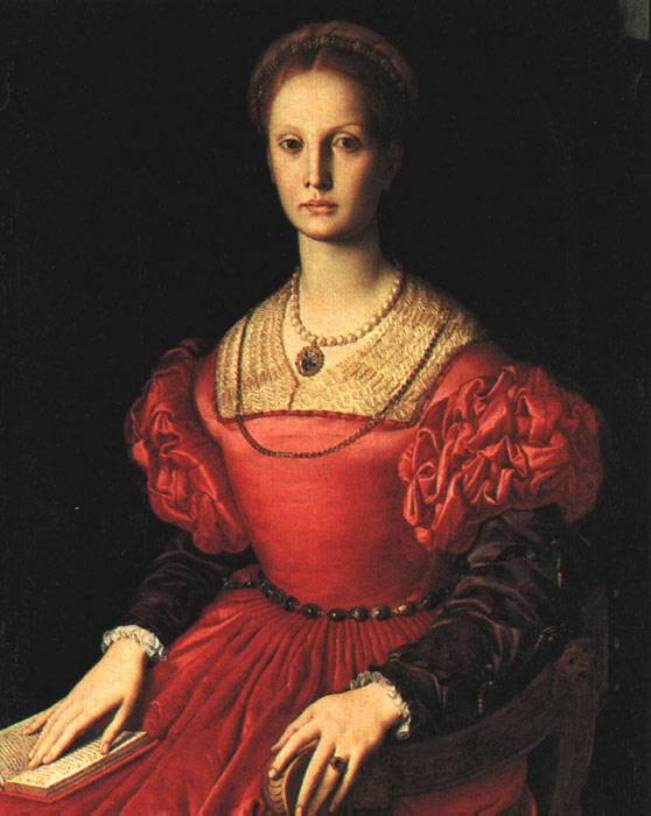
Here’s another thought regarding the relative power of nobles. The thinking behind makings kings weaker than border barons is generally sound in terms of “earned experience”, which drives the player characters. On the other hand, not all kings are lay-about weenies. Frederick Barbarossa (you can access a scholarly review of his life HERE) and Henry V come to mind, as do Genghis Khan, Julius Caesar, etc. These are the architects of empire, as opposed to the heirs of empire. So – if you’re doing your king or duke or count as an architect of a great kingdom or empire, by all means, use the Borderer stats for him or her.
Now for some more samples, using this table as a source for nicknames.
Marquessa Hiertrude the Bounteous, the Blood Marquessa
The Marquessa Hiertrude is mostly known for her large, loving family – six children by her late husband, the Marquis. It is less known that she is a vampire, turned by a foe of her husband. She has since turned her children into her spawn (save the eldest, Hormand, who is in hiding) and is even now preparing to rally the humanoids she once fought and lead them into the heart of Azura’s kingdom. Her retinue (also vampire spawn) consists of three men-at-arms, two clarks, her court musician Antonio and two sons of the lesser nobility, Anatole and Freder, who were serving as page boys in her husband’s court before she turned them. They are now eternally eleven years old and thoroughly evil.
HIERTRUDE: HD 9 (42 hp); AC 2 [17]; Atk 1 weapon (1d8) or bite (1d10 + level drain); Move 9 (12 out of armor, F18); Save 6; CL/XP 12/2000; Special: Eight followers, vampire powers.
Count Gudolph the Cunning
Gudolph is a cunning man, though only lightly educated. He knows well that his county lies in the path of the Blood Marquessa, and has been recruiting heavily among the priesthood of the kingdom for the last year, giving generous gifts of land to the church in an attempt to shore up his defenses or, at a minimum, convince Hiertrude to march her armies around his land. His retinue consists of two scribes (lay priests), three men-at-arms and three sergeant-at-arms. All of his bodyguards have been trained and armed to deal with vampires.
GUDOLPH: HD 5 (22 hp); AC 2 [17]; Atk 1 weapon (1d8); Move 9 (12 out of armor); Save 12; CL/XP 5/240; Special: Eight followers, treasure as CL 15, intelligence 14.
Queen Azura I, the Calf
The young Azura has recently assumed the throne after the mysterious death of her mother. She is only 16, but head strong and confident. Faced with signs of rebellion on her borders, she is assembling an army to meet it head on, caring little for the council of her advisers. Her retinue includes four lesser nobles, four sergeants-at-arms (one of them her secret lover) and four scribes doing their best to educate the girl-queen while she scurries about barking orders and managing her new kingdom with gusto.
AZURA: HD 2 (14 hp); AC 2 [17]; Atk 1 weapon (1d8); Move 9 (12 out of armor); Save 16; CL/XP 2/60; Special: Triple normal number of followers, treasure as CL 20 intelligence 8, wisdom 6, strength 16, constitution 16.

 Land of Nod