 While rainbow fantasy has warriors and weapons and swordplay, it also avoids killing (except for robots – you can bash them up and not get in trouble) and doesn’t seem to care much about treasure. In other words – it is far removed from the “kill things and take their stuff” genre of fantasy gaming.
In rainbow fantasy, the point is about promoting, for lack of a better term, “goodness”. Evil must be stopped, but should not be killed, for to kill is evil. Moreover, some monsters that appear to be evil turn out to be misguided. In rainbow fantasy, the goal is to stop the evil without taking life, and thus experience points are handed out for exactly that. Killing a monster in rainbow fantasy does not get you XP – and in fact, it should get you something like a cumulative 10% deduction for XP earned on an adventure for each creature purposely killed.
To help this sort of fantasy along, it is important for the GM to do three things.
The first is to make sure that adventurers can choose to stun a creature when it reaches zero hit points rather than kill it. A stunned monster remains unconscious for 1d4 rounds and then awakens with half of its lost hit points restored. The monster must immediately make a morale check to remain in the fight. And speaking of morale checks …
The second is to institute strict morale checks for monsters, perhaps using a modified scale that makes each successive check more difficult. In rainbow fantasy, the bad guys lack courage because they lack goodness, and thus they will run away before it is necessary to kill them.
Finally, they must understand why the bad guys are fighting – what motivates them. They may be agents of “Evil” who are driven to be evil for the sake of it. They may be laboring under a misunderstanding – twisted into aggression by the bad guys through deception, or simply acting out of an innocent misunderstanding. They might also turn out to be far from evil, but in fact potential allies on a quest once everyone has had a chance to get to know one another. This means that talking and dialogue are very important in a rainbow fantasy game, as are reaction checks. Adventurers can earn experience points by understanding their enemies, apologizing for accidental slights and forgiving misunderstandings, and finding a way to live in harmony.
This might not be popular with lots of gamers – there is after all some therapeutic value in pretending to be Conan the Barbarian – but there might be more value in roleplaying solutions to problems that do not involve violence. In the real world in which we live, you cannot solve every conflict you have with swordplay – in fact, you can solve very few problems legally with violence. Practicing the resolution of conflict without resorting to violence and argument can come in pretty handy, as can making sure that the conflict you think you have really is a conflict and not just a misunderstanding.
What it comes down to at the end of every episode of He-Man and the Master of the Universe and She-Ra, Princess of Power is a moral. The challenges faced should be built around a morale, and the key to winning the adventure is identifying the moral and putting it to use to overcome the challenge.
Image found at He-Man.org

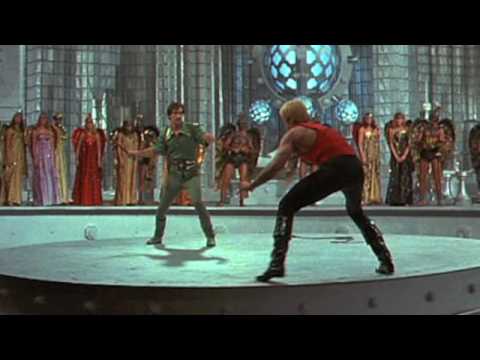 Actually staging a combat in such a dangerous space can be tricky, though, because the combat rules are abstract. You can use a battle grid and miniatures, but sometimes they are feasible, or you just don’t want the bother.
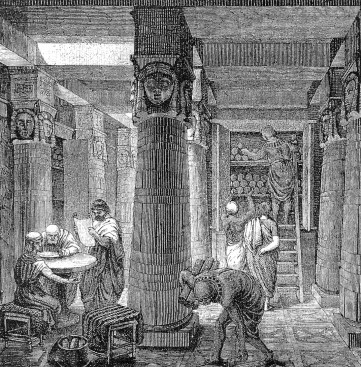 Libraries are a common trope in fantasy art, literature, etc. The old wizard hunched over books amid a sea of books. In fantasy games, though, they leave something to be desired. They can always be used as a backdrop, of course – just window dressing – but I think it’s more satisfying to make them worth their while.
 It’s been a long slog through a dangerous wilderness and then a devilish dungeon. Henchmen have died, PC’s have bled, but in the end, Law triumphed over Chaos (with an assist by Neutrality) and the dragon is dead.
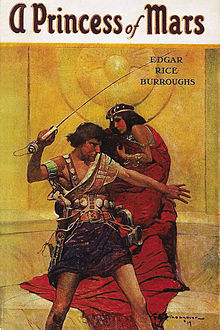 In A Princess of Mars, every success by John Carter is a doorway to a new challenge that must be faced (and must be faced NOW!). Once John Carter gets used to the red planet, it’s pretty nonstop action – challenge followed by resolution followed by complication or new challenge, etc. When the book finally ends, the adventure does not. Like all of us wide-eyed kids who saw Han frozen in carbonite and Luke get a rough lesson about his family tree, readers of the first Barsoom novel are left hanging, waiting for the next installment.
 Here’s where consequences come into play. In our own lives, there are moments where we have to choose about moving forward – say from childhood to adulthood. We can choose not to, but there are consequences. Choosing to reject adulthood does not mean the world of your childhood lives on. Things still change, and often not for the better. When the players choose to ignore that next challenge, the campaign world they inhabit changes because of their choice. This doesn’t have to be a severe change designed to force them into tackling the next adventure, but it should involve loss and a noticeable change. If in the end the players decide not to follow up, they have to live in the world they’ve created and you can embark on a new trilogy. They just have to accept that the campaign world is different and move on.


 Land of Nod